Adhyaya 28
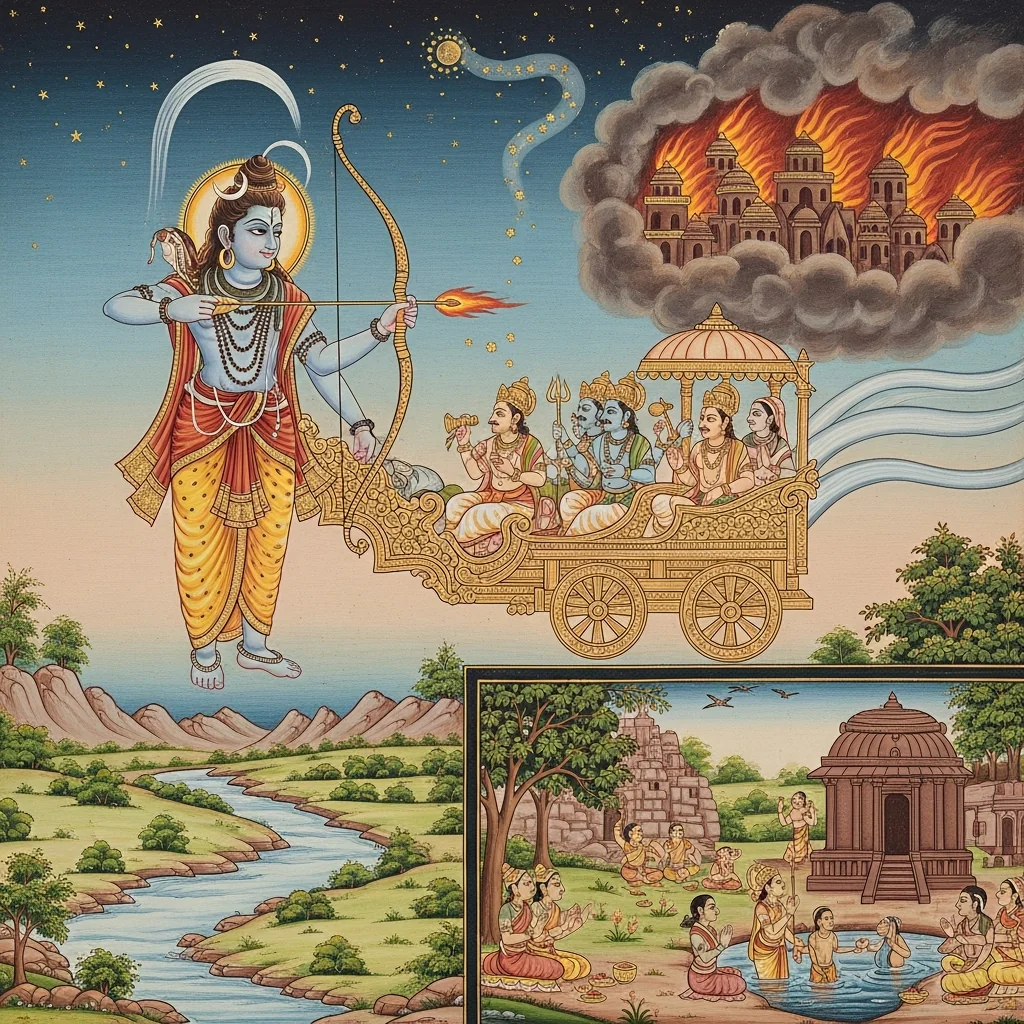
Mārkaṇḍeya relates that Rudra, abiding with Umā on the bank of the Narmadā, receives Nārada’s report concerning Bāṇa and his palace. Śiva then contemplates the Tripura campaign and fashions a cosmic chariot and weapon-system, assigning deities, the Vedas, sacred meters, and cosmic principles to the chariot’s parts; when the three cities align, he releases the arrow and Tripura is brought to ruin. Ominous portents and catastrophic imagery portray the vast conflagration and the social disorientation within Tripura. Bāṇa, acknowledging moral culpability and the devastation wrought, seeks refuge in Śiva and offers a sustained stotra, declaring Śiva the all-pervading ground of gods and elements. Śiva’s wrath subsides; he grants Bāṇa protection and rank, and restrains a portion of the destructive fire. The fallen, burning fragments are then linked to sacred sites such as Śrīśaila and Amarakāṇṭaka, explaining the name Jvāleśvara and establishing a theology of pilgrimage. Mārkaṇḍeya further prescribes a disciplined method (kṛcchra, japa, homa, worship) for the ‘pātana’ practice at Amarakāṇṭaka and lists nearby tīrthas on the southern bank of the Revā, emphasizing regulated observance, ancestral rites, and the removal of faults.
Shlokas
Verse 1
मार्कण्डेय उवाच । एतस्मिन्नन्तरे रुद्रो नर्मदातटमास्थितः । क्रीडते ह्युमया सार्द्धं नारदस्तत्र चागतः
Mārkaṇḍeya said: Meanwhile, Rudra stayed upon the bank of the Narmadā, sporting with Umā; and to that very place Nārada also arrived.
Verse 2
प्रणम्य देवदेवेशमुमया सह शङ्करम् । व्यज्ञापयत्तदा देवं यद्वृत्तं त्रिपुरे तदा
Having bowed to Śaṅkara—the Lord of lords—together with Umā, he then informed the God of what had occurred in Tripura at that time.
Verse 3
गतोऽहं स्वामिनिर्देशाद्यत्र तद्बाणमन्दिरम् । दृष्टा बाणं यथान्यायं गतो ह्यन्तःपुरं महत्
“By my lord’s command I went to where Bāṇa’s palace stood. After meeting Bāṇa in the proper manner, I then entered his vast inner apartments.”
Verse 4
तत्र भार्यासहस्राणि दृष्ट्वा बाणस्य धीमतः । यथायोग्यं यथाकाममागतः क्षोभ्य तत्पुरम्
There, seeing the thousands of wives of the wise Bāṇa, he went forth—acting as was fitting and as he desired—thus stirring that city.
Verse 5
नारदस्य वचः श्रुत्वा साधु साध्विति पूजयन् । चिन्तयामास देवेशो भ्रमणं त्रिपुरस्य हि
Hearing Nārada’s words and honoring them with “Well spoken, well spoken!”, the Lord of the gods began to ponder Tripura’s course and movement.
Verse 6
करमुक्तं यथा चक्रं विष्णुना प्रभविष्णुना । महावेगं महायामं रक्षितं तेजसा मम
“Just as the discus, released from the hand of Viṣṇu—the mighty and radiant—moves with immense speed and far-reaching force, so it is sustained and safeguarded by my own spiritual splendor.”
Verse 7
स च मे भक्तिनिरतो बाणो लोके च विश्रुतः । भारती च मया दत्ता ब्राह्मणानां विशेषतः
“And that Bāṇa is devoted to me and renowned in the world. Moreover, I granted him Bhāratī—the gift of eloquence—especially in matters concerning the Brāhmaṇas.”
Verse 8
एवं स सुचिरं कालं देवदेवो महेश्वरः । चिन्तयित्वा सुनिर्वाणं कार्यं प्रति जनेश्वरः
Thus, for a long time, Maheśvara—the God of gods, the Lord of beings—pondered deeply, and then settled upon a clear and decisive course of action.
Verse 9
ततोऽसौ मन्दरं ध्यात्वा चापे कृत्वा गुणे महीम् । विष्णुं सनातनं देवं बाणे ध्यात्वा त्रिलोचनः
Then Trilocana (Śiva) meditated on Mandara as the bow and made the Earth the bowstring; and, meditating on the eternal God Viṣṇu, he conceived Him as the arrow.
Verse 10
फले हुताशनं देवं ज्वलन्तं सर्वतोमुखम् । सुपर्णं पुङ्खयोर्मध्ये जवे वायुं प्रकल्प्य च
He appointed Hutāśana (Fire), the flaming deity with faces in every direction, as the arrowhead; he set Suparṇa (Garuḍa) between the feathers; and he established Vāyu (Wind) as its speed.
Verse 11
रथं महीमयं कृत्वा धुरि तावश्विनावुभौ । अक्षे सुरेश्वरं देवमग्रकील्यां धनाधिपम्
Having fashioned the chariot out of the very Earth, he placed the two Aśvinī-kumāras upon the yoke; he set the Lord of the gods (Indra) upon the axle, and installed the Lord of wealth (Kubera) upon the foremost pin of the chariot.
Verse 12
यमं तु दक्षिणे पार्श्वे वामे कालं सुदारुणम् । आदित्यचन्द्रौ चक्रे तु गन्धर्वानारकादिषु
He placed Yama on the right side and the terribly fierce Kāla on the left; and he set the Sun and the Moon as the wheels, with hosts such as Gandharvas and Nāgas and others appointed in their respective stations.
Verse 13
यन्तारं च सुरज्येष्ठं वेदान्कृत्वा हयोत्तमान् । खलीनादिषु चाङ्गानि रश्मींश्छन्दांसि चाकरोत्
He appointed the eldest of the gods as the charioteer; he made the excellent horses to be the Vedas; he fashioned the bridle and related parts from the limbs of sacred order, and made the reins to be the Vedic metres (chandas).
Verse 14
कृत्वा प्रतोदमोंकारं मुखग्राह्यं महेश्वरः । धातारं चाग्रतः कृत्वा विधातारं च पृष्ठतः
Maheśvara fashioned the goad as the sacred syllable Oṃ, fit to be borne at the fore; and he set Dhātṛ in front and Vidhātṛ at the rear.
Verse 15
मारुतात्सर्वतो दिग्भ्य ऊर्ध्वयन्त्रे तथैव च । महोरगपिशाचांश्च सिद्धविद्याधरांस्तथा
From the winds, from every direction, and upon the upper mechanism as well, he stationed great serpents and piśācas, and likewise the Siddhas and Vidyādharas.
Verse 16
गणांश्च भूतसङ्घांश्च सर्वे सर्वाङ्गसंधिषु । युगमध्ये स्थितो मेरुर्युगस्याधो महागिरिः
He placed the Gaṇas and the multitudes of beings at every joint and junction of the chariot’s limbs. In the middle of the yoke stood Meru, and beneath the yoke was the great mountain.
Verse 17
सर्पा यन्त्रस्थिता घोराः शम्ये वरुणनैरृतौ । गायत्री चैव सावित्री स्थिते ते रश्मिबन्धने
Fierce serpents were set within the mechanism; Varuṇa and Nairṛta were stationed at the crossbar. And Gāyatrī and Sāvitrī stood there as the binding of the reins.
Verse 18
सत्यं रथध्वजे शौचं दमं रक्षां समन्ततः । रथं देवमयं कृत्वा देवदेवो महेश्वरः
He set Truth upon the chariot’s banner; purity and self-restraint became its protection on every side. Thus Maheśvara—the God of gods—made the chariot wholly divine.
Verse 19
संनद्धः कवची खड्गी बद्धगोधाङ्गुलित्रवान् । बद्धा परिकरं गाढं जटाजूटं नियम्य च
Fully armed and clad in mail, sword in hand, wearing an iguana-skin finger-guard, he tightened his firm belt and bound up his matted jata locks.
Verse 20
सज्जं कृत्वा धनुर्दिव्यं योजयित्वा रथोत्तमम् । रथमध्ये स्थितो देवः शुशुभे च युधिष्ठिर
Having readied his divine bow and yoked the excellent chariot, the God stood in the midst of the chariot and shone forth—O Yudhiṣṭhira.
Verse 21
धनुषः शब्दनादेनाकम्पयच्च जगत्त्रयम् । स्थानं कृत्वा तु वैशाखं निभृतं संस्थितो हरः
With the thunderous twang of His bow, Hara made the three worlds tremble. Then, having taken His position in the month of Vaiśākha, He stood poised in profound stillness.
Verse 22
निरीक्ष्य सुचिरं कालं कोपसंरक्तलोचनः । ध्यात्वा तं परमं मन्त्रमात्मानं च निरुध्य सः
After watching for a long time, His eyes reddened with wrath. Meditating on that supreme mantra and restraining His own being, He gathered Himself in focused control.
Verse 23
मुमोच सहसा बाणं पुरस्य वधकाङ्क्षया । यदा त्रीणि समेतानि अन्तरिक्षस्थितानि तु
Then, desiring the destruction of the city, He suddenly released the arrow—at the very moment when the three (cities) had come together, poised in the sky.
Verse 24
ततः कालनिमेषार्धं दृष्ट्वैक्यं त्रिपुरस्य च । त्रिपर्वणा त्रिशल्येन ततस्तान्यवसादयत्
Then, seeing the threefold Tripura become one—within but half a blink—He struck them down with an arrow of three joints and three barbs, and brought them to ruin.
Verse 25
ततो लोका भयत्रस्तास्त्रिपुरे भरतोत्तम । सर्वासुरविनाशाय कालरूपा भयावहाः
Then the worlds were shaken with fear, O best of the Bharatas, at Tripura—terrifying omens appearing in the form of Time itself, foretelling the destruction of all the asuras.
Verse 26
अट्टहासान् प्रमुञ्चन्ति कष्टरूपा नरास्तदा । निमेषोन्मेषणं चैव कुर्वन्ति लिपिकर्मसु
At that time, men of grim appearance burst into harsh laughter; and in their writing tasks they kept making strange motions of blinking and unblinking, as though seized by dread.
Verse 27
निष्पन्दनयना मर्त्याश्चित्रेष्वालिखिता इव । देवायतनगा देवा रटन्ति प्रहसन्ति च । स्वप्ने पश्यन्ति चात्मानं रक्ताम्बरविभूषितम्
Mortals stared without blinking, like figures painted in a picture. Even the gods within the temples cried out and laughed strangely; and in dreams people saw themselves adorned in red garments.
Verse 28
रक्तमाल्योत्तमाङ्गाश्च पतन्तः कार्दमे ह्रदे । पश्यन्ति नाम चात्मानं सतैलाभ्यङ्गमस्तकम्
They saw their own heads, crowned with red garlands, falling into a muddy pond; and they beheld themselves with their heads smeared by an oily anointing—ominous visions indeed.
Verse 29
पश्यन्ति यानमारूढं रासभैश्च नृपोत्तम । संवर्तको महावायुर्युगान्तप्रतिमो महान्
They saw themselves mounted on a vehicle drawn by asses, O best of kings; and a vast Saṃvartaka wind arose—mighty, like the gale at the end of a yuga.
Verse 30
गृहानुन्मूलयामास वृक्षजातीननेकशः । भूमिकम्पाः सनिर्घाता उल्कापाताः सहस्रशः
It uprooted houses and many kinds of trees. Earthquakes struck with thunderous crashes, and meteors fell by the thousand—terrifying portents filling the worlds.
Verse 31
रुधिरं वर्षते देवो मिश्रितं कर्करैर्बहु । अग्निकुण्डेषु विप्राणां हुतः सम्यग्घुताशनः
The god rained down blood, thickly mixed with many gritty fragments; and in the fire-pits of the Brāhmaṇas the sacrificial Fire—properly invoked—was duly offered into and blazed forth.
Verse 32
ज्वलते धूमसंयुक्तो विस्फुलिङ्गकणैः सह । कुंजरा विमदा जातास्तुरगाः सत्त्ववर्जिताः
It blazed, choked with smoke and accompanied by showers of sparks. Elephants became devoid of rut, and horses were stripped of their vigor and spirit.
Verse 33
अवादितानि वाद्यन्ते वादित्राणि सहस्रशः । ध्वजा ह्यकम्पिताः पेतुश्छत्राणि विविधानि च
Instruments that had not been played began sounding by themselves—by the thousands. Unshaken banners toppled down, and many kinds of royal parasols fell as well.
Verse 34
ज्वलति पादपास्तत्र पर्णानि च सभं ततः । सर्वं तद्व्याकुलीभूतं हाहाकारसमन्वितम्
There the trees blazed, even the leaves; then that whole place was thrown into turmoil, filled with cries of “Alas! Alas!”
Verse 35
उद्यानानि विचित्राणि प्रबभञ्ज प्रभञ्जनः । तेन संप्रेरिताः सर्वे ज्वलन्ति विशिखाः शिखाः
The mighty wind, Prabhañjana, shattered the wondrous gardens. Driven by it, flames surged everywhere, blazing like cresting tongues of fire.
Verse 36
वृक्षगुल्मलतावल्ल्यो गृहाणि च समन्ततः । दिग्विभागैश्च सर्वैश्च प्रवृत्तो हव्यवाहनः
All around, trees, shrubs, creepers and vines—and the houses as well—were seized; from every quarter Agni, bearer of offerings, spread forth.
Verse 37
सर्वं किंशुकपर्णाभं प्रज्वलच्चैव दृश्यते । गृहाद्गृहं तदा गन्तुं नैव धूमेन शक्यते
Everything appeared aflame, red like the leaves of the kiṃśuka tree. Then, because of the smoke, it was impossible to go even from house to house.
Verse 38
हरकोपाग्निनिर्दग्धाः क्रन्दन्ते त्रिपुरे जनाः । प्रदीप्तं सर्वतो दिक्षु दह्यते त्रिपुरं परम्
Scorched by the fire of Hara’s wrath, the people of Tripura wailed. Ablaze on every side in all directions, the great city of Tripura burned.
Verse 39
पतन्ति शिखराग्राणि विशीर्णानि सहस्रशः । पावको धूमसंपृक्तो दह्यमानः समन्ततः
Shattered to fragments, the tips of the towers fell by the thousand. The fire, mingled with smoke, raged on every side as all things burned.
Verse 40
नृत्यन्वै व्याप्तदिग्देशः कान्तारेष्वभिधावति । देवागारेषु सर्वेषु गृहेष्वट्टालकेषु च
Dancing as it spread through every region and quarter, it rushed through the forests—into every temple, into houses, and even up the watchtowers.
Verse 41
प्रवृत्तो हुतभुक्तत्र पुरे कालप्रचोदितः । ददाह लोकान्सर्वत्र हरकोपप्रकोपितः
There, within that city, the Fire blazed forth—impelled by Time itself—and, inflamed by Hara’s wrath, it burned the worlds on every side.
Verse 42
दहते त्रैपुरं लोकं बालवृद्धसमन्वितम् । सपुरं सगृहद्वारं सवाहनवनं नृप
O King, the Tripura-world was burning—together with its children and the aged—its whole city, its houses and gateways, its vehicles and even its groves and forests.
Verse 43
केचिद्भोजनसक्ताश्च पानासक्तास्तथापरे । अपरा नृत्यगीतेषु संसक्ता वारयोषितः
Some were absorbed in feasting, others in drinking; and others—courtesan-women—were wholly engrossed in dance and song.
Verse 44
अन्योन्यं च परिष्वज्य हुताशनशिखार्दिताः । दह्यमाना नृपश्रेष्ठ सर्वे गच्छन्त्यचेतनाः
Clasping one another in embrace, tormented by the flames of Fire, they burned; O best of kings, all of them wandered about senseless and bewildered.
Verse 45
अथान्ये दानवास्तत्र दह्यन्तेऽग्निविमोहिताः । न शक्ताश्चान्यतो गन्तुं धूमेनाकुलिताननाः । हंसकारण्डवाकीर्णा नलिन्यो हेमपङ्कजाः
Then other Dānavas there, bewildered by the fire, were burned. Their faces choked with smoke, they were unable to go anywhere else. Lotus-ponds, filled with swans and kāraṇḍava birds, bore golden lotuses.
Verse 46
दह्यन्ते विविधास्तत्र वाप्यः कूपाश्च भारत । दृश्यन्तेऽनलदग्धानि पुरोद्यानानि दीर्घिकाः । अम्लानैः पङ्कजैश्छन्ना विस्तीर्णावसुयोजनाः
O Bhārata, various tanks and wells there were burning. The royal gardens and long reservoirs were seen scorched by fire—covered with unfading lotuses and spread out for many yojanas.
Verse 47
गिरिकूटनिभास्तत्र प्रासादा रत्नशोभिताः । दृश्यन्तेऽनलसंदग्धा विशीर्णा धरणीतले
There, palaces like mountain-peaks, adorned with jewels, were seen—burned by fire and shattered down upon the earth.
Verse 48
नरस्त्रीबालवृद्धेषु दह्यमानेषु सर्वतः । निर्दयं ज्वलते वह्निर्हाहाकारो महानभूत् । काचिच्च सुखसंसुप्ताप्रमत्तान्या नृपोत्तम
As men, women, children, and the aged were burning everywhere, the fire blazed pitilessly, and a great cry of “Alas!” arose. Yet some slept in comfort, while others remained heedless—O best of kings.
Verse 49
क्रीडित्वा च सुविस्तीर्णशयनस्था वराङ्गना । काचित्सुप्ता विशालाक्षी हारावलिविभूषिता । धूमेनाकुलिता दीना न्यपतद्धव्यवाहने
After sporting, a noble woman lay upon a broad couch; a wide-eyed lady, adorned with rows of necklaces, slept. Overcome by smoke, wretched, she fell into the consuming fire.
Verse 50
काचित्तस्मिन्पुरे दीप्ते पुत्रस्नेहानुलालसा । पुत्रमालिङ्गते गाढं दह्यते त्रिपुरेऽग्निना
In that blazing city, a mother, yearning through love for her son, clasped her child tightly; and in Tripura she was burned by the fire.
Verse 51
काचित्कनकवर्णाभा इन्द्रनीलविभूषिता । भर्तारं पतितं दृष्ट्वा पतिता तस्य चोपरि
A woman, golden-hued and adorned with sapphire ornaments, saw her husband fallen; and at once she too fell down upon him.
Verse 52
काचिदादित्यवर्णाभा प्रसुप्ता तु प्रियोपरि । अग्निज्वालाहता गाढं कंठमालिङ्गते नृप
Another woman, radiant like the sun, lay asleep upon her beloved; struck by tongues of fire, she still clung tightly around his neck, O king.
Verse 53
मेधवर्णा परा नारी चलत्कनकमेखला । श्वेतवस्त्रोत्तरीया तु पपात धरणीतले
A noble woman, fair-complexioned, her golden girdle swaying, and clad in white garments with an upper cloth, collapsed upon the earth.
Verse 54
काचित्कुन्देन्दुवर्णाभा नीलरत्नविभूषिता । शिरसा प्राञ्जलिर्भूत्वा विज्ञापयति पावकम्
Another woman, white as jasmine and the moon and adorned with blue jewels, bowed her head with folded hands and pleaded with the Fire.
Verse 55
कस्याश्चिज्ज्वलते वस्त्रं केशाः कस्याश्च भारत । ज्वलज्ज्वलनसङ्काशैर्हेमभाण्डैस्त्रसंहित च
For one, her clothes were burning; for another, her hair—O Bhārata. And some were further tormented by golden vessels blazing like fire itself.
Verse 56
काचित्प्रभूतदुःखार्ता विललाप वराङ्गना । भस्मीभूतं पतिं दृष्ट्वा क्रन्दन्ती कुररी यथा
A noble lady, overwhelmed by immense sorrow, wailed aloud; seeing her husband reduced to ashes, she cried like a kurarī-bird.
Verse 57
आलिङ्ग्य गाढं सहसा पतिता तस्य मूर्धनि । काचिच्च बहुदुःखार्ता व्यलपत्स्त्री स्ववेश्मनि
Embracing him tightly, she suddenly collapsed upon his head. And another woman, stricken by much sorrow, cried out within her own home.
Verse 58
भस्मसाच्च कृतं दृष्ट्वा क्रन्दते कुररी यथा । मातरं पितरं काचिद्दृष्ट्वा विगतचेतनम्
Seeing someone turned to ashes, she cried like a kurarī-bird. Another, seeing her mother and father lying senseless, lost all composure.
Verse 59
वेपते पतिता भूमौ खेदिता वडवा यथा । इतश्चेतश्च काचिच्च दह्यमाना वराङ्गना
One lay fallen upon the ground, trembling like an exhausted mare. Another noble woman, as though burning with terror, ran here and there in panic.
Verse 60
नापश्यद्बालमुत्सङ्गे विपरीतमुखी स्थिता । कुम्भिलस्य गृहं दग्धं पतितं धरणीतले
Standing with her face turned the wrong way, she did not see the child in her lap. Kumbhila’s house, burned by fire, collapsed onto the ground.
Verse 61
कूष्माण्डस्य च धूम्रस्य कुहकस्य बकस्य च । विरूपनयनस्यापि विरूपाक्षस्य चैव हि
“(The fire blazed) in the houses of Kūṣmāṇḍa and Dhūmra, of Kuhaka and Baka, and also of Virūpa-nayana and indeed of Virūpākṣa.”
Verse 62
शुम्भो डिम्भश्च रौद्रश्च प्रह्लादश्चासुरोत्तमः । दण्डपाणिर्विपाणिश्च सिंहवक्त्रस्तथानघ
“(So too in the houses of) Śumbha and Ḍimbha, of Raudra, and of Prahlāda—the foremost of Asuras—of Daṇḍapāṇi and Vipāṇi, and also of Siṃhavaktra, O sinless one.”
Verse 63
दुन्दुभश्चैव संह्रादो डिण्डिर्मुण्डिस्तथैव च । बाणभ्राता च बाणश्च क्रव्यादव्याघ्रवक्त्रकौ
“And (in the houses of) Dundubha and Saṃhrāda, of Ḍiṇḍi and Muṇḍi as well; and of Bāṇa’s brother and Bāṇa himself; and of Kravyāda and Vyāghravaktra.”
Verse 64
एवमन्येऽपि ये केचिद्दानवा बलदर्पिताः । तेषां गृहे तथा वह्निर्ज्वलते निर्दयो नृप । दह्यमानाः स्त्रियस्तात विलपन्ति गृहे गृहे
So too, in the homes of other Dānavas, intoxicated with the pride of strength, the same pitiless fire blazed, O king. As they burned, the women, dear one, wailed in every house.
Verse 65
करुणाक्षरवादिन्यो निराधारा गताः शिवम् । यदि वैरं सुरारेश्च पुरुषोपरिपावक
Speaking words of pity, left without refuge, they sought Śiva’s protection. “If there is enmity with the foe of the gods, O Fire that moves at a man’s bidding…”
Verse 66
स्त्रियः किमपराध्यन्ति गृहपञ्जरकोकिलाः । अनिर्दयो नृशंसस्त्वं कस्ते कोपः स्त्रियं प्रति
What offense have women committed—women who are like cuckoos confined in the cage of the home? You are pitiless and cruel; what is this anger of yours toward women?
Verse 67
किं त्वया न श्रुतं लोके अवध्याः सर्वथा स्त्रियः । किं तु तुभ्यं गुणो ह्यस्ति दहने पवनेरितः
Have you not heard what is said in the world—that women are in every way not to be slain? Yet what ‘virtue’ is there in you, O Fire, when you burn only as driven by the wind?
Verse 68
न कारुण्यं त्वया किंचिद्दाक्षिण्यं च स्त्रियं प्रति । दयां म्लेच्छा हि कुर्वन्ति वचनं वीक्ष्य योषिताम्
You show no pity at all, nor any kindness toward women. Even mlecchas, on hearing the words of women, show compassion.
Verse 69
म्लेच्छानामपि च म्लेच्छो दुर्निवार्यो ह्यचेतनः । एवं विलपमानानां स्त्रीणां तत्रैव भारत
Even among the mlecchas there is a “mleccha”—one mindless and hard to restrain. While the women there thus lamented, O Bhārata…
Verse 70
ज्वालाकलापबहुलः प्रज्वलत्येव पावकः । एवं दृष्ट्वा ततो बाणो दह्यमान उवाच ह
Thick with clusters of flames, the fire blazed fiercely. Seeing this, Bāṇa—while being burned—spoke.
Verse 71
अवज्ञाय विनष्टोऽहं पापात्मा हरमञ्जसा । मया पापेन मूर्खेण ये लोका नाशिता ध्रुवम्
By slighting Hara, I—sinful at heart—have been ruined at once. Through my own sin, I the fool have surely brought destruction upon those people.
Verse 72
गोब्राह्मणा हता नित्यमिह लोके परत्र च । नाशितान्यन्नपानानि मठारामाश्रमास्तथा
Cows and brāhmaṇas have been continually harmed—here in this world and in the next. Stores of food and drink were destroyed, and so too monasteries, gardens, and āśramas.
Verse 73
ऋषीणामाश्रमाश्चैव देवारामा गणालयाः । तेन पापेन मे ध्वंसस्तपसश्च बलस्य च
The hermitages of the ṛṣis, the divine groves, and the abodes of Śiva’s gaṇas have been ruined. By that very sin, my tapas and my strength too have been destroyed.
Verse 74
किं धनेन करिष्यामि राज्येणान्तःपुरेण च
What shall I do with wealth, with kingship, or even with the inner chambers of royal life?
Verse 75
वरं शङ्करपादौ च शरणं यामि मूढधीः । न माता न पिता चैव न बन्धुर्नापरो जनः
Better—though my mind be deluded—that I take refuge at the feet of Śaṅkara; for neither mother nor father, nor kinsman, nor any other can truly protect me.
Verse 76
मुक्त्वा चैव महेशानं परमार्तिहरं परम् । आत्मना च कृतं पापमात्मनैव तु भुज्यते
To abandon Maheśāna—the supreme remover of the deepest affliction—is wholly wrong. The sin one commits by oneself is indeed borne by oneself alone.
Verse 77
अहं पुनः समस्तैश्च दह्यामि सह साधुभिः । एवमुक्त्वा शिवं लिङ्गं कृत्वा तन्मस्तकोपरि
“And I too, together with all (my companions), shall burn along with the holy men.” Having spoken thus, he fashioned a Śiva-liṅga and placed it upon his head.
Verse 78
निर्जगाम गृहाच्छीघ्रं पावकेनावगुण्ठितः । स खिन्नः स्विन्नगात्रस्तु प्रस्खलंस्तु मुहुर्मुहुः
He quickly went out of the house, enveloped in fire. Worn out, his limbs drenched in sweat, he stumbled again and again.
Verse 79
हरं गद्गदया वाचा स्तुवन्वै शरणं ययौ । त्वत्कोपानलनिर्दग्धो यदि वध्योऽस्मि शङ्कर
With a choked voice he praised Hara and sought refuge in Him: “If I am to be slain, O Śaṅkara—burnt by the fire of Your wrath—so be it.”
Verse 80
त्वत्प्रसादान्महादेव मा मे लिङ्गं प्रणश्यतु । अर्चितं मे सुरश्रेष्ठ ध्यातं भक्त्या मया विभो
By Your grace, O Mahādeva, let my liṅga not perish. O best of the gods, O Lord—this has been worshipped by me and meditated upon with devotion, O Vibhū.
Verse 81
प्राणादिष्टतमं देव तस्माद्रक्षितुमर्हसि । यदि तेऽहमनुग्राह्यो वध्यो वा सुरसत्तम
O God, dearer to me than life itself—therefore You ought to protect me. O best among the gods, whether You show me favor or slay me, it rests with You alone.
Verse 82
प्रतिजन्म महादेव त्वद्भक्तिरचलास्तु मे । पशुकीटपतङ्गेषु तिर्यग्योनिगतेषु च । स्वकर्मणा महादेव त्वद्भक्तिरचलास्तु मे
O Mahādeva, in every birth may my devotion to You remain unmoving. Even among beasts, worms, and insects—indeed in any animal womb—through the force of my own deeds, O Mahādeva, may my devotion to You remain steadfast.
Verse 83
एवमुक्त्वा महाभागो बाणो भक्तिमतां वरः । स्तोत्रेण देवदेवेशं छन्दयामास भारत
Having spoken thus, the fortunate Bāṇa—foremost among the devoted—began, O Bhārata, to delight and propitiate the Lord of gods with a hymn.
Verse 84
बाण उवाच । शिव शङ्कर सर्वहराय नमो भवभीतभयार्तिहराय नमः । कुसुमायुधदेहविनाशंकर प्रमदाप्रियकामक देव नमः
Bāṇa said: Salutations to Śiva, to Śaṅkara, the destroyer of all; salutations to the remover of fear and anguish for those terrified by worldly becoming. O Deity who brought about the ruin of the flower-arrowed one’s body (Kāma), O fulfiller of the wishes of Your beloved (Pārvatī), salutations to You.
Verse 85
जय पार्वतीश परमार्थसार जय विरचितभीमभुजङ्गहार । जय निर्मलभस्मविलिप्तगात्र जय मन्त्रमूल जगदेकपात्र
Victory to You, Lord of Pārvatī, essence of the highest truth; victory to You who wears the dreadful serpent as a garland. Victory to You whose limbs are smeared with pure ash; victory to You, root of mantra, the sole vessel and support of the universe.
Verse 86
जय विषधरकपिलजटाकलाप जय भैरवविघृतपिनाकचाप । जय विषमनयनपरिमुक्तसङ्ग जय शङ्कर धृतगाङ्गतरङ्ग
Victory to You whose tawny matted locks are adorned with serpents; victory to You who bears the Pināka bow in the fierce form of Bhairava. Victory to You, the uneven-eyed one (the Three-Eyed), free from all attachment; victory to You, Śaṅkara, who bears the waves of the Gaṅgā.
Verse 87
जय भीमरूप खट्वाङ्गहस्त शशिशेखर जय जगतां प्रशस्त । जय सुखरेश सुरलोकसार जय सर्वसकलनिर्दग्धसार
Victory to You of formidable form, holding the khaṭvāṅga in Your hand; O moon-crested one, victory—praised by the worlds. Victory to You, Lord of bliss, essence of the realm of the devas; victory to You whose power burns away all that is impure and unsubstantial.
Verse 88
जय कीर्तनीय जगतां पवित्र जय वृषाङ्क बहुविधचरित्र । जय विरचितनरकङ्कालमाल अघासुरदेहकङ्कालकाल
Victory to You, worthy of praise, purifier of the worlds; victory to You, marked by the Bull, of manifold divine deeds. Victory to You who wears a garland of the skeletons of hell; O Kāla, Time, who makes even the skeleton of the sinful body (Aghāsura) Your prey.
Verse 89
जय नीलकंठ वरवृषभगमन जय सकललोकदुरितानुशमन । जय सिद्धसुरासुरविनतचरण जय रुद्र रौद्रभवजलधितरण
Victory to you, Nīlakaṇṭha, rider of the noble bull; victory to you who stills the sins and afflictions of all worlds. Victory to you, at whose feet Siddhas, devas, and asuras bow; victory to you, Rudra, who bears beings across the dreadful ocean of becoming.
Verse 90
जय गिरिश सुरेश्वरमाननीय जय सूक्ष्मरूप संचितनीय । जय दग्धत्रिपुर विश्वसत्त्व जय सकलशास्त्रपरमार्थतत्त्व
Victory to you, Girīśa, Lord of the mountain, revered even by the lords of the devas; victory to you of subtle form, to be gathered inwardly and realized. Victory to you who burned Tripura, the very being of the universe; victory to you, the Reality that is the supreme purport of all śāstras.
Verse 91
जय दुरवबोध संसारतार कलिकलुषमहार्णवघोरतार । जय सुरासुरदेवगणेश नमो हयवानरसिंहगजेन्द्रमुख
Victory to you—hard to comprehend, yet the Savior who ferries beings across saṃsāra; the dread Deliverer across the terrifying ocean of Kali’s defilement. Victory to you, Lord of the hosts of devas and asuras; salutations to you whose faces appear as horse, monkey, lion, and elephant-lord.
Verse 92
अतिह्रस्वस्थूलसुदीर्घतम उपलब्धिर्न शक्यते ते ह्यमरैः । प्रणतोऽस्मि निरञ्जन ते चरणौ जय साम्ब सुलोचनकान्तिहर
Even the amara cannot fully comprehend you—whether as the exceedingly minute, the gross, the immeasurably vast, or as the Supreme beyond all. I bow to your stainless feet. Victory to you, Sāmba, beautiful-eyed Lord, who outshines and thus steals away all radiance.
Verse 93
अप्राप्य त्वां किमत्यन्तमुच्छ्रयी न विनाशयेत् । अतिप्रमाथि च तदा तपो महत्सुदारुणम्
Without attaining you, what loftiest rise would not end in ruin? Therefore one should undertake a great tapas, exceedingly austere, that utterly shatters all impurities.
Verse 94
न पुत्रबान्धवा दारा न समस्तः सुहृज्जनः । सङ्कटेऽभ्युपगच्छन्ति व्रजन्तमेकगामिनम्
Neither sons, nor kinsmen, nor wife, nor even the whole circle of friends comes to one’s aid in calamity—when a person departs, he goes alone upon the single path (of death).
Verse 95
यदेव कर्म कैवल्यं कृतं तेन शुभाशुभम् । तदेव सार्थवत्तस्य भवत्यग्रे तु गच्छतः
Whatever deed a person has done—good or evil—becomes for that very person the only true “wealth,” the one that proves meaningful ahead as he goes onward (after death).
Verse 96
निर्धनस्यैव चरतो न भयं विद्यते क्वचित् । धनीभयैर्न मुच्येत धनं तस्मात्त्यजाम्यहम्
For one who lives without wealth, fear is found nowhere; but the wealthy is not freed from fears born of wealth. Therefore, I renounce riches.
Verse 97
लुब्धाः पापानि कुर्वन्ति शुद्धांशा नैव मानवाः । श्रुत्वा धर्मस्य सर्वस्वं श्रुत्वा चैवावधार्य तत्
The greedy commit sins; people are not, in truth, pure in their portion. Even after hearing the whole essence of dharma—and hearing and reflecting upon it—(they still fall through greed).
Verse 98
त्वं विष्णुस्त्वं जगन्नाथो ब्रह्मरूपः सनातनः । इन्द्रस्त्वं देवदेवेश सुरनाथ नमोऽस्तु ते
You are Viṣṇu; you are Jagannātha, Lord of the universe; you are the Eternal One whose form is Brahmā. You are Indra. O Lord of the lords of the devas, O Master of the suras—homage to you.
Verse 99
त्वं क्षितिर्वरुणश्चैव पवनस्त्वं हुताशनः । त्वं दीक्षा यजमानश्च आकाशं सोम एव च
You are the earth; You are Varuṇa; You are the wind; You are the fire. You are dīkṣā, the consecration, and the sacrificer; You are the sky, and You are Soma as well.
Verse 100
त्वं सूर्यस्त्वं तु वित्तेशो यमस्त्वं गुरुरेव च । त्वया व्याप्तं जगत्सर्वं त्रैलोक्यं भास्वता यथा
You are the Sun; You are the Lord of wealth; You are Yama; and You are the Guru as well. By You the entire universe is pervaded—like radiant light filling the three worlds.
Verse 101
एतद्बाणकृतं स्तोत्रं श्रुत्वा देवो महेश्वरः । क्रोधं मुक्त्वा प्रसन्नात्मा तदा वचनमब्रवीत्
Hearing this hymn composed by Bāṇa, the god Maheśvara released His wrath. With a tranquil and gracious heart, He then spoke these words.
Verse 102
ईश्वर उवाच । न भेतव्यं न भेतव्यमद्यप्रभृति दानव । सौवर्णे भवने तिष्ठ मम पार्श्वेऽथवा पुनः
Īśvara said: “Do not fear—do not fear, O Dānava, from this day onward. Dwell in the golden mansion, or else remain by My very side.”
Verse 103
पुत्रपौत्रप्रपौत्रैश्च बान्धवैः सह भार्यया । अद्यप्रभृति वत्स त्वमवध्यः सर्वशत्रुषु
“Along with your sons, grandsons, great-grandsons, kinsmen, and your wife—O dear one—from this day onward you shall be invincible, beyond the power of all enemies to slay.”
Verse 104
मार्कण्डेय उवाच । भूयस्तस्य वरो दत्तो देवदेवेन भारत । स्वर्गे मर्त्ये च पाताले पूजितः ससुरासुरैः
Mārkaṇḍeya said: “Again, O Bhārata, the God of gods granted him yet another boon: in heaven, on earth, and in the netherworld he became one who is honored—by Devas and Asuras alike.”
Verse 105
अक्षयश्चाव्ययश्चैव वस त्वं वै यथासुखम् । ततो निवारयामास रुद्रः सप्तशिखं तदा
“Be imperishable and free from decay; dwell as you please in comfort.” Then, at that time, Rudra restrained Saptashikha.
Verse 106
तृतीयं रक्षितं तस्य पुरं देवेन शम्भुना । ज्वालामालाकुलं चान्यत्पतितं धरणीतले
The third of his cities was protected by the god Śambhu; but another portion, filled with garlands of flame, fell down upon the earth.
Verse 107
अर्धेन प्रस्थितादूर्ध्वं तस्य ज्वाला दिवं गताः । हाहाकारो महांस्तत्र ऋषिसङ्घैरुदीरितः
As half of it surged upward, its flames rose to the heavens. There, the assemblies of sages raised a great cry of “Alas!”.
Verse 108
दैवतैश्च महाभागैः सिद्धविद्याधरादिभिः । एकं तु पतितं तत्र श्रीशैले खण्डमुत्तरम्
And the blessed gods—together with Siddhas, Vidyādharas, and others—saw one northern fragment fall there upon Śrīśaila.
Verse 109
द्वितीयं पतितं राजञ्छैले ह्यमरकण्टके । प्रज्वलत्पतितं तत्र तेन ज्वालेश्वरं स्मृतम्
A second fragment fell, O King, upon the mountain called Amarakāṇṭaka. Since it fell there in blazing fire, that place came to be remembered as Jvāleśvara.
Verse 110
दग्धे तु त्रिपुरे राजन्पतिते खण्ड उत्तमे । रुद्रो देवः स्थितस्तत्र ज्वालामालानिवारकः
When Tripura had been burned and the excellent fragment had fallen, O King, the god Rudra remained established there—He who checks and wards off the encircling garlands of flame.
Verse 111
हाहाकारपराणां तु ऋषीणां रक्षणाय च । स्वयं मूर्तिर्महेशानुमावृषभसंयुतः
To protect the sages who were crying out in distress, Maheśa Himself manifested in person—accompanied by Umā and mounted upon the bull (Nandin).
Verse 112
मनसापि स्मरेद्यस्तु भक्त्या ह्यमरकण्टकम् । चान्द्रायणाधिकं पुण्यं स लभेन्नात्र संशयः
Whoever, with devotion, even remembers Amarakaṇṭaka in the mind—he gains merit greater than that of the Cāndrāyaṇa vow; of this there is no doubt.
Verse 113
अतिपुण्यो गिरिश्रेष्ठो यस्माद्भरतसत्तम । अस्मान्नित्यं भवेद्राजन्सर्वपापक्षयंकरः
Because this is an exceedingly meritorious, best of mountains, O best of the Bhāratas—through it, O King, there is continual destruction of all sins for people like us.
Verse 114
नानाद्रुमलताकीर्णो नानापुष्पोपशोभितः । नानागुल्मलताकीर्णो नानावल्लीभिरावृतः
It was filled with diverse trees and creepers, beautified by many kinds of flowers; crowded with varied shrubs and vines, and covered over with countless climbing plants.
Verse 115
सिंहव्याघ्रसमाकीर्णो मृगयूथैरलंकृतः । श्वापदानां च घोषेण नित्यं प्रमुदितोऽभवत्
It was thronged with lions and tigers, adorned with herds of deer; and by the calls of wild creatures it was ever filled with lively delight.
Verse 116
ब्रह्मेन्द्रविष्णुप्रमुखैर्ह्यमरैश्च सहस्रशः । सेव्यते देवदेवेशः शङ्करस्तत्र पर्वते
On that mountain, Śaṅkara—the Lord of the lords of gods—is worshipped by thousands of immortals, led by Brahmā, Indra, and Viṣṇu.
Verse 117
पतनं कुरुते योऽस्मिन्पर्वतेऽमरकण्टके । क्रीडते क्रमशो राजन्भुवनानि चतुर्दश
Whoever casts himself down on this mountain, Amarakaṇṭaka—he sports, step by step, O King, through the fourteen worlds.
Verse 118
ऐन्द्रं वाह्नं च कौबेरं वायव्यं याम्यमेव च । नैरृत्यं वारुणं चैव सौम्यं सौरं तथैव च
Indra’s realm, Agni’s, Kubera’s, Vāyu’s, and Yama’s; Nairṛta’s, Varuṇa’s, Soma’s, and Sūrya’s as well—
Verse 119
ब्राह्मं च पदमक्लिष्टं वैष्णवं तदनन्तरम् । उमारुद्रं महाभाग ऐश्वरं तदनन्तरम्
Then comes the stainless realm of Brahmā, and after that the realm of Viṣṇu; then the realm of Umā‑Rudra, O greatly fortunate one, and after that the Aiśvara realm.
Verse 120
परं सदाशिवं शान्तं सूक्ष्मं ज्योतिरतीन्द्रियम् । तस्मिन्याति लयं धीरो विधिना नात्र संशयः
Beyond all is Sadāśiva—peaceful, subtle, a light beyond the senses. Into That the steadfast one merges, in accordance with the proper way; of this there is no doubt.
Verse 121
युधिष्ठिर उवाच । कोऽप्यत्र विधिरुद्दिष्टः पतने ऋषिसत्तम । एतन्मे सर्वमाचक्ष्व संशयोऽस्ति महामुने
Yudhiṣṭhira said: “O best of sages, is any rule (vidhi) prescribed here regarding the act of falling (patana)? Tell me all of it in full, O great muni—for doubt has arisen in me.”
Verse 122
श्रीमार्कण्डेय उवाच । शृणुष्व कथयिष्यामि तं विधिं पाण्डुनन्दन । यत्कृत्वा प्रथमं कर्म निपतेत्तदनन्तरम्
Śrī Mārkaṇḍeya said: “Listen, O son of Pāṇḍu. I shall explain that prescribed rule—having first performed the preliminary rite, one should then proceed to the act of falling (patana).”
Verse 123
कृत्वा कृच्छ्रत्रयं पूर्वं जप्त्वा लक्षं दशैव तु । शाकयावकभुक्चैव शुचिस्त्रिषवणो नृप
“First, having undertaken three Kṛcchra penances, and having chanted in japa ten lakṣas (a million) times; living on greens and barley‑gruel, remaining pure, and observing the three daily rites at the three sandhyās, O king—”
Verse 124
त्रिकालमर्चयेदीशं देवदेवं त्रिलोचनम् । दशांशेन तु राजेन्द्र होमं तत्रैव कारयेत्
He should worship Īśa—the God of gods, the Three-eyed Lord—at the three times of day; and with a tenth part (of the japa as an offering), O best of kings, he should have a fire-offering (homa) performed right there.
Verse 125
लक्षवारं जपेद्देवं गन्धमाल्यैश्च पूजयेत् । रात्रौ स्वप्ने तदा पश्येद्विमानस्थं ततः क्षिपेत्
He should recite the Lord a lakh of times and worship Him with fragrances and garlands. Then, at night in a dream, he beholds Him seated in a celestial chariot (vimāna); thereafter, he should cast himself down (perform the patana).
Verse 126
अनेनैव विधानेन आत्मानं यस्तु निक्षिपेत् । स्वर्गलोकमनुप्राप्य क्रीडते त्रिदशैः सह
Whoever, following this very procedure, casts down his own body—reaching the world of heaven, he sports there in the company of the gods.
Verse 127
त्रिंशद्वर्षसहस्राणि त्रिंशत्कोट्यस्तथैव च । मुक्त्वा मनोरमान्भोगांस्तदा गच्छेन्महीतलम्
For thirty thousand years—and likewise for thirty crores—having enjoyed delightful pleasures, he then returns to the surface of the earth.
Verse 128
पृथिवीमेकच्छत्रेण भुनक्ति लोकपूजितः । व्याधिशोकविनिर्मुक्तो जीवेच्च शरदां शतम्
He rules the earth under a single royal umbrella, honored by the people; freed from illness and sorrow, he lives a hundred autumns—a full century.
Verse 129
ज्वालेश्वरं तु तत्तीर्थं त्रिषु लोकेषु विश्रुतम् । तत्र ज्वाला नदी पार्थ प्रस्रुता शिवनिर्मिता
That sacred ford is Jvāleśvara, renowned in the three worlds. There, O son of Pṛthā, the river called Jvālā flows forth—brought into being by Śiva.
Verse 130
निर्वाप्य तद्बाणपुरं रेवया सह संगता । तत्र स्नात्वा महाराज विधिना मन्त्रसंयुतः
Having quenched that Bāṇapura and joined together with the Revā, (the Jvālā river flows). There, O great king, having bathed according to the proper rule and accompanied by mantras—
Verse 131
तिलसंमिश्रतोयेन तर्पयेत्पितृदेवताः । पिण्डदानेन च पित्ःन् पैण्डरीकफलं लभेत्
With water mixed with sesame, one should offer tarpaṇa libations to the ancestral deities; thereby the Pitṛs are satisfied. And by giving piṇḍas to the ancestors, one attains the merit known as the ‘Paiṇḍarīka’ fruit.
Verse 132
अनाशकं तु यः कुर्यात्तस्मिंस्तीर्थे नराधिप । मुच्यते सर्वपापेभ्यो रुद्रलोकं स गच्छति
O king, whoever undertakes a fast at that sacred ford is freed from all sins, and he goes to Rudra’s world.
Verse 133
अमराणां शतैश्चैव सेवितो ह्यमरेश्वरः । तथैव ऋषिसङ्घैश्च तेन पुण्यतमो महान्
Amareśvara is indeed worshipped by hundreds of gods, and likewise by hosts of sages; therefore that (place and Lord) is supremely meritorious and greatly exalted.
Verse 134
समन्ताद्योजनं तीर्थं पुण्यं ह्यमरकण्टकम् । रुद्रकोटिसमोपेतं तेन तत्पुण्यमुत्तमम्
Amarkaṇṭaka is a holy tīrtha extending a yojana in every direction; it is endowed with crores of Rudras—therefore its sacred merit is unsurpassed.
Verse 135
तस्य पर्वतराजस्य यः करोति प्रदक्षिणम् । प्रदक्षिणीकृता तेन पृथिवी नात्र संशयः
Whoever performs circumambulation of that king of mountains—by him the whole earth is, as it were, circumambulated; of this there is no doubt.
Verse 136
वाचिकं मानसं चैव कायिकं त्रिविधं च यत् । नश्यते पातकं सर्वमित्येवं शङ्करोऽब्रवीत्
Thus Śaṅkara declared: ‘All sin—threefold as verbal, mental, and bodily—perishes.’
Verse 137
अमरेश्वरपार्श्वे च तीर्थं शक्रेश्वरं नृप । तपस्तप्त्वा पुरा तत्र शक्रेण स्थापितं किल
O king, near Amareśvara there is a tīrtha called Śakreśvara; having performed austerities there long ago, Śakra (Indra) is said to have established it.
Verse 138
कुशावर्तं नाम तीर्थं ब्रह्मणा च कृतं शुभम् । ब्रह्मकुण्डमिति ख्यातं हंसतीर्थं तथा परम्
There is an auspicious tīrtha named Kuśāvarta, made by Brahmā; it is famed as Brahmakuṇḍa—and likewise there is also the excellent Haṃsatīrtha.
Verse 139
अम्बरीषस्य तीर्थं च महाकालेश्वरं तथा । कावेर्याः पूर्वभागे च तीर्थं वै मातृकेश्वरम्
There is also the tīrtha of Ambarīṣa, and likewise Mahākāleśvara; and on the eastern side of the Kāverī is the tīrtha known as Mātṛkeśvara.
Verse 140
एतानि दक्षिणे तीरे रेवाया भरतर्षभ । संसेवनस्नानदानैः पापसङ्घहराणि च
O bull among the Bhāratas, these tīrthas lie on the southern bank of the Revā; by resorting to them, bathing, and giving dāna, they remove heaps of sins.
Verse 141
भृगुतुङ्गे महाराज प्रसिद्धो भैरवः शिवः । तस्य याम्यविभागे च तीर्थं वै चपलेश्वरम्
O great king, on Bhṛgutunga Śiva is famed as Bhairava. And on its southern side there is indeed the tīrtha known as Capaleśvara.
Verse 142
एतौ स्थितौ दुःखहरौ रेवाया उत्तरे तटे । तावभ्यर्च्य तथा नत्वा सम्यग्यात्राफलं भवेत् । अदृष्टपूजितौ तौ हि नराणां विघ्नकारकौ
These two, stationed on the northern bank of the Revā, remove sorrow. Having duly worshipped them and bowed down, the pilgrim attains the full fruit of the journey. For if they are not seen and worshipped, they become causes of obstacles for people.