Adhyaya 92
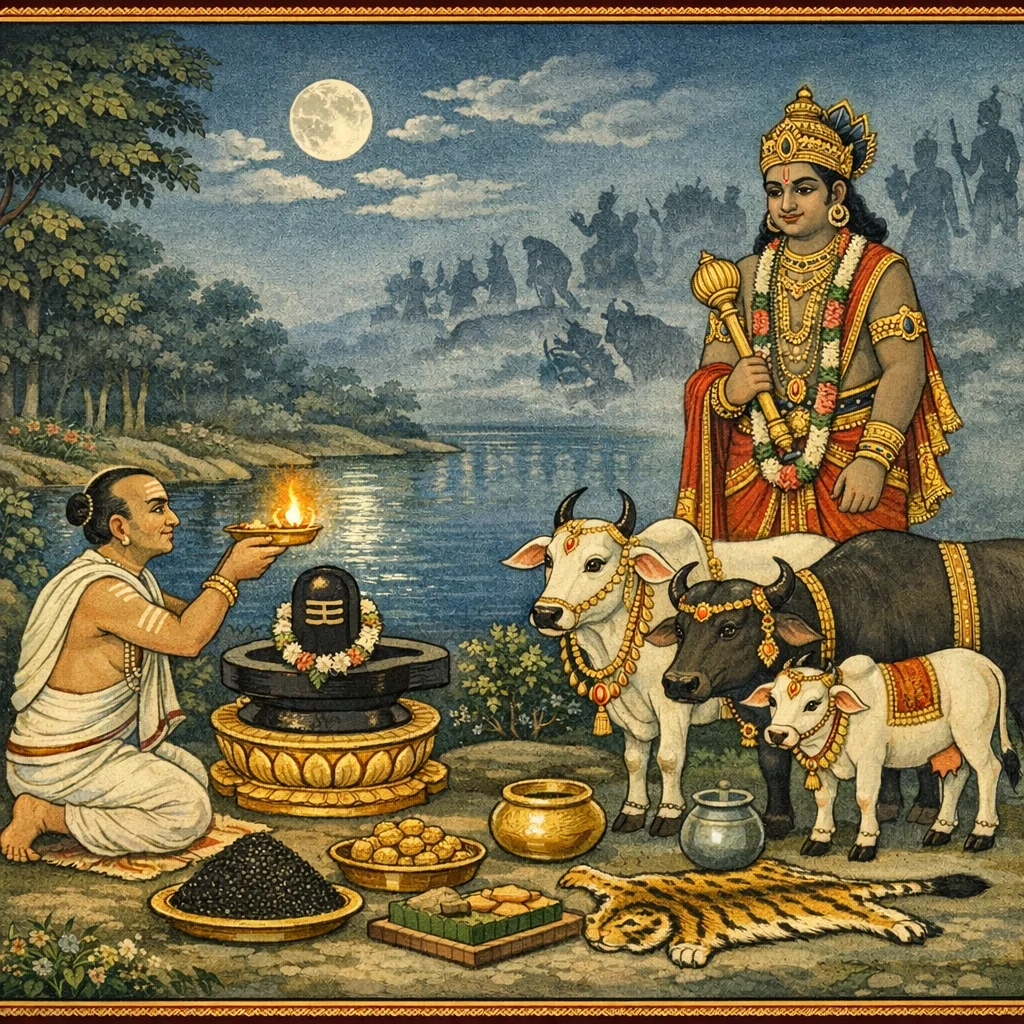
This adhyāya unfolds as a dialogue: Yudhiṣṭhira asks Mārkaṇḍeya to tell the origin of a Narmadā-bank tīrtha called Yamahāsya (“Yama’s laughter”). Mārkaṇḍeya relates that Yama (Dharmarāja), arriving early to bathe in the Revā, witnesses the purifying power of even a single immersion. He ponders the paradox that wrongdoers still reach his realm, while Revā-snāna is praised as leading to an auspicious, even Vaiṣṇava, state; laughing at those who can yet fail to behold the sacred river, he establishes the deity Yamahāseśvara there and departs. The chapter then prescribes an observance: in the month of Aśvina, on kṛṣṇa-pakṣa caturdaśī, one should fast with devotion, keep night vigil, and awaken the deity with a ghee lamp—said to remove many kinds of faults. It also sets forth dāna-based ethical guidance, especially honoring brāhmaṇas on amāvāsyā with conquered anger (jita-krodha) and prescribed gifts (gold/land/sesame, black antelope skin, a sesame-cow, and notably a buffalo-cow gift with detailed ritual arrangement). A didactic list of feared torments in Yama’s world is included, reinterpreted as nullified by the efficacy of the tīrtha and of dāna; the closing phalaśruti declares that even hearing this account frees one from faults and prevents the vision of Yama’s abode.
Shlokas
Verse 1
। श्रीमार्कण्डेय उवाच । ततो गच्छेत्तु राजेन्द्र यमहास्यमनुत्तमम् । सर्वपापहरं तीर्थं नर्मदातटमाश्रितम्
Śrī Mārkaṇḍeya said: “Then, O king of kings, one should go to the unsurpassed tīrtha called Yamahāsya—a sacred ford that removes all sins, situated upon the bank of the Narmadā.”
Verse 2
युधिष्ठिर उवाच । यमहास्यं कथं जातं पृथिव्यां द्विजपुंगव । एतत्सर्वं ममाख्याहि परं कौतूहलं हि मे
Yudhiṣṭhira said: “O foremost among the twice-born, how did Yamahāsya arise upon the earth? Tell me all of this—for my curiosity is great.”
Verse 3
श्रीमार्कण्डेय उवाच । साधु साधु महाप्राज्ञ पृष्टोऽहं नृपनन्दन । स्नानार्थं नर्मदां पुण्यामागतस्ते पिता पुरा
Śrī Mārkaṇḍeya said: “Well asked, well asked, O greatly wise son of a king. Long ago your father came to the holy Narmadā for the sake of bathing.”
Verse 4
रजकेन यथा धौतं वस्त्रं भवति निर्मलम् । तथासौ निर्मलो जातो धर्मराजो युधिष्ठिर
Just as a cloth washed by a washerman becomes clean, so too that Dharmarāja became purified, O Yudhiṣṭhira.
Verse 5
स पश्यन्निर्मलं देहं हसन्प्रोवाच विस्मितः
Seeing that spotless body, he smiled and, astonished, spoke.
Verse 6
यम उवाच । मत्पुरं कथमायान्ति मनुजाः पापबृंहिताः । स्नानेनैकेन रेवायाः प्राप्यते वैष्णवं पदम्
Yama said: “How do humans, swollen with sins, come to my city? By a single bath in the Revā, one attains the Vaiṣṇava state—the abode of Viṣṇu.”
Verse 7
समर्था ये न पश्यन्ति रेवां पुण्यजलां शुभाम् । जात्यन्धैस्ते समा ज्ञेया मृतैः पङ्गुभिरेव वा
Those who are able, yet do not behold the auspicious Revā with her holy waters, should be known as equal to the congenitally blind—or even as the dead, or the lame.
Verse 8
समर्था ये न पश्यन्ति रेवां पुण्यजलां नदीम् । एतस्मात्कारणाद्राजन्हसितो लोकशासनः
O King, because even those who are able do not behold the Revā, the river of holy waters, for this reason the ruler of the worlds, Yama, laughed.
Verse 9
स्थापयित्वा यमस्तत्र देवं स्वर्गं जगाम ह । यमहासेश्वरे राजञ्जितक्रोधो जितेन्द्रियः
Having installed the deity there, Yama indeed departed for heaven. O King, at Yama-hāseśvara he was one who had conquered anger and mastered his senses.
Verse 10
विशेषाच्चाश्विने मासि कृष्णपक्षे चतुर्दशीम् । उपोष्य परया भक्त्या सर्वपापैः प्रमुच्यते
Especially in the month of Āśvina, on the fourteenth lunar day of the dark fortnight, by fasting with supreme devotion one is released from all sins.
Verse 11
रात्रौ जागरणं कुर्याद्दीपं देवस्य बोधयेत् । घृतेन चैव राजेन्द्र शृणु तत्रास्ति यत्फलम्
At night one should keep vigil and awaken the Lord with a lamp; and with ghee as well, O best of kings—listen to the fruit that arises from that.
Verse 12
मुच्यते पातकैः सर्वैरगम्यागमनोद्भवैः । अभक्ष्यभक्षणोद्भूतैरपेयापेयजैरपि
One is freed from all sins—even those arising from forbidden unions, from eating what must not be eaten, and even from drinking what must not be drunk.
Verse 13
अवाह्यवाहिते यत्स्याददोह्यादोहने यथा । स्नानमात्रेण तस्यैवं यान्ति पापान्यनेकधा
Just as guilt arises in making what should not be carried be carried, or in milking what should not be milked—so too, by bathing alone in that sacred water, sins depart in many ways.
Verse 14
यमलोकं न वीक्षेत मनुजः स कदाचन । पित्ःणां परमं गुह्यमिदं भूमौ नरेश्वर
Such a person will never behold Yama’s world. O lord of men, this is the supreme secret of the Pitṛs (ancestral realm) upon the earth.
Verse 15
ददतामक्षयं सर्वं यमहास्ये न संशयः । अमावास्यां जितक्रोधो यस्तु पूजयते द्विजान्
For those who give, all merit becomes inexhaustible at the very threshold of Yama—of this there is no doubt. On the day of Amāvāsyā (new moon), whoever, having conquered anger, honors and worships the dvijas (twice-born brāhmaṇas) gains that unfailing fruit.
Verse 16
हिरण्यभूमिदानेन तिलदानेन भूयसा । कृष्णाजिनप्रदानेन तिलधेनुप्रदानतः
By gifting gold and land, by abundant gifting of sesame, by offering a black antelope-skin, and by donating a ‘tiladhenu’—a ritual ‘sesame-cow’ formed of sesame—the merit is greatly increased.
Verse 17
विधानोक्तद्विजाग्र्याय ये प्रदास्यन्ति भक्तितः । हयं वा कुंजरं वाथ धूर्वहौ सीरसंयुतौ
Those who, with devotion, give to an excellent brāhmaṇa as enjoined by rule—whether a horse, or an elephant, or a pair of plough-oxen yoked with a plough—perform a highly meritorious act of charity.
Verse 18
कन्यां वसुमतीं गां च महिषीं वा पयस्विनीम् । ददते ये नृपश्रेष्ठ नोपसर्पन्ति ते यमम्
O best of kings, those who give a maiden in marriage, or land, or a cow, or a milk-giving buffalo-cow do not draw near to Yama.
Verse 19
यमोऽपि भवति प्रीतः प्रतिजन्म युधिष्ठिर । यमस्य वाहो महिषो महिष्यस्तस्य मातरः
Even Yama becomes pleased, O Yudhiṣṭhira, in birth after birth. The buffalo is Yama’s mount, and buffalo-cows are regarded as (like) his mothers, worthy of reverence.
Verse 20
तासां दानप्रभावेण यमः प्रीतो भवेद्ध्रुवम् । नासौ यममवाप्नोति यदि पापैः समावृतः
By the power of donating those buffalo-cows, Yama is certainly pleased. Even if a person is covered over with sins, he does not come into Yama’s grasp.
Verse 21
एतस्मात्कारणादत्र महिषीदानमुत्तमम् । तस्याः शृङ्गे जलं कार्यं धूम्रवस्त्रानुवेष्टिता
For this reason, in this context, the gift of a buffalo-cow is considered supreme. Water should be placed upon her horn, and she should be wrapped with a smoke-colored cloth.
Verse 22
आयसस्य खुराः कार्यास्ताम्रपृष्ठाः सुभूषिताः । लवणाचलं पूर्वस्यामाग्नेय्यां गुडपर्वतम्
Her hooves should be fashioned of iron, her back plated with copper and well adorned. In the eastern direction one should place a ‘mountain of salt’, and in the southeast a ‘mountain of jaggery’.
Verse 23
कार्पासं याम्यभागं तु नवनीतं तु नैरृते । पश्चिमे सप्तधान्यानि वायव्ये तंदुलाः स्मृताः
In the southern quarter one should place cotton; in the southwest, fresh butter. In the west are to be set the seven grains, and in the northwest, rice is prescribed.
Verse 24
सौम्ये तु काञ्चनं दद्यादीशाने घृतमेव च । प्रदद्याद्यमराजो मे प्रीयतामित्युदीरयन्
In the northern quarter one should give gold, and in the northeast, ghee as well. Let the donor give while proclaiming: “May Yamarāja be pleased with me.”
Verse 25
इत्युच्चार्य द्विजस्याग्रे यमलोकं महाभयम् । असिपत्त्रवनं घोरं यमचुल्ली सुदारुणा
Having thus spoken in the presence of the eminent brāhmaṇa, (he described) the realm of Yama, terrifying in the extreme—its dreadful forest of sword-like leaves (Asipattravana) and the most cruel ‘Yama’s furnace’ (Yamacullī).
Verse 26
रौद्रा वैतरणी चैव कुम्भीपाको भयावहः । कालसूत्रो महाभीमस्तथा यमलपर्वतौ
There are (hells) such as Raudra, and also Vaitaraṇī; the fearsome Kumbhīpāka; the exceedingly dreadful Kālasūtra; and likewise the mountains of Yama’s domain.
Verse 27
क्रकचं तैलयन्त्रं च श्वानो गृध्राः सुदारुणाः । निरुच्छ्वासा महानादा भैरवो रौरवस्तथा
There (are torments) like the saw (Krakaca) and the oil-press device (Tailayantra); and most cruel dogs and vultures. There are also places of suffocation and thunderous roaring—Bhairava and Raurava as well.
Verse 28
एते घोरा याम्यलोके श्रूयन्ते द्विजसत्तम । त्वत्प्रसादेन ते सोम्यास्तीर्थस्यास्य प्रभावतः
O best of brāhmaṇas, these are heard to be dreadful in Yama’s realm; yet by your grace—and by the power of this sacred ford—they become gentle, no longer terrifying.
Verse 29
दानस्यास्य प्रभावेण यमराजप्रसादतः । नरकेऽहं न यास्यामि द्विज जन्मनि जन्मनि
By the power of this act of charity, and by the favor of King Yama, O brāhmaṇa, I shall not go to hell—birth after birth.
Verse 30
यमहास्यस्य चाख्यानमिदं शृण्वन्ति ये नराः । तेऽपि पापविनिर्मुक्ता न पश्यन्ति यमालयम्
Those who listen to this account of “Yama’s laughter”—they too, freed from sin, do not behold the abode of Yama.