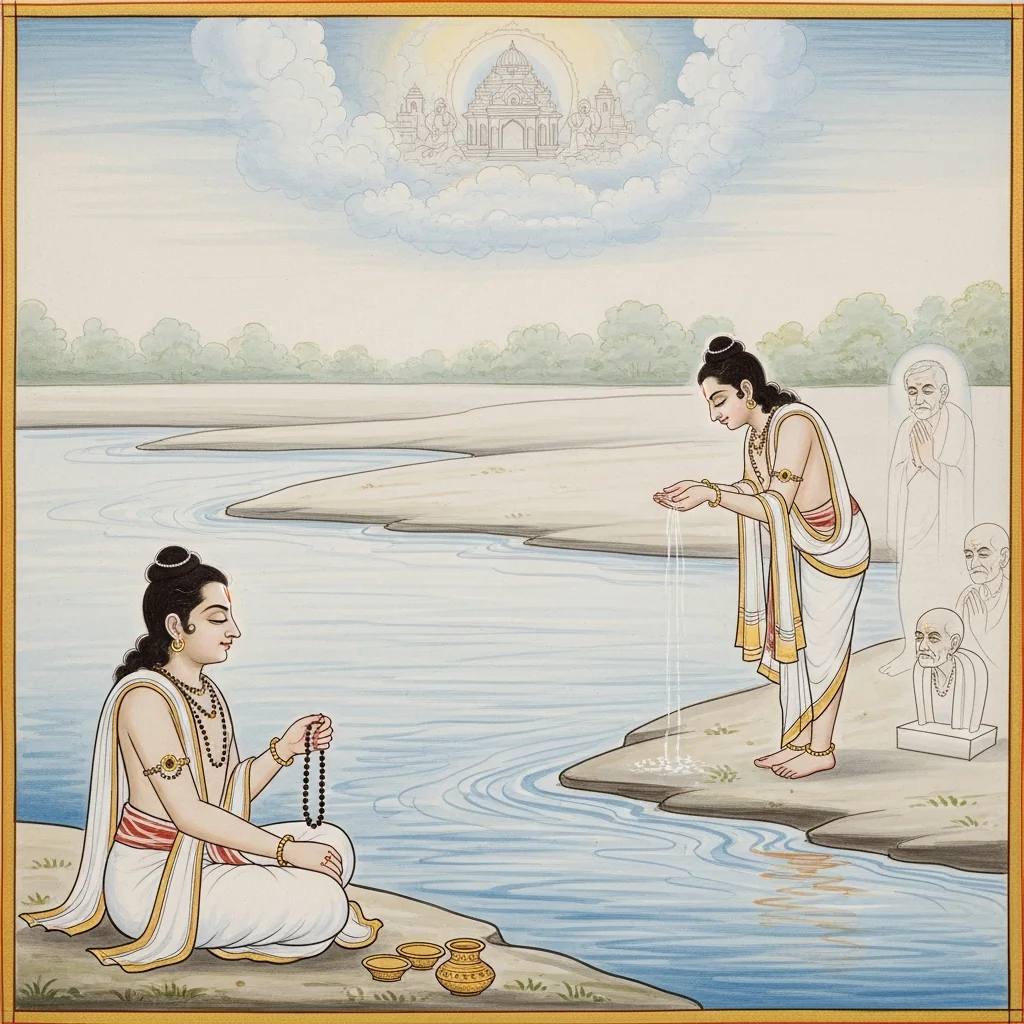
Adhyaya 25
In the Avantī Khaṇḍa, Chapter 25, spoken by Mārkaṇḍeya, points out a celebrated confluence to the eastern side of Oṃkāra, where the Revā (Narmadā) meets the Nīlagāṅgā. The teaching is framed first as a specification of the tīrtha, and then as a compact statement of its fruits (phala). It declares that bathing (snāna) and mantra-recitation (japa) at this saṅgama make worldly aims attainable, presenting the place as a means of ritual efficacy. It further promises a prolonged sacred posthumous residence—sixty thousand years in Nīlakaṇṭhapura—thus linking local geography with a Śaiva-associated holy realm. A lineage-ethical element is added: during śrāddha, if one performs tarpaṇa for the ancestors with water mixed with sesame (tila-miśra jala), the practitioner is said to “lift up” twenty-one persons along with oneself. Overall, the chapter serves as a concise ritual-geo index: location → recommended acts → enumerated fruits.
Shlokas
Verse 1
श्रीमार्कण्डेय उवाच । ओंकारात्पूर्वभागे वै सङ्गमो लोकविश्रुतः । रेवया संगता यत्र नीलगङ्गा नृपोत्तम
Śrī Mārkaṇḍeya said: To the east of Oṃkāra lies a confluence renowned throughout the world, O best of kings, where the Nīlagaṅgā meets the Revā.
Verse 2
तत्र स्नात्वा जपित्वा च कोऽर्थोऽलभ्यो भवेद्भुवि । षष्टिर्वर्षसहस्राणि नीलकण्ठपुरे वसेत्
Having bathed there and performed japa, what desired aim would remain unattained on earth? Such a one is deemed to have dwelt in Nīlakaṇṭhapura for sixty thousand years.
Verse 3
तर्पयित्वा पितॄञ्श्राद्धे तिलमिश्रैर्जलैरपि । उद्धरेदात्मना सार्धं पुरुषानेकविंशतिम्
Having satisfied the ancestors in the śrāddha with water mixed with sesame, one lifts up—together with oneself—twenty-one persons of one’s line.
Verse 25
। अध्याय
End of the chapter.