Adhyaya 15
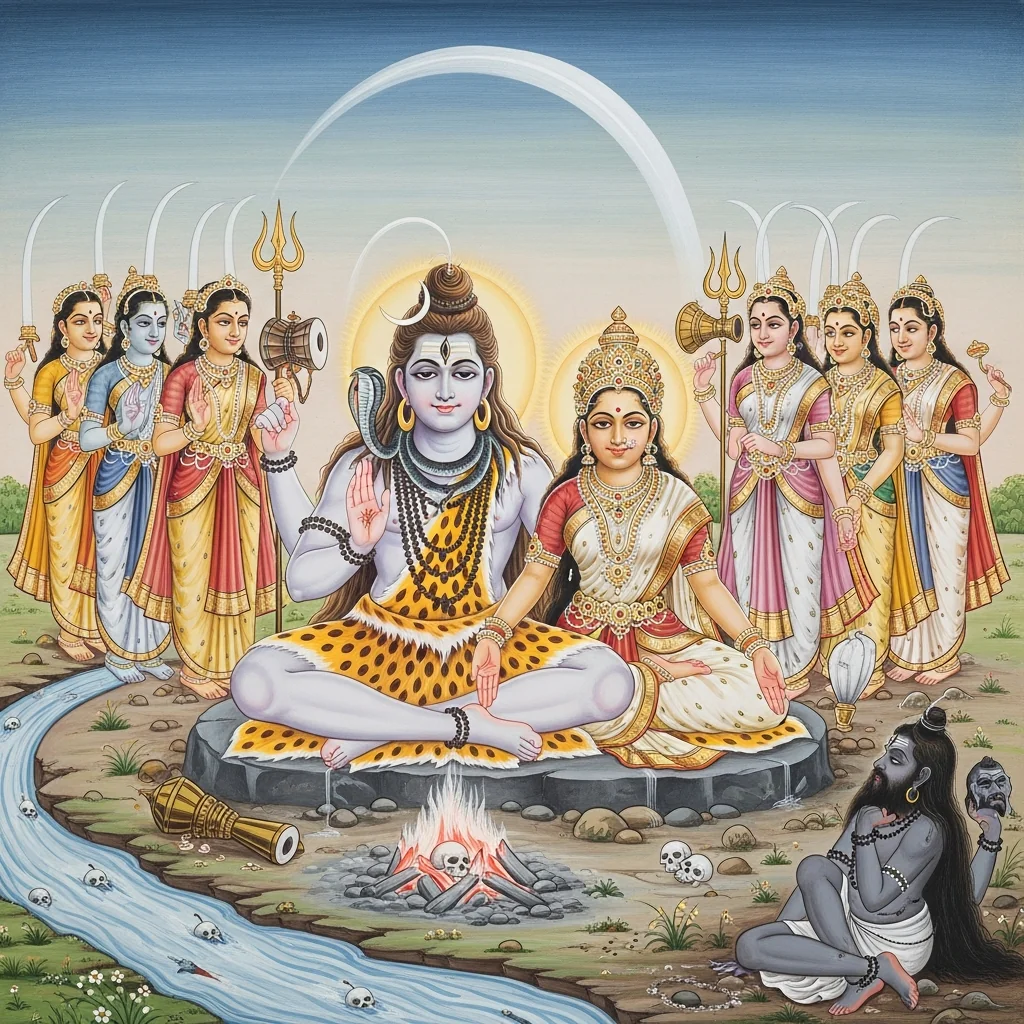
Mārkaṇḍeya recounts a catastrophic, yuga-end-like vision: Kālarātri, encircled by fierce Mātṛgaṇas, overwhelms the worlds. These Mothers are portrayed as powers inflected by Brahmā–Viṣṇu–Śiva and aligned with the elements and the deities of the directions; moving through the ten quarters with weapons, their cries and footfalls scorch the three worlds. The devastation spreads across the seven island-continents, with stark images of blood-drinking and the devouring of beings, signaling cosmic dissolution. After this destructive crescendo, the narrative returns to a sacred center—Śiva’s presence on the bank of the Narmadā at a place called Amarāṅkaṭa, explained through the terms “amarā” and “kaṭa.” Śaṅkara appears with Umā and his hosts (gaṇas and mātṛs), even with Mṛtyu (Death) personified, all joining in ecstatic dance, revealing Rudra as both terror and refuge. The Narmadā is praised as a world-venerated mother-river, mighty and turbulent in her forms. The chapter culminates in an intensified theophany: the storm-wind Saṃvarta arising from Rudra’s mouth dries the oceans; Śiva, marked by cremation-ground emblems and cosmic radiance, enacts dissolution while remaining the supreme object of worship for Kālarātri, the mātṛs, and the gaṇas. The closing verses offer a protective stuti, praising Hari-Hara/Śiva as the universal cause and the focus of continual remembrance.
Shlokas
Verse 1
श्रीमार्कण्डेय उवाच । ततो मातृसहस्रैश्च रौद्रैश्च परिवारिता । कालरात्रिर्जगत्सर्वं हरते दीप्तलोचना
Śrī Mārkaṇḍeya said: Then, surrounded by thousands of fierce Mother-goddesses, Kālarātri—her eyes blazing—began to seize and carry off the entire world.
Verse 2
ततस्ता मातरो घोरा ब्रह्मविष्णुशिवात्मिकाः । वाय्विन्द्रानलकौबेरा यमतोयेशशक्तयः
Then those dreadful Mother-goddesses appeared—embodying the powers of Brahmā, Viṣṇu, and Śiva—along with the śaktis of Vāyu, Indra, Agni, Kubera, Yama, Varuṇa (lord of waters), and Īśa.
Verse 3
स्कन्दक्रोडनृसिंहानां विचरन्त्यो भयानकाः । चक्रशूलगदाखड्गवज्रशक्त्यृष्टिपट्टिशैः
Fearsome as they roamed—like Skanda, the Boar (Varāha), and Narasiṃha—bearing discus, trident, mace, sword, thunderbolt, spear, lance, and battle-axes.
Verse 4
खट्वाङ्गैरुल्मुकैर्दीप्तैर्व्यचरन्मातरः क्षये । उमासंनोदिता सर्वाः प्रधावन्त्यो दिशो दश
Wielding khaṭvāṅgas and blazing firebrands, the Mothers moved about at the time of destruction; urged on by Umā, they all surged forth, racing into the ten directions.
Verse 5
तासां चरणविक्षेपैर्हुङ्कारोद्गारनिस्वनैः । त्रैलोक्यमेतत्सकलं विप्रदग्धं समन्ततः
By the stamping of their feet and the roaring din of their huṃkāras and cries, this entire threefold world was scorched on every side.
Verse 6
हाहारवाक्रन्दितनिस्वनैश्च प्रभिन्नरथ्यागृहगोपुरैश्च । बभूव घोरा धरणी समन्तात्कपालकोशाकुलकर्बुराङ्गी
With the clamour of “hā hā!” cries and wailing, and with streets, houses, and gate-towers shattered, the earth became dreadful everywhere—its surface mottled and strewn with heaps of skulls.
Verse 7
यदेतच्छतसाहस्रं जम्बूद्वीपं निगद्यते । सर्वमेव तदुच्छन्नं समाधृष्य नृपोत्तम
That Jambūdvīpa which is spoken of as spanning a hundred-thousand (leagues) was entirely overrun and laid waste—O best of kings—when it was assailed on all sides.
Verse 8
जम्बुं शाकं कुशं क्रौञ्चं गोमेदं शाल्मलिस्तथा । पुष्करद्वीपसहिता ये च पर्वतवासिनः
Jambu, Śāka, Kuśa, Krauñca, Gomeda, and Śālmalī—together with Puṣkara-dvīpa—and even those who dwelt upon the mountains were all caught up in that calamity.
Verse 9
ते ग्रस्ता मृत्युना सर्वे भूतैर्मातृगणैस्तथा । महासुरकपालैश्च मांसमेदोवसोत्कटैः
All of them were seized by Death—by hosts of bhūtas and by the companies of the Mothers (Mātṛgaṇa)—along with great demon-skulls, gruesome with flesh, fat, and marrow.
Verse 10
रुधिरोद्गारशोणाङ्गी महामाया सुभीषणा । पिबन्ती रुधिरं तत्र महामांसवसाप्रिया
There, the supremely terrifying Mahāmāyā—her body crimson with spurting blood—drank blood, delighting in great heaps of flesh and fat.
Verse 11
कपालहस्ता विकटा भक्षयन्ती सुरासुरान् । नृत्यन्ती च हसन्ती च विपरीता महारवा
Holding a skull in her hand, grotesque in form, she devoured gods and demons alike; dancing and laughing, inverted in posture, she thundered with a mighty roar.
Verse 12
त्रैलोक्यसंत्रासकरी विद्युत्संस्फोटहासिनी । सप्तद्वीपसमुद्रान्तां भक्षयित्वा च मेदिनीम्
She, who spread terror through the three worlds and laughed like the crackling burst of lightning, even after devouring the earth bounded by the seven continents and the encircling oceans, still remained unsated.
Verse 13
ततः स्वस्थानमगमद्यत्र देवो महेश्वरः । नर्मदातीरमाश्रित्यावसन्मातृगणैः सह
Then she went to her own appointed abode—where Lord Maheśvara dwells—taking shelter on the bank of the Narmadā, residing there together with the host of Mothers.
Verse 14
अमराणां कटे तुङ्गे नृत्यन्ती हसितानना । अमरा देवताः प्रोक्ताः शरीरं कटमुच्यते
Dancing upon the lofty ‘kaṭa’ (hip) of the immortals, her face smiling—‘amaras’ are declared to be the gods, and the body is called ‘kaṭa’; thus the place is explained by etymology.
Verse 15
। अध्याय
Chapter marker: “Adhyāya.”
Verse 16
अमरंकट इत्येवं तेन प्रोक्तो मनीषिभिः । महापवित्रो लोकेषु शम्भुना स विनिर्मितः
Thus, by that reasoning, the sages have called it “Amaraṃkaṭa.” It is supremely purifying among the worlds, established as such by Śambhu himself.
Verse 17
नित्यं संनिहितस्तत्र शङ्करो ह्युमया सह । ततोऽहं नियतस्तत्र तस्य पादाग्रसंस्थितः
Śaṅkara is ever present there, indeed together with Umā. Therefore I too remain fixed there, stationed at the very forepart of his feet in devoted attendance.
Verse 18
प्रह्वः प्रणतभावेन स्तौमि तं नीललोहितम् । ततस्तालकसम्पातैर्गणैर्मातृगणैः सह
Bowed down, with a spirit of reverent submission, I praise that Nīlalohita. Then, along with the gaṇas and the hosts of the Mothers, there arises a tumultuous gathering.
Verse 19
संप्रनृत्यति संहृष्टो मृत्युना सह शङ्करः । खट्वाङ्गैरुल्मुकैश्चैव पट्टिशैः परिघैस्तथा
Śaṅkara, delighted, dances together with Mṛtyu (Death). And there are khaṭvāṅgas, blazing brands, battle-axes, and iron clubs as well.
Verse 20
मांसमेदोवसाहस्ता हृष्टा नृत्यन्ति संघशः । वामना जटिला मुण्डा लम्बग्रीवोष्ठमूर्द्धजाः
In companies they dance in exultation, their hands smeared with flesh, fat, and grease—dwarfish, matted-haired, shaven-headed, with long necks, protruding lips, and strange tufts upon their heads.
Verse 21
महाशिश्नोदरभुजा नृत्यन्ति च हसन्ति च । विकृतैराननैर्घोरैरर्भुजोल्बणमुखादिभिः
With huge phalluses, bellies, and arms, they dance and they laugh; with distorted and dreadful faces—some with monstrous mouths and other terrifying features.
Verse 22
अमरं कण्टकं चक्रुः प्राप्ते कालविपर्यये । तेषां मध्ये महाघोरं जगत्सन्त्रासकारणम्
When the order of time was overturned, the immortals themselves became as thorns, a source of torment. In their midst appeared something exceedingly dreadful, the very cause of terror for the whole world.
Verse 23
मृत्युं पश्यामि नृत्यन्तं तडित्पिङ्गलमूर्द्धजम् । तस्य पार्श्वे स्थितां देवीं विमलाम्बरभूषिताम्
I behold Death itself, dancing—its hair tawny like lightning. Beside it stands a goddess, adorned in spotless garments.
Verse 24
कुण्डलोद्घुष्टगण्डां तां नागयज्ञोपवीतिनीम् । विचित्रैरुपहारैश्च पूजयन्तीं महेश्वरम्
That goddess—her cheeks resounding with earrings, wearing a serpent as her sacred thread—was worshipping Maheśvara with wondrous offerings.
Verse 25
अपश्यं नर्मदां तत्र मातरं विश्ववन्दिताम् । नानातरङ्गां सावर्तां सुवेलार्णवसंनिभाम्
There I beheld Narmadā—the Mother revered by the whole world—filled with countless waves and whirlpools, like the ocean bounded by lofty shores.
Verse 26
महासरःसरित्पातैरदृश्यां दृश्यरूपिणीम् । वन्द्यमानां सुरैः सिद्धैर्मुनिसङ्घैश्च भारत
O Bhārata, she was at once unseen—hidden by great lakes, rivers, and cascades—yet manifest in visible form, worshipped by the gods, the Siddhas, and hosts of sages.
Verse 27
एतस्मिन्नन्तरे घोरां सप्तसप्तकसंज्ञिताम् । महावीच्यौघफेनाढ्यां कुर्वन्तीं सजलं जगत्
In the meantime, a fearsome condition arose, called ‘the Seven-Sevens’: filled with foam from torrents of huge waves, it made the entire world one mass of water.
Verse 28
दृष्टवान्नर्मदां देवीं मृगकृष्णाम्बरां पुनः । सधूमाशनिनिर्ह्रादैर्वहन्तीं सप्तधा तदा
Again I beheld the goddess Narmadā, clad in dark deerskin; then she surged forth in seven streams, accompanied by smoky thunder and the roar of lightning.
Verse 29
इति संहारमतुलं दृष्टवान्राजसत्तम । नष्टचन्द्रार्ककिरणमभूदेतच्चराचरम्
Thus, O best of kings, I witnessed an incomparable destruction; the rays of moon and sun vanished, and all that moves and does not move fell into darkness.
Verse 30
महोत्पातसमुद्भूतं नष्टनक्षत्रमण्डलम् । अलातचक्रवत्तूर्णमशेषं भ्रामयंस्ततः
Great portents arose; the circle of stars vanished. Then all things, without remainder, whirled swiftly like a spinning firebrand.
Verse 31
विमानकोटिसंकीर्णः स किंनरमहोरगः । महावातः सनिर्घातो येनाकम्पच्चराचरम्
The sky grew crowded with crores of aerial chariots, with Kiṃnaras and great serpents all around. A mighty wind, with thunderous crashes, shook all that moves and all that stands still.
Verse 32
रुद्रवक्त्रात्समुद्भूतः संवर्तो नाम विश्रुतः । वायुः संशोषयामास विततन् सप्तसागरान्
From Rudra’s very mouth arose the famed wind called Saṃvarta; spreading everywhere, it began to dry up the seven oceans.
Verse 33
उद्धूलिताङ्गः कपिलाक्षमूर्द्धजो जटाकलापैरवबद्धमूर्द्धजः । महारवो दीप्तविशालशूलधृक्स पातु युष्मांश्च दिने दिने हरः
May Hara protect you day after day—His body dust-smeared, His tawny hair bound in thick matted locks, roaring mightily, and bearing a blazing, massive trident.
Verse 34
शूली धनुष्मान्कवची किरीटी श्मशानभस्मोक्षितसर्वगात्रः । कपालमालाकुलकण्ठनालो महाहिसूत्रैरवबद्धमौलिः
Trident-bearing, bow-bearing, armored, and crowned—His entire body smeared with cremation-ground ash; His neck encircled with a garland of skulls, and His head bound with great serpent-cords.
Verse 35
स गोनसौघैः परिवेष्टिताङ्गो विषाग्निचन्द्रामरसिन्धुमौलिः । पिनाकखण्टूवाङ्गकरालपाणिः स कृत्तिवासा डमरुप्रणादः
His limbs are encircled by hosts of serpents; upon His head abide poison, fire, the moon, and the celestial river. In His dreadful hands are the Pināka bow and the khatvāṅga; clad in a hide, His ḍamaru resounds.
Verse 36
स सप्तलोकान्तरनिःसृतात्मा महभुजावेष्टितसर्वगात्रः । नेत्रेण सूर्योदयसन्निभेन प्रवालकाङ्कूरनिभोदरेण
His being seemed to surge forth across the intervals of the seven worlds; all His limbs were enveloped by mighty arms. With an eye like the rising sun, and a belly like a sprouting coral shoot, He appeared.
Verse 37
सन्ध्याभ्ररक्तोत्पलपद्मरागसिन्दूरविद्युत्प्रकरारुणेन । ततेन लिङ्गेन च लोचनेन चिक्रीडमानः स युगान्तकाले
At the end of the age He sported—His form suffused with a redness like twilight clouds, red lotuses, rubies, vermilion, and flashes of lightning; and with His manifested liṅga and His eye, He played forth.
Verse 38
हिरण्मयेनैव समुत्सृजन् स दण्डेन यद्वद्भगवान् समेरुः । पादाग्रविक्षेपविशीर्णशैलः कुर्वञ्जगत्सोऽपि जगाम तत्र
Brandishing a golden staff, like the exalted Meru itself, He moved onward; mountains shattered by the kick of His toe-tips, and as He made the world tremble, He too went there.
Verse 39
संहर्तुकामस्त्रिदिवं त्वशेषं प्रमुञ्चमानो विकृताट्टहासम् । जहार सर्वं त्रिदिवं महात्मा संक्षोभयन्वै जगदीश एकः
Desiring to dissolve the entire heaven-world, He released a dreadful peal of laughter. That great-souled One—the sole Lord of the universe—seized and shook all the triple heaven.
Verse 40
तं देवमीशानमजं वरेण्यं दृष्ट्वा जगत्संहरणं महेशम् । सा कालरात्रिः सह मातृभिश्च गणाश्च सर्वे शिवमर्चयन्ति
Beholding that God—Īśāna, unborn and most worthy—Maheśa, the dissolver of the world, Kālarātrī, together with the Mātṛs and all the Gaṇas, worships Śiva.
Verse 41
नन्दी च भृङ्गी च गणादयश्च तं सर्वभूतं प्रणमन्ति देवम् । जागद्वरं सर्वजनस्य कारणं हरं स्मरारातिमहर्निशं ते
Nandī, Bhṛṅgī, and the hosts of Gaṇas bow to that God who is all beings—Hara, foe of Smara—supreme over the world, the cause of all creatures, remembered by you day and night.