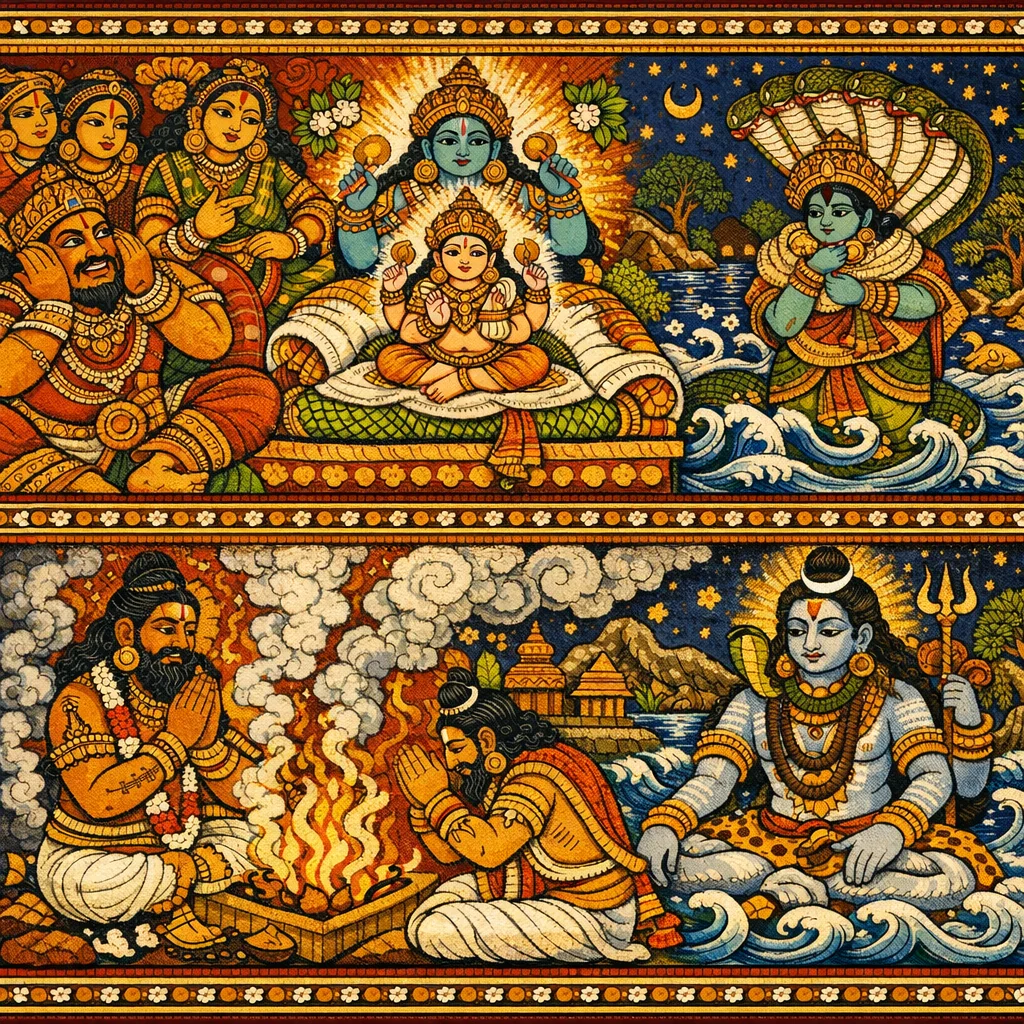
Adhyaya 47: Yadu Lineage, Vishnu’s Human Descents, Deva–Asura Wars, and Shukra’s Austerity (Dhūma-vrata)
यदुवंश-वैष्णवावतार-देवासुरयुद्ध-शुक्रतपःप्रसङ्गः
Speaker: Sūta, Ṛṣis (sages)
Sūta recounts Viṣṇu’s human birth in Devakī, Vasudeva’s fear of Kaṃsa, and the child’s concealment and transfer to Nanda’s house. The Ṛṣis ask the true identities of Vasudeva–Devakī–Nanda–Yaśodā; Sūta answers by linking them to the cosmic progenitors Kaśyapa and Aditi, and by explaining Yoga-māyā as the means by which the Lord descends. The chapter then turns to Yādava polity and genealogy—queens, sons, and the vast numbers of the clans—with Viṣṇu as pradhāna, the leading lawgiver. Asked why beings arise in groups and why Viṣṇu manifests again and again, Sūta explains yuga-decline, Deva–Asura wars, and Bhṛgu’s curse (arising from the slaying of Kāvyamātā) that necessitates seven human births. A long episode describes Śukra’s dhūma-vrata under Śiva, Jayantī’s attendance, Bṛhaspati’s impersonation and the Asuras’ misrecognition, ending with Śukra’s curse and the Asuras’ defeat and withdrawal. Sūta concludes with a structured list of divine and human manifestations, including Buddha and Kalki, and returns to the wider dynastic lines.
Key Concepts
Shlokas in Adhyaya 47
Verse 1
*सूत उवाच अथ देवो महादेवः पूर्वं कृष्णः प्रजापतिः विहारार्थं स देवेशो मानुषेष्विह जयते //
Sūta said: Then that God—Mahādeva—who formerly appeared as Kṛṣṇa, the Prajāpati, for the sake of divine sport, that Lord of the gods is born here among human beings.
Verse 2
देवक्यां वसुदेवस्य तपसा पुष्करेक्षणः चतुर्बाहुस्तदा जातो दिव्यरूपो ज्वलञ्श्रिया //
By the austerity of Vasudeva, the lotus-eyed Lord was then born in Devakī—four-armed, of divine form, blazing with splendor.
Verse 3
श्रीवत्सलक्षणं देवं दृष्ट्वा दिव्यैश्च लक्षणैः उवाच वसुदेवस्तं रूपं संहर वै प्रभो //
Seeing the Lord marked with the Śrīvatsa emblem and other divine signs, Vasudeva said: “O Master, withdraw (conceal) that form indeed.”
Verse 4
भीतो ऽहं देव कंसस्य ततस्त्वेतद्ब्रवीमि ते मम पुत्रा हतास्तेन ज्येष्ठास्ते भीमविक्रमाः //
O lord, I am afraid of Kaṃsa; therefore I tell you this: my sons—my elder sons, of dreadful valor—have been slain by him.
Verse 5
वसुदेववचः श्रुत्वा रूपं संहरते ऽच्युतः अनुज्ञाप्य ततः शौरिं नन्दगोपगृहे ऽनयत् //
Having heard Vasudeva’s words, the infallible Lord (Acyuta) withdrew His manifested form; then, after taking leave (with permission), he took Śauri and brought him to the house of Nanda the cowherd.
Verse 6
दत्त्वैनं नन्दगोपस्य रक्ष्यतामिति चाब्रवीत् अतस्तु सर्वकल्याणं यादवानां भविष्यति अयं तु गर्भो देवक्यां जातः कंसं हनिष्यति //
Having handed him over to Nandagopa the cowherd, he said, “Let him be protected.” From this, complete auspiciousness will arise for the Yādavas; for this very child, born from Devakī’s womb, will slay Kaṃsa.
Verse 7
*ऋषय ऊचुः क एष वसुदेवस्तु देवकी च यशस्विनी नन्दगोपश्च कस्त्वेष यशोदा च महाव्रता //
The sages said: “Who is this Vasudeva, and who is the illustrious Devakī? Who is Nandagopa, and who indeed is this Yaśodā, the woman of great vows?”
Verse 8
यो विष्णुं जनयामास यं च तातेत्यभाषत या गर्भं जनयामास या चैनं त्व् अभ्यवर्धयत् //
He is truly the father who brought Vishnu into being, whom the child addressed as “father”; and she is truly the mother who conceived him in the womb and who, indeed, nourished and raised him.
Verse 9
*सूत उवाच पुरुषः कश्यपस्त्वासीद् अदितिस्तु प्रिया स्मृता ब्रह्मणः कश्यपस्त्वंशः पृथिव्यास्त्वदितिस्तथा //
Sūta said: “Kashyapa indeed was the male progenitor, and Aditi is remembered as his beloved. Kashyapa was a portion (emanation) of Brahmā, and likewise Aditi was a portion of the Earth (Pṛthivī).”
Verse 10
अथ कामान्महाबाहुर् देवक्याः समपूरयत् ये तया काङ्क्षिता नित्यम् अजातस्य महात्मनः //
Then the mighty-armed one fulfilled Devakī’s desires—those very wishes she continually cherished for the unborn, great-souled child.
Verse 11
सो ऽवतीर्णो महीं देवः प्रविष्टो मानुषीं तनुम् मोहयन्सर्वभूतानि योगात्मा योगमायया //
That divine Lord descended upon the earth and entered a human body; being the very essence of Yoga, He bewildered all beings through His power of Yoga-māyā.
Verse 12
नष्टे धर्मे तथा जज्ञे विष्णुर्वृष्णिकुले प्रभुः कर्तुं धर्मस्य संस्थानम् असुराणां प्रणाशनम् //
When dharma had declined, the Lord Vishnu was born in the Vrishni lineage, in order to re-establish righteousness and to bring about the destruction of the asuras.
Verse 13
रुक्मिणी सत्यभामा च सत्या नाग्नजिती तथा सुभामा च तथा शैब्या गान्धारी लक्ष्मणा तथा //
Rukmiṇī, Satyabhāmā, Satyā, Nāgnajitī, Subhāmā, Śaibyā, Gāndhārī, and likewise Lakṣmaṇā—these are the names mentioned.
Verse 14
मित्रविन्दा च कालिन्दी देवी जाम्बवती तथा सुशीला च तथा माद्री कौशल्या विजया तथा एवमादीनि देवीनां सहस्राणि च षोडश //
Mitravindā, and Kāḷindī, and the goddess-like Jāmbavatī as well; Suśīlā, Mādrī, Kauśalyā, and Vijayā—thus and others of that kind—(in all) sixteen thousand divine queens.
Verse 15
रुक्मिणी जनयामास पुत्रान्रणविशारदान् चारुदेष्णं रणे शूरं प्रद्युम्नं च महाबलम् //
Rukmiṇī gave birth to sons who were skilled in battle—Cārudeṣṇa, a hero in war, and Pradyumna, possessed of great strength.
Verse 16
सुचारुं भद्रचारुं च सुदेष्णं भद्रमेव च परशुं चारुगुप्तं च चारुभद्रं सुचारुकम् चारुहासं कनिष्ठं च कन्यां चारुमतीं तथा //
“He had children named” Sucāru and Bhadracāru; Sudeṣṇa and likewise Bhadra; Paraśu; Cārugupta; Cārubhadra; Sucāruka; Cāruhāsa; and Kaniṣṭha; and also a daughter named Cārumatī.
Verse 17
जज्ञिरे सत्यभामायां भानुर्भ्रमरतेक्षणः रोहितो दीप्तिमांश्चैव ताम्रश् चक्रो जलंधमः //
From Satyabhāmā were born Bhānu (whose eyes were like those of a bee), and also Rohita, Dīptimān, Tāmra, Cakra, and Jalaṃdhama.
Verse 18
चतस्रो जज्ञिरे तेषां स्वसारस्तु यवीयसीः जाम्बवत्याः सुतो जज्ञे साम्बः समितिशोभनः //
Among them, four sisters were born, and the youngest of those sisters was also born. From Jāmbavatī was born a son—Sāmba—who was splendid in the assembly of warriors (and in battle).
Verse 19
मित्रवान्मित्रविन्दश्च मित्रविन्दा वराङ्गना मित्रबाहुः सुनीथश्च नाग्नजित्याः प्रजा हि सा //
From Nāgnajitī were born the children: Mitravān and Mitravinda; and Mitravindā, the noble-limbed lady; also Mitrabāhu and Sunītha—these indeed were the offspring of Nāgnajitī.
Verse 20
एवमादीनि पुत्राणां सहस्राणि निबोधत शतं शतसहस्राणां पुत्राणां तस्य धीमतः //
“In this manner, understand” that he had sons by the thousands—indeed, by hundreds of thousands—such was the progeny of that wise one.
Verse 21
अशीतिश्च सहस्राणि वासुदेवसुतास्तथा लक्षमेकं तथा प्रोक्तं पुत्राणां च द्विजोत्तमाः //
It is said that there were eighty thousand sons of Vāsudeva; and likewise, O best among the twice-born, a further one lakh (one hundred thousand) sons is also declared.
Verse 22
उपसङ्गस्य तु सुतौ वज्रः संक्षिप्त एव च भूरीन्द्रसेनो भूरिश्च गवेषणसुताव् उभौ //
Now, Upasaṅga had two sons—Vajra and Saṃkṣipta. Likewise, Bhūrīndrasena and Bhūri were both sons of Gaveṣaṇa.
Verse 23
प्रद्युम्नस्य तु दायादो वैदर्भ्यां बुद्धिसत्तमः अनिरुद्धो रणे ऽरुद्धो जज्ञे ऽस्य मृगकेतनः //
From Pradyumna, through the princess of Vidarbha (Vaidarbhī), was born his heir Aniruddha, foremost in intellect; and from Aniruddha was born Mṛgaketu, who was never checked in battle.
Verse 24
काश्या सुपार्श्वतनया साम्बाल्लेभे तरस्विनः सत्यप्रकृतयो देवाः पञ्च वीराः प्रकीर्तिताः //
Kāśyā, the daughter of Supārśva, obtained from Sāmbāla five mighty heroes as her sons—divine in stature and truthful by nature—who are celebrated as the “five heroes.”
Verse 25
तिस्रः कोट्यः प्रवीराणां यादवानां महात्मनाम् षष्टिः शतसहस्राणि वीर्यवन्तो महाबलाः //
Of those high-souled Yādavas there were three crores (thirty million) of foremost heroes, and a further sixty hundred-thousands (six hundred thousand)—men endowed with valor and great strength.
Verse 26
देवांशाः सर्व एवेह ह्य् उत्पन्नास्ते महौजसः देवासुरे हता ये च त्व् असुरा ये महाबलाः //
Here, all those divine portions were indeed born—beings of great splendor. And those mighty Asuras too, who were slain in the Deva–Asura conflict, were of great strength.
Verse 27
इहोत्पन्ना मनुष्येषु बाधन्ते सर्वमानवान् तेषामुत्सादनार्थाय उत्पन्नो यादवे कुले //
Born here among human beings, they oppress all people; and for the purpose of destroying them, he was born in the Yadu (Yādava) lineage.
Verse 28
कुलानां शतमेकं च यादवानां महात्मनाम् सर्वमेतत्कुलं यावद् वर्तते वैष्णवे कुले //
Among the noble Yādavas there are a hundred and one clans; and all this lineage continues to endure so long as it remains within the Vaiṣṇava (devoted-to-Viṣṇu) family-line.
Verse 29
विष्णुस्तेषां प्रणेता च प्रभुत्वे च व्यवस्थितः निदेशस्थायिनस्तस्य कथ्यन्ते सर्वयादवाः //
Vishnu is their leader and lawgiver, firmly established in sovereignty; and all the Yadavas are said to be those who abide by His command.
Verse 30
*ऋषय ऊचुः सप्तर्षयः कुबेरश्च यक्षो माणिचरस्तथा शालकिर् नारदश्चैव सिद्धो धन्वन्तरिस्तथा //
The sages said: “The Seven Seers (Saptarṣis), Kubera, the Yakṣa Māṇicara, Śālaki, Nārada, the Siddha, and Dhanvantari as well—(all were present/are to be counted).”
Verse 31
आदिदेवस्तथा विष्णुर् एभिस्तु सह दैवतः किमर्थं संघशो भूताः स्मृताः सम्भूतयः कति //
Along with these deities, the Primeval God—Viṣṇu—is also spoken of. For what purpose are beings remembered as arising in groups, and how many such collective manifestations (sambhūti) are there?
Verse 32
भविष्याः कति चैवान्ये प्रादुर्भावा महात्मनः ब्रह्मक्षत्रेषु शान्तेषु किमर्थमिह जायते //
How many other future manifestations of the great-souled Lord will there be? And when the Brahmins and Kshatriyas are at peace, for what purpose does He take birth here in the world?
Verse 33
यदर्थमिह सम्भूतो विष्णुर्वृष्ण्यन्धकोत्तमः पुनः पुनर्मनुष्येषु तन्नः प्रब्रूहि पृच्छताम् //
For what purpose has Viṣṇu—the foremost among the Vṛṣṇis and Andhakas—manifested here again and again among human beings? Tell us that, for we ask you.
Verse 34
*सूत उवाच त्यक्त्वा दिव्यां तनुं विष्णुर् मानुषेष्विह जायते युगे त्व् अथ परावृत्ते काले प्रशिथिले प्रभुः //
Sūta said: Casting aside His divine form, Lord Viṣṇu is born here among human beings; and when the yuga has turned and time has grown slackened, the Sovereign Lord manifests again.
Verse 35
देवासुरविमर्देषु जायते हरिरीश्वरः हिरण्यकशिपौ दैत्ये त्रैलोक्यं प्राक्प्रशासति //
Amid the crushing conflicts between the Devas and Asuras, Hari—the Supreme Lord—manifests. Previously, when the Daitya Hiraṇyakaśipu held power, he ruled over the three worlds.
Verse 36
बलिनाधिष्ठिते चैव पुरा लोकत्रये क्रमात् सख्यमासीत्परमकं देवानामसुरैः सह //
In ancient times, when Bali in due course came to preside over the three worlds, a supreme friendship arose between the Devas and the Asuras.
Verse 37
युगाख्यासुरसम्पूर्णं ह्य् आसीद् अत्याकुलं जगत् निदेशस्थायिनश्चापि तयोर्देवासुराः समम् //
Indeed, the world became utterly agitated, filled with the Asuras called the Yugākhyas; and equally, both the Devas and the Asuras stood obedient to the commands of those two.
Verse 38
मृधो बलिविमर्दाय सम्प्रवृद्धः सुदारुणः देवानामसुराणां च घोरः क्षयकरो महान् //
To crush the mighty Bali in battle, the War-Spirit (Mṛdha) swelled forth—most dreadful—terrifying both gods and demons alike, a great power bringing ruin and destruction.
Verse 39
कर्तुं धर्मव्यवस्थानं जायते मानुषेष्विह भृगोः शापनिमित्तं तु देवासुरकृते तदा //
Here among human beings, the need arises to establish an ordered system of dharma; and at that time it came about as a consequence of Bhṛgu’s curse, in the affair involving the Devas and the Asuras.
Verse 40
*मुनय ऊचुः कथं देवासुरकृते व्यापारं प्राप्तवान्स्वतः देवासुरं यथा वृत्तं तन्नः प्रब्रूहि पृच्छताम् //
The sages said: “How did you, of your own accord, come to undertake action in the affair of the Devas and the Asuras? Tell us, as we ask, exactly how the conflict between the Devas and the Asuras took place.”}]}
Verse 41
*सूत उवाच तेषां दायनिमित्तं ते संग्रामास्तु सुदारुणाः वराहाद्या दश द्वौ च शण्डामर्कान्तरे स्मृताः //
Sūta said: Because of disputes over inheritance, those wars became exceedingly dreadful. Twelve wars—beginning with the one called Varāha—are remembered as occurring in the interval associated with Śaṇḍa and Amarka.
Verse 42
नामतस्तु समासेन शृणुतैषां विवक्षतः प्रथमो नारसिंहस्तु द्वितीयश्चापि वामनः //
Now hear their names in brief, as I am about to state them: the first is Narasiṃha, and the second is Vāmana.
Verse 43
तृतीयस्तु वराहश्च चतुर्थो ऽमृतमन्थनः संग्रामः पञ्चमश्चैव संजातस्तारकामयः //
The third is Varāha (the Boar incarnation); the fourth is the churning for the nectar, amṛta-manthana. The fifth, too, is the battle that arose—the Tārakāmaya war.
Verse 44
षष्ठो ह्य् आडीबकाख्यस्तु सप्तमस्त्रैपुरस्तथा अन्धकाख्यो ऽष्टमस्तेषां नवमो वृत्रघातकः //
Among them, the sixth is called ĀḌībaka; the seventh is Traipura; the eighth is named Andhaka; and the ninth is the slayer of Vṛtra (Vṛtra-ghātaka).
Verse 45
धात्रश्च दशमश्चैव ततो हालाहलः स्मृतः प्रथितो द्वादशस्तेषां घोरः कोलाहलस्तथा //
Among them, Dhātṛ is the tenth; thereafter is remembered Hālāhala. Of these, the twelfth—well known—is the dreadful Kolāhala.
Verse 46
हिरण्यकशिपुर् दैत्यो नारसिंहेन पातितः वामनेन बलिर् बद्धस् त्रैलोक्याक्रमणे पुरा //
In former times, the Daitya Hiraṇyakaśipu was struck down by Narasiṃha; and Bali was bound by Vāmana during the ancient stride that encompassed the three worlds.
Verse 47
हिरण्याक्षो हतो द्वंद्वे प्रतिघाते तु दैवतैः दंष्ट्रया तु वराहेण समुद्रस्तु द्विधा कृतः //
Hiraṇyākṣa was slain in single combat, struck down amid the assault of the gods; and by the tusk of Varāha the ocean was cleft as though into two.
Verse 48
प्रह्लादो निर्जितो युद्धे इन्द्रेणामृतमन्थने विरोचनस्तु प्राह्लादिर् नित्यम् इन्द्रवधोद्यतः //
In the battle connected with the churning for nectar, Prahlāda was defeated by Indra; and Virocana, the son of Prahlāda, remained ever intent on slaying Indra.
Verse 49
इन्द्रेणैव तु विक्रम्य निहतस्तारकामये अशक्नुवन्स देवानां सर्वं सोढुं सदैवतम् //
Then, in the Tārakāmaya conflict, Indra alone advanced with valor and struck him down; for the gods were unable to endure the whole burden of that ever-divine (foe’s) might.
Verse 50
निहता दानवाः सर्वे त्रैलोक्ये त्र्यम्बकेण तु असुराश्च पिशाचाश्च दानवाश्चान्धकाहवे //
In the battle with Andhaka, Tryambaka (Śiva) struck down all the Dānavas across the three worlds—along with the Asuras and the Piśācas.
Verse 51
हता देवमनुष्ये स्वे पितृभिश्चैव सर्वशः संपृक्तो दानवैर्वृत्रो घोरो हालाहले हतः //
In that calamity, gods and humans alike were slain, and even the Pitṛs (ancestral spirits) were struck down on every side. The dreadful Vṛtra too—mingled with the Dānavas—was destroyed in the Hālāhala poison.
Verse 52
तदा विष्णुसहायेन महेन्द्रेण निवर्तितः हतो ध्वजे महेन्द्रेण मायाच्छन्नस्तु योगवित् ध्वजलक्षणमाविश्य विप्रचित्तिः सहानुजः //
Then, aided by Viṣṇu, Mahendra (Indra) checked him. And upon Indra’s banner he was struck down by Mahendra—though that master of yogic power was concealed by illusion—when Vipracitti, together with his younger brother, entered into the form/sign of the banner.
Verse 53
दैत्यांश्च दानवांश्चैव संयतान्किल संयुतान् जयन्कोलाहले सर्वान् देवैः परिवृतो वृषा //
He—bull-like in prowess—surrounded by the gods, defeated all those Daityas and Dānavas who had been marshalled and joined in battle, even amid the roar and tumult of war.
Verse 54
यज्ञस्यावभृथे दृश्यौ शण्डामर्कौ तु दैवतैः एते देवासुरे वृत्ताः संग्रामा द्वादशैव तु //
At the concluding bath (avabhṛtha) of the sacrifice, Śaṇḍa and Amarka were seen by the gods. These were the Deva–Asura conflicts—twelve battles in all—said to have taken place.
Verse 55
देवासुरक्षयकराः प्रजानां तु हिताय वै हिरण्यकशिपू राजा वर्षाणामर्बुदं बभौ //
For the welfare of the people—bringing about the destruction of both devas and asuras—King Hiraṇyakaśipu held sway for an arbuda of years.
Verse 56
द्विसप्तति तथान्यानि नियुतान्यधिकानि च अशीतिं च सहस्राणि त्रैलोक्यैश्वर्यतां गतः //
Having attained sovereignty over the three worlds, he possessed seventy-two niyutas and other additional niyutas, and also eighty thousand more—a vast measure of dominion and wealth.
Verse 57
पर्यायेण नु राजाभूद् बलिर्वर्षायुतं पुनः षष्टिवर्षसहस्राणि नियुतानि च विंशतिः //
Then, in due succession, Bali again became king for a term of one varṣāyuta (ten thousand years), together with sixty thousand years, and a further twenty niyutas—vast multitudes of years.
Verse 58
बले राज्याधिकारस्तु यावत्कालं बभूव ह तावत्कालं तु प्रह्लादो निवृत्तो ह्य् असुरैः सह //
So long as Bali held the rightful authority over the kingdom, for that very span of time Prahlāda, together with the Asuras, remained withdrawn from rule (having stepped aside).
Verse 59
इन्द्रास्त्रयस्ते विज्ञेया असुराणां महौजसः दैत्यसंस्थमिदं सर्वम् आसीद्दशयुगं पुनः //
These three are to be understood as Indra’s divine weapons, belonging to the mighty, high-powered Asuras. In that period, the entire order of the world again became established under the Daityas for ten yugas.
Verse 60
त्रैलोक्यमिदमव्यग्रं महेन्द्रेणानुपाल्यते असपत्नमिदं सर्वम् आसीद्दशयुगं पुनः //
This threefold world remained untroubled, being protected by Mahendra (Indra). All of it was without any rival, and again it endured so for ten yugas.
Verse 61
प्रह्लादस्य हते तस्मिंस् त्रैलोक्ये कालपर्ययात् पर्यायेण तु सम्प्राप्ते त्रैलोक्यं पाकशासने ततो ऽसुरान्परित्यज्य शुक्रो देवानगच्छत //
When Prahlāda was slain, by the turning of Time in the three worlds the appointed cycle arrived, and the sovereignty of the three worlds came to Pākaśāsana (Indra). Then Śukra, abandoning the Asuras, went over to the Devas.
Verse 62
यज्ञे देवानथ गतं दितिजाः काव्यमाह्वयन् किं त्वं नो मिषतां राज्यं त्यक्त्वा यज्ञं पुनर्गतः //
When the gods had gone to the yajña (sacrifice), the Daityas invoked Kāvya (Śukrācārya): “How is it that, while we looked on, you abandoned the kingdom and have returned again to the sacrifice?”
Verse 63
स्थातुं न शक्नुमो ह्य् अत्र प्रविशामो रसातलम् एवमुक्तो ऽब्रवीद्दैत्यान् विषण्णान्सान्त्वयन्गिरा //
“We cannot remain here; let us enter Rasātala (the netherworld).” Thus addressed, he spoke to the despondent Daityas, consoling them with reassuring words.
Verse 64
मा भैष्ट धारयिष्यामि तेजसा स्वेन वो ऽसुराः मन्त्राश्चौषधयश्चैव रसा वसु च यत्परम् //
“Do not fear, O Asuras. By my own innate tejas (splendor) I shall uphold you—along with the mantras, the medicinal herbs, the essences (rasas), and even the supreme treasure, the highest among riches.”
Verse 65
कृत्स्नानि मयि तिष्ठन्ति पादस्तेषां सुरेषु वै तत्सर्वं वः प्रदास्यामि युष्मदर्थे धृता मया //
“All of those are wholly established in me; their portions indeed abide among the gods. All that I shall bestow upon you—having been upheld by me for your sake.”
Verse 66
ततो देवास्तु तान्दृष्ट्वा वृतान्काव्येन धीमता संमन्त्रयन्ति देवा वै संविज्ञास्तु जिघृक्षया //
Then the gods, seeing them thus won over by the wise Kāvya (Śukra), held counsel among themselves—for they had become fully aware that an attempt was being made to seize them.
Verse 67
काव्यो ह्य् एष इदं सर्वं व्यावर्तयति नो बलात् साधु गच्छामहे तूर्णं यावन्नाध्यापयिष्यति //
For this Kāvya will forcibly turn all this back against us. So let us go quickly—before he compels someone to teach or recite it, thereby binding the outcome.
Verse 68
प्रसह्य हत्वा शिष्टांस्तु पातालं प्रापयामहे ततो देवास्तु संरब्धा दानवान् उपसृत्य ह //
“Having violently slain the righteous and driving them down into Pātāla, they acted thus.” Thereupon the gods, enraged, approached the Dānavas to confront them.
Verse 69
ततस्ते वध्यमानास्तु काव्यमेवाभिदुद्रुवुः ततः काव्यस्तु तान्दृष्ट्वा तूर्णं देवैर् अभिद्रुतान् //
Then, as they were being slain, they ran straight to Kāvya (Śukra). And Kāvya, seeing them swiftly chased down by the gods, responded at once.
Verse 70
रक्षां काव्येन संहृत्य देवास्ते ऽप्यसुरार्दिताः काव्यं दृष्ट्वा स्थितं देवा निःशङ्कमसुराञ्जहुः //
Having secured their protection through the sacred kāvya, those gods—though harassed by the Asuras—on seeing that the kāvya stood firm, became free from fear and drove away the Asuras without hesitation.
Verse 71
ततः काव्यो ऽनुचिन्त्याथ ब्राह्मणो वचनं हितम् तानुवाच ततः काव्यः पूर्वं वृत्तमनुस्मरन् //
Then Kāvya, having reflected, spoke a wholesome and beneficial word. That brāhmaṇa Kāvya addressed them, recalling what had happened before.
Verse 72
त्रैलोक्यं वो हृतं सर्वं वामनेन त्रिभिः क्रमैः बलिर्बद्धो हतो जम्भो निहतश्च विरोचनः //
“All the three worlds have been taken from you by Vāmana through his three strides; Bali has been bound, Jambha has been slain, and Virocana too has been killed.”
Verse 73
महासुरा द्वादशसु संग्रामेषु सुरैर् हताः तैस्तैरुपायैर्भूयिष्ठं निहता वः प्रधानतः //
The mighty Asuras were slain by the Devas in twelve battles; and by those various stratagems, most of your leading chiefs were, above all, repeatedly destroyed.
Verse 74
किंचिच्छीष्टास्तु यूयं वै युद्धं मास्त्विति मे मतम् नीतिं यां वो ऽभिधास्यामि तिष्ठध्वं कालपर्ययात् //
You are, indeed, somewhat disciplined and well-instructed; therefore, in my judgment, let there be no battle. Stand firm until the turn of time, and I shall declare to you the nīti (policy and prudent strategy) that I am about to expound.
Verse 75
यास्याम्यहं महादेवं मन्त्रार्थं विजयावहम् अप्रतीपांस्ततो मन्त्रान् देवात्प्राप्य महेश्वरात् युध्यामहे पुनर्देवांस् ततः प्राप्स्यथ वै जयम् //
“I shall go to Mahādeva to obtain the purport of a victory-bestowing mantra. Then, having received from Maheśvara those mantras that render the opponents powerless, we shall fight the gods again; and then you will surely attain victory.”
Verse 76
ततस्ते कृतसंवादा देवान् ऊचुस्तदासुराः न्यस्तशस्त्रा वयं सर्वे निःसंनाहा रथैर्विना //
Then, after holding their parley, the Asuras spoke to the Devas: “We have all laid down our weapons; we are without armor, and without chariots.”
Verse 77
वयं तपश्चरिष्यामः संवृता वल्कलैर्वने प्रह्लादस्य वचः श्रुत्वा सत्याभिव्याहृतं तु तत् //
“We shall undertake austerities, clothed in bark-garments in the forest.” Having heard Prahlāda’s words, they accepted that utterance as a truthfully spoken resolve.
Verse 78
ततो देवा न्यवर्तन्त विज्वरा मुदिताश्च ते न्यस्तशस्त्रेषु दैत्येषु विनिवृत्तास्तदा सुराः //
Then the gods turned back—free from distress and filled with joy. When the demons had laid down their weapons, the deities withdrew from the battle at that time.
Verse 79
ततस्तानब्रवीत्काव्यः कंचित्कालमुपास्यथ निरुत्सिक्तास् तपोयुक्ताः कालं कार्यार्थसाधकम् //
Then Kāvya addressed them: “For some time, remain in devoted attendance—free from arrogance, endowed with austerity—until the right time arrives, the time that accomplishes the intended purpose.”
Verse 80
पितुर्ममाश्रमस्था वै मां प्रतीक्षत दानवाः तत्संदिश्यासुरान्काव्यो महादेवं प्रपद्यत //
“The Dānavas were indeed waiting for me, staying at my father’s hermitage.” After giving his instructions to those Asuras, Kāvya (Śukra) took refuge in Mahādeva.
Verse 81
*शुक्र उवाच मन्त्रानिच्छाम्यहं देव ये न सन्ति बृहस्पतौ पराभवाय देवानाम् असुराणां जयाय च //
Śukra said: “O God, I desire those mantras that are not possessed by Bṛhaspati—so that the Devas may be brought to defeat and the Asuras may attain victory.”
Verse 82
एवमुक्तो ऽब्रवीद्देवो व्रतं त्वं चर भार्गव पूर्णं वर्षसहस्रं तु कणधूममवाक्शिराः यदि पास्यसि भद्रं ते ततो मन्त्रानवाप्स्यसि //
Thus addressed, the Lord said: “O Bhārgava, undertake this vow. For a full thousand years, drink only the smoke of chaff, keeping your head bowed downward. If you can observe it, blessings to you—then you shall obtain the mantras.”
Verse 83
तथेति समनुज्ञाप्य शुक्रस्तु भृगुनन्दनः पादौ संस्पृश्य देवस्य बाढमित्यब्रवीद्वचः व्रतं चराम्यहं देव त्वयादिष्टो ऽद्य वै प्रभो //
Having thus received permission, Śukra—the delight of the Bhṛgus—touched the feet of the Lord and spoke firmly: “So be it. O Deva, O Lord, today I shall undertake the vow exactly as you have enjoined.”
Verse 84
ततो ऽनुसृष्टो देवेन कुण्डधारो ऽस्य धूमकृत् तदा तस्मिन्गते शुक्रे ह्य् असुराणां हिताय वै मन्त्रार्थं तत्र वसति ब्रह्मचर्यं महेश्वरे //
Then, by the god’s command, Kuṇḍadhāra—who produced smoke—was dispatched. And when Śukra had gone there, indeed for the welfare of the Asuras, he stayed in that place for the sake of the mantra, observing brahmacarya in devotion to Maheśvara (Śiva).
Verse 85
तद्बुद्ध्वा नीतिपूर्वं तु राज्ये न्यस्ते तदासुरैः अस्मिंश्छिद्रे तदामर्षाद् देवास्तान्समुपाद्रवन् दंशिताः सायुधाः सर्वे बृहस्पतिपुरःसराः //
Realizing this—and seeing that the Asuras had, by a calculated policy, been installed in the kingship—the gods, seizing upon that very vulnerability, attacked them in anger. All of the gods, fully armed and arrayed for battle, advanced with Bṛhaspati at their head.
Verse 86
दृष्ट्वासुरगणा देवान् प्रगृहीतायुधान्पुनः उत्पेतुः सहसा ते वै संत्रस्तास्तान्वचो ऽब्रुवन् //
Seeing the gods once again with weapons in their hands, the hosts of Asuras suddenly sprang up; and, struck with fear, they spoke these words to them.
Verse 87
न्यस्ते शस्त्रे ऽभये दत्त आचार्ये व्रतमास्थिते दत्त्वा भवन्तो ह्य् अभयं सम्प्राप्ता नो जिघांसया //
“When a weapon has been laid down, when safety (abhaya) has been granted, and when the teacher has undertaken a vow—having thus bestowed fearlessness, you have come to us; therefore, do not wish to kill us.”
Verse 88
अनाचार्या वयं देवास् त्यक्तशस्त्रास्त्ववस्थिताः चीरकृष्णाजिनधरा निष्क्रिया निष्परिग्रहाः //
“We gods are without teachers; we stand having cast aside our weapons. Wearing bark-garments and black antelope-skins, we remain inactive, without possessions.”
Verse 89
रणे विजेतुं देवांश्च न शक्ष्यामः कथंचन अयुद्धेन प्रपत्स्यामः शरणं काव्यमातरम् //
We are in no way able to defeat the gods in battle. Therefore, without fighting, let us seek refuge in Kāvyamātā, the Mother of sacred poetry.
Verse 90
यापयामः कृच्छ्रमिदं यावदभ्येति नो गुरुः निवृत्ते च तथा शुक्रे योत्स्यामो दंशितायुधाः //
“Let us endure this hardship until our teacher comes back. And when Śukra too has withdrawn, then we shall fight—armed and fully prepared.”
Verse 91
एवमुक्त्वा ततो ऽन्योन्यं शरणं काव्यमातरम् प्रापद्यन्त ततो भीतास् तेभ्यो ऽदादभयं तु सा //
Having spoken thus, they then—frightened—took refuge, each supporting the other, in Kāvyamātā, the Mother of sacred poetry; and she, in turn, granted them fearlessness (abhaya).
Verse 92
न भेतव्यं न भेतव्यं भयं त्यजत दानवाः मत्संनिधौ वर्ततां वो न भीर् भवितुमर्हति //
“Do not be afraid—do not be afraid. Cast off fear, O Dānavas. While you remain in Matsya’s presence, it is not fitting that you should feel terror.”
Verse 93
तया चाभ्युपपन्नांस्तान् दृष्ट्वा देवास्ततो ऽसुरान् अभिजग्मुः प्रसह्यैतान् अविचार्य बलाबलम् //
Seeing those Asuras thus emboldened by her, the Devas rushed upon them, forcibly engaging them, without pausing to weigh their own strength against the enemy’s.
Verse 94
ततस्तान्बाध्यमानांस्तु देवैर्दृष्ट्वासुरांस्तदा देवी क्रुद्धाब्रवीद्देवान् अनिन्द्रान्वः करोम्यहम् //
Then the Goddess, seeing those Asuras being harried by the gods, became enraged and said to the Devas: “I shall make you all without Indra—each of you an Indra in your own right.”
Verse 95
संभृत्य सर्वसम्भारान् इन्द्रं साभ्यचरत्तदा तस्तम्भ देवी बलवद् योगयुक्ता तपोधना //
Having gathered all requisite implements, she then set about subduing Indra; the Goddess—rich in ascetic power and steadfast in yoga—powerfully immobilized him.
Verse 96
ततस्तं स्तम्भितं दृष्ट्वा इन्द्रं देवाश्च मूकवत् प्राद्रवन्त ततो भीता इन्द्रं दृष्ट्वा वशीकृतम् //
Then, seeing Indra immobilized, the gods—struck dumb as if mute—fled in fear, having beheld Indra brought under another’s control.
Verse 97
गतेषु सुरसंघेषु शक्रं विष्णुरभाषत मां त्वं प्रविश भद्रं ते नयिष्ये त्वां सुरोत्तम //
When the hosts of gods had departed, Viṣṇu spoke to Śakra (Indra): “Enter into me—may it be well with you. O best of the gods, I shall carry you through and lead you safely onward.”
Verse 98
एवमुक्तस्ततो विष्णुं प्रविवेश पुरंदरः विष्णुना रक्षितं दृष्ट्वा देवी क्रुद्धा वचो ऽब्रवीत् //
Thus addressed, Purandara (Indra) then entered into Viṣṇu. Seeing him protected by Viṣṇu, the Goddess, angered, spoke these words.
Verse 99
एषा त्वां विष्णुना सार्धं दहामि मघवन्बलात् मिषतां सर्वभूतानां दृश्यतां मे तपोबलम् //
“Now, O Maghavan (Indra), I shall burn you—together with Viṣṇu—by force. Let all beings, as they look on, behold the might of my ascetic power (tapas).”
Verse 100
तया ऽभिभूतौ तौ देवाव् इन्द्राविष्णू बभूवतुः कथं मुच्येव सहितौ विष्णुरिन्द्रम् अभाषत //
Overpowered by her, the two gods—Indra and Viṣṇu—found themselves subdued. Then Viṣṇu spoke to Indra: “How shall we, together, be freed from this?”
Verse 101
इन्द्रो ऽब्रवीज्जहि ह्येनां यावन्नौ न दहेत्प्रभो विशेषणाभिभूतो ऽस्मि त्वत्तो ऽहं जहि मा चिरम् //
Indra said: “O Lord, slay her at once, before she burns us. I am overpowered by her extraordinary might; therefore, you must strike her down—do not delay.”
Verse 102
ततः समीक्ष्य विष्णुस्तां स्त्रीवधे कृच्छ्रम् आस्थितः अभिध्याय ततश्चक्रम् आपदुद्धरणे तु तत् //
Then, having looked upon her, Viṣṇu found Himself in grave difficulty about the killing of a woman; so, after deliberate reflection, He set in motion that discus for the very purpose of delivering (all) from impending calamity.
Verse 103
ततस्तु त्वरया युक्तः शीघ्रकारी भयान्वितः ज्ञात्वा विष्णुस्ततस्तस्या क्रूरं देव्याश्चिकीर्षितम् क्रुद्धः स्वमस्त्रमादाय शिरश्चिच्छेद वै भिया //
Then, driven by urgency—quick to act and filled with fear—Vishnu, having understood the goddess’s cruel intent, became enraged; taking up his own weapon, he severed her head in dread.
Verse 104
तं दृष्ट्वा स्त्रीवधं घोरं चुक्रोध भृगुरीश्वरः ततो ऽभिशप्तो भृगुणा विष्णुर् भार्यावधे तदा //
Seeing that dreadful killing of a woman, the great lordly sage Bhṛgu flared with anger. Then, at that time, Viṣṇu was cursed by Bhṛgu on account of the slaying of (Bhṛgu’s) wife.
Verse 105
यस्मात्ते जानतो धर्मप्रवध्या स्त्री निषूदिता तस्मात्त्वं सप्तकृत्वेह मानुषेषूपपत्स्जसे //
Because you knowingly killed a woman who was under the protection of Dharma, therefore you shall be born among human beings here seven times (to undergo the consequence).
Verse 106
ततस्तेनाभिशापेन नष्टे धर्मे पुनःपुनः लोकस्य च हितार्थाय जायते मानुयेष्विह //
Then, owing to that very curse, whenever Dharma repeatedly declines, he is born again and again among human beings here, for the welfare of the world.
Verse 107
अनुव्याहृत्य विष्णुं स तदादाय शिरस्त्वरन् समानीय ततः कायम् असौ गृह्येदमब्रवीत् //
Having repeatedly invoked Viṣṇu, he hurriedly lifted it onto his head; then, bringing it to hand and taking hold of the body, he spoke these words.
Verse 108
एषा त्वं विष्पुना देवि हता संजीवयाम्यहम् ततस्तां योज्य शिरसा अभिजीवेति सो ऽब्रवीत् //
“Goddess, you have been slain by Viṣpu; I shall restore you to life.” Then, having joined her with her head, he said, “Live again!”
Verse 109
यदि कृत्स्नो मया धर्मो ज्ञायते चरितो ऽपि वा तेन सत्येन जीवस्व यदि सत्यं वदाम्यहम् //
If I have truly understood the whole of dharma, and have also practiced it, then by that truth may you live—if I am speaking the truth.
Verse 110
ततस्तां प्रोक्ष्य शीताभिर् अद्भिर् जीवेति सो ऽब्रवीत् ततो ऽभिव्याहृते तस्य देवी संजीविता तदा //
Then, sprinkling her with cool water, he said, “Live!” As soon as those words were uttered by him, the goddess was revived at that very moment.
Verse 111
ततस्तां सर्वभूतानि दृष्ट्वा सुप्तोत्थितामिव साधु साध्विति चक्रुस्ते वचसा सर्वतोदिशम् //
Then all beings, seeing her as though she had awakened from sleep, acclaimed her from every direction with their words, crying, “Well done! Well done!”
Verse 112
एवं प्रत्याहृता तेन देवी सा भृगुणा तदा मिषतां देवतानां हि तदद्भुतम् इवाभवद् //
Thus, when that Goddess was brought back by Bhṛgu, it seemed truly wondrous to the gods who looked on.
Verse 113
असंभ्रान्तेन भृगुणा पत्नी संजीविता पुनः दृष्ट्वा चेन्द्रो नालभत शर्म काव्यभयात्पुनः प्रजागरे ततश्चेन्द्रो जयन्तीमिदमब्रवीत् //
With unshaken composure, Bhṛgu restored his wife to life again. Seeing this, Indra found no peace of mind; once more, out of fear of Kāvya (Śukra), he remained wakeful. Then Indra said this to Jayantī.
Verse 114
संचिन्त्य मतिमान् वाक्यं स्वां कन्यां पाकशासनः एष काव्यो ह्यमित्राय व्रतं चरति दारुणम् तेनाहं व्याकुलः पुत्रि कृतो मतिमता भृशम् //
Pondering his words, Pākaśāsana (Indra) addressed his own daughter: “This Kāvya (Śukra) is indeed undertaking a harsh vow for the sake of our enemy. Therefore, my dear daughter, I have been made greatly anxious—despite all my deliberation.”
Verse 115
गच्छ संसाधयस्वैनं श्रमापनयनैः शुभैः तैस्तैर्मनोनुकूलैश्च ह्य् उपचारैर् अतन्द्रिता //
Go—O diligent one—attend to him properly, with auspicious measures that remove fatigue, and with those various treatments and courtesies that are pleasing to his mind.
Verse 116
काव्यमाराधयस्वैनं यथा तुष्येत स द्विजः गच्छ त्वं तस्य दत्ताऽसि प्रयत्नं कुरु मत्कृते //
Honor him through poetry, so that that learned twice-born man may be pleased. Go—you have been given to him; make every effort for my sake.
Verse 117
एवमुक्ता जयन्ती सा वचः संगृह्य वै पितुः अगच्छद्यत्र घोरं स तप आरभ्य तिष्ठति //
Thus addressed, Jayantī—having taken to heart her father’s words—went to the place where he was standing, having begun a fierce austerity (tapas).
Verse 118
तं दृष्ट्वा तु पिबन्तं सा कणधूमम् अवाङ्मुखम् यक्षेण पात्यमानं च कुण्डधारेण पातितम् //
Seeing him, she beheld him forced to drink smoky particles, his face turned downward, being hurled about by a Yakṣa and struck down by a bearer of a bowl (kuṇḍa).
Verse 119
दृष्ट्वा च तं पात्यमानं देवी काव्यमवस्थितम् स्वरूपं ध्यानशाम्यन्तं दुर्बलं भूतिमास्थितम् पित्रा यथोक्तं वाक्यं सा काव्ये कृतवती तदा //
Seeing Kāvya (Śukra) in that condition—being cast down, his true form present yet his meditative power fading, weakened and fallen into a diminished state—the Goddess then acted toward Kāvya exactly in accordance with the words previously spoken by her father.
Verse 120
गीर्भिश्चैवानुकूलाभिः स्तुवती वल्गुभाषिणी गात्रसंवाहनैः काले सेवमाना त्वचः सुखैः व्रतचर्यानुकूलाभिर् उवास बहुलाः समाः //
With agreeable words she praised him, speaking sweetly; in due time she served him with massages and skin-pleasing comforts. Living in a manner consistent with vows and disciplined conduct, she spent many years thus.
Verse 121
पूर्णे धूमव्रते तस्मिन् घोरे वर्षसहस्रके वरेण च्छन्दयामास काव्यं प्रीतो भवस्तदा //
When that formidable Dhūma-vrata had been completed over a thousand years, Bhava (Śiva), pleased, then granted Kāvyā (Śukra) a boon.
Verse 122
*महादेव उवाच एतद्व्रतं त्वयैकेन चीर्णं नान्येन केनचित् तस्माद्वै तपसा बुद्ध्या श्रुतेन च बलेन च //
Mahādeva said: “This sacred vow has been observed by you alone—by no one else at all. Therefore indeed you are endowed with austerity, discernment, sacred learning (Śruti), and strength.”
Verse 123
तेजसा च सुरान्सर्वांस् त्वमेको ऽभिभविष्यसि यच्चाभिलषितं ब्रह्मन् विद्यते भृगुनन्दन //
By your spiritual radiance (tejas), you alone will surpass all the gods; and whatever you desire, O Brahman—O delight of Bhṛgu’s line—shall indeed be fulfilled.
Verse 124
प्रपत्स्यसे तु तत्सर्वं नानुवाच्यं तु कस्यचित् सर्वाभिभावी तेन त्वं भविष्यसि द्विजोत्तम //
You shall indeed attain all of that—yet it is not to be taught to just anyone. By that knowledge and discipline, you will become one who overcomes all, O best of the twice-born.
Verse 125
एतान्दत्त्वा वरांस्तस्मै भार्गवाय भवः पुनः प्रजेशत्वं धनेशत्वम् अवध्यत्वं च वै ददौ //
Having thus granted those boons to that Bhārgava, Bhava (Śiva) again bestowed upon him lordship over creatures, lordship over wealth, and inviolability (the state of being unassailable).
Verse 126
एतांल्लब्ध्वा वरान्काव्यः सम्प्रहृष्टतनूरुहः हर्षात्प्रादुर्बभौ तस्य दिव्यस्तोत्रं महेश्वरे तथा तिर्यक्स्थितश्चैव तुष्टुवे नीललोहितम् //
Having obtained these boons, Kāvya’s hair stood on end in rapture. Out of joy, a divine hymn to Maheśvara manifested for him; and, standing respectfully to the side, he praised Nīlalohita.
Verse 127
*शुक्र उवाच नमो ऽस्तु शितिकण्ठाय कनिष्ठाय सुवर्चसे लेलिहानाय काव्याय वत्सरायान्धसः पते //
Śukra said: Salutations to Śitikaṇṭha, the blue-throated Lord; to the youngest (yet supreme) One; to the radiant One; to the flaming One that licks like fire; to Kāvya; to Vatsara; and to the Lord of Andhas (darkness and blindness).
Verse 128
कपर्दिने करालाय हर्यक्ष्णे वरदाय च संस्तुताय सुतीर्थाय देवदेवाय रंहसे //
Salutations to the matted-haired Lord (Kapardin), to the Terrible One (Karāla), to Him of tawny eyes; to the Giver of boons; to the Ever-praised One; to the very embodiment of the sacred tīrthas; to the God of gods; and to the swift-moving One.
Verse 129
उष्णीषिणे सुवक्त्राय बहुरूपाय वेधसे वसुरेताय रुद्राय तपसे चित्रवाससे //
Salutations to Rudra—wearer of the uṣṇīṣa, the turban-crown, of auspicious countenance; of manifold forms, Vedhas, the all-ordaining Creator; whose seed is radiant like gold; who is austerity (tapas) itself; and who is clad in wondrous, variegated garments.
Verse 130
ह्रस्वाय मुक्तकेशाय सेनान्ये रोहिताय च कवये राजवृक्षाय तक्षकक्रीडनाय च //
Salutations to the Short One; to Him with unbound hair; to Senānī, the Commander; to Rohita, the Ruddy One; to Kavi, the sage-poet; to the Royal Tree (Rājavṛkṣa); and to Him who sports with Takṣaka, the serpent.
Verse 131
सहस्रशिरसे चैव सहस्राक्षाय मीधुषे वराय भव्यरूपाय श्वेताय पुरुषाय च //
Salutations indeed to Him of a thousand heads, to Him of a thousand eyes; to the bountiful bestower, the excellent One—whose form is auspicious and majestic—to the radiant, white-hued Supreme Person, Puruṣa.
Verse 132
गिरिशाय नमो ऽर्काय बलिने आज्यपाय च सुतृप्ताय सुवस्त्राय धन्विने भार्गवाय च //
Salutations to Girīśa, Lord of the mountain; salutations to the Sun-like One; to the Mighty; to the drinker of ājya (clarified butter, ghee); to the Fully Sated; to the Well-clad; to the Archer; and to Bhārgava, descendant of Bhṛgu.
Verse 133
निषङ्गिणे च ताराय स्वक्षाय क्षपणाय च ताम्राय चैव भीमाय उग्राय च शिवाय च //
Salutations to the bearer of the quiver; to Tārā, the Deliverer, the Star; to the Self-eyed, the all-seeing One; to the Destroyer who brings dissolution; to the Copper-hued One; to the Terrible; to the Fierce; and to Śiva, the Auspicious One.
Verse 134
महादेवाय शर्वाय विश्वरूपशिवाय च हिरण्याय वरिष्ठाय ज्येष्ठाय मध्यमाय च //
Salutations to Mahādeva, to Śarva, and to Śiva whose form is the whole universe; to the Golden One; to the Most Excellent; to the Eldest; and to the One who abides in the middle as the sustaining presence.
Verse 135
वास्तोष्पते पिनाकाय मुक्तये केवलाय च मृगव्याधाय दक्षाय स्थाणवे भीषणाय च //
O Vāstoṣpati, obeisance to You as Pinākī, bearer of the Pināka bow; as the giver of mukti, liberation; as Kevala, the One beyond all; as Mṛgavyādha, the Hunter; as Dakṣa, the Capable; as Sthāṇu, the Immovable; and as Bhīṣaṇa, the awe-inspiring.
Verse 136
बहुनेत्राय धुर्याय त्रिनेत्रायेश्वराय च कपालिने च वीराय मृत्यवे त्र्यम्बकाय च //
Salutation to the Many‑eyed One, to the Bearer of the burden; to the Three‑eyed Lord; to the Skull‑bearing ascetic; to the Hero; to Death itself; and to Tryambaka, the Three‑eyed Śiva.
Verse 137
बभ्रवे च पिशङ्गाय पिङ्गलायारुणाय च पिनाकिने चेषुमते चित्राय रोहिताय च //
Salutations to the brown‑hued One; to the tawny One; to the golden‑tawny and the ruddy‑red One; to the bearer of the Pināka bow; to Him who is armed with arrows; to the variegated One; and to the reddish One.
Verse 138
दुन्दुभ्यायैकपादाय अजाय बुद्धिदाय च आरण्याय गृहस्थाय यतये ब्रह्मचारिणे //
Salutations to Dundubhi; to Ekapāda, the One‑footed; to Aja, the Unborn, and the Giver of understanding; to the forest‑dweller (Vānaprastha), to the householder, to the renunciant (Yati), and to the celibate student (Brahmacārin).
Verse 139
सांख्याय चैव योगाय व्यापिने दीक्षिताय च अनाहताय शर्वाय भव्येशाय यमाय च //
Salutations to Him who is Sāṅkhya and Yoga; to the all‑pervading One; to the consecrated initiate (Dīkṣita); to Anāhata, the unstruck inner sound; to Śarva; to Bhavyeśa, Lord of auspicious becoming; and to Yama, the Ordainer.
Verse 140
रोधसे चेकितानाय ब्रह्मिष्ठाय महर्षये चतुष्पदाय मेध्याय रक्षिणे शीघ्रगाय च //
Salutations to the Restrainer; to the All‑knowing; to the great seer most established in Brahman‑realization; to the four‑footed One; to the pure One fit for sacrifice; to the Protector; and to the swift‑goer.
Verse 141
शिखण्डिने करालाय दंष्ट्रिणे विश्ववेधसे भास्वराय प्रतीताय सुदीप्ताय सुमेधसे //
Salutations to the Crested One; to the Terrible One; to the Fanged One; to Him who pierces and pervades the whole universe; to the Radiant One; to the Manifest and renowned One; to the Intensely blazing One; to the All-wise One.
Verse 142
क्रूरायाविकृतायैव भीषणाय शिवाय च सौम्याय चैव मुख्याय धार्मिकाय शुभाय च //
Salutations to the Fierce One; to the wondrous and uncanny One; to the Terrifying One; and also to the Auspicious One (Śiva); to the Gentle One; to the Foremost One; to the Righteous One who upholds Dharma; and to the Blessed One.
Verse 143
अवध्यायामृतायैव नित्याय शाश्वताय च व्यापृताय विशिष्टाय भरताय च साक्षिणे //
Salutations to Him who is inviolable and deathless; to the Eternal and the Everlasting; to Him who actively pervades all; to the Supreme and Distinguished One; to Bharata, the Lord who bears and sustains all; and to the Witness of everything.
Verse 144
क्षेमाय सहमानाय सत्याय चामृताय च कर्त्रे परशवे चैव शूलिने दिव्यचक्षुषे //
Salutations to the Lord who is welfare itself; to the enduring One who bears all; to Truth and to Immortality; to the Creator; to Him who bears the axe; to the wielder of the trident; and to Him of divine sight.
Verse 145
सोमपायाज्यपायैव धूमपायोष्मपाय च शुचये परिधानाय सद्योजाताय मृत्यवे //
Obeisance to the Soma-drinker, the ghee-drinker; to the smoke-drinker and the heat-drinker; to the Pure One; to Him who is himself the garment—covering and protection; to Sadyojāta; and to Death (Mṛtyu), the all-consuming Lord.
Verse 146
पिशिताशाय सर्वाय मेघाय विद्युताय च व्यावृत्ताय वरिष्ठाय भरिताय तरक्षवे //
Salutations to the Flesh-eater; to the All; to the Cloud and to the Lightning; to Him who turns back evil; to the Supreme; to the Bearer of the burden; and to Him who is like the Tiger.
Verse 147
त्रिपुरघ्नाय तीर्थाया-वक्राय रोमशाय च तिग्मायुधाय व्याख्याय सुसिद्धाय पुलस्तये //
Salutation to Pulastya—renowned as the slayer of Tripura; the very Tīrtha, the sacred ford; the one of curved, austere form, the hairy ascetic; the bearer of a sharp weapon; the great expositor; the perfectly accomplished sage.
Verse 148
रोचमानाय चण्डाय स्फीताय ऋषभाय च व्रतिने युञ्जमानाय शुचये चोर्ध्वरेतसे //
Salutation to the Radiant One; to the Fierce One; to the Prosperous and Abundant One; to the Bull-like Lord; to the keeper of sacred observances; to Him ever yoked in yoga; to the Pure One; and to Him whose vital seed is held upward—the perfect celibate ascetic.
Verse 149
असुरघ्नाय स्वाघ्नाय मृत्युघ्ने यज्ञियाय च कृशानवे प्रचेताय वह्नये निर्मलाय च //
Salutations to the slayer of the Asuras; to Him who consumes the oblation uttered with “svāhā”; to the destroyer of death; to Him who is fit for sacrifice; to Kṛśānu; to Pracetas; to Vahni; and to the pure and stainless One.
Verse 150
रक्षोघ्नाय पशुघ्नायाविघ्नाय श्वसिताय च विभ्रान्ताय महान्ताय अर्णवे दुर्गमाय च //
Salutations to Him who destroys rākṣasas and malignant spirits; who strikes down harmful beasts; who removes obstacles; who is the very Breath of life; who moves in wondrous, unfathomable ways; who is the Great One; who is the Ocean itself—and who is difficult to cross.
Verse 151
कृष्णाय च जयन्ताय लोकानामीश्वराय च अनाश्रिताय वेध्याय समत्वाधिष्ठिताय च //
Salutations to Kṛṣṇa; salutations to Jayanta, the Ever-Victorious; to the Lord of the worlds; to the Independent One who depends on none; to the One who is to be known and realized; and to Him who stands established in perfect equanimity.
Verse 152
हिरण्यबाहवे चैव व्याप्ताय च महाय च सुकर्मणे प्रसह्याय चेशानाय सुचक्षुषे //
Salutations to Him whose arms are golden; to the All-pervading; to the Great One; to the doer of auspicious deeds; to the irresistible, overpowering Lord; to Īśāna, the sovereign ruler; and to Him of flawless vision.
Verse 153
क्षिप्रेषवे सदश्वाय शिवाय मोक्षदाय च कपिलाय पिशङ्गाय महादेवाय धीमते //
Salutations to Śiva—swift in sending forth his arrows, ever well-mounted; the auspicious One, the giver of mokṣa (liberation); tawny-hued, golden-brown in complexion; the Great God (Mahādeva), wise and discerning.
Verse 154
महाकायाय दीप्ताय रोदनाय सहाय च दृढधन्विने कवचिने रथिने च वरूथिने //
Salutations to Him of vast form, radiant and blazing; to the awe-inspiring One and the ever-helpful Ally; to the firm bowman, the armored warrior, the charioteer, and to Him who stands as a protective bulwark.
Verse 155
भृगुनाथाय शुक्राय गह्वरेष्ठाय वेधसे अमोघाय प्रशान्ताय सुमेधाय वृषाय च //
Salutations to Śukra, lord of the Bhṛgus; to Vedhas, the wise ordainer, the best among the profound; to the unfailing One; to the tranquil One; to Him of clear intellect; and to Vṛṣa, the righteous bull, upholder of dharma.
Verse 156
नमो ऽस्तु तुभ्यं भगवन् विश्वाय कृत्तिवाससे पशूनां पतये तुभ्यं भूतानां पतये नमः //
Salutations to You, O Blessed Lord—the all-pervading One, wearer of the hide. To You, the Lord of creatures (Paśupati), to You, the Lord of all beings—salutation again and again.
Verse 157
प्रणवे ऋग्यजुःसाम्ने स्वाहाय च स्वधाय च वषट्कारात्मने चैव तुभ्यं मन्त्रात्मने नमः //
Salutations to You who are the Pranava (Oṁ); to You who are the essence of the Ṛg, Yajus, and Sāman; to You who are present as the invocations svāhā and svadhā; and to You who are embodied as the sacrificial call vaṣaṭ—obeisance to You, the very Self of mantra.
Verse 158
त्वष्ट्रे धात्रे तथा कर्त्रे चक्षुःश्रोत्रमयाय च भूतभव्यभवेशाय तुभ्यं कर्मात्मने नमः //
Salutations to You—the Fashioner (Tvaṣṭṛ), the Sustainer (Dhātṛ), and the Doer (Kartṛ); to You who are constituted as sight and hearing; to the Lord of what has been, what will be, and what is coming into being—salutations to You whose very essence is action (karma).
Verse 159
वसवे चैव साध्याय रुद्रादित्यसुराय च विषाय मारुतायैव तुभ्यं देवात्मने नमः //
Salutations to You—the very Soul of the gods—who are Vasus and Sādhyas, who are Rudras, Ādityas, and Asuras, who are the all-pervading essence (Viṣa), and who are also the Maruts.
Verse 160
अग्नीषोमविधिज्ञाय पशुमन्त्रौषधाय च स्वयम्भुवे ह्य् अजायैव अपूर्वप्रथमाय च प्रजानां पतये चैव तुभ्यं ब्रह्मात्मने नमः //
Salutations to You, the very Self of Brahmā—knower of the rites of Agni and Soma; the power behind the mantras, sacrificial beasts, and healing herbs; the Self-born, the Unborn, the Primordial and First; and the Lord of all creatures.
Verse 161
आत्मेशायात्मवश्याय सर्वेशातिशयाय च सर्वभूताङ्गभूताय तुभ्यं भूतात्मने नमः //
Salutations to You—the Lord of the Self, self-governed; the One who surpasses all lords; the One whose limbs are all beings; to You, the very Soul within all creatures, I bow.
Verse 162
निर्गुणाय गुणज्ञाय व्याकृतायामृताय च निरुपाख्याय मित्राय तुभ्यं सांख्यात्मने नमः //
Salutations to You—attribute-less (nirguṇa) yet knower of all qualities; manifested (vyākṛta) and deathless (amṛta); indescribable (nirupākhyā) and benevolent Friend—salutations to You whose very nature is the Sāṃkhya truth.
Verse 163
पृथिव्यै चान्तरिक्षाय दिव्याय च महाय च जनस्तपाय सत्याय तुभ्यं लोकात्मने नमः //
Salutations to You, the Soul of the worlds—who are the Earth, the intermediate space, the heaven, the Vast One, and who are also Janas, Tapas, and Satya, the higher realms of existence.
Verse 164
अव्यक्ताय च महते भूतादेरिन्द्रियाय च आत्मज्ञाय विशेषाय तुभ्यं सर्वात्मने नमः //
Salutations to You—the Unmanifest (Avyakta), the Great Principle (Mahat), the source of the elements and the Lord of the senses; to You who are Self-knowing, the differentiating principle (Viśeṣa), and the Self of all.
Verse 165
नित्याय चात्मलिङ्गाय सूक्ष्मायैवेतराय च बुद्धाय विभवे चैव तुभ्यं मोक्षात्मने नमः //
Salutations to You—the eternal One; the Self whose very mark is the inner sign; the subtle and also the manifest; pure Intelligence (buddhi); the all-pervading Lord of power—You whose very nature is liberation (mokṣa).
Verse 166
नमस्ते त्रिषु लोकेषु नमस्ते परतस् त्रिषु सत्यान्तेषु महाद्येषु चतुर्षु च नमो ऽस्तु ते //
Salutations to You in the three worlds; salutations to You beyond the three. Salutations to You in the four ages (yugas), from the Mahā (yuga) onward, ending in Satya; to You indeed be homage.
Verse 167
नमः स्तोत्रे मया ह्य् अस्मिन् यदि न व्याहृतं भवेत् मद्भक्त इति ब्रह्मण्य तत्सर्वं क्षन्तुमर्हसि //
If, in this hymn of salutations composed by me, I have failed to utter anything properly—such as not saying, “I am Your devotee”—O gracious Lord, kindly disposed to the righteous, please forgive all of that.
Verse 168
*सूत उवाच एवमाभाष्य देवेशम् ईश्वरं नीललोहितम् प्रह्वो ऽभिप्रणतस्तस्मै प्राञ्जलिर्वाग्यतो ऽभवत् //
Sūta said: Having thus addressed the Lord of the gods—Īśvara Nīlalohita—he bowed low and prostrated before Him; with palms joined in reverence, he became silent in speech.
Verse 169
काव्यस्य गात्रं संस्पृश्य हस्तेन प्रीतिमान्भवः निकामं दर्शनं दत्त्वा तत्रैवान्तरधीयत //
Then Bhava (Śiva), pleased, touched Kāvyā’s body with his hand; granting her a full and satisfying vision of himself, he vanished then and there.
Verse 170
ततः सो ऽन्तर्हिते तस्मिन् देवेशे ऽनुचरीं तदा तिष्ठन्तीं पार्श्वतो दृष्ट्वा जयन्तीमिदमब्रवीत् //
Then, when that Lord of the gods had vanished from sight, he noticed Jayantī standing nearby as an attendant, and said this to her.
Verse 171
कस्य त्वं सुभगे का वा दुःखिते मयि दुःखिता महता तपसा युक्ता किमर्थं मां निषेवसे //
O beautiful one, whose are you—or who indeed are you? Since I am afflicted, you too seem afflicted. Endowed with great austerity, for what purpose do you attend upon me?
Verse 172
अनया संस्तुतो भक्त्या प्रश्रयेण दमेन च स्नेहेन चैव सुश्रोणि प्रीतो ऽस्मि वरवर्णिनि //
Praised by you with devotion—and also with humility, self-restraint, and affection—O fair-hipped one, O lovely-complexioned lady, I am pleased.
Verse 173
किमिच्छसि वरारोहे कस्ते कामः समृध्यताम् तत्ते सम्पादयाम्यद्य यद्यपि स्यात्सुदुष्करः //
What do you desire, O fair-hipped one? What wish of yours should be fulfilled? I shall accomplish it for you today—even if it should be exceedingly difficult.
Verse 174
एवमुक्ताब्रवीदेनं तपसा ज्ञातुमर्हसि चिकीर्षितं हि मे ब्रह्मंस् त्वं हि वेत्थ यथातथम् //
Thus addressed, he said to him: “O Brahman, you are fit to know through austerity what I intend to accomplish; for you indeed know it truly, just as it is.”
Verse 175
एवमुक्तो ऽब्रवीदेनां दृष्ट्वा दिव्येन चक्षुषा मया सह त्वं सुश्रोणि दश वर्षाणि भामिनि //
Thus addressed, he looked upon her with divine sight and said: “O fair-hipped one, O passionate lady—stay with me for ten years.”
Verse 176
सर्वभूतैरदृश्या च संप्रयोगमिहेच्छसि देवि चेन्दीवरश्यामे वरार्हे वामलोचने एवं वृणोषि कामं त्वं मत्तो वै वल्गुभाषिणि //
“And you desire union here while remaining unseen by all beings, O Goddess—dark as the blue lotus, worthy to be chosen, with lovely eyes. Thus, O sweet-speaking one, you indeed choose this desire from me.”
Verse 177
एवं भवतु गच्छामो गृहान्नो मत्तकाशिनि ततः स्वगृहमागत्य जयन्त्याः पाणिमुद्वहन् //
“So be it. Let us go back to our homes, O radiant one. Then, returning to my own house, I shall take Jayantī’s hand in marriage.”
Verse 178
तया सहावसद्देव्या दश वर्षाणि भार्गवः अदृश्यः सर्वभूतानां मायया संवृतः प्रभुः //
Along with that Goddess, Bhārgava dwelt for ten years—unseen by all beings, the mighty lord concealed by his own māyā.
Verse 179
कृतार्थमागतं दृष्ट्वा काव्यं सर्वे दितेः सुताः अभिजग्मुर्गृहं तस्य मुदितास्ते दिदृक्षवः //
Seeing Kāvya (Śukra) return with his purpose fulfilled, all the sons of Diti went to his house—joyful and eager to see him.
Verse 180
यदा गता न पश्यन्ति मायया संवृतं गुरुम् लक्षणं तस्य तद्बुद्ध्वा प्रतिजग्मुर्यथागतम् //
But when they arrived, they did not see the Guru, for he was concealed by Māyā. Recognizing the sign of that concealment, they understood it and returned the way they had come.
Verse 181
बृहस्पतिस्तु संरुद्धं काव्यं ज्ञात्वा वरेण तु तुष्ट्यर्थं दश वर्षाणि जयन्त्या हितकाम्यया //
But Bṛhaspati, learning that Kāvya (Śukra) had been restrained by the power of a boon, kept him thus for ten years—through Jayantī—seeking his welfare and intending to secure the satisfaction of the gods.
Verse 182
बुद्ध्वा तदन्तरं सो ऽपि दैत्यानामिन्द्रनोदितः काव्यस्य रूपमास्थाय असुरान् समुपाह्वयत् //
Having understood that opportune interval, he too—urged on by Indra—assumed the form of Kāvya (Śukrācārya) and summoned the Asuras.
Verse 183
ततस्तानागतान्दृष्ट्वा बृहस्पतिरुवाच ह स्वागतं मम याज्यानां प्राप्तो ऽहं वो हिताय च //
Then, seeing them arrive, Bṛhaspati said: “Welcome, you who are to be honored by my sacrifice. I have come for your welfare as well.”
Verse 184
अहं वो ऽध्यापयिष्यामि विद्याः प्राप्तास्तु या मया ततस्ते हृष्टमनसो विद्यार्थमुपपेदिरे //
“I shall teach you the sciences (vidyās) that have been attained by me.” Thereupon, delighted at heart, they approached him in order to receive that knowledge.
Verse 185
पूर्णे काव्यस्तदा तस्मिन् समये दशवार्षिके समयान्ते देवयानी तदोत्पन्ना इति श्रुतिः बुद्धिं चक्रे ततः सो ऽथ याज्यानां प्रत्यवेक्षणे //
When Kāvya (Śukra) had completed that ten-year period, at the end of the appointed time he heard the report, “Devayānī has been born.” Thereupon he formed his resolve, and then turned his attention to the oversight of those who were to be served by his sacrificial ministrations—his ritual patrons.
Verse 186
देवि गच्छाम्यहं द्रष्टुं मम याज्याञ्शुचिस्मिते विभ्रान्तवीक्षिते साध्वि त्रिवर्णायतलोचने //
O Goddess, I am going to behold those whom I must worship—O you of the pure smile, whose glances wander playfully; O virtuous lady with long eyes marked in three hues.
Verse 187
एवमुक्ताब्रवीद् एनं भज भक्तान्महाव्रत एष धर्मः सतां ब्रह्मन् न धर्मं लोपयामि ते //
Having spoken thus, she said to him: “Honor and serve the devotees (bhaktas), O great observer of vows. This is the dharma of the good, O Brahmin; I will not allow your dharma to be diminished.”
Verse 188
ततो गत्वासुरान्दृष्ट्वा देवाचार्येण धीमता वञ्चितान्काव्यरूपेण ततः काव्यो ऽब्रवीत्तु तान् //
Then he went there and saw the Asuras—who had been outwitted by the wise preceptor of the gods. Thereupon Kāvya (Śukra), assuming his own guise as Kāvya, spoke to them.
Verse 189
काव्यं मां वो विजानीध्वं तोषितो गिरिशो विभुः वञ्चिता बत यूयं वै सर्वे शृणुत दानवाः //
Know me as Kāvya (Śukra), on whose behalf the mighty Lord Girīśa (Śiva) has been pleased. Alas—indeed, all of you have been deceived; listen, O Dānavas!
Verse 190
श्रुत्वा तथा ब्रुवाणं तं संभ्रान्तास्ते तदाभवन् प्रेक्षन्तस् ताव् उभौ तत्र स्थितासीनौ सुविस्मिताः //
Hearing him speak in that manner, they became agitated at that time; and, gazing there upon those two—one standing and one seated—they remained utterly astonished.
Verse 191
सम्प्रमूढास् ततः सर्वे न प्राबुध्यन्त किंचन अब्रवीत् सम्प्रमूढेषु काव्यस्तानसुरांस्तदा //
Then all of them became utterly bewildered and could understand nothing at all. At that moment, Kāvya (Śukra) spoke to those deluded Asuras.
Verse 192
आचार्यो वो ह्य् अहं काव्यो देवाचार्यो ऽयमङ्गिराः अनुगच्छत मां दैत्यास् त्यजतैनं बृहस्पतिम् //
“I—Kāvya (Śukra)—am indeed your teacher. This one born of Aṅgiras is the preceptor of the gods. Follow me, O Daityas, and abandon this Bṛhaspati.”
Verse 193
इत्युक्ता ह्य् असुरास्तेन ताव् उभौ समवेक्ष्य च यदासुरा विशेषं तु न जानन्त्युभयोस्तयोः //
Thus addressed by him, the Asuras looked closely at those two; yet they could not discern any distinguishing difference between them both.
Verse 194
बृहस्पतिर् उवाचैनान् असम्भ्रान्तस्तपोधनः काव्यो वो ऽहं गुरुर्दैत्या मद्रूपो ऽयं बृहस्पतिः //
Bṛhaspati, the serene ascetic rich in austerity, addressed them: “O Daityas, I am Kāvya (Śukra), your preceptor. This Bṛhaspati here bears my very form.”
Verse 195
संमोहयति रूपेण मामकेनैष वो ऽसुराः श्रुत्वा तस्य ततस्ते वै समेत्य तु ततो ऽब्रुवन् //
“By assuming my very form, he is deluding you Asuras.” Hearing this, they then assembled together and spoke thereafter.
Verse 196
अयं नो दश वर्षाणि सततं शास्ति वै प्रभुः एष वै गुरुरस्माकम् अन्तरेप्सुरयं द्विजः //
For ten years this lord has continually disciplined and instructed us. Indeed, this twice-born is our teacher—he seeks the inner meaning and the inmost good.
Verse 197
ततस्ते दानवाः सर्वे प्रणिपत्याभिनन्द्य च वचनं जगृहुस्तस्य चिराभ्यासे न मोहिताः //
Then all those Dānavas, bowing down and offering their assent, accepted his words; through long practice they were not deluded by them.
Verse 198
ऊचुस् तमसुराः सर्वे क्रोधसंरक्तलोचनाः अयं गुरुर् हितो ऽस्माकं गच्छ त्वं नासि नो गुरुः //
All those Asuras, their eyes reddened with rage, said: “This one is the guru who is truly favorable to us. Go away—you are not our teacher.”
Verse 199
भार्गवो वाङ्गिरा वापि भगवानेष नो गुरुः स्थिता वयं निदेशे ऽस्य साधु त्वं गच्छ माचिरम् //
Whether Bhārgava or Vāṅgira, this blessed one is our revered guru. We remain established in his command; therefore, go at once, without delay.
Verse 200
एवमुक्त्वासुराः सर्वे प्रापद्यन्त बृहस्पतिम् यदा न प्रत्यपद्यन्त काव्येनोक्तं महद्धितम् //
Having spoken thus, all the Asuras then approached Bṛhaspati, because they did not accept the great benefit that had been advised by Kāvyā (Śukra).
Frequently Asked Questions
The chapter teaches that avatāra (divine descent) functions as a corrective system for dharma when time (kāla) and yuga-conditions loosen moral order. Viṣṇu’s births—especially among humans—are explained as both compassionate welfare (loka-hita) and necessary cosmic governance, even when constrained by ethical consequences such as Bhṛgu’s curse.
This adhyāya is primarily Genealogy and Dharma/Itihāsa: (1) Kṛṣṇa’s birth narrative and the Yādava lineage, including queens and progeny; (2) dharma-saṃsthāpana theology and repeated manifestations; (3) Deva–Asura wars, strategy (nīti), vows (vrata), and priestly power (Śukra/Bṛhaspati); (4) eschatological forecast culminating in Kalki. Vāstu/architecture is not a central topic in this chapter.
Sūta states that when dharma declines (dharme praśithile), Viṣṇu abandons the divine form and takes human birth to re-establish dharma and destroy oppressive asuric forces. Additionally, Bhṛgu’s curse—arising from the ethical problem of killing a woman—provides a karmic rationale for seven human births, aligning divine intervention with moral causality.
Śukra undertakes a severe thousand-year vow of subsisting on smoke (kāṇa-dhūma), head bowed downward, to obtain victory-bestowing mantras from Śiva. It illustrates how tapas (austerity) and mantra-adhikāra function as sources of political-military power in Purāṇic statecraft, and it becomes the opening for Bṛhaspati’s deception via impersonation.
Yes. After explaining divine descents and the curse-born human births, the chapter explicitly references later manifestations including Buddha (as a dharma-ordering descent) and Kalki (arising at the end of Kali’s twilight), framing them within a yuga-cycle model of decline and renewal.