Adhyaya 4
Dāna as Prāyaścitta; Deathbed Gifts; Antyeṣṭi Procedures; Nārāyaṇa-bali for Untimely Deaths
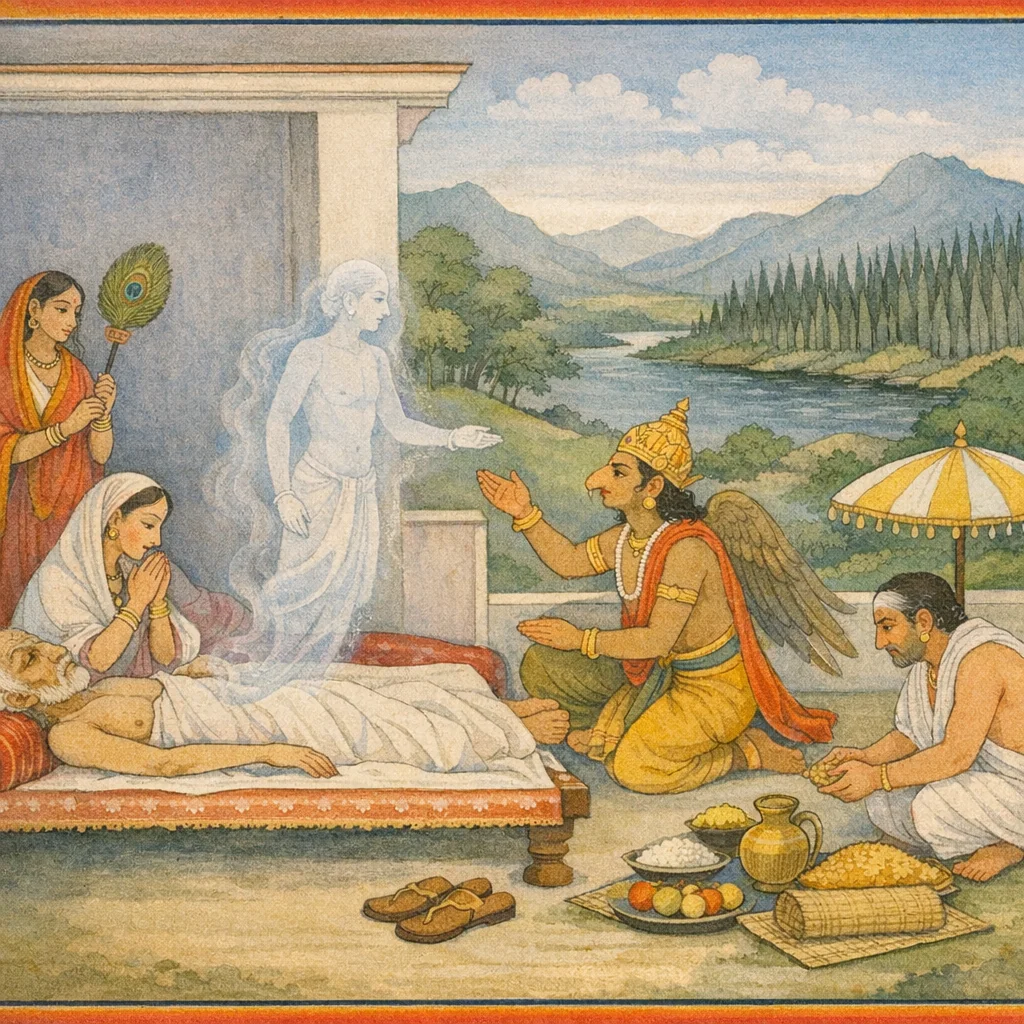
Kṛṣṇa answers Garuḍa by defining niṣkṛti (prāyaścitta, expiation) for sins done knowingly or unknowingly, and by prescribing preliminary purifications. He then teaches dāna as a graded remedy: the ten principal gifts (cow, land, sesame, gold, ghee, clothing, grain, jaggery, silver, salt) and the “eight great gifts,” along with deathbed path-articles (umbrella, footwear, water-pot, seat, provisions, etc.). These are aligned with the soul’s post-mortem journey—crossing Vaitaraṇī, facing heat, the thorny Asipatravana, thirst, and Yama’s messengers—showing how each donation grants a specific protection. The chapter then explains what occurs between death and cremation: washing and clothing the body, ekoddiṣṭa śrāddha, piṇḍa/udaka offerings, worship of the cremation-fire Kravyāda, and post-cremation restraint, including moderation in lamentation. Special passages address inauspicious or untimely deaths and missing remains: Nārāyaṇa-bali at a tīrtha with Vaiṣṇava mantras, making and cremating an effigy (puttalaka), and penances such as kṛcchra, taptakṛcchra, and sāntapana. It closes with cautions about pañcaka nakṣatra and exceptional rules for deaths during menstruation or childbirth, preparing for later chapters on the preta’s yearly rites and the ordered afterlife itinerary.
Shlokas
Verse 1
नाम तृतीयो ऽध्यायः श्रीकृष्ण उवाच / ज्ञानतो ऽज्ञानतो वापियन्नरैः कलुषं कृतम् / तस्य पापस्य शुद्ध्यर्थं विधेया निष्कृतिर्नरैः
Śrī Kṛṣṇa said: Whether knowingly or unknowingly, whatever defilement people have committed—so that sin may be purified, human beings should perform niṣkṛti, the prescribed expiatory remedy.
Verse 2
भस्मादिस्नानदशकमादौ कुर्याद्विचक्षणः / यथाशक्ति षडब्दादिप्रत्याम्नायाच्चरेदपि
At the outset, the discerning person should perform the ten purificatory bath-observances beginning with the use of sacred ash; and, according to one’s capacity, one should also undertake the prescribed discipline—such as the six-year observance and the like—taught in the tradition.
Verse 3
तदर्धं वा तदर्धं वा तदर्धार्धमथापि वा / यथाशक्त्या ततः कुर्याद्दश दानानि वै शृणु
Or one may give half of that, or again half of that, or even a quarter; then, according to one’s capacity, one should perform the ten prescribed gifts—listen to them.
Verse 4
गोभूतिलहिरण्याज्यवासोधन्यगुडास्तथा / रजतं लवणं चैव दानानि दश वै विदुः
They declare that the ten principal gifts (dānas) are: a cow, land, sesame, gold, ghee, clothing, grain, jaggery, silver, and salt.
Verse 5
प्रायश्चित्ते त्वागता ये तेभ्यो दद्यान्नरो दश / ततो यमद्वारपथे पूयशोणितसंकुले
To those who have come seeking expiation, one should give ten offerings. Thereafter, on the road leading to Yama’s gate, there is a path crowded with pus and blood.
Verse 6
नदीं वैतरणीं तर्तुं दद्याद्वैतरणीं च गाम् / कृष्णस्तनी सकृष्णाङ्गी सा वै वैतरणी स्मृता
To cross the river Vaitaraṇī, one should give the “Vaitaraṇī cow” in donation. That cow—black-breasted and black-limbed—is indeed known as the Vaitaraṇī (cow).
Verse 7
तिला लोहं हिरण्यं च कर्पासं लवणं तथा / सप्तधान्यं क्षितिर्गाव एकैकं पावनं स्मृतम्
Sesame seeds, iron, gold, cotton, and salt—together with the seven grains, land, and cows—each, taken singly, is remembered as a purifier in rites such as śrāddha and sacred charity.
Verse 8
एतान्यष्टौ महादानान्युत्तमाय द्विजातये / आतुरेण तु देयानि पदरूपाणि मे शृणु
These are the eight great gifts (mahādāna), to be bestowed upon an excellent twice-born brāhmaṇa. Now hear from me the specific items that one at the point of death should give.
Verse 9
छत्रो पानहवस्त्राणि मुद्रिका च कमण्डलुः / आसनं भाजनं पदं चाष्टविधं स्मृतम्
An umbrella, footwear, garments, a signet ring, and a kamaṇḍalu (water-pot); also a seat, a vessel, and provisions for the journey—these are remembered as the eight essential articles.
Verse 10
तिलापात्रं सर्पिः पात्रं शय्या सोपस्करा तथा / एतत्सर्वं प्रदातव्यं यदिष्टं चात्मनो ऽपि तत्
A vessel of sesame, a vessel of ghee, and a bed furnished with its accessories—all these should be given in charity; even what is dear to oneself should also be donated.
Verse 11
अश्वो रथश्च महीषी व्यञ्जनं वस्त्रमेव च / ब्राह्मणेभ्यः प्रदातव्यं ब्रह्मपूर्वमपि स्वयम्
A horse, a chariot, a buffalo, prepared foods, and clothing should be given to brāhmaṇas as gifts; and first of all, one should offer oneself—by honoring Brahman, the Sacred, before everything else.
Verse 12
दाना न्यन्यान्यपि खग तर्पयेत्स्वीयशक्तितः / प्रायाश्चित्तं कृतं येन दश दानान्यपि क्षितौ
O Bird (Garuda), one should also satisfy the prescribed recipients through other gifts, according to one’s own capacity. By this, expiation (prāyaścitta) is fulfilled—indeed, upon the earth even ten kinds of charitable giving are to be performed for purification.
Verse 13
दानं गोर्वैतरण्याश्च दानान्यष्टौ तथापि वा / तिलपात्रं सर्पिः पात्रं शय्यादानं तथैव च
One should perform the gift of a cow for crossing the Vaitaraṇī, the dreadful river of the afterlife, and likewise the eight prescribed gifts—such as a vessel of sesame, a vessel of ghee, and the gifting of a bed.
Verse 14
पददानं च विधिवन्नासौ निरयगर्भगः / स्वातन्त्र्येणापि लवणदानमिच्छन्ति सूरयः
If the gift of footwear is properly performed according to rule, that person does not fall into the womb of hell. Therefore, even of one’s own accord, the wise recommend the gifting of salt.
Verse 15
विष्णुदेहसमुत्पन्नो यतो ऽयं लवणो रसः / आतुरस्य यदा प्राणा न यान्ति वसुधातले
Because this salty essence is said to arise from the body of Viṣṇu, when a person is severely afflicted and their vital breaths (prāṇa) do not depart upon the surface of the earth, this principle is recalled and observed.
Verse 16
लवणं च तदा देयं द्वारस्योद्वाटनं दिवः / यानिकानि च दानानि स्वयं दत्तानि मानवैः
At that time, salt should indeed be given; it becomes like an opening of the gate of heaven. And whatever gifts humans have given by their own hand—those donations too become beneficial.
Verse 17
तानितानि च सर्वाणि उपतिष्ठन्ति चाग्रतः / प्रायश्चित्तं कृतं येन साङ्गं खग स वै पुमान्
All those prescribed rites and supports stand ready before him. O Khaga (Garuda), that man indeed is the one who has performed prāyaścitta—atonement—completely, with all its required parts.
Verse 18
पापानि भस्मसात्कृत्वा स्वर्गलोके महीयते / अमृतं तु गवां क्षीरं यतः पतगसत्तम्
Having reduced sins to ashes, one is honored in the heavenly world. For the milk of cows is verily like nectar (amṛta), O best of birds.
Verse 19
तस्माद्ददाति यो धेनुममृतत्वं स गच्छति / दानान्यष्टौ तु दत्त्वा वै गन्धर्वनिलये वसेत्
Therefore, whoever gives a cow in charity attains immortality. And having indeed given the eight kinds of gifts, one dwells in the abode of the Gandharvas.
Verse 20
आलयस्तत्र रौद्रे हि दह्यते येन मानवः / छत्रदानेन सुच्छाया जायते पथि तुष्टिदा
In that fierce, sun-scorched realm, a person is burned by blazing heat; but by the gift of an umbrella, a cool and pleasing shade arises on the journey, bringing comfort.
Verse 21
असिपत्रवनं धारमतिक्रामति वै सुखम् / अश्वारूढश्च व्रजति ददते यद्युपानहौ
He crosses the razor‑edged Asipatravana thicket with ease, and he proceeds mounted on a horse, if footwear has been given as a gift.
Verse 22
भोजनासनदानेन सुखं मार्गे भुनक्ति वै / प्रदेशे निर्जले दाता सुखी स्याद्वै कमण्डलोः
By the gift of food and a seat, one truly enjoys comfort along the journey. And in a waterless region, the giver becomes happy indeed through the merit of donating a kamaṇḍalu, a sacred water-pot.
Verse 23
यमदूता महारौद्राः करालाः कृष्णपिङ्गलाः / न पीडयन्ति दाक्षिण्याद्वस्त्राभरणदानतः
Yama’s messengers—fierce, terrifying, and dark-hued—do not torment the departed, because of kindness shown through the gifting of garments and ornaments.
Verse 24
तिलपात्रं तु विप्राय दत्तं पत्ररथ ध्रुवम् / नाशयेत्त्रिविधं षापं वाङ्मनः कायसम्भवम्
O Garuḍa, whose chariot is swift: a vessel of sesame (tilapātra), when surely given to a brāhmaṇa, destroys the threefold curse arising from speech, mind, and body.
Verse 25
घृतपात्रप्रदाने रुद्रलोके वसेन्नरः / सर्वोपस्करसंयुक्तां शय्यां दत्त्वा द्विजातये
By donating a vessel of ghee (ghṛta), a man dwells in Rudra’s realm; and by giving a bed furnished with all necessary accessories to a twice-born (brāhmaṇa), he attains the corresponding merit.
Verse 26
नानाप्सरोभिराकीर्णं विमानमधिरोहति / षष्टिवर्षसहस्राणि क्रीडित्वा शक्रमन्दिरे
He ascends a celestial vimāna filled with many apsarās, and, having enjoyed himself in Śakra’s (Indra’s) divine abode, sports there for sixty thousand years.
Verse 27
इन्द्रलोकात्परिभ्रष्ट इह लोके नृपो भवेत् / सर्वोपस्करणोपेतं युवानं दोषवर्जितम्
Fallen from Indra’s heavenly realm, he is born here in the human world as a king—endowed with every requisite and resource, youthful, and free from defects.
Verse 28
यो ऽश्वं ददाति विप्राय स्वर्गलोके च तिष्ठति / यावन्ति रोमाणि हये भवन्ति हि खगेश्वर
O Khageśvara (lord of birds), whoever donates a horse to a brāhmaṇa dwells in the heavenly world for as many years as there are hairs on that horse.
Verse 29
तावतो राजितांल्लोकानाप्नुवन्ति हि पुष्कलान् / चतुर्भिस्तुरगैर्युक्तं सर्वोपकरणैर्युतम्
For that long, indeed, they attain many splendid, radiant worlds; and they obtain a chariot yoked with four horses, furnished with every requisite equipment.
Verse 30
रथं द्विजातये दत्त्वा राजसूयफलं लभ्त्
By gifting a chariot to a twice-born (a qualified brāhmaṇa), one attains the merit equal to that of performing the Rājasūya sacrifice.
Verse 31
दुग्धाधिकां च महिषीं नवमेघवर्णां सन्तुष्टतर्णकवलीं जघनाभिरामाम् / दत्त्वा सुवर्णतिलकां द्विजपुङ्गवाय लोकोदयं स जयतीति किमत्र चित्रम्
Having gifted to an eminent brāhmaṇa a milk-abundant she-buffalo—dark as a fresh raincloud, content with her calf, and comely in form—adorned with a golden forehead-mark, if the donor attains the rise of auspicious worlds and prospers thereby, what is surprising in that?
Verse 32
तालवृन्तस्य दानेन वायुना वीज्यते पथि / कान्तियुक् सुभगः श्रीमान् भवत्यम्बरदानतः
By gifting a palm-leaf fan, one is fanned by a cool breeze along the path. By donating clothing, one becomes radiant, fortunate, and endowed with prosperity (Śrī).
Verse 33
रसान्नोपस्करयुतं गृहं विप्राय योर्ऽपयेत् / न हीयते तस्य वंशः स्वर्गं प्राप्नोत्यनुत्तमम्
Whoever offers to a brāhmaṇa a house furnished with provisions—food rich in taste and the necessary household articles—his lineage does not decline, and he attains the unsurpassed heaven.
Verse 34
भवत्यत्र खगश्रेष्ठ फलगौखलाघवम् / श्रद्धाश्रद्धाविभेदेन दानगौरवलाघवात्
Here, O best of birds (Garuda), the fruit becomes weighty or light; due to the difference between faith and lack of faith, and due to the donation’s being substantial or meagre.
Verse 35
ततो येनाम्बुदानानि कृतान्यत्र रसास्तथा / तदा खग तथाह्लादमापदि प्रतिपद्यते
Then, O Bird (Garuda), by whomsoever water-offerings are performed here in this world—and likewise offerings of refreshing liquids—at that time the distressed one attains that very relief and consolation.
Verse 36
अन्नानि येन दत्तानि श्रद्धापूतेन चेतसा / सो ऽपि तृप्तिमवाप्नोति विनाप्यन्नेन वै तदा
He who has given food with a mind purified by faith—he too attains satisfaction then, even without personally consuming food.
Verse 37
आसन्ने मरणे कुर्यात्संन्यासं चेद्विधानतः / आवर्तेत पुनर्नासौ ब्रह्मभूयाय कल्पते
When death is near, if one undertakes saṃnyāsa according to the prescribed rule, that person does not return again to rebirth; he becomes fit to attain the Brahman-state, liberation.
Verse 38
आसन्नमरणो मत्यश्चेत्तीर्थं प्रतिनयिते / तीर्थप्राप्तौ भवेन्मुक्तिर्म्रियते यदि मार्गगः / पदेपदे क्रतुसमं भवेत्तस्य न संशयः
If a mortal near death is escorted toward a sacred tīrtha, then upon reaching that tīrtha there is liberation. Even if he dies on the way, at every step of that journey he gains merit equal to a Vedic sacrifice—of this there is no doubt.
Verse 39
गृह्णीयाच्चेदनशनं व्रतं विधिवदागते / मृत्यौ न सो ऽपि संसारे भूयः पर्यटति द्विज
O twice-born one, if, when the appointed time has come, a person duly undertakes the vow of fasting (anāśana), then even at the moment of death he does not wander again in this saṃsāra.
Verse 40
किं दानमिति तुर्यस्य प्रश्नस्योत्तरमीरितम् / दाहमृत्योरन्तरे किमितिप्रश्नोत्तरं शृणु
Thus the answer to the fourth question—“What is dāna (charitable giving)?”—has been stated. Now listen to the answer to the question: “What occurs in the interval between death and cremation?”
Verse 41
गतप्राणं ततो ज्ञात्वा स्नात्वा पुत्रादिराशु तम् / शवं जलेन शुद्धेन क्षालयेदविचारयन्
Knowing that the life-breath has departed, the son and other relatives should promptly bathe and, without hesitation, wash the corpse with pure water.
Verse 42
परिधाप्याहते वस्त्रे चन्दनैः प्रोक्षयेत्तनुम् / ततो मृतस्य स्थाने वै एकोद्दिष्टं समाचरेत्
Having clothed the body in a fresh, unwashed garment, one should sprinkle it with sandalwater; thereafter, in the place of the deceased, one should duly perform the ekoddiṣṭa rite—the śrāddha offered to a single departed person.
Verse 43
प्रयोगपूर्वं दाहस्य योग्यतादिर्यथा भवेत् / आंसनं प्राक्षण च स्यान्न स्यादेतच्चतुष्टयम्
Before the rite is undertaken, one should ascertain the fitness and other prerequisites for cremation. Proper arranging/placing and the sprinkling of water should be present; without these, this fourfold set of preliminaries is not complete.
Verse 44
आवाहनार्चन चैव पान्त्रालम्भावगाहने / भवेद्दानान्नसङ्कल्पः पिण्डदानं सदा भवेत्
At the rites of invocation (āvāhana) and worship (arcana), and during the bathing/immersion performed in the funeral observances, one should make the saṅkalpa to give food in charity; and the offering of piṇḍas—rice-balls for the departed—should always be performed.
Verse 45
पदार्थपञ्चकं न स्याद्रेखा प्रत्यवनेजनम् / दद्यादक्षय्यमुदकं न स्यादेतत्त्रयं पुनः
The “five requisite items” should not be omitted; the marking of lines and the counter-washing (ritual cleansing) should also not be neglected. One should offer the “inexhaustible water” (akṣayya-udaka); again, these three must not be left undone.
Verse 46
स्वधावाचनमाशीश्च तिलकं च खगोत्तम / घटं दद्यात्समाषान्नं दद्याल्लोहस्य दक्षिणाम्
One should recite the sacred “svadhā” formula and offer blessings; and, O Garuḍa, best of birds, apply the tilaka. One should donate a water-pot and give food prepared with mixed grains; and one should also give a dakṣiṇā—an offering of iron.
Verse 47
पिण्डस्य चालनं प्रोक्तं नैव प्रोक्तमिदं त्रिकम् / प्रच्छादनविसर्गौ च स्वस्तिवाचनकं तथा
The shifting of the piṇḍa-offering is indeed prescribed; yet this triad is not declared obligatory: the covering and the releasing (of the offering), and likewise the recitation of auspicious benedictions (svasti).
Verse 48
एषु षट्सु विधिः प्रोक्तः श्राद्धेषु मलिनेषु ते / षडेव मरणस्थाने द्वारि चात्वरिके तथा
For these six situations the procedure is taught—namely for impure or irregular śrāddha rites. These same six apply as well at the place of death, at the doorway, and likewise at the crossroads (chātvārika).
Verse 49
विश्रामे काष्ठचयने तथा सञ्चयने खग / मृतिस्थाने शवो नाम भूमिस्तुष्यति देवता
O Bird (Garuda), at the resting-place, at the piling of the funeral wood, and likewise at the gathering (of the remains), at the place of death the divine potency of Earth is pleased by what is called a “śava,” a corpse.
Verse 50
पान्थो द्वारि भवेत्तेन प्रीता स्याद्वास्तुदेवता / चत्वरे खेचरस्तेन तुष्येद्भृतादिदेवता
By doing so, a traveller (guest) will come to one’s doorway, and the Vāstu-devatā, the presiding deity of the dwelling, becomes pleased. Likewise, at the crossroads the sky-moving beings are satisfied, and the deities beginning with Bhṛta are gratified.
Verse 51
विश्रामे भूतसंज्ञो ऽयं तुष्टस्तेन दिशो दश / चितायां साधक इति सञ्चितौ प्रेत उच्यते
At the stage of rest, this departed one is called a bhūta, and when satisfied he blesses the ten directions. Upon the funeral pyre (citā) he is called a sādhaka; and when the remains have been gathered, he is spoken of as a preta.
Verse 52
तिलदर्भघृतेधांसि गृहीत्वा तु सुतादयः / गाथां यमस्य सूक्तं वाप्यधीयाना व्रजन्ति हि
Taking sesame, darbha grass, ghee, and firewood, the sons and other kinsmen proceed, reciting on the way a gāthā of Yama or a fitting sacred chant.
Verse 53
अहरहर्नीयमानो गामश्वं पुरुषं वृषम् / वैवस्वतो न तृप्येत सुरया त्विव दुर्मतिः
Day after day, as cows, horses, men, and bulls are carried off, Vaivasvata (Yama) is never satisfied—like a wicked-minded person who cannot be sated even with liquor.
Verse 54
इमां गाथमपेतेति सूक्तं वा पथि संपठेत् / दक्षिणस्यां दिश्यरण्यं व्रजेयुः सर्वबान्धवाः
On the way, one should recite this verse—“Depart (from here)”—or a fitting hymn; and all the relatives should proceed toward the forest in the southern direction.
Verse 55
पथि श्राद्धद्वयं कुर्यात्पूर्वोक्तविधिना खग / ततः शनैर्भूतले वै दक्षिणाशिरसं शवम्
O Bird (Garuda), one should perform the two śrāddhas on the way, according to the procedure already described. Then, slowly, one should place the corpse upon the ground with its head turned to the south.
Verse 56
स्थापयित्वा चिताभूमौ पूर्वोक्तं श्राद्धमाचरेत् / तृणकाष्ठतिलाज्यादि स्वयं निन्युः सुतादयः
Having arranged the pyre-ground at the cremation place, one should perform the previously described śrāddha. The sons and other relatives themselves should bring the grass, firewood, sesame, ghee, and related items.
Verse 57
शूद्रानीतैः कृतं कर्म सर्वं भवति निष्फलम् / प्राचीनावीतिना भाव्यं दक्षिणाभिमुकेन च
Any rite performed with items brought by a Śūdra becomes wholly fruitless. Therefore the performer should wear the sacred thread in the prācīnāvīta manner, as for the ancestors, and perform it facing south, the direction of the Pitṛs.
Verse 58
वेदी तत्र प्रकर्तव्या यथाशास्त्रमथाण्डज / प्रतेवस्त्रं द्विधा कृत्वार्धेन तं छादयेत्ततः
O Egg-born Garuda, there the ritual altar should be prepared in accordance with the śāstras. Then, taking the cloth meant for the departed and folding it in two, one half should thereafter be used to cover him.
Verse 59
अर्धं श्मशानवासार्थं भूमावेव विनिः क्षिपेत् / ततः पूर्वोक्तविधिना पिण्डं प्रेतकरे न्यसेत्
He should place half of it upon the ground, meant for the departed one’s sojourn at the cremation-ground. Then, by the method stated earlier, he should set the piṇḍa— the rice-ball offering—into the “hand of the preta,” as an oblation for the departed spirit.
Verse 60
आज्येनाभ्यञ्जनं कार्यं सर्वाङ्गेषु शवस्य च / दाहमृत्योरन्तराले विधिः पिण्डस्य तं शृणु
The corpse should be anointed with ghee over all its limbs. Now hear the prescribed procedure for offering the piṇḍa during the interval between death and cremation.
Verse 61
पूर्वोक्तैः पञ्चभिः पिण्डैः शवस्याहुतियोग्यता / अन्यथा चोपघाताच्च राक्षसाद्या भवन्ति हि
By the five piṇḍas described earlier, the corpse becomes fit to receive the funeral offerings. Otherwise, through neglect and injury to the rite, it indeed turns into beings such as rākṣasas and the like.
Verse 62
संमृज्य चोपलिप्याथ उल्लिख्योद्धृत्य वेदिकाम् / अभ्युक्ष्योपसमाधाय वह्निं तत्र विधानतः
Having swept the place and smeared it with a purifying coating, one should mark out and prepare the altar-platform; then, having sprinkled it with water, one should duly kindle and establish the sacred fire there according to the prescribed rite.
Verse 63
पुष्पाक्षतैश्च संपूज्य देवं क्रव्यादसंज्ञकम् / श्रौतेन तु विधानेन ह्याहिताग्निं दहेद्वुधः
Having duly worshipped the deity known as Kravyāda with flowers and unbroken rice-grains, the wise person should then cremate the āhitāgni—one who has maintained the sacred fires—according to the śrauta (Vedic) procedure.
Verse 64
चण्डालाग्निं चिताग्निं च पतिताग्निं परित्यजेत् / त्वं भूतकृज्जगद्योनिस्त्वं लोकपरिपालकः
One should avoid the fire of a caṇḍāla, the fire of a funeral pyre (citāgni), and the fire associated with the fallen (patita). You are the creator of beings, the womb and source of the universe; you are the protector and ruler of the worlds.
Verse 65
उपसंहर तस्मात्त्वमेनं स्वर्गं नयामृतम् / इति क्रव्यादमभ्यर्च्य शरीराहुतिमाचरेत्
“Therefore, gather him up and lead this immortal one to heaven.” Having thus worshipped Kravyāda—the flesh-eating fire, the cremation fire—one should perform the offering of the body as an oblation (āhuti).
Verse 66
अर्धदग्धे तथा देहे दद्यादाज्याहुतिं ततः / अस्मात्त्वमधिजातो ऽसि त्वदयं जायतां पुनः
When the body has been only half-burnt, one should then offer an oblation of ghee. (Saying:) “From this you have arisen; may this body be born again through you.”
Verse 67
असौ स्वर्गाय लोकाय स्वाहेत्युक्त्वा तु नामतः / एवमाज्याहुतिं दत्त्वा तिलमिश्रां समन्त्रकम्
Uttering the person’s name and saying, “Svāhā—may this reach the heavenly world,” one should thus offer an oblation of ghee mixed with sesame, accompanied by the proper mantra.
Verse 68
रोदितव्यं ततो गाढमेवं तस्य सुखं भवेत् / दाहस्यानन्तरं तत्र कृत्वा सञ्चयनिक्रियाम्
Therefore one should weep deeply; by doing so, comfort arises for that departed one. Then, after the cremation, one should there perform the rite of collection and gathering of the remains.
Verse 69
प्रेतपिण्डं प्रदद्याच्च दाहार्तिशमनं खग / ततः प्रदक्षिणं कृक्त्वा चिताप्रस्थानवीक्षकाः
O Bird (Garuda), one should offer the preta-piṇḍa, which alleviates the suffering caused by the burning of the funeral pyre. Then, having circumambulated in the auspicious direction, they should depart while looking toward the place where the pyre is set forth.
Verse 70
कनिष्ठपूर्वाः स्नानार्थं गच्छेयुः सूक्तजापकाः / ततो जालसमीपे तु गत्वा प्रक्षाल्य चांशुकम्
The youngest should go first for bathing, while the reciters of sacred hymns proceed. Then, having gone near the water-source, one should wash and cleanse the cloth as well.
Verse 71
परिधाय पुनस्तच्च ब्रृयुस्तं पुरुषं प्रति / उदकं तु करिष्यामः सचैलं पुरुषास्ततः
Having clothed him again with that garment, those men should then say to that person: “Now we shall perform the water-offering (udaka)”; and thereafter they should proceed, keeping the cloth as part of the rite.
Verse 72
कुरुध्वमित्येव वदेच्छतवर्षावरे मृते / पुत्राद्या वृद्धपूर्वास्ते एकवस्त्राः शिखां विना
When one dies after completing a hundred years, one should simply say, “Perform the rites.” Then the sons and other kin—beginning with the eldest—should undertake the observances wearing a single garment and without the śikhā (tuft of hair).
Verse 73
प्राचीनावीतिनः सर्वे विशेयुर्मौनिनो जलम् / अपनः शोशुचदघमनेन पितृदिङ्मुखाः
All should enter the water in the prācīnāvīta manner (with the sacred thread worn for rites to the Pitṛs), remaining silent and facing the direction of the Pitṛs; by this act the impurity of sin is dried up and cleansed away.
Verse 74
जलावघट्टनं चव न कुर्युः स्नानकारकाः / ततस्तटे समागत्य शिखां बद्ध्वा ऋजून् कुशान्
Those performing the ritual bath should not agitate or splash the water. Then, coming to the riverbank, having tied up the śikhā (topknot), they should take straight darbha (kuśa) grasses in hand.
Verse 75
दक्षिणाग्रहस्तयोस्तु कृत्वाथ सतिलं जलम् / आदायाञ्जलिना याम्यां दुः खी पैतृकतीर्थतः
Then, placing the offering into the right hand and holding it properly, he takes water mixed with sesame in a cupped palm (añjali); the afflicted departed one proceeds southward, away from the ancestral sacred ford (paitṛka-tīrtha), toward Yama’s direction.
Verse 76
एकवारं त्रिवारं वा दशवारमथापि वा / भूमावश्मनि वा सर्वे क्षिपेयुर्वाग्यताः खग
Once, or three times, or even ten times—let all the participants in silence, O Bird (Garuda), cast the prescribed offering either upon the ground or upon a stone.
Verse 77
तृप्यन्तु तृप्यतां वापि तर्पयाम्युपतिष्ठताम् / प्रेतैतदमुकगोत्रेत्युक्तेष्वेवं समुच्चरेत्
May they be satisfied; or may they become satisfied. I offer this water-libation (tarpana)—may they be present and accept it. When the formula is to be recited as “O preta named …, of the gotra …,” it should be uttered in this very manner.
Verse 78
जलाञ्जलौ कृते पश्चाद्विधेयं दन्तधावनम् / त्यजन्ति गोत्रिणः सर्वे दिनानि नव काश्यप
After offering the water-oblation (jalāñjali), one should then perform the cleansing of the teeth. O Kāśyapa, all who belong to the same gotra refrain from this act for nine days.
Verse 79
तत उत्तीर्योदकाद्वै वस्त्राणि परिधाय च / स्नानवस्त्रं सकृत्पीड्य विशेयुः शुचिभूतले
Then, having come up out of the water, they should put on their garments; and after squeezing the bathing cloth once, they should sit down upon a clean and purified spot of ground.
Verse 80
अश्रुपातं न कुर्वीत दत्त्वा दाहजलाञ्जलिम् / श्लेष्माश्रु बान्धवैर्मुक्तं प्रेतो भुङ्क्ते यतो ऽवशः
After offering the water-libation connected with the cremation rites (dāha-jalāñjali), one should not let tears fall. For the preta, helpless, is said to consume the mucus and tears released by the relatives.
Verse 81
अतो न रोदितव्यं हि क्रियाः कार्याः स्वशक्तितः / ततस्तेषूपविष्टेषु पुराणज्ञः सुकृत्स्वकः
Therefore one should not weep; rather, the prescribed funerary rites should be performed according to one’s capacity. Then, when those people have taken their seats, a knower of the Purāṇas—virtuous and devoted to right conduct—should instruct them.
Verse 82
शोकापनोदं कुर्वीत संसारानित्यतां ब्रुवन् / मानुष्ये कदलीस्तन्भे असारे सारमार्गणम्
Let one dispel grief by proclaiming the impermanence of worldly saṃsāra. Human life is like the trunk of the banana plant—without an enduring core—therefore one should seek the true essential within what is, by nature, insubstantial.
Verse 83
करोति यः स संमूढो जलबुद्वद्रसन्निभे / पञ्चधा संभृतः कायो यदि पञ्चत्वमागतः
Whoever busies himself only with this body is deluded, for it is like a water-bubble—momentary and without substance. Since the body is compounded of the five elements, it inevitably returns to the state of the five.
Verse 84
कर्मभिः स्वशरीरोत्थैस्तत्र का परिदेवना / गन्त्री वसुमती नाशमुदधिर्दैवतानि च
When one’s own deeds—born of one’s very body—are bearing fruit there, what room is left for lamentation? The earth that bears all beings, destruction, the ocean, and even the deities themselves are subject to this very order.
Verse 85
फेनप्रख्यः कथं नाशं मर्त्यलोको न यास्यति / एवं संश्रावयेत्तत्र मृदुशाद्वलसंस्थितान्
“Human life is like foam—how could the world of mortals not pass into destruction?” Speaking thus, one should gently cause those seated upon the soft grass to listen and understand.
Verse 86
ते ऽयि संश्रुत्य गच्छेयुर्गृहं बालपुरः सराः / विदश्य र्निबपत्राणि नियता द्वारि वेश्मनः
Hearing that summons, they would go to the house—those attendants of childlike simplicity. Having set down the written leaves (the records), they remain stationed at the doorway of the dwelling.
Verse 87
आचम्य वह्निसलिलं गोमयं गौरसर्षपान् / दूर्वाप्रवालं वृषभमन्यदप्यथ मङ्गलम्
Having performed ācamana (the ritual sipping for purification), one should arrange the auspicious items—fire and water, cow-dung, white mustard seeds, dūrvā grass and fresh sprouts, a bull, and whatever else is held to be propitious.
Verse 88
प्रविशेयुः समालभ्य कृत्वाश्मनि पदं शनैः / श्रौतेन तु विधानेन आहिताग्निं देहद्वधः
Supporting the body and taking footing upon a stone, step by step and slowly, they should proceed into the rite. But for one who has established the sacred fires (āhitāgni), the disposal of the body is to be performed according to the Śrauta (Vedic) procedure.
Verse 89
ऊनद्विवर्षं निखनेन्न कुर्यादुदकं ततः / योषित्पतिव्रता या स्याद्भर्तारं यानुगच्छति
One should not bury a body that is less than two years old, nor perform the water-offering rites (udaka) for it. A woman who is truly pativratā—devoted in fidelity to her husband—follows her husband in destiny.
Verse 90
प्रयोग पूर्वं भर्तारं नमस्कृत्यारुहेच्चितिम् / चितिभ्रष्टा तु या मोहात्सा प्राजापत्यमाचरेत्
Before the rite is carried out, having bowed in reverence to her husband, she should ascend the funeral pyre (citi). But if, through delusion, she slips or falls from the pyre, then she should perform the Prājāpatya expiation.
Verse 91
तिस्रः कोट्योर्धकोटी य यानि लोमानि मानुषे / तावत्कालं वसेत्स्वर्गे भर्तारं यानुगच्छति
For as many years as there are three crores and a half-crore of hairs on a human body, so long does she dwell in heaven—the woman who faithfully follows her husband.
Verse 92
व्यालग्राही यथा व्यालं बिलादुद्धरते बलात् / तद्वदुद्धृत्य सा नारी तेनैव सह मोदते
Just as a snake-catcher forcefully pulls a serpent up from its burrow, so too that woman is drawn out from her plight and then rejoices together with that very one who drew her out.
Verse 93
तत्र सा भर्तृपरमा स्तूयमानाप्सरोगणैः / क्रीडते पतिना सार्धं यावदिन्द्राश्चतुर्दश
There, that woman—supremely devoted to her husband—praised by hosts of Apsarās, enjoys and plays together with her husband for as long as fourteen Indras, that is, through fourteen Indra-cycles.
Verse 94
ब्रह्मघ्नो वा कृघ्नो वा मित्त्रिघ्नो वा भवेत्पतिः / पुनात्यविधवा नारी तमादाय मृता तु या
Even if a husband is a slayer of a brāhmaṇa, a killer of the righteous, or a murderer of a friend, the faithful wife who dies before becoming a widow purifies him, taking him along to a higher state.
Verse 95
मृते भर्तरि या नारी समारोहेद्धुताशनम् / सारन्धतीसमाचारा स्वर्गलोके महीयते
When her husband has died, the woman who ascends the blazing fire—conducting herself like Arundhatī—is honored in the heavenly world.
Verse 96
यावच्चाग्नौ मृते पत्यौ स्त्री नात्मानं प्रदाहयेत् / तावन्न मुच्यते सा हि स्त्रीशरीरात्कथञ्चन
So long as, when her husband has died, a woman does not burn herself in the fire, so long indeed she is not released in any way from the condition of a woman’s body.
Verse 97
मातृकं पैतृकं चैव यत्र चैव प्रदीयते / कुलत्रयं पुनात्येषा भर्तारं यानुगच्छति
Where offerings are duly given to both the maternal and paternal lines, that devoted wife—who follows her husband in dharma—purifies the threefold lineage.
Verse 98
आर्तार्ते मुदिते हृष्टा प्रोषिते मलिना कृशा / मृते म्रियेत या पत्यौ सा स्त्री ज्ञेया पतिव्रता
She who is distressed when her husband is distressed, joyful when he is joyful, radiant when he is pleased; who becomes unadorned and thin when he is away; and who would even die when her husband dies—such a woman is to be known as a pativratā, devoted to her husband.
Verse 99
पृथक् चितां समारुह्य न प्रिया गन्तुमर्हति / क्षत्त्रियाद्याः सवर्णाश्च आरोहेयुरपीह ताः
Mounting a separate funeral pyre, the beloved wife is not permitted to go (i.e., to die with him). Here, women of the same social class—beginning with Kṣatriyas and others—should not ascend the pyre either.
Verse 100
चाण्डालीमवधिं कृत्वा ब्राह्मणीतः समो विधिः / अगर्भिणीनां सर्वासामबालताक्मे(का)नामपि
From a Caṇḍāla woman up to a Brāhmaṇa woman, the prescribed rule is the same; it applies to all women who are not pregnant, and also to those who are not afflicted by childhood fever/illness.
Verse 101
दहनस्य विधिः प्रोक्तः सामान्येन मया खग / विशेषमपि तस्यास्य कञ्चित्किं श्रोतुमिच्छति
O bird (Garuda), I have explained the procedure of cremation in a general way. Do you wish to hear any particular details of it as well?
Verse 102
गरुड उवाच / प्रोषिते तु मृते स्वामिन्यस्थ्निनाशमुपेयुषि / कथं दाहः प्रकर्तव्यस्तन्मे वद जगत्पते
Garuḍa said: “When the husband is away, and the mistress of the house (the wife) has died—her body having reached decay and dissolution—how should the cremation rites be performed? Tell me that, O Lord of the universe.”
Verse 103
श्रीकृष्ण उवाच / अस्थीनि चेन्न लभ्यन्ते प्रोषितस्य नरस्य च / तेषाञ्च हि गतिस्थानं विधानं कथयाम्यहम्
Śrī Kṛṣṇa said: “If the bones of a man who has died away from home are not obtained, then I shall explain the prescribed rite, and also the destination and resting-place that are ordained for him.”
Verse 104
शृणु तार्क्ष्य परं गोप्यं पत्युर्दुर्मरणेषु यत् / लङ्घनैर्ये मृता जीवां दंष्ट्रिभिश्चाभिघातिताः
Listen, O Tārkṣya (Garuḍa), to this supremely secret teaching of the Lord regarding evil and untimely deaths: those beings who die by being trampled down, and those struck down by fanged creatures.
Verse 105
कण्ठग्रहे विलग्नानां क्षीणानां तुण्डघातिनाम् / विषाग्निवृषविप्रेभ्यो विषूच्या चात्मघातकाः
Those who remain stuck in choking seizures, those wasted away and emaciated, those struck down by blows and injuries; those afflicted through poison, fire, cattle-related harm, or by offenses against brāhmaṇas; those seized by fierce epidemics like cholera, and even self-killers—all these are described as outcomes born of sinful causes.
Verse 106
पतनोद्बन्धनजलैर्मृतानां शृणु संस्थितिम् / सर्पव्याघ्रैः शृङ्गिभिश्च उपसर्गोपलोदकैः
Hear now the condition of the dead: how they are beset by falls, restraints, and torrents of water, and how they are afflicted by serpents, tigers, horned creatures, and other calamities and obstacles that arise on their way.
Verse 107
ब्राह्मणैः श्वापदैश्चैव पतनैर्वृक्षवैद्युतैः / नखैर्लोहैर्गिरेः पातैर्भित्तिपातैर्भृगोस्तथा
He is afflicted by (the curse or wrath of) Brāhmaṇas, by wild beasts, by falls, by trees and lightning; by claws and iron weapons, by falling from a mountain, by the collapse of walls, and likewise by falling from a precipice.
Verse 108
कट्वायामन्तरिक्षे च चौरचाण्डालतस्तथा / उदक्याशुनकीशूद्ररजकादिविभूषिताः
In the Kaṭvā region and also in the mid-air (antarikṣa), there are likewise beings associated with thieves and with cāṇḍālas, marked by the company of menstruating women, female dogs, Śūdras, washermen, and the like.
Verse 109
ऊर्ध्वोचछिष्टाधरोच्छिष्टोभयोच्छिष्टास्तु ये मृताः / शस्त्रघातैर्मृता ये चास्यश्वस्पृष्टास्तथैव च
Those who die in a state of impurity—whether with the upper part (mouth/head) defiled, the lower part defiled, or both defiled; as well as those who die from the blow of weapons, and those who are likewise struck down by a horse—are counted among the special classes of deaths described here.
Verse 110
तत्तु दुर्मरणं ज्ञेयं यच्च जातं विधैं विना / तेन पापेन नरकान् भुक्त्वा प्रेतत्वभागिनः
Know this to be an ‘ill death’ (durmaraṇa): when one dies without the prescribed rites. By that sin, after experiencing the hells, the being becomes a partaker of the state of a preta, a restless departed spirit.
Verse 111
न तेषां कारयेद्दाहं सूतकं नोदकक्रियाम् / न विधानं मृताद्यञ्च न कुर्या दौर्ध्वदैहिकम्
For such persons one should not arrange cremation, nor observe sūtaka (ritual impurity), nor perform the water-rites (udaka-kriyā). Nor should one undertake the prescribed ceremonies beginning with death, nor perform the aurdhva-dehika, the post-funeral rites meant for the departed.
Verse 112
न पिण्डदानं कर्तव्यं प्रमादाच्चेत्करोति हि / नोपतिष्ठति तत्सर्वमन्तरिक्षे विनश्यति
The piṇḍa-offering (piṇḍa-dāna) should not be performed carelessly; for when done through negligence it does not reach the intended recipient. All of it perishes in the mid-space (antarikṣa), the intermediate realm.
Verse 113
अतस्तस्य सुतैः पौत्त्रैः सपिण्डैः शुभमिच्छुभिः / नारायणबलिः कार्यो लोकगर्हाभिया खग
Therefore, by his sons, grandsons, and other sapinda kinsmen who seek his welfare, the Nārāyaṇa-bali offering should be performed—O Bird (Garuda)—out of fear of public reproach.
Verse 114
तथा तेषां भवेच्छौचं नान्यथेत्यब्रवीद्यमः / कृते नारायणबलावौर्ध्वदेहिकयोग्यता
“Therefore, for them, śauca—ritual purity—must be observed, and never otherwise,” declared Yama. “When the Nārāyaṇa-bali rite is duly performed, one becomes fit for the subsequent post-death rites (ūrdhva-dehika).”
Verse 115
तस्य सुद्धिकरं कर्म तद्भवेन्न तदन्यथा / नारायणबलिं सम्यक् तीर्थे सर्वं प्रक्पयेत्
That rite alone becomes the purifying act for him—never otherwise. Therefore one should duly offer the Nārāyaṇa-bali at a tīrtha, a sacred ford, placing all the prescribed offerings properly.
Verse 116
कृष्णाग्रे कारयेद्बिप्रैर्येन पूतो भवेन्नरः / पूर्वन्तु तर्पणं कार्यं विप्रैः पौराणवैदिकैः
In the presence of Kṛṣṇa, a man should have the prescribed rite performed by brāhmaṇas, by which he becomes purified. But first, tarpaṇa—the water-offering of satisfaction—should be performed by brāhmaṇas versed in both the Purāṇas and the Vedas.
Verse 117
सर्वौषध्यक्षतैर्मिश्रैर्विष्णुमुद्दिश्य तर्पयेत् / कार्यं पुरुषसूक्तेन मन्त्रैर्वा वैष्णवैरपि
One should offer tarpana to Lord Viṣṇu with rice-grains mixed with all medicinal herbs. This rite is to be performed with the Puruṣa-sūkta, or else with other Vaiṣṇava mantras as well.
Verse 118
दक्षिणाभिमुखो भूत्वा प्रेतं विष्णुमिति स्मरन् / अनादिनिधनो देवः शङ्खचक्रगदाधरः
Facing south, one should remember the departed as resting in Viṣṇu—He, the Lord without beginning or end, the Deity who bears the conch, the discus, and the mace.
Verse 119
अक्षयः पुण्डरीकाक्षः प्रेतमोक्षप्रदो भव / तर्पणस्यावसाने स्याद्वीतरागो विमत्सरः
“O Imperishable One, O Lotus-eyed Lord—be the giver of liberation to the departed spirit. At the conclusion of the tarpana offering, one should be free from attachment and free from envy.”
Verse 120
जितेन्द्रियमना भूत्वा शुचिष्मान्धर्मतत्परः / भक्त्या तत्र प्रकुर्वीत श्राद्धान्येकादशैव तु
Having mastered the senses and steadied the mind—being pure and devoted to dharma—one should, with faith, perform there the śrāddha rites, eleven in number.
Verse 121
सर्वकर्मविधाने एकैकाग्रे समाहितः / तोयव्रीहियवान्दद्याद्गोधूमांश्च प्रियङ्गवः
In the proper performance of all rites, one should remain composed with one-pointed attention; and one should offer water, rice, barley, wheat, and priyaṅgu grain.
Verse 122
हविष्यान्नं शुभं मुद्रां छत्रोष्णीषे च दापयेत् / दापयेत्सर्वसंस्यानि क्षीरं क्षौद्रसमान्वितम्
One should give sacred food fit for oblations (havisya) together with auspicious gifts, and also donate an umbrella and a turban (uṣṇīṣa). One should further provide all requisite provisions—milk accompanied by honey.
Verse 123
वस्त्रोपानहसंयुक्तं दद्यादष्टविधं पदम् / द्पयेत्सर्वपापेभ्यो न कुर्यात्पङ्क्तिवञ्चनम्
One should give the “eightfold gift” (aṣṭavidha pada) together with clothing and footwear. Such giving frees one from all sins; therefore one should not deceive or discriminate in the ritual feeding line (paṅkti).
Verse 124
भूमौ स्थितेषु पिण्डेषु गन्धपुष्पाक्षतान्वितम् / दातव्यं सर्वंविप्रेभ्यो वेदशास्त्रविधानतः
When the piṇḍas have been placed upon the ground, everything—accompanied by fragrance, flowers, and unbroken grains of rice (akṣata)—should be duly given to the brāhmaṇas, in accordance with the injunctions of the Vedas and the śāstras.
Verse 125
शङ्खे खड्गे ऽथ वा ताम्रे तर्पणञ्च पृथक्पृथक् / ध्यानधारणसंयुक्तो जानुभ्यामवनीं गतः
In a conch-shell, or on a sword, or else in a copper vessel, one should offer the tarpaṇa libations separately, as prescribed. Joined with meditation and steady concentration, he should bow down to the ground, resting on his knees.
Verse 126
ऋचा वै दापयेदर्घमर्घोद्दिष्टं पृथक्पृथक् / ब्रह्मा विष्णुश्च रुद्रश्च यमः प्रेतश्च पञ्चमः
One should have the arghya (water-offering) given with the prescribed ṛc (Vedic formula), separately for each recipient: Brahmā, Viṣṇu, Rudra, Yama, and as the fifth, the preta (departed spirit).
Verse 127
पृथक्कुम्भे ततः स्थाप्याः पञ्चरत्नसमन्विताः / वस्त्रयज्ञोपवीतानि पृथङ्मुद्गाः पदानि च
Then, in separate pots, one should place the five gems; and separately set aside garments and the sacred thread (yajñopavīta), as well as mung beans and the ‘pada’ items (ritual steps/footprints) used in the funerary rite.
Verse 128
पञ्च श्राद्धानि कुर्वीत देवतानां यथाविधि / जलधारां ततः कुर्यात्पिण्डेपिण्डे पृथक्पृथक्
One should perform the five śrāddha offerings for the deities in the prescribed manner; thereafter, one should pour a stream of water, separately for each piṇḍa—piṇḍa by piṇḍa.
Verse 129
शङ्खे वा ताम्रपात्रे वा अलाभे मृन्मये पि वा / तिलोदकं समादाय सर्वोषधिमसन्वितम्
Taking sesame-water (tilodaka) in a conch or a copper vessel—or, if those are unavailable, even in an earthen pot—one should offer it without mixing in any herbs or medicinal substances.
Verse 130
ताम्रपात्रं तिलैः पूर्णं सहिरण्यं सदक्षिणम् / दद्याद्ब्राह्मणमुख्याय पददानं तथैच
One should give to an eminent Brāhmaṇa a copper vessel filled with sesame seeds, along with gold and a proper honorarium (dakṣiṇā); and likewise one should also perform the offering known as ‘padadāna’, the gift for the departed’s onward journey.
Verse 131
यमोद्देशेतिलांल्लौहं ततो दद्याच्च दक्षिणाम् / एवं विष्णुबलिं दत्त्वा यथाशक्त्या विधानतः
At the place (or in the rite) designated for Yama, one should offer sesame seeds and iron, and then give the priestly fee (dakṣiṇā). Thus, having presented the Viṣṇu-bali offering, one should perform it according to one’s capacity and in the prescribed manner.
Verse 132
समुद्धरति तत्क्षिप्रं नात्र कार्या विचारण नागदंशान्मृतो यस्तु विशेषस्तन्तु मे शृणु
It rescues the departed at once—here there is no need for deliberation. But for one who has died of a snakebite, there is a special rule; hear it from me.
Verse 133
सुवर्णभारनिष्पन्नं नागं कृत्वा तथैव गाम् / विप्राय दत्त्वा विधिवत्पितुरानृण्यमाप्नुयात्
Having fashioned a serpent of gold of the prescribed weight—and likewise donating a cow—if one gives these properly to a brāhmaṇa, one attains release from the debt owed to one’s father (ancestral obligation).
Verse 134
एवं सर्पबलिं दत्त्वा सर्पदोषाद्विमुच्यते / पश्चात्पुत्तलकं कार्यं सर्वोषधिसमन्वितम्
Thus, after offering the sarpabali (serpent-oblation), one is freed from faults arising from serpents. Thereafter, one should prepare the puttalaka, furnished with all medicinal herbs.
Verse 135
पलाशस्य च वृन्तानां विभागं शृणु काश्यप / कृष्णाजिनं समास्तीर्य कुशैश्च पुरुषाकृतिम्
O Kāśyapa, listen to the proper arrangement of the palāśa stalks. Having spread out a black antelope-skin, one should fashion a human-shaped form with kuśa grass.
Verse 136
शतत्रयेण षष्ट्या च वृन्तैः प्रोक्तो ऽस्थिसञ्चयः / विन्यस्य तानि वृन्तानि अङ्गेष्वेषु पृथक् पृथक्
The collection of bones (for the rite) is said to be made with three hundred and sixty stalks. Placing those stalks, one should arrange them separately upon these respective limbs of the body.
Verse 137
चत्वारिंशच्छिरोभागे ग्रीवायां दश विन्यसेत् / विंशत्युरः स्थले दद्याद्विंशतिञ्जठरे तथा
One should place forty portions upon the region of the head, ten upon the neck, twenty upon the area of the chest, and likewise twenty upon the belly.
Verse 138
बाहुद्वये शतं दद्यात्कटिदेशे च विंशतिम् / ऊरुद्वये शतञ्चापि त्रिंशज्जङ्घाद्वये न्यसेत्
One should place one hundred upon the two arms, twenty at the region of the waist, again one hundred upon the two thighs, and thirty should be placed upon the two shanks.
Verse 139
दद्याच्चतुष्टयं शिश्ने षड् दद्याद्वृषाणद्वये / दश पादाङ्गुलीभागे एवमस्थीनि विन्यसेत्
One should place four in the penis, six in the pair of testicles, and ten in the region of the toes of the feet; thus should the bones be arranged in their proper places.
Verse 140
नारिकेलं शिरः स्थानें तुम्बं दद्याच्च तालुके / पञ्चरत्नं मुखे दद्याज्जिह्वायां कदलीफलम्
One should place a coconut at the position of the head, and set a gourd at the palate. One should place the five gems in the mouth, and a banana fruit upon the tongue.
Verse 141
अन्त्रेषु नालिकं तद्याद्वालुकाङ्घ्राणे एव च / वसायां मृत्तिकां दद्याद्धरितालमनः शिलाः
For the intestines one should offer a tubular stalk (nālikā); for the feet, sand. For the fat one should offer clay; and for bile and the mind, one should offer yellow orpiment (haritāla) and stone.
Verse 142
पारदं रेतसः स्थाने पुरीषे पित्तलं तथा / मनः शिला तथा गात्रे तिलपक्वन्तु सन्धिषु
In place of semen there is mercury; in place of feces there is brass. Likewise, manaḥśilā (realgar) forms the limbs, and in the joints it is as though sesame were being cooked.
Verse 143
यवपिष्टं यथा मांसे मधु शोणितमेव च / केशेषु च जटाजूटं त्वचायाञ्च मृगत्वचम्
Barley-flour paste appears as though it were flesh; honey is seen as blood. In the hair there forms a matted lock (jaṭā-jūṭa), and upon the skin there arises a deerskin-like covering.
Verse 144
कर्णयोस्तालपत्रञ्च स्तनयोश्चैव गुञ्जिकाः / नासायां शतपत्रञ्च कमलं नाभिमण्डले
On the ears there are tāla-leaves; on the breasts there are guñjikā-berries; in the nose there is a hundred‑petalled lotus; and at the circle of the navel there is a lotus.
Verse 145
वृन्ताकं वृषणद्वन्द्वे लिङ्गे स्याद्गृञ्जनं शुभम् / घृतं नाभ्यां प्रदेयं स्यात्कौ पीने च त्रपुस्मृतम्
For ailments of the pair of testicles, vṛntāka (brinjal) is prescribed; for disorders of the male organ, the auspicious remedy is gṛñjana. Ghee should be applied at the navel; and in cases of swelling in the groin, trapu is said to be the remedy.
Verse 146
मौक्तिकं स्तनयोर्मूर्ध्नि कुङ्कुमेव विलेपनम् / कर्पूरागुरुधूपैश्च शुभैर्माल्यैः सुगन्धिभिः
Pearls are placed upon the breasts, and the head is anointed with kunkuma (saffron); and with auspicious incense of camphor and aguru (aloe-wood), and with fragrant, sacred garlands, the body is adorned and honored.
Verse 147
परिधानं पट्टसूत्रंहृदये चैव विन्यसेत् / ऋद्धिवृद्धी भुजौ द्वौ च चक्षुर्भ्याञ्च कपर्दकम्
One should place the garment and the sacred band-thread upon the heart. Then one should set the emblems of Prosperity and Increase upon the two arms, and a kapardaka-shell upon the eyes.
Verse 148
दन्तेषु दाडिमीबीजान्यङ्गुलीषु च चम्पकम् / सिन्दूरं नेत्रकोणे च ताम्बूलाद्युपहारकम्
Place pomegranate seeds upon the teeth, champaka flowers upon the fingers, vermilion (sindūra) at the corner of the eyes, and offer betel and related items as ritual gifts.
Verse 149
सर्वौषदियुतं प्रेतं कृत्वा पूजां यथोदिताम् / साग्निके चापि विधिना यज्ञपात्रं न्यस्येत्क्रमात्
Having prepared the departed preta together with all the requisite medicinal herbs, and having performed the worship as prescribed, one should then, in the fire-rite as well, properly arrange—step by step—the ritual vessel of the yajña (yajña-pātra).
Verse 150
स्त्रियः पुनन्तु म शिर इमं मे वरुणेन च / प्रेतस्य पावनं कृत्वा शालग्रामशिलोदकैः
“May the women purify my head, and may Varuṇa also (purify me).” Having purified the departed preta, this is done with the water used to bathe the Śālagrāma stone.
Verse 151
विष्णुमुद्दिश्य दातव्या सुशीला गौः पयस्विनी / तिला लौहं हिरण्यञ्च कर्पासं लवणं तथा
Dedicating it to Lord Viṣṇu, one should donate a gentle, well-mannered cow rich in milk; likewise sesame seeds, iron, gold, cotton, and also salt are to be given.
Verse 152
सप्तधान्यं क्षितिर्गाव एकैकं पावनं स्मृतम् / तिलपात्रं ततो दद्यात्पददानं तथैव च
The seven kinds of grain, the gift of land, and a cow—each is remembered as purifying. Thereafter one should also give a vessel of sesame, and likewise the gift of footwear for the departed.
Verse 153
कर्तव्यं वैष्णवं श्राद्धं प्रेतमुक्त्यर्थमात्मनः / प्रेतमोक्षं ततः कुर्याद्धृदि विष्णुं प्रकल्प्यच
One should perform a Vaiṣṇava śrāddha for the release of the departed spirit from the preta state. Thereafter, one should accomplish the preta’s liberation by establishing Lord Viṣṇu within the heart as the rite’s inner focus.
Verse 154
एवं पुत्तलकं कृत्वा दाहयेद्विधिपूर्वकम् / तच्छ्रुद्धये तु संस्कर्ता पुत्रादिर्निष्कृतिं चरेत्
Thus, having prepared the puttalaka (effigy), one should cremate it according to the prescribed rite; and for the purification connected with that act, the performer of the funeral saṃskāras—such as the son and other relatives—should undertake the appropriate expiatory observances.
Verse 155
त्रीन्कृच्छ्रान्षड्द्वादश च तथा पञ्चदशापि च / प्रायश्चित्तनिमित्तानुसारेण विप्रवत्स्मृतः
Three Kṛcchra penances—of six days, twelve days, and also fifteen days—are prescribed, to be undertaken according to the specific cause that calls for expiation, as taught in the learned brāhmaṇa tradition.
Verse 156
अशक्तौ गोहिरण्यादि प्रत्याम्नायं चरेदपि / आत्मनो ऽनधिकारित्वे शुद्धिमेवं चरेद्वुन्धः
If one is unable to perform the prescribed rite, one may undertake a substitute offering such as a cow, gold, and the like. And if one is not entitled or competent to perform it oneself, then one should pursue purification in this manner—so declares the sacred instruction.
Verse 157
अशुद्धेन तु यद्दत्तमुद्दिश्याशुद्धिमेव च / नोपतिष्ठति तत्सर्वमन्तरिक्षे विनश्यति
But whatever is given by one who is impure—or offered with an impure intention—does not reach the one for whom it is intended; all of it is lost, perishing in the mid-space (antarikṣa).
Verse 158
शुद्धिं सम्पाद्य कर्तव्यं दहनाद्यौर्ध्वदेहिकम् / अकृत्वा निष्कृतिं यस्तु कुरुते दहनादिकम्
Having first accomplished ritual purification, one should perform the post-death rites beginning with cremation. But whoever performs cremation and the like without first carrying out the prescribed niṣkṛti (expiation) acts improperly.
Verse 159
मतिपूर्वममत्या च क्रमात्तनिष्कृतिं शृणु / कृत्वाग्निमुदकं स्नानं स्पर्शनं वहनं कथाम्
With mindful intention, and together with the prescribed attendant rites, listen to the niṣkṛti to be performed in due sequence: the fire-rite and the water-rite, bathing, purificatory touching (spārśana), and the carrying/transport of what must be borne, as taught in the tradition.
Verse 160
रज्जुच्छेदाश्रुपातञ्च तप्तकृच्छ्रेण शुध्यति / एषामन्यतमं प्रेतं यो वहेत्तु देहत वा
By the severe penance known as Taptakṛcchra, one is purified of sins such as cutting with a rope and causing tears to fall through cruelty. But whoever carries a preta (a departed spirit) in any of these ways—whether from the body itself or otherwise—incurs grave fault.
Verse 161
कटोदकक्रियां कृत्वा कृच्छ्र सान्तपनं चरेत् / निमित्ते लघुनि स्वल्पं महन्महति कल्पयेत्
Having performed the kaṭodaka-kriyā, the rite of offering water, one should undertake the expiation called Kṛcchra–Sāntapana. For a minor occasion, prescribe a small penance; for a major occasion, prescribe a greater one.
Verse 162
गरुड उवाच / कृच्छ्रस्य तप्तकृच्छ्रस्य तथा सान्तपनस्य च / लक्षणं ब्रूहि मे स्वामिंस्त्रयाणामपि सुव्रत
Garuḍa said: “O Lord, pray tell me the defining marks of the Kṛcchra, the Tapta‑Kṛcchra, and the Sāntapana—of all these three, O you of excellent vows.”
Verse 163
श्रीकृष्ण उवाच / त्र्यहं प्रातस्त्र्यहं सायं त्र्यहमद्यादयाचितम् / उपवासस्त्र्यहञ्चैव एष कृच्छ्र उदाहृतः
Śrī Kṛṣṇa said: For three days one should eat in the morning; for three days, in the evening; for three days, only what comes unasked; and for three days one should fast—this is declared to be the kṛcchra expiatory austerity.
Verse 164
तप्तक्षीरघृताम्बूनामेकैकं प्रत्यहं पिबेत् / एकरात्रोपवासश्च तप्तकृच्छ्र उदाहृतः
One should drink, day by day, only one of these—heated milk, heated ghee, or heated water—and also observe a fast for a single night. This is declared to be the tapta‑kṛcchra.
Verse 165
गोमूत्रं गोमयं क्षीरं दधि सर्पिः कुशोदकम् / जग्ध्वा परे ऽह्न्युपवसेत्कृच्छ्रं सान्तपनञ्चरन्
Having consumed cow’s urine, cow-dung, milk, curd (dadhi), ghee, and water sanctified with kuśa grass, on the following day one should fast—thus performing the Sāntapana form of the kṛcchra.
Verse 166
मया ते ऽयं समाख्यातो दुर्मृतस्य विधिः खग / तदा मृतं विजानीयाद्दीपनिर्वाणमागतः
O Bird (Garuḍa), I have thus explained to you the procedure concerning an inauspicious (difficult) death. One should then know the person to be dead when the lamp’s flame has gone out.
Verse 167
अग्निदाहं ततः कुर्यात्सूतकञ्च दिनत्रयम् / दशाहं गर्तपिणाडञ्च कर्तव्यं प्रेतपूर्वकम्
Thereafter, one should perform the cremation by fire, and observe the impurity (sūtaka) for three days. For ten days, the rite of offering piṇḍas (rice-balls) in the pit (garta) should be performed first of all for the benefit of the preta (departed spirit).
Verse 168
एवं विधिं ततः कुर्यात्ततः प्रेतश्च मुक्तिभाक् / मृतभ्रान्त्या प्रतिकृतेः कृते दाहे स वै यदि
Having performed the rite in this prescribed manner, the preta (departed spirit) becomes entitled to release. Even if, due to the mistaken belief that someone is dead, a substitute effigy is cremated, then (the rite still bears its intended effect) in that case.
Verse 169
आयाति तेन कर्तव्यं मज्जनं घृकुण्डके / जातकर्मादिसंस्काराः कर्तव्याः पुनरेव तु
When he returns (comes back), he should be made to bathe in the Ghṛkuṇḍa (the ghee-filled/purificatory basin). Then the sacraments beginning with the birth-rite (jātakarma) should be performed once again.
Verse 170
ऊढामेव स्वकां भार्यामुद्वहेद्विधिवत्पुमान् / वर्षे पञ्चदशे पक्षिन् द्वादशे वा गते सति
A man should marry only a maiden of his own community, in accordance with the prescribed rites, O Bird (Garuda), when he has reached the age of fifteen—or, alternatively, when he has completed twelve years.
Verse 171
अज्ञातस्य प्रोषितस्य कृत्वा प्रतिकृतिं दहेत् / रजस्वलासूतिकयोर्विशेषं मरणे शृणु
For one whose whereabouts are unknown and who has long been away, having made a substitute effigy, one should perform the cremation. Now hear the special rule regarding death (ritual impurity) in the case of a menstruating woman and a woman in childbirth.
Verse 172
सूतिकायां मृतायान्तु एवं कुर्वन्ति याज्ञिकाः / कुम्भे सलिलमादाय पञ्चगव्यं तथैव च
When a woman dies in the state of childbirth, ritual experts perform the rites in this manner: they take water in a pot, and likewise prepare the pañcagavya.
Verse 173
पुण्याभिरभिमन्त्र्यापो वाचा शुद्धिं लभेत्ततः / शतसूर्पोदकेनादौ स्नापयित्वा यथाविधि
Consecrating the water with auspicious mantras, one then attains purity through speech; thereafter, one should bathe the person with water that has been sanctified a hundred times.
Verse 174
तेनैव स्नापयित्वा तु दाहं कुर्यात्स्वगेश्वर / पञ्चभिः स्नापयित्वा तु गव्यैः प्रेतां रजस्वलाम्
O lord of birds (Garuda), having bathed her with that same substance, one should then perform the cremation. But a menstruating woman should be bathed with the five cow-products first.
Verse 175
वस्त्रान्तराकृतिं कृत्वा दाहयेद्विधिपूर्वकम् / मृतस्य पञ्चके दाहविधिं वच्मि शृणुष्व मे
Having arranged the body by covering it with cloth, one should cremate it according to proper rule. Now listen as I describe the cremation method for the Panchaka period.
Verse 176
आदौ कृत्वा धनिष्ठार्धमेतन्नक्षत्रपञ्चकम् / रेवत्यन्तं सदा दूष्यमशुभं सर्वदा भवेत्
Beginning from the latter half of Dhanishtha, this set of five lunar mansions—ending with Revati—is always considered blemished and inauspicious.
Verse 177
दाहस्तत्र न कर्तव्यो विषादः सर्वजन्तुषु / न जलं दीयते तेषु अशुभं सर्वदा भवेत्
In such cases, cremation should not be performed; nor should one grieve for those beings. Water-offerings are not to be given to them—otherwise inauspiciousness will continually arise.
Verse 178
पञ्चकानन्तरं सर्वं कार्यं कर्तव्यमन्यथा / पुत्त्राणां गोत्रिणां तस्य सन्तापो ऽप्युपजायते
After the pañcaka rites, all the remaining duties should be performed; otherwise, distress also arises for his sons and for those of his lineage (kinsmen).
Verse 179
गृहे हानिर्भवत्येव ऋक्षेष्वेषु मृतस्य च / अथ वा ऋक्षमद्ये च दाहस्तु विधिपूर्वकः
If a person dies when these lunar mansions (nakṣatras) are prevailing, loss surely befalls the household. Alternatively, if death occurs in the middle of a nakṣatra-period, the cremation should indeed be performed according to the prescribed rites.
Verse 180
क्रियते मानुषाणान्तु स वा आहुतिपूर्वकः / विप्रैर्विधिरतः कार्यो मन्त्रैस्तु विधिपूर्वकम्
For human beings, this rite is to be performed together with offerings into the sacred fire. Therefore, learned brāhmaṇas should carry it out according to the prescribed procedure, and the mantras too must be applied exactly in the proper, rule-bound manner.
Verse 181
शवस्थानसमीपे तु क्षेप्तव्याः पुत्तलास्ततः / दर्भकॢप्तास्तु चत्वार ऋक्षमन्त्राभिमन्त्रिताः
Near the place where the corpse is kept, one should then place the ritual effigies (puttalās). Four of them, fashioned from darbha grass, are to be consecrated by the Ṛk (Rigvedic) mantras.
Verse 182
ततो दाहः प्रकर्तव्यस्तैश्च पुत्तलकैः सह / सूतकान्ते तदा पुत्त्रैः कार्यं शान्तिकपौष्टिकम्
Thereafter, the cremation (dāha) should be performed together with those effigies (puttalakas). When the period of sūtaka—ritual impurity—has ended, the sons should then perform the śānti and pauṣṭika rites, bringing pacification and prosperity.
Verse 183
पञ्चकेषु मृतो यो ऽसौ न सतिं लभते नरः / तिलान् गाञ्च सुवर्णञ्च तमुद्दिश्य घृतं ददेत्
A man who dies during the pañcaka—the five inauspicious periods—does not attain a good state thereafter. Therefore, on his behalf one should donate ghee (ghṛta), together with sesame (tila), a cow, and gold.
Verse 184
विप्राणां दापयेद्दानं सर्वविघ्नविनाशनम् / भोजनोपानहौच्छत्त्रं हेममुद्रा च वाससी
One should have gifts given to the brāhmaṇas—gifts that destroy all obstacles: food, footwear, an umbrella, a gold seal-ring (mudrā), and garments.
Verse 185
दक्षिणा दीयते विप्रे पातकस्य प्रमोचनः / मयाते ऽयं समाख्यातो विधिः पञ्चहरः स्थितः / संयमिन्यां यथायानं यथावर्षं मृतक्रिया
Dakṣiṇā—the ritual fee—should be given to the priestly brāhmaṇa, for it brings release from sin. Thus have I explained to you this established rite, which removes the fivefold burden. In Saṁyaminī, Yama’s realm, the rites for the dead are to be performed according to the soul’s journey and according to the passing of the year.
Frequently Asked Questions
They are presented as merit-made supports that manifest on Yama’s road: the umbrella produces cooling shade in the sun-scorched realm; footwear enables safe passage through Asipatravana’s razor-like foliage; the water-pot brings relief in waterless regions; clothing/ornaments reduce torment by Yama’s messengers—linking ritual giving to experiential consequences.
The text states salt is an essence arising from Viṣṇu’s body and, when given at the critical time of severe affliction near death, it becomes like an opening of heaven’s gate. Hence salt-dāna is recommended even voluntarily as a potent, accessible remedy.
It warns that negligent piṇḍa offerings fail to reach the intended preta and are said to perish in the intermediate space (antarikṣa). Therefore, purity, correct procedure, and eligibility rites (including Nārāyaṇa-bali where required) are emphasized before continuing with ūrdhva-dehika rituals.
It permits deep weeping at a specific moment as giving comfort, but then instructs that after the cremation-water libation one should not let tears fall, stating that the preta helplessly consumes the relatives’ mucus-and-tears—thus encouraging disciplined performance of rites over prolonged lament.