Adhyaya 15
Pracetās, Māriṣā, Dakṣa’s Re-manifestation, and the Brahma-parastava; Cyclic Creation and Genealogies
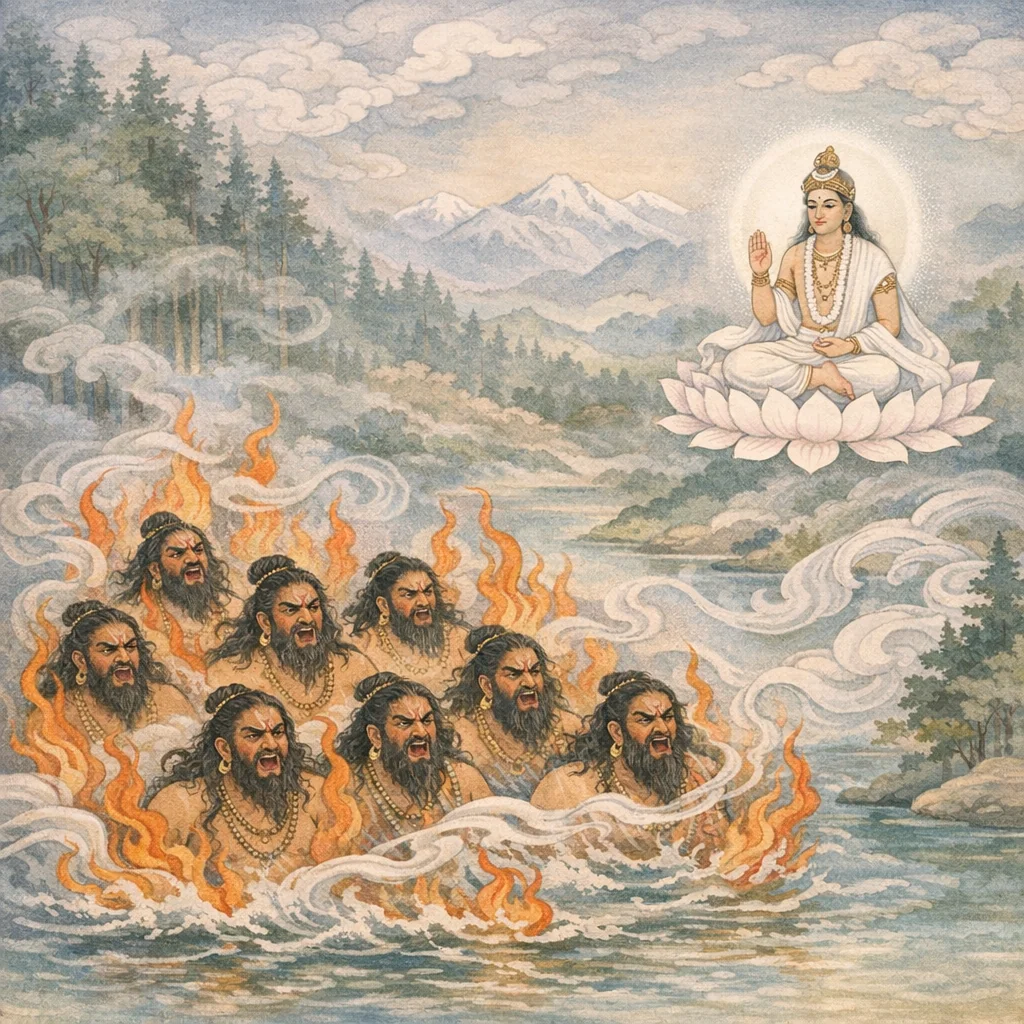
Parāśara tells Maitreya that while the Pracetās are absorbed in tapas, the earth becomes overrun by forests and beings suffer; when they emerge, they unleash wind and fire to destroy the trees. Soma intervenes, counsels restraint, and offers reconciliation through Māriṣā, a maiden of intricate origin connected with Kaṇḍu, the apsaras Pramlocā, the trees, Vāyu, and Soma’s foreknowledge. The Kaṇḍu episode teaches that prolonged sensual attachment erodes tapas and viveka, leading to repentance, and warns of kāma as a “mahāgraha.” The chapter culminates in the Brahma-parastava, a lofty hymn proclaiming Viṣṇu as the transcendent “far shore” beyond even Brahman and the cause within all causes. Māriṣā becomes wife to the ten Pracetās; from them Dakṣa is born again and organizes procreation: daughters are allotted to Dharma, Kaśyapa, Soma, and others, giving rise to devas, asuras, nāgas, gandharvas, and further classes. When Maitreya doubts Dakṣa’s repeated births and shifting kin-relations, Parāśara explains the eternal cycles of utpatti and nirodha, where rank is determined by tapas rather than linear seniority, and proceeds into genealogical enumerations.
Shlokas
Verse 1
तपश् चरत्सु पृथिवीं प्रचेतःसु महीरुहाः अरक्ष्यमाणाम् आवव्रुर् बभूवाथ प्रजाक्षयः
While the Pracetas were absorbed in austere penance, the unguarded earth was overrun on every side by mighty trees; and, for want of space and sustenance, living beings began to waste away.
Verse 2
नाशकन् मारुतो वातुं वृतं खम् अभवद् द्रुमैः दशवर्षसहस्राणि न शेकुश् चेष्टितुं प्रजाः
The trees choked the sky so that the wind could not blow. For ten thousand years, living beings were unable to move or perform their natural activities, as the world’s order was wholly obstructed.
Verse 3
तान् दृष्ट्वा जलनिष्क्रान्ताः सर्वे क्रुद्धाः प्रचेतसः मुखेभ्यो वायुम् अग्निं च ते ऽसृजञ् जातमन्यवः
Seeing this, all the Pracetas rose up from the waters, inflamed with wrath; and, with anger newly kindled, they unleashed from their mouths both wind and fire.
Verse 4
उन्मूलान् अथ तान् वृक्षान् कृत्वा वायुर् अशोषयत् तान् अग्निर् अदहद् घोरस् तत्राभूद् द्रुमसंक्षयः
Then the wind tore those trees up by the roots and dried them utterly; and the fierce fire consumed them, so that there came to be a complete destruction of the forests.
Verse 5
द्रुमक्षयम् अथो दृष्ट्वा किंचिच् छिष्टेषु शाखिषु उपगम्याब्रवीद् एतान् राजा सोमः प्रजापतीन्
Seeing that the trees had been all but exhausted, with only a little left upon the branches, King Soma approached those Prajāpatis and addressed them.
Verse 6
कोपं यच्छत राजानः शृणुध्वं च वचो मम संधानं वः करिष्यामि सह क्षितिरुहैर् अहम्
O kings, restrain your wrath and heed my words. I shall bring about reconciliation among you—even with the trees of the earth as my allies.
Verse 7
रत्नभूता च कन्येयं वार्क्षेयी वरवर्णिनी भविष्यं जानता पूर्वं मया गोभिर् विवर्धिता
This maiden—Vārkṣeyī, of exquisite beauty—was like a jewel made manifest. Knowing beforehand what was yet to come, I once had her carefully reared and nurtured with cows and their gifts.
Verse 8
मारिषा नाम नाम्नैषा वृक्षाणाम् इति निर्मिता भार्या वो ऽस्तु महाभागा ध्रुवं वंशविवर्धिनी
She is fashioned by the trees and is renowned by the name Māriṣā. Let this noble lady become your wife; assuredly, she will enlarge and sustain your lineage.
Verse 9
युष्माकं तेजसो ऽर्धेन मम चार्धेन तेजसः अस्याम् उत्पत्स्यते विद्वान् दक्षो नाम प्रजापतिः
From half of your radiance and from half of my own splendor, there shall be born from her a wise progenitor—Dakṣa by name—who will become a Prajāpati, an ordainer of beings within the cosmic order.
Verse 10
मम चांशेन संयुक्तो युष्मत्तेजोमयेन वै अग्निनाग्निसमो भूयः प्रजाः संवर्धयिष्यति
United with a portion of My own being, and infused with your radiance, he will become like fire made one with fire; and, renewed in that blazing power, he shall foster and increase the creatures of the world.
Verse 11
कण्डुर् नाम मुनिः पूर्वम् आसीद् वेदविदां वरः सुरम्ये गोमतीतीरे स तेपे परमं तपः
In former times there lived a sage named Kaṇḍu, foremost among the knowers of the Veda; on the lovely bank of the river Gomati he practiced the highest austerities.
Verse 12
तत्क्षोभाय सुरेन्द्रेण प्रम्लोचाख्या वराप्सराः प्रयुक्ता क्षोभयाम् आस तम् ऋषिं सा शुचिस्मिता
To disturb his austerity, Indra dispatched the excellent apsaras named Pramlocā; and she—smiling with an artful, radiant charm—set about unsettling that sage.
Verse 13
क्षोभितः स तया सार्धं वर्षाणाम् अधिकं शतम् अतिष्ठन् मन्दरद्रोण्यां विषयासक्तमानसः
Stirred and unsettled by her, he remained with her for more than a hundred years in the hollow of Mandara, his mind bound fast to the objects of sense.
Verse 14
सा तं प्राह महाभाग गन्तुम् इच्छाम्य् अहं दिवम् प्रसादसुमुखो ब्रह्मन्न् अनुज्ञां दातुम् अर्हसि
She said to him: “O greatly fortunate one, I wish to depart for heaven. O Brahman, with a gracious countenance, you ought to grant me permission.”
Verse 15
तयैवम् उक्तः स मुनिस् तस्याम् आसक्तमानसः दिनानि कतिचिद् भद्रे स्थीयताम् इत्य् अभाषत
Thus addressed by her, the sage—his mind now drawn toward her—spoke: “O noble lady, let a few days pass here,” he said, asking her to remain.
Verse 16
एवम् उक्ता ततस् तेन साग्रं वर्षशतं पुनः बुभुजे विषयांस् तन्वी तेन सार्धं महात्मना
Thus addressed by him, the slender lady, together with that great-souled man, once again enjoyed the objects of the senses for a full hundred years and more.
Verse 17
अनुज्ञां देहि भगवन् व्रजामि त्रिदशालयम् उक्तस् तयेति स मुनिः स्थीयताम् इत्य् अभाषत
“Grant me leave, O Blessed Lord; I shall depart for the abode of the Thirty (the gods).” Thus addressed, the sage replied to her, “So be it—remain as ordained.”
Verse 18
पुनर् गते वर्षशते साधिके सा शुभानना यामीत्य् आह दिवं ब्रह्मन् प्रणयस्मितशोभनम्
And when a little more than a hundred years had passed again, that fair-faced lady—her features adorned by a smile born of tender affection—said, “O Brāhman, I shall go to heaven.”
Verse 19
उक्तस् तयैवं स मुनिर् उपगुह्यायतेक्षणाम् प्राहास्यतां क्षणं सुभ्रु चिरकालं गमिष्यसि
Thus addressed by her, the sage—drawing close and gazing upon her—said: “Stay for a moment, fair-browed one; for you are about to depart for a very long time.”
Verse 20
तच्छापभीता सुश्रोणी सह तेनर्षिणा पुनः शतद्वयं किंचिद् ऊनं वर्षाणाम् अन्वतिष्ठत
Terrified of that curse, the fair-hipped woman remained again in the company of that sage, abiding for a span of years—almost two hundred in number, just a little less.
Verse 21
गमनाय महाभागो देवराजनिवेशनम् प्रोक्तः प्रोक्तस् तया तन्व्या स्थीयताम् इत्य् अभाषत
Thus, when the slender maiden bade him depart for the splendid abode of the king of the gods, that noble one replied: “So be it; I shall remain here.”
Verse 22
तं सा शापभयाद् भीता दाक्षिण्येन च दक्षिणा प्रोक्ता प्रणयभङ्गार्तिवेदिनी न जहौ मुनिम्
She, frightened by the dread of a curse, yet guided by her own graciousness, spoke with gentle courtesy; and though pained by love’s rupture, she did not abandon the sage.
Verse 23
तया च रमतस् तस्य परमर्षेर् अहर्निशम् नवं नवम् अभूत् प्रेम मन्मथाविष्टचेतसः
As that great seer delighted in union with her, day and night, his love kept arising ever anew—his mind wholly seized by Manmatha, the power of desire.
Verse 24
एकदा तु त्वरायुक्तो निश्चक्रामोटजान् मुनिः निष्क्रामन्तं च कुत्रेति गम्यते प्राह सा शुभा
Once, the sage—moved by sudden haste—stepped out from his forest-hut. Seeing him depart, the auspicious lady asked: “Where are you going in such a hurry, and for what purpose?”
Verse 25
इत्य् उक्तः स तया प्राह परिवृत्तम् अहः शुभे संध्योपास्तिं करिष्यामि क्रियालोपो ऽन्यथा भवेत्
Thus addressed, he replied: “Auspicious one, the day has turned; I shall now perform the worship of the twilight (sandhyā). Otherwise there would be a lapse in the ordained rites.”
Verse 26
ततः प्रहस्य मुदिता तं सा प्राह महामुनिम् किम् अद्य सर्वधर्मज्ञ परिवृत्तम् अहस् तव
Then, smiling with delight, she spoke to the great sage: “O knower of all dharma, what has happened today that the course of your day has so changed?”
Verse 27
बहूनां विप्र वर्षाणां परिणामम् अहस् तव गतम् एतन् न कुरुते विस्मयं कस्य कथ्यताम्
“O Brāhmaṇa, when the outcome of countless years can, as it were, be compressed into a single day for you, for whom could this be a wonder? Tell me.”
Verse 28
प्रातस् त्वम् आगता भद्रे नदीतीरम् इदं शुभम् मया दृष्टा च तन्वङ्गि प्रविष्टा च ममाश्रमम्
“At dawn you came, O auspicious lady, to this sacred riverbank. Slender-limbed one, I saw you, and you entered my hermitage.”
Verse 29
इयं च वर्तते संध्या परिणामम् अहर् गतम् अवहासः किमर्थो ऽयं सद्भावः कथ्यतां मम
“Now twilight is upon us; the day has reached its turning and decline. Why this mockery—what is its purpose? Tell me the true intent.”
Verse 30
प्रत्यूषस्य् आगता ब्रह्मन् सत्यम् एतन् न तन् मृषा किन्त्व् अद्य तस्य कालस्य गतान्य् अब्दशतानि ते
“O Brahman, it is true that she came at dawn—this is no falsehood. Yet by today, in the measure of that time, hundreds of years have passed for you.”
Verse 31
ततः ससाध्वसो विप्रस् तां पप्रच्छायतेक्षणाम् कथ्यतां भीरु कः कालस् त्वया मे रमतः सह
Then the brāhmaṇa, seized by anxiety, questioned her, the long‑eyed lady: “Tell me, timid one—what span of time has passed while I have been delighting with you?”
Verse 32
सप्तोत्तराण्य् अतीतानि नव वर्षशतानि ते मासाश् च षट् तथैवान्यत् समतीतं दिनत्रयम्
Nine hundred years have passed for you, with seven more besides; six months as well—and indeed a further three days have also elapsed.
Verse 33
सत्यं भीरु वदस्य् एतत् परिहासो ऽथ वा शुभे दिनम् एकम् अहं मन्ये त्वया सार्धम् इहासितम्
“It is true, timid one—you speak rightly; or else, O auspicious lady, it is but a jest. For I deem that I have dwelt here with you only for a single day.”
Verse 34
वदिष्याम्य् अनृतं ब्रह्मन् कथम् अत्र तवान्तिके विशेषेणाद्य भवता पृष्टा मार्गानुवर्तिना
“How could I speak what is untrue, O Brahman, here in your very presence—especially now, when you, a follower of the righteous path, have questioned me so precisely?”
Verse 35
निशम्य तद् वचः तस्याः स मुनिर् नृपनन्दनाः धिङ् मां धिङ् माम् अतीवेत्थं निनिन्दात्मानम् आत्मना
Hearing her words, that sage—O beloved scion of kings—cried, “Shame on me, shame on me!” and, in bitter remorse, condemned his own self within his own mind.
Verse 36
तपांसि मम नष्टानि हतं ब्रह्मविदां धनम् हृतो विवेकः केनापि योषिन् मोहाय निर्मिता
My austerities are ruined; the treasure of the knowers of Brahman is struck down. Someone has stolen my discernment—this woman has been fashioned as a snare of delusion.
Verse 37
ऊर्मिषट्कातिगं ब्रह्म ज्ञेयम् आत्मजयेन मे मतिर् एषा हृता येन धिक् तं कामं महाग्रहम्
Brahman is to be known as the Reality that transcends the six waves of worldly experience—yet even as I strive for self-mastery, my very understanding is stolen away. Fie upon that desire, that mighty seizer, which robs the mind of its highest aim.
Verse 38
व्रतानि वेदवेद्याप्तिकारणान्य् अखिलानि च नरकग्राममार्गेण सङ्गेनापहृतानि मे
All my sacred observances—those disciplines that are the means to attain what the Vedas reveal—have been wholly stolen from me by corrupting association, as though I were being dragged along the road that leads to the village of hell.
Verse 39
विनिन्द्येत्थं स धर्मज्ञः स्वयम् आत्मानम् आत्मना ताम् अप्सरसम् आसीनाम् इदं वचनम् अब्रवीत्
Thus, having reproached himself—his own self correcting his own self—that knower of dharma addressed the Apsaras, who sat before him, with these words.
Verse 40
गच्छ पापे यथा कामं यत् कार्यं तत् कृतं त्वया देवराजस्य मत्क्षोभं कुर्वन्त्या भावचेष्टितैः
Go, sinful one—depart as you please. What you came to accomplish has been accomplished by you, for by your feigned moods and calculated gestures you have stirred my agitation and provoked the Lord of the gods.
Verse 41
न त्वां करोम्य् अहं भस्म क्रोधतीव्रेण वह्निना सतां सप्तपदं मैत्रम् उषितो ऽहं त्वया सह
I will not reduce you to ashes with the fire made fierce by my wrath; among the noble, friendship is sealed by seven steps, and I have dwelt with you as a companion.
Verse 42
अथ वा तव को दोषः किं वा कुप्याम्य् अहं तव ममैव दोषो नितरां येनाहम् अजितेन्द्रियः
Or else—what fault is there in you? Why should I be angry with you at all? The fault is entirely mine alone, for it is I who have not mastered my senses.
Verse 43
यया शक्रप्रियार्थिन्या कृतो मे तपसो व्ययः त्वया धिक् त्वां महामोहमञ्जूषां सुजुगुप्सिताम्
Because of you—who sought only to please Śakra—my hard-won austerities have been squandered. Fie upon you! Fie upon you, you most detestable casket of great delusion!
Verse 44
यावद् इत्थं स विप्रर्षिस् तां ब्रवीति सुमध्यमाम् तावद् गलत्स्वेदजला सा बभूवातिवेपथुः
While that brahmin-sage spoke to the fair-waisted lady in this manner, she—her sweat streaming down—became seized with intense trembling.
Verse 45
प्रवेपमानां सततं खिन्नगात्रलतां सतीम् गच्छ गच्छेति सक्रोधम् उवाच मुनिसत्तमः
Seeing that virtuous woman continually trembling—her body worn and drooping like a bruised creeper—the best of sages, stirred to anger, said to her, “Go—go at once.”
Verse 46
सा तु निर्भर्त्सिता तेन विनिष्क्रम्य तदाश्रमात् आकाशगामिनी स्वेदं ममार्ज तरुपल्लवैः
Rebuked by him, she departed from that hermitage; moving through the sky, she wiped away her perspiration with the tender shoots and leaves of trees.
Verse 47
वृक्षाद् वृक्षं ययौ बाला तदग्रारुणपल्लवैः निर्मार्जमाना गात्राणि गलत्स्वेदजलानि वै
The young maiden went from tree to tree, wiping her limbs with the reddish tender shoots at their tips, as beads of sweat streamed down her body.
Verse 48
ऋषिणा यस् तदा गर्भस् तस्या देहे समाहितः निर्जगाम सरोमाञ्चस्वेदरूपी तदङ्गतः
The embryo that the sage had then implanted within her body emerged from her limbs, manifesting as sweat accompanied by horripilation (gooseflesh).
Verse 49
तं वृक्षा जगृहुर् गर्भम् एकं चक्रे च मारुतः मया चाप्यायितो गोभिः स तदा ववृधे शनैः
The trees received and sheltered that embryo; the Wind-god made it one and whole. Nourished by me through the rays of the Sun, he then grew gradually, little by little.
Verse 50
वृक्षाग्रगर्भसंभूता मारिषाख्या वरानना तां प्रदास्यन्ति वो वृक्षाः कोप एष प्रशाम्यताम्
Born from the womb that formed upon the tops of the trees is the fair-faced maiden named Māriṣā. The trees will present her to you—therefore let this anger of yours be calmed.
Verse 51
कण्डोर् अपत्यम् एवं सा वृक्षेभ्यश् च समुद्गता ममापत्यं तथा वायोः प्रम्लोचातनया च सा
Thus she became the offspring of Kaṇḍu and also sprang forth from the trees. She is likewise my child—and also the child of Vāyu—for she was born as the daughter of Pramlocā.
Verse 52
स चापि भगवान् कण्डुः क्षीणे तपसि सत्तमाः पुरुषोत्तमाख्यम् अद्रीशं विष्णोर् आयतनं ययौ
And that venerable sage Kaṇḍu—foremost among the virtuous—when his austerities had run their course, departed to the mountain-lord called Puruṣottama, the sacred abode of Lord Viṣṇu.
Verse 53
तत्रैकाग्रमतिर् भूत्वा चकाराराधनं हरेः ब्रह्मपारमयं कुर्वञ् जपम् एकाग्रमानसः ऊर्ध्वबाहुर् महायोगी स्थित्वासौ भूपनन्दनाः
There, with his mind made utterly one-pointed, the king’s son began the worship of Hari. With unwavering concentration he performed japa directed to the Supreme Brahman; and that royal child—become a great yogin—stood with arms raised aloft, steadfast in his vow.
Verse 54
ब्रह्मपारं मुनेः श्रोतुम् इच्छामः परमं स्तवम् जपता कण्डुना देवो येनाराध्यत केशवः
We wish to hear, O sage, that supreme hymn which carries one beyond Brahman itself—the highest praise—by whose recitation the venerable Kaṇḍu worshipped and perfectly propitiated Lord Keśava.
Verse 55
पारं परं विष्णुर् अपारपारः परः परेभ्यः परमार्थरूपी स ब्रह्मपारः परपारभूतः परः पराणाम् अपि पारपारः
Vishnu is the further shore—the supreme beyond; the One whose farthest limit is itself beyond limit. Higher than all that is called “higher,” He is the very form of ultimate reality. He is the far shore of Brahman, the Reality that stands beyond the beyond—supreme even among the supremely transcendent, the final ‘shore’ of all shores.
Verse 56
स कारणं कारणतस् ततो ऽपि तस्यापि हेतुः परहेतुहेतुः कार्येषु चैवं सह कर्मकर्तृ रूपैर् अशेषैर् अवतीह सर्वम्
He is the cause of causes; beyond the chain of causation, He is the ultimate ground behind every ground. Thus, within all effects, He alone abides here as everything, assuming without remainder the forms of action and actor, of deed and doer.
Verse 57
ब्रह्म प्रभुर् ब्रह्म स सर्वभूतो ब्रह्म प्रजानां पतिर् अच्युतो ऽसौ ब्रह्माव्ययं नित्यम् अजं स विष्णुर् अपक्षयाद्यैर् अखिलैर् असङ्गि
Brahman is the Lord; Brahman is He who has become all beings. Brahman is the ruler of creatures—He, the unfailing Acyuta. That Vishnu is the imperishable, eternal, unborn Brahman, untouched by decay and loss and every such condition—ever unattached.
Verse 58
ब्रह्माक्षरम् अजं नित्यं यथासौ पुरुषोत्तमः तथा रागादयो दोषाः प्रयान्तु प्रशमं मम
As that Supreme Person (Puruṣottama) is the imperishable syllable of Brahman—unborn and eternal—so too may the faults that begin with passion (rāga) be stilled within me and pass into perfect tranquility.
Verse 59
एतद् ब्रह्मपराख्यं वै संस्तवं परमं जपन् अवाप परमां सिद्धिं स समाराध्य केशवम्
Reciting this supreme hymn—known as the ‘Brahma-para’ praise—he attained the highest perfection, for through it he had truly worshipped Keshava (Vishnu), the Supreme Reality.
Verse 60
इयं च मारिषा पूर्वम् आसीद् या तां ब्रवीमि वः कार्यगौरवम् एतस्याः कथने फलदायि वः
This very Marishā existed in former times as well—she of whom I now speak to you. Great is the weight and consequence of her story; and the telling of it is fruitful for you, bestowing merit.
Verse 61
अपुत्रा प्राग् इयं विष्णुं मृते भर्तरि सत्तमाः भूपपत्नी महाभागा तोषयाम् आस भक्तितः
Formerly childless, this most fortunate queen—after her husband had died—devotedly worshipped Lord Viṣṇu, seeking to please Him through pure bhakti.
Verse 62
आराधितस् तया विष्णुः प्राह प्रत्यक्षतां गतः वरं वृणीष्वेति शुभां सा च प्राहात्मवाञ्छितम्
Thus worshipped by her, Lord Viṣṇu—having become directly manifest—spoke: “Auspicious one, choose a boon.” And she declared the desire held within her heart.
Verse 63
भगवन् बालवैधव्याद् वृथाजन्माहम् ईदृशी मन्दभाग्या समुद्भूता विफला च जगत्पते
O Blessed Lord—widowed while still a child—my birth has become a futile thing. Thus have I arisen, ill-fated and fruitless, O Lord of the worlds.
Verse 64
भवन्तु पतयः श्लाघ्या मम जन्मनि जन्मनि त्वत्प्रसादात् तथा पुत्रः प्रजापतिसमो ऽस्तु मे
By your gracious favor, may I, in birth after birth, be blessed with husbands worthy of praise; and may I also have a son equal to a Prajāpati.
Verse 65
रूपसंपत्समायुक्ता सर्वस्य प्रियदर्शना अयोनिजा च जायेयं त्वत्प्रसादाद् अधोक्षज
“Endowed with the full wealth of beauty and excellence, pleasing to the sight of all, may she be born without a mortal womb—only by Your grace, O Adhokṣaja.”
Verse 66
तयैवम् उक्तो देवेशो हृषीकेश उवाच ताम् प्रणामनम्राम् उत्थाप्य वरदः परमेश्वरः
Thus addressed by her, Hṛṣīkeśa, Lord of the gods, spoke to her; and the Supreme Lord, bestower of boons, raised her up as she lay bowed in reverent prostration.
Verse 67
भविष्यन्ति महावीर्या एकस्मिन्न् एव जन्मनि प्रख्यातोदारकर्माणो भवत्याः पतयो दश
In a single lifetime, you shall have ten husbands—men of great valor, renowned everywhere for their lofty and generous deeds.
Verse 68
पुत्रं च सुमहात्मानम् अतिवीर्यपराक्रमम् प्रजापतिगुणैर् युक्तं त्वम् अवाप्स्यसि शोभने
O radiant one, you shall obtain a son—great-souled, endowed with extraordinary might and valor—adorned with the very virtues of the Prajāpatis.
Verse 69
वंशानां तस्य कर्तृत्वं जगत्य् अस्मिन् भविष्यति त्रैलोक्यम् अखिलं सूतिस् तस्य चापूरयिष्यति
In this world, he shall become the maker and establisher of dynasties; and his progeny shall fill and sustain the entire three worlds, without remainder.
Verse 70
त्वं चाप्य् अयोनिजा साध्वी रूपौदार्यगुणान्विता मनःप्रीतिकरी नॄणां मत्प्रसादाद् भविष्यसि
And you too, O blameless one, shall be born without a womb, endowed with beauty, generosity, and noble virtues; by my grace you will become a delight to the hearts of people.
Verse 71
इत्य् उक्त्वान्तर्दधे देवस् तां विशालविलोचनाम् सा चेयं मारिषा जाता युष्मत्पत्नी नृपात्मजाः
Having spoken thus, the radiant Deva vanished from before the wide-eyed maiden, declaring: “She herself has been born as Māriṣā; O princes, she shall be your wife.”
Verse 72
ततः सोमस्य वचनाज् जगृहुस् ते प्रचेतसः संहृत्य कोपं वृक्षेभ्यः पत्नीधर्मेण मारिषाम्
Then, heeding Soma’s words, the Pracetas restrained their wrath against the trees and, in accord with the dharma of marriage, accepted Māriṣā as their wife.
Verse 73
दशभ्यस् तु प्रचेतोभ्यो मारिषायां प्रजापतिः जज्ञे दक्षो महाभागो यः पूर्वं ब्रह्मणो ऽभवत्
From the ten Pracetas, in Māriṣā, was born the illustrious Prajāpati Dakṣa—he who had formerly arisen from Brahmā.
Verse 74
स तु दक्षो महाभागः सृष्ट्यर्थं सुमहामते पुत्रान् उत्पादयाम् आस प्रजासृष्ट्यर्थम् आत्मनः
O most wise one, that greatly fortunate Dakṣa, for the sake of creation, set about begetting sons, so that through his own progeny the generation of beings might proceed.
Verse 75
अचरांश् च चरांश् चैव द्विपदो ऽथ चतुष्पदः आदेशं ब्रह्मणः कुर्वन् सृष्ट्यर्थं समवस्थितः
He stood ready for the work of manifestation, fulfilling Brahmā’s command—bringing forth the immovable and the movable, the two-footed and the four-footed—so that creation might proceed in due order.
Verse 76
स सृष्ट्वा मनसा दक्षः पञ्चाशद् असृजत् स्त्रियः ददौ स दश धर्माय कश्यपाय त्रयोदश कालस्य नयने युक्ताः सप्तविंशतिम् इन्दवे
Thereafter Dakṣa, by the power of his mind, created fifty daughters. Of these he gave ten to Dharma, thirteen to Kaśyapa, and twenty-seven—who are the nakṣatras, the “eyes of Time”—to Soma, the Moon.
Verse 77
तासु देवास् तथा दैत्या नागा गावस् तथा खगाः गन्धर्वाप्सरसश् चैव दानवाद्याश् च जज्ञिरे
From them were born the gods and the Daityas; the Nāgas, cattle, and birds; likewise the Gandharvas and Apsarases, and the Dānavas and other orders of beings as well.
Verse 78
ततः प्रभृति मैत्रेय प्रजा मैथुनसंभवाः संकल्पाद् दर्शनात् स्पर्शात् पूर्वेषाम् अभवन् प्रजाः तपोविशैषैर् इद्धानां तदात्यन्ततपस्विनाम्
From that point onward, O Maitreya, beings came to be through sexual union; whereas among the earlier orders of creation, offspring arose through mere intention, through sight, and through touch—those primeval progenitors being kindled by extraordinary austerities, supremely ascetic in nature.
Verse 79
अङ्गुष्ठाद् दक्षिणाद् दक्षः पूर्वं जातः श्रुतो मया कथं प्राचेतसो भूयः स संभूतो महामुने
I have heard that Dakṣa was formerly born from the right thumb. O great sage, how then was that same Dakṣa later born again as Prācetasa, the son of the Pracetas?
Verse 80
एष मे संशयो ब्रह्मन् सुमहान् हृदि वर्तते यद् दौहित्रश् च सोमस्य पुनः श्वशुरतां गतः
A great doubt, O Brahman, abides in my heart: how is it that the grandson of Soma has again come to stand in the role of Soma’s father-in-law?
Verse 81
उत्पत्तिश् च निरोधश् च नित्यो भूतेषु सत्तम ऋषयो ऽत्र न मुह्यन्ति ये चान्ये दिव्यचक्षुषः
O best of the virtuous, among all beings the rhythm of arising and passing away is eternal; therefore the seers, and all others endowed with divine sight, are not deluded about this cosmic process.
Verse 82
युगे युगे भवन्त्य् एते दक्षाद्या मुनिसत्तम पुनश् चैव निरुद्ध्यन्ते विद्वांस् तत्र न मुह्यति
O best of sages, in every age these beings—beginning with Dakṣa—arise again and again, and again they are withdrawn; the wise, knowing this rhythm, are not deluded by it.
Verse 83
कानिष्ठ्यं ज्यैष्ठ्यम् अप्य् एषां पूर्वं नाभूद् द्विजोत्तम तप एव गरीयो ऽभूत् प्रभावश् चैव कारणम्
O best of the twice-born, among them formerly there was no fixed rule of junior or senior rank; austerity alone carried greater weight, and spiritual potency itself became the deciding cause.
Verse 84
देवानां दानवानां च गन्धर्वोरगरक्षसाम् उत्पत्तिं विस्तरेणेह मम ब्रह्मन् प्रकीर्तय
O Brahman, here and now recount to me in full the origins of the gods and the Dānavas, and of the Gandharvas, the Nāgas, and the Rākṣasas.
Verse 85
प्रजाः सृजेति व्यादिष्टः पूर्वं दक्षः स्वयंभुवा यथा ससर्ज भूतानि तथा शृणु महामते
Formerly, Dakṣa—commanded by Svayambhū (Brahmā) with the charge, “Create the beings”—brought forth the orders of life. Hear now, O great-minded one, how he generated the creatures.
Verse 86
मनसा त्व् एव भूतानि पूर्वं दक्षो ऽसृजत् तदा देवान् ऋषीन् सगन्धर्वान् असुरान् पन्नगांस् तथा
Then, in the beginning, Dakṣa brought forth beings by mind alone—creating the gods and the seers, together with the Gandharvas, the Asuras, and the serpent races as well.
Verse 87
यदास्य सृजमानस्य न व्यवर्धन्त ताः प्रजाः ततः संचिन्त्य बहुशः सृष्टिहेतोः प्रजापतिः
When, even as he was creating, those beings did not multiply, then Prajāpati—the cause of manifestation—pondered again and again, at length, upon the means by which creation might truly proceed.
Verse 88
मैथुनेनैव धर्मेण सिसृक्षुर् विविधाः प्रजाः असिक्नीम् आवहत् कन्यां वीरणस्य प्रजापतेः सुतां सुतपसा युक्तां महतीं लोकधारिणीम्
Desiring to bring forth the many kinds of creatures through the ordained dharma of union, he took to wife Asiknī, the maiden daughter of the Prajāpati Vīraṇa—endowed with ascetic merit, great in virtue, and a steadfast bearer of the world’s order.
Verse 89
अथ पुत्रसहस्राणि वैरिण्यां पञ्च वीर्यवान् असिक्न्यां जनयाम् आस सर्गहेतोः प्रजापतिः
Thereafter Prajāpati, the very cause of creation, begot thousands of sons from Asiknī; and from Vairiṇī he brought forth five vigorous offspring as well.
Verse 90
तान् दृष्ट्वा नारदो विप्र संविवर्द्धयिषून् प्रजाः संगम्य प्रियसंवादो देवर्षिर् इदम् अब्रवीत्
O Brāhmaṇa, seeing them intent on nurturing and increasing their subjects, Nārada—the divine seer, gentle in speech—approached and spoke these words.
Verse 91
हे हर्यश्वा महावीर्याः प्रजा यूयं करिष्यथ ईदृशो लक्ष्यते यत्नो भवतां श्रूयताम् इदम्
O Haryaśvas, mighty in potency, you shall indeed bring forth progeny; yet the manner of your striving is plain—therefore listen to this instruction.
Verse 92
बालिशा बत यूयं वै नास्या जानीत वै भुवः अन्तर् ऊर्ध्वम् अधश् चैव कथं स्रक्ष्यथ वै प्रजाः
Truly, you are childish! You do not know the nature of this world—what is within, above, and below. Without such knowledge, how will you protect the creatures?
Verse 93
ऊर्ध्वं तिर्यग् अधश् चैव यदाप्रतिहता गतिः तदा कस्माद् भुवो नान्तं सर्वे द्रक्ष्यथ बालिशाः
If motion is unobstructed—upwards, sideways, and downwards—then why, you foolish ones, do you not all behold the very end of the world?
Verse 94
ते तु तद्वचनं श्रुत्वा प्रयाताः सर्वतो दिशम् अद्यापि न निवर्तन्ते समुद्रेभ्य इवापगाः
Hearing those words, they departed in every direction; and even to this day they do not return—like rivers that, once they reach the ocean, never turn back.
Verse 95
हर्यश्वेष्व् अथ नष्टेषु दक्षः प्राचेतसः पुनः वैरिण्याम् अथ पुत्राणां सहस्रम् असृजत् प्रभुः
When the Haryaśvas had thus disappeared, Dakṣa—son of the Pracetases—once again, in Vairiṇī, the lordly progenitor, brought forth a thousand sons.
Verse 96
विवर्धयिषवस् ते तु शबलाश्वाः प्रजाः पुनः पूर्वोक्तं वचनं ब्रह्मन् नारदेनैव चोदिताः
But those Śabalāśva princes, intent on increasing their progeny, O Brahman, set out once more, urged on by Nārada himself to act according to the counsel he had previously given.
Verse 97
अन्योन्यम् ऊचुस् ते सर्वे सम्यग् आह महामुनिः भ्रातॄणां पदवी चैव गन्तव्या नात्र संशयः
Then they all spoke among themselves; and the great sage declared rightly: “The very path trodden by the brothers must indeed be followed—of this there is no doubt.”
Verse 98
ज्ञात्वा प्रमाणं पृथ्व्याश् च प्रजाः स्रक्ष्यामहे ततः
Having ascertained the true measure of the Earth, we shall thereafter bring forth the generations of beings and set them in due order.
Verse 99
ते ऽपि तेनैव मार्गेण प्रयाताः सर्वतो दिशम् अद्यापि न निवर्तन्ते समुद्रेभ्य इवापगाः
They too, having set forth by that very path in every direction, do not return even now—just as rivers, once they have reached the ocean, do not flow back from it.
Verse 100
ततः प्रभृति वै भ्राता भ्रातुर् अन्वेषणे द्विज प्रयातो नश्यति तथा तन् न कार्यं विजानता
From that time onward, O brāhmaṇa, a brother who sets out in search of his brother is lost as well; therefore, one who understands should not undertake that course of action.
Verse 101
तांश् चापि नष्टान् विज्ञाय पुत्रान् दक्षः प्रजापतिः क्रोधं चक्रे महाभागो नारदं स शशाप च
When the illustrious Prajāpati Dakṣa realized that those sons too had vanished, he was seized with wrath and pronounced a curse upon Nārada.
Verse 102
सर्गकामस् ततो विद्वान् स मैत्रेय प्रजापतिः षष्टिं दक्षो ऽसृजत् कन्या वैरिण्याम् इति नः श्रुतम्
Then, O Maitreya, that wise Prajāpati Dakṣa—moved by the desire to further creation—begot sixty daughters upon Vairiṇī; so indeed have we heard in sacred tradition.
Verse 103
ददौ स दश धर्माय कश्यपाय त्रयोदश सप्तविंशति सोमाय चतस्रो ऽरिष्टनेमिने
He bestowed ten (daughters) upon Dharma, thirteen upon Kaśyapa, twenty-seven upon Soma, and four upon Ariṣṭanemi.
Verse 104
द्वे चैव बहुपुत्राय द्वे चैवाङ्गिरसे तथा द्वे कृशाश्वाय विदुषे तासां नामानि मे शृणु
Two (daughters) were given to Bahuputra, two likewise to Aṅgiras, and two to the wise Kṛśāśva. Now hear from me their names.
Verse 105
अरुन्धती वसुर् जामिर् लम्बा भानुर् मरुत्वती संकल्पा च मुहूर्ता च साध्या विश्वा च ता दश धर्मपत्न्यो दश त्व् एतास् तास्व् अपत्यानि मे शृणु
Arundhatī, Vasū, Jāmi, Lambā, Bhānū, Marutvatī, Saṅkalpā, Muhūrtā, Sādhyā, and Viśvā—these are the ten wives of Dharma. Now hear from me the offspring born of them.
Verse 106
विश्वेदेवास् तु विश्वायाः साध्या साध्यान् व्यजायत मरुत्वत्या मरुत्वन्तो वसोस् तु वसवः स्मृताः
From Viśvā arose the Viśvedevas; from Sādhyā were born the Sādhyas; from Marutvatī came forth the Maruts; and from Vasū were manifested the Vasus—thus are these divine hosts remembered in the order of emanation.
Verse 107
भानोस् तु भानवस् तत्र मुहूर्ताया मुहूर्तजाः लम्बायाश् चैव घोषो ऽथ नागवीथी तु जामिजा
From Bhānu are born the Bhānavas; from Muhūrtā arise the Muhūrtajas. From Lambā is born Ghoṣa; and from Jāmī is born Nāgavīthī—thus are declared the lineages linked to the Sun’s ordained order of time.
Verse 108
पृथिवीविषयं सर्वम् अरुन्धत्याम् अजायत संकल्पायास् तु सर्वात्मा जज्ञे संकल्प एव च
From Arundhatī arose all that pertains to the realm of Earth; and from Saṅkalpā, the All-Self came forth—indeed, Saṅkalpa (Divine Will) itself was born as Saṅkalpa.
Verse 109
ये त्व् अनेकवसुप्राणा देवा ज्योतिःपुरोगमाः वसवो ऽष्टौ समाख्यातास् तेषां वक्ष्यामि विस्तरम्
Now, those radiant gods—whose very life-breath is manifold sustaining power and wealth, and who move with light at their head—are known as the eight Vasus. Their full account I shall now set forth in detail.
Verse 110
आपो ध्रुवश् च सोमश् च धरश् चैवानिलो ऽनलः प्रत्यूषश् च प्रभासश् च वसवो नामभिः स्मृताः
They are remembered by these names as the Vasus: Āpa, Dhruva, Soma, Dhara, Anila, Anala, Pratyūṣa, and Prabhāsa—cosmic powers that uphold the world’s stability and order under the supreme governance of Viṣṇu.
Verse 111
आपस्य पुत्रो वैतण्डः श्रमः श्रान्तो ऽधुनिस् तथा ध्रुवस्य पुत्रो भगवान् कालो लोकप्रकालनः
From Āpa was born Vaitaṇḍa; then Śrama, Śrānta, and likewise Dhuni. And to Dhruva was born the venerable Bhagavān Kāla—Time itself—who orders and governs the worlds.
Verse 112
सोमस्य भगवान् वर्चा वर्चस्वी येन जायते
Soma, the Moon, bears a divine radiance; by that sacred splendour he becomes resplendent, a very source of luminous vitality.
Verse 113
धरस्य पुत्रो द्रविणो हुतहव्यवहस् तथा मनोहरायां शिशिरः प्राणो ऽथ रवणस् तथा
From Dhara was born Draviṇa; and likewise Hutahavyavaha. And in Manoharā were born Śiśira, Prāṇa, and also Ravaṇa.
Verse 114
अनिलस्य शिवा भार्या तस्याः पुत्रः पुरोजवः अविज्ञातगतिश् चैव द्वौ पुत्राव् अनिलस्य तु
Anila had a wife named Śivā. From her was born his son Purojava; and also Avijñātagati—these two were the sons of Anila.
Verse 115
अग्निपुत्रः कुमारस् तु शरस्तम्बे व्यजायत तस्य शाखो विशाखश् च नैगमेयश् च पृष्ठजाः
Kumāra, the son of Agni, came forth amid the clump of śara reeds. From his very back were born Śākha, Viśākha, and Naigameya.
Verse 116
अपत्यं कृत्तिकानां तु कार्त्तिकेय इति स्मृतः
He who is revered as the offspring of the Kṛttikās is therefore remembered by the name Kārttikeya.
Verse 117
प्रत्यूषस्य विदुः पुत्रं ऋषिं नाम्ना तु देवलम् द्वौ पुत्रौ देवलस्यापि क्षमावन्तौ मनीषिणौ
They know that Pratyūṣa had a son—a sage named Devala. Devala too had two sons, both forbearing in temper and wise in understanding.
Verse 118
बृहस्पतेस् तु भगिनी वरस्त्री ब्रह्मचारिणी योगसिद्धा जगत् कृत्स्नम् असक्ता विचरत्य् उत प्रभासस्य तु भार्या सा वसूनाम् अष्टमस्य ह
Bṛhaspati’s sister—an excellent woman, steadfast in brahmacarya and perfected in yoga—moves through the entire world without attachment. She indeed is the wife of Prabhāsa, the eighth among the Vasus.
Verse 119
विश्वकर्मा महाभागस् तस्यां जज्ञे प्रजापतिः कर्ता शिल्पसहस्राणां त्रिदशानां च वार्द्धकिः
From her was born the greatly illustrious Viśvakarmā, the Prajāpati—maker of a thousand arts—who became the master-builder and architect of the gods.
Verse 120
भूषणानां च सर्वेषां कर्ता शिल्पवतां वरः यः सर्वेषां विमानानि देवतानां चकार ह मनुष्याश् चोपजीवन्ति यस्य शिल्पं महात्मनः
He is the maker of every kind of ornament, the foremost among artisans. It was he who fashioned the vimānas and celestial palaces of all the gods; and by the craft of that great-souled one, human beings too gain their livelihood—sustained by the arts he set in motion.
Verse 121
अजैकपाद् अहिर्बुध्न्यस् त्वष्टा रुद्रश् च बुद्धिमान् त्वष्टुश् चाप्य् आत्मजः पुत्रो विश्वरूपो महातपाः
Among them were Ajaikapāda and Ahirbudhnya; and there were Tvaṣṭṛ and Rudra the wise. From Tvaṣṭṛ, too, was born his own son—Viśvarūpa, the great ascetic.
Verse 122
हरश् च बहुरूपश् च त्र्यम्बकश् चापराजितः वृषाकपिश् च शंभुश् च कपर्दी रैवतस् तथा
He is Hara, the remover; Bahurūpa, of countless forms; Tryambaka, the three‑eyed Lord; and Aparājita, the unconquered. He is also called Vṛṣākapi, Śambhu, Kapardī, and Raivata.
Verse 123
मृगव्याधश् च शर्वश् च कपाली च महामुने एकादशैते कथिता रुद्रास् त्रिभुवनेश्वराः
O great sage, Mṛgavyādha, Śarva, and Kapālī—together with the rest—these eleven are declared to be the Rudras, sovereign powers presiding over the three worlds.
Verse 124
शतं त्व् एवं समाम्नातं रुद्राणाम् अमितौजसाम्
Thus, in the sacred enumeration, a full hundred Rudras—of immeasurable power—are recited and declared.
Verse 125
अदितिर् दितिर् दनुश् चैव अरिष्टा सुरसा स्वसा सुरभिर् विनता चैव ताम्रा क्रोधवशा इरा कद्रुर् मुनिश् च धर्मज्ञ तदपत्यानि मे शृणु
Aditi, Diti, Danu; and also Ariṣṭā, Surasā, Svasā, Surabhi, Vinatā, Tām्रā, Krodhavaśā, Irā, Kadrū, and Muni—O knower of dharma, now hear from me the offspring born of them.
Verse 126
पूर्वमन्वन्तरे श्रेष्ठा द्वादशासन् सुरोत्तमाः तुषिता नाम ते ऽन्योन्यम् ऊचुर् वैवस्वते ऽन्तरे
In the former Manvantara there were twelve most excellent, supreme gods. They were called the Tuṣitas; and in the interval before the Vaivasvata Manvantara, they spoke together in counsel.
Verse 127
उपस्थिते ऽतियशसश् चाक्षुषस्यान्तरे मनोः समवायीकृताः सर्वे समागम्य परस्परम्
When the exceedingly illustrious interval of Cākṣuṣa Manu arrived, all those beings—drawn together by the force of cosmic conjunction—assembled, converging upon one another in mutual gathering.
Verse 128
आगच्छत द्रुतं देवा अदितिं संप्रविश्य वै मन्वन्तरे प्रसूयामस् तन् नः श्रेयो भवेद् इति
They said, “Come quickly, O gods. Enter Aditi indeed; let us be born within the Manvantara—so that it may become our highest good.”
Verse 129
एवम् उक्त्वा तु ते सर्वे चाक्षुषस्यान्तरे मनोः मारीचात् कश्यपाज् जातास् ते ऽदित्या दक्षकन्यया
Having thus spoken, all of them—within the Manvantara of Cākṣuṣa Manu—were born from Kaśyapa, the son of Marīci, through Aditi, the daughter of Dakṣa.
Verse 130
तत्र विष्णुश् च शक्रश् च जज्ञाते पुनर् एव हि अर्यमा चैव धाता च त्वष्टा पूषा तथैव च
There, indeed, Viṣṇu and Śakra (Indra) were born once again; and likewise Aryaman, Dhātṛ, Tvaṣṭṛ, and Pūṣan also came forth.
Verse 131
विवस्वान् सविता चैव मित्रो वरुण एव च अंशो भगश् चातितेजा आदित्या द्वादश स्मृताः
Vivasvān and Savitṛ, Mitra and Varuṇa; likewise Aṁśa, Bhaga, and the exceedingly radiant one—these are remembered as the Twelve Ādityas.
Verse 132
चाक्षुषस्यान्तरे पूर्वम् आसन् ये तुषिताः सुराः वैवस्वते ऽन्तरे ते वै आदित्या द्वादश स्मृताः
Those gods once known as the Tuṣitas in the Manvantara of Cākṣuṣa are, in the Manvantara of Vaivasvata, remembered as the Twelve Ādityas.
Verse 134
अरिष्टनेमिपत्नीनाम् अपत्यानीह षोडश
Of Ariṣṭanemi’s wives, the children born here are sixteen in number.
Verse 135
बहुपुत्रस्य विदुषश् चतस्रो विद्युतः स्मृताः
Of that wise one, blessed with many sons, four daughters are remembered, bearing the name Vidyut.
Verse 136
प्रत्यङ्गिरसजाः श्रेष्ठा ऋचो ब्रह्मर्षिसत्कृताः
The finest Ṛk-hymns, born of the Angiras lineage, are those revered and upheld by the Brahmarṣis.
Verse 137
कृशाश्वस्य तु देवर्षेर् देवप्रहरणाः सुताः
From the divine seer Kṛśāśva were born sons who became the very “divine weapons”—celestial instruments of the gods’ sovereignty and protection.
Verse 138
एते युगसहस्रान्ते जायन्ते पुनर् एव हि सर्वे देवगणास् तात त्रयस् त्रिंशत् तु छन्दजाः तेषाम् अपीह सततं निरोधोत्पत्तिर् उच्यते
At the close of a thousand yugas, dear one, all these hosts of gods are indeed born again; and those thirty-three—said to be born of the Vedic metres—are described here as moving in an unceasing rhythm of withdrawal and re-emergence.
Verse 139
यथा सूर्यस्य मैत्रेय उदयास्तमनाव् इह एवं देवनिकायास् ते संभवन्ति युगे युगे
Just as, O Maitreya, the sun is seen here in its rising and its setting, so too those hosts of divine beings come forth again and again, yuga after yuga.
Verse 140
दित्या पुत्रद्वयं जज्ञे कश्यपाद् इति नः श्रुतम् हिरण्यकशिपुश् चैव हिरण्याक्षश् च दुर्जयः
We have heard that Diti bore two sons by Kaśyapa—Hiraṇyakaśipu and Hiraṇyākṣa, the unconquerable.
Verse 141
सिंहिका चाभवत् कन्या विप्रचित्तेः परिग्रहः
And a maiden named Siṃhikā was born; she became the wedded consort of Vipracitti.
Verse 142
हिरण्यकशिपोः पुत्राश् चत्वारः प्रथितौजसः अनुह्लादश् च ह्लादश् च प्रह्लादश् चैव धर्मवान् संह्लादश् च महावीर्या दैत्यवंशविवर्धनाः
Hiraṇyakaśipu had four sons, famed for their might—Anuhlāda, Hlāda, the righteous Prahlāda, and Saṃhlāda as well—great heroes who increased the Daitya line.
Verse 143
तेषां मध्ये महाभागः सर्वत्र समदृग् वशी प्रह्लादः परमां भक्तिं य उवाह जनार्दने
Among them was the greatly blessed Prahlāda—self-controlled, master of himself, and equal-sighted toward all—who held within him the highest devotion to Janārdana.
Verse 144
दैत्येन्द्रदीपितो वह्निः सर्वाङ्गोपचितो द्विज न ददाह च यं पूर्वं वासुदेवे हृदि स्थिते
O brāhmaṇa, the fire kindled by the lord of the Daityas and made to blaze over every limb could not burn him before, for Vāsudeva dwelt within his heart.
Verse 145
महार्णवान्तःसलिले स्थितस्य चलतो मही चचाल सकला यस्य पाशबद्धस्य धीमतः
Though stationed within the waters of the great ocean, when that wise one—bound by the noose—moved, the entire earth trembled and shook with his motion.
Verse 146
न भिन्नं विविधैः शस्त्रैर् यस्य दैत्येन्द्रपातितैः शरीरम् अद्रिकठिनं सर्वत्राच्युतचेतसः
Though struck by the demon-lord with weapons of every kind, his body was not pierced—hard as rock—because his mind, everywhere and always, was fixed upon Acyuta.
Verse 147
विषानलोज्ज्वलमुखा यस्य दैत्यप्रचोदिताः नान्ताय सर्पपतयो बभूवुर् उरुतेजसः
Urged on by the Daityas, the mighty lords of serpents—whose mouths blazed with venom-fire—rose in countless hosts, radiant with vast and terrible splendor.
Verse 148
शैलैर् आक्रान्तदेहो ऽपि यः स्मरन् पुरुषोत्तमम् तत्याज नात्मनः प्राणान् विष्णुस्मरणदंशितः
Even though his body was crushed beneath rocks, he did not relinquish his life-breath; for, remembering Puruṣottama, he was as though pierced through by the power of Vishnu-remembrance.
Verse 149
पतन्तम् उच्चाद् अवनिर् यम् उपेत्य महामतिम् दधार दैत्यपतिना क्षिप्तं स्वर्गनिवासिना
When that great-souled one was hurled down from the heights toward the earth, though thrown by the lord of the Daityas, he was caught and borne up by a dweller of heaven.
Verse 150
यस्य संशोषको वायुर् देहे दैत्येन्द्रयोजितः अवाप संक्षयं सद्यश् चित्तस्थे मधुसूदने
In his body, the life-wind set by the lord of the Daityas to wither him away at once lost its power and dwindled to nothing, for Madhusūdana dwelt within his very mind.
Verse 151
विषाणभङ्गम् उन्मत्ता मदहानिं च दिग्गजाः यस्य वक्षःस्थले प्राप्ता दैत्येन्द्रपरिणामिताः
Those mighty elephants of the quarters—driven into frenzy and stripped of their pride—when hurled by the lord of the Daityas against the broad expanse of His chest, had their tusks shattered, their madness broken, and their intoxication undone.
Verse 152
यस्य चोत्पादिता कृत्या दैत्यराजपुरोहितैः बभूव नान्ताय पुरा गोविन्दासक्तचेतसः
Even the kṛtyā conjured by the priests of the Daitya-king once could not bring about his end; for his mind was unwaveringly absorbed in Govinda, and thus that hostile rite became futile.
Verse 153
शम्बरस्य च मायानां सहस्रम् अतिमायिनः यस्मिन् प्रयुक्तं चक्रेण कृष्णस्य वितथीकृतम्
The thousand deceptive illusions of Śambara, the great master of sorcery, which he unleashed, were rendered futile by Kṛṣṇa with His discus (cakra).
Verse 154
दैत्येन्द्रसूदोपहृतं यश् च हालाहलं विषम् जरयाम् आस मतिमान् अविकारम् अमत्सरी
He—wise, unchanging, and free from envy—rendered harmless even the dreadful Hālāhala poison that had arisen through the slaying of the lord of the Daityas.
Verse 155
समचेता जगत्य् अस्मिन् यः सर्वेष्व् एव जन्तुषु यथात्मनि तथान्यत्र परं मैत्रगुणान्वितः
He who moves through this world with an even mind, regarding every living being as he regards his own self—seeing the same reality here and elsewhere—becomes supremely endowed with maitri, universal friendliness.
Verse 156
धर्मात्मा सत्यशौचादिगुणानाम् आकरः परः उपमानम् अशेषाणां साधूनां यः सदाभवत्
He was righteousness itself—an exalted fountainhead of virtues such as truthfulness and purity; and he ever stood as the unsurpassed standard for all the virtuous.
Frequently Asked Questions
They act to remove ecological obstruction that is causing prajā-kṣaya (decline of beings), but the narrative critiques uncontrolled krodha; Soma’s mediation reorients their power toward dharma, showing that even justified action must be governed by restraint and cosmic reconciliation.
Māriṣā is the destined wife of the Pracetās and mother of Dakṣa; her multi-source origin (Kaṇḍu, Pramlocā, trees, Vāyu, Soma’s nurture) functions as a Purāṇic device to integrate tapas, nature (vanaspati), deva-forces, and divine providence into a single lineage that restores sṛṣṭi-pravāha (the flow of creation).
It crystallizes the metaphysics of Amsha 1: Viṣṇu is described as ‘pāra’ (the far shore), beyond all ‘beyond’, the cause of causes, and the indwelling reality in all action and agency—supporting a non-dualistic Vaishnava reading where the Supreme is both transcendent and immanent.
By invoking the eternal cyclicity of manifestation and withdrawal (utpatti–nirodha) across yugas/manvantaras: the same cosmic agents reappear in different relational configurations, and earlier notions of seniority/juniority are secondary to tapas and spiritual potency.