Adhyaya 9
दुर्वासाशापः, क्षीरसागरमन्थनम्, श्रीः (लक्ष्मी) उद्भवः तथा श्रीस्तुतिः
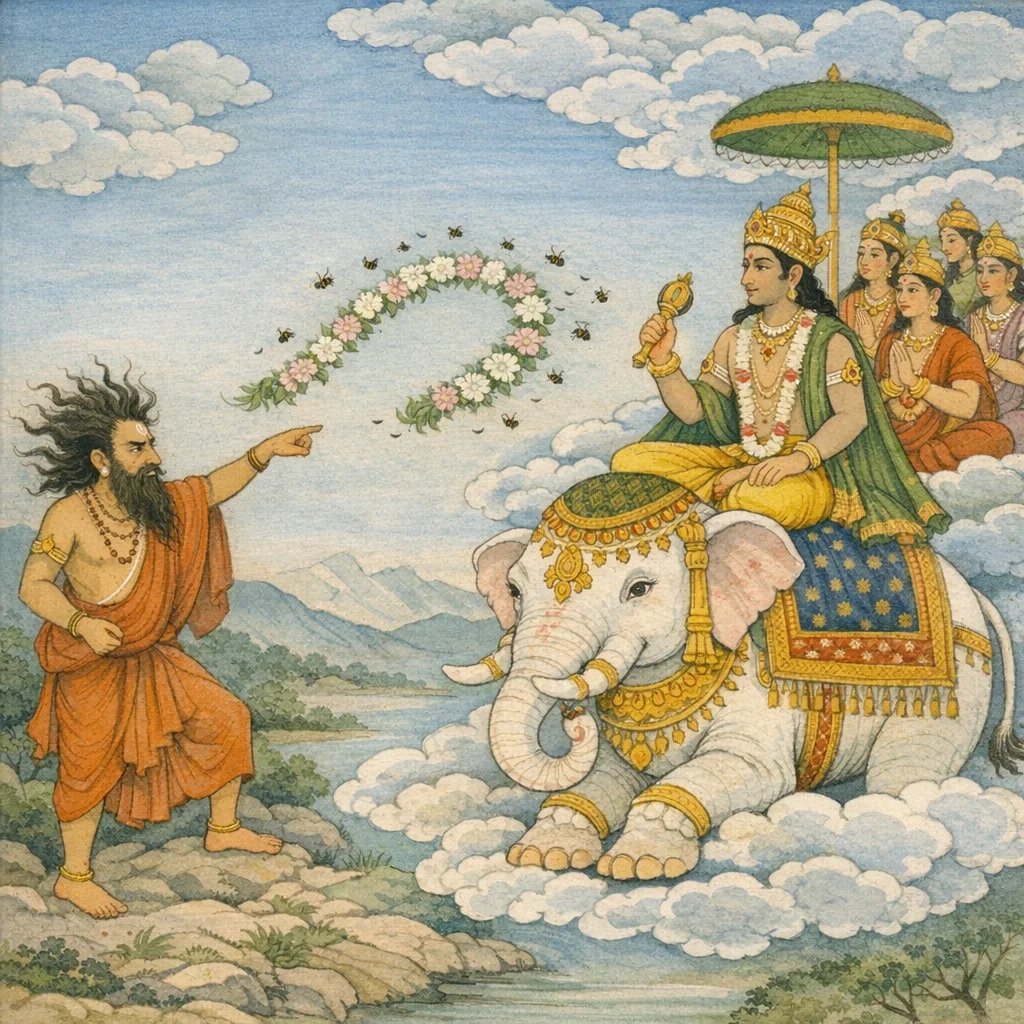
Parāśara answers Maitreya’s question about Śrī by tracing a chain of causes. Durvāsā gains a divine garland and gives it to Indra; Indra’s careless reception leads Airāvata to cast it down, and Durvāsā curses Indra’s realm to become niḥśrī, bereft of Śrī. Parāśara teaches that where sattva abides, Śrī arises; without Śrī, dharma, yajña, and tapas wane, and the asuras grow aggressive. Defeated, the devas seek Brahmā, who directs them to take refuge in Viṣṇu. On the shore of the Kṣīroda, hymns praise Viṣṇu as the uncaused cause, beyond the guṇas yet all-pervading. Viṣṇu appears and instructs the churning of the ocean with Mandara and Vāsuki, supporting as Kūrma, strengthening the devas and weakening the asuras. From the churning emerge Surabhī, Vāruṇī, Pārijāta, apsarās, the Moon, poison, Dhanvantari with amṛta, and finally Śrī (Lakṣmī) on a lotus, who chooses Hari’s chest. Lakṣmī-stuti is recited; Śrī grants boons—not abandoning the worlds and favoring reciters—and cosmic order is restored.
Shlokas
Verse 1
इदं च शृणु मैत्रेय यत् पृष्टो ऽहम् इह त्वया श्रीसंबद्धं मयाप्य् एतच् श्रुतम् आसीन् मरीचितः
Hear this also, O Maitreya—what you have asked me here. This account, bound up with Śrī (Lakṣmī), I too once heard from Marīci.
Verse 2
दुर्वासाः शंकरस्यांशश् चचार पृथिवीम् इमाम् स ददर्श स्रजं दिव्याम् ऋषिर् विद्याधरीकरे
Durvāsā—held to be a portion of Śaṅkara—wandered across this very earth. As he went, the sage beheld a celestial garland in the hand of a Vidyādharī.
Verse 3
संतानकानाम् अखिलं यस्या गन्धेन वासितम् अतिसेव्यम् अभूद् ब्रह्मन् तद् वनं वनचारिणाम्
O Brāhmaṇa, the whole forest was perfumed by the fragrance of santānaka blossoms; thus it became exceedingly delightful to all who dwelt and wandered there.
Verse 4
उन्मत्तव्रतधृग् विप्रः स दृष्ट्वा शोभनां स्रजम् तां ययाचे वरारोहां विद्याधरवधूं ततः
Then that brāhmaṇa, who had taken up a wild and unconventional vow, on seeing the splendid garland, asked for it from the graceful Vidyādhara maiden.
Verse 5
याचिता तेन तन्वङ्गी मालां विद्याधराङ्गना ददौ तस्मै विशालाक्षी सादरं प्रणिपत्य तम्
Thus entreated, the slender-limbed Vidyādhara maiden, wide-eyed, bowed with reverence and graciously bestowed the garland upon him.
Verse 6
ताम् आदायात्मनो मूर्ध्नि स्रजम् उन्मत्तरूपधृक् कृत्वा स विप्रो मैत्रेय परिबभ्राम मेदिनीम्
Taking that garland and setting it upon his own head, the brāhmaṇa, assuming the guise of one maddened, wandered over the earth, O Maitreya.
Verse 7
स ददर्श समायान्तम् उन्मत्तैरावतस्थितम् त्रैलोक्याधिपतिं देवं सह देवैः शचीपतिम्
He beheld the lord of the three worlds—Indra, Śacī’s consort—approaching with the gods, seated upon the frenzied Airāvata.
Verse 8
ताम् आत्मनः स शिरसः स्रजम् उन्मत्तषट्पदाम् आदायामरराजाय चिक्षेपोन्मत्तवन् मुनिः
Then the sage, as though seized by divine frenzy, took from his own head the garland swarming with maddened bees and hurled it toward the king of the immortals.
Verse 9
गृहीत्वामरराजेन स्रग् ऐरावतमूर्धनि न्यस्ता रराज कैलासशिखरे जाह्नवी यथा
The king of the gods seized it and set the garland upon Airāvata’s head; it shone resplendent, like Jāhnavī (Gaṅgā) gleaming upon the summit of Kailāsa.
Verse 10
मदान्धकारिताक्षो ऽसौ गन्धाकृष्टेन वारणः करेणाघ्राय चिक्षेप तां स्रजं धरणीतले
His eyes clouded by the darkness of rut-maddened frenzy, that elephant—drawn by the fragrance—lifted the garland with its trunk, smelled it, and then flung it down upon the ground.
Verse 11
ततश् चुक्रोध भगवान् दुर्वासा मुनिसत्तमः मैत्रेय देवराजानं क्रुद्धश् चैतद् उवाच ह
Thereupon the venerable Durvāsā—foremost among sages—was seized with anger; and, O Maitreya, in wrath he addressed the king of the gods, Indra, saying these words.
Verse 12
ऐश्वर्यमददुष्टात्मन्न् अतिस्तब्धो ऽसि वासव श्रियो धाम स्रजं यस् त्वं मद्दत्तां नाभिनन्दसि
O Vāsava (Indra), your inner being has been corrupted by the intoxication of power; you have grown exceedingly arrogant. You, who are the abode of prosperity, do not even welcome the garland I have bestowed upon you.
Verse 13
प्रसाद इति नोक्तं ते प्रणिपातपुरःसरम् हर्षोत्फुल्लकपोलेन न चापि शिरसा धृता
You did not utter the words, “Be gracious,” preceded by a reverent prostration; nor—your cheeks blooming with joy—did you bow your head in humble acceptance.
Verse 14
मया दत्ताम् इमां मालां यस्मान् न बहु मन्यसे त्रैलोक्यश्रीर् अतो मूढ विनाशम् उपयास्यति
Because you do not value this garland that I have given, O deluded one, the splendor and sovereignty of the three worlds will, for that very reason, pass toward ruin.
Verse 15
मां मन्यते ऽन्यैः सदृशं नूनं शक्र भवान् द्विजैः अतो ऽवमानम् अस्मासु मानिना भवता कृतम्
O Śakra (Indra), you surely deem me no different from other brāhmaṇas; thus, in the pride of your station, you have shown contempt toward me.
Verse 16
मद्दत्ता भवता यस्मात् क्षिप्ता माला महीतले तस्मात् प्रणष्टलक्ष्मीकं त्रैलोक्यं ते भविष्यति
Because the garland I bestowed was cast by you upon the ground, therefore the three worlds under your sway shall become bereft of Śrī—stripped of fortune, splendor, and auspicious sovereignty.
Verse 17
यस्य संजातकोपस्य भयम् एति चराचरम् तं त्वं माम् अतिगर्वेण देवराजावमन्यसे
He whose newly arisen wrath makes all that moves and all that stands still fall into fear—him, me, you now despise, puffed up with excessive pride, as though I were merely the king of the gods.
Verse 18
महेन्द्रो वारणस्कन्धाद् अवतीर्य त्वरान्वितः प्रसादयाम् आस मुनिं दुर्वाससम् अकल्मषम्
Mahendra—Indra himself—quickly descended from the back of his elephant and, in urgent haste, sought to appease the stainless sage Durvāsā.
Verse 19
प्रसाद्यमानः स तदा प्रणिपातपुरःसरम् प्रत्युवाच सहस्राक्षं दुर्वासा मुनिसत्तमः
Then, as he was being propitiated with reverent prostrations offered beforehand, the foremost of sages—Durvāsā—replied to Sahasrākṣa (Indra).
Verse 20
नाहं कृपालुहृदयो न च मां भजते क्षमा अन्ये ते मुनयः शक्र दुर्वाससम् अवेहि माम्
I am not one whose heart is softened by pity, nor does forgiveness dwell in me. Other sages may be so, O Śakra; but know me as Durvāsas.
Verse 21
गौतमादिभिर् अन्यैस् त्वं गर्वम् आपादितो मुधा अक्षान्तिसारसर्वस्वं दुर्वाससम् अवेहि माम्
Misled by Gautama and other sages, you have swelled with empty pride. Know me as Durvāsas—whose very essence is fierce intolerance, whose only wealth is unendurable wrath.
Verse 22
वसिष्ठाद्यैर् दयासारैः स्तोत्रं कुर्वद्भिर् उच्चकैः गर्वं गतो ऽसि येनैवं माम् अप्य् अद्यावमन्यसे
Because Vasiṣṭha and the other compassion-filled sages loudly sang hymns in your praise, you have grown intoxicated with pride—and so today you even dare to slight me thus.
Verse 23
ज्वलज्जटाकलापस्य भृकुटीकुटिलं मुखम् निरीक्ष्य कस् त्रिभुवने मम यो न गतो भयम्
Beholding that face—its brow knotted in a fierce frown, and its matted locks blazing like fire—who in all the three worlds could see it and not be seized by fear?
Verse 24
नाहं क्षमिष्ये बहुना किम् उक्तेन शतक्रतो विडम्बनाम् इमां भूयः करोष्य् अनुनयात्मिकाम्
I will not forgive. What is the use of many words, O Śatakratu? Do not again make this mockery—this show of conciliation meant only to coax and placate.
Verse 25
इत्य् उक्त्वा प्रययौ विप्रो देवराजो ऽपि तं पुनः आरुह्यैरावतं ब्रह्मन् प्रययाव् अमरावतीम्
Thus having spoken, the Brahmin departed; and the king of the gods, O Brahmin, mounting Airāvata once more, set out for Amarāvatī.
Verse 26
ततःप्रभृति निःश्रीकं सशक्रं भुवनत्रयम् मैत्रेयासीद् अपध्वस्तं संक्षीणौषधिवीरुधम्
From that time onward, O Maitreya, the three worlds—Indra’s realm included—were bereft of Śrī and splendor; all fell into ruin, and the herbs and creeping plants were exhausted.
Verse 27
न यज्ञाः संप्रवर्तन्ते न तपस्यन्ति तापसाः न च दानादिधर्मेषु मनश् चक्रे तदा जनः
Then the sacrificial rites no longer went forward; the ascetics ceased their austerities; and people’s minds no longer turned toward dharma—toward giving and the other sacred duties.
Verse 28
निःसत्त्वाः सकला लोका लोभाद्युपहतेन्द्रियाः स्वल्पे ऽपि हि बभूवुस् ते साभिलाषा द्विजोत्तम
All worlds became drained of sattva; their senses were wounded by greed and other passions. Thus, O best of the twice-born, even for the smallest gain they rose up filled with craving.
Verse 29
यतः सत्त्वं ततो लक्ष्मीः सत्त्वं भूत्यनुसारि च निःश्रीकाणां कुतः सत्त्वं विना तेन गुणाः कुतः
Where sattva prevails, there Lakṣmī arises, and prosperity follows after sattva. But for those bereft of Śrī, how could sattva exist? And without that sattva, from where could virtues come?
Verse 30
बलशौर्याद्यभावश् च पुरुषाणां गुणैर् विना लङ्घनीयः समस्तस्य बलशौर्यविवर्जितः भवत्य् अपध्वस्तमतिर् लङ्घितः प्रथितः पुमान्
A man bereft of strength and valor, and lacking the other sustaining qualities, becomes one whom all may readily overstep and disregard. Deprived of power and courage, his judgment is shattered; and when treated with contempt, he is spoken of as one humiliated.
Verse 31
एवम् अत्यन्तनिःश्रीके त्रैलोक्ये सत्त्ववर्जिते देवान् प्रति बलोद्योगं चक्रुर् दैतेयदानवाः
Thus, when the three worlds had become utterly bereft of Śrī and devoid of sattva, the Daityas and Dānavas set themselves to the exertion of force, mustering their power against the Devas.
Verse 32
लोभाभिभूता निःश्रीका दैत्याः सत्त्वविवर्जिताः श्रिया विहीनैर् निःसत्त्वैर् देवैश् चक्रुस् ततो रणम्
Overpowered by greed, the Daityas—bereft of Śrī and emptied of sattva—then entered into battle with the Devas, who likewise, being without Śrī, had become weakened and devoid of strength.
Verse 33
विजितास् त्रिदशा दैत्यैर् इन्द्राद्याः शरणं ययुः पितामहं महाभागं हुताशनपुरोगमाः
Defeated by the Daityas, Indra and the other gods sought refuge with the Grandfather—Brahmā, the greatly fortunate—approaching him with Agni at their head.
Verse 34
यथावत् कथितो देवैर् ब्रह्मा प्राह ततः सुरान् परावरेशं शरणं व्रजध्वम् असुरार्दनम्
When the gods had reported everything in due order, Brahmā addressed the Devas: “Go and take refuge in the Lord of the higher and the lower realms—Śrī Viṣṇu, the destroyer of the Asuras.”
Verse 35
उत्पत्तिस्थितिनाशानाम् अहेतुं हेतुम् ईश्वरम् प्रजापतिपतिं विष्णुम् अनन्तम् अपराजितम्
I bow to Vishnu, the sovereign Lord—the cause of creation, preservation, and dissolution, yet Himself without cause; Master of the Prajāpatis, all-pervading, endless, and unconquered.
Verse 36
प्रधानपुंसोर् अजयोः कारणं कार्यभूतयोः प्रणतार्तिहरं विष्णुं स वः श्रेयो विधास्यति
May Lord Vishnu—unborn, yet the cause of Pradhāna and Puruṣa, the ground of all effects, and the remover of the distress of those who bow—ordain for you the highest good.
Verse 37
एवम् उक्त्वा सुरान् सर्वान् ब्रह्मा लोकपितामहः क्षीरोदस्योत्तरं तीरं तैर् एव सहितो ययौ
Thus having addressed all the gods, Brahmā, the Pitāmaha of the worlds, set out with those very deities for the northern shore of the Ocean of Milk (Kṣīroda).
Verse 38
स गत्वा त्रिदशैः सर्वैः समवेतः पितामहः तुष्टाव वाग्भिर् इष्टाभिः परावरपतिं हरिम्
Having gone there with all the gods assembled, Pitāmaha praised Hari—the Lord of the higher and lower realms—with cherished and fitting words.
Verse 39
नमामि सर्वं सर्वेशम् अनन्तम् अजम् अव्ययम् लोकधामधराधारम् अप्रकाशम् अभेदिनम्
I bow to Him who is all and Lord of all—endless, unborn, imperishable; the abode of the worlds and the support even of the earth’s bearer; unmanifest to the senses and undivided.
Verse 40
नारायणम् अणीयांसम् अशेषाणाम् अणीयसाम् समस्तानां गरिष्ठं च भूरादीनां गरीयसाम्
I bow to Nārāyaṇa—subtler than all that is subtle without remainder, and yet greater than all that is great; surpassing even earth and the rest, which are themselves counted among the great.
Verse 41
यत्र सर्वं यतः सर्वम् उत्पन्नं मत्पुरःसरम् सर्वभूतश् च यो देवः पराणाम् अपि यः परः
In Him all this abides, and from Him all this has arisen—He who stands before me as the primal cause; the God who is the very Self of all beings, and who is higher even than the highest—upon that Supreme Lord my mind rests.
Verse 42
परः परस्मात् पुरुषात् परमात्मस्वरूपधृक् योगिभिश् चिन्त्यते यो ऽसौ मुक्तिहेतोर् मुमुक्षुभिः
He who is higher than the highest Person—bearing the very nature of the Supreme Self—is the One whom yogins contemplate; and seekers of liberation meditate upon Him as the cause and means of release.
Verse 43
सत्त्वादयो न सन्तीशे यत्र च प्राकृता गुणाः स शुद्धः सर्वशुद्धेभ्यः पुमान् आद्यः प्रसीदतु
In the Lord, neither sattva and the other qualities exist, nor do the material guṇas of Prakṛti find any footing. May that Primordial Person—purer than all that is called pure—be gracious to us.
Verse 44
कलाकाष्ठानिमेषादि कालसूत्रस्य गोचरे यस्य शक्तिर् न शुद्धस्य प्रसीदतु स नो हरिः
May that Hari be gracious to us—He whose power is not confined even within the stainless course of the thread of Time, though Time is measured out as kalā, kāṣṭhā, nimeṣa, and the rest.
Verse 45
प्रोच्यते परमेशो हि यः शुद्धो ऽप्य् उपचारतः प्रसीदतु स नो विष्णुर् आत्मा यः सर्वदेहिनाम्
May Vishnu be gracious to us—He who is the Self of all embodied beings; though ever pure, He is spoken of as the Supreme Lord in the devotional language of reverent convention.
Verse 46
यः कारणं च कार्यं च कारणस्यापि कारणम् कार्यस्यापि च यः कार्यं प्रसीदतु स नो हरिः
May Hari be gracious to us—He who is both cause and effect; the cause even of the cause, and the very effect within what is called the effect.
Verse 47
कार्यकार्यस्य यत् कार्यं तत्कार्यस्यापि यः स्वयम् तत्कार्यकार्यभूतो यस् ततश् च प्रणतो ऽस्मि तम्
I bow to the Supreme—who is the cause of what is itself called a cause; who Himself is the cause even of that cause; and who, in turn, becomes the effect of that very cause.
Verse 48
कारणं कारणस्यापि तस्य कारणकारणम् तत्कारणानां हेतुं तं प्रणतो ऽस्मि सुरेश्वरम्
I bow to the Lord of the gods—He who is the cause even of all causes, the cause of that cause as well, the primal reason behind those causes, the ultimate source of every chain of causation.
Verse 49
भोक्तारं भोज्यभूतं च स्रष्टारं सृज्यम् एव च कार्यकर्तृस्वरूपं तं प्रणतो ऽस्मि परं पदम्
I bow to that Supreme Abode—He who is the experiencer and also what is experienced; the creator and also what is created; whose very nature is both the deed and the doer.
Verse 50
विशुद्धबोधवन् नित्यम् अजम् अक्षयम् अव्ययम् अव्यक्तम् अविकारं यत् तद् विष्णोः परमं पदम्
That which is perfectly pure consciousness—everlasting, unborn, imperishable, undecaying; unmanifest and changeless—is proclaimed as the supreme station, the highest abode of Viṣṇu.
Verse 51
न स्थूलं न च सूक्ष्मं यन् न विशेषणगोचरम् तत् पदं परमं विष्णोः प्रणमामि सदामलम्
I bow always to the spotless, supreme state of Viṣṇu—neither gross nor subtle, and not within the reach of limiting descriptions or qualifying attributes.
Verse 52
यस्यायुतायुतांशांशे विश्वशक्तिर् इयं स्थिता परब्रह्मस्वरूपस्य प्रणमामि तम् अव्ययम्
I bow to the Imperishable One whose very nature is the Supreme Brahman—within an infinitesimal fraction of whose boundless being this entire power of the universe abides.
Verse 53
यन् न देवा न मुनयो न चाहं न च शंकरः जानन्ति परमेशस्य तद् विष्णोः परमं पदम्
That supreme station of Viṣṇu, belonging to the Highest Lord, is beyond the knowing of the gods, beyond the sages, beyond even me, and beyond Śaṅkara as well.
Verse 54
यद् योगिनः सदोद्युक्ताः पुण्यपापक्षये ऽक्षयम् पश्यन्ति प्रणवे चिन्त्यं तद् विष्णोः परमं पदम्
That imperishable Reality which ever-striving yogins behold when merit and sin are brought to exhaustion—contemplated as the Pranava (Oṃ)—that indeed is the supreme abode, the highest station of Viṣṇu.
Verse 55
शक्तयो यस्य देवस्य ब्रह्मविष्णुशिवात्मिकाः भवन्त्य् अभूतपूर्वस्य तद् विष्णोः परमं पदम्
This is the supreme station of Viṣṇu—of that unparalleled Divine Being—whose powers manifest as Brahmā, Viṣṇu, and Śiva in their respective forms.
Verse 56
सर्वेश सर्वभूतात्मन् सर्व सर्वाश्रयाच्युत प्रसीद विष्णो भक्तानां व्रज नो दृष्टिगोचरम्
O Lord of all, Self within every being—O All, O unfailing Acyuta, refuge of the universe—be gracious, O Viṣṇu. For the sake of Your devotees, come within our sight and reveal Yourself.
Verse 57
इत्य् उदीरितम् आकर्ण्य ब्रह्मणस् त्रिदशास् ततः प्रणम्योचुः प्रसीदेति व्रज नो दृष्टिगोचरम्
Hearing these words spoken by Brahmā, the gods bowed in reverence and said, “Be gracious; now withdraw from our sight.”
Verse 58
यन् नायं भगवान् ब्रह्मा जानाति परमं पदम् तं नताः स्मो जगद्धाम तव सर्वगताच्युत
To that supreme abode of Yours—which even Bhagavān Brahmā does not fully know—we bow. O dwelling-place of the worlds, O all-pervading Acyuta, we offer reverent homage to You.
Verse 59
इत्य् अन्ते वचसस् तेषां देवानां ब्रह्मणस् तथा ऊचुर् देवर्षयः सर्वे बृहस्पतिपुरोगमाः
When the words of the gods—and of Brahmā as well—had thus come to their close, all the divine seers, led by Bṛhaspati, spoke forth in reply.
Verse 60
आद्यो यज्ञः पुमान् ईड्यो यः पूर्वेषां च पूर्वजः तं नताः स्मो जगत्स्रष्टुः स्रष्टारम् अविशेषणम्
He is the primordial Yajña—the Sacrifice itself—the adorable Supreme Person, the first cause and the ancestor even of the ancients. To that Creator of the universe, the Creator beyond all limiting attributes and distinctions, we bow in reverence.
Verse 61
भगवन् भूतभव्येश यज्ञमूर्तिधराव्यय प्रसीद प्रणतानां त्वं सर्वेषां देहि दर्शनम्
O Bhagavān, Lord of all that has been and all that is yet to be, imperishable One who bears the very form of sacrifice—be gracious. To us who have bowed down in surrender, to all of us, grant Your vision.
Verse 62
एष ब्रह्मा तथैवायं सह रुद्रैस् त्रिलोचनः सर्वादित्यैः समं पूषा पावको ऽयं सहाग्निभिः
Here, indeed, is Brahmā; and here is the three-eyed Lord together with the Rudras. Here is Pūṣan along with all the Ādityas; and here is the blazing Fire together with the host of Agnis—each power and office gathered into the One Supreme Reality.
Verse 63
अश्विनौ वसवश् चेमे सर्वे चैते मरुद्गणाः साध्या विश्वे तथा देवा देवेन्द्रश् चायम् ईश्वरः
These are the Aśvins; these are the Vasus; and all these are the hosts of the Maruts; likewise the Sādhyas, the Viśvedevas, and the other gods—while this one is Devendra, the sovereign lord among them.
Verse 64
प्रणामप्रवणा नाथ दैत्यसैन्यपराजिताः शरणं त्वाम् अनुप्राप्ताः समस्ता देवतागणाः
O Lord, bowed down in reverence, all the hosts of gods—defeated by the armies of the Daityas—have now come to You alone for refuge.
Verse 65
एवं संस्तूयमानस् तु भगवाञ् छङ्खचक्रधृक् जगाम दर्शनं तेषां मैत्रेय परमेश्वरः
Thus, as He was hymned in this way, the Blessed Lord, bearer of conch and discus—O Maitreya, the Supreme Ruler—came into their presence and granted them His darśana (direct vision).
Verse 66
तं दृष्ट्वा ते तदा देवाः शङ्खचक्रगदाधरम् अपूर्वरूपसंस्थानं तेजसां राशिम् ऊर्जितम्
Beholding Him then, the gods saw the Bearer of conch, discus, and mace—of an unprecedented form and perfect symmetry—an exalted mass of splendour, concentrated and irresistible in power.
Verse 67
प्रणम्य प्रणताः पूर्वं संक्षोभस्तिमितेक्षणाः तुष्टुवुः पुण्डरीकाक्षं पितामहपुरोगमाः
First bowing down in reverence, their eyes stilled from agitation, they—led by the Grandfather (Brahmā)—praised the Lotus-eyed Lord, Puṇḍarīkākṣa (Viṣṇu).
Verse 68
नमो नमस् ते विश्वेश त्वं ब्रह्मा त्वं पिनाकधृक् इन्द्रस् त्वम् अग्निः पवनो वरुणः सविता यमः वसवो मरुतः साध्या विश्वेदेवगणा भवान्
Homage—homage to You, O Lord of the universe. You are Brahmā; You are the bearer of the Pināka bow (Rudra). You are Indra; You are Agni; You are Vāyu, Varuṇa, Savitṛ, and Yama. You are the Vasus, the Maruts, the Sādhyas—indeed, You Yourself are the entire host of the Viśvedevas.
Verse 69
यो ऽयं तवागतो देव समीपं देवतागणः स त्वम् एव जगत्स्रष्टा यतः सर्वगतो भवान्
O Lord—this very host of gods that has come into Your presence is none other than You Yourself; for You alone are the Creator of the universe, since You pervade and abide everywhere.
Verse 70
त्वं यज्ञस् त्वं वषट्कारस् त्वम् ओङ्कारः प्रजापतिः वेत्ता वेद्यं च सर्वात्मंस् त्वन्मयं चाखिलं जगत्
You are the sacrifice itself; You are the sacred cry “vaṣaṭ”; You are the primordial syllable Oṁ and Prajāpati. You are the knower and the known, the Self within all; indeed this whole universe is pervaded by You and made of You.
Verse 71
त्वाम् आर्ताः शरणं विष्णो प्रयाता दैत्यनिर्जिताः वयं प्रसीद सर्वात्मंस् तेजसाप्याययस्व नः
O Viṣṇu, we—afflicted and overcome by the Daityas—have come to You alone for refuge. Be gracious to us, O Self of all; by Your divine splendour restore us and make us flourish again.
Verse 72
तावद् आर्तिस् तथा वाञ्छा तावन् मोहस् तथासुखम् यावन् नायाति शरणं त्वाम् अशेषाघनाशनम्
So long do anguish and craving endure; so long do delusion and even fleeting happiness persist—until one comes to You for refuge, O destroyer of all sin.
Verse 73
त्वं प्रसादं प्रसन्नात्मन् प्रपन्नानां कुरुष्व नः तेजसां नाथ सर्वेषां स्वशक्त्याप्यायनं कुरु
O Serene-Souled Lord, bestow Your gracious favour upon us who have taken refuge in You. O Master of all splendours, by Your own divine power nourish and strengthen our inborn might.
Verse 74
एवं संस्तूयमानस् तु प्रणतैर् अमरैर् हरिः प्रसन्नदृष्टिर् भगवान् इदम् आह स विश्वकृत्
Thus praised by the immortals who bowed before Him, Hari—the Blessed Lord, the Maker of the universe—looked upon them with gracious favour and spoke these words.
Verse 75
तेजसो भवतां देवाः करिष्याम्य् उपबृंहणम् वदाम्य् अहं यत् क्रियतां भवद्भिस् तद् इदं सुराः
O Devas, I shall augment and strengthen your splendor. What I now declare—O Suras—let that very counsel be carried out by you.
Verse 76
आनीय सहिता दैत्यैः क्षीराब्धौ सकलौषधीः मन्थानं मन्दरं कृत्वा नेत्रं कृत्वा तु वासुकिम् मथ्यताम् अमृतं देवाः सहाये मय्य् अवस्थिते
Gather all medicinal herbs and cast them into the Ocean of Milk; joining with the Daityas, churn for the amṛta—using Mandara as the churning-rod and Vāsuki as the rope—while I stand present as your support and aid.
Verse 77
सामपूर्वं च दैतेयास् तत्र साहाय्यकर्मणि सामान्यफलभोक्तारो यूयं वाच्या भविष्यथ
And you, O Daityas, beginning with conciliation and peaceful counsel, in that work of mutual assistance you shall be acknowledged as sharers in the common result, entitled to partake of the collective fruit.
Verse 78
मथ्यमाने च तत्राब्धौ यत् समुत्पद्यते ऽमृतम् तत्पानाद् बलिनो यूयम् अमराश् च भविष्यथ
And when that ocean is churned, whatever amṛta arises from it—by drinking it you shall become mighty, and you shall become deathless as well.
Verse 79
तथा चाहं करिष्यामि ते यथा त्रिदशद्विषः न प्राप्स्यन्त्य् अमृतं देवाः केवलं क्लेशभागिनः
Yet I shall also act in such a way that the enemies of the Thirty will not obtain the amṛta, and the devas themselves will be made to share only in hardship.
Verse 80
इत्य् उक्ता देवदेवेन सर्व एव ततः सुराः संधानम् असुरैः कृत्वा यत्नवन्तो ऽमृते ऽभवन्
Thus addressed by the God of gods, all the Devas then made a pact with the Asuras; and, intent on attaining amṛta, they set themselves to the work with steadfast effort.
Verse 81
नानौषधीः समानीय देवदैतेयदानवाः क्षिप्त्वा क्षीराब्धिपयसि शरदभ्रामलत्विषि
Gathering many kinds of healing herbs, the Devas, the Daityas, and the Dānavas cast them into the milky waters of the Ocean of Milk, whose sheen was like the bright, cloud-washed radiance of autumn.
Verse 82
मन्थानं मन्दरं कृत्वा नेत्रं कृत्वा च वासुकिम् ततो मथितुम् आरब्धा मैत्रेय तरसामृतम्
Making Mandara the churning-staff and appointing Vāsuki as the pulling-cord, they then began—O Maitreya—to churn with force the ocean that held ambrosia within it.
Verse 83
विबुधाः सहिताः सर्वे यतः पुच्छं ततः कृताः कृष्णेन वासुकेर् दैत्याः पूर्वकाये निवेशिताः
All the Devas together took their stand at the tail-end; and, by Kṛṣṇa’s direction, the Daityas were made to hold Vāsuki at the forepart of his body.
Verse 84
ते तस्य फणनिःश्वासवह्निनापहतत्विषः निस्तेजसो ऽसुराः सर्वे बभूवुर् अमितद्युते
Struck by the fire of his breath that issued from the hoods, all the Asuras—once radiant—were robbed of their splendor and became utterly powerless, O you of boundless brilliance.
Verse 85
तेनैव मुखनिःश्वासवायुनास्तबलाहकैः पुच्छप्रदेशे वर्षद्भिस् तदा चाप्यायिताः सुराः
Then, by the very wind of His exhalation from the mouth, driving dense rain-clouds, showers fell upon the region of the tail; and by those rains the gods too were nourished and restored.
Verse 86
क्षीरोदमध्ये भगवान् कूर्मरूपी स्वयं हरिः मन्दराद्रेर् अधिष्ठानं भ्रमतो ऽभून् महामुने
O great sage, in the midst of the Ocean of Milk, the Blessed Lord Hari Himself assumed the form of the Tortoise, becoming the steadfast base of Mount Mandara as it whirled in the churning.
Verse 87
रूपेणान्येन देवानां मध्ये चक्रगदाधरः चकर्ष नागराजानं दैत्यमध्ये ऽपरेण च
Assuming one form amid the hosts of the gods, the Bearer of the discus and mace seized the serpent-king; and, taking yet another form among the Daityas, He drew him there as well—thus revealing the Lord’s sovereign power to act in many places at once.
Verse 88
उपर्य् आक्रान्तवाञ् छैलं बृहद्रूपेण केशवः तथापरेण मैत्रेय यन् न दृष्टं सुरासुरैः
Then Keśava, expanding into a vast and immeasurable form, strode upon and subdued the mountain. And, O Maitreya, He revealed yet another marvel—such as had never been witnessed by gods or demons alike.
Verse 89
तेजसा नागराजानं तथाप्यायितवान् हरिः अन्येन तेजसा देवान् उपबृंहितवान् विभुः
By His own radiant power, Hari nourished and strengthened the king of serpents; and by another radiance, the all-pervading Lord likewise invigorated the gods—sustaining each order of beings according to its place in the cosmic balance.
Verse 90
मथ्यमाने ततस् तस्मिन् क्षीराब्धौ देवदानवैः हविर्धामाभवत् पूर्वं सुरभिः सुरपूजिता
As the Devas and the Dānavas churned the Ocean of Milk, first arose Surabhī, radiant as the very abode of sacrificial oblations, honoured and worshipped by the gods.
Verse 91
जग्मुर् मुदं ततो देवा दानवाश् च महामुने व्याक्षिप्तचेतसश् चैव बभूवुः स्तिमितेक्षणाः
Then, O great sage, both the Devas and the Dānavas were seized by gladness; yet, their minds whirled by wonder, they stood still with unblinking eyes.
Verse 92
किम् एतद् इति सिद्धानां दिवि चिन्तयतां ततः बभूव वारुणी देवी मदाघूर्णितलोचना
As the Siddhas in heaven pondered, “What is this?”, there then arose the goddess Vāruṇī, her eyes unsteady, rolling with intoxicating rapture.
Verse 93
कृतावर्तात् ततस् तस्मात् क्षीरोदाद् वासयञ् जगत् गन्धेन पारिजातो ऽभूद् देवस्त्रीनन्दनस् तरुः
Then, from that whirling surge of the churned Ocean of Milk, arose the Pārijāta tree, delight of the wives of the gods, perfuming the whole world with its fragrance.
Verse 94
रूपौदार्यगुणोपेतस् ततश् चाप्सरसां गणः क्षीरोदधेः समुत्पन्नो मैत्रेय परमाद्भुतः
Then, endowed with beauty, grace, and excellent qualities, a wondrous host of Apsarās arose from the Ocean of Milk—marvelous indeed, O Maitreya.
Verse 95
ततः शीतांशुर् अभवज् जगृहे तं महेश्वरः जगृहुश् च विषं नागाः क्षीरोदाब्धिसमुत्थितम्
Then the cool-rayed Moon came forth, and Maheśvara (Śiva) received him. And the Nāgas, too, took up the poison that had arisen from the Ocean of Milk, so that the order of the worlds might proceed without hindrance.
Verse 96
ततो धन्वन्तरिर् देवः श्वेताम्बरधरः स्वयम् बिभ्रत्कमण्डलुं पूर्णम् अमृतस्य समुत्थितः
Then the divine Dhanvantari himself arose, clad in white garments, bearing a water-vessel filled to the brim with amṛta, the nectar of immortality.
Verse 97
ततः स्वस्थमनस्कास् ते सर्वे दैतेयदानवाः बभूवुर् मुदिताः सद्यो मैत्रेय मुनिभिः सह
Then, O Maitreya, all those Daityas and Dānavas at once became calm and composed in mind, and—together with the sages—were immediately filled with gladness.
Verse 98
ततः स्फुरत्कान्तिमती विकासिकमले स्थिता श्रीर् देवी पयसस् तस्माद् उत्थिता धृतपङ्कजा
Then, radiant with flashing splendor, the Goddess Śrī arose from that ocean of milk, standing upon a fully blossomed lotus—herself the lotus-bearer—manifesting as the sovereign auspiciousness that abides with the Supreme.
Verse 99
तां तुष्टुवुर् मुदा युक्ताः श्रीसूक्तेन महर्षयः
Filled with joy and united in devotion, the great seers praised her with the Śrī Sūkta, extolling the divine Śrī, through whom auspiciousness and prosperity are made manifest.
Verse 100
विश्वावसुमुखास् तस्या गन्धर्वाः पुरतो जगुः घृताचीप्रमुखा ब्रह्मन् ननृतुश् चाप्सरोगणाः
The Gandharvas—led by Viśvāvasu—sang sweetly before her; and, O Brahman, the hosts of Apsarases, headed by Ghṛtācī, danced in accompaniment.
Verse 101
गङ्गाद्याः सरितस् तोयैः स्नानार्थम् उपतस्थिरे दिग्गजा हेमपात्रस्थम् आदाय विमलं जलम् स्नापयां चक्रिरे देवीं सर्वलोकमहेश्वरीम्
For her ceremonial bath, the sacred rivers—foremost the Gaṅgā—came forth with their waters. The mighty elephants of the quarters, lifting pure water in golden vessels, performed the ablution of the Goddess, the Great Sovereign Lady of all the worlds.
Verse 102
क्षीरोदो रूपधृक् तस्यै मालाम् अम्लानपङ्कजाम् ददौ विभूषणान्य् अङ्गे विश्वकर्मा चकार ह
Then Kṣīroda, assuming a fitting form, presented her an unfading garland of lotuses; and Viśvakarmā fashioned ornaments to adorn her limbs.
Verse 103
दिव्यमाल्याम्बरधरा स्नाता भूषणभूषिता पश्यतां सर्वदेवानां ययौ वक्षःस्थलं हरेः
Wearing celestial garlands and garments, freshly bathed and adorned with radiant ornaments, she—before the gaze of all the gods—went and took her place upon the chest of Hari (Viṣṇu).
Verse 104
ततो ऽवलोकिता देवा हरिवक्षःस्थलस्थया लक्ष्म्या मैत्रेय सहसा परां निर्वृतिम् आगताः
Then, O Maitreya, when Lakṣmī—abiding upon Hari’s chest—beheld the gods, they at once entered into supreme relief and deep contentment.
Verse 105
उद्वेगं परमं जग्मुर् दैत्या विष्णुपराङ्मुखाः त्यक्ता लक्ष्म्या महाभाग विप्रचित्तिपुरोगमाः
Turning away from Viṣṇu, the Daityas were seized by the utmost alarm; O noble one, forsaken by Lakṣmī, they fell into ruin with Vipracitti at their head.
Verse 106
ततस् ते जगृहुर् दैत्या धन्वन्तरिकरे स्थितम् कमण्डलुं महावीर्या यत्रास्ते तद् द्विजामृतम्
Then those mighty Daityas seized the water-pot resting in Dhanvantari’s hand—the vessel in which the amṛta, the nectar of immortality, was contained.
Verse 107
मायया मोहयित्वा तान् विष्णुः स्त्रीरूपम् आस्थितः दानवेभ्यस् तद् आदाय देवेभ्यः प्रददौ विभुः
Bewildering them by His own māyā, Viṣṇu assumed the form of a woman, took the nectar from the Dānavas, and the all-pervading Lord bestowed it upon the Devas.
Verse 108
ततः पपुः सुरगणाः शक्राद्यास् तत् तदामृतम् उद्यतायुधनिस्त्रिंशा दैत्यास् तांश् च समभ्ययुः
Then the hosts of the gods—Indra and the rest—drank that amṛta; but the Daityas, weapons raised and swords drawn, rushed against them.
Verse 109
पीते ऽमृते च बलिभिर् देवैर् दैत्यचमूस् तदा वध्यमाना दिशो भेजे पातालं च विवेश वै
When the mighty Devas had drunk the amṛta, the Daitya host, being cut down, fled in every direction and indeed withdrew into Pātāla, the netherworld.
Verse 110
ततो देवा मुदा युक्ताः शङ्खचक्रगदाधरम् प्रणिपत्य यथापूर्वम् अशासंस् तत् त्रिविष्टपम्
Then the gods, filled with joy, bowed down to the Lord who bears the conch, discus, and mace; and as before they resumed the rightful rule of Triviṣṭapa, the heavenly realm restored by his sovereign protection.
Verse 111
ततः प्रसन्नभाः सूर्यः प्रययौ स्वेन वर्त्मना ज्योतींषि च यथामार्गं प्रययुर् मुनिसत्तम
Thereupon the Sun, his radiance serene and auspicious, proceeded along his ordained path; and the other lights of heaven too, O best of sages, moved onward in their proper courses.
Verse 112
जज्वाल भगवांश् चोच्चैश् चारुदीप्तिर् विभावसुः धर्मे च सर्वभूतानां तदा मतिर् अजायत
Then the Blessed Vibhāvasu (Agni), radiant with lovely brilliance, blazed forth on high; and at that very time, in all beings, the inclination toward dharma awakened.
Verse 113
श्रिया जुष्टं च त्रैलोक्यं बभूव द्विजसत्तम शक्रश् च त्रिदशश्रेष्ठः पुनः श्रीमान् अजायत
O best of the twice-born, the three worlds once again became graced by Śrī—Fortune and auspicious sovereignty; and Śakra, foremost among the gods, was restored anew in splendor.
Verse 114
सिंहासनगतः शक्रः संप्राप्य त्रिदिवं पुनः देवराज्ये स्थितो देवीं तुष्टावाब्जकरां ततः
Seated once more upon his throne in Tridiva, Śakra, having regained the celestial realm, stood established again in the kingship of the gods; and then he praised the Goddess whose hand bears the lotus.
Verse 115
नमस्ये सर्वलोकानां जननीम् अब्जसंभवाम् श्रियम् उन्निद्रपद्माक्षीं विष्णुवक्षःस्थलस्थिताम्
I bow to Śrī—the Mother of all worlds, lotus-born, lotus-eyed with ever-wakeful gaze, who abides upon the chest of Lord Viṣṇu.
Verse 116
त्वं सिद्धिस् त्वं स्वधा स्वाहा सुधा त्वं लोकपावनी संध्या रात्रिः प्रभा भूतिर् मेधा श्रद्धा सरस्वती
You are attainment itself; You are svadhā and svāhā, and You are sudhā, the nectar of immortality. You are the purifier of the worlds—twilight and night, radiance and prosperity; You are intelligence and faith, and You are Sarasvatī, the very power of sacred speech and knowledge.
Verse 117
यज्ञविद्या महाविद्या गुह्यविद्या च शोभने आत्मविद्या च देवि त्वं विमुक्तिफलदायिनी
O radiant Goddess, you are the wisdom of sacrifice, the great wisdom, and the secret wisdom; you are also the knowledge of the Self—O Devi, you are the bestower of the fruit of liberation.
Verse 118
आन्वीक्षिकी त्रयी वार्ता दण्डनीतिस् त्वम् एव च सौम्यासौम्यैर् जगद् रूपैस् त्वयैतद् देवि पूरितम्
You alone are ānvīkṣikī, the science of inquiry and discernment; you are the trayī, the threefold Veda; you are vārttā, the practical arts of livelihood and exchange; and you are also daṇḍanīti, the science of governance and chastisement. O Goddess, by your gentle and by your awe-inspiring forms, this entire universe is pervaded and filled.
Verse 119
का त्व् अन्या त्वाम् ऋते देवि सर्वयज्ञमयं वपुः अध्यास्ते देवदेवस्य योगिचिन्त्यं गदाभृतः
O Goddess, who else but you could ever abide upon that form which is itself the essence of every sacrifice—the form of the God of gods, the mace-bearing Lord, whom the yogins contemplate in inward vision?
Verse 120
त्वया देवि परित्यक्तं सकलं भुवनत्रयम् विनष्टप्रायम् अभवत् त्वयेदानीं समेधितम्
O Goddess, when you withdrew, the threefold world was almost ruined; now, by your presence once more, it has flourished and come to fullness.
Verse 121
दाराः पुत्रास् तथागारं सुहृद्धान्यधनादिकम् भवत्य् एतन् महाभागे नित्यं त्वद्वीक्षणान् नृणाम्
Wives, sons, a home, loyal friends, grain, wealth, and the rest—O most fortunate one—these ever come to men by your gracious glance alone.
Verse 122
शरीरारोग्यम् ऐश्वर्यम् अरिपक्षक्षयः सुखम् देवि त्वद्दृष्टिदृष्टानां पुरुषाणां न दुर्लभम्
O Goddess, for men graced by your glance, bodily health, sovereignty, the waning of hostile forces, and enduring happiness are not hard to attain.
Verse 123
त्वं माता सर्वभूतानां देवदेवो हरिः पिता त्वयैतद् विष्णुना चाम्ब जगद् व्याप्तं चराचरम्
You are the mother of all beings; Hari, God of gods, is the father. O revered Mother, by you and by that very Vishnu, this whole universe—moving and unmoving—is pervaded everywhere.
Verse 124
मा नः कोशं तथा गोष्ठं मा गृहं मा परिच्छदम् मा शरीरं कलत्रं च त्यजेथाः सर्वपावनि
O all-purifying one, do not abandon us—neither our treasury nor our cattle-sheds; neither our home nor our possessions; nor even our body and our spouse. Do not forsake us in any way.
Verse 125
मा पुत्रान् मा सुहृद्वर्गान् मा पशून् मा विभूषणम् त्यजेथा मम देवस्य विष्णोर् वक्षःस्थलालये
Do not abandon your sons; do not forsake your circle of friends; do not give up your cattle or your ornaments—while you dwell as an abode upon the chest of my Lord, the divine Viṣṇu.
Verse 126
सत्त्वेन सत्यशौचाभ्यां तथा शीलादिभिर् गुणैः त्यज्यन्ते ते नराः सद्यः संत्यक्ता ये त्वयामले
By sattva, by truth and inner purity, and by virtues beginning with good conduct—O Stainless One—those men are abandoned at once who have already abandoned you.
Verse 127
त्वयावलोकिताः सद्यः शीलाद्यैर् अखिलैर् गुणैः कुलैश्वर्यैश् च युज्यन्ते पुरुषा निर्गुणा अपि
Even men who are otherwise without merit—once merely looked upon by you—are at once endowed with every excellence, beginning with noble character, and are joined to high lineage and sovereign prosperity as well.
Verse 128
स श्लाघ्यः स गुणी धन्यः स कुलीनः स बुद्धिमान् स शूरः स च विक्रान्तो यस् त्वया देवि वीक्षितः
Worthy of praise is he; virtuous is he; blessed is he. Noble-born is he; wise is he; heroic is he, and valiant too—he whom you, O Goddess, have deigned to look upon.
Verse 129
सद्यो वैगुण्यम् आयान्ति शीलाद्याः सकला गुणाः पराङ्मुखी जगद्धात्री यस्य त्वं विष्णुवल्लभे
O beloved of Viṣṇu, for that person from whom you—the Mother who upholds the worlds—turn your face away, all virtues, good conduct and the rest, at once fall into defect and lose their lustre.
Verse 130
न ते वर्णयितुं शक्ता गुणाञ् जिह्वापि वेधसः प्रसीद देवि पद्माक्षि मास्मांस् त्याक्षीः कदाचन
Even the tongue of the Creator cannot fully describe your virtues. Be gracious, O Goddess, lotus-eyed one—never abandon us at any time.
Verse 131
एवं श्रीः संस्तुता सम्यक् प्राह हृष्टा शतक्रतुम् शृण्वतां सर्वदेवानां सर्वभूतस्थिता द्विज
Thus duly praised, Śrī—who abides within all beings—spoke with delight to Śatakratu (Indra), O twice-born one, while all the gods listened.
Verse 132
परितुष्टास्मि देवेश स्तोत्रेणानेन ते हरे वरं वृणीष्व यस् त्व् इष्टो वरदाहं तवागता
O Lord of the gods, O Hari—by this hymn of praise I am fully satisfied. Choose whatever boon you desire; I have come before you as a giver of boons.
Verse 133
वरदा यदि मे देवि वरार्हो यदि चाप्य् अहम् त्रैलोक्यं न त्वया त्याज्यम् एष मे ऽस्तु वरः परः
O Goddess, if you are truly a bestower of boons—and if I am worthy to receive—then do not abandon the three worlds. Let this be my highest boon.
Verse 134
स्तोत्रेण यस् तथैतेन त्वां स्तोष्यत्य् अब्धिसंभवे स त्वया न परित्याज्यो द्वितीयो ऽस्तु वरो मम
O Ocean-born Goddess, whoever praises you with this very hymn—may he never be forsaken by you. Let this be my second boon.
Verse 135
त्रैलोक्यं त्रिदशश्रेष्ठ न संत्यक्ष्यामि वासव दत्तो वरो मयायं ते स्तोत्राराधनतुष्टया
O best of the gods, O Vāsava— I shall not abandon the three worlds. Pleased by your worship through hymns of praise, I have granted you this boon.
Verse 136
यश् च सायं तथा प्रातः स्तोत्रेणानेन मानवः मां स्तोष्यति न तस्याहं भविष्यामि पराङ्मुखी
Whoever, at evening and again at dawn, praises Me with this hymn— I shall never turn away from that devotee; I shall not be averse to him.
Verse 137
एवं ददौ वरौ देवी देवराजाय वै पुरा मैत्रेय श्रीर् महाभागा स्तोत्राराधनतोषिता
Thus, in former times, O Maitreya, the illustrious Goddess Śrī—most auspicious and gracious—bestowed boons upon the king of the gods, delighted by his worship and hymn of praise.
Verse 138
भृगोः ख्यात्यां समुत्पन्ना श्रीः पूर्वम् उदधेः पुनः देवदानवयत्नेन प्रसूतामृतमन्थने
Śrī—Lakṣmī—was first born from Khyāti, the consort of Bhṛgu; and again she arose from the Ocean when gods and demons, striving together, churned it for amṛta, the nectar of immortality.
Verse 139
एवं यदा जगत्स्वामी देवदेवो जनार्दनः अवतारं करोत्य् एषा तदा श्रीस् तत्सहायिनी
Thus, whenever Janārdana—the Lord of the universe, the God of gods—assumes an avatāra, Śrī (Lakṣmī) is then present beside Him, as His inseparable companion and aid.
Verse 140
पुनश् च पद्मा संभूता आदित्यो ऽभूद् यदा हरिः यदा तु भार्गवो रामस् तदाभूद् धरणी त्व् इयम्
Again Padmā (Lakṣmī) arose; and when Hari manifested as Āditya, He shone with the splendor of the Sun itself. But when He was born as Rāma of Bhṛgu’s line (Paraśurāma), this very Earth became the field of His decisive work of lifting the world’s burden.
Verse 141
राघवत्वे ऽभवत् सीता रुक्मिणी कृष्णजन्मनि अन्येषु चावतारेषु विष्णोर् एषा सहायिनी
When He was born as Rāghava (Rāma), she became Sītā; when He was born as Kṛṣṇa, she became Rukmiṇī. In Viṣṇu’s other descents as well, this Goddess ever remains His companion.
Verse 142
देवत्वे देवदेहेयं मनुष्यत्वे च मानुषी विष्णोर् देहानुरूपां वै करोत्य् एषात्मनस् तनुम्
When divinity is to be shown, this becomes a deva-like body; when humanity is to be shown, it becomes a human one. Thus does Viṣṇu, according to the needed mode of embodiment, fashion for Himself a form suited to that very state.
Verse 143
यश् चैतच् छृणुयाज् जन्म लक्ष्म्या यश् च पठेन् नरः श्रियो न विच्युतिस् तस्य गृहे यावत् कुलत्रयम्
Whoever hears this account of Lakṣmī’s birth, and whoever recites it—Śrī, prosperity and auspiciousness, does not depart from that person’s home, enduring through three generations of the lineage.
Verse 144
पठ्यते येषु चैवेयं गृहेषु श्रीस्तुतिर् मुने अलक्ष्मीः कलहाधारा न तेष्व् आस्ते कदाचन
O sage, in those homes where this hymn of praise to Śrī (Lakṣmī) is truly recited, Alakṣmī—whose nature is the abode of quarrel and misfortune—never dwells there, at any time.
Verse 145
एतत् ते कथितं ब्रह्मन् यन् मां त्वं परिपृच्छसि क्षीराब्धौ श्रीर् यथा जाता पूर्वं भृगुसुता सती
O Brahmin, I have told you what you asked of me—how Śrī (Lakṣmī) arose in the Ocean of Milk, and how in former times she was indeed the virtuous daughter of Bhṛgu.
Verse 146
इति सकलविभूत्यवाप्तिहेतुः स्तुतिर् इयम् इन्द्रमुखोद्गता हि लक्ष्म्याः अनुदिनम् इह पठ्यते नृभिर् यैर् वसति न तेषु कदाचिद् अप्य् अलक्ष्मीः
Thus ends this hymn to Śrī (Lakṣmī), uttered from Indra’s own mouth, declared the cause of attaining every prosperity. Those who recite it day after day are never, at any time, dwelt in by Alakṣmī—misfortune.
Frequently Asked Questions
The narrative treats disrespect toward tapas and dharmic humility as a breach that dissolves sattva; since Śrī follows sattva, her withdrawal manifests as loss of prosperity, ritual vitality, and moral stability—an ontological consequence rather than mere punishment.
It illustrates Viṣṇu’s sovereign immanence: as Kūrma he becomes the adhāra (support) of the process, while simultaneously empowering different parties—showing the Lord as the inner regulator (antaryāmin) who coordinates cosmic balance without losing transcendence.
In this excerpt: Surabhī, Vāruṇī, Pārijāta, apsarās, the Moon (received by Śiva), poison (taken by nāgas), Dhanvantari with amṛta, and Śrī (Lakṣmī) arising on a lotus and choosing Hari’s chest.
The text states that one who praises Śrī morning and evening with this stotra is not forsaken by her; households where the stuti is recited are free from Alakṣmī (misfortune/quarrel), and prosperity is said to remain through three generations.