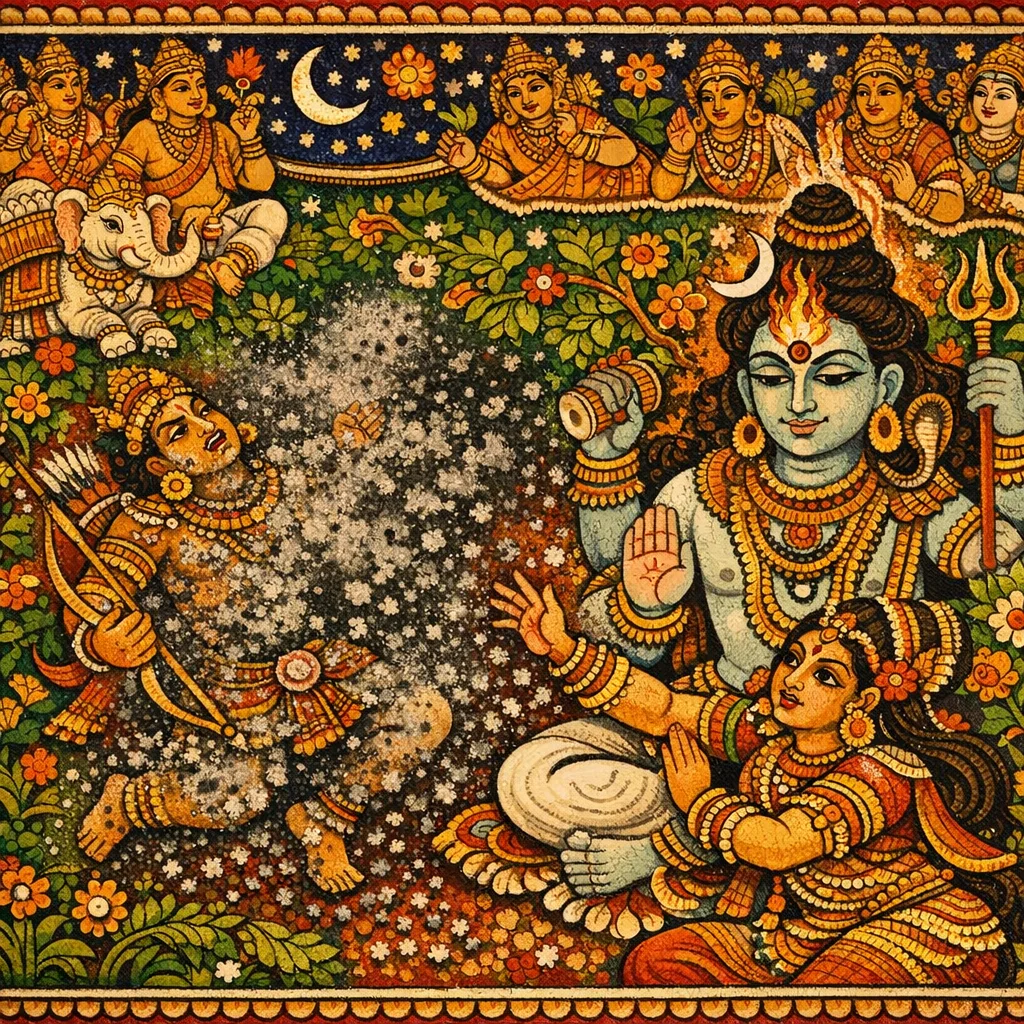
Adhyaya 154: The Strategy to Defeat Tāraka: Pārvatī’s Birth, Austerities, and the Burning of Kāma
तारकवधोपायः—पार्वत्याः जन्मतपःकामदहनकथा
Speaker: Sūta, Devas (Indra and the gods), Brahmā (Viriñci), Vāyu (as spokesperson), Niśā/Vibhāvarī (Night, addressed by Brahmā), Nārada, Himavān (Himālaya), Indra (Śakra), Kāma (Madana/Manobhava), Rati, Śiva (Śaṅkara/Dhūrjaṭi/Bhava)
Sūta relates: (1) The gods are seized and shamed by a Daitya host; once freed, they approach Brahmā and praise him with cosmic-theological hymns. (2) Brahmā explains the crisis: Tāraka’s boon makes him invulnerable; only a seven-day-old child, bound to Śiva, can slay him—yet Śiva is presently without a wife. (3) Brahmā commissions Niśā (Night), lauding her as the many-formed Devī (Ekānaṃśā/Gāyatrī/Kālārātri and more), to arrange the birth-setting in Himālaya’s household with Menā, initiating the Mountain-born Goddess’ manifestation. (4) Indra sends Nārada to Himālaya; his omen-reading first alarms Himavān (“no husband for her”), then he reveals the esoteric sense: Śiva is the Unborn, and the Goddess’ iconographic “uttāna/varada” hand is fitting. (5) Indra summons Kāma with Spring (Madhu) to unite Śiva and Pārvatī; Kāma’s flower-arrow briefly stirs Śiva’s mind, but Śiva’s third eye burns Kāma to ashes. (6) Rati hymns Śiva; Śiva grants that Kāma will return as Ananga (bodiless), while the greater divine design—Śiva’s eventual union and Tāraka’s downfall—moves forward.
Key Concepts
Shlokas in Adhyaya 154
Verse 1
*सूत उवाच प्रादुरासीत्प्रतीहारः शुभ्रनीलाम्बुजाम्बरः स जानुभ्यां महीं गत्वा पिहितास्यः स्वपाणिना //
Sūta said: A pratīhāra (door-guardian/attendant) then manifested, clad in garments white like the blue lotus. Going down to the ground upon his knees, he covered his mouth with his own hand.
Verse 2
उवाचानाविलं वाक्यम् अल्पाक्षरपरिस्फुटम् दैत्येन्द्रमर्कवृन्दानां बिभ्रतं भास्वरं वपुः //
He spoke words that were unclouded—few in syllables yet perfectly clear—while bearing a radiant form, resplendent like the lord of the Daityas amid a circle of suns.
Verse 3
कालनेमिः सुरान्बद्धांश् चादाय द्वारि तिष्ठति स विज्ञापयति स्थेयं क्व बन्दिभिरिति प्रभो //
Kālanemi, having seized the gods and bound them, stood at the gate; and he reported, “O Lord, where are the guards (jailers) to keep watch over the prisoners?”
Verse 4
तन्निशम्याब्रवीद्दैत्यः प्रतीहारस्य भाषितम् यथेष्टं स्थीयतामेभिर् गृहं मे भुवनत्रयम् //
Hearing the words spoken by the doorkeeper, the Daitya replied: “Let these stay here as they wish; my home is (as vast as) the three worlds.”
Verse 5
केवलं पाशबन्धेन विमुक्तैरविलम्बितम् एवं कृते ततो देवा दूयमानेन चेतसा //
Though they were freed solely from the bondage of the noose, without the least delay, even after this was done the gods remained inwardly tormented in their minds.
Verse 6
जग्मुर्जगद्गुरुं द्रष्टुं शरणं कमलोद्भवम् निवेदितास्ते शक्राद्याः शिरोभिर्धरणिं गताः तुष्टुवुः स्पष्टवर्णार्थैर् वचोभिः कमलासनम् //
They went forth to behold the Guru of the world—Brahmā, the Lotus-born refuge. Having made their petition known, Indra and the other gods bowed with their heads to the earth and praised the Lotus-seated One with words of clear and well-expressed meaning.
Verse 7
*देवा ऊचुः त्वमोंकारो ऽस्यङ्कुराय प्रसूतो विश्वस्यात्मानन्तभेदस्य पूर्वम् सम्भूतस्यानन्तरं सत्त्वमूर्ते संहारेच्छोस्ते नमो रुद्रमूर्ते //
The Devas said: You are the syllable Oṃ, born as the seed-sprout of this universe—its very Self, prior to its endless differentiations. You arise before it and remain after it; O embodiment of sattva, O you who will dissolution, salutations to you in your Rudra-form.
Verse 8
व्यक्तिं नीत्वा त्वं वपुः स्वं महिम्ना तस्मादण्डात् साभिधानादचिन्त्यः द्यावापृथ्व्योर् ऊर्ध्वखण्डावराम्यां ह्य् अण्डादस्मात्त्वं विभागं करोषि //
O inconceivable Lord, by Your own majesty You bring Your form into manifest expression; and from this named Cosmic Egg You make the division—setting heaven as the upper portion and earth as the lower.
Verse 9
व्यक्तं मेरौ यज्जनायुस्तवाभूद् एवं विद्मस्त्वत्प्रणीतश्चकास्ति व्यक्तं देवा जन्मनः शाश्वतस्य द्यौस्ते मूर्धा लोचने चन्द्रसूर्यौ //
It is manifest that the life-span of beings is set upon Meru; thus we know that all this is established and made to shine by You. Manifest indeed are the gods, born of the Eternal One: heaven is Your head, and the Moon and Sun are Your two eyes.
Verse 10
व्यालाः केशाः श्रोत्ररन्ध्रा दिशस्ते पादौ भूमिर्नाभिरन्ध्रे समुद्राः मायाकारः कारणं त्वं प्रसिद्धो वेदैः शान्तो ज्योतिषा त्वं विमुक्तः //
Serpents and wild creatures are Your hair; the directions are the apertures of Your ears. The earth is Your feet, and the oceans abide in the hollow of Your navel. You are the wielder of Māyā—the famed primal Cause proclaimed by the Vedas; serene in essence, and by the inner light of knowledge You are ever free.
Verse 11
वेदार्थेषु त्वां विवृण्वन्ति बुद्ध्वा हृत्पद्मान्तःसंनिविष्टं पुराणम् त्वामात्मानं लब्धयोगा गृणन्ति सांख्यैर्यास्ताः सप्त सूक्ष्माः प्रणीताः //
Having understood You as the Purāṇa seated within the lotus of the heart, the wise unfold You through the meanings of the Vedas. Those who have attained Yoga praise You as the very Self; and the Sāṅkhyas too extol You through the seven subtle principles they have set forth.
Verse 12
तासां हेतुर्याष्टमी चापि गीता तस्यां तस्यां गीयसे वै त्वमन्तम् दृष्ट्वा मूर्तिं स्थूलसूक्ष्मां चकार देवैर्भावाः कारणैः कैश्चिदुक्ताः //
The cause of those is said to be the eighth tithi, and it is also sung of; on each such occasion, You indeed are praised as the ultimate end. Having beheld the form, He fashioned it as both gross and subtle; and the gods, by certain causes, have declared these states (bhāvas).
Verse 13
सम्भूतास्ते त्वत्त एवादिसर्गे भूयस्तां तां वासनां ते ऽभ्युपेयुः त्वत्संकल्पेनान्तमायाप्तिगूढः कालो मेयो ध्वस्तसंख्याविकल्पः //
They arise from You alone at the first creation, and again they enter into those very latent impressions (vāsanās). By Your mere resolve, Time—whose true measure is hidden within the attainment of the final mystery (the supreme Māyā)—becomes the standard; yet all reckonings and numerical alternatives are shattered before it.
Verse 14
भावाभावव्यक्तिसंहारहेतुस् त्वं सो ऽनन्तस्तस्य कर्तासि चात्मन् ये ऽन्ये सूक्ष्माः सन्ति तेभ्यो ऽभिगीतः स्थूला भावाश्चावृतारश्च तेषाम् //
You are the very cause of manifestation and non-manifestation, of appearance and dissolution. You are that Ananta—its maker as well as the indwelling Self. Those other principles that are subtle are praised as dependent upon You; and the gross states of being, along with their coverings, belong to them.
Verse 15
तेभ्यः स्थूलैस्तैः पुराणैः प्रतीतो भूतं भव्यं चैवमुद्भूतिभाजाम् भावे भावे भावितं त्वा युनक्ति युक्तं युक्तं व्यक्तिभावान्निरस्य इत्थं देवो भक्तिभाजां शरण्यस् त्राता गोप्ता नो भवानन्तमूर्तिः //
Through those expansive Purāṇas You are known—You who encompass what has been and what is yet to be for all beings that arise. Meditated upon in state after state of existence, You yoke the mind to Yourself; and again and again, by proper discernment, You cast aside the limiting notions of particularized individuality. Thus You, O God—refuge of the devoted—are our rescuer and protector, O Anantamūrti of infinite forms.
Verse 16
विरेमुरमराः स्तुत्वा ब्रह्माणमविकारिणम् तस्थुर्मनोभिर् इष्टार्थसम्प्राप्तिप्रार्थनास्ततः //
Having praised the unchanging Brahmā, the immortals grew calm; then, with their minds fixed in devotion, they stood there, offering prayers for the attainment of their desired aims.
Verse 17
एवं स्तुतो विरिञ्चिस्तु प्रसादं परमं गतः अमरान्वरदेनाह वामहस्तेन निर्दिशन् //
Thus praised, Viriñci (Brahmā) attained supreme graciousness; then, as the granter of boons, he addressed the immortals, indicating his intent with his left hand.
Verse 18
*ब्रह्मोवाच नारी याभर्तृकाकस्मात् तनुस्ते त्यक्तभूषणा न राजते तथा शक्र म्लानवक्त्रशिरोरुहा //
Brahmā said: O Śakra (Indra), why is that woman—one who has a husband—so emaciated? Having cast off her ornaments, she does not shine; her face and the hair upon her head are withered and faded.
Verse 19
हुताशनविमुक्तो ऽपि न धूमेन विराजसे भस्मनेव प्रतिच्छन्नो दग्धदावश्चिरोषितः //
Even though you have been released from the fire, you do not shine with smoke; you are as though covered with ash—like a forest conflagration that has long since burned out.
Verse 20
यमामयमये नैव शरीरे त्वं विराजसे दण्डस्यालम्बनेनेव ह्य् अकृच्छ्रस्तु पदे पदे //
In this body afflicted by Yama’s misery, you do not truly shine; yet by taking support—like a staff for the weak—you become free from hardship at every step.
Verse 21
रजनीचरनाथो ऽपि किं भीत इव भाषसे राक्षसेन्द्र क्षताराते त्वमरातिक्षतो यथा //
Though you are the lord of the night-roamers, why do you speak as if afraid, O king of Rākṣasas? O enemy-slayer, you speak like one wounded by his foes.
Verse 22
तनुस्ते वरुणोच्छुष्का परीतस्येव वह्निना विमुक्तरुधिरं पाशं फणिभिः प्रविलोकयन् //
Your body, dried up as though by Varuṇa, looked as if it were ringed by fire—while the serpent-forms watched, with raised hoods, a pāśa noose that had been freed of blood.
Verse 23
वायो भवान् विचेतस्कस् त्वं स्निग्धैरिव निर्जितः किं त्वं बिभेषि धनद संन्यस्यैव कुबेरताम् //
O Vāyu, you seem bewildered—as though overcome by those who are dear to you. Why do you, O Dhanada (Kubera), feel fear, even after having renounced your very status as Kubera?
Verse 24
रुद्रास्त्रिशूलिनः सन्तो वदध्वं बहुशूलताम् भवन्तः केन तत्क्षिप्तं तेजस्तु भवतामपि //
“You who bear Rudra’s power and are armed with tridents—declare to me the truth about this ‘many-trident’ force. By whom was that blazing energy hurled—an energy that even belongs to you?”
Verse 25
अकिंचित्करतां यातः करस्ते न विभासते अलं नीलोत्पलाभेन चक्रेण मधुसूदन //
If Your hand were left empty, it would not shine in its full splendor. Therefore, O Madhusūdana, it is fitting that it be adorned with the discus (cakra), radiant like a blue lotus.
Verse 26
किं त्वयानुदरालीनभुवनप्रविलोकनम् क्रियते स्तिमिताक्षेण भवता विश्वतोमुख //
Why do You, O all-faced One, with steady, unblinking eyes, gaze upon the worlds as though they were contained within Your belly?
Verse 27
एवमुक्ताः सुरास्तेन ब्रह्मणा ब्रह्ममूर्तिना वाचां प्रधानभूतत्वान् मारुतं तमचोदयन् //
Thus addressed by Brahmā—who bore the very form of Brahman—the gods, recognizing the Wind (Vāyu) as foremost among the powers of speech, urged him onward to act.
Verse 28
अथ विष्णुमुखैर्देवैः श्वसनः प्रतिबोधितः चतुर्मुखं तदा प्राह चराचरगुरुं विभुम् //
Then Śvasana (the Breath, the Wind), awakened by the gods headed by Viṣṇu, addressed the four-faced Brahmā—mighty lord and teacher of all that moves and all that is still.
Verse 29
न तु वेत्सि चराचरभूतगतं भवभावमतीव महानुच्छ्रितः प्रभवः / पुनरर्थिवचो ऽभिविस्तृतश्रवणोपमकौतुकभावकृतः //
Yet you do not truly know the profound nature of becoming that pervades all moving and unmoving beings, nor the exceedingly great and exalted Source (Prabhava). Therefore, urged again by the seeker’s words, he replied with an expansive discourse, stirred by wonder, as though widening the listener’s ears to hear more.
Verse 30
त्वमनन्त करोषि जगद्भवतां सचराचरगर्भविभिन्नगुणाम् अमरासुरमेतदशेषमपि त्वयि तुल्यमहो जनको ऽसि यतः //
O Infinite One, you bring forth this universe—together with all that moves and all that does not move—whose womb contains qualities of many kinds. This entire host of gods and demons, without remainder, is equal in its dependence upon you; for you are indeed their wondrous Progenitor.
Verse 31
पितुरस्ति तथापि मनोविकृतिः सगुणो विगुणो बलवानबलः भवतो वरलाभनिवृत्तभयः कुलिशाङ्गसुतो दितिजो ऽतिबलः //
Though he is indeed your father, his mind is distorted. At times he is virtuous, at times flawed; now strong, now weak. But you—having obtained a boon—are freed from fear. You are the exceedingly powerful Daitya, the son of Kuliśāṅga.
Verse 32
सचराचरनिर्मथने किमिति कितवस्तु कृतो विहितो भवता किल देव त्वया स्थितये जगतां महदद्भुतचित्रविचिगुणाः //
O Lord, why indeed was this wondrous ‘deceptive stratagem’ arranged by you in the churning that shook all moving and unmoving beings? For the stability of the worlds, you—endowed with great, astonishing, manifold and variegated excellences—ordained it.
Verse 33
अपि तुष्टिकृतः श्रुतकामफला विहिता द्विजनायक देवगणाः अपि नाकमभूत्किल यज्ञभुजां भवतो विनियोगवशात्सततम् //
O leader of the twice-born, even the hosts of gods—when duly satisfied—become bestowers of the fruits that are desired and heard of in the sacred tradition. Indeed, by your constant, proper apportioning of the oblations to those who partake of sacrifice, they (as it were) attained heaven.
Verse 34
अपहृत्य विमानगणं स कृतो दितिजेन महामरुभूमिसमः कृतवानसि सर्वगुणातिशयं यमशेषमहीधरराजतया //
Having stolen away the host of celestial vimānas, that Daitya was reduced to a state like a vast desert wasteland. But you have fashioned this (vīmāna/edifice) to excel in every quality—standing in kingly splendor like the foremost of mountains, as lofty and enduring as the world-bearing peaks.
Verse 35
सममिङ्गितभावविधिः स गिरिर् गगनेन सदोच्छ्रयतां हि गतः अधिवासविहारविधावुचितो दितिजने पविक्षतशृङ्गतटः //
That mountain—balanced in its signs and natural dispositions—rises loftily as though meeting the sky. With ridges and slopes unbroken and well-formed, it is deemed fit for dwelling and for establishing pleasure-groves or retreats, even for a community of people.
Verse 36
परिलुण्ठितरत्नगुहानिवहो बहुदैत्यसभाश्रयतां गमितः सुरराज स तस्य भयेन गतं व्यदधादशरीर इतो ऽपि वृथा //
The multitude of jewel-filled caves, having been plundered, was carried off to become the refuge of many Daitya assemblies. The king of the gods (Indra), driven by fear of him, made himself bodiless (invisible); even so, it proved futile.
Verse 37
उपयोग्यतया विवृतं सुचिरं विमलद्युतिपूरितदिग्वदनम् भवतैव विनिर्मितमादियुगे सुरहेतिसमूहम् अनुत्थमिदम् //
This assembly of the gods’ weapons—fit for use, long displayed, and facing all directions filled with stainless radiance—was fashioned by you yourself in the primordial age; it stands unmoved and unshaken.
Verse 38
दितिजस्य शरीरमवाप्य गतं शतधा मतिभेदमिवाल्पमनाः आसारधूलिध्वस्ताङ्गा द्वारस्थाः स्मः कदर्थिनः लब्धप्रवेशाः कृच्छ्रेण वयं तस्यामरद्विषः //
Having entered the body of that Daitya, we were shattered into a hundred parts—as if a feeble mind were split by conflicting notions. Our limbs were battered by rain and dust; we stood at the doorway, humiliated. We—haters of the gods—won entry only with great difficulty.
Verse 39
सभायाममरा देव निकृष्टे ऽप्युपवेशिताः वेत्रहस्तैर् अजल्पन्तस् ततो ऽपहसितास्तु तैः //
O Deva, even the immortals, when made to sit in a lowly place in the assembly, fell silent with staffs in hand—and then they were mocked by those (present there).
Verse 40
महार्थाः सिद्धसर्वार्था भवन्तः स्वल्पभाषिणः चाटुयुक्तमथो कर्म ह्य् अमरा बहु भाषत //
Those who speak little become weighty in meaning and accomplish every aim. But when action is mingled with flattery, even the “immortals” end up speaking much.
Verse 41
समयं दैत्यसिंहस्य सशक्रस्य नु संस्थिताः वदतेति च दैत्यस्य प्रेष्यैर्विहसिता बहु //
Standing before Indra (Śakra) and the “lion” among the Daityas, they spoke of the agreed truce; yet the Daitya’s attendants laughed loudly and at length.
Verse 42
ऋतवो मूर्तिमन्तस्तम् उपासन्ते ह्यहर्निशम् कृतापराधसंत्रासं न त्यजन्ति कदाचन //
The Seasons, embodied in form, worship Him day and night; and, fearful because of any offence committed, they never abandon Him at any time.
Verse 43
तन्त्रीत्रयलयोपेतं सिद्धगन्धर्वकिंनरैः सुरागम् उपधा नित्यं गीयते तस्य वेश्मसु //
In his mansions, music—set to the rhythm of the three-stringed vīṇā, melodious and well-tuned—is constantly sung, accompanied by Siddhas, Gandharvas, and Kiṃnaras.
Verse 44
हन्ताकृतोपकरणैर् मित्राणि गुरुलाघवैः शरणागतसंत्यागी त्यक्तसत्यपरिश्रयः //
He harms friends by contrived devices, treating what is weighty as trivial; he abandons those who have sought refuge and has cast off all reliance on truth.
Verse 45
इति निःशेषमथवा निःशेषं वै न शक्यते तस्याविनयमाख्यातुं स्रष्टा तत्र परायणम् //
Thus, whether one seeks to relate it in full or not, it is truly impossible to describe completely that person’s utter lack of discipline; in this matter, even the Creator stands as the final authority.
Verse 46
इत्युक्तः स्वात्मभूर्देवः सुरैर्दैत्यविचेष्टितम् सुरानुवाच भगवांस् ततः स्मितमुखाम्बुजः //
Thus addressed by the gods concerning the daityas’ aggressive designs, the Self-born Lord (Brahmā), the Blessed One—his lotus-like face gently smiling—then spoke to the Devas.
Verse 47
*ब्रह्मोवाच अवध्यस्तारको दैत्यः सर्वैरपि सुरासुरैः यस्य वध्यः स नाद्यापि जातस्त्रिभुवने पुमान् //
Brahmā said: “The daitya Tāraka is invulnerable to all, whether suras or asuras. The man destined to slay him has not yet been born anywhere in the three worlds.”
Verse 48
मया स वरदानेन छन्दयित्वा निवारितः तपसः सांप्रतं राजा त्रैलोक्यदहनात्मकात् //
I placated him by granting a boon and thereby restrained him. At present, that king has been checked from his tapas—an austerity whose very nature was to burn the three worlds.
Verse 49
स च वव्रे वधं दैत्यः शिशुतः सप्तवासरात् स सप्तदिवसो बालः शंकराद्यो भविष्यति //
And that daitya asked for a boon: that he could be slain only by a child of seven days. That seven-day-old boy will become connected with Śaṅkara (Śiva) and be foremost among his own.
Verse 50
तारकस्य निहन्ता स भास्कराभो भविष्यति सांप्रतं चाप्यपत्नीकः शंकरो भगवान्प्रभुः //
He will become the slayer of Tāraka, radiant like the Sun; and at present the Lord Śaṅkara—the Blessed One, the sovereign—remains without a wife.
Verse 51
यच्चाहमुक्तवान्यस्या ह्य् उत्तानकरता सदा उत्तानो वरदः पाणिर् एष देव्याः सदैव तु //
And what I have stated regarding her—that her hand should always be held with the palm turned upward—this upturned hand of the Goddess is indeed ever the boon-bestowing (varada) hand.
Verse 52
हिमाचलस्य दुहिता सा तु देवी भविष्यति तस्याः सकाशाद्यः शर्वस् त्व् अरण्यां पावको यथा //
She will indeed become the Goddess—the daughter of Himācala (the Himalaya). And from her presence, Śarva (Śiva) will arise, like fire kindled in a forest.
Verse 53
जनयिष्यति तं प्राप्य तारको ऽभिभविष्यति मयाप्युपायः स कृतो यथैवं हि भविष्यति //
“Once he is born and attained (as the destined one), Tāraka will be overcome. I too have devised that means—so indeed it shall come to pass in this very way.”
Verse 54
शेषश्चाप्यस्य विभवो विनश्येत्तदनन्तरम् स्तोककालं प्रतीक्षध्वं निर्विशङ्केन चेतसा //
And whatever remaining manifestation of his power will also perish immediately thereafter. Wait for a short while, with a mind free from anxiety.
Verse 55
इत्युक्तास्त्रिदशास्तेन साक्षात्कमलजन्मना जग्मुस्तं प्रणिपत्येशं यथायोगं दिवौकसः //
Thus instructed by him—Brahmā himself, the Lotus-born—the thirty-three gods set forth; and, having bowed down to that Lord, they departed, each in a manner fitting to his own station.
Verse 56
ततो गतेषु देवेषु ब्रह्मा लोकपितामहः निशां सस्मार भगवान् स्वतनोः पूर्वसंभवाम् //
Then, when the gods had departed, Brahmā—the Pitāmaha, grandsire and father of the worlds—remembered the cosmic Night, and with it the former manifestation that had arisen from his own body.
Verse 57
ततो भगवती रात्रिर् उपतस्थे पितामहम् तां विविक्ते समालोक्य ब्रह्मोवाच विभावरीम् //
Then the revered goddess Night approached Pitāmaha (Brahmā). Seeing her in solitude, Brahmā spoke to that bringer of night, Vibhāvarī.
Verse 58
*ब्रह्मोवाच विभावरि महत्कायं विबुधानामुपस्थितम् तत्कर्तव्यं त्वया देवि शृणु कार्यस्य निश्चयम् //
Brahmā said: “O Vibhāvarī, a mighty host of the gods has assembled. Therefore, O goddess, listen—this is what must be done by you; hear the settled decision regarding the task.”
Verse 59
तारको नाम दैत्येन्द्रः सुरकेतुरनिर्जितः तस्याभावाय भगवाञ् जनयिष्यति चेश्वरः //
There is a lord of the Dānavas named Tāraka, an unconquered foe of the gods. For his destruction, the Blessed Lord, the Supreme Ruler, will bring forth (a divine being).
Verse 60
सुतं स भविता तस्य तारकस्यान्तकारकः शंकरस्याभवत्पत्नी सती दक्षसुता तु या //
He would become his son—the destroyer of Tāraka. And Satī, the daughter of Dakṣa, became the wife of Śaṅkara (Śiva).
Verse 61
सा मृता कुपिता देवी कस्मिंश्चित्कारणान्तरे भविता हिमशैलस्य दुहिता लोकभाविनी //
That Goddess—having departed (from her former state) in anger—at some later occasion and for a certain cause, will become the daughter of the Himālaya mountain, the benefactress and sustainer of the worlds.
Verse 62
विरहेण हरस्तस्या मत्वा शून्यं जगत्त्रयम् तपस्यन्हिमशैलस्य कन्दरे सिद्धसेविते //
In separation from her, Hara (Śiva) deemed the three worlds to be empty, and he undertook austerities in a cavern of the Himālaya—frequented and attended by the Siddhas.
Verse 63
प्रतीक्षमाणस्तज्जन्म कंचित्कालं निवत्स्यति तयोः सुतप्ततपसोर् भविता यो महाबलः //
Waiting for that birth, he will dwell there for some time; and to those two, whose austerities are intensely performed, there will be born a son of great strength.
Verse 64
स भविष्यति दैत्यस्य तारकस्य विनाशकः जातमात्रा तु सा देवी स्वल्पसंज्ञा च भामिनी //
He shall become the destroyer of the demon Tāraka. But that Goddess—though just born—was faint of awareness, a radiant lady with only slight consciousness.
Verse 65
विरहोत्कण्ठिता गाढं हरसंगमलालसा तयोः सुतप्ततपसोः संयोगः स्याच्छुभानने //
Deeply anguished by separation, she longed intensely for union with Hara (Śiva). Then, O fair-faced one, the reunion of those two—whose austerities (tapas) had been well performed—came to pass.
Verse 66
ततस्ताभ्यां तु जनितः स्वल्पो वाक्कलहो भवेत् ततो ऽपि संशयो भूयस् तारकं प्रति दृश्यते //
Then, arising from those two, a minor quarrel of words occurs; and from that again, even greater doubt is seen—directed toward Tāraka.
Verse 67
तयोः संयुक्तयोस्तस्मात् सुरतासक्तिकारणे विघ्नस्त्वया विधातव्यो यथा ताभ्यां तथा शृणु //
Therefore, when those two are united and become absorbed in erotic pleasure, an obstacle must be contrived by you. Hear now, exactly as it is to be done to them.
Verse 68
गर्भस्थाने च तन्मातुः स्वेन रूपेण रञ्जय ततो विहाय शर्वस्तां विश्रान्तो नर्मपूर्वकम् //
And even within his mother’s womb, he delighted her by manifesting his own form. Then Śarva (Śiva), leaving her behind, withdrew to rest—playfully and in a spirit of gentle jest.
Verse 69
भर्त्सयिष्यति तां देवीं ततः सा कुपिता सती प्रयास्यति तपश्चर्तुं तत्तस्मात्तपसे पुनः //
He will rebuke that goddess; then she—Sati, angered—will set out to undertake austerities. Therefore she will again resort to tapas.
Verse 70
जनयिष्यति यं शर्वा दयितद्युतिमण्डितम् स भविष्यति हन्ता वै सुरारीणामसंशयम् //
He whom Śarvā (Śiva) will beget—adorned with the splendor of the beloved—will indeed become the slayer of the enemies of the gods, without doubt.
Verse 71
त्वयापि दानवा देवि हन्तव्या लोकदुर्जयाः यावच्च न सती देहसंक्रान्तगुणसंचया //
O Goddess, even by you the Dānavas—invincible to the worlds—must be slain, so long as you, the virtuous one, still bear within this body the accumulated powers and qualities that have entered into it.
Verse 72
तत्संगमेन तावत्त्वं दैत्यान्हन्तुं न शक्ष्यसे एवं कृते तपस्तप्त्वा सृष्टिसंहारकारिणी //
So long as you remain in that association, you will not be able to slay the Daityas. When this is done, having performed austerity (tapas), she becomes the very power that brings about creation and dissolution.
Verse 73
समाप्तनियमा देवी यदा चोमा भविष्यति तदा स्वमेव तद्रूपं शैलजा प्रतिपत्स्यते //
When the Goddess has completed her prescribed vows, and when she becomes Umā, then the Mountain-born one (Śailajā) will, of her own accord, assume that very form.
Verse 74
तनुस्तवापि सहजा सैकानंशा भविष्यति रूपांशेन तु संयुक्ता त्वमुमायां भविष्यसि //
“A body of yours too—born naturally from your own essence—will come to be as a single portion. And when united with a portion of form, you will become Umā (Pārvatī).”
Verse 75
एकानंशेति लोकस्त्वां वरदे पूजयिष्यति भेदैर्बहुविधाकारैः सर्वगा कामसाधिनी //
O boon-giving Goddess, the people will worship you as “Ekānaṃśā,” in many differentiated forms and manifold manifestations. All-pervading, you are the fulfiller of desires.
Verse 76
ओंकारवक्त्रा गायत्री त्वमिति ब्रह्मवादिभिः आक्रान्तिरूर्जिताकारा राजभिश्च महाभुजैः //
O Gāyatrī, whose very face is the sacred syllable Oṁ—thus do the expounders of Brahman proclaim you. And mighty-armed kings also hail you as the powerful, triumphant one, firm in strength and form.
Verse 77
त्वं भूरिति विशां माता शूद्रैः शैवीति पूजिता क्षान्तिर्मुनीनामक्षोभ्या दया नियमिनामिति //
You are praised as Bhū—the Earth—and as the mother of the Vaiśyas; among the Śūdras you are worshipped as Śaivī. Among sages you are the unshakable virtue of forbearance (kṣānti), and among the self-restrained you are compassion (dayā).
Verse 78
त्वं महोपायसंदोहा नीतिर्नयविसर्पिणाम् परिच्छित्तिस्त्वमर्थानां त्वमीहा प्राणिहृच्छया //
You are the vast treasury of great expedients; you are policy itself (nīti) for those who advance by wise conduct. You are the clear discernment of aims, and you are the very striving that arises from the desire within the hearts of living beings.
Verse 79
त्वं मुक्तिः सर्वभूतानां त्वं गतिः सर्वदेहिनाम् त्वं च कीर्तिमतां कीर्तिस् त्वं मूर्तिः सर्वदेहिनाम् //
You are the liberation (mukti) of all beings; you are the ultimate refuge and course of all embodied souls. You are the fame of the renowned, and you are the very embodied form present in all living beings.
Verse 80
रतिस्त्वं रक्तचित्तानां प्रीतिस्त्वं हृष्टदर्शिनाम् त्वं कान्तिः कृतभूषाणां त्वं शान्तिर्दुःखकर्मणाम् //
You are Rati—desire—in those whose hearts are inflamed with passion; you are Prīti—joy—in those whose vision is delighted. You are Kānti—the radiance—of those who are adorned; you are Śānti—the peace—of those whose deeds are bound up with sorrow.
Verse 81
त्वं भ्रान्तिः सर्वबोधानां त्वं गतिः क्रतुयाजिनाम् जलधीनां महावेला त्वं च लीला विलासिनाम् //
You are Bhrānti—bewilderment—that veils every kind of understanding; and you are Gati—the final refuge—of those who perform Vedic sacrifices. For the oceans you are Mahāvelā, the mighty shoreline; and for those who revel in play you are Līlā, the very delight of sportive grace.
Verse 82
संभूतिस्त्वं पदार्थानां स्थितिस्त्वं लोकपालिनी त्वं कालरात्रिर्निःशेषभुवनावलिनाशिनी //
You are Sambhūti—the arising of all entities—and you are Sthiti—their abiding stability—O protectress of the worlds. You are Kālārātri, the dark night of Time, who destroys the entire succession of worlds without remainder.
Verse 83
प्रियकण्ठग्रहानन्ददायिनी त्वं विभावरी इत्यनेकविधैर्देवि रूपैर्लोके त्वमर्चिता //
“You are the giver of Ānanda—joy—to those who embrace the beloved’s neck; you are Vibhāvarī (the Night).” Thus, O Goddess, you are worshipped in the world in many kinds of forms and names.
Verse 84
ये त्वां स्तोष्यन्ति वरदे पूजयिष्यन्ति वापि ये ते सर्वकामानाप्स्यन्ति नियता नात्र संशयः //
O Varadā, bestower of boons, those who praise you—or those who worship you—will assuredly obtain all their desired aims; of this there is no doubt.
Verse 85
इत्युक्ता तु निशा देवी तथेत्युक्त्वा कृताञ्जलिः जगाम त्वरिता तूर्णं गृहं हिमगिरेः परम् //
Thus addressed, the goddess Niśā replied, “So be it,” and, with hands folded in añjali, swiftly departed at once for her exalted abode upon Himagiri, the Himālaya.
Verse 86
तत्रासीनां महाहर्म्ये रत्नभित्तिसमाश्रयाम् ददर्श मेनामापाण्डुच्छविवक्त्रसरोरुहाम् //
There, seated within the great palace hall and leaning against a jewel-inlaid wall, he beheld Menā—her lotus-like face radiant with a fair and unblemished complexion.
Verse 87
किंचिच् छ्याममुखोदग्रस्तनभारावनामिताम् महौषधिगणाबद्धमन्त्रराजनिषेविताम् //
Her face was somewhat dark, and her high, prominent breasts made her bend slightly beneath their weight; she was secured by clusters of great medicinal herbs and attended upon by the sovereign of mantras, the Mantrarāja.
Verse 88
उद्वहत्कनकोन्नद्धजीवरक्षामहोरगाम् मणिदीपगणज्योतिर् महालोकप्रकाशिते //
She bore a great serpent (nāga) as a living guardian, adorned with gold; and the place was lit by the radiance of clusters of jewel-lamps, shining so as to illumine the vast region all around.
Verse 89
प्रकीर्णबहुसिद्धार्थे मनोजपरिवारके शुचिन्यंशुकसंछन्नभूशय्यास्तरणोज्ज्वले //
In a well-appointed chamber, furnished with many accomplished and useful articles, attended by a pleasing retinue, and made resplendent by a clean bed laid upon the ground and covered with spotless linens—thus should the dwelling be arranged.
Verse 90
धूपामोदमनोरम्ये सर्जगन्धोपयोगिके ततः क्रमेण दिवसे गते दूरं विभावरी //
In that pleasing atmosphere, delightful with the fragrance of incense and suited to the use of resinous perfumes, then, as the day gradually advanced in due course, the night (darkness) receded far away.
Verse 91
व्यजृम्भत सुखोदर्के ततो मेना महागृहे प्रसुप्तप्रायपुरुषे निद्राभूतोपचारिके //
Then, as comfort swelled into drowsy heaviness, in Menā’s great household the people seemed as if asleep, and even the attendants’ service turned into a kind of sleep.
Verse 92
स्फुटालोके शशभृति भ्रान्तिरात्रिविहंगमे रजनीचरभूतानां संघैरावृतचत्वरे //
When the moon shines with a clear light, yet night-birds wander in confusion, and the public crossroads are thronged—covered over—by bands of nocturnal beings, it is taken as an inauspicious sign.
Verse 93
गाढकण्ठग्रहालग्नसुभगेष्टजने ततः किंचिदाकुलतां प्राप्ते मेनानेत्राम्बुजद्वये //
Then, as her beloved and fortunate dear one clung tightly around her neck, Menā’s two lotus-like eyes became slightly agitated—welling with emotion.
Verse 94
आविवेश मुखे रात्रिः सुचिरस्फुटसंगमा जन्मदाया जगन्मातुः क्रमेण जठरान्तरे //
Then Night entered her mouth—after a long and manifest union—and, in due order, the giver of birth, the World-Mother, drew it into the inner chamber of her womb.
Verse 95
आविवेशान्तरं जन्म मन्यमाना क्षपा तु वै अरञ्जयच्छविं देव्या गुहारण्ये विभावरी //
That night, thinking as though she had entered another birth, she went within; and in the cave-forest the very hours of darkness shone, as if illumined by the Goddess’s radiance.
Verse 96
ततो जगत्पतिप्राणहेतुर्हिमगिरिप्रिया ब्राह्मे मुहूर्ते सुभगे व्यसूयत गुहारणिम् //
Then Pārvatī, beloved of Himagiri—the life-cause of the Lord of the world—at the auspicious Brāhma muhūrta brought forth the “cave-fire,” the sacred fire generated within a cavern-like enclosure.
Verse 97
तस्यां तु जायमानायां जन्तवः स्थाणुजङ्गमाः अभवन्सुखिनः सर्वे सर्वलोकनिवासिनः //
When that auspicious establishment came into being, all creatures—immobile and mobile—became happy; indeed, all who dwell in every world were filled with joy.
Verse 98
नारकाणामपि तदा सुखं स्वर्गसमं महत् अभवत्क्रूरसत्त्वानां चेतः शान्तं च देहिनाम् //
Then even those in hell experienced a great happiness equal to heaven; and the minds of embodied beings—even of cruel-natured creatures—became calm and peaceful.
Verse 99
ज्योतिषामपि तेजस्त्वम् अभवत्सुरतोन्नता वनाश्रिताश्चौषधयः स्वादुवन्ति फलानि च //
Even the heavenly luminaries took on heightened radiance; the earth was uplifted in abundant prosperity. Forest-dwelling herbs grew potent, and the fruits became sweet as well.
Verse 100
गन्धवन्ति च माल्यानि विमलं च नभो ऽभवत् मारुतश्च सुखस्पर्शो दिशश्च सुमनोहरा //
The garlands became fragrant, and the sky turned spotless and clear. The wind grew pleasantly soothing to the touch, and the very directions became exceedingly delightful.
Verse 101
तेन चोद्भूतफलितपरिपाकगुणोज्ज्वलाः अभवत्पृथिवी देवी शालिमालाकुलापि च //
Through that divine influence, the goddess Earth became radiant with the qualities of sprouting, fruiting, and full ripening—and she was also filled with clusters of śāli rice.
Verse 102
तपांसि दीर्घचीर्णानि मुनीनां भावितात्मनाम् तस्मिन्गतानि साफल्यं काले निर्मलचेतसाम् //
The long-practised austerities of sages, whose inner selves are disciplined, attain their true fruition in due time, when the mind has become pure and stainless.
Verse 103
विस्मृतानि च शस्त्राणि प्रादुर्भावं प्रपेदिरे प्रभावस्तीर्थमुख्यानां तदा पुण्यतमो ऽभवत् //
Even weapons that had fallen into oblivion manifested again; and at that time the sanctifying power of the foremost tīrthas became supremely meritorious.
Verse 104
अन्तरिक्षे सुराश्चासन् विमानेषु सहस्रशः समहेन्द्रहरिब्रह्मवायुवह्निपुरोगमाः //
In the mid-sky, the gods stood in their celestial chariots by the thousands—led in front by Indra, Hari (Viṣṇu), Brahmā, Vāyu, and Vahni (Agni).
Verse 105
पुष्पवृष्टिं प्रमुमुचुस् तस्मिंस्तु हिमभूधरे जगुर्गन्धर्वमुख्याश्च ननृतुश्चाप्सरोगणाः //
On that Himalayan mountain, they released a showering rain of flowers; the foremost Gandharvas sang, and hosts of Apsarases danced.
Verse 106
मेरुप्रभृतयश्चापि मूर्तिमन्तो महाबलाः तस्मिन्महोत्सवे प्राप्ते दिव्यप्रभृतपाणयः //
Meru and the other great ones too—embodied and immensely powerful—arrived for that grand festival, their hands adorned with divine splendor and gifts.
Verse 107
सरितः सागराश्चैव समाजग्मुश्च सर्वशः हिमशैलो ऽभवल्लोके तथा सर्वैश्चराचरैः //
Rivers and oceans, from every direction, converged together; and the whole world, along with all moving and unmoving beings, became as though a single Himālaya-like mass.
Verse 108
सेव्यश्चाप्यभिगम्यश्च स श्रेयांश्चाचलोत्तमः अनुभूयोत्सवं देवा जग्मुः स्वानालयान्मुदा //
That supreme mountain is worthy of reverent service and also of being approached in pilgrimage; it is truly most auspicious. Having experienced the festival there, the gods joyfully returned to their own abodes.
Verse 109
देवगन्धर्वनागेन्द्रशैलशीलावनीगुणैः हिमशैलसुता देवी स्वयंपूर्विकया ततः //
Then the Goddess, the daughter of the Himālaya, appeared of her own accord, endowed with the qualities of the gods, Gandharvas, the lordly Nāgas, mountains, noble conduct, and the earth itself.
Verse 110
क्रमेण वृद्धिमानीता लक्ष्मीवानलसैर्बुधैः क्रमेण रूपसौभाग्यप्रबोधैर्भुवनत्रयम् //
By stages it is brought to full increase—by diligent and discerning sages endowed with prosperity; and by successive awakenings of beauty and auspicious fortune, the three worlds are uplifted.
Verse 111
अजयद्भूषयच्चापि निःसाधारैर्नगात्मजा एतस्मिन्नन्तरे शक्रो नारदं देवसंमतम् //
And the mountain-born maiden (Pārvatī) also caused (him/that) to be adorned with unrivalled ornaments. Meanwhile, Śakra (Indra) encountered Nārada, the sage honoured among the gods.
Verse 112
देवर्षिमथ सस्मार कार्यसाधनसत्वरम् स्मृतिं शक्रस्य विज्ञाय जातां तु भगवांस्तदा //
Then he remembered the divine sage, swift in accomplishing the required task; and the Blessed One, realizing that Śakra’s (Indra’s) recollection had arisen, responded at once.
Verse 113
आजगाम मुदा युक्तो महेन्द्रस्य निवेशनम् तं स दृष्ट्वा सहस्राक्षः समुत्थाय महासनात् //
Filled with joy, he came to the dwelling of Mahendra (Indra). Seeing him, the thousand-eyed one rose at once from his great throne.
Verse 114
यथार्हेण तु पाद्येन पूजयामास वासवः शक्रप्रणीतां तां पूजां प्रतिगृह्य यथाविधि //
Then Vāsava (Indra) duly honored him with the appropriate offering of water for the feet (pādya). And that worship, instituted by Śakra, was accepted in accordance with the prescribed ritual.
Verse 115
नारदः कुशलं देवम् अपृच्छत्पाकशासनम् पृष्टे च कुशले शक्रः प्रोवाच वचनं प्रभुः //
Nārada asked the god Pākaśāsana (Indra) about his well-being. Thus questioned about his welfare, Śakra, the Lord, spoke these words.
Verse 116
*इन्द्र उवाच कुशलस्याङ्कुरे तावत् सम्भूते भुवनत्रये तत्फलोद्भवसंपत्तौ त्वं भवातन्द्रितो मुने //
Indra said: “So long as the sprout of well-being has arisen throughout the three worlds, be vigilant, O sage, in bringing about the prosperity that comes from its fruit.”
Verse 117
वेत्सि चैतत्समस्तं त्वं तथापि परिचोदकः निर्वृतिं परमां याति निवेद्यार्थं सुहृज्जने //
You already know all this; even so, the one who prompts (you to speak) attains the highest contentment by conveying the matter to a friend and well-wisher.
Verse 118
तद्यथा शैलजा देवी योगं यायात्पिनाकिना शीघ्रं तदुद्यमः सर्वैर् अस्मत्पक्षैर्विधीयताम् //
Therefore, let us act swiftly so that the Mountain-born Goddess (Pārvatī) may enter into yogic union with Pinākin (Śiva, bearer of the bow); let this effort be undertaken at once by all those on our side.
Verse 119
अवगम्यार्थमखिलं तत आमन्त्र्य नारदः शक्रं जगाम भगवान् हिमशैलनिवेशनम् //
Having understood the entire purport, the venerable Nārada then took leave of Śakra (Indra) and departed for his dwelling in the Himalayan mountains.
Verse 120
तत्र द्वारे स विप्रेन्द्रश् चित्रवेत्रलताकुले वन्दितो हिमशैलेन निर्गतेन पुरो मुनिः //
There at the gateway, the foremost of Brahmins—the sage—was duly honored; and before him emerged Himālaya, Lord of the Snowy Mountains, from an entrance thick with wondrous cane-vines.
Verse 121
सह प्रविश्य भवनं भुवो भूषणतां गतम् निवेदिते स्वयं हैमे हिमशैले न विस्तृते //
Entering together, they went into that residence which had become an ornament of the earth: a golden mansion, freely presented, set upon Himālaya—lofty and expansive.
Verse 122
महासने मुनिवरो निषसादातुलद्युतिः यथार्हं चार्घ्यपाद्यं च शैलस्तस्मै न्यवेदयत् //
The best of sages, of incomparable radiance, sat upon the great seat; and Śaila duly presented him with the respectful offerings of arghya and water for washing the feet (pādya).
Verse 123
मुनिस्तु प्रतिजग्राह तमर्घं विधिवत्तदा गृहीतार्घं मुनिवरम् अपृच्छच्छ्लक्ष्णया गिरा //
Then the sage duly accepted that offering of honor (arghya) according to proper rite; and once the eminent sage had received the arghya, he was addressed with gentle and courteous words.
Verse 124
कुशलं तपसः शैलः शनैः फुल्लाननाम्बुजः मुनिरप्यद्रिराजानम् अपृच्छत्कुशलं तदा //
Then Śaila, his lotus-like face gradually blossoming with calm, asked about the sage’s well-being and the flourishing of his austerities (tapas); and the sage in turn inquired of the mountain-king’s welfare.
Verse 125
*नारद उवाच अहो ऽवतारिताः सर्वे संनिवेशे महागिरे पृथुत्वं मनसा तुल्यं कन्दराणां तथाचल //
Nārada said: “Ah! In the very layout of this great mountain, everything has been set down and described. Its breadth is as though measured by the mind itself—so too, O mountain, are your caves duly accounted for.”
Verse 126
गुरुत्वं ते गुणौघानां स्थावरादतिरिच्यते प्रसन्नता च तोयस्य मनसो ऽप्यधिका च ते //
Your heaviness surpasses that of all other solid, immobile substances; and your clarity exceeds even that of water—indeed, it is greater even than that of the mind.
Verse 127
न लक्षयामः शैलेन्द्र शिष्यते कन्दरोदरात् न च लक्ष्मीस्तथा स्वर्गे कुत्राधिकतया स्थिता //
O lord of mountains, we do not perceive that anything remains hidden within the belly of a cave; nor is Lakṣmī (Fortune) found established anywhere—even in heaven—as being superior in that way.
Verse 128
नानातपोभिर्मुनिभिर् ज्वलनार्कसमप्रभैः पावनैः पावितो नित्यं त्वत्कन्दरसमाश्रितैः //
Ever sanctified is this place by sages of many austerities—pure and purifying—whose splendor is like fire and the sun, as they continually dwell within your cave.
Verse 129
अवमत्य विमानानि स्वर्गवासविरागिणः पितुर्गृह इवासन्ना देवगन्धर्वकिंनराः //
Disregarding their celestial chariots, the Devas, Gandharvas, and Kinnaras—now grown indifferent to life in heaven—came close, as though to their father’s own house.
Verse 130
अहो धन्यो ऽसि शैलेन्द्र यस्य ते कन्दरं हरः अध्यास्ते लोकनाथो ऽपि समाधानपरायणः //
Ah! Blessed are you, O lord of mountains, for in your cavern Hara (Śiva) himself dwells—he too, the Lord of the worlds, devoted wholly to meditative absorption (samādhi).
Verse 131
इत्युक्तवति देवर्षौ नारदे सादरं गिरा हिमशैलस्य महिषी मेना मुनिदिदृक्षया //
When the divine sage Nārada had thus spoken, Menā—the revered queen-consort of Himālaya—addressed him with respectful words, desiring to behold the sage (and receive his audience).
Verse 132
अनुयाता दुहित्रा तु स्वल्पालिपरिचारिका लज्जाप्रणयनम्राङ्गी प्रविवेश निवेशनम् //
Following the daughter, a young female attendant with only a few companions—her limbs gently bowed by modesty and affectionate grace—entered the residence.
Verse 133
तत्र स्थितो मुनिवरः शैलेन सहितो वशी दृष्ट्वा तु तेजसो राशिं मुनिं शैलप्रिया तदा //
There stood the excellent sage—self-controlled and master of his senses—together with the mountain; and then Śailapriyā, seeing that sage as a very mass of radiance, (approached/was struck with wonder).
Verse 134
ववन्दे गूढवदना पाणिपद्मकृताञ्जलिः तां विलोक्य महाभागो महर्षिर् अमितद्युतिः //
With her face modestly veiled, she bowed in reverence, her lotus-like hands joined in añjali. Seeing her, the greatly fortunate sage, of boundless splendor, looked on.
Verse 135
आशीर्भिर् अमृतोद्गाररूपाभिस्तां व्यवर्धयत् ततो विस्मितचित्ता तु हिमवद्गिरिपुत्रिका //
He increased her with blessings—words that flowed forth like nectar of amṛta. Then the daughter of the Himālaya, her mind filled with wonder, stood astonished.
Verse 136
उदैक्षन्नारदं देवी मुनिमद्भुतरूपिणम् एहि वत्सेति चाप्युक्ता ऋषिणा स्निग्धया गिरा //
The Goddess looked upon Nārada, the sage of wondrous form, and in a gentle, affectionate voice said, “Come, dear child.”
Verse 137
कण्ठे गृहीत्वा पितरम् उत्सङ्गे समुपाविशत् उवाच माता तां देवीम् अभिवन्दय पुत्रिके //
Embracing her father by the neck, she sat upon his lap. Then the mother said, “Daughter, bow in reverence to that Goddess.”
Verse 138
भगवन्तं ततो धन्यं पतिमाप्स्यसि संमतम् इत्युक्ता तु ततो मात्रा वस्त्रान्तपिहितानना //
Then her mother said to her: “Thereafter you will obtain a blessed and noble husband, one approved and agreeable.” Having spoken thus, she covered her face with the edge of her garment.
Verse 139
किंचित्कम्पितमूर्धा तु वाक्यं नोवाच किंचन ततः पुनरुवाचेदं वाक्यं माता सुतां तदा //
Her head trembling slightly, she spoke not a single word; then, once again, the mother addressed her daughter with these words.
Verse 140
वत्से वन्दय देवर्षिं ततो दास्यामि ते शुभम् रत्नक्रीडनकं रम्यं स्थापितं यच्चिरं मया //
My child, first bow to the divine seer; then I shall give you an auspicious gift—this delightful jeweled plaything, which I have long kept and set aside.
Verse 141
इत्युक्ता तु ततो वेगाद् उद्धृत्य चरणौ तदा ववन्दे मूर्ध्नि संधाय करपङ्कजकुड्मलम् //
Thus addressed, she swiftly lifted up his feet and then bowed, placing them upon her head, her lotus-like hands folded like a closed bud.
Verse 142
कृते तु वन्दने तस्या माता सखीमुखेन तु चोदयामास शनकैस् तस्याः सौभाग्यशंसिनाम् //
When her reverent salutation was completed, her mother, speaking through the mouth of her friend, gently and little by little prompted words that proclaimed the girl’s good fortune and auspicious destiny.
Verse 143
शरीरलक्षणानां तु विज्ञानाय तु कौतुकात् स्त्रीस्वभावाद्यद्दुहितुश् चिन्तां हृदि समुद्वहन् //
Wishing, out of curiosity, to understand the science of bodily marks, and reflecting on a woman’s nature and the like, he carried in his heart a concern regarding his daughter.
Verse 144
ज्ञात्वा तदिङ्गितं शैलो महिष्या हृदयेन तु अनुद्गीर्णो ऽक्षतिर्मेने रम्यमेतदुपस्थितम् //
Understanding her unspoken intention from the queen’s heart, Śaila—without uttering a word—considered it a favorable, harmless sign, and felt that something delightful had presented itself.
Verse 145
चोदितः शैलमहिषीसख्या मुनिवरस्तदा स्मिताननो महाभागो वाक्यं प्रोवाच नारदः //
Prompted by his companion Śailamahiṣī, Nārada—the foremost of sages, smiling and noble-hearted—then spoke these words.
Verse 146
न जातो ऽस्याः पतिर्भद्रे लक्षणैश्च विवर्जिता उत्तानहस्ता सततं चरणैर्व्यभिचारिभिः स्वछायया भविष्येयं किमन्यद्बहु भाष्यते //
O gentle lady, no husband will be born for her—she is devoid of auspicious marks. Her palms are ever outstretched, her feet unsteady and straying; she will live by her own shadow, that is, depend only upon herself. What need is there to say more?
Verse 147
श्रुत्वैतत्संभ्रमाविष्टो ध्वस्तधैर्यो महाबलः नारदं प्रत्युवाचाथ साश्रुकण्ठो महागिरिः //
Hearing this, the mighty Mahāgiri was seized by agitation; his composure shattered, his throat choked with tears—he then replied to Nārada.
Verse 148
*हिमवानुवाच संसारस्यातिदोषस्य दुर्विज्ञेया गतिर्यतः सृष्ट्यां चावश्यभाविन्यां केनाप्यतिशयात्मना //
Himavān said: Since the course of saṃsāra—so gravely flawed—is hard to comprehend, and since creation too inevitably comes to be, by what supremely excellent principle (or exalted being) is this brought about?
Verse 149
कर्त्रा प्रणीता मर्यादा स्थिता संसारिणामियम् यो जायते हि यद्बीजो जनितुः स ह्यसार्थकः //
This boundary of conduct, established by the Creator, stands for all embodied beings: whatever “seed” a man begets, if it is born contrary to that order, then the begetter’s act becomes futile, devoid of true purpose.
Verse 150
जनिता चापि जातस्य न कश्चिदिति यत्स्फुटम् स्वकर्मणैव जायन्ते विविधा भूतजातयः //
It is plainly declared that, for one who is born, there is in truth no independent “begetter” as the ultimate cause; rather, by one’s own karma alone, the many diverse classes of living beings come to be born.
Verse 151
अण्डजो ह्यण्डजाज्जातः पुनर्जायेत मानवः मानुषाच्च सरीसृप्यां मनुष्यत्वेन जायते //
A human being, having been born as an egg-born creature, may be born again and rise to human status. And even from a human birth, if one falls into the womb of creeping beings, one is born as a human only through the regained state of humanity.
Verse 152
तत्रापि जातौ श्रेष्ठायां धर्मस्योत्कर्षणेन तु अपुत्रजन्मिनः शेषाः प्राणिनः समवस्थिताः //
Even there, within the highest class of birth, it is through the exaltation of dharma that the remaining living beings—those born without sons—are duly placed in their respective condition.
Verse 153
मनुजास्तत्र जायन्ते यतो न गृहधर्मिणः क्रमेणाश्रमसंप्राप्तिर् ब्रह्मचारिव्रतादनु //
People are born there because they are not established in the duties of the householder (gṛha-dharma); and the orderly attainment of the stages of life (āśramas)—following the observance of brahmacarya—does not proceed there in due sequence.
Verse 154
तस्य कर्तुर्नियोगेन संसारो येन वर्धितः संसारस्य कुतो वृद्धिः सर्वे स्युर्यदतिग्रहाः //
By the ordinance of that Doer (the supreme Agent), saṃsāra is said to “expand”. Yet how could saṃsāra truly grow? If it really increased, then all beings would end up in excess—overflowing beyond measure.
Verse 155
अतः कर्त्रा तु शास्त्रेषु सुतलाभः प्रशंसितः प्राणिनां मोहनार्थाय नरकत्राणसंश्रयात् //
Therefore, the composer of the śāstras has praised the attainment of Sutala as a pedagogical device to guide living beings, since it is a refuge that protects them from falling into hell.
Verse 156
स्त्रिया विरहिता सृष्टिर् जन्तूनां नोपपद्यते स्त्रीजातिस्तु प्रकृत्यैव कृपणा दैन्यभाषिणी शास्त्रालोचनसामर्थ्यम् उज्झितं तासु वेधसा //
A creation of beings without woman cannot be sustained. Yet the female kind is, by nature, described as helpless and speaking in tones of distress; and Vedhas, the Creator, has withheld from them the capacity to scrutinize the śāstras.
Verse 157
शास्त्रेषूक्तमसंदिग्धं बहुवारं महाफलम् दशपुत्रसमा कन्या या न स्याच्छीलवर्जिता //
It is stated in the śāstras—without any doubt, and repeatedly—that it yields great merit: a daughter who is not devoid of good conduct is equal in worth to ten sons.
Verse 158
वाक्यमेतत्फलभ्रष्टं पुंसि ग्लानिकरं परम् कन्या हि कृपणा शोच्या पितुर्दुःखविवर्धिनी //
Such a statement is devoid of wholesome fruit and brings profound dejection to a man; for a daughter, being helpless, is to be pitied, and she increases her father’s sorrow.
Verse 159
यापि स्यात्पूर्णसर्वाढ्या पतिपुत्रधनादिभिः किं पुनर्दुर्भगा हीना पतिपुत्रधनादिभिः //
Even a woman fully endowed with every kind of prosperity—husband, sons, wealth, and the like—still depends upon good fortune; how much more, then, does an unfortunate woman deprived of husband, sons, wealth, and the like suffer from the lack of auspiciousness.
Verse 160
त्वं चोक्तवान्सुताया मे शरीरे दोषसंग्रहम् अहो मुह्यामि शुष्यामि ग्लामि सीदामि नारद //
And you have spoken to me of the accumulation of faults in my daughter’s body. Alas—I am bewildered; I wither; I grow faint; I sink down, O Nārada.
Verse 161
अयुक्तमथ वक्तव्यम् अप्राप्यमपि सांप्रतम् अनुग्रहेण मे छिन्द्धि दुःखं कन्याश्रयं मुने //
Even if what I am about to say is improper—and even if it seems unattainable at present—out of compassion, O sage, cut away my sorrow, which is bound up with my daughter.
Verse 162
परिच्छिन्ने ऽप्यसंदिग्धे मनः परिभवाश्रयम् तृष्णा मुष्णाति निष्णाता फललोभाश्रयाशुभा //
Even when the mind is well-defined and free from doubt, craving—skilled in deception—steals it away, making it a seat of humiliation, for it rests on the inauspicious greed for results.
Verse 163
स्त्रीणां हि परमं जन्म कुलानामुभयात्मनाम् इहामुत्र सुखायोक्तं सत्पतिप्राप्तिसंज्ञितम् //
For women, the highest blessed state of birth is described as the attainment of a virtuous husband—an attainment that brings happiness here in this world and hereafter, and that uplifts both families (of birth and of marriage).
Verse 164
दुर्लभः सत्पतिः स्त्रीणां विगुणो ऽपि पतिः किल न प्राप्यते विना पुण्यैः पतिर्नार्या कदाचन //
For women, a truly good husband is rare; indeed, even a husband with faults is not obtained without merit. A husband is never gained by a woman without the fruits of past virtuous deeds.
Verse 165
यतो निःसाधनो धर्मः परिमाणोज्झिता रतिः धनं जीवितपर्याप्तं पत्यौ नार्याः प्रतिष्ठितम् //
For dharma is not fulfilled without proper means; love that casts aside due measure becomes destructive; and the wealth sufficient for livelihood—indeed a woman’s security and standing—is established in her husband.
Verse 166
निर्धनो दुर्भगो मूर्खः सर्वलक्षणवर्जितः दैवतं परमं नार्याः पतिरुक्तः सदैव हि //
Even if a man is poor, ill-fated, foolish, and devoid of all auspicious marks, for a woman the husband is ever declared to be the supreme divinity.
Verse 167
त्वया चोक्तं हि देवर्षे न जातो ऽस्याः पतिः किल एतद्दौर्भाग्यमतुलम् असंख्यं गुरु दुःसहम् //
O divine seer, you have indeed said that no husband has been born for her. This misfortune is incomparable—countless in its weight, grievous, and hard to endure.
Verse 168
चराचरे भूतसर्गे यदद्यापि च नो मुने न स जात इति ब्रूषे तेन मे व्याकुलं मनः //
O sage, in the creation of beings—both moving and unmoving—if even now you say, “He has not been born,” then my mind is thrown into confusion.
Verse 169
मनुष्यदेवजातीनां शुभाशुभनिवेदकम् लक्षणं हस्तपादादौ विहितैर्लक्षणैः किल //
For the classes of humans and divine beings, the marks (lakṣaṇas) on the hands, feet, and the like are said to indicate what is auspicious and what is inauspicious, according to the established canons of signs.
Verse 170
सेयम् उत्तानहस्तेति त्वयोक्ता मुनिपुंगव उत्तानहस्तता प्रोक्ता याचतामेव नित्यदा //
This indeed is what you called “the outstretched hand,” O best of sages. The state of having an outstretched hand is declared to belong—always and only—to those who beg.
Verse 171
शुभोदयानां धन्यानां न कदाचित्प्रयच्छताम् स्वछाययास्याश्चरणौ त्वयोक्तौ व्यभिचारिणौ //
Never grant your favor to those who ever rise in fortune and call themselves “blessed,” yet do not truly give in charity. Even her very shadow—so you have said—becomes unfaithful at your feet.
Verse 172
तत्रापि श्रेयसां ह्याशा मुने न प्रतिभाति नः शरीरलक्षणाश्चान्ये पृथक्फलनिवेदिनः //
Even in that matter, O sage, we do not clearly perceive any assured hope of the highest good; for there are other bodily marks and characteristics too, each proclaiming a different and separate result.
Verse 173
सौभाग्यधनपुत्रायुः पतिलाभानुशंसनम् तैश्च सर्वैर्विहीनेयं त्वमात्थ मुनिपुंगव //
You spoke in praise of obtaining a husband, together with the fruits of good fortune, wealth, sons, and long life; yet you also said, O best of sages, that she is deprived of all those blessings.
Verse 174
त्वं मे सर्वं विजानासि सत्यवागसि चाप्यतः मुह्यामि मुनिशार्दूल हृदयं दीर्यतीव मे //
You know everything about me, and you are a speaker of truth. Yet I am bewildered, O tiger among sages; my heart feels as though it is being torn apart.
Verse 175
इत्युक्त्वा विरतः शैलो महादुःखविचारणात् श्रुत्वैतदखिलं तस्माच् छैलराजमुखाम्बुजात् स्मितपूर्वमुवाचेदं नारदो देवचोदितः //
Having spoken thus, the Mountain ceased his deliberation upon great sorrow. Then, after hearing everything from the lotus-like mouth of the king of mountains, Nārada—impelled by the gods—smiled first and spoke these words.
Verse 176
*नारद उवाच हर्षस्थाने ऽपि महति त्वया दुःखं निरूप्यते अपरिच्छिन्नवाक्यार्थे मोहं यासि महागिरे //
Nārada said: Even on a great occasion for rejoicing, you construe it as sorrow. Because the intended meaning of the words is not clearly ascertained, you fall into delusion, O great mountain.
Verse 177
इमां शृणु गिरं मत्तो रहस्यपरिनिष्ठिताम् समाहितो महाशैल मयोक्तस्य विचारणे //
Listen to these words from me—firmly grounded in sacred secrecy. With a collected mind, O great mountain, reflect upon what I have spoken in this deliberation.
Verse 178
न जातो ऽस्याः पतिर्देव्या यन्मयोक्तं हिमाचल न स जातो महादेवो भूतभव्यभवोद्भवः शरण्यः शाश्वतः शास्ता शंकरः परमेश्वरः //
O Himācala, what I have said is this: for this Goddess, no husband has ever been born. Mahādeva is not born—He from whom the past, the future, and the present arise; the Refuge of all, the Eternal Ruler and Ordainer, Śaṅkara, the Supreme Lord.
Verse 179
ब्रह्मविष्ण्विन्द्रमुनयो जन्ममृत्युजरार्दिताः तस्यैते परमेशस्य सर्वे क्रीडनका गिरे //
Brahmā, Viṣṇu, Indra, and even the sages—afflicted by birth, death, and old age—are all but playthings, O mountain, of that Supreme Lord.
Verse 180
आस्ते ब्रह्मा तदिच्छातः सम्भूतो भुवनप्रभुः विष्णुर्युगे युगे जातो नानाजातिर्महातनुः //
By His will, Brahmā comes into being—the Lord of the worlds—and abides to carry out creation. And Viṣṇu, of vast form, is born in every age, taking on many kinds of births (avatāras).
Verse 181
मन्यसे मायया जातं विष्णुं चापि युगे युगे आत्मनो न विनाशो ऽस्ति स्थावरान्ते ऽपि भूधर //
O steadfast one, you think that Viṣṇu is born through māyā in every age; yet the Self (ātman) is never destroyed—even at the end of all that is immovable.
Verse 182
संसारे जायमानस्य भ्रियमाणस्य देहिनः नश्यते देह एवात्र नात्मनो नाश उच्यते //
For the embodied being who is born into saṃsāra and is carried along through its course, it is only the body that perishes here; the destruction of the Self (ātman) is not affirmed.
Verse 183
ब्रह्मादिस्थावरान्तो ऽयं संसारो यः प्रकीर्तितः स जन्ममृत्युदुःखार्तो ह्य् अवशः परिवर्तते //
This cycle of worldly existence—spoken of as extending from Brahmā down to immobile beings—turns helplessly in repeated change, afflicted by the suffering of birth and death.
Verse 184
महादेवो ऽचलः स्थाणुर् न जातो जनको ऽजरः भविष्यति पतिः सो ऽस्या जगन्नाथो निरामयः //
Mahādeva is unmoving, the steadfast One—unborn, yet the Father; unaging. He shall be the Lord and protector of this world; the Master of the universe, free from all affliction.
Verse 185
यदुक्तं च मया देवी लक्षणैर्वर्जिता तव शृणु तस्यापि वाक्यस्य सम्यक्त्वेन विचारणम् //
O Goddess, hear now a proper and careful examination of that statement too which I previously spoke—namely, that a certain form or description of yours is devoid of the prescribed characteristics.
Verse 186
लक्षणं दैविको ह्यङ्कः शरीरावयवाश्रयः सर्वायुर्धनसौभाग्यपरिमाणप्रकाशकः //
An auspicious mark (lakṣaṇa) is indeed a divine sign, situated upon the limbs of the body; it reveals one’s full span of life, wealth, good fortune, and proper measure (proportion).
Verse 187
अनन्तस्याप्रमेयस्य सौभाग्यस्यास्य भूधर नैवाङ्को लक्षणाकारः शरीरे संविधीयते //
O Bhūdhara, for this auspicious One—who is infinite and immeasurable—no bodily mark, sign, or definable form can truly be fixed upon the body.
Verse 188
अतो ऽस्या लक्षणं गात्रे शैल नास्ति महामते यथाहमुक्तवानस्या ह्य् उत्तानकरतां सदा //
Therefore, O great-minded one, there is no further distinguishing mark to be shown upon her body in stone; just as I have stated, for this image the hands should always be fashioned with the palms turned upward.
Verse 189
उत्तानो वरदः पाणिर् एष देव्याः सदैव तु सुरासुरमुनिव्रातवरदेयं भविष्यति //
This outstretched hand of the Goddess—bestowing boons (varada)—shall ever remain a giver of blessings to the hosts of gods, asuras, and sages.
Verse 190
यथा प्रोक्तं तदा पादौ स्वच्छायाव्यभिचारिणौ अस्याः शृणु ममात्रापि वाग्युक्तिं शैलसत्तम //
As prescribed, then the two feet should be fashioned true to their own proper outline, without any deviation. Now hear from me as well the reasoned explanation of this, O best of mountains (master sculptor).
Verse 191
चरणौ पद्मसंकाशाव् अस्याः स्वच्छनखोज्ज्वलौ सुरासुराणां नमतां किरीटमणिकान्तिभिः //
Her two feet are radiant like lotuses; her clear, shining toenails gleam—illumined by the jewel-lustre of the crowns of gods and asuras as they bow before her.
Verse 192
विचित्रवर्णैर्भासन्तौ स्वच्छायाप्रतिबिम्बितौ भार्या जगद्गुरोर्ह्येषा वृषाङ्कस्य महीधर //
Radiant with wondrous hues and mirrored in their own clear sheen—she indeed is the consort of the World-Teacher (Jagad-guru), O Mountain-bearer: the wife of Vṛṣāṅka (Śiva, marked by the bull).
Verse 193
जननी लोकधर्मस्य सम्भूता भूतभावनी शिवेयं पावनायैव त्वत्क्षेत्रे पावकद्युतिः //
She is the mother of the world’s dharma, arisen as the nourisher of all beings. This auspicious Goddess (Śivā) has manifested solely to purify; in your sacred field (kṣetra) she shines with the radiance of fire.
Verse 194
तद्यथा शीघ्रमेवैषां योगं यायात्पिनाकिना तथा विधेयं विधिवत् त्वया शैलेन्द्रसत्तम अत्यन्तं हि महत्कार्यं देवानां हिमभूधर //
Therefore, arrange matters so that their union with the Bearer of the Pināka (Śiva) may be accomplished swiftly. Do this properly, according to due procedure, O best of mountains—O snow-clad Himālaya—for this is indeed a supremely great undertaking for the gods.
Verse 195
*सूत उवाच एवं श्रुत्वा तु शैलेन्द्रो नारदात्सर्वमेव हि आत्मानं स पुनर्जातं मेने मेनापतिस्तदा //
Sūta said: Having thus heard everything from Nārada, the lord of mountains—Himālaya, the husband of Menā—then deemed himself as if reborn.
Verse 196
नमस्कृत्य वृषाङ्काय तदा देवाय धीमते उवाच सो ऽपि संहृष्टो नारदं तु हिमाचलः //
Having bowed to the wise Lord marked by the Bull (Śiva), Himavat too, delighted, then spoke to Nārada.
Verse 197
*हिमवानुवाच दुस्तरान्नरकाद्घोराद् उद्धृतो ऽस्मि त्वया मुने पातालादहमुद्धृत्य सप्तलोकाधिपः कृतः //
Himavān said: “O sage, you have lifted me out of the dreadful, hard-to-cross hell. Raising me up from Pātāla, you have made me the lord presiding over the seven worlds.”
Verse 198
हिमाचलो ऽस्मि विख्यातस् त्वया मुनिवराधुना हिमाचले ऽचलगुणां प्रापितो ऽस्मि समुन्नतिम् //
“I am Himācala, made renowned by you, O best of sages. Upon Himācala you have bestowed steadfast virtues like a mountain, and I have attained exalted eminence.”
Verse 199
आनन्ददिवसाहारि हृदयं मे ऽधुना मुने नाध्यवस्यति कृत्यानां प्रविभागविचारणम् यदि वाचामधीशः स्यां त्वद्गुणानां विचारणे //
O sage, my heart—carried away by the joy of this auspicious day—cannot at present settle down to examine the proper divisions and deliberations of duties. Even if I were the lord of speech, I could not fully encompass a contemplation of your virtues.
Verse 200
भवद्विधानां नियतम् अमोघं दर्शनं मुने तवास्मान्प्रति चापल्यं व्यक्तं मम महामुने //
O sage, the darśana—the sacred sight—of holy ones like you is unfailingly effective. Yet, O great seer, my own fickleness toward you is plainly evident.
Frequently Asked Questions
The chapter teaches how cosmic order is restored through dharma-aligned strategy: boons create constraints (Tāraka’s invulnerability), and the remedy must arise within those constraints (a seven-day-old child born through Śiva’s line). It also instructs that surface readings (like ‘no husband is born for her’) require theological discernment—Śiva is unborn, so the statement points to his transcendence rather than misfortune. Devotion (stuti), tapas, and disciplined mind-mastery are presented as forces that shape outcomes at the scale of worlds.
Creation-theology appears in the Devas’ hymn to Brahmā (cosmic body imagery, time, manifestation and dissolution). Dharma appears through boon-ethics, tapas, and the gods’ pursuit of world-stability. Genealogical-mythic continuity appears in the setup for Śiva–Pārvatī union and the future slayer of Tāraka (the Skanda/Kārttikeya arc). Vastu/Śilpa-style content appears as iconographic prescriptions: Devī’s ‘uttāna/varada’ hand, the discussion of bodily marks (lakṣaṇa), and descriptive guidelines for depicting forms.
Nārada first states it in a way that alarms Himavān, then reveals the esoteric meaning: the destined husband is Mahādeva, who is not ‘born’ at all (ajāta). Thus the phrase is not a curse but a theological indicator of Śiva’s transcendence. This reinterpretation also supports why conventional bodily ‘marks’ cannot define the immeasurable Goddess, leading to the prescription of the always-boon-giving (varada) outstretched hand.
Kāma attempts to disturb Śiva’s samādhi using springtime stimuli and the ‘Mohana’ flower-arrow. Śiva perceives the disturbance, manifests the third eye, and burns Kāma to ash. When Rati praises Śiva with a long hymn, Śiva grants that Kāma will be reborn as ‘Ananga’ (bodiless) and again become dear to the world—preserving the cosmic function of desire while affirming Śiva’s mastery over it.
Read Matsya Purana in the Vedapath app
Scan the QR code to open this directly in the app, with audio, word-by-word meanings, and more.