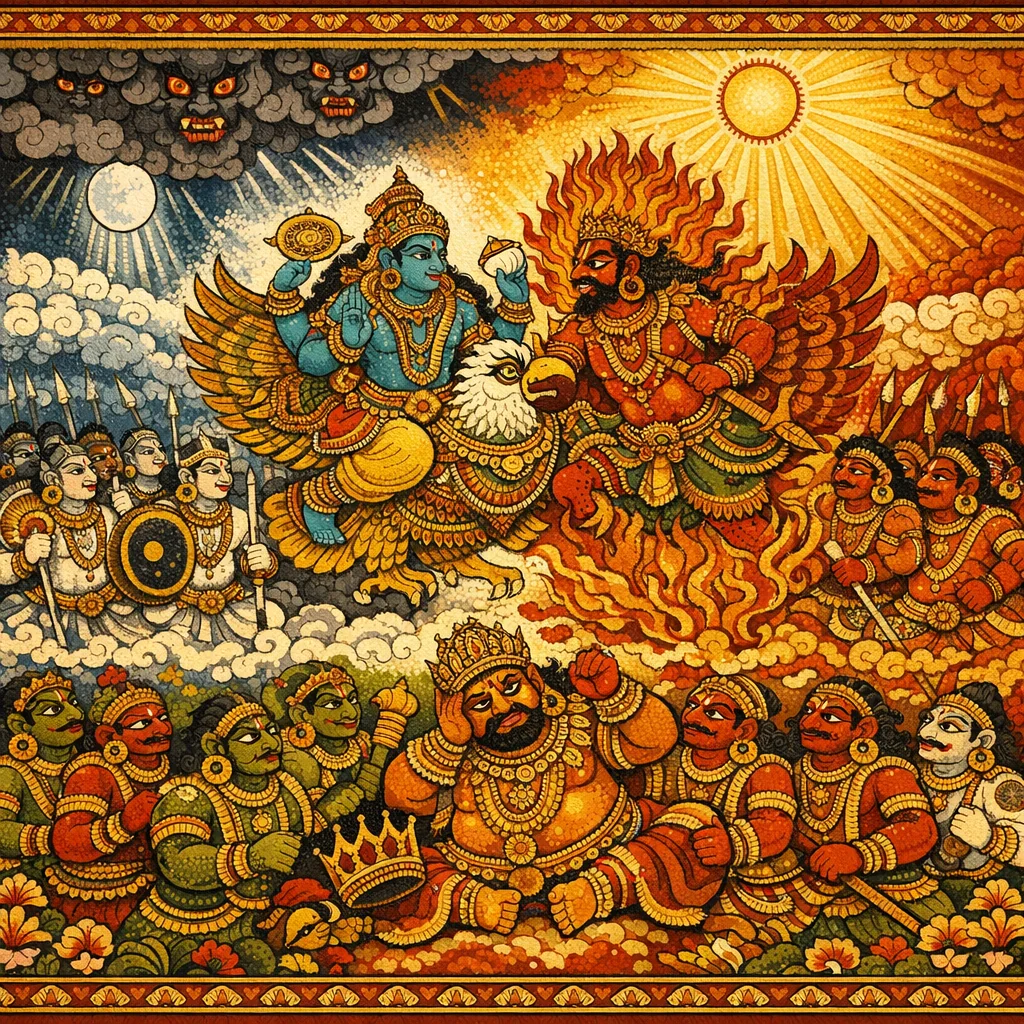
Adhyaya 150: War of Devas and Dānavas: Yama and Kubera Defeated; Kālanemi’s Māyā and the Arrival of Viṣṇu
दानवदेवयुद्धे यमकुबेरकालनेमिविष्णुसंग्रामः
Speaker: Sūta
Sūta narrates successive battlefield episodes: (1) Yama (Antaka/Kṛtānta) duels Grāsana with arrows, mace, staff, and wrestling, until Yama falls as if lifeless and Grāsana rages against Yama’s kiṅkaras. (2) Kubera (Dhanādhipa/Vitteśa) fights Jambha and then Kujambha; despite fierce arrow-volleys and invoked astras, Kubera is overwhelmed, his crown drops, the Yakṣas form a defensive ring, and the Dānava host seizes treasures and captives. (3) The war turns cosmic: tamasic māyā brings darkness and confusion; the Sāvitra astra restores sight; lunar cold and solar heat alternately cripple armies; Kālanemi expands into a world-filling fiery form, then later becomes a cloud-form, reviving his side with rain. (4) Omens of world-ruin arise; Viṣṇu awakens from yoganidrā, mounts Garuḍa, and confronts Kālanemi with allied Daityas. (5) After a fierce exchange—heart-piercing arrows, mace and śakti blows—Viṣṇu crushes Kālanemi’s head with his mace, yet grants him release for the moment, declaring that he alone will be Kālanemi’s final slayer in time.
Key Concepts
Shlokas in Adhyaya 150
Verse 1
*सूत उवाच अथ ग्रसनमालोक्य यमः क्रोधविमूर्छितः ववर्ष शरवर्षेण विशेषेणाग्निवर्चसा //
Sūta said: Then, seeing the act of devouring, Yama—overpowered by wrath—rained down a storm of arrows, blazing with a brilliance like fire.
Verse 2
स विद्धो बहुभिर्बाणैर् ग्रसनो ऽतिपराक्रमः कृतप्रतिकृताकाङ्क्षी धनुरानम्य भैरवम् //
Though pierced by many arrows, Grasana—of extraordinary valor—longing to repay the injury, bent his dreadful bow.
Verse 3
शतैः पञ्चभिरत्युग्रैः शराणां यममर्दयत् स विचिन्त्य यमो बाणान् ग्रसनस्यातिपौरुषम् //
With five hundred exceedingly fierce arrows, he struck down Yama. Then Yama, reflecting upon those shafts, contemplated the extraordinary prowess of Grāsana.
Verse 4
बाणवृष्टिभिरुग्राभिर् यमो ग्रसनमर्दयत् कृतान्तशरवृष्टिं तां वियति प्रतिसर्पिणीम् //
With a fierce shower of arrows, Yama struck down and crushed that ‘rain of death-dealing shafts’ as it moved back through the sky.
Verse 5
चिछेद शरवर्षेण ग्रसनो दानवेश्वरः विफलां तां समालोक्य यमस्तां शरसंततिम् //
Grāsana, the lord of the Dānavas, cut down that continuous torrent of arrows with a rain of his own shafts; and Yama, seeing that arrow-stream rendered futile, beheld it fail.
Verse 6
स विचिन्त्य शरव्रातं ग्रसनस्य रथं प्रति चिक्षेप मुद्गरं घोरं तरसा तस्य चान्तकः //
Having considered the volley of arrows, Antaka swiftly hurled a dreadful mace toward the chariot of Grāsana with great force.
Verse 7
स तं मुद्गरम् आयान्तम् उत्प्लुत्य गगनस्थितम् जग्राह वामहस्तेन याम्यं दानवनन्दनः //
Leaping up, the son of the Dānava caught that onrushing mace—poised in midair—grasping it with his left hand, facing the southern quarter.
Verse 8
तमेव मुद्गरं गृह्य यमस्य महिषं रुषा पातयामास वेगेन स पपात महीतले //
Seizing that very mallet, he angrily struck down Yama’s buffalo with force; and it fell swiftly to the ground.
Verse 9
उत्प्लुत्याथ यमस्तस्मान् महिषान्निष्पतिष्यतः प्रासेन ताडयामास ग्रसनं वदने दृढम् //
Then Yama sprang up; as that buffalo was about to bolt away, he struck it hard in the mouth and throat with his spear, restraining it firmly.
Verse 10
स तु प्रासप्रहारेण मूर्छितो न्यपतद्भुवि ग्रसनं पतितं दृष्ट्वा जम्भो भीमपराक्रमः //
Struck by the blow of a spear, he fainted and fell to the ground. Seeing Grasana lying fallen, Jambha—of dreadful prowess—(reacted in fury/resolve).
Verse 11
यमस्य भिन्दिपालेन प्रहारमकरोद्धृदि यमस्तेन प्रहारेण सुस्राव रुधिरं मुखात् //
He struck Yama in the chest with a bhindipāla (a javelin-like weapon); and from that blow, Yama’s blood streamed forth from his mouth.
Verse 12
कृतान्तं मर्दितं दृष्ट्वा गदापाणिर्धनाधिपः वृतो यक्षायुतशतैर् जम्भं प्रत्युद्ययौ रुषा //
Seeing Kṛtānta (Death) struck down, the Lord of Wealth—mace in hand—surrounded by hundreds of thousands of Yakṣas, advanced in wrath to face Jambha.
Verse 13
जम्भो रुषा तम् आयान्तं दानवानीकसंवृतः उवाच प्राज्ञो वाक्यं तु यथा स्निग्धेन भाषितम् //
Jambha, though aflame with wrath and encompassed by the host of the Dānavas, addressed the one who was drawing near—speaking as a wise man might, gently and with an air of affection.
Verse 14
ग्रसनो लब्धसंज्ञो ऽथ यमस्य प्राहिणोद्गदाम् मणिहेमपरिष्कारां गुर्वीम् अरिविमर्दिनीम् //
Then Grasana, having regained consciousness, hurled forth Yama’s mace—adorned with jewels and gold, massive in weight, and a crusher of foes.
Verse 15
तामप्रतर्क्यां सम्प्रेक्ष्य गदां महिषवाहनः गदायाः प्रतिघातार्थं जगद्दलनभैरवम् //
Beholding that unfathomable mace, Mahiṣavāhana fixed his gaze upon Jagaddalana-bhairava, intending to counter the blow of the mace.
Verse 16
दण्डं मुमोच कोपेन ज्वालामालासमाकुलम् स गदां वियति प्राप्य ररासाम्बुधरो यथा //
In wrath he hurled his staff, wreathed in garlands of flame; and that mace, as it rose into the sky, roared like a rain-bearing cloud.
Verse 17
संघट्टमभवत्ताभ्यां शैलाभ्यामिव दुःसहम् ताभ्यां निष्पेषनिर्ह्रादजडीकृतदिगन्तरम् //
Between the two there arose a collision, unbearable as the crashing of mountains; and by the thunderous roar of their crushing blows, the far horizons in every direction seemed stunned into stillness.
Verse 18
जगद् व्याकुलतां यातं प्रलयागमशङ्कया क्षणात्प्रशान्तनिर्ह्रादं ज्वलदुल्कासमाचितम् //
The world was thrown into turmoil, fearing the approach of pralaya, the cosmic dissolution. In an instant all roaring sounds were stilled, and the sky grew crowded with blazing meteors.
Verse 19
निष्पेषणे तयोर्भीमम् अभूद्गगनगोचरम् निहत्याथ गदां दण्डस् ततो ग्रसनमूर्धनि //
As the two crushed and struck at one another, a dreadful clash arose, seeming to range through the sky. Then Daṇḍa struck down the mace (gadā) and thereafter delivered his blow upon Grasanamūrdhan’s head.
Verse 20
हृत्वा श्रियमिवानर्थो दुर्वृत्तस्यापतद्दृढः स तु तेन प्रहारेण दृष्ट्वा सतिमिरा दिशः //
As though misfortune had seized his śrī—his prosperity—calamity fell heavily upon the ill-conducted man; and from that blow he saw the quarters veiled in darkness.
Verse 21
पपात भूमौ निःसंज्ञो भूमिरेणुविभूषितः ततो हाहारवो घोरः सेनयोरुभयोरभूत् //
He fell to the ground, senseless, his body covered with the dust of the earth. Then a dreadful cry of lamentation—“hā hā!”—arose from both armies.
Verse 22
ततो मुहूर्तमात्रेण ग्रसनः प्राप्य चेतनाम् अपश्यत्स्वां तनुं ध्वस्तां विलोलाभरणाम्बराम् //
Then, within only a moment, Grasana regained consciousness and beheld his own body ruined—his ornaments and garments hanging loose, disordered, and askew.
Verse 23
स चापि चिन्तयामास कृते प्रतिकृतिक्रियाम् मद्विधे वस्तुनि पुंसि प्रभोः परिभवोदयात् //
He too began to ponder how to carry out a counter-act of retaliation, for the insult to his master had arisen through a man of my sort—an insignificant person.
Verse 24
मय्याश्रितानि सैन्यानि जिते मयि विनाशिता असंभावित एवास्तु जनः स्वच्छन्दचेष्टितः //
The armies that depended on me are destroyed when I am defeated. Therefore, let the people be left unthreatened and allowed to act by their own free choice.
Verse 25
न तु व्यर्थशतोद्घुष्टसंभावितधनो नरः एवं संचिन्त्य वेगेन समुत्तस्थौ महाबलः //
But that man—whose wealth and standing had been proclaimed and celebrated a hundred times over—was not one to be praised in vain. Having reflected thus, the mighty one rose up at once with speed.
Verse 26
मुद्गरं कालदण्डाभं गृहीत्वा गिरिसंनिभः ग्रसनो घोरसंकल्पः संदष्टौष्ठपुटच्छदः //
Taking up a mace resembling the staff of Kāla (Time, Death), and mountain-like in stature, Grasana—of dreadful resolve—stood with his lips clenched tight, his mouth firmly set.
Verse 27
रथेन त्वरितो गच्छन् नाससादान्तकं रणे समासाद्य यमं युद्धे ग्रसनो भ्राम्य मुद्गरम् //
Rushing forward in his chariot, he did not retreat in the battle; closing in upon Yama in the fight, Grasana whirled his mace, intent on striking down his foe.
Verse 28
वेगेन महता रौद्रं चिक्षेप यममूर्धनि विलोक्य मुद्गरं दीप्तं यमः संभ्रान्तलोचनः //
With tremendous force he hurled the fierce blow upon Yama’s head; and Yama, seeing the blazing mace, looked on with eyes widened in alarm.
Verse 29
वञ्चयामास दुर्धर्षं मुद्गरं स महाबलः तस्मिन्नपसृते दूरं चण्डानां भीमकर्मणाम् //
That mighty one deftly evaded the irresistible war-mace; and when it had been driven far away, it fell at a distance among the Caṇḍas, men of dreadful deeds.
Verse 30
याम्यानां किंकराणां तु सहस्रं निष्पिपेष ह ततस्तां निहतां दृष्ट्वा घोरां किंकरवाहिनीम् //
He crushed a thousand of Yama’s servants; and then, seeing that dreadful host of Kiṅkaras struck down, terror and rout arose.
Verse 31
अगमत्परमं क्षोभं नानाप्रहरणोद्यतः ग्रसनस्तु समालोक्य तां किंकरमयीं चमूम् //
Seeing that army—crowded with attendants and retainers—Grasana, with many kinds of weapons raised, was seized by the utmost agitation and fury.
Verse 32
मेने यमसहस्राणि सृष्टानि यममायया निग्राह्य ग्रसनः सेनां विसृजन्नस्त्रवृष्टयः //
He perceived thousands of Yamas, conjured by Yama’s illusory power; and, restraining them, Grasana—the Devourer—overwhelmed the army while releasing a rain of weapons, sending forth astras in succession.
Verse 33
कल्पान्तघोरसंकाशो बभूव क्रोधमूर्छितः कांश्चिद्बिभेद शूलेन कांश्चिद्बाणैरजिह्मगैः //
Fierce as the terror at the end of an aeon, he became maddened with wrath; some he pierced with a spear, and others he struck down with arrows that flew unerringly.
Verse 34
कांश्चित् पिपेष गदया कांश्च मुद्गरवृष्टिभिः केचित्प्रासप्रहारैश्च दारुणैस्ताडितास्तदा //
Some he crushed with a mace; others were overwhelmed by a rain of mallets, and some were then struck down by fierce thrusts of spears.
Verse 35
अपरे बहुशस्तस्य ललम्बुर्बाहुमण्डले शिलाभिरपरे जघ्नुर् द्रुमैरन्यैर्महोच्छ्रयैः //
Some again and again clung to his circle of arms; others struck him with stones, while still others battered him with lofty, towering trees.
Verse 36
तस्यापरे तु गात्रेषु दशनैरप्यदंशयन् अपरे मुष्टिभिः पृष्ठं किंकराः प्रहरन्ति च //
Some of Yama’s servants bite his limbs with their teeth, while others strike his back with their fists.
Verse 37
अभिद्रुतस्तथा घोरैर् ग्रसनः क्रोधमूर्छितः उत्सृज्य गात्रं भूपृष्ठे निष्पिपेष सहस्रशः //
Thus assailed by the dreadful ones, Grasana—faint with rage—cast his body down upon the earth’s surface and crushed them into the ground again and again, by the thousand.
Verse 38
कांश्चिदुत्थाय मुष्टिभिर् जघ्ने किंकरसंश्रयान् स तु किंकरयुद्धेन ग्रसनः श्रममाप्तवान् //
Rising up, he struck down with his fists some who had taken refuge among the kiṅkaras (attendant fighters). Yet, by that very battle with the kiṅkaras, Grasana became exhausted.
Verse 39
तमालोक्य यमः श्रान्तं निहतां च स्ववाहिनीम् आजगाम समुद्यम्य दण्डं महिषवाहनः //
Seeing this—his own host exhausted and slain—Yama, the rider of the buffalo, advanced, raising aloft his rod of punishment.
Verse 40
ग्रसनस्तु समायान्तम् आजघ्ने गदयोरसि अचिन्तयित्वा तत्कर्म ग्रसनस्यान्तको ऽरिहा //
As Grasana came rushing forward, Antaka—the slayer of foes—struck him on the chest with his mace, without a moment’s hesitation, intent on that deed.
Verse 41
जघ्ने रथस्य मूर्धन्यान् व्याघ्रान्दण्डेन कोपनः स रथो दण्डमथितैर् व्याघ्रैरर्धैर् विकृष्यते //
Enraged, he struck down with a staff the foremost tigers at the head of the chariot; yet that chariot was dragged away—half-pulled—by the tigers, though they were battered by the blows of the staff.
Verse 42
संशयः पुरुषस्येव चित्तं दैत्यस्य तद्रथम् समुत्सृज्य रथं दैत्यः पदातिर्धरणीं गतः //
Doubt seized the demon’s mind as it does a man’s; abandoning that chariot, the Daitya left it behind and went down to the ground on foot.
Verse 43
यमं भुजाभ्यामादाय योधयामास दानवः यमो ऽपि शस्त्राण्युत्सृज्य बाहुयुद्धेष्ववर्तत //
Seizing Yama with both arms, the Dānava grappled and fought him; and Yama too, casting aside his weapons, engaged in hand-to-hand combat.
Verse 44
ग्रसनः कटिवस्त्रैस्तु यमं गुह्य बलोद्धतः भ्रामयामास वेगेन प्रचित्तमिव सम्भ्रमः //
Then Grāsana—his strength roused to fury—seized Yama by the waist-cloth at his loins and whirled him around with forceful speed, like confusion spinning a mind that has lost its steadiness.
Verse 45
यमो ऽपि कण्ठे ऽवष्टभ्य दैत्यं बाहुयुगेन तु वेगेन भ्रामयामास समुत्कृष्य महीतलात् //
Yama too, seizing the demon by the throat with both arms, lifted him up from the surface of the earth and whirled him around with force.
Verse 46
ततो मुष्टिभिरन्योन्यं निर्दयौ तौ निजघ्नतुः दैत्येन्द्रस्यातिकायत्वात् ततः श्रान्तभुजो यमः //
Then the two, merciless, struck one another with their fists. But because the lord of the Daityas was of enormous stature, Yama’s arms grew weary thereafter.
Verse 47
स्कन्धे निधाय दैत्यस्य मुखं विश्रान्तिमैच्छत तमालक्ष्य ततो दैत्यः श्रान्तमन्तकमोजसा //
Resting the demon’s head upon his shoulder, he sought a moment’s respite. Noticing Antaka (the slayer) wearied, the demon then, with sheer force, pressed the exhausted one hard.
Verse 48
निष्पिपेष महीपृष्ठे बहुशः पार्ष्णिपाणिभिः यावद्यमस्य वदनात् सुस्राव रुधिरं बहु //
He repeatedly crushed him down upon the surface of the earth, striking with heels and fists, until from Yama’s very mouth a great deal of blood poured forth.
Verse 49
निर्जीवितं यमं दृष्ट्वा ततः संत्यज्य दानवः जयं प्राप्योद्धतं दैत्यो नादं मुक्त्वा महास्वनः //
Seeing Yama lying lifeless, the Dānava then withdrew; having gained victory, that arrogant Daitya let out a tremendous, thunderous roar.
Verse 50
स्वयं सैन्यं समासाद्य तस्थौ गिरिरिवाचलः धनाधिपस्य जम्भेन सायकैर्मर्मभेदिभिः //
Advancing in person against the army, he stood firm like an unmoving mountain, while Jambha assailed Kubera, the Lord of Wealth, with arrows that pierced the vital points.
Verse 51
दिशो ऽवरुद्धाः क्रुद्धेन सैन्यं चास्य निकृन्तितम् ततः क्रोधपरीतस्तु धनेशो जम्भदानवम् //
With wrath, he blocked off the directions, and his army too was cut down. Then, overcome by anger, Dhanesha (Kubera), confronted the demon Jambha.
Verse 52
हृदि विव्याध बाणानां सहस्रेणाग्निवर्चसाम् सारथिं च शतेनाजौ ध्वजं दशभिरेव च //
Blazing like fire, he pierced (his foe) in the heart with a thousand arrows; and in the battle he struck the charioteer with a hundred (arrows), and the banner with just ten.
Verse 53
हस्तौ च पञ्चसप्तत्या मार्गणैर्दशभिर्धनुः मार्गणैर् बर्हिपत्त्राङ्गैस् तैलधौतैरजिह्मगैः //
In both hands he should be depicted with seventy-five arrows, and with a bow together with ten arrows—arrows fitted with peacock-feathered shafts, well oiled and perfectly straight.
Verse 54
सिंहमेकेन तं तीक्ष्णैर् विव्याध दशभिः शरैः जम्भस्तु कर्म तद्दृष्ट्वा धनेशस्यातिदुष्करम् //
With a single lion, he pierced him with ten sharp arrows. But Jambha, seeing that deed, recognized it as an exceedingly difficult feat accomplished by Dhanesha (Kubera).
Verse 55
हृदि धैर्यं समालम्ब्य किंचित्संत्रस्तमानसः जग्राह निशितान्बाणाञ् छत्रुमर्मविभेदिनः //
Steadying his heart with courage—though his mind was somewhat shaken—he seized sharp arrows, piercers of the enemy’s vital joints.
Verse 56
आकर्णाकृष्टचापस्तु जम्भः क्रोधपरिप्लुतः विव्याध धनदं तीक्ष्णैः शरैर्वक्षसि दानवः //
Then Jambha—the Dānava—his bow drawn back to the ear and overwhelmed with rage, struck Dhanada (Kubera) in the chest with sharp arrows.
Verse 57
सारथिं चास्य बाणेन दृढेनाभ्यहनद्धृदि चिछेद ज्यामथैकेन तैलधौतेन दानवः //
And the Dānava struck his charioteer in the chest with a strong arrow; then, with a single arrow—smoothened as if oil-polished—he also cut the bowstring.
Verse 58
ततस्तु निशितैर्बाणैर् दारुणैर् मर्मभेदिभिः विव्याधोरसि वित्तेशं दशभिः क्रूरकर्मकृत् //
Then that fierce-doer pierced Vitteśa (Kubera), the Lord of Wealth, in the chest with ten sharp arrows—terrible shafts that split the vital points.
Verse 59
मोहं परमतो गच्छन् दृढविद्धो हि वित्तपः स क्षणाद्धैर्यमालम्ब्य धनुराकृष्य भैरवम् //
As delusion was about to overtake him completely, Vittapa—though struck hard—at that very moment steadied himself with courage and drew his fearsome bow.
Verse 60
किरन्बाणसहस्राणि निशितानि धनाधिपः दिशः खं विदिशो भूमीर् अनीकान्यसुरस्य च //
The lord of wealth, releasing thousands of razor‑sharp arrows, filled the directions, the sky, the intermediate quarters, and the earth—and he struck down the battle-formations of the Asura as well.
Verse 61
पूरयामास वेगेन संछाद्य रविमण्डलम् जम्भो ऽपि परमेकैकं शरैर्बहुभिराहवे //
With great speed he filled the sky, veiling the orb of the sun; and in that battle Jambha too was struck—each one in turn—by many arrows.
Verse 62
चिछेद लघुसंधानो धनेशस्यातिपौरुषात् ततो धनेशः संक्रुद्धो दानवेन्द्रस्य कर्मणा //
Through extraordinary might, Laghusaṃdhāna struck down (or cut apart) Dhanesha. Thereupon Dhanesha, enraged by the deed of the lord of the Dānavas, became furious.
Verse 63
व्यधमत्तस्य सैन्यानि नानासायकवृष्टिभिः तद्दृष्ट्वा दुष्कृतं कर्म धनाध्यक्षस्य दानवः //
He shattered the enemy’s forces with showers of missiles of many kinds. Seeing the evil deed committed by the treasurer, the Dānava (demon) responded accordingly.
Verse 64
गृहीत्वा मुद्गरं भीमम् आयसं हेमभूषितम् धनदानुचरान्यक्षान् निष्पिपेष सहस्रशः //
Seizing a terrifying iron mace adorned with gold, he crushed the Yakṣas—attendants of Dhanada (Kubera)—by the thousand.
Verse 65
ते वध्यमाना दैत्येन मुञ्चन्तो भैरवान्रवान् रथं धनपतेः सर्वे परिवार्य व्यवस्थिताः //
Being struck down by the Daitya, they let out terrifying cries; and all of them, surrounding Dhanapati’s chariot, took up their positions.
Verse 66
दृष्ट्वा तानर्दितान्देवः शूलं जग्राह दारुणम् तेन दैत्यसहस्राणि सूदयामास सत्वरः //
Seeing them being grievously harried, the Lord seized his fearsome trident; and with it he swiftly slew thousands of demons.
Verse 67
क्षीयमाणेषु दैत्येषु दानवः क्रोधमूर्छितः जग्राह परशुं दैत्यो मर्दनं दैत्यविद्विषाम् //
As the Daityas were being worn down, a Dānava—faint with rage—seized an axe, a weapon meant to crush the foes of the Daityas.
Verse 68
स तेन शितधारेण धनभर्तुर् महारथम् चिछेद शतशो दैत्यो ह्य् आखुः स्निग्धमिवाम्बरम् //
With that razor-edged blade, the Daitya cut the great chariot-warrior of Dhanabhartu into hundreds of pieces, just as a mouse gnaws through a smooth garment.
Verse 69
पदातिरथ वित्तेशो गदामादाय भैरवीम् महाहवविमर्देषु दृप्तशत्रुविनाशिनीम् //
Vitteśa (Kubera), with infantry and chariots, takes up the fearsome Bhairavī who bears a mace—she who, amid the crush of great battles, destroys arrogant enemies.
Verse 70
अधृष्यां सर्वभूतानां बहुवर्षगणार्चिताम् नानाचन्दनदिग्धाङ्गां दिव्यपुष्पविवासिताम् //
She is unassailable to all beings, worshipped for many years by hosts of celestials; her limbs are anointed with many kinds of sandal-paste and perfumed with divine flowers.
Verse 71
निर्मलायोमयीं गुर्वीम् अमोघां हेमभूषणाम् चिक्षेप मूर्ध्नि संक्रुद्धो जम्भस्य तु धनाधिपः //
Then the Lord of Wealth, enraged, hurled upon Jambha’s head a heavy, unfailing weapon—pure, fashioned of iron, and adorned with gold ornaments.
Verse 72
आयान्तीं तां समालोक्य तडित्संघातमण्डिताम् दैत्यो गदाभिघातार्थं शस्त्रवृष्टिं मुमोच ह //
Seeing her advancing, adorned like a mass of lightning, the Daitya—intending a mace-blow—unleashed a shower of weapons.
Verse 73
चक्राणि कुणपान्प्रासान् भुशुण्डीः पट्टिशानपि हेमकेयूरनद्धाभ्यां बाहुभ्यां चण्डविक्रमः //
Fierce in prowess, his arms—adorned with golden armlets—wielded discus-weapons, heavy maces, spears, bhuśuṇḍī missiles, and even battle-axes.
Verse 74
व्यर्थीकृत्य तु तान्सर्वान् आयुधान्दैत्यवक्षसि प्रस्फुरन्ती पपातोग्रा महोल्केवाद्रिकन्दरे //
Having rendered all those weapons ineffective upon the demon’s chest, that fierce, blazing force fell—flashing and crackling—like a great meteor into a mountain cave.
Verse 75
स तयाभिहतो गाढं पपात रथकूबरे स्रोतोभिश्चास्य रुधिरं सुस्राव गतचेतसः //
Struck hard by her, he collapsed upon the chariot’s yoke; and from him, blood streamed in torrents, as he lay senseless.
Verse 76
जम्भं तु निहतं मत्वा कुजम्भो भैरवस्वनः धनाधिपस्य संक्रुद्धो वाक्येनातीव कोपितः //
But when Kujambha—whose voice was dreadful—came to know that Jambha had been slain, he became enraged with the Lord of Wealth (Kubera) and, because of his words, was inflamed with intense anger.
Verse 77
चक्रे बाणमयं जालं दिक्षु यक्षाधिपस्य तु चिछेद बाणजालं तद् अर्धचन्द्रैः शितैस्ततः //
Then the Lord of the Yakṣas cast a net of arrows in all directions; but he (the opposing warrior) immediately cut that arrow-net apart with sharp, crescent-shaped shafts.
Verse 78
मुमोच शरवृष्टिं तु तस्मै यक्षाधिपो बली स तं दैत्यः शरव्रातं चिछेद निशितैः शरैः //
Then the mighty lord of the Yakṣas loosed a rain of arrows at him; but that Daitya cut down the whole mass of shafts with his own keen arrows.
Verse 79
व्यर्थीकृतां तु तां दृष्ट्वा शरवृष्टिं धनाधिपः शक्तिं जग्राह दुर्धर्षां हेमघण्टाट्टहासिनीम् //
Seeing that the shower of arrows had been made futile, Dhanādhipa seized a dreadful śakti-javelin, irresistible in might; its golden bells rang out with a loud, mocking clamor.
Verse 80
बाहुना रत्नकेयूरकान्तिसंतानहासिना स तां निरूप्य वेगेन कुजम्भाय मुमोच ह //
With his arm adorned by jeweled armlets—whose radiance seemed to laugh in an unbroken stream—he took aim and, with force, swiftly hurled it at Kujambha.
Verse 81
सा कुजम्भस्य हृदयं दारयामास दारुणम् वित्तेहा स्वल्पसत्त्वस्य पुरुषस्येव भाविता //
Driven as though by craving for wealth, it cruelly tore open Kujambha’s heart—just as greed for riches, once it takes hold, rends the heart of a man of little inner strength.
Verse 82
अथास्य हृदयं भित्त्वा जगाम धरणीतलम् ततो मुहूर्तादस्वस्थो दानवो दारुणाकृतिः //
Then, his heart pierced, he fell upon the earth’s surface. Soon after, within a brief while, that Dānava of dreadful aspect grew faint and unsteady.
Verse 83
जग्राह पट्टिशं दैत्यः प्रांशुं शितशिलामुखम् स तेन पट्टिशेनाजौ धनदस्य स्तनान्तरम् //
The Daitya seized a tall pattiśa, its stone-like blade keen-edged; and with that pattiśa in the fight he struck Dhanada (Kubera) upon the chest, in the space between the breasts.
Verse 84
वाक्येन तीक्ष्णरूपेण मर्मान्तरविसर्पिणा निर्बिभेदाभिजातस्य हृदयं दुर्जनो यथा //
With words sharp in form, creeping into one’s vital points, the wicked pierces the heart of the noble-born, as though stabbing it from within.
Verse 85
तेन पट्टिशघातेन धनेशः परिमूर्छितः निपपात रथोपस्थे जर्जरो धूर्वहो यथा //
Struck by that blow of the pattiśa, Dhanesha (Kubera) was utterly stunned and fell upon the chariot-seat, like a worn-out beast of burden collapsing from exhaustion.
Verse 86
तथागतं तु तं दृष्ट्वा धनेशं नरवाहनम् खड्गास्त्रो निरृतिर्देवो निशाचरबलानुगः //
But seeing Dhanēśa (Kubera), who had come there mounted upon a man, the god Nirṛti—armed with a sword—advanced, followed by the forces of the night-roaming spirits.
Verse 87
अभिदुद्राव वेगेन कुजम्भं भीमविक्रमम् अथ दृष्ट्वा तु दुर्धर्षं कुजम्भो राक्षसेश्वरम् //
With great speed he rushed straight at Kujambha, mighty in prowess. Then Kujambha, seeing that fearsome and unassailable lord of the Rākṣasas, advanced in turn to confront him.
Verse 88
चोदयामास सैन्यानि राक्षसेन्द्रवधं प्रति स दृष्ट्वा चोदितां सेनां भल्लनानास्त्रभीषणाम् //
He urged the armies onward toward the slaying of the lord of the Rākṣasas; and seeing the host thus driven forward—terrifying with barbed darts and weapons of many kinds—he advanced to meet it.
Verse 89
रथादाप्लुत्य वेगेन भूषणद्युतिभास्वरः खड्गेन कमलानीव विकोशेनाम्बरत्विषा //
Leaping down from his chariot with great speed, radiant with the splendor of his ornaments, he flashed his sword—like lotuses opening—its sheen spreading like the brightness of the sky.
Verse 90
चिछेद रिपुवक्त्राणि विचित्राणि समन्ततः तिर्यक्पृष्ठमधश्चोर्ध्वं दीर्घबाहुर्महासिना //
With his great sword, the long-armed hero cut down the enemies’ faces and fronts in wondrous fashion on every side—slashing crosswise, from the back, from below, and from above.
Verse 91
संदष्टौष्ठपुटाटोपभ्रुकुटीविकटाननः प्रचण्डकोपरक्ताक्षो न्यकृन्तद्दानवान्रणे //
With lips clenched tight, brows knit in a fierce frown and his face made terrible, his eyes reddened by violent wrath, he cut down the Dānavas in the battle.
Verse 92
ततो निःशेषितप्रायां विलोक्य स्वामनीकिनीम् मुक्त्वा कुजम्भो धनदं राक्षसेन्द्रमभिद्रवन् //
Then, seeing his own army almost entirely destroyed, Kujambha released Dhanada (Kubera) and charged straight at the lord of the Rākṣasas.
Verse 93
लब्धसंज्ञो ऽथ जम्भस्तु धनाध्यक्षपदानुगान् जीवग्राहान्स जग्राह बद्ध्वा पाशैः सहस्रशः //
Then Jambha, having regained consciousness, seized the living captives—those who followed the office of the Lord of Wealth’s superintendent—and bound them by the thousand with nooses.
Verse 94
मूर्तिमन्ति तु रत्नानि विविधानि च दानवाः वाहनानि च दिव्यानि विमानानि सहस्रशः //
There are also many kinds of gems endowed with tangible form; and the Dānavas possess divine mounts and thousands upon thousands of celestial aerial chariots (vimānas).
Verse 95
धनेशो लब्धसंज्ञो ऽथ तामवस्थां विलोक्य तु निःश्वसन्दीर्घमुष्णं च रोषात्ताम्रविलोचनः //
Then Dhaneśa (Kubera), regaining consciousness, looked upon her condition; and, his eyes reddened with wrath, he heaved a long, hot sigh.
Verse 96
ध्यात्वास्त्रं गारुडं दिव्यं बाणं संधाय कार्मुके मुमोच दानवानीके तं बाणं शत्रुदारणम् //
Having mentally invoked the divine Gāruḍa-weapon, he set an arrow to the bow and released that enemy-rending shaft into the host of the Dānavas.
Verse 97
प्रथमं कार्मुकात्तस्य निश्चेरुर्धूमराजयः अनन्तरं स्फुलिङ्गानां कोटयो दीप्तवर्चसाम् //
First, from that bow there issued streams of smoke; thereafter, crores of sparks, blazing with radiant brilliance, burst forth.
Verse 98
ततो ज्वालाकुलं व्योम चकारास्त्रं समन्ततः ततः क्रमेण दुर्वारं नानारूपं तदाभवत् //
Then that weapon, on every side, made the sky a mass of flames; thereafter, step by step, it became irresistible, assuming many terrifying forms.
Verse 99
अमूर्तश्चाभवल्लोको ह्य् अन्धकारसमावृतः ततो ऽन्तरिक्षे शंसन्ति तेजस्ते तु परिष्कृतम् //
The world became formless indeed, enveloped in darkness. Then, in the mid-space, they proclaim that that radiance was purified and made manifest.
Verse 100
कुजम्भस्तत्समालोच्य दानवो ऽतिपराक्रमः अभिदुद्राव वेगेन पदातिर्धनदं नदन् //
Seeing that, the exceedingly valiant Dānava Kujambha, advancing on foot, rushed forward with speed, roaring at Dhanada (Kubera).
Verse 101
अथाभिमुखम् आयान्तं दैत्यं दृष्ट्वा धनाधिपः बभूव सम्भ्रमाविष्टः पलायनपरायणः //
Then, seeing the Daitya coming straight toward him, the lord of wealth was seized by panic and became intent only on fleeing.
Verse 102
ततः पलायतस्तस्य मुकुटं रत्नमण्डितम् पपात भूतले दीप्तं रविबिम्बमिवाम्बरात् //
Then, as he fled, his gem-studded crown fell onto the earth, blazing—like the disk of the sun dropping from the sky.
Verse 103
शूराणामभिजातानां भर्तर्यपसृते रणात् मर्तुं संग्रामशिरसि युक्तं तद्भूषणाग्रतः //
For brave men of noble lineage, if their lord withdraws from the battlefield, it is fitting that they die upon the very front of the combat—before their lord’s insignia and ornaments, in his presence and for his honor.
Verse 104
इति व्यवस्य दुर्धर्षा नानाशस्त्रास्त्रपाणयः युयुत्सवः स्थिता यक्षा मुकुटं परिवार्य तम् //
Having thus resolved, the unassailable Yakṣas—bearing many kinds of weapons and missiles—stood ready for battle, surrounding that crowned one on all sides.
Verse 105
अभिमानधना वीरा धनदस्य पदानुगाः तानमर्षाच्च सम्प्रेक्ष्य दानवश्चण्डपौरुषः //
Those valiant warriors—proud of their wealth—who followed in the footsteps of Dhanada (Kubera), were seen by the Daitya of fierce prowess; and at the sight of them, he burned with indignation.
Verse 106
भुशुण्डीं भैरवाकारां गृहीत्वा शैलगौरवाम् रक्षिणो मुकुटस्याथ निष्पिपेष निशाचरान् //
Then, seizing the bhuśuṇḍī—terrible in form like Bhairava and heavy as a mountain—the guardian of the crown crushed the night-roaming demons to pieces.
Verse 107
तान्प्रमथ्याथ दनुजो मुकुटं तत्स्वके रथे समारोप्यामररिपुर् जित्वा धनदमाहवे //
Having crushed them, the Dānava then mounted that crown upon his own chariot; and the foe of the gods, having vanquished Dhanada (Kubera) in battle, proceeded onward.
Verse 108
धनानि रत्नानि च मूर्तिमन्ति तथा निधानानि शरीरिणश्च आदाय सर्वाणि जगाम दैत्यो जम्भः स्वसैन्यं दनुजेन्द्रसिंहः धनाधिपो वै विनिकीर्णमूर्धजो जगाम दीनः सुरभर्तुरन्तिकम् //
Seizing all the riches—tangible jewels, hidden hoards, and even the living guardians of the treasures—the Daitya Jambha, a lion among the lords of Danu, departed with his own army. Then Kubera, Lord of Wealth, his hair dishevelled, went in misery to the presence of Indra, Lord of the Gods.
Verse 109
कुजम्भेनाथ संसक्तो रजनीचरनन्दनः मायाममोघामाश्रित्य तामसीं राक्षसेश्वरः //
Bound in alliance with Kujambha, the son of the night-roamers—the lord of the Rākṣasas—resorted to an unfailing māyā, tamasic in nature, that cast darkness upon the mind.
Verse 110
मोहयामास दैत्येन्द्रं जगत्कृत्वा तमोमयम् ततो विफलनेत्राणि दानवानां बलानि तु //
He bewildered the lord of the Daityas, making the whole world appear as though it were made of darkness; then the hosts of the Dānavas were left with their sight rendered useless.
Verse 111
न शेकुश्चलितं तत्र पदादपि पदं तदा ततो नानास्त्रवर्षेण दानवानां महाचमूम् //
There, at that time, they were unable to move even a single step. Then, by a rain of many kinds of weapons, the great army of the Dānavas was struck down and thrown into disarray.
Verse 112
जघान घननीहारतिमिरातुरवाहनाम् वध्यमानेषु दैत्येषु कुजम्भे मूढचेतसि //
Amid thick fog and darkness, he struck down the one whose mount was in distress; and while the Daityas were being slain, Kujambha—his mind deluded—stood confounded.
Verse 113
महिषो दानवेन्द्रस्तु कल्पान्ताम्भोदसंनिभः अस्त्रं चकार सावित्रम् उल्कासंघातमण्डितम् //
Mahisha, lord of the Dānavas, dark as rain-clouds at the end of an aeon, then unleashed the Sāvitra weapon, adorned with a showering mass of meteoric firebrands.
Verse 114
विजृम्भत्यथ सावित्रे परमास्त्रे प्रतापिनि प्रणाशमगमत्तीव्रं तमो घोरमनन्तरम् //
Then, as the blazing supreme weapon called the Sāvitra Astra spread forth, the fierce and dreadful darkness immediately went to destruction.
Verse 115
ततो ऽस्त्रं विस्फुलिङ्गाङ्कं तमः कृत्स्नं व्यनाशयत् प्रफुल्लारुणपद्मौघं शरदीवामलं सरः //
Then that weapon, marked with flashing sparks, completely destroyed the darkness—like an autumn lake, stainless and clear, filled with masses of fully blossomed red lotuses.
Verse 116
ततस्तमसि संशान्ते दैत्येन्द्राः प्राप्तचक्षुषः चक्रुः क्रूरेण मनसा देवानीकैः सहाद्भुतम् //
Then, when the darkness had subsided, the lords of the Daityas regained their sight; with a cruel intent they carried out a wondrous (and dreadful) feat against the hosts of the gods.
Verse 117
शस्त्रैरमर्षान्निर्मुक्तैर् भुजंगास्त्रं विनोदितम् अथादाय धनुर्घोरम् इषूंश्चाशीविषोपमान् //
With weapons hurled in wrath, the serpent-weapon was warded off and rendered ineffective. Then, taking up a fearsome bow, he seized arrows likened to venomous cobras.
Verse 118
कुजम्भो ऽधावत क्षिप्तं रक्षोराजबलं प्रति राक्षसेन्द्रस्तम् आयान्तं विलोक्य सपदानुगः //
Kujambha rushed forward, hurling himself against the army of the Rakshasa-king. Seeing him advance, the lord of the Rakshasas at once followed in pursuit.
Verse 119
विव्याध निशितैर्बाणैः क्रूराशीविषभीषणैः तदादानं च संधानं न मोक्षश्चापि लक्ष्यते //
He pierced the foe with sharp arrows, terrifying like cruel, venomous serpents; yet neither their drawing forth nor their fastening on again is perceived, nor is any respite seen.
Verse 120
चिछेदास्य शरव्रातान् स्वशरैर् अतिलाघवात् ध्वजं परमतीक्ष्णेन चित्रकर्मामरद्विषः //
With great swiftness, the foe of the gods—skilled in wondrous martial craft—cut down his volleys of arrows with his own arrows, and with an exceedingly sharp shaft he also severed the standard (dhvaja).
Verse 121
सारथिं चास्य भल्लेन रथनीडादपातयत् कुजम्भः कर्म तद्दृष्ट्वा राक्षसेन्द्रस्य संयुगे //
And with a sharp arrow (bhalla) he struck down his charioteer, toppling him from the chariot-seat. Seeing that deed in the battle of the lord of the Rakshasas, Kujambha responded accordingly.
Verse 122
रोषरक्तेक्षणयुतो रथादाप्लुत्य दानवः खड्गं जग्राह वेगेन शरदम्बरनिर्मलम् //
With eyes reddened in fury, the Dānava leapt down from his chariot and, with great speed, seized a sword—bright and spotless like the clear autumn sky.
Verse 123
चर्म चोदयखण्डेन्दुदशकेन विभूषितम् अभ्यद्रवद्रणे दैत्यो रक्षो ऽधिपतिमोजसा //
In battle, the Daitya—the lord of the Rākṣasas—charged forward with mighty force, his shield adorned with ten crescent-moon segments as sacred emblems.
Verse 124
तं रक्षो ऽधिपतिः प्राप्तं मुद्गरेणाहनद्धृदि स तु तेन प्रहारेण क्षीणः संभ्रान्तमानसः //
Reaching him, the lord of the Rākṣasas struck his chest with a mace; weakened by that blow, he was inwardly shaken and his mind fell into confusion.
Verse 125
तस्थावचेष्टो दनुजो यथा धीरो धराधरः स मुहूर्तं समाश्वस्तो दानवेन्द्रो ऽतिदुर्जयः //
The Danu-born demon stood motionless, like a steadfast mountain; after a brief moment, that hard-to-conquer lord of the Dānavas regained his composure.
Verse 126
रथमारुह्य जग्राह रक्षो वामकरेण तु केशेषु निरृतिं दैत्यो जानुनाक्रम्य धिष्ठितम् //
Mounting his chariot, the rākṣasa seized Nirṛti by the hair with his left hand; the daitya pressed her down with his knee and stood over her in dominance.
Verse 127
ततः खड्गेन च शिरश् छेत्तुमैच्छदमर्षणः तस्मिंस्तदन्तरे देवो वरुणो ऽपांपतिर्द्रुतम् //
Then, in a surge of wrath, he sought to sever the head with his sword; but in that very interval, the god Varuṇa—the lord of the waters—swiftly intervened.
Verse 128
पाशेन दानवेन्द्रस्य बबन्ध च भुजद्वयम् ततो बद्धभुजं दैत्यं विफलीकृतपौरुषम् //
With a noose he bound the two arms of the lord of the Dānavas; then that Daitya, his arms restrained, had his manly might rendered futile.
Verse 129
ताडयामास गदया दयामुत्सृज्य पाशभृत् स तु तेन प्रहारेण स्रोतोभिः क्षतजं वमन् //
Casting aside compassion, the wielder of the noose struck him with a mace; and he, by that blow, vomited blood in streams.
Verse 130
दधार रूपं मेघस्य विद्युन्मालालतावृतम् तदवस्थागतं दृष्ट्वा कुजम्भं महिषासुरः //
Mahīṣāsura assumed the form of a cloud, wreathed in garlands of lightning-creeper flashes; and seeing Kujambha caught in that condition, he advanced upon him.
Verse 131
व्यावृत्तवदने ऽगाधे ग्रस्तुमैच्छत् सुरावुभौ निरृतिं वरुणं चैव तीक्ष्णदंष्ट्रोत्कटाननः //
With his gaping mouth turned wide in that fathomless deep, the fierce-faced one—terrible with sharp fangs—sought to swallow both of those gods, Nirṛti and Varuṇa.
Verse 132
तावभिप्रायमालक्ष्य तस्य दैत्यस्य दूषितम् त्यक्त्वा रथपथं भीतौ महिषस्यातिरंहसा //
Perceiving the wicked intent of that corrupted Daitya, the two—frightened—abandoned the chariot-road and, with the buffalo’s great speed, fled away.
Verse 133
भृशं द्रुतौ जवाद् दिग्भ्याम् उभाभ्यां भयविह्वलौ जगाम निरृतिः क्षिप्रं शरणं पाकशासनम् //
Terrified and utterly shaken, Nirṛti, moving with great speed from both directions, swiftly went to seek refuge in Pākaśāsana (Indra).
Verse 134
क्रुद्धस्तु महिषो दैत्यो वरुणं समभिद्रुतः तमन्तकमुखासक्तम् आलोक्य हिमवद्द्युतिः //
Then the Daitya Mahiṣa, enraged, rushed upon Varuṇa; and seeing him caught in the very mouth of Death, he—radiant like the Himalaya—looked on.
Verse 135
चक्रे सोमास्त्रनिःसृष्टं हिमसंघातकण्टकम् वायव्यं चास्त्रमतुलं चन्द्रश्चक्रे द्वितीयकम् //
He fashioned the Soma-weapon, which—once released—became a thorny barrage of compacted ice; and the Moon then fashioned a second, incomparable weapon, the Vāyavya (Wind) astra.
Verse 136
वायुना तेन चन्द्रेण संशुष्केण हिमेन च व्यथिता दानवाः सर्वे शीतोच्छिन्ना विपौरुषाः //
Afflicted by that wind, by the moon’s chilling influence, and by the frost that had dried up their strength, all the Dānavas were tormented—cut down by cold and left devoid of manly vigor.
Verse 137
न शेकुश्चलितुं पद्भ्यां नास्त्राण्यादातुमेव च महाहिमनिपातेन शस्त्रैश्चन्द्रप्रचोदितैः //
They were unable to move their feet, nor could they even take up their weapons, for a great fall of ice—set in motion by moon-driven missiles—had struck them down.
Verse 138
गात्राण्यसुरसैन्यानाम् अदह्यन्त समन्ततः महिषो निष्प्रयत्नस्तु शीतेनाकम्पिताननः //
On every side the limbs of the Asura host were scorched; yet the buffalo Mahīṣa, without any exertion, stood with his face unmoved, benumbed by the cold.
Verse 139
कक्षावालम्ब्य पाणिभ्याम् उपविष्टो ह्यधोमुखः सर्वे ते निष्प्रतीकारा दैत्याश्चन्द्रमसा जिताः //
Clasping their sides/waists with both hands, they sat down with faces turned downward. All those Daityas, left without any countermeasure, were defeated by Chandramas (the Moon).
Verse 140
रणेच्छां दूरतस्त्यक्त्वा तस्थुस्ते जीवितार्थिनः तत्राब्रवीत्कालनेमिर् दैत्यान्कोपेन दीपितः //
Casting far away their desire to fight, those Daityas stood back, intent only on saving their lives. Then Kālanemi—blazing with anger—spoke there to the Daityas.
Verse 141
भो भोः शृङ्गारिणः शराः सर्वे शस्त्रास्त्रपारगाः एकैको ऽपि जगत्सर्वं शक्तस्तुलयितुं भुजैः //
“Ho! Ho! O splendid, impetuous archers—each of you is a master of every weapon and missile. Any one of you alone is strong enough to weigh the whole world in the balance by the power of his arms.”
Verse 142
एकैको ऽपि क्षमो ग्रस्तुं जगत्सर्वं चराचरम् एकैकस्यापि पर्याप्ता न सर्वे ऽपि दिवौकसः //
Each one of them alone is capable of swallowing the entire universe—everything moving and unmoving; and even for just one such being, all the gods together are not sufficient (to match or restrain him).
Verse 143
कलां पूरयितुं यत्नात् षोडशीमतिविक्रमाः किं प्रयाताश्च तिष्ठध्वं समरे ऽमरनिर्जिताः //
Strive earnestly to complete the prescribed kalā (measure/phase) up to the sixteenth; why have you begun to withdraw? Stand firm in battle—O you of surpassing prowess, victorious even over the gods.
Verse 144
न युक्तमेतच्छूराणां विशेषाद्दैत्यजन्मनाम् राजा चान्तरितो ऽस्माकं तारको लोकमारकः //
This is not fitting for the brave—especially for those born as Daityas. And our king has vanished; Tāraka, the slayer of the worlds, is now hidden away.
Verse 145
विरतानां रणादस्मात् क्रुद्धः प्राणान्हरिष्यति शीतेन नष्टश्रुतयो भ्रष्टवाक्पाटवास्तथा //
From this battlefield, he—enraged—will take the lives of those who have turned away (or withdrawn). And through cold (and hardship), their learning will be lost, and their skill in speech will likewise be ruined.
Verse 146
मूकास्तदाभवन्दैत्या रणद्दशनपङ्क्तयः तान्दृष्ट्वा नष्टचेतस्कान् दैत्याञ्छीतेन सादितान् //
Then the Daityas became mute—though their rows of teeth still clattered amid the din of battle. Seeing those Daityas, their senses gone, struck down and weakened by the cold, (the onlookers beheld them thus).
Verse 147
मत्वा कालक्षमं कार्यं कालनेमिर्महासुरः आश्रित्य दानवीं मायां वितत्य स्वं महावपुः //
Judging the undertaking timely and suited to the moment, the great Asura Kālanemi resorted to daityic māyā (illusion); and, spreading it forth, he expanded his own colossal form.
Verse 148
पूरयामास गगनं दिशो विदिश एव च निर्ममे दानवेन्द्रेशः शरीरे भास्करायुतम् //
Then the lord of the Dānavas filled the sky—together with all the directions and intermediate quarters—and caused a radiance to arise in his own body, as though endowed with countless suns.
Verse 149
दिशश्च मायया चण्डैः पूरयामास पावकैः ततो ज्वालाकुलं सर्वं त्रैलोक्यमभवत्क्षणात् //
By his magical power he filled all the directions with fierce fires; and then, in an instant, the entire threefold world became a mass of flames.
Verse 150
तेन ज्वालासमूहेन हिमांशुरगमच्छमम् ततः क्रमेण विभ्रष्टं शीतदुर्दिनम् आबभौ //
Struck by that mass of blazing flames, the Moon (Himāṃśu) lost its radiance and became subdued; then, little by little, the cold season went awry, and bleak, wintry days prevailed.
Verse 151
तद्बलं दानवेन्द्राणां मायया कालनेमिनः तद्दृष्ट्वा दानवानीकं लब्धसंज्ञं दिवाकरः उवाचारुणमुद्भ्रान्तः कोपाल्लोकैकलोचनः //
That power of the Dānava lords arose from the sorcery of Kālanemi. Seeing that Dānava army, the Sun (Divākara), regaining his senses, spoke—while Aruṇa was thrown into agitation—he, the one-eyed witness of the worlds, inflamed with anger.
Verse 152
*दिवाकर उवाच नयारुण रथं शीघ्रं कालनेमिरथो यतः विमर्दस्तत्र विषमो भविता शूरसंक्षयः //
Divākara (the Sun) said: “Drive my chariot swiftly, O Aruṇa—toward where Kālanemi’s chariot is. There a fierce and uneven clash will arise, bringing about the destruction of heroes.”
Verse 153
जित एष शशाङ्को ऽत्र यद्बलं वयमाश्रिताः इत्युक्तश्चोदयामास रथं गरुडपूर्वजः //
“Here, this Moon has been conquered, for we have taken refuge in that very power.” Having spoken thus, Garuḍa’s elder brother urged his chariot onward.
Verse 154
प्रयत्नविधृतैरश्वैः सितचामरमालिभिः जगद्दीपो ऽथ भगवाञ् जग्राह विततं धनुः //
Then the Blessed Lord—like a lamp for the world—took up his fully strung bow, while the horses were held firmly under control and white yak-tail fans were waved in attendance.
Verse 155
शरौ च द्वौ महाभागो दिव्यावाशीविषद्युती संचारास्त्रेण संधाय बाणमेकं ससर्ज सः //
That illustrious hero, taking two arrows—shining like divine, razor-edged blades—joined them by the missile called Saṃcāra and then discharged them as a single arrow.
Verse 156
द्वितीयमिन्द्रजालेन योजितं प्रमुमोच ह संचारास्त्रेण रूपाणां क्षणाच्चक्रे विपर्ययम् //
Then he released the second (device/weapon) that had been set in motion through Indrajāla; and by means of the Saṃcāra-astra, in an instant he brought about a reversal of forms (appearances).
Verse 157
देवानां दानवं रूपं दानवानां च दैविकम् मत्वा सुरान्स्वकानेव जघ्ने घोरास्त्रलाघवात् //
Mistaking the gods to have assumed demonic forms, and the demons to have taken on divine forms, he struck down the Devas as though they were his own enemies—swiftly, by the terrible mastery and rapid deployment of weapons.
Verse 158
कालनेमी रुषाविष्टः कृतान्त इव संक्षये कांश्चित्खड्गेन तीक्ष्णेन कांश्चिन् नाराचवृष्टिभिः कांश्चिद्गदाभिर्घोराभिः कांश्चिद्घोरैः परश्वधैः //
Kālanemi, seized by fury, was like Death (Kṛtānta) at the time of destruction. Some he struck down with a sharp sword; some with showers of iron arrows; some with dreadful maces; and some with terrifying battle-axes.
Verse 159
शिरांसि केषांचिदपातयच्च भुजान्रथान्सारथींश्चोग्रवेगः कांश्चित् पिपेषाथ रथस्य वेगात् कांश्चित्क्रुधा चोद्धतमुष्टिपातैः //
With terrifying speed, he struck down the heads of some, and cut off the arms of others; he toppled chariots and their charioteers as well. Some he crushed beneath the force of his chariot’s rush, and some—out of wrath—he felled with heavy blows of his upraised fists.
Verse 160
रणे विनिहतान्दृष्ट्वा नेमिः स्वान्दानवाधिपः रूपं स्वं तु प्रपद्यन्त ह्य् असुराः सुरधर्षिताः //
Seeing his own followers slain in battle, Nemi—the lord of the Dānavas—(then) assumed his own (true) form; and the Asuras, harried by the gods, likewise took to their (proper) forms.
Verse 161
कालनेमी रुषाविष्टस् तेषां रूपं न बुद्धवान् नेमिदैत्यस्तु तान्दृष्ट्वा कालनेमिमुवाच ह //
Kālanemi, seized by anger, did not recognize their true form. But the demon Nemi, seeing them, spoke to Kālanemi.
Verse 162
अहं नेमिः सुरो नैव कालनेमे विदस्व माम् भवता मोहितेनाजौ निहता भूरिविक्रमाः //
Know me, O Kālanemi: I am Nemi—no ordinary god. In battle, when you were deluded, many heroes of great prowess were slain by you.
Verse 163
दैत्यानां दशलक्षाणि दुर्जयानां सुरैरिह सर्वास्त्रवारणं मुञ्च ब्राह्ममस्त्रं त्वरान्वितः //
Verse 164
स तेन बोधितो दैत्यः सम्भ्रमाकुलचेतनः योजयामास बाणं हि ब्रह्मास्त्रविहितेन तु //
Thus instructed by him, the Daitya—his mind thrown into agitated confusion—proceeded to fit and discharge an arrow, empowered according to the ordinance of the Brahmāstra.
Verse 165
मुमोच चापि दैत्येन्द्रः स स्वयं सुरकण्टकः ततो ऽस्त्रतेजसा व्याप्तं त्रैलोक्यं सचराचरम् //
Then the lord of the Daityas—himself a thorn in the side of the gods—released (his weapon); and thereafter, by the blazing power of that missile, the entire threefold world, with all that moves and all that is unmoving, became pervaded.
Verse 166
देवानां चाभवत्सैन्यं सर्वमेव भयान्वितम् संचरास्त्रं च संशान्तं स्वयमायोधने बभौ //
And the entire army of the gods became seized with fear; and the moving missiles grew quiet—of themselves the weapons fell still upon the battlefield.
Verse 167
तस्मिन्प्रतिहते ह्यस्त्रे भ्रष्टतेजा दिवाकरः महेन्द्रजालमाश्रित्य चक्रे स्वां कोटिशस्तनुम् //
When that weapon had been checked, the Sun (Divākara), his radiance shaken, resorted to Mahendra’s illusory art and fashioned his own body into millions of forms.
Verse 168
विस्फूर्जत्करसम्पातसमाक्रान्तजगत्त्रयम् तताप दानवानीकं गतमज्जौघशोणितम् //
With thunderous blows of His hands, the Lord overwhelmed the three worlds and scorched the host of the Dānavas, so shattered that streams of marrow and blood poured forth.
Verse 169
ततश्चावर्षदनलं समन्ताद् अतिसंहतम् चक्षूंषि दानवेन्द्राणां चकारान्धानि च प्रभुः //
Then the Lord poured down on every side a dense, all-encompassing rain of fire, and He rendered the eyes of the Dānava lords blind.
Verse 170
गजानामगलन्मेदः पेतुश्चाप्यरवा भुवि तुरगा निःश्वसन्तश्च घर्मार्ता रथिनो ऽपि च //
The elephants’ fat began to ooze and their cries fell upon the earth; the horses, tormented by heat, panted heavily—and even the charioteers were overcome by the oppressive blaze.
Verse 171
इतश्चेतश्च सलिलं प्रार्थयन्तस्तृषातुराः प्रच्छायविटपांश्चैव गिरीणां गह्वराणि च //
Tormented by thirst, they wandered here and there begging for water, and likewise sought shady tree-branches and the caves and ravines of the mountains.
Verse 172
तेषां प्रार्थयतां शीतं द्रुमान्तरविसर्पिणाम् दावाग्निः प्रज्वलंश्चैव घोरार्चिर्दग्धपादपः तोयार्थिनः पुरो दृष्ट्वा तोयं कल्लोलमालिनम् //
As they slipped between the trees, praying for coolness, a forest-conflagration blazed up—terrible in flame, consuming the very trees. And those who sought water, looking ahead, saw water heaving, wreathed with garlands of waves.
Verse 173
पुरःस्थितमपि प्राप्तुं न शेकुरवमर्दिताः अप्राप्य सलिलं भूमौ व्यात्तास्या गतचेतसः //
Though water stood right before them, those crushed by exhaustion could not reach it; failing to obtain it, they fell upon the ground—mouths gaping, their awareness slipping away.
Verse 174
तत्र तत्र व्यदृश्यन्त मृता दैत्येश्वरा भुवि रथा गजाश्च पतितास् तुरगाश्च समापिताः //
Here and there upon the earth were seen the slain lords of the Daityas; chariots and elephants lay fallen, and the horses too had been brought to their end.
Verse 175
स्थिता वमन्तो धावन्तो गलद्रक्तवसासृजः दानवानां सहस्राणि व्यदृश्यन्त मृतानि तु //
Thousands of Dānavas were seen—some standing still, some vomiting, some running—while blood and fat streamed out of them; indeed, they lay dead.
Verse 176
संक्षये दानवेन्द्राणां तस्मिन्महति वर्तिते प्रकोपोद्भूतताम्राक्षः कालनेमी रुषातुरः //
When that great destruction of the Dānava chiefs had taken place, Kālanemi—his copper-red eyes flaring up from wrath—became tormented by rage.
Verse 177
अभवत्कल्पमेघाभः स्फुरद्भूरिशतह्रदः गम्भीरास्फोटनिर्ह्रादजगद्धृदयघट्टकः //
It became like a cloud at the end of an age—flashing with countless hundreds of eddying pools—its deep, bursting roar striking and churning as though it were pounding the very heart of the world.
Verse 178
प्रच्छाद्य गगनाभोगं रविमायां व्यनाशयत् शीतं ववर्ष सलिलं दानवेन्द्रबलं प्रति //
Veiling the entire expanse of the sky, he dispelled the sun’s illusion; then he poured down a rain of cold water upon the army of the lord of the Dānavas.
Verse 179
दैत्यास्तां वृष्टिमासाद्य समाश्वस्तास्ततः क्रमात् बीजाङ्कुरा इवाम्लानाः प्राप्य वृष्टिं धरातले //
When those Dāityas encountered that rainfall, they gradually regained their strength and composure—like seed-sprouts on the earth that, having received rain, are no longer withered.
Verse 180
ततः स मेघरूपी तु कालनेमिर्महासुरः शस्त्रवृष्टिं ववर्षोग्रां देवानीकेषु दुर्जयाम् //
Then Kālanemi, that mighty Asura, assuming the form of a cloud, rained down a fierce shower of weapons upon the hosts of the gods—an onslaught hard to withstand.
Verse 181
तया वृष्ट्या बाध्यमाना दैत्येन्द्राणां महौजसाम् गतिं कां च न पश्यन्तो गावः शीतार्दिता इव //
Harried by that rain, those mighty Daitya-lords—of great prowess—could see no way out, like cattle tormented by cold, not knowing where to go.
Verse 182
परस्परं व्यलीयन्त पृष्ठेषु व्यस्त्रपाणयः स्वेषु बाधे व्यलीयन्त गजेषु तुरगेषु च //
Clinging to one another, weapons in hand, they pressed close upon one another’s backs. In the crush and mêlée they became entangled even within their own ranks, among elephants and horses alike.
Verse 183
रथेषु त्वमरास्त्रस्तास् तत्र तत्र निलिल्यिरे अपरे कुञ्चितैर्गात्रैः स्वहस्तपिहिताननाः //
But on the chariots, those struck down by the unerring missiles lay scattered here and there; others, their limbs contracted, covered their faces with their own hands.
Verse 184
इतश्चेतश्च संभ्रान्ता बभ्रमुर्वै दिशो दश एवंविधे तु संग्रामे तुमुले देवसंक्षये //
Panic-stricken, they wandered to and fro, scattering into all the ten directions, when such a fierce battle raged on—an uproar in which the hosts of the gods were being cut down.
Verse 185
दृश्यन्ते पतिता भूमौ शस्त्रभिन्नाङ्गसंधयः विभुजा भिन्नमूर्धानस् तथा छिन्नोरुजानवः //
Seen lying fallen on the ground are warriors whose limbs and joints have been split by weapons—some with their heads cleft by mighty arms, and others with their thighs and knees severed.
Verse 186
विपर्यस्तरथासङ्गा निष्पिष्टध्वजपङ्क्तयः निर्भिन्नाङ्गैस्तुरंगैस्तु गजैश्चाचलसंनिभैः //
Chariot-formations were overturned, rows of banners were crushed, and the field was filled with horses whose limbs were shattered, along with elephants towering like mountains.
Verse 187
स्रुतरक्तह्रदैर्भूमिर् विकृताविकृता बभौ एवमाजौ बली दैत्यः कालनेमिर्महासुरः //
With pools formed by the streaming blood, the earth appeared grotesquely transformed—yet in another sense unchanged in its grim inevitability. Thus, in that battle stood the mighty Daitya, Kālanemi, the great Asura.
Verse 188
जघ्ने मुहूर्तमात्रेण गन्धर्वाणां दशायुतम् यक्षाणां पञ्च लक्षाणि रक्षसामयुतानि षट् //
In merely a single muhūrta, he slew ten ayutas of Gandharvas, five lakṣas of Yakṣas, and six ayutas of Rākṣasas.
Verse 189
त्रीणि लक्षाणि जघ्ने स किंनराणां तरस्विनाम् जघ्ने पिशाचमुख्यानां सप्त लक्षाणि निर्भयः //
Fearlessly, he slew three lakhs of the swift Kinnaras; and he slew seven lakhs of the Piśācas and their chiefs.
Verse 190
इतरेषामसंख्याताः सुरजातिनिकायिनाम् जघ्ने स कोटीः संक्रुद्धश् चित्रास्त्रैरस्त्रकोविदः //
Then, in fury, that master of weapons slew countless crores of the hosts belonging to the various classes of gods, using wondrous and manifold missiles.
Verse 191
एवं परिभवे भीमे तदा त्वमरसंक्षये संक्रुद्धावश्विनौ देवौ चित्रास्त्रकवचोज्ज्वलौ //
Thus, when that dreadful humiliation occurred, then—at the waning of your immortal vigor—the two divine Aśvins, enraged, shone brilliantly, adorned with wondrous weapons and radiant armor.
Verse 192
जघ्नतुः समरे दैत्यं कृतान्तानलसंनिभम् तमासाद्य रणे घोरम् एकैकः षष्टिभिः शरैः //
In that battle, the two of them, having closed in upon the Daitya—terrifying like the fire of Death itself—slew him in that dreadful combat, each with sixty arrows.
Verse 193
जघ्ने मर्मसु तीक्ष्णाग्रैर् असुरं भीमदर्शनम् ताभ्यां बाणप्रहारैः स किंचिदायस्तचेतनः //
He struck the dreadful-looking asura at his vital points with sharp-pointed arrows; and by the impact of those two arrow-blows, the demon was for a moment weakened, his senses dulled.
Verse 194
जग्राह चक्रमष्टारं तैलधौतं रणान्तकम् तेन चक्रेण सो ऽश्विभ्यां चिछेद रथकूबरम् //
He seized an eight-spoked discus, polished with oil and deadly in battle; and with that discus he cut through the chariot’s yoke-pole, together with the pair of horses.
Verse 195
जग्राहाथ धनुर्दैत्यः शरांश्चाशीविषोपमान् ववर्ष भिषजो मूर्ध्नि संछाद्याकाशगोचरम् //
Then the demon seized his bow and, taking arrows like venomous serpents, rained them down upon Bhisaja’s head, veiling the very expanse of the sky where they flew.
Verse 196
तावप्यस्त्रैश्चिछिदतुः शितैस्तैर्दैत्यसायकान् तच्च कर्म तयोर्दृष्ट्वा विस्मितः कोपमाविशत् //
Then those two also, with their sharp missiles, cut down the demon’s arrows. Seeing that feat of the pair, he was astonished—and then entered into anger.
Verse 197
महता स तु कोपेन सर्वायोमयसादनम् जग्राह मुद्गरं भीमं कालदण्डविभीषणम् //
Then, in towering rage, he seized a dreadful mace—an all-iron instrument of crushing—terrifying like Yama’s rod of Time.
Verse 198
स ततो भ्राम्य वेगेन चिक्षेपाश्विरथं प्रति तं तु मुद्गरम् आयान्तम् आलोक्याम्बरगोचरम् //
Then, whirling it with great force, he hurled the mallet (mudgara) toward Aśviratha. Seeing that mallet coming, moving through the open sky, Aśviratha prepared to respond.
Verse 199
त्यक्त्वा रथौ तु तौ वेगाद् आप्लुतौ तरसाश्विनौ तौ रथौ स तु निष्पिष्य मुद्गरो ऽचलसंनिभः //
Abandoning their chariots, the two Aśvins—swift as horses—leapt forward with speed. Then he, whose mace was like an immovable mountain, crushed those two chariots to pieces.
Verse 200
दारयामास धरणीं हेमजालपरिष्कृतः तस्य कर्माश्विनौ दृष्ट्वा भिषजौ चित्रयोधिनौ //
Adorned with a net of gold, he split the earth. Seeing that feat, the two Aśvins—the divine physicians, wondrous in battle—took notice.
Frequently Asked Questions
Adhyaya 150 uses war-epic imagery to teach that unchecked force (especially when driven by tamasic māyā, anger, or greed) produces cosmic disorder resembling pralaya, and that restoration of order requires both divine power and discernment. Viṣṇu’s awakening and measured intervention—subduing Kālanemi yet postponing final slaying—highlights timing, restraint, and the principle that dharma is upheld not only by might but by right application of might.
This chapter is primarily Dharma and cosmological-theological narrative (Deva–Asura conflict, māyā, astras, pralaya-omens). It does not teach Vastu-śāstra measurements or genealogical lists; instead it emphasizes dharmic order through divine governance (Yama), wealth and sovereignty under threat (Kubera), and the protector role of Viṣṇu.