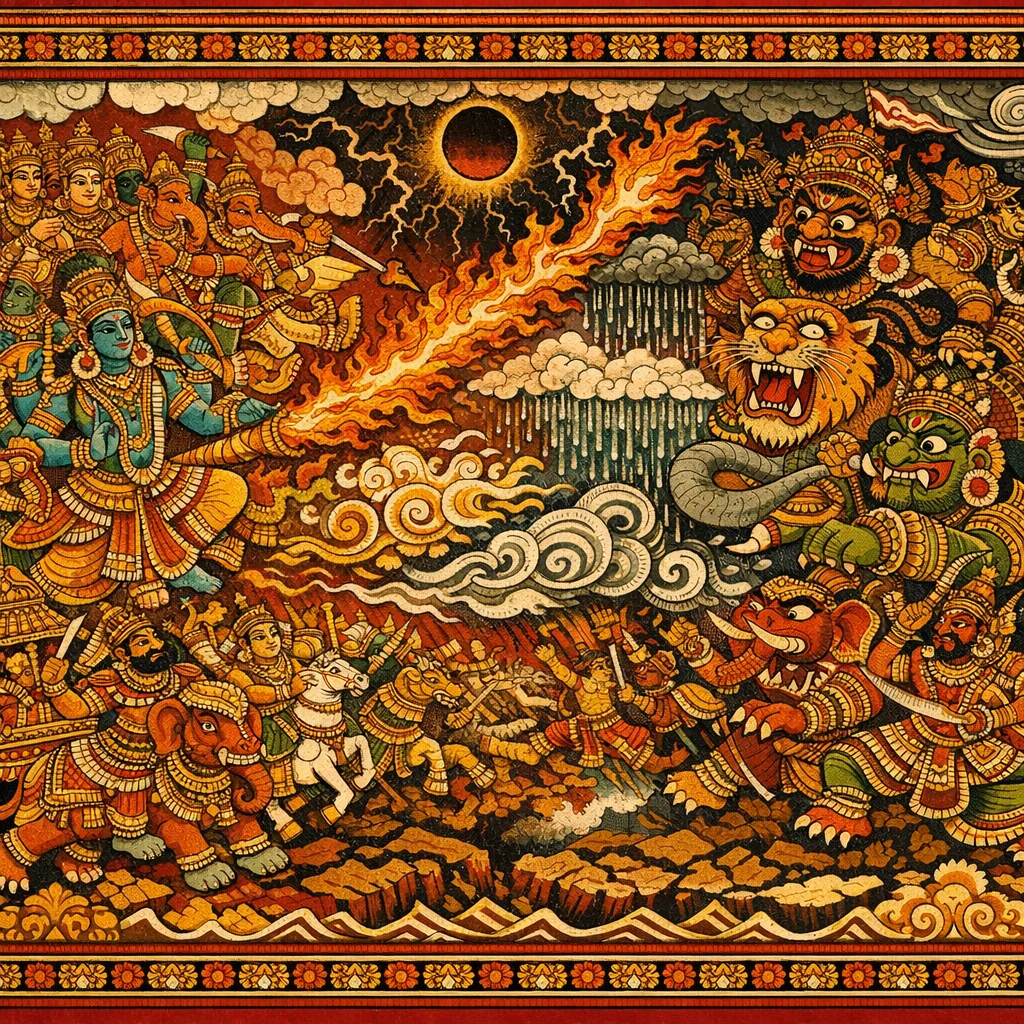
Adhyaya 153: The Slaying of Jambha and the Rise of Tāraka: Divine Battle Formations, Astras, and the Crisis of Indra
जम्भतारकयुद्धे देवसेनाविन्यासः शस्त्रास्त्रसमरश्च
Speaker: Sūta, Indra (Śatakratu / Pākaśāsana), Viṣṇu (Hari / Adhokṣaja / Vaikuṇṭha / Keśava), Rudras (esp. Kapālī)
Sūta relates: Indra, seeing Hari (Viṣṇu) withdraw, assumes defeat and seeks Viṣṇu’s counsel. Indra argues that sparing wicked foes only emboldens them; Viṣṇu replies that Daitya-lords fall only by their appointed means and commands Indra to slay Jambha under divine protection. The gods arrange battle formations; Viṣṇu appoints the Eleven Rudras as the vanguard and names them. Daitya champions assault: Gajāsura ravages the devas until Kapālī fells him and dons the elephant-hide; Nimi’s elephant form is crushed by Kubera’s mace. Jambha then enters, and a prolonged exchange of astras and counter-astras follows—Gāndharva, Mausala, Tvāṣṭra yantras, Śaila, Vajra, Aiṣīka, Agneya, Vāruṇa, Vāyavya, Nārasiṃha, and Gāruḍa. Jambha employs māyā and devours troops, but is struck by the Nārāyaṇa weapon and finally beheaded; the Daityas flee to Tāraka. Tāraka arrives amid apocalyptic omens, begins a new phase of battle, overpowers and binds the Lokapālas, and then returns to his abode.
Key Concepts
Shlokas in Adhyaya 153
Verse 1
*सूत उवाच तमालोक्य पलायन्तं विभ्रष्टध्वजकार्मुकम् हरिं देवः सहस्राक्षो मेने भग्नं दुराहवे //
Sūta said: Seeing Hari fleeing—his banner and bow lost—Indra, the thousand-eyed lord of the gods, thought him to be routed in that hard-fought battle.
Verse 2
दैत्यांश्च मुदितान्दृष्ट्वा कर्तव्यं नाध्यगच्छत अथायान्निकटे विष्णोः सुरेशः पाकशासनः //
Seeing the Daityas exultant, Indra—lord of the gods, the chastiser of Pāka—could not discern what ought to be done; then he went near to Viṣṇu.
Verse 3
उवाच चैनं मधुरं प्रोत्साहपरिबृंहकम् किमेभिः क्रीडसे देव दानवैर्दुष्टमानसैः //
And he spoke to him in a sweet voice, offering words that strengthened his resolve: “O Lord, why do you sport with these Dānavas whose minds are wicked?”
Verse 4
दुर्जनैर्लब्धरन्ध्रस्य पुरुषस्य कुतः क्रियाः शक्तेनोपेक्षितो नीचो मन्यते बलमात्मनः //
When wicked men have found a man’s vulnerable point, how can he perform his proper duties? If a strong man merely overlooks him, the base fellow imagines that he himself possesses strength.
Verse 5
तस्मान्न नीचं मतिमान् दुर्गहीनं हि संत्यजेत् अथाग्रेसरसंपत्त्या रथिनो जयमाप्नुयुः //
Therefore a wise man should not abandon one of low station or one without a fort; for by the advantage of a capable leader, even chariot-warriors may attain victory.
Verse 6
कस्ते सखाभवच्चाग्रे हिरण्याक्षवधे विभो हिरण्यकशिपुर्दैत्यो वीर्यशाली मदोद्धतः //
O mighty Lord, who was your ally formerly at the time of Hiranyākṣa’s slaying? And tell also of the Daitya Hiranyakaśipu—strong in valor and swollen with pride.
Verse 7
त्वां प्राप्यापश्यदसुरो विषमं स्मृतिविभ्रमम् पूर्वे ऽप्यतिबला ये च दैत्येन्द्राः सुरविद्विषः //
Having encountered you, the Asura perceived a grievous confusion of memory; even in former times, those exceedingly mighty lords of the Daityas—haters of the gods—met the same fate.
Verse 8
विनाशमागताः प्राप्य शलभा इव पावकम् युगे युगे च दैत्यानां त्वमेवान्तकरो हरे //
Having met their ruin—like moths rushing into a flame—so too, in every age, you alone, O Hari, are the bringer of the end for the Daityas.
Verse 9
तथैवाद्येह मग्नानां भव विष्णो सुराश्रयः एवमुक्तस्ततो विष्णुर् व्यवर्धत महाभुजः //
“So too, here and now, for those who are sinking, become our support—O Viṣṇu, refuge of the gods!” Thus addressed, Viṣṇu, the mighty-armed one, then grew in form.
Verse 10
ऋद्ध्या परमया युक्तः सर्वभूताश्रयो ऽरिहा अथोवाच सहस्राक्षं कालक्षमम् अधोक्षजः //
Endowed with the highest divine prosperity, the refuge of all beings and the destroyer of foes, Adhokṣaja—the Lord beyond the senses—then spoke to Sahasrākṣa (Indra), who endures the workings of Time.
Verse 11
दैत्येन्द्राः स्वैर्वधोपायैः शक्या हन्तुं हि नान्यतः दुर्जयस्तारको दैत्यो मुक्त्वा सप्तदिनं शिशुम् //
The lords of the Dānavas can indeed be slain only by the very means ordained for their death—by no other way. And the hard-to-conquer demon Tāraka, too, could be overcome only after the child had been left unharmed for seven days.
Verse 12
कश्चित्स्त्रीवध्यतां प्राप्तो वधे ऽन्यस्य कुमारिका जम्भस्तु वध्यतां प्राप्तो दानवः क्रूरविक्रमः //
In one case, a person condemned to death for killing a woman is, in the execution, replaced by the maiden (daughter) of another. And Jambha too—the Dānava of fierce prowess—is sentenced to death.
Verse 13
तस्माद्वीर्येण दिव्येन जहि जम्भं जगद्वरम् अवध्यः सर्वभूतानां त्वां विना स तु दानवः //
Therefore, with your divine prowess, strike down Jambha, the scourge of the worlds. That Dānava is invincible to all beings—except to you.
Verse 14
मया गुप्तो रणे जम्भं जगत्कण्टकमुद्धर तद्वैकुण्ठवचः श्रुत्वा सहस्राक्षो ऽमरारिहा //
“Protected by me in battle, go and uproot Jambha—the thorn of the world.” Hearing these words of Vaikuṇṭha (Viṣṇu), Indra of the thousand eyes, slayer of the gods’ foes, set forth to act.
Verse 15
समादिशत्सुरान्सर्वान् सैन्यस्य रचनां प्रति यत्सारं सर्वलोकेषु वीर्यस्य तपसो ऽपि च //
He commanded all the gods concerning the formation and ordering of the army, drawing upon that essential excellence which, in all the worlds, is the very quintessence of valor and even of ascetic power (tapas).
Verse 16
तदेकादश रुद्रांस्तु चकाराग्रेसरान्हरिः व्यालभोगाङ्गसंनद्धा बलिनो नीलकंधराः //
Then Hari (Viṣṇu) brought forth the Eleven Rudras as foremost leaders—mighty ones, their bodies girded with serpent-coils, and dark-throated in hue.
Verse 17
चन्द्रखण्डनृमुण्डालीमण्डितोरुशिखण्डिनः शूलज्वालावलिप्ताङ्गा भुजमण्डलभैरवाः //
They are Bhairavas with mighty arms arrayed in a fearsome circle—wearing lofty crests adorned with a fragment of the crescent moon and garlands of human skulls, their bodies smeared and blazing with the flames of their tridents (śūla).
Verse 18
पिङ्गोत्तुङ्गजटाजूटाः सिंहचर्मानुषङ्गिणः कपालीशादयो रुद्रा विद्रावितमहासुराः //
The Rudras—Kapālīśa and the others—bearing tawny, lofty matted locks (jaṭā) and wearing lion-skins, put the mighty Asuras to flight.
Verse 19
कपाली पिङ्गलो भीमो विरूपाक्षो विलोहितः अजेशः शासनः शास्ता शंभुश्चण्डो ध्रुवस्तथा //
He is Kapālī, the bearer of the skull; Piṅgala, tawny-hued; Bhīma, the formidable; Virūpākṣa, the odd-eyed; and Vilohita, the intensely red. He is Ajeśa, lord beyond birth; Śāsana, the sovereign command; Śāstā, the divine ruler and instructor; Śambhu, the beneficent one; Caṇḍa, the fierce; and Dhruva, the steadfast and immutable.
Verse 20
एत एकादशानन्तबला रुद्राः प्रभाविणः पालयन्तो बलस्याग्रे दारयन्तश्च दानवान् //
These eleven Rudras, of immeasurable might and radiant power, stood guarding at the very front of the army, crushing the Dānavas (demonic foes).
Verse 21
आप्याययन्तस्त्रिदशान् गर्जन्त इव चाम्बुदाः हिमाचलाभे महति काञ्चनाम्बुरुहस्रजि //
Nourishing the Thirty (the gods), they resounded like thunderclouds, upon that vast, Himālaya-like edifice, adorned with garlands of golden lotuses.
Verse 22
प्रचलच्चामरे हेमघण्टासंघातमण्डिते ऐरावते चतुर्दन्ते मातङ्गे ऽचलसंस्थिते //
Upon Airāvata—the four-tusked elephant—steadfast as a mountain, adorned with swaying yak-tail fans and clusters of golden bells.
Verse 23
महामदजलस्रावे कामरूपे शतक्रतुः तस्थौ हिमगिरेः शृङ्गे भानुमानिव दीप्तिमान् //
In Kāmarūpa, amid the streaming gush of abundant rut-fluid, Śatakratu (Indra) stood upon a peak of the Himālaya, radiant like the Sun.
Verse 24
तस्यारक्षत्पदं सव्यं मारुतो ऽमितविक्रमः जुगोपापरमग्निस्तु ज्वालापूरितदिङ्मुखः //
Maruta, of immeasurable prowess, guarded his left foot; and Agni, filling the faces of the directions with flames, protected the other side.
Verse 25
पृष्ठरक्षो ऽभवद्विष्णुः ससैन्यस्य शतक्रतोः आदित्या वसवो विश्वे मरुतश्चाश्विनावपि //
Vishnu became the rear-guard protector of Śatakratu (Indra) together with his army; and the Ādityas, the Vasus, the Viśvedevas, the Maruts, and the two Aśvins also stood with him.
Verse 26
गन्धर्वा राक्षसा यक्षाः सकिंनरमहोरगाः नानाविधायुधाश्चित्रा दधाना हेमभूषणाः //
Gandharvas, Rakshasas, and Yakshas—together with Kinnaras and the great serpents (Mahoragas)—appeared in splendid array, bearing weapons of many kinds and adorned with ornaments of gold.
Verse 27
कोटिशः कोटिशः कृत्वा वृन्दं चिह्नोपलक्षितम् विश्रामयन्तः स्वां कीर्तिं बन्दिवृन्दपुरःसराः चेरुर्दैत्यवधे हृष्टाः सहेन्द्राः सुरजातयः //
Forming companies upon companies—marked out by their distinctive insignia—the hosts of the gods, with Indra among them, moved about joyfully after the slaying of the Daityas, while bards at their head proclaimed and gave repose to their glory (fame).
Verse 28
शतक्रतोरमरनिकायपालिता पताकिनी गजशतवाजिनादिता सितोन्नतध्वजपटकोटिमण्डिता बभूव सा दितिसुतशोकवर्धिनी //
Guarded by Śatakratu (Indra) and the hosts of the immortals, that bannered army advanced—resounding with hundreds of elephants and horses, adorned with lofty white standards and countless flag-cloths—becoming a cause that increased the sorrow of Diti’s son (the Daitya).
Verse 29
आयान्तीम् अवलोक्याथ सुरसेनां गजासुरः गजरूपी महाम्भोदसंघातो भाति भैरवः //
Then, seeing the army of the gods advancing, Gajāsura—having assumed the form of an elephant—appeared terrifying, like a dense mass of towering storm-clouds.
Verse 30
परश्वधायुधो दैत्यो दंशितोष्ठकसंपुटः ममर्द च रणे देवांश् चिक्षेपान्यान्करेण तु //
Armed with an axe, the Daitya—his lip-corners clenched in fury—crushed the gods in the battle, and with his hand he hurled others away.
Verse 31
परान्परशुना जघ्ने दैत्येन्द्रो रौद्रविक्रमः तस्य पातयतः सेनां यक्षगन्धर्वकिंनराः //
With his battle-axe, the Daitya-lord—terrible in prowess—struck down the enemy. As he felled the army, the Yakṣas, Gandharvas, and Kiṃnaras were brought down as well.
Verse 32
मुमुचुः संहताः सर्वे चित्रशस्त्रास्त्रसंहतिम् पाशान् परश्वधांश्चक्रान् भिन्दिपालान् समुद्गरान् //
All of them, formed up together, hurled a dazzling array of weapons—nooses, battle-axes, discus-weapons, bhindipāla javelins, and heavy maces.
Verse 33
कुन्तान्प्रासान् असींस्तीक्ष्णान् मुद्गरांश्चापि दुःसहान् तान्सर्वान्सो ऽग्रसद्दैत्यः कवलानिव यूथपः //
Spears, javelins, sharp swords, and even unbearable iron maces—he swallowed them all, that Daitya, as an elephant-leader gulps down mouthfuls of food.
Verse 34
कोपास्फालितदीर्घाग्रकरास्फोटेन पातयन् विचचार रणे देवान् दुष्प्रेक्ष्ये गजदानवः //
Gaja, the elephant-demon, dreadful to behold, ranged over the battlefield; and in wrath, with the whip-like crack of his long, sharp-tipped hand, he struck the gods down.
Verse 35
यस्मिन्यस्मिन्निपतति सुरवृन्दे गजासुरः तस्मिंस्तस्मिन्महाशब्दो हाहाकारकृतो ऽभवत् //
Wherever Gajāsura fell upon the host of gods, there at once arose a great uproar—an outcry of “Alas! Alas!”
Verse 36
अथ विद्रवमाणं तद् बलं प्रेक्ष्य समन्ततः रुद्राः परस्परं प्रोचुर् अहंकारोत्थितार्चिषः //
Then, seeing that army fleeing in every direction, the Rudras—ablaze with flames born of pride—said to one another:
Verse 37
भो भो गृह्णीत दैत्येन्द्रं मर्दतैनं हताश्रयम् कर्षतैनं शितैः शूलैर् भञ्जतैनं च मर्मसु //
“Ho! Ho! Seize the lord of the Daityas! Crush him—now bereft of support! Drag him with sharp tridents, and break him at his vital points!”
Verse 38
कपाली वाक्यमाकर्ण्य शूलं शितशिखामुखम् संमार्ज्य वामहस्तेन संरम्भविवृतेक्षणः //
Hearing those words, Kapālī—his eyes widened in fury—wiped and readied his trident, whose point and edge were razor-sharp, using his left hand.
Verse 39
अधावद्भृकुटीवक्रो दैत्येन्द्राभिमुखो रणे दृढेन मुष्टिबन्धेन शूलं विष्टभ्य निर्मलम् //
With his brow knit in a fierce frown, he rushed into the fray, facing the lord of the Daityas; and, gripping firmly with a clenched fist, he braced his spotless spear for the strike.
Verse 40
जघान कुम्भदेशे तु कपाली गजदानवम् ततो दशापि ते रुद्रा निर्मलायोमयै रणे //
Then Kapālī struck down the elephant‑demon (Gaja-dānava) at the region of the temples (kumbha-deśa). Thereupon, in that battle, all ten of those Rudras became purified—filled with stainless radiance.
Verse 41
जघ्नुः शूलैश्च दैत्येन्द्रं शैलवर्ष्माणमाहवे स्रुतशोणितरन्ध्रस्तु शितशूलमुखार्दितः //
In the battle, they struck down the lord of the Dānavas—Śailavarṣman—with spears. His body’s openings ran with blood, tormented and pierced by the sharp spear-points.
Verse 42
बभौ कृष्णच्छविर् दैत्यः शरदीवामलं सरः प्रोत्फुल्लारुणनीलाब्जसंघातः सर्वतोदिशम् //
The Daitya, dark-hued in complexion, shone forth like a spotless lake in autumn—everywhere adorned with clusters of fully blossomed red and blue lotuses in all directions.
Verse 43
भस्मशुभ्रतनुछायै रुद्रैर्हंसैरिवावृतः उपस्थितार्तिर्दैत्यो ऽथ प्रचलत्कर्णपल्लवः //
Then the Daitya—his distress now upon him—stood surrounded by Rudra-like beings whose bodies shone ash-white, as though encircled by swans; and his ear-ornaments trembled as he stirred.
Verse 44
शंभुं बिभेद दशनैर् नाभिदेशे गजासुरः दृष्ट्वा सक्तं तु रुद्राभ्यां नव रुद्रास्ततो ऽद्भुतम् //
Gajāsura pierced Śambhu (Śiva), biting him with his tusks in the region of the navel. Seeing him thus engaged with the two Rudras, thereupon—marvellously—nine Rudras manifested.
Verse 45
ततक्षुर्विविधैः शस्त्रैः शरीरममरद्विषः निर्भया बलिनो युद्धे रणभूमौ व्यवस्थिताः //
Then, standing firm upon the battlefield, the mighty and fearless foes of the gods struck at their bodies with weapons of many kinds.
Verse 46
मृतं महिषमासाद्य वने गोमायवो यथा कपालिनं परित्यज्य गतश्चासुरपुंगवः //
Just as jackals in a forest, finding a dead buffalo, abandon the Skull-bearer (Śiva) and slip away, so too that foremost of Asuras, forsaking Kapālin, departed.
Verse 47
वेगेन कुपितो दैत्यो नव रुद्रानुपाद्रवत् ममर्द चरणाघातैर् दन्तैश्चापि करेण च //
Enraged and rushing with great speed, the Daitya charged at the nine Rudras; he crushed them with blows of his feet, with his teeth, and also with his hand.
Verse 48
स तैस्तुमुलयुद्धेन श्रममासादितो यदा तदा कपाली जग्राह करं तस्यामरद्विषः //
When he had become wearied by that fierce and tumultuous battle, then Kapālī (Śiva), the skull-bearing Lord, seized the hand of that enemy of the gods.
Verse 49
भ्रामयामास वेगेन ह्य् अतीव च गजासुरम् दृष्ट्वा श्रमातुरं दैत्यं किंचित्स्फुरितजीवितम् //
He whirled Gajāsura around with tremendous speed; and seeing that the daitya was exhausted—his life-breath only faintly flickering—he pressed the attack.
Verse 50
निरुत्साहं रणे तस्मिन् गतयुद्धोत्सवोद्यमम् ततः पतत एवास्य चर्म चोत्कृत्य भैरवम् //
In that battle he became spiritless, his former martial exhilaration and enterprise spent. Then, as he fell, his hide (skin/armour) was cut off, and a dreadful, terrifying cry arose.
Verse 51
स्रवत्सर्वाङ्गरक्तौघं चकाराम्बरमात्मनः दृष्ट्वा विनिहतं दैत्यं दानवेन्द्रा महाबलाः //
As torrents of blood streamed from all his limbs, his own garment was drenched. Seeing the Daitya slain, the mighty lords of the Dānavas looked on (in shock and dismay).
Verse 52
वित्रेसुर्दुद्रुवुर्जग्मुर् निपेतुश्च सहस्रशः दृष्ट्वा कपालिनो रूपं गजचर्माम्बरावृतम् //
Terrified, they fled and ran in all directions, and by the thousands they fell down, on seeing the form of the Skull-bearing Lord—clad in an elephant-hide garment.
Verse 53
दिक्षु भूमौ तमेवोग्रं रुद्रं दैत्या व्यलोकयन् एवं विलुलिते तस्मिन् दानवेन्द्रे महाबले //
In every direction and upon the earth, the Daityas beheld none but that fierce Rudra. Thus, when that mighty lord of the Dānavas had been utterly shaken and thrown into confusion, they kept their gaze fixed on Rudra alone.
Verse 54
द्विपाधिरूढो दैत्येन्द्रो हतदुन्दुभिना ततः कल्पान्ताम्बुधराभेण दुर्धरेणापि दानवः //
Then the lord of the Daityas, mounted upon an elephant, advanced—himself a formidable Dānava—bearing the mighty force/weapon called Hatadundubhi, and appearing like a dark cloud at the end of a kalpa, hard to withstand.
Verse 55
निमिरभ्यपतत्तूर्णं सुरसैन्यानि लोडयन् //
Nimi rushed forward at once, assaulting and scattering the armies of the gods.
Verse 56
यां यां निमिगजो याति दिशं तां तां सवाहना संत्यज्य दुद्रुवुर्देवा भयार्तास्त्यक्तहेतयः गन्धेन सुरमातङ्गा दुद्रुवुस्तस्य हस्तिनः //
Whichever direction the elephant Nimigaja moved toward, in that very direction the gods—abandoning even their mounts—fled in panic, casting aside their weapons. And by his scent, the celestial elephants too ran off, along with his own herd of elephants.
Verse 57
पलायितेषु सैन्येषु सुराणां पाकशासनः तस्थौ दिक्पालकैः सार्धम् अष्टभिः केशवेन च //
When the armies of the gods had fled, Indra—the chastiser of Pāka—stood firm together with Keśava and the eight guardians of the directions.
Verse 58
सम्प्राप्तो निमिमातङ्गो यावच्छक्रगजं प्रति तावच्छक्रगजो यातो मुक्त्वा नादं स भैरवम् //
As Nimi’s great elephant advanced toward Indra’s elephant, Indra’s elephant likewise moved forward, letting out a terrifying roar like that of Bhairava.
Verse 59
ध्रियमाणो ऽपि यत्नेन स रणे नैव तिष्ठति पलायिते गजे तस्मिन्न् आरूढः पाकशासनः //
Even when restrained with great effort, he does not remain in the battle. When that elephant fled, Pākaśāsana (Indra), mounted upon it, fled as well.
Verse 60
विपरीतमुखो ऽयुध्यद् दानवेन्द्रबलं प्रति शतक्रतुस्तु वज्रेण निमिं वक्षस्यताडयत् //
Turning his face about, Śatakratu (Indra) fought against the army of the Dānava lord; and with his thunderbolt (vajra) he struck Nimi upon the chest.
Verse 61
गदया दन्तिनश्चास्य गण्डदेशे ऽहनद्दृढम् तत्प्रहारमचिन्त्यैव निमिर्निर्भयपौरुषः //
And with his mace he struck that elephant firmly on the temple-region of its head. Untroubled by that counterblow, King Nimi—whose manliness was fearless—stood undaunted.
Verse 62
ऐरावणं कटीदेशे मुद्गरेणाभ्यताडयत् स हतो मुद्गरेणाथ शक्रकुञ्जर आहवे //
He struck Airāvata on the flank with a mace; and thus, in the battle, Indra’s elephant was slain by that mace.
Verse 63
जगाम पश्चाच्चरणैर् धरणीं भूधराकृतिः लाघवात्क्षिप्रमुत्थाय ततो ऽमरमहागजः //
Then the great divine elephant—mountain-like in form—lightly and swiftly rose up and moved upon the earth, stepping backward with its feet.
Verse 64
रणादपससर्पाशु भीषितो निमिहस्तिना ततो वायुर्ववौ रूक्षो बहुशर्करपांसुलः //
Frightened by Nimi’s elephant, he swiftly withdrew from the battlefield. Then a harsh, dry wind began to blow, thick with gravel and dust.
Verse 65
संमुखो निमिमातङ्गो जवनाचलकम्पनः स्रुतरक्तो बभौ शैलो घनधातुह्रदो यथा //
Facing them head-on, Nimi’s mighty elephant advanced, its speed shaking the mountain; and the mountain seemed to stream with blood, like a lake thick with mineral ores.
Verse 66
धनेशो ऽपि गदां गुर्वीं तस्य दानवहस्तिनः चिक्षेप वेगाद्दैत्येन्द्रो निपपातास्य मूर्धनि //
Dhaneśa (Kubera) too hurled a heavy mace with force at that Danava “elephant” (the mighty demon); and the lord of the Daityas was struck as it fell upon his head.
Verse 67
गजो गदानिपातेन स तेन परिमूर्छितः दन्तैर्भित्त्वा धरां वेगात् पपाताचलसंनिभः //
Struck by the downward blow of the mace, the elephant was stunned; with its tusks it tore into the earth in its momentum, and then collapsed—like a mountain.
Verse 68
पतिते तु गजे तस्मिन् सिंहनादो महानभूत् सर्वतः सुरसैन्यानां गजबृंहितबृंहितैः //
But when that elephant fell, a mighty lion-roar arose everywhere among the armies of the gods, resounding with repeated trumpeting cries of elephants.
Verse 69
ह्रेषारवेण चाश्वानां गुणास्फोटैश्च धन्विनाम् गजं तं निहतं दृष्ट्वा निमिं चापि पराङ्मुखम् //
Amid the clamour of the horses’ neighing and the sharp twang of the archers’ bowstrings, seeing that elephant slain—and Nimi too turned away in retreat—(the warriors pressed on).
Verse 70
श्रुत्वा च सिंहनादं च सुराणामतिकोपनः जम्भो जज्वाल कोपेन पीताज्य इव पावकः //
Hearing the lion-like battle-roar of the gods, Jambha—fierce with excessive anger—blazed up with fury, like fire fed with clarified butter.
Verse 71
स सुरान्कोपरक्ताक्षो धनुष्यारोप्य सायकम् तिष्ठतेत्यब्रवीत्तावत् सारथिं चाप्यचोदयत् //
With eyes reddened in wrath at the gods, he set an arrow upon his bow and cried, “Stand!”—and at once he also urged on his charioteer.
Verse 72
वेगेन चलतस्तस्य तद्रथस्याभवद्द्युतिः यथादित्यसहस्रस्याभुदितस्योदयाचले //
As his chariot sped along with tremendous force, its radiance flared forth—like the brilliance of a thousand suns rising upon the eastern mountain at dawn.
Verse 73
पताकिना रथेनाजौ किङ्किणीजालमालिना शशिशुभ्रातपत्रेण स तेन स्यन्दनेन तु //
On the battlefield, he rode in that chariot—bannered, adorned with a net of tinkling bells, and shaded by a parasol white as the moon.
Verse 74
घट्टयन्सुरसैन्यानां हृदयं समदृश्यत तम् आयान्तम् अभिप्रेक्ष्य धनुष्याहितसायकः //
Striking terror into the hearts of the gods’ army, he was seen; and seeing him advance, the warrior set an arrow upon his bow.
Verse 75
शतक्रतुरदीनात्मा दृढमाधत्त कार्मुकम् बाणं च तैलधौताग्रम् अर्धचन्द्रमजिह्मगम् //
Śatakratu (Indra), unshaken in spirit, firmly took up his bow, and also a straight-flying arrow with an oil-polished tip, shaped like a half-moon.
Verse 76
तेनास्य सशरं चापं रणे चिछेद वृत्रहा क्षिप्रं संत्यज्य तच्चापं जम्भो दानवनन्दनः //
With that blow, Vṛtrahā—Indra, the slayer of Vṛtra—cut to pieces in battle his bow together with its arrows. Quickly abandoning that bow, Jambha, the beloved son of the Dānava clan, prepared to fight on by other means.
Verse 77
अन्यत्कार्मुकमादाय वेगवद्भारसाधनम् शरांश्चाशीविषाकारांस् तैलधौतानजिह्मगान् //
Taking up another bow—swift in action and able to bear a heavy draw—he also took arrows like venomous serpents, oil-polished and unfalteringly straight.
Verse 78
शक्रं विव्याध दशभिर् जत्रुदेशे तु पत्त्रिभिः हृदये च त्रिभिश्चापि द्वाभ्यां च स्कन्धयोर् द्वयोः //
He pierced Śakra (Indra) with ten arrows in the region of the collarbone; with three more in the heart; and with two each in both shoulders.
Verse 79
शक्रो ऽपि दानवेन्द्राय बाणजालमपीदृशम् अप्राप्तान्दानवेन्द्रस्तु शराञ्छक्रभुजेरितान् //
Śakra (Indra) too rained down such a net of arrows upon the lord of the Dānavas; but the Dānava-king, before the shafts released from Indra’s arm could even reach him, checked them.
Verse 80
चिछेद दशधाकाशे शरैरग्निशिखोपमैः ततस्तु शरजालेन देवेन्द्रो दानवेश्वरम् //
With arrows blazing like tongues of fire, he cut (him) into ten parts in the open sky; then Devendra (Indra) further assailed the lord of the Dānavas with a net-like shower of arrows.
Verse 81
आच्छादयत यत्नेन वर्षास्विव घनैर्नभः दैत्यो ऽपि बाणजालं तद् व्यधमत्सायकैः शितैः //
With great effort he covered the sky, as if in the rainy season with dense clouds; yet the Daitya, with his sharp missiles, shattered that very net of arrows.
Verse 82
यथा वायुर्घनाटोपं परिवार्य दिशो मुखे शक्रो ऽथ क्रोधसंरम्भान् न विशेषयते यदा //
Just as the wind, driving a mass of clouds, sweeps across the faces of all directions, so too Indra—when seized by the surge of anger—fails to discriminate between what should and should not be done.
Verse 83
दानवेन्द्रं तदा चक्रे गन्धर्वास्त्रं महाद्भुतम् तदुत्थतेजसा व्याप्तम् अभूद्गमनगोचरम् //
Then the lord of the Dānavas unleashed the wondrous Gandharva-weapon; pervaded by the radiance it generated, the entire field became a realm fit only for movement—an impassable, inescapable zone.
Verse 84
गन्धर्वनगरैश् चापि नानाप्राकारतोरणैः मुञ्चद्भिरद्भुताकारैर् अस्त्रवृष्टिं समन्ततः //
And there were also “Gandharva-cities”—wondrous, seemingly magical constructions—together with many kinds of ramparts and arched gateways (toraṇas), which in marvelous forms discharged a shower of weapons on every side.
Verse 85
अथास्त्रवृष्ट्या दैत्यानां हन्यमाना महाचमूः जम्भं शरणमागच्छद् अप्रमेयपराक्रमम् //
Then, struck down by the shower of missiles, the vast host of the Daityas sought refuge with Jambha, whose prowess was beyond measure.
Verse 86
व्याकुलो ऽपि स्वयं दैत्यः सहस्राक्षास्त्रपीडितः स्मरन्साधुसमाचारं भीतत्राणपरो ऽभवत् //
Though himself a Daitya, he was thrown into turmoil, tormented by the weapon of Sahasrākṣa (Indra); yet he remembered the code of noble conduct and, in fear, became intent only on seeking protection.
Verse 87
अथास्त्रं मौसलं नाम मुमोच दितिनन्दनः ततो ऽयोमुसलैः सर्वम् अभवत्पूरितं जगत् //
Then Diti’s son released the weapon known as the Mausala Astra; thereupon the entire world became filled on all sides with iron clubs.
Verse 88
एकप्रहारकरणैर् अप्रधृष्यैः समन्ततः गन्धर्वनगरं तेषु गन्धर्वास्त्रविनिर्मितम् //
All around, it was made unassailable by defensive contrivances that could repel with a single stroke; and within those defences stood a “Gandharva-city”, fashioned by Gandharva-weapons—superhuman, magically engineered armaments.
Verse 89
गान्धर्वमस्त्रं संधाय सुरसैन्येषु चापरम् एकैकेन प्रहारेण गजानश्वान्महारथान् //
Fixing the Gāndharva Astra upon his weapon—and taking yet another weapon besides—he struck into the host of the gods, and with single, distinct blows felled elephants, horses, and great chariot-warriors.
Verse 90
रथाश्वान्सो ऽहनत्क्षिप्रं शतशो ऽथ सहस्रशः ततः सुराधिपस्त्वाष्ट्रम् अस्त्रं च समुदीरयत् //
He swiftly struck down chariots and horses—by the hundreds and then by the thousands. Then the lord of the gods invoked and set in motion the Tvāṣṭra missile-weapon.
Verse 91
संध्यमाने ततस्त्वाष्ट्रे निश्चेरुः पावकार्चिषः ततो यन्त्रमयान् दिव्यान् आयुधान्दुष्प्रधर्षिणः //
Then, as the work of Tvāṣṭṛ was being set in motion at that critical juncture, tongues of fire burst forth; and from it emerged divine weapons, fashioned as marvels of mechanism, irresistible to assail.
Verse 92
तैर्यन्त्रैरभवद्बद्धम् अन्तरिक्षे वितानकम् वितानकेन तेनाथ प्रशमं मौसले गते //
By those mechanical devices a canopy was fastened aloft in mid-air; and by means of that very canopy, calm was restored when the tumult of the pestle-weapon (mausala) had passed.
Verse 93
शैलास्त्रं मुमुचे जम्भो यन्त्रसंघातताडनम् व्यामप्रमाणैरुपलैस् ततो वर्षमवर्तत //
Then Jambha released the ‘Mountain-weapon’ (Śaila-astra), a crushing onslaught as though struck by a massed engine of war; and thereupon a rain of stones poured down, each measuring a vyāma (a fathom).
Verse 94
त्वाष्ट्रस्य निर्मितान्याशु यन्त्राणि तदनन्तरम् तेनोपलनिपातेन गतानि तिलशस्ततः //
Then, immediately afterward, the mechanical contrivances fashioned by Tvaṣṭṛ were struck by a shower of stones; and by that hail of rocks they were shattered and scattered into fragments, like sesame seeds.
Verse 95
यन्त्राणि तिलशः कृत्वा शैलास्त्रं परमूर्धसु निपपातातिवेगेना-दारयत्पृथिवीं ततः //
After smashing the machines into fragments as fine as sesame, the rock-missile (śailāstra) struck the loftiest peaks; then, falling with tremendous speed, it split the earth apart.
Verse 96
ततो वज्रास्त्रम् अकरोत् सहस्राक्षः पुरंदरः तदोपलमहावर्षं व्यशीर्यत समन्ततः //
Then Sahasrākṣa (Indra), Purandara the city-destroyer, discharged the Vajra-weapon; and that great shower of hailstones was shattered and dispersed on every side.
Verse 97
ततः प्रशान्ते शैलास्त्रे जम्भो भूधरसंनिभः ऐषीकमस्त्रमकरोद् अभीतो ऽतिपराक्रमः //
Then, when the mountain-weapon (śailāstra) had been pacified, Jambha—resembling a mighty mountain—fearless and of tremendous prowess, deployed the Aiṣīka weapon.
Verse 98
ऐषीकेणागमन्नाशं वज्रास्त्रं शक्रवल्लभम् विजृम्भत्यथ चैषीके परमास्त्रे ऽतिदुर्धरे //
By the Aiṣīka weapon, the Vajrāstra—beloved of Śakra (Indra)—was brought to destruction. Then, as that exceedingly formidable supreme missile (paramāstra) of Aiṣīka expanded and surged forth, it became overpowering.
Verse 99
जज्वलुर्देवसैन्यानि सस्यन्दनगजानि तु दह्यमानेष्वनीकेषु तेजसा सुरसत्तमः //
The armies of the gods—together with their chariots and war-elephants—burst into flame; and as the battle-formations were scorched by tejas, the foremost among the suras blazed with overwhelming radiance.
Verse 100
आग्नेयमस्त्रमकरोद् बलवान्पाकशासनः तेनास्त्रेण तदस्त्रं च बभ्रंशे तदनन्तरम् //
Then the mighty Pākaśāsana (Indra) unleashed the Agneya weapon; by that weapon the opposing missile was immediately struck down and made to fall.
Verse 101
तस्मिन्प्रतिहते चास्त्रे पावकास्त्रं व्यजृम्भत जज्वाल कायं जम्भस्य सरथं च ससारथिम् //
When that weapon had been checked, the Fire-weapon, the Pāvakāstra, flared forth; it set Jambha’s body ablaze—together with his chariot and his charioteer.
Verse 102
ततः प्रतिहतः सो ऽथ दैत्येन्द्रः प्रतिभानवान् वारुणास्त्रं मुमोचाथ शमनं पावकार्चिषाम् //
Then, being repelled, that brilliant lord of the Dānavas released the Varuṇa weapon, a countermeasure meant to quell the blazing flames of fire.
Verse 103
ततो जलधरैर्व्योम स्फुरद्विद्युल्लताकुलैः गम्भीरमुरजध्वानैर् आपूरितम् इवाम्बरम् //
Then the sky, crowded with rain-clouds and flashing creepers of lightning, seemed as though the whole firmament were filled with deep, drum-like thunder.
Verse 104
करीन्द्रकरतुल्याभिर् जलधाराभिर् अम्बरात् पतन्तीभिर्जगत्सर्वं क्षणेनापूरितं बभौ //
As torrents of water—like streams pouring from the trunks of great elephants—fell from the sky, the entire world appeared filled up in an instant.
Verse 105
शान्तमाग्नेयमस्त्रं तत् प्रविलोक्य सुराधिपः वायव्यम् अस्त्रम् अकरोन् मेघसंघातनाशनम् //
Seeing that the fire-weapon had been quenched, the Lord of the gods then employed the Wind-weapon, the destroyer of masses of clouds.
Verse 106
वायव्यास्त्रबलेनाथ निर्धूते मेघमण्डले बभूव विमलं व्योम नीलोत्पलदलप्रभम् //
Then, O Lord, when the mass of clouds had been blown away by the power of the Vāyavya Astra (the wind-weapon), the sky became spotless and clear—shining with the hue of blue lotus petals.
Verse 107
वायुना चातिघोरेण कम्पितास्ते तु दानवाः न शेकुस्तत्र ते स्थातुं रणे ऽतिबलिनो ऽपि ये //
Shaken by that exceedingly dreadful wind, those Dānava demons could not stand their ground there in battle—even those among them who were very mighty.
Verse 108
तदा जम्भो ऽभवच्छैलो दशयोजनविस्तृतः मारुतप्रतिघातार्थं दानवानां भयापहः //
Then Jambha became a mountain, spreading across ten yojanas, in order to block the onrushing wind—dispelling the fear of the Dānavas.
Verse 109
मुक्तनानायुधोदग्रतेजो ऽभिज्वलितद्रुमः ततः प्रशमिते वायौ दैत्येन्द्रे पर्वताकृतौ //
Blazing with the fierce radiance of many hurled weapons, he appeared like a tree set aflame. Then, when the wind had been stilled, the Daitya-king—mountain-like in form—was subdued.
Verse 110
महाशनीं वज्रमयीं मुमोचाशु शतक्रतुः तयाशन्या पतितया दैत्यस्याचलरूपिणः //
Śatakratu (Indra) swiftly hurled the great thunderbolt, made of vajra. Struck down by that falling bolt, the Daitya—whose form was like an immovable mountain—collapsed.
Verse 111
कन्दराणि व्यशीर्यन्त समन्तान्निर्झराणि तु ततः सा दानवेन्द्रस्य शैलमाया न्यवर्तत //
Then the caverns split apart, and springs burst forth on every side; thereafter the demon-king’s mountain-illusion—the rock-like magical formation—came to an end.
Verse 112
निवृत्तशैलमायो ऽथ दानवेन्द्रो मदोत्कटः बभूव कुञ्जरो भीमो महाशैलसमाकृतिः //
Then the lord of the Dānavas—abandoning his mountain-like illusion and swelling with intoxicated fury—became a terrifying elephant, huge in form like a great mountain.
Verse 113
स ममर्द सुरानीकं दन्तैश्चाप्यहनत्सुरान् बभञ्ज पृष्ठतः कांश्चित् करेणावेष्ट्य दानवः //
That Dānava crushed the army of the gods; with his tusks he struck down the Devas. Seizing some from behind by wrapping them in his arm, he broke them to pieces.
Verse 114
ततः क्षपयतस्तस्य सुरसैन्यानि वृत्रहा अस्त्रं त्रैलोक्यदुर्धर्षं नारसिंहं मुमोच ह //
Then, as he was annihilating the armies of the gods, Vṛtrahā (Indra) released the Nārasiṃha weapon—an irresistible missile, hard to withstand in all the three worlds.
Verse 115
ततः सिंहसहस्राणि निश्चेरुर्मन्त्रतेजसा कृष्णदंष्ट्राट्टहासानि क्रकचाभनखानि च //
Then, by the blazing power of the mantra, thousands of lions burst forth—black-fanged, roaring with fierce laughter, and bearing claws that shone like saw-blades.
Verse 116
तैर्विपाटितगात्रो ऽसौ गजमायां व्यपोथयत् ततश्चाशीविषो घोरो ऽभवत्फणशताकुलः //
His limbs torn open by them, he abandoned the elephant-form illusion; then he became a dreadful venomous serpent, bristling with hundreds of hoods.
Verse 117
विषनिःश्वासनिर्दग्धं सुरसैन्यं महारथः ततो ऽस्त्रं गारुडं चक्रे शक्रश्चारुभुजस्तदा //
When the army of the gods had been scorched by poisonous blasts of breath, then Śakra (Indra)—the great chariot-warrior, strong-armed and splendid—thereupon employed the Gāruḍa weapon (Garuḍa-astra).
Verse 118
ततो गरुत्मतस्तस्मात् सहस्राणि विनिर्ययुः तैर्गरुत्मद्भिरासाद्य जम्भो भुजगरूपवान् कृतस्तु खण्डशो दैत्यः सास्य माया व्यनश्यत //
Then, from that Garuḍa, thousands (of Garuḍa-like forms) burst forth. Assailed by those Garuḍas, Jambha—who had assumed the form of a serpent—was cut into pieces; and with him, his power of illusion (māyā) was destroyed.
Verse 119
प्रनष्टायां तु मायायां ततो जम्भो महासुरः चकार रूपमतुलं चन्द्रादित्यपथानुगम् विवृत्तवदनो ग्रस्तुम् इयेष सुरपुंगवान् //
But when the māyā was destroyed, Jambha, the great Asura, assumed a matchless form that moved along the path of the Moon and the Sun; with his mouth gaping wide, he sought to swallow the foremost of the gods.
Verse 120
ततो ऽस्य विविशुर्वक्त्रं समहारथकुञ्जरा सुरसेनाविशद्भीमं पातालोत्तानतालुकम् //
Then the army of the gods—together with chariots and elephants—rushed into his mouth, dreadful and gaping, whose palate seemed uplifted like the very vault of the netherworld.
Verse 121
सैन्येषु ग्रस्यमानेषु दानवेन बलीयसा शक्रो दैन्यं समापन्नः श्रान्तबाहुः सवाहनः //
As the armies were being devoured by a stronger Dānava, Śakra (Indra) fell into misery—his arms weary—along with his mount.
Verse 122
कर्तव्यतां नाध्यगच्छत् प्रोवाचेदं जनार्दनम् किमनन्तरमत्रास्ति कर्तव्यस्यावशेषितम् //
Not having fully understood what ought to be done, he addressed Janārdana: “What, then, remains here to be done next? What part of my duty is still left unfinished?”
Verse 123
यदाश्रित्य घटामो ऽस्य दानवस्य युयुत्सवः ततो हरिरुवाचेदं वज्रायुधमुदारधीः //
“Relying on this plan/support, we shall confront this Dānava, eager for battle.” Then Hari, of noble resolve, spoke these words concerning the thunderbolt-weapon, the Vajra.
Verse 124
न सांप्रतं रणस्त्याज्यस् त्वया कातरभैरवः वर्धस्वाशु महामायां पुरंदर रिपुं प्रति //
Now is not the time for you to abandon the battlefield, O timid and fearful one. Gather your strength at once and advance—bringing forth your great power of illusion—against the enemy of Purandara (Indra).
Verse 125
मयैष लक्षितो दैत्यो ऽधिष्ठितः प्राप्तपौरुषः मा शक्र मोहमागच्छ क्षिप्रमस्त्रं स्मर प्रभो //
“I have marked this Daitya—he is now firmly possessed (by resolve) and has regained his full manly prowess. O Śakra, do not fall into delusion; quickly recollect and deploy your weapon, O Lord.”
Verse 126
एतस्मिन्नन्तरे दैत्यो विवृतास्यो ऽग्रसत्क्षणात् त्रीणि लक्षाणि गन्धर्वीकिंनरोरगराक्षसान् //
Meanwhile, that Daitya—his jaws gaping wide—instantly swallowed up three lakhs of Gandharvīs, Kiṃnaras, serpent-beings, and Rākṣasas.
Verse 127
ततो नारायणास्त्रं तत् पपातासुरवक्षसि महास्त्रभिन्नहृदयः सुस्राव रुधिरं च सः //
Then that Nārāyaṇa-missile fell upon the demon’s chest; his heart, split by the mighty weapon, he poured forth blood.
Verse 128
रणागारमिवोद्गारं तत्याजासुरनन्दनः तदस्त्रतेजसा तस्य रूपं दैत्यस्य नाशितम् //
The son of the Asuras let out a roar like the tumult of a battlefield; yet by the blazing power of that weapon, the Daitya’s very form was destroyed.
Verse 129
ततश्चान्तर्दधे दैत्यो वियत्यनुपलक्षितः गगनस्थः स दैत्येन्द्रः शस्त्रासनमतीन्द्रियम् //
Then the Daitya disappeared—unnoticed in the open sky. Stationed in the heavens, that lord of Daityas employed a weapon-seat (aerial assault) that was beyond the reach of the senses.
Verse 130
मुमोच सुरसैन्यानां संहारे कारणं परम् प्रासान्परश्वधांश्चक्रान् बाणान्वज्रान्समुद्गरान् //
He unleashed the supreme means for the destruction of the gods’ army—spears, battle-axes, discus-weapons, arrows, thunderbolts, and iron maces.
Verse 131
कुठारान्सह खड्गैश्च भिन्दिपालानयोगुडान् ववर्ष दानवो रौद्रो ह्य् अबन्ध्यानक्षयानपि //
Then the fierce Dānava rained down axes along with swords, bhindipāla-javelins, and iron balls—unerring and seemingly inexhaustible as well.
Verse 132
तैरस्त्रैर्दानवैर्मुक्तैर् देवानीकेषु भीषणैः बाहुभिर्धरणिः पूर्णा शिरोभिश्च सकुण्डलैः //
By those dreadful missiles released by the Dānavas against the hosts of the gods, the earth was filled with severed arms—and with heads still bearing their earrings.
Verse 133
ऊरुभिर् गजहस्ताभैः करीन्द्रैर्वाचलोपमैः भग्नेषादण्डचक्राक्षै रथैः सारथिभिः सह //
With thighs like elephants’ trunks, with lordly elephants like moving mountains, and with chariots—together with their charioteers—whose arrow-shafts, poles, wheels, and axles had been shattered.
Verse 134
दुःसंचाराभवत्पृथ्वी मांसशोणितकर्दमा रुधिरौघह्रदावर्ता शवराशिशिलोच्चयैः //
The earth became impossible to traverse—turned into mire of flesh and blood, with whirlpools in lakes formed by torrents of gore, and with heaps of corpses rising like rocky mounds.
Verse 135
कबन्धनृत्यसंकुले स्रवद्वसास्रकर्दमे जगत्त्रयोपसंहृतौ समे समस्तदेहिनाम् शृगालगृध्रवायसाः परं प्रमोदमादधुः क्वचिद्विकृष्टलोचनः शवस्य रौति वायसः //
When the whole threefold world was being drawn into dissolution, the ground—common to all embodied beings—became a mire of oozing fat and blood, crowded with the ghastly ‘dance’ of headless trunks. Jackals, vultures, and crows took supreme delight; and somewhere a crow, its eyes dragged wide, cries out over a corpse.
Verse 136
विकृष्टपीवरान्त्रकाः प्रयान्ति जम्बुकाः क्वचित् क्वचित्स्थितो ऽतिभीषणः श्वचञ्चुचर्वितो बकः मृतस्य मांसमाहरञ्छ्वजातयश्च संस्थिताः क्वचिद्वृको गजासृजं पपौ निलीयतान्त्रतः //
In some places jackals wander about, dragging thick entrails. Elsewhere, a terrifying crane stands—its beak chewed and mangled by dogs—while dog-packs gather, hauling away the flesh of the dead. In another place a wolf drinks the blood of an elephant and then slips away, hiding among the intestines.
Verse 137
क्वचित् तुरंगमण्डली विकृष्यते श्वजातिभिः क्वचित्पिशाचजातकैः प्रपीतशोणितासवैः स्वकामिनीयुतैर्द्रुतं प्रमोदमत्तसंभ्रमैर् ममैतदानयाननं खुरो ऽयमस्तु मे प्रियः //
Somewhere, a herd of horses is dragged away by dog-like creatures; elsewhere, by goblin-born beings who have drunk fermented liquor mixed with blood. Joined by their own lustful women, they rush about in intoxicated revelry and frenzy, crying, “Bring this here—this face!” and “This hoof—let it be mine, my beloved!”
Verse 138
करो ऽयमब्जसंनिभो ममास्तु कर्णपूरकः सरोषमीक्षते ऽपरा वपां विना प्रियं तदा परा प्रिया ह्यवाप यद्भृतोष्णशोणितासवं विकृष्य शवचर्म तत्प्रबद्धसान्द्रपल्लवम् //
May this lotus-like hand become my ear-ornament (a protective charm). When another (woman) looks on in anger, then the beloved—deprived of her fat (and vitality)—is undone; but the supreme Beloved prevails, for she draws out the warm essence of blood, stripping away the skin of a corpse, and binding it with dense, sprouting tendrils (as an overpowering, fearsome protection).
Verse 139
चकार यक्षकामिनी तरुं कुठारपाटितं गजस्य दन्तमात्मजं प्रगृह्य कुम्भसंपुटम् विपाट्य मौक्तिकं परं प्रियप्रसादमिच्छते समांसशोणितासवं पपुश्च यक्षराक्षसाः //
The Yakṣa-woman fashioned (something) from a tree split by an axe; and, taking an elephant’s tusk as though it were her own child, she broke open the pot-like casket and drew out a supreme pearl, seeking the beloved’s favor. And the Yakṣas and Rākṣasas drank a liquor of blood mixed with flesh.
Verse 140
मृताश्वकेशवासितं रसं प्रगृह्य पाणिना प्रियाविमुक्तजीवितं समानयासृगासवम् न पथ्यतां प्रयाति मे गतं श्मशानगोचरं नरस्य तज्जहात्यसौ प्रशस्य किंनराननम् //
Taking in the hand a liquid reeking of the hair of a dead horse, and bringing a ferment made of blood, (one says,) “My beloved has been deprived of life.” For me, having entered what is fit only for the cremation-ground, it is not wholesome. That praised one, Kinnara-faced, abandons that man.
Verse 141
स नाग एष नो भयं दधाति मुक्तजीवितो न दानवस्य शक्यते मया तदेकयाननम् इति प्रियाय वल्लभा वदन्ति यक्षयोषितः परे कपालपाणयः पिशाचयक्षराक्षसाः //
“This Nāga brings fear upon us; I have barely escaped with my life. I am not able to face that Dānava in single combat.” Thus the lovers spoke to their beloveds—those Yakṣa women—while nearby were skull-bearing beings: Piśācas, Yakṣas, and Rākṣasas.
Verse 142
वदन्ति देहि देहि मे ममातिभक्ष्यचारिणः परे ऽवतीर्य शोणितापगासु धौतमूर्तया पितॄन् प्रतर्प्य देवताः समर्चयन्ति चामिषैर् गजोडुपे सुसंस्थितास्तरन्ति शोणितं ह्रदम् //
“Give, give to me!”—thus cry those who once lived by excessive eating of flesh. Having fallen into rivers of blood, their forms are “washed” by that torment. Then, after offering libations to the Fathers (Pitṛs) and worshipping the deities with flesh as the offering, they are placed upon an elephant-shaped boat and made to cross a lake of blood.
Verse 143
इति प्रगाढसंकटे सुरासुरे सुसंगरे भयं समुझ्य दुर्जया भटाः स्फुटन्ति मानिनः //
Thus, in that deeply perilous and evenly matched battle between gods and Asuras, the proud warriors—though hard to overcome—cast off fear and pressed on, striking and breaking their foes.
Verse 144
तत शक्रो धनेशश्च वरुणः पवनो ऽनलः यमो ऽपि निरृतिश्चापि दिव्यास्त्राणि महाबलाः //
Then Indra, Kubera, Varuṇa, Vāyu, Agni, Yama, and Nirṛti also came forth; and the mighty divine weapons as well, endowed with great power.
Verse 145
आकाशे मुमुचुः सर्वे दानवानभिसंध्य ते अस्त्राणि व्यर्थतां जग्मुर् देवानां दानवान्प्रति //
Aiming at the Dānavas, they all discharged their missiles into the sky; yet those weapons, hurled by the Devas against the Dānavas, came to nothing and proved futile.
Verse 146
संरम्भेणाप्ययुध्यन्त संहतास्तुमुलेन च गतिं न विविदुश्चापि श्रान्ता दैत्यस्य देवताः //
Though they fought with fierce resolve and stood together in a tumultuous clash, the gods—wearied by the Daitya—could not find any way forward.
Verse 147
दैत्यास्त्रभिन्नसर्वाङ्गा ह्य् अकिंचित्करतां गताः परस्परं व्यलीयन्त गावः शीतार्दिता इव //
The Daityas—pierced in every limb by missiles—were reduced to helplessness, and in confusion they seemed to melt into one another, like cattle stricken by cold.
Verse 148
तदवस्थान्हरिर्दृष्ट्वा देवाञ्छक्रमुवाच ह ब्रह्मास्त्रं स्मर देवेन्द्र यस्यावध्यो न विद्यते विष्णुना चोदितः शक्रः सस्मारास्त्रं महौजसम् //
Seeing the gods in that predicament, Hari (Viṣṇu) spoke to Śakra (Indra): “O lord of the gods, remember and invoke the Brahmāstra; there is none who cannot be slain by it.” Thus urged by Viṣṇu, Śakra recalled and readied that exceedingly powerful weapon.
Verse 149
सम्पूजितं नित्यमरातिनाशनं समाहितं बाणममित्रघातने धनुष्यजय्ये विनियोज्य बुद्धिमान् अभूत्ततो मन्त्रसमाधिमानसः //
Having duly worshipped the ever enemy-destroying arrow, well consecrated for the slaying of foes, the wise one set it upon the bowstring; thereafter his mind became absorbed in mantra and deep concentration.
Verse 150
स मन्त्रमुच्चार्य यतान्तराशयो वधाय दैत्यस्य धियाभिसंध्य तु विकृष्य कर्णान्तम् अकुण्ठदीधितिं मुमोच वीक्ष्याम्बरमार्गमुन्मुखः //
Reciting a mantra, intent within himself on the demon’s destruction and resolved in mind, he drew back the bowstring to his ear and released the unblunted, radiant missile, looking upward along its path through the sky.
Verse 151
अथासुरः प्रेक्ष्य महास्त्रमाहितं विहाय मायामवनौ व्यतिष्ठत प्रवेपमानेन मुखेन शुष्यता बलेन गात्रेण च संभ्रमाकुलः //
Then the Asura, seeing the great missile set in motion, abandoned his magic and stood upon the ground—his face trembling and drying up, his limbs drained of strength, and his mind thrown into confusion.
Verse 152
ततस्तु तस्यास्त्रवराभिमन्त्रितः शरो ऽर्धचन्द्रप्रतिमो महारणे पुरंदरस्यासनबन्धुतां गतो नवार्कबिम्बं वपुषा विडम्बयन् //
Then, in that great battle, an arrow—consecrated with the finest weapon-mantras—shaped like a half-moon, struck Purandara (Indra) so that he fell into helpless bondage upon his seat; and by its splendor it seemed to mock the disc of the newly risen sun.
Verse 153
किरीटकोटिस्फुटकान्तिसंकटं सुगन्धिनानाकुसुमाधिवासितम् प्रकीर्णधूमज्वलनाभमूर्धजं पपात जम्भस्य शिरः सकुण्डलम् //
Then Jambha’s head—still wearing its earrings—fell to the ground: crowded with the flashing brilliance of a myriad jeweled diadems, perfumed and wreathed with many kinds of flowers, and with hair that looked like a blaze amid scattered smoke.
Verse 154
तस्मिन्विनिहते जम्भे दानवेन्द्राः पराङ्मुखाः ततस्ते भग्नसंकल्पाः प्रययुर्यत्र तारकः //
When Jambha had been slain, the lords of the Dānavas turned back in retreat; and, their resolve shattered, they departed for the place where Tāraka was.
Verse 155
तांस्तु त्रस्तान्समालोक्य श्रुत्वारोषमगात्परम् स जम्भदानवेन्द्रं तु सुरै रणमुखे हतम् //
But seeing them terrified, and hearing what had happened, he was seized by extreme wrath—for Jambha, the lord of the Dānavas, had been slain by the gods on the very front of battle.
Verse 156
सावलेपं ससंरम्भं सगर्वं सपराक्रमम् साविष्कारमनाकारं तारको भावमाविशत् //
Tāraka entered into a state of mind marked by self-conceit and heated impetuosity—full of pride and aggressive prowess—openly displayed, and unrestrained by any modest form.
Verse 157
स जैत्रं रथमास्थाय सहस्रेण गरुत्मताम् संरम्भाद्दानवेन्द्रस्तु सुरै रणमुखे गतः //
Mounting his victory-chariot, and accompanied by a thousand Garuḍa-bearers, the lord of the Dānavas—fired with battle-fury—advanced to the very front of the battlefield against the gods.
Verse 158
सर्वायुधपरिष्कारः सर्वास्त्रपरिरक्षितः त्रैलोक्यऋद्धिसम्पन्नः सुविस्तृतमहाननः //
He is adorned with the complete array of weapons and equipped with every implement of war; protected on all sides by all divine missiles, endowed with the prosperity and majesty of the three worlds, and possessed of a vast and exalted countenance.
Verse 159
रणायाभ्यपतत्तूर्णं सैन्येन महता वृतः जम्भास्त्रक्षतसर्वाङ्गं त्यक्त्वैरावतदन्तिनम् //
Hurriedly rushing into battle, surrounded by a great army, he abandoned the elephant Airāvata—its entire body wounded by the Jambha-weapon.
Verse 160
सज्जं मातलिना गुप्तं रथमिन्द्रस्य तेजसा तप्तहेमपरिष्कारं महारत्नसमन्वितम् //
Indra’s chariot stood fully prepared—guarded by Mātali and empowered by Indra’s own radiance—adorned with fittings of refined, heated gold and enriched with great jewels.
Verse 161
चतुर्योजनविस्तीर्णं सिद्धसंघपरिष्कृतम् गन्धर्वकिंनरोद्गीतम् अप्सरोनृत्यसंकुलम् //
It was spread across four yojanas, splendidly adorned by the assemblies of Siddhas; resounding with the songs of Gandharvas and Kiṃnaras, and thronged with the dances of Apsarases.
Verse 162
सर्वायुधम् असंबाधं विचित्ररचनोज्ज्वलम् तं रथं देवराजस्य परिवार्य समन्ततः //
That chariot of the king of the gods—fitted with every weapon, unimpeded in its movement, and radiant with wondrous craftsmanship—was surrounded on all sides by his attendants.
Verse 163
दंशिता लोकपालास्तु तस्थुः सगरुडध्वजाः ततश्चचाल वसुधा ततो रूक्षो मरुद्ववौ //
The guardians of the worlds stood ready, armed, bearing banners marked with Garuḍa. Then the earth began to tremble, and thereafter a harsh, dry wind blew.
Verse 164
ततो ऽम्बुधय उद्भूतास् ततो नष्टा रविप्रभा ततस्तमः समुद्भूतं नातो ऽदृश्यन्त तारकाः //
Then the oceans surged up; then the radiance of the Sun vanished. Thereafter darkness arose everywhere, and from that point the stars were no longer seen.
Verse 165
ततो जज्वलुरस्त्राणि ततो ऽकम्पत वाहिनी एकतस्तारको दैत्यः सुरसंघस्तु चैकतः //
Then the missiles blazed forth, and the entire army shook. On one side stood the demon Tāraka, and on the other side stood the host of the gods.
Verse 166
लोकावसादमेकत्र जगत्पालनमेकतः चराचराणि भूतानि सुरासुरविभेदतः //
In one and the same Reality are found both the sinking of worlds and the safeguarding of the universe; and all beings—moving and unmoving—are (also) differentiated as gods and asuras.
Verse 167
तद्द्विधाप्येकतां यातं ददृशुः प्रेक्षका इव यद्वस्तु किंचिल् लोकेषु त्रिषु सत्तास्वरूपकम् तत् तत्रादृश्यद् अखिलं खिलीभूतविभूतिकम् //
Even what appeared as two was seen to have become one—like spectators beholding a vision. Whatever thing, in the three worlds, had the very nature of existence, there it was all perceived: the entire manifest glory reduced to barrenness, its splendor emptied out.
Verse 168
अस्त्राणि तेजांसि धनानि धैर्यं सेनाबलं वीर्यपराक्रमौ च सत्त्वौजसां तन्निकरं बभूव सुरासुराणां तपसो बलेन //
Through the power born of austerity, the gods and the asuras came to possess an amassed store of weapons, radiance, wealth, steadfast courage, the strength of armies, and heroic vigor and prowess—indeed, a concentrated abundance of vitality and inner force.
Verse 169
अथाभिमुखम् आयान्तं नवभिर्नतपर्वभिः बाणैरनलकल्पाग्रैर् बिभिदुस्तारकं हृदि //
Then, as Tāraka advanced straight toward them, they pierced him in the heart with nine arrows, each with bent joints and blazing, fire-like tips.
Verse 170
स तानचिन्त्य दैत्येन्द्रः सुरबाणान्गतान्हृदि नवभिर्नवभिर्बाणैः सुरान्विव्याध दानवः //
Then that Daitya lord, undaunted though the gods’ arrows had lodged in his heart, the Danava pierced the Devas with nine and nine arrows.
Verse 171
जगद्धरणसम्भूतैः शल्यैरिव पुरःसरैः ततो ऽच्छिन्नं शरव्रातं संग्रामे मुमुचुः सुराः //
Then, in the thick of battle, the gods released an unbroken volley of arrows—like spear-like stakes born of the World-Bearer’s power—flying foremost in front.
Verse 172
अनन्तरं च कान्तानाम् अश्रुपातमिवानिशम् तदप्राप्तं वियत्येव नाशयामास दानवः //
Thereafter, the Danava destroyed what the beloved women sought; thus their unceasing condition became like a constant fall of tears, as though their happiness had vanished into empty space.
Verse 173
शरैर्यथा कुचरितैः प्रख्यातं परमागतम् सुनिर्मलं क्रमायातं कुपुत्रः स्वं महाकुलम् //
Just as arrows, when wrongly aimed, can strike down what is famed and inherited from the highest ancestors, so too does a wicked son destroy his own great lineage, though it has come down in pure repute through an unbroken succession.
Verse 174
ततो निवार्य तद्बाणजालं सुरभुजेरितम् बाणैर्व्योम दिशः पृथ्वीं पूरयामास दानवः //
Then, having checked that net of arrows discharged from the arm of the god, the Dānava in turn filled the sky, the quarters, and the earth with his own arrows.
Verse 175
चिछेद पुङ्खदेशेषु स्वके स्थाने च लाघवात् बाणजालैः सुतीक्ष्णाग्रैः कङ्कबर्हिणवाजितैः //
With swift precision, he cut the arrows at their feathered ends, right where they were, using a shower of arrows with razor-sharp points, fletched with vulture-feathers and peacock-plumes.
Verse 176
कर्णान्तकृष्टैर्विमलैः सुवर्णरजतोज्ज्वलैः शास्त्रार्थैः संशयप्राप्तान् यथार्थान्वै विकल्पितैः //
With pure scriptural meanings—bright as gold and silver, drawn right up to the ear—he correctly distinguished the true senses of the teachings that had become clouded by doubt.
Verse 177
ततः शतेन बाणानां शक्रं विव्याध दानवः नारायणं च सप्तत्या नवत्या च हुताशनम् //
Then the Dānava pierced Śakra (Indra) with a hundred arrows; Nārāyaṇa with seventy; and Hutāśana (Agni) with ninety.
Verse 178
दशभिर्मारुतं मूर्ध्नि यमं दशभिरेव च धनदं चैव सप्तत्या वरुणं च तथाष्टभिः //
With ten arrows he struck Maruta (Vāyu) upon the head; with ten likewise Yama; with seventy, Dhanada (Kubera); and with eight, Varuṇa as well.
Verse 179
विंशत्या निरृतिं दैत्यः पुनश्चाष्टाभिरेव च विव्याध पुनरेकैकं दशभिर्दशभिः शरैः //
The Daitya pierced Nirṛti with twenty arrows, and again with eight more; then once more he struck each of the others individually with ten arrows apiece.
Verse 180
तथा च मातलिं दैत्यो विव्याध त्रिभिराशुगैः गरुडं दशभिश्चैव स विव्याध पतत्रिभिः //
Then the Daitya struck Mātali with three swift arrows, and he also pierced Garuḍa with ten—while Garuḍa in turn wounded him with his wing-feathers.
Verse 181
पुनश्च दैत्यो देवानां तिलशो नतपर्वभिः चकार वर्मजातानि चिछेद च धनूंषि तु ततो विकवचा देवा विधनुष्काः शरैः कृताः //
Then again the Daitya struck: with his arrows whose joints were bent (barbed), he reduced the gods to fragments like sesame-seeds; he shattered their various armors and also cut apart their bows. Thereupon the gods were left without armor and without bows, brought to that state by his shafts.
Verse 182
अथान्यानि चापानि तस्मिन्सरोषा रणे लोकपाला गृहीत्वा समन्तात् शरैरक्षयैर्दानवेन्द्रं ततक्षुस् तदा दानवो ऽमर्षसंरक्तनेत्रः //
Then, in that battle, the Lokapālas—filled with wrath—took up other bows from all sides and struck the lord of the Dānavas with inexhaustible arrows; and the Dānava, his eyes reddened with furious indignation, stood enraged.
Verse 183
शरानग्निकल्पान्ववर्षामराणां ततो बाणमादाय कल्पानलाभम् जघानोरसि क्षिप्रमिन्द्रं सुबाहुं महेन्द्रो व्यकम्पद्रथोपस्थ एव //
He showered the immortals with arrows like fire. Then Subāhu, taking up a dart like the blaze of the world-ending fire at the close of a kalpa, swiftly struck Indra upon the chest; and the great Indra trembled, even as he sat upon his chariot-seat.
Verse 184
विलोक्यान्तरिक्षे सहस्रार्कबिम्बं पुनर्दानवो विष्णुमुद्भूतवीर्यम् शराभ्यां जघानांसमूले सलीलं ततः केशवस्यापतच्छार्ङ्गमग्रे //
Then the Dānava looked up into the sky and beheld (Vishnu) like the orb of a thousand suns. Again he struck Vishnu—whose prowess had surged forth—with two arrows at the root of the shoulder; and then Keśava’s bow, Śārṅga, slipped and fell forward.
Verse 185
ततस्तारकः प्रेतनाथं पृषत्कैर् वसुं तस्य सव्ये स्मरन्क्षुद्रभावम् शरैरग्निकल्पैर्जलेशस्य कायं रणे ऽशोषयद्दुर्जयो दैत्यराजः //
Then Tāraka—the unconquerable king of the Daityas—assailed Pretanātha and Vasu with sharp arrows; and, remembering (and exploiting) his petty weakness on the left side, he dried up in battle the very body of Jaleśa with arrows like fire.
Verse 186
शरैरग्निकल्पैश्चकाराशु दैत्यस् तथा राक्षसान्भीतभीतान्दिशासु पृषत्कैश्च रूक्षैर्विकारप्रयुक्तं चकारानिलं लीलयैवासुरेशः //
With arrows like blazing fire the lord of the Asuras swiftly struck down the Daityas; and the Rākṣasas—terrified—were driven in all directions. With harsh, piercing shafts he also, as if in sport, stirred up a wind made turbulent by violent disturbance.
Verse 187
क्षणाल्लब्धचित्ताः स्वयं विष्णुशक्रानलाद्याः सुसंहत्य तीक्ष्णैः पृषत्कैः / प्रचक्रुः प्रचण्डेन दैत्येन सार्धं महासंगरं संगरग्रासकल्पम् //
In a moment, recovering their composure, Vishnu, Indra, Agni, and the other gods, closing ranks together, launched sharp arrows and engaged the fierce Daitya in a mighty battle—one that seemed ready to swallow up the very combatants.
Verse 188
अथानम्य चापं हरिस्तीक्ष्णबाणैर् हनत्सारथिं दैत्यराजस्य हृद्यम् ध्वजं धूमकेतुः किरीटं महेन्द्रो धनेशो धनुः काञ्चनानद्धपृष्ठम् यमो बाहुदण्डं रथाङ्गानि वायुर् निशाचारिणाम् ईश्वरस्यापि वर्म //
Then Hari, bending his bow, struck with sharp arrows the charioteer and the heart of the Daitya-king. Dhūmaketu shattered the banner; Mahendra felled the crown; Dhaneśa cut down the bow with its back plated in gold; Yama struck the arm-staff; and Vāyu smashed the chariot-parts—indeed, even the armour of the lord of the night-roamers was broken.
Verse 189
दृष्ट्वा तद्युद्धममरैर् अकृत्रिमपराक्रमम् दैत्यनाथः कृतं संख्ये स्वबाहुयुगबान्धवः //
Seeing that battle waged by the Immortals with unfailing valor, the lord of the Daityas—trusting in the strength of his own two arms—entered the fray and engaged in combat.
Verse 190
मुमोच मुद्गरं भीमं सहस्राक्षाय संगरे दृष्ट्वा मुद्गरम् आयान्तम् अनिवार्यमथाम्बरे //
In the battle he hurled a dreadful mace (mudgara) at Sahasrākṣa (Indra). Seeing that mace coming through the sky—irresistible—Indra braced himself to meet it.
Verse 191
रथादाप्लुत्य धरणीम् अगमत्पाकशासनः मुद्गरो ऽपि रथोपस्थे पपात परुषस्वनः //
Leaping down from the chariot, Pākaśāsana (Indra) went onto the ground; and the mace too, clanging with a harsh sound, fell upon the chariot-seat.
Verse 192
स रथं चूर्णयामास न ममार च मातलिः गृहीत्वा पट्टिशं दैत्यो जघानोरसि केशवम् //
He smashed the chariot to pieces, yet Mātali did not die. Then the Daitya, seizing a paṭṭiśa (a bladed spear/axe), struck Keśava upon the chest.
Verse 193
स्कन्धे गरुत्मतः सो ऽपि निषसाद विचेतनः खड्गेन राक्षसेन्द्रस्य निचकर्त च वाहनम् //
Struck upon Garuḍa’s shoulder, he too collapsed senseless; and with a sword he hewed down the mount of the lord of the Rākṣasas.
Verse 194
यमं च पातयामास भूमौ दैत्यो भुशुण्डिना वह्निं च भिन्दिपालेन ताडयामास मूर्धनि //
And the Daitya struck Yama down to the earth with a bhuśuṇḍī (a heavy mace), and he also smote Agni upon the head with a bhindipāla (a throwing spear).
Verse 195
वायुं च दोर्भ्यामुत्क्षिप्य पातयामास भूतले धनेशं च धनुष्कोट्या कुट्टयामास कोपनः //
And, lifting Vāyu up with his two arms, he hurled him down upon the ground; and the wrathful one struck Dhaneśa (Kubera) with the tip of his bow.
Verse 196
ततो देवनिकायानाम् एकैकं समरे ततः जघानास्त्रैरसंख्येयैर् दैत्येन्द्रो ऽमितविक्रमः //
Then, in that battle, the Daitya king of immeasurable prowess struck down the celestial battalions one by one, assailing them with countless missiles.
Verse 197
लब्धसंज्ञः क्षणाद्विष्णुश् चक्रं जग्राह दुर्धरम् दानवेन्द्रवसासिक्तं पिशिताशनकोन्मुखम् //
Regaining consciousness, Viṣṇu in an instant seized that irresistible discus—smeared with the fat of the lord of the Dānavas, poised to devour flesh.
Verse 198
मुमोच दानवेन्द्रस्य दृढं वक्षसि केशवः पपात चक्रं दैत्यस्य हृदये भास्करद्युति //
Keśava hurled (his discus) hard against the broad, firm chest of the lord of the Dānavas; the radiant cakra, shining like the sun, fell upon the demon’s very heart.
Verse 199
व्यशीर्यत ततः काये नीलोत्पलमिवाश्मनि ततो वज्रं महेन्द्रस्तु प्रमुमोचार्चितं चिरम् //
Then his body began to split apart—like a blue lotus crushed upon a stone. Thereupon great Indra (Mahendra) released the Vajra, the thunderbolt long revered and consecrated.
Verse 200
यस्मिञ्जयाशा शक्रस्य दानवेन्द्ररणे त्वभूत् तारकस्य सुसंप्राप्य शरीरं शौर्यशालिनः //
In that battle with the lord of the Dānavas, Śakra (Indra)’s hope of victory arose when he came to possess the very body of the valiant Tāraka, endowed with heroism.
Frequently Asked Questions
The chapter teaches that victory over powerful adharma-forces requires right counsel, steadiness, and the correct, ordained method (svavadhopāya). Indra’s panic is corrected by Viṣṇu, who emphasizes that Daitya-lords can be slain only through the specific means destined for them, and that a leader must not abandon the battlefield through fear or confusion.
Adhyāya 153 is primarily a Deva–Asura yuddha narrative (dharma in the form of courage, counsel, and cosmic order). It does not teach Vastu-śāstra measurements or construction rules, and it is not a genealogical catalog; instead it provides names of the Eleven Rudras and a detailed astra/counter-astra sequence culminating in Jambha’s death and Tāraka’s rise.