Adhyaya 5
Āśauca, Daśāha Piṇḍa-Rites, Vṛṣotsarga, Sāpiṇḍīkaraṇa, and the Yama-mārga (Path to Yama)
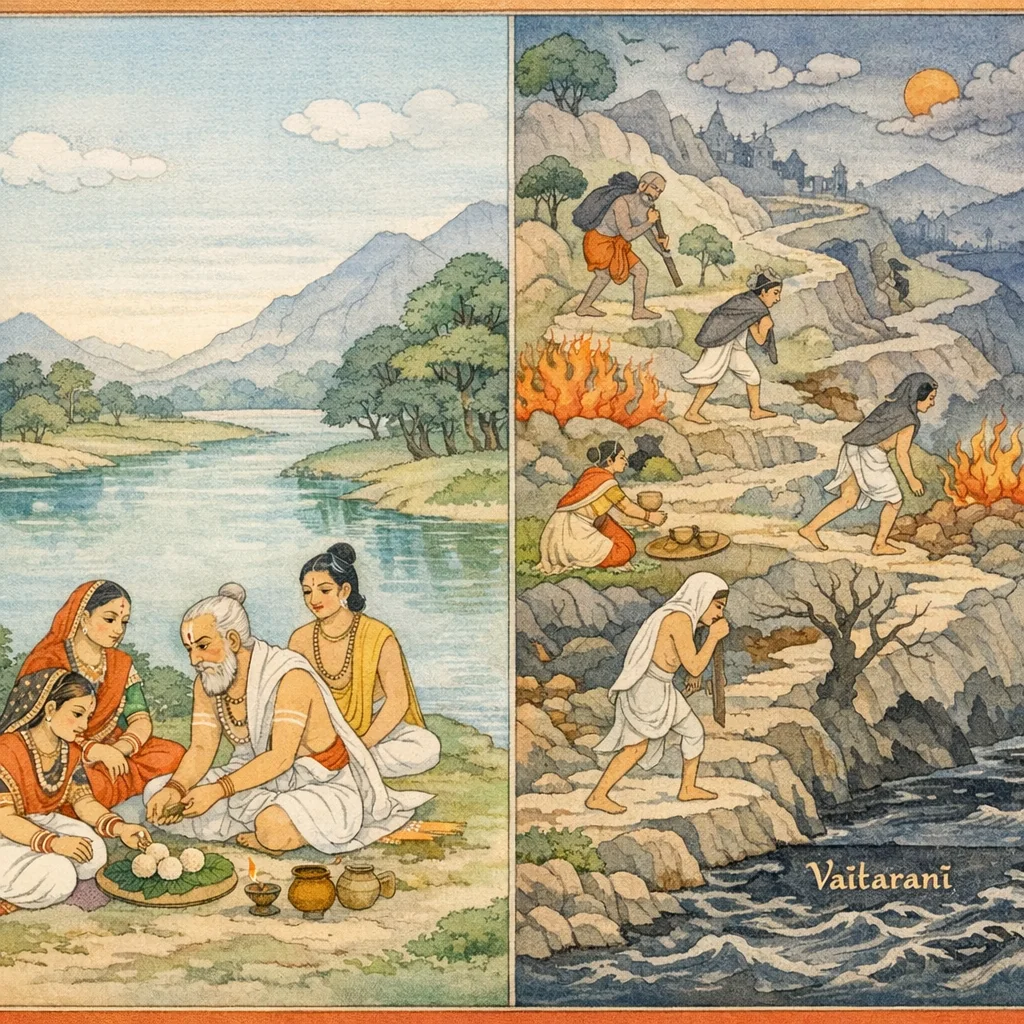
Continuing the Preta-kalpa’s funeral-rite sequence, Kṛṣṇa instructs Garuḍa on conduct immediately after cremation, re-entry into the household, and the ten-night āśauca observances for sapiṇḍa kin, with variants for birth-impurity and early childhood. He then lays down the daśāha regimen: daily piṇḍa offerings (rules of purity, placement, and materials), daily dāna measured by añjali, and the tenth-day completion rites (bath, discarding garments/hair, and varṇa-linked purification tokens). The chapter explains how offerings are apportioned to sustain the preta and satisfy Yama’s agents, and how a subtle body is progressively formed through successive piṇḍas. It introduces the middle/ṣoḍaśī rites and stresses vṛṣotsarga as pivotal on or around the eleventh day, followed by gifts and feeding of brāhmaṇas. Next comes sāpiṇḍīkaraṇa using ekoddiṣṭa vessels, transferring the departed into Pitṛ status, with timing options and special cases (husband–wife rites). The narrative then turns to the Yama-mārga: the preta’s compelled journey under Yama’s attendants, distances and travel time, sixteen stations/cities and the Vaitaraṇī crossing linked to go-dāna, culminating in the vision of Yama and the assignment of destiny, preparing for later teaching on karmic judgment and post-mortem realms.
Shlokas
Verse 1
नाम चतुर्थो ऽध्यायः श्रीकृष्ण उवाच / एवं दग्ध्वा नरं प्रेतं स्नात्वा कृत्वा तिलोदकम् / अग्रतः स्त्रीजनो गच्छेद्व्रजेयुः पृष्ठतो नराः
Śrī Kṛṣṇa said: Thus, after cremating the man who has become a preta (departed spirit), and after bathing and offering tilodaka—sesame-water—the women should proceed in front, and the men should follow behind.
Verse 2
प्राशयेन्निम्बपत्राणि रुदन्तो नामपूर्वकम् / विधातव्यं चाचमनं पाषाणोपरि संस्थिते
Let the bereaved, weeping and first uttering his name, make him partake of neem leaves; and while seated upon a stone, the rite of ācamana—the purifying sipping of water—should also be performed.
Verse 3
ते प्रविश्य गृहं सर्वे सुताद्याश्च सपिण्डकाः / भवेयुर्दशरात्रं वै यत आशौचकं खग
O Bird (Garuda), when all the sons and other sapinda kin enter the house, they incur āśauca—ritual impurity—for ten nights; such is the rule.
Verse 4
क्रीतलब्धाशनाः सर्वे स्वपेयुस्ते पृथक्पृथक् / अक्षारलवणान्नाः स्युर्निमज्जेयुश्च ते त्र्यहम्
All of them, obtaining their food only by purchase, should sleep each one separately. Their fare should be without alkaline seasoning and without salt, and they should remain immersed in water for three days.
Verse 5
अमांसभोजनाश्चाधः शयीरन्ब्रह्मचारिणः / परस्परं न संस्पृष्टा दानाध्ययनवर्जिताः
Those who lived as brahmacārins—eating no meat and sleeping on the ground—yet remained without mutual fellowship and were devoid of charity and sacred study, meet their due state after death.
Verse 6
मलिनाश्चाधोमुखाश्च दीना भोगविवर्जिताः / अङ्गसंवाहनं केशमार्जनं वर्जयन्ति ते
They remain filthy and downcast, wretched and deprived of all enjoyment; they abstain from bodily comforts such as massaging the limbs and grooming or arranging the hair.
Verse 7
मृन्मये पत्रजे वापि भुञ्जीरंस्ते च भाजने / उवासन्तु ते कुर्युरेकाहमथ वा त्र्यहम्
Let them eat from an earthen vessel, or even from a plate made of leaves; and let them remain there, performing the observance for one day, or else for three days.
Verse 8
गरुड उवाच / आशौचिन इति प्रोक्तमाशौचस्य च वै प्रभो / लक्षणं किं कियत्कालं भाव्यं वा तद्युतैर्नरैः
Garuḍa said: “O Lord, the condition called ‘āśauca’—ritual impurity—has been spoken of. What are its defining marks? How long does it endure? And what observances should be undertaken by those affected by it?”
Verse 9
शृकृष्ण उवाच / अपनोद्यन्त्विदं कालादिभिराशु निषेधकृत् / पिण्डाध्ययनदानादेः पुङ्गतो ऽतिशयो हि तत्
Śrī Kṛṣṇa said: Let this obstruction be swiftly driven away by proper timing and the like, which serve as immediate restraints. Truly, the merit born of piṇḍa-offerings, scriptural recitation and study, gifts (dāna), and related rites is exceptionally potent for that purpose.
Verse 10
दशाहं शावमाशौचं सपिण्डेषु विधीयते / जनने ऽप्येवमेव स्यान्निपुणं शुद्धिमिच्छताम्
Among sapinda relatives, a ten-day āśauca is prescribed on account of death. In the case of birth as well, it is to be the same—for those who seek precise and proper purification.
Verse 11
जन्मन्येकोदकानान्तुत्रिरात्राच्छुद्धिरिष्यते / शावस्य शेषाच्छुध्यन्ति त्र्यहादुदकदायिनः
In the case of birth, for those who share ‘one water’—the same household and commensal bond—purification is prescribed after three nights. Likewise, those who offer water (udaka) become purified after three days from the remaining impurity connected with the corpse.
Verse 12
आदन्तजननत्सद्य आ चौलान्नैशिकी स्मृता / त्रिरात्रमा व्रतादेशाद्दशरात्रमतः परम्
From a child’s birth until the teeth erupt, and again until the tonsure rite (cūḍākaraṇa), the state of ritual impurity (āśauca) is remembered as lasting one night. By śāstric injunction it is three nights; beyond that it is held to be ten nights.
Verse 13
आशौचं ते समाख्यातं संक्षेपात्प्रकृतं ब्रुवे / जलं त्रिदिवमाकाशे स्थाप्यं क्षीरञ्च मृन्मये
Thus āśauca has been explained to you; now I shall state, in brief, the customary procedure: place water in a raised, open spot beneath the sky, and set milk in an earthen vessel.
Verse 14
अत्र स्नाहि पिबात्रेति मन्त्रेणानेन काश्यप / काष्ठत्रये गुणैर्बद्धे प्रीत्यै रात्रौ चतुष्पथे
“Here, bathe; here, drink”—with this mantra, O Kāśyapa, the offering is made at night at the four-way crossroads, for the appeasement of spirits, when the three pieces of wood are bound with cords.
Verse 15
प्रथमे ऽह्नि तृतीये वा सप्तमे नवमे तथा / अस्थिसंचयनं कार्यं दिने तद्गोत्रजैः सह
On the first day, or the third, the seventh, and likewise the ninth, the gathering of the bones after cremation should be performed on that day together with kinsmen of the same gotra.
Verse 16
तदूर्ध्वमङ्गसंस्पर्शः सपिण्डानां विधीयते / योग्याः सर्वक्रियाणां च समानसलिलास्तथा
After that stage, bodily contact is prescribed among sapinda relatives. They are also deemed eligible for all rites, and likewise counted among those who share the water-libation offerings (udaka).
Verse 17
प्रेतपिण्डं बहिर्दद्याद्दर्भमात्रविवर्जितम् / प्रागुदीच्यां चरुं कृत्वा स्नात्वा प्रयतमानसः
With a disciplined mind, after bathing, one should place the piṇḍa-offering for the preta outside, without even a blade of darbha grass; and, having prepared the caru (ritual porridge) while facing east or north, one should proceed with the rite.
Verse 18
भूमावसंस्कृतानां च संस्कृतानां कुशेषु च / नवभिर्दिवसैः पिण्डान्नव दद्यात्समाहितः
Offerings not ritually prepared should be placed upon the bare ground; but those properly sanctified should be set upon kuśa-grass. With a collected mind, one should offer nine piṇḍas over the course of nine days.
Verse 19
दशमं पिण्डमुत्सृज्य रात्रिशेषे शुचिर्भवेत् / असगोत्रः सगोत्रो वा यदि स्त्री यति वा पुमान्
After offering (or setting down) the tenth piṇḍa, one should remain pure for the rest of the night—whether the performer is of a different lineage or the same lineage, whether a woman, an ascetic (yati), or a man.
Verse 20
प्रथमे ऽहनि यो दद्यात्स दशाहं समापयेत् / शालिना सक्तुभिर्वापि शाकैर्वाप्यथ निर्वपेत्
Whoever makes an offering on the very first day completes the observance of the ten-day rites (daśāha). He may offer with rice, or with saktu (parched grain-flour), or he may also set out cooked vegetables as the oblation.
Verse 21
प्रथमे ऽहनि यद्द्रव्यं तदेव स्याद्दशाहिकम् / यावदाशौचमेकैकस्याञ्जलेर्दानमुच्यते
Whatever offering-substance is given on the first day is to be continued as the ten-day (daśāha) offering. Until the period of ritual impurity (āśauca) ends, the prescribed giving is a daily donation—each day an offering by the measure of one cupped handful (añjali).
Verse 22
यद्वा यस्मिन्दिने दानं तस्मिंस्तद्दिनसंख्यया / दशाहे ऽञ्जलयः पक्षिन्पञ्चाशदन्तिमे
Or else, O Bird (Garuda): on whatever day a sacred gift (dāna) is given, that very day is to be counted by its number; within the ten-day rite there are daily añjali handful-offerings, and on the final day they become fifty.
Verse 23
द्विवृद्ध्या वा भवेत्पक्षिन्नञ्जलीनां शतं पुनः / यदाहि त्र्यहमाशौचं तदा वाञ्जलयो दश
O Bird (Garuda), if the measure is increased twofold, the añjali offerings may again amount to a hundred. But when there is three-day aśauca (ritual impurity), then (the offering is) ten handfuls.
Verse 24
त्रयो ऽञ्जलय एवं तु प्रथमे ऽहनिवै तदा / चत्वारस्तु द्वितीये ऽह्नि तृतीये स्युस्त्रयस्तथा
Thus, on the first day three añjali handful-offerings should be given; on the second day, four; and on the third day, likewise three.
Verse 25
शताञ्जलि यदा पक्षिन्नाद्ये त्रिंशत्तदाहनि / चत्वारिंशद्द्वितीये ऽह्नि त्रिंशदह्नि तृतीयके
O bird (Garuda), when the measure is a hundred añjalis: on the first day it is thirty; on the second day, forty; and on the third day, thirty.
Verse 26
एवं जलस्याञ्जलयो विभाज्याः पक्षयोर्द्वयोः / सर्वेषु पितृकार्येषु पुत्रो मुक्यो ऽधिकारवान्
Thus, the añjali handfuls of water (libations) should be apportioned between the two fortnights (pakṣas); and in all rites performed for the ancestors (pitṛ-kārya), the son is the principal one who holds rightful authority.
Verse 27
पिण्डप्रसेकस्तूष्णीञ्च पुष्पधूपादिकं तथा / दशमे ऽहनि सम्प्राप्ते स्नानं ग्रामाद्वहिश्चरेत्
The piṇḍa offering should be made in silence, together with flowers, incense, and the like. When the tenth day arrives, one should go beyond the village and perform the ceremonial bath of purification.
Verse 28
तत्र त्याज्यानि वासांसि केशश्मश्रुनखानि च / विप्रः शुध्यत्यपः स्पृष्ट्वा क्षत्त्रियो वाहनं तथा
There, one should discard the garments, and likewise cut away hair, beard and moustache, and nails. A Brāhmaṇa is purified by touching water; and a Kṣatriya likewise by touching or attending to his vehicle.
Verse 29
वैश्यः प्रतोदं रश्मीन्वा शूद्रो यष्टिं कृतक्रियः / मृतादल्पवयोभिश्च सपिण्डैः परिवापनम्
For the Vaiśya, the prescribed articles are a goad or reins; for the Śūdra, a staff—these are to be offered after the rites have been duly performed. And when one who has died is of very tender age, the circumambulatory/covering rite is to be carried out by the sapiṇḍas, the near kin who share the ancestral piṇḍa oblations.
Verse 30
कार्यन्तु षोडशी षड्भिः पिण्डैर्दशभिरैव च / प्रथमा मलिना ह्येतैरादशाहं मृतेर्भवेत्
The sixteenth-day rite (ṣoḍaśī) should be performed with six piṇḍas, and likewise the sequence with ten piṇḍas as well. By these prescribed piṇḍas and offerings, the first set removes impurity; thus the ten-day period after death (ādaśāha) is duly fulfilled.
Verse 31
दिनानि दश यान्षिण्डान्कुर्वन्त्यत्र सुतादयः / प्रत्यहं ते विभज्यन्ते चतुर्भागैः खगोत्तम
For ten days, the sons and other relatives prepare the piṇḍa offerings here; and each day, O best of birds, Garuḍa, those offerings are apportioned into four parts.
Verse 32
भागद्वयेन देहः स्यात्तृतीयेन यमानुगाः / तृप्यन्ति हि चतुर्थेन स्वयमप्युपजीवति
With two portions the departed one’s body is sustained; with the third, Yama’s attendants are satisfied; and with the fourth, he himself also lives on, supported thereby.
Verse 33
अहोरात्रैस्तु नवभिर्देहो निष्पत्तिमाप्नुयात् / शिरस्त्वाद्येन पिण्डेन प्रेतस्य क्रियते तथा
Over the course of nine days and nights, the subtle body attains its formation. Accordingly, the preta’s head is fashioned by the first piṇḍa-offering.
Verse 34
द्वितीयेन तु कर्णाक्षिनासिकं तु समासतः / गलांसभुजवक्षश्च तृतीयेन तथा क्रमात्
By the second offering, the ears, eyes, and nose are formed in brief; and by the third, in due order, the throat, shoulders, arms, and chest are likewise constituted.
Verse 35
चतुर्थेन च पिण्डेन नाभिलिङ्गगुदं तथा / जानुजङ्घं तथा पादौ पञ्चमेन तु सर्वदा
By the fourth piṇḍa-offering, the navel, the generative organ, and the anus are formed; and by the fifth, the knees, shanks, and the feet are always formed.
Verse 36
सर्वमर्माणि षष्ठेन सप्तमेन तु नाडयः / दन्तलोमान्यष्टमेन वीर्यन्तु नवमेन च
By the sixth, all the marmas—the vital junctions—are formed; by the seventh, the nāḍīs, the subtle channels, arise. By the eighth, the teeth and body-hairs appear; and by the ninth, vīrya, the generative potency, is established.
Verse 37
दशमेन तु पूर्णत्वं तृप्तता क्षुद्विपर्ययः / मध्यमां षोडशीं वच्मि वैनतेय शृणुष्व मे
By the tenth observance, fullness is attained—there is contentment, and hunger is reversed. Now I shall explain the middle rite, the sixteenth; O Vainateya (Garuda), listen to me.
Verse 38
विष्णवादिविष्णुपर्यन्तान्येकादश तथा खग / श्राद्धानि पञ्च देवानामित्येषां मध्यषीडशी
O Khaga (Garuda), there are eleven Śrāddha rites beginning with (the one for) Viṣṇu and ending again with Viṣṇu; and there are five Śrāddha offerings for the Devas. Thus, in the middle, the total becomes sixteen.
Verse 39
निमित्तं दुर्मतिं कृत्वा यदि नारायणो बलिः / एकादशाहे कर्तव्यो वृषोत्सर्गो ऽपि तत्र वै
If, through a mistaken notion—taking a wrong occasion as the basis—one makes a bali offering meant for Nārāyaṇa, then on the eleventh day, in that very context, the rite of vṛṣotsarga, the releasing and dedication of a bull, should certainly be performed as well.
Verse 40
एकादशाहे प्रेतस्य यस्यात्सृज्येत नो वृषः / प्रेतत्वं सुस्थिरं तस्य दत्तैः श्राद्धशतैरपि
If, on the eleventh day, the ‘vṛṣa’ rite (vṛṣotsarga) is not performed for the departed preta, then that being’s preta-condition becomes firmly fixed—so much so that even hundreds of Śrāddhas offered later do not easily undo it.
Verse 41
अकृत्वा यद्वृषोत्सर्गं कृतं वै पिण्डपातनम् / निष्फलं सकलं विद्यात्प्रमीताय न तद्भवेत्
If one performs the offering of funeral piṇḍas (piṇḍa-pātana) without first carrying out vṛṣotsarga, then one should know that the entire piṇḍa-offering becomes fruitless; it does not truly benefit the departed.
Verse 42
वृषोत्सर्गादृते नान्यत्किञ्चिदस्ति महीतले / पुत्रः पत्न्यथ दौहित्रः पिता वा दुहिताथ वा
On this earth, apart from the rite of releasing a bull (vṛṣotsarga), nothing else is so efficacious—whether performed by a son, a wife, a daughter’s son, a father, or a daughter.
Verse 43
मृतादनन्तरं तस्य ध्रुवं कार्यो वृषोत्सवः / चतुर्वत्सतरीयुक्तो यस्योत्सृज्येत वा वृषः
Immediately after a person’s death, the rite known as the “bull-festival” (vṛṣotsava) should certainly be performed; a bull, endowed with four years of age, should be released in the deceased’s name.
Verse 44
अलङ्कृतो विधानेन प्रेतत्वं तस्य नो भवेत् / एकादशे ऽह्नि सम्प्राप्ते वृषालाभो भवेद्यदि
If the departed is duly honored according to the prescribed rites, he does not fall into the condition of a preta (a restless departed spirit). And if, upon the arrival of the eleventh day, a bull is obtained, then the rite is duly fulfilled in that respect.
Verse 45
दर्भैः पिष्टैस्तु सम्पाद्य तं वृषं मोचयेद्वुधः / वृषोत्सर्जनवेलायां वृषाभाव (लाभ) कथञ्चन
Having duly prepared the rite with darbha-grass and the prescribed paste, the wise man should release that bull. At the time of the bull-release (vṛṣotsarga), there should never be any lack of a bull—one should somehow ensure its availability.
Verse 46
मृत्तिकाभिस्तु दर्भैर्वा वृषं कृत्वा विमोचयेत् / यदिष्टं जीवतस्तस्य दद्यादेकादशे ऽहनि
Using clay lumps or darbha grass, one should fashion a bull and then set it free. Whatever offering was dear to the deceased while living should be given on the eleventh day.
Verse 47
मृतमुद्दिश्य दातव्यं शय्याधेन्वादिकं तथा / विप्रान्बहून् भोजयीत प्रेतस्य क्षुद्विशान्तये
Keeping the departed in mind, one should give gifts such as a bed, a cow, and the like; and one should feed many brāhmaṇas, to pacify the hunger of the preta.
Verse 48
तृतीयां षोडशीं वच्मि वैनतेय शृणुष्व ताम् / द्वादश प्रतिमास्यानि आद्यं षाण्मासिकं तथा
O Vainateya (Garuda), listen: I shall now describe the third—namely, the rite of the sixteenth day. Thereafter are to be observed the twelve monthly rites, beginning as well with the semi-annual observance.
Verse 49
सपिण्डीकरणं चैव तृतीया षोडशी मता / द्वादशाहे त्रिपक्षे च षण्मासे मासिके ऽब्दिके
The rite of sapiṇḍīkaraṇa is also prescribed—either on the third day or on the sixteenth day. It may likewise be performed on the twelfth day, after a fortnight, at six months, at the monthly observance, or at the annual ceremony.
Verse 50
तृतीयां षोडशीमेनां वदन्ति मतभेदतः / यस्यैता नि न दत्तानि प्रेतश्राद्धानि षोडश
By difference of opinion, some call this set “the third,” while others call it “the sixteenth.” For one who has not offered these sixteen śrāddhas for the preta, the due rites remain unfulfilled.
Verse 51
पिशाचत्वं स्थिरं तस्य दत्तैः श्राद्धशतैरपि / एकादशे द्वादशे वा दिने आद्यं प्रकीर्तितम्
Even if hundreds of śrāddhas are performed for him, his state of being a piśāca remains fixed. The first prescribed rite is declared to be on the eleventh day, or else on the twelfth.
Verse 52
मासादौ प्रतिमासञ्च शुद्धं मृततिथौ खग / एकेनाह्ना त्रिभिर्वापि हीनेषु विनतासुत
O Khaga (Garuda), at the beginning of the month and again each month, the rite should be performed in purity on the death‑anniversary tithi. O son of Vinatā, if the prescribed conditions are lacking, it may be completed within one day—or, at most, within three days.
Verse 53
मासषण्मासवर्षेषु त्रिपक्षेषु भवन्ति हि / श्राद्धान्यथस्यात्सापिण्ड्यं पूर्णे वर्षे तदर्धके
The śrāddha rites are indeed performed at the monthly, half‑yearly, yearly, and also the three‑fortnight intervals; thereafter, the sāpiṇḍīkaraṇa (joining the departed to the ancestral line) is to be done—either at the completion of one full year or at half of that period.
Verse 54
त्रिपक्षे ऽभ्युदये वापि द्वादशाहे ऽथ वा नृणाम् / आनन्त्यात्कुलधर्माणां पुंसाञ्चैवायुषः क्षयात्
For men, whether the rites are performed on the thirteenth day, or at an auspicious occasion, or on the twelfth day—this is because the duties of one’s lineage are without end, and because human life itself is diminishing.
Verse 55
अस्थिरत्वाच्छरीरस्य द्वादशाहे प्रशस्यते / सपिण्डीकरणेष्वेवं विधिं पक्षीन्द्र मे शृणु
Because the body’s condition is unstable in the days after death, the twelve‑day period is regarded as appropriate. Therefore, O king of birds, listen as I explain this procedure for the sāpiṇḍīkaraṇa rites.
Verse 56
एकोद्दिष्टविधानेन कार्यं तदपि काश्यप / तिलगन्धोदकैर्युक्तं कुर्यात्पात्रचतुष्टयम्
O Kāśyapa, that too should be performed according to the ekoddiṣṭa procedure; one should prepare a set of four ritual vessels, furnished with sesame (tila) and scented water.
Verse 57
पात्रं प्रेतस्य तत्रैकं पित्र्यं पात्रत्रयं तथा / सेचयेत्पितृपात्रेषु प्रेतपात्रं खग त्रिषु
There, one vessel is to be set apart for the preta (the newly departed), and likewise three vessels for the Pitṛs (the ancestral fathers). O Bird (Garuda), one should pour the offering from the preta-vessel into the three vessels meant for the Pitṛs.
Verse 58
चतुरो निर्वपेत्पिण्डान्पूर्वन्तेषु समापयेत् / ततः प्रभृति वै प्रेतः पितृसामान्यमश्नुते
One should offer four piṇḍas (rice-balls) and complete the rite at the proper earlier concluding points. From that time onward, indeed, the preta attains the common status of the Pitṛs (ancestral beings).
Verse 59
ततः पितृत्वमापन्ने तस्मिन्प्रेते खगेश्वर / श्राद्धधर्मैरशेषैस्तु तत्पूर्वानर्चयेत्पितॄन्
Then, O lord of birds (Garuda), when that departed one attains the status of an ancestor (Pitṛ), one should, through all the prescribed rites of śrāddha without omission, worship and honor the Pitṛs who preceded him.
Verse 60
एकचित्यारोहणे च एकाह्नि मरणे तथा / सापिण्ड्यन्तु स्त्रिया नास्ति मृते भर्तुः स्त्रियो भवेत्
If a woman ascends the same funeral pyre (with her husband), or if she dies within a single day (of him), then for her there is no sapīṇḍīkaraṇa rite; when her husband has died, she is reckoned among his women—belonging to his household and lineage in the post-death ritual accounting.
Verse 61
पाकैक्यमथ कालैक्यं कर्त्रैक्यञ्च भवेत्खग / श्राद्धादौ सह दाहे च पतिपत्न्योर्न संशयः
O Khaga (Garuda), there should be unity in the cooking, unity in the timing, and unity of the officiant; and in śrāddha and related rites, as well as in the cremation, husband and wife are to be treated as jointly concerned—of this there is no doubt.
Verse 62
भर्तुर्मृततिथेरन्यतिथौ चितिमथारुहेत् / तांमृताहनि तु सम्प्राप्ते पृथक् पिण्डेन योजयेत्
If a wife ascends the funeral pyre (citi) on a date other than her husband’s death‑tithi, then when his death‑day arrives, she should be ritually joined to him by offering a separate piṇḍa.
Verse 63
प्रत्यब्दञ्च युगपत्तु समापयेत्
And the annual rite should also be completed—indeed, it should be concluded promptly and without delay.
Verse 64
यस्य संवत्सरादर्वाक् सपिण्डीकरणं भवेत् / मासिकञ्चोदकुम्भञ्च देयं तस्यापि वत्सरम्
For one whose sapiṇḍīkaraṇa (the rite of joining the departed to the ancestral line) is performed before the completion of a year, the monthly śrāddha offerings and the water‑pot (udakumbha) should still be given for that person for the full year.
Verse 65
नवश्राद्धं सपिण्डत्वं श्राद्धान्यपि च षोडश / एकेनैव तु कार्याणि संविभक्तधनेष्वपि
The nine śrāddhas, the rite of sapiṇḍīkaraṇa (bringing the departed into the line of ancestors), and the other sixteen śrāddha rites—even when the family wealth has been divided—should be performed by a single person alone.
Verse 66
पितामहीभिः सापिण्ड्यं तथा मातामहैः सह / उक्तं भर्त्रापि सापिण्ड्यं स्त्रिया वेषयभेदतः
Sapinda‑relationship is also stated with the paternal grandmothers and likewise with the maternal grandfathers; and for a woman, sapinda‑relationship with the husband is also taught, depending on the distinction of her marital and household status.
Verse 67
नवश्राद्धस्य ते कालं वक्ष्यामि शृणु काश्यप / मरणाह्नि मृतिस्थाने श्राद्धं पक्षिन्प्रकल्पयेत्
I shall declare the proper time for the nine śrāddhas—listen, O Kāśyapa. On the very day of death, at the place where death occurred, one should duly perform the śrāddha, O Bird (Garuda).
Verse 68
द्वितीयञ्च ततो मार्गे विश्रामो यत्र कारितः / ततः सञ्चयनस्थाने तृतीयं श्राद्धमुच्यते
Next, the second śrāddha is to be performed at the resting place arranged along the path. Thereafter, at the place of sañcayana—the gathering of the remains—the rite called the third śrāddha is performed.
Verse 69
पञ्चमे सप्तमे तद्वदष्टमे नवमे तथा / दशमैकादशे चैव नव श्राद्धानि वै खग
On the fifth and seventh days, likewise on the eighth and ninth, and also on the tenth and eleventh—thus, O Bird (Garuda), there are nine śrāddha rites to be performed.
Verse 70
श्राद्धानि नव चैतानि तृतीया षोडशी स्मृता / एकोद्दिष्टविधानेन कार्याणि मनुजैस्तथा
These are the nine śrāddha rites; the third day and the sixteenth are also enjoined. Human beings should perform them according to the Ekoddiṣṭa procedure, intended for a single departed person.
Verse 71
प्रथमे ऽह्नि तृतीये वा पञ्चमे सप्तमे तथा / नवमैकादशे चैव नवश्राद्धं प्रकीर्तितम्
On the first day, or on the third, the fifth, the seventh, likewise on the ninth and the eleventh—these are proclaimed as the nava-śrāddhas, the nine śrāddha rites for the departed.
Verse 72
उच्यन्ते षडिमानीह नव स्युरपि यागेतः / उक्तानि ते मया तानि ऋषीणां मतभेदतः
Here they are stated as six; yet, with regard to the rites of yajña, they may even be nine. I have explained them to you according to the differing opinions of the ṛṣis.
Verse 73
रूढिपक्षो ममाभीष्टो योगः कैश्चिदिहेष्यते / आद्ये द्वितीये दातव्यस्तथैवैकं पवित्रकम्
The customary procedure is what I approve; this is the discipline (yoga) that some accept here. In the first and in the second observance, one should give the prescribed offering; likewise, one sacred kuśa-grass ring (pavitraka) should also be given.
Verse 74
प्रेताय पिण्डो दातव्यो भुक्तवत्सु द्विजातिषु / प्रश्रस्तत्राभिरण्येति यजमानद्विजन्मना
A piṇḍa (funerary rice offering) should be given for the preta, in the presence of satisfied twice-born brāhmaṇas who have eaten. Then the yajamāna, himself twice-born, should pronounce the auspicious formula: “praśasta-tatra-abhi-raṇya.”
Verse 75
अक्षय्यममुकस्येति वक्तव्यं विरतौ तथा / एकोद्दिष्टं मे निबोध चेत्थमावत्सरं स्मृतम्
At the concluding rite as well, one should say: “May this be imperishable for such-and-such (amuka, the departed).” Now listen from me about the Ekoddiṣṭa; in this manner the annual (āvatsara) śrāddha is prescribed.
Verse 76
सपिण्डीकरणादूर्ध्वं यानि श्राद्धानि षोडश / एकोद्दिष्टविधानेन चरेद्वा पार्वणादृते
After the rite of sapiṇḍīkaraṇa, the sixteen śrāddha ceremonies that follow should be performed according to the ekoddiṣṭa procedure, excluding the pārvaṇa method.
Verse 77
प्रत्यब्दं यो यथा कुर्यात्तथा कुर्यात्स तान्यपि / एकादशे द्वादशे ऽह्नि प्रेतो भुङ्क्ते दिनद्वयम्
Whatever annual rite a person performs in a particular manner, in that very manner do those offerings reach the departed. On the eleventh and the twelfth day, the preta (departed spirit) partakes of the offerings for two days.
Verse 78
योषितः पुरुषस्यापि पिण्डं प्रेतेति निर्वपेत् / सापिण्ड्ये तु कृते तस्य प्रेतशब्दो निवर्तते
A woman too should offer the piṇḍa for a man, designating him as a “preta”. But when the sāpiṇḍya rite is completed for him, the very designation “preta” ceases.
Verse 79
दीपदानं प्रकर्तव्यमावर्षन्तु गृहाद्बहिः / अन्नं दीपो जलं वस्त्रमन्यद्वादीयते च यत्
One should certainly perform the gift of a lamp (dīpa-dāna), placing it outside the house so it may burn through the night. Food, a lamp, water, clothing—and whatever else is appropriate—should also be given in charity.
Verse 80
तृप्तिदं प्रेतशब्देन सपिण्डीकरणावधि / अब्दकृत्यं मयोक्तन्ते समासाद्विनतासुत
O son of Vinatā, I have explained to you in brief the annual rites (abda-kṛtya) that bring satisfaction to the departed—those performed for one termed a “preta”—up to the rite of sapiṇḍīkaraṇa.
Verse 81
वैवस्वतगृहे यानं यथा तत्तु निबोधमेः / त्रयोदशे ऽह्नि श्रवणाकर्मणोनन्तरन्तु सः
Understand from me how the journey to Vaivasvata’s (Yama’s) abode takes place. Immediately after the śrāvaṇa rite performed on the thirteenth day, he (the departed) proceeds onward.
Verse 82
त्वग्गृहीताहिवत्तार्क्ष्य गृहीतो यमकिङ्करैः / तस्मिन्मार्गे व्रजत्येको गृहीत इव मर्कटः
O Tārkṣya (Garuda), seized by Yama’s attendants, he goes along that path alone—dragged like a snake caught by the skin, like a monkey held fast.
Verse 83
वाय्वग्रसारिवद्रूपं देहमन्यत्प्रपद्यते / तत्पिण्डजं पातनार्थमन्यत्तु पितृसम्भवम्
Taking on another body—subtle in form, swift as the foremost wind—the departed being attains a new embodiment. One body is born from the piṇḍa offerings for the purpose of being carried onward, while another arises from the fathers (Pitṛs).
Verse 84
तत्प्रमाणवयो ऽवस्थासंस्थानां प्रग्भवो यथा / षडशीति सहस्राणि योजनानां प्रमाणतः
In the same way, the measures, ages, conditions, and forms of that realm are to be understood as they arise in due order; its extent, by measure, is said to be eighty-six thousand yojanas.
Verse 85
अध्वान्तरालिको ज्ञेयो यममानुषलोकयोः / साधिकार्धक्रोशयुतं योजनानां शतद्वयम्
Know that the intervening distance on the road between Yama’s world and the human world is two hundred yojanas, together with an additional half-krośa.
Verse 86
चत्वारिं शत्तथा सप्त प्रत्यहं याति तत्र सः / अष्टाचत्वारिंशता च त्रैंशता दिवसैरिति
There, he (as a preta) travels forty-seven yojanas each day; thus, in thirty-eight days the journey is completed.
Verse 87
वैवस्वतपुरं याति कृष्यमाणो यमानुगैः / एवं क्रमेण यातब्ये मार्गे पापरतैस्तु यत्
Dragged along by Yama’s attendants, the sinner goes to Vaivasvata’s city, the realm of Yama. Thus, step by step, those devoted to sin must undergo the path that is to be traversed.
Verse 88
जायते सप्रपञ्चं तच्छृणु त्वमरुणानुज / त्रयोदशदिने दत्तः पाशैर्बद्ध्वातिदारुणैः
It comes to pass in full detail—listen, O younger brother of Aruṇa. On the thirteenth day he is handed over, bound fast with exceedingly dreadful nooses.
Verse 89
यमस्याङ्कुशहस्तो वै भृकुटीकुटिलाननः / दण्डप्रहारसम्भ्रान्तः कृष्यते दक्षिणां दिशम्
Indeed, with Yama’s goad in hand, the frowning, grim-faced attendant—panic-stricken by the blows of the staff—is dragged toward the southern direction.
Verse 90
कुशकण्टकवल्मीकशङ्कुपाषाणकर्कशे / तथा प्रदीप्तज्वलने क्वचिच्छ्वभ्रशतोत्कटे
The path is harsh, strewn with sharp kuśa-grass thorns, ant-hills, spikes, and jagged stones; in places it blazes with fierce fire, and elsewhere it is made dreadful by hundreds of pits and chasms.
Verse 91
प्रदीप्तादित्यतप्ते च दह्यमानः सदंशके / कृष्यते यमदूतैश्च शिवावन्नादभीषणैः
In that region scorched by the blazing sun, the being burns amid biting and stinging creatures; and he is dragged on by Yama’s messengers, terrifying with their harsh, inauspicious cries.
Verse 92
प्रयातिः दारुणे मार्गे पापकर्मा यमालये / कलेवरे दह्यमाने महान्तं क्षयमृच्छति
The doer of sinful deeds departs along a dreadful road toward Yama’s abode; and as the body is being burned, he falls into great ruin and suffering.
Verse 93
भक्ष्यमाणे तथैवाङ्गे भिद्यमाने च दारुणम् / छिद्यमाने चिरतरं जन्तुर्दुः खमवाप्नुते
When the limbs are being eaten, when they are cruelly split apart, and when they are cut and torn for a long time, the embodied being falls into intense suffering.
Verse 94
स्वेन कर्मवि पाकेन देहान्तरगतो ऽपि सन् / पुराणि षोडशामुष्मन्मार्गे तानि च मे शृणु
Even after the soul has passed into another body due to the ripening of its own karma, there are sixteen cities on this path of the hereafter—listen to them from me.
Verse 95
याम्यं सौरिपुरं नगेद्वभवनं गन्धर्वशैलागमौ क्रौञ्चं क्रूरपुरं विचित्रभवनं बह्वापदं दुः खदम् / नानाक्रन्दपुरं सुतप्तभवनं रौद्रं पयोवर्षणं शीताढ्यं बहुभीतिषोडशपुराण्येतान्यदृष्टनि ते
Yāmya, Sauripura, Nagedvabhavana, Gandharvaśaila, Agama, Krauñca, Krūrapura, Vicitrabhavana, Bahvāpad, Duḥkhada, Nānākrandapura, Sutaptabhavana, Raudra, Payovarṣaṇa, Śītāḍhya, and Bahubhīti—these sixteen cities have not been seen by you.
Verse 96
तत्र याम्य पुरं गच्छन्पुत्रपुत्रेति च ब्रुवन् / हाहेति क्रन्दते नित्यं स्वकृतं दुष्कृतं स्मरन्
There, while going to Yama’s city, he keeps calling out, “O son, O grandson,” and continually wails, crying “Alas! Alas!”, remembering the evil deeds he himself has done.
Verse 97
अष्टादशोदिने तार्क्ष्य तत्पुर प्राप्नुयादसौ / पुष्पभद्रा नदी यत्र न्यग्रोधः प्रियदर्शनः
O Tārkṣya (Garuda), on the eighteenth day he reaches that city; there is the river Puṣpabhadrā, and there stands a nyagrodha (banyan) tree, lovely to behold.
Verse 98
विश्रामेच्छां करोत्यत्र कारयन्ति न ते भटाः / क्षितौ दत्तं सुतैस्तस्य स्नेहाद्वा कृपया तथा
Here, even if he longs to rest, those guards do not permit it; only what his sons have given upon the earth—out of affection or out of compassion—becomes available to him there.
Verse 99
मासिकं पिण्डमश्नाति ततः सौरिपुरं व्रजेत् / व्रजन्नेवं प्रलपते मुद्गराहतिपीडितः
He eats the monthly piṇḍa offering; then he proceeds to Sauripura. As he goes, afflicted by blows of a mallet, he cries out in this manner.
Verse 100
जलाशयो नैव कृतो मया तदा मनुष्यतृप्त्यै पशुपक्षितृप्तय / गोतृप्तिहेतोर्न च गोचरः कृतः शरीर हे निस्तर यत्त्वया कृतम्
“In that life I made no water-reservoir to satisfy people, nor to sate animals and birds. Nor did I provide pasture to nourish cattle. O body, carry me across—what good deed was ever done by you?”
Verse 101
तत्र नाम्ना तु राजासौ जङ्गमः कामरूपधृक् / भयात् तद्दर्शनाज्जाताद्भुङ्क्ते पिण्डं स शङ्कितः
There, there is a ruler known as Jaṅgama, a being who can assume any form at will. Struck with fear upon seeing him, the departed one, anxious and alarmed, eats the piṇḍa offering.
Verse 102
त्रिपक्षे जलसंयुक्तं क्षितौ दत्तं ततो व्रजेत् / व्रजन्नेवं प्रलपते खड्गाघातप्रपीडितः
After three fortnights, having offered the rite upon the earth together with water, one should then depart. As he goes, he laments thus, tormented as though struck by a sword-blow.
Verse 103
न नित्यदानं न गवाह्निकं कृतं पुस्तं च दत्तं न हि वेदशास्त्रयोः / पुराणदृष्टो न हि सेवितो ऽध्वा शरीर हे निस्तर यत्त्वया कृतम्
“No daily charity was given; no daily rites—such as honoring the cow—were performed; no sacred book was donated; the Vedas and śāstras were not studied. The path taught in the Purāṇas was not followed. O body—now carry me across: what have you truly done to save us?”
Verse 104
नगेन्द्रनगरं गत्वा भुक्त्वा चान्नं तथाविधम् / मासि द्वितीये यद्दत्तं बान्धवैस्तु ततो व्रजेत्
Having gone to Nagendra-nagara and eaten that kind of food, the preta then proceeds onward—sustained by what the relatives offer in the second month.
Verse 105
व्रजन्नेवं प्रलपते कृपाणत्सरुताडितः / पराधानमभूत्सर्वंमम मूर्खशिरोमणेः
As he is driven onward, struck by swords and clubs, he wails in this way: “All of this has become my own fault—alas, I am the very crest-jewel of fools.”
Verse 106
महता पुण्ययोगेन मानुष्यं लब्धवानहम् / तृतीये मासि सम्प्राप्ते गन्धर्वनगरे शुभम्
By the powerful conjunction of accumulated merit, I attained a human state; and when the third month arrived, I reached the auspicious city of the Gandharvas.
Verse 107
तृतीयमासिकं पिण्डं तत्र भुक्त्वा ब्रजत्यसौ / व्रजन्नेवं विलपते तदग्रेणाहतः पथि
Having consumed there the third monthly piṇḍa offering, he proceeds onward. As he goes, he laments in this way, being struck on the road by those who are in front of him.
Verse 108
मया न दत्तं न हुतं हुताशने तपो न तप्तं हिमशैलगह्वरे / न सेवितं गाङ्गमहो महाजलं शरीर हे निस्तर यत्त्वया कृतम्
I gave no gifts, I offered no oblations into the sacred fire; I performed no austerities in the caves of the snowy mountains; I did not even resort to the mighty waters of the revered Gaṅgā. O body—carry me across, for whatever has been done has been done through you.
Verse 109
तुर्ये शैलागमं मासि प्राप्नुयात्तत्र वर्षणम् / तस्योपरि भवेत्पक्षिन्पाषाणानां निरन्तरम्
In the fourth month, one reaches the mountainous region; there, a rain (of torment) is encountered. Over him, O bird (Garuda), there is an unceasing shower of stones.
Verse 110
चतुर्थमासिकं श्राद्धं भुक्त्वा तत्र प्रसर्पति / स पतन्नेव विलपन्पाषाणाद्यतिपीडितः
Having partaken of the śrāddha offering made in the fourth month, he crawls onward there; falling again and again, he wails, being severely tormented by stones and the like.
Verse 111
न ज्ञानमार्गो न च योगमार्गो न कर्ममार्गो न च भक्तिमार्गः / न साधुसङ्गात्किमपि श्रुतं मया शरीर हे निस्तर यत्त्वया कृतम्
Neither the path of knowledge, nor the path of yoga, nor the path of ritual action, nor even the path of devotion was pursued by me; nor did I hear anything from the company of saints. O body, you alone must carry me across—by whatever you have done.
Verse 112
ततः क्रूरपुर मासि पञ्चमे याति काश्यप / भुवि दत्तं पिण्डजलं भुक्त्वा क्रूरपुरं व्रजेत्
Then, O Kāśyapa, in the fifth month the departed soul goes to Krūrapura. Having partaken of the piṇḍa-offerings and water-libations given on earth, it proceeds onward to Krūrapura.
Verse 113
व्रजन्नेवं विलपते पट्टिशैः पातितः पथि / हा मातर्हापितर्भ्रातः सुता हा हा मम स्त्रियः
As he goes on, lamenting like this, he is struck down on the road with sharp blades. Crying out—“O mother! O father! O brother! O son! Alas, alas—my wife!”—he wails in anguish.
Verse 114
युष्माभिर्नोपदिष्टो ऽहमवस्थां प्राप्त ईदृशीम् / एवं लालप्यमानं ते यमदूता वदन्तिहि
“I was not instructed by you, and thus I have fallen into such a condition.” When he is lamenting in this way, the messengers of Yama indeed speak to him.
Verse 115
क्व माता क्व पिता मूढ क्व जाया क्व सुतः सुहृत् / स्वकर्मोपार्जिते भुङ्क्ष्वं मूर्ख याताश्चिरं पथि
Where now are your mother and father, deluded one? Where are your wife, your son, your friend? O fool—now that you have set out upon the long road, you must endure and experience only what you have earned by your own actions.
Verse 116
जानासि शम्बलमलं बलमध्वगानां नो ऽशम्बलः प्रयतते परलोकगत्यै / गन्तव्यमस्ति तव निश्चितमेव तेन मार्गेण येन न भवेत् क्रयविक्रयो ऽपि
You know that provisions are enough strength for travelers on the road; yet one who has no provisions still strives to reach the other world. You too must certainly depart by that very path—by the way in which there is not even any buying or selling.
Verse 117
ऊनषाण्मासिके क्रौञ्चे भुक्त्वा पिण्डन्तु सोदकम् / घटीमात्रन्तु विश्रम्य विचित्रनगरं व्रजेत्
At the station called Krauñca, connected with the rite performed before six months, having partaken of the piṇḍa offering together with water, the departed rests for only a ghaṭī; then he proceeds to the city named Vicitranagara.
Verse 118
व्रजन्नेवं विलपते शूलाग्रेण विदारितः
As he goes on, he laments in this manner—his body torn open upon the sharp point of a spear.
Verse 119
कुत्र यामि न हि गामि जीवितं हा मृतस्य मरणं पुनर्न वै / इत्थमेव विलपन् प्रयात्यसौ यातनार्हधृतविग्रहः पति
“Where shall I go? I do not return to life. Alas—there is no second death for one who has died.” Thus lamenting, that person departs, bearing a body fit for torment and punishment.
Verse 120
विचित्रनगरे तत्र विचित्रो नाम पारिथिवः / तत्र षण्मासपिण्डेन तृप्तः सन् व्रजते पुरः
There, in the city called Vicitranagara, a king named Vicitra resides. Having been satisfied by the piṇḍa offering made at the six-month rite, the departed one proceeds onward on the path ahead.
Verse 121
व्रजन्नेवं विलपते प्रासाग्रेण प्रपीडितः
As he goes along, he laments in this way, tormented and pressed down by the sharp point (of suffering).
Verse 122
माता भ्राता पिता पुत्रः को ऽपि मे वर्तते न वा / यो मामुद्धरते पापं पतन्तं दुः खसागरे
Whether I have a mother, a brother, a father, or a son—or whether I have no one at all—who is there to lift me up, a sinner, as I fall into the ocean of suffering?
Verse 123
व्रजतस्तत्र मार्गे तु तत्र वैतरणी शुभा / शतयोजनविस्तीर्णा पूयशोणितसंकुला
As one proceeds along that road, there lies the river Vaitaraṇī—called here ‘auspicious’—spreading a hundred yojanas wide, choked and filled with pus and blood.
Verse 124
आयाति तत्र दृश्यन्ते नाविका धीवरादयः / ते वदन्ति प्रदत्ता गौर्यदि वैतरणी त्वया / नावमेनां समारोह सुकेनोत्तर वै नदीम्
When the departed soul arrives there, boatmen and fishermen are seen. They say, “If you have given a cow in charity, then the Vaitaraṇī has been provided for you. Board this boat and cross the river in comfort.”
Verse 125
तत्र येन प्रदत्ता गौः स सुखेनैव तां तरेत् / अदायी तत्र घृष्येत करग्राहन्तु नाविकैः
There, the one who has given a cow in charity crosses that dreadful river with ease. But the one who did not give is dragged and tormented there, as the boatmen seize him by the hand and exact their due.
Verse 126
उखैः काकैर्बकोलूकैस्तीक्ष्णतुण्डैर्वितुद्यते / मनुजानां हितं दानमन्ते वैतरणी खग
He is pecked and torn by crows, herons, and owls with sharp beaks. For human beings, dāna—sacred charity—is truly beneficial at the end, at the crossing of the Vaitaraṇī, O bird Garuḍa.
Verse 127
दत्ता पापं दहेत् सर्वं मम लोकन्तु सा नयेत् / मप्तमे मासि सम्प्राप्ते पुरं बह्वापदं मृतः
A gift offered in the proper manner burns away all sin and leads the giver to My realm. But when the seventh month arrives, the departed is taken to a city beset with many dangers.
Verse 128
व्रजेत्तु सोदकं भुक्त्वा पिण्डं वै सप्तमासिकम् / व्रजन्नेवं विलपते परिघाहतिपीडितः
Having eaten the seventh-month piṇḍa together with the water-offering, he proceeds onward; and as he goes, he laments thus, tormented by blows of the club.
Verse 129
न दत्तं न हुतं तप्तं न स्नातं न कृतं हितम् / यादृशं चरितं कर्म मूढात्मन् भुङ्क्ष्व तादृशम्
You gave no charity, performed no offerings, undertook no austerity, did not purify yourself by bathing, and did no beneficial deed. O deluded soul—whatever actions you practiced, results of that very kind you must now experience.
Verse 130
मास्यष्टमे दुः खदे तु परे भुक्त्वाथ सोदकम् / पिण्डं प्रयात्सयौ तार्क्ष्य नानाक्रन्दपुरं ततः
In the eighth month, after the departed has undergone the painful realm, he consumes the water-offering together with the piṇḍa. Thereafter, O Tārkṣya (Garuda), he proceeds onward to the city called Nānākrandapura—“the town of many cries”.
Verse 131
प्रयाणे च प्रवदते मुसलाघातपीडितः / क्व जायाचटुलैश्चाटुपटुभिर्वचनैर्मम
Even at the time of departure, tormented as though struck by a club, he cries out: “Where is my wife—so fickle—who once spoke to me with clever, flattering words?”
Verse 132
भोजनं भल्लभल्लीभिर्मुसलैश्च क्व मारणम् / नवमे मासि दत्तं वै नानाक्रन्दपुरे ततः
Where is the charitable giving of food, and where is the killing with clubs and cudgels? Thereafter, the offering made in the ninth month is indeed received in the city called Nānākranda, “the place of many cries.”
Verse 133
पिण्डमश्राति करुणं नानाक्रन्दान् करोत्यपि / दशमे मासि दत्तं वै सुतप्तभवनं ततः
He partakes of the piṇḍa offering in sorrow, even crying out in many ways. When it is given in the tenth month, then thereafter he attains a well-heated, comforting dwelling.
Verse 134
सरन्नेवं विलपते हलाहतिहतः पथि / क्व सूनुपेशलकरैः पादसंवाहनं मम
Thus, as he staggers along the road, stricken by the deadly poison of suffering, he laments: “Where now is the gentle pressing and massage of my feet by the tender hands of my sons?”
Verse 135
क्व दूतवज्रप्रतिमकैर्मत्पदकर्षणम् / दशमे मासि पिण्डादि तत्र भुक्त्वा प्रसर्पति
How could there be the dragging of my feet by Yama’s messengers, whose force is like a thunderbolt? In the tenth month, having eaten the piṇḍa-offerings and the like there, he then crawls onward.
Verse 136
मासे चैकादशे पूर्णे पुरं रौद्रं स गच्छति / गच्छन्नेव विलपते यथा पृष्ठे प्रपीडितः
When the eleventh month is completed, he goes to the dreadful city called Raudra. Even while going, he laments—like one whose back is being painfully pressed and crushed.
Verse 137
क्वाहं सतूलीशयने परिवर्तन् क्षणे क्षणे / भटहस्तभ्रष्टयष्टिकृष्टपृष्ठः क्व वा पुनः
Where am I now—once turning again and again, moment after moment, upon a soft, cotton-stuffed bed? And where am I now instead—my back being dragged and struck by a staff that has slipped from the soldier-guards’ hands?
Verse 138
क्षितौ दत्तञ्च पिण्डादि भुक्त्वा तत्र ततो व्रजेत् / पयोवर्षणमित्येतन्नामकं पुरमण्डज
Having there partaken of the piṇḍa-offerings and the like that were given upon the earth, he then departs from that place and proceeds onward—O Egg-born (Garuda)—to the city named Payovarṣaṇa (“Milk-Rain”).
Verse 139
व्रजन्नेवं विलपते कुठारैर्मूर्ध्नि ताडितः / क्व भृत्यकोमलकरैर्गन्धतैलावसेचनम्
As he is driven onward, wailing thus, struck on the head with axes, he laments: “Where now is the soothing anointing and sprinkling of fragrant oils by the tender hands of servants?”
Verse 140
क्व कीनाशानुगैः क्रोधात्कुठारैः शिरसि व्यथा / ऊनाब्दिकञ्च यच्छ्राद्धं तत्र भुङ्क्ते सुदुः खितः
There, the attendants of Yama, enraged, strike with axes, causing agony in his head; and whatever śrāddha is offered before the completion of the year, he partakes of it in that very state—deeply afflicted.
Verse 141
संपूर्णे तु ततो वर्षे शीताढ्यं नगरं व्रजेत् / गच्छन्नेवं छुरिकया च्छिन्नजिह्वस्तु रोदिति
When that year is completed, he goes to a city filled with intense cold. As he proceeds, his tongue is cut with a knife, and he weeps.
Verse 142
प्रियालापैः क्व च ससमधुरत्वस्य वर्णनम् / उक्तमात्रे ऽसिपत्रादिजिह्वाच्छेदः क्व चैव हि
Where is the praise of sweet, affectionate speech—and where, indeed, is the severing of the tongue by sword-like blades and the like for a mere utterance? How vastly different are the fruits.
Verse 143
वार्षिकं पिण्डदानादि भुक्त्वा तत्र प्रसर्पति / बहुभीतिकरं तत्तत् पिण्डजं देवमास्थितः
Having partaken of the annual śrāddha offerings—beginning with the piṇḍa-gifts—he then moves about there. Taking refuge in that piṇḍa-born divine support, he passes through those various, fear-producing conditions.
Verse 144
प्रकाशयति पाप्पानमात्मानञ्च विनिन्दति / योषिदप्येवमेतस्मिन् मार्गे वै परिदेवति
On that path, the departed soul lays bare its sins and condemns itself; even a woman, in the same way, laments bitterly along this route.
Verse 145
ततो याम्यं नातिदूरे नगरं स हि गच्छति / चत्वारिंशद्योजनानि चतुर्युक्तानिविस्तृतम्
Thereafter he indeed goes to Yama’s city, not very far away, spread out to a breadth of forty yojanas, laid out in four well-ordered divisions.
Verse 146
त्रयोदश प्रतीहाराः श्रवणा नाम तत्र वै / श्रवणाकर्मतस्तुष्यन्त्यन्यथा क्रोधमाप्नुयुः
There, indeed, are thirteen gatekeepers called the Śravaṇas. They are pleased when the prescribed act of “hearing/attentive listening” is duly performed; otherwise, they become angry.
Verse 147
ततस्तत्राशु रक्ताक्षं भिन्नाञ्जनचयोपमम् / मृत्युकालान्तकादीनां मध्ये पश्यति वै यमम्
Then, in that realm, he swiftly beholds Yama—red-eyed, like a heap of crushed añjana (collyrium)—standing amid Death, Time, the Ender, and other dread powers.
Verse 148
दंष्ट्राकरालवदनं भृकुटीदारुणाकृतिम् / विरूपैर्भोषणैर्वक्त्रैर्वृतं व्याधिशतैः प्रभुम्
He beheld the Lord of death: his face made terrifying by protruding fangs, his form dreadful with a fierce knitted brow—surrounded by grotesque, fearsome-visaged attendants, and encircled by hundreds of afflictions (diseases).
Verse 149
दण्डासक्तमहाबाहुं पाशहस्तं सुभैरवम् / तन्निर्दिष्टां ततो जन्तुर्गतिं याति शुभाशुभाम्
Then the being (the departed soul) proceeds to the auspicious or inauspicious destination assigned to it—after beholding the mighty-armed, terrifying one who bears a staff and holds a noose (pāśa) in his hand.
Verse 150
पापी पापां गतिं याति यथा ते कथितं पुरा / छत्रोपानहदातारो ये च वेश्मप्रदायकाः
A sinner goes to the sinful course of destiny, as I told you before; but those who give umbrellas and footwear, and those who provide a dwelling, attain a destination born of merit.
Verse 151
ये तु पुण्यकृतस्तत्र ते पश्यन्ति यमं तदा / सौम्याकृतिं कुण्डलिनं मौलिमन्तं धृतश्रियम्
But those who have performed meritorious deeds there behold Yama at that time as gentle in form—adorned with earrings, crowned, and bearing an auspicious splendor.
Verse 152
एकादशे द्वादशे हि षण्मासे आब्दिके तथा / विप्रान् बहून् भोजयेत् तत्र यन्महती क्षुधा
On the eleventh and the twelfth day, and likewise at the six‑month observance and at the annual śrāddha, one should feed many Brāhmaṇas, for at those times the departed endures intense hunger.
Verse 153
जीवन् पुत्रकलत्रादिप्रदिष्टमितरैः खग / यो न साधयति स्वार्थमेवं पश्चाद्धिखिद्यते
O Garuḍa, one who, while still alive, does not accomplish his true purpose—though advised by his son, wife, and others—later indeed falls into regret and sorrow.
Verse 154
एतत् ते सर्वमाख्यातं संयमिन्यां यथागति / प्रोक्तमावर्षकृत्यं ते किमन्यच्छ्रोतुमिच्छसि
Thus I have explained to you everything, in its proper order, about Saṃyamanī, Yama’s realm. I have also described the rites to be performed throughout the year; what else do you wish to hear?
Frequently Asked Questions
For sapiṇḍa relatives, the chapter prescribes a ten-night impurity for death and likewise for birth when seeking precise purification. It also records shorter purifications in specific cases (e.g., three nights for certain commensal/household relations, and one-night variants in early childhood stages), presenting a graded system rather than a single uniform rule.
The text states that across nine day-night periods a subtle body is formed, with specific bodily components attributed to successive piṇḍas; by the tenth observance completeness and relief (including reversal of hunger) are attained. This frames piṇḍa not merely as memorial food but as transitional support shaping post-death embodiment.
It asserts that without vṛṣotsarga on/around the eleventh day, the preta-state can become firmly fixed, and subsequent śrāddhas may not easily undo it; moreover, piṇḍa offerings done without first doing vṛṣotsarga are said to become fruitless. The theological logic presented is that this rite is uniquely efficacious in stabilizing the deceased’s transition.
Sāpiṇḍīkaraṇa is performed by the ekoddiṣṭa method using four vessels (one for the preta and three for the Pitṛs) and a transfer of offering from the preta-vessel to the Pitṛ vessels; after completion, the departed is said to attain the common status of the Pitṛs, and the label ‘preta’ ceases.
The chapter repeatedly links the preta’s provisions to what relatives give on earth and highlights go-dāna at the Vaitaraṇī: those who gave a cow cross comfortably, while those who did not are tormented. It also recommends feeding brāhmaṇas on key days (11th, 12th, six-month, annual) due to the departed’s intense hunger at those junctures.