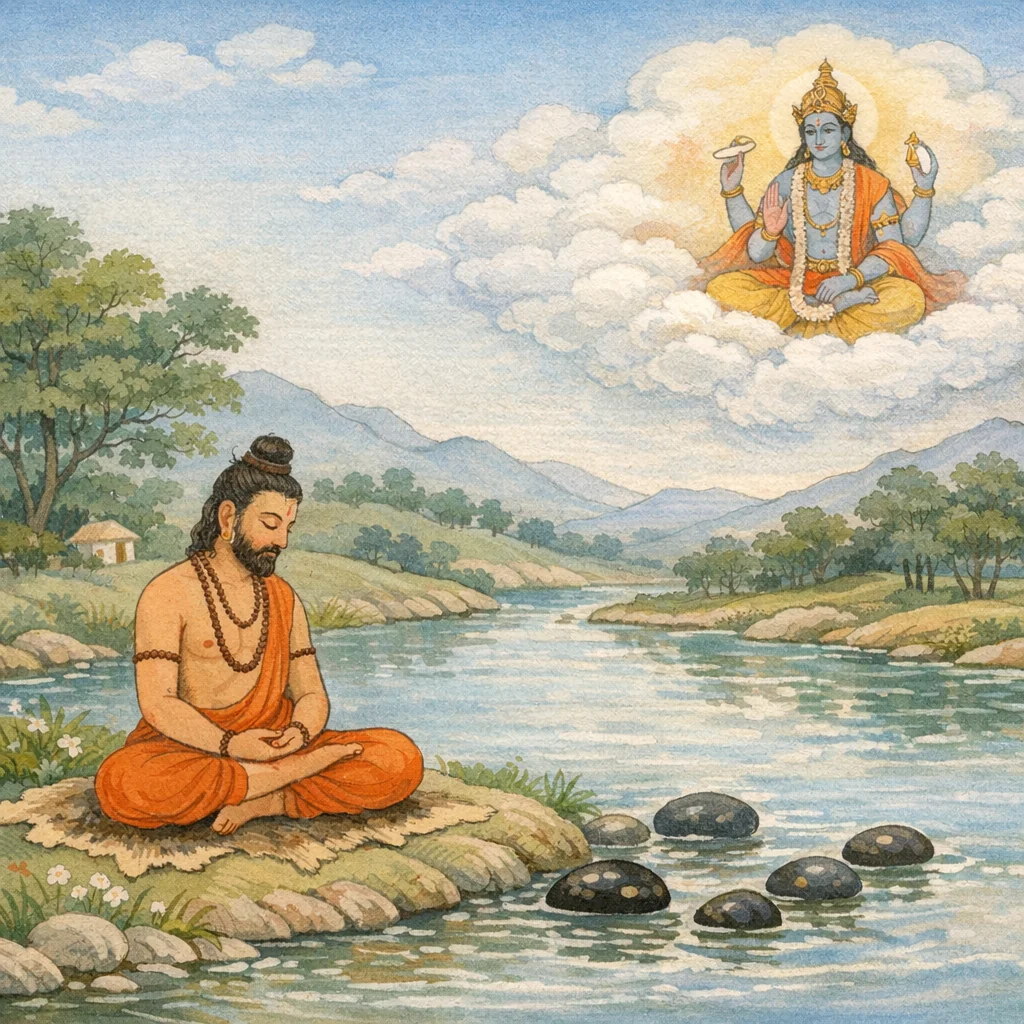
Adhyaya 13
भरतचरितम्—मृगासक्ति-हेतुकः समाधिभङ्गः, जातिस्मरत्वं, रहूगण-जाḍभरत-संवादः
Maitreya, accepting Parāśara’s earlier cosmological teaching, asks why Bharata was reborn despite practicing yoga at Śālagrāma. Parāśara relates that Bharata was absorbed in Vāsudeva-japa and performed few rites; then a frightened doe miscarried, and Bharata rescued the fawn, gradually falling into possessive attachment (mamātmya). His samādhi broke; at death his mind clung to the deer, so he was reborn as a jāti-smara deer. Renouncing even that life, he returned to Śālagrāma, performed expiation, and was reborn as a Brahmin with full scriptural insight, yet assumed a jada/unmatta guise to avoid honor and company. Forced into palanquin service for King Rahūgaṇa, he taught through a piercing inquiry into “I” and “mine,” dismantling notions of body, burden, and designation, and declaring the Self nirguṇa, akṣara, beyond prakṛti. The humbled king grasps the sage’s feet and seeks instruction.
Shlokas
Verse 1
भगवन् सम्यग् आख्यातं यत् पृष्टो ऽसि मयाखिलम् भूसमुद्रादिसरितां संस्थानं ग्रहसंस्थितिः
O revered one, you have explained in full and with perfect clarity all that I asked: the ordering of the earth, the arrangement of oceans and rivers, and the abiding of the heavenly bodies in their appointed stations.
Verse 2
विष्ण्वाधारं यथा चैतत् त्रैलोक्यं समवस्थितम् परमार्थश् च मे प्रोक्तो यथा ज्ञानं प्रधानतः
You have explained how this threefold world stands established upon Viṣṇu as its very foundation; and you have also declared to me the highest truth—how true knowledge, in its foremost sense, is to be understood.
Verse 3
यत् तु तद् भगवान् आह भरतस्य महीपतेः कथयिष्यामि चरितं तन् ममाख्यातुम् अर्हसि
Now I shall recount what the Blessed One declared regarding Bharata, the lord of the earth. I will narrate his life and deeds; therefore deem me fit to relate it.
Verse 4
भरतः स महीपालः सालग्रामे ऽवसत् किल योगयुक्तः समाधाय वासुदेवे मनः सदा
That king Bharata, it is said, dwelt at Śālagrāma. Established in Yoga, he entered samādhi and kept his mind ever fixed upon Vāsudeva.
Verse 5
पुण्यदेशप्रभावेन ध्यायतश् च सदा हरिम् कथं तु नाभवन् मुक्तिर् यदाभूत् स द्विजः पुनः
By the potency of that holy land, and because he ever meditated upon Hari, how could liberation not arise? Yet if that brahmin was born again, what indeed was the true cause?
Verse 6
विप्रत्वे च कृतं तेन यद् भूयः सुमहात्मना पूर्वकर्मस्वभावेन तन् ममाख्यातुम् अर्हसि
After attaining the state of a brāhmaṇa, what further deed did that great-souled one perform? What occurred, impelled by the natural momentum of former karma, you ought to recount to me.
Verse 7
सालग्रामे महाभागो भगवन्न्यस्तमानसः उवास सुचिरं कालं मैत्रेय पृथिवीपतिः
O Maitreya, that greatly fortunate lord of the earth—his mind wholly placed in the Blessed Lord—dwelt for a long time at Śālagrāma, absorbed in devotion.
Verse 8
अहिंसादिष्व् अशेषेषु गुणेषु गुणिनां वरः अवाप परमां काष्ठां मनसश् चापि संयमे
Foremost among the virtuous, established in every excellence beginning with non-violence, he attained the highest summit—perfect restraint and mastery of the mind as well.
Verse 9
यज्ञेशाच्युत गोविन्द माधवानन्त केशव कृष्ण विष्णो हृषीकेशेत्य् आह राजा स केवलम्
That king spoke only this, calling upon the Lord by His sovereign names: “Yajñeśa, Acyuta, Govinda, Mādhava, Ananta, Keśava, Kṛṣṇa, Viṣṇu, Hṛṣīkeśa.”
Verse 10
नान्यज् जगाद मैत्रेय किंचित् स्वप्नान्तरेष्व् अपि एतत् पदं तदर्थं च विना नान्यद् अचिन्तयत्
O Maitreya, he spoke of nothing else—indeed, not even in the intervals of dream. Apart from this very word and its meaning, he contemplated nothing whatsoever.
Verse 11
समित्पुष्पकुशादानं चक्रे देवक्रियाकृते नान्यानि चक्रे कर्माणि निःसङ्गो योगतापसः
For the rites owed to the gods, he gathered only fuel-sticks, flowers, and kuśa grass; beyond these, the ascetic—steadfast in yoga and wholly unattached—performed no other worldly acts.
Verse 12
जगाम सो ऽभिषेकार्थम् एकदा तु महानदीम् सस्नौ तत्र तदा चक्रे स्नानस्यानन्तरक्रियाः
Once, seeking the consecratory rite (abhiṣeka), he went to the great river. There he bathed, and then duly performed the rites that follow after bathing.
Verse 13
अथाजगाम तत् तीर्थं जलं पातुं पिपासिता आसन्नप्रसवा ब्रह्मन्न् एकैव हरिणी वनात्
Then, O Brahman, a solitary doe—parched with thirst and heavy with imminent birth—came out of the forest to that sacred ford, seeking to drink its water.
Verse 14
ततः समभवत् तत्र पीतप्राये जले तया सिंहस्य नादः सुमहान् सर्वप्राणिभयंकरः
Then, right there—when the water had nearly been drunk—there arose a mighty roar like that of a lion, immense and terrifying to all living beings.
Verse 15
ततः सा सहसा त्रासाद् आप्लुता निम्नगातटम् अत्युच्चारोहणेनास्या नद्यां गर्भः पपात सः
Then, seized all at once by fear, she sprang toward the river’s low bank; and by that sudden, violent leap, the child in her womb was cast down and fell into the stream.
Verse 16
तम् ऊह्यमानं वेगेन वीचिमालापरिप्लुतम् जग्राह स नृपो गर्भात् पतितं मृगपोतकम्
Swept along by the river’s force and engulfed by garlands of waves, the king seized that fawn—fallen from its mother’s womb—snatching it from the rushing current.
Verse 17
गर्भप्रच्युतिदुःखेन प्रोत्तुङ्गाक्रमणेन च मैत्रेय सापि हरिणी पपात च ममार च
O Maitreya, tormented by the agony of her miscarried womb and struck down by the force of that sudden leap from a great height, the doe collapsed—and thereupon she died.
Verse 18
हरिणीं तां विलोक्याथ विपन्नां नृपतापसः मृगपोतं समादाय पुनर् आश्रमम् आगतः
Seeing that doe in distress, the king—now living as an ascetic—took up the little fawn and returned once more to his hermitage.
Verse 19
चकारानुदिनं चासौ मृगपोतस्य वै नृपः पोषणं पुष्यमाणश् च स तेन ववृधे मुने
And that king, day after day, diligently tended the young fawn; and the little creature, being nourished by him, grew and flourished—O sage.
Verse 20
चचाराश्रमपर्यन्ते तृणानि गहनेषु सः दूरं गत्वा च शार्दूलत्रासाद् अभ्याययौ पुनः
He wandered along the outskirts of the hermitage, grazing on grass amid the dense thickets; but when he had gone far, terrified by a tiger, he hurried back again.
Verse 21
प्रातर् गत्वातिदूरं च सायम् आयात् तदाश्रमम् पुनश् च भरतस्याभूद् आश्रमस्योटजाजिरे
At dawn he would go very far, and by evening return to that hermitage; thus he again became a dweller in Bharata’s forest-āśrama, among its humble huts and sacred quiet.
Verse 22
तस्य तस्मिन् मृगे दूरसमीपपरिवर्तिनि आसीच् चेतः समासक्तं न ययाव् अन्यतो द्विज
His mind became deeply entangled with that deer, which moved now far away and now close by; thus, O twice-born one, his attention went nowhere else.
Verse 23
विमुक्तराज्यतनयः प्रोज्झिताशेषबान्धवः ममत्वं स चकारोच्चैस् तस्मिन् हरिणबालके
Though he had relinquished both kingdom and son and cast off every remaining worldly tie, he still developed a powerful sense of possessive attachment—an intense “mine-ness”—toward that young fawn.
Verse 24
किं वृकैर् भक्षितो व्याघ्रैः किं सिंहेन निपातितः चिरायमाणे निष्क्रान्ते तस्यासीद् इति मानसम्
“Was he devoured by wolves? Torn apart by tigers? Or struck down by a lion?”—when the one who had gone out did not return for a long time, such anxious thoughts arose in his mind.
Verse 25
एषा वसुमती तस्य खुराग्रक्षतकर्बुरा
This Earth—rich in all treasures—became mottled with the wounds of his hoof-tips, scarred by their sharp points.
Verse 26
प्रीतये मम यातो ऽसौ क्व ममैणकबालकः विषाणाग्रेण मद्बाहुकण्डूयनपरो हि सः क्षेमेणाभ्यागतो ऽरण्याद् अपि मां सुखयिष्यति
He went out only to please me—where is my little antelope-fawn now? He was always intent on scratching my arm with the tip of his horn.
Verse 27
एते लूनशिखास् तस्य दशनैर् अचिरोद्गतैः कुशकाशा विराजन्ते बटवः सामगा इव
Their topknots newly shorn by his teeth, these kuśa and kāśa grasses shine forth like young students chanting the Sāma-veda.
Verse 28
इत्थं चिरगते तस्मिन् स चक्रे मानसं मुनिः प्रीतिप्रसन्नवदनः पार्श्वस्थे चाभवन् मृगे
Thus, as a long time passed, the sage’s mind became set upon the deer; his face, bright with affection, remained turned toward it.
Verse 29
समाधिभङ्गस् तस्यासीत् तन्मयत्वादृतात्मनः संत्यक्तराज्यभोगर्द्धिस्वजनस्यापि भूपतेः
Yet, even for that king who had abandoned kingdom and kin, there arose a breaking of samādhi, for his consciousness became wholly absorbed in that deer.
Verse 30
चपले चपलं तस्मिन् दूरगं दूरगामिनि मृगपोते ऽभवच् चित्तं स्थैर्यवत् तस्य भूपतेः
Upon that skittish fawn—restless by nature and ever darting farther and farther—the king’s mind became fixed; and even in chasing the distant, his heart held a strange firmness of unwavering attention.
Verse 31
कालेन गच्छता सो ऽथ कालं चक्रे महीपतिः पितेव सास्रं पुत्रेण मृगपोतेन वीक्षितः
As time moved onward, that lord of the earth met Time’s decree. Like a father in tears, watched by his child—like a young fawn gazing up—he passed from the world, showing that even sovereignty is gathered back into the Supreme Order upheld by Lord Viṣṇu.
Verse 32
मृगम् एष तदाद्राक्षीत् त्यजन् प्राणान् असाव् अपि तन्मयत्वेन मैत्रेय नान्यत् किंचिद् अचिन्तयत्
At that moment he beheld the deer; and even as his life-breath was departing, O Maitreya, absorbed wholly in it, he thought of nothing else.
Verse 33
ततश् च तत्कालकृतां भावनां प्राप्य तादृशीम् जम्बूमार्गे महारण्ये जज्ञे जातिस्मरो मृगः
Then, carried onward by the mental formation cultivated at that very time, he attained a corresponding state: along the route of Jambū (Jambū-dvīpa), in a vast wilderness, he was born as a deer—yet one who remembered his former birth.
Verse 34
जातिस्मरत्वाद् उद्विग्नः संसारात् स द्विजोत्तम विहाय मातरं भूयः सालग्रामम् उपाययौ
Troubled by the memory of his former births and wearied of the wheel of worldly existence, O best of the twice-born, he left even his mother behind and once again set out for Śālagrāma.
Verse 35
शुष्कैस् तृणैस् तथा पर्णैः स कुर्वन्न् आत्मपोषणम् मृगत्वहेतुभूतस्य कर्मणो निष्कृतिं ययौ
Living only on dry grasses and fallen leaves, he sustained himself through severe austerity; thus he attained expiation for the deed whose fruit had been his becoming a deer.
Verse 36
तत्र चोत्सृष्टदेहो ऽसौ जज्ञे जातिस्मरो द्विजः सदाचारवतां शुद्धे योगिनां प्रवरे कुले
There, casting off his former body, he was born again as a twice-born Brahmin who remembered past births, in a pure and eminent family of yogins renowned for spotless conduct.
Verse 37
सर्वविज्ञानसंपन्नः सर्वशास्त्रार्थतत्त्ववित् अपश्यत् स च मैत्रेय आत्मानं प्रकृतेः परम्
Endowed with complete knowledge and knowing the true purport of all the śāstras, O Maitreya, he beheld his own Self as transcendent, beyond Prakṛti.
Verse 38
आत्मनो ऽधिगतज्ञानो देवादीनि महामुने सर्वभूतान्य् अभेदेन ददर्श स महामतिः
Having attained true knowledge of the Self, O great sage, that high-minded one beheld the gods and all beings without division, seeing everywhere a single, undivided reality.
Verse 39
न पपाठ गुरुप्रोक्तां कृतोपनयनः श्रुतिम् न ददर्श च कर्माणि शास्त्राणि जगृहे न च
Though he had undergone the rite of initiation, he did not study the Śruti as taught by his guru. He did not attend to prescribed rites and duties, nor did he take up the discipline of the Śāstras.
Verse 40
उक्तो ऽपि बहुशः किंचिज् जडवाक्यम् अभाषत तद् अप्य् असंस्कारगुणं ग्राम्यवाक्योक्तिसंश्रितम्
Though addressed again and again, he spoke only a little—dull, clumsy words; and even those were unrefined, leaning on rustic, uncultured turns of speech.
Verse 41
अपध्वस्तवपुः सो ऽथ मलिनाम्बरधृग् द्विजः क्लिन्नदन्तान्तरः सर्वैः परिभूतः स नागरैः
Then that twice-born man—his body wasted and ruined, clad in soiled garments, with the spaces between his teeth foul and damp—was scorned and humiliated by all the townspeople.
Verse 42
संमानना परां हानिं योगर्द्धेः कुरुते यतः जनेनावमतो योगी योगसिद्धिं च विन्दति
For honor brings the greatest loss to a yogin’s spiritual prosperity; whereas the yogin disregarded by people attains the true perfection of yoga.
Verse 43
तस्माच् चरेत वै योगी सतां धर्मम् अदूषयन् जना यथावमन्येरन् गच्छेयुर् नैव संगतिम्
Therefore, the yogin should move through the world without blemishing the dharma of the good; so that people, finding no occasion to disparage him, do not drift into association and entanglement with him.
Verse 44
हिरण्यगर्भवचनं विचिन्त्येत्थं महामतिः आत्मानं दर्शयाम् आस जडोन्मत्ताकृतिं जने
Thus, having reflected upon the words of Hiraṇyagarbha, that great-minded one began to present himself among people in the guise of a dull-witted madman—concealing his inner purpose beneath an outward mask.
Verse 45
भुङ्क्ते कुल्माषवाट्यादिशाकं वन्यं फलं कणान् यद् यद् आप्नोति सुबहु तद् अत्ते कालसंयमम्
He ate only coarse fare—wild greens such as kulmāṣa and vāṭya, forest fruits, and scattered grains. Whatever he obtained, little or much, he consumed with disciplined restraint, keeping to the proper measure and time of food.
Verse 46
पितर्य् उपरते सो ऽथ भ्रातृभ्रातृव्यबान्धवैः कारितः क्षेत्रकर्मादि कदन्नाहारपोषितः
When his father had passed away, his brothers, cousins, and kinsmen set him to field-labour and the like, keeping him alive only on coarse and inferior food.
Verse 47
स रूक्षपीनावयवो जडकारी च कर्मणि सर्वलोकोपकरणं बभूवाहारवेतनः
His limbs grew rough and sinewy, and he became dull in his labour; yet he served as an instrument for the good of all, his only wages being mere food.
Verse 48
तं तादृशम् असंस्कारं विप्राकृतिविचेष्टितम् क्षत्ता सौवीरराजस्य विष्टियोग्यम् अमन्यत
Seeing him in that condition—unrefined, untrained, and carrying the ill-disciplined airs of a brahmin—the attendant (kṣattā) of the king of Sauvīra deemed him fit only for forced menial service at court.
Verse 49
स राजा शिबिकारूढो गन्तुं कृतमतिर् द्विज बभूवेक्षुमतीतीरे कपिलर्षेर् वराश्रमम्
O brāhmaṇa, that king—having mounted his palanquin and fixed his resolve to depart—set out for the noble hermitage of Sage Kapila on the bank of the Ikṣumatī river.
Verse 50
श्रेयः किम् अत्र संसारे दुःखप्राये नृणाम् इति प्रष्टुं तं मोक्षधर्मज्ञं कपिलाख्यं महामुनिम्
Wishing to ask, “What indeed is the highest good for human beings in this world, so filled with suffering?”, he approached the great sage named Kapila, renowned as a knower of the dharma of liberation (mokṣa).
Verse 51
उवाह शिबिकां तस्य क्षत्तुर् वचनचोदितः नृणां विष्टिगृहीतानाम् अन्येषां सो ऽपि मध्यगः
Urged on by the command of the royal attendant, he too bore that palanquin, taking his place in the middle among the other men who had been pressed into forced service.
Verse 52
गृहीतो विष्टिना विप्रः सर्वज्ञानैकभाजनः जातिस्मरो ऽसौ पापस्य क्षयकाम उवाह ताम्
Seized by forced service, that brāhmaṇa—who was a singular vessel of all knowledge—became one who remembered his former births; and, desiring the exhaustion of his sin, he took her as his wife.
Verse 53
ययौ जडगतिः सो ऽथ युगमात्रावलोकनम् कुर्वन् मतिमतां श्रेष्ठस् ते त्व् अन्ये त्वरितं ययुः
Then he went on, moving with a heavy, unhurried pace, while the best among the wise kept watch as though measuring time by a single yuga; but the others hastened quickly onward.
Verse 54
विलोक्य नृपतिः सो ऽपि विषमां शिबिकागतिम् किम् एतद् इत्य् आह समं गम्यतां शिबिकावहाः
Seeing that even the palanquin’s motion had become uneven, the king asked, “What is this?” Then he commanded, “O bearers of the palanquin, walk evenly.”
Verse 55
पुनस् तथैव शिबिकां विलोक्य विषमां हसन् नृपः किम् एतद् इत्य् आह भवद्भिर् गम्यते ऽन्यथा
Then again, seeing the palanquin still moving unevenly, the king laughed and said, “What is this? You are carrying it in a different manner than before.”
Verse 56
भूपतेर् वदतस् तस्य श्रुत्वेत्थं बहुशो वचः शिबिकोद्वाहकाः प्रोचुर् अयं यातीत्य् असत्वरम्
Hearing again and again such words spoken by the king, the bearers of the palanquin replied, “He is going,” and—without haste—proceeded on their way.
Verse 57
किं श्रान्तो ऽस्य् अल्पम् अध्वानं त्वयोढा शिबिका मम किम् आयाससहो न त्वं पीवान् असि निरीक्ष्यसे
“Why are you weary? The distance is small, and it is you who bear my palanquin. Are you not one who can endure exertion? You appear stout and strong—so why do you seem exhausted?”
Verse 58
नाहं पीवा न चैवोढा शिबिका भवतो मया न श्रान्तो ऽस्मि न चायासः सोढव्यो ऽस्ति महीपते
“O king, I am neither a drunkard nor truly a bearer of your palanquin. I am not weary, nor is there any strain that must be endured—for what, indeed, is there to be ‘carried’?”
Verse 59
प्रत्यक्षं दृश्यसे पीवान् अद्यापि शिबिका त्वयि श्रमश् च भारोद्वहने भवत्य् एव हि देहिनाम्
The king said, “You are plainly seen to be stout even now; yet, on this palanquin, you still experience fatigue in carrying the load—for exertion in bearing burdens indeed belongs to embodied beings.”
Verse 60
प्रत्यक्षं भवता भूप यद् दृष्टं मम तद् वद बलवान् अबलश् चेति वाच्यं पश्चाद् विशेषणम्
O King, tell me what you yourself have directly witnessed; only afterward speak of distinctions such as ‘mighty’ or ‘weak,’ for they are merely qualifying descriptions.
Verse 61
त्वयोढा शिबिका चेति त्वय्य् अद्यापि च संस्थिता मिथ्यैतद् अत्र तु भवाञ् शृणोतु वचनं मम
“You carried the palanquin,” and “it still rests upon you even now”—this is false; but, sir, listen here to my words.
Verse 62
भूमौ पादयुगस्यास्था जङ्घे पादद्वये स्थिते ऊरू जङ्घाद्वयावस्थौ तदाधारं तथोदरम्
Upon the Earth rests the foundation of the pair of feet; upon the shanks are stationed the two feet. The thighs abide upon the two shanks, and upon that support, in due order, rests the belly.
Verse 63
वक्षःस्थलं तथा बाहू स्कन्धौ चोदरसंस्थितौ स्कन्धाश्रितेयं शिबिका मम भारो ऽत्र किं कृतः
“Here are the chest and the arms; here are the shoulders, and the belly as well. This palanquin rests upon the shoulders—so what ‘burden’ of mine has truly been placed here at all?”
Verse 64
शिबिकायां स्थितं चेदं देहं त्वदुपलक्षितम् तत्र त्वम् अहम् अप्य् अत्र प्रोच्यते चेदम् अन्यथा
If this body—recognized by you—be said to be “situated in the palanquin,” then there too the words “you” and “I” are spoken; yet the truth is otherwise.
Verse 65
अहं त्वं च तथान्ये च भूतैर् उह्याम पार्थिव गुणप्रवाहपतितो भूतवर्गो ऽपि यात्य् अयम्
O king, I, you, and all others are borne along by the current of embodied existence; and this whole multitude of beings, fallen into the rushing stream of the guṇas, is ceaselessly carried onward from state to state.
Verse 66
कर्मवश्या गुणा ह्य् एते सत्त्वाद्याः पृथिवीपते अविद्यासंचितं कर्म तच् चाशेषेषु जन्तुषु
O lord of the earth, these guṇas—beginning with sattva—truly move under the governance of karma; and that karma, amassed through ignorance, is found without remainder throughout all living beings.
Verse 67
आत्मा शुद्धो ऽक्षरः शान्तो निर्गुणः प्रकृतेः परः प्रवृद्ध्यपचयौ नास्य एकस्याखिलजन्तुषु
The Self is pure, imperishable, and tranquil—without material qualities, and beyond Prakṛti. That One abides in all beings; for Him there is neither increase nor decline among the whole multitude of creatures.
Verse 68
यदा नोपचयस् तस्य न चैवापचयो नृप तदा पीवान् असीतीत्थं कया युक्त्या त्वयेरितम्
O king, you have said that in Him there was neither increase nor decrease, and yet that He was then ‘full and flourishing.’ By what reasoning can this be maintained?
Verse 69
भूपादजङ्घाकट्यूरुजठरादिषु संस्थिते शिबिकेयं यदा स्कन्धे तदा भारः समस् त्वया
When this palanquin—resting upon the earth’s feet, shanks, hips, thighs, belly, and the rest—comes to your shoulder, then the burden becomes equal for you as well.
Verse 70
तथान्यैर् जन्तुभिर् भूप शिबिकोत्थो न केवलम् शैलद्रुमगृहोत्थो ऽपि पृथिवीसंभवो ऽपि वा
So too, O king, among other living beings it is not only those called “born from a palanquin.” Some are said to arise from mountains, trees, and houses; and some are even said to be born from the very earth itself.
Verse 71
यदा पुंसः पृथग्भावः प्राकृतैः कारणैर् नृप वोढव्यस् तु तदा भारः कतमो नृपते मया
O king, when a person’s sense of separateness is produced by the material causes of Prakṛti, that burden must indeed be borne. But tell me, lord of kings—what burden, then, is there for me to carry?
Verse 72
यद्द्रव्या शिबिका चेयं तद्द्रव्यो भूतसंग्रहः भवतो मे ऽखिलस्यास्य ममत्वेनोपबृंहितः
Just as this palanquin is nothing but a collection of materials, so too this aggregate of living beings is a collection of elements. Yet, by the swelling force of “mine-ness,” you and I fasten ownership upon this whole and call it “myself” and “my world”.
Verse 73
एवम् उक्त्वाभवन् मौनी स वहञ् छिबिकां द्विजः सो ऽपि राजावतीर्योर्व्यां तत्पादौ जगृहे त्वरन्
Having spoken thus, the twice-born bearer fell silent, still carrying the palanquin. The king quickly descended to the ground and, in haste, clasped the ascetic’s feet.
Verse 74
भो भो विसृज्य शिबिकां प्रसादं कुरु मे द्विज कथ्यतां को भवान् अत्र जाल्मरूपधरः स्थितः
“Ho there, ho there! Set down the palanquin and show me your favor, O twice-born. Tell me—who are you, standing here in this base, deceptive guise?”
Verse 75
यो भवान् यन् निमित्तं वा यद् आगमनकारणम् तत् सर्वं कथ्यतां विद्वन् मह्यं शुश्रूषवे त्वया
O venerable sir—who you are, for what purpose you have come, and what cause has brought about your arrival—tell me all of this, O wise one, for I am eager to listen to your words.
Verse 76
श्रूयतां को ऽहम् इत्य् एतद् वक्तुं भूप न शक्यते उपभोगनिमित्तं च सर्वत्रागमनक्रिया
Listen, O king: it cannot truly be spoken—“who am I?” For the very movement of going everywhere arises only from the cause of experiencing and enjoying the fruits of karma.
Verse 77
सुखदुःखोपभोगौ तु तौ देहाद्युपपादकौ धर्माधर्मोद्भवौ भोक्तुं जन्तुर् देहादिम् ऋच्छति
The experiences of pleasure and pain are indeed the causes that bring about a body and its adjuncts; born of dharma and adharma, a living being attains embodiment precisely in order to undergo their fruition.
Verse 78
सर्वस्यैव हि भूपाल जन्तोः सर्वत्र कारणम् धर्माधर्मौ यतस् तस्मात् कारणं पृच्छ्यते कुतः
O King, for every being, everywhere, the operative cause is nothing other than dharma and adharma. Since these two already account for all causation, from where, then, need any further “cause” be asked?
Verse 79
धर्माधर्मौ न संदेहः सर्वकार्येषु कारणम् उपभोगनिमित्तं च देहीदेशान्तरागमः
There is no doubt that dharma and adharma are the causes behind all actions and their results; and for the sake of experiencing the fruits of karma, the embodied soul journeys from one place to another, entering different conditions and realms.
Verse 80
यत् त्व् एतद् भवता प्रोक्तं को ऽहम् इत्य् एतद् आत्मनः वक्तुं न शक्यते श्रोतुं तन् ममेच्छा प्रवर्तते
What you have just said—“Who am I?”—this truth of the Ātman cannot truly be spoken in words; yet my longing has been stirred to hear it from you.
Verse 81
यो ऽस्ति सो ऽहम् इति ब्रह्मन् कथं वक्तुं न शक्यते आत्मन्य् एव न दोषाय शब्दो ऽहम् इति यो द्विज
O Brāhmaṇa, why should it be impossible to say, “He who truly is—that am I”? The word “I” is no fault when it is grounded in the Ātman alone, O twice-born.
Verse 82
शब्दो ऽहम् इति दोषाय नात्मन्य् एष तथैव तत् अनात्मन्य् आत्मविज्ञानं शब्दो वा भ्रान्तिलक्षणः
The mere word “I” becomes a cause of fault, for it does not truly belong to the Ātman; likewise, “self-knowledge” in what is not the Self is only a word—marked by delusion.
Verse 83
जिह्वा ब्रवीत्य् अहम् इति दन्तौष्ठौ तालुकं नृप एते नाहं यतः सर्वे वाङ्निष्पादनहेतवः
“I speak,” says the tongue. Yet, O king, the teeth, the lips, and the palate reply, “Not I,” for all of these are merely the causes that bring speech into manifestation.
Verse 84
किं हेतुभिर् वदत्य् एषा वाग् एवाहम् इति स्वयम् तथापि वाङ् नाहम् एतद् वक्तुम् इत्थं न युज्यते
Why does speech speak by means of causes, even while declaring, “I alone am speech”? Yet speech is not the Ātman; therefore it is not fitting to say, “I speak,” in that manner.
Verse 85
पिण्डः पृथग् यतः पुंसः शिरःपाण्यादिलक्षणः ततो ऽहम् इति कुत्रैतां संज्ञां राजन् करोम्य् अहम्
O King, this bodily mass—marked by head, hands, and the like—stands apart from the true person; where, then, can I rightly fasten upon it the designation “I”? How could I call this body “me”?
Verse 86
यद्य् अन्यो ऽस्ति परः को ऽपि मत्तः पार्थिवसत्तम तदैषो ऽहम् अयं चान्यो वक्तुम् एवम् अपीष्यते
O best of kings, if there truly exists any being higher than I, then let that one be pointed out: “Here am I, and here is another.” Only then would such words be fit to be spoken.
Verse 87
यदा समस्तदेहेषु पुमान् एको व्यवस्थितः तदा हि को भवान् को ऽहम् इत्य् एतद् विफलं वचः
When the one Person (the Self) is understood to abide alike within all bodies, then the talk of “Who are you?” and “Who am I?” becomes meaningless—mere words without purpose.
Verse 88
त्वं राजा शिबिका चेयम् वयं वाहाः पुरःसराः अयं च भवतो लोको न सद् एतन् नृपोच्यते
“You call yourself the king; this is the palanquin; and we are its bearers and those who go before. Yet this world that you call ‘yours’ is not truly yours—so such speech is not sound, nor is it worthy of a king.”
Verse 89
वृक्षाद् दारु ततश् चेयं शिबिका त्वदधिष्ठिता क्व वृक्षसंज्ञा याता स्याद् दारुसंज्ञाथ वा नृप
From a tree comes wood, and from that wood this palanquin has been made, which you now occupy. Tell me, O King—where has the name “tree” gone? Or where, indeed, is the name “wood” now?
Verse 90
वृक्षारूढो महाराजो नायं वदति ते जनः न च दारुणि सर्वस् त्वां ब्रवीति शिबिकागतम्
O great king, when you are perched upon a tree your people do not speak to you; nor does anyone address you when you arrive borne in a palanquin.
Verse 91
शिबिकादारुसंघातो रचनास्थितिसंस्थितिः अन्विष्यतां नृपश्रेष्ठ तद्भेदे शिबिका त्वया
The palanquin is only a compact assemblage of wooden parts; its “construction,” “position,” and “stability” are merely arrangements. O best of kings, investigate: when its components are distinguished, where is the “palanquin” to be found?
Verse 92
एवं छत्रशलाकानां पृथग्भावो विमृश्यताम् क्व यातं छत्रम् इत्य् एष न्यायस् त्वयि तथा मयि
So too, examine carefully the supposed separateness of the umbrella and its ribs. When the umbrella is taken away one asks, “Where has the umbrella gone?”—this very reasoning applies to you and to me as well.
Verse 93
पुमान् स्त्री गौर् अयं वाजी कुञ्जरो विहगस् तरुः देहेषु लोकसंज्ञेयं विज्ञेया कर्महेतुषु
“Man,” “woman,” “cow,” “this horse,” “elephant,” “bird,” “tree”—such designations are recognized by the world only with reference to bodies; but the wise should understand them as arising from the causes of karma.
Verse 94
पुमान् न देवो न नरो न पशुर् न च पादपः शरीराकृतिभेदास् तु भूपैते कर्मयोनयः
A being is not, in truth, inherently a god, nor a man, nor an animal, nor even a plant. O king, these distinctions are only differences of bodily form—births and conditions brought forth by one’s own karma.
Verse 95
वस्तु राजेति यल् लोके यच् च राजभटात्मकम् तथान्यच् च नृपेत्थं तन् न सत्संकल्पनामयम्
Whatever in this world is called “a king,” whatever appears as the king’s men and instruments of rule, and whatever else is spoken of as sovereignty—none of it is born of true, righteous resolve. It is only a constructed name and form, not an enduring reality.
Verse 96
यत् तु कालान्तरेणापि नान्यसंज्ञाम् उपैति वै परिणामादिसंभूतं तद् वस्तु नृप तच् च किम्
But that which—even as time passes—does not take on any other name or identity, though it may appear through transformation and the like: that alone is truly a ‘thing’, O king. And what is that?
Verse 97
त्वं राजा सर्वलोकस्य पितुः पुत्रो रिपो रिपुः पत्न्याः पतिः पिता सूनोः कं त्वां भूप वदाम्य् अहम्
You are the sovereign of all the worlds—yet to your father you are a son; to an enemy you are an enemy; to your wife you are a husband; to your child you are a father. O king, what single name can I truly use to define you?
Verse 98
त्वं किम् एतच् छिरः किं नु शिरस् तव तथोदरम् किम् उ पादादिकं त्वं वै तवैतत् किं महीपते
Who are you—and what is this head? What indeed is your head, and likewise what is your belly? What, then, are your feet and the rest of your limbs? And who are you truly, O lord of the earth—what is all this that appears as ‘yours’?
Verse 99
समस्तावयवेभ्यस् त्वं पृथग् भूप व्यवस्थितः को ऽहम् इत्य् एव निपुणो भूत्वा चिन्तय पार्थिव
O king, you stand apart from all the limbs and parts of the body. Become discerning, O ruler of the earth, and contemplate with skill this alone: “Who am I?”
Verse 100
एवं व्यवस्थिते तत्त्वे मयाहम् इति भाषितुम् पृथक्करणनिष्पाद्यं शक्यते नृपते कथम्
O king, when reality is thus rightly established, how can one still speak of “mine” and “I”? For such speech would require a true separation to be accomplished—yet in truth no such separation can be made.
Frequently Asked Questions
Because his mind became absorbed in the rescued fawn; at death, that antaḥkaraṇa-vṛtti (final fixation) matured into a corresponding birth. The text uses this to show that even advanced sādhana can be undermined by subtle attachment (mamatā).
Parāśara states that honor can damage yogic prosperity, while disregard protects detachment. Jaḍa Bharata adopts a jada/unmatta appearance to avoid social entanglement, praise, and the reactivation of egoic identity.
It dismantles the assumption that the Self is the doer/bearer. ‘Palanquin,’ ‘king,’ and ‘bearer’ are shown as designations on aggregates of parts and functions; the true Ātman is nirguṇa and not a load-bearing entity.