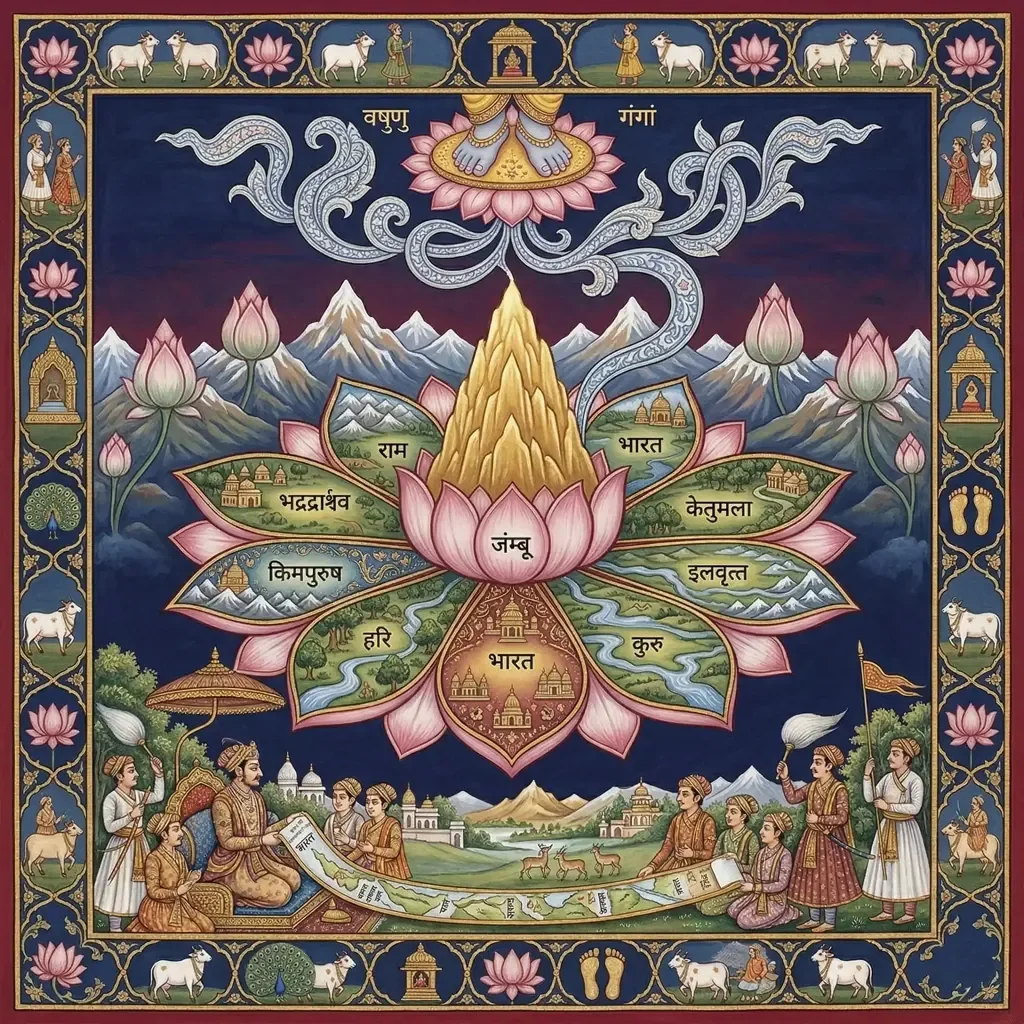
Amsha 2: Priyavrata’s Lineage and the Sacred Geography of Bhū-maṇḍala (Jambūdvīpa & Bhārata-varṣa)
द्वितीयोऽंशः (भू-मण्डलवर्णनं तथा प्रियव्रतवंशानुचरितम्)
Sacred Geography of Bhu-mandala
Amsha 2 carries forward the Guru–Śiṣya dialogue of Parāśara and Maitreya, moving from cosmogony into cosmography and sacred history. Viṣṇu is affirmed as Jagat-kāraṇa—the cause of the world, both upādāna (material) and nimitta (efficient)—who orders creation into intelligible forms: dynasties, continents (dvīpas), regions (varṣas), mountains, rivers, and divine abodes. Maitreya’s careful questions model śāstra-guided inquiry, while Parāśara’s replies interpret the world as a dharmic architecture upheld by Hari’s sovereignty. Knowledge is thus not mere description, but a way of seeing the cosmos through the lens of dharma. The narrative opens with Priyavrata’s progeny and the apportioning of the seven dvīpas, then turns to Jambūdvīpa’s nine varṣas, Mount Meru as the cosmic axis, and the Gaṅgā descending from Viṣṇu’s foot as a purifying sacred stream. Bhārata-varṣa receives special theological emphasis as karma-bhūmi, where yajña, tapas, dāna, and yoga can yield both svarga and apavarga (mokṣa). Geography thereby becomes a devotional map: the cosmos is not only described, but read as the field in which Viṣṇu’s immanence and lordship are realized through dharma and bhakti-informed action.
Adhyayas in Amsha 2 - Sacred Geography
Adhyaya 1
प्रियव्रतवंशवर्णनम् — सप्तद्वीपविभागः, जम्बूद्वीप-वर्षविभागः, भरत-नामकरणम्
After hearing the teaching on sarga, Maitreya asks Parāśara to describe what was not yet detailed—the descendants of Priyavrata. Parāśara lists Priyavrata’s sons, noting that some were yoga-parāyaṇa and indifferent to kingship. Priyavrata then orders sovereignty in a cosmic way, dividing the seven dvīpas among seven sons and establishing a dharmic polity aligned with the world’s structure. The account narrows to Jambūdvīpa: Āgnīdhra rules and begets nine sons whose names become the nine varṣa divisions; their placement around Meru and the directional logic are explained. Having set order, Priyavrata retires to Śālagrāma for tapas, exemplifying renunciation. The chapter highlights Nābhi’s realm and the birth of Ṛṣabha, then Bharata’s rule, renunciation, and the naming of Bhārata-varṣa. A long genealogical succession follows, concluding with the Svāyambhuva sarga context and reference to the Varāha-kalpa manvantara framework.
Adhyaya 2
भू-मण्डलसंक्षेपवर्णनम् — सप्तद्वीप-सप्तसमुद्राः, मेरु-मानम्, गङ्गावतरणम्, देववन-सरोवर-लोकपालपुर्यः
Maitreya asks for a full account of the Earth’s mandala—its measures, supports, and arrangement. Parāśara agrees, yet says only a brief outline can be given, and he enumerates the seven dvīpas and the seven surrounding oceans of differing substances, placing Jambūdvīpa at the center. He describes golden Meru as the cosmic axis, with its dimensions and the lotus-pericarp metaphor, and lists the boundary mountains (varṣa-parvatas), the nine-thousand-yojana extent of the varṣas, and Ilāvṛta encircling Meru. He mentions the great trees (notably the Jambū tree), the Jambūnadī river and Jāmbūnada gold, and the directional varṣas Bhadrāśva and Ketumāla. The divine forests and lakes near Meru are mapped, along with the Kesarā ranges and boundary mountains in each direction. Above Meru lies Brahmā’s city, surrounded by the cities of the lokapālas. Gaṅgā descends from Viṣṇu’s foot, floods the lunar sphere, falls into Brahmā’s city, and divides into four streams flowing to the four oceans. The chapter ends by affirming Viṣṇu’s presence in many forms across the varṣas and reiterating the effortless, sorrowless condition of the eight regions outside Bhārata.
Adhyaya 3
भारतवर्षमहात्म्यम् — कर्मभूमित्वम्, नवभेदाः, कुलपर्वताः-नद्यः-जनपदाः, युगचक्रविशेषः, यज्ञपुरुषविष्णुपूजा
Parāśara defines Bhārata-varṣa by its bounds—north of the ocean and south of the Himālaya—and states its extent. He declares Bhārata the karma-bhūmi where embodied beings may, through action, attain svarga or apavarga (liberation), unlike other regions that are bhoga-bhūmis. He lists the seven kula-parvatas and teaches that from this land arise all destinations—heaven, liberation, animal births, and hell—because the law of karmic consequence according to dharma and adharma operates here. He enumerates Bhārata’s nine divisions, its inhabited limits (Kirātas in the east, Yavanas in the west), the varṇa-based social order, and the great rivers issuing from major mountain ranges, along with many peoples and regions as sacred geography. A key doctrine follows: only in Bhārata do all four yugas fully manifest, enabling yajña, tapas, and dāna aimed at the next world. In Jambūdvīpa, Viṣṇu is worshipped as Yajñapuruṣa through sacrifice, while other dvīpas have different modes. The chapter ends by praising the rarity of human birth in Bhārata and by mentioning the ring-shaped Kṣāra ocean encircling Jambūdvīpa.
Adhyaya 4
सप्तद्वीप-समुद्र-प्रमाणम्: प्लक्षादि-द्वीपवर्णनं, लोकालोक-सीमा, चन्द्र-समुद्र-वृद्धिक्षयः
Maitreya hears as Parāśara continues the concentric design of Bhū-maṇḍala: beyond Jambū’s salt ocean lies Plakṣadvīpa, twice Jambū’s measure, with its seven varṣas and rulers, boundary mountains, and purifying rivers, where a Tretā-like order prevails with varṇa–āśrama discipline and Soma-form worship of Hari. The account then moves outward through Śālmaladvīpa, Kuśadvīpa, Krauñcadvīpa, Śākadvīpa, and Puṣkaradvīpa, repeatedly giving the doubling of measures, the sevenfold mountains/rivers/regions, and region-specific modes of worship of Janārdana (as Brahmā-form, Rudra-form, Sūrya-form, and the like). In Puṣkara, Mānasottara divides the island into two varṣas and its distinctive social condition is noted. Next come the sweet-water ocean, the lifeless golden land, and Lokāloka mountain as the boundary of the manifest worlds. The chapter ends with the sea’s rise and fall in harmony with the Moon and the total extent of the earth-system within the brahmāṇḍa shell, affirming Viṣṇu’s regulated cosmic sovereignty.
Adhyaya 5
मेरु-प्रमाणम्, सप्त-पाताल-वर्णनम्, तथा अनन्त-शेष-तत्त्वम्
Parāśara continues instructing Maitreya: he states Meru’s height and then lists the seven Pātālas, each spreading ten thousand yojanas. These nether realms are portrayed as dazzling—many-hued lands with mansions—inhabited by Dānavas, Daityas, and mighty Nāgas. Citing Nārada’s testimony, Parāśara stresses that Pātāla can seem more delightful than Svarga, rich with jewels, music, forests, rivers, and pleasures where time is scarcely felt. The account then descends beneath Pātāla to Viṣṇu’s manifestation as Śeṣa/Ananta, praised by Siddhas and worshipped by gods and sages: thousand-headed, jewel-hooded, radiant, and bearing the whole earth at Pātāla’s root. Parāśara explains that Ananta’s power is beyond description; when He stirs, the earth trembles, and His endless qualities make the name “Ananta” true. Thus the chapter grounds cosmography in theology: the world rests on divine support, ultimately in Viṣṇu’s śakti and presence.
Adhyaya 6
नरक-निर्णयः, पाप-कर्म-फल-व्यवस्था, प्रायश्चित्त-क्रमः, तथा हरि-स्मरण-परमत्वम्
Parāśara tells Maitreya that beneath earth and the waters lie many Narakas within Yama’s realm, where karmic results ripen. He names major hell-realms and assigns particular sins to particular Narakas: false testimony; grave violence such as bhrūṇahatyā, guru-hatyā, and go-hatyā; surā-drinking; brahma-hatyā; gold-theft; sexual transgressions; insulting or abusing gurus; defiling, selling, or trading the Veda; destroying forests; deceitful livelihoods; and other breaches of dharma and maryādā. After noting innumerable Narakas and the graded movement of beings, he turns to prāyaścitta: expiations match the sin, yet the supreme expiation is Hari/Kṛṣṇa-smaraṇa—remembering Nārāyaṇa at the junctions of time swiftly destroys sin. He warns that even svarga and Indra-hood can hinder liberation for the Vāsudeva-centered devotee. The chapter closes by treating heaven and hell as names for the experience of puṇya and pāpa, and by affirming a knowledge-centered metaphysic in Viṣṇu’s order, where jñāna is both bondage and Brahman, integrating ethics, mind, and mokṣa.
Adhyaya 7
लोकसंस्थानम्, ग्रहदूरी-प्रमाणम्, ब्रह्माण्डावरणानि, विष्णोः जगत्कारणत्वम्
Maitreyā asks Parāśara to explain the order of the lokas from Bhuvarloka upward and the arrangement and measured distances of the grahas. Parāśara defines Earth’s extent as far as the Sun’s and Moon’s rays reach, then gives the successive distances above: Sun, Moon, the nakṣatra-maṇḍala, Budha, Śukra, Maṅgala, Bṛhaspati, Śani, the Saptarṣi-maṇḍala, and Dhruva as the cosmic pivot. He describes the higher lokas above Dhruva—Maharloka, Janaloka, Tapoloka, Satyaloka/Brahmaloka—and sets spatial intervals for Bhūrloka, Bhuvarloka, and Svarga. He distinguishes kṛtaka (made) from akṛtaka (unmade) realms, placing Maharloka between them. The teaching then turns to the brahmāṇḍa shell and the seven tenfold envelopes—water→fire→wind→space→bhūtādi→mahat→pradhāna—and to countless universes. Finally, he grounds cosmology in Vedāntic devotion: Puruṣa within Pradhāna, both upheld by Viṣṇu-śakti; creation proceeds without diminishing its cause; and Hari is the Supreme Brahman—sacrifice, its instruments, and its fruits being non-different from Him.
Adhyaya 8
सूर्यरथ-कालचक्र-आयनविभागः, संध्योपासनम्, देवयान-पितृयानम्, विष्णुपद-गङ्गावतरणम्
Parāśara moves from the structure of the brahmāṇḍa to the measures and ordering of Sūrya and the other luminaries: the Sun’s chariot, its axle, and the kāla-cakra (wheel of time) with hub, courses, and rim. He explains day and night as relative visibility rather than absolute rising and setting, and details uttarāyaṇa/dakṣiṇāyana, rāśi traversal, nakṣatra movement by muhūrtas, and time units (nimeṣa→kāṣṭhā→kalā→muhūrta; 30 muhūrtas in a day-night). Dharma is woven in through sandhyā: at twilight the Mandeha rākṣasas assail the Sun, and brāhmaṇas protect cosmic order by water-offerings empowered by Oṃ and the Gāyatrī; neglect of sandhyā is portrayed as harming the Sun. Parāśara then describes the Lokāloka boundary and the Devayāna and Pitṛyāna paths with siddhas and agnihotrin ṛṣis. The teaching culminates in the “third Viṣṇu-pada” linked with Dhruva, support of the three worlds and cause of rain; from it Gaṅgā arises, borne by Dhruva, passing the Saptarṣis, descending from the Moon to Meru, and flowing as four streams to the four directions—granting purification, efficacy in pitṛ-tarpaṇa, prosperity, and liberation for Keśava-bhaktas.
Adhyaya 9
शिशुमार-रूपं, ध्रुवबन्धनम्, वृष्टिचक्र-पालनम्, नारायणाधारत्वम्
Parāśara describes Hari’s celestial arrangement as the star-formed Śiśumāra (cosmic dolphin), with Dhruva fixed at the tip of its tail. Dhruva’s circling regulates the revolutions of the Sun, Moon, planets, and constellations, said to be bound to him by the unseen “wind-host” bonds that uphold cosmic order. Dhruva, son of Uttānapāda, attained this station through devoted worship of the Lord. Parāśara then clarifies the chain of support: Janārdana upholds the Śiśumāra; the Śiśumāra rests on Dhruva; and the Sun’s station is established upon Dhruva—yet in the end all rests upon Nārāyaṇa. The chapter also explains the rainfall cycle that sustains life: the Sun draws up waters for eight months and releases them as rain, producing food and nourishing beings; waters are conveyed through Soma (the Moon) and spread into clouds by wind-channels. It distinguishes cloud-rain from the purifying ‘ākāśa-gaṅgā’ waters that fall without clouds. The cycle culminates in dharma: rain enables food, sacrifice, Veda-ordered life, and the nourishment of the devas, showing cosmic processes and ritual economy integrated under Nārāyaṇa enthroned at the heart of the Śiśumāra.
Adhyaya 10
सूर्यरथः, सप्तगणाः, मासाधिकारिणः (The Sun’s Chariot and the Sevenfold Monthly Governors)
Parāśara teaches Maitreya the measurement of time and the Sun’s yearly course, then describes Sūrya’s chariot as served by ordered classes—Ādityas, Ṛṣis, Gandharvas, Apsarases, Grāmaṇīs, Nāgas, and Rākṣasas—each appointed to a distinct duty. He lists the seven groups who govern month by month (māsādhikāriṇaḥ), beginning with Caitra and continuing through the year, showing that the solar orb is not solitary but a regulated seat of many cosmic agencies. The chapter ends by summarizing their sacred functions: sages praise, Gandharvas sing, Apsarases dance, Nāgas bear the load, Yakṣas marshal the rays, and Vālakhilyas encircle the Sun—together, by Viṣṇu’s sovereign ordinance, becoming the causes of seasonal cold and heat and of rainfall when their time arrives.
Adhyaya 11
आदित्यकर्म, त्रयीमयी वैष्णवी शक्तिः, सवितुरन्तर्यामी (The Sun’s Function and Vishnu’s Vedic Śakti within Savitṛ)
Maitreya raises a sharp doubt: if the saptagaṇa bring about cold, heat, and rain, what is the Sun’s own function, and why is rainfall credited to the Sun? Parāśara replies by affirming hierarchy—among the sevenfold host, Ravi is foremost in governance. He grounds this in theology: Viṣṇu’s supreme śakti, identical with the trayī (Ṛg–Yajus–Sāman), abides within Savitṛ as the indwelling ruler (antaryāmin). The day’s phases mirror the Vedic triad—Ṛk in the forenoon, Yajus at midday, and Sāman as the day declines. He also links Brahmā–Viṣṇu–Rudra with Ṛg–Yajus–Sāman and recalls the attendant roles of Gandharvas, Apsarases, Nāgas, Yakṣas, and Vālakhilyas. The chapter ends with cosmic sustenance: the Sun nourishes Devas, Pitṛs, and humans; the Suṣumnā ray feeds Soma; and the Sun draws up and releases the earth’s essence for crops—Viṣṇu’s preserving power operating through Sūrya.
Adhyaya 12
सोमचक्रः, ग्रह-रथाः, ध्रुवबन्धनं, शिशुमारसंनिवेशः, विष्णु-सर्वात्मकता (Moon, Planets, Dhruva-Tethering, Śiśumāra, and Vishnu as All)
Parāśara describes Soma’s three-wheeled chariot with ten radiant horses, and explains the Moon’s waning and waxing: the Sun replenishes Soma with a single ray, while the Devas drink the gathered nectar through the two fortnights. At new moon Soma enters the Sun’s orb; the Moon’s passage through waters and plants is detailed, with a strict dharma warning not to harm vegetation then. The planetary chariots (Śukra, Bhoma, Bṛhaspati, Śanaiścara, Rāhu/Ketu) are surveyed, and the principle is taught that all luminaries are bound to Dhruva by wind-rays in the pravaha stream, with analogies explaining apparent motion. Parāśara then sets forth the Śiśumāra cosmic form and its deities as a merit-giving contemplation. The chapter culminates in the teaching that luminaries, worlds, rivers, and directions are Viṣṇu; distinctions are expansions of vijñāna, and pure knowledge alone is ultimately real, guiding the seeker into Vāsudeva.
Adhyaya 13
भरतचरितम्—मृगासक्ति-हेतुकः समाधिभङ्गः, जातिस्मरत्वं, रहूगण-जाḍभरत-संवादः
Maitreya, accepting Parāśara’s earlier cosmological teaching, asks why Bharata was reborn despite practicing yoga at Śālagrāma. Parāśara relates that Bharata was absorbed in Vāsudeva-japa and performed few rites; then a frightened doe miscarried, and Bharata rescued the fawn, gradually falling into possessive attachment (mamātmya). His samādhi broke; at death his mind clung to the deer, so he was reborn as a jāti-smara deer. Renouncing even that life, he returned to Śālagrāma, performed expiation, and was reborn as a Brahmin with full scriptural insight, yet assumed a jada/unmatta guise to avoid honor and company. Forced into palanquin service for King Rahūgaṇa, he taught through a piercing inquiry into “I” and “mine,” dismantling notions of body, burden, and designation, and declaring the Self nirguṇa, akṣara, beyond prakṛti. The humbled king grasps the sage’s feet and seeks instruction.
Adhyaya 14
परमार्थ-निर्णयः—श्रेयस्-भेदः, कर्म-ध्यान-सीमा, एकात्मदर्शनम्
Following the king’s humbled stance, the teaching turns to paramārtha. Maitreya says the doctrine both unsettles and uplifts the mind, praising the universal reach of viveka-jñāna. Parāśara explains that many ‘goods’ (śreyas)—ritual merit, wealth, sons, kingship, even heaven gained by yajña—are only provisional; the supreme śreyas is realizing the unity of Ātman with Paramātman (Viṣṇu). He criticizes seeking the imperishable through perishable ritual materials, and warns that even meditation, if treated as a separative act, falls short of non-dual paramārtha. The chapter ends with a concise definition: the One Self is all-pervading, equal, pure, nirguṇa, beyond prakṛti, unborn and imperishable; distinctions of name and jāti are superimpositions. True knowledge is seeing one consciousness in oneself and others; analogies like flute-notes and wind show apparent multiplicity upon an undivided reality.
Adhyaya 15
ऋभु–निदाघ-संवादः—अद्वैत-उपदेशः, समता, वासुदेव-स्वरूप-एकत्वम्
With the king absorbed in contemplation, Parāśara continues the teaching through the Ṛbhu–Nidāgha episode, framed as an advaita-leaning discourse to awaken direct understanding. Ṛbhu, son of Brahmā, visits his disciple Nidāgha after a long interval, using hospitality and food to question hunger, satisfaction, taste (mṛṣṭa/amṛṣṭa), and mental steadiness, thereby separating bodily dharmas from the Self. By explaining earth, water, fire, and other elements, he shows that bodily states arise from material conditions while the realized standpoint remains untouched. The instruction transcends notions of “coming and going,” affirming the all-pervading Person like space. Samatā—equanimity—is taught as the practical support for liberation. The chapter ends with Ṛbhu revealing his identity and sealing the non-dual vision: the entire undivided universe is the very svarūpa of Vāsudeva, the Paramātman.
Adhyaya 16
ऋभु-निदाघ-संवादः — अधः-ऊर्ध्व-दृष्टान्तेन अद्वैतबोधः (राजा-गज-उपमा) तथा मोक्षफलश्रुति
Parāśara tells Maitreya that after a thousand years Ṛbhu returns to the same city to complete Nidāgha’s training in the knowledge of dispassion (vairāgya-jñāna). Outside the city Nidāgha stands apart from the crowd as the king enters with a mighty retinue; Ṛbhu approaches and asks why he is alone. The dialogue moves from identifying the “king” versus “the other” to the king-and-elephant example of what “below” and “above” mean. Ṛbhu teaches a critique of standpoint: relational labels depend on position and therefore cannot define the Self (Ātman). Nidāgha recognizes Ṛbhu as his guru, receives the essence of paramārtha—advaitha—attains abheda-darśana, and is liberated. Parāśara adds that as one sky appears many-colored, the one Ātman seems divided to deluded sight; in truth everything is Acyuta alone. The fruit is declared: the king abandons bheda and gains apavarga in this very life, and devoted hearing/recitation purifies the mind and makes one fit for mukti.
Frequently Asked Questions
It maps sacred history and sacred geography together: Priyavrata’s lineage and the partition of the earth into dvīpas/varṣas, culminating in Jambūdvīpa and Bhārata-varṣa as the unique karma-bhūmi where dharma, yajña, yoga, and devotion to Viṣṇu can lead to svarga and mokṣa.
By portraying the cosmos as an ordered system sustained by Hari’s ordinance: continents, oceans, mountains, rivers, and even the descent of Gaṅgā from Viṣṇu’s foot are framed as expressions of Viṣṇu’s immanence (as the Self of all) and lordship (as the arranger and supporter of all).
Because only in Bhārata-varṣa do the full four yugas operate and the moral conditions for merit/demerit and spiritual striving are fully present; therefore human action (karma) performed as yajña, dāna, tapas, and yoga can meaningfully lead to svarga or apavarga (liberation).
Read Vishnu Purana in the Vedapath app
Scan the QR code to open this directly in the app, with audio, word-by-word meanings, and more.