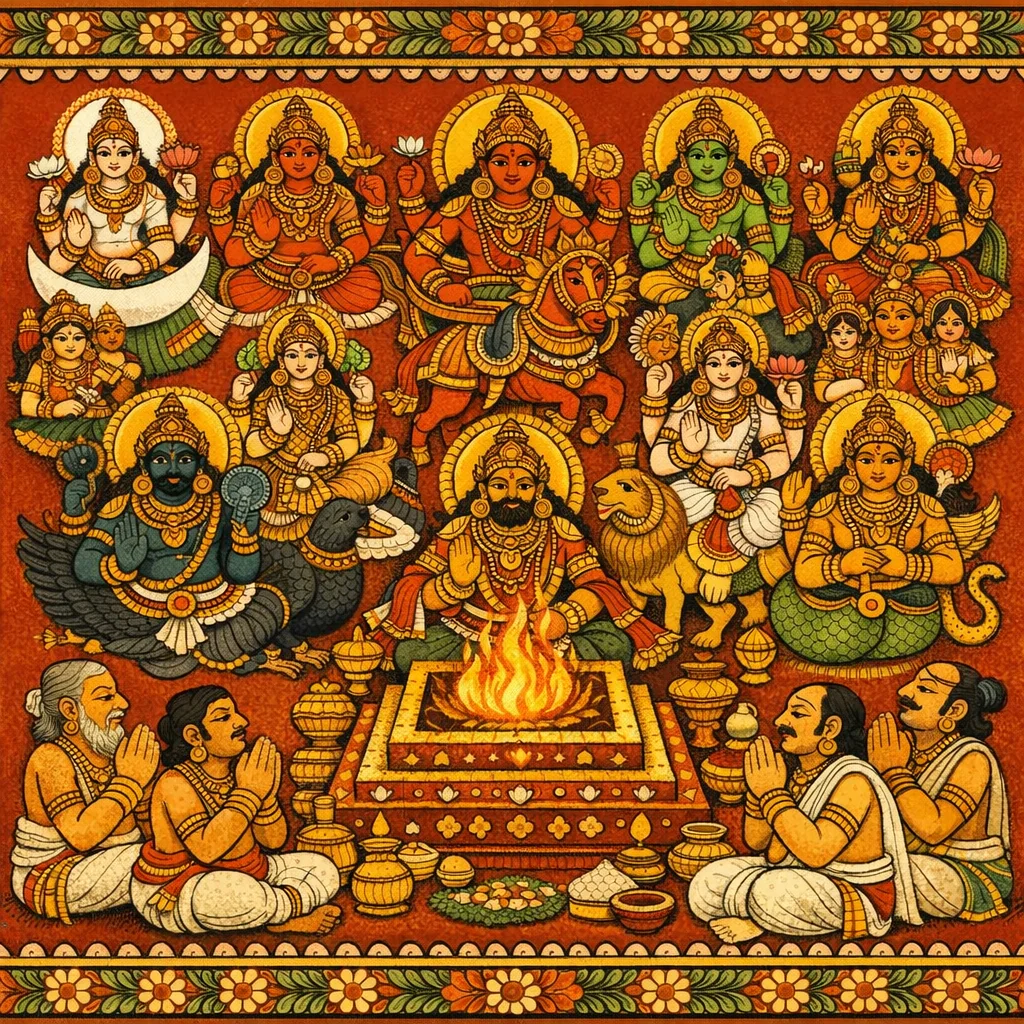
Adhyaya 93: Navagraha Sacrifice for Planetary Pacification and Prosperity (Ayuta–Lakṣa–Koṭi Homa Procedures)
ग्रहयज्ञ-शान्ति-पौष्टिकविधानम्
Speaker: Sūta, Śaunaka, Vaiśampāyana
Sūta recounts a former assembly where Śaunaka asks Vaiśampāyana how śāntika (pacificatory) and pauṣṭika (prosperity‑giving) rites should be performed so that wishes are continually fulfilled. Vaiśampāyana replies that the graha‑yajña is the chief remedy for peace, prosperity, growth, longevity, nourishment, and the countering of harms. He then details: (1) preparations—an auspicious day and brāhmaṇa recitation; (2) installation of the Navagrahas with their adhidevatā/pratyadhidevatā connections; (3) altar geometry and directional placements; (4) homa materials—order of samidh, offerings of ghee, barley, rice, sesame, and mantra‑specific oblations; (5) abhiṣeka and honoring the priests; and (6) graded intensities—ayuta, lakṣa, koṭi—with expanded kuṇḍa/maṇḍapa specifications and required priest counts. The chapter concludes with the fruits (worldly success, heavenly honor, liberation), ethical limits (no yajña without dakṣiṇā), the teaching that śānti is armor against daiva afflictions, and a warning against habitual abhicāra even though certain kāmya rites are described.
Key Concepts
Shlokas in Adhyaya 93
Verse 1
*सूत उवाच वैशम्पायनम् आसीनम् अपृच्छच्छौनकः पुरा सर्वकामाप्तये नित्यं कथं शान्तिकपौष्टिकम् //
Sūta said: Long ago, Śaunaka questioned Vaiśampāyana as he sat in the assembly: “For the continual attainment of all desired aims, how is the pacificatory (śāntika) and prosperity-conferring (pauṣṭika) rite to be performed?”
Verse 2
*वैशम्पायन उवाच श्रीकामः शान्तिकामो वा ग्रहयज्ञं समारभेत् वृद्ध्यायुः पुष्टिकामो वा तथैवाभिचरन्पुनः येन ब्रह्मन्विधानेन तन्मे निगदतः शृणु //
Vaiśampāyana said: Whether one seeks fortune or desires peace, one should undertake the planetary sacrifice (graha-yajña). Likewise, one who longs for growth, longevity, and nourishment—or even one engaged in counteracting harmful influences—should perform it again and again. O Brahmin, listen as I explain the prescribed procedure by which it is to be done.
Verse 3
सर्वशास्त्राण्यनुक्रम्य संक्षिप्य ग्रन्थविस्तरम् ग्रहशान्तिं प्रवक्ष्यामि पुराणश्रुतिचोदिताम् //
Having surveyed all the treatises in due order and condensed their expansive detail, I shall now teach the pacificatory rite for the planets (graha-śānti), as enjoined by Purāṇic tradition and sacred śruti.
Verse 4
पुण्ये ऽह्नि विप्रकथिते कृत्वा ब्राह्मणवाचनम् ग्रहान्ग्रहाधिदेवांश्च स्थाप्य होमं समारभेत् //
On an auspicious day, as prescribed by the brāhmaṇas, one should arrange for brāhmaṇa recitation; then, having installed (invoked) the planetary deities and their presiding divinities, one should commence the fire-offering (homa).
Verse 5
ग्रहयज्ञस्त्रिधा प्रोक्तः पुराणश्रुतिकोविदैः प्रथमो ऽयुतहोमः स्याल् लक्षहोमस्ततः परम् //
Those skilled in the Purāṇas and the śruti tradition declare the graha-yajña to be of three kinds. The first is the ayuta-homa, consisting of ten thousand oblations; the next is the lakṣa-homa, consisting of a hundred thousand oblations.
Verse 6
तृतीयः कोटिहोमस्तु सर्वकामफलप्रदः अयुतेनाहुतीनां च नवग्रहमखः स्मृतः //
The third is the koṭi-homa, which bestows the fruits of all desired aims. And the Navagraha-sacrifice is remembered as consisting of ten thousand oblations (āhuti).
Verse 7
तस्य तावद्विधिं वक्ष्ये पुराणश्रुतिभाषितम् गर्तस्योत्तरपूर्वेण वितस्तिद्वयविस्तृताम् //
Now I shall explain its procedure, as stated in the Purāṇic tradition: on the north‑eastern side of the pit (garta), it should be laid out with a breadth of two vitastis (spans).
Verse 8
वप्रद्वयावृतां वेदिं वितस्त्युच्छ्रायसंमिताम् संस्थापनाय देवानां चतुरस्रामुदङ्मुखाम् //
For establishing the deities, one should set up a square altar (vedī), enclosed by two embankments, measured to a height of one vitasti, and oriented facing north.
Verse 9
अग्निप्रणयनं कृत्वा तस्यामावाहयेत्सुरान् देवतानां ततः स्थाप्या विंशतिर्द्वादशाधिका //
Having performed the bringing in and installation of the sacred fire (agni‑praṇayana), one should invoke the gods into it. Thereafter, twenty deities, with twelve added (thirty‑two in total), are to be duly established in their respective places.
Verse 10
सूर्यः सोमस्तथा भौमो बुधजीवसितार्कजाः राहुः केतुरिति प्रोक्ता ग्रहा लोकहितावहाः //
Sun, Moon, Mars, Mercury, Jupiter, Venus, and Saturn, along with Rahu and Ketu—these are declared to be the grahas (planets), bearers of welfare for the world.
Verse 11
मध्ये तु भास्करं विद्याल् लोहितं दक्षिणेन तु उत्तरेण गुरुं विद्याद् बुधं पूर्वोत्तरेण तु //
One should place (or recognize) the Sun in the middle; Mars on the southern side; Jupiter on the northern side; and Mercury in the north‑eastern direction.
Verse 12
पूर्वेण भार्गवं विद्यात् सोमं दक्षिणपूर्वके पश्चिमेन शनिं विद्याद् राहुं पश्चिमदक्षिणे पश्चिमोत्तरतः केतुं स्थापयेच्छुक्लतण्डुलैः //
One should recognize Bhārgava (Śukra, Venus) in the east, Soma (the Moon) in the south-east, and Śani (Saturn) in the west; Rāhu is to be known in the south-west. In the north-west one should establish Ketu, using white grains of rice.
Verse 13
भास्करस्येश्वरं विद्याद् उमां च शशिनस्तथा स्कन्दमङ्गारकस्यापि बुधस्य च तथा हरिम् //
One should understand Īśvara (Śiva) as the presiding deity of the Sun; likewise Umā as that of the Moon; Skanda as that of Maṅgala (Mars); and similarly Hari (Viṣṇu) as that of Budha (Mercury).
Verse 14
ब्रह्माणं च गुरोर्विद्याच् छुक्रस्यापि शचीपतिम् शनैश्चरस्य तु यमं राहोः कालं तथैव च //
One should know Brahmā as the presiding deity of Jupiter (Guru); Indra (the lord of Śacī) as that of Venus (Śukra); Yama as that of Saturn (Śanaiścara); and Kāla (Time/Death) likewise as that of Rāhu.
Verse 15
केतोर्वै चित्रगुप्तं च सर्वेषामधिदेवताः अग्निरापः क्षितिर्विष्णुर् इन्द्र ऐन्द्री च देवताः //
For Ketu, indeed, the presiding deity is Citragupta. And as the higher presiding divinities over all these principles are: Agni (Fire), Āpas (Waters), Kṣiti (Earth), Viṣṇu, Indra, and Aindrī (the power of Indra).
Verse 16
प्रजापतिश्च सर्पाश्च ब्रह्मा प्रत्यधिदेवताः विनायकं तथा दुर्गां वायुराकाशमेव च आवाहयेद्व्याहृतिभिस् तथैवाश्विकुमारकौ //
With the sacred utterances (vyāhṛtis), one should invoke Prajāpati, the Serpents (Nāgas), and Brahmā as the presiding counter-deities; likewise Vināyaka (Gaṇeśa), Durgā, Vāyu (Wind), and Ākāśa (Space)—and in the same manner the Aśvinī-kumāras, the twin divine physicians.
Verse 17
संस्मरेद्रक्तमादित्यम् अङ्गारकसमन्वितम् सोमशुक्रौ तथा श्वेतो बुधजीवौ च पिङ्गलौ मन्दराहू तथा कृष्णौ धूम्रं केतुगणं विदुः //
One should meditate upon the Sun as red, together with Aṅgāraka (Mars). The Moon and Śukra (Venus) are to be remembered as white; Budha (Mercury) and Jīva/Bṛhaspati (Jupiter) as tawny, yellow-brown. Śanaiścara (Saturn) and Rāhu are to be known as black, and the host of Ketus as smoke-colored.
Verse 18
ग्रहवर्णानि देयानि वासांसि कुसुमानि च धूपामोदो ऽत्र सुरभिर् उपरिष्टाद् वितानिकम् शोभनं स्थापयेत्प्राज्ञः फलपुष्पसमन्वितम् //
Cloths and flowers should be offered in the colors prescribed for the planets, and fragrant incense should be used there. Above, the wise officiant should set up an auspicious and beautiful vitānika (canopy or pavilion), adorned with fruits and flowers.
Verse 19
गुडौदनं रवेर्दद्यात् सोमाय घृतपायसम् अङ्गारकाय संयावं बुधाय क्षीरषष्टिके //
To Ravi (the Sun) one should offer guḍaudana—rice mixed with jaggery. To Soma (the Moon), ghṛtapāyasa—rice pudding cooked with ghee. To Aṅgāraka (Mars), saṃyāva, a sweet preparation. To Budha (Mercury), ṣaṣṭika rice cooked in milk.
Verse 20
दध्योदनं च जीवाय शक्राय च घृतौदनम् शनैश्चराय कृसराम् अजामांसं च राहवे चित्रौदनं च केतुभ्यः सर्वभक्ष्यैरथार्चयेत् //
To Jīva/Bṛhaspati (Jupiter) one should offer dadhyodana—rice cooked with curd; and to Śakra (Indra), ghṛtaudana—rice cooked with ghee. To Śanaiścara (Saturn) one should offer kṛsara, a mixed rice dish. To Rāhu, goat’s meat; and to Ketu, variegated (mixed/colored) rice. Thus should one worship them with all appropriate food-offerings.
Verse 21
प्रागुत्तरेण तस्माच्च दध्यक्षतविभूषितम् चूतपल्लवसंछन्नं फलवस्त्रयुगान्वितम् //
On its east–north side, it should be adorned with curds and unbroken rice-grains (akṣata), covered with mango leaves, and furnished with fruits and a pair of cloths.
Verse 22
पञ्चरत्नसमायुक्तं पञ्चभङ्गसमन्वितम् स्थापयेदव्रणं कुम्भं वरुणं तत्र विन्यसेत् //
One should install an unblemished ritual water-pot (kumbha), furnished with the five gems and accompanied by the five sacred substances; and there one should invoke and establish Varuṇa.
Verse 23
गङ्गाद्याः सरितः सर्वाः समुद्रांश्च सरांसि च गजाश्वरथ्यावल्मीकसंगमाद्ध्रदगोकुलात् //
All rivers beginning with the Gaṅgā, the oceans, and the lakes as well—these sacred waters—from confluences near elephant-grounds, horse-tracks, chariot-roads, and anthills, and from pools and cow-settlements, are to be regarded as holy for purificatory bathing and rites.
Verse 24
मृदमानीय विप्रेन्द्र सर्वौषधिजलान्विताम् स्नानार्थं विन्यसेत्तत्र यजमानस्य धर्मवित् //
O best of Brahmins, having brought consecrated earth (purifying clay) together with water infused with all medicinal herbs, the knower of dharma should place it there for the sacrificer’s ritual bath.
Verse 25
सर्वे समुद्राः सरितः सरांसि च नदास्तथा आयान्तु यजमानस्य दुरितक्षयकारकाः //
May all the oceans, the rivers, the lakes, and likewise the streams come forth for the sacrificer (yajamāna), as agents that bring about the destruction of his sins.
Verse 26
एवमावाहयेदेतान् अमरान्मुनिसत्तम होमं समारभेत्सर्पिर् यवव्रीहितिलादिना //
Thus, O best of sages, having invoked these immortal gods, one should then begin the fire-offering (homa) using ghee, along with barley, rice, sesame, and the like.
Verse 27
अर्कः पलाशखदिराव् अपामार्गो ऽथ पिप्पलः औदुम्बरः शमी दूर्वा कुशाश्च समिधः क्रमात् //
In proper sequence, the sacred fuel-sticks (samidhā) for the fire-rite are: arka, palāśa and khadira; then apāmārga and pippala; also udumbara, śamī, dūrvā, and kuśa—these are the samidhās in order.
Verse 28
एकैकस्याष्टकशतम् अष्टविंशतिरेव वा होतव्या मधुसर्पिर्भ्यां दध्ना चैव समन्विताः //
For each one, oblations (āhuti) should be offered—either one hundred and eight, or else twenty-eight—each accompanied by honey, ghee, and also curd.
Verse 29
प्रादेशमात्रा अशिफा अशाखा अपलाशिनीः समिधः कल्पयेत्प्राज्ञः सर्वकर्मसु सर्वदा //
A wise person should always prepare the samidh-sticks for every rite so that they are a span in length, without pointed tips, without branches, and without leaves.
Verse 30
देवानामपि सर्वेषाम् उपांशु परमार्थवित् स्वेन स्वेनैव मन्त्रेण होतव्याः समिधः पृथक् //
For all the deities as well, the knower of the highest truth should make the offerings in a low voice (upāṁśu); and the samidh-sticks are to be offered separately, each with its own respective mantra.
Verse 31
होतव्यं च घृताभ्यक्तं चरुभक्षादिकं पुनः मन्त्रैर्दशाहुतीर्हुत्वा होमं व्याहृतिभिस्ततः //
One should again offer into the fire oblations anointed with ghee, along with caru (cooked rice) and other edible offerings. Having made ten oblations with the prescribed mantras, one should then perform the homa with the sacred utterances (vyāhṛtis).
Verse 32
उदङ्मुखाः प्राङ्मुखा वा कुर्युर्ब्राह्मणपुंगवाः मन्त्रवन्तश्च कर्तव्याश् चरवः प्रतिदैवतम् //
Facing either north or east, the foremost among Brahmins should perform the rite; and for each deity, the cooked offering (caru) is to be prepared together with the proper mantras.
Verse 33
हुत्वा च तांश्चरून्सम्यक् ततो होमं समाचरेत् आकृष्णेति च सूर्याय होमः कार्यो द्विजन्मना //
Having properly offered those ritual rice-cakes (caru) into the fire, one should then duly perform the homa. A twice-born person should make the fire-offering to Sūrya, reciting the formula beginning with “ā-kṛṣṇa…”.
Verse 34
आप्यायस्वेति सोमाय मन्त्रेण जुहुयात्पुनः अग्निर्मूर्धा दिवो मन्त्र इति भौमाय कीर्तयेत् //
Again, one should offer an oblation to Soma with the mantra beginning “Āpyāyasva” (“May you be nourished and increase”). Then, invoking the Earth-born deity (Bhauma), one should recite the mantra: “Agni is the head of heaven.”
Verse 35
अग्ने विवस्वदुषस इति सोमसुताय वै बृहस्पते परिदीया रथेनेति गुरोर्मतः //
“O Agni, (with) Vivasvat and Uṣas…”—this mantra is prescribed for the son of Soma; and for Bṛhaspati, the mantra “paridīyā rathena” is approved—such is the considered opinion of the Guru (the authoritative teacher).
Verse 36
शुक्रं ते अन्यदिति च शुक्रस्यापि निगद्यते शनैश्चरायेति पुनः शं नो देवीति होमयेत् //
For Venus, one should recite the mantra beginning “śukraṃ te anyat…”. Then again, for Saturn, (reciting) “śanaiścarāya…”, one should offer oblations into the fire with the mantra “śaṃ no devī…”.
Verse 37
कया नश्चित्र आभुवद् इति राहोरुदाहृतः केतुं कृण्वन्न् अपि ब्रूयात् केतूनामपि शान्तये //
Reciting the formula “Kayā naś citra ābhuvat,” which is proclaimed as Rahu’s appeasement chant, one should also utter it while performing the rite for Ketu, for the pacification of the ketus—comets and other celestial portents.
Verse 38
आ वो राजेति रुद्रस्य बलिहोमं समाचरेत् आपो हि ष्ठेत्युमायास्तु स्योनेति स्वामिनस्तथा //
One should duly perform the bali-offering and the homa for Rudra with the mantra beginning “ā vo rāje…”. For Umā it is done with “āpo hi ṣṭhā…”, and likewise for the Lord (Svāmin) with the mantra beginning “syonā…”.
Verse 39
विष्णोरिदं विष्णुरिति तमीशेति स्वयम्भुवः इन्द्रम् इद्देवतातेति इन्द्राय जुहुयात्ततः //
Then the Self-born (Brahmā) should offer the oblation to Indra, reciting: “This belongs to Viṣṇu—Viṣṇu indeed; He rules (all)”; and also the formula, “Indra is the deity of this offering,” and thus make the offering to Indra.
Verse 40
तथा यमस्य चायं गौर् इति होमः प्रकीर्तितः कालस्य ब्रह्म जज्ञानम् इति मन्त्रः प्रशस्यते //
Likewise, for Yama the homa-oblation is declared with the formula, “This cow (is for him).” For Kāla (Time/Death), the praised mantra is: “From Time, Brahman was born.”
Verse 41
चित्रगुप्तस्य चाज्ञातम् इति मन्त्रविदो विदुः अग्निं दूतं वृणीमह इति वह्नेरुदाहृतः //
Those versed in the mantras know the formula “unknown even to Citragupta” as pertaining to Citragupta. And the mantra “We choose Agni as our messenger” is declared to pertain to Vahni (Agni).
Verse 42
उद् उत्तमं वरुणमित्य् अपां मन्त्रः प्रकीर्तितः भूमेः पृथिव्यन्तरिक्षम् इति वेदेषु पठ्यते //
“Ud uttamaṃ varuṇam …”—this is proclaimed as the Vedic mantra of the Waters (Apāṃ). And “of the Earth—earth and the mid-space (antarikṣa, the atmosphere)”—thus it is recited in the Vedas.
Verse 43
सहस्रशीर्षा पुरुष इति विष्णोरुदाहृतः इन्द्रायेन्दो मरुत्वत इति शक्रस्य शस्यते //
“The Puruṣa with a thousand heads”—thus Viṣṇu is proclaimed. And “Indra—O Soma, accompanied by the Maruts”—thus Śakra (Indra) is celebrated in praise.
Verse 44
उत्तानपर्णे सुभगे इति देव्याः समाचरेत् प्रजापतेः पुनर्होमः प्रजापतिरिति स्मृतः //
One should duly perform the rite for the Goddess with the mantra “uttānaparṇe subhage”. Then a further oblation (punar-homa) is to be offered for Prajāpati; this rite is traditionally remembered as the “Prajāpati homa”.
Verse 45
नमो ऽस्तु सर्पेभ्य इति सर्पाणां मन्त्र उच्यते एष ब्रह्मा य ऋत्विग्भ्य इति ब्रह्मण्युदाहृतः //
“Namo’stu sarpebhyaḥ—homage be to the serpents”: this is declared to be the mantra for serpents. And “Eṣa brahmā ya ṛtvigbhyaḥ—this is Brahmā; (homage) to the ṛtvij priests”: this is taught as the mantra pertaining to Brahmins (Brahmin priests).
Verse 46
विनायकस्य चानूनम् इति मन्त्रो बुधैः स्मृतः जातवेदसे सुनवाम दुर्गामन्त्रो ऽयमुच्यते //
The wise remember the mantra beginning with “vināyakasya cānūnam …” as a formula connected with Vināyaka (Gaṇeśa). And the chant “jātavedase sunavāma …” is said to be the mantra of Durgā, invoked for protection.
Verse 47
आदित्प्रत्नस्य रेतस आकाशस्य उदाहृतः क्राणा शिशुर्महीनां च वायोर्मन्त्रः प्रकीर्तितः //
“Āditpratna” is declared to be the seed—the creative essence—of the Sky, Ākāśa. “Krāṇā” is proclaimed as the “child of the Earths,” born of the terrestrial realms. And for Vāyu, the Wind, his mantra too is set forth and celebrated.
Verse 48
एषो उषा अपूर्व्या इत्य् अश्विनोर्मन्त्र उच्यते पूर्णाहुतिस्तु मूर्धानं दिव इत्यभिपातयेत् //
“This is the wondrous Dawn”—this is declared to be the mantra of the Aśvins. But for the complete (final) oblation, one should cast it into the fire with the formula, “(O Agni,) the head of heaven.”
Verse 49
अथाभिषेकमन्त्रेण वाद्यमङ्गलगीतकैः पूर्णकुम्भेन तेनैव होमान्ते प्रागुदङ्मुखम् //
Then, at the conclusion of the homa, facing east or north, one should perform the consecratory sprinkling (abhiṣeka) with that same full water-pot, accompanied by the abhiṣeka-mantra, musical instruments, and auspicious songs.
Verse 50
अव्यङ्गावयवैर्ब्रह्मन् हेमस्रग्दामभूषितैः यजमानस्य कर्तव्यं चतुर्भिः स्नपनं द्विजैः //
O Brāhmaṇa, the officiating twice-born priests (dvija)—sound in limb, free from bodily defects, and adorned with golden garlands and ornaments—should perform the ritual bathing (snapana) of the sacrificer (yajamāna), with four priests officiating.
Verse 51
सुरास्त्वामभिषिञ्चन्तु ब्रह्मविष्णुमहेश्वराः वासुदेवो जगन्नाथस् तथा संकर्षणो विभुः प्रद्युम्नश्चानिरुद्धश्च भवन्तु विजयाय ते //
May the gods anoint you—Brahmā, Viṣṇu, and Maheśvara; and may Vāsudeva, Lord of the universe, as well as Saṃkarṣaṇa the mighty, Pradyumna, and Aniruddha, be for your victory.
Verse 52
आखण्डलो ऽग्निर्भगवान् यमो वै निरृतिस्तथा वरुणः पवनश्चैव धनाध्यक्षस्तथा शिवः ब्रह्मणा सहितः शेषो दिक्पालास्त्वामवन्तु ते //
May Indra (Ākhaṇḍala), the blessed Fire-god Agni, Yama, Nirṛti, Varuṇa, and Vāyu; likewise Kubera, Śiva, and Śeṣa together with Brahmā—may these guardians of the directions protect you.
Verse 53
कीर्तिर्लक्ष्मीर्धृतिर्मेधा पुष्टिः श्रद्धा क्रिया मतिः बुद्धिर्लज्जा वपुः शान्तिस् तुष्टिः क्रान्तिश्च मातरः एतास्त्वामभिषिञ्चन्तु धर्मपत्न्यः समागताः //
May these Mother-powers—Fame, Lakṣmī (Fortune), Steadfastness, Intelligence, Nourishment, Faith, Right Action, Discernment, Higher Intellect, Modesty, Comeliness, Peace, Contentment, and Spiritual Striving—assembled as the consorts of Dharma, anoint you with consecration.
Verse 54
आदित्यश्चन्द्रमा भौमो बुधो जीवः सितो ऽर्कजः ग्रहास्त्वामभिषिञ्चन्तु राहुः केतुश्च तर्पिताः //
May the Sun, Moon, Mars, Mercury, Jupiter, Venus, and Saturn—the planetary powers—consecrate you; and may Rāhu and Ketu also bestow their favor, being duly satisfied through offerings.
Verse 55
देवदानवगन्धर्वा यक्षराक्षसपन्नगाः ऋषयो मुनयो गावो देवमातर एव च //
Devas, Dānavas, Gandharvas, Yakṣas, Rākṣasas, and serpent-beings; Ṛṣis and Munis; cows; and the divine Mothers as well—(all are included).
Verse 56
देवपत्न्यो द्रुमा नागा दैत्याश्चाप्सरसां गणाः अस्त्राणि सर्वशस्त्राणि राजानो वाहनानि च //
The wives of the gods, the trees, the Nāgas, the Daityas, and the hosts of Apsarases—along with missiles and every kind of weapon, kings, and their vehicles as well—(were all gathered/affected at that time).
Verse 57
औषधानि च रत्नानि कालस्यावयवाश्च ये सरितः सागराः शैलास् तीर्थानि जलदा नदाः एते त्वामभिषिञ्चन्तु सर्वकामार्थसिद्धये //
May medicinal herbs and precious gems, and all the limbs (divisions) of Time; rivers, oceans, mountains, sacred tīrthas (fords), rain-bearing clouds, and streams—may all these consecrate you with abhiṣeka, for the fulfillment of every desired aim and object.
Verse 58
ततः शुक्लाम्बरधरः शुक्लगन्धानुलेपनः सर्वौषधैः सर्वगन्धैः स्नापितो द्विजपुंगवैः //
Then, clad in white garments and anointed with white, auspicious fragrances, he was bathed by eminent Brahmins (dvija-puṅgava) with all sacred herbs and with every variety of perfume.
Verse 59
यजमानः सपत्नीक ऋत्विजः सुसमाहितान् दक्षिणाभिः प्रयत्नेन पूजयेद्गतविस्मयः //
The yajamāna (sacrificer), together with his wife, should earnestly honour the well-composed ṛtvij (officiating priests) with dakṣiṇā (sacrificial gifts), with a steady mind and without distraction.
Verse 60
सूर्याय कपिलां धेनुं शङ्खं दद्यात्तथेन्दवे रक्तं धुरंधरं दद्याद् भौमाय च ककुद्मिनम् //
One should gift a tawny kapilā cow to the Sun; likewise, a śaṅkha (conch) to the Moon. One should give to Bhauma (Mars) a red, load-bearing bull (dhurandhara), and also a humped bull (kakudmin) to Bhauma.
Verse 61
बुधाय जातरूपं तु गुरवे पीतवाससी श्वेताश्वं दैत्यगुरवे कृष्णां गामर्कसूनवे //
To Budha (Mercury) one should give gold (jātarūpa); to Guru (Jupiter), yellow garments. To the preceptor of the Daityas, Śukra (Venus), one should offer a white horse; and to the son of Arka, Śani (Saturn), a black cow.
Verse 62
आयसं राहवे दद्यात् केतुभ्यश्छागमुत्तमम् सुवर्णेन समा कार्या यजमानेन दक्षिणा //
One should offer an iron gift to Rāhu, and an excellent goat to Ketu. The dakṣiṇā (sacrificial fee) given by the yajamāna (patron of the rite) should be made equal in value to gold.
Verse 63
सर्वेषामथवा गावो दातव्या हेमभूषिताः सुवर्णमथवा दद्याद् गुरुर्वा येन तुष्यति समन्त्रेणैव दातव्याः सर्वाः सर्वत्र दक्षिणाः //
Or else, for all rites, cows adorned with golden ornaments should be given; or one may give gold—whatever most satisfies the guru. In every case and everywhere, all dakṣiṇās are to be given only together with the prescribed mantras.
Verse 64
कपिले सर्वदेवानां पूजनीयासि रोहिणी तीर्थदेवमयी यस्माद् अतः शान्तिं प्रयच्छ मे //
O Kapilā—O Rohiṇī—since you are worthy of worship by all the gods, and since you embody the divinity of the tīrtha itself, therefore grant me peace and appeasement.
Verse 65
पुण्यस्त्वं शङ्ख पुण्यानां मङ्गलानां च मङ्गलम् विष्णुना विधृतश्चासि ततः शान्तिं प्रयच्छ मे //
O Conch, you are holy among all that is holy, and the very auspiciousness among all auspicious things. You are borne by Lord Viṣṇu; therefore, grant me peace (and protection).
Verse 66
धर्मस्त्वं वृषरूपेण जगदानन्दकारक अष्टमूर्तेरधिष्ठानम् अतः शान्तिं प्रयच्छ मे //
You are Dharma in the form of the Bull, the one who brings joy to the world. You are the foundational support of the Eight-Formed Lord (Aṣṭamūrti). Therefore, grant me peace.
Verse 67
हिरण्यगर्भगर्भस्त्वं हेमबीजं विभावसोः अनन्तपुण्यफलदम् अतः शान्तिं प्रयच्छ मे //
O you who abide in the womb of Hiraṇyagarbha, the golden seed of the Radiant Fire (Agni), bestower of endless fruits of merit—therefore grant me peace.
Verse 68
पीतवस्त्रयुगं यस्माद् वासुदेवस्य वल्लभम् प्रदानात्तस्य मे विष्णो ह्य् अतः शान्तिं प्रयच्छ मे //
Since the pair of yellow garments is dear to Vāsudeva, O Viṣṇu—by the act of offering that, therefore grant me peace.
Verse 69
विष्णुस्त्वमश्वरूपेण यस्मादमृतसम्भवः चन्द्रार्कवाहनो नित्यम् अतः शान्तिं प्रयच्छ मे //
You are Viṣṇu in the form of a horse; from you arises the nectar of immortality. Ever borne by the Moon and the Sun, therefore grant me peace.
Verse 70
यस्मात्त्वं पृथिवी सर्वा धेनुः केशवसंनिभा सर्वपापहरा नित्यम् अतः शान्तिं प्रयच्छ मे //
Since you are the whole Earth—like a cow resembling Keśava—and you ever remove all sins, therefore grant me peace.
Verse 71
यस्मादायासकर्माणि तवाधीनानि सर्वदा लाङ्गलाद्यायुधादीनि तस्माच्छान्तिं प्रयच्छ मे //
Since all toilsome works are always under your control—along with implements such as the plough and other tools and weapons—therefore grant me peace and freedom from harm.
Verse 72
यस्मात्त्वं सर्वयज्ञानाम् अङ्गत्वेन व्यवस्थितः यानं विभावसोर्नित्यम् अतः शान्तिं प्रयच्छ मे //
Since you are established as an integral limb of all sacrifices, and are ever the vehicle of Vibhāvasu (Agni), therefore grant me peace.
Verse 73
गवामङ्गेषु तिष्ठन्ति भुवनानि चतुर्दश यस्मात्तस्माच्छ्रिये मे स्याद् इह लोके परत्र च //
Because the fourteen worlds are said to abide within the limbs of the cow, therefore may prosperity and auspicious fortune be mine—both in this world and in the world hereafter.
Verse 74
यस्मादशून्यं शयनं केशवस्य च सर्वदा शय्या ममाप्यशून्यास्तु दत्ता जन्मनि जन्मनि //
Since Keśava’s couch is never left vacant at any time, may my own bed too never be left empty—may it be granted to me, birth after birth.
Verse 75
यथा रत्नेषु सर्वेषु सर्वे देवाः प्रतिष्ठिताः तथा रत्नानि यच्छन्तु रत्नदानेन मे सुराः //
Just as all the gods abide established within all gems, so may the deities, pleased by my gifting of jewels, grant me jewels in return.
Verse 76
यथा भूमिप्रदानस्य कलां नार्हन्ति षोडशीम् दानान्यन्यानि मे शान्तिर् भूमिदानाद्भवत्विह //
Just as other gifts do not merit even a sixteenth part of the merit of giving land, so may my peace (appeasement) arise here through the donation of land.
Verse 77
एवं सम्पूजयेद्भक्त्या वित्तशाठ्येन वर्जितः रत्नकाञ्चनवस्त्रौघैर् धूपमाल्यानुलेपनैः //
Thus one should worship the deity with devotion, free from deceit concerning one’s wealth, offering abundant gems, gold, and heaps of garments, together with incense, garlands, and unguents.
Verse 78
अनेन विधिना यस्तु ग्रहपूजां समाचरेत् सर्वान्कामानवाप्नोति प्रेत्य स्वर्गे महीयते //
Whoever performs the worship of the planets according to this prescribed method attains all desired aims; and after death, he is honored in heaven.
Verse 79
यस्तु पीडाकरो नित्यम् अल्पवित्तस्य वा ग्रहः तं च यत्नेन सम्पूज्य शेषानप्यर्चयेद्बुधः //
But whichever planet constantly causes affliction—especially for one of limited means—the wise person should worship that planet with special care, and then also offer worship to the remaining planets.
Verse 80
ग्रहा गावो नरेन्द्राश्च ब्राह्मणाश्च विशेषतः पूजिताः पूजयन्त्येते निर्दहन्त्यवमानिताः //
The planets, cows, kings—and especially Brahmins—when honored, bestow honor in return; but when insulted, they burn the offender with ruinous consequences.
Verse 81
यथा बाणप्रहाराणां कवचं भवति वारणम् तद्वद्दैवोपघातानां शान्तिर्भवति वारणम् //
Just as armor serves as a ward against the blows of arrows, so too śānti—the pacificatory rite—serves as a ward against afflictions caused by daiva (fate).
Verse 82
तस्मान्न दक्षिणाहीनं कर्तव्यं भूतिमिच्छता सम्पूर्णया दक्षिणया यस्मादेको ऽपि तुष्यति //
Therefore, one who seeks prosperity should not perform a rite lacking dakṣiṇā (the sacred honorarium); for when the dakṣiṇā is given in full, even a single recipient is satisfied.
Verse 83
सदैवायुतहोमो ऽयं नवग्रहमखे स्थितः विवाहोत्सवयज्ञेषु प्रतिष्ठादिषु कर्मसु //
This ‘ten-thousand-offering’ homa (ayuta-homa) is always prescribed within the Navagraha-sacrifice, and it is to be performed in marriage rites, festive ceremonies, sacrificial observances, and acts such as consecration (pratiṣṭhā) and related rituals.
Verse 84
निर्विघ्नार्थं मुनिश्रेष्ठ तथोद्वेगाद्भुतेषु च कथितो ऽयुतहोमो ऽयं लक्षहोममतः शृणु //
O best of sages, for the sake of rendering rites free from obstacles—and also to allay disturbance caused by bhūtas and other beings—this ayuta-homa, a homa of ten thousand offerings, has been taught. Now hear the procedure for the lakṣa-homa, a homa of one hundred thousand offerings.
Verse 85
सर्वकामाप्तये यस्माल् लक्षहोमं विदुर्बुधाः पितॄणां वल्लभं साक्षाद् भुक्तिमुक्तिफलप्रदम् //
Therefore, for the attainment of all desired ends, the wise prescribe the lakṣa-homa, a homa of one hundred thousand oblations—a rite directly dear to the Pitṛs, bestowing the fruits of both worldly enjoyment and final liberation.
Verse 86
ग्रहताराबलं लब्ध्वा कृत्वा ब्राह्मणवाचनम् गृहस्योत्तरपूर्वेण मण्डपं कारयेद्बुधः //
After ascertaining the auspicious strength of the planets and stars, and after having Brahmins recite benedictory texts, the wise person should have a maṇḍapa (ritual pavilion) constructed on the north‑eastern side of the house.
Verse 87
रुद्रायतनभूमौ वा चतुरस्रमुदङ्मुखम् दशहस्तमथाष्टौ वा हस्तान्कुर्याद्विधानतः //
On the ground chosen for a Rudra (Śiva) shrine, one should, according to rule, lay out a square plan facing north, measuring either ten cubits or else eight cubits in extent.
Verse 88
प्रागुदक्प्लवनां भूमिं कारयेद्यत्नतो बुधः प्रागुत्तरं समासाद्य प्रदेशं मण्डपस्य तु //
A wise man should, with due care, have the ground prepared so that it slopes (for drainage) toward the east and north; and he should choose, in particular, the eastern or northern portion as the site for the maṇḍapa (pavilion).
Verse 89
शोभनं कारयेत्कुण्डं यथावल्लक्षणान्वितम् चतुरस्रं समन्तात्तु योनिवक्त्रं समेखलम् //
One should have a beautiful sacrificial fire-pit (kuṇḍa) constructed, furnished with the proper marks. It should be square on all sides, with a well-formed yoni (spout/channel) and mouth, and provided with an even surrounding rim (mekhalā).
Verse 90
चतुरङ्गुलविस्तारा मेखला तद्वदुच्छ्रिता प्रागुदक्प्लवना कार्या सर्वतः समवस्थिता //
The surrounding band (mekhalā) should be made four aṅgulas in width, and raised to the same measure. A drainage fall should be constructed toward the east and toward the water-side (udak, i.e., north), and it should be evenly set on all sides.
Verse 91
शान्त्यर्थं सर्वलोकानां नवग्रहमखः स्मृतः मानहीनाधिकं कुण्डम् अनेकभयदं भवेत् यस्मात्तस्मात् सुसम्पूर्णं शान्तिकुण्डं विधीयते //
For the sake of bringing peace to all beings, the Navagraha-sacrifice (Navagraha-makha) is prescribed. A kuṇḍa that is deficient or excessive in its proper measurements becomes a cause of many fears; therefore a fully complete and correctly proportioned Śānti-kuṇḍa should be constructed.
Verse 92
अस्माद्दशगुणः प्रोक्तो लक्षहोमः स्वयम्भुवा आहुतीभिः प्रयत्नेन दक्षिणाभिस्तथैव च //
Compared to this, Svayambhū (Brahmā) declares that the lakṣa-homa—a homa of one hundred thousand oblations—yields tenfold merit, when performed with diligent offering of the āhutis and likewise with proper dakṣiṇā (priestly fees).
Verse 93
द्विहस्तविस्तृतं तद्वच् चतुर्हस्तायतं पुनः लक्षहोमे भवेत्कुण्डं योनिवक्त्रं त्रिमेखलम् //
For a lakṣa-homa, the fire-pit (kuṇḍa) should be two hastas in breadth and four hastas in length; it should be fashioned with a yoni-shaped mouth (yoni-vaktra) and provided with three encircling bands (tri-mekhalā).
Verse 94
तस्य चोत्तरपूर्वेण वितस्तित्रयसंस्थितम् प्रागुदक्प्लवनं तच्च चतुरस्रं समन्ततः //
To its north-east, a ‘plavana’ (a raised platform or paved working area) should be laid out, measuring three vitastis; it should face east and north, and be square on all sides.
Verse 95
विष्कम्भार्धोच्छ्रितं प्रोक्तं स्थण्डिलं विश्वकर्मणा संस्थापनाय देवानां वप्रत्रयसमावृतम् //
For the installation of the deities, Viśvakarman has prescribed a sthaṇḍila (ritual platform) raised to half its breadth, and encircled by three vapras (protective earthen ramparts).
Verse 96
द्व्यङ्गुलो ह्युच्छ्रितो वप्रः प्रथमः स उदाहृतः अङ्गुलोच्छ्रयसंयुक्तं वप्रद्वयमथोपरि //
The first rampart (vapra) is declared to be raised to a height of two aṅgulas; above it, two further ramparts are to be made, each with an additional height of one aṅgula.
Verse 97
त्र्यङ्गुलस्य च विस्तारः सर्वेषां कथ्यते बुधैः दशाङ्गुलोच्छ्रिता भित्तिः स्थण्डिले स्यात्तथोपरि तस्मिन्नावाहयेद्देवान् पूर्ववत्पुष्पतण्डुलैः //
The wise declare that the prescribed breadth for all these ritual features is three aṅgulas (finger-breadths). Upon the prepared altar-ground (sthaṇḍila), one should further raise a surrounding wall (bhitti) to a height of ten aṅgulas. On that altar arrangement, one should invoke the deities as before, using flowers and grains of rice.
Verse 98
आदित्याभिमुखाः सर्वाः साधिप्रत्यधिदेवताः स्थापनीया मुनिश्रेष्ठ नोत्तरेण पराङ्मुखाः //
O best of sages, all deities—together with their attendant and presiding divinities—should be installed facing the Sun (east). They should not be placed toward the north while turned away, with their backs facing.
Verse 99
गरुत्मानधिकस्तत्र संपूज्यः श्रियमिच्छता सामध्वनिशरीरस्त्वं वाहनं परमेष्ठिनः विषपापहरो नित्यम् अतः शान्तिं प्रयच्छ मे //
Therefore, Garutmān (Garuḍa) is to be worshipped above all by one who seeks prosperity. You, whose very body is the resonance of the Sāman chants, are the mount of the Supreme Lord; you ever remove poison and sin—hence, grant me peace.
Verse 100
पूर्ववत्कुम्भमामन्त्र्य तद्वद्धोमं समाचरेत् सहस्राणां शतं हुत्वा समित्संख्याधिकं पुनः घृतकुम्भवसोर्धारां पातयेदनलोपरि //
Having invoked the ritual pot (kumbha) as before, one should perform the homa in the same manner. After offering a hundred thousand oblations (100,000), and again offering an additional number corresponding to the count of fuel-sticks (samit), one should pour a stream of ghee (ghṛta) from the ghee-pot upon the fire.
Verse 101
औदुम्बरीं तथार्द्रां च ऋज्वीं कोटरवर्जिताम् बाहुमात्रां स्रुचं कृत्वा ततः स्तम्भद्वयोपरि घृतधारां तया सम्यग् अग्नेरुपरि पातयेत् //
Having fashioned a ladle (sruc) from udumbara wood—moist, straight, and free from hollows—measuring the length of a forearm, one should then, from above the pair of posts, properly pour a continuous stream of ghee (ghṛta) over the fire with it.
Verse 102
श्रावयेत्सूक्तमाग्नेयं वैष्णवं रौद्रमैन्दवम् महावैश्वानरं साम ज्येष्ठसाम च वाचयेत् //
He should have the Agni-sūkta heard, as well as the Vaiṣṇava, Raudra, and Aindava (Soma-related) hymns; and he should also have the Mahāvaiśvānara Sāman and the Jyeṣṭha-sāman chanted.
Verse 103
स्नानं च यजमानस्य पूर्ववत्स्वस्तिवाचनम् दातव्या यजमानेन पूर्ववद्दक्षिणाः पृथक् //
And the sacrificer should perform the purificatory bath; and, as previously prescribed, the auspicious benedictory recitations (svasti-vācana) should be done. Likewise, the sacrificer should give the priestly fees (dakṣiṇās) as before—each separately.
Verse 104
कामक्रोधविहीनेन ऋत्विग्भ्यः शान्तचेतसा नवग्रहमखे विप्राश् चत्वारो वेदवेदिनः //
In the Navagraha sacrifice, four Brahmin priests—knowers of the Vedas—should be appointed as ṛtviks by one who is free from desire and anger and whose mind is tranquil.
Verse 105
अथवा ऋत्विजौ शान्तौ द्वावेव श्रुतिकोविदौ कार्यावयुतहोमे तु न प्रसज्येत विस्तरे //
Or else, for the rite, two priests alone—calm in conduct and well-versed in the Veda—should be employed; and in performing the homa appropriate to the required act, one should not become entangled in excessive elaboration.
Verse 106
तद्वच्च दश चाष्टौ च लक्षहोमे तु ऋत्विजः कर्तव्याः शक्तितस्तद्वच् चत्वारो वा विमत्सरः //
Likewise, in a lakh-homa (a rite of one hundred thousand oblations), ten or eight officiating priests (ṛtvijas) should be engaged according to one’s capacity; similarly, even four may be appointed—provided they are free from envy and rivalry.
Verse 107
नवग्रहमखात्सर्वं लक्षहोमे दशोत्तरम् भक्ष्यान्दद्यान्मुनिश्रेष्ठ भूषणान्यपि शक्तितः //
Having completed everything connected with the sacrifice to the Nine Planets (Navagraha), one should perform a homa of one hundred thousand offerings, plus ten more; and, O best of sages, one should give gifts of food and also ornaments, according to one’s capacity.
Verse 108
शयनानि सवस्त्राणि हैमानि कटकानि च कर्णाङ्गुलिपवित्राणि कण्ठसूत्राणि शक्तिमान् //
A capable man should also give beds complete with coverings and garments, golden bracelets, sanctifying rings for the ear and finger, and necklaces (sacred neck-threads).
Verse 109
न कुर्याद्दक्षिणाहीनं वित्तशाठ्येन मानवः अददल्लोभतो मोहात् कुलक्षयम् अवाप्नुते //
A man should not perform a rite devoid of the prescribed fee (dakṣiṇā) out of deceit regarding wealth. One who does not give—through greed and delusion—incurs the ruin of his family line.
Verse 110
अन्नदानं यथाशक्त्या कर्तव्यं भूतिमिच्छता अन्नहीनः कृतो यस्माद् दुर्भिक्षफलदो भवेत् //
One who desires prosperity should give food (annadāna) according to one’s capacity; for if one makes others deprived of food, it yields the bitter fruit of famine.
Verse 111
अन्नहीनो दहेद्राष्ट्रं मन्त्रहीनस्तु ऋत्विजः यष्टारं दक्षिणाहीनं नास्ति यज्ञसमो रिपुः //
A sacrifice lacking proper food-offerings can burn up a kingdom; a sacrifice lacking mantras can ruin the officiating priests (ṛtvij); and one lacking the prescribed dakṣiṇā destroys the sacrificer. There is no enemy equal to a defective yajña.
Verse 112
न वाप्यल्पधनः कुर्याल् लक्षहोमं नरः क्वचित् यस्मात्पीडाकरो नित्यं यज्ञे भवति विग्रहः //
A man of scant means should never undertake a lakṣa-homa (a hundred-thousand oblations), for it invariably becomes a cause of hardship and brings disturbance and conflict into the sacrifice (yajña).
Verse 113
तमेव पूजयेद्भक्त्या द्वौ वा त्रीन्वा यथाविधि एकमप्यर्चयेद्भक्त्या ब्राह्मणं वेदपारगम् दक्षिणाभिः प्रयत्नेन न बहूनल्पवित्तवान् //
With devotion one should honor that very worthy recipient—or, as prescribed, two or three. Even if only one is possible, one should worship with devotion a Brāhmaṇa who has reached the far shore of the Vedas; and a person of limited means should not invite many, but should earnestly offer fitting dakṣiṇā (ritual gifts) according to capacity.
Verse 114
लक्षहोमस्तु कर्तव्यो यथावित्तं भवेद्बहु यतः सर्वानवाप्नोति कुर्वन्कामान्विधानतः //
A lakṣa-homa (one lakh of oblations) should be performed according to one’s means, whether modest or abundant, for when the rite is carried out as prescribed, one attains all desired aims.
Verse 115
पूज्यते शिवलोके च वस्वादित्यमरुद्गणैः यावत्कल्पशतान्यष्टाव् अथ मोक्षमवाप्नुयात् //
He is honored in Śiva’s world by the hosts of the Vasus, Ādityas, and Maruts for eight hundred kalpa-cycles; thereafter, he attains liberation (mokṣa).
Verse 116
सकामो यस्त्विमं कुर्याल् लक्षहोमं यथाविधि स तं काममवाप्नोति पदमानन्त्यम् अश्नुते //
Whoever, with a specific desire, performs this lakṣa-homa in the prescribed manner attains that desired object and also reaches the imperishable, endless state (anantya).
Verse 117
पुत्रार्थी लभते पुत्रान् धनार्थी लभते धनम् भार्यार्थी शोभनां भार्यां कुमारी च शुभं पतिम् //
One who longs for a son obtains sons; one who longs for wealth obtains wealth; one who longs for a wife obtains an excellent wife—and an unmarried maiden obtains a worthy husband.
Verse 118
भ्रष्टराज्यस्तथा राज्यं श्रीकामः श्रियमाप्नुयात् यं यं प्रार्थयते कामं स वै भवति पुष्कलः निष्कामः कुरुते यस्तु स परं ब्रह्म गच्छति //
One who has lost his kingdom may regain sovereignty; one who longs for prosperity attains prosperity. Whatever desired object a person prays for—indeed, that wish becomes abundantly fulfilled. But the one who acts without desire attains the Supreme Brahman.
Verse 119
अस्माच्छतगुणः प्रोक्तः कोटिहोमः स्वयम्भुवा आहुतीभिः प्रयत्नेन दक्षिणाभिः फलेन च //
Compared to this, Svayambhū (Brahmā) declares that the ‘koṭi-homa’—a homa performed with a koṭi (a crore) of oblations—yields a hundredfold result, when carried out with careful effort, with proper āhutis, with dakṣiṇā (priestly fees), and with the requisite fruit-offerings.
Verse 120
पूर्ववद्ग्रहदेवानाम् आवाहनविसर्जने होममन्त्रास्त एवोक्ताः खाने दाने तथैव च कुण्डमण्डपवेदीनां विशेषो ऽयं निबोध मे //
As before, for the planetary deities (graha-devatās), the mantras for invocation (āvāhana) and dismissal (visarjana)—and the very same homa mantras—have already been stated; likewise for digging (khāna) and gifting (dāna) as well. Now learn from me this particular specification regarding the fire-pit (kuṇḍa), the pavilion (maṇḍapa), and the altar-platforms (vedīs).
Verse 121
कोटिहोमे चतुर्हस्तं चतुरस्रं तु सर्वतः योनिवक्त्रद्वयोपेतं तदप्याहुस् त्रिमेखलम् //
For the Koṭi-homa, one should make the kuṇḍa (fire-pit/altar) four cubits in measure, square on all sides, furnished with a yoni and with two mouths/openings; this too is called the “trimekhala” (the three-girdled form).
Verse 122
द्व्यङ्गुलाभ्युच्छ्रिता कार्या प्रथमा मेखला बुधैः त्र्यङ्गुलाभ्युच्छ्रिता तद्वद् द्वितीया परिकीर्तिता //
The learned prescribe that the first mekhalā (encircling band or moulding) should be made raised by two aṅgulas (finger-breadths); likewise, the second is declared to be raised by three aṅgulas.
Verse 123
उच्छ्रायविस्तराभ्यां च तृतीया चतुरङ्गुला द्व्यङ्गुलश्चेति विस्तारः पूर्वयोरेव शस्यते //
In terms of height and breadth, the third measure is four aṅgulas, and the breadth is said to be two aṅgulas; thus, this rule of breadth is recommended specifically for the two earlier types as well.
Verse 124
वितस्तिमात्रा योनिः स्यात् षट्सप्ताङ्गुलविस्तृता कूर्मपृष्ठोन्नता मध्ये पार्श्वयोश्चाङ्गुलोच्छ्रिता //
The yoni (the base-channel or pedestal feature) should measure one vitasti (a span) in length, and be six or seven aṅgulas in width. It should be raised in the middle like the back of a tortoise, and at the sides it should rise by one aṅgula.
Verse 125
गजौष्ठसदृशी तद्वद् आयता छिद्रसंयुता एतत्सर्वेषु कुण्डेषु योनिलक्षणमुच्यते //
Resembling an elephant’s lip, likewise elongated and furnished with an aperture—this is declared to be the defining “yoni” mark in all kinds of ritual fire-pits (kuṇḍas).
Verse 126
मेखलोपरि सर्वत्र अश्वत्थदलसंनिभम् वेदी च कोटिहोमे स्याद् वितस्तीनां चतुष्टयम् //
Above the surrounding girdle (mekhalā), everywhere it should resemble the leaf of the sacred aśvattha tree; and in the Koṭihoma rite, the altar (vedī) is to be four vitastis in measure.
Verse 127
चतुरस्रा समन्ताच्च त्रिभिर्वप्रैस्तु संयुता वप्रप्रमाणं पूर्वोक्तं वेदीनां च तथोच्छ्रयः //
The vedi (platform) should be square on all sides and furnished with three ramparts (vapras). The measure of the ramparts has been stated earlier, and likewise the prescribed elevation of the vedis.
Verse 128
तथा षोडशहस्तः स्यान् मण्डपश्च चतुर्मुखः पूर्वद्वारे च संस्थाप्य बह्वृचं वेदपारगम् //
Likewise, the maṇḍapa (pavilion) should measure sixteen cubits and be four-faced (open on four sides). At the eastern gateway one should station a Bahvṛca, a Ṛgvedic expert who has mastered the Veda.
Verse 129
यजुर्विदं तथा याम्ये पश्चिमे सामवेदिनम् अथर्ववेदिनं तद्वद् उत्तरे स्थापयेद्बुधः //
A wise person should station the knower of the Yajurveda in the southern quarter, the knower of the Sāmaveda in the western quarter, and likewise the knower of the Atharvaveda in the northern quarter.
Verse 130
अष्टौ तु होमकाः कार्या वेदवेदाङ्गवेदिनः एवं द्वादश विप्राः स्युर् वस्त्रमाल्यानुलेपनैः पूर्ववत्पूजयेद्भक्त्या वस्त्राभरणभूषणैः //
Eight learned Brahmins—knowers of the Veda and its auxiliary disciplines (Vedāṅgas)—should be engaged to perform the homa. Thus there should be twelve Brahmins in all, honored with garments, garlands, and unguents; and, as prescribed earlier, one should worship them devotedly with clothes, ornaments, and adornments.
Verse 131
रात्रिसूक्तं च रौद्रं च पावमानं सुमङ्गलम् पूर्वतो बह्वृचः शान्तिं पठन्नास्ते ह्युदङ्मुखः //
Facing north, the Ṛgvedic priest (Bahvṛca) sits to the east and recites for śānti (pacification) the Rātri-sūkta (Night Hymn), the Raudra hymn, and the purificatory Pavamāna hymns, auspicious in their effect.
Verse 132
शाक्तं शाक्रं च सौम्यं च कौष्माण्डं शान्तिमेव च पाठयेद्दक्षिणद्वारि यजुर्वेदिनमुत्तमम् //
At the southern doorway, one should have an excellent Yajurveda-reciter chant the Śākta (Goddess) formulas, the Śākra (Indra-related), the Saumya (Soma-related), the Kauṣmāṇḍa (protective/warding) formulas, and also the pacificatory Śānti rite.
Verse 133
सुपर्णमथ वैराजम् आग्नेयं रुद्रसंहिताम् ज्येष्ठमास तथा शान्तिं छन्दोगः पश्चिमे जपेत् //
In the western direction, the Chāndoga should recite in japa the formulas called Suparṇa, Vairāja, Āgneya, and the Rudra-saṃhitā; likewise he should recite the Jyeṣṭha-month mantra and the pacificatory Śānti rite.
Verse 134
शान्तिसूक्तं च सौरं च तथा शाकुनकं शुभम् पौष्टिकं च महाराज्यम् उत्तरेणाप्यथर्ववित् //
He should also be versed in the Śānti-sūkta (Peace Hymn), the Saura (solar) rite, and the auspicious Śākunaka lore of omens; and likewise in the Pauṣṭika rite (for increase and prosperity) for great sovereignty—together with the “Uttara” portion as well—being a knower of Atharvanic (Atharva-Vedic) practice.
Verse 135
पञ्चभिः सप्तभिर्वापि होमः कार्यो ऽत्र पूर्ववत् स्नाने दाने च मन्त्राः स्युस् त एव मुनिसत्तम //
Here the homa (fire-offering) should be performed as before, with either five or seven oblations. And in bathing (snāna) and in gifting (dāna) as well, the mantras are to be those very same ones, O best of sages.
Verse 136
वसोर्धाराविधानं च लक्षहोमे विशिष्यते अनेन विधिना यस्तु कोटिहोमं समाचरेत् सर्वान्कामानवाप्नोति ततो विष्णुपदं व्रजेत् //
The prescribed Vasordhārā rite is especially distinguished in the performance of a lakṣa-homa (one hundred thousand oblations). Whoever, following this very procedure, performs a koṭi-homa (ten million oblations) attains all desired aims—and thereafter goes to Viṣṇupada, Viṣṇu’s supreme abode.
Verse 137
यः पठेच्छृणुयाद्वापि ग्रहयज्ञत्रयं नरः सर्वपापविशुद्धात्मा पदमिन्द्रस्य गच्छति //
Whoever recites—or even merely listens to—the triad of Graha-sacrifices (Graha-yajña-traya) becomes purified of all sins and attains Indra’s abode.
Verse 138
अश्वमेधसहस्राणि दश चाष्टौ च धर्मवित् कृत्वा यत्फलमाप्नोति कौटिहोमात् तदश्नुते //
A knower of dharma attains from the Kauṭi-homa that very fruit which one would obtain by performing one thousand Aśvamedha sacrifices—and also ten and eight more, that is, eighteen additional Aśvamedhas.
Verse 139
ब्रह्महत्यासहस्राणि भ्रूणहत्यार्बुदानि च कोटिहोमेन नश्यन्ति यथावच्छिवभाषितम् //
Thousands of sins equal to brahma-hatyā (brahman-slaying) and tens of millions of foeticides are destroyed by performing a koṭi-homa—just as Śiva has declared, fully and in proper measure.
Verse 140
वश्यकर्माभिचारादि तथैवोच्चाटनादिकम् नवग्रहमखं कृत्वा ततः काम्यं समाचरेत् //
After performing the Navagraha sacrifice (Navagraha-makha), one should then duly undertake the desired (kāmya) rites—such as vaśya (attraction or subjugation), abhicāra (hostile sorcery), uccāṭana (expulsion or removal), and the like.
Verse 141
अन्यथा फलदं पुंसां न काम्यं जायते क्वचित् तस्मादयुतहोमस्य विधानं पूर्वमाचरेत् //
Otherwise, the desired (kāmya) rite that grants results to people does not succeed under any circumstance; therefore one should first perform, in due order, the prescribed procedure of the Ayuta-homa—the ten-thousand-offering fire rite.
Verse 142
वृत्तं वोच्चाटने कुण्डं तथा च वश्यकर्मणि त्रिमेखलं चैकवक्त्रम् अरत्निर्विस्तरेण तु //
For rites of driving away (uccāṭana), the fire-pit (kuṇḍa) should be circular; likewise for rites of subjugation (vaśyakarma). It should be made with three girdling lines (tri-mekhala), with a single opening/face (eka-vaktra), and with a breadth of one aratni (cubit/forearm).
Verse 143
पलाशसमिधः शस्ता मधुगोरोचनान्विताः चन्दनागुरुणा तद्वत् कुङ्कुमेनाभिषिञ्चिताः //
Palāśa kindling-sticks (samidh) are praised as excellent—endowed with honey and gorocanā; likewise they are anointed with sandal and agaru, and sprinkled (consecrated) with saffron (kuṅkuma).
Verse 144
होमयेन्मधुसर्पिर्भ्यां बिल्वानि कमलानि च सहस्राणि दशैवोक्तं सर्वदैव स्वयम्भुवा //
One should perform oblations in the homa with honey and ghee, offering bilva leaves and lotus flowers—ten thousand in number, as was always prescribed by Svayambhū (Brahmā).
Verse 145
वश्यकर्मणि बिल्वानां पद्मानां चैव धर्मवित् सुमित्रिया न आप ओषधय इति होमयेत् //
In rites of vaśya-karman (attraction or subjugation), the knower of dharma should offer bilva leaves and lotus into the fire, performing the homa with the mantra: “su-mitriyā na āpa oṣadhayaḥ.”
Verse 146
न चात्र स्थापनं कार्यं न च कुम्भाभिषेचनम् स्नानं सर्वौषधैः कृत्वा शुक्लपुष्पाम्बरो गृही //
Here, no formal installation (sthapana) is to be performed, nor the consecratory sprinkling from a ritual pot (kumbhābhiṣeka). After bathing with all medicinal herbs, the householder (gṛhī) should wear white garments and be adorned with white flowers.
Verse 147
कण्ठसूत्रैः सकनकैर् विप्रान् समभिपूजयेत् सूक्ष्मवस्त्राणि देयानि शुक्ला गावः सकाञ्चनाः //
One should duly honour the brāhmaṇas with sacred neck-ornaments set with gold. Fine, delicate garments should be given, and white cows—together with gold—should be donated.
Verse 148
अवश्यानि वशी कुर्यात् सर्वशत्रुबलान्यपि अमित्राण्यपि मित्राणि होमो ऽयं पापनाशनः //
By this rite of homa, one can bring even the inevitable under control and subdue the powers of all enemies; even foes become friends. This homa is a destroyer of sin.
Verse 149
विद्वेषणे ऽभिचारे च त्रिकोणं कुण्डमिष्यते द्विमेखलं कोणमुखं हस्तमात्रं च सर्वशः //
For rites meant to cause enmity (vidveṣaṇa) and for acts of sorcery (abhicāra), a triangular fire-pit (kuṇḍa) is prescribed. It should have two surrounding girdles (dvimekhala), an angular mouth (koṇamukha), and be one cubit in measure on all sides.
Verse 150
होमं कुर्युस्ततो विप्रा रक्तमाल्यानुलेपनाः निवीतलोहितोष्णीषा लोहिताम्बरधारिणः //
Then the brāhmaṇa priests should perform the homa, adorned with red garlands and red unguents, wearing the sacred thread in the reverse manner (nivīta), with red turbans, and dressed in red garments.
Verse 151
नववायसरक्ताढ्यपात्रत्रयसमन्विताः समिधो वामहस्तेन श्येनास्थिबलसंयुताः होतव्या मुक्तकेशैस्तु ध्यायद्भिरशिवं रिपौ //
Fuel-sticks (samidh), accompanied by three vessels filled with the blood of nine crows and empowered with the strength of a hawk’s bones (śyena), are to be offered into the fire with the left hand—while the performers, with loosened hair, meditate upon misfortune befalling the enemy.
Verse 152
दुर्मित्रियास् तस्मै सन्तु तथा हुंफडितीति च श्येनाभिचारमन्त्रेण क्षुरं समभिमन्त्र्य च //
“May hostile allies befall him!”—saying thus, and also uttering “huṁ phaṭ”, one should consecrate a razor by the Śyena abhicāra-mantra (the ‘hawk’ rite) as part of the hostile operation.
Verse 153
प्रतिरूपं रिपोः कृत्वा क्षुरेण परिकर्तयेत् रिपुरूपस्य शकलान् यथैवाग्नौ विनिष्क्षिपेत् //
Having fashioned an effigy of the enemy, one should slice it with a razor; and the pieces of that enemy-form should then be cast into the fire.
Verse 154
ग्रहयज्ञविधानान्ते सदैवाभिचरन्पुनः विद्वेषणं तथा कुर्वन् नेतदेव समाचरेत् //
After completing the prescribed procedure of the Graha-yajña, one should not again continually engage in abhicāra (hostile sorcery); nor should one practice such acts at all by performing vidveṣaṇa rites meant to incite enmity.
Verse 155
इहैव फलदं पुंसाम् एतन्नामुत्र शोभनम् तस्माच्छान्तिकमेवात्र कर्तव्यं भूतिमिच्छता //
This observance yields results for people here itself, and its renown is also auspicious in the next world. Therefore, one who desires prosperity should certainly perform the śānti rite (rite of pacification) here, in this life.
Verse 156
ग्रहयज्ञत्रयं कुर्याद् यस् त्वकाम्येन मानवः स विष्णोः पदमाप्नोति पुनरावृत्तिदुर्लभम् //
That person who performs the threefold graha-sacrifice without selfish desire (akāmya) attains the supreme abode of Viṣṇu—an attainment in which return to rebirth is hard to come by.
Verse 157
य इदं शृणुयान्नित्यं श्रावयेद्वापि मानवः न तस्य ग्रहपीडा स्यान् न च बन्धुजनक्षयः //
One who regularly listens to this teaching, or causes it to be recited for others, will not suffer affliction from the planets (grahas), nor will there be loss or ruin among his kinsmen.
Verse 158
ग्रहयज्ञत्रयं गेहे लिखितं यत्र तिष्ठति न पीडा तत्र बालानां न रोगो न च बन्धनम् //
In the house where the threefold graha-yajña is written down and kept, there is no affliction for the children—no disease and no bondage.
Verse 159
अशेषयज्ञफलदं निःशेषाघविनाशनम् कोटिहोमं विदुः प्राज्ञा भुक्तिमुक्तिफलप्रदम् //
The wise know the Koṭihoma to bestow the fruits of all sacrifices, to destroy every sin without remainder, and to grant both worldly enjoyment (bhukti) and the final fruit of liberation (mukti).
Verse 160
अश्वमेधफलं प्राहुर् लक्षहोमं सुरोत्तमाः द्वादशाहमखस् तद्वन् नवग्रहमखः स्मृतः //
The foremost of the gods declare that a lakh (one hundred thousand) oblations in a homa yields the fruit of an Aśvamedha. Likewise, a twelve-day sacrifice is said to be equivalent; and so too is the Navagraha-sacrifice (Navagraha-makha) regarded.
Verse 161
इति कथितमिदानीमुत्सवानन्दहेतोः सकलकलुषहारी देवयज्ञाभिषेकः परिपठति य इत्थं यः शृणोति प्रसङ्गाद् अभिभवति स शत्रूनायुरारोग्ययुक्तः //
Thus has now been described the Devayajña-abhiṣeka—the consecratory rite connected with divine worship—which is a cause of festive joy and a remover of all impurity. Whoever recites it in this manner, and whoever hears it even incidentally, overcomes enemies and becomes endowed with long life and health.
Frequently Asked Questions
It teaches the full prayoga (procedure) of the Navagraha-yajña for graha-śānti (pacification) and pauṣṭika (prosperity), including deity installation, homa materials and mantras, offerings, abhiṣeka, dakṣiṇā rules, and the three graded homas—ayuta, lakṣa, and koṭi.
Primarily ritual-dharma and applied sacred architecture: kuṇḍa/vedī/maṇḍapa measurements and orientation (a Vāstu-adjacent ritual architecture domain), along with dharmic rules of yajña integrity (mantra, anna, dakṣiṇā). It is not a genealogy or creation narrative chapter.
Sūrya is placed in the middle; Maṅgala to the south; Guru to the north; Budha to the north-east; Śukra to the east; Soma to the south-east; Śani to the west; Rāhu to the south-west; and Ketu to the north-west (noted with white rice grains).
Ayuta-homa (10,000 oblations), Lakṣa-homa (100,000 oblations), and Koṭi-homa (ten million oblations). The chapter presents them as ascending levels of ritual force and merit, with lakṣa giving tenfold merit compared to the basic form, and koṭi giving a hundredfold result when properly performed with offerings and dakṣiṇā.
Examples listed include jaggery-rice for Sūrya, ghee-pāyasa for Soma, saṃyāva for Maṅgala, milk-cooked ṣaṣṭika rice for Budha, curd-rice for Guru, ghee-rice for Indra/Śukra’s association, kṛsara for Śani, goat meat for Rāhu, and mixed/variegated rice for Ketu—along with color-matched cloths and flowers.
Adhyāya 93 repeatedly warns that rites should not be performed without dakṣiṇā; it states that an anna-less yajña can harm a kingdom, a mantra-less yajña ruins priests, and a dakṣiṇā-less yajña destroys the yajamāna—calling a defective yajña an enemy.