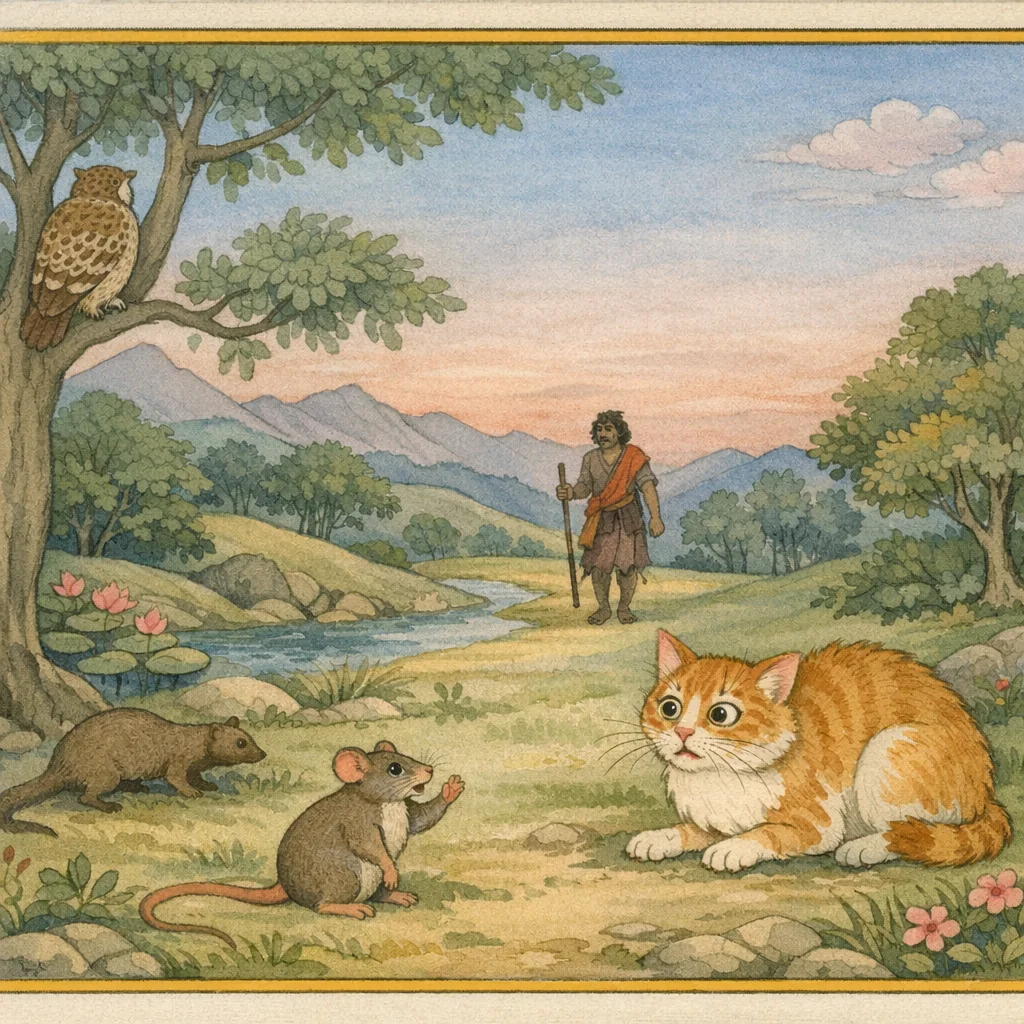
Adhyaya 139
आपद्धर्मनिर्णयः — विश्वामित्र-श्वपचसंवादः (Apaddharma Determination: Dialogue of Viśvāmitra and the Śvapaca)
Upa-parva: Āpaddharma (Ethics in Calamity) — Viśvāmitra–Caṇḍāla Saṃvāda Episode
Yudhiṣṭhira opens by describing a world where dharma is inverted—boundaries breached, social trust broken, rulers and criminals oppress the populace, and famine-like conditions prevail—asking how a brāhmaṇa and a king should act without losing artha and dharma. Bhīṣma responds that social welfare and even the characteristics of the yugas are ‘rooted in the king,’ emphasizing governance as a causal foundation for public security, rainfall, health, and stability. He then cites an ancient precedent: at the junction of Tretā and Dvāpara, a twelve-year drought devastates settlements and interrupts ritual life; people scatter in hunger and fear. Viśvāmitra, starving, reaches a caṇḍāla settlement and, finding no alms, considers taking a portion of dog-meat stored there, reasoning that in calamity theft may become permitted as a last resort and that preserving life enables later dharmic practice. The caṇḍāla counters with objections grounded in purity norms, propriety, and the danger of rationalizing transgression; the debate turns on necessity, scriptural categories of permitted foods, precedent (e.g., Agastya and Vātāpi), and whether intention and absence of violence mitigate fault. Ultimately Viśvāmitra takes the meat; soon after, rain returns, and Bhīṣma concludes with a didactic maxim: one should, with disciplined intellect, use all lawful means to lift oneself from distress, aiming to live so that dharma can be pursued and merit accrued.
Chapter Arc: युधिष्ठिर, शत्रुओं से घिरे राजा की ‘परम बुद्धि’ जानने की उत्कंठा से भीष्म से पूछते हैं—ऐसी कौन-सी नीति है जिससे राजा घिरकर भी मोह में न पड़े और अवसर न चूके। → भीष्म नीति-उपदेश को एक दृष्टान्त में बाँधते हैं: बिडाल (बिलाव) और चूहे का आख्यान। संकट में फँसे प्राणी ‘संधि’ का मुखौटा पहनते हैं; पर भीतर-भीतर स्वार्थ, भय और अवसरवाद काम करता रहता है। चूहा उतावले बिलाव को समय-ज्ञान और धैर्य का पाठ देता है—अकाले कर्म विनाशक है, सही क्षण ही विजय का द्वार है। → विश्वास और अविश्वास की रस्सी पर सबसे तीखा क्षण आता है: चूहा बिलाव की ‘अकृतप्रज्ञ’ नीति को पहचानकर उसे पथ्य वचन सुनाता है और साथ ही स्वयं भी सावधानी बरतता है—संधि केवल काम निकलने तक। तभी बाहरी खतरे (चाण्डाल/जन्मजात शत्रु) के आगमन से बिलाव भयाक्रान्त हो उठता है और चूहे से पूछता है—अब क्या करूँ? → चूहा और बिलाव, परस्पर-हित की अस्थायी संधि-सूत्र में बँधकर अपने-अपने प्राण बचाते हैं; उल्लू और नेवला जैसे अन्य शत्रु-प्राणी भी यह गठजोड़ देखकर लौट जाते हैं। कथा का निष्कर्ष नीति-वाक्य में सघन होता है—अविश्वसनीय पर विश्वास न करो, और विश्वसनीय पर भी अति-विश्वास न करो; क्योंकि विश्वास से ही भय जन्म लेता है और वही मूल काट देता है। → कथा के भीतर संधि सफल दिखती है, पर उपदेश का काँटा शेष रहता है—राजा किस सीमा तक ‘संधि’ करे कि वह सुरक्षा बने, आत्म-विनाश का मूल न बने?
Shlokas
Verse 1
ऑपन--माज बछ। ्:॑॑ि अष्टात्रिशर्दाधिकशततमो< ध्याय: शत्रुओंसे घिरे हुए राजाके कर्तव्यके विषयमें बिडाल और चूहेका आख्यान युधिछिर उवाच सर्वत्र बुद्धि: कथिता श्रेष्ठा ते भरतर्षभ । अनागता तथोत्पन्ना दीर्घसूत्रा विनाशिनी,युधिष्ठिर बोले--भरतश्रेष्ठ। आपने सर्वत्र अनागत (संकट आनेसे पहले ही आत्मरक्षाकी व्यवस्था करनेवाली) तथा प्रत्युत्पन्न (समयपर बचावका उपाय सोच लेनेवाली) बुद्धिको ही श्रेष्ठ बताया है और प्रत्येक कार्यमें आलस्यके कारण विलम्ब करनेवाली बुद्धिको विनाशकारी बताया है
Yudhiṣṭhira said: “O best of the Bharatas, you have declared that, in every situation, the finest intelligence is of two kinds: foresight that prepares before danger arrives, and presence of mind that devises protection when danger has already arisen. But the intelligence that procrastinates—delaying action out of sluggishness—leads to ruin.”
Verse 2
तदिच्छामि परां श्रोतु बुद्धि ते भरतर्षभ । यथा राजा न मुहोत शत्रुभि: परिवारित:,भरतभूषण! अत: अब मैं उस श्रेष्ठ बुद्धिके विषयमें आपसे सुनना चाहता हूँ, जिसका आश्रय लेनेसे धर्म और अर्थमें कुशल तथा धर्मशास्त्रविशारद राजा शत्रुओं-द्वारा घिरा रहनेपर भी मोहमें नहीं पड़ता। कुरुश्रेष्ठ। उसी बुद्धिके विषयमें मैं आपसे प्रश्न करता हूँ; अतः आप मेरे लिये उसकी व्याख्या करें
Yudhiṣṭhira said: “O bull among the Bharatas, I wish to hear from you about that highest wisdom—by relying on which a king, even when surrounded by enemies, does not fall into delusion. O ornament of the Bharata line, it is about that very intelligence that I question you; therefore explain it for my sake.”
Verse 3
धर्मार्थकुशलो राजा धर्मशास्त्रविशारद: । पृच्छामि त्वां कुरुश्रेष्ठ तन्मे व्याख्यातुमहसि,भरतभूषण! अत: अब मैं उस श्रेष्ठ बुद्धिके विषयमें आपसे सुनना चाहता हूँ, जिसका आश्रय लेनेसे धर्म और अर्थमें कुशल तथा धर्मशास्त्रविशारद राजा शत्रुओं-द्वारा घिरा रहनेपर भी मोहमें नहीं पड़ता। कुरुश्रेष्ठ। उसी बुद्धिके विषयमें मैं आपसे प्रश्न करता हूँ; अतः आप मेरे लिये उसकी व्याख्या करें
Yudhiṣṭhira said: “O best of the Kurus, ornament of the Bharata line— I ask you: please explain to me that (kind of) understanding by relying on which a king, skilled in dharma and artha and well-versed in the treatises on dharma, does not fall into delusion even when surrounded by enemies.”
Verse 4
शत्रुभि॑हुभिग्रस्तो यथा वर्तेत पार्थिव: । एतदिच्छाम्यहं श्रोतुं सर्वमेव यथाविधि,बहुत-से शत्रुओंका आक्रमण हो जानेपर राजाको कैसा बर्ताव करना चाहिये? यह सब कुछ मैं विधिपूर्वक सुनना चाहता हूँ
Yudhiṣṭhira said: “When a king is hard-pressed—overwhelmed by the assault of many enemies—how should he conduct himself? I wish to hear this in full, in the proper manner, according to right procedure and dharma.”
Verse 5
विषमस्थं हि राजानं शत्रव: परिपन्थिन: । बहवोडप्येकमुद्धर्तु यतन्ते पूर्वतापिता:,पहलेके सताये हुए डाकू आदि शत्रु जब राजाको संकटमें पड़ा हुआ देखते हैं, तब वे बहुत-से मिलकर उस असहाय राजाको उखाड़ फेंकनेका प्रयत्न करते हैं
Yudhiṣṭhira said: “For when enemies—highwaymen and other hostile men—see a king fallen into distress, they, many together, strive to uproot and overthrow that lone, helpless ruler, especially those who have previously been chastised by him.”
Verse 6
सर्वत्र प्रार्थ्यमानेन दुर्बलेन महाबलै: । एकेनैवासहायेन शक्यं स्थातुं भवेत् कथम्,जब अनेक महाबली शत्रु किसी दुर्बल राजाको सब ओरसे हड़प जानेके लिये तैयार हो जाये, तब उस एकमात्र असहाय नरेशके द्वारा उस परिस्थितिका कैसे सामना किया जा सकता है?
Yudhiṣṭhira said: “When a weak king is beset on every side by mighty rulers, each pressing his claim and ready to seize what they can, how can that lone, unsupported man possibly stand firm against such a situation?”
Verse 7
कथं मित्रमरिं चापि विन्दते भरतर्षभ । चेष्टितव्यं कथं चात्र शत्रोर्मित्रस्य चान्तरे,राजा किस प्रकार मित्र और शत्रुको अपने वशमें करता है तथा उसे शत्रु और मित्रके बीचमें रहकर कैसी चेष्टा करनी चाहिये?
Yudhiṣṭhira said: “O bull among the Bharatas, how does a king win over both friend and foe? And when he must stand between an enemy and an ally, what course of action should he undertake there?”
Verse 8
प्रज्ञातलक्षणे मित्रे तथैवामित्रतां गते । कथं तु पुरुष: कुर्यात् कृत्वा कि वा सुखी भवेत्,पहले लक्षणोंद्वारा जिसे मित्र समझा गया है, वही मनुष्य यदि शत्रु हो जाय, तब उसके साथ कोई पुरुष कैसा बर्ताव करे? अथवा कया करके वह सुखी हो?
Yudhiṣṭhira said: “When one who was recognized—by clear signs—as a friend has in the same way turned into an enemy, how should a man conduct himself toward him? And by doing what can he remain at peace and happy?”
Verse 9
विग्रहं केन वा कुर्यात् संधिं वा केन योजयेत् । कथं वा शत्रुमध्यस्थो वर्तेत बलवानपि,किसके साथ विग्रह करे? अथवा किसके साथ संधि जोड़े और बलवान् पुरुष भी यदि शत्रुओंके बीचमें मिल जाय तो उसके साथ कैसा बर्ताव करे?
Yudhiṣṭhira said: “With whom should one choose to enter into hostility, and with whom should one forge a treaty? And even if a man is powerful, if he finds himself placed amid enemies, how should he conduct himself there?”
Verse 10
एतद् वै सर्वकृत्यानां परं कृत्यं परंतप । नैतस्य कश्रिद् वक्तास्ति श्रोता वापि सुदुर्लभ:,परंतप पितामह! यह कार्य समस्त कार्याँमें श्रेष्ठ है। सत्यप्रतिज्ञ जितेन्द्रिय शान्तनुनन्दन भीष्मके सिवा, दूसरा कोई इस विषयको बतानेवाला नहीं है। इसको सुननेवाला भी दुर्लभ ही है। अतः: महाभाग! आप उसका अनुसंधान करके यह सारा विषय मुझसे कहिये
Yudhiṣṭhira said: “This indeed is the highest duty among all duties, O scorcher of foes. For this teaching there is no speaker to be found—indeed, even a listener is exceedingly rare. Therefore, O grandsire, please investigate it thoroughly and tell me the whole matter.”
Verse 11
ऋते शान्तनवाद् भीष्मात् सत्यसंधाज्जितेन्द्रियात् । तदन्विष्य महाभाग सर्वमेतद् वदस्व मे,परंतप पितामह! यह कार्य समस्त कार्याँमें श्रेष्ठ है। सत्यप्रतिज्ञ जितेन्द्रिय शान्तनुनन्दन भीष्मके सिवा, दूसरा कोई इस विषयको बतानेवाला नहीं है। इसको सुननेवाला भी दुर्लभ ही है। अतः: महाभाग! आप उसका अनुसंधान करके यह सारा विषय मुझसे कहिये
Yudhiṣṭhira said: “Except for Bhīṣma, the son of Śāntanu—steadfast in truth and master of his senses—there is no one who can truly expound this matter. Therefore, O greatly fortunate one, having carefully investigated it, tell me all of it, O scorcher of foes, O Grandfather. This undertaking is the highest among all undertakings; and rare indeed is one fit to hear it.”
Verse 12
भीष्म उवाच त्वदयुक्तोडयमनुप्रश्नो युधिष्ठिर सुखोदय: । शृणु मे पुत्र कार्त्स्न्येन गुह्यमापत्सु भारत,भीष्मजीने कहा--भरतनन्दन बेटा युधिष्ठिर! तुम्हारा यह विस्तारपूर्वक पूछना बहुत ठीक है। यह सुखकी प्राप्ति करानेवाला है। आपत्तिके समय क्या करना चाहिये? यह विषय गोपनीय होनेसे सबको मालूम नहीं है। तुम यह सब रहस्य मुझसे सुनो
Bhishma said: “Yudhishthira, this follow-up question of yours is well-placed and fitting; it leads to the rise of true well-being. Listen, my son, in full: what should be done in times of calamity is a guarded matter, not commonly known. Hear this secret teaching from me, O Bharata.”
Verse 13
अमित्रो मित्रतां याति मित्र चापि प्रदुष्यति । सामर्थ्ययोगात् कार्याणामनित्या वै सदा गति:,भिन्न-भिन्न कार्योका ऐसा प्रभाव पड़ता है, जिसके कारण कभी शत्रु भी मित्र बन जाता है और कभी मित्रका मन भी द्वेषभावसे दूषित हो जाता है। वास्तवमें शत्रु-मित्रकी परिस्थिति सदा एक-सी नहीं रहती है
Bhishma said: By the force of changing circumstances and capacities in worldly affairs, an enemy may come to the state of friendship, and even a friend may become tainted with hostility. In truth, the course of enmity and friendship is never permanently fixed; it continually shifts with conditions.
Verse 14
तस्माद् विश्वसितव्यं च विग्रहं च समाचरेत् । देशं कालं॑ च विज्ञाय कार्याकार्यविनिश्षये,अतः देश-कालको समझकर कर्तव्य-अकर्तव्यका निश्चय करके किसीपर विश्वास और किसीके साथ युद्ध करना चाहिये
Therefore, one should know when to place trust and when to enter into conflict. Having understood the place and the time, one must determine what ought to be done and what ought not to be done; on that basis, one should either rely on another or oppose them as the situation demands.
Verse 15
संधातव्यं बुधैर्नित्यं व्यवस्य च हितार्थिभि: । अमिन्रैरपि संधेयं प्राणा रक्ष्या हि भारत,भारत! कर्तव्यका विचार करके सदा हित चाहनेवाले विद्वान मित्रोंक साथ संधि करनी चाहिये और आवश्यकता पड़नेपर शत्रुओंसे भी संधि कर लेनी चाहिये; क्योंकि प्राणोंकी रक्षा सदा ही कर्तव्य है
Bhishma said: The wise, having firmly resolved upon what is truly beneficial, should always seek alliance and reconciliation. When necessity demands, one should even make peace with enemies—for, O Bharata, the safeguarding of life is indeed a constant duty.
Verse 16
यो हामित्रैर्नरो नित्यं न संदध्यादपण्डित: । न सो<र्थ प्राप्रुयात् किंचित् फलान्यपि च भारत,भारत! जो मूर्ख मानव शत्रुओंके साथ कभी किसी भी दशामें संधि ही नहीं करता, वह अपने किसी भी उद्देश्यको सिद्ध नहीं कर सकता और न कोई फल ही पा सकता है
Bhishma said: A foolish man who, in every circumstance, refuses to make any accommodation or treaty even with enemies will not accomplish any practical aim; nor will he obtain results. In matters of governance and conduct, rigid hostility without timely conciliation destroys one’s own purpose.
Verse 17
यस्त्वमित्रेण संदध्यान्मित्रेण च विरुद्धयते । अर्थयुक्ति समालोक्य सुमहद् विन्दते फलम्,जो स्वार्थसिद्धिका अवसर देखकर शत्रुसे तो संधि कर लेता है और मित्रोंके साथ विरोध बढ़ा लेता है, वह महान् फल प्राप्त कर लेता है
Bhishma said: One who, discerning the strategy of advantage, makes a pact even with an enemy when it serves his purpose, and is willing to oppose even friends when they stand in the way, attains a very great result.
Verse 18
अत्राप्युदाहरन्तीममितिहासं पुरातनम् । मार्जारस्य च संवाद न्यग्रोधे मूषिकस्य च,इस विषयमें विद्वान् पुरुष वटवृक्षके आश्रयमें रहनेवाले एक बिलाव और चूहेके संवादरूप एक प्रचीन कथानकका दृष्टान्त दिया करते हैं
Here too, the learned cite an ancient illustrative tale: the dialogue between a cat and a mouse, connected with a nyagrodha (banyan) tree. It is offered as an example to illuminate the ethical point under discussion.
Verse 19
वने महति कम्मिंश्चिन्न्यग्रोध: सुमहानभूत् । लताजालपरिच्छिन्नो नानाद्विजगणान्वित:,किसी महान् वनमें एक विशाल बरगदका वृक्ष था, जो लतासमूहोंसे आच्छादित तथा भाँति-भाँतिके पक्षियोंसे सुशोभित था
Bhishma said: In a vast forest there stood an enormous banyan tree. It was wrapped in a net of creeping vines and adorned by flocks of many kinds of birds.
Verse 20
स्कन्धवान् मेघसड्काश: शीतच्छायो मनोरम: । अरण्यमभितो जात: स तु व्यालमृगाकुल:,वह अपनी मोटी-मोटी डालियोंसे हरा-भरा होनेके कारण मेघके समान दिखायी देता था। उसकी छाया शीतल थी। वह मनोरम वृक्ष वनके समीप होनेके कारण बहुत-से सर्पों तथा पशुओंका आश्रय बना हुआ था
Bhīṣma said: “A tree had grown there, thick-limbed and cloud-like in its lushness. Its shade was cool and pleasing. Standing by the forest, it had become a refuge and gathering-place for many serpents and wild beasts.”
Verse 21
तस्य मूलं समाश्रित्य कृत्वा शतमुखं बिलम् । वसति सम महाप्राज्ञ: पलितो नाम मूषिक:,उसीकी जड़मे सौ दरवाजोंका बिल बनाकर पलित नामक एक परम बुद्धिमान् चूहा निवास करता था
Taking refuge at the root of that tree, a supremely intelligent mouse named Palita made a burrow with a hundred entrances and lived there.
Verse 22
शाखां तस्य समाश्रित्य वसति सम सुखं पुरा । लोमशो नाम मार्जार: पक्षिसंघातखादक:,उसी बरगदकी डालीपर पहले लोमश नामका एक बिलाव भी बड़े सुखसे रहता था। पक्षियोंका समूह ही उसका भोजन था
Bhishma said: “Having taken refuge on one of its branches, there once lived there in great comfort a cat named Lomaśa, whose food was the flocks of birds.”
Verse 23
तत्र चागत्य चाण्डालो हारण्ये कृतकेतन: । प्रयोजयति चोन्माथं नित्यमस्तंगते रवौ,उसी वनमें एक चाण्डाल भी घर बनाकर रहता था। वह प्रतिदिन सायंकाल सूर्यास्त हो जानेपर वहाँ आकर जाल फैला देता और उसकी ताँतकी डोरियोंको यथास्थान लगा घर जाकर मौजसे सोता था; फिर सबेरा होनेपर वहाँ आया करता था
Bhīṣma said: “There, a Caṇḍāla came and, in that forest, set up his dwelling. Every day, once the sun had set, he would go to that spot and set his snare, fixing its cords in their proper places; then he would return home and sleep at ease. When morning came, he would go there again.”
Verse 24
तत्र स्नायुमयान् पाशान् यथावत् संविधाय सः । गृहं गत्वा सुखं शेते प्रभातामेति शर्वरीम्,उसी वनमें एक चाण्डाल भी घर बनाकर रहता था। वह प्रतिदिन सायंकाल सूर्यास्त हो जानेपर वहाँ आकर जाल फैला देता और उसकी ताँतकी डोरियोंको यथास्थान लगा घर जाकर मौजसे सोता था; फिर सबेरा होनेपर वहाँ आया करता था
Bhīṣma said: “There, having properly arranged the nooses and snares made of sinew-strings, he would go back to his hut and sleep at ease; and when the night had passed and dawn arrived, he would return there again.”
Verse 25
तत्र सम नित्यं बध्यन्ते नक्तं बहुविधा मृगा: । कदाचिदत्र मार्जारिस्त्वप्रमत्तो व्यबध्यत,रातको उस जालनमें प्रतिदिन नाना प्रकारके पशु फँस जाते थे (उन्हींको लेनेके लिये वह सबेरे आता था)। एक दिन अपनी असावधानीके कारण पूर्वोक्त बिलाव भी उस जालमें फँस गया
In that place, many kinds of animals were regularly caught in the snare at night. Once, however, the cat itself—through a moment of carelessness—was caught there.
Verse 26
तस्मिन् बद्धे महाप्राणे शत्रौ नित्याततायिनि । त॑ काल॑ पलितो ज्ञात्वा प्रचचार सुनिर्भय:,उस महान् शक्तिशाली और नित्य आततायी शत्रुके फँस जानेपर जब पलितको यह समाचार मालूम हुआ, तब वह उस समय बिलसे बाहर निकलकर सब ओर निर्भय विचरने लगा
When that mighty enemy—ever an aggressor—had been caught and bound, Palita, learning of the moment, came out of his burrow and began to roam about on all sides without fear.
Verse 27
तेनानुचरता तस्मिन् वने विश्वस्तचारिणा । भक्ष्यं मृगयमाणेन चिराद् दृष्टं तदामिषम्,उस वनमें विश्वस्त होकर विचरते तथा आहारकी खोज करते हुए उस चूहेने बहुत देरके बाद वह माँस देखा, जो जालपर बिखेरा गया था। चूहा उस जालपर चढ़कर उस मांसको खाने लगा
Bhīṣma said: “As he wandered about in that forest with growing confidence, searching for food, after a long time he finally noticed the baited flesh that had been strewn upon the snare. Climbing onto the trap, the mouse began to eat the meat.”
Verse 28
स तमुन्माथमारुह्मु तदामिषमभक्षयत्,उस वनमें विश्वस्त होकर विचरते तथा आहारकी खोज करते हुए उस चूहेने बहुत देरके बाद वह माँस देखा, जो जालपर बिखेरा गया था। चूहा उस जालपर चढ़कर उस मांसको खाने लगा
Climbing onto the trap, it ate the baited meat.
Verse 29
तस्योपरि सपत्नस्य बद्धस्य मनसा हसन् । आमिषे तु प्रसक्त: स कदाचिदवलोकयन्,जालके ऊपर मांस खानेमें लगा हुआ वह चूहा अपने शत्रुके ऊपर मन-ही-मन हँस रहा था। इतनेहीमें कभी उसकी दृष्टि दूसरी ओर घूम गयी
Bhishma said: “Laughing inwardly at his rival who lay bound beneath him, the mouse became absorbed in the bait (meat). While intent on feeding, he happened at one moment to glance away—setting the stage for a reversal brought about by carelessness and overconfidence.”
Verse 30
अपश्यदपरं घोरमात्मन: शत्रुमागतम् | शरप्रसूनसड्काशं महीविवरशायिनम्,फिर तो उसने एक दूसरे भयंकर शत्रुको वहाँ आया हुआ देखा, जो सरकण्डेके फूलके समान भूरे रंगका था। वह धरतीमें विवर बनाकर उसके भीतर सोया करता था
Bhīṣma said: “Then he saw yet another dreadful enemy approaching—dusky-brown like the blossom of the śara-reed—one who makes a hollow in the earth and lies hidden within it. The scene underscores how danger can arise in successive forms, and how vigilance and discernment are required when confronting threats that conceal themselves beneath the surface.”
Verse 31
नकुलं हरिणं नाम चपलं॑ ताम्रलोचनम् | तेन मूषिकगन्धेन त्वरमाणमुपागतम्,वह जातिका न्यौला था। उसकी आँखें ताँबेके समान दिखायी देती थीं। वह चपल नेवला हरिणके नामसे प्रसिद्ध था और उसी चूहेकी गन्ध पाकर बड़ी उतावलीके साथ वहाँ आ पहुँचा था
Bhishma said: “A nimble nakula (mongoose), copper-eyed, known by the name Hariṇa, caught the scent of a mouse and hurried swiftly to that place.”
Verse 32
भक्ष्यार्थ संलिहानं तं भूमावूर्ध्वमुखं स्थितम् । शाखागतमरिं चान्यमपश्यत् कोटरालयम्
Bhīṣma said: “Seeking food, he saw that one creature was lying on the ground with its face turned upward, while another enemy, perched upon a branch, was dwelling in a hollow of the tree.”
Verse 33
गतस्य विषयं तत्र नकुलोलूकयोस्तथा
Bhīṣma said: “There, the matter concerning what had occurred was also (spoken of)—in particular, the affair of Nakula and the owl.”
Verse 34
अथास्यासीदियं चिन्ता तत् प्राप्प सुमहद् भयम् । न्यौले और उल्लू--दोनोंका लक्ष्य बने हुए उस चूहेको बड़ा भय हुआ। अब उसे इस प्रकार चिन्ता होने लगी-- ।। आपपशद्यस्यां सुकष्टायां मरणे प्रत्युपस्थिते
Bhishma said: Then a grave anxiety arose in him, and he was seized by great fear. The mouse, having become the target of both the mongoose and the owl, was overwhelmed with terror. In that dire calamity, with death standing close at hand, he began to think in this way.
Verse 35
स तथा सर्वतो रुद्धः सर्वत्र भयदर्शन:
Bhishma said: Thus hemmed in on every side, he became a figure of fear wherever he turned—seeing danger in all directions and appearing dreadful to all around him.
Verse 36
आपद्विनाशभूयिष्ठ गर्त: कार्य हि जीवितम्
Bhishma said: “In times of calamity, life itself becomes a deep pit—one dominated by the threat of ruin. Therefore, one must act with the primary aim of preserving life.”
Verse 37
गतं मां सहसा भूमिं नकुलो भक्षयिष्यति
Bhishma said: “Once I am gone, the earth will swiftly be consumed by Nakula.” In context, the line conveys an anxious, cautionary warning: when a stabilizing elder or guardian of dharma departs, unchecked impulses—here personified through a named agent—can rapidly bring disorder and harm upon the realm.
Verse 38
न त्वेवास्मद्विधः प्राज्ञ: सम्मोहं गन्तुमरहति
Bhishma said: “Yet a wise person of our kind should not fall into delusion.”
Verse 39
करिष्ये जीविते यत्नं यावद् युक्त्या प्रतिग्रहात् | “तथापि मुझ-जैसे बुद्धिमानूको घबराना नहीं चाहिये। अतः: जहाँतक युक्ति काम देगी, परस्पर सहयोगका आदान-प्रदान करके मैं जीवन-रक्षाके लिये प्रयत्न करूँगा ।। ३८ ई ।। न हि बुद्धयान्वितः प्राज्ञो नीतिशास्त्रविशारद:,“बुद्धिमान, विद्वान् और नीतिशास्त्रमें निपुण पुरुष भारी और भयंकर विपत्तिमें पड़नेपर भी उसमें डूब नहीं जाता है--उससे छूटनेकी चेष्टा करता है
Bhīṣma said: “So long as sound reasoning can still be applied, I will strive to preserve life by accepting and offering mutual support. For a wise man—endowed with discernment and trained in the science of polity—does not sink even when overtaken by a great and dreadful calamity; he exerts himself to escape it.”
Verse 40
निमज्जत्यापदं प्राप्प महतीं दारुणामपि,“बुद्धिमान, विद्वान् और नीतिशास्त्रमें निपुण पुरुष भारी और भयंकर विपत्तिमें पड़नेपर भी उसमें डूब नहीं जाता है--उससे छूटनेकी चेष्टा करता है
Bhishma said: Even when a great and dreadful calamity befalls him, a wise man—learned and skilled in the science of right conduct—does not sink into that disaster. Instead, he strives to free himself from it. The teaching is that intelligence and ethical discernment keep a person steady in crisis, turning suffering into a field for deliberate, disciplined effort rather than despair.
Verse 41
न त्वन्यामिह मार्जाराद् गतिं पश्यामि साम्प्रतम् । विषमस्थो हायं शत्रु: कृत्यं चास्य महन्मया,“मैं इस समय इस बिलावका सहारा लेनेके सिवा, अपने लिये दूसरा कोई मार्ग नहीं देखता। यद्यपि यह मेरा कट्टर शत्रु है, तथापि इस समय स्वयं ही भारी संकटमें पड़ा हुआ है। मेरे द्वारा इसका भी बड़ा भारी काम निकल सकता है
Bhishma said: “Here and now I see no other course for myself except to rely on this cat. Though it is indeed my bitter enemy, at present it is itself caught in a grave predicament; and through me, a great service can be rendered to it as well.”
Verse 42
जीवितार्थी कथं त्वद्य शत्रुभि: प्रार्थितस्त्रिभि: । तस्मादेनमहं शत्रुं मार्जार संश्रयामि वै,“इधर, मैं भी जीवनकी रक्षा चाहता हूँ, तीन-तीन शत्रु मुझपर घात लगाये बैठे हैं; अतः क्यों न आज मैं अपने शत्रु इस बिलावका ही आश्रय लूँ?
Bhīṣma said: “How can I, who seek to preserve my life, act today when three enemies lie in wait for me? Therefore, I shall take refuge in this very enemy—the cat.”
Verse 43
नीतिशास्त्रं समाश्रित्य हितमस्योपवर्णये । येनेमं शत्रुसंघातं मतिपूर्वेण वजचये,“आज नीतिशास्त्रका सहारा लेकर इसके हितका वर्णन करूँगा जिससे बुद्धिके द्वारा इस शत्रुसमुदायको धोखा देकर बच जाऊँगा
Bhishma said: “Relying on the science of polity and right conduct, I shall describe what is beneficial for him. By doing so, I will, through deliberate intelligence, outmaneuver this mass of enemies. Today, taking refuge in nītiśāstra, I will set forth his welfare, so that by strategy of mind I may escape after deceiving this hostile host.”
Verse 44
अयमत्यन्तशत्रुमें वैषम्यं परमं गत: । मूढो ग्राहयितुं स्वार्थ सड्भत्या यदि शक््यते,“इसमें संदेह नहीं कि बिलाव मेरा महान् दुश्मन है, तथापि इस समय महान् संकटमें है। यदि सम्भव हो तो इस मूर्खको संगतिके द्वारा स्वार्थ सिद्ध करनेकी बातपर राजी करूँ
Bhishma said: “This one is indeed my bitter enemy, and he has fallen into the utmost distress. Yet, if it is possible, I should try to make this fool accept a course that serves my own interest—by drawing him into an alliance.”
Verse 45
कदाचिद् व्यसन प्राप्य संधिं कुर्यान्मया सह । बलिना संनिकृष्टस्य शत्रोरपि परिग्रह:
Bhīṣma said: “At times, when calamity befalls one, one should even make peace with me. For when a powerful enemy has drawn near, even accepting that enemy’s protection or alliance may become necessary.”
Verse 46
श्रेष्ठो हि पण्डित: शत्रुर्न च मित्रमपण्डित:
Bhīṣma said: “Even an enemy who is wise is preferable; a foolish person is not truly a friend.” The saying underscores that sound judgment and discernment are more reliable for one’s welfare than mere affection without understanding, since folly—though clothed as friendship—can lead to harm and adharma.
Verse 47
हन्तास्मै सम्प्रवक्ष्यामि हेतुमात्माभिरक्षणे
Bhīṣma said: “Very well—now I shall clearly explain to him the reason and guiding principle for safeguarding one’s own self.”
Verse 48
एवं विचिन्तयामास मूषिक: शरत्रुचेष्टितम्,इस प्रकार चूहेने शत्रुकी चेष्टापर विचार किया। वह अर्थसिद्धिके उपायको यथार्थरूपसे जाननेवाला तथा संधि और विग्रहके अवसरको समझनेवाला था। उसने बिलावको सान्त्वना देते हुए मधुर वाणीमें कहा--
Thus the mouse reflected carefully on the enemy’s manoeuvre. Skilled in discerning the means to secure his purpose, and able to judge when conciliation or conflict was appropriate, he soothed the cat and spoke in sweet words—setting strategy under the guise of gentleness.
Verse 49
ततोड<र्थगतितत्त्वज्ञ: संधिविग्रहकालवित् | सान्त्वपूर्वमिदं वाक््यं मार्जारं मूषिकोडब्रवीत्,इस प्रकार चूहेने शत्रुकी चेष्टापर विचार किया। वह अर्थसिद्धिके उपायको यथार्थरूपसे जाननेवाला तथा संधि और विग्रहके अवसरको समझनेवाला था। उसने बिलावको सान्त्वना देते हुए मधुर वाणीमें कहा--
Then the mouse—one who truly understood the course of advantage and the principles of effective means, and who knew when to seek alliance and when to enter conflict—considered the enemy’s intentions. Seeking first to pacify, he addressed the cat with conciliatory, sweet words, choosing diplomacy as the ethical and strategic opening move before any harsher course.
Verse 50
सौहदेनाभि भाषे त्वां कच्चिन्मार्जार जीवसि । जीवितं हि तवेच्छामि श्रेय: साधारणं हि नौ,'भैया बिलाव! मैं तुम्हारे प्रति मैत्रीका भाव रखकर बातचीत कर रहा हूँ। तुम अभी जीवित तो हो न? मैं चाहता हूँ कि तुम्हारा जीवन सुरक्षित रहे; क्योंकि इसमें मेरी और तुम्हारी दोनोंकी एक-सी भलाई है
Bhishma said: “I speak to you in a spirit of friendship, O cat—are you still alive? I truly wish for your life to be preserved, for in your continued living lies a shared good for both of us.”
Verse 51
न ते सौम्य भयं कार्य जीविष्यसि यथासुखम् | अहं त्वामुद्धरिष्यामि यदि मां न जिघांससि,'सौम्य! तुम्हें डरना नहीं चाहिये। तुम आनन्दपूर्वक जीवित रह सकोगे। यदि मुझे मार डालनेकी इच्छा त्याग दो तो मैं इस संकटसे तुम्हारा उद्धार कर दूँगा
Bhīṣma said: “Gentle one, you need not be afraid. You will live in comfort and peace. If you abandon the wish to kill me, I will rescue you from this peril.”
Verse 52
अस्ति ककश्रिदुपायोअत्र दुष्कर: प्रतिभाति मे । येन शक््यस्त्वया मोक्ष: प्राप्तुं श्रेयस्तथा मया,“एक उपाय है जिससे तुम इस संकटसे छुटकारा पा सकते हो और मैं भी कल्याणका भागी हो सकता हूँ। यद्यपि वह उपाय मुझे दुष्कर प्रतीत होता है
Bhishma said: “There is, in this matter, a certain means that occurs to me—though it seems difficult. By it, you may be able to obtain release from this distress, and I too may attain what is truly beneficial.”
Verse 53
मयाप्युपायो दृष्टोडयं विचार्य मतिमात्मन: । आत्मार्थ च त्वदर्थ च श्रेयः साधारणं हि नौ,“मैंने अपनी बुद्धिसे अच्छी तरह सोच-विचार करके अपने और तुम्हारे लिये एक उपाय ढूँठ निकाला है, जिससे हम दोनोंकी समानरूपसे भलाई होगी
Bhishma said: “After carefully reflecting with my own judgment, I too have found a course of action—one that serves both my good and yours. For the welfare it brings is not one-sided; it is shared by us both.”
Verse 54
इदं हि नकुलोलूकं पापबुद्धयाभिसंस्थितम् | न धर्षयति मार्जार तेन मे स्वस्ति साम्प्रतम्,'मार्जार! देखो, ये नेवला और उल्लू दोनों पापबुद्धिसे यहाँ ठहरे हुए हैं। मेरी ओर घात लगाये बैठे हैं। जबतक वे मुझपर आक्रमण नहीं करते, तभीतक मैं कुशलसे हूँ
Bhishma said: “Look, O cat—here the mongoose and the owl have taken their positions with sinful intent. They lie in wait to strike at me. So long as they do not attack me, I am safe for the moment.”
Verse 55
कूजंश्वपलनेत्रो5यं कौशिको मां निरीक्षते | नगशाखाग्रग: पापस्तस्याहं भृशमुद्धविजे,“यह चंचल नेत्रोंवाला पापी उल्लू वृक्षकी डालीपर बैठकर “हू हू” करता मेरी ही ओर घूर रहा है। उससे मुझे बड़ा डर लगता है
Bhishma said: “This wicked owl, with its restless, blinking eyes, keeps hooting and staring straight at me from the tip of a tree-branch. I am deeply frightened of it.”
Verse 56
सतां साप्तपदं मैत्रं स सखा मे5सि पण्डित: । सांवास्यकं करिष्यामि नास्ति ते भयमद्य वै,'साधु पुरुषोंमें तो सात पग साथ-साथ चलनेसे ही मित्रता हो जाती है। हम और तुम तो यहाँ सदासे ही साथ रहते हैं; अतः तुम मेरे विद्वान् मित्र हो। मैं इतने दिन साथ रहनेका अपना मित्रोचित धर्म अवश्य निभाऊँगा, इसलिये अब तुम्हें कोई भय नहीं है
Bhishma said: “Among the virtuous, friendship is sealed by merely taking seven steps together. Since you and I have long lived in close company here, you are my learned friend. I will certainly fulfill the duty owed to one who has shared my dwelling; therefore, from this day onward, you have nothing to fear.”
Verse 57
न हि शक्तो5सि मार्जार पाशं छेत्तुं मया विना | अहं छेत्स्यामि पाशांस्ते यदि मां त्वं न हिंससि,'मार्जार! तुम मेरी सहायताके बिना अपना यह बन्धन नहीं काट सकते। यदि तुम मेरी हिंसा न करो तो मैं तुम्हारे ये सारे बन्धन काट डालूँगा
Bhishma said: “O cat, you are not able to cut this noose without my help. If you do not harm me, I will cut all your bonds for you.”
Verse 58
त्वमश्रितो द्रुमस्याग्रं मूलं त्वहमुपाश्रित: । चिरोषितावुभावावां वृक्षेडस्मिन् विदितं च ते,“तुम इस पेड़के ऊपर रहते हो और मैं इसकी जड़में रहता हूँ। इस प्रकार हम दोनों चिरकालसे इस वृक्षका आश्रय लेकर रहते हैं, यह बात तो तुम्हें ज्ञात ही है
Bhishma said: “You have taken shelter on the top of this tree, while I have taken shelter at its root. Thus, for a long time we both have lived depending on this very tree—this is already known to you.”
Verse 59
यस्मिन्नाश्वासते कश्चिद् यश्न नाश्वसिति क्वचित् | न तौ धीरा: प्रशंसन्ति नित्यमुद्धिग्नमानसौ,“जिसपर कोई भरोसा नहीं करता तथा जो दूसरे किसीपर स्वयं भी भरोसा नहीं करता, उन दोनोंकी धीर पुरुष कोई प्रशंसा नहीं करते हैं; क्योंकि उनके मनमें सदा उद्वेग भरा रहता है
He whom none can trust, and who himself trusts none—such men the steadfast and wise never praise; for their minds are ever filled with agitation.
Verse 60
तस्माद् विवर्धतां प्रीतिर्नित्यं संगतमस्तु नौ । कालातीतमिहार्थ तु न प्रशंसन्ति पण्डिता:,“अतः हमलोगोंमें सदा प्रेम बढ़े तथा नित्य प्रति हमारी संगति बनी रहे। जब कार्यका समय बीत जाता है, उसके बाद विद्वान् पुरुष उसकी प्रशंसा नहीं करते हैं
Therefore, let our mutual affection ever increase, and let our companionship remain constant. For when the proper time for an undertaking has passed, the wise do not praise that belated effort.
Verse 61
अर्थयुक्तिमिमां तत्र यथाभूतां निशामय । तव जीवितमिच्छामि त्वं ममेच्छसि जीवितम्,“बिलाव! हम दोनोंके प्रयोजनका जो यह संयोग आ बना है, उसे यथार्थरूपसे सुनो। मैं तुम्हारे जीवनकी रक्षा चाहता हूँ और तुम मेरे जीवनकी रक्षा चाहते हो
Listen carefully to this reasoning, exactly as it stands in our present situation. I seek to preserve your life, and you seek to preserve mine.
Verse 62
कश्चित् तरति काछ्ेन सुगम्भीरां महानदीम् । स तारयति तत् काष्ठं स च काछेन तार्यते,“कोई पुरुष जब लकड़ीके सहारे किसी गहरी एवं विशाल नदीको पार करता है, तब उस लकड़ीको भी किनारे लगा देता है तथा वह लकड़ी भी उसे तारनेमें सहायक होती है
A man may cross a deep and mighty river by relying on a piece of wood. In doing so, he brings that very wood safely to the far bank, and the wood, in turn, serves as the means by which he is carried across.
Verse 63
ईदृशो नौ समायोगो भविष्यति सुविस्तर: । अहं त्वां तारयिष्यामि मां च त्वं तारयिष्यसि,“इसी प्रकार हम दोनोंका यह संयोग चिरस्थायी होगा। मैं तुम्हें विपत्तिसे पार कर दूँगा और तुम मुझे आपत्तिसे बचा लोगे”
Thus shall our association endure and spread far. I will carry you across times of peril, and you in turn will safeguard and deliver me when danger comes.
Verse 64
एवमुक्त्वा तु पलितस्तमर्थमुभयोहितम् । हेतुमद् ग्रहणीयं च कालापेक्षी न्यवेक्ष्य च,इस प्रकार पलित दोनोंके लिये हितकर, युक्तियुक्त और मानने योग्य बात कहकर उत्तर मिलनेके अवसरकी प्रतीक्षा करता हुआ बिलावकी ओर देखने लगा
Having spoken thus, Palita set forth a matter beneficial to both sides, supported by reason and worthy of acceptance; then, waiting for the right moment and for a reply, he turned his gaze toward the cat.
Verse 65
अथ सुत्याद्ठतं श्रुत्वा तस्य शत्रोर्विचक्षण: । हेतुमद् ग्रहणीयार्थ मार्जारो वाक्यमब्रवीत्,अपने उस शत्रुका यह युक्तियुक्त और मान लेने योग्य सुन्दर भाषण सुनकर बुद्धिमान् बिलाव कुछ बोलनेको उद्यत हुआ
Then, having heard that well-reasoned statement of his enemy and grasped its import, the discerning cat—finding it supported by sound rationale and worthy of acceptance—prepared to respond and spoke.
Verse 66
बुद्धिमान् वाक्यसम्पन्नस्तद्वाक्यमनुवर्णयन् । स्वामवस्थां समीक्ष्याथ साम्नैव प्रत्यपूजयत्,उसकी बुद्धि अच्छी थी। वह बोलनेकी कलामें कुशल था। पहले तो उसने चूहेकी बातको मन-ही-मन दुहराया; फिर अपनी दशापर दृष्टिपात करके उसने सामनीतिसे ही उस चूहेकी भूरि-भूरि प्रशंसा की
Endowed with keen intelligence and accomplished in speech, he repeated that statement in his mind. Then, after reflecting on his own condition, he responded by employing conciliation (sāma) and offered the mouse abundant praise.
Verse 67
ततस्तीक्ष्णाग्रदशनो मणिवैदूर्यलोचन: । मूषिकं मन्दमुद्वीक्ष्य मार्जारो लोमशोडब्रवीत्,तदनन्तर जिसके आगेके दाँत बड़े तीखे थे और दोनों नेत्र नीलमके समान चमक रहे थे, उस लोमश नामक बिलावने चूहेकी ओर किंचिद् दृष्टिपात करके इस प्रकार कहा --
Bhishma said: Then the cat named Lomaśa—whose front teeth were razor-sharp and whose eyes gleamed like vaidūrya gems—cast a slow, measured glance at the mouse and spoke.
Verse 68
नन्दामि सौम्य भद्र ते यो मां जीवितुमिच्छसि । श्रेयक्ष॒ यदि जानीषे क्रियतां मा विचारय,'सौम्य! मैं तुम्हारा अभिनन्दन करता हूँ। तुम्हारा कल्याण हो, जो कि तुम मुझे जीवन प्रदान करना चाहते हो। यदि हमारे कल्याणका उपाय जानते हो तो इसे अवश्य करो, कोई अन्यथा विचार मनमें न लाओ
“I rejoice, gentle and noble one, that you wish me to live; may good be upon you. If you know the means that leads to our welfare, then do it—do not let any other thought arise in your mind.”
Verse 69
अहं हि भृशमापतन्नस्त्वमापन्नतरो मम । द्वयोरापन्नयो: संधि: क्रियतां मा चिराय च,“मैं भारी विपत्तिमें फँसा हूँ और तुम भी महान् संकटमें पड़े हुए हो। इस प्रकार आपफत्तिमें पड़े हुए हम दोनोंको संधि कर लेनी चाहिये। इसमें विलम्ब न हो
Bhishma said: “I have fallen into severe distress, and you are in an even graver plight than I. Since we both stand in calamity, let a reconciliation be made between us—without delay.”
Verse 70
विधास्ये प्राप्तकालं यत् कार्य सिद्धिकरं विभो । मयि कृच्छाद् विनिर्मुक्ते न विनड्क्ष्यति ते कृतम्,'प्रभो! समय आनेपर तुम्हारे अभीष्टकी सिद्धि करनेवाला जो भी कार्य होगा, उसे अवश्य करूँगा। इस संकटसे मेरे मुक्त हो जानेपर तुम्हारा किया हुआ उपकार नष्ट नहीं होगा। मैं इसका बदला अवश्य चुकाऊँगा
Bhishma said: “O mighty lord, when the proper time arrives, whatever action will bring about the fulfillment of your purpose—I shall certainly do it. Once I am freed from this distress, the favor you have shown me will not be lost; I will surely repay what you have done.”
Verse 71
न्यस्तमानो5स्मि भक्तो5स्मि शिष्यस्त्वद्धितकृत् तथा । निदेशवशवर्ती च भवन्तं शरणं गत:,“इस समय मेरा मान भंग हो चुका है। मैं तुम्हारा भक्त और शिष्य हो गया हूँ। तुम्हारे हितका साधन करूँगा और सदा तुम्हारी आज्ञाके अधीन रहूँगा। मैं सब प्रकारसे तुम्हारी शरणमें आ गया हूँ
Bhishma said: “Now my pride is laid low. I have become your devotee and your disciple. I shall act for your benefit and remain ever subject to your command. In every way, I have come to you for refuge.”
Verse 72
इत्येवमुक्त: पलितो मार्जारं वशमागतम् । वाक््यं हितमुवाचेदमभिनीतार्थमर्थवित्,बिलावके ऐसा कहनेपर अपने प्रयोजनको समझनेवाले पलितने वशमें आये हुए उस बिलावसे यह अभिप्रायपूर्ण हितकर बात कही--
Bhishma said: Thus addressed, Palita—wise and understanding the true purpose—spoke a beneficial, pointedly suggestive counsel to the cat, who had now come under his control.
Verse 73
उदार यद् भवानाह नैतच्चित्रं भवद्विधे । विहितो यस्तु मार्गो मे हितार्थ शृणु तं मम,'भैया बिलाव! आपने जो उदारतापूर्ण वचन कहा है, यह आप-जैसे बुद्धिमानके लिये आश्चर्यकी बात नहीं है। मैंने दोनोंके हितके लिये जो बात निर्धारित की है, वह मुझसे सुनो
Bhishma said: “The generous words you have spoken are not at all surprising in one like you. Now listen to the course I have laid down, intended for the welfare of both sides.”
Verse 74
अहं त्वानुप्रवेक्ष्यामि नकुलान्मे महद् भयम् । त्रायस्व भो मा वधीस्त्वं शक्तोडस्मि तव रक्षणे
Bhishma said: “I shall enter after you; I have great fear of the Nakulas. Save me, sir—do not kill me. I am able to protect you.”
Verse 75
'भैया! इस नेवलेसे मुझे बड़ा डर लग रहा है। इसलिये मैं तुम्हारे पीछे इस जालमें प्रवेश कर जाऊँगा, परंतु दादा! तुम मुझे मार न डालना, बचा लेना; क्योंकि जीवित रहनेपर ही मैं तुम्हारी रक्षा करनेमें समर्थ हूँ ।। उलूकाच्चैव मां रक्ष क्षुद्र: प्रार्थयते हि माम् । अहं छेत्स्यामि ते पाशान् सखे सत्येन ते शपे,“इधर यह नीच उल्लू भी मेरे प्राणका ग्राहक बना हुआ है। इससे भी तुम मुझे बचा लो। सखे! मैं तुमसे सत्यकी शपथ खाकर कहता हूँ, मैं तुम्हारे बन्धन काट दूँगा"
Bhishma said: “Brother! I am greatly afraid of this mongoose. Therefore I shall enter this net behind you; but, elder, do not kill me—save me, for only if I live am I able to protect you. And protect me also from the owl; that vile creature is indeed seeking my life. Friend, I swear to you by truth itself: I will cut through your bonds.”
Verse 76
तद्गचः संगतं श्रुत्वा लोमशो युक्तमर्थवत् | हर्षादुद्वीक्ष्य पलितं स्वागतेनाभ्यपूजयत्,चूहेकी यह युक्तियुक्त, सुसंगत और अभिप्रायपूर्ण बात सुनकर लोमशने उसकी ओर हर्षभरी दृष्टिसे देखा तथा स्वागतपूर्वक उसकी भूरि-भूरि प्रशंसा की
Bhishma said: Hearing those well-knit words—reasonable and full of meaning—Lomaśa, delighted, looked up at the grey-haired one and honored him with a courteous welcome, praising him abundantly.
Verse 77
त॑ सम्पूज्याथ पलितं मार्जार: सौहदे स्थित: । स विचिन्त्याब्रवीद् धीर: प्रीतस्त्वरित एव च,इस प्रकार पलितकी प्रशंसा एवं पूजा करके सौहार्दमें प्रतिष्ठित हुए धीरबुद्धि मार्जारने भलीभाँति सोच-विचारकर तुरंत ही प्रसन्नतापूर्वक कहा--
Bhishma said: Having duly honored and praised the grey-haired Palita, the cat—now established in a mood of friendliness—reflected carefully and then spoke at once, with composure and evident satisfaction.
Verse 78
शीघ्रमागच्छ भद्रं ते त्वं मे प्राणसम: सखा । तव प्राज्ञ प्रसादाद्धि प्राय: प्राप्स्पामि जीवितम्,'भैया! शीघ्र आओ! तुम्हारा कल्याण हो। तुम तो हमारे प्राणोंके समान प्रिय सखा हो। विद्वन! इस समय मुझे प्रायः तुम्हारी ही कृपासे जीवन प्राप्त होगा
Bhishma said: “Come quickly—may good befall you. You are a friend as dear to me as my very life-breath. O wise one, it is by your gracious favor that I shall, in all likelihood, regain life (or be sustained).”
Verse 79
यद् यदेवंगतेनाद्य शक्यं कर्तु मया तव । तदाज्ञापय कर्तास्मि संधिरेवास्तु नौ सखे,“सखे! इस दशामें पड़े हुए मुझ सेवकके द्वारा तुम्हारा जो-जो कार्य किया जा सकता हो, उसके लिये मुझे आज्ञा दो, मैं अवश्य करूँगा। हम दोनोंमें संधि रहनी चाहिये
Bhishma said: “Friend, in the condition I am in now, whatever service I am still able to do for you—command me to do it; I will surely carry it out. Let there be reconciliation and concord between us, my friend.”
Verse 80
अस्मात् तु संकटान्मुक्त: समित्रगणबान्धव: । सर्वकार्याणि कर्ताहं प्रियाणि च हितानि च,“इस संकटसे मुक्त होनेपर मैं अपने सभी मित्रों और बन्धु-बान्धवोंके साथ तुम्हारे सभी प्रिय एवं हितकर कार्य करता रहूँगा
Bhīṣma said: “Once I am freed from this distress, together with my circle of friends and kinsmen, I shall carry out all your undertakings—those that are dear to you as well as those that are truly beneficial.”
Verse 81
मुक्तश्न व्यसनादस्मात् सौम्याहमपि नाम ते । प्रीतिमुत्पादयेयं च प्रीतिकर्तुश्न॒ सत्क्रियाम्,'सौम्य! इस विपत्तिसे छुटकारा पानेपर मैं भी तुम्हारे हृदयमें प्रीति उत्पन्न करूँगा। तुम मेरा प्रिय करनेवाले हो, अतः तुम्हारा भलीभाँति आदर-सत्कार करूँगा
Bhīṣma said: “O gentle one, when you are freed from this calamity, I too shall awaken affection in your heart; and since you have acted to please me, I will duly honor you with fitting respect and hospitality.”
Verse 82
प्रत्युपकुर्वन् बह्मपि न भाति पूर्वोपकारिणा तुल्य: । एक: करोति हि कृते निष्कारणमेव कुरुतेडन्य:,“कोई किसीके उपकारका कितना ही अधिक बदला क्यों न चुका दे; वह प्रथम उपकार करनेवालेके समान नहीं शोभा पाता है; क्योंकि एक तो किसीके उपकार करनेपर बदलेमें उसका उपकार करता है; परंतु दूसरेने बिना किसी कारणके ही उसकी भलाई की है!
Bhishma said: Even if someone repays a kindness many times over, he still does not shine as equal to the one who first bestowed the favor. For one person acts only in return for what has been done to him, whereas the other did good without any prompting cause—freely and unasked.
Verse 83
भीष्म उवाच ग्राहयित्वा तु तं॑ स्वार्थ मार्जार मूषिकस्तथा । प्रविवेश तु विश्रभ्य क्रोडमस्य कृतागस:,भीष्मजी कहते हैं--युधिष्ठिर! इस प्रकार चूहेने बिलावसे अपने मतलबकी बात स्वीकार कराकर और स्वयं भी उसका विश्वास करके उस अपराधी शत्रुकी भी गोदमें जा बैठा
Bhishma said: Having made him accept the point that served his own interest, the mouse—dealing with the cat—then, in misplaced confidence, entered and sat in the very lap of that sinful offender, his enemy.
Verse 84
एवमाश्वचासितो विद्वान् माजरिण स मूषिक: । मार्जारोरसि विस्रब्ध: सुष्वाप पितृमातृवत्,बिलावने जब उस दिद्वान् चूहेको पूर्वोक्तरूपसे आश्वासन दिया, तब वह माता-पिताकी गोदके समान उस बिलावकी छातीपर निर्भय होकर सो गया
Thus reassured by the learned cat, the mouse—now free of suspicion—fell asleep upon the cat’s chest, as trustfully as a child resting in the lap of its father and mother.
Verse 85
लीन तु तस्य गात्रेषु मार्जारस्य च मूषिकम् | दृष्टवा तौ नकुलोलूकौ निराशौ प्रत्यपद्यताम्,चूहेको बिलावके अंगोंमें छिपा हुआ देख नेवला और उल्लू दोनों निराश हो गये
But the mouse had already hidden itself close within the cat’s limbs. Seeing this, the mongoose and the owl lost hope and withdrew.
Verse 86
तथैव तौ सुसंत्रस्तौ दृढमागततन्द्रितौ । दृष्टवा तयो: परां प्रीतिं विस्मयं परमं गतौ,उन दोनोंको बड़े जोरसे औंघाई आ रही थी और वे अत्यन्त भयभीत भी हो गये थे। उस समय चूहे और बिलावका वह विशेष प्रेम देखकर नेवला और उल्लू दोनोंको बड़ा आश्चर्य हुआ
So too, those two were greatly terrified, and a heavy drowsiness came over them. Seeing the extraordinary affection between the pair, the mongoose and the owl were struck with the utmost astonishment.
Verse 87
बलिनौ मतिमन्तौ च सुवृत्तौ चाप्युपासितौ | अशक्तौ तु नयात् तस्मात् सम्प्रधर्षयेतुं बलातू,यद्यपि वे बड़े बलवान, बुद्धिमान, सुन्दर बर्ताव करनेवाले, कार्यकुशल तथा निकटवर्ती थे तो भी उस संधिकी नीतिसे काम लेनेके कारण उन चूहे और बिलावपर वे बलपूर्वक आक्रमण करनेमें समर्थ न हो सके
Bhīṣma said: “Though they were strong and intelligent, of good conduct and well-attended, they still became incapable because of policy (naya). Therefore they could not be forcibly assailed by sheer strength.”
Verse 88
कार्यार्थ कृतसंधी तौ दृष्टवा मार्जारमूषिकौ । उलूकनकुलौ तूर्ण जग्मतुस्ती स्वमालयम्,अपने-अपने प्रयोजनकी सिद्धिके लिये चूहे और बिलावने आपसमें संधि कर ली, यह देखकर उल्लू और नेवला देनों तत्काल अपने निवासस्थानको लौट गये
Bhīṣma said: Seeing that the cat and the mouse had entered into an alliance for the sake of accomplishing their respective aims, the owl and the mongoose at once withdrew and hurried back to their own dwelling-places.
Verse 89
लीन: स तस्य गात्रेषु पलितो देशकालवित् । चिच्छेद पाशान् नृपते कालापेक्षी शनै: शनै:,नरेश्वर! चूहा देश-कालकी गतिको अच्छी तरह जानता था; इसलिये वह बिलावके अंगोंमें ही छिपा रहकर चाण्डालके आनेके समयकी प्रतीक्षा करता हुआ धीरे-धीरे जालको काटने लगा
Bhīṣma said: Hidden close against the cat’s body, the grey mouse—skilled in judging place and time—waited for the right moment; and, watching the approach of danger, he slowly and steadily gnawed through the nooses, O king.
Verse 90
अथ बन्धपरिक्लिष्टो मार्जारो वीक्ष्य मूषिकम् । छिन्दन्तं वै तदा पाशानत्वरन्तं त्वरान्वित:,बिलाव उस बन्धनसे तंग आ गया था। उसने देखा, चूहा जाल तो काट रहा है; किंतु इस कार्यमें फुर्ती नहीं दिखा रहा है, तब वह उतावला होकर बन्धन काटनेमें जल्दी न करनेवाले पलित नामक चूहेको उकसाता हुआ बोला--
Bhīṣma said: Then the cat, distressed by the bondage, saw the mouse cutting the noose-ropes. But noticing that the mouse was not acting swiftly, the cat—himself seized by urgency—spoke to spur him on, pressing him to cut the bonds faster.
Verse 91
तमत्वरन्तं पलितं पाशानां छेदने तथा । संचोदयितुमारेभे मार्जारो मूषिकं तदा,बिलाव उस बन्धनसे तंग आ गया था। उसने देखा, चूहा जाल तो काट रहा है; किंतु इस कार्यमें फुर्ती नहीं दिखा रहा है, तब वह उतावला होकर बन्धन काटनेमें जल्दी न करनेवाले पलित नामक चूहेको उकसाता हुआ बोला--
Then the cat began to urge the mouse on, seeing that he was not hurrying in the cutting of the nooses.
Verse 92
कि सौम्य नातित्वरसे कि कृतार्थोडवमन्यसे । छिन्धि पाशानमित्रघ्न पुरा श्वपच एति च,'सौम्य! तुम जल्दी क्यों नहीं करते हो? क्या तुम्हारा काम बन गया, इसलिये मेरी अवहेलना करते हो? शत्रुसूदन! देखो, अब चाण्डाल आ रहा होगा। उसके आनेसे पहले ही मेरे बन्धनोंको काट दो”
Bhīṣma said: “Dear one, why do you not hurry? Is it because your purpose is already accomplished that you now disregard me? O slayer of foes, cut these bonds at once—before the outcaste (śvapaca) arrives.”
Verse 93
इत्युक्तस्त्वरता तेन मतिमान् पलितो<ब्रवीत् । मार्जारमकृतप्रज्ञं पथ्यमात्महितं वच:,उतावले हुए बिलावके ऐसा कहनेपर बुद्धिमान् पलितने अपवित्र विचार रखनेवाले उस मार्जारसे अपने लिये हितकर और लाभदायक बात कही--
Bhīṣma said: Thus addressed in haste by him, the wise Palita replied. To the cat—one whose understanding was unformed and whose intent was impure—Palita spoke words that were wholesome and truly beneficial for one’s own welfare, setting forth counsel aimed at self-protection and right conduct.
Verse 94
तूष्णीं भव न ते सौम्य त्वरा कार्या न सम्भ्रम: | वयमेवात्र कालज्ञा न काल: परिहास्यते
Bhishma said: “Be silent, gentle one. There is no need for haste, nor for agitation. Here, we ourselves understand the proper time; Time is not something to be treated lightly.”
Verse 95
'सौम्य चुप रहो, तुम्हें जल्दी नहीं करनी चाहिये, घबरानेकी कोई आवश्यकता नहीं है। मैं समयको खूब पहचानता हूँ, ठीक अवसर आनेपर मैं कभी नहीं चूकूँगा ।। अकाले कृत्यमारब्धं कर्तुर्नार्थाय कल्पते । तदेव काल आरब्धं महतेड<र्थाय कल्पते,“बेमौके शुरू किया हुआ काम करनेवालेके लिये लाभदायक नहीं होता है और वही उपयुक्त समयपर आरम्भ किया जाय तो महान् अर्थका साधक हो जाता है
Bhishma said: “Gentle one, be silent; do not act in haste—there is no need for alarm. I understand time well; when the right moment arrives, I will not miss it. A task begun at the wrong time does not bring benefit to the doer; but the very same task, begun at the proper time, becomes the means to great success.”
Verse 96
अकाले विप्रमुक्तान्मे त्वत्त एव भयं भवेत् | तस्मात् काल प्रतीक्षस्व किमिति त्वरसे सखे,“यदि असमयमें ही तुम छूट गये तो मुझे तुम्हींसे भय प्राप्त हो सकता है, इसलिये मेरे मित्र! थोड़ी देर और प्रतीक्षा करो; क्यों इतनी जल्दी मचा रहे हो?
Bhīṣma said: “If you are released prematurely, I may come to fear even you. Therefore, my friend, wait for the proper time—why do you hurry so?”
Verse 97
यदा पश्यामि चाण्डालमायान्तं शस्त्रपाणिनम् | ततश्छेत्स्यामि ते पाशान् प्राप्ते साधारणे भये,“जब मैं देख लूँगा कि चाण्डाल हाथमें हथियार लिये आ रहा है, तब तुम्हारे ऊपर साधारण-सा भय उपस्थित होनेपर मैं शीघ्र ही तुम्हारे बन्धन काट डालूँगा
Bhīṣma said: “When I see a Caṇḍāla approaching with a weapon in his hand, then—once even an ordinary danger has arisen for you—I will at once cut the bonds that bind you.”
Verse 98
तस्मिन् काले प्रमुक्तस्त्वं तरुमेवाधिरो क्ष्यसे । न हि ते जीवितादन्यत् किंचित् कृत्यं भविष्यति,“उस समय छूटते ही तुम पहले पेड़पर ही चढ़ोगे। अपने जीवनकी रक्षाके सिवा दूसरा कोई कार्य तुम्हें आवश्यक नहीं प्रतीत होगा
Bhishma said: “At that time, the moment you are released, you will climb up the nearest tree. For you will see no duty as necessary other than the safeguarding of your life.”
Verse 99
ततो भवत्यफक्रान्ते त्रस्ते भीते च लोमश । अहं बिल प्रवेक्ष्यामि भवान् शाखां भजिष्यति,“लोमशजी! जब आप त्रास और भयसे आक्रान्त हो भाग खड़े होंगे, उस समय मैं बिलमें घुस जाऊँगा और आप वृक्षकी शाखापर जा बैठेंगे”
Bhīṣma said: “Then, O Lomaśa, when you are seized by fear and panic and flee, I will enter the burrow, and you will take refuge upon a tree-branch.”
Verse 100
एवमुक्तस्तु मार्जारो मूषिकेणात्मनो हितम् । वचन वाक्यतत्त्वज्ञो जीवितार्थी महामति:,चूहेके ऐसा कहनेपर वाणीके मर्मको समझनेवाला और अपने जीवनकी रक्षा चाहनेवाला परम बुद्धिमान् बिलाव अपने हितकी बात बताता हुआ बोला
Bhīṣma said: Thus addressed by the mouse, the cat—keenly discerning the real import of words and sentences, intent on preserving his own life, and possessed of great intelligence—spoke, setting forth what he claimed to be for his own welfare.
Verse 101
अथात्मकृत्ये त्वरित: सम्यक् प्रश्नितमाचरन् । उवाच लोमशो वाक््यं मूषिकं चिरकारिणम्
Then, hastening to attend to what needed to be done, and acting in accordance with what had been properly asked, Lomaśa spoke these words to the mouse named Cirakārin.
Verse 102
लोमशको अपना काम बनानेकी जल्दी लगी हुई थी; अतः वह भलीभाँति विनयपूर्ण बर्ताव करता हुआ विलम्ब करनेवाले चूहेसे इस प्रकार कहने लगा-- ।। न होवं मित्रकार्याणि प्रीत्या कुर्वन्ति साधव: । यथा त्वां मोक्षित: कृच्छात् त्वरमाणेन वै मया,श्रेष्ठ पुरुष मित्रोंके कार्य बड़े प्रेम और प्रसन्नताके साथ किया करते हैं; तुम्हारी तरह नहीं। जैसे मैंने तुरंत ही तुम्हें संकटसे छुड़ा लिया था
Bhīṣma said: “Good people do not perform a friend’s work in this manner—without warmth and gladness. I, in haste, rescued you from distress at once; you should not delay when it is time to act for a friend.”
Verse 103
तथा हि त्वरमाणेन त्वया कार्य हित॑ मम । यत्नं कुरु महाप्राज्ञ यथा रक्षा5डवयोर्भवेत्,“इसी प्रकार तुम्हें भी जल्दी ही मेरे हितका कार्य करना चाहिये। महाप्राज्ञ! तुम ऐसा प्रयत्न करो, जिससे हम दोनोंकी रक्षा हो सके
“Therefore, you must act swiftly for my welfare. O great-minded one, make such an effort that protection may be secured for us both.”
Verse 104
अथवा पूर्ववैरं त्वं स्मरन् काल॑ जिहीषसि । पश्य दुष्कृतकर्मस्त्वं व्यक्तमायु:क्षयं तव,“अथवा यदि पहलेके वैरका स्मरण करके तुम यहाँ व्यर्थ समय काटना चाहते हो तो पापी! देख लेना, इसका क्या फल होगा? निश्चय ही तुम्हारी आयु क्षीण हो चली है
Bhishma said: “Or perhaps, recalling an old enmity, you wish to waste time here. Look, you who act in sin—your end is plainly approaching; your span of life is surely being consumed.”
Verse 105
यदि किंचिन्मयाज्ञानात् पुरस्ताद् दुष्कृंत कृतम् । न तन्मनसि कर्ताव्यं क्षामये त्वां प्रसीद मे,“यदि मैंने अज्ञानवश पहले कभी तुम्हारा कोई अपराध किया हो तो तुम्हें उसको मनमें नहीं लाना चाहिये, मैं क्षमा माँगता हूँ। तुम मुझपर प्रसन्न हो जाओ
Bhīṣma said: “If, through my ignorance, I ever committed any wrong against you in the past, you should not keep it in your heart. I ask your forgiveness; be gracious and be pleased with me.”
Verse 106
तमेवंवादिन प्राज्ञ: शास्त्रबुद्धिसमन्वित: । उवाचेदं वच: श्रेष्ठ मार्जार मूषिकस्तदा,चूहा बड़ा विद्वान् तथा नीतिशास्त्रको जाननेवाली बुद्धिसे सम्पन्न था। उसने उस समय इस प्रकार कहनेवाले बिलावसे यह उत्तम बात कही--
Then the wise mouse—endowed with an intellect trained by the teachings of the śāstras—addressed the cat who was speaking in that manner, and spoke these excellent words.
Verse 107
श्रुतं मे तव मार्जार स्वमर्थ परिगृह्नत: । ममापि त्वं विजानासि स्वमर्थ परिगृह्नत:,'भैया बिलाव! तुमने अपनी स्वार्थसिद्धिपर ही ध्यान रखकर जो कुछ कहा है, वह सब मैंने सुन लिया तथा मैंने भी अपने प्रयोजनको सामने रखते हुए जो कुछ कहा है, उसे तुम भी अच्छी तरह समझते हो
“O cat, I have heard all that you said while clinging to your own advantage. And you too understand well all that I have said, keeping my own purpose in view.”
Verse 108
यम्सित्रं भीतवत्साध्यं यन्मित्र॑ भयसंहितम् । सुरक्षितव्यं तत् कार्य पाणि: सर्पमुखादिव,“जो किसी डरे हुए प्राणीद्वारा मित्र बनाया गया हो तथा जो स्वयं भी भयभीत होकर ही उसका मित्र बना हो--इन दोनों प्रकारके मित्रोंकी ही रक्षा होनी चाहिये और जैसे बाजीगर सर्पके मुखसे हाथ बचाकर ही उसे खेलाता है, उसी प्रकार अपनी रक्षा करते हुए ही उन्हें एक दूसरेका कार्य करना चाहिये
Bhishma said: “A friendship formed by a frightened creature, and a friendship in which one becomes a friend while oneself remaining fearful—such friendships must be handled with careful protection. One should cooperate in each other’s tasks, yet always safeguard oneself, just as a snake-charmer plays while keeping his hand protected from the serpent’s mouth.”
Verse 109
कृत्वा बलवता संधिमात्मानं यो न रक्षति । अपथ्यमिव तद् भुक्तं तस्य नार्थाय कल्पते,'जो व्यक्ति बलवानसे संधि करके अपनी रक्षाका ध्यान नहीं रखता, उसका वह मेल- जोल खाये हुए अपथ्य अन्नके समान हितकर नहीं होता
Bhishma said: If a person makes an alliance with someone powerful but fails to safeguard himself, that association brings him no benefit—like eating food unfit for one’s health: once consumed, it cannot become wholesome and instead turns harmful.
Verse 110
न वश्चित् कस्यचिन्मित्रं न कश्नित् कस्यचिद्ू रिपु: | अर्थतस्तु निबद्धयन्ते मित्राणि रिपवस्तथा
Bhishma said: No one is inherently anyone’s friend, and no one is inherently anyone’s enemy. Rather, it is on account of material interest that friendships are formed—and likewise enmities too are bound.
Verse 111
नच वक्चित् कृते कार्य कर्तारें समवेक्षते
Bhishma said: “And one should not, after an act has been done, look around for someone to be treated as the doer (to be credited or blamed).” In the ethical frame of Śānti Parva, the point is to restrain the mind from post‑facto fixation on agency—especially the urge to assign praise or fault—so that judgment remains aligned with dharma rather than reactive emotion.
Verse 112
तस्मात् सर्वाणि कार्याणि सावशेषाणि कारयेत् । काम पूरा हो जानेपर कोई भी उसके करनेवालेको नहीं देखता--उसके हितपर नहीं ध्यान देता; अतः सभी कार्योंको अधूरे ही रखना चाहिये || १११ ह ।। तस्मिन् कालेडपि च भवान् दिवाकीर्तिभयार्दित:
Bhishma said: “Therefore, one should have all undertakings carried out with something still left unfinished. For when a desire has been fully satisfied, no one looks upon the doer any longer, nor do they attend to his welfare. Hence, it is better that tasks remain somewhat incomplete. And even at that time, you too were afflicted by fear concerning fame in the world.”
Verse 113
छिन्नं तु तन्तुबाहुल्यं तन्तुरेको5वशेषितः
Bhishma said: “Though the multitude of threads has been cut away, a single thread still remains.” In ethical context, the image suggests that when many entangling ties are severed, one subtle residual attachment or causal link may persist and must be recognized and addressed for complete freedom.
Verse 114
छेत्स्याम्यहं तमप्याशु निर्वतो भव लोमश । “मैंने बहुतसे तंतु काट डाले हैं, केवल एक ही डोरी बाकी रख छोड़ी है। उसे भी मैं शीघ्र ही काट डालूँगा; अत: लोमश! तुम शान्त रहो, घबराओ न' ।। तयो: संवदतोरेवं तथैवापन्नयोर्द्रयो:
Bhishma said: “I have already cut away many strands; only a single cord remains. I shall cut that too without delay. Therefore, Lomasha, be calm—do not be distressed.” Thus, as the two of them spoke in this manner, both remained in the same afflicted condition.
Verse 115
ततः प्रभातसमये विकृत:ः कृष्णपिड्रल
Then, at daybreak, Kṛṣṇapiḍrala was found in a changed and disturbed condition.
Verse 116
स्थूलस्फिग् विकृतो रूक्ष: श्वयूथपरिवारित: । शंकुकर्णो महावक्त्रो मलिनो घोरदर्शन:
Bhīṣma said: “He was gross of hip, misshapen and rough in appearance, surrounded by packs of dogs; with pointed ears and a huge mouth, filthy and terrifying to behold.”
Verse 117
परिघो नाम चाण्डाल: शस्त्रपाणिरदृश्यत | तदनन्तर प्रातःकाल परिघ नामक चाण्डाल हाथमें हथियार लेकर आता दिखायी दिया। उसकी आकृति बड़ी विकराल थी। शरीरका रंग काला और पीला था। उसका नितम्ब भाग बहुत स्थूल था। कितने ही अंग विकृत हो गये थे। वह स्वभावका रूखा जान पड़ता था। कुत्तोंसे घिरा हुआ वह मलिनवेषधारी चाण्डाल बड़ा भयंकर दिखायी दे रहा था, उसका मुँह विशाल था और कान दीवारमें गड़ी हुई खूँटियोंके समान जान पड़ते थे ।। त॑ दृष्टवा यमदूताभ॑ मार्जारिस्त्रस्तचेतन:
Bhishma said: A Chandala named Parigha was seen, holding a weapon. Then, at dawn, that Chandala called Parigha appeared again with a weapon in his hand. His form was exceedingly dreadful: his complexion was dark and yellowish, his hips were very large, many of his limbs were misshapen, and he seemed harsh by nature. Surrounded by dogs and clad in soiled garments, he looked terrifying; his mouth was huge, and his ears seemed like pegs driven into a wall. Seeing him, the messengers of Yama—and Marjari—were struck with fear.
Verse 118
अथ तावपि संत्रस्तौ तं दृष्टवा घोरसंकुलम्
Bhīṣma said: Then those two also, struck with fear, on seeing that dreadful and tumultuous sight, were shaken and alarmed.
Verse 119
बलिनौ मतिमन्तौ च संघाते चाप्युपागतौ
Bhīṣma said: “Both were strong and intelligent, and they had also come together into a close encounter—a direct clash.”
Verse 120
कार्यार्थे कृतसंधानौ दृष्टवा मार्जारमूषिकौ
Bhīṣma said: “Seeing a cat and a mouse who had formed an understanding with each other to accomplish a certain task, I point to their pragmatic alliance: even natural enemies may unite for a time when driven by a shared aim, though such unions demand caution and discernment in conduct.”
Verse 121
ततश्रिच्छेद तं पाशं मार्जारस्थ च मूषिक:,बिलं विवेश पलित: शाखां लेभे स लोमश: । तदनन्तर चूहेने बिलावका बन्धन काट दिया। जालसे छूटते ही बिलाव उसी पेड़पर चढ़ गया। उस घोर शत्रु तथा उस भारी घबराहटसे छुटकारा पाकर पलित अपने बिलमें घुस गया और लोमश वृक्षकी शाखापर जा बैठा
Then the mouse severed that noose. Palita entered his burrow, and Lomaśa gained a branch of the tree. After that, the mouse gnawed through the cat’s bonds as well. The moment it slipped free of the net, the cat sprang up onto that very tree. Released from a dreadful foe and from crushing terror, Palita slipped into his hole, while Lomaśa sat upon the branch.
Verse 122
विप्रमुक्तो5थ मार्जारस्तमेवाभ्यपतद् द्रुमम् । स तस्मात् सम्भ्रमावर्तान्मुक्तो घोरेण शत्रुणा
Bhīṣma said: “Then, once released, the cat sprang back to that very tree. Having escaped that whirl of panic and confusion, it was freed from a dreadful enemy.”
Verse 123
उन्माथमप्यथादाय चाण्डालो वीक्ष्य सर्वश:,भरतश्रेष्ठ] चाण्डालने उस जालको लेकर उसे सब ओरसे उलट-पलटकर देखा और निराश होकर क्षणभरमें उस स्थानसे हट गया और अन्तमें अपने घरको चला गया
Bhīṣma said: “The Caṇḍāla, having taken up that implement as well, examined it from every side. Finding no use or hope in it, he withdrew from that spot after a moment and, in the end, went back to his home—illustrating how desire collapses into disappointment when one seeks gain where none is due.”
Verse 124
विहताश: क्षणेनास्ते तस्माद् देशादपाक्रमत् । जगाम स स्वभवनं चाण्डालो भरतर्षभ,भरतश्रेष्ठ] चाण्डालने उस जालको लेकर उसे सब ओरसे उलट-पलटकर देखा और निराश होकर क्षणभरमें उस स्थानसे हट गया और अन्तमें अपने घरको चला गया
Disappointed, the Caṇḍāla withdrew from that spot within a moment. Then, O bull among the Bharatas, he went back to his own home—his hopes thwarted and his effort rendered fruitless.
Verse 125
ततस्तस्माद् भयान्मुक्तो दुर्लभं प्राप्प जीवितम् । बिलस्थं पादपाग्रस्थ: पलितं लोमशोडब्रवीत्,उस भारी भयसे मुक्त हो दुर्लभ जीवन पाकर वृक्षकी शाखापर बैठे हुए लोमशने बिलके भीतर बैठे हुए चूहेसे कहा--
Bhishma said: “Then, freed from that fear and having regained the rare gift of life, Lomaśa—seated upon the tip of a tree-branch—spoke to Palita, who was staying within his burrow.”
Verse 126
अकृत्वा संविदं काज्चित् सहसा समवपष्लुत: । कृतज्ञं कृतकर्माणं कच्चिन्मां नाभिशंकसे,'भैया! तुम मुझसे कोई बातचीत किये बिना ही इस प्रकार सहसा बिलमें क्यों घुस गये? मैं तो तुम्हारा बड़ा ही कृतज्ञ हूँ। मैंने तुम्हारे प्राणोंकी रक्षा करके तुम्हारा भी बड़ा भारी काम किया है। तुम्हें मेरी ओरसे कुछ शंका तो नहीं है?
Bhīṣma said: “Without having made any prior understanding or even a brief exchange, why have you suddenly slipped into this burrow? I am grateful to you; by protecting your life I have also accomplished a great service for you. You do not harbor any suspicion toward me, do you?”
Verse 127
गत्वा च मम विश्वासं दत्त्वा च मम जीवितम् | मित्रोपभोगसमये किं मां त्वं नोपसर्पसि,“मित्र! तुमने विपत्तिके समय मेरा विश्वास किया और मुझे जीवनदान दिया। अब तो मैत्रीके सुखका उपभोग करनेका समय है, ऐसे समय तुम मेरे पास क्यों नहीं आते हो?
Bhishma said: “You won my trust and even preserved my life in the hour of calamity. Now the time has come to enjoy the happiness of friendship—why, then, do you not come near me, my friend?”
Verse 128
कृत्वा हि पूर्व मित्राणि यः पश्चान्नानुतिष्ठति । न स मित्राणि लभते कृच्छास्वापत्सु दुर्मति:,“जो खोटी बुद्धिवाला मनुष्य पहले बहुत-से मित्र बनाकर पीछे उस मित्रभावमें स्थिर नहीं रहता है, वह कष्टदायिनी विपत्तिमें पड़नेपर उन मित्रोंको नहीं पाता है अर्थात् उनसे उसको सहायता नहीं मिलती
Bhishma said: A man who first makes many friends but later does not remain steadfast in that friendship does not obtain those friends when harsh calamities arise; in times of distress, the foolish find no help from the very bonds they neglected to uphold.
Verse 129
सत्कृतो<हं त्वया मित्र सामर्थ्यादात्मन: सखे | स मां मित्रत्वमापन्नमुपभोक्तुं त्वमहसि,“सखे! मित्र! तुमने अपनी शक्तिके अनुसार मेरा पूरा सत्कार किया है और मैं भी तुम्हारा मित्र हो गया हूँ; अतः तुम्हें मेरे साथ रहकर इस मित्रताका सुख भोगना चाहिये
Bhishma said: “O friend, dear companion, you have honored me to the full extent of your ability. I, too, have entered into friendship with you; therefore it is fitting that you remain with me and partake of the happiness and privilege that come from this bond of friendship.”
Verse 130
यानि मे सन्ति मित्राणि ये च सम्बन्धिबान्धवा: । सर्वे त्वां पूजयिष्यन्ति शिष्या गुरुमिव प्रियम्,“मेरे जो भी मित्र, सम्बन्धी और बन्धु-बान्धव हैं, वे सब तुम्हारी उसी प्रकार सेवा-पूजा करेंगे, जैसे शिष्य अपने श्रद्धेय गुरुकी करते हैं
Bhishma said: “All the friends I have, and all my relatives and kinsmen, will honor and serve you—just as devoted students revere and attend upon a beloved and respected teacher.”
Verse 131
अहं च पूजयिष्ये त्वां समित्रगणबान्धवम् | जीवितस्य प्रदातारं कृतज्ञ: को न पूजयेत्,“मैं भी मित्रों और बन्धु-बान्धवोंसहित तुम्हारा सदा ही आदर-सत्कार करूँगा। संसारमें ऐसा कौन पुरुष होगा, जो अपने जीवनदाताकी पूजा न करे?
Bhishma said: “I too will honor you—together with your circle of friends and kinsmen. Who, being grateful, would not revere the giver of one’s very life?”
Verse 132
ईश्वरो मे भवानस्तु स्वशरीरगृहस्य च । अर्थानां चैव सर्वेषामनुशास्ता च मे भव,“तुम मेरे शरीरके और मेरे घरके भी स्वामी हो जाओ। मेरी जो कुछ भी सम्पत्ति है, वह सारी-की-सारी तुम्हारी है। तुम उसके शासक और व्यवस्थापक बनो
Bhishma said: “Be my lord—of my own body and of my household as well. And of all my possessions without exception; become their governor and administrator for me.”
Verse 133
अमात्यो मे भव प्राज्ञ पितेवेह प्रशाधि माम् । न ते5स्ति भयमस्मत्तो जीवितेनात्मन: शपे,“विद्वन! तुम मेरे मन््त्री हो जाओ और पिताकी भाँति मुझे कर्तव्यका उपदेश दो। मैं अपने जीवनकी शपथ खाकर कहता हूँ कि तुम्हें हमलोगोंकी ओरसे कोई भय नहीं है
Bhishma said: “O wise one, become my minister and, like a father, guide and instruct me here in what ought to be done. I swear upon my own life: you have nothing to fear from me (or from our side).”
Verse 134
बुद्धया त्वमुशना साक्षाद् बलेनाधिकृता वयम् । त्वं मन्त्रबलयुक्तो हि दत्त्वा जीवितमद्य मे,“तुम साक्षात् शुक्राचार्यके समान बुद्धिमान् हो। तुममें मन्त्रणाका बल है। आज तुमने मुझे जीवनदान देकर अपने मन्त्रणाबलसे हम सब लोगोंके हृदयपर अधिकार प्राप्त कर लिया है”
Bhishma said: “In intellect you are truly like Ushana (Shukracharya) himself. By your power we have been brought under your sway. For you are endowed with the strength of counsel and sacred formulae; by granting me life today, you have won mastery over the hearts of us all.”
Verse 135
एवमुक्त: परां शान्तिं माजरिण स मूषिक: । उवाच परमन्त्रज्ञ: श्लक्षणमात्महितं वच:,बिलावकी ऐसी परम शान्तिपूर्ण बातें सुनकर उत्तम मन्त्रणाके ज्ञाता चूहेने मधुर वाणीमें अपने लिये हितकर वचन कहा--
Bhishma said: Thus addressed with words of supreme peace by the she-cat, the mouse—skilled in counsel—replied in a gentle tone, speaking what he believed to be beneficial for his own welfare.
Verse 136
यद् भवानाह तत् सर्व मया ते लोमश श्रुतम् ममापि तावद् ब्रुवतः शृणु यत् प्रतिभाति मे,“लोमश! तुमने जो कुछ कहा, वह सब मैंने ध्यान देकर सुना। अब मेरी बुद्धिमें जो विचार स्फुरित हो रहा है उसे बतलाता हूँ, अतः मेरे इस कथनको भी सुन लो
Bhishma said: “Whatever you have said, O Lomaśa, I have heard in full with attentive care. Now listen in turn to what occurs to my own understanding as I speak.”
Verse 137
वेदितव्यानि मित्राणि विज्ञेयाश्वापि शत्रव: | एतत् सुसूक्ष्मं लोके5स्मिन् दृश्यते प्राज्ञ सम्मतम्,“मित्रोंको जानना चाहिये, शत्रुओंको भी अच्छी तरह समझ लेना चाहिये--इस जगतमें मित्र और शत्रुकी यह पहचान अत्यन्त सूक्ष्म तथा विज्ञजनोंको अभिमत है
“Friends should be recognized, and enemies too should be clearly understood. In this world, the discernment of friend and foe is exceedingly subtle, and is approved by the wise.”
Verse 138
शत्रुरूपा हि सुहृदो मित्ररूपाश्न शत्रव: । संधितास्ते न बुद्धयन्ते कामक्रोधवशं गता:,“अवसर आनेपर कितने ही मित्र शत्रुरूप हो जाते हैं और कितने ही शत्रु मित्र बन जाते हैं। परस्पर संधि कर लेनेके पश्चात् जब वे काम और क्रोधके अधीन हो जाते हैं, तब यह समझना असम्भव हो जाता है कि वे मित्रभावसे युक्त हैं या शत्रुभावसे? इति श्रीमहा भारते शान्तिपर्वणि आपद्धर्मपर्वणि मार्जारमूषिकसंवादे अष्टात्रिंशयेंधिकशततमो<ध्याय:
Bhīṣma said: “Friends can indeed assume the guise of enemies, and enemies the guise of friends. Even after making a pact, when people fall under the sway of desire and anger, it becomes impossible to discern whether they are acting with friendship or with hostility.”
Verse 139
नास्ति जातु रिपुर्नाम मित्र नाम न विद्यते । सामर्थ्ययोगाज्जायन्ते मित्राणि रिपवस्तथा,“न कभी कोई शत्रु होता है और न मित्र होता है। आवश्यक शक्तिके सम्बन्धसे लोग एक दूसरेके मित्र और शत्रु हुआ करते हैं
Bhīṣma said: “In truth, there is never anyone who is inherently an ‘enemy,’ nor does anyone exist as an inherent ‘friend.’ Through the conjunction of power, need, and circumstance, people come to be regarded as friends—and likewise as enemies.”
Verse 140
यो यस्मिन् जीवति स्वार्थ पश्येत् पीडां न जीवति । स तस््य मित्र तावत् स्याद् यावन्न स्याद् विपर्यय:,“जो जिसके जीते-जी अपना स्वार्थ सधता देखता है और जिसके मर जानेपर अपनी हानि मानता है, वह तबतक उसका मित्र बना रहता है, जबतक कि इस स्थितिमें कोई उलट-फेर नहीं होता
“He who sees that, while another lives, his own interest is served, and who deems that other’s death a loss to himself—remains that person’s friend only so long as this condition is not reversed.”
Verse 141
नास्ति मैत्री स्थिरा नाम न च ध्रुवमसौहृदम् । अर्थयुक्त्यानुजायन्ते मित्राणि रिपवस्तथा,“'मैत्री कोई स्थिर वस्तु नहीं है और शत्रुता भी सदा स्थिर रहनेवाली चीज नहीं है। स्वार्थके सम्बन्धसे मित्र और शत्रु होते रहते हैं
Bhīṣma said: “Friendship is not, in truth, something permanently fixed; nor is enmity unchanging. According to the calculations of advantage and interest, people come to be friends—and likewise, enemies.”
Verse 142
मित्र च शत्रुतामेति कम्मिंश्चित् कालपर्यये । शन्रुश्न मित्रतामेति स्वार्थों हि बलवत्तर:,“कभी-कभी समयके फेरसे मित्र शत्रु बन जाता है और शत्रु भी मित्र बन जाता है; क्योंकि स्वार्थ बड़ा बलवान् होता है
Bhīṣma said: “In some turn of time, a friend may become an enemy, and an enemy may become a friend. For self-interest is indeed the stronger force.”
Verse 143
यो विश्वसिति मित्रेषु न विश्वसिति शत्रुषु । अर्थयुक्तिमविज्ञाय य: प्रीती कुरुते मन:
Bhīṣma said: “He who places trust among friends and does not place trust among enemies—yet, without understanding the true logic of advantage and purpose, lets his mind form affection—such a person acts without discernment.”
Verse 144
मित्रे वा यदि वा शत्रौ तस्यापि चलिता मति: । “जो मनुष्य स्वार्थके सम्बन्धका विचार किये बिना ही मित्रोंपर केवल विश्वास और शत्रुओंपर केवल अविश्वास करता जाता है तथा जो शत्रु हो या मित्र, जो सबके प्रति प्रेमभाव ही स्थापित करने लगता है, उसकी बुद्धि भी चंचल ही समझनी चाहिये || १४३ ई || चूहेकी सहायताके फलस्वरूप चाण्डालके जालसे बिलावकी मुक्ति नविश्वसेदविश्वस्ते विश्वस्ते नातिविश्वसेत्
Bhishma said: “Whether one deals with friend or foe, the mind of a person who moves by mere habit—trusting friends blindly and distrusting enemies blindly, without weighing self-interest and circumstance—remains unsteady. Therefore, do not trust the untrustworthy; and even the trustworthy should not be trusted to excess. (This counsel is illustrated in the tale that follows, of a cat freed from a Caṇḍāla’s net through the help of a mouse.)”
Verse 145
अर्थयुकत्या हि जायन्ते पिता माता सुतस्तथा
Bhishma said: “Indeed, by the logic of purpose and benefit the roles of father, mother, and likewise the son come into being—implying that these bonds are to be understood not merely by birth, but by the meaningful duties and aims they are meant to fulfill.”
Verse 146
मातुला भागिनेयाश्व तथा सम्बन्धिबान्धवा: । “माता-पिता, पुत्र, मामा, भांजे, सम्बन्धी तथा बन्धु-बान्धव-इन सबमें स्वार्थके सम्बन्धसे ही स्नेह होता है ।। पुत्र हि मातापितरौ त्यजत: पतितं प्रियम्
Bhishma said: “Maternal uncles and nephews, and likewise relatives and kinsmen—among mother and father, son, uncle, nephew, relations and family ties, affection commonly arises only insofar as self-interest is involved. Indeed, even a son may abandon his beloved parents when they have fallen into misfortune.”
Verse 147
सामान्या निष्कृति:ः प्राज्ञ यो मोक्षात् प्रत्यनन्तरम्
Bhishma said: “O wise one, the common means of expiation is that which follows immediately after the pursuit of liberation.”
Verse 148
कृतं मृगयसे शत्रुं सुखोपायमसंशयम् । “बुद्धिमानू लोमश! जो तुम आज जालके बन्धनसे छूटनेके बाद ही कृतज्ञतावश मुझ अपने शत्रुको सुख पहुँचानेका असंदिग्ध उपाय ढूँढ़ने लगे हो, इसका क्या कारण है? जहाँतक उपकारका बदला चुकानेका प्रश्न है, वहाँतक तो हमारी-तुम्हारी समान स्थिति है। यदि मैंने तुम्हें संकटसे छुड़ाया है, तो तुमने भी तो मुझे वैसी ही विपत्तिसे बचाया है; फिर मैं तो कुछ करता नहीं, तुम्हीं क्यों उपकारका बदला देनेके लिये उतावले हो उठे हो? ।। १४७ * अस्मिन् निलय एव त्वं न्यग्रोधादवतारित:
Bhishma said: “You are seeking, without doubt, a sure and gentle means to benefit your enemy in return for a deed done. Yet it was in this very dwelling that you were brought down from the banyan tree. Why, after being freed from the snare, are you so eager—out of gratitude—to find a way to bring comfort to me, your enemy? As for repaying a kindness, our positions are equal: if I released you from danger, you too saved me from a similar peril. Then why do you alone hurry to repay the favor, while I do nothing?”
Verse 149
आत्मनश्वपलो नास्ति कुतो<न्येषां भविष्यति
Bhīṣma said: “If even one’s own self is not fickle, how could fickleness arise in others?”
Verse 150
ब्रवीषि मधुरं यच्च प्रियो मे5द्य भवानिति,“इसके सिवा तुम जो यह मीठी-मीठी बात कह रहे हो कि “आज तुम मुझे बड़े प्रिय लगते हो” इसका भी कारण है, मेरे मित्र! वह सब मैं विस्तारके साथ बताता हूँ, सुनो। मनुष्य कारणसे ही प्रेमपात्र और कारणसे ही द्वेषका पात्र बनता है
Bhīṣma said: “You speak sweetly when you say, ‘Today you are dear to me.’ There is a reason even for that, my friend. I shall explain it to you in detail—listen. A person becomes an object of love for a cause, and likewise becomes an object of hatred for a cause.”
Verse 151
तम्मित्र कारणं सर्व विस्तरेणापि मे शूणु । कारणात् प्रियतामेति द्वेष्यो भवति कारणात्,“इसके सिवा तुम जो यह मीठी-मीठी बात कह रहे हो कि “आज तुम मुझे बड़े प्रिय लगते हो” इसका भी कारण है, मेरे मित्र! वह सब मैं विस्तारके साथ बताता हूँ, सुनो। मनुष्य कारणसे ही प्रेमपात्र और कारणसे ही द्वेषका पात्र बनता है
Bhīṣma said: “Listen, my friend, as I explain in detail the entire reason behind this. Even the sweet words you speak—‘Today you seem very dear to me’—have a cause. A person becomes an object of affection because of causes, and likewise becomes an object of hatred because of causes.”
Verse 152
अर्थार्थी जीवलोको<यं न कश्रित् कस्यचित् प्रिय: । सख्यं सोदर्ययोर्भ्रन्रोर्दम्पत्योर्वां परस्परम्
Bhīṣma said: “This world of living beings is driven by self-interest; no one is truly dear to anyone without some purpose. Even the friendship between brothers born of the same mother, or the mutual affection between husband and wife, often rests upon reciprocal advantage.”
Verse 153
कस्यचितन्नाभिजानामि प्रीतिं निष्कारणामिह । “यह जीव-जगत् स्वार्थका ही साथी है। कोई किसीका प्रिय नहीं है। दो सगे भाइयों तथा पति और पत्नीमें भी जो परस्पर प्रेम होता है, वह भी स्वार्थवश ही है। इस जगत्में किसीके भी प्रेमको मैं निष्कारण (स्वार्थरहित) नहीं समझता ।। १५२ $ ।। यद्यपि भ्रातर: क्रुद्धा भार्या वा कारणान्तरे
Bhīṣma said: “Here in this world, I do not recognize anyone’s affection as truly without motive. Living beings and society move in companionship chiefly for self-interest; no one is dear to another without some cause. Even the love seen between two full brothers, or between husband and wife, is generally bound up with personal advantage. Therefore, I do not regard any love in this world as wholly disinterested.”
Verse 154
प्रियो भवति दानेन प्रियवादेन चापर:,मन्त्रहोमजपैरन्य: कार्यार्थ प्रीयते जन: । “कोई दान देनेसे प्रिय होता है, कोई प्रिय वचन बोलनेसे प्रीतिपात्र बनता है और कोई कार्यसिद्धिके लिये मन्त्र, होम एवं जप करनेसे प्रेमका भाजन बन जाता है
Bhishma said: A person becomes dear through generosity; another wins affection through pleasing speech. Yet another gains people’s goodwill by performing mantra-recitation, sacrificial offerings (homa), and japa for the sake of accomplishing a task. Thus, people are pleased by different means, according to their aims and dispositions.
Verse 155
उत्पन्ना कारणे प्रीतिरासीन्नौ कारणान्तरे
Bhishma said: “Affection that arose due to a particular cause did not remain for us when the cause changed.”
Verse 156
कि नु तत् कारणं मन्ये येनाहं भवतः प्रिय:
Bhishma said: “What, indeed, do I consider to be the reason by which I have become dear to you?”
Verse 157
कालो हेतुं विकुरुते स्वार्थस्तमनुवर्तते,“समय कारणके स्वरूपको बदल देता है; और स्वार्थ उस समयका अनुसरण करता रहता है। विद्वान् पुरुष उस स्वार्थको समझता है और साधारण लोग विद्वान् पुरुषके ही पीछे चलते हैं। तात्पर्य यह है कि मैं विद्वान् हूँ; इसलिये तुम्हारे स्वार्थको अच्छी तरह समझता हूँ; अतः तुम्हें मुझसे ऐसी बात नहीं कहनी चाहिये
Bhishma said: “Time reshapes even the very form of causes and motives; and self-interest keeps following along with that changing time. The wise discern this self-interest clearly, while ordinary people merely trail behind the wise. Therefore, since I understand your interest well, you should not speak to me in that manner.”
Verse 158
स्वार्थ प्राज्ञोडभिजानाति प्राज्ञं लोको<नुवर्तते । न त्वीदृशं त्वया वाच्यं विदुषि स्वार्थपण्डिते,“समय कारणके स्वरूपको बदल देता है; और स्वार्थ उस समयका अनुसरण करता रहता है। विद्वान् पुरुष उस स्वार्थको समझता है और साधारण लोग विद्वान् पुरुषके ही पीछे चलते हैं। तात्पर्य यह है कि मैं विद्वान् हूँ; इसलिये तुम्हारे स्वार्थको अच्छी तरह समझता हूँ; अतः तुम्हें मुझसे ऐसी बात नहीं कहनी चाहिये
Bhishma said: “A wise man discerns what is truly in one’s self-interest, and ordinary people tend to follow the wise. Therefore, you should not speak to me in this manner, for I am learned and skilled in understanding motives and self-interest.”
Verse 159
अकाले हि समर्थस्य स्नेहहेतुरयं तव । तस्मान्नाहं चले स्वार्थात् सुस्थिर: संधिविग्रहे,“तुम शक्तिशाली हो तो भी जो बेसमय मुझपर इतना स्नेह दिखा रहे हो, इसका यह स्वार्थ ही कारण है; अतः मैं भी अपने स्वार्थसे विचलित नहीं हो सकता। संधि और विग्रहके विषयमें मेरा विचार सुनिश्चित है
Bhishma said: “Even though you are capable, this untimely display of affection toward me has self-interest as its motive. Therefore I too cannot be moved away from my own interest; my resolve regarding peace and hostility is firm and settled.”
Verse 160
अभ्राणामिव रूपाणि विकुर्वन्ति क्षणे क्षणे । अद्यैव हि रिपुर्भूत्वा पुनरद्यैव मे सुहत्
Bhīṣma said: “Like the shifting shapes of clouds, people’s dispositions transform from moment to moment. One who is an enemy today can, within the very same day, become my well-wisher again.”
Verse 161
पुनश्च रिपुरद्यैव युक्तीनां पश्य चापलम् । “मित्रता और शत्रुताके रूप तो बादलोंके समान क्षण-क्षणमें बदलते रहते हैं। आज ही तुम मेरे शत्रु होकर फिर आज ही मेरे मित्र हो सकते हो और उसके बाद आज ही पुनः शत्रु भी बन सकते हो। देखो, यह स्वार्थका सम्बन्ध कितना चंचल है? ।। १६० ह ।। आसीन्मैत्री तु तावन्नौ यावद्धेतुरभूत् पुरा
Bhishma said: “And again, see how fickle the calculations of policy are: a man may be an enemy today and, on this very day, become a friend—and again, on this very day, turn into an enemy once more. Look how unstable a bond founded on self-interest is. Our friendship lasted only so long as the earlier cause for it remained.”
Verse 162
सा गता सह तेनैव कालयुक्तेन हेतुना । “पहले जब उपयुक्त कारण था, तब हम दोनोंमें मैत्री हो गयी थी, किंतु कालने जिसे उपस्थित कर दिया था उस कारणके निवृत्त होनेके साथ ही वह मैत्री भी चली गयी ।। १६१ ई || त्वं हि मे जातितः शत्रु: सामर्थ्यान्मित्रतां गत:
Bhishma said: “That friendship too passed away, along with that very cause which had been brought about by Time. For you are, by birth, my enemy; only through capability and circumstance did you come to the state of friendship.”
Verse 163
तत् कृत्यमभिनिर्वर्त्य प्रकृति: शत्रुतां गता । “तुम जातिसे ही मेरे शत्रु हो, किंतु विशेष प्रयोजनसे मित्र बन गये थे। वह प्रयोजन सिद्ध कर लेनेके पश्चात् तुम्हारी प्रकृति फिर सहज शत्रुभावको प्राप्त हो गयी ।। १६२ $ ।। सो>हमेवं प्रणीतानि ज्ञात्वा शास्त्राणि तत्त्वतः
Bhishma said: “For you are, by birth, my enemy; but for a particular purpose you became a friend. Once that purpose was fulfilled, your nature returned to its inherent hostility.”
Verse 164
त्वद्वीर्येण प्रमुक्तो5हं मद्वीयेण तथा भवान्
Bhīṣma said: “By your heroic power I have been set free, and in the same way you have been released by what is mine.”
Verse 165
त्वं हि सौम्य कृतार्थोड्द्य निर्वत्तार्थास्तथा वयम्
Bhīṣma said: “O gentle one, today you have truly attained your purpose; and in the same way, we too have had our aims fulfilled. Thus, the matter stands completed, with no further obligation left undone.”
Verse 166
न ते>स्त्यद्य मया कृत्यं किंचिदन्यत्र भक्षणात् | 'सौम्य! अब तुम्हारा काम बन गया और मेरा प्रयोजन भी सिद्ध हो गया; अतः अब मुझे खा लेनेके सिवा मेरे द्वारा तुम्हारा दूसरा कोई प्रयोजन सिद्ध होनेवाला नहीं है ।। १६५ ई | अहमन्नं भवान् भोक्ता दुर्बलो5हं भवान् बली
Bhīṣma said: “Today I have nothing further to do for you except to be eaten. Gentle one, your purpose has now been accomplished, and my own aim too has been fulfilled. Therefore, apart from consuming me, there is no other end of yours that I can now bring about. I am the food; you are the eater. I am weak; you are strong.”
Verse 167
स मन्येऊहं तव प्रज्ञां यन्मोक्षात् प्रत्यनन्तरम्
Bhīṣma said: “I deem your understanding to be truly discerning, for it turns immediately toward liberation (moksha), without delay or diversion.”
Verse 168
भक्ष्यार्थ हवबद्धस्त्वं स मुक्त: पीडित: क्षुधा
Bhīṣma said: “Bound by the lure of food, you became ensnared; and though you were later released, you remained tormented by hunger.”
Verse 169
शास्त्रजां मतिमास्थाय नून॑ भक्षयिताद्य माम् । जानामि क्षुधितं तु त्वामाहारसमयश्च ते
Bhīṣma said: “Relying on a resolve grounded in the scriptures, you will surely eat me today. I know you are hungry, and that this is your time for food.”
Verse 170
स त्वं मामभिसंधाय भक्ष्यं मृगयसे पुनः । “आहारकी खोजके लिये ही निकलनेपर तुम इस जालमें फँसे थे और अब इससे छूटकर भूखसे पीड़ित हो रहे हो। निश्चय ही शास्त्रीय बुद्धिका सहारा लेकर अब तुम मुझे खा जाओगे। मैं जानता हूँ कि तुम भूखे हो और यह तुम्हारे भोजनका समय है; अतः तुम पुनः मुझसे संधि करके अपने लिये भोजनकी तलाश करते हो ।। १६८-१६९ $ ।। त्वं चापि पुत्रदारस्थो यत् संधिं सृजसे मयि
Bhīṣma said: “So, keeping me in mind, you once again go in search of food to eat. And you too—burdened with son and wife—seek to make a pact with me.”
Verse 171
शुश्रूषां यतसे कर्तु सखे मम न तत् क्षमम् । “सखे! तुम जो बाल-बच्चोंके बीचमें बैठकर मुझपर संधिका भाव दिखा रहे हो तथा मेरी सेवा करनेका यत्न करते हो, वह सब मेरे योग्य नहीं है ।। १७० $।। त्वया मां सहित दृष्टवा प्रिया भार्या सुताश्ष ते
Bhīṣma said: “Friend, you strive to render me service, but that is not fitting for me. Seeing me here in such a condition, your beloved wife and your children too are distressed.”
Verse 172
नाहं त्वया समेष्यामि वृत्तो हेतु: समागमे
Bhīṣma declared: “I will not come to terms with you, for in this matter a decisive cause has already arisen.”
Verse 173
शत्रोरनार्य भूतस्य क्लिष्टस्य क्षुधितस्यथ च
Bhīṣma said: “Even when dealing with an enemy who has fallen into ignoble conduct—one who is distressed and even hungry—one must weigh one’s response with dharma in view, not merely with hostility.”
Verse 174
स्वस्ति ते5स्तु गमिष्यामि दूरादपि तवोद्धिजे
Bhīṣma said: “May well-being be yours. I shall depart—yet even from afar, O you who have arisen for your own sake in this undertaking, I remain concerned for you.”
Verse 175
विश्वस्तं वा प्रमत्तं वा एतदेव कृतं भवेत् । बलवत्संनिकर्षो हि न कदाचित् प्रशस्थते
Whether one is trusting or careless, the result is the same: this harm can be done. For close contact with the powerful is never, at any time, truly commendable—because it exposes one to danger even without warning.
Verse 176
“तुम्हारा कल्याण हो। अब मैं चला जाऊँगा। मुझे दूरसे भी तुमसे डर लगता है। मेरा यह पलायन विश्वासपूर्वक हो रहा हो या प्रमादके कारण; इस समय यही मेरा कर्तव्य है। बलवानोंके निकट रहना दुर्बल प्राणीके लिये कभी अच्छा नहीं माना जाता ।। नाहं त्वया समेष्यामि निवृत्तो भव लोमश | यदि त्वं सुकृतं वेत्सि तत् सख्यमनुसारय,“लोमश! अब मैं तुमसे कभी नहीं मिलूँगा। तुम लौट जाओ। यदि तुम समझते हो कि मैनें तुम्हारा कोई उपकार किया है तो तुम मेरे प्रति सदा मैत्रीभाव बनाये रखना
Bhīṣma said: “May good be yours. Now I shall go. Even from afar, I still fear you. This flight of mine—whether born of trust or of heedlessness—is, at this moment, my duty. To dwell near the powerful is never held good for a weak creature. I will not meet you again, O Lomaśa. Turn back. If you acknowledge any good deed I have done for you, then keep that friendship toward me always, and act in accordance with it.”
Verse 177
प्रशान्तादपि मे पापाद् भेतव्यं बलिन: सदा । यदि स्वार्थ न ते कार्य ब्रूहि किं करवाणि ते
Bhīṣma said: “Even when my wrongdoing seems pacified, the powerful should always be feared. If you have no selfish purpose to pursue, then tell me—what is it that I should do for you?”
Verse 178
“जो बलवान् और पापी हो, वह शान्तभावसे रहता हो तो भी मुझे सदा उससे डरना चाहिये। यदि तुम्हें मुझसे कोई स्वार्थ सिद्ध नहीं करना है तो बताओ मैं तुम्हारा (इसके अतिरिक्त) कौन-सा कार्य करूँ? ।। काम सर्व प्रदास्यामि न त्वा55त्मानं कदाचन । आत्मार्थे संततिस्त्याज्या राज्यं रत्नं धनानि च
Bhīṣma said: “I will grant you whatever you desire—everything—yet I will never give up my own self (my integrity and rightful autonomy). For the sake of one’s own true good, even one’s progeny may have to be renounced, and likewise kingdom, jewels, and wealth.”
Verse 179
ऐश्वर्यधनरत्नानां प्रत्यमित्रे निवर्तताम्
Bhīṣma said: “Let those who stand against an enemy turn back from the pursuit of sovereignty, wealth, and jewels.”
Verse 180
न त्वात्मन: सम्प्रदानं धनरत्नवदिष्यते
But the giving away of one’s own self is not approved as though it were merely wealth or jewels; the self is not a transferable possession.
Verse 181
आत्मरक्षणतन्त्राणां सुपरीक्षितकारिणाम्
Bhīṣma speaks of those who employ well-tested methods and disciplines aimed at self-preservation—people whose actions are carefully examined and proven, undertaken with prudent foresight.
Verse 182
आपदो नोपपद्चन्ते पुरुषाणां स्वदोषजा: । 'जो आत्मरक्षामें तत्पर हैं और भलीभाँति परीक्षापूर्वक निर्णय करके काम करते हैं, ऐसे पुरुषोंको अपने ही दोषसे उत्पन्न होनेवाली आपत्तियाँ नहीं प्राप्त होती हैं ।। शत्रून् सम्यग् विजानन्ति दुर्बला ये बलीयस:
Calamities born of one’s own faults do not befall those men who are intent on self-protection and act only after well-examined decision. They rightly discern their enemies—who is weak and who is stronger.
Verse 183
इत्यभिव्यक्तमेवं स पलितेनाभिभर्त्सित:,पलितने जब इस प्रकार स्पष्टरूपसे कड़ी फटकार सुनायी, तब बिलावने लज्जित होकर पुनः उस चूहेसे इस प्रकार कहा
Bhīṣma said: “Thus, when the matter had been made plainly known and he had been sharply rebuked by the grey-haired elder, he became ashamed; and then, turning again to that mouse, the cat spoke in this manner.”
Verse 184
माजरि व्रीडितो भूत्वा मूषिकं वाक्यमब्रवीत्,पलितने जब इस प्रकार स्पष्टरूपसे कड़ी फटकार सुनायी, तब बिलावने लज्जित होकर पुनः उस चूहेसे इस प्रकार कहा
Bhishma said: When the cat had been openly and sternly rebuked, it became ashamed; and, regaining composure, it spoke again to the mouse. The episode shows that wrongdoing, when exposed by clear admonition, can force even a crafty offender into outward humility—yet the listener must still judge intentions carefully.
Verse 185
लोमश उवाच सत्यं शपे त्वयाहं वै मित्रद्रोहो विगर्हित: | तन्मन्ये5हं तव प्रज्ञां यस्त्वं मम हिते रत:,लोमश बोला--भाई! मैं तुमसे सत्यकी शपथ खाकर कहता हूँ, मित्रसे द्रोह करना तो बड़ी घृणित बात है। तुम जो सदा मेरे हितमें तत्पर रहते हो, इसे मैं तुम्हारी उत्तम बुद्धिका ही परिणाम समझता हूँ
Lomaśa said: “I swear to you in truth: betrayal of a friend is a despicable act. And I take it as the mark of your good judgment that you remain devoted to my welfare.”
Verse 186
उक्तवानर्थतत्त्वेन मया सम्मभिन्नदर्शन: । न तु मामन्यथा साधो त्वं ग्रहीतुमिहाहसि,श्रेष्ठ पुरुष! तुमने तो यथार्थरूपसे नीति-शास्त्रका सार ही बता दिया। मुझसे तुम्हारा विचार पूरा-पूरा मिलता है। मित्रवर! किंतु तुम मुझे गलत न समझो। मेरा भाव तुमसे विपरीत नहीं है
Lomaśa said: “You have spoken in accordance with the true essence of the matter; my own view is in complete accord with yours. Yet, O good sir—O best of men—you should not take me here in any other sense. Do not misunderstand me; my intention is not opposed to yours.”
Verse 187
प्राणप्रदानजं त्वत्तो मयि सौहृदमागतम् । धर्मज्ञोडस्मि गुणज्ञोडस्मि कृतज्ञोडस्मि विशेषत:,तुमने मुझे प्राणदान दिया है। इसीसे मुझपर तुम्हारे सौहार्दका प्रभाव पड़ा। मैं धर्मको जानता हूँ, गुणोंका मूल्य समझता हूँ, विशेषतः तुम्हारे प्रति कृतज्ञ हूँ, मित्रवत्सल हूँ और सबसे बड़ी बात यह है कि मैं तुम्हारा भक्त हो गया हूँ; अतः मेरे अच्छे मित्र! तुम फिर मेरे साथ ऐसा ही बर्ताव करो--मेलजोल बढ़ाकर मेरे साथ घूमो-फिरो
Lomaśa said: “Because you granted me life, a feeling of warm friendship has arisen in me toward you. I understand dharma; I recognize true merit; and above all I am deeply grateful to you.”
Verse 188
मित्रेषु वत्सलश्षास्मि त्वद्धक्तश्न विशेषत: । तस्मादेवं पुनः साधो मय्याचरितुमरहसि,तुमने मुझे प्राणदान दिया है। इसीसे मुझपर तुम्हारे सौहार्दका प्रभाव पड़ा। मैं धर्मको जानता हूँ, गुणोंका मूल्य समझता हूँ, विशेषतः तुम्हारे प्रति कृतज्ञ हूँ, मित्रवत्सल हूँ और सबसे बड़ी बात यह है कि मैं तुम्हारा भक्त हो गया हूँ; अतः मेरे अच्छे मित्र! तुम फिर मेरे साथ ऐसा ही बर्ताव करो--मेलजोल बढ़ाकर मेरे साथ घूमो-फिरो
“I am affectionate toward friends, and, above all, I have become devoted to you. Therefore, O good man, you should again behave toward me in this very way—treat me with friendly intimacy and keep company with me.”
Verse 189
त्वया हि वाच्यमानो<हं जहां प्राणान् सबान्धव: । विश्रम्भो हि बुधैर्दृष्टो मद्विधेषु मनस्विषु,यदि तुम कह दो तो मैं बन्धु-बान्धवोंसहित तुम्हारे लिये अपने प्राण भी त्याग दे सकता हूँ। विद्वानोंने मुझ-जैसे मनस्वी पुरुषोंपर सदा विश्वास ही किया और देखा है
Lomaśa said: “If you but command me, I would even give up my life for your sake, together with my kinsmen. For the wise have observed that men of spirit like me are worthy of trust; confidence placed in such persons is not misplaced.”
Verse 190
तदेतद् धर्मतत्त्वज्ञ न त्वं शंकितुमहसि । अत: धर्मके तत्त्वको जाननेवाले पलित! तुम्हें मुझपर संदेह नहीं करना चाहिये ।। १८९ इ || इति संस्तूयमानो5पि माजरिण स मूषिक:
Lomaśa said: “O knower of the true principles of dharma, you ought not to be doubtful about this. Therefore, O venerable elder who understands the essence of righteousness, you should not suspect me.” Even while being thus praised, that mouse (in the story) remained wary of the cat.
Verse 191
मनसा भावगम्भीरो मार्जारं वाक्यमब्रवीत् | बिलावके द्वरा इस प्रकारकी स्तुति की जानेपर भी चूहा अपने मनसे गम्भीर भाव ही धारण किये रहा। उसने मार्जारसे पुनः इस प्रकार कहा-- || १९० इ ।। साधुर्भवान् श्रुतार्थो5स्मि प्रीयेच न च विश्वसे,'भैया! तुम वास्तवमें बड़े साधु हो। यह बात मैंने तुम्हारे विषयमें सुन रक्खी है। उससे मुझे प्रसन्नता भी है; परंतु मैं तुमपर विश्वास नहीं कर सकता। तुम मेरी कितनी ही स्तुति क्यों न करो। मेरे लिये कितनी ही धनराशि क्यों न लुटा दो; परंतु अब मैं तुम्हारे साथ मिल नहीं सकता। सखे! बुद्धिमान् एवं विद्वान् पुरुष बिना किसी विशेष कारणके अपने शत्रुके वशमें नहीं जाते
Lomaśa said: The mouse, keeping his mind grave and unshaken, spoke again to the cat: “You are indeed a good man; I have heard as much about you. That pleases me—yet I do not trust you. However much you praise me, however much wealth you may scatter for my sake, I cannot now join with you. A wise and learned person does not, without compelling reason, place himself under the power of his enemy.”
Verse 192
संस्तवैर्वा धनौधैर्वा नाहं शक््य: पुनस्त्वया । नह्ामित्रे वशं यान्ति प्राज्ञा निष्कारणं सखे,'भैया! तुम वास्तवमें बड़े साधु हो। यह बात मैंने तुम्हारे विषयमें सुन रक्खी है। उससे मुझे प्रसन्नता भी है; परंतु मैं तुमपर विश्वास नहीं कर सकता। तुम मेरी कितनी ही स्तुति क्यों न करो। मेरे लिये कितनी ही धनराशि क्यों न लुटा दो; परंतु अब मैं तुम्हारे साथ मिल नहीं सकता। सखे! बुद्धिमान् एवं विद्वान् पुरुष बिना किसी विशेष कारणके अपने शत्रुके वशमें नहीं जाते
Lomaśa said: “Neither by flattery nor by heaps of wealth can you win me back. Friend, I cannot again come under your power. Wise and discerning men do not, without some compelling cause, place themselves in the control of an enemy.”
Verse 193
अस्मिन्नर्थ च गाथे द्वे निबोधोशनसा कृते । शत्रुसाधारणे कृत्ये कृत्वा संधि बलीयसा
“On this very point, listen to two verses composed by Uśanas: when a task concerns a common enemy, one should first make an alliance with the stronger party.”
Verse 194
समाहितकश्चरेद् युक्त्या कृतार्थश्न न विश्वसेत् । “इस विषय में शुक्राचार्यने दो गाथाएँ कही हैं। उन्हें ध्यान देकर सुनो। जब अपने और शत्रुपर एक-सी विपत्ति आयी हो, तब निर्बलको सबल शत्रुके साथ मेल करके बड़ी सावधानी और युक्तिसे अपना काम निकालना चाहिये और जब काम हो जाय, तो फिर उसे शत्रुपर विश्वास नहीं करना चाहिये (यह पहली गाथा है)” | १९३ $ ।। नविश्वसेदविश्वस्ते विश्वस्ते नातिविश्वसेत्
Lomaśa said: “Let a man, self-possessed, act with prudent strategy; and once his purpose is accomplished, he should not place trust in the enemy. One should not trust one who is untrustworthy; and even in one who seems trustworthy, one should not trust excessively.”
Verse 195
तस्मात् सर्वास्ववस्थासु रक्षेज्जीवितमात्मन:
Therefore, in every circumstance, one should safeguard one’s own life.
Verse 196
संक्षेपो नीतिशास्त्राणामविश्वास: परो मत:
Lomaśa said: “In brief, the highest conclusion of all treatises on statecraft and ethics is this: do not place trust lightly—vigilant distrust is the supreme policy.”
Verse 197
नृषु तस्मादविश्वास: पुष्कलं हितमात्मन: । 'संक्षेपमें नीतिशास्त्रका सार यह है कि किसीका भी विश्वास न करना ही उत्तम माना गया है; इसलिये दूसरे लोगोंपर विश्वास न करनेमें ही अपना विशेष हित है ।। वध्यन्ते न हाविश्वस्ता: शत्रुभिर्दु्बला अपि
Lomaśa said: “Therefore, among men, distrust (i.e., not placing blind confidence in others) is a great safeguard for one’s own welfare. For even the weak are not easily destroyed by enemies when they remain vigilant and do not become trusting and careless.”
Verse 198
त्वद्विधेभ्यो मया ह्ात्मा रक्ष्यो मार्जार सर्वदा
Lomaśa said: “From those like you, O cat, I must always protect my very self.”
Verse 199
स तसय ब्रुवतस्त्वेवं संत्रासाज्जातसाध्वस:
As he spoke in this manner, the listener—overcome by sudden alarm—was seized by fear born of that agitation.
Verse 200
ततः शान््त्रार्थतत्त्वज्ञो बुद्धिसामर्थ्यमात्मन:
Then, being one who truly understood the essential meaning and reality of the scriptural teachings, he assessed the strength and capacity of his own intellect—preparing to act in a way aligned with right understanding rather than impulse.
Frequently Asked Questions
Whether survival-driven appropriation and consumption of prohibited food (including from a socially stigmatized household) can be justified under āpaddharma when ordinary means of sustenance fail, and what limits should govern such exceptions.
Dharma in crisis requires disciplined discernment: prioritize preserving life through the least wrongful available means, because continued life enables future dharmic practice; governance is portrayed as a primary determinant of collective order and security.
A concluding didactic statement functions as meta-commentary: the knowledgeable person should, by steady intellect and appropriate means, rescue oneself from distress; living allows the acquisition of puṇya and the eventual restoration of well-being.