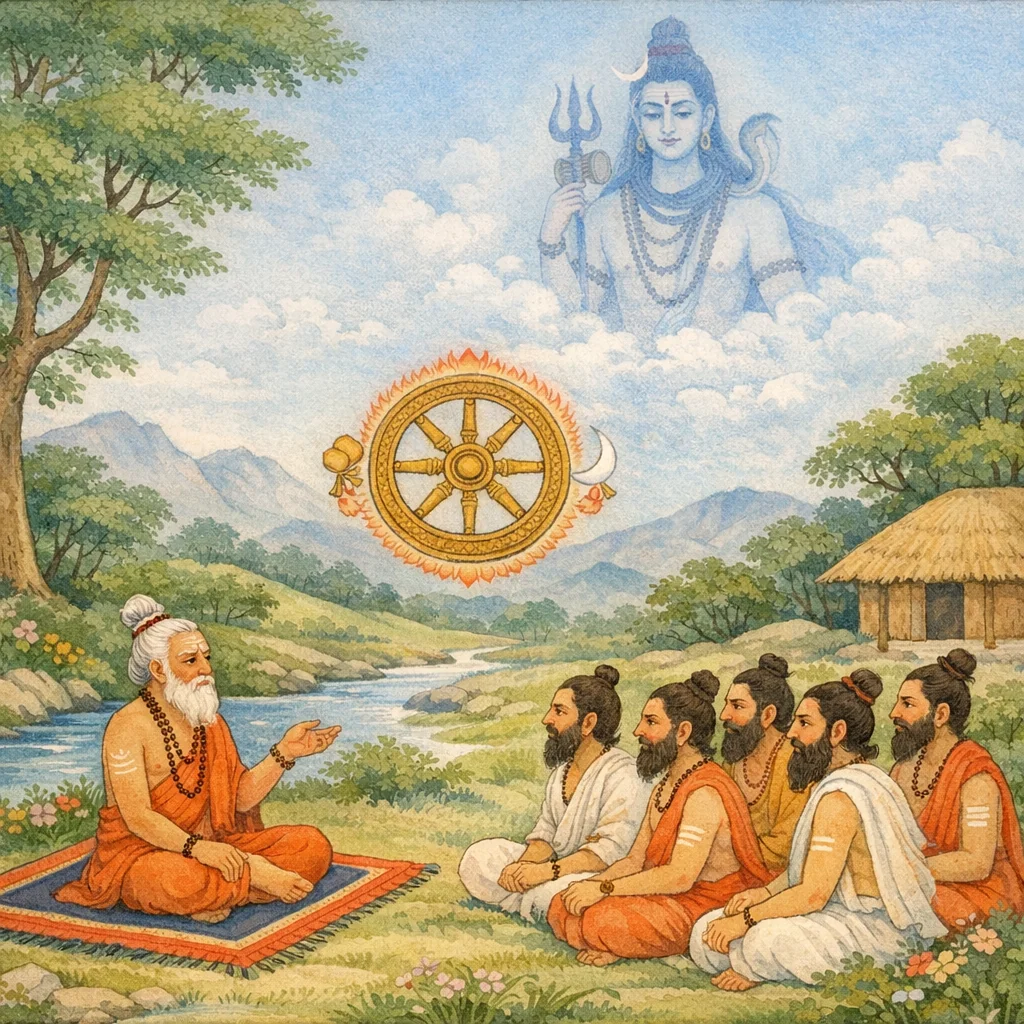
बन्धमोक्षवर्णनम् (Bondage and Liberation: The Prakṛti–Karma Wheel and Śiva as the Transcendent Cause)
Adhyāya 18 unfolds as a teaching dialogue: the ṛṣis ask for exact definitions of bondage (bandha) and liberation (mokṣa), and Sūta replies with a technical exposition. The bound jīva is defined as constrained by an “eightfold” complex beginning with prakṛti, while liberation is freedom from that same complex. The chapter then lists prakṛti-born constituents—prakṛti, buddhi, guṇic ahaṃkāra, and the five tanmātras—as a concise metaphysical inventory explaining embodiment and karmic continuity. It expands into the doctrine of three bodies (sthūla, sūkṣma, kāraṇa), linking pleasure and pain to puṇya–pāpa and to the jīva’s karmic rope that repeatedly generates birth and action. The decisive theological turn is that to stop the wheel-like wandering driven by body–karma dynamics, one should worship the maker of the wheel. Śiva is explicitly placed beyond prakṛti as the transcendent ground and the final soteriological reference. Thus Sāṃkhya-style analysis is integrated with a Śaiva resolution: metaphysical diagnosis culminates in a remedy centered on Śiva.
Shlokas
Verse 1
ऋषयः ऊचुः । बंधमोक्षस्वरूपं हि ब्रूहि सर्वार्थवित्तम । सूत उवाच । बंधमोक्षं तथोपायं वक्ष्येऽहं शृणुतादरात्
The sages said: “O knower of the meaning of all things, declare indeed the true nature of bondage and liberation.” Sūta said: “I shall expound bondage and liberation, and also the means to attain them—listen with reverent attention.”
Verse 2
प्रकृत्याद्यष्टबंधेन बद्धो जीवः स उच्यते । प्रकृत्याद्यष्टबंधेन निर्मुक्तो मुक्त उच्यते
The individual soul (jīva) is called “bound” when it is fettered by the eight bonds beginning with Prakṛti. When it is wholly freed from those same eight bonds beginning with Prakṛti, it is called “liberated” (mukta).
Verse 3
प्रकृत्यादिवशीकारो मोक्ष इत्युच्यते स्वतः । बद्धजीवस्तु निर्मुक्तो मुक्तजीवः स कथ्यते
Mokṣa, by its very nature, is said to be mastery—bringing Prakṛti and the other limiting factors under control. The bound soul that becomes wholly released is called the liberated soul.
Verse 4
प्रकृत्यग्रे ततो बुद्धिरहंकारो गुणात्मकः । पंचतन्मात्रमित्येते प्रकृत्याद्यष्टकं विदुः
First is Prakṛti; then comes Buddhi; and then the guṇa-formed Ahaṃkāra. Together with the five Tanmātras—these are known as the eightfold set beginning with Prakṛti.
Verse 5
प्रकृट्याद्यष्टजो देहो देहजं कर्म उच्यते । पुनश्च कर्मजो देहो जन्मकर्म पुनः पुनः
The body, produced from Prakṛti and the eight principles, is said to be the cause of actions arising from embodiment. And again, actions themselves generate a body—thus birth and karma recur again and again.
Verse 6
शरीरं त्रिविधं ज्ञेयं स्थूलं सूक्ष्मं च कारणम् । स्थूलं व्यापारदं प्रोक्तं सूक्ष्ममिंद्रि यभोगदम्
The body is to be understood as threefold: the gross, the subtle, and the causal. The gross body is said to be the instrument of outward actions, while the subtle body grants sense-experiences through the faculties.
Verse 7
कारणं त्वात्मभोगार्थं जीवकर्मानुरूपतः । सुखं दुःखं पुण्यपापैः कर्मभिः फलमश्नुते
Indeed, the body and its instruments exist for the jīva’s experience, in accordance with one’s own karma. Through deeds born of merit and demerit, one partakes of their fruits as pleasure and pain.
Verse 8
तस्माद्धि कर्मरज्ज्वा हि बद्धो जीवः पुनः पुनः । शरीरत्रयकर्मभ्यां चक्रवद्भ्राम्यते सदा
Therefore, bound again and again by the rope of karma, the individual soul continually wanders—spun like a wheel—by the actions connected with the three bodies.
Verse 9
चक्रभ्रमनिवृत्यर्थं चक्रकर्तारमीडयेत् । प्रकृत्यादि महाचक्रं प्रकृतेः परतः शिवः
To bring the revolving wheel (of transmigratory existence) to rest, one should worship the Maker of the wheel. The great wheel begins with Prakṛti, yet Śiva stands beyond Prakṛti.
Verse 10
चक्रकर्ता महेशो हि प्रकृतेः परतोयतः । पिबति वाथ वमति जीवन्बालो जलं यथा
Mahesha alone is the maker of the cosmic cycle, for He stands beyond Prakriti (material nature). From that transcendence He absorbs the universe and again emits it—just as a living child drinks water and then spits it out.
Verse 11
शिवस्तथा प्रकृत्यादि वशीकृत्याधितिष्ठति । सर्वं वशीकृतं यस्मात्तस्माच्छिव इति स्मृतः । शिव एव हि सर्वज्ञः परिपूर्णश्च निःस्पृहः
Shiva, having brought Prakriti and all that arises from it under His mastery, presides over them. Because everything is thus subdued and governed by Him, He is remembered as “Shiva.” Indeed, Shiva alone is omniscient—perfectly complete and wholly desireless.
Verse 12
सर्वज्ञता तृप्तिरनादिबोधः स्वतंत्रता नित्यमलुप्तशक्तिः । अनंतशक्तिश्च महेश्वरस्य यन्मानसैश्वर्यमवैति वेदः
Omniscience, perfect fullness, beginningless awareness, absolute independence, ever-unfailing power, and infinite potency—these are the qualities of Maheshvara. The Veda apprehends this as the Lord’s inner sovereignty, the supreme dominion abiding in His own consciousness.
Verse 13
अतः शिवप्रसादेन प्रकृत्यादिवशं भवेत् । शिवप्रसादलाभार्थं शिवमेव प्रपूजयेत्
Therefore, by Śiva’s grace one becomes free from subjection to Prakṛti and the like. To obtain that grace of Śiva, one should worship Śiva alone.
Verse 14
निःस्पृहस्य च पूर्णस्य तस्य पूजा कथं भवेत् । शिवोद्देशकृतं कर्म प्रसादजनकं भवेत्
How could worship be performed for Him who is desireless and complete? Yet any act done with Śiva as its intention becomes a cause of His grace.
Verse 15
लिंगे बेरे भक्तजने शिवमुद्दिश्य पूजयेत् । कायेन मनसा वाचा धनेनापि प्रपूजयेत्
Keeping Śiva in view, one should worship Him in the Liṅga, in His icon (bera), and also in His devotees. One should offer that worship fully—through the body, the mind, speech, and even through one’s wealth.
Verse 16
पुजया तु महेशो हि प्रकृतेः परमः शिवः । प्रसादं कुरुते सत्यं पूजकस्य विशेषतः
Through worship indeed, Maheśa—Śiva, supreme beyond Prakṛti—truly bestows His grace, especially upon the one who worships Him.
Verse 17
शिवप्रसादात्कर्माद्यं क्रमेण स्ववशं भवेत् । कर्मारभ्य प्रकृत्यंतं यदासर्वं वशं भवेत्
By the grace of Śiva, beginning with one’s own karma, all things gradually come under one’s command. From karma onward, even up to Prakṛti itself—then indeed, everything is mastered.
Verse 18
इति श्रीशैवेमहापुराणे विद्येश्वरसंहितायां साध्यसाधनखंडे शिवलिंगमहिमावर्णनं नामाष्टादशोऽध्यायः
Thus, in the holy Śaiva Mahāpurāṇa, within the Vidyeśvara-saṃhitā and the Sādhyasādhana-khaṇḍa, ends the eighteenth chapter entitled “The Description of the Glory of the Śiva-liṅga.”
Verse 19
तदा वै शिवलोके तु वासः सालोक्यमुच्यते । सामीप्यं याति सांबस्य तन्मात्रे च वशं गते
Then, dwelling in Śiva’s own world is called sālokya (abiding in the same realm). Thereafter, one attains sāmīpya—nearness to Lord Śiva (Sāmbā), becoming wholly surrendered and subject only to Him.
Verse 20
तदा तु शिवसायुज्यमायुधाद्यैः क्रियादिभिः । महाप्रसादलाभे च बुद्धिश्चापि वशा भवेत्
Then, through the prescribed observances—beginning with the use of the sacred implements and other ritual disciplines—one attains union with Śiva. And upon receiving the Great Grace (mahāprasāda) of Śiva, even the intellect becomes mastered and obedient (steadied in His way).
Verse 21
बुद्धिस्तु कार्यं प्रकृतेस्तत्सृष्टिरिति कथ्यते । पुनर्महाप्रसादेन प्रकृतिर्वशमेष्यति
Intellect (buddhi) is said to be an effect of Prakṛti—indeed, a product of her creation. Yet, by the great grace (mahāprasāda) of Lord Śiva, Prakṛti again comes under control and is subdued.
Verse 22
शिवस्य मानसैश्वर्यं तदाऽयत्नं भविष्यति । सार्वज्ञाद्यं शिवैश्वर्यं लब्ध्वा स्वात्मनि राजते
Then the mental sovereignty of Śiva arises effortlessly. Having attained Śiva’s lordly power—beginning with omniscience—one shines in one’s own Self.
Verse 23
तत्सायुज्यमिति प्राहुर्वेदागमपरायणाः । एवं क्रमेण मुक्तिः स्याल्लिंगादौ पूजया स्वतः
Those devoted to the Vedas and the Āgamas declare that state to be sāyujya—union with Śiva. Thus, in due sequence, liberation arises of its own accord through worship of the Liṅga and the like.
Verse 24
अतः शिवप्रसादार्थं क्रियाद्यैः पूजयेच्छिवम् । शिवक्रिया शिवतपः शिवमंत्रजपः सदा
Therefore, for the sake of attaining Śiva’s grace, one should worship Śiva through the prescribed observances and related disciplines—ever engaging in Śiva-centered ritual action, Śiva-oriented austerity, and the constant repetition of Śiva’s mantras.
Verse 25
शिवज्ञानं शिवध्यानमुत्तरोत्तरमभ्यसेत् । आसुप्तेरामृतेः कालं नयेद्वै शिवचिंतया
One should practice, more and more, the knowledge of Śiva and meditation on Śiva. From the moment one awakens until the time of death, one should indeed pass one’s time in contemplation of Śiva.
Verse 26
सद्यादिभिश्च कुसुमैरर्चयेच्छिवमेष्यति । ऋषय ऊचुः । लिंगादौ शिवपूजाया विधानं ब्रूहि सर्वतः
By worshipping Śiva with fresh flowers and the like, one surely attains Śiva. The sages said: “Teach us fully the proper procedure for Śiva’s worship, beginning with the Liṅga.”
Verse 27
सूत उवाच । लिंगानां च क्रमं वक्ष्ये यथावच्छृणुत द्विजाः । तदेव लिंगं प्रथमं प्रणवं सार्वकामिकम्
Sūta said: “I shall declare, in proper order, the hierarchy of the Liṅgas—listen attentively, O twice-born sages. The very first Liṅga is the Praṇava (Oṁ), which is the fulfiller of all rightful aims.”
Verse 28
सूक्ष्मप्रणवरूपं हि सूक्ष्मरूपं तु निष्फलम् । स्थूललिंगं हि सकलं तत्पंचाक्षरमुच्यते
Indeed, the subtle form is of the nature of the Pranava (Oṃ); but the merely subtle form is unproductive for practice. The gross Liṅga, however, is the complete (sakala) support for worship—this is what is called the Pañcākṣara (the five-syllabled mantra, “Namaḥ Śivāya”).
Verse 29
तयोः पूजा तपः प्रोक्तं साक्षान्मोक्षप्रदे उभे । पौरुषप्रकृतिभूतानि लिंगानिसुबहूनि च
Of those two, worship and austerity are declared—both indeed directly bestowing liberation. And there are very many Liṅgas as well, manifest in the modes of Puruṣa (the Conscious Lord) and Prakṛti (His power of manifestation).
Verse 30
तानि विस्तरतो वक्तुं शिवो वेत्ति न चापरः । भूविकाराणि लिंगानि ज्ञातानि प्रब्रवीमि वः
To explain them in full detail, Śiva alone knows—none other. Yet, as far as is known, I shall tell you about the Liṅgas that arise as transformations of the earth.
Verse 31
स्वयं भूलिंगं प्रथमं बिंदुलिंगंद्वितीयकम् । प्रतिष्ठितं चरंचैव गुरुलिंगं तु पंचमम्
The self-manifest Liṅga is the first; the Bindu-Liṅga is the second. The consecrated (installed) Liṅga and the movable Liṅga are also counted, and the Guru-Liṅga is the fifth.
Verse 32
देवर्षितपसा तुष्टः सान्निध्यार्थं तु तत्र वै । पृथिव्यन्तर्गतः शर्वो बीजं वै नादरूपतः
Pleased by the austerities of the divine sage, Śarva (Lord Śiva), in order to grant His immediate presence there, entered within the earth—indeed, as the seed in the form of Nāda, the primordial sacred sound.
Verse 33
स्थावरांकुरवद्भूमिमुद्भिद्य व्यक्त एव सः । स्वयंभूतं जातमिति स्वयंभूरिति तं विदुः
Like a sprout breaking through the earth, He became manifest of Himself. Since He is said to have arisen as self-born, the wise know Him by the name “Svayambhū” (the Self-existent Lord).
Verse 34
तल्लिंगपूजया ज्ञानं स्वयमेव प्रवर्द्धते । सुवर्णरजतादौ वा पृथिव्यां स्थिंडिलेपि वा
By the worship of that Śiva-liṅga, true knowledge increases of its own accord. Whether the liṅga is made of gold or silver, or even fashioned upon the earth as a simple earthen emblem, the fruit of worship remains spiritually efficacious.
Verse 35
स्वहस्ताल्लिखितं लिंगं शुद्धप्रणवमंत्रकम् । यंत्रलिंगं समालिख्य प्रतिष्ठावाहनं चरेत्
One should draw with one’s own hand a liṅga-yantra, inscribing it with the pure Praṇava mantra (Oṃ). Having thus properly prepared the yantra-liṅga, one should perform its consecration and the invocation (of Śiva’s presence) into it.
Verse 36
बिंदुनादमयं लिंगं स्थावरं जंगमं च यत् । भावनामयमेतद्धि शिवदृष्टं न संशयः
The Liṅga is constituted of Bindu and Nāda; it is present as both the unmoving and the moving world. Indeed, this is of the nature of contemplative realization (bhāvanā); it is Śiva’s own vision—of this there is no doubt.
Verse 37
यत्र विश्वस्य ते शंभुस्तत्र तस्मै फलप्रदः । स्वहस्ताल्लिख्यते यंत्रे स्थावरादावकृत्रिमे
Wherever You, Śambhu—the Lord of the universe—are installed, there You become the giver of fruits, both spiritual and worldly, to that devotee. Therefore the yantra should be drawn by one’s own hand upon a natural, steady base—such as an unmoving surface—without artificial contrivance.
Verse 38
आवाह्य पूजयेच्छंभुं षोडशैरुपचारकैः । स्वयमैश्वर्यमाप्नोति ज्ञानमभ्यासतो भवेत्
Having invoked Śambhu, one should worship Him with the sixteen offerings. Through that worship, in due course one attains aiśvarya—divine lordliness; and by steady practice, true knowledge arises.
Verse 39
देवैश्च ऋषिभिश्चापि स्वात्मसिद्ध्यर्थमेव हि । समंत्रेणात्महस्तेन कृतं यच्छुद्धमंडले
Indeed, what the gods and the sages performed—solely for the attainment of their own spiritual perfection—was done in a purified sacred maṇḍala, with mantra-recitation and by their own hands.
Verse 40
शुद्धभावनया चैव स्थापितं लिंगमुत्तमम् । तल्लिंगं पौरुषं प्राहुस्तत्प्रतिष्ठितमुच्यते
When the supreme Liṅga is installed with pure inner intention and devotion, that Liṅga is called “pauruṣa” (established by a person) and is termed “pratiṣṭhita”—duly consecrated and set in its place.
Verse 41
तल्लिंगपूजया नित्यं पौरुषैश्वर्यमाप्नुयात् । महद्भिर्ब्राह्मणैश्चापि राजभिश्च महाधनैः
By worshipping that Liṅga daily, one attains vigorous personal power and lordly prosperity, and is honoured and supported by eminent brāhmaṇas as well as by kings of great wealth.
Verse 42
शिल्पिनाकल्पितं लिंगं मंत्रेण स्थापितं च यत् । प्रतिष्ठितं प्राकृतं हि प्राकृतैश्वर्यभोगदम्
A Liṅga fashioned by an artisan and then established with mantra—when thus duly installed—is indeed called “prākṛta” (made of material substance), and it bestows material enjoyments and worldly prosperities upon embodied beings.
Verse 43
यदूर्जितं च नित्यं च तद्धि पौरुषमुच्यते । यद्दुर्बलमनित्यं च तद्धि प्राकृतमुच्यते
That which is powerful and eternal is indeed called the pauruṣa (the higher, conscious principle). But that which is weak and impermanent is indeed called prākṛta (of Prakṛti—material nature).
Verse 44
लिंगं नाभिस्तथा जिह्वा नासाग्रञ्च शिखा क्रमात् । कट्यादिषु त्रिलोकेषु लिंगमाध्यात्मिकं चरम्
In the inner body, the Liṅga is understood in sequence as the navel, the tongue, the tip of the nose, and the crown of the head. Thus, within the three worlds experienced in one’s own being (from the waist upward and in the other bodily centers), the inner, spiritual Liṅga is the living, moving principle to be realized.
Verse 45
पर्वतं पौरुषं प्रोक्तं भूतलं प्राकृतं विदुः । वृक्षादि पौरुषं ज्ञेयं गुल्मादि प्राकृतं विदुः
They declare the mountain to be of the order of Puruṣa (the conscious, presiding principle), while the earth’s ground is known as Prākṛta (of Prakṛti, material nature). Likewise, trees and the like are to be understood as belonging to the Puruṣa-order, whereas shrubs and the like are known as Prākṛta. Thus the Śiva Purāṇa distinguishes the presiding principle (Puruṣa) from the field of nature (Prakṛti), guiding the seeker to discern Pati (Śiva) beyond both.
Verse 46
षाष्टिकं प्राकृतं ज्ञेयं शालिगोधूमपौरुषम् । ऐश्वर्यं पौरुषं विद्यादणिमाद्यष्टसिद्धिदम्
Know that ‘ṣāṣṭika’ (a sixty-day crop) is of the Prākṛta, the ordinary kind—rice and wheat gained by human effort. But understand ‘aiśvarya’ (divine lordship) in human attainment as that which bestows the eight siddhis, beginning with aṇimā.
Verse 47
सुस्त्रीधनादिविषयं प्राकृतं प्राहुरास्तिकाः । प्रथमं चरलिंगेषु रसलिंगं प्रकथ्यते
The theistic teachers declare that the “prākṛta” sphere (worldly, sense-bound) concerns matters such as women and wealth. Among the movable liṅgas (cara-liṅgas), first is described the “rasa-liṅga”, the liṅga associated with sensual relish and taste.
Verse 48
रसलिंगं ब्राह्मणानां सर्वाभीष्टप्रदं भवेत् । बाणलिंगं क्षत्रियाणां महाराज्यप्रदं शुभम्
For Brahmins, the Rasa-liṅga becomes a bestower of every cherished aim. For Kshatriyas, the Bāṇa-liṅga is auspicious, granting great sovereignty and royal dominion.
Verse 49
स्वर्णलिंगं तु वैश्यानां महाधनपतित्वदम् । शिलालिंगं तु शूद्रा णां महाशुद्धिकरं शुभम्
For the Vaiśyas, a golden Liṅga bestows the state of great wealth and lordship over riches. For the Śūdras, a stone Liṅga is auspicious and brings about great purification.
Verse 50
स्फाटिकं बाणलिंगं च सर्वेषांसर्वकामदम् । स्वीयाभावेऽन्यदीयं तु पूजायां न निषिद्ध्यते
A crystal liṅga (sphaṭika) and the Bāṇa-liṅga bestow all desired ends upon all devotees. And when one’s own liṅga is not available, worship with another’s liṅga is not forbidden in ritual worship.
Verse 51
स्त्रीणां तु पार्थिवं लिंगं सभर्तृणां विशेषतः । विधवानां प्रवृत्तानां स्फाटिकं परिकीर्तितम्
For women, the Śiva-liṅga of earth (clay) is prescribed—especially for those who dwell with their husbands; but for widows devoted to dharmic observance, the crystal (sphāṭika) liṅga is declared to be fitting.
Verse 52
विधवानां निवृत्तानां रसलिंगं विशिष्यते । बाल्येवायौवनेवापि वार्द्धकेवापि सुव्रताः
For widows and for those who have withdrawn from worldly life, the worship of the Rasa-Liṅga is especially commended. O you of good vows, whether in childhood, in youth, or even in old age, it remains an excellent support for devotion to Śiva.
Verse 53
शुद्धस्फटिकलिंगं तु स्त्रीणां तत्सर्वभोगदम् । प्रवृत्तानां पीठपूजा सर्वाभीष्टप्रदा भुवि
For women, the worship of a pure crystal Liṅga grants every enjoyment and auspicious fulfillment. And for householders engaged in worldly duties, worship of the pīṭha—the Liṅga’s sacred pedestal and base—bestows all desired aims here on earth.
Verse 54
पात्रेणैव प्रवृत्तस्तु सर्वपूजां समाचरेत् । अभिषेकांते नैवेद्यं शाल्यन्नेन समाचरेत्
Having begun the worship with the prescribed vessel, one should duly perform the entire worship. At the conclusion of the abhiṣeka, one should offer naivedya—especially cooked rice—as the food-offering.
Verse 55
पूजांते स्थापयेल्लिंगं संपुटेषु पृथग्गृहे । करपूजानि वृत्तानां स्वभोज्यं तु निवेदयेत्
At the close of the worship, one should duly install the Śiva-liṅga in its proper protective casket in a separate place. Then, according to one’s means and prescribed observance, one should perform the concluding hand-offerings (karapūjā) and offer as naivedya the food fit for one’s own consumption—dedicating it first to Lord Śiva.
Verse 56
निवृत्तानां परं सूक्ष्मलिंगमेव विशिष्यते । विभूत्यभ्यर्चनं कुर्याद्विभूतिं च निवेदयेत्
For those who have turned away from worldly involvement (nivṛtti), the supreme and most excellent is the subtle Liṅga alone. One should worship Śiva with vibhūti (sacred ash) and also offer that vibhūti in devotion.
Verse 57
पूजां कृत्वाथ तल्लिंगं शिरसा धारयेत्सदा । विभूतिस्त्रिविधा प्रोक्ता लोकवेदशिवाग्निभिः
Having performed worship, one should ever bear that Liṅga upon one’s head with reverence. Vibhūti, the sacred ash, is declared to be of three kinds—according to worldly usage, Vedic ordinance, and the fire consecrated to Śiva.
Verse 58
लोकाग्निजमथो भस्मद्र व्यशुद्ध्यर्थमावहेत् । मृद्दारुलोहरूपाणां धान्यानां च तथैव च
One should then procure ash produced from the sacred household fire, for the purpose of purifying the substances used in worship—those made of clay, wood, and metal, and likewise grains as well.
Verse 59
तिलादीनां च द्र व्याणां वस्त्रादीनां तथैव च । तथा पर्युषितानां च भस्मना शिद्धिरिष्यते
For substances such as sesame and the like, for articles such as cloth and the like, and even for items kept overnight and become stale, purification is enjoined to be accomplished by sacred ash (bhasma).
Verse 60
श्वादिभिर्दूषितानां च भस्मना शुद्धिरिष्यते । सजलं निर्जलं भस्म यथायोग्यं तु योजयेत्
For items defiled by dogs and the like, purification is prescribed by means of sacred ash (bhasma). One should apply bhasma mixed with water or in dry form, as is appropriate to the rite.
Verse 61
वेदाग्निजं तथा भस्म तत्कर्मांतेषु धारयेत् । मंत्रेण क्रियया जन्यं कर्माग्नौ भस्मरूपधृक्
At the conclusion of those rites, one should apply the sacred ash produced from the Vedic fire. Brought forth through mantra and prescribed action, it is born in the sacrificial fire of ritual and is worn in the form of bhasma.
Verse 62
तद्भस्मधारणात्कर्म स्वात्मन्यारोपितं भवेत् । अघोरेणात्ममंत्रेण बिल्वकाष्ठं प्रदाहयेत्
By wearing that sacred ash (bhasma), one’s ritual action becomes inwardly established—offered and fixed in one’s own Self. Then, with the Aghora mantra as one’s personal (ātma) mantra, one should burn bilva-wood to prepare the holy ash.
Verse 63
शिवाग्निरिति संप्रोक्तस्तेन दग्धं शिवाग्निजम् । कपिलागोमयं पूर्वं केवलं गव्यमेव वा
That fire is proclaimed to be “Śiva’s fire”; and whatever is burned by Śiva’s fire becomes bhasma—the sacred ash born of Śiva’s fire. First, one should burn the dung of a tawny (kapilā) cow, or else only pure cow-dung.
Verse 64
शम्यस्वत्थपलाशान्वा वटारम्वधबिल्वकान् । शिवाग्निना दहेच्छुद्धं तद्वै भस्म शिवाग्निजम्
One should burn (the wood/leaves of) śamī, aśvattha, palāśa, vaṭa, aramvadha, and bilva in Śiva’s sacred fire. What is thus burned and made pure—indeed, that is bhasma, the holy ash born of Śiva’s fire.
Verse 65
दर्भाग्नौ वा दहेत्काष्ठं शिवमंत्रं समुच्चरन् । सम्यक्संशोध्य वस्त्रेण नवकुंभे निधापयेत्
Or, kindling the fire with darbha-grass, one should burn the wood while reciting Śiva’s mantra. Then, having purified it well and strained it through cloth, one should place it into a new water-pot.
Verse 66
दीप्त्यर्थं तत्तु संग्राह्यं मन्यते पूज्यतेपि च । भस्मशब्दार्थ एवं हि शिवः पूर्वं तथाऽकरोत्
It is held that this bhasma should be gathered for the sake of spiritual radiance, and it is also regarded as worthy of worship. Indeed, this is the very purport of the word “bhasma”; and Lord Śiva himself acted in this manner in ancient times.
Verse 67
यथा स्वविषये राजा सारं गृह्णाति यत्करम् । यथा मनुष्याः सस्यादीन्दग्ध्वा सारं भजंति वै
Just as a king, within his own realm, takes the due tax as the essential share, and just as people, after burning crops and the like, take up only the essence, so too the wise should grasp the essential truth—Śiva—leaving aside what is non-essential.
Verse 68
यथा हि जाठराग्निश्च भक्ष्यादीन्विविधान्बहून् । दग्ध्वा सारतरं सारात्स्वदेहं परिपुष्यति
Just as the digestive fire, after burning many kinds of foods and the like, draws out what is most essential from their essence and thereby nourishes its own body, so too does the inner fire of Shaiva discernment assimilate the subtlest truth and strengthen the seeker’s spiritual being.
Verse 69
तथा प्रपंचकर्तापि स शिवः परमेश्वरः । स्वाधिष्ठेयप्रपंचस्य दग्ध्वा सारं गृहीतवान्
Thus, that Parameśvara Śiva—though the very creator of the manifested universe—burned away the world that lies within His own domain, and took up only its essential reality (its true essence).
Verse 70
दग्ध्वा प्रपंचं तद्भस्म् अस्वात्मन्यारोपयच्छिवः । उद्धूलनेन व्याजेन जगत्सारं गृहीतवान्
Having burned the entire manifested world into ash, Shiva placed that ash upon His own Self; and under the pretext of smearing (bhasma), He took up the very essence of the universe.
Verse 71
स्वरत्नं स्थापयामास स्वकीये हि शरीरके । केशमाकाशसारेण वायुसारेण वै मुखम्
He then set his own radiant jewel within his very body; he fashioned the hair from the essence of space, and the face indeed from the essence of wind.
Verse 72
हृदयं चाग्निसारेण त्वपां सारेण वैकटिम् । जानु चावनिसारेण तद्वत्सर्वं तदंगकम्
His heart is formed from the essence of Fire; His skin from the essence of Water; His knees from the essence of Earth—thus all His limbs are fashioned from the essences of the elements.
Verse 73
ब्रह्मविष्ण्वोश्च रुद्रा णां सारं चैव त्रिपुंड्रकम् । तथा तिलकरूपेण ललाटान्ते महेश्वरः
The Tripuṇḍra of sacred ash is indeed the very essence of Brahmā, Viṣṇu, and the Rudras. Likewise, as the tilaka-mark at the end of the forehead, Mahādeva Himself abides there.
Verse 74
भवृद्ध्या सर्वमेतद्धि मन्यते स्वयमैत्यसौ । प्रपंचसारसर्वस्वमनेनैव वशीकृतम्
Through the swelling of worldly becoming (bhava-vṛddhi), he imagines all this to be real and self-established. By this very notion, the entire essence and totality of the phenomenal world overpowers and binds him.
Verse 75
तस्मादस्य वशीकर्ता नास्तीति स शिवः स्मृतः । यथा सर्वमृगाणां च हिंसको मृगहिंसकः
Therefore, because none can subdue or control Him, He is remembered as Śiva. Just as, among all beasts, the slayer is called the ‘slayer of beasts’ (the lion), so too is He the unsurpassed One whom none can overpower.
Verse 76
अस्य हिंसामृगो नास्ति तस्मात्सिंह इतीरितः । शं नित्यं सुखमानंदमिकारः पुरुषः स्मृतः
In Him there is no beast of violence; therefore He is called “Siṃha” (the Lion). “Śam” signifies eternal peace and bliss; and the syllable “mi” is remembered as the Puruṣa—the indwelling conscious Lord.
Verse 77
वकारः शक्तिरमृतं मेलनं शिव उच्यते । तस्मादेवं स्वमात्मानं शिवं कृत्वार्चयेच्छिवम्
“Va” is declared to be Śakti, the amṛta—nectar of immortality—and the sacred union; this indeed is called Śiva. Therefore, having made one’s own self to be Śiva (through inner identification and purity), one should worship Śiva.
Verse 78
तस्मादुद्धूलनं पूर्वं त्रिपुंड्रं धारयेत्परम् । पूजाकाले हि सजलं शुद्ध्यर्थं निर्जलं भवेत्
Therefore, one should first apply vibhūti, the sacred ash, and then wear the supreme Tripuṇḍra. But at the time of pūjā it should be mixed with water; for purity, otherwise it should be kept dry.
Verse 79
दिवा वा यदि वारात्रौ नारी वाथ नरोपि वा । पूजार्थं सजलं भस्म त्रिपुंड्रेणैव धारयेत्
Whether by day or by night—whether woman or man—when one intends worship, one should wear only the Tripuṇḍra, made of sacred ash (bhasma) moistened with water.
Verse 80
त्रिपुंड्रं सजलं भस्म धृत्वा पूजां करोति यः । शिवपूजां फलं सांगं तस्यैव हि सुनिश्चितम्
Whoever performs worship after applying the Tripuṇḍra—sacred ash (bhasma) moistened with water—surely attains the complete, undiminished fruit of Śiva-worship in all its parts.
Verse 81
भस्म वै शिवमंत्रेण धृत्वा ह्यत्याश्रमी भवेत् । शिवाश्रमीति संप्रोक्तः शिवैकपरमो यतः
Having applied the sacred ash (bhasma) with the Śiva-mantra, one becomes transcendent to all ordinary stages of life. Therefore one is called a “Śiva-āśramī,” for one’s highest and sole refuge is Śiva alone.
Verse 82
शिवव्रतैकनिष्ठस्य नाशौचं न च सूतकम् । ललाटेऽग्रे सितं भस्म तिलकं धारयेन्मृदा
For one who is unwaveringly devoted to the observance of Śiva’s vow (Śiva-vrata), there is neither aśauca (ritual impurity) nor sūtaka (the pollution connected with birth or death). Upon the front of the forehead one should wear a white bhasma tilaka, prepared with purified earth.
Verse 83
स्वहस्ताद्गुरुहस्ताद्वाशिवभक्तस्य लक्षणम् । गुणान्रुंध इति प्रोक्तो गुरुशब्दस्य विग्रहः
The distinguishing mark of a devotee of Śiva is that the sacred emblem is received either by one’s own hand or by the hand of the Guru. The word “guru” is explained as “one who restrains (ruṃdha) the guṇas.”
Verse 84
सविकारान्राजसादीन्गुणान्रुंधे व्यपोहति । गुणातीतः परशिवो गुरुरूपं समाश्रितः
Paraśiva, who is beyond the guṇas, taking refuge in the form of the Guru, restrains and removes the guṇas such as rajas together with their modifications, and thus leads the bound soul beyond their sway.
Verse 85
गुणत्रयं व्यपोह्याग्रे शिवं बोधयतीति सः । विश्वस्तानां तु शिष्याणां गुरुरित्यभिधीयते
He is called the Guru because, first removing the triad of guṇas (guṇa-traya), he awakens the knowledge of Śiva. For those disciples who have placed their trust in him, he is thus designated “Guru.”
Verse 86
तस्माद्गुरुशरीरं तु गुरुलिंगं भवेद्बुधः । गुरुलिंगस्य पूजा तु गुरुशुश्रूषणं भवेत्
Therefore, O wise one, the Guru’s very body should be regarded as the Guru-Liṅga; and the worship of that Guru-Liṅga is fulfilled by reverent service and attentive attendance upon the Guru.
Verse 87
श्रुतं करोति शुश्रूषा कायेन मनसा गिरा । उक्तं यद्गुरुणा पूर्वं शक्यं वाऽशक्यमेव वा
He makes his learning real through devoted service—by body, mind, and speech. Whatever the Guru has previously instructed, whether it seems possible or even impossible, he undertakes it as a sacred duty.
Verse 88
करोत्येव हि पूतात्मा प्राणैरपि धनैरपि । तस्माद्वै शासने योग्यः शिष्य इत्यभिधीयते
Indeed, the purified-souled one acts (in service of the Guru and the sacred teaching) even with his very life-breath and even with his wealth. Therefore he is truly called a “disciple” (śiṣya)—one who is fit to be guided, corrected, and trained in the Guru’s discipline.
Verse 89
शरीराद्यर्थकं सर्वं गुरोर्दत्त्वा सुशिष्यकः । अग्रपाकं निवेद्याग्रेभुंजीयाद्गुर्वनुज्ञया
A worthy disciple should dedicate everything connected with the body and its needs to the Guru. Having first offered the foremost portion of the cooked food to the Guru, he should eat only afterwards, with the Guru’s permission.
Verse 90
शिष्यः पुत्र इति प्रोक्तः सदाशिष्यत्वयोगतः । जिह्वालिंगान्मंत्रशुक्रं कर्णयोनौ निषिच्यवै
Because of the bond of perpetual discipleship, the disciple is called a “son”. From the liṅga of the tongue the Guru pours the mantra-seed—likened to semen—into the womb of the ear (of the disciple).
Verse 91
जातः पुत्रो मंत्रपुत्रः पितरं पूजयेद्गुरुम् । निमज्जयति पुत्रं वै संसारे जनकः पिता
The son who is truly “born”—the mantra-born son, awakened through initiation—should venerate his father as a Guru. For in the cycle of saṃsāra, the father who merely begets can indeed cause his son to sink deeper into worldly bondage.
Verse 92
संतारयति संसाराद्गुरुर्वै बोधकः पिता । उभयोरंतरं ज्ञात्वा पितरं गुरुमर्चयेत्
The Guru ferries one across saṃsāra, and the father is indeed the one who awakens a person into life and duty. Knowing the distinction between these two, one should worship both—the father and the Guru.
Verse 93
अंगशुश्रूषया चापि धनाद्यैः स्वार्जितैर्गुरुम् । पादादिकेशपर्यंतं लिंगान्यंगानि यद्गुरोः
One should honor and attend upon the Guru through devoted personal service, and also by offering one’s own rightly earned wealth and other resources—revering, from the Guru’s feet up to the crown of the head, the sacred marks and limbs of that Guru as venerable signs of Śiva.
Verse 94
धनरूपैः पादुकाद्यैः पादसंग्रणादिभिः । स्नानाभिषेकनैवेद्यैर्भोजनैश्च प्रपूजयेत्
One should worship the Lord with offerings in the form of wealth, with gifts such as sandals (pādukā), with services like attending to and massaging the feet, and with rites such as bathing and ritual ablution (abhiṣeka); and one should also honor Him with food-offerings (naivedya) and by feeding devotees or guests.
Verse 95
गुरुपूजैव पूजा स्याच्छिवस्य परमात्मनः । गुरुशेषं तु यत्सर्वमात्मशुद्धिकरं भवेत्
Worship of the Guru alone is truly the worship of Śiva, the Supreme Self. Whatever remains after serving the Guru—every such act—becomes a cause of inner purification.
Verse 96
गुरोः शेषः शिवोच्छिष्टं जलमन्नादिनिर्मितम् । शिष्याणां शिवभक्तानां ग्राह्यं भोज्यं भवेद्द्विजाः
O twice-born ones, the remnants left by the Guru are to be regarded as Śiva’s own sacred leavings—whether water, food, or the like. For disciples who are devotees of Śiva, it is proper to accept them and partake of them.
Verse 97
गुर्वनुज्ञाविरहितं चोरवत्सकलं भवेत् । गुरोरपि विशेषज्ञं यत्नाद्गृह्णीत वै गुरुम्
Any sacred act done without the Guru’s permission becomes wholly tainted—like an act of theft. Therefore, with diligent effort, one should accept a Guru who is truly discerning, even among Gurus, and well-versed in the specific path.
Verse 98
अज्ञानमोचनं साध्यं विशेषज्ञो हि मोचकः । आदौ च विघ्नशमनं कर्तव्यं कर्म पूर्तये
The removal of ignorance is the goal; indeed, the one who truly knows the method is the liberator. Therefore, at the very beginning, the pacification of obstacles must be performed, so that the rite may be brought to completion.
Verse 99
निर्विघ्नेन कृतं सांगं कर्म वै सफलं भवेत् । तस्मात्सकलकर्मादौ विघ्नेशं पूजयेद् बुधः
A rite performed without obstacles, complete with its proper auxiliaries, truly becomes fruitful. Therefore, at the beginning of every undertaking, the wise should worship Vighneśa (Gaṇeśa), the Lord who governs obstacles.
Verse 100
सर्वबाधानिवृत्त्यर्थं सर्वान्देवान्यजेद्बुधः । ज्वरादिग्रंथिरोगाश्च बाधा ह्याध्यात्मिका मता
For the removal of every kind of affliction, the wise should duly worship all the deities; for fevers and other knot-like maladies are regarded as obstacles arising from one’s inner (adhyātmika) condition.
Verse 101
पिशाचजंबुकादीनां वल्मीकाद्युद्भवे तथा । अकस्मादेव गोधादिजंतूनां पतनेपि च
Likewise, when ghouls, jackals, and the like appear; when anthills and similar formations suddenly arise; and even when creatures such as the godhā (iguana) and other animals fall unexpectedly—these too are counted as ominous signs.
Verse 102
गृहे कच्छपसर्पस्त्रीदुर्जनादर्शनेपि च । वृक्षनारीगवादीनां प्रसूतिविषयेपि च
Even within one’s home—upon seeing a tortoise, a snake, a woman, or a wicked person—and likewise in matters concerning the giving birth of trees, women, cows, and the like, one should understand the indicated omens and act with discerning care.
Verse 103
भाविदुःखं समायाति तस्मात्ते भौतिका मता । अमेध्या शनिपातश्च महामारी तथैव च
Future sorrow may descend upon a person; therefore these are regarded as worldly (bhūtika) afflictions—impurity and defilement, the malignant fall of Śani (Saturn), that is, inauspicious astral influence, and likewise great epidemics.
Verse 104
ज्वरमारी विषूचिश्च गोमारी च मसूरिका । जन्मर्क्षग्रहसंक्रांतिग्रहयोगाः स्वराशिके
Fevers and epidemic afflictions, cholera-like disorders, cattle-plagues, and smallpox; likewise the natal asterism, planetary transits, and planetary combinations within one’s own zodiac sign—these too are counted among the influences that can trouble embodied beings.
Verse 105
दुःस्वप्नदर्शनाद्याश्च मता वै ह्यधिदैविकाः । शवचांडालपतितस्पर्शाद्येंतर्गृहे गते
Seeing evil dreams and the like is indeed regarded as adhidaivika—arising from higher, unseen forces. Likewise, when within one’s dwelling there occurs contact with a corpse, a Caṇḍāla, or a fallen person—and such defilements—these too are to be understood as the same kind of inauspicious influence.
Verse 106
एतादृशे समुत्पन्ने भाविदुःखस्य सूचके । शांतियज्ञं तु मतिमान्कुर्यात्तद्दोषशांतये
When such a sign arises—an indicator of suffering yet to come—the wise person should perform a Śānti-yajña, a rite of pacification, to soothe that fault and bring it to rest.
Verse 107
देवालयेऽथ गोष्ठे वा चैत्ये वापि गृहांगणे । प्रादेशोन्नतधिष्ण्ये वै द्विहस्ते च स्वलंकृते
Whether in a temple, in a cowshed, at a shrine, or even in the courtyard of one’s home, one should prepare a well-adorned sacred platform for worship—raised to about a span in height and measuring two hands in extent.
Verse 108
भारमात्रव्रीहिधान्यं प्रस्थाप्य परिसृत्य च । मध्ये विलिख्यकमलं तथा दिक्षुविलिख्य वै
Placing a measured quantity of unhusked rice-grain and arranging it evenly all around, one should draw a lotus in the center, and likewise draw (lotus-markings) in the directions as well.
Verse 109
तंतुना वेष्टितं कुंभं नवगुग्गुलधूपितम् । मध्ये स्थाप्य महाकुंभं तथा दिक्ष्वपि विन्यसेत्
Having wrapped a ritual water-pot (kumbha) with a sacred thread and fumigated it with fresh guggulu incense, one should place the great kumbha in the center and likewise arrange the other kumbhas in the (cardinal) directions as well.
Verse 110
सनालाम्रककूर्चादीन्कलशांश्च तथाष्टसु । पूरयेन्मंत्रपूतेन पंचद्र व्ययुतेन हि
He should fill and prepare the vessels—such as the bundle of mango leaves with its stalk and other ritual implements—and likewise the eight kalaśas, with the five sacred substances that have been purified by mantra.
Verse 111
प्रक्षिपेन्नव रत्नानि नीलादीन्क्रमशस्तथा । कर्मज्ञं च सपत्नीकमाचार्यं वरयेद्बुधः
Then he should place the nine gems—beginning with sapphire and the rest—in their proper order. The wise devotee should also choose and appoint an ācārya, skilled in ritual action, together with his wife, so that the worship may be conducted rightly.
Verse 112
सुवर्णप्रतिमां विष्णोरिंद्रा दीनां च निक्षिपेत् । सशिरस्के मध्यकुंभे विष्णुमाबाह्य पूजयेत्
One should place a golden image of Viṣṇu, and also images of Indra and of the humble supplicant. In the central pot (kumbha), fitted with its lid, one should invoke Viṣṇu to abide there and worship Him.
Verse 113
प्रागादिषु यथामंत्रमिंद्रा दीन्क्रमशो यजेत् । तत्तन्नाम्ना चतुर्थ्यां च नमोन्ते न यथाक्रमम्
Beginning with Indra and proceeding in proper order, one should worship in the east and the other directions according to the prescribed mantras. Each offering is made by uttering the respective deity’s name in the dative, and the mantra is concluded with “namaḥ,” in due sequence.
Verse 114
आवाहनादिकं सर्वमाचार्येणैव कारयेत् । आचार्य ऋत्विजा सार्धं तन्मात्रान्प्रजपेच्छतम्
All rites beginning with the invocation (āvāhana) should be carried out only through the ācārya (preceptor). The ācārya, together with the officiating priest (ṛtvij), should have the prescribed mantra-form recited one hundred times.
Verse 115
कुंभस्य पश्चिमे भागे जपांते होममाचरेत् । कोटिं लक्षं सहस्रं वा शतमष्टोत्तरं बुधाः
On the western side of the ritual kumbha, when japa is completed, one should perform homa, offering oblations into the sacred fire. The wise prescribe the count as a koṭi, a lakṣa, a thousand, or one hundred and eight—according to one’s capacity and observance.
Verse 116
एकाहं वा नवाहं वा तथा मंडलमेव वा । यथायोग्यं प्रकुर्वीत कालदेशानुसारतः
Whether for a single day, for nine days, or for an entire maṇḍala-period, one should perform the observance in a fitting manner, in accordance with the time and the place.
Verse 117
शमीहोमश्च शांत्यर्थे वृत्त्यर्थे च पलाशकम् । समिदन्नाज्यकैर्द्र व्यैर्नाम्ना मंत्रेण वा हुनेत्
For the attainment of peace (śānti), one should perform the fire-offering (homa) with śamī-wood; and for prosperity and proper livelihood (vṛtti), with palāśa-wood. Using fuel-sticks, cooked rice, ghee, and other fitting offerings, one should make oblations—either invoking the deity by name or reciting the appropriate mantra.
Verse 118
प्रारंभे यत्कृतं द्र व्यं तत्क्रियांतं समाचरेत् । पुण्याहं वाचयित्वांते दिने संप्रोक्ष्ययेज्जलैः
Whatever materials are prepared at the beginning of the rite should be kept fit for use until the ritual is completed. Then, on the concluding day, after having the auspicious “Puṇyāha” benediction recited, one should sanctify all by sprinkling with consecrated water.
Verse 119
ब्राह्मणान्भोजयेत्पश्चाद्यावदाहुतिसंख्यया । आचार्यश्च हविष्याशीऋत्विजश्च भवेद्बुधाः
Afterwards, one should feed the brāhmaṇas in a number corresponding to the count of oblations offered. The wise should ensure that both the ācārya and the officiating priest (ṛtvij) partake only of the consecrated havis (ritual food).
Verse 120
आदित्यादीन्ग्रहानिष्ट्वा सर्वहोमांत एव हि । ऋत्विभ्यो दक्षिणां दद्यान्नवरत्नं यथाक्रमम्
Having duly worshipped the planetary deities beginning with the Sun, and indeed at the conclusion of all the oblations, one should give the officiating priests their honorarium (dakṣiṇā) in the form of the nine gems (navaratna), in the prescribed order.
Verse 121
दशदानं ततः कुर्याद्भूरिदानं ततः परम् । बालानामुपनीतानां गृहिणां वनिनां धनम्
Thereafter one should perform the ‘tenfold giving’; and beyond that, one should undertake abundant charity. Such giving is to be directed toward the young who have been invested with the sacred thread (upānayana), householders, and forest-dwellers—providing them with means of support.
Verse 122
कन्यानां च सभर्तृणां विधवानां ततः परम् । तंत्रोपकरणं सर्वमाचार्याय निवेदयेत्
In the case of maidens, married women, and widows as well, thereafter one should formally present all the implements of Tantric worship to the Ācārya (preceptor).
Verse 123
उत्पातानां च मारीणां दुःखस्वामी यमः स्मृतः । तस्माद्यमस्य प्रीत्यर्थं कालदानं प्रदापयेत्
Yama is remembered as the lord who presides over the sufferings arising from ominous portents and epidemics. Therefore, to please Yama, one should duly offer the ritual gift known as kāla-dāna.
Verse 124
शतनिष्केण वा कुर्याद्दशनिष्केण वा पुनः । पाशांकुशधरं कालं कुर्यात्पुरुषरूपिणम्
With an offering worth a hundred niṣkas—or again even with ten niṣkas—one should have Kāla fashioned in the form of a man, holding a noose and a goad.
Verse 125
तत्स्वर्णप्रतिमादानं कुर्याद्दक्षिणया सह । तिलदानं ततः कुर्यात्पूर्णायुष्यप्रसिद्धये
Then one should donate a golden image, together with a fitting dakṣiṇā. After that, one should give sesame seeds in charity, for the attainment of full longevity and its well-established repute.
Verse 126
आज्यावेक्षणदानं च कुर्याद्व्याधिनिवृत्तये । सहस्रं भोजयेद्विप्रान्दरिद्र ः शतमेव वा
For the cessation of illness, one should perform the charitable offering connected with ājya (ghee) and its ritual observance. One should feed a thousand brāhmaṇas; or, if one is poor, even a hundred will suffice.
Verse 127
वित्ताभावे दरिद्र स्तु यथाशक्ति समाचरेत् । भैरवस्य महापूजां कुर्याद्भूतादिशांतये
If, for lack of wealth, one is poor, one should still perform worship according to one’s capacity. For the pacification of bhūtas—spirits—and other disturbing forces, one should undertake the great worship of Bhairava.
Verse 128
महाभिषेकं नैवेद्यं शिवस्यान्ते तुकारयेत् । ब्राह्मणान्भोजयेत्पश्चाद्भूरिभोजनरूपतः
At the conclusion of Śiva’s worship, one should have the great ablution (mahābhiṣeka) performed and offer Him naivedya, consecrated food. Thereafter, one should feed the Brāhmaṇas with abundant nourishment, thus completing the rite.
Verse 129
एवं कृतेन यज्ञेन दोषशांतिमवाप्नुयात् । शांतियज्ञमिमं कुर्याद्वर्षे वर्षे तु फाल्गुने
By performing the sacrifice in this manner, one attains the pacification of doṣas—faults and adverse influences. Therefore, one should perform this Śānti-yajña every year, in the month of Phālguna, for the sake of harmony and auspiciousness.
Verse 130
दुर्दर्शनादौ सद्यो वै मासमात्रे समाचरेत् । महापापादिसंप्राप्तौ कुर्याद्भैरवपूजनम्
If one is afflicted by inauspicious sights and similar ill-omens, one should promptly undertake the prescribed observance for a full month. And when one has fallen into great sins and the like, one should perform the worship of Bhairava.
Verse 131
महाव्याधिसमुत्पत्तौ संकल्पं पुनराचरेत् । सर्वभावे दरिद्र स्तु दीपदानमथाचरेत्
When a grave illness arises, one should renew one’s sacred resolve (saṅkalpa) for Śiva-worship. And if one is impoverished in every respect, one should then perform the gift of a lamp (dīpa-dāna) as a devotional offering.
Verse 132
तदप्यशक्तः स्नात्वा वै यत्किंचिद्दानमाचरेत् । दिवाकरं नमस्कुर्यान्मन्त्रेणाष्टोत्तरं शतम्
Even if one is unable to do that, one should bathe and perform whatever charity one can. Then, with a mantra, one should bow to the Sun (Divākara) a hundred and eight times.
Verse 133
सहस्रमयुतं लक्षं कोटिं वा कारयेद् बुधः । नमस्कारात्मयज्ञेन तुष्टाः स्युः सर्वदेवताः
Whether a wise devotee performs a thousand, ten thousand, a hundred thousand, or even a crore of acts of worship, by the sacrifice whose very essence is reverent prostration (namaskāra), all the deities become pleased.
Verse 134
त्वत्स्वरूपेर्पिता बुद्धिर्नतेऽशून्ये च रोचति । या चास्त्यस्मदहंतेति त्वयि दृष्टे विवर्जिता
When the intellect is offered into Your own essential nature, it no longer delights in the “non-void” (any objective support). And the notion, “I am this” (ego-sense), which persists in us, is abandoned when You are truly seen.
Verse 135
नम्रोऽहं हि स्वदेहेन भो महांस्त्वमसि प्रभो । न शून्यो मत्स्वरूपो वै तव दासोऽस्मि सांप्रतम्
“O Lord, I bow with my very body. Truly, You are the Great One, O Master. I am not void or non-existent; I indeed possess my own nature—yet at present I am Your servant.”
Verse 136
यथायोग्यं स्वात्मयज्ञं नमस्कारं प्रकल्पयेत् । अथात्र शिवनैवेद्यं दत्त्वा तांबूलमाहरेत्
Then, as is fitting, one should duly perform self-offering (the inward sacrifice) and make reverent prostration. After that, having offered sacred food as Śiva’s naivedya, one should present tāmbūla (betel) as well.
Verse 137
शिवप्रदक्षिणं कुर्यात्स्वयमष्टोत्तरं शतम् । सहस्रमयुतं लक्षं कोटिमन्येन कारयेत्
One should personally perform one hundred and eight pradakṣiṇā—circumambulations of Śiva. For a thousand, ten thousand, a hundred thousand, or a koṭi (crore) of circumambulations, one may have them performed by another on one’s behalf.
Verse 138
शिवप्रदक्षिणात्सर्वं पातकं नश्यति क्षणात् । दुःखस्य मूलं व्याधिर्हि व्याधेर्मूलं हि पातकम्
By circumambulating Śiva, every sin is destroyed in an instant. For disease is the root of suffering, and sin is indeed the root of disease.
Verse 139
धर्मेणैव हि पापानामपनोदनमीरितम् । शिवोद्देशकृतो धर्मः क्षमः पापविनोदने
Indeed it is declared that sins are removed only through dharma. And that dharma which is performed with Lord Śiva as its very intention and dedication is fully capable of dispelling sin.
Verse 140
अध्यक्षं शिवधर्मेषु प्रदक्षिणमितीरितम् । क्रियया जपरूपं हि प्रणवं तु प्रदक्षिणम्
In the disciplines of Śiva, “pradakṣiṇā” is declared to be the act of keeping the Lord as the presiding center. In practice it is essentially a form of japa; indeed, the recitation of the Praṇava (Oṁ) itself is pradakṣiṇā.
Verse 141
जननं मरणं द्वंद्वं मायाचक्रमितीरितम् । शिवस्य मायाचक्रं हि बलिपीठं तदुच्यते
Birth and death, together with the pairs of opposites, are declared to be the wheel of Māyā. Indeed, this very wheel of Māyā belonging to Śiva is called the bali-pīṭha—the altar where the ego and bondage are symbolically offered up in surrender.
Verse 142
बलिपीठं समारभ्य प्रादक्षिण्यक्रमेण वै । पदे पदांतरं गत्वा बलिपीठं समाविशेत्
Beginning from the bali-pīṭha, one should circumambulate in the auspicious clockwise order. Moving step by step to the next place, one should then enter (return to) the bali-pīṭha.
Verse 143
नमस्कारं ततः कुर्यात्प्रदक्षिणमितीरितम् । निर्गमाज्जननं प्राप्तं नमस्त्वात्मसमर्पणम्
Then one should perform prostration (namaskāra), and also the rite known as circumambulation (pradakṣiṇā). Having come forth from the womb and attained birth, one should offer obeisance—this ‘namas’ is the surrender of one’s very self (ātman) to Śiva.
Verse 144
जननं मरणं द्वंद्वं शिवमायासमर्पितम् । शिवमायार्पितद्वंद्वो न पुनस्त्वात्मभाग्भवेत्
Birth and death—the pair of opposites—are handed over to Śiva’s māyā. But the one who consigns these dualities to Śiva’s māyā does not again claim embodied individuality; he does not return to rebirth.
Verse 145
यावद्देहं क्रियाधीनः सजीवो बद्ध उच्यते । देहत्रयवशीकारे मोक्ष इत्युच्यते बुधैः
So long as the embodied soul remains dependent on the actions of the body, it is called “bound.” But when one gains mastery over the three bodies (gross, subtle, and causal), the wise declare that state to be “liberation” (mokṣa).
Verse 146
मायाचक्रप्रणेता हि शिवः परमकारणम् । शिवमायार्पितद्वंद्वं शिवस्तु परिमार्जति
Indeed, Śiva is the maker of the wheel of Māyā and the Supreme Cause. Yet Śiva Himself wipes away the pairs of opposites imposed by His Māyā.
Verse 147
शिवेन कल्पितं द्वंद्वं तस्मिन्नेव समर्पयेत् । शिवस्यातिप्रियं विद्यात्प्रदक्षिणं नमो बुधाः
Whatever pairs of opposites (dvandva) are fashioned by Śiva—pleasure and pain, gain and loss—one should offer them back to Him alone. Know that circumambulation (pradakṣiṇā) is supremely dear to Śiva. Salutations, O wise ones.
Verse 148
प्रदक्षिणनमस्काराः शिवस्य परमात्मनः । षोडशैरुपचारैश्च कृतपूजा फलप्रदा
Circumambulations (pradakṣiṇā) and prostrations (namaskāra) offered to Śiva, the Supreme Self, and worship performed with the sixteen traditional offerings (ṣoḍaśopacāra)—such worship bestows spiritual fruits.
Verse 149
प्रदक्षिणाऽविनाश्यं हि पातकं नास्ति भूतले । तस्मात्प्रदक्षिणेनैव सर्वपापं विनाशयेत्
On this earth there is no sin that cannot be destroyed by pradakṣiṇā, the sacred circumambulation. Therefore, by circumambulation alone one should bring about the destruction of all sins.
Verse 150
शिवपूजापरो मौनी सत्यादिगुणसंयुतः । क्रियातपोजपज्ञानध्यानेष्वेकैकमाचरेत्
Devoted to the worship of Śiva, observing sacred silence, and endowed with virtues beginning with truthfulness, one should steadily undertake—each in turn—the disciplines of sacred action, austerity, mantra-recitation, spiritual knowledge, and meditation.
Verse 151
ऐश्वर्यं दिव्यदेहश्च ज्ञानमज्ञानसंशयः । शिवसान्निध्यमित्येते क्रियादीनां फलं भवेत्
Sovereign spiritual prosperity, a purified divine body, true knowledge that removes ignorance and doubt, and nearness to Lord Śiva—these are said to be the fruits of sacred observances and allied practices.
Verse 152
करणेन फलं याति तमसः परिहापनात् । जन्मनः परिमार्जित्वाज्ज्ञबुद्ध्या जनितानि च
By right practice of Śiva’s discipline one attains the fruit, for darkness (tamas) is driven away. Having cleansed the stains borne from birth, and those produced by deluded understanding, the seeker becomes fit for Śiva’s grace and liberation.
Verse 153
यथादेशं यथाकालं यथादेहं यथाधनम् । यथायोग्यं प्रकुर्वीत क्रियादीञ्छिवभक्तिमान्
A devotee of Śiva should perform rites and all related duties in a fitting manner—according to place, according to time, according to one’s bodily capacity, and according to one’s means—doing each practice as is truly appropriate.
Verse 154
न्यायार्जितसुवित्तेन वसेत्प्राज्ञः शिवस्थले । जीवहिंसादिरहितमतिक्लेशविवर्जितम्
A wise person should dwell in Śiva’s sacred abode supported by wealth earned through righteous means—living free from harm to living beings and other such sins, and avoiding excessive hardship.
Verse 155
पंचाक्षरेण जप्तं च तोयमन्नं विदुः सुखम् । अथवाऽहुर्दरिद्र स्य भिक्षान्नंज्ञानदं भवेत्
Water and food over which the Pañcākṣara, “Om Namaḥ Śivāya,” has been recited are known to become a source of well-being and inner ease. Moreover, it is said that even a poor person’s begged food, when sanctified, can become a giver of spiritual understanding.
Verse 156
शिवभक्तस्य भिक्षान्नंशिवभक्तिविवर्धनम् । शंभुसत्रमिति प्राहुर्भिक्षान्नंशिवयोगिनः
For a devotee of Śiva, food received as alms becomes an enhancer of devotion to Śiva. The Śiva-yogins declare such alms-food to be a “Śambhu-satra”—a sacred offering-feast dedicated to Śambhu (Lord Śiva).
Verse 157
येन केनाप्युपायेन यत्र कुत्रापि भूतले । शुद्धान्नभुक्सदा मौनीरहस्यं न प्रकाशयेत्
By whatever means, and wherever one may be upon the earth, one should live on pure food, remain restrained in speech, and never disclose the sacred secret of Śiva’s worship and mantra to the unfit.
Verse 158
प्रकाशयेत्तु भक्तानां शिवमाहात्म्यमेव हि । रहस्यं शिवमंत्रस्य शिवो जानाति नापरः
One should indeed reveal to devotees the very glory of Śiva. For the innermost secret of Śiva’s mantra is known only to Śiva—none other.
Verse 159
शिवभक्तो वसेन्नित्यं शिवलिंगं समाश्रितः । स्थाणुलिंगाश्रयेणैव स्थाणुर्भवति भूसुराः
A devotee of Śiva should always dwell, taking refuge in the Śiva-liṅga. By relying upon the Sthāṇu-liṅga alone, the devotee becomes steadfast like Sthāṇu—Śiva, O best among the twice-born.
Verse 160
पूजया चरलिंगस्य क्रमान्मुक्तो भवेद्ध्रुवम् । सर्वमुक्तं समासेन साध्यसाधनमुत्तमम्
By the worship of the movable Liṅga (cara-liṅga), one certainly becomes liberated—gradually and in due order. Thus, in brief, everything has been stated: the supreme means and the supreme goal.
Verse 161
व्यासेन यत्पुराप्रोक्तं यच्छ्रुतं हि मया पुरा । भद्र मस्तु हि वोऽस्माकं शिवभक्तिर्दृढाऽस्तुसा
That which Vyāsa once proclaimed, and which I indeed heard long ago—may auspiciousness rest upon you and upon us; may devotion to Lord Śiva be firm and unwavering.
Verse 162
य इमं पठतेऽध्यायं यः शृणोति नरः सदा । शिवज्ञानं स लभतेशिवस्य कृपया बुधाः
O wise ones, whoever regularly recites this chapter, or continually listens to it, attains true knowledge of Śiva—by the grace of Śiva Himself.
Frequently Asked Questions
Rather than a single mythic episode, the chapter advances a theological argument: the jīva’s repeated wandering is caused by karma operating through prakṛti-derived constituents and the three bodies; cessation requires turning to the ultimate cause—Śiva—identified as beyond prakṛti and thus capable of ending the cycle.
The chapter’s key symbol is the ‘wheel’ (cakra): saṃsāra is a wheel-like rotation driven by body–karma dynamics, while Śiva is the wheel-maker (cakra-kartā). The rahasya is methodological: analytical enumeration (prakṛti, buddhi, ahaṃkāra, tanmātras; three bodies) is not merely descriptive but meant to generate dis-identification from the mechanism and re-identification with the transcendent source.
The emphasis is on Śiva as Maheśa/Maheśvara in a metaphysical register—‘prakṛteḥ parataḥ śivaḥ’ (Śiva beyond prakṛti)—rather than on a localized iconographic manifestation; Gaurī is not foregrounded in the sampled portion of this adhyāya.