Adhyaya 8
सूर्यरथ-कालचक्र-आयनविभागः, संध्योपासनम्, देवयान-पितृयानम्, विष्णुपद-गङ्गावतरणम्
Parāśara moves from the structure of the brahmāṇḍa to the measures and ordering of Sūrya and the other luminaries: the Sun’s chariot, its axle, and the kāla-cakra (wheel of time) with hub, courses, and rim. He explains day and night as relative visibility rather than absolute rising and setting, and details uttarāyaṇa/dakṣiṇāyana, rāśi traversal, nakṣatra movement by muhūrtas, and time units (nimeṣa→kāṣṭhā→kalā→muhūrta; 30 muhūrtas in a day-night). Dharma is woven in through sandhyā: at twilight the Mandeha rākṣasas assail the Sun, and brāhmaṇas protect cosmic order by water-offerings empowered by Oṃ and the Gāyatrī; neglect of sandhyā is portrayed as harming the Sun. Parāśara then describes the Lokāloka boundary and the Devayāna and Pitṛyāna paths with siddhas and agnihotrin ṛṣis. The teaching culminates in the “third Viṣṇu-pada” linked with Dhruva, support of the three worlds and cause of rain; from it Gaṅgā arises, borne by Dhruva, passing the Saptarṣis, descending from the Moon to Meru, and flowing as four streams to the four directions—granting purification, efficacy in pitṛ-tarpaṇa, prosperity, and liberation for Keśava-bhaktas.
Shlokas
Verse 1
व्याख्यातम् एतद् ब्रह्माण्डसंस्थानं तव सुव्रत ततः प्रमाणसंस्थाने सूर्यादीनां शृणुष्व मे
O you of holy observance, I have explained to you the ordered structure of the cosmic egg, the universe. Now hear from me the established measures and arrangements of the Sun and the other celestial bodies.
Verse 2
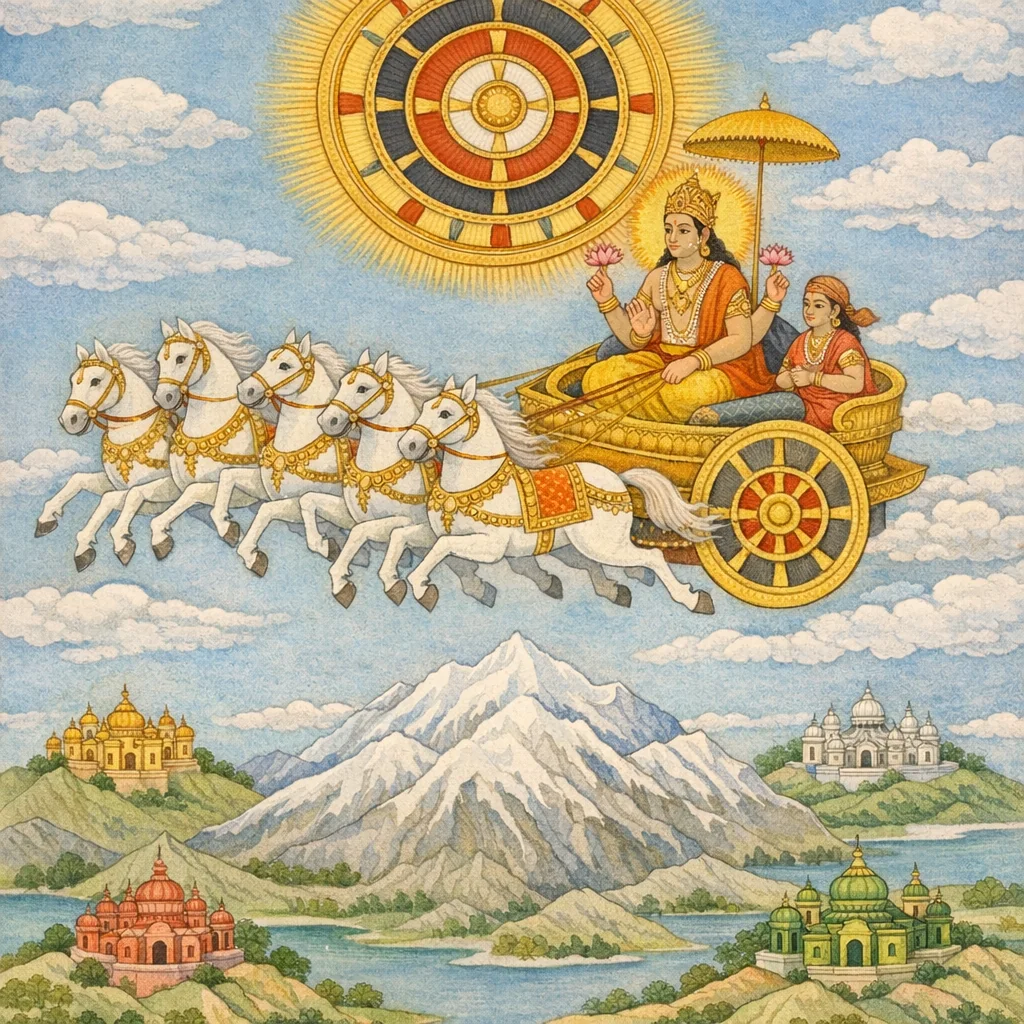
योजनानां सहस्राणि भास्करस्य रथो नव ईषादण्डस् तथैवास्य द्विगुणो मुनिसत्तम
O best of sages, the chariot of Bhāskara, the Sun, measures nine thousand yojanas; and the pole-shaft (īṣā-daṇḍa) of that chariot is said to be twice that measure.
Verse 3
सार्धकोटिस् तथा सप्त नियुतान्य् अधिकानि वै योजनानां तु तस्याक्षस् तत्र चक्रं प्रतिष्ठितम्
Its axle measures seven and a half krores of yojanas, with seven niyutas besides; upon that very axis the great wheel is firmly set, so that by the Lord’s unerring ordinance the worlds move in harmonious course.
Verse 4
त्रिनाभिमति पञ्चारे षण्णेमिन्य् अक्षयात्मके संवत्सरमये कृत्स्नं कालचक्रं प्रतिष्ठितम्
In that imperishable wheel—conceived as having three hubs, turning in five courses, and furnished with six rims—the entire Wheel of Time is established, constituted of the year itself.
Verse 5
चत्वारिंशत् सहस्राणि द्वितीयो ऽक्षो विवस्वतः पञ्चान्यानि तु सार्धानि स्यन्दनस्य महामते
O great-minded one, the second axle of Vivasvān, the Sun, measures forty thousand yojanas; and for the Sun’s celestial chariot (syandana), a further five thousand and a half yojanas are to be understood.
Verse 6
अक्षप्रमाणम् उभयोः प्रमाणं तद्युगार्धयोः ह्रस्वो ऽक्षस् तद्युगार्धं च ध्रुवाधारो रथस्य वै द्वितीये ऽक्षे तु तच् चक्रं संस्थितं मानसाचले
The measure of the axle equals the measure of the two halves of the yoke; and the measure of those halves is half the span of a yuga. The shorter axle, measured by that same yuga-half, truly serves as Dhruva’s support for the celestial chariot. Upon the second axle the wheel is fixed, firmly set upon the mountain called Mānasa.
Verse 7
हयाश् च सप्त छन्दांसि तेषां नामानि मे शृणु गायत्री च बृहत्य् उष्णिग् जगती त्रिष्टुब् एव च अनुष्टुप् पङ्क्तिर् इत्य् उक्ताश् छन्दांसि हरयो रवेः
The horses are seven—indeed, they are the seven Vedic metres. Hear their names from me: Gāyatrī, Bṛhatī, Uṣṇik, Jagatī, Triṣṭubh, Anuṣṭubh, and Paṅkti. These metres are declared to be the steeds of Ravi, the Sun.
Verse 8
मानसोत्तरशैले तु पूर्वतो वासवी पुरी दक्षिणेन यमस्यान्या प्रतीच्यां वरुणस्य च उत्तरेण च सोमस्य तासां नामानि मे शृणु
Upon the Mānasottara mountain, to the east stands the city of Vāsavī (Indra); to the south is another belonging to Yama; to the west is Varuṇa’s; and to the north is Soma’s. Now hear from me the names of those cities.
Verse 9
वस्वोकसारा शक्रस्य याम्या संयमनी तथा पुरी सुखा जलेशस्य सोमस्य च विभावरी
Śakra (Indra) has the city called Vasvokasārā; Yama’s is Yāmyā, also known as Saṃyamanī; Varuṇa, lord of the waters, has the city named Sukhā; and Soma’s city is called Vibhāvarī.
Verse 10
काष्ठां गतो दक्षिणतः क्षिप्तेषुर् इव सर्पति मैत्रेय भगवान् भानुर् ज्योतिषां चक्रसंयुतः
O Maitreya, when Bhagavān Bhānu, the Sun, reaches the southern turning-point, he seems to glide onward like an arrow released, bearing with him the revolving wheel of the luminaries.
Verse 11
अहोरात्रव्यवस्थानकारणं भगवान् रविः देवयानः परः पन्था योगिनां क्लेशसंक्षये
Bhagavān Ravi, the Sun, is the cause that sets day and night in due order. He is also the Devayāna, the higher path, by which yogins seeking the fading of afflictions proceed toward liberation.
Verse 12
दिवसस्य रविर् मध्ये सर्वकालं व्यवस्थितः सर्वद्वीपेषु मैत्रेय निशार्धस्य च संमुखः
In the midst of the day the Sun stands ever established in his appointed station. O Maitreya, in all the continents he is directly before beings in the daytime, and likewise faces them in the corresponding half of the night.
Verse 13
उदयास्तमने चैव सर्वकालं तु संमुखे दिशास्व् अशेषासु तथा मैत्रेय विदिशासु च
Not only at sunrise and sunset, but at every time, He stands facing forward in all directions without remainder; and so too, O Maitreya, in the intermediate directions.
Verse 14
यैर् यत्र दृश्यते भास्वान् स तेषाम् उदयः स्मृतः तिरोभावं च यत्रैति तत्रैवास्तमनं रवेः
Wherever, and for whomsoever, the radiant Sun becomes visible, that is remembered as their “sunrise.” And wherever he passes from sight into concealment, there itself is spoken of as Ravi’s “sunset.”
Verse 15
नैवास्तमनम् अर्कस्य नोदयः सर्वदा सतः उदयास्तमनाख्यं हि दर्शनादर्शनं रवेः
For the Sun, in truth, there is neither “setting” nor “rising,” for he ever exists. What is called “sunrise” and “sunset” is only Ravi’s being seen and being unseen.
Verse 16
शक्रादीनां पुरे तिष्ठन् स्पृशत्य् एष पुरत्रयम् विकर्णौ द्वौ विकर्णस्थस् त्रीन् कोणान् द्वे पुरे तथा
Abiding in the city of Śakra (Indra) and the other divine realms, this principle touches the triad of celestial cities. It extends along two diagonals; set upon those diagonals, it reaches three angles, and likewise makes contact with two of the cities.
Verse 17
उदितो वर्धमानाभिर् आमध्याह्नात् तपन् रविः ततः परं ह्रसन्तीभिर् गोभिर् अस्तं नियच्छति
Having risen, the Sun—burning with heat—advances toward midday, borne along by rays that steadily increase; thereafter, carried by rays that progressively diminish, he is guided down into setting.
Verse 18
उदयास्तमनाभ्यां च स्मृते पूर्वापरे दिशौ यावत् पुरस्तात् तपति तावत् पृष्ठे च पार्श्वयोः
By the very notions of sunrise and sunset, the eastern and western quarters are understood. And as far as the Sun blazes in front, to that same extent does it illumine behind and along the flanks.
Verse 19
ऋते ऽमरगिरेर् मेरोर् उपरि ब्रह्मणः सभाम् ये ये मरीचयो ऽर्कस्य प्रयान्ति ब्रह्मणः सभाम् ते ते निरस्तास् तद्भासा प्रतीपम् उपयान्ति वै
Except for the divine mountain Meru, above which lies Brahmā’s assembly-hall, whatever rays of the Sun proceed toward Brahmā’s court are all repelled; driven back by that radiance itself, they return in the opposite direction.
Verse 20
तस्माद् दिश्य् उत्तरस्यां वै दिवारात्रिः सदैव हि सर्वेषां द्वीपवर्षाणां मेरुर् उत्तरतो यतः
Therefore, in the northern direction, the course of day and night is ever determined; for to all the continents and their regions, Mount Meru stands to the north, and by that supreme axis the measure of time is set.
Verse 21
प्रभा विवस्वतो रात्राव् अस्तं गच्छति भास्करे विशत्य् अग्निम् अतो रात्रौ वह्निर् दूरात् प्रकाशते
When Vivasvat, the Sun, sets at night, his radiance does not perish; it enters into fire. Therefore in the night the flame shines even from afar, bearing within it the Sun’s borrowed splendor.
Verse 22
वह्निपादस् तथा भानुं दिनेष्व् आविशति द्विज अतीव वह्निसंयोगाद् अतः सूर्यः प्रकाशते
So too, O twice-born, Vahnipāda enters the Sun during the days; through an intense conjunction with fire, the Sun therefore blazes forth in radiance.
Verse 23
तेजसी भास्कराग्नेये प्रकाशोष्णस्वरूपिणी परस्परानुप्रवेशाद् आप्यायेते दिवानिशम्
The two radiant powers—of the Sun and of Fire—whose very nature is illumination and heat, continually nourish and intensify one another through mutual interpenetration, day and night.
Verse 24
दक्षिणोत्तरभूम्यर्धे समुत्तिष्ठति भास्करे अहोरात्रं विशत्य् अम्भस् तमःप्राकाश्यशीलवत्
When the Sun rises over the southern or the northern half of the earth, the waters enter into the alternation of day and night—darkness and illumination taking their turns, as though by their very nature.
Verse 25
आताम्रा हि भवन्त्य् आपो दिवा नक्तप्रवेशनात् दिनं विशति चैवाम्भो भास्करे ऽस्तम् उपागते तस्माच् छुक्लीभवन्त्य् आपो नक्तम् अह्नः प्रवेशनात्
By day the waters take on a coppery hue, for night is then entering into them. And when the Sun has gone to setting, the waters in turn enter into the day. Therefore by night the waters become bright and pale, because day is then entering into them.
Verse 26
एवं पुष्करमध्ये तु यदा याति दिवाकरः त्रिंशद्भागं तु मेदिन्यास् तदा मौहूर्तिकी गतिः
Thus, when Divākara, the Sun, moves through the midst of Puṣkara and advances by a thirtieth part of the earth’s measure, that progression is called the motion of a muhūrta.
Verse 27
कुलालचक्रपर्यन्तो भ्रमन्न् एष दिवाकरः करोत्य् अहस् तथा रात्रिं विमुञ्चन् मेदिनीं द्विज
O twice-born one, as Divākara, the Sun, whirls like the rim of a potter’s wheel, he brings forth day and night, releasing the earth alternately into light and into darkness.
Verse 28
अयनस्योत्तरस्यादौ मकरं याति भास्करः ततः कुम्भं च मीनं च राशे राश्यन्तरं द्विज
At the commencement of the Sun’s northern course (uttarāyaṇa), Bhāskara enters Capricorn; thereafter he passes into Aquarius and then into Pisces—moving, O twice-born one, from sign to sign in due succession.
Verse 29
त्रिष्व् एतेष्व् अथ भुक्तेषु ततो वैषुवतीं गतिम् प्रयाति सविता कुर्वन्न् अहोरात्रं ततः समम्
When those three segments have been traversed, Savitā enters the equinoctial path; from that transition he brings about a day and a night that are perfectly equal.
Verse 30
ततो रात्रिः क्षयं याति वर्धते ऽनुदिनं दिनम्
Thereafter, the night wanes away, and the day continually grows, day after day.
Verse 31
ततश् च मिथुनस्यान्ते परां काष्ठाम् उपागतः राशिं कर्कटकं प्राप्य कुरुते दक्षिणायनम्
Then, having reached the utmost limit at the end of Mithuna, the Sun, entering the sign of Karkaṭaka, sets in motion the southern course, Dakṣiṇāyana; thus the year turns and the ordained rhythm of Time proceeds.
Verse 32
कुलालचक्रपर्यन्तो यथा शीघ्रं प्रवर्तते दक्षिणे प्रक्रमे सूर्यस् तथा शीघ्रं प्रवर्तते
As the rim of a potter’s wheel turns swiftly, so the Sun, when he enters the southern course, moves with that same swiftness, according to the divine order of the heavens.
Verse 33
अतिवेगितया कालं वायुवेगगतिश् चरन् तस्मात् प्रकृष्टां भूमिं तु कालेनाल्पेन गच्छति
Moving with exceedingly swift momentum, coursing with a speed like the wind, he seems to traverse Time itself; therefore, in but a little while, he reaches the farthest stretches of the earth.
Verse 34
सूर्यो द्वादशभिः शैघ्र्यान् मुहूर्तैर् दक्षिणायने त्रयोदशार्धम् ऋक्षाणाम् अह्ना तु चरते द्विज मुहूर्तैस् तावदृक्षाणि नक्तम् अष्टादशैश् चरन्
O twice-born, in Dakṣiṇāyana the Sun moves with a swifter pace: by day, in twelve muhūrtas, he traverses thirteen and a half nakṣatras; by night he covers the same measure in eighteen muhūrtas—thus is his passage measured by the law of Time.
Verse 35
कुलालचक्रमध्यस्थो यथा मन्दं प्रसर्पति तथोदगयने सूर्यः सर्पते मन्दविक्रमः
As one standing at the hub of a potter’s wheel seems to move only slowly, so in Udagāyana, the Sun advances with measured pace, as though restrained—yet all proceeds by the ordained order that sustains the world.
Verse 36
तस्माद् दीर्घेण कालेन भूमिम् अल्पां तु गच्छति अष्टादशमुहूर्तं यद् उत्तरायणपश्चिमम्
Therefore, over a long span of time it traverses only a small portion of the earth; and that westward course during the Sun’s northward progress (uttarāyaṇa) is reckoned as eighteen muhūrtas.
Verse 37
अहर् भवति तत्रापि चरते मन्दविक्रमः
There too, a ‘day’ comes into being; and the Slow-moving One proceeds on his course with measured pace.
Verse 38
त्रयोदशार्धम् अह्नैव ऋक्षाणां चरते रविः मुहूर्तैस् तावदृक्षाणि रात्रौ द्वादशभिश् चरन्
In the span of a single day, Ravi (the Sun) traverses thirteen and a half nakṣatras; by night, moving through twelve muhūrtas, he passes through the same measure of nakṣatras.
Verse 39
अधो मन्दतरं नाभ्यां चक्रं भ्रमति वै यथा मृत्पिण्ड इव मध्यस्थो ध्रुवो भ्रमति वै तथा
Just as a wheel turns more slowly near its hub, so too the region below moves with diminished speed; and Dhruva, stationed at the center, revolves in the same manner—like a clod of clay fixed in the middle while all else turns around it.
Verse 40
कुलालचक्रनाभिस् तु यथा तत्रैव वर्तते ध्रुवस् तथा हि मैत्रेय तत्रैव परिवर्तते
Just as the hub of a potter’s wheel remains fixed in its own place while the wheel turns around it, so too, O Maitreya, does Dhruva remain established there—while all else revolves about him.
Verse 41
उभयोः काष्ठयोर् मध्ये भ्रमतो मण्डलानि च दिवा नक्तं च सूर्यस्य मन्दा शीघ्रा च वै गतिः
Between the two termini of his course, the Sun’s spheres revolve; from this arise day and night. In that very motion, by the ordained order of his circuit, his progress is spoken of as sometimes slow and sometimes swift.
Verse 42
मन्दाह्नि यस्मिन्न् अयने शीघ्रा नक्तं तदा गतिः शीघ्रा निशि यदा चास्य तदा मन्दा दिवा गतिः
In that solstitial course where the day grows drawn out and sluggish, the Sun’s movement by night is swift; and when his movement is swift at night, by day it becomes slow. Thus, by the Lord’s ordinance, the measures of light and darkness are kept in balance.
Verse 43
एकप्रमाणम् एवैष मार्गं याति दिवाकरः अहोरात्रेण यो भुङ्क्ते समस्ता राशयो द्विज
The Sun, bearer of day, travels a single measured path. In one full day-and-night, O twice-born, he traverses—‘consuming’ in order—the entire circuit of the zodiacal signs.
Verse 44
षड् एव राशयो भुङ्क्ते रात्राव् अन्यांश् च षड् दिवा
By night, the Sun is said to traverse only six zodiacal signs; and by day, the other six.
Verse 45
राशिप्रमाणजनिता दीर्घह्रस्वात्मता दिने तथा निशायां राशीनां प्रमाणैर् लघुदीर्घता
From the measured extents of the rāśis arises the day’s length and brevity; likewise, by those very measures of the zodiacal signs, the night too becomes shorter or longer.
Verse 46
दिनादेर् दीर्घह्रस्वत्वं तद्भोगेनैव जायते उत्तरे प्रक्रमे शीघ्रा निशि मन्दा गतिर् दिवा
The lengthening and shortening of days and nights arises solely from the Sun’s own course. In his northward progress, he moves swiftly by night and slowly by day.
Verse 47
दक्षिणे त्व् अयने चैव विपरीता विवस्वतः
But in the southern course (Dakṣiṇāyana), the movement of Vivasvat—the Sun—proceeds in the reverse manner.
Verse 48
उषा रात्रिः समाख्याता व्युष्टिश् चाप्य् उच्यते दिनम् प्रोच्यते च तथा संध्या उषाव्युष्ट्योर् यद् अन्तरम्
Night is designated as uṣā, and day is also called vyuṣṭi. The interval between uṣā and vyuṣṭi is spoken of as saṃdhyā, the sacred junction of time.
Verse 49
संध्याकाले तु संप्राप्ते रौद्रे परमदारुणे मन्देहा राक्षसा घोराः सूर्यम् इच्छन्ति खादितुम्
When the hour of saṃdhyā arrives—fierce and exceedingly dreadful—the terrifying rākṣasas known as the Mandehas seek to devour the Sun.
Verse 50
प्रजापतिकृतः शापस् तेषां मैत्रेय रक्षसाम् अक्षयत्वं शरीराणां मरणं च दिने दिने
Maitreya, this was the curse pronounced by Prajāpati upon those rākṣasas: their bodies would not waste away—yet, day after day, they would still meet with death.
Verse 51
ततः सूर्यस्य तैर् युद्धं भवत्य् अत्यन्तदारुणम् ततो द्विजोत्तमास् तोयं यत् क्षिपन्ति महामुने
Then a battle with the Sun blazes forth, fierce beyond all measure. Thereupon, O great sage, the best of the twice-born cast sanctifying water to quell that dreadful conflict.
Verse 52
ओंकारब्रह्मसंयुक्तं गायत्र्या चाभिमन्त्रितम् तेन दह्यन्ति ते पापा वज्रीभूतेन वारिणा
Water united with Oṃkāra and Brahman, and empowered by the Gāyatrī-mantra—by that water their sins are burned away, for in its purifying force it becomes like a thunderbolt.
Verse 53
अग्निहोत्रे हूयते या समन्त्रा प्रथमाहुतिः सूर्यो ज्योतिः सहस्रांशुस् तया दीप्यति भास्करः
That first oblation, offered in the Agnihotra with the sacred mantras, becomes the very cause by which the Sun—radiant Light, the thousand-rayed one—blazes forth as Bhāskara, the maker of day.
Verse 54
ओंकारो भगवान् विष्णुस् त्रिधामा वचसां पतिः तदुच्चारणतस् ते तु विनाशं यान्ति राक्षसाः
The sacred syllable Oṃ is Bhagavān Viṣṇu Himself—the One established in the threefold realm, the Lord of all speech. By the very utterance of that Oṃ, those rākṣasas are driven to destruction.
Verse 55
वैष्णवो ऽंशः परः सूर्यो यो ऽन्तर्ज्योतिर् असंप्लवम् अभिधायक ओंकारस् तस्य स प्रेरकः परः
That Supreme Sun is the Vaishnava portion itself—the imperishable inner Light that never sinks beneath the flood of change. The syllable Oṃ is the name that denotes Him; and He, the Supreme, is the One who impels even that sacred utterance.
Verse 56
तेन तत् प्रेरितं ज्योतिर् ओंकारेणाथ दीप्तिमत् दहत्य् अशेषरक्षांसि मन्देहाख्यान्य् अघानि वै
Impulsed by Him, that radiant light—made blazing through the power of the sacred Oṃ—burns away entirely the rākṣasas known as the Mandehas, those very embodiments of sin.
Verse 57
तस्मान् नोल्लङ्घनं कार्यं संध्योपासनकर्मणः स हन्ति सूर्यं संध्याया नोपास्तिं कुरुते हि यः
Therefore, one must never transgress the sacred obligation of Sandhyā worship. Whoever neglects the worship at Sandhyā is said, in effect, to strike down the Sun himself.
Verse 58
ततः प्रयाति भगवान् ब्राह्मणैर् अभिरक्षितः वालखिल्यादिभिश् चैव जगतः पालनोद्यतः
Thereafter the Blessed Lord proceeds forth—guarded and attended by the Brahman-sages, by the Vālakhilyas and others—fully intent upon the protection and righteous governance of the world.
Verse 59
काष्ठा निमेषा दश पञ्च चैव त्रिंशच् च काष्ठा गणयेत् कलां ताम् त्रिंशत्कलाश् चैव भवेन् मुहूर्तस् तैस् त्रिंशता रात्र्यहनी समेते
Fifteen nimeṣas make one kāṣṭhā; thirty kāṣṭhās are reckoned as a kalā. Thirty kalās become a muhūrta; and by thirty muhūrtas the pair—night and day—stands complete.
Verse 60
ह्रासवृद्धी त्व् अहर्भागैर् दिवसानां यथाक्रमम् संध्या मुहूर्तमात्रा वै ह्रासवृद्धौ समा स्मृता
The decrease and increase of the days occur, in due order, by the changing portions of daylight. Yet the twilight junction (saṃdhyā) is remembered to last a single muhūrta, remaining the same even as days wax and wane.
Verse 61
रेखाप्रभृत्य् अथादित्ये त्रिमुहूर्तगते तु वै प्रातः स्मृतस् ततः कालो भागश् चाह्नः स पञ्चमः
From the first faint line of dawn, when the Sun has advanced by three muhūrtas, that span is remembered as prātaḥ, “morning.” It is a fixed portion of the day, reckoned as the fifth division.
Verse 62
तस्मात् प्रातस्तनात् कालात् त्रिमुहूर्तस् तु संगवः मध्याह्नस् त्रिमुहूर्तस् तु तस्मात् कालात् तु संगवात्
From that prātaḥ time, the period called Saṅgava lasts for three muhūrtas; and from Saṅgava, after three muhūrtas, comes Madhyāhna, midday. Thus the day is marked by measured intervals.
Verse 63
तस्मान् माध्याह्निकात् कालाद् अपराह्ण इति स्मृतः त्रय एव मुहूर्तास् तु कालभागः स्मृतो बुधैः
Therefore, after the midday period, the later part of the day is known as aparāhṇa. The wise declare that this division of time is precisely three muhūrtas.
Verse 64
अपराह्णे व्यतीते तु कालः सायाह्न उच्यते दशपञ्चमुहूर्ताहो मुहूर्तास् त्रय एव च
When aparāhṇa has passed, that portion of time is called sāyāhna, the evening twilight. A day consists of fifteen muhūrtas, and evening comprises only three muhūrtas.
Verse 65
दशपञ्चमुहूर्तं वै अहर् वैषुवतं स्मृतम्
Indeed, a day consisting of fifteen muhūrtas is remembered as ahar vaiṣuvata, the equinoctial day, when the balance of time is held even in the cosmic order.
Verse 66
वर्धते ऽहो ह्रसति च अयने दक्षिणोत्तरे अहस् तु ग्रसते रात्रिं रात्रिर् ग्रसति वासरम्
In the southern and northern ayana, the day now waxes and now wanes. As day increases it seems to swallow the night, and as night increases it seems to swallow the day—thus does Time keep the world in measured balance.
Verse 67
शरद्वसन्तयोर् मध्ये विषुवं तु विभाव्यते तुलामेषगते भानौ समरात्रिदिनं तु तत्
Between autumn and spring the viṣuva, the equinox, is known: when the Sun enters Libra or Aries, night and day become perfectly equal—balanced within the cosmic order.
Verse 68
कर्कटावस्थिते भानौ दक्षिणायनम् उच्यते उत्तरायणम् अप्य् उक्तं मकरस्थे दिवाकरे
When the Sun abides in Cancer, that course is called Dakṣiṇāyana; and when the maker of day stands in Capricorn, that is declared to be Uttarāyaṇa.
Verse 69
त्रिंशन्मुहूर्तं कथितम् अहोरात्रं तु यन् मया तानि पञ्चदश ब्रह्मन् पक्ष इत्य् अभिधीयते
I have declared that a full day and night consist of thirty muhūrtas. Of these, O Brahmin, fifteen are designated as a pakṣa (half-month).
Verse 70
मासः पक्षद्वयेनोक्तो द्वौ मासौ चार्कजाव् ऋतुः ऋतुत्रयं चाप्य् अयनं द्वे ऽयने वर्षसंज्ञिते
A month is declared to consist of two pakṣas. Two months make a season (ṛtu), born of the Sun’s course. Three seasons form an ayana (half-year), and the two ayanas together are known as a year.
Verse 71
संवत्सरादयः पञ्च चतुर्मासविकल्पिताः निश्चयः सर्वकालस्य युगम् इत्य् अभिधीयते
Five measures beginning with the year, each further distinguished by the four‑month divisions, constitute the settled standard by which all time is determined; this fixed reckoning is called a “yuga.”
Verse 72
संवत्सरस् तु प्रथमो द्वितीयः परिवत्सरः इद्वत्सरस् तृतीयस् तु चतुर्थश् चानुवत्सरः वत्सरः पञ्चमश् चात्र कालो ऽयं युगसंज्ञितः
The first is called Saṃvatsara; the second, Parivatsara; the third, Idvatsara; the fourth, Anuvatsara; and the fifth, Vatsara. This very cycle of time is here designated as a “yuga.”
Verse 73
यः श्वेतस्योत्तरे शैलः शृङ्गवान् इति विश्रुतः त्रीणि तस्य तु शृङ्गाणि यैर् असौ शृङ्गवान् स्मृतः
To the north of Mount Śveta stands a peak renowned as Śṛṅgavān. It is said to have three summits; therefore it is remembered as “the three‑peaked one.”
Verse 74
दक्षिणं चोत्तरं चैव मध्यं वैषुवतं तथा शरद्वसन्तयोर् मध्ये तद् भानुः प्रतिपद्यते मेषादौ च तुलादौ च मैत्रेय विषुवत्स्थितः
O Maitreya, the Sun takes the southern course and the northern course, and also the middle station known as the equinoctial. Between autumn and spring he attains that equinoctial balance; and at the beginnings of Meṣa (Aries) and Tulā (Libra) he is established in the state of equinox.
Verse 75
तदा तुल्यम् अहोरात्रं करोति तिमिरापहः दशपञ्चमुहूर्तं वै तद् एतद् उभयं स्मृतम्
Then the dispeller of darkness, the Sun, makes day and night equal; and that span—fifteen muhūrtas—is remembered as belonging to both, alike.
Verse 76
प्रथमे कृत्तिकाभागे यदा भास्वांस् तदा शशी विशाखानां चतुर्थे ऽंशे मुने तिष्ठत्य् असंशयम्
O sage, when the radiant Sun stands in the first portion of Kṛttikā, then the Moon—without doubt—abides in the fourth portion of Viśākhā.
Verse 77
विशाखानां यदा सूर्यश् चरत्य् अंशं तृतीयकम् तदा चन्द्रं विजानीयात् कृत्तिकाशिरसि स्थितम्
When the Sun advances to the third division within Viśākhā, one should understand that the Moon is stationed at the head of Kṛttikā.
Verse 78
तदैव विषुवाख्यो वै कालः पुण्यो ऽभिधीयते तदा दानानि देयानि देवेभ्यः प्रयतात्मभिः
At that very time, the sacred season known as Viṣuva is proclaimed supremely meritorious; then, with disciplined mind, one should offer gifts dedicated to the Devas.
Verse 79
ब्राह्मणेभ्यः पितृभ्यश् च मुखम् एतत् तु दानजम् दत्तदानस् तु विषुवे कृतकृत्यो ऽभिजायते
This is the foremost fruit of giving: offerings made to Brāhmaṇas and to the Fathers (Pitṛs). One who gives at Viṣuva becomes as one whose duty is fulfilled.
Verse 80
अहोरात्रार्धमासौ तु कलाः काष्ठाः क्षणास् तथा पौर्णमासी तथा ज्ञेया अमावास्या तथैव च सिनीवाली कुहूश् चैव राका चानुमतिस् तथा
Thus are reckoned the measures of time—day and night, the half-month, and the smaller divisions such as kalā, kāṣṭhā, and kṣaṇa; likewise are understood the lunar observances: Paurṇamāsī (Full Moon), Amāvāsyā (New Moon), and the phases Sinīvālī, Kuhū, Rākā, and Anumati.
Verse 81
तपस्तपस्यौ मधुमाधवौ च शुक्रः शुचिश् चायनम् उत्तरं स्यात् नभो नभस्यो ऽथ इषश् च सोर्जः सहःसहस्याव् इति दक्षिणं स्यात्
Tapas and Tapasyā, Madhu and Mādhava, Śukra and Śuci—these are the months of the Sun’s northern course (Uttarāyaṇa). Nabhas and Nabhasya, then Iṣa and Ūrja, and thereafter Saha and Sahasya—these are the months of the southern course (Dakṣiṇāyana); thus the ordered flow of time stands by the ordinance of the Supreme Lord.
Verse 82
लोकालोकस् तु यः शैलः प्रागुक्तो भवतो मया लोकपालास् तु चत्वारस् तत्र तिष्ठन्ति सुव्रताः
That mountain called Lokāloka—of which I spoke to you before—stands as the great boundary of the worlds; and upon it abide the four Lokapālas, guardians of the quarters, steadfast in sacred vows, upholding the cosmic order under the Supreme Lord.
Verse 83
सुधामा शङ्खपाच् चैव कर्दमस्यात्मजौ द्विज हिरण्यरोमा चैवान्यश् चतुर्थः केतुमान् अपि
O twice-born one, Kardama’s sons were named Sudhāmā and Śaṅkhapāc; another was Hiraṇyaromā, and the fourth also was Ketumān.
Verse 84
निर्द्वंद्वा निरभीमाना निस्तन्द्रा निष्परिग्रहाः लोकपालाः स्थिता ह्य् एते लोकालोके चतुर्दिशम्
Free from all dualities, without the conceit of ‘I’ and ‘mine’, unwearied and ever-vigilant, and possessing nothing for themselves—thus these Lokapālas stand at Lokāloka in the four directions.
Verse 85
उत्तरं यद् अगस्त्यस्य अजवीथ्याश् च दक्षिणम् पितृयानः स वै पन्था वैश्वानरपथाद् बहिः
That region lying to the north of Agastya and to the south of Ajavīthī is indeed Pitṛyāna, the ‘Way of the Ancestors’, situated outside the course known as the Vaiśvānara path.
Verse 86
तत्रासते महात्मान ऋषयो ये ऽग्निहोत्रिणः भूतारम्भकृतं ब्रह्म शंसन्त ऋत्विगुद्यताः लोकारम्भं प्रारभन्ते तेषां पन्थाः स दक्षिणः
There abide the great-souled seers who uphold the Agnihotra. The appointed ṛtvij priests duly chant the Brahman—sacred formula bound to the arising of the elements; by these rites they set in motion the beginning of the worlds, and their path is the southern course, the Dakṣiṇāyana.
Verse 87
चलितं ते पुनर् ब्रह्म स्थापयन्ति युगे युगे संतत्या तपसा चैव मर्यादाभिः श्रुतेन च
When the Brahmanic order—the sacred foundation of dharma—is shaken, they establish it anew, age after age: through unbroken succession, through tapas (austerity), through guarding right bounds and disciplines, and through fidelity to Śruti, revealed tradition.
Verse 88
जायमानास् तु पूर्वे तु पश्चिमानां गृहेषु वै पश्चिमाश् चैव पूर्वेषां जायन्ते निधनेष्व् इह
Those who were earlier are born later in the houses of those who came after; and those who were later are likewise born among the earlier here in this world, as deaths occur. Thus embodied beings continually exchange places in the turning of lineage and time.
Verse 89
एवम् आवर्तमानास् ते तिष्ठन्त्य् आभूतसंप्लवात् सवितुर् दक्षिणं मार्गं श्रिता ह्य् आचन्द्रतारकम्
Thus, revolving in this ordained manner, they continue until the dissolution of all beings; for they have taken refuge in Savitṛ’s southern course, extending up to the Moon and the stars.
Verse 90
नागवीथ्युत्तरं यच् च सप्तर्षिभ्यश् च दक्षिणम् उत्तरः सवितुः पन्था देवयानस् तु स स्मृतः
That path which lies to the north of Nāgavīthī and to the south of the Seven Sages is Savitṛ’s northern course. It is remembered as the Devayāna—the divine way by which beings ascend.
Verse 91
तत्र ते वशिनः सिद्धा विमला ब्रह्मचारिणः संततिं ते जुगुप्सन्ति तस्मान् मृत्युर् जितश् च तैः
There, the self-mastered Siddhas—pure, stainless, steadfast in brahmacarya—shun even the prospect of progeny; therefore, by them, death itself is overcome.
Verse 92
अष्टाशीतिसहस्राणि यतीनाम् ऊर्ध्वरेतसाम् उदक्पन्थानम् अर्यम्णः श्रिता ह्य् आभूतसंप्लवात्
Eighty-eight thousand ascetics—yatis of uplifted seed, established in continence—have taken refuge in Aryaman’s northern path, and abide there until the cosmic deluge, the dissolution of beings.
Verse 93
ते ऽसंप्रयोगाल् लोभस्य मैथुनस्य च वर्जनात् इच्छाद्वेषाप्रवृत्त्या च भूतारम्भविवर्जनात्
Because they do not associate with greed and renounce sexual indulgence; because they do not set desire and aversion into motion; and because they refrain from initiating new embodied undertakings—thus they cut off the very beginnings of bondage and move toward release.
Verse 94
पुनश् चाकामसंयोगाच् शब्दादेर् दोषदर्शनात् इत्य् एभिः कारणैः शुद्धास् ते ऽमृतत्वं हि भेजिरे
And again, through association devoid of desire, and by clearly perceiving the defects in sense-objects—beginning with sound—by these very causes they were purified and indeed attained immortality (liberation).
Verse 95
आभूतसंप्लवं स्थानम् अमृतत्वं विभाव्यते त्रैलोक्यस्थितिकालो ऽयम् अपुनर्मार उच्यते
That state which endures until the great inundation of all beings is contemplated as “immortality”; for this span, while the three worlds remain established, is declared to be the “path of no return.”
Verse 96
ब्रह्महत्याश्वमेधाभ्यां पापपुण्यकृतो विधिः आभूतसंप्लवान्तान्तं फलम् उक्तं तयोर् द्विज
O twice-born one, by invoking the two extremes—the sin of brahma-slaughter and the merit of the Aśvamedha—the ordinance concerning deeds that beget demerit and merit has been taught; and it is declared that the fruit of both endures until the great dissolution, the final bhūta-samplava.
Verse 97
यावन्मात्रप्रदेशे तु मैत्रेयावस्थितो ध्रुवः क्षयम् आयाति तावत् तु भूमेर् आभूतसंप्लवे
O Maitreya, for as long as Dhruva remains unmoving within that measured sphere, for that very span the Earth endures—until the bhūta-samplava, the Mahāpralaya, comes.
Verse 98
ऊर्ध्वोत्तरम् ऋषिभ्यस् तु ध्रुवो यत्र व्यवस्थितः एतद् विष्णुपदं दिव्यं तृतीयं व्योम्नि भास्वरम्
Higher even than the abodes of the Ṛṣis is the station where Dhruva stands firmly established. That third, radiant region in the heavens is the divine ‘Vishnupada’—the Footstep of Vishnu, shining in the vault of space.
Verse 99
निर्धूतदोषपङ्कानां यतीनां संयतात्मनाम् स्थानं तत् परमं विप्र पुण्यपापपरिक्षये
O Brahmin, that is the supreme abode of the self-restrained ascetics who have shaken off the mire of faults; there, with the exhaustion of both merit and sin, all karmic reckoning comes to its end.
Verse 100
अपुण्यपुण्योपरमे क्षीणाशेषाप्तिहेतवः यत्र गत्वा न शोचन्ति तद् विष्णोः परमं पदम्
That is the Supreme Station of Vishnu—beyond both merit and demerit—where every remaining cause that leads to further attainments is exhausted; having gone there, beings grieve no more.
Verse 101
धर्मध्रुवाद्यास् तिष्ठन्ति यत्र ते लोकसाक्षिणः तत्सार्ष्ट्योत्पन्नयोगेद्धास् तद् विष्णोः परमं पदम्
That is Vishnu’s supreme station, where Dharma, Dhruva, and the rest abide as witnesses of the worlds; and where the perfected ones, awakened by yoga born of sharing in that divine sovereignty, stand firmly established.
Verse 102
यत्रोतम् एतत् प्रोतं च यद् भूतं सचराचरम् भाव्यं च विश्वं मैत्रेय तद् विष्णोः परमं पदम्
That in which this entire universe is woven and interwoven—whatever has been, all that moves and does not move, and even the world yet to be—O Maitreya, that is Vishnu’s supreme station.
Verse 103
दिवीव चक्षुर् आततं विततं यन् महात्मनाम् विवेकज्ञानदृष्टं च तद् विष्णोः परमं पदम्
That which, for the great-souled, is like an all-pervading eye spread out across the heavens—vast and extended everywhere—and which is beheld through discriminative wisdom: that indeed is Vishnu’s supreme station.
Verse 104
यस्मिन् प्रतिष्ठितो भास्वान् मेढीभूतः स्वयं ध्रुवः ध्रुवे च सर्वज्योतींषि ज्योतिष्व् अम्भोमुचो द्विज
Upon Him the radiant Sun is established, and Dhruva himself stands as the fixed pivot. Upon Dhruva, O twice-born, rest all the lights of heaven; and among those heavenly bodies move the cloud-bearers.
Verse 105
मेघेषु संतता वृष्टिर् वृष्टेः सृष्टेश् च पोषणम् आप्यायनं च सर्वेषां देवादीनां महामुने
In the clouds abides the unbroken stream of rain; from that rain comes the nourishment that sustains creation itself, and the replenishment and renewed vigor of all beings—beginning with the gods—O great sage.
Verse 106
ततश् चाज्याहुतिद्वारा पोषितास् ते हविर्भुजः वृष्टेः कारणतां यान्ति भूतानां स्थितये पुनः
Thereafter, the gods who partake of the oblation—nourished by offerings of ghee—become in turn the cause of rainfall, that all beings may be sustained.
Verse 107
एवम् एतत् पदं विष्णोस् तृतीयम् अमलात्मकम् आधारभूतं लोकानां त्रयाणां वृष्टिकारणम्
Thus is this third station of Viṣṇu, pure in essence: the support of the three worlds and the very cause by which rain descends upon them.
Verse 108
ततः प्रभवति ब्रह्मन् सर्वपापहरा सरित् गङ्गा देवाङ्गनाङ्गानाम् अनुलेपनपिञ्जरा
From that source, O Brahmin, arises the river Gaṅgā, destroyer of all sin, tawny-hued as though stained by the celestial unguents of the divine nymphs.
Verse 109
वामपादाम्बुजाङ्गुष्ठनखस्रोतोविनिर्गताम् विष्णोर् बिभर्ति यां भक्त्या शिरसाहर्निशं ध्रुवः
From the stream that issues from the nail of the great toe of Lord Viṣṇu’s left lotus-foot, Dhruva, in unwavering devotion, bears her upon his head day and night.
Verse 110
ततः सप्तर्षयो यस्याः प्राणायामपरायणाः तिष्ठन्ति वीचिमालाभिर् उह्यमानजटाजले
Thereafter, within that sacred stream, the Seven Ṛṣis—devoted to prāṇāyāma—abide in yogic steadiness, borne amid garlands of waves within the flowing jaṭā-jala.
Verse 111
वार्योघैः संततैर् यस्याः प्लावितं शशिमण्डलम् भूयो ऽधिकतरां कान्तिं वहत्य् एतद् उपक्षयम्
When her lunar orb is ceaselessly flooded by unbroken streams of water, it thereafter bears an even greater radiance—this is called upakṣaya, the waning.
Verse 112
मेरुपृष्ठे पतत्य् उच्चैर् निष्क्रान्ता शशिमण्डलात् जगतः पावनार्थाय या प्रयाति चतुर्दिशम्
Bursting forth from the lunar sphere, she plunges from on high upon the back of Meru and, flowing to the four quarters, goes forth to purify the worlds.
Verse 113
सीता चालकनन्दा च चक्षुर् भद्रा च संस्थिता एकैव या चतुर्भेदा दिग्भेदगतिलक्षणा
That single cosmic principle is established as Sītā, Cālakanandā, Cakṣus, and Bhadrā—one in essence, yet spoken of as fourfold, distinguished by the directions and by its modes of movement.
Verse 114
भेदं चालकनन्दाख्यं यस्याः शर्वो ऽपि दक्षिणम् दधार शिरसा प्रीत्या वर्षाणाम् अधिकं शतम्
Her right-side parting, famed as Cālakanandā, was borne by Śarva—Śiva himself—who, in delight, held that auspicious parting upon his own head for more than a hundred years.
Verse 115
शम्भोर् जटाकलापाच् च विनिष्क्रान्तास्थिशर्करान् प्लावयित्वा दिवं निन्ये या पापान् सगरात्मजान्
Issuing forth from Śambhu’s tangled matted locks, she flooded over the gravel-like fragments of bone and, lifting up the sinful sons of Sagara, conveyed them to heaven.
Verse 116
स्नातस्य सलिले यस्याः सद्यः पापं प्रणश्यति अपूर्वपुण्यप्राप्तिश् च सद्यो मैत्रेय जायते
O Maitreya, for one who bathes in the waters of that sacred tīrtha, sin is destroyed at once; and immediately there arises the gaining of a merit never before possessed.
Verse 117
दत्ताः पितृभ्यो यत्रापस् तनयैः श्रद्धयान्वितैः समात्रयं प्रयच्छन्ति तृप्तिं मैत्रेय दुर्लभाम्
O Maitreya, where sons endowed with reverent śraddhā offer water to the Pitṛs, those libations—given in proper measure—bestow upon the ancestors a rare and hard-won contentment.
Verse 118
यस्याम् इष्ट्वा महायज्ञैर् यज्ञेशं पुरुषोत्तमम् द्विजभूपाः पराम् ऋद्धिम् अवापुर् दिवि चेह च
In that sacred place, having worshiped Viṣṇu—the Puruṣottama, Lord of sacrifice—through great yajñas, the twice-born kings attained the highest prosperity, both here on earth and in heaven.
Verse 119
स्नानाद् विधूतपापाश् च यज्जले यतयस् तथा केशवासक्तमनसः प्राप्ता निर्वाणम् उत्तमम्
By bathing in that water, ascetics too had their sins washed away; and with minds fastened upon Keśava, they attained the supreme nirvāṇa—final liberation.
Verse 120
श्रुताभिलषिता दृष्टा स्पृष्टा पीतावगाहिता या पावयति भूतानि कीर्तिता च दिने दिने
That sacred potency which purifies living beings—whether merely heard of, longed for, seen, touched, drunk, or entered by bathing—indeed, even when remembered and recited day after day, continually cleanses all creatures.
Verse 121
गङ्गा गङ्गेति यन् नाम योजनानां शतेष्व् अपि स्थितैर् उच्चारितं हन्ति पापं जन्मत्रयार्जितम्
Even from hundreds of yojanas away, the utterance “Ganga, Ganga” destroys the sins amassed across three births.
Verse 122
यतः सा पावनायालं त्रयाणां जगताम् अपि समुद्भूता परं तत् तु तृतीयं भगवत्पदम्
From Him arises that supremely purifying power, able to cleanse even the three worlds; yet beyond it stands the third, transcendent station—the Lord’s own abode, the Bhagavat-pada.
Frequently Asked Questions
It frames sandhyā as a dharmic act that participates in sustaining ṛta (cosmic order): water empowered by Oṃ and Gāyatrī symbolically ‘burns’ forces of chaos, affirming that ritual discipline aligns human action with Viṣṇu’s cosmic governance.
Parāśara states the Sun neither truly rises nor sets; “udaya” and “astamana” are names for the Sun becoming visible and invisible relative to observers, while the luminary continues its ordained course.
Gaṅgā is said to originate from Viṣṇu’s foot (Viṣṇu-pada), be borne by Dhruva in devotion, pass through the Saptarṣis, and descend to purify the worlds—tying sacred geography and liberation to Viṣṇu’s transcendent station.