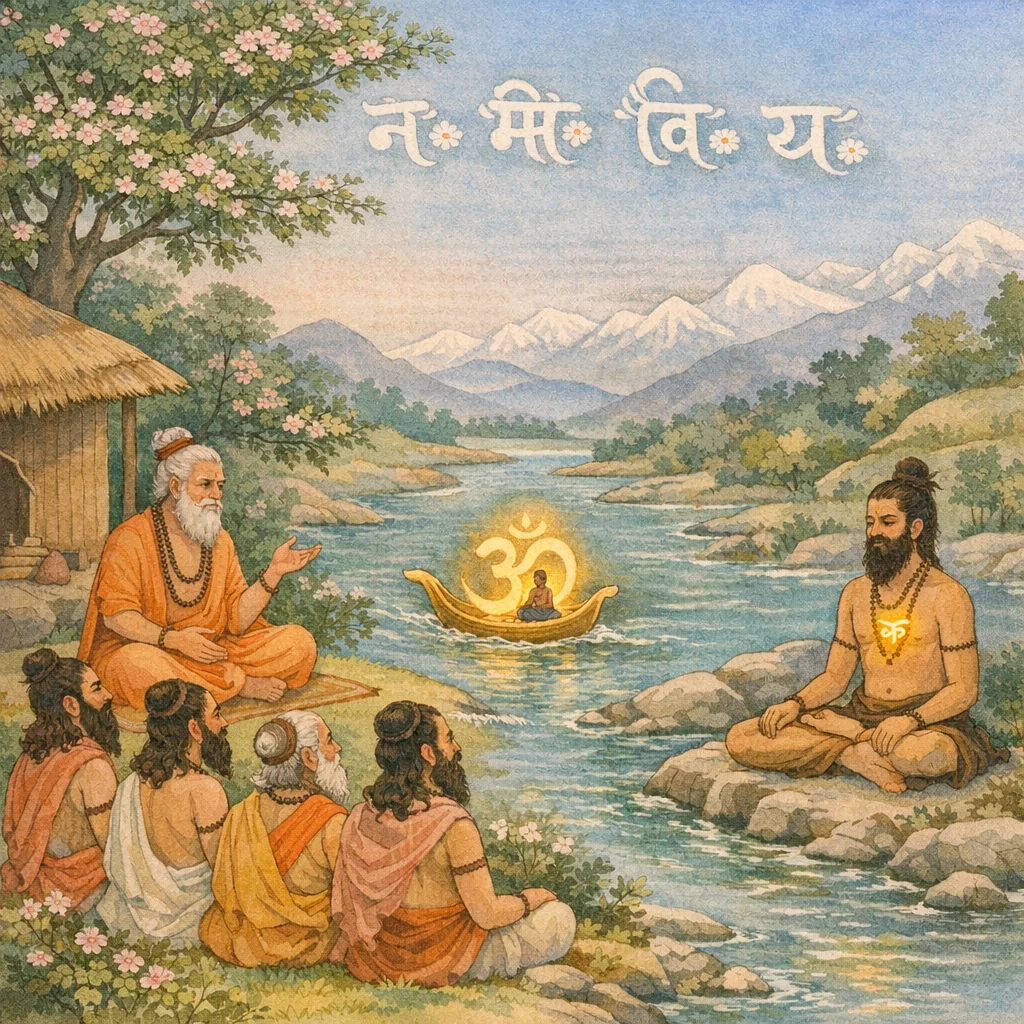
Praṇava-Māhātmya and the Twofold Mantra (Sūkṣma–Sthūla) in Śaiva Sādhanā
Adhyāya 17 opens with the ṛṣis requesting a sequential teaching on (1) the greatness of praṇava (OM), (2) the doctrine of the “six liṅgas” (ṣaḍliṅga), and (3) the proper honoring of a Śiva-bhakta. Sūta acknowledges the depth of the inquiry and, by Śiva’s grace, begins to transmit the doctrine. The early portion presents praṇava as a salvific “boat” across saṃsāra, renewing (nūtana) the practitioner by dissolving karmic residues and awakening divya-jñāna. A key distinction is then taught: praṇava is twofold as sūkṣma and sthūla—sūkṣma as ekākṣara and sthūla as pañcākṣara—corresponding to levels of manifestation (avyakta/vyakta) and to suitability for spiritual states (those oriented to jīvanmukta incline to the subtle essence). The discourse thus unites mantra-meaning, yogic practice, and a graded pedagogy of liberation, preparing for later treatment of liṅga-doctrine and bhakta-pūjā as embodied expressions of the same metaphysical principle.
Shlokas
Verse 1
ऋषय ऊचुः । प्रणवस्य च माहात्म्यं षड्लिंगस्य महामुने । शिवभक्तस्य पूजां च क्रमशो ब्रूहि नःप्रभो
The sages said: “O great sage, please explain to us—in due order—the glory of the Praṇava (Oṃ), the doctrine of the sixfold Liṅga, and also the manner of worship offered by a devotee of Śiva, O revered one.”
Verse 2
सूत उवाच । तपोधनैर्भवद्भिश्च सम्यक्प्रश्नस्त्वयं कृतः । अस्योत्तरं महादेवो जानाति स्म न चापरः
Sūta said: “O you who are rich in austerity, you have asked this question properly and in the right spirit. The true answer to this is known to Mahādeva alone—and to none other.”
Verse 3
अथापि वक्ष्ये तमहं शिवस्य कृपयैव हि । शिवोऽस्माकं च युष्माकं रक्षां गृह्णातु भूरिशः
Even so, I shall speak of it—indeed, only by the grace of Śiva. May Śiva, the Lord of abundant power, accept and undertake the protection of both us and you.
Verse 4
प्रो हि प्रकृतिजातस्य संसारस्य महोदधेः । नवं नावांतरमिति प्रणवं वै विदुर्बुधाः
To cross the great ocean of saṃsāra born of Prakṛti, the wise know the Praṇava (Oṁ) as the ever-new boat and the supreme means of passage.
Verse 5
प्रः प्रपंचो न नास्तिवो युष्माकं प्रणवं विदुः । प्रकर्षेण नयेद्यस्मान्मोक्षं वः प्रणवं विदुः
They know Your Praṇava—the sacred syllable Oṁ—as that by which the manifested universe is not denied, but rightly understood; and because it powerfully leads to liberation, they know that Praṇava to be Your very means to mokṣa.
Verse 6
स्वजापकानां योगिनां स्वमंत्रपूजकस्य च । सर्वकर्मक्षयं कृत्वा दिव्यज्ञानं तु नूतनम्
For those yogins who steadily perform japa of their own mantra, and for the devotee who worships the chosen mantra, all karmas are brought to exhaustion; then truly a fresh, divine knowledge arises within.
Verse 7
तमेव मायारहितं नूतनं परिचक्षते । प्रकर्षेण महात्मानं नवं शुद्धस्वरूपकम्
They describe Him alone as free from māyā—ever-fresh, ever-new. In the highest sense, He is the Great Self (Mahātman): perpetually new, of perfectly pure essential nature.
Verse 8
नूतनं वै करोतीति प्रणवं तं विदुर्बुधाः । प्रणवं द्विविधं प्रोक्तं सूक्ष्मस्थूलविभेदतः
The wise know it as ‘Praṇava’ because it truly makes the seeker ever-new. Praṇava is taught to be of two kinds, distinguished as subtle and gross.
Verse 9
सूक्ष्ममेकाक्षरं विद्यात्स्थूलं पंचाक्षरं विदुः । सूक्ष्ममव्यक्तपंचार्णं सुव्यक्तार्णं तथेतरत्
Know the subtle form to be the one-syllabled “Oṁ”, and the gross form to be the five-syllabled mantra. The subtle is the unmanifest five-syllabled reality, while the other is the clearly manifest syllabled form for worship.
Verse 10
जीवन्मुक्तस्य सूक्ष्मं हि सर्वसारं हि तस्य हि । मंत्रेणार्थानुसंधानं स्वदेहविलयावधि
For the jīvanmukta (one liberated while living), this subtle inner realization is truly his very essence—the total quintessence. Through the mantra he sustains contemplation of its meaning, continuing until the dissolution of his own body.
Verse 11
स्वदेहेगलिते पूर्णं शिवं प्राप्नोति निश्चयः । केवलं मंत्रजापी तु योगं प्राप्नोति निश्चयः
When identification with the body has melted away, one surely attains the Perfect Shiva. But one who is merely a repeater of mantra surely attains only yoga—a yogic state—not the final fullness of Shiva-realization.
Verse 12
षट्त्रिंशत्कोटिजापी तु निश्चयं योगमाप्नुयात् । सूक्ष्मं च द्विविधं ज्ञेयं ह्रस्वदीर्घविभेदतः
But one who performs japa to the measure of thirty-six crores attains Yoga with certainty. And the subtle (sūkṣma) should be understood as of two kinds, distinguished as short and long.
Verse 13
अकारश्च उकारश्च मकारश्च ततः परम् । बिंदुनादयुतं तद्धि शब्दकालकलान्वितम्
“A”, “U”, and “M”—and beyond these—verily that Praṇava (Oṃ) is joined with bindu and nāda, and is endowed with sound, time, and kalā, the subtle power of manifestation.
Verse 14
दीर्घप्रणवमेवं हि योगिनामेव हृद्गतम् । मकारं तंत्रितत्त्वं हि ह्रस्वप्रणव उच्यते
Thus the extended Praṇava (Oṃ) is said to abide in the very heart of yogins. And the syllable “ma”, embodying the inner principle taught in the Tantra, is called the short Praṇava.
Verse 15
शिवः शक्तिस्तयोरैक्यं मकारं तु त्रिकात्मकम् । ह्रस्वमेवं हि जाप्यं स्यात्सर्वपापक्षयैषिणाम्
Śiva, Śakti, and the oneness of the two—these are expressed by the syllable “ma,” threefold in nature. Therefore, for those who seek the destruction of all sins, it is to be repeated in japa in its short form.
Verse 16
भूवायुकनकार्णोद्योःशब्दाद्याश्च तथा दश । आशान्वयेदशपुनः प्रवृत्ता इति कथ्यते
Earth, wind, agni (fire/gold), water, and light (ākāśa/space), together with the ten beginning with sound—these are said to make ten. Again, another ten arise in connection with the directions (āśā); thus it is declared.
Verse 17
इति श्रीशिवमहापुराणे विद्येश्वरसंहितायां सप्तदशोऽध्यायः
Thus ends the seventeenth chapter in the Vidyeśvara Saṃhitā of the revered Śrī Śiva Mahāpurāṇa.
Verse 18
वेदादौ च प्रयोज्यं स्याद्वंदने संध्ययोरपि । नवकौटिजपाञ्जप्त्वा संशुद्धः पुरुषो भवेत्
It should be employed at the beginning of Vedic recitation and also in the acts of worship at the two Sandhyās (dawn and dusk). Having performed japa amounting to nine koṭis, a person becomes purified.
Verse 19
पुनश्च नवकोट्या तु पृथिवीजयमाप्नुयात् । पुनश्च नवकोट्या तु ह्यपांजयमवाप्नुयात्
And again, by the merit of nine koṭis, one attains conquest over the earth; and again, by nine koṭis, one indeed attains victory over the waters.
Verse 20
पुनश्च नवकोट्या तु तेजसांजयमाप्नुयात् । पुनश्च नवकोट्या तु वायोर्जयमवाप्नुयात् । आकाशजयमाप्नोति नवकोटिजपेन वै
Again, by another nine koṭis of mantra-repetition, one attains victory over fire. Again, by another nine koṭis, one attains mastery over wind. And by the repetition of nine koṭis indeed, one attains mastery over space (ākāśa).
Verse 21
गंधादीनांक्रमेणैवनवकोटिजपेणवै । अहंकारस्य च पुनर्नव कोटिजपेन वै
For the subtle principles beginning with smell and the rest, in their proper sequence, one should perform japa to the measure of nine koṭis; and again, for the principle of egoity (ahaṅkāra), one should likewise perform japa to the measure of nine koṭis.
Verse 22
सहस्रमंत्रजप्तेन नित्यशुद्धो भवेत्पुमान् । ततः परं स्वसिद्ध्यर्थं जपो भवति हि द्विजाः
By repeating a mantra a thousand times, a person becomes ever purified. Thereafter, O twice-born ones (dvijas), japa is performed for the sake of one’s own spiritual attainment (siddhi).
Verse 23
एवमष्टोत्तरशतकोटिजप्तेन वै पुनः । प्रणवेन प्रबुद्धस्तु शुद्धयोगमवाप्नुयात्
Thus, by again performing japa of the Praṇava (Oṁ) to the measure of one hundred and eight crores, the seeker—fully awakened by that Praṇava—attains the state of pure Yoga (śuddha-yoga).
Verse 24
शुद्धयोगेन संयुक्तो जीवन्मुक्तो न संशयः । सदा जपन्सदाध्यायञ्छिवं प्रणवरूपिणम्
One who is united with pure yoga is liberated while still embodied—of this there is no doubt—ever repeating (japa) and ever engaged in sacred study, meditating on Śiva who is of the very form of the Praṇava (Om).
Verse 25
समाधिस्थो महायोगीशिव एव न संशयः । ऋषिच्छंदोदेवतादि न्यस्य देहेपुनर्जपेत्
Established in samādhi, the great Yogin is verily Śiva—of this there is no doubt. Having performed the nyāsa of the seer (ṛṣi), metre (chandas), deity (devatā), and the rest upon his body, he should again repeat (the mantra) in japa.
Verse 26
प्रणवं मातृकायुक्तं देहे न्यस्य ऋषिर्भवेत् । दशमातृषडध्वादि सर्वं न्यासफलं लभेत्
By performing nyāsa—placing the Praṇava (Oṃ) together with the Mātr̥kā letters upon one’s own body—one attains the state of a ṛṣi. From the “ten mothers,” the “six paths,” and the rest, one gains the entire fruit of nyāsa in Śiva’s worship.
Verse 27
प्रवृत्तानां च मिश्राणां स्थूलप्रणवमिष्यते । क्रियातपोजपैर्युक्तास्त्रिविधाः शिवयोगिनः
For those engaged in outward activity and for those of mixed discipline, the “gross” form of the Praṇava (Oṃ) is prescribed. Śiva‑yogins are of three kinds: those devoted to ritual action, those devoted to austerity, and those devoted to mantra‑repetition (japa).
Verse 28
धनादिविभवैश्चैव कराद्यंगैर्नमादिभिः । क्रियया पूजया युक्तः क्रियायोगीति कथ्यते
One who is engaged in worship through ritual action—using offerings such as wealth and other resources, employing the limbs beginning with the hands, and performing acts of reverence like prostration—is called a practitioner of Kriyā‑yoga.
Verse 29
पूजायुक्तश्च मितभुग्बाह्येंद्रि यजयान्वितः । परद्रो हादिरहितस्तपोयोगीति कथ्यते
One who is steadfast in pūjā, moderate in food, victorious over the outward-going senses, and free from hostility and harm toward others—such a one is called a “tapo-yogī”, a yogin established in tapas (austerity).
Verse 30
एतैर्युक्तः सदा क्रुद्धः सर्वकामादिवर्जितः । सदा जपपरः शांतोजपयोगीति तं विदुः
Endowed with these disciplines, ever firm and intense, free from all cravings and desires, always devoted to mantra-japa, and inwardly tranquil—such a one is known as a “japa-yogin”, established in the yoga of sacred repetition.
Verse 31
उपचारैः षोडशभिः पूजया शिवयोगिनाम् । सालोक्यादिक्रमेणैव शुद्धो मुक्तिं लभेन्नरः
By worshipping Śiva with the sixteen offerings (ṣoḍaśopacāra), in the manner taught by the Śiva-yogins, a person becomes purified and—progressing through sālokya and the other grades—attains liberation.
Verse 32
जपयोगमथो वक्ष्ये गदतः शृणुत द्विजाः । तपःकर्तुर्जपः प्रोक्तो यज्जपन्परिमार्जते
Now I shall explain the discipline of japa-yoga; listen attentively, O twice-born. For one who undertakes tapas, japa is declared to be the essential practice—by repeating it, the practitioner is thoroughly purified (of impurities and faults).
Verse 33
शिवनाम नमःपूर्वं चतुर्थ्यां पंचतत्त्वकम् । स्थूलप्रणवरूपं हि शिवपंचाक्षरं द्विजाः
O twice-born ones, the five-syllabled mantra of Śiva is formed by placing “namaḥ” first and “śiva” as the fourth; it is constituted of the five tattvas and is indeed the gross (manifest) form of Praṇava (Oṁ).
Verse 34
पंचाक्षरजपेनैव सर्वसिद्धिं लभेन्नरः । प्रणवेनादिसंयुक्तं सदा पंचाक्षरं जपेत्
By the japa of the five-syllabled mantra alone, a person attains every spiritual accomplishment. Therefore one should always repeat the five-syllabled mantra joined with the Pranava “Oṁ” at its beginning.
Verse 35
गुरूपदेशं संगम्य सुखवासे सुभूतले । पूर्वपक्षे समारभ्य कृष्णभूतावधि द्विजाः
Having received the Guru’s instruction, the twice-born should dwell in a pleasant residence on auspicious ground, and begin the observance in the bright fortnight, continuing it until the new-moon day.
Verse 36
माघं भाद्रं विशिष्टं तु सर्वकालोत्तमोत्तमम् । एकवारं मिताशीतु वाग्यतो नियतेंद्रि यः
Among times, the months of Māgha and Bhādrapada are especially distinguished—indeed, the best among the best of all seasons. One who, during this period, eats only once a day in moderation, is restrained in speech, and keeps the senses disciplined, becomes fit for the higher fruits of Śiva-worship.
Verse 37
स्वस्य राजपितृणां च शुश्रूषणं च नित्यशः । सहस्रजपमात्रेण भवेच्छुद्धोऽन्यथा ऋणी
By daily serving one’s own king (rightful authority) and one’s forefathers, a person becomes purified through the mere performance of a thousand repetitions (of the mantra). Otherwise, he remains a debtor—bound by obligation and impurity.
Verse 38
पंचाक्षरं पंचलक्षं जपेच्छिवमनुस्मरन् । पद्मासनस्थं शिवदं गंगाचंद्र कलान्वितम्
Remembering Śiva, one should repeat the five-syllabled mantra five hundred thousand times, meditating on the boon-giving Lord seated in the lotus posture, adorned with the Gaṅgā and the crescent-moon digit.
Verse 39
वामोरुस्थितशक्त्या च विराजं तं महागणैः । मृगटंकधरं देवं वरदाभयपाणिकम्
Radiant amid the great hosts of Śiva’s gaṇas, with Śakti seated upon His left thigh, that God shone forth—bearing the deer and the axe, and holding His hands in the gestures of boon-giving and fearlessness.
Verse 40
सदानुग्रहकर्त्तारं सदा शिवमनुस्मरन् । संपूज्य मनसा पूर्वं हृदिवासूर्यमंडले
Ever remembering Sadāśiva—the constant bestower of grace—one should first perform mental worship, contemplating Him as abiding in the solar orb within the heart.
Verse 41
जपेत्पंचाक्षरीं विद्यां प्राण्मुखः शुद्धकर्मकृत् । प्रातः कृष्णचतुर्दश्यां नित्यकर्मसमाप्य च
Having purified his conduct and works, facing east, one should recite the five-syllabled sacred mantra (Pañcākṣarī). On the morning of the dark fortnight’s fourteenth lunar day, after completing one’s daily obligatory rites as well, one should perform this japa.
Verse 42
मनोरमे शुचौ देशे नियतः शुद्धमानसः । पंचाक्षरस्य मंत्रस्य सहस्रं द्वादशं जपेत्
In a delightful and pure place, disciplined and with a purified mind, one should repeat the Pañcākṣara mantra—twelve thousand times.
Verse 43
वरयेच्च सपत्नीकाञ्छैवान्वै ब्राह्मणोत्तमान् । एकं गुरुवरं शिष्टं वरयेत्सांबमूर्तिकम्
He should invite the foremost Śaiva brāhmaṇas together with their wives. And he should especially invite one exemplary and well-disciplined preceptor—one who embodies Śiva united with Umā (Sāmba).
Verse 44
ईशानं चाथ पुरुषमघोरं वाममेव च । सद्योजातं च पंचैव शिवभक्तान्द्विजोत्तमान्
He then described the five—Īśāna, Tatpuruṣa, Aghora, Vāma, and Sadyojāta—as the supreme Brahmin devotees of Śiva.
Verse 45
पूजाद्र व्याणि संपाद्य शिवपूजां समारभेत् । शिवपूजां च विधिवत्कृत्वा होमं समारभेत्
Having procured the materials required for worship, one should begin the worship of Lord Śiva. And after performing that Śiva-pūjā according to proper rule, one should then commence the homa (fire-offering).
Verse 46
मुखांतं च स्वसूत्रेण कृत्वा होमं समारभेत् । दशैकं वा शतैकं वा सहस्रैकमथापि वा
Having arranged the rite up to its concluding portion according to one’s own prescribed sūtra, one should then begin the homa. The oblations may be offered eleven times, or a hundred and one times, or even a thousand and one times.
Verse 47
कापिलेन घृतेनैव जुहुयात्स्वयमेव हि । कारयेच्छिवभक्तैर्वाप्यष्टोत्तरशतं बुधः
Indeed, he should personally perform the fire-offering using only ghee prepared from a kapilā (tawny) cow. Or else, the wise man may have one hundred and eight oblations performed by devotees of Śiva.
Verse 48
होमान्ते दक्षिणा देया गुरोर्गोमिथुनं तथा । ईशानादिस्वरूपांस्तान्गुरुं सांबं विभाव्य च
At the conclusion of the homa, one should offer the prescribed dakṣiṇā to the Guru—indeed, a pair of cows as well—while contemplatively recognizing the Guru as embodying the forms beginning with Īśāna, and as Śiva together with Ambā.
Verse 49
तेषां पत्सिक्ततोयेन स्वशिरः स्नानमाचरेत् । षट्त्रिंशत्कोटितीर्थेषु सद्यः स्नानफलं लभेत्
With the water that has washed their feet, one should bathe one’s own head. By this, one immediately gains the fruit of bathing in the thirty-six crores of sacred tīrthas—an act of reverence that purifies the soul through devotion to Śiva’s holy ones.
Verse 50
दशांगमन्नं तेषां वै दद्याद्वैभक्तिपूर्वकम् । पराबुद्ध्या गुरोः पत्नीमीशानादिक्रमेण तु
With devotion he should offer them the food prepared in tenfold form. And with the highest reverence, he should honor the Guru’s wife as well, following the proper order beginning with Īśāna.
Verse 51
परमान्नेन संपूज्य यथाविभवविस्तरम् । रुद्रा क्षवस्त्रपूर्वं च वटकापूपकैर्युतम्
Worship Śiva with the finest offering of cooked rice, extending the service according to your means. Begin with proper garments and Rudrākṣa, and present it together with vadas and sweet cakes (apūpas).
Verse 52
बलिदानं ततः कृत्वा भूरिभोजनमाचरेत् । ततः संप्रार्थ्य देवेशं जपं तावत्समापयेत्
Then, having made the prescribed offering (bali), one should arrange a plentiful feeding (for devotees and the needy). Thereafter, having earnestly prayed to the Lord of the gods—Śiva—one should properly conclude the japa for that period.
Verse 53
पुरश्चरणमेवं तु कृत्वा मन्त्रीभवेन्नरः । पुनश्च पंचलक्षेण सर्वपापक्षयो भवेत्
Having thus performed the prescribed puraścaraṇa, a man becomes accomplished in the mantra. And further, by repeating it five lakhs (five hundred thousand times), the destruction of all sins comes about.
Verse 54
अतलादि समारभ्य सत्यलोकावधिक्रमात् । पंचलक्षजपात्तत्तल्लोकैश्वर्यमवाप्नुयात्
Beginning with Atala and proceeding upward in due order up to Satyaloka, by performing five hundred thousand mantra-repetitions one attains the lordly prosperity and authority belonging to each of those worlds.
Verse 55
मध्ये मृतश्चेद्भोगांते भूमौ तज्जापको भवेत् । पुनश्च पंचलक्षेण ब्रह्मसामीप्यमाप्नुयात्
If one dies midway (before completing the full observance), then at the end of enjoying the fruits of karma one is born again on earth as a practitioner of that very japa. And then, by performing a further five lakhs of repetitions, one attains nearness to Brahman—intimate proximity to the Supreme Lord.
Verse 56
पुनश्च पंचलक्षेण सारूप्यैश्वर्यमाप्नुयात् । आहत्य शतलक्षेण साक्षाद्ब्रह्मसमो भवेत्
And further, by repeating it five lakhs of times, one attains the lordly glory of likeness (to Śiva). In sum, by one hundred lakhs (ten million), one becomes directly equal to Brahman itself.
Verse 57
कार्यब्रह्मण एवं हि सायुज्यं प्रतिपद्य वै । यथेष्टं भोगमाप्नोति तद्ब्रह्मप्रलयावधि
Thus, indeed, attaining union (sāyujya) with the manifested Brahman, one enjoys pleasures as desired—until the time of Brahmā’s dissolution.
Verse 58
पुनः कल्पांतरे वृत्ते ब्रह्मपुत्रः सजायते । पुनश्च तपसा दीप्तः क्रमान्मुक्तो भविष्यति
When another aeon (kalpa) has passed, he is born again as a son of Brahmā. And once more, blazing with the power of austerity (tapas), he will, step by step, attain liberation (mokṣa).
Verse 59
पृथ्व्यादिकार्यभूतेभ्यो लोका वै निर्मिताः क्रमात् । पातालादि च सत्यांतं ब्रह्मलोकाश्चतुर्दश
From the created elements beginning with earth, the worlds were fashioned in due order—fourteen in all—ranging from Pātāla below up to Satya above, including Brahmaloka.
Verse 60
सत्यादूर्ध्वं क्षमांतं वैविष्णुलोकाश्चतुर्दश । क्षमलोके कार्यविष्णुर्वैकुंठे वरपत्तने
From Satya (Satyaloka) upward, up to Kṣamā, there are indeed fourteen realms belonging to Viṣṇu. In Kṣamā-loka Viṣṇu abides as the Lord who performs the cosmic function; and in Vaikuṇṭha, within the supreme city, he dwells as the bestower of boons.
Verse 61
कार्यलक्ष्म्या महाभोगिरक्षां कृत्वाऽधितिष्ठति । तदूर्ध्वगाश्च शुच्यंतां लोकाष्टाविंशतिः स्थिताः
Having established a mighty protection for the great enjoyers through the ordered prosperity of their destined works, He presides there. Above that, the twenty‑eight worlds—rising upward—stand in a purified state.
Verse 62
शुचौ लोके तु कैलासे रुद्रो वै भूतहृत्स्थितः । षडुत्तराश्च पंचाशदहिंसांतास्तदूर्ध्वगाः
In the pure realm of Kailāsa, Rudra indeed abides, firmly established in the hearts of all beings. Above that are fifty‑six higher planes, rising upward and culminating in ahiṃsā (non‑violence).
Verse 63
अहिंसालोकमास्थाय ज्ञानकैलासके पुरे । कार्येश्वरस्तिरोभावं सर्वान्कृत्वाधितिष्ठति
Abiding in the realm of ahiṃsā, in the city of Jñāna‑Kailāsa, Kāryeśvara presides—having veiled all beings by His power of concealment (tirobhāva).
Verse 64
तदंते कालचक्रं हि कालातीतस्ततः परम् । शिवेनाधिष्ठितस्तत्र कालश्चक्रेश्वराह्वयः
Beyond that indeed lies the Wheel of Time; and beyond Time itself is the Supreme Reality, transcending temporality. There, established and presided over by Śiva, Time abides—known as Cakreśvara, the Lord of the Wheel.
Verse 65
माहिषं धर्ममास्थाय सर्वान्कालेन युंजति । असत्यश्चाशुचिश्चैव हिंसा चैवाथ निर्घृणा
Taking refuge in a brutish, buffalo-like code of conduct, they subject everyone to the force of Time. They swiftly become devoted to falsehood and impurity, and they turn to violence—utterly without compassion.
Verse 66
असत्यादिचतुष्पादः सर्वांशः कामरूपधृक् । नास्तिक्यलक्ष्मीर्दुःसंगो वेदबाह्यध्वनिः सदा
He stands upon four feet beginning with untruth; he is wholly a fragment of that adharmic principle, assuming whatever form desire dictates. He is endowed with the “prosperity” of disbelief, keeps wicked company, and ever speaks in a manner outside the authority of the Veda.
Verse 67
क्रोधसंगः कृष्णवर्णो महामहिषवेषवान् । तावन्महेश्वरः प्रोक्तस्तिरोधास्तावदेव हि
Associated with wrath, dark in hue, and assuming the guise of a great buffalo—so long is Maheśvara spoken of as “Tirodhā” (the Veiling Power); indeed, it is only to that extent, as obscuration operates.
Verse 68
तदर्वाक्कर्मभोगो हि तदूर्ध्वं ज्ञानभोगकम् । तदर्वाक्कर्ममाया हि ज्ञानमाया तदूर्ध्वकम्
Below that level, experience is indeed the enjoyment (and suffering) of actions; above it, experience becomes the enjoyment born of knowledge. Below it operates the māyā that binds through karma; above it operates the māyā that functions through knowledge.
Verse 69
मा लक्ष्मीः कर्मभोगो वै याति मायेति कथ्यते । मा लक्ष्मीर्ज्ञानभोगो वै याति मायेति कथ्यते
It is declared that even Lakṣmī—when sought as enjoyment through karma (action)—leads one into Māyā. It is also declared that even Lakṣmī—when sought as enjoyment through jñāna (knowledge)—leads one into Māyā.
Verse 70
तदूर्ध्वं नित्यभोगो हि तदर्वाण्नश्वरं विदुः । तदर्वाक्च तिरोधानं तदूर्ध्वं न तिरोधनम्
Above that state there is indeed eternal experience; below it, the wise know all to be perishable. And concealment (tirodhāna) operates only below that; above it there is no concealment at all.
Verse 71
तदर्वाक्पाशबंधो हि तदूर्ध्वं न हि बंधनम् । तदर्वाक्परिवर्तंते काम्यकर्मानुसारिणः
Below that higher state there is indeed bondage by the fetter; above it there is no bondage at all. Those who follow desire-driven rites and actions keep revolving only below it.
Verse 72
निष्कामकर्मभोगस्तु तदूर्ध्वं परिकीर्तितः । तदर्वाक्परिवर्तंते बिंदुपूजापरायणाः
Above this has been proclaimed the state of experiencing action without desire. Below that, however, revolve those devoted to the worship of the bindu, remaining within the cycle of return.
Verse 73
तदूर्ध्वं हि व्रजंत्येव निष्कामा लिंगपूजकाः । तदर्वाक्परिवर्तंते शिवान्यसुरपूजकाः
Indeed, the desireless devotees who worship the Śiva-liṅga ascend toward the higher divine state; but those who worship other deities and the asuras turn back downward into lower courses of existence.
Verse 74
शिवैकनिरता ये च तदूर्ध्वं संप्रयांति ते । तदर्वाग्जीवकोटिः स्यात्तदूर्ध्वं परकोटिकाः
Those who are exclusively devoted to Shiva proceed to the higher state. Below that lies the class of bound souls (jīvas); above that are the supreme classes (of liberated or transcendent beings).
Verse 75
सांसारिकास्तदर्वाक्च मुक्ताः खलु तदूर्ध्वगाः । तदर्वाक्परिवर्तंते प्राकृतद्र व्यपूजकाः
Those bound to worldly life remain below, while the liberated indeed move upward. But those who worship only with material substances turn back again to the lower path.
Verse 76
तदूर्ध्वं हि व्रजंत्येते पौरुषद्र व्यपूजकाः । तदर्वाक्छक्तिलिंगं तु शिवलिंगं तदूर्ध्वकम्
Indeed, those who worship the masculine principle (Puruṣa) through material offerings rise upward beyond that. Below it is the Śakti-liṅga; higher than that stands the Śiva-liṅga.
Verse 77
तदर्वागावृतं लिंगं तदूर्ध्वं हि निरावृति । तदर्वाक्कल्पितं लिंगं तदूर्ध्वं वै न कल्पितम्
Below, the Liṅga is to be kept covered; above, it is indeed to remain uncovered. The lower portion is a formed and measured Liṅga, whereas the upper portion is truly unformed—beyond human fabrication.
Verse 78
तदर्वाग्बाह्यलिंगं स्यादंतरंगं तदूर्ध्वकम् । तदर्वाक्छक्तिलोका हि शतं वै द्वादशाधिकम्
Below lies the outer Liṅga; above it is the inner, subtle realm. And below that inner realm are indeed the worlds of Śakti—one hundred and twelve in number.
Verse 79
तदर्वाग्बिंदुरूपं हि नादरूपं तदुत्तरम् । तदर्वाक्कर्मलोकस्तु तदूर्ध्वं ज्ञानलोककः
Below that is indeed the realm in the form of Bindu, and above it is the realm in the form of Nāda. Below lies the world of action (karma-loka), while above is the world of knowledge (jñāna-loka).
Verse 80
नमस्कारस्तदूर्ध्वं हि मदाहंकारनाशनः । जनिजं वै तिरोधानं नानिषिद्ध्यातते इति
Thereafter, prostration (namaskāra) indeed destroys pride and ego. It removes the innate veiling (tirodhāna) born of embodied existence, and thus the seeker is not obstructed on the path of worship and realization.
Verse 81
ज्ञानशब्दार्थ एवं हि तिरोधाननिवारणात् । तदर्वाक्परिवर्तंते ह्याधिभौतिकपूजकाः
For the very meaning of the word “knowledge” is the removal of veiling (tirodhāna); therefore, those who worship only the outward, material level turn back and remain below that true attainment.
Verse 82
आध्यात्मिकार्चका एव तदूर्ध्वं संप्रयांतिवै । तावद्वै वेदिभागं तन्महालोकात्मलिंगके
Only those worshippers who perform inward, spiritual adoration truly ascend beyond that; others reach only as far as the altar-portion. Such is the distinction taught regarding that Liṅga whose very nature is the “Great World” (Mahā-loka), the supreme plane of being.
Verse 83
प्रकृत्याद्यष्टबंधोपि वेद्यंते संप्रतिष्ठतः । एवमेतादृशं ज्ञेयं सर्वं लौकिकवैदिकम्
Beginning with Prakṛti and the rest, even the eightfold bond is understood through proper establishment (of the sacred principle). In this very manner, one should know all that is spoken of—whether worldly or Vedic—as being of this same kind.
Verse 84
अधर्ममहिषारूढं कालचक्रं तरंति ते । सत्यादिधर्मयुक्ता ये शिवपूजापराश्च ये
They alone cross beyond the wheel of Time, mounted upon the buffalo of unrighteousness—those endowed with virtues beginning with truthfulness, and wholly devoted to the worship of Lord Śiva.
Verse 85
तदूर्ध्वं वृषभो धर्मो ब्रह्मचर्यस्वरूपधृक् । सत्यादिपादयुक्तस्तु शिवलोकाग्रतः स्थितः
Above that stands Dharma in the form of the bull, bearing the very nature of brahmacarya—chaste spiritual discipline. Endowed with the feet of virtues beginning with Truth (satya) and the rest, it stands before the realm of Śiva.
Verse 86
क्षमाशृङ्गः शमश्रोत्रो वेदध्वनिविभूषितः । आस्तिक्यचक्षुर्निश्वासगुरुबुद्धिमना वृषः
The Bull (Vṛṣa) of Dharma, whose horns are forbearance and whose ears are tranquillity, is adorned with the resonance of the Vedas. His eyes are faith, and his very breath is reverence for the Guru; his mind is steady, endowed with noble understanding.
Verse 87
क्रियादिवृषभा ज्ञेयाः कारणादिषु सर्वदा । तं क्रियावृषभं धर्मं कालातीतोधितिष्ठति
Know that the “bulls,” beginning with Kriyā (sacred action), are ever present in the causal principles and the rest. That Dharma—whose very strength is Kriyā—is upheld and transcended by the One beyond Time (Śiva).
Verse 88
ब्रह्मविष्णुमहेशानां स्वस्वायुर्दिनमुच्यते । तदूर्ध्वं न दिनं रात्रिर्न जन्ममरणादिकम्
For Brahmā, Viṣṇu, and Maheśa, the measure of their respective lifespan is spoken of in terms of “days.” Beyond that supreme state, however, there is neither day nor night, nor anything such as birth, death, and the rest.
Verse 89
पुनः कारणसत्यांताः कारणब्रह्मणस्तथा । गंधादिभ्यस्तु भूतेभ्यस्तदूर्ध्वं निर्मिताः सदा
Again, the principles beginning with “causal reality” arise from the Causal Brahman; and above them—starting from the elements such as earth, endowed with the quality of fragrance—further levels are ever fashioned in due order.
Verse 90
सूक्ष्मगंधस्वरूपा हि स्थिता लोकाश्चतुर्दश । पुनः कारणविष्णोर्वै स्थिता लोकाश्चतुर्दश
Indeed, the fourteen worlds abide in the form of subtle fragrance; and again, the fourteen worlds abide in the causal Viṣṇu, the source-cause.
Verse 91
पुनःकारणरुद्र स्य लोकाष्टाविंशका मताः । पुनश्च कारणेशस्य षट्पंचाशत्तदूर्ध्वगाः
Again it is taught that Kāraṇa-Rudra possesses twenty-eight worlds. And above those, further still, are the fifty-six worlds belonging to Kāraṇeśa, the Causal Lord.
Verse 92
ततः परं ब्रह्मचर्यलोकाख्यं शिवसंमतम् । तत्रैव ज्ञानकैलासे पंचावरणसंयुते
Beyond that lies the realm called Brahmacarya-loka, approved by Lord Śiva. There itself is Jñāna-Kailāsa, endowed with the five enclosures (pañcāvaraṇas).
Verse 93
पंचमंडलसंयुक्तं पंचब्रह्मकलान्वितम् । आदिशक्तिसमायुक्तमादिलिंगं तु तत्र वै
There indeed is the Ādi-liṅga, joined with the five sacred circles and endowed with the kalās (aspects) of the Five Brahmans; and it is united with Ādi-Śakti as well.
Verse 94
शिवालयमिदं प्रोक्तं शिवस्य परमात्मनः । परशक्त्यासमायुक्तस्तत्रैव परमेश्वरः
This has been declared to be the abode of Śiva, the Supreme Self. There itself abides Parameśvara, united with His supreme Power, Parāśakti.
Verse 95
सृष्टिः स्थितिश्च संहारस्तिरोभावोप्यनुग्रहः । पंचकृत्यप्रवीणोऽसौ सच्चिदानंदविग्रहः
Creation, preservation, dissolution, concealment, and grace—these are His five divine acts. Perfectly adept in this fivefold activity, He is Śiva, whose very form is Sat-Cit-Ānanda: Existence, Consciousness, and Bliss.
Verse 96
ध्यानधर्मः सदा यस्य सदानुग्रहतत्परः । समाध्यासनमासीनः स्वात्मारामो विराजते
He whose very nature is constant meditation, ever intent on bestowing grace, shines forth—seated in the posture of samādhi, rejoicing in the bliss of his own Self.
Verse 97
तस्य संदर्शनं सांध्यं कर्मध्यानादिभिः क्रमात् । नित्यादिकर्मयजनाच्छिवकर्ममतिर्भवेत्
By regularly taking darśana of Him at the sandhyā times, and by proceeding step by step through prescribed duties, meditation, and related disciplines, and by performing the daily rites and worship, one’s understanding and intention become firmly oriented toward Śiva-karman—Śiva’s sacred work of worship—leading the mind to Śiva.
Verse 98
क्रियादिशिवकर्मभ्यः शिवज्ञानं प्रसाधयेत् । तद्दर्शनगताः सर्वे मुक्ता एव न संशयः
By Śaiva practices—beginning with ritual action—one should rightly bring about the knowledge of Śiva. All who have entered that direct vision (of Śiva) are indeed liberated; of this there is no doubt.
Verse 99
मुक्तिरात्मस्वरूपेण स्वात्मारामत्वमेव हि । क्रियातपोजपज्ञानध्यानधर्मेषु सुस्थितः
Liberation is indeed abiding in one’s own true nature—resting in the bliss of the Self alone. Firmly established in right conduct, austerity, mantra-recitation, sacred knowledge, meditation, and dharma, one becomes fit for that state.
Verse 100
शिवस्य दर्शनं लब्धा स्वात्मारामत्वमेव हि । यथा रविः स्वकिरणादशुद्धिमपनेष्यति
Having attained the vision of Śiva, one indeed becomes established in delight in one’s own Self; just as the Sun, by its own rays, removes impurity.
Verse 101
कृपाविचक्षणः शंभुरज्ञानमपनेष्यति । अज्ञानविनिवृत्तौ तु शिवज्ञानं प्रवर्तते
Śambhu, whose compassion is discerning and effective, removes ignorance. When ignorance is dispelled, the knowledge of Śiva naturally arises and begins to operate within the seeker.
Verse 102
शिवज्ञानात्स्वस्वरूपमात्मारामत्वमेष्यति । आत्मारामत्वसंसिद्धौ कृतकृत्यो भवेन्नरः
Through the knowledge of Śiva, one attains one’s own true nature and becomes established as an ātmārāma, delighting in the Self. When ātmārāmatva is fully accomplished, a person becomes kṛtakṛtya—one whose life’s purpose is fulfilled.
Verse 103
पुनश्च शतलक्षेण ब्रह्मणः पदमाप्नुयात् । पुनश्च शतलक्षेण विष्णोः पदमवाप्नुयात्
And again, by the same practice performed for one hundred thousand (counts), one attains the state of Brahmā; and again, by one hundred thousand (counts), one attains the state of Viṣṇu.
Verse 104
पुनश्च शतलक्षेण रुद्र स्य पदमाप्नुयात् । पुनश्च शतलक्षेण ऐश्वर्यं पदमाप्नुयात्
And again, by performing it for one hundred thousand (times), one attains the state of Rudra. And again, by one hundred thousand (times), one attains the sovereign station of divine lordship (aiśvarya).
Verse 105
पुनश्चैवंविधेनैव जपेन सुसमाहितः । शिवलोकादिभूतं हि कालचक्रमवाप्नुयात्
Again, with the mind well-collected, by japa performed in this very manner, one attains the Wheel of Time (kālacakra) rooted in Śiva’s realm and the higher worlds; by Śiva’s grace one transcends ordinary worldly time.
Verse 106
कालचक्रं पंचचक्रमेकैकेन क्रमोत्तरे । सृष्टिमोहौ ब्रह्मचक्रं भोगमोहौ तु वैष्णवम्
The Wheel of Time is a fivefold wheel, each succeeding one rising step by step. The delusion connected with creation belongs to Brahmā’s wheel, while the delusion connected with enjoyment belongs to Viṣṇu’s wheel.
Verse 107
कोपमोहौ रौद्र चक्रं भ्रमणं चैश्वरं विदुः । शिवचक्रं ज्ञानमोहौ पंचचक्रं विदुर्बुधाः
The wise know anger and delusion to be the ‘Raudra wheel’; restless wandering to be the ‘Īśvara wheel’; and knowledge together with delusion to be the ‘Śiva wheel’. Thus, the learned declare these as the five wheels (pañca-cakras).
Verse 108
पुनश्च दशकोट्या हि कारणब्रह्मणः पदम् । पुनश्च दशकोट्या हि तत्पदैश्वर्यमाप्नुयात्
And again, by a further ten crores, one attains the state of the Causal Brahman; and again, by yet another ten crores, one obtains the sovereign glory belonging to that very state.
Verse 109
एवं क्रमेण विष्ण्वादेः पदं लब्ध्वा महौजसः । क्रमेण तत्पदैश्वर्यं लब्ध्वा चैव महात्मनः
Thus, step by step, that great-splendoured noble soul attained the rank of Viṣṇu and the other divine stations; and in due order he also obtained the lordly powers that belong to those exalted positions.
Verse 110
शतकोटिमनुं जप्त्वा पंचोत्तरमतंद्रि तः । शिवलोकमवाप्नोति पंचमावरणाद्बहिः
Having diligently repeated the mantra a hundred million times and then a further one hundred and five times without laziness, one attains Śivaloka—beyond the fifth enclosure of the cosmic coverings.
Verse 111
राजसं मंडपं तत्र नंदीसंस्थानमुत्तमम् । तपोरूपश्च वृषभस्तत्रैव परिदृश्यते
There, the pavilion of rājasa (active, royal) splendor is seen, and there too is the excellent abode of Nandī. In that very place the Bull—Nandī, whose very form is austerity (tapas)—is also beheld.
Verse 112
सद्योजातस्य तत्स्थानं पंचमावरणं परम् । वामदेवस्य च स्थानं चतुर्थावरणं पुनः
The station of Sadyojāta is the supreme fifth enclosure (āvaraṇa). And again, the station of Vāmadeva is the fourth enclosure.
Verse 113
अघोरनिलयं पश्चात्तृतीयावरणं परम् । पुरुषस्यैव सांबस्य द्वितीयावरणं शुभम्
Thereafter, the supreme third enclosure is the abode of Aghora. And the auspicious second enclosure belongs indeed to Puruṣa, of Śiva in His form as Sāmbā (Śiva united with Śakti).
Verse 114
ईशानस्य परस्यैव प्रथमावरणं ततः । ध्यानधर्मस्य च स्थानं पंचमं मंडपं ततः
Thereafter is the first enclosure belonging to the Supreme Īśāna. Following that is the seat of dhyāna-dharma (the discipline of meditation); thereafter comes the fifth maṇḍapa (sacred pavilion).
Verse 115
बलिनाथस्य संस्थानं तत्र पूर्णामृतप्रदम् । चतुर्थं मंडपं पश्चाच्चंद्र शेखरमूर्तिमत्
There stands the sacred seat of Balinātha, bestowing the fullness of divine amṛta (immortal grace). Beyond it is the fourth maṇḍapa, endowed with the form of Chandrashekhara—Śiva who bears the moon upon His crest.
Verse 116
सोमस्कंदस्य च स्थानं तृतीयं मंडपं परम् । द्वितीयं मंडपं नृत्यमंडपं प्राहुरास्तिकाः
The third, supreme pavilion (maṇḍapa) is declared to be the sacred station of Somāskanda. The faithful also proclaim that the second pavilion is the Nṛtya-maṇḍapa, the Pavilion of Dance.
Verse 117
प्रथमं मूलमायायाः स्थानं तत्रैव शोभनम् । ततः परं गर्भगृहं लिंगस्थानं परं शुभम्
First, one should establish there the beautiful seat of Mūla-Māyā. Next, beyond that, one should construct the garbhagṛha (inner sanctum)—the supremely auspicious place for the Liṅga.
Verse 118
नंदिसंस्थानतः पश्चान्न विदुः शिववैभवम् । नंदीश्वरो बहिस्तिष्ठन्पंचाक्षरमुपासते
Those who remain outside the station of Nandin do not truly know the majesty of Śiva. Therefore Nandīśvara, standing outside in devoted attendance, worships the Lord through the Pañcākṣara mantra.
Verse 119
एवं गुरुक्रमाल्लब्धं नंदीशाच्च मया पुनः । ततः परं स्वसंवेद्यं शिवे नैवानुभावितम्
Thus I obtained this through the successive lineage of gurus, and again from Nandīśa. Beyond this, what must be directly realized within oneself cannot be made an object of narration—even with regard to Śiva.
Verse 120
शिवस्य कृपया साक्षाच्छिव लोकस्य वैभवम् । विज्ञातुं शक्यते सर्वैर्नान्यथेत्याहुरास्तिकाः
Only by Śiva’s grace can the splendor of Śivaloka be truly known by all; the faithful declare that it cannot be known by any other means.
Verse 121
एवंक्रमेणमुक्ताः स्युर्ब्राह्मणा वै जितेंद्रि यः । अन्येषां च क्रमं वक्ष्ये गदतः शृणुतादरात्
Thus, in this very order, the self-controlled brāhmaṇas indeed become liberated. Now I shall explain the prescribed sequence for the others as well—listen attentively to what I am saying.
Verse 122
गुरूपदेशाज्जाप्यं वै ब्राह्मणानां नमोऽतकम् । पंचाक्षरं पंचलक्षमायुष्यं प्रजपेद्विधिः
Having received instruction from the Guru, a Brāhmaṇa should indeed perform japa of the ‘namo’ mantra. According to proper rule, he should recite the five-syllabled (Pañcākṣara) mantra five hundred thousand times for the attainment of long life.
Verse 123
स्त्रीत्वापनयनार्थं तु पंचलक्षं जपेत्पुनः । मंत्रेण पुरुषो भूत्वा क्रमान्मुक्तो भवेद्बुधः
To remove the state of womanhood, one should again repeat the mantra five hundred thousand times. By the power of that mantra, becoming (fit as) a man, the wise one is gradually liberated.
Verse 124
क्षत्रियः पंचलक्षेण क्षत्त्रत्वमपनेष्यति । पुनश्च पंचलक्षेण क्षत्त्रियो ब्राह्मणो भवेत्
By (the prescribed observance for) five lakhs (of counts), a kṣatriya casts off kṣatriyahood; and again, by another five lakhs, that kṣatriya becomes a brāhmaṇa. Thus the Purāṇa points to inner refinement through Śiva-oriented discipline—where spiritual merit and purity, not mere birth-identity, lead one toward brahminical steadiness in knowledge and worship.
Verse 125
मंत्रसिद्धिर्जपाच्चैव क्रमान्मुक्तो भवैन्नरः । वैश्यस्तु पंचलक्षेण वैश्यत्वमपनेष्यति
Through disciplined mantra-japa, mantra-siddhi surely arises; and in due order, a person becomes liberated. A Vaiśya, by completing five lakhs (of repetitions), casts off the limiting condition of ‘Vaiśyahood’—transcending worldly identity through the power of the mantra.
Verse 126
पुनश्च पंचलक्षेण मंत्रक्षत्त्रिय उच्यते । पुनश्च पंचलक्षेण क्षत्त्रत्वमपनेष्यति
Again, by completing five lakhs of japa, one is declared a “mantra-kṣatriya”—a spiritual warrior empowered by the mantra. Again, by another five lakhs, that kṣatriya-status is cast off, as the aspirant moves beyond even that identity through deeper mantra-maturity.
Verse 127
पुनश्च पंचलक्षेण मंत्रब्राह्मण उच्यते । शूद्र श्चैव नमओंतेन पंचविंशतिलक्षतः
Further, by completing five lakhs of mantra-japa one is spoken of as a “mantra-brāhmaṇa,” purified and established in mantra-discipline. And even a Śūdra, by the japa of the Nama–Oṁ mantra, attains that status through twenty-five lakhs (2,500,000) repetitions.
Verse 128
मंत्रविप्रत्वमापद्य पश्चाच्छुद्धो भवेद्द्विजः । नारीवाथ नरो वाथ ब्राह्मणो वान्य एव वा
Having attained, through mantra-consecration (dīkṣā), the status of a “mantra-born brāhmaṇa,” one becomes purified thereafter. Whether woman or man—whether brāhmaṇa or any other by worldly birth—through mantra one becomes fit for Śiva’s path of purity.
Verse 129
नमोन्तं वा नमःपूर्वमातुरः सर्वदा जपेत् । ततः स्त्रीणां तथैवोह्यगुरुर्निर्दर्शयेत्क्रमात्
One who is afflicted or in distress should always repeat the mantra, whether it ends with “namaḥ” or begins with “namaḥ.” Thereafter, in the same way, the Guru should instruct women as well, teaching the proper order step by step.
Verse 130
साधकः पंचलक्षान्ते शिवप्रीत्यर्थमेव हि । महाभिषेक नैवेद्यं कृत्वा भक्तांश्च पूजयेत्
When the practitioner completes five lakhs of mantra-japa, solely for the delight of Lord Śiva, he should perform the great ablution (mahābhiṣeka), offer naivedya (consecrated food), and also honor and worship Śiva’s devotees.
Verse 131
पूजया शिवभक्तस्य शिवः प्रीततरो भवेत् । शिवस्य शिवभक्तस्य भेदो नास्ति शिवो हि सः
By worshipping a devotee of Śiva, Śiva becomes even more pleased. Between Śiva and His devotee there is no difference—for that devotee is truly Śiva, through grace and identity in devotion.
Verse 132
शिवस्वरूपमंत्रस्य धारणाच्छिव एव हि । शिवभक्तशरीरे हि शिवे तत्परमो भवेत्
By holding within oneself the mantra that is of Śiva’s very nature, one indeed becomes Śiva. And in the body of a devotee of Śiva arises supreme devotion, wholly intent upon Śiva alone.
Verse 133
शिवभक्ताः क्रियाः सर्वा वेदसर्वक्रियां विदुः । यावद्यावच्छिवं मंत्रं येन जप्तं भवेत्क्रमात्
All the observances performed by devotees of Śiva are to be understood as embodying the totality of Vedic rites; for, in due order, to whatever extent one repeats Śiva’s mantra, to that very extent the fruit of the complete range of sacred actions is fulfilled.
Verse 134
तावद्वै शिवसान्निध्यं तस्मिन्देहे न संशयः । देवीलिंगं भवेद्रू पं शिवभक्तस्त्रियास्तथा
So long as that state endures, there is—without doubt—the immediate presence of Śiva within that very body. Likewise, in the case of a woman devoted to Śiva, her form becomes marked with the sign of the Goddess (Devī-liṅga).
Verse 135
यावन्मंत्रं जपेद्देव्यास्तावत्सान्निध्यमस्ति हि । शिवं संपूजयेद्धीमान्स्वयं वै शब्दरूपभाक्
So long as one repeats the Goddess’s mantra, for just that long her immediate presence surely abides. Therefore the wise devotee should worship Śiva with full reverence—for he himself becomes a participant in the form of sacred sound (mantra).
Verse 136
स्वयं चैव शिवो भूत्वा परां शक्तिं प्रपूजयेत् । शक्तिं बेरं च लिंगं च ह्यालेख्या मायया यजेत्
Becoming, in inner identification, none other than Śiva Himself, one should worship the Supreme Śakti. By the power of sacred visualization, one should also worship Śakti, the iconic Bera-form, and the Liṅga—mentally ‘drawing’ them and offering reverence.
Verse 137
शिवलिंगं शिवं मत्वा स्वात्मानं शक्तिरूपकम् । शक्तिलिंगं च देवीं च मत्वा स्वं शिवरूपकम्
Knowing the Śiva-liṅga to be Śiva Himself, one should contemplate one’s own Self as having the form of Śakti. And knowing the Śakti-liṅga and the Goddess to be Śakti, one should contemplate oneself as having the form of Śiva.
Verse 138
शिवलिंगं नादरूपं बिंदुरूपं तु शक्तिकम् । उपप्रधानभावेन अन्योन्यासक्तलिंगकम्
The Śiva-liṅga is of the nature of Nāda (the primordial inner sound), while Śakti is of the nature of Bindu (the seed-point). In the mode of principal and subsidiary reality, they are mutually inseparable—thus the liṅga is ever united with Śakti.
Verse 139
पूजयेच्च शिवं शक्तिं स शिवो मूलभावनात् । शिवभक्ताञ्छिवमंत्ररूपकाञ्छिवरूपकान्
One should worship Śiva together with Śakti; for by the fundamental contemplation of their root reality, that worshipper becomes Śiva-like. One should also honor Śiva’s devotees—who are embodiments of Śiva’s mantra and veritable forms of Śiva Himself.
Verse 140
षोडशैरुपचारैश्च पूजयेदिष्टमाप्नुयात् । येन शुश्रूषणाद्यैश्च शिवभक्तस्य लिंगिनः
By worshipping (Śiva) with the sixteen traditional offerings (ṣoḍaśopacāra), one attains the desired fruit. Likewise, by devoted service—beginning with attentive attendance—rendered to a Śiva-bhakta who bears the sacred liṅga, the same auspicious result is obtained.
Verse 141
आनंदं जनयेद्विद्वाञ्छिवः प्रीततरो भवेत् । शिवभक्तान्सपत्नीकान्पत्न्या सह सदैव तत्
A wise person should generate joy; then Lord Śiva becomes ever more pleased. Therefore, one should always, together with one’s wife, delight the devotees of Śiva—especially those who have come with their wives.
Verse 142
पूजयेद्भोजनाद्यैश्च पंच वा दश वा शतम् । धने देहे च मंत्रे च भावनायामवंचकः
Let him worship (Śiva) through offerings such as food—whether five, ten, or even a hundred (in number). In wealth, in bodily conduct, in mantra-practice, and in inner contemplation, he should be free from deceit.
Verse 143
शिवशक्तिस्वरूपेण न पुनर्जायते भुवि । नाभेरधो ब्रह्मभागमाकंठं विष्णुभागकम्
One who abides in the essential nature of Śiva united with Śakti is not born again upon the earth. Below the navel is the portion of Brahmā, and up to the throat is the portion of Viṣṇu.
Verse 144
मुखं लिंगमिति प्रोक्तं शिवभक्तशरीरकम् । मृतान्दाहादियुक्तान्वा दाहादिरहितान्मृतान्
It is declared that the body of a devotee of Śiva is itself a Liṅga, and that the face is the Liṅga—its foremost sacred aspect. This teaching applies to the departed, whether funerary rites such as cremation are performed, or even if such rites are not performed.
Verse 145
उद्दिश्य पूजयेदादिपितरं शिवमेव हि । पूजां कृत्वादिमातुश्च शिवभक्तांश्च पूजयेत्
With the right intention, one should worship the Primordial Father—none other than Lord Śiva. After completing worship of the Primordial Mother as well, one should also honor and worship the devotees of Śiva.
Verse 146
पितृलोकं समासाद्यक्रमान्मुक्तो भवेन्मृतः । क्रियायुक्तदशभ्यश्च तपोयुक्तो विशिष्यते
Having reached the world of the ancestors (Pitṛloka), the deceased one becomes liberated in due course. And among ten people devoted to ritual observances, the one endowed with austerity (tapas) is regarded as superior.
Verse 147
तपोयुक्तशतेभ्यश्च जपयुक्तो विशिष्यते । जपयुक्तसहस्रेभ्यः शिवज्ञानी विशिष्यते
Among hundreds engaged in austerity (tapas), the one devoted to mantra-japa is superior; and among thousands engaged in japa, the knower of Śiva (Śiva-jñānī) is superior.
Verse 148
शिवज्ञानिषु लक्षेषु ध्यानयुक्तो विशिष्यते । ध्यानयुक्तेषु कोटिभ्यः समाधिस्थो विशिष्यते
Among hundreds of thousands who possess knowledge of Śiva, the one established in meditation (dhyāna) is superior; and among millions established in meditation, the one firmly abiding in samādhi is superior.
Verse 149
उत्तरोत्तर वै शिष्ट्यात्पूजायामुत्तरोत्तरम् । फलं वैशिष्ट्यरूपं च दुर्विज्ञेयं मनीषिभिः
Indeed, as worship (pūjā) becomes progressively more refined and proper, its fruit too rises progressively higher. Yet the distinctive, graded nature of those fruits is difficult to fathom—even for the wise.
Verse 150
तस्माद्वै शिवभक्तस्य माहात्म्यं वेत्ति को नरः । शिवशक्त्योः पूजनं च शिवभक्तस्य पूजनम्
Therefore, what human being can truly know the greatness of a devotee of Śiva? Indeed, the worship of Śiva and Śakti is itself the worship of Śiva’s devotee.
Verse 151
कुरुते यो नरो भक्त्या स शिवः शिवमेधते । य इमं पठतेऽध्यायमर्थवद्वेदसंमतम्
Whoever performs this with devotion becomes truly aligned with Śiva, flourishes in Śiva, and attains Śiva’s own auspicious prosperity. And whoever recites this chapter—meaningful and in harmony with the intent of the Vedas—gains that sacred benefit.
Verse 152
शिवज्ञानी भवेद्विप्रः शिवेन सह मोदते । श्रावयेच्छिवभक्तांश्च विशेषज्ञो मनीश्वराः
A Brahmin who truly knows Śiva becomes a knower of Śiva; he rejoices in communion with Śiva. As a discerning and wise master, he should also recite and teach these teachings to the devotees of Śiva.
Verse 153
शिवप्रसादशिद्धिः स्याच्छिवस्य कृपया बुधाः
O wise ones, success that comes through Śiva’s grace arises only by Śiva’s own compassion.
Frequently Asked Questions
Praṇava is argued to be a direct salvific principle: a ‘boat’ across the ocean of saṃsāra that, when practiced as japa and mantra-contemplation, effects karma-kṣaya and yields divya-jñāna, thereby orienting the aspirant toward mokṣa.
The sūkṣma–sthūla schema encodes a graded theory of manifestation and practice: sūkṣma (ekākṣara) points to interior, essence-level realization aligned with jīvanmukti, while sthūla (pañcākṣara) provides an articulated, practice-facing form suited to structured worship and progressive purification.
Śiva is foregrounded as the sole authoritative knower of the teaching and the protective refuge, while praṇava is presented as Śiva-linked mantra-power that renews the practitioner beyond māyā and supports liberation-oriented discipline.