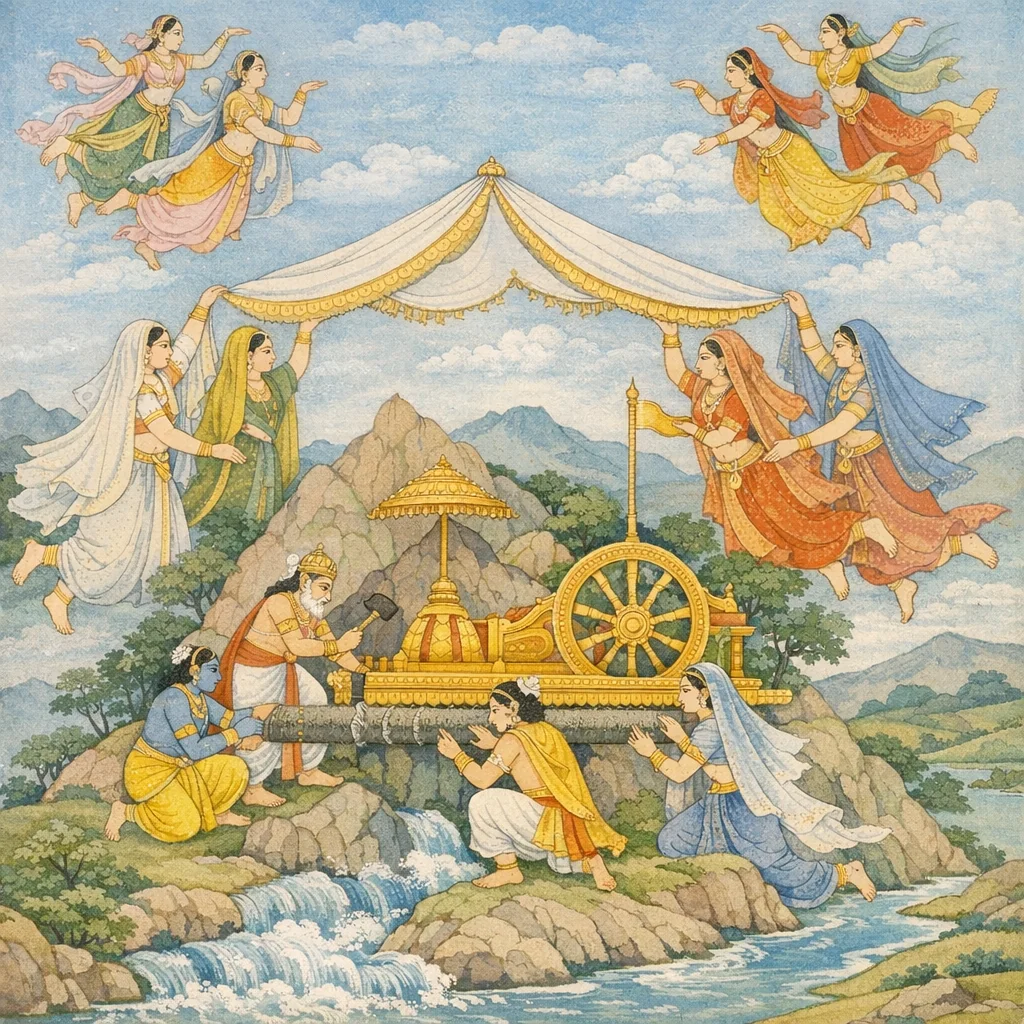
Adhyaya 33
कर्णेन युधिष्ठिरानीकविदारणम् / Karṇa’s Breach of Yudhiṣṭhira’s Battle-Line
Upa-parva: Yudhiṣṭhira–Karṇa Saṃmarda (Engagement with Dharmarāja)
Sañjaya reports that Karṇa, surrounded by large contingents of chariots, elephants, cavalry, and infantry, breaks through the Pandava forces and advances toward Dharmarāja Yudhiṣṭhira. He neutralizes incoming volleys with rapid archery, inflicting severe losses; renewed infantry assaults (including Draviḍa, Āndhra, and Niṣāda troops urged forward) are cut down. Pandava-Pañcāla formations attempt to restrain Karṇa, yet he surges again toward Yudhiṣṭhira. Yudhiṣṭhira addresses Karṇa with a pointed challenge concerning his rivalry with Arjuna and his alignment with the Dhārtarāṣṭra policy, then strikes him; Karṇa counters with superior missile work, damaging Yudhiṣṭhira’s equipment and forcing a temporary retreat from the immediate front. Karṇa follows with verbal censure questioning Yudhiṣṭhira’s martial aptitude and urging withdrawal from combat. The scene expands into generalized melee: mass casualties, vivid battlefield imagery (a “river” of blood), and a renewed push by Pandava heroes that causes portions of the Kaurava force to turn back under pressure.
Chapter Arc: धृतराष्ट्र के समक्ष संजय युद्ध-भूमि से हटकर एक अद्भुत प्रसंग उठाते हैं—दुर्योधन शल्य से ‘शिव के विचित्र रथ’ का रहस्य सुनने को कहता है, मानो विनाश के बीच भी विजय का कोई दिव्य उपाय खोज रहा हो। → शल्य देव-निर्मित रथ की उत्पत्ति का वृत्तांत सुनाते हैं: प्रजापति-पद पर स्थित एक देव-कार्यकर्ता (आदेशपालक) द्वारा दानवों को दिया गया ऐसा वर, जो मर्यादा-भंग करने पर भी ‘अन्य किसी से’ नष्ट न हो—केवल देवेश्वर के अतिरिक्त। इस वरदान-जनित असंतुलन को साधने हेतु देव-समूह एक महाशक्ति-रथ की कल्पना करते हैं, जिसमें लोक-तत्त्व, दिशाएँ, पर्वत, नदियाँ, ऋषि-स्तुतियाँ और दण्ड-शक्तियाँ तक उपकरण बन जाती हैं। → रथ का ‘सर्वतोदिशमुद्यत’ भयावह वैभव प्रकट होता है—ब्रह्मदण्ड, कालदण्ड, रुद्रदण्ड और ज्वर जैसे दण्ड-तत्त्व रथ के चारों ओर उठे रहते हैं; देवगण रथ-रचना में विष्णु, सोम और अग्नि को बाण-स्वरूप समर्पित करते हैं; पृथ्वी (नगर-पर्वत-वन-द्वीप सहित) स्वयं रथ-रूप में कल्पित होती है और दिशाएँ-प्रदिशाएँ उसका आवरण बनती हैं। → शल्य का वर्णन रथ को केवल अस्त्र नहीं, ‘सृष्टि-व्यवस्था का दण्ड-यंत्र’ सिद्ध करता है—देवों द्वारा रचित ऐसा वाहन जो अतिक्रान्त-मर्यादा शक्तियों को रोकने के लिए ब्रह्माण्डीय अनुशासन का मूर्त रूप है; दुर्योधन के लिए यह कथा प्रेरणा भी है और चेतावनी भी कि विजय केवल बल से नहीं, दैवी-नियमों की छाया में ही टिकती है। → कथा का संकेत युद्ध की ओर लौटता है—ऐसे दण्ड-तत्त्वों से युक्त रथ का स्मरण कर दुर्योधन किस उपाय/आशा को पकड़ेगा, और शल्य का यह ‘दिव्य-रथ’ वर्णन आगामी रण-नीति पर क्या प्रभाव डालेगा?
Shlokas
Verse 1
(दाक्षिणात्य अधिक पाठके ४६ लोक मिलाकर कुल ६७ ३ “लोक हैं) नस शा (0) उस औअन+- चतुस्त्रिंशो 5 ध्याय: दुर्योधनका शल्यको शिवके विचित्र रथका विवरण सुनाना और शिवजीद्दारा त्रिपुर-वधका उपाख्यान सुनाना एवं परशुरामजीके द्वारा कर्णको दिव्य अस्त्र मिलनेकी बात कहना दुर्योधन उवाच पितृदेवर्षिसंघेभ्यो5 भये दत्ते महात्मना । सत्कृत्य शड्करं प्राह ब्रह्मा लोकहितं वच:,दुर्योधन बोला--राजन्! परमात्मा शिवने जब देवताओं, पितरों तथा ऋषियोंके समुदायको अभय दे दिया, तब ब्रह्माजीने उन भगवान् शंकरका सत्कार करके यह लोक- हितकारी वचन कहा--
Duryodhana said: “O King! When the great-souled Lord Śiva had granted fearlessness to the assembled hosts of the Pitṛs, the gods, and the sages, Brahmā—having duly honored Śaṅkara—spoke these words for the welfare of the worlds.”
Verse 2
तवातिसर्गाद् देवेश प्राजापत्यमिदं पदम् | मयाधितिष्ठता दत्तो दानवेभ्यो महान् वर:
Duryodhana said: “O Lord of the gods, by your extraordinary generosity this sovereign station—grounded in Prajāpati’s ordinance—has been granted for me to hold; and a great boon has been bestowed upon the Dānavas.”
Verse 3
'देवेश्वरर आपके आदेशसे इस प्रजापतिपदपर स्थित रहते हुए मैंने दानवोंको एक महान् वर दे दिया है ।। तानतिक्रान्तमर्यादान् नान्य: संहर्तुमहति । त्वामृते भूतभव्येश त्वं होषां प्रत्यरिर्वधे,“उस वरको पाकर वे मर्यादाका उल्लंघन कर चुके हैं। भूत, वर्तमान और भविष्यके स्वामी महेश्वर! आपके सिवा दूसरा कोई भी उनका संहार नहीं कर सकता। उनके वधके लिये आप ही प्रतिपक्षी शत्रु हो सकते हैं
Duryodhana said: “O Lord of the gods, acting under your command while I stood in the office of Prajāpati, I granted the Dānavas a great boon. Having obtained it, they have overstepped all bounds. O Maheśvara, master of past and future—apart from you there is no one capable of destroying them. For their death, you alone can stand as the opposing enemy.”
Verse 4
स त्वं देव प्रपन्नानां याचतां च दिवौकसाम् | कुरु प्रसादं देवेश दानवाज्जहि शड्कर,“देव! हम सब देवता आपकी शरणमें आकर याचना करते हैं। देवेश्वर शंकर! आप हमपर कृपा कीजिये और इन दानवोंको मार डालिये
O god, you are the refuge of those who surrender, and the grantor of boons even to the dwellers of heaven when they supplicate. Therefore, O Lord of gods, O Śaṅkara, show us your favor and strike down these Dānavas.
Verse 5
त्वत्प्रसादाज्जगत् सर्व सुखमैथधत मानद । शरण्यस्त्वं हि लोकेश ते वयं शरणं गता:,“मानद! आपके प्रसादसे सम्पूर्ण जगत् सुखपूर्वक उन्नति करता आया है, लोकेश्वर! आप ही आश्रयदाता हैं; इसलिये हम आपकी शरणमें आये हैं!
Duryodhana said: “By your favor, the whole world has prospered and advanced in happiness, O bestower of honor. You are indeed the refuge of the world, O lord of the people; therefore we have come to you for shelter.”
Verse 6
स्थाणुरुवाच हन्तव्या: शत्रव: सर्वे युष्माकमिति मे मति: । न त्वेक उत्सहे हन्तुं बलस्था हि सुरद्विष:,भगवान् शिवने कहा--देवताओ! मेरा ऐसा विचार है कि तुम्हारे सभी शत्रुओंका वध किया जाय, परंतु मैं अकेला ही उन सबको नहीं मार सकता; क्योंकि वे देवद्रोही दैत्य बड़े बलवान हैं
Sthāṇu (Śiva) said: “O gods, it is my judgment that all your enemies should be slain. Yet I alone cannot bring myself to kill them all, for those asuras who hate the gods are exceedingly strong.”
Verse 7
ते यूयं संहता: सर्वे मदीयेनार्धतेजसा । जयध्वं युधि ताञ्शत्रून् संहता हि महाबला:,अतः तुम सब लोग एक साथ संघ बनाकर मेरे आधे तेजसे पुष्ट हो युद्धमें उन शत्रुओंको जीत लो; क्योंकि जो संघटित होते हैं वे महान् बलशाली हो जाते हैं
Duryodhana said: “All of you, standing united and strengthened by half of my own prowess, conquer those enemies in battle. For those who fight in close union become truly mighty.”
Verse 8
देवा ऊचु अस्मत्तेजोबलं यावत् तावदद्विगुणमाहवे । तेषामिति हि मन्यामो दृष्टतेजोबला हि ते,देवता बोले--प्रभो! युद्धमें हमलोगोंका जितना भी तेज और बल है, उससे दूना उन दैत्योंका है, ऐसा हम मानते हैं; क्योंकि उनके तेज और बलको हमने देख लिया है
The gods said: “In battle, whatever measure of radiance and strength we possess, the Daityas have twice that. This is what we judge, for we have directly witnessed their might and splendor.”
Verse 9
स्थाणुरुवाच वध्यास्ते सर्वतः पापा ये युष्मास्वपराधिन: । मम तेजोबलार्धेन सर्वान् निध्नत शात्रवान्,भगवान् शिव बोले--देवताओ! जो पापी तुम-लोगोंके अपराधी हैं, वे सब प्रकारसे वधके ही योग्य हैं। मेरे तेज और बलके आधे भागसे युक्त हो तुमलोग समस्त शत्रुओंको मार डालो
Sthāṇu (Śiva) said: “O gods, those sinners who have wronged you are in every way fit to be slain. Endowed with half of my radiance and strength, strike down all the foes.”
Verse 10
देवा ऊचु बिभर्तु भवतो<र्ध तु न शक्ष्यामो महेश्वर । सर्वेषां नो बलार्धेन त्वमेव जहि शात्रवान्,देवताओंने कहा--महेश्वर! हम आपका आधा बल धारण नहीं कर सकते; अत: आप ही हम सब लोगोंके आधे बलसे युक्त हो शत्रुओंका वध कीजिये
The gods said: “Maheśvara, we are not able to bear even half of your power. Therefore, you alone—endowed with half of the combined strength of us all—should strike down the foes.”
Verse 11
स्थाणुरुवाच यदि शक्तिर्न वः काचिद् बिभर्तु मामकं॑ बलम् | अहमेतान् हनिष्यामि युष्मत्तेजो<र्धबृंहित:,भगवान् शिव बोले--देवगण! यदि मेरे बलको धारण करनमेमें तुम्हारी सामर्थ्य नहीं है तो मैं ही तुमलोगोंके आधे तेजसे परिपुष्ट हो इन दैत्योंका वध करूँगा
Sthāṇu (Śiva) said: “If none of you has the capacity to sustain my power, then I myself—strengthened by half of your collective radiance—will slay these Daityas.”
Verse 12
ततस्तथेति देवेशस्तैरुक्तो राजसत्तम | अर्धमादाय सर्वेषां तेजसा भ्यधिको5भवत्,नृपश्रेष्ठी तदनन्तर देवताओंने देवेश्वर भगवान् शिवसे “तथास्तु” कह दिया और सबके तेजका आधा भाग लेकर वे अधिक तेजस्वी हो गये
Then the Lord of the gods, thus addressed by them, said, “So be it.” Taking half of the splendor of all, he became surpassingly radiant.
Verse 13
स तु देवो बलेनासीतू सर्वेभ्यो बलवत्तर: । महादेव इति ख्यातस्ततः प्रभृति शड्कर:ः,वे देवबलके द्वारा उन सबकी अपेक्षा अधिक बलशाली हो गये। इसलिये उसी समयसे उन भगवान् शंकरका महादेव नाम विख्यात हो गया
That god, by his might, became stronger than all the others. From that time onward he came to be renowned as “Mahādeva”—the Great God—thus establishing the fame of Śaṅkara.
Verse 14
ततोडअब्रवीन्महादेवो धनुर्बाणधरो हाहम् । हनिष्यामि रथेनाजौ तान् रिपून् वो दिवौकस:,तत्पश्चात् महादेवजीने कहा--“देवताओ! मैं धनुष-बाण धारण करके रथपर बैठकर युद्धस्थलमें तुम्हारे उन शत्रुओंका वध करूँगा
Then Mahādeva declared, “I—armed with bow and arrows—shall mount a chariot and, on the battlefield, slay those enemies of yours, O dwellers of heaven.”
Verse 15
ते यूयं मे रथं चैव धनुर्बाणं तथैव च । पश्यध्वं यावदद्यैतान् पातयामि महीतले,“अतः तुमलोग मेरे लिये रथ और धनुष-बाणकी खोज करो, जिसके द्वारा आज इन दैत्योंको भूतलपर मार गिराऊँ?”
“Therefore, all of you, look out for my chariot, and likewise my bow and arrows. Today I will strike those foes down upon the earth.”
Verse 16
देवा ऊचु: मूर्ती: सर्वा: समाधाय त्रैलोक्यस्य ततस्तत: । रथं ते कल्पयिष्यामो देवेश्वर सुवर्चसम्
The gods said: “Having gathered together all the manifested forms and powers from every part of the three worlds, we shall fashion for you a chariot—O Lord of the gods—radiant with splendor.”
Verse 17
ततो विबुधशार्दूलास्ते रथं समकल्पयन्
Then those wise and capable ones—tiger-like among the discerning—set his chariot in readiness: a vision of swift, disciplined preparation amid the moral pressure of war, where resolve is enacted through orderly action.
Verse 18
शृज़मग्निर्बभूवास्य भलल: सोमो विशाम्पते,वृषभस्यास्य निनदं श्रुत्वा भयकरं महत् | विनाशमगमंस्तत्र तारका: सुरशत्रव:
Duryodhana said: “O lord of the people, the arrowhead blazed like fire at its tip, and shone with the sheen of the moon. Hearing the mighty, fearsome bellow of this bull-like hero, the stars there—enemies of the gods—seemed to rush toward destruction.”
Verse 19
रथं वसुन्धरां देवीं विशालपुरमालिनीम्
Duryodhana invokes and describes the sacred Earth as the goddess Vasundharā, adorned with vast cities, while also alluding to the chariot as the immediate instrument of war. The line blends reverence for the sustaining ground of all beings with the grim reality that the same earth bears the burden of battle, reminding the listener that power and conquest rest upon what is ultimately divine and shared by all.
Verse 20
मन्दर: पर्वतश्नाक्षो जड्घा तस्य महानदी
Duryodhana said: “Mandara is his mountain-like shoulder; his thigh is a mighty river.” In this martial context, the speaker uses grand natural imagery to magnify a warrior’s bodily strength, turning the human frame into a landscape of power—an ethical reminder of how war-speech often glorifies force and physical might to inspire confidence and loyalty.
Verse 21
ईषा नक्षत्रवंशश्व॒ युग: कृतयुगो5भवत्,नक्षत्रोंका समूह ईषादण्ड हुआ और कृतयुगने जूएका रूप धारण किया। नागराज वासुकि उस रथका कूबर बन गये थे। हिमालय पर्वत अपस्कर (रथके पीछेका काठ) और विन्ध्याचलने उसके आधारकाष्ठका रूप धारण किया। उदयाचल और अस्ताचल दोनोंको उन श्रेष्ठ देवताओंने पहियोंका आधारभूत काष्ठ बनाया
Duryodhana said: “The pole of that cosmic chariot became the line of the constellations, and the yoke took the form of the Kṛta-yuga. The gathered host of stars became the pole-staff. Vāsuki, king of serpents, became the chariot’s yoke-pin. The Himalaya became the rear crossbar, and the Vindhya became the supporting beam. Udayācala and Astācala were fashioned by those exalted divine beings into the wooden supports on which the wheels are set.”
Verse 22
कूबरश्न रथस्यासीद् वासुकिर्भुजगोत्तम: । अपस्करमधिष्ठाने हिमवान् विन्ध्यपर्वत: । उदयास्तावधिष्ठाने गिरी चक्कुः सुरोत्तमा:,नक्षत्रोंका समूह ईषादण्ड हुआ और कृतयुगने जूएका रूप धारण किया। नागराज वासुकि उस रथका कूबर बन गये थे। हिमालय पर्वत अपस्कर (रथके पीछेका काठ) और विन्ध्याचलने उसके आधारकाष्ठका रूप धारण किया। उदयाचल और अस्ताचल दोनोंको उन श्रेष्ठ देवताओंने पहियोंका आधारभूत काष्ठ बनाया
Duryodhana said: “For that chariot, Vāsuki—the serpent-king, best of the nāgas—became the kūbara (the chief structural piece at the front/centre). Himavān (the Himalaya) and the Vindhya mountain became the apaskara and the supporting base-wood at the rear. The excellent gods fashioned the Udaya and Asta mountains as the wooden supports for the wheels. The host of stars became the pole (īṣā), and the Kṛta Yuga itself assumed the form of the yoke.”
Verse 23
समुद्रमक्षमसृजन् दानवालयमुत्तमम् | सप्तर्षिमण्डलं चैव रथस्यासीत् परिष्कर:,दानवोंके उत्तम निवासस्थान समुद्रको बन्धनरज्जु बनाया। सप्तर्षियोंका समुदाय रथका परिस्कर (चक्ररक्षा आदिका साधन) बन गया
Duryodhana said: “The ocean itself was fashioned as the binding-cord, and it became the finest dwelling-place of the Dānavas. Even the circle of the Seven Ṛṣis served as the fittings and protective gear (pariskara) of the chariot.”
Verse 24
गड़ा सरस्वती सिन्धुर्धुमाकाशमेव च । उपस्करो रथस्यासन्नाप: सर्वाश्ष निम्नगा:,गंगा, सरस्वती और सिंधु--इन तीनों नदियोंके साथ आकाश त्रिवेणुकाष्ठयुक्त धुरेका भाग हुआ। उस रथके बन्धन आदिकी सामग्री जल तथा सम्पूर्ण नदियाँ थीं
Duryodhana said: “The mace became Sarasvatī; the Sindhu too was there; and even the smoky sky took its place. The fittings and fastenings of that chariot were water itself, and all the rivers that flow downward.”
Verse 25
अहोरात्र कलाश्लैव काष्ठाश्न् ऋतवस्तथा । अनुकर्ष ग्रहा दीप्ता वरूथं चापि तारका:,दिन, रात, कला, काष्ठा और छहों ऋतुएँ उस रथका अनुकर्ष (नीचेका काष्ठ) बन गयीं। चमकते हुए ग्रह और तारे वरूथ (रथकी रक्षाके लिये आवरण) हुए
Duryodhana said: “Day and night, the divisions of time—the kalās, the kāṣṭhās—and the seasons themselves became the chariot’s under-support (anukarṣa). The blazing planets became its protective covering (varūtha), and the stars too formed its armour.”
Verse 26
धर्मार्थकामं संयुक्त त्रिवेणुं दारु बन्धुरम् । ओषधीर्वीरुधश्चैव घण्टा: पुष्पफलोपगा:,त्रिवेणु-तुल्य धर्म, अर्थ और काम--तीनोंको संयुक्त करके रथकी बैठक बनाया। फल और फूलोंसे युक्त ओषधियों एवं लताओंको घण्टाका रूप दिया
Duryodhana said: “Uniting dharma, artha, and kāma as a single triad—like a threefold braid bound upon a wooden frame—I fashioned the chariot’s seat. And from medicinal herbs and creeping vines, rich with flowers and fruits, I made bell-like ornaments.”
Verse 27
सूर्याचन्द्रमसौ कृत्वा चक्रे रथवरोत्तमे | पक्षौ पूर्वापरौ तत्र कृते सत्यहनी शुभे,उस श्रेष्ठ रथमें सूर्य और चन्द्रमाको दोनों पहिये बनाकर सुन्दर रात्रि और दिनको वहाँ पूर्वपक्ष और अपरपक्षके रूपमें प्रतिष्ठित किया
Duryodhana said: “On that most excellent chariot, he fashioned the Sun and the Moon as its two wheels; and there he set the bright pair—day and night—as the two halves (the former and the latter), as though establishing the very order of time upon it.”
Verse 28
दश नागपतीनीषां धृतराष्ट्रमुखांस्तदा । योक्त्राणि चक्रुर्नागांश्व॒ नि:श्वसन्तो महोरगान्,धृतराष्ट्र आदि दस नागराजोंको भी ईषादण्डमें ही स्थान दिया। फुफकारते हुए बड़े-बड़े सर्पोंको उस रथके जोत बनाये
Duryodhana said: “Then those ten serpent-lords—headed by Dhṛtarāṣṭra—were assigned their places upon the pole of the chariot, and the great, hissing serpents were fashioned into the yoke-ropes.”
Verse 29
द्यां युगं युगचर्माणि संवर्तकबलाहकान् । कालपृष्ठोडथ नहुष: कर्कोटकधनंजयौ,झ्ुलोकको भी जूएमें ही स्थान दिया। प्रलयकालके मेघोंको युगचर्म बनाया। कालपृष्ठ, नहुष, कर्कोटक, धनंजय तथा दूसरे-दूसरे नाग घोड़ोंके केसर बाँधनेकी रस्सी बनाये गये। दिशाओं और विदिशाओंने रथमें जुते हुए घोड़ोंकी बागडोरका भी रूप धारण किया
Duryodhana said: “The sky itself became the yoke; the hides of the cosmic ages became the yoke-straps; and the great clouds of dissolution served as the binding gear. Kālapṛṣṭha, Nahuṣa, Karkoṭaka, and Dhanaṃjaya—together with other nāgas—were made into the ropes for fastening the horses’ manes, while the directions and intermediate directions took the form of the reins.”
Verse 30
इतरे चाभवन् नागा हयानां बालबन्धना: । दिशश्च प्रदिशश्वैव रश्मयो रथवाजिनाम्,झ्ुलोकको भी जूएमें ही स्थान दिया। प्रलयकालके मेघोंको युगचर्म बनाया। कालपृष्ठ, नहुष, कर्कोटक, धनंजय तथा दूसरे-दूसरे नाग घोड़ोंके केसर बाँधनेकी रस्सी बनाये गये। दिशाओं और विदिशाओंने रथमें जुते हुए घोड़ोंकी बागडोरका भी रूप धारण किया
Duryodhana said: “Other serpents became the cords for binding the horses’ manes, and the very directions and intermediate directions took the form of the reins for the chariot-horses.”
Verse 31
संध्यां धृतिं च मेधां च स्थितिं संनतिमेव च | ग्रहनक्षत्रताराभि क्षर्म चित्र नभस्तलम्,संध्या, धृति, मेधा, स्थिति और संनतिसहित आकाशको, जो ग्रह, नक्षत्र और तारोंसे विचित्र शोभा धारण करता है, चर्म (रथका ऊपरी आवरण) बनाया
Duryodhana said: “I fashioned as a chariot-cover the sky itself—adorned with planets, constellations, and stars—together with twilight, steadfastness, intelligence, stability, and humble submission.”
Verse 32
सुराम्बुप्रेतवित्तानां पतील्लोंकेश्वरान् हयान् । सिनीवालीमनुमतिं कुहूं राकां च सुव्रताम्
Duryodhana invokes a sweeping catalogue of powers and presiding forces—lords of intoxicants and waters, spirits of the departed, wealth, and the rulers of the world, along with swift horses; and he also calls upon the lunar goddesses Sinīvālī, Anumatī, Kuhū, and the well-vowed Rākā. In the ethical atmosphere of the war, this kind of invocation functions as a bid for auspiciousness and support, revealing a reliance on external powers even as the conflict is driven by human choices and responsibility.
Verse 33
इस प्रकार श्रीमह्याभारत कर्णपर्वमें त्रिपुराख्यानविषयक तैंतीसवाँ अध्याय पूरा हुआ,धर्म: सत्यं तपो<र्थश्ष विहितास्तत्र रश्मय:
Thus ends the thirty-third chapter of the Karṇa Parva of the Śrī Mahābhārata, dealing with the account of Tripura. There, dharma, truthfulness, austerity, and purposeful striving are set forth as guiding rays—principles meant to illuminate conduct amid conflict and uncertainty.
Verse 34
अधिष्ठानं मनश्लासीत् परिरथ्या सरस्वती । नानावर्णा्ष चित्राश्न पताका: पवनेरिता:,इति श्रीमहाभारते कर्णपर्वणि त्रिपुरवधोपाख्याने चतुमस्त्रिंशो 5ध्याय:
Duryodhana said: “The royal seat and its surroundings appeared splendid; the avenues were graced as if by Sarasvatī herself. Many-colored, variegated banners, stirred and lifted by the wind, adorned the scene.”
Verse 35
विद्युदिन्द्रधनुर्नद्धं रथं दीप्तं व्यदीपयन् । धर्म, सत्य, तप और अर्थ--इनको वहाँ लगाम बनाया गया। रथकी आधारभूमि मन हुआ और सरस्वती देवी रथके आगे बढ़नेका मार्ग थीं। नाना रंगोंकी विचित्र पताकाएँ पवनसे प्रेरित होकर फहरा रही थीं, जो बिजली और इन्द्रधनुषसे बँधे हुए उस देदीप्यमान रथकी शोभा बढ़ाती थीं ।। ३३-३४ ई ।। वषट्कार: प्रतोदो5भूद् गायत्री शीर्षबन्धना,वषट्कार घोड़ोंका चाबुक हुआ और गायत्री उस रथके ऊपरी भागकी बन्धन-रज्जु बनीं
Duryodhana said: “That blazing chariot shone all the more, as though bound with lightning and a rainbow. There, Dharma, Truth, austerity, and rightful prosperity were fashioned into its reins. The mind served as its supporting base, and the goddess Sarasvatī was the guiding path before it. Many-colored, wondrous banners—driven by the wind—fluttered and heightened the splendor of that radiant chariot. The vaṣaṭ-call became its whip, and Gāyatrī was the binding cord upon its upper frame.”
Verse 36
यो यज्ञे विहित: पूर्वमीशानस्य महात्मन: । संवत्सरो धनुस्तद् वै सावित्री ज्या महास्वना,पूर्वकालमें जो महात्मा महादेवजीके यज्ञमें निर्मित हुआ था, वह संवत्सर ही उनके लिये धनुष बना और सावित्री उस धनुषकी महान् टंकार करनेवाली प्रत्यंचा बनी
Duryodhana said: “That which was fashioned long ago in the sacrificial rite of the great-souled Īśāna (Śiva)—the very year (saṃvatsara) became his bow, and Sāvitrī became the bowstring, resonant with a mighty twang.” In this speech, the weapon is framed as arising from sacred order, lending divine sanction and awe to the martial power being invoked.
Verse 37
दिव्यं च वर्म विहित॑ महाहँ रत्नभूषितम् । अभेद्यं विरजस्कं वै कालचक्रबहिष्कृतम्,महादेवजीके लिये एक दिव्य कवच तैयार किया गया जो बहुमूल्य, रत्नभूषित, रजोगुणरहित (अथवा धूलरहित स्वच्छ), अभेद्य तथा कालचक्रकी पहुँचसे परे था
Duryodhana said: “A divine cuirass was fashioned—priceless and adorned with gems—unstained and immaculate, impossible to pierce, as though kept beyond the reach of Time’s revolving wheel.”
Verse 38
ध्वजयष्टिरभून्मेरु: श्रीमान् कनकपर्वत: । पताकाश्चाभवन् मेघास्तडिद्धि:ः समलड्कृता:
Duryodhana said: “The standard-staff seemed like Mount Meru itself—a splendid mountain of gold; and the banners became like clouds, beautifully adorned with lightning.”
Verse 39
क्लृप्तं तु तं रथं दृष्टवा विस्मिता देवता5भवन्,मान्यवर! वह रथ क्या था, सम्पूर्ण जगत्के तेजका पुंज एकत्र हो गया था। उसे निर्मित हुआ देख सम्पूर्ण देवता आश्वर्यचकित हो उठे। फिर उन्होंने महात्मा महादेवजीसे यह निवेदन किया कि रथ तैयार है
Duryodhana said: “When they saw that chariot fully prepared, the gods were struck with wonder, O revered one. It was as though the entire radiance of the world had gathered into a single mass. Seeing it completed, all the deities stood astonished; then they respectfully informed the great-souled Mahādeva that the chariot was ready.”
Verse 40
सर्वलोकस्य तेजांसि दृष्टवैकस्थानि मारिष । युक्त निवेदयामासुर्देवास्तस्मै महात्मने,मान्यवर! वह रथ क्या था, सम्पूर्ण जगत्के तेजका पुंज एकत्र हो गया था। उसे निर्मित हुआ देख सम्पूर्ण देवता आश्वर्यचकित हो उठे। फिर उन्होंने महात्मा महादेवजीसे यह निवेदन किया कि रथ तैयार है
Duryodhana said: “O venerable one, seeing the splendors of the entire world gathered together in one place, the gods were struck with wonder. Then they respectfully informed that great-souled one (Mahādeva): ‘The chariot is ready.’”
Verse 41
एवं तस्मिन् महाराज कल्पिते रथसत्तमे । देवैर्मनुजशार्दूल द्विषतामभिमर्दने,पुरुषसिंह! महाराज! इस प्रकार देवताओंद्वारा शत्रुओंका मर्दन करनेवाले उस श्रेष्ठ रथका निर्माण हो जानेपर भगवान् शंकरने उसके ऊपर अपने मुख्य-मुख्य अस्त्र-शस्त्र रख दिये और ध्वजदण्डको आकाशव्यापी बनाकर उसके ऊपर अपने वृषभ नन्दीको स्थापित कर दिया
Duryodhana said: “O great king, O tiger among men, crusher of foes—when that finest of chariots had thus been fashioned by the gods, the blessed Lord Śaṅkara placed upon it his foremost weapons, and, making its flagstaff reach the very sky, he set his bull Nandin upon it.”
Verse 42
स्वान्यायुधानि मुख्यानि न्यदधाच्छड्करो रथे । ध्वजयष्टिं वियत् कृत्वा स्थापयामास गोवृषम्,पुरुषसिंह! महाराज! इस प्रकार देवताओंद्वारा शत्रुओंका मर्दन करनेवाले उस श्रेष्ठ रथका निर्माण हो जानेपर भगवान् शंकरने उसके ऊपर अपने मुख्य-मुख्य अस्त्र-शस्त्र रख दिये और ध्वजदण्डको आकाशव्यापी बनाकर उसके ऊपर अपने वृषभ नन्दीको स्थापित कर दिया
Duryodhana said: “When that excellent chariot—renowned among the gods for crushing enemies—had been fully fashioned, Lord Śaṅkara placed upon it his foremost weapons. Then, making the banner-staff sky-reaching, he set upon it his bull, Nandin. Thus the chariot was marked not merely by force of arms, but by the divine sanction and awe that a sacred emblem confers in war.”
Verse 43
ब्रह्म॒दण्ड: कालदण्डो रुद्रदण्डस्तथा ज्वर: | परिस्कन्दा रथस्यासन् सर्वतोदिशमुद्यता:,तत्पश्चात् ब्रह्मदण्ड, कालदण्ड, रुद्रदण्ड तथा ज्वर--ये उस रथके पार्श्वरक्षक बनकर चारों ओर शस्त्र लेकर खड़े हो गये
Duryodhana said: “Brahmadaṇḍa, Kāladaṇḍa, Rudradaṇḍa, and Jvara—these stood as the chariot’s flank-guards, weapons raised, vigilant in every direction.”
Verse 44
अथर्वड्डलिसावास्तां चक्ररक्षौ महात्मन: | ऋग्वेद: सामवेदश्न पुराणं च पुर:सरा:,अथर्वा और अंगिरा महात्मा शिवके उस रथके पहियोंकी रक्षा करने लगे। ऋग्वेद, सामवेद और समस्त पुराण उस रथके आगे चलनेवाले योद्धा हुए
Duryodhana said: “Atharvan and Aṅgiras stood guard over the wheels of that great-souled one’s chariot, while the Ṛgveda, the Sāmaveda, and the Purāṇas went before it as its vanguard.”
Verse 45
इतिहासयजुर्वेदौ पृष्ठरक्षौ बभूवतु: । दिव्या वाचश्न विद्याश्न परिपार्श्वचरा: स्थिता:,इतिहास और यजुर्वेद पृष्ठरक्षक हो गये तथा दिव्य वाणी और विद्याएँ पार्श्ववर्ती बनकर खड़ी हो गयीं
Duryodhana said: “The Itihāsa tradition and the Yajurveda stood as protectors at the rear, while the divine utterance and the sacred sciences took their places at the flanks.”
Verse 46
स्तोत्रादयश्व राजेन्द्र वषघट्कारस्तथैव च । ओंकारश्न मुखे राजन्नतिशो भाकरो5 भवत्,राजेन्द्र! स्तोत्र-कवच आदि, वषट्कार तथा ओंकार--ये मुखभागमें स्थित होकर अत्यन्त शोभा बढ़ाने लगे
Duryodhana said: “O king, hymns and the like, the vaṣaṭ exclamation used in Vedic rites, and the sacred syllable Oṃ—all these seemed to dwell upon his very mouth, making it shine with exceptional splendour.”
Verse 47
विचित्रमृतुभि: षड्भि: कृत्वा संवत्सरं धनुः । छायामेवात्मनश्षक्रे धनुज्यामक्षयां रणे,छहों ऋतुओंसे युक्त संवत्सरको विचित्र धनुष बनाकर अपनी छायाको ही महादेवजीने उस धनुषकी प्रत्यंचा बनायी, जो रणभूमिमें कभी नष्ट होनेवाली नहीं थी
Duryodhana said: “Having fashioned the year—made wondrous by its six seasons—into a bow, Śakra (Indra) made his own shadow into the bowstring, a string that would never be worn away in battle.”
Verse 48
कालो हि भगवान् रुद्रस्तस्य संवत्सरो धनु: । तस्माद् रौद्री कालरात्रिज्या कृता धनुषो&5जरा,भगवान् रुद्र ही काल हैं, अत: कालका अवयवभूत संवत्सर ही उनका धनुष हुआ। कालरात्रि भी रुद्रका ही अंश है, अत: उसीको उन्होंने अपने धनुषकी अटूट प्रत्यंचा बना लिया
Duryodhana said: “Time itself is the Blessed Rudra; and the year is his bow. Therefore Kālarātri—Rudra’s own fierce power—has been made the bowstring, unbreakable and unaging.”
Verse 49
इषुश्चाप्यभवद् विष्णुज्वलन: सोम एव च । अग्नीषोमौ जगत् कृत्स्नं वैष्णवं चोच्यते जगत्,भगवान् विष्णु, अग्नि और चन्द्रमा--ये ही बाण हुए थे; क्योंकि सम्पूर्ण जगत् अग्नि और सोमका ही स्वरूप है। साथ ही सारा संसार वैष्णव (विष्णुमय) भी कहा जाता है
Duryodhana said: “That arrow became Viṣṇu’s blazing power, and it became Soma as well. For the entire universe is, in essence, Agni and Soma; and the whole world is also spoken of as Vaiṣṇava—pervaded by Viṣṇu.”
Verse 50
विष्णुश्नात्मा भगवतो भवस्यामिततेजस: । तस्माद् धनुर्ज्यासंस्पर्श न विषेह॒र्हरस्य ते,अमिततेजस्वी भगवान् शंकरके आत्मा हैं विष्णु। अतः वे दैत्य भगवान् शिवके धनुषकी प्रत्यंचा एवं बाणका स्पर्श न सह सके
Duryodhana said: “Viṣṇu is indeed the very Self of the blessed Bhava (Śiva), whose splendor is immeasurable. Therefore those beings could not endure the touch of Hara’s bowstring and arrows.”
Verse 51
तस्मिन् शरे तिग्ममन्युं मुमोचासहामी श्वरः । भग्वज्धिरोमन्युभवं क्रोधाग्निमतिदुः:सहम्,महेश्वरने उस बाणमें अपने असहा एवं प्रचण्ड कोपको तथा भूगु और अंगिराके रोषसे उत्पन्न हुई अत्यन्त दुःसह क्रोधाग्निको भी स्थापित कर दिया
Duryodhana said: “Into that arrow the mighty Lord, unbearable in force, released and lodged His razor-edged wrath—an exceedingly intolerable fire of anger, born of the fierce indignation associated with the seers Bhṛgu and Aṅgiras—so that the missile might strike with a divinely intensified, destructive fury.”
Verse 52
स नीललोहितो धूम्र: कृत्तिवासा भयंकर: । आदित्यायुतसंकाशस्तेजोज्वालावृतो ज्वलन्,तत्पश्चात् धूम्रवर्ण, व्याप्रचर्मधारी, देवताओंको अभय तथा दैत्योंको भय देनेवाले, सहस्रों सूर्योके समान तेजस्वी नीललोहित भगवान् शिव तेजोमयी ज्वालासे आवृत हो प्रकाशित होने लगे
That Śiva was blue-red, smoke-hued, clad in tiger-skin, and fearsome. Blazing, wrapped in flames of radiance, he shone like a thousand suns.
Verse 53
दुशच्यावच्यावनो जेता हन्ता ब्रद्वाद्विषां हर: । नित्यं त्राता च हन्ता च धर्माधर्माश्रितान् नरान्,जिस लक्ष्यको मार गिराना अत्यन्त कठिन है, उसको भी गिरानेमें समर्थ, विजयशील, ब्रह्मद्रोहियोंके विनाशक भगवान् शिव धर्मका आश्रय लेनेवाले मनुष्योंकी सदा रक्षा और पापियोंका विनाश करनेवाले हैं
Duryodhana said: “Hara (Śiva) is the unconquerable victor—able to strike down even what is hardest to bring down. He is the slayer of those hostile to Brahman and the sacred order. Ever he protects those who take refuge in dharma, and he destroys those who cling to adharma.”
Verse 54
प्रमाथिभिर्भीमबलैर्भीमरूपैर्मनोजवै: । विभाति भगवान् स्थाणुस्तैरेवात्मगुणैर्वत:
Duryodhana said: “With those crushing Pramatha hosts—terrible in strength like Bhīma, dreadful in form, and swift as thought—Lord Sthāṇu (Śiva) shines forth, indeed, by those very qualities that are his own.”
Verse 55
उनके जो अपने उपयोगमें आनेवाले रथ आदि गुणवान् उपकरण थे, वे शत्रुओंको मथ डालनेमें समर्थ, भयानक बलशाली, भयंकररूपधारी और मनके समान वेगवान् थे। उनसे घिरे हुए भगवान् शिवकी बड़ी शोभा हो रही थी ।। तस्याड्रानि समाश्रित्य स्थितं विश्वमिदं जगत् | जज्जमाजड्डमं राजन् शुशुभे5द्भधुतदर्शनम्,राजन! उनके पंचभूतस्वरूप अंगोंका आश्रय लेकर ही यह अद्भुत दिखायी देनेवाला सारा चराचर जगत् स्थित एवं सुशोभित है
Duryodhana said: “O King, taking refuge in his limbs—formed of the five great elements—this entire universe, the whole moving and unmoving world, stands established and appears resplendent in wondrous form.”
Verse 56
दृष्टवा तु तं रथं युक्त कवची स शरासनी । बाणमादाय तं दिव्यं सोमविष्ण्वग्निसम्भवम्,उस रथको जुता हुआ देख भगवान् शंकर कवच और धनुषसे युक्त हो चन्द्रमा, विष्णु और अग्निसे प्रकट हुए उस दिव्य बाणको लेकर युद्धके लिये उद्यत हुए
Seeing that chariot fully harnessed, and beholding Śaṅkara (Śiva) armoured and bearing a bow, he took up that celestial arrow—said to have arisen from Soma, Viṣṇu, and Agni—readying himself for battle.
Verse 57
तस्य राजंस्तदा देवा: कल्पयाज्चक्रिरे प्रभो । पुण्यगन्धवहं राजन् श्वसन देवसत्तमम्,राजन! प्रभो! उस समय देवताओंने पवित्र सुगन्न्ध वहन करनेवाले देवश्रेष्ठ वायुको उनके लिये हवा करनेके कामपर नियुक्त किया
O King, at that time the gods, O lord, made arrangements for him: they appointed the Wind—best among the gods, the bearer of sacred fragrance—to serve him by fanning him.
Verse 58
तमास्थाय महादेवस्त्रासयन् दैवतान्यपि । आरुरोह तदा यत्त: कम्पयन्निव मेदिनीम्,तब महादेवजी दानवोंके वधके लिये प्रयत्नशील हो देवताओंको भी डराते और पृथ्वीको कम्पित करते हुए-से उस रथको थामकर उसपर चढ़ने लगे
Mounting it, Mahādeva—intent on the destruction of the Dānavas—rose up upon that chariot, terrifying even the gods and seeming to make the very earth tremble.
Verse 59
तमारुरुक्षुं देवेशं तुष्ठवु: परमर्षय: । गन्धर्वा दैवसड्घाश्न तथैवाप्सरसां गणा:,देवेश्वर शिव रथपर चढ़ना चाहते हैं, यह देखकर महर्षियों, गन्धर्वों, देवसमूहों तथा अप्सराओंके समुदायोंने उनकी स्तुति की
As the Lord of the gods was about to mount the chariot, the great seers praised him; so too did the Gandharvas, the hosts of gods, and the companies of Apsarases.
Verse 60
ब्रह्मर्षिभि: स्तूयमानो वन्द्यमानश्न वन्दिभि: | तथैवाप्सरसां वृन्दैर्न॑त्यद्धिर्न॑त्यकोविदै:,ब्रह्मर्षियोंद्वारा प्रशंसित, वन्दीजनोंद्वारा वन्दित तथा नाचती हुई नृत्य-कुशल अप्सराओंसे सुशोभित होते हुए वरदायक भगवान् शिव खड़्ग, बाण और धनुष ले देवताओंसे हँसते हुए-से बोले--'“मेरा सारथि कौन होगा?”
Praised by the Brahmarṣis and saluted by the bards, and likewise adorned by companies of Apsarases—dancing with consummate skill—Lord Śiva, the bestower of boons, bearing sword, arrows, and bow, spoke as though smiling at the gods: ‘Who will be my charioteer?’
Verse 61
स शोभमानो वरद: खड्गी बाणी शरासनी । हसन्निवाब्रवीद् देवान् सारथि: को भविष्यति,ब्रह्मर्षियोंद्वारा प्रशंसित, वन्दीजनोंद्वारा वन्दित तथा नाचती हुई नृत्य-कुशल अप्सराओंसे सुशोभित होते हुए वरदायक भगवान् शिव खड़्ग, बाण और धनुष ले देवताओंसे हँसते हुए-से बोले--'“मेरा सारथि कौन होगा?”
Then the boon-giving Lord Śiva, resplendent—bearing a sword, arrows, and a bow—spoke to the gods with a smile, as if in playful challenge: ‘Who will become my charioteer?’
Verse 62
तमनब्रुवन् देवगणा यं भवान् संनियोक्ष्यते । स भविष्यति देवेश सारथिस्ते न संशय:,यह सुनकर देवताओंने उनसे कहा--'देवेश! आप जिसको इस कार्यमें नियुक्त करेंगे, वही आपका सारथि होगा, इसमें संशय नहीं है”
Then the hosts of gods addressed him: “O Lord of the gods, whomever you appoint for this task—he indeed will become your charioteer; of this there is no doubt.”
Verse 63
तानब्रवीत् पुनर्देवो मत्त: श्रेष्ठठरो हि यः । त॑ सारथिं कुरुध्व॑ं मे स्वयं संचिन्त्य मा चिरम्,तब महादेवजीने फिर कहा--“तुमलोग स्वयं ही सोच-विचारकर जो मुझसे भी श्रेष्ठतर हो, उसे मेरा सारथि बना दो, विलम्ब न करो”
Then the god again addressed them: “Choose for me, after due reflection, a charioteer who is even superior to me. Make him my driver—do not delay.”
Verse 64
एतच्छुत्वा ततो देवा वाक्यमुक्त महात्मना | गत्वा पितामहं देवा: प्रसाद्येदं वचो<ब्रुवन्,उन महात्माके कहे हुए इस वचनको सुनकर सब देवता ब्रह्माजीके पास गये और उन्हें प्रसन्न करके इस प्रकार बोले--
Hearing these words spoken by the great-souled one, the gods then went to the Grandsire (Brahmā). Having propitiated him, the gods addressed him with the following request—
Verse 65
यथा त्वत्कथितं देव त्रिदशारिविनिग्रहे । तथा च कृतमस्माभ्रि: प्रसन्नो नो वृषध्वज:,“देव! देवशत्रुओंका दमन करनेके विषयमें आपने जैसा कहा था, वैसा ही हमने किया है। भगवान् शंकर हमलोगोंपर प्रसन्न हैं
Duryodhana said: “O Lord, just as you instructed us regarding the subduing of the enemies of the gods, so indeed have we acted. Therefore Vṛṣadhvaja (Śiva), the bearer of the bull-emblem, is pleased with us.”
Verse 66
रथश्न विहितोस्माभिरवविंचित्रायुधसंवृत: । सारथिं च न जानीम: क: स्यात् तस्मिन् रथोत्तमे,“हमने उनके लिये विचित्र आयुधोंसे सम्पन्न रथ तैयार कर दिया है; परंतु उस उत्तम रथपर कौन सारथि होकर बैठेगा? यह हम नहीं जानते हैं'
Duryodhana said: “We have had a chariot prepared—fully equipped and enclosed with an array of extraordinary weapons. Yet we do not know who will sit upon that finest of chariots as its charioteer.”
Verse 67
तस्माद् विधीयतां कश्चित् सारथिदेंवसत्तम | सफलां तां गिरं देव कर्तुमहसि नो विभो
Therefore, O best of the gods, let some charioteer be appointed. O divine Lord, O mighty one—be pleased to make that promise of yours bear fruit for us.
Verse 68
“अतः देवश्रेष्ठ प्रभो! आप किसीको सारथि बनाइये। देव! आपने हमें जो वचन दिया है, उसे सफल कीजिये ।। एवमस्मासु हि पुरा भगवन्नुक्तवानसि । हितकर्तास्मि भवतामिति तत् कर्तुमहसि
Duryodhana said: “Therefore, O best of the gods, O Lord—appoint someone as charioteer. O divine one, fulfill the promise you once gave us. For formerly you said to us, ‘I shall act for your welfare’; now you ought to carry that out.”
Verse 69
'भगवन्! आपने पहले हमलोगोंसे कहा था कि “मैं तुमलोगोंका हित करूँगा।” अतः उसे पूर्ण कीजिये ।। स देव युक्तो रथसत्तमो नो दुराधरो द्रावण: शात्रवाणाम् | पिनाकपाणिर्विहितो<त्र योद्धा विभीषयन् दानवानुद्यतोडसौ,“देव! हमारा तैयार किया हुआ वह श्रेष्ठ रथ शत्रुओंको मार भगानेवाला और दुर्थर्ष है। पिनाकपाणि भगवान् शंकरको उसपर योद्धा बनाकर बैठा दिया गया है और वे दानवोंको भयभीत करते हुए युद्धके लिये उद्यत हैं
Duryodhana appeals: “O revered one, you once promised us, ‘I will act for your welfare.’ Now fulfill that pledge. Our finest chariot—divinely empowered—stands irresistible, a rout-bringer to our enemies. Here, Pināka-bearing Śaṅkara has been appointed as the warrior upon it; he is poised for battle, terrifying the Dānavas.”
Verse 70
तथैव वेदाश्षतुरो हयाग्रया धरा सशैला च रथो महात्मन: । नक्षत्रवंशानुगतो वरूथी हरो योद्धा सारथिनाभिलक्ष्य:,“इसी प्रकार चारों वेद उन महात्माके उत्तम घोड़े हैं और पर्वतोंसहित पृथ्वी उनका उत्तम रथ बनी हुई है। नक्षत्रसमुदायरूपी ध्वजसे युक्त तथा आवरणसे सुशोभित भगवान् शिव उस रथपर रथी योद्धा बनकर बैठे हुए हैं; परंतु कोई सारथि नहीं दिखायी देता
Duryodhana says: “So too, the four Vedas are the foremost horses of that great-souled one, and the earth with its mountains is his splendid chariot. Bearing a banner formed by the host of constellations and adorned with protective armour, Lord Hara (Śiva) sits upon that chariot as the chariot-warrior—yet no charioteer is seen.”
Verse 71
तत्र सारथिरेष्टव्य: सर्वरेतर्विशेषवान् । तत्प्रतिष्ठो रथो देव हया योद्धा तथैव च,“देव! उस रथके लिये ऐसे सारथिका अनुसंधान करना चाहिये जो इन सबसे बढ़कर हो; क्योंकि रथ, घोड़े और योद्धा इन सबकी प्रतिष्ठा सारथिपर ही निर्भर है
“Therefore, O king, one must seek a charioteer who surpasses all others in excellence. For the standing and effectiveness of the chariot depend upon him—and so too do the horses and the warrior.”
Verse 72
कवचानि सश्त्राणि कार्मुकं च पितामह । त्वामृते सारथिं तत्र नान्यं पश्यामहे वयम्
Duryodhana said: “O Grandsire, the armours, the weapons, and the bow—without you, we see no other charioteer there. In this crisis of war, our confidence rests on you alone to guide and steady the course of battle.”
Verse 73
(त्वं देव शक्तो लोके5स्मिन् नियन्तुं प्रद्गुतानिमान् । वेदाश्वान्ू सोपनिषद: सारथिभर्भव न: स्वयम् ।। “देव! आप ही इस जगत्में इन भागते हुए उपनिषद्सहित वेदरूपी अश्वोंको नियन्त्रणमें रख सकते हैं; अतः आप स्वयं ही सारथि हो जाइये । योद्धुं बलेन सत्त्वेन वीर्येण विनयेन च । अधिक: सारथि: कार्यो नास्ति चान्दोडघिको भवात् ।। “बल, धैर्य, पराक्रम और विनय इन सभी गुणोंद्वारा जो रथीसे भी श्रेष्ठ हो, उसे ही युद्धके लिये सारथि बनाना चाहिये; दूसरा कोई ऐसा नहीं है जो भगवान् शंकरसे भी बढ़कर हो। स भवांस्तारयत्वस्मान् कुरु सारथ्यमव्ययम् | भवानभ्यधिक स्त्वत्तो नान्यो5स्तीह पितामह ।। 'पितामह! आप अक्षय सारथिकर्म कीजिये और हमें इस संकटसे उबारिये। आप ही सबसे श्रेष्ठ हैं; आपसे बढ़कर दूसरा कोई नहीं है। त्वं हि देवेश सर्वैस्तु विशिष्टो वदतां वर ।) स रथं तूर्णमारुह्मु संयच्छ परमान् हयान्,जयाय त्रिदेवेशानां वधाय त्रिदशद्विषाम् “वक्ताओंमें श्रेष्ठ देवेश्वरर आप सभी गुणोंसे श्रेष्ठ हैं; इसलिये देवद्रोहियोंक वध और देवताओंकी विजयके लिये तुरंत रथपर आरूढ़ होकर इन उत्तम घोड़ोंको काबूमें रखिये
Duryodhana said: “O divine one, you alone in this world are able to rein in these—like Vedic horses—rushing onward together with the Upaniṣads. Therefore, become our charioteer yourself. For battle, the charioteer should be one who surpasses even the warrior in strength, steadfast courage, valor, and disciplined humility; and there is none greater than you. O Grandsire, take up this unfailing office of charioteer and carry us across this peril. None here is superior to you. O Lord of the gods, best of speakers, you excel all; so mount the chariot at once, control these finest steeds, and act for the victory of the gods and the destruction of the foes of the gods.”
Verse 74
(तव प्रसादाद् वध्येरन् देव दैवतकण्टका: । स नो रक्ष महाबाहो दैत्येभ्यो महतो भयात् ।। “देव! आपके प्रसादसे देवताओंके लिये यह कण्टकरूप दैत्य मारे जायँगे। महाबाहो! आप दैत्योंके महान् भयसे हमारी रक्षा करें। त्वंहि नो गतिरव्यग्र त्वं नो गोप्ता महाव्रत । त्वत्प्रसादात् सुरा: सर्वे पूज्यन्ते त्रिदिवे प्रभो ।।) “व्यग्रताशून्य महान् व्रतधारी प्रभो! आप ही हमारे आश्रय तथा संरक्षक हैं; आपकी कृपासे ही समस्त देवता स्वर्गलोकमें पूजित होते हैं'। इति ते शिरसा गत्वा त्रिलोकेशं पितामहम्
Duryodhana said: “By your favor, O Lord, those Daityas who are a thorn to the gods will be slain. O mighty-armed one, protect us from the great terror posed by the Daityas. For you alone are our untroubled refuge; you are our guardian, O great-vowed master. By your grace all the gods are honored in the heaven-world, O sovereign.” Having spoken thus, he bowed his head and approached the grandsire, the Lord of the three worlds.
Verse 75
देवा: प्रसादयामासु: सारथ्यायेति नः श्रुतम् । इस प्रकार देवताओंने तीनों लोकोंके ईश्वर पितामह ब्रह्माजीके आगे मस्तक टेककर उन्हें सारथि बननेके लिये प्रसन्न किया। यह बात हमारे सुननेमें आयी है || ७४ ई ।। पितामह उवाच नात्र किंचिन्मृषा वाक््यं यदुक्त त्रेदिवौकस:
We have heard that the gods, bowing their heads before the grandsire Brahmā, Lord of the three worlds, sought to please him and urged him to take up the office of charioteer. The grandsire said: “There is nothing untrue in what the dwellers of heaven have spoken.”
Verse 76
ततः स भगवान् देवो लोकस्त्रष्टा पितामह:,(एवमुक्त्वा जटाभारं संयम्य प्रपितामह: । परिधायाजिन गाढं संन्यस्य च कमण्डलुम् ।। प्रतोदपाणिर्भगवानारुरोह रथ तदा ।) तदनन्तर लोकस्रष्टा भगवान् पितामह देवने जो जगतके प्रपितामह हैं, उपर्युक्त बात कहकर अपनी जटाओंके बोझको बाँध लिया और मृगचर्मके वस्त्रको अच्छी तरह कसकर कमण्डलुको अलग रख दिया। तत्पश्चात् वे भगवान् ब्रह्मा हाथमें चाबुक लेकर तत्काल उस रथपर जा चढ़े
Then that blessed deity—the grandsire, the creator of the worlds—having spoken thus, bound up the heavy mass of his matted locks. Tightening his deerskin garment firmly and setting aside his water-pot, the venerable Prāpitāmaha took a whip in hand and at once mounted the chariot.
Verse 77
सारथ्ये कल्पितो देवैरीशानस्य महात्मन: । तस्मिन्नारोहति क्षिप्रं स्पन्दने लोकपूजिते
He was appointed by the gods to the office of charioteer for the great-souled Īśāna (Śiva). Therefore, mount quickly upon that Spandana, the world-honoured conveyance.
Verse 78
आरुह्य भगवान् देवो दीप्यमान: स्वतेजसा
Bhīṣma said: “Having mounted his conveyance, the blessed divine one shone forth, blazing with his own innate radiance.”
Verse 79
अभीषून् हि प्रतोदं च संजग्राह पितामह: । अपने तेजसे प्रकाशित होते हुए भगवान् ब्रह्माने रथारूढ़ होकर घोड़ोंकी बागडोर और चाबुक दोनों वस्तुएँ अपने हाथमें ले लीं ।। ७८ इ ।। तत उत्थाप्य भगवांस्तान् हयाननिलोपमान्
Then the Grandsire took up the reins and the whip. Radiant with his own splendor, the blessed Brahmā, mounting the chariot, himself grasped both the horses’ reins and the goad. Thereafter, the Lord roused those steeds, swift as the wind. The passage underscores a moral image of responsible leadership: in moments of crisis, the truly venerable do not merely command from afar but assume direct control, guiding powerful forces with discipline rather than abandon.
Verse 80
ततस्तमिषुमादाय विष्णुसोमाग्निसम्भवम्
Then the grandsire took up that arrow—said to have arisen from the combined potency of Viṣṇu, Soma, and Agni—signaling the deliberate use of a divinely empowered weapon in the unfolding moral crisis of war.
Verse 81
तमारूढं तु देवेशं तुष्टवु: परमर्षय:
Then the supreme sages praised the Lord of the gods as he mounted (his conveyance), expressing reverence and approval. The scene underscores how even the highest seers affirm divine sovereignty and the moral order that stands above the turmoil of war.
Verse 82
स शोभमानो वरद: खड्गी बाणी शरासनी
He, resplendent and boon-bestowing, stood equipped with a sword, with arrows, and with a bow.
Verse 83
ततो भूयोअब्रवीद् देवो देवानिन्द्रपुरोगमान्,तब महादेवजीने पुन: इन्द्र आदि देवताओंसे कहा--“शायद ये दैत्योंको न मारें' ऐसा समझकर तुम्हें किसी प्रकार भी शोक नहीं करना चाहिये। तुमलोग असुरोंको इस बाणसे “मरा हुआ' ही समझो”
Then the divine Lord spoke again to the gods led by Indra. Mahādeva said once more to Indra and the other deities: “Do not grieve in any way, thinking, ‘Perhaps these Daityas will not be slain.’ You should regard the Asuras as already dead by this arrow.”
Verse 84
न हन्यादिति कर्तव्यो न शोको व: कथज्चन । हतानित्येव जानीत बाणेनानेन चासुरान्,तब महादेवजीने पुन: इन्द्र आदि देवताओंसे कहा--“शायद ये दैत्योंको न मारें' ऐसा समझकर तुम्हें किसी प्रकार भी शोक नहीं करना चाहिये। तुमलोग असुरोंको इस बाणसे “मरा हुआ' ही समझो”
The Grandsire said: “Do not entertain the thought, ‘They should not be slain.’ Let there be no grief among you in any way. Know the Asuras to be as good as slain by this very arrow.”
Verse 85
ते देवा: सत्यमित्याहुर्निहता इति चाब्लुवन् न च तद् वचन मिथ्या यदाह भगवान् प्रभु:
Bhīṣma said: “The gods declared, ‘It is true,’ and they also proclaimed, ‘They are slain.’ Yet that statement was not false, for it was spoken by the Blessed Lord, the sovereign master.”
Verse 86
ततः प्रयातो देवेश: सर्वैर्देवगणैर्वत:
Then the Lord of the gods departed, surrounded and attended by all the hosts of deities.
Verse 87
स्वैश्व पारिषदैर्देव: पूज्यमानो महायशा:,उस समय उनके अपने पार्षद भी महायशस्वी महादेवजीकी पूजा कर रहे थे। शिवके वे दुर्धर्ष पार्षद नृत्य करते और परस्पर एक-दूसरेको डाँटते हुए चारों ओर दौड़ लगाते थे। अन्य किलने ही पार्षद (भूत-प्रेतादि) मांसभक्षी थे
Bhīṣma said: At that time the great and illustrious Lord, Mahādeva, was being worshipped by his own attendants. Those irresistible gaṇas of Śiva danced, ran about in all directions, and shouted rebukes at one another. Some among those attendants—ghostly beings and the like—were flesh-eaters.
Verse 88
नृत्यद्धिरपरैश्चैव मांसभक्षैर्दुरासदै: । धावमानै: समन्ताच्च तर्जमानै: परस्परम्,उस समय उनके अपने पार्षद भी महायशस्वी महादेवजीकी पूजा कर रहे थे। शिवके वे दुर्धर्ष पार्षद नृत्य करते और परस्पर एक-दूसरेको डाँटते हुए चारों ओर दौड़ लगाते थे। अन्य किलने ही पार्षद (भूत-प्रेतादि) मांसभक्षी थे
Bhīṣma said: “There were also other attendants—hard to approach, some of them flesh-eaters—who danced wildly. Running about on every side, they shouted at and threatened one another.”
Verse 89
ऋषयश्च महाभागास्तपोयुक्ता महागुणा: । आशंसुर्वे जना देवा महादेवस्य सर्वश:,महान् भाग्यशाली और उत्तम गुणसम्पन्न तपस्वी ऋषियों, देवताओं तथा अन्य लोगोंने भी सब प्रकारसे महादेवजीकी विजयके लिये शुभाशंसा की
Then the blessed sages—rich in austerity and noble qualities—along with the gods and other beings, offered auspicious benedictions from every side, praying for Mahādeva’s victory.
Verse 90
एवं प्रयाते देवेशे लोकानामभयंकरे । तुष्टमासीज्जगतू सर्व देवताश्न नरोत्तम,नरश्रेष्ठ! सम्पूर्ण लोकोंको अभय देनेवाले देवेश्वर महादेवजीके इस प्रकार प्रस्थान करनेपर सारा जगत संतुष्ट हो गया। देवता भी बड़े प्रसन्न हुए
Bhīṣma said: “When the Lord of the gods, Mahādeva—who grants fearlessness to all worlds—departed in this manner, the entire world became content. The gods too were greatly pleased, O best of men.”
Verse 91
ऋषयपस्तत्र देवेशं स्तुवन्तो बहुभि: स्तवैः । तेजश्चास्मै वर्धयन्तो राजन्नासन् पुन: पुन:,राजन्! ऋषिगण नाना प्रकारके स्तोत्रोंका पाठ करके देवेश्वर महादेवकी स्तुति करते हुए बारंबार उनका तेज बढ़ा रहे थे
O King, there the assembled sages, reciting many kinds of hymns, praised the Lord of the gods, Mahādeva. By their repeated laudations they were, again and again, augmenting his divine radiance.
Verse 92
गन्धर्वाणां सहस्राणि प्रयुतान्यर्बुदानि च । वादयन्ति प्रयाणे5स्य वाद्यानि विविधानि च,उनके प्रस्थानके समय सहस्रों, लाखों और अरबों गन्धर्व नाना प्रकारके बाजे बजा रहे थे
At the time of his departure, thousands—indeed tens of thousands and even crores—of Gandharvas were playing many kinds of musical instruments. The scene proclaims the extraordinary, almost celestial weight of that going forth, as though the very heavens marked the moment with honor and solemnity.
Verse 93
ततो<थिरूढे वरदे प्रयाते चासुरान् प्रति । साधु साध्विति विश्वेश: स्मयमानो5भ्यभाषत,रथपर आरूढ़ हो वरदायक भगवान् शंकर जब असुरोंकी ओर चले, तब वे विश्वनाथ ब्रह्माजीको साधुवाद देते हुए मुसकराकर बोले--
Then, when the boon-giving Lord Śaṅkara had mounted his chariot and set out toward the Asuras, the Lord of the universe—smiling—addressed Brahmā with words of approval: “Well done, well done!” The scene shows how righteous resolve and timely action in defense of cosmic order are praised by the highest powers, even as war draws near.
Verse 94
याहि देव यतो दैत्याश्षोदयाश्वानतन्द्रित: । पश्य बाह्ोर्बलं मेडद्य निध्नतः शात्रवान् रणे,“देव! जिस ओर दैत्य हैं, उधर ही चलिये और सावधान होकर घोड़ोंको हाँकिये। आज रणभूमिमें जब मैं शत्रुसेनाका संहार करने लगूँ, उस समय आप मेरी इन दोनों भुजाओंका बल देखियेगा”
The Grandsire (Brahmā) said: “Drive on, O divine charioteer, toward the side where the Daityas stand; urge the horses forward without slackness. Today, when I set about destroying the enemy forces in battle, you shall witness the strength of my two arms.”
Verse 95
ततो<श्वांक्षोदयामास मनोमारुतरंहस: । येन तत् त्रिपुरं राजन् दैत्यदानवरक्षितम्,राजन! तब ब्रह्माजीनी मन और पवनके समान वेगशाली घोड़ोंको उसी ओर बढ़ाया, जिस ओरे दैत्यों और दानवोंद्वारा सुरक्षित वे तीनों पुर थे
Then he urged on the horses—swift as thought and as the wind—driving them toward that Triple City (Tripura), O king, which was guarded by the Daityas and Dānavas.
Verse 96
पिबद्धिरिव चाकाशं तैहयैलोॉकपूजितै: । जगाम भगवान् क्षिप्रं जयाय त्रिदिवौकसाम्,वे लोकपूजित अश्व ऐसे तीव्र वेगसे चल रहे थे, मानो सारे आकाशको पी जायूँगे। उस समय भगवान् शिव उन अअश्रोंके द्वारा देवतवाओंकी विजयके लिये बड़ी शीघ्रताके साथ जा रहे थे
Those world-honoured horses surged forward with such fierce speed that it seemed as though they would drink up the very sky. Then the Blessed Lord (Śiva) swiftly advanced, intent on securing victory for the dwellers of heaven.
Verse 97
प्रयाते रथमास्थाय त्रिपुराभिमुखे भवे । ननाद सुमहानादं वृषभ: पूरयन् दिश:,रथपर आरूढ़ हो जब महादेवजी त्रिपुरकी ओर प्रस्थित हुए, उस समय नन््दी वृषभने सम्पूर्ण दिशाओंको गुँजाते हुए बड़े चोरसे सिंहनाद किया
When Bhava (Śiva) set out, mounting his chariot and turning toward Tripura, his bull Nandin let out a tremendous roar that filled all directions—an auspicious proclamation of the Lord’s march against adharma.
Verse 98
उस वृषभका वह अत्यन्त भयंकर सिंहनाद सुनकर बहुत-से देवशत्रु तारक नामवाले दैत्यगण वहीं विनष्ट हो गये
Hearing the exceedingly terrifying lion-roar of that bull, many Daityas—enemies of the gods—known by the name Tāraka were destroyed on the spot.
Verse 99
अपरे<वस्थितास्तत्र युद्धायाभिमुखास्तदा । ततः स्थाणुर्महाराज शूलधृक् क्रोधमूर्च्छित:,दूसरे जो दैत्य वहाँ खड़े थे, वे युद्धके लिये महादेवजीके सामने आये। महाराज! तब त्रिशूलधारी महादेवजी क्रोधसे आतुर हो उठे
Other beings stationed there advanced, facing Mahādeva, intent on battle. O King, at that moment Sthāṇu—Śiva, bearer of the trident—was seized by a surge of wrath.
Verse 100
त्रस्तानि सर्वभूतानि त्रैलोक्यं भू: प्रकम्पते । निमित्तानि च घोराणि तत्र संदधत: शरम्,फिर तो समस्त प्राणी भयभीत हो उठे। सारी त्रिलोकी और भूमि काँपने लगी। जब वे वहाँ धनुषपर बाणका संधान करने लगे, तब उसमें चन्द्रमा, अग्नि, विष्णु, ब्रह्मा और रुद्रके क्षोभसे बड़े भयंकर निमित्त प्रकट हुए। धनुषके क्षोभसे वह रथ अत्यन्त शिथिल होने लगा
Bhīṣma said: All beings were struck with fear; the three worlds and the earth itself began to tremble. And as he set an arrow upon the bow, dreadful omens manifested—born of the agitation of Soma (the Moon), Agni, Viṣṇu, Brahmā, and Rudra—so that even the chariot, shaken by the bow’s violent strain, seemed to grow unsteady and slack.
Verse 101
तस्मिन् सोमाग्निविष्णूनां क्षोभेण ब्रह्मरुद्रयो: । स रथो धनुष: क्षोभादतीव हावसीदति,फिर तो समस्त प्राणी भयभीत हो उठे। सारी त्रिलोकी और भूमि काँपने लगी। जब वे वहाँ धनुषपर बाणका संधान करने लगे, तब उसमें चन्द्रमा, अग्नि, विष्णु, ब्रह्मा और रुद्रके क्षोभसे बड़े भयंकर निमित्त प्रकट हुए। धनुषके क्षोभसे वह रथ अत्यन्त शिथिल होने लगा
Bhīṣma said: “At that moment, as the powers of Soma, Agni, and Viṣṇu were stirred—along with Brahmā and Rudra—fearful portents arose. With the bow’s violent agitation, the chariot itself began to slacken and falter greatly.”
Verse 102
ततो नारायणस्तस्माच्छर भागाद् विनि:सृतः । वृषरूपं समास्थाय उज्जहार महारथम्,तब भगवान् नारायणने उस बाणके एक भागसे बाहर निकलकर वृषभका रूप धारण करके भगवान् शिवके विशाल रथको ऊपर उठाया
Then Nārāyaṇa emerged from a portion of that arrow. Taking the form of a bull, he lifted the great chariot—Śiva’s vast car—thereby revealing the divine power that shields the righteous and humbles pride even amid the violence of war.
Verse 103
सीदमाने रथे चैव नर्दमानेषु शत्रुषु स सम्भ्रमात् तु भगवान् नादं चक्रे महाबल:,जब रथ शिथिल होने लगा और शत्रु गर्जना करने लगे, तब महाबली भगवान् शिवने बड़े वेगसे घोर गर्जना की
As the chariot began to falter and the enemies roared in exultation, the mighty Lord—Śiva—moved by sudden urgency, let out a terrible, forceful roar. Amid war’s instability and taunting noise, the divine presence asserted itself, overwhelming fear with awe.
Verse 104
वृषभस्य स्थितो मूर्थ्नि हयपृष्ठेच मानद । तदा स भगवान् रुद्रो निरैक्षद् दानवं पुरम्,मानद! उस समय वे वृषभके मस्तक और घोड़ेकी पीठपर खड़े थे। नरोत्तम! भगवान् रुद्रने वृषभ तथा घोड़ेकी भी पीठपर सवार हो उस दानव-नगरको देखा। तब उन्होंने वृषभके खुरोंको चीरकर उन्हें दो भागोंमें बाँठ दिया और घोड़ोंके स्तन काट डाले
Bhīṣma said: “O bestower of honor, at that time Lord Rudra stood upon the bull’s head and also upon the horse’s back, and he surveyed the city of the Dānavas. Then, in a fierce act of subjugation, he split the bull’s hooves into two and cut away the horse’s breasts—signs of overpowering the demonic stronghold and demonstrating the terrible, corrective force that upholds cosmic order when it is threatened.”
Verse 105
वृषभस्यास्थितो रुद्रो हयस्य च नरोत्तम | स्तनांस्तदा5$शातयत खुरांश्चैव द्विधाकरोत्,मानद! उस समय वे वृषभके मस्तक और घोड़ेकी पीठपर खड़े थे। नरोत्तम! भगवान् रुद्रने वृषभ तथा घोड़ेकी भी पीठपर सवार हो उस दानव-नगरको देखा। तब उन्होंने वृषभके खुरोंको चीरकर उन्हें दो भागोंमें बाँठ दिया और घोड़ोंके स्तन काट डाले
Bhīṣma said: O best of men, Rudra stood upon the bull’s head and upon the horse’s back. Surveying the demon-city while mounted upon them, he then split the bull’s hooves into two and cut away the horse’s teats—an act that marks his fierce, world-subduing power and the uncompromising severity with which he breaks hostile, adharma-aligned forces.
Verse 106
ततःप्रभृति भद्रं ते गवां द्वैधीकृता: खुरा: । हयानां च सतना राजंस्तदाप्रभूति नाभवन्
From that time onward—may it be well with you—the hooves of cattle became cloven; and, O king, horses thereafter no longer had solid, undivided hooves. The statement marks a lasting alteration in the natural order, implying that actions and cosmic conditions can leave permanent traces upon the world.
Verse 107
अथाधिज्यं धनु: कृत्वा शर्व: संधाय तं शरम्
Then Śarva, having drawn his bow to full tautness, set that arrow firmly in place—an image of deliberate, disciplined force, where power is not random but directed by resolve amid war.
Verse 108
तस्मिन् स्थिते महाराज रुद्रे विधृतकार्मुके
O great king, when he stood thus—while Rudra held his bow ready—the scene reached a decisive, awe-filled moment, marked by divine power and the grave weight of righteous war.
Verse 109
पुराणि तानि कालेन जग्मुरेवैकतां तदा । महाराज! इस प्रकार जब रुद्रदेव धनुष चढ़ाकर खड़े हो गये, उसी समय कालकी प्रेरणासे वे तीनों पुर॒ मिलकर एक हो गये ।। १०८ # ।। एकीभावं गते चैव त्रिपुरत्वमुपागते
Bhishma said: “O great king, as Rudra stood ready with his bow strung, Time itself impelled the three ancient cities to converge into a single unity. When they had thus become one—assuming the state of ‘Tripura’ as a single target—the moment was ripe for their destined destruction.”
Verse 110
ततो देवगणा: सर्वे सिद्धाश्ष परमर्षय:
Then all the hosts of gods, along with the Siddhas and the supreme seers, gathered/appeared—marking a moment when the cosmic order itself bore witness to the unfolding events and their moral weight.
Verse 111
जयेति वाचो मुमुचु: संस्तुवन्तो महेश्वरम् । उस समय समस्त देवता, महर्षि और सिद्धगण महेश्वरकी स्तुति करते हुए उनकी जय- जयकार करने लगे | ११० $ ।। ततोडग्रतः प्रादुरभूत् त्रिपुरं निघध्नतोडसुरान्
Praising Maheśvara, the assembled gods, great seers, and perfected beings burst forth with cries of “Victory!” Then, before them, he manifested—destroying Tripura and striking down the asuras. The passage frames divine victory as arising from devotion and the restoration of cosmic order against forces that violate dharma.
Verse 112
स तद् विकृष्य भगवान् दिव्यं लोकेश्वरो धनु:
Then the venerable Lord of the worlds drew back that divine bow—an act that signaled sovereign resolve and readiness to enforce righteous order amid the pressures of war.
Verse 113
उत्सृष्टे वै महाभाग तस्मिन्निषुवरे तदा,महाभाग! उस समय उस श्रेष्ठ बाणके छूटते ही भूतलपर गिरते हुए उन तीनों पुरोंका महान् आर्तनाद प्रकट हुआ। भगवानने उन असुरोंको भस्म करके पश्चिम समुद्रमें डाल दिया
Bhishma said: “O noble one, the moment that supreme arrow was released, a great cry of anguish arose as the three aerial cities fell toward the earth. The Lord reduced those demons to ashes and cast them into the western ocean.”
Verse 114
महानार्तस्वरो हयासीत् पुराणां पततां भुवि । तान् सो$सुरगणान् दश्ध्वा प्राक्षिपत् पश्चिमार्णवे,महाभाग! उस समय उस श्रेष्ठ बाणके छूटते ही भूतलपर गिरते हुए उन तीनों पुरोंका महान् आर्तनाद प्रकट हुआ। भगवानने उन असुरोंको भस्म करके पश्चिम समुद्रमें डाल दिया
A great cry of anguish arose as the cities fell toward the earth. He burned the host of Asuras to ashes and cast them into the western ocean.
Verse 115
एवं तु त्रिपुरं दग्धं दानवाश्वाप्पशेषत: । महेश्वरेण क्रुद्धेन त्रलोक्यस्य हितैषिणा,इस प्रकार तीनों लोकोंका हित चाहनेवाले महेश्वरने कुपित होकर उन तीनों पुरों तथा उनमें निवास करनेवाले दानवोंको दग्ध कर दिया
Thus the three cities (Tripura) were burned down completely, together with the Dānavas who dwelt within them, by Maheśvara—who, though wrathful, acted as a well-wisher of the three worlds. The episode frames divine punishment not as mere anger, but as a protective act undertaken for the welfare and moral order of the cosmos.
Verse 116
स चात्मक्रोधजो वह्निहहित्युक्त्वा निवारित: | मा कार्षीर्भस्मसाल्लोकानि ति त्र्यक्षोडब्रवीच्च तम्,उनके अपने क्रोधसे जो अग्नि प्रकट हुई थी, उसे भगवान् त्रिलोचनने 'हा-हा” कहकर रोक दिया और उससे कहा--'तू सम्पूर्ण जगत्को भस्म न कर”
And the fire that had arisen from his own wrath was checked when the Three-eyed Lord cried, “Ha! Ha!” Restraining it, he said to that blazing force: “Do not reduce the worlds to ashes.”
Verse 117
ततः प्रकृतिमापन्ना देवा लोकास्त्वथर्षय: । तुष्टवुर्वाग्भिरग्रयाभि: स्थाणुमप्रतिमौजसम्,तब समस्त देवता, महर्षि तथा तीनों लोकोंके प्राणी स्वस्थ हो गये। सबने श्रेष्ठ वचनोंद्वारा अप्रतिम शक्तिशाली महादेवजीका स्तवन किया
Then the gods, the worlds, and the seers returned to their natural, settled state. With choicest words they praised Sthāṇu—Mahādeva of incomparable power—so that the cosmos, shaken by fear and disorder, regained steadiness through reverence and right speech.
Verse 118
तेडनुज्ञाता भगवता जम्मु: सर्वे यथागतम् । कृतकामा: प्रयत्नेन प्रजापतिमुखा: सुरा:,फिर भगवान्की आज्ञा लेकर अपने प्रयत्नसे पूर्णकाम हुए प्रजापति आदि सम्पूर्ण देवता जैसे आये थे, वैसे चले गये
Having received the Lord’s permission, all the gods—headed by Prajāpati—departed, returning the same way they had come. Through their own earnest effort they had fulfilled their purpose, and now, their task accomplished, they withdrew in due order.
Verse 119
एवं स भगवान् देवो लोकस््रष्टा महे श्वर: । देवासुरगणाध्यक्षो लोकानां विदधे शिवम्,इस प्रकार देवताओं तथा असुरोंके भी अध्यक्ष जगतस्रष्टा भगवान् महेश्वर देवने तीनों लोकोंका कल्याण किया था
Thus that blessed Lord—Maheśvara, the divine Creator of the worlds and the overlord of the hosts of gods and asuras—ordained welfare and auspicious good for all the worlds. The statement underscores that true sovereignty is measured not by domination but by the capacity to establish universal well-being.
Verse 120
यथैव भगवान् ब्रह्मा लोकधाता पितामह: । सारथ्यमकरोत्तत्र रुद्रस्य परमो5व्यय:,वहाँ विश्वविधाता सर्वोत्कृष्ट अविनाशी पितामह भगवान् ब्रह्माने जिस प्रकार रुद्रका सारथि-कर्म किया था तथा जिस प्रकार उन पितामहने रुद्रदेवके घोड़ोंकी बागडोर सँभाली थी, उसी प्रकार आप भी शीघ्र ही इस महामनस्वी राधापुत्र कर्णके घोड़ोंको काबूमें कीजिये
Bhīṣma said: “Just as the blessed Brahmā—creator of the worlds, the revered Grandsire, supreme and imperishable—once undertook the office of charioteer for Rudra, so too should you at once take firm control of the horses of Rādhā’s son, the great-souled Karṇa.”
Verse 121
तथा भवानपि क्षिप्रं रुद्रस्येव पितामह: । संयच्छतु हयानस्य राधेयस्य महात्मन:,वहाँ विश्वविधाता सर्वोत्कृष्ट अविनाशी पितामह भगवान् ब्रह्माने जिस प्रकार रुद्रका सारथि-कर्म किया था तथा जिस प्रकार उन पितामहने रुद्रदेवके घोड़ोंकी बागडोर सँभाली थी, उसी प्रकार आप भी शीघ्र ही इस महामनस्वी राधापुत्र कर्णके घोड़ोंको काबूमें कीजिये
Bhīṣma said: “So you too, quickly—like the Grandfather (Brahmā) who once performed the charioteer’s office for Rudra—take firm control of the horses of this great-souled Rādheya (Karna).” In the midst of war, the verse underscores disciplined mastery of one’s means (the steeds and chariot) as a prerequisite for righteous and effective action.
Verse 122
त्वं हि कृष्णाच्च कर्णाच्च फाल्गुनाच्च विशेषत: । विशिष्टो राजशार्दूल नास्ति तत्र विचारणा,नृपश्रेष्ठ) आप श्रीकृष्णसे, कर्णसे और अर्जुनसे भी श्रेष्ठ हैं, इसमें कोई अन्यथा विचार करनेकी आवश्यकता नहीं है
Bhīṣma said: “Indeed, O tiger among kings, you are superior—even to Kṛṣṇa, to Karṇa, and especially to Phālguna (Arjuna). On this there is no room for doubt or further deliberation.”
Verse 123
युद्धे हायं रुद्रकल्पस्त्वं च ब्रह्म॒समो नये । तस्माच्छक्तो भवाउजेतुं मच्छत्रूंस्तानिवासुरान्,यह कर्ण युद्धक्षेत्रमें रुद्रके समान है और आप भी नीतिमें ब्रह्माजीके तुल्य हैं; अतः आप उन असुरोंकी भाँति मेरे शत्रुओंको जीतनेमें समर्थ हैं
Bhīṣma said: “In battle, Karṇa is like Rudra himself, and you are like Brahmā in matters of policy and right counsel. Therefore, you are capable of overcoming my enemies, as the gods once overcame the asuras—by strength guided by wise strategy.”
Verse 124
यथा शल्याद्य कर्णो<यं श्वेताश्वं कृष्णसारथिम् | प्रमथ्य हन्यात् कौन्तेयं तथा शीघ्रं विधीयताम्,शल्य! आप शीघ्र ऐसा प्रयत्न कीजिये, जिससे यह कर्ण उस श्वेतवाहन अर्जुनको, जिसके सारथि श्रीकृष्ण हैं, मथकर मार डाले
Bhīṣma said: “O Śalya, act swiftly and arrange matters so that Karṇa may crush and slay that son of Kuntī—Arjuna—whose chariot is drawn by white horses and whose charioteer is Kṛṣṇa.”
Verse 125
त्वयि मद्रेश राज्याशा जीविताशा तथैव च । विजयश्न तथैवाद्य कर्णसाचिव्यकारित:,मद्रराज! आपपर ही मेरी राज्यप्राप्तिविषयक अभिलाषा और जीवनकी आशा निर्भर है। आपके द्वारा कर्णका सारथिकर्म सम्पादित होनेपर जो आज विजय मिलनेवाली है, उसकी सफलता भी आपपर ही निर्भर है
“O king of Madra, upon you rest my hope of gaining the kingdom and even my hope of life itself. And today, since you have undertaken the role of Karṇa’s charioteer, the hope of victory too depends on you—may that victory be brought to fulfillment through your steadfast support.”
Verse 126
त्वयि कर्णक्ष् राज्यं च वयं चैव प्रतिष्ठिता: । विजयश्नैव संग्रामे संयच्छाद्य हयोत्तमान्,आपपर ही कर्ण, राज्य, हम और हमारी विजय प्रतिष्ठित हैं। इसलिये आज संपग्राममें आप इन उत्तम घोड़ोंको अपने वशमें कीजिये
Bhīṣma said: “O Karṇa, upon you rest the kingdom and we ourselves; upon you also rests our victory in battle. Therefore, today in this war, bring these excellent horses under control (and harness them well).”
Verse 127
इमं चाप्यपरं भूय इतिहासं निबोध मे । पितुर्मम सकाशे यद् ब्राह्मण: प्राह धर्मवित्,राजन्! आप मुझसे फिर यह दूसरा इतिहास भी सुनिये, जिसे एक धर्मज्ञ ब्राह्मणने मेरे पिताके समीप कहा था
Bhīṣma said: “Now hear from me yet another ancient account. O King, it is what a dharma-knowing brāhmaṇa once related in the presence of my father.”
Verse 128
श्रुत्वा चैतद् वचन्रित्रं हेतुकार्यार्थसंहितम् । कुरु शल्य विनिश्चित्य माभूदत्र विचारणा,शल्य! कारण और कार्यसे युक्त इस विचित्र ऐतिहासिक वार्ताको सुनकर आप अच्छी तरह सोच-विचार लेनेके पश्चात् मेरा कार्य करें, इस विषयमें आपके मनमें कोई अन्यथा विचार नहीं होना चाहिये
O Śalya of the Kurus, having heard this wondrous account—joined with cause and consequence—deliberate well, decide firmly, and then carry out my purpose; let no contrary thought arise in your mind in this matter.
Verse 129
भार्गवाणां कुले जातो जमदग्निर्महायशा: । तस्य रामेति विख्यात: पुत्रस्तेजोगुणान्वित:,भर्णववंशमें महायशस्वी महर्षि जमदग्नि प्रकट हुए थे, जिनके तेजस्वी और गुणवान् पुत्र परशुरामके नामसे विख्यात हैं
Bhīṣma said: In the lineage of the Bhṛgus was born the illustrious sage Jamadagni. His son, renowned by the name Rāma (Paraśurāma), was endowed with radiant power and noble qualities.
Verse 130
स तीव्रं तप आस्थाय प्रसादयितवान् भवम् । अस्त्रहेतो: प्रसन्नात्मा नियत: संयतेन्द्रिय:,उन्होंने अस्त्र-प्राप्तिके लिये मन और इन्द्रियोंको संयममें रखते हुए प्रसन्न हृदयसे भारी तपस्या करके भगवान् शंकरको प्रसन्न किया
He undertook severe austerities and thereby pleased Bhava (Śiva). Seeking the acquisition of divine weapons, he remained disciplined—his senses restrained and his mind serene—and, with a joyful heart, won the Lord’s favor through intense penance.
Verse 131
तस्य तुष्टो महादेवो भक्त्या च प्रशमेन च । ह्ृदगतं चास्य विज्ञाय दर्शयामास शड्कर:,(प्रत्यक्षेण महादेव: स्वां तनुं सर्वशड्कर: ।) उनकी भक्ति और मन:संयमसे संतुष्ट हो सबका कल्याण करनेवाले महादेवजीने उनके मनोगत भावको जानकर उन्हें अपने दिव्य शरीरका प्रत्यक्ष दर्शन कराया
Pleased by his devotion and inner restraint, the Great God—Śaṅkara—knowing what lay within his heart, granted him the direct vision of his own divine form.
Verse 132
महेश्वर उवाच राम तुष्टोडस्मि भद्रं ते विदितं मे तवेप्सितम् । कुरुष्व पूतमात्मानं सर्वमेतदवाप्स्यसि,महादेवजी बोले--राम! तुम्हारा कल्याण हो। मैं तुमपर बहुत प्रसन्न हूँ। तुम क्या चाहते हो, यह मुझे विदित है। अपने हृदयको शुद्ध करो। तुम्हें यह सब कुछ प्राप्त हो जायगा
Mahēśvara said: “Rāma, blessings upon you. I am greatly pleased with you; I already know what you seek. Purify your heart and self—then you shall obtain all this.”
Verse 133
दास्यामि ते तदास्त्राणि यदा पूतो भविष्यसि । अपात्रमसमर्थ च दहन्त्यस्त्राणि भार्गव,जब तुम पवित्र हो जाओगे, तब तुम्हें अपने अस्त्र दूँगा, भृूगुनन्दन! अपात्र और असमर्थ पुरुषको तो ये अस्त्र जलाकर भस्म कर डालते हैं
“I shall grant you those weapons when you have become purified. O Bhārgava, these weapons burn to ashes one who is unfit and one who lacks the strength or competence to bear them.”
Verse 134
इत्युक्तो जामदग्न्यस्तु देवदेवेन शूलिना । प्रत्युवाच महात्मानं शिरसावनत: प्रभुम्,त्रिशूलथारी देवाधिदेव महादेवजीके ऐसा कहनेपर जमदग्निनन्दन परशुरामने उन महात्मा भगवान् शिवको मस्तक झुकाकर प्रणाम किया और इस प्रकार कहा --
Thus addressed by Śiva—the trident-bearing Lord of lords—Jāmadagnya (Paraśurāma) bowed his head in reverence to that great-souled Master and replied.
Verse 135
यदा जानाति देवेश: पात्र मामस्त्रधारणे | तदा शुश्रूषवे<स्त्राणि भवान् मे दातुमहति,“यदि आप देवेश्वर प्रभु मुझे अस्त्रधारणका पात्र समझें तभी मुझ सेवकको दिव्यास्त्र प्रदान करें!
“When the Lord of the gods recognizes me as a fit vessel for bearing weapons, then—only then—may you deem it right to grant those divine missiles to me, your devoted attendant.”
Verse 136
दुर्योधन उवाच ततः स तपसा चैव दमेन नियमेन च । पूजोपहारबलिभिहोंममन्त्रपुरस्कृतै:
Duryodhana said: “Thereafter, he—by austerity, self-restraint, and disciplined observances—performed worship with offerings and sacrificial presentations, placing sacred oblations (homa) and mantra-recitation at the forefront.”
Verse 137
प्रसन्नश्ष महादेवो भार्गवस्य महात्मन:,इससे महादेवजी महात्मा परशुरामपर प्रसन्न हो गये और उन्होंने पार्वती देवीके समीप उनके गुणोंका बारंबार वर्णन किया--'ये दृढ़तापूर्वक उत्तम व्रतका पालन करनेवाले परशुराम मेरे प्रति सदा भक्तिभाव रखते हैं!
Duryodhana said: Mahadeva (Śiva) was pleased with the great-souled Bhārgava, Paraśurāma. Then, in the presence of Goddess Pārvatī, Śiva repeatedly praised Paraśurāma’s virtues, declaring: “This Paraśurāma steadfastly observes the highest vows and is ever devoted to me.”
Verse 138
अब्रवीत् तस्य बहुशो गुणान् देव्या: समीपतः । भक्तिमानेष सततं मयि रामो दृढव्रत:,इससे महादेवजी महात्मा परशुरामपर प्रसन्न हो गये और उन्होंने पार्वती देवीके समीप उनके गुणोंका बारंबार वर्णन किया--'ये दृढ़तापूर्वक उत्तम व्रतका पालन करनेवाले परशुराम मेरे प्रति सदा भक्तिभाव रखते हैं!
Duryodhana said: “In the Goddess’s presence he spoke many times of his virtues: ‘This Rāma (Paraśurāma), steadfast in his vow, is ever devoted to me.’”
Verse 139
एवं तस्य गुणान् प्रीतो बहुशो5कथयत् प्रभु: । देवतानां पितृणां च समक्षमरिसूदन,शत्रुसूदन! इसी प्रकार प्रसन्न हुए भगवान् शिवने देवताओं और पितरोंके समक्ष भी बारंबार प्रसन्नतापूर्वक उनके गुणोंका वर्णन किया
O slayer of foes, thus the Lord, pleased, spoke again and again of his virtues, even in the presence of the gods and the ancestral Fathers (Pitṛs).
Verse 140
एतस्मिन्नेव काले तु दैत्या हासन् महाबला: । तैस्तदा दर्पमोहाद्यैरबा ध्यन्त दिवौकस:,इन्हीं दिनोंकी बात है, दैत्यलोग महान् बलसे सम्पन्न हो गये थे। वे दर्प और मोह आदिके वशीभूत हो उस समय देवताओंको सताने लगे
At that very time, the Daityas, having grown exceedingly powerful, laughed in triumph. Driven by pride, delusion, and the like, they began to harass the dwellers of heaven.
Verse 141
ततः सम्भूय विबुधास्तान् हन्तुं कृतनिश्चया: । चक्कुः शत्रुवधे यत्नं न शेकुर्जेतुमेव तान्,तब सम्पूर्ण देवताओंने एकत्र हो उन्हें मारनेका निश्चय करके शत्रुओंके वधके लिये यत्न किया; परंतु वे उन्हें जीत न सके
Then the gods assembled together, resolved to slay them, and strove for the destruction of the foe; yet they were unable to conquer them at all.
Verse 142
अभिगम्य ततो देवा महेश्वरमुमापतिम् । प्रासादयंस्तदा भक््त्या जहि शत्रुगणानिति,तत्पश्चात् देवताओंने उमावल्लभ महेश्वरके समीप जाकर भक्तिपूर्वक उन्हें प्रसन्न किया और कहा--'प्रभो! हमारे शत्रुओंका संहार कीजिये”
Then the gods approached Maheśvara, the Lord of Umā. With devoted reverence they sought to please him and implored: “O Lord, destroy the hosts of our enemies.”
Verse 143
प्रतिज्ञाय ततो देवो देवतानां रिपुक्षयम् । रामं भार्गवमाहूय सो5भ्यभाषत शड्कर:,तब कल्याणकारी महादेवजीने देवताओंके समक्ष उनके शत्रुओंका संहार करनेकी प्रतिज्ञा करके भृगुनन्दन परशुरामको बुलाकर इस प्रकार कहा--
Then the god Śaṅkara, having pledged before the assembled gods that he would bring about the destruction of their enemies, summoned Rāma Bhārgava (Paraśurāma) and addressed him in these words—
Verse 144
रिपून् भार्गव देवानां जहि सर्वान् समागतान् | लोकानां हितकामार्थ मत्प्रीत्यर्थ तथैव च,'भार्गव! तुम तीनों लोकोंके हितकी इच्छासे तथा मेरी प्रसन्नताके लिये देवताओंके समस्त समागत शत्रुओंका वध करो'
“O Bhārgava, slay all these assembled foes of the gods. Do it for the welfare of the worlds—and likewise to gratify me.”
Verse 145
राम उवाच का शक्तिर्मम देवेश अकृतास्त्रस्य संयुगे
Rāma said: “O Lord of the gods, what power do I have in battle, when I am without my weapons and their consecrated use?”
Verse 146
महेश्वर उवाच गच्छ त्वं मदनुज्ञातो निहनिष्यसि शात्रवान्
Maheśvara said: “Go forth—you have my permission. You will strike down the hostile foes.”
Verse 147
एतच्छुत्वा तु वचन प्रतिगृह्य च सर्वश:,उनकी यह बात सुनकर उसे सब प्रकारसे शिरोधार्य करके परशुराम स्वस्तिवाचन आदि मंगलकृत्य करनेके पश्चात् दानवोंका सामना करनेके लिये गये और महान् दर्प एवं बलसे सम्पन्न उन देवशत्रुओंसे इस प्रकार बोले--
Having heard those words and accepted them in every respect, Paraśurāma took them to heart. After performing auspicious rites—benedictory recitations and other acts of good omen—he set out to confront the Dānavas. Then, facing those enemies of the gods, proud and mighty, he spoke to them in this manner—
Verse 148
राम: कृतस्वस्त्ययन: प्रययौ दानवान् प्रति । अब्रवीद् देवशत्रूंस्तान् महादर्पबलान्वितान्,उनकी यह बात सुनकर उसे सब प्रकारसे शिरोधार्य करके परशुराम स्वस्तिवाचन आदि मंगलकृत्य करनेके पश्चात् दानवोंका सामना करनेके लिये गये और महान् दर्प एवं बलसे सम्पन्न उन देवशत्रुओंसे इस प्रकार बोले--
Rama (Paraśurāma), having duly performed auspicious rites and benedictory recitations, set out to confront the Dānavas. Then he addressed those enemies of the gods—swollen with great pride and upheld by formidable strength—speaking to them directly, as one who maintains dharma by restraining arrogant power.
Verse 149
मम युद्ध प्रयच्छ ध्वं दैत्या युद्धमदोत्कटा: । प्रेषितो देवदेवेन वो निजेतुं महासुरा:,'युद्धके मदसे उन्मत्त रहनेवाले दैत्यो! मुझे युद्ध प्रदान करो। महान् असुरगण! मुझे देवाधिदेव महादेवजीने तुम्हें परास्त करनेके लिये भेजा है”
Maheśvara said: “O Daityas, fierce with the intoxication of battle—grant me combat! O mighty Asuras, the God of gods has dispatched me to subdue you.” Thus the encounter is cast as a divinely sanctioned confrontation, where arrogant, violence-driven power is checked by a higher cosmic authority.
Verse 150
इत्युक्ता भार्गवेणाथ दैत्या युद्ध प्रचक्रमु: । स तान् निहत्य समरे दैत्यान् भार्गवनन्दन:,भगुवंशी परशुरामके ऐसा कहनेपर दैत्य उनके साथ युद्ध करने लगे। भार्गवनन्दन रामने समरांगणमें वज्ञ और विद्युतके समान स्पर्शवाले प्रहारोंद्वारा उन दैत्योंका वध कर डाला। साथ ही उन द्विजश्रेष्ठ जमदग्निकुमारके शरीरको भी दानवोंने क्षत-विक्षत कर डाला
Thus addressed by Bhārgava, the Daityas began the battle. Then Rama, Bhārgava’s son (Paraśurāma), slew those Daityas in the fight. Yet even as he struck them down, the Dānavas tore and mangled the body of that foremost of the twice-born, Jamadagni’s son, leaving him wounded—showing that in war even the righteous warrior’s body may suffer, while his resolve to confront adharma remains unshaken.
Verse 151
वज्जाशनिसमस्पर्श: प्रहारैरेव भार्गव: । स दानवै: क्षततनुर्जामदग्न्यो द्विजोत्तम:,भगुवंशी परशुरामके ऐसा कहनेपर दैत्य उनके साथ युद्ध करने लगे। भार्गवनन्दन रामने समरांगणमें वज्ञ और विद्युतके समान स्पर्शवाले प्रहारोंद्वारा उन दैत्योंका वध कर डाला। साथ ही उन द्विजश्रेष्ठ जमदग्निकुमारके शरीरको भी दानवोंने क्षत-विक्षत कर डाला
Maheśvara said: With blows whose impact was like thunderbolt and lightning, the Bhārgava (Rama) slew those Daityas on the battlefield. Yet that best of Brahmins, Jamadagni’s son, was himself left with his body torn and wounded by the Dānavas—showing that even a righteous and formidable warrior may bear injury while carrying out the grim duty of war.
Verse 152
संस्पृष्ट:स्थाणुना सद्यो निर्व्रण: समजायत । प्रीतश्न भगवान् देव: कर्मणा तेन तस्य वै,परंतु महादेवजीके हाथोंका स्पर्श पाकर परशुरामजीके सारे घाव तत्काल दूर हो गये। परशुरामके उस शत्रुविजयरूपी कर्मसे भगवान् शंकर बड़े प्रसन्न हुए
Touched by Sthāṇu (Śiva), he at once became free of wounds. The Blessed Lord, the God, was truly pleased with that deed of his—his act of conquering the foe—showing how divine grace responds to valor aligned with a higher purpose.
Verse 153
वरान् प्रादाद् बहुविधान् भार्गवाय महात्मने । उक्तश्न देवदेवेन प्रीतियुक्तेन शूलिना,उन देवाधिदेव त्रिशूलधारी भगवान् शिवने बड़ी प्रसन्नताके साथ महात्मा भार्गवको नाना प्रकारके वर प्रदान किये
Mahādeva, the Lord of the gods, pleased and affectionate, granted the great-souled Bhārgava many kinds of boons. The episode underscores that divine favor is portrayed as responding to devotion and worthiness, and that power is ideally conferred with discernment rather than demanded through pride.
Verse 154
निपातात्तव शस्त्राणां शरीरे याभवद् रुजा | तया ते मानुषं कर्म व्यपोर्द भूगुनन्दन,गृहाणास्त्राणि दिव्यानि मत्सकाशाद् यथेप्सितम् । उन्होंने कहा--'भृगुनन्दन! दैत्योंके अस्त्र-शस्त्रोंके आघातसे तुम्हारे शरीरमें जो चोट पहुँची है, उससे तुम्हारा मानवोचित कर्म नष्ट हो गया (अब तुम देवताओंके ही समान हो गये); अतः मुझसे अपनी इच्छाके अनुसार दिव्यास्त्र ग्रहण करो”
Maheśvara said: “Bhṛgu’s descendant, the wound that arose in your body from the impact of the Daityas’ weapons has, by its very effect, erased the limitations of merely human action for you—so you have become comparable to the gods. Therefore, receive from me, according to your wish, the divine missiles and weapons.”
Verse 155
।। दुर्योधन उवाच ततोअ<स्त्राणि समस्तानि वरांश्व मनसेप्सितान्,दुर्योधन कहता है--राजन्! तब रामने भगवान् शिवसे समस्त दिव्यास्त्र और नाना प्रकारके मनोवांछित वर पाकर उनके चरणोंमें मस्तक रखकर प्रणाम किया। फिर वे महातपस्वी परशुराम देवेश्वर शिवसे आज्ञा लेकर चले गये
Duryodhana said: “O King, then Rāma (Paraśurāma), having obtained from the Blessed Lord Śiva all the divine weapons and many boons desired in his heart, bowed his head at Śiva’s feet in reverence. Thereafter, that great ascetic Paraśurāma, having received leave from Śiva, departed.”
Verse 156
लब्ध्वा बहुविधान् राम: प्रणम्य शिरसा भवम् | अनुज्ञां प्राप्प देवेशाज्जगाम स महातपा:,दुर्योधन कहता है--राजन्! तब रामने भगवान् शिवसे समस्त दिव्यास्त्र और नाना प्रकारके मनोवांछित वर पाकर उनके चरणोंमें मस्तक रखकर प्रणाम किया। फिर वे महातपस्वी परशुराम देवेश्वर शिवसे आज्ञा लेकर चले गये
Duryodhana said: “O King, having obtained from Bhava (Śiva) many kinds of divine weapons and various boons he desired, Rāma (Paraśurāma) bowed with his head at the Lord’s feet. Then that great ascetic, having received leave from the God of gods, Śiva, departed.”
Verse 157
एवमेतत् पुरावृत्तं तदा कथितवानृषि: । भार्गवो5पि ददौ दिव्यं धनुर्वेदं महात्मने
Duryodhana said: “So indeed it happened in the past, as the sage then recounted. And Bhārgava too bestowed upon that great-souled one the divine science of archery—an extraordinary martial knowledge that can elevate a warrior, yet also tests how power will be used in the moral crucible of war.”
Verse 158
वृजिनं हि भवेत् किंचिद् यदि कर्णस्य पार्थिव
O king, if there were even the slightest misfortune or moral blemish to befall Karṇa, it would be a grievous matter—showing how heavily the Kauravas’ cause rests upon him, and how anxious Duryodhana is for the fate of his chief support in war.
Verse 159
नापि सूतकुले जात॑ कर्ण मन््ये कथंचन,राजन! मैं किसी तरह इस बातपर विश्वास नहीं करता कि कर्ण सूतकुलमें उत्पन्न हुआ है। मैं इसे क्षत्रियकुलमें उत्पन्न देवपुत्र मानता हूँ। मेरा तो यह विश्वास है कि इसकी माताने अपने गुप्त रहस्यको छिपानेके लिये तथा इसे अन्य कुलका बालक विख्यात करनेके लिये ही सूतकुलमें छोड़ दिया होगा
Duryodhana said: “Karna, I do not believe in any way that you were born in a charioteer’s lineage, among the Sūtas. O King, I cannot accept that claim at all. I regard you as a divine-born son, born in a Kshatriya house. My conviction is this: your mother, in order to conceal her secret and to have you known as a child of another family, must have abandoned you among the Sūtas.”
Verse 160
देवपुत्रमहं मन्ये क्षत्रियाणां कुलोद्धवम् | विसृष्टमवबोधार्थ कुलस्थेति मतिर्मम,राजन! मैं किसी तरह इस बातपर विश्वास नहीं करता कि कर्ण सूतकुलमें उत्पन्न हुआ है। मैं इसे क्षत्रियकुलमें उत्पन्न देवपुत्र मानता हूँ। मेरा तो यह विश्वास है कि इसकी माताने अपने गुप्त रहस्यको छिपानेके लिये तथा इसे अन्य कुलका बालक विख्यात करनेके लिये ही सूतकुलमें छोड़ दिया होगा
Duryodhana said: “I regard him as a son of the gods, born in a Kṣatriya line. My conviction is this, O king: he was deliberately abandoned so that people would take him to belong to a different household—so that the truth might not be recognized.”
Verse 161
सर्वथा न हायं शल्य कर्ण: सूतकुलोद्धव: । सकुण्डलं सकवचं दीर्घबाहुं महारथम्
Duryodhana said: “In no way, O Śalya, is this Karṇa merely a man born of a charioteer’s clan. Adorned with earrings and armored in his cuirass, long-armed and a great chariot-warrior, he stands as a foremost hero.”
Verse 162
यथा हास्य भुजीौ पीनौ नागराजकरोपमौ,राजेन्द्र! गजराजके शुण्डदण्डके समान जैसी इसकी मोटी भुजाएँ हैं तथा समस्त शत्रुओंका संहार करनेमें समर्थ जैसा इसका विशाल वक्ष:स्थल है, उससे सूचित होता है कि परशुरामजीका यह प्रतापी शिष्य महामनस्वी धर्मात्मा वैकर्तन कर्ण कोई प्राकृत पुरुष नहीं है
Duryodhana said: “Just as his arms are thick and powerful, like the forearms of the king of serpents, and like the trunk-staff of a lordly elephant, and just as his broad chest seems capable of destroying all enemies—these signs show that Karna, the mighty disciple of Parashurama, great-souled and righteous, is no ordinary man.”
Verse 163
तथैव बुद्ध्या विहितं विश्वकर्मकृतं शुभम् । देवता बोले--देवेश्वर! हमलोग तीनों लोकोंके तेजकी सारी मात्राओंको एकत्र करके आपके लिये परम तेजस्वी रथका निर्माण करेंगे। विश्वकर्माका बुद्धिपूर्वक बनाया हुआ वह रथ बहुत ही सुन्दर होगा,वक्ष: पश्य विशालं च सर्वशत्रुनिबर्हणम् । न त्वेष प्राकृत: कश्रित् कर्णो वैकर्तनो वृष: । महात्मा होष राजेन्द्र रामशिष्य: प्रतापवान् राजेन्द्र! गजराजके शुण्डदण्डके समान जैसी इसकी मोटी भुजाएँ हैं तथा समस्त शत्रुओंका संहार करनेमें समर्थ जैसा इसका विशाल वक्ष:स्थल है, उससे सूचित होता है कि परशुरामजीका यह प्रतापी शिष्य महामनस्वी धर्मात्मा वैकर्तन कर्ण कोई प्राकृत पुरुष नहीं है
Duryodhana said: “So indeed—fashioned with deliberate skill, auspicious, and made by Viśvakarman—behold this chariot. Look at his broad chest, capable of crushing all enemies. This Karṇa, the bull among men, son of the charioteer (Vaikartana), is no ordinary person. O king, here stands that great-souled, mighty disciple of Rāma (Paraśurāma).”
Verse 186
कुड्मलश्चाभवद् विष्णुस्तस्मिन्निषुवरे तदा । प्रजानाथ! उस बाणका शुंग (गाँठ) अग्नि हुए। उसका भल्ल (फल) चन्द्रमा हुए और उस श्रेष्ठ बाणके अग्रभागमें भगवान् विष्णु प्रतिष्ठित हुए
Duryodhana said: “O Lord of creatures! At that moment, Viṣṇu himself became present in that excellent arrow. Its knot-like joint blazed as fire; its sharp head shone as the moon; and upon the foremost tip of that supreme missile the Blessed Lord Viṣṇu stood established.”
Verse 323
योक्त्राणि चक्रुर्वाहानां रोहकांस्तत्र कण्टकान् । इन्द्र, वरुण, यम और कुबेर--इन चार लोकपालोंको देवताओंने उस रथके घोड़े बनाये। सिनीवाली, अनुमति, कुह्दू तथा उत्तम व्रतका पालन करनेवाली राका इनकी अधिष्ठात्री देवियोंको घोड़ोंके जोतेका रूप दिया और इनके अधिकारी देवताओंको घोड़ोंकी लगामोंके काँटे बनाया
Duryodhana said: “They fashioned the harnesses for the steeds, and there they also made the goads/spikes and the reins.”
Verse 383
रेजुरध्वर्युमध्यस्था ज्वलन्त इव पावका: । कान्तिमान् कनकमय मेरुपर्वत रथके ध्वजका दण्ड बना था। बिजलियोंसे विभूषित बादल ही पताकाओंका काम दे रहे थे, जो यजुर्वेदी ऋत्विजोंके बीचमें स्थित हुई अग्नियोंके समान प्रकाशित हो रहे थे
Duryodhana said: “They shone like blazing fires set amid the Adhvaryu priests. On that chariot—radiant, golden, like Mount Meru—its standards and flagpoles gleamed. Lightning-adorned clouds themselves seemed to serve as banners, flashing like sacrificial fires stationed among the Yajurvedic officiants.”
Verse 723
त्वं हि सर्वगुणैर्युक्तो दैवतेभ्योडघिक: प्रभो | “पितामह! कवच, शस्त्र और धनुषकी सफलता भी सारथिपर ही निर्भर है। हमलोग आपके सिवा दूसरे किसीको वहाँ सारथि होनेके योग्य नहीं देखते हैं। प्रभो! क्योंकि आप सभी देवताओंसे श्रेष्ठ और सर्वगुणसम्पन्न हैं
Duryodhana said: “O Lord, you are endowed with every excellence and are superior even to the gods. Indeed, the effectiveness of armor, weapons, and the bow depends upon the charioteer; and we see no one there fit to be charioteer except you alone.”
Verse 753
संयच्छामि हयानेष युध्यतो वै कपर्दिन: । पितामह बोले--देवताओ! तुमने जो कुछ कहा है, उसमें तनिक भी मिथ्या नहीं है। मैं युद्ध करते समय भगवान् शंकरके घोड़ोंको काबूमें रखूँगा
Bhīṣma said: “O gods, there is not the slightest untruth in what you have spoken. In the midst of battle, as Kapardin (Śiva) fights, I shall restrain these horses.”
Verse 776
शिरोभिरगमन् भूमिं ते हया वातरंहस: । इस प्रकार देवताओंने भगवान् शंकरके सारथिके पदपर उन्हें प्रतेष्ठित कर दिया। जब उस लोकपूजित रथपर ब्रह्माजी चढ़ रहे थे, उस समय वायुके समान वेगशाली घोड़े धरतीपर माथा टेककर बैठ गये थे
Bhīṣma said: Those horses, swift as the wind, lowered their heads to the earth in reverent submission. Thus the gods established the Lord Śaṅkara’s charioteer in his appointed station. And when Brahmā was about to mount that chariot—honoured and worshipped in that world—the wind-speed steeds sat down, touching the ground with their foreheads, as if to mark the sanctity of the moment and the hierarchy of divine order.
Verse 796
बभाषे च तदा स्थाणुमारोहेति सुरोत्तम: | तत्पश्चात् वायुके समान तीव्रगतिवाले उन घोड़ोंको उठाकर सुरश्रेष्ठ भगवान् ब्रह्माने महादेवजीसे कहा--'अब आप रथपर आरूढ़ होइये'
Then the foremost of the gods spoke, “O Sthāṇu (Śiva), mount the chariot.” Thereafter, Brahmā—best among the celestials—having raised and readied those horses, swift as the wind, addressed Mahādeva: “Now you ascend the chariot.”
Verse 806
आरुरोह तदा स्थाणुर्धनुषा कम्पयन् परान् । तब विष्णु, चन्द्रमा और अग्निसे उत्पन्न हुए उस बाणको हाथमें लेकर महादेवजी अपने धनुषके द्वारा शत्रुओंको कम्पित करते हुए उस रथपर चढ़ गये
Bhīṣma said: Then Sthāṇu (Śiva), making the foes tremble with his bow, mounted the chariot. Taking in his hand that arrow said to have arisen from Viṣṇu, the Moon, and Agni, Mahādeva ascended the car and, with his own bow, shook the enemy ranks with fear.
Verse 813
गन्धर्वा देवसंघाश्ष तथैवाप्सरसां गणा: । रथपर आखरूढ़ हुए देवेश्वर शिवकी महर्षियों, गन्धर्वों, देवसमूहों तथा अप्सराओंके समुदायोंने स्तुति की
Bhīṣma said: The Gandharvas, the hosts of gods, and the companies of Apsarases likewise praised Lord Śiva, the sovereign of the gods, as he rode upon his chariot—honouring him with reverence and hymn, in the presence of great seers and celestial beings. The scene underscores that even amid the epic’s war setting, the highest authority is acknowledged through devotion and rightful praise.
Verse 826
प्रदीपयन् रथे तस्थौ त्रीललोकान् स्वेन तेजसा । खड्ग, धनुष और बाण लेकर शोभा पाते हुए वरदायक महादेवजी अपने तेजसे तीनों लोकोंको प्रकाशित करते हुए रथपर स्थित हो गये
Bhīṣma said: Bestowing boons, Mahādeva—bearing sword, bow, and arrows—stood upon his chariot, and by his own radiance illumined the three worlds. The scene underscores divine sovereignty amid war: power is shown as disciplined, purposeful, and capable of protecting and granting grace even in a battlefield context.
Verse 856
इति संचिन्त्य वै देवा: परां तुष्टिमवाप्रुवन् । यह सुनकर उन देवताओंने कहा--'प्रभो! आपका कथन सत्य है। अवश्य ही वे दैत्य मारे गये। शक्तिशाली भगवान् जो कुछ कह रहे हैं, वह वचन मिथ्या नहीं हो सकता” यह सोचकर देवताओंको बड़ा संतोष हुआ
Reflecting thus, the gods attained supreme satisfaction. Hearing the Lord’s assurance, they concluded that the demons had indeed been slain; for the words spoken by the mighty Bhagavān cannot be false. This conviction brought them deep contentment and relief.
Verse 863
रथेन महता राजन्नुपमा नास्ति यस्य ह । राजन्! तदनन्तर जिसकी कहीं उपमा नहीं थी, उस विशाल रथके द्वारा देवेश्वर महादेवजी समस्त देवताओंसे घिरे हुए वहाँसे चल दिये
Bhīṣma said: “O King, then the Lord of the gods, Mahādeva—surrounded by all the deities—departed from that place in a vast chariot, one whose like had no comparison anywhere.”
Verse 1063
पीडितानां बलवता रुद्रेणाद्भुतकर्मणा । राजन्! आपका कल्याण हो। तभीसे बैलोंके दो खुर हो गये और तभीसे अद्भुत कर्म करनेवाले बलवान रुद्रके द्वारा पीड़ित हुए घोड़ोंके स्तन नहीं उगे
Bhīṣma said: “O King, may welfare be yours. From that very time the bulls came to have two hooves; and from that very time, the horses—having been afflicted by mighty Rudra of wondrous deeds—did not develop udders.”
Verse 1073
युक्त्वा पाशुपतास्त्रेण त्रिपुरं समचिन्तयत् । तदनन्तर भगवान् रुद्रने धनुषपर प्रत्यंचा चढ़ाकर उसके ऊपर पूर्वोक्त बाणको रखा और उसे पाशुपतास्त्रसे संयुक्त करके तीनों पुरोंके एकत्र होनेका चिन्तन किया
Having empowered the missile with the Pāśupata weapon, he fixed his mind upon Tripura. Thereafter the Blessed Lord Rudra, stringing his bow and setting upon it the previously mentioned arrow, joined it with the Pāśupata force and contemplated the moment when the three cities would align as one—acting with deliberate restraint and precise timing, so that the destruction would be just, measured, and effective.
Verse 1093
बभूव तुमुलो हर्षो देवतानां महात्मनाम् । जब तीनों एक होकर त्रिपुर-भावको प्राप्त हुए, तब महामनस्वी देवताओंको बड़ा हर्ष हुआ
A tremendous surge of joy arose among the great-souled gods. When the three came together as one and attained the state of Tripura’s consuming fire, the high-minded deities were filled with exultation—signaling the triumph of a unified divine purpose over a fortified, arrogant power.
Verse 1113
अनिर्देश्योग्रवपुषो देवस्पासहुतेजस: । तब असुरोंका संहार करते हुए अवर्णनीय भयंकर रूपवाले असहा तेजस्वी महादेवजीके सामने वह तीनों पुरोंका समुदाय सहसा प्रकट हो गया
Bhīṣma said: As Mahādeva—of indescribably fierce form, irresistible and blazing with divine splendor—went about destroying the Asuras, the collective mass of the three cities suddenly manifested before him. The scene underscores how overwhelming divine power arises to curb destructive forces when they threaten cosmic order.
Verse 1126
त्रैलोक्यसारं तमिषुं मुमोच त्रिपुरं प्रति । फिर तो सम्पूर्ण जगत्के स्वामी भगवान् रुद्रने अपने उस दिव्य धनुषको खींचकर उसपर रखे हुए त्रिलोकीके सारभूत उस बाणको त्रिपुरपर छोड़ दिया
Bhīṣma said: Drawing his divine bow, Lord Rudra—sovereign of the entire world—released that arrow, the very essence of the three worlds, straight toward Tripura. The moment underscores how cosmic power, when aligned with righteous purpose, becomes a decisive instrument against entrenched wrongdoing.
Verse 1366
आराधयिततवान् शर्व बहून् वर्षगणांस्तदा । दुर्योधन कहता हैं--तदनन्तर परशुरामने बहुत वर्षोतक तपस्या, इन्द्रिय-संयम, मनोनिग्रह, पूजा, उपहार, भेंट, अर्पण, होम और मन्त्र-जप आदि साथनोंद्वारा भगवान् शिवकी आराधना की
Duryodhana said: “At that time he worshipped Śarva (Śiva) for many years.” The line underscores the ethic of sustained discipline and devotion—long, regulated effort directed toward a higher power—often presented in the epic as a means to obtain extraordinary boons and strength, which can later be used either in alignment with dharma or in its violation.
Verse 1443
एवमुक्तः प्रत्युवाच तरयम्बकं वरदं प्रभुम् उनके ऐसा कहनेपर परशुरामने वरदायक भगवान् त्रिलोचनको इस प्रकार उत्तर दिया
Thus addressed, Paraśurāma replied in turn to Tryambaka—the three-eyed Lord, the bestower of boons. The passage frames a moment of reverent address: a powerful figure responds not with pride but by turning toward the divine source of authority and grace, implying that decisive action and moral consequence are ultimately anchored in the Lord’s will and the ethics of boons and vows.
Verse 1453
निहन्तुं दानवान् सर्वान् कृतास्त्रान् युद्धदुर्मदान् । परशुराम बोले--देवेश्वर! मैं तो अस्त्रविद्याका ज्ञाता नहीं हूँ। फिर युद्धस्थलमें अस्त्रविद्याके ज्ञाता तथा रणदुर्मद समस्त दानवोंका वध करनेके लिये मुझमें क्या शक्ति है?
Rāma said: “How could I possibly slay all the Dānavas—those who are fully trained in weaponry and intoxicated with the arrogance of battle?” In this utterance, he foregrounds humility and realism: moral intent alone is not enough in war; competence and rightful capacity are also required before undertaking violent action.
Verse 1463
विजित्य च रिपून् सर्वान् गुणान् प्राप्पसि पुष्कलान् | महेश्वरने कहा--राम! तुम मेरी आज्ञासे जाओ। निश्चय ही देवशत्रुओंका संहार करोगे। उन समस्त वैरियोंपर विजय पाकर प्रचुर गुण प्राप्त कर लोगे
Maheśvara said: “Having conquered all your enemies, you will surely attain abundant virtues and excellence. Go forth by my command; you will destroy the foes of the gods, and through victory over those adversaries you will gain great merit and noble qualities.”
Verse 1573
कर्णाय पुरुषव्याघ्र सुप्रीतेनान्तरात्मना । राजन्! इस प्रकार यह पुरातन वृत्तान्त उस समय ऋषिने मेरे पिताजीसे कहा था। पुरुषसिंह! भृगुनन्दन परशुरामने भी अत्यन्त प्रसन्न हृदयसे महामना कर्णको दिव्य धनुर्वेद प्रदान किया है
Duryodhana said: “O tiger among men, with his inmost heart fully pleased for Karna’s sake—O King—this ancient account was once narrated by the sage to my father. O lion among men, the noble Parashurama, delight of the Bhrigu line, also, with a heart exceedingly gratified, bestowed upon great-souled Karna the divine science of archery.”
Verse 1583
नास्मै हरास्त्राणि दिव्यानि प्रादास्यद् भूगुनन्दन: । भूपाल! यदि कर्णमें कोई पाप या दोष होता तो भृगुनन्दन परशुराम इसे दिव्यास्त्र न देते
Duryodhana said: “O king! Bhṛgunandana (Paraśurāma) would never have bestowed these divine weapons upon him if there were any sin or moral blemish in Karṇa. The very fact that Paraśurāma granted him celestial arms stands as proof of Karṇa’s worthiness.”
Verse 1613
कथमादित्यसदृशं मृगी व्यात्रं जनिष्यति । शल्य! मैं सर्वथा इस बातपर विश्वास करता हूँ कि इस कर्णका जन्म सूतकुलमें नहीं हुआ है। इस महाबाहु महारथी और सूर्यके समान तेजस्वी कुण्डल-कवचविभूषित पुत्रको सूतजातिकी स्त्री कैसे पैदा कर सकती है? क्या कोई हरिणी अपने पेटसे बाघको जन्म दे सकी है?
Duryodhana said: “How could a doe give birth to a tiger that is like the Sun? Śalya, I am wholly convinced that Karṇa was not born in a charioteer’s lineage. How could a woman of the sūta caste bear this mighty-armed, great chariot-warrior—radiant like the Sun and adorned with earrings and armor? Has any doe ever brought forth a tiger from her womb?”
Verse 1763
विष्णुं सोमं हुताशं च तस्येषुं समकल्पयन् । तदनन्तर उन देवसंघोंने रथका निर्माण किया और विष्णु, चन्द्रमा तथा अग्नि--इन तीनोंको उनका बाण बनाया
Duryodhana said: “They fashioned for him an arrow embodying Viṣṇu, Soma (the Moon), and Hutāśa (Agni, Fire). Thereafter the assembled gods constructed the chariot, and those very deities—Viṣṇu, the Moon, and Fire—were made into his missile.”
Verse 1936
सपर्वतवनद्ीपां चक्रुर्भूतधरां तदा । बड़े-बड़े नगरोंसे सुशोभित, पर्वत, वन और द्वीपोंसे युक्त, प्राणियोंकी आधारभूता पृथ्वीदेवीको उस समय देवताओंने रथ बनाया
Duryodhana said: “At that time, the gods fashioned the Earth—support of all living beings, adorned with great cities and endowed with mountains, forests, and islands—into a chariot.”
Verse 2036
दिशश्न प्रदिशश्वैव परिवारो रथस्य तु । मन्दराचल उस रथका धुरा था, महानदी गंगा जंघा (धुरेका आश्रय) बनी थीं, दिशाएँ और विदिशाएँ उस रथका आवरण थीं
Duryodhana continues the grand, hyperbolic description of a cosmic chariot: the directions and intermediate directions formed its encircling frame and covering. Mount Mandara served as its yoke-pole, and the great river Gaṅgā became its supporting ‘thigh’—the prop that bears the yoke.
Frequently Asked Questions
The chapter highlights the tension between prudent command (preserving leadership and cohesion) and the honor-driven expectation that a king must personally face a superior adversary; Yudhiṣṭhira’s confrontation and subsequent withdrawal illustrates the strain between duty to fight and duty to sustain the army’s viability.
Martial excellence alone does not settle moral legitimacy: the narrative juxtaposes tactical dominance with contested ethical standing, showing how reputation, anger, and allegiance can distort judgment, and how leadership is evaluated both by outcomes and by adherence to role-based duty.
No explicit phalaśruti is presented in this unit; the meta-level is carried indirectly through Sañjaya’s reportorial framing and the epic’s recurring implication that understanding war episodes requires interpreting both strategic causality and dharma-laden intention.