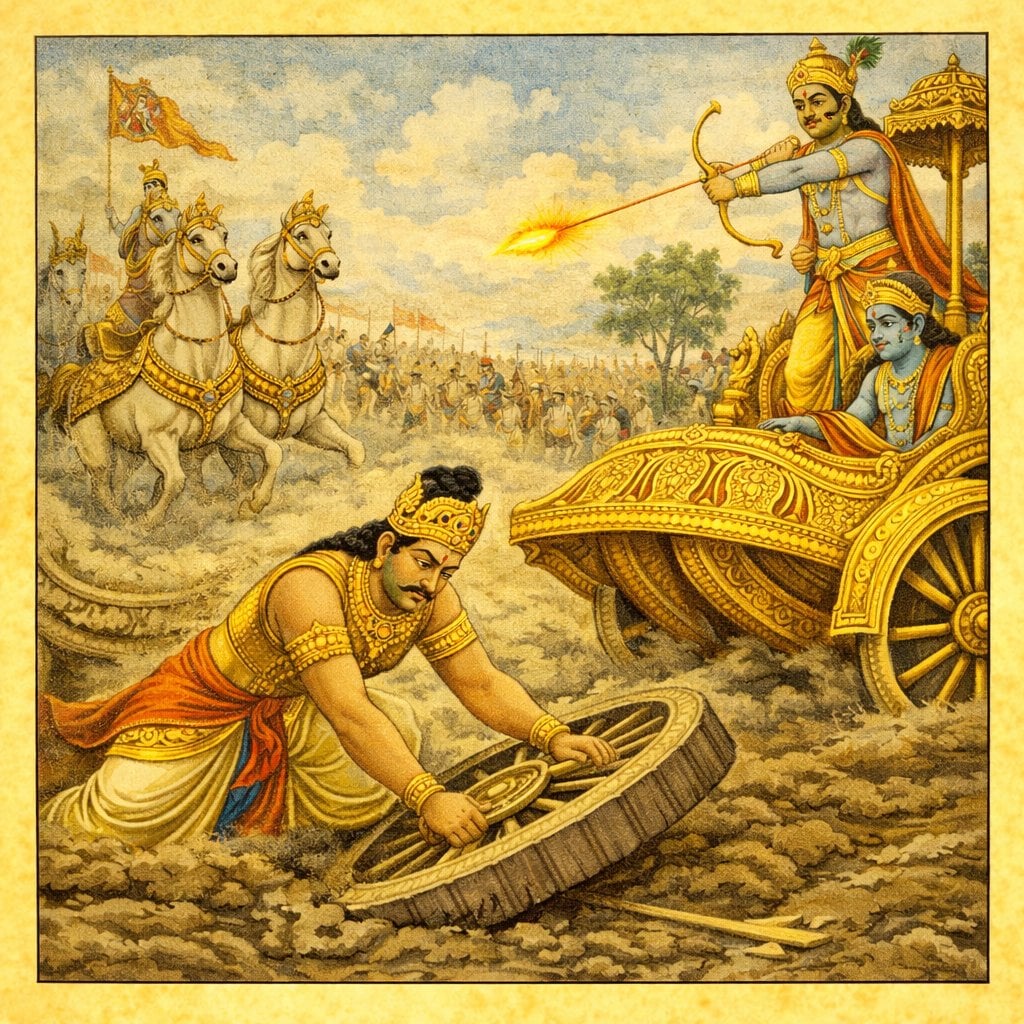
Parva Karna Parva
कर्णपर्व
The Book of Karna
The Karna Parva is the eighth book of the great Indian epic, the Mahābhārata. It chronicles the events of the Kurukshetra War during the sixteenth and seventeenth days, following the fall of the preceptor Drona. Karna, the valiant but tragic solar hero, is appointed as the supreme commander of the Kaurava army. This parva highlights his unwavering loyalty to Duryodhana, his unparalleled martial prowess, and the inescapable weight of his past curses and karmic destiny. Under Karna's leadership, the battlefield witnesses unprecedented destruction. The narrative vividly describes intense duels, most notably the fierce encounters between Karna and the Pandava brothers. A pivotal moment occurs when Karna defeats Yudhishthira, Bhima, Nakula, and Sahadeva, but spares their lives to honor the sacred vow he made to his biological mother, Queen Kunti. The cosmic and earthly tension escalates as the ultimate confrontation between Karna and Arjuna, the two greatest archers of their era, draws near. The climax of the parva is the monumental duel between Karna and Arjuna, a battle that shakes the very heavens. Despite Karna's unmatched skill, his chariot wheel gets stuck in the mud—a manifestation of a Brahmin's curse—and he forgets his divine mantras due to the curse of his guru, Parashurama. On the urging of Lord Krishna, who reminds Arjuna of Karna's participation in the unrighteous killing of Abhimanyu and the humiliation of Draupadi, Arjuna strikes down the unarmed Karna. This parva profoundly explores the complex themes of dharma (righteousness), fate, loyalty, and the tragic consequences of aligning with adharma, cementing Karna as one of the most compelling and tragic figures in the entire epic.
Adhyayas in Karna Parva
Adhyaya 1
कर्णसेनापत्यारम्भः — Karṇa’s Appointment and the Report to Dhṛtarāṣṭra (Chapter 1)
The chapter opens with Vaishampayana describing the Kaurava leaders’ agitation after Droṇa’s death and their approach to Droṇa’s son (Aśvatthāman), followed by a sleepless night marked by strategic anxiety and recollection of the dice-hall outrage against Draupadī. At dawn, both camps perform prescribed duties and prepare for battle; the Kauravas appoint Karṇa as senāpati with auspicious rites and gifts, while the Pāṇḍavas likewise depart determined for engagement. The narrative telescopes to the consequence: after two days of intense fighting under Karṇa’s command, Karṇa is slain by Arjuna (Phalguna). Sañjaya travels swiftly to Hastināpura and approaches the bereaved Dhṛtarāṣṭra, offering formal salutations and probing whether the king is distressed by remembering ignored counsel from Vidura, Droṇa, Bhīṣma (Gāṅgeya), Keśava, and other sages. Dhṛtarāṣṭra articulates compounded grief at the deaths of Bhīṣma and Droṇa and asks how his remaining forces could have acted otherwise; Sañjaya frames the report within an interpretive doctrine of diṣṭa (ordained outcome), urging steadiness and promising an orderly account.
Adhyaya 2
Droṇanidhana-anantaraṃ sainya-viṣādaḥ and Karṇa-pravṛttiḥ (After Droṇa’s fall: army despondency and Karṇa’s advance)
Saṃjaya reports to Dhṛtarāṣṭra that, upon Droṇa’s death, the Kaurava mahārathas and the wider armed host display visible despondency: downcast faces, silence, and mutual non-communication. The troops appear stunned, with weapons slipping from blood-smeared hands; hanging straps and gear are compared to stars in the sky, emphasizing disorientation and ominous stillness. Observing this, Duryodhana addresses his forces, asserting that the war was undertaken relying on their strength and that in battle victory and death are both plausible outcomes. He directs attention to Karṇa Vaikartana’s demonstrated prowess—his capacity to pressure Arjuna, subdue Bhīma through human combat, and fell Ghaṭotkaca with an unfailing śakti—presenting Karṇa as a stabilizing center of martial competence. Karṇa responds with a lion-roar and advances with great force, inflicting significant casualties among Sṛñjayas, Pāñcālas, Kekayas, and Videhas; volleys of arrows are described in dense, swarming imagery. The chapter closes by noting that after extensive pressure and large-scale killing, Karṇa is ultimately brought down by Arjuna, foreshadowing the parva’s terminal trajectory.
Adhyaya 3
धृतराष्ट्रस्य मूर्च्छा स्त्रीणां च आर्तनादः (Dhṛtarāṣṭra’s Collapse and the Lament of the Palace Women)
Vaiśaṃpāyana reports that upon hearing Sanjaya’s words, Dhṛtarāṣṭra—overwhelmed and unable to find an end to grief—falls to the ground as if senseless, imagining Duryodhana slain. A great lament rises from the women, filling the surroundings; the Bharata women are described as submerged in a terrifying ocean of sorrow. Gāndhārī reaches the king and collapses unconscious, and the inner-palace attendants likewise faint. Sanjaya consoles the distressed women as they repeatedly weep, trembling like plantain trees shaken by wind. Vidura also reassures the king, sprinkling water, until Dhṛtarāṣṭra gradually regains awareness. He stands silent, then reflects for a long time, repeatedly sighing; he censures his sons, judges the Pāṇḍavas formidable, and reproaches his own judgment and Śakuni’s counsel. Regaining composure, he questions Sanjaya again, asking whether Duryodhana has truly gone to Yama’s abode and requesting a truthful repetition. Sanjaya replies with grave confirmation of major losses: Karṇa (Vaikartana) is slain along with his sons and brothers (noted as skilled archers), and Duḥśāsana is killed; Bhīma, in fury, drinks Duḥśāsana’s blood in battle.
Adhyaya 4
Karṇa-nidhana-śravaṇa, Kṣaya-Varṇana, and Śeṣa-sainika-nirdeśa (Hearing of Karṇa’s Fall, Accounting of Losses, and Naming of Remaining Warriors)
Chapter 4 records a grief-saturated exchange in which Dhṛtarāṣṭra, hearing of Karṇa’s death, queries Saṃjaya about the state of both armies. Saṃjaya first summarizes the cumulative devastation: major Kaurava leaders and allied kings have fallen, and Karṇa himself is described as slain by Arjuna after severe attrition. The report proceeds as a catalogue of notable casualties, moving from prominent commanders to allied rulers and then to broader troop categories, emphasizing the scale of loss. Dhṛtarāṣṭra then demands reciprocal accounting—who among the Pāṇḍava side was slain by Kauravas—prompting Saṃjaya to list key Pāṇḍava-aligned deaths (including major kings and warriors) with attributions to Bhīṣma, Droṇa, Karṇa, and others. Finally, Dhṛtarāṣṭra requests the names of surviving Kaurava champions; Saṃjaya identifies remaining principal fighters (notably Aśvatthāman, Kṛtavarmā, Kṛpa, Śalya, the Gāndhāra king, and Duryodhana with associated retainers). The chapter closes with Dhṛtarāṣṭra’s cognitive overwhelm and temporary collapse, underscoring the epic’s theme that political blindness culminates in personal and institutional disintegration.
Adhyaya 5
कर्णनिधनश्रवणम् — Hearing of Karṇa’s Fall and Dhṛtarāṣṭra’s Lament
The chapter opens with Janamejaya’s inquiry about Dhṛtarāṣṭra’s words after hearing of Karṇa’s death and his sons’ retreat. Vaiśaṃpāyana describes the news as psychologically implausible—likened to cosmic inversions—and narrates Dhṛtarāṣṭra’s shock, grief, and disbelief. Dhṛtarāṣṭra addresses Saṃjaya with an extended encomium of Karṇa’s martial stature and prior conquests, presenting Karṇa as the primary pillar of Kaurava security. Saṃjaya attempts measured consolation by appealing to Dhṛtarāṣṭra’s stature and self-control. Dhṛtarāṣṭra then pivots to a fatalistic doctrine: daiva supersedes human effort, since even Karṇa fell. He recounts Karṇa’s battlefield prowess and earlier decisive actions (including the use of Indra’s śakti against Ghaṭotkaca), and questions how such a warrior could be slain unless extraordinary disruption occurred (weapon failure, chariot impediment, or loss of astras). The lament expands into retrospective causality: Duryodhana’s refusal of restraint, the earlier counsel attributed to Bhīṣma, and the compounding losses of Bhīṣma and Droṇa. The chapter culminates in Dhṛtarāṣṭra’s interrogatives about the reactions and statements of Duryodhana and other leaders (Śakuni, Kṛtavarman, Aśvatthāman, Kṛpa, Śalya, and allied kings), and requests a detailed account of the formations and circumstances around Karṇa’s death.
Adhyaya 6
कर्णस्य सेनापत्याभिषेकः | Karṇa’s Consecration as Commander-in-Chief
Saṃjaya reports that after Droṇa’s death and the frustration of Aśvatthāman’s immediate aims, Kaurava forces waver while the Pāṇḍavas re-form their array with the brothers. As evening approaches, the Kauravas withdraw to camp and convene in comfort to deliberate on collective advantage. Duryodhana invites rapid counsel; Droṇa’s son articulates a policy frame in which multiple means (rāga, yoga, dākṣya, naya) operate under daiva, discouraging despair and proposing a decisive remedy: appoint Karṇa as senāpati. Duryodhana addresses Karṇa with assurances of trust, recounting how Bhīṣma and Droṇa, due to age and prior regard for Arjuna, had constrained their pressure, and asserts that no equal to Karṇa remains for Kaurava victory. Karṇa accepts, reiterating prior promises to defeat the Pāṇḍavas with Kṛṣṇa. The kings then perform a rapid, rule-governed abhiṣeka with consecrated vessels and auspicious materials, and bards and priests proclaim victory-formulas. The chapter closes with Karṇa radiant in new authority, while Duryodhana considers his objective fulfilled and Karṇa orders preparations oriented to sunrise and renewed operations.
Adhyaya 7
कर्णस्य सेनापत्यं, माकरव्यूहः, पाण्डवानामर्धचन्द्रव्यूहः (Karna’s Command; Mākara Formation; Pandava Crescent Counter-Array)
Dhṛtarāṣṭra asks Saṃjaya to report what Karṇa did after receiving the generalship and ordering the army’s mobilization at sunrise. Saṃjaya describes the nocturnal-to-dawn arming: elephants, chariots, infantry, and cavalry readying amid a rising soundscape of calls and instruments. Karṇa appears in a richly described chariot—white banner, bright weaponry, and prominent insignia—functioning as a visual anchor for Kaurava confidence; the troops, seeing him at the front of the array, no longer dwell on earlier commander losses. Karṇa then drives the Kaurava host forward with conch-signal urgency and arranges a mākara-vyūha, assigning key figures to anatomized positions (snout/eyes/head/limbs/center/tail), including Śakuni, Ulūka, Aśvatthāman, Duryodhana, Kṛtavarmā, Śalya, Suṣeṇa, and others. As the Kaurava formation advances, Yudhiṣṭhira points out that despite the Kaurava army’s attrition, Karṇa remains the singular decisive factor and urges Arjuna to defeat him to remove a long-standing burden. Arjuna, with Kṛṣṇa as charioteer, counters by deploying an ardhacandra formation, placing Bhīma on the left, Dhṛṣṭadyumna on the right, and arranging central and rear supports (Nakula, Sahadeva, Yudhiṣṭhira), with designated protectors. Both sides interpret the opposing formation as a sign of imminent victory, after which conches, drums, and the composite noise of horses, elephants, and chariots swell, and the engagement begins with mutual striking among infantry, elephants, cavalry, and charioteers.
Adhyaya 8
Adhyāya 8: Saṃprahāra-varṇana and Bhīma–Kṣemadhūrti Dvipa-Yuddha (Combat Description and Elephant Duel)
Saṃjaya describes the armies closing in with heightened energy, likened to divine–asuric hosts. A generalized mêlée follows: elephants, chariots, cavalry, and infantry intermix; severed heads and limbs are depicted with comparative imagery (moon, sun, lotus; serpents struck by Garuḍa), emphasizing the sensory density of the battlefield. The narrative then shifts from panoramic slaughter to organized arrivals of Pāṇḍava-aligned forces—Dhṛṣṭadyumna, Śikhaṇḍin, the Draupadeyas, Prabhadrakas, Sātyaki, Cekitāna, and multiple regional contingents—framing a renewed push into the Kaurava center led by Bhīma. A focal duel emerges: Bhīma and Kṣemadhūrti engage first as elephant-combatants with tomara exchanges, then maneuver into circling tactics and archery. Kṣemadhūrti wounds Bhīma; Bhīma responds with projectile and then sustained arrow pressure that destabilizes the enemy elephant. After forcing the elephant’s collapse, Bhīma strikes Kṣemadhūrti with a mace as the latter approaches with sword raised. The Kulūta ruler falls, and Saṃjaya notes the demoralization and flight within Dhṛtarāṣṭra’s forces upon witnessing the death of a celebrated king.
Adhyaya 9
अध्याय ९ — कर्णस्य प्रहारः, योधयुग्मनियोजनम्, शैनेय-कैकेययोर्युद्धविन्यासः
Saṃjaya reports a rapid escalation of engagements. Karṇa, described as a great archer, strikes the Pāṇḍava host with well-jointed arrows and polished nārācas, causing disorder among elephants and spreading confusion across directions. The Pāṇḍavas respond by attacking the Kaurava force in front of Karṇa. The narration then enumerates concurrent matchups that stabilize the battlefield through paired contests: Nakula advances toward Karṇa; Bhīmasena engages Droṇa’s son (Drauṇi); Sātyaki checks the Kaikeya brothers Vindā and Anuvindā; other named warriors intercept approaching opponents. Focus tightens on Sātyaki’s duel with the Kaikeyas: mutual arrow-covering, repeated bow-cutting, and a shift from missile exchange to close combat with swords and shields. The turning point occurs when Sātyaki, after sustaining wounds, uses a sharp kṣurapra to sever Anuvinda’s head; the surviving brother retaliates with a spear and renewed arrow strikes. Sātyaki counters, transitions again into close-quarters maneuvering, and ultimately cuts down the Kaikeya combatant, after which the Kekaya contingent breaks and disperses, indicating morale-driven rout following the loss of a key champion.
Adhyaya 10
Adhyāya 10: Śrutakarmā’s Engagements; Prativindhya–Citra Duel; Drauṇi Advances toward Bhīma
Saṃjaya reports a sequence of tightly linked battlefield engagements. Śrutakarmā strikes King Citraseṇa with concentrated volleys; Abhisāra counters by wounding Śrutakarmā and his charioteer. Śrutakarmā retaliates with a precise nārāca to a vital point; Śrutakīrti adds suppressive fire, and Citraseṇa briefly recovers to cut Śrutakarmā’s bow. Śrutakarmā re-arms, visually described as adorned by arrows, then absorbs a chest wound yet regains initiative by severing the enemy’s bow and saturating him with nārācas; he finally decapitates the opponent with a bhalla, prompting Citraseṇa’s troops to surge and then break under Śrutakarmā’s counter-pressure. The focus then shifts: Prativindhya and Citra exchange bow-breaking and missile throws; a hurled śakti is split mid-flight, a gadā strike destroys Prativindhya’s chariot team, and a returned śakti disables Prativindhya’s right arm. Prativindhya answers with a hema-bhūṣita tomara that pierces Citra’s defenses and heart, causing his fall and triggering a surrounding attack that Prativindhya disperses with dense arrow-net tactics. The chapter closes by announcing a new major engagement as Drauṇi (Aśvatthāman) advances toward Bhīmasena, likened to a mythic-scale clash, signaling escalation and transition.
Adhyaya 11
Bhīmasena–Drauṇi Mahāyuddha (Chariot Duel and Astra-Exchange)
Sañjaya describes a high-density duel between Bhīma and Drauṇi. Drauṇi first wounds Bhīma with a rapid sequence of sharp arrows, exhibiting astralāghava (weapons dexterity) and targeted knowledge of vital points (marma). Bhīma answers by blanketing Drauṇi with a thousand arrows and issuing a siṃhanāda, after which Drauṇi strikes Bhīma’s forehead with an ārāca; Bhīma bears the embedded arrow and returns three nārācas to Drauṇi’s forehead, producing a vivid visual tableau. The fighters exchange hundreds of arrows without “shaking” one another, and the narration emphasizes symmetric endurance. Their ratha-caryā becomes circular (apasavya maneuvers), and the battle expands into an explicit astrayuddha likened to catastrophic cosmic conflict; arrow impacts generate fire that burns through both forces. Siddhas proclaim the encounter incomparable, praising both strength and training. The duel culminates in simultaneous, high-velocity shots that drop both warriors within their chariots; recognizing unconsciousness or disorientation, their charioteers withdraw them from the field in view of the assembled warriors.
Adhyaya 12
Chapter 12: Arjuna’s suppression of the Saṃśaptakas and duel with Aśvatthāmā (Drauṇi)
Dhṛtarāṣṭra requests a report on Arjuna’s battle with the Saṃśaptakas and the wider Kaurava situation; Saṃjaya narrates the engagement as a purificatory, high-stakes contest for elite warriors. Arjuna enters the Saṃśaptaka formation likened to an ocean and disrupts it with sustained archery: severing heads, arms, weapons, reins, standards, chariots, and mounts, sending elephants, horses, and chariot divisions into collapse. Celestial beings praise Keśava and Arjuna as an extraordinary paired force, framed in elevated theological language (Nara-Nārāyaṇa). Aśvatthāmā, stirred by the spectacle, challenges Arjuna with the idiom of martial hospitality; Arjuna consults Keśava, then advances. The duel intensifies through reciprocal missile-storms: Aśvatthāmā wounds both Keśava and Arjuna; Arjuna counters by breaking bows, dispersing volleys, and employing broader-coverage weaponry (sarvatodhāra). Keśava urges decisive action; Arjuna targets the enemy’s mobility by cutting reins and striking horses, forcing Aśvatthāmā’s tactical withdrawal from immediate engagement. Keśava and Arjuna then turn back toward the Saṃśaptakas, continuing the campaign sequence.
Adhyaya 13
दण्डधारवधः | The Slaying of Daṇḍadhāra
Saṃjaya reports a surge of battle-noise from the Pāṇḍava side as Kṛṣṇa turns Arjuna’s chariot with high speed and directs him toward Daṇḍadhāra, a leading Magadhan combatant mounted on a formidable elephant and supported by mixed forces. Daṇḍadhāra’s elephant formation causes severe disruption among opposing troops, described through repeated similes emphasizing unstoppable momentum. Arjuna advances in a chariot amid conch, drum, and war-instrument signals. Daṇḍadhāra strikes Arjuna and Kṛṣṇa with missiles and attempts to destabilize their position. Arjuna responds with precise archery: he severs the opponent’s banner and key attendants, then progressively incapacitates Daṇḍadhāra—cutting off arms and finally the head—before bringing down the elephant with concentrated volleys. The opposing elephant unit collapses, contributing to broader disarray among allied forces. Pāṇḍava soldiers acclaim Arjuna for removing a source of fear, and Arjuna, after receiving their words with composure, proceeds to re-engage other hostile formations (the Saṃśaptakas), maintaining the chapter’s emphasis on tactical sequencing and controlled escalation.
Adhyaya 14
कर्णपर्व — चतुर्दशोऽध्यायः (Arjuna’s Suppression of the Saṃśaptakas; Kṛṣṇa’s Strategic Admonition; Battlefield Inventory)
Sañjaya reports that Arjuna, returning to the engagement, strikes down many Saṃśaptaka combatants with rapid, technically varied archery—severing weapons, arms, and heads, disabling chariots and mounts, and dispersing converging units. The narrative emphasizes the density of incoming attacks and Arjuna’s countering of missiles with missiles, producing a swift collapse of enemy mobility and cohesion. Kṛṣṇa addresses Arjuna directly, questioning the delay and instructing him to crush the Saṃśaptakas and hasten toward the objective of Karṇa’s confrontation. As they move, Kṛṣṇa draws Arjuna’s attention to the battlefield’s accumulated remains: discarded bows and quivers, broken armor, diverse weapons, fallen standards, and the bodies of men, horses, and elephants. This descriptive survey functions as a documentary register of war’s material culture and as a moral-phenomenological frame, highlighting the scale of loss, the transformation of royal splendor into wreckage, and the strategic urgency continuing within a landscape of devastation.
Adhyaya 15
कर्णपर्व — पञ्चदशोऽध्यायः | Karṇa Parva, Chapter 15: Pāṇḍya’s Advance and Aśvatthāmā’s Counterstroke
Dhṛtarāṣṭra asks Saṃjaya to elaborate on a famed hero’s battlefield deeds, requesting details of training, influence, strength, stature, and pride (1–2). Saṃjaya frames the competitive field of elite archers—Droṇa, Bhīṣma, Kṛpa, Drauṇi, Karṇa, Arjuna, and Vāsudeva—highlighting the psychology of equivalence and refusal of inferiority (3–4). The narrative then turns to the Pāṇḍya king, presented as an exceptional arms-bearer, who strikes down elements of Karṇa’s formation and scatters chariots, standards, and weapons with precise volleys (5–10). Seeing this, Aśvatthāmā advances, addresses Pāṇḍya with controlled praise and a direct invitation to single combat, emphasizing his visible power and archery display (11–18). The duel escalates: Pāṇḍya wounds Drauṇi; Drauṇi responds with fierce, vital-point-seeking arrows and releases successive nārācas (19–23). Drauṇi then saturates the sky with arrows in immense quantity; Pāṇḍya counters by cutting down incoming missiles and employs the Vāyavya astra to check the arrow-storm (24–31). Drauṇi breaks Pāṇḍya’s banner, kills horses and charioteer, and disables the chariot, yet is described as not immediately killing the exposed foe, reflecting a moment of restraint or tactical sequencing (32–34). The Pāṇḍya king mounts an elephant and hurls a radiant tomara; Drauṇi’s decisive response follows—he strikes the elephant and then the king’s limbs and head with a set of arrows, causing the king’s fall, described through vivid similes (35–42). The chapter closes with a commendatory note that the victorious guru-putra (Drauṇi), accomplished in knowledge and action, is honored by allies, reinforcing status and martial legitimacy (43).
Adhyaya 16
Pāṇḍya-vadha-anantaram Arjunasya Pravṛttiḥ (Arjuna’s Response and the Renewed Battle)
Dhṛtarāṣṭra questions Sañjaya about Arjuna’s conduct after Pāṇḍya is slain and after Karṇa has driven opposing forces. Sañjaya reports that Kṛṣṇa urgently addresses Arjuna, pointing to the elevated threat and to reversals affecting allied contingents (including Sṛñjayas), thereby reframing the immediate tactical situation. Arjuna, perceiving the gravity of his brother’s danger, instructs Hṛṣīkeśa to drive the horses swiftly, and their chariot advances, precipitating a renewed and severe convergence of forces. The chapter then shifts into a high-density battlefield description: enumerations of weapons (bows, arrows, maces, spears, axes), the soundscape of bowstrings, wheels, and elephant cries, and the psychological effects on combatants. Karṇa is depicted as exerting decisive pressure—destroying multiple chariots and cutting through armor—likened to a lion among herds. In response, key Pāṇḍava-side figures (the Draupadeyas, the twins, and Yuyudhāna) move together toward Karṇa, indicating a coordinated attempt to contain his momentum. The thematic focus is situational awareness, command responsiveness, and the epic’s portrayal of dharma under accelerated tactical crisis.
Adhyaya 17
Adhyāya 17 — गजयुद्ध-वृत्तान्तः, सहदेव-दुःशासन-संघर्षः, नकुल-कर्ण-समागमः (Elephant-battle account; Sahadeva–Duhshasana clash; Nakula–Karna encounter)
Saṃjaya reports that Kaurava commanders, urged by Duryodhana, drive elephant divisions against Dhṛṣṭadyumna and the Pāñcāla front. Regionally named elephant-warriors advance and unleash dense missile volleys, while Pāṇḍava allies counter with coordinated archery. Elephants trample men, horses, and chariots; several are brought down by precise nārāca shots, with Sātyaki and Sahadeva highlighted for disabling key animals and their crews. The fighting expands into a rathin–hastin mêlée, with significant elephant losses attributed to Sahadeva, Nakula, and supporting Pāñcāla champions. A duel then forms between Sahadeva and Duḥśāsana: bows are cut, swords raised, missiles exchanged, and Duḥśāsana is momentarily overpowered and withdrawn by his charioteer after a penetrating shot. Karṇa then checks Nakula’s advance; Nakula reproaches Karṇa as a root cause of hostility, while Karṇa responds by urging action over speech. A fierce exchange follows: bows are severed, chariots damaged, and Nakula is forced to flee on foot. Karṇa theatrically binds Nakula’s strung bow at his neck and admonishes him to fight equals rather than seniors; despite having a clear opportunity to kill, Karṇa releases Nakula, explicitly because he recalls Kuntī’s request. Karṇa then turns rapidly upon the Pāñcālas, producing widespread rout imagery—broken chariots, panicked elephants, scattered cavalry—framed as a mid-day devastation cycle.
Adhyaya 18
Adhyāya 18 — Sequential Duels and Formation Pressure (Ulūka–Yuyutsu; Śakuni–Sutasoma; Kṛpa–Dhṛṣṭadyumna; Kṛtavarmā–Śikhaṇḍin)
Saṃjaya narrates a chain of engagements emphasizing tactical disruption. Ulūka intercepts the fast-moving Yuyutsu, is struck, retaliates by severing the bow and cutting down the banner, and forces Yuyutsu to counterstrike; Ulūka then beheads the charioteer, disables horses, and moves on to attack Pañcāla and Sṛñjaya troops. Elsewhere, Śatānīka and Śrutakarman rapidly neutralize each other’s chariot capacity through direct impact (gadā), prompting both to withdraw and remount. Sutasoma concentrates on Śakuni with dense arrow volleys; Śakuni counters with precision, dismantles Sutasoma’s chariot assets, and forces a transition to ground combat where Sutasoma displays sword-skill by cutting incoming arrows, until Śakuni severs the sword and bow, compelling Sutasoma to shift position. Śakuni then advances against Pāṇḍava formations, producing visible disarray. Kṛpa restrains Dhṛṣṭadyumna, generating fear and interpretive commentary among troops; Dhṛṣṭadyumna, experiencing physiological distress, orders withdrawal to seek safer engagement elsewhere. Finally, Śikhaṇḍin confronts Kṛtavarmā; repeated bow-severing and high-volume exchanges culminate in Kṛtavarmā’s decisive strike that induces Śikhaṇḍin’s fainting and evacuation, after which a localized Pāṇḍava retreat is described. The chapter’s thematic center is battlefield causality: how disabling tools of war (bows, banners, horses) rapidly converts advantage into rout without requiring total annihilation.
Adhyaya 19
Karṇa-parva Adhyāya 19 — Saṃśaptaka–Trigarta Assault and Aindra-astra Counter
Saṃjaya reports that Śvetāśva’s force presses the Kaurava host, while Trigartas, Śibis, Śālvas, Saṃśaptakas, and the Nārāyaṇa contingent surge against Arjuna. Named Trigarta leaders (including Satyasena, Satyakīrti, Mitradeva, Śrutaṃjaya, Sauśruti, Citrasena, Mitravarmā) attack in massed volleys, likened to waves. Despite heavy pressure, Arjuna’s counterfire causes rapid collapses in the attacking ranks. He kills key figures—Śatruṃjaya, Sauśruti, Candradeva—and continues to check other mahārathas with measured volleys. Satyasena hurls a tomara that pierces Kṛṣṇa/Mādhava’s left arm, briefly disrupting reins and whip; Kṛṣṇa regains control and drives toward Satyasena, after which Arjuna kills Satyasena and strikes further leaders, including Mitradeva, while wounding Suśarmā. Encircled again by Saṃśaptakas, Arjuna manifests the Aindra-astra, producing a vast discharge of arrows that shatters standards, weapons, chariots, and armor, creating a chaotic field of severed heads and bodies described with stark similes. The battle devolves into close-quarters mêlée—elephants trampling, chariots overturned, and even fistfights—until confusion spreads and combatants strike friend and foe alike. The report closes with a broader attrition update: Karṇa slays Pāñcālas, Arjuna slays Trigartas, and Bhīma strikes Kuru forces and elephant divisions as afternoon slaughter intensifies.
Adhyaya 20
Karṇa-parva Adhyāya 20 — Yudhiṣṭhira–Duryodhana Encounter and Escalation of Arms
Dhṛtarāṣṭra opens with a grief-laden inquiry, stating that he has heard of severe and unbearable losses and pressing Sañjaya to describe how the battle proceeded, especially the afternoon engagement. Sañjaya reports that Duryodhana, remounting a new chariot amid fragmented fighting, advances toward Yudhiṣṭhira with urgent instructions to his charioteer. Yudhiṣṭhira, angered, likewise directs his driver to meet Duryodhana, and the two kings engage in a concentrated rathayuddha. The exchange includes precision archery: Duryodhana severs Yudhiṣṭhira’s bow; Yudhiṣṭhira replaces it and counters by cutting Duryodhana’s banner and bow. The duel intensifies through sustained arrow volleys, audible signals (conch and battle cries), and mutual wounding. Duryodhana throws a sharp śakti likened to a meteor; Yudhiṣṭhira intercepts it mid-flight, then pierces Duryodhana with additional arrows. After further strikes, Yudhiṣṭhira launches a powerful śakti that penetrates Duryodhana’s armor, causing him to fall and lose consciousness. Kṛtavarmā rapidly intervenes to retrieve and protect Duryodhana, while Bhīma rushes forward with a mace, marking the episode’s tactical shift from duel to protective engagement.
Adhyaya 21
कर्णार्जुनयुद्ध-प्रवृत्तिः (Renewal of the Karṇa–Arjuna Engagement at Day’s End)
Saṃjaya reports that the Kaurava forces, placing Karṇa at the front, re-enter the conflict with heightened intensity. The field is portrayed through combined-arms motion and sensory density: conch and troop sounds, missile showers, and mounting casualties, with the ground strewn with crowned heads and broken formations. Sātyaki (Śiniputra/Śinivṛṣabha) engages Karṇa; allies surge to support Karṇa when pressured. Arjuna and Kṛṣṇa arrive after completing ritual duties and immediately generate a suppressive arrow-storm, dismantling chariots, standards, horses, and drivers; Duryodhana advances but is materially checked as Arjuna severs bow, charioteer, banner, horses, and parasol, while Drauṇi interrupts a decisive projectile. Arjuna continues disabling multiple Kaurava champions’ weapon-systems (bows, flags, mounts). Karṇa then reorients toward Arjuna, striking both Arjuna and Kṛṣṇa; Sātyaki retaliates with heavy volleys. Pandava allies mass around Karṇa, but Karṇa disperses the assault and inflicts severe losses until Arjuna counters Karṇa’s astras with his own, producing mutual missile saturation. As darkness, dust, and reduced visibility spread, both sides withdraw to camps; the Pandavas return in orderly morale, while the battlefield is described as attracting yakṣas, rākṣasas, piśācas, and scavengers—an epic marker of nightfall after large-scale loss.
Adhyaya 22
Karṇa’s Camp-Council Discourse: Dhṛtarāṣṭra’s Lament, Sañjaya’s Counsel, and Karṇa’s Request for Śalya (Book 8, Chapter 22)
Dhṛtarāṣṭra opens by emphasizing Arjuna’s singular prowess through a catalogue of past exploits, implying that even formidable adversaries cannot easily escape him in battle. Sañjaya reports the Kaurava camp’s distressed condition and describes renewed deliberations. Karṇa, angered yet calculating, attributes the day’s reversal to Arjuna’s readiness and to timely inspiration, promising to counter Arjuna’s intentions on the following day. Dhṛtarāṣṭra presses for details on Karṇa’s conduct and the renewed fighting. Sañjaya interjects a reflective admonition: regret after missed opportunities is unproductive, and Dhṛtarāṣṭra’s earlier failures of judgment have contributed to the present destruction. At dawn, Karṇa approaches Duryodhana, declares his intent to meet Arjuna decisively, and analyzes comparative resources—Arjuna’s famed Gāṇḍīva, divine equipment, and Kṛṣṇa’s charioteership—contrasted with Karṇa’s own bow (Vijaya) and martial capacity. To neutralize disadvantages, Karṇa requests Śalya as charioteer and logistical support for specialized missiles; Duryodhana assents and moves to secure Śalya, closing the chapter on a concrete strategic reconfiguration.
Adhyaya 23
Śalya’s Objection to Sārathya and Duryodhana’s Conciliation (शल्यमन्यु-प्रशमनम् / Sārathyāṅgīkāra)
Saṃjaya reports that Duryodhana approaches Śalya with courteous, affectionate speech, requesting that Śalya serve as Karṇa’s charioteer to neutralize Arjuna’s advantage of Kṛṣṇa’s guidance. Duryodhana argues by analogy: as Kṛṣṇa protects Arjuna through mastery of reins and strategy, so Śalya should protect Karṇa; he also frames this as a remaining “share” of duty after earlier commanders have fallen. Śalya responds with visible anger, interpreting the request as disrespect and as an improper inversion of rank. He asserts his royal consecration and martial status, then advances a normative hierarchy of social functions, claiming that sūtas are designated attendants of brahmins and kṣatriyas, and rejecting charioteership for a “sūta’s son” in battle. Śalya threatens withdrawal from participation if dishonored. Duryodhana restrains him and reopens dialogue using sāma: he affirms that he does not consider Karṇa superior to Śalya, praises Śalya’s truthfulness and enemy-harming capacity, and reframes the request as reliance on Śalya’s exceptional expertise in horses and chariots—greater, he claims, even than Vāsudeva’s in that domain. Śalya, pleased by the restored honor and praise, agrees to take up Karṇa’s charioteership while stating a prior understanding concerning how he will speak in Karṇa’s presence. The chapter thus interweaves war logistics, honor politics, and social-theoretical justification into a single negotiation scene.
Adhyaya 24
त्रिपुरदाह-इतिहासः (Tripura-destruction exemplum and counsel to Śalya)
Duryodhana re-engages Śalya with an authoritative recollection attributed to Mārkaṇḍeya, presenting a layered itihāsa. First, after an early devasura conflict, Tāraka’s three sons (Tārākṣa, Kamalākṣa, Vidyunmālī) undertake severe tapas and receive boons from Brahmā, including conditional invulnerability and a death-condition tied to the rare convergence of three fortified cities. Assisted by the architect Maya, they establish three cities of distinct materials and cosmic locations (heaven/sky/earth), later forming Tripura. A further boon-device appears through Hari (son of Tārākṣa), who creates a revivifying reservoir that restores fallen asuras, producing battlefield resilience. The devas, unable to contain the disruption, appeal upward: Brahmā directs them to Śiva. Extensive stuti frames Śiva’s supremacy; the devas construct a cosmic chariot and request Brahmā as charioteer. When the three cities align in time, Śiva releases a decisive projectile (Pāśupata-linked) and destroys Tripura, restoring order. Duryodhana then pivots from mythic precedent to immediate counsel: he analogizes the need for an exceptional charioteer (Śalya) to enable Karṇa’s victory over Arjuna, and introduces a second exemplum (Paraśurāma/Jāmadagnya’s tapas and astras) to reinforce Karṇa’s legitimacy and martial capacity.
Adhyaya 25
Śalya Appointed as Karṇa’s Sārathi; Discourse on Praise, Blame, and Beneficial Counsel (कर्णस्य शल्यसारथ्यं तथा स्तवनिन्दाविचारः)
Chapter 25 presents a compact negotiation over martial logistics and moral-psychological support. Duryodhana cites a precedent of divine hierarchy—Brahmā serving as charioteer where Rudra is the warrior—to argue that a charioteer must be superior in competence to the fighter, and he urges Śalya to control the horses in battle. Sañjaya reports Śalya’s embrace and acceptance, with a pledge to carry Duryodhana’s burdens wherever he is fit for service. Śalya requests tolerance for any counsel he may give to Karṇa, whether pleasing or displeasing, framing it as welfare-oriented. Karṇa reciprocally requests that Śalya align with them in constant benefit, analogizing to Brahmā for Īśāna and Keśava for Pārtha. Śalya then articulates a fourfold pattern—self-blame, self-praise, other-blame, other-praise—as conduct not practiced by the noble, and proceeds to establish his credibility by asserting his competence as charioteer (comparable to Mātali for Indra) through discipline, knowledge, and applied skill. He concludes by assuring Karṇa of steady charioteership during combat with Pārtha, aiming to reduce anxiety and stabilize performance.
Adhyaya 26
अध्याय २६ — शल्यस्य सारथ्य-नियोजनं, कर्णस्य प्रस्थानं, उत्पातदर्शनं च (Chapter 26: Śalya appointed as charioteer; Karṇa’s departure; portents)
Chapter 26 documents a coordinated transition in Kaurava command logistics and battlefield psychology. Duryodhana praises Śalya as a charioteer surpassing even Kṛṣṇa in skill, arguing that with Karṇa as warrior and Śalya as driver, Arjuna will not prevail. Saṃjaya reports the practical enactment: Karṇa’s chariot is prepared in due form, honored ritually, and Śalya mounts it; Karṇa then takes position, radiating martial readiness. Duryodhana issues a directive framed as compensatory ambition—what Bhīṣma and Droṇa did not accomplish, Karṇa should now achieve—naming key Pandava targets. Karṇa responds with aggressive intent and orders Śalya to drive forward. Śalya counters by rebuking Karṇa’s contempt for the Pandavas, emphasizing their proven prowess and warning that the sound of Gāṇḍīva will alter Karṇa’s confidence. Karṇa dismisses the warning; Kaurava forces celebrate. The chapter then shifts to omenology: earthquakes, celestial anomalies, fires, winds, animal behavior, and unsettling signs accompany Karṇa’s advance, interpreted as indicators of impending catastrophe, though the Kauravas disregard them. The unit closes with Karṇa moving toward the Pandava formation and urgently inquiring after Arjuna’s position.
Adhyaya 27
कर्णस्य दानप्रतिज्ञा–शल्योपदेश–वाक्ययुद्धम् (Karna’s Gift-Vows, Shalya’s Counsel, and the Battle of Words)
Saṃjaya reports that as Karṇa advances he repeatedly asks, upon seeing each Pāṇḍava, to be shown Arjuna (śvetavāhana). Karṇa publicly offers a graded series of boons—wealth, jeweled carts, golden elephants and cattle, adorned women, large numbers of horses, chariots, and elephants—framing the sighting of Arjuna (and later Kṛṣṇa–Arjuna together) as a prize-worthy disclosure. The Kaurava camp responds with drums, instruments, and collective exhilaration. Śalya then rebukes Karṇa’s overconfidence, warning against imprudent gifting and unrealistic aims, using layered similes to portray Karṇa as mismatched against Arjuna (e.g., jackal vs lion, hare vs elephant), and urging a more guarded approach. Karṇa answers by reaffirming his intent, rejecting intimidation, and asserting his knowledge of both his own and Arjuna’s capacities; he introduces a special arrow reserved for Arjuna or Kṛṣṇa and escalates into harsh invective against Śalya and the Madra people via proverbial gāthās. The chapter ends with Karṇa threatening violence if Śalya repeats such speech, while maintaining his determination to fight.
Adhyaya 28
काकोपमोपदेशः (The Crow-and-Swan Exemplum as Counsel to Karṇa)
Saṃjaya narrates Śalya’s renewed address to Karṇa, introduced as a corrective ‘illustration’ (nidarśana). Śalya frames his speech as welfare-counsel from a charioteer responsible for comprehensive situational awareness—terrain, the chariot’s condition, horses’ fatigue, weapon-handling, omens, and tactical contingencies. He then delivers the kākopamā: a prosperous merchant family’s children feed a crow, who becomes arrogant and scorns other birds. When swans appear, the children flatter the crow into believing himself superior; he challenges a swan to a flight contest, boasting of many ‘styles’ of flight. The swan replies that birds truly know only one effective flight; the contest moves over the ocean, where the crow—unable to endure distance and lacking a place to land—panics and collapses. The swan, recalling noble conduct, rescues the crow and returns him to land. Śalya explicitly applies the exemplum to Karṇa: sustained by Kaurava patronage, Karṇa overestimates himself and undervalues superior opponents; Śalya cites prior episodes where Karṇa failed to prevail against Arjuna and concludes by warning against disparaging Acyuta (Kṛṣṇa) and Dhanañjaya (Arjuna), urging restraint from boastful speech.
Adhyaya 29
अध्याय २९: कर्णस्य शल्यं प्रति शापस्मरणं च युद्धनिश्चयः | Chapter 29: Karṇa recalls curses to Śalya and declares resolve for battle
Saṃjaya reports Karṇa’s address to Śalya after hearing an unwelcome remark. Karṇa states that he understands Arjuna’s strength and Kṛṣṇa’s charioteering skill, yet intends to engage them without retreat. He then introduces a key thematic constraint: the burden of curses. Karṇa recalls approaching Rāma (Paraśurāma) in brāhmaṇa disguise to obtain divine weapons, the discovery of his true identity as a sūta, and the resulting curse that the acquired weapon-knowledge will fail him at the decisive time. He further recalls a brāhmaṇa’s pronouncement that his chariot wheel will sink or become trapped during combat, creating a specific operational vulnerability. Karṇa describes attempts at restitution through substantial gifts and appeals, but the brāhmaṇa refuses to retract the utterance, citing the dharmic obligation to preserve truthfulness. The chapter closes with Karṇa’s insistence on fearlessness toward opponents, while admitting fear of the brāhmaṇa’s truth-bound speech—thus framing late-war action as a convergence of valor, fate, and moral causality.
Adhyaya 30
Karna Reproves Shalya; Brahmin Reports on Bāhlīkas; Shalya’s Universalizing Rebuttal (कर्ण–शल्य संवादः)
Saṃjaya reports that Karṇa addresses Śalya, rejecting intimidation by mere speech and asserting fearlessness even against divine opposition. Karṇa then recounts what he claims to have heard in Dhṛtarāṣṭra’s presence: Brahmins narrating earlier accounts that disparage Bāhlīka/Āraṭṭa regions through lists of places, practices, and transgressive behaviors, including ritual impurity, intemperance, and social disorder. The discourse expands into a theory of kingship: the ruler is described as bearing a ‘sixth share’ of the subjects’ merit and demerit, implying governance as moral participation. Further embedded sayings attribute directional guardianship to deities and enumerate regional characterizations. Karṇa concludes by urging Śalya to remain silent and not act antagonistically, threatening to eliminate Śalya first before engaging Keśava and Arjuna. Śalya replies by pointing to faults within Karṇa’s own domain, emphasizing that virtue and vice exist everywhere, and that people are adept at criticizing others while missing self-critique. Saṃjaya closes: Karṇa offers no further answer; the exchange ends with renewed prompting to proceed.
Adhyaya 31
कर्णेन व्यूहविधानम् — Karṇa’s Battle Formation and the Pāṇḍava Counter-Plan (Adhyāya 31)
Saṃjaya describes Karṇa observing the Pāṇḍava formation protected by Dhṛṣṭadyumna and advancing with chariot-roar and instruments, then counter-forming his own array and pressing the Pāṇḍava host, momentarily gaining advantage against Yudhiṣṭhira. Dhṛtarāṣṭra interrogates the specifics of the Kaurava deployment—wings, sub-wings, and proper division—prompting Saṃjaya’s technical account: commanders occupy the right wing (including Kṛpa and Kṛtavarmā), protective sub-divisions (Śakuni and Ulūka), and the left wing held by Saṃśaptakas, with additional allied contingents positioned for pressure against Arjuna. Karṇa stands at the center-front, supported by key figures; Duryodhana follows, protected by allies; Aśvatthāmā and other Kuru leaders trail the chariot divisions, with infantry and elephant-guards reinforcing. The formation is characterized as expertly designed (bārhaspatya), visually imposing, and dynamically projecting fear. Yudhiṣṭhira then addresses Arjuna to evaluate the threat and prevent being overrun; Arjuna affirms and commits to the decisive neutralization of the formation’s principal. Yudhiṣṭhira assigns matchups across leaders (including Bhīma, Nakula, Sahadeva, Dhṛṣṭadyumna, and others). As Arjuna’s chariot approaches, Śalya points out battlefield omens—dust, tremors, cries of scavengers, and unsettling sights—while also acknowledging Arjuna’s near-unconquerability; he redirects attention to the broader Pāṇḍava strength. The chapter closes with the armies clashing intensely, likened to converging rivers.
Adhyaya 32
Karṇa’s advance against the Pāṇḍava host; Arjuna’s clash with the Saṃśaptakas (कर्णस्य पाण्डवसेनाप्रवेशः—अर्जुनस्य संशप्तकसंप्रहारः)
Dhṛtarāṣṭra asks Sañjaya how Arjuna confronted the Saṃśaptakas and how Karṇa proceeded against the Pāṇḍavas. Sañjaya reports that Arjuna re-ordered formations against the hostile array, producing a tumultuous engagement marked by rapid destruction of chariots, standards, elephants, and weapon-bearing arms. Parallelly, a broader coalition battle unfolds among Pāñcālas, Cedis, Sṛñjayas, and Kaurava allies (Kṛpa, Kṛtavarman, Śakuni, and others). Dhṛtarāṣṭra then presses for details of Karṇa’s penetration and the defenders who attempted to halt him. Sañjaya describes intense sonic and atmospheric imagery as Karṇa, enraged, employs swift weaponry to cut down numerous rathins and infantry contingents, including notable Pāñcāla figures, while his sons (Suṣeṇa, Satya-sena, Vṛṣasena) and Kaurava protectors form a defensive screen. Counterattacks by Bhīma, Nakula, Sahadeva, Sātyaki, Dhṛṣṭadyumna, Śikhaṇḍin, and others momentarily check Karṇa’s momentum; Satya-sena is felled, and multiple chariot-disablements occur. The chapter closes with both sides regrouping into renewed confrontation: the Pāṇḍavas protect Yudhiṣṭhira from Karṇa’s approach while Kaurava forces protect Karṇa, restoring a balanced but highly volatile battle line.
Adhyaya 33
कर्णेन युधिष्ठिरानीकविदारणम् / Karṇa’s Breach of Yudhiṣṭhira’s Battle-Line
Sañjaya reports that Karṇa, surrounded by large contingents of chariots, elephants, cavalry, and infantry, breaks through the Pandava forces and advances toward Dharmarāja Yudhiṣṭhira. He neutralizes incoming volleys with rapid archery, inflicting severe losses; renewed infantry assaults (including Draviḍa, Āndhra, and Niṣāda troops urged forward) are cut down. Pandava-Pañcāla formations attempt to restrain Karṇa, yet he surges again toward Yudhiṣṭhira. Yudhiṣṭhira addresses Karṇa with a pointed challenge concerning his rivalry with Arjuna and his alignment with the Dhārtarāṣṭra policy, then strikes him; Karṇa counters with superior missile work, damaging Yudhiṣṭhira’s equipment and forcing a temporary retreat from the immediate front. Karṇa follows with verbal censure questioning Yudhiṣṭhira’s martial aptitude and urging withdrawal from combat. The scene expands into generalized melee: mass casualties, vivid battlefield imagery (a “river” of blood), and a renewed push by Pandava heroes that causes portions of the Kaurava force to turn back under pressure.
Adhyaya 34
कर्णभीमसमागमः | Karṇa–Bhīma Encounter
Saṃjaya reports that as the Pāṇḍavas press forward, Kaurava troops surge toward Bhīma from multiple directions. Karṇa, seeing his forces in motion and the tactical situation shifting, advances with Śalya as charioteer. Bhīma, angered and intent on ending the grief associated with Karṇa’s actions, instructs Sātyaki and Dhṛṣṭadyumna to safeguard Yudhiṣṭhira, explicitly treating the king as a trust (nyāsa). Śalya draws Karṇa’s attention to Bhīma’s intensified resolve and recalls prior feats (including the slaying of Kīcaka during incognito exile), framing Bhīma as a high-risk adversary. Karṇa acknowledges Bhīma’s qualities and expresses his long-held desire for a decisive encounter that could draw Arjuna into engagement. The battle escalates: Karṇa strikes Bhīma with penetrating arrows, cuts Bhīma’s bow, and continues pressure; Bhīma re-arms, counters with precise shots, and releases a powerful missile that renders Karṇa unconscious on the chariot. Śalya withdraws Karṇa from immediate danger, and Bhīma uses the momentum to drive back the Kaurava host, described in simile as Indra dispersing a demonic army.
Adhyaya 35
Adhyāya 35 — Bhīmasena’s Counter-Encirclement and the Karṇa Engagement Escalation
Dhṛtarāṣṭra questions Sañjaya about the difficult feat of Bhīma forcing Karṇa into a compromised position, recalling Duryodhana’s repeated assertions of Karṇa’s singular battlefield potency. Sañjaya narrates a rapid protective response: Kaurava forces, including multiple named fighters, surge to cover Rādheya and to neutralize Bhīma. Bhīma withstands concentrated assaults, executes swift attrition against incoming chariots, and kills several opponents in sequence, producing panic and dispersal. Reinforcements escalate: elephant units and additional chariot formations attempt to contain him; Bhīma, now dismounted and wielding a mace, breaks through by targeting vulnerable points and dismantling formations. A further cavalry wave—described as directed by Śakuni—advances with assorted weapons; Bhīma meets them with mobile routing tactics and heavy casualties, then re-engages toward Karṇa. The scene culminates in intensified exchanges among major combatants, including Karṇa’s arrow volleys and a broader convergence of forces, presenting the late-war atmosphere of compressed time, high noise, and mutual escalation rather than a single decisive resolution within the chapter.
Adhyaya 36
Adhyāya 36: Ghora-yuddha-varṇanam (A Clinical Description of the Intensified Engagement)
Sañjaya describes a densely interlocked engagement in which chariots, horses, elephants, and infantry collide across the field. Weapon types are enumerated to convey saturation—maces, clubs, spears, and volleys of arrows—creating a ‘fog of war’ compounded by dust and continuous impacts. The terrain is depicted as transformed by blood and scattered armor and ornaments, with repeated similes to seasonal or natural phenomena to mark scale rather than celebration. Elephants clash horn-to-horn; some collapse, some flee wounded, others stand roaring; horses are struck, fall, and scatter. Human casualties are portrayed through severed limbs and bodies, while combatants attempt identification by calling out names and gotras amid confusion. The chapter culminates in an operational assessment: the Kaurava army becomes dispirited and fragmented, likened to a broken vessel at sea, indicating systemic loss of cohesion under sustained pressure.
Adhyaya 37
Saṃśaptaka-Varūthinī Saṅgrāma — Binding and Counter-Binding (संशप्तक-वरूथिनी-संग्रामः)
Saṃjaya reports that amid intense combat the sound of Arjuna’s Gāṇḍīva is heard as he inflicts heavy losses on the Saṃśaptakas, Kosalas, and allied formations. The Saṃśaptakas respond with a surrounding arrow-storm, attempting to overwhelm Arjuna; Arjuna presses through the barrage and closes on Suśarmā. Suśarmā wounds Arjuna and strikes at Kṛṣṇa and the banner; the banner’s roar unsettles the Kaurava host, producing a momentary paralysis likened to a flower-strewn forest. Regaining cohesion, the surrounding warriors seize at chariot elements and even attempt to physically restrain Kṛṣṇa and Arjuna; Kṛṣṇa repels them, and Arjuna counterattacks, dislodging close assailants. Arjuna signals confidence in his capacity to endure the chariot-binding pressure, after which both Arjuna and Kṛṣṇa sound their conches, amplifying psychological impact. Arjuna then employs Padabandha to immobilize targeted opponents, rendering them motionless; he neutralizes many in that state. Observing this, Suśarmā deploys the Sauparṇa astra, represented through the motif of suparṇas dispersing nāgas, which releases the bound force. The freed troops renew their missile assault; Suśarmā strikes Arjuna in the chest, briefly forcing him to sit down. Recovering, Arjuna deploys an Aindra astra, producing a vast projectile output that suppresses elephants, horses, and chariots, generating widespread fear and a collapse of effective opposition. After heavy losses, remaining Saṃśaptakas again encircle Arjuna with a resolve framed as either victory or death, and the chapter closes on the scale of the engagement between the crowned Pāṇḍava and the opposing host.
Adhyaya 38
Kṛpa’s Archery Display; Śikhaṇḍin Checked; Suketu Slain; Dhṛṣṭadyumna–Kṛtavarmā Clash (कृपशौर्य–पार्षतहार्दिक्ययुद्धम्)
Sañjaya reports that, seeing the Kaurava host distressed by fear of the Pāṇḍavas, leading Kaurava fighters move to recover the situation. A sharp engagement follows: Kṛpa (Śāradvata/Gautama) overwhelms Śikhaṇḍin with dense arrow volleys, disables his chariot team, and forces him to dismount with sword and shield. Śikhaṇḍin’s advance is repeatedly screened by Kṛpa’s fire, prompting Dhṛṣṭadyumna to ride out to counter Kṛpa; Kṛtavarmā immediately intercepts Dhṛṣṭadyumna, producing a separate, intense duel marked by alternating weapon-showers and defensive dispersals. Meanwhile, Suketu (son of Citraketu) attempts to assist by attacking Kṛpa; Kṛpa answers with precise strikes, culminates in a beheading with a razor-headed arrow, and Suketu’s followers scatter. The chapter closes with Dhṛṣṭadyumna, after gaining advantage over his immediate opponent, turning his missiles to restrain advancing Kaurava forces as the melee continues.
Adhyaya 39
Aśvatthāman’s Arrow-Screen and the Confrontation with Yudhiṣṭhira (द्रौणि–युधिष्ठिर-संग्रामः)
Saṃjaya reports that Drauṇi (Aśvatthāman), seeing Yudhiṣṭhira protected by Śaineya (Sātyaki) and the Draupadeyas, advances with visible confidence and unleashes a terrifying, ornamented arrow-storm, filling the sky and enclosing Yudhiṣṭhira’s position. The battlefield becomes visually occluded by a net-like canopy of shafts, producing astonishment among warriors who cannot easily counter or even look upon Drauṇi’s brilliance. Sātyaki, Yudhiṣṭhira, the Draupadeyas, and allied Pañcālas then coordinate a counter-attack, striking Drauṇi with multiple volleys; Drauṇi responds with measured retaliation, wounding them, cutting Śrutakīrti’s bow, and renewing suppression. He severs Yudhiṣṭhira’s bow, is struck again, and is momentarily checked when Sātyaki cuts Drauṇi’s bow; Drauṇi shifts weapons and disables Sātyaki’s charioteer, causing Sātyaki’s horses to bolt. As the Pāṇḍava side presses forward, Drauṇi receives them with laughter and renewed intensity, likened to fire consuming dry brush. Yudhiṣṭhira then confronts Drauṇi verbally, accusing him of ingratitude and challenging his self-presentation by contrasting brāhmaṇa duties with kṣatriya warfare; Drauṇi offers no reply and instead overwhelms the Pāṇḍava forces with another arrow-rain, after which Yudhiṣṭhira withdraws from this engagement and moves toward a harsher operational intent against the opposing army.
Adhyaya 40
कर्णपर्व — अध्याय ४० (Karṇa’s Pressure on the Pāñcālas; Duryodhana Disabled; Arjuna’s Counter-Advance)
Sañjaya reports escalating multi-front engagements. Karṇa halts Bhīma with arrows while simultaneously striking Cedi, Kekaya, and Sṛñjaya elites; Bhīma then pivots away from Karṇa to set Kaurava ranks aflame metaphorically, producing broad disruption. Duryodhana engages the Mādrī-putras (Nakula and Sahadeva): he wounds them, severs Sahadeva’s golden banner, and intensifies arrow-pressure that visually ‘covers’ the twins. Dhṛṣṭadyumna intervenes as Pāṇḍava commander, trading volleys with Duryodhana and systematically dismantling his combat platform—cutting bow, killing horses and driver, severing weapons, parasol, and standard—forcing Duryodhana into a vulnerable, chariotless state protected and extracted by his brothers. Karṇa, after overcoming Sātyaki, advances toward Dhṛṣṭadyumna; Śaineya attacks from behind. A large engagement forms between Karṇa and Pāñcāla forces; Karṇa is described as moving fearlessly among them, causing extensive casualties and panic in elephant and chariot units. Karṇa then surges toward Yudhiṣṭhira, prompting Dhṛṣṭadyumna, the Draupadeyas, Śikhaṇḍin, the twins, and other allies to surround and resist him. Parallelly, Arjuna reports to Kṛṣṇa that the Saṃśaptakas are breaking; he requests movement toward Karṇa’s position. Kṛṣṇa drives the chariot into Kaurava formations; Arjuna devastates the Saṃśaptaka wing and kills a prominent Kāmboja leader (Sudakṣiṇa’s younger brother). Droṇa’s son (Drauṇi/Aśvatthāmā) arrives, showers Kṛṣṇa and Arjuna with arrows, briefly immobilizes them, and provokes Kṛṣṇa’s anger; Arjuna counters by cutting Drauṇi’s bow and chariot elements, leading to Drauṇi’s extraction. The chapter closes by summarizing severe mutual attrition and the continuing pressure exerted by Arjuna, Bhīma, and Dhṛṣṭadyumna against the Kaurava forces and Karṇa.
Adhyaya 41
Adhyāya 41 — Kṛṣṇa’s Battlefield Briefing and the Renewal of the Great Engagement
Saṃjaya reports that Kṛṣṇa, moving with urgency, speaks quietly to Arjuna and directs his attention to the battlefield’s shifting alignment: the Kaurava king is observed, and the Pāṇḍava forces are described as having moved away and then turned back. Kṛṣṇa highlights Karṇa on the main field, likened to a blazing fire, and notes Bhīma’s reorientation toward renewed combat. Dhṛṣṭadyumna leads allied formations (Pāñcālas, Sṛñjayas, and Pāṇḍavas) back into the fray, and the enemy’s large force is described as broken in the wake of this return. Karṇa is portrayed as the stabilizing agent who holds the retreating Kauravas, with speed and prowess compared to formidable standards. The movement of Droṇa’s son (Drauṇi/Aśvatthāman) and Dhṛṣṭadyumna’s pursuit is noted, after which Kṛṣṇa continues to explain the situation to Arjuna. The chapter closes with the emergence of a highly intense, large-scale engagement marked by lion-roars and the grim resolve of both armies, framed as a return to combat with death as an accepted horizon.
Adhyaya 42
कर्णपर्व — द्विचक्रिकी युद्धपरिस्थिति: धृष्टद्युम्न- द्रौणि-संघर्षः तथा अर्जुन-रक्षणम् (Chapter 42)
Sañjaya reports a renewed convergence of forces: the Kuru–Sṛñjaya formations rejoin and a fear-inducing engagement intensifies between Karṇa’s side and the Pāṇḍavas. Dhṛṣṭadyumna, supported by allied kings and Pāṇḍava mahārathas, advances toward Karṇa, who absorbs the onrush ‘like a mountain holding back floods.’ Dhṛṣṭadyumna strikes Karṇa; Karṇa counters with the Vijaya bow, breaks Dhṛṣṭadyumna’s bow, and wounds him, while Sātyaki (Śaineya) intercepts a lethal, gold-adorned arrow sent by Karṇa. Karṇa then surrounds Sātyaki with arrow-showers; the combat spectacle is described as terrifying yet visually compelling. Aśvatthāmā (Drauṇi) enters with the explicit objective of punishing Dhṛṣṭadyumna for Droṇa’s earlier death, issuing accusatory challenges. A duel escalates: both sides exchange dense volleys until Dhṛṣṭadyumna is disarmed, made chariotless, and pursued at close range. Observing the imminent risk, Kṛṣṇa instructs Arjuna to rescue Dhṛṣṭadyumna; Kṛṣṇa drives the chariot toward Drauṇi, Arjuna strikes Drauṇi with forceful arrows, and Drauṇi is momentarily incapacitated. Sahadeva then removes Dhṛṣṭadyumna from immediate danger. The Pāñcālas celebrate audibly, while Arjuna redirects Kṛṣṇa toward the Saṃśaptakas, indicating continuing operational priorities beyond the rescue.
Adhyaya 43
कर्णपरर्वणि त्रयोचत्वारिंशदध्यायः (Karṇa-parva Adhyāya 43) — Kṛṣṇa’s Battlefield Assessment and the Reversal Around Bhīma
Saṃjaya reports Kṛṣṇa’s urgent address to Arjuna in the midst of rapidly shifting formations. Kṛṣṇa indicates that Yudhiṣṭhira is being pursued by Duryodhana and powerful Dhārtarāṣṭra archers, describing the concentrated missile threat from Duryodhana, Aśvatthāman (Drauṇi), Kṛpa (Śāradvata), and Karṇa. The narration portrays Yudhiṣṭhira as physically weakened (austere, fasting-lean) and tactically endangered, with his standard reportedly struck down by Karṇa’s arrows, signaling crisis in royal visibility and morale. Karṇa is depicted as dispersing Pāṇḍava-aligned forces, issuing rallying commands to Kaurava troops, and then turning attention toward Arjuna as a principal objective. The chapter then pivots: Saṃjaya announces that Yudhiṣṭhira survives, while Bhīma, supported by Sṛñjayas and Sātyaki, counterattacks with force, causing Kaurava units to recoil. Detailed battlefield imagery follows—fallen banners, scattered umbrellas, rout of elephants and chariots—culminating in Bhīma’s decisive suppression of multiple akṣauhiṇīs and Arjuna’s subsequent engagement against remaining hostile groups (including Saṃśaptakas). The thematic lesson is operational: leadership protection, morale indicators, and coordinated counterpressure can reverse an apparent collapse even under superior missile concentration.
Adhyaya 44
कर्णेन सैन्यस्थापनं तथा नानायुद्धसमवायः (Karna Reforms the Host and Multiple Duels Converge)
Dhṛtarāṣṭra, observing reports of Kaurava forces being pressed and wavering, asks Saṃjaya what actions the Kurus took amid repeated rout-like movement. Saṃjaya describes Karṇa, angered at the sight of Bhīma and the Pandava advance, moving to confront Bhīma while simultaneously restoring order among retreating Kaurava units through deliberate re-formation. The chapter then presents a structured set of simultaneous engagements: Śikhaṇḍī checks Karṇa with volleys; Karṇa counters by disabling horses, charioteer, and standard, and Śikhaṇḍī withdraws under pressure. Dhṛṣṭadyumna clashes with Duḥśāsana in an exchange of bow-cutting and rapid arrow-work, with Duḥśāsana demonstrating tactical resilience amid acclaim. Nakula and Vṛṣasena trade heavy arrow strikes; the broader formation fractures and is then partially stabilized. Sahadeva blocks Ulūka, killing his horses and charioteer, forcing Ulūka to dismount and seek protection among allied troops. Sātyaki wounds Śakuni, cuts his standard, and strikes his charioteer and horses; Śakuni escapes by mounting Ulūka’s chariot. Across the field, other duels (e.g., Yudhāmanyu vs. Kṛpa; Uttamaujā vs. Kṛtavarmā) illustrate the chapter’s theme: late-war combat is governed by rapid tactical adaptation, vehicle disablement, and morale effects as much as by direct slaying. The episode closes with intensified pressure on the Pandava host as combatants regroup and surge again.
Adhyaya 45
अस्त्रयुद्धे द्रौणिपार्थसंघर्षः — Karṇa’s Bhārgavāstra and the Search for Yudhiṣṭhira (Chapter 45)
Saṃjaya reports an intense astrayuddha: Drauṇi (Aśvatthāmā), heavily supported by chariot forces, suddenly assaults the sector where Arjuna and Kṛṣṇa are positioned. Arjuna checks the assault, but Drauṇi blankets both ‘Kṛṣṇas’ (Arjuna and Kṛṣṇa) with arrows; Arjuna’s counter-weapons are repeatedly neutralized, and Drauṇi is portrayed as deathlike in ferocity. Drauṇi wounds Kṛṣṇa’s right arm and continues multi-directional arrow coverage; Arjuna retaliates by killing Drauṇi’s horses and disrupting his chariot team, while Drauṇi demonstrates rapid recovery by managing his team and continuing pressure. As the broader Kaurava host wavers under Pandava pressure, Duryodhana addresses Karṇa, urging decisive action to halt the flight. Karṇa vows to destroy the Pāñcālas with the Pandavas and deploys the Bhārgavāstra, releasing an overwhelming volume of blazing missiles; the Pāñcāla–Sṛñjaya forces suffer disarray and panic, calling repeatedly for Arjuna and Kṛṣṇa. Observing the weapon’s severity, Arjuna acknowledges the difficulty of countering it directly and, with Kṛṣṇa, moves to locate the wounded Yudhiṣṭhira. Arjuna consults Bhīma regarding the king’s whereabouts; Bhīma reports Yudhiṣṭhira has withdrawn to camp, badly injured by Karṇa’s arrows. Arjuna requests verification but notes he cannot disengage until the Saṃśaptakas are addressed; Bhīma undertakes to hold them, enabling Arjuna and Kṛṣṇa to proceed. They reach Yudhiṣṭhira lying down, offer formal respect, and the king—believing Karṇa slain—greets them with relief.
Adhyaya 46
Karṇa-vadha-pratyaya: Yudhiṣṭhira’s Verification of Karṇa’s Fall (कर्णवध-प्रत्ययः)
Sañjaya frames the scene as Kṛṣṇa and Arjuna arrive together, prompting the inference that Karṇa has been neutralized. Yudhiṣṭhira receives them with formal welcome and immediate scrutiny: he asks how they returned uninjured after confronting a highly skilled charioteer-warrior described as the Kaurava vanguard, protected by prominent allies, and empowered by prior martial training. The chapter then shifts into a sustained interrogative catalogue (kaccit…): Yudhiṣṭhira repeatedly seeks confirmation that Karṇa lies defeated, dismembered by arrows, and that the psychological pillar supporting Duryodhana has been broken. Interwoven are Yudhiṣṭhira’s disclosures of long-term fear, insomnia, and shame—an archival record of the war’s interior cost—alongside recollections of Karṇa’s earlier public insults and boasts. The thematic center is epistemic closure: the king requires a complete causal account (kārtsnya) of the method and conditions by which Karṇa, portrayed as near-invincible, was overcome, so that personal anguish may be pacified and the polity’s narrative stabilized.
Adhyaya 47
अर्जुनस्य द्रोणिप्रतिघातः कर्णोपसर्पणं च (Arjuna Checks Droṇaputra; Karṇa Advances)
Saṃjaya reports that Arjuna (Jiṣṇu) addresses Yudhiṣṭhira after hearing the king’s anger, framing the moment as a disciplined response rather than a mere emotional exchange. Arjuna describes being engaged by the Saṃśaptakas while acting at the front of the Kuru host, when Droṇa’s son (Droṇaputra/Aśvatthāmā) suddenly positions himself ahead and releases volleys with such speed that observers cannot discern whether he shoots with left or right hand. Droṇaputra strikes Arjuna and Vāsudeva with five sharp arrows each; Arjuna answers immediately with thirty forceful shafts, driving Droṇaputra back bleeding into the chariot ranks. Seeing his side pressured, Karṇa advances swiftly with fifty leading charioteers; Arjuna repels the accompanying fighters and hastens toward Yudhiṣṭhira, noting the Pāñcālas’ apprehension toward Karṇa. The report intensifies into a vow-centered declaration: Arjuna invites Yudhiṣṭhira to witness the encounter and asserts that if he does not defeat Karṇa that day, he would incur the grave consequence associated with unfulfilled promises. He formally seeks auspicious affirmation of victory, presenting the impending duel as both strategic necessity and dharmic commitment.
Adhyaya 48
युधिष्ठिरस्य धनंजय-प्रति गर्हा (Yudhiṣṭhira’s Reproach to Dhanaṃjaya)
Saṃjaya reports that Yudhiṣṭhira, wounded and heated by Karṇa’s arrows, speaks sharply to Arjuna. Yudhiṣṭhira recalls earlier moments—such as expectations formed in exile and proclamations about Arjuna’s destined supremacy—arguing that such assurances appear contradicted by present conduct. He employs layered comparisons (baited hook, deceived animal) to characterize the gap between promised protection and experienced loss, and he questions why Karṇa was not decisively engaged when opportunity arose. The chapter also invokes the symbolic inventory of Arjuna’s martial identity (Gaṇḍīva, the chariot, Kṛṣṇa as charioteer, divine craftsmanship) to intensify the charge of inconsistency. Thematic emphasis falls on wartime ethics of speech and responsibility: how praise, prophecy, and vows create obligations; how fear, retreat, or prudence are interpreted politically; and how internal critique can function both as morale pressure and as a destabilizing force within allied leadership.
Adhyaya 49
धर्मरहस्योपदेशः (Dharma-rahasya Instruction: Vows, Truth, and Non-injury)
Sañjaya reports that Arjuna, provoked by Yudhiṣṭhira’s words, seizes a sword in anger, intending to fulfill a prior vow: anyone who urges him to give Gāṇḍīva to another should be killed. Kṛṣṇa questions the act and argues that dharma is subtle, warning against confusion of what should and should not be done. He prioritizes non-injury and explains that the killing of the unarmed, fleeing, or surrendered is not endorsed by the wise. Kṛṣṇa then articulates a nuanced doctrine of truthful speech: truth is supreme, yet in specific contexts—protecting life, during marriage arrangements, or preventing total loss—untruth may be ethically preferable. To illustrate, he recounts Balāka, a hunter who gains merit by acting within duty and eliminating a destructive being, and Kauśika, an ascetic whose rigid truth-telling enables harm and leads to negative consequence. Guided by this teaching, Arjuna accepts a non-lethal substitute: he will symbolically ‘kill’ the offense by addressing the king with a disrespectful “tvam,” then reconcile. Arjuna speaks harshly, then seeks pardon; Yudhiṣṭhira reacts with self-reproach and despair, but Kṛṣṇa mediates, explains the vow-logic, requests forgiveness, and reorients the group toward the operational objective—engagement with Karṇa—while affirming that the immediate crisis has been ethically resolved.
Adhyaya 50
कृष्णोपदेशः, अर्जुनस्य क्षमा-याचनम्, कर्णवध-अनुज्ञा (Krishna’s Counsel, Arjuna’s Apology, and Authorization for Karṇa’s Slaying)
Sañjaya reports that Arjuna becomes remorseful after responding sharply to Yudhiṣṭhira, as if having committed a moral fault. Vāsudeva Kṛṣṇa rebukes the notion of harming the dharma-abiding elder brother, warning of grave consequences and urging Arjuna to seek reconciliation. Arjuna, ashamed, falls at Yudhiṣṭhira’s feet and repeatedly asks forgiveness; Yudhiṣṭhira lifts and embraces him, both brothers weeping and then regaining composure. Yudhiṣṭhira recounts the visible damage Karṇa inflicted upon him and declares that his life would be meaningless if Karṇa remains undefeated, pressing the urgency of the task. Arjuna swears by truth and by the goodwill of his brothers that he will slay Karṇa that very day or fall in battle, and he requests Kṛṣṇa’s support. Kṛṣṇa affirms his commitment, instructs Yudhiṣṭhira to console Arjuna and grant permission; Yudhiṣṭhira explicitly authorizes the act and asks Arjuna to abandon resentment. Preparations follow: chariot and horses are readied by Dāruka; Arjuna departs with auspicious rites and blessings, while omens—both favorable and grim—are described as anticipating Karṇa’s fall and enemy losses. As Arjuna experiences anxiety, Kṛṣṇa reassures him of his unmatched prowess yet cautions against underestimating Karṇa, detailing Karṇa’s strengths and positioning him as formidable and nearly invincible except to Arjuna. The chapter thus binds ethical repair (apology and forgiveness) to operational resolve (vow and mobilization), framing the coming engagement as both strategically necessary and morally regularized.
Adhyaya 51
कृष्णेन अर्जुनस्य प्रोत्साहनम् — Kṛṣṇa’s Exhortation to Arjuna (Prelude to Karṇa’s Slaying)
Saṃjaya reports Keśava addressing Arjuna, who is already intent on Karṇa’s destruction. Kṛṣṇa situates the moment within the seventeenth day of catastrophic attrition, noting how immense armies on both sides have been reduced to remnants. He reviews key prior war outcomes—Bhīṣma and Droṇa brought down through coordinated protection and tactical sequencing, Jayadratha slain despite heavy defenses—arguing that Arjuna’s martial capacity has repeatedly determined strategic turns. Kṛṣṇa enumerates the surviving Kaurava mahārathas (Aśvatthāman, Kṛtavarman, Karṇa, Śalya, Kṛpa) and urges Arjuna to eliminate them, with special emphasis on Karṇa as the moral and operational root of Duryodhana’s confidence. The discourse also recalls Karṇa’s earlier hostile speech toward Draupadī and his antagonism toward the Pāṇḍavas, presenting the impending engagement as both a strategic necessity and a reckoning for accumulated wrongdoing. The chapter closes with an explicit directive: fulfill the vow-like expectation of confronting Karṇa, thereby securing fame and advancing the war toward closure.
Adhyaya 52
कर्णवधार्थं धनञ्जयस्य प्रतिज्ञा — Arjuna’s resolve for Karṇa’s defeat
Sañjaya reports that Arjuna, after hearing Keśava’s words, becomes free from grief and immediately energized (1). He prepares for action by tending the bowstring and raising the Gāṇḍīva, explicitly orienting his readiness toward Karṇa’s neutralization while addressing Kṛṣṇa (2). Arjuna attributes assured victory to Kṛṣṇa’s support, describing Kṛṣṇa as lord of past and future, and asserts that with such aid even cosmic opposition would be surmountable—therefore Karṇa in battle is not insurmountable (3–4). He observes the battlefield: the Pāñcāla forces in motion, Karṇa moving fearlessly, and the circulation of Bhārgava weaponry likened to Indra’s thunderbolt (5–6). Arjuna frames the encounter as historically memorable (7) and predicts that his arrows will carry Karṇa toward death (8). He anticipates cascading political-psychological effects: Dhṛtarāṣṭra’s regret, Duryodhana’s despair, and the Kauravas’ fear and dispersal upon Karṇa’s fall (9–11, 20–22). He links the act to moral accounting—repayment for past suffering and for Karṇa’s earlier harsh words toward Draupadī and the Pāṇḍavas—while reaffirming his own martial preeminence in archery and valor (12–19, 23–33). The chapter thus fuses tactical readiness, ethical memory, and self-characterization into a single pre-engagement declaration.
Adhyaya 53
अध्याय ५३ — रणमेघोपमा सेना-वर्णना तथा सुषेण-वधोत्तर प्रतिक्रिया (Battle-as-Storm Imagery and the Aftermath of Suṣeṇa’s Fall)
Saṃjaya opens with a high-density simile: the assembled armies, rich with great standards and resonant drums, appear like thundercloud masses. The battlefield is rendered as a violent ‘weather system’—elephants as clouds, weapons as rain, gold-adorned arms as lightning, and chariot/war-instrument noise as rolling thunder. The description then narrows from panoramic atmosphere to enumerated engagements: Pārtha (Arjuna) drives adversaries toward death with volleys; Kṛpa and Śikhaṇḍin converge amid shifting lines; other named warriors enter paired confrontations across chariots, infantry, and allied contingents. A focal reversal occurs when Suṣeṇa (identified as Karṇa’s son in the provided extract) is struck down, his head falling with a sound that ‘fills’ earth and sky; Karṇa, seeing the fallen head, becomes visibly distressed and, from anger, cuts down the opponent’s horses, chariot, and standard with sharpened arrows. The sequence continues with further tactical displacements: fighters are wounded, mounts are killed, a chariot is recovered from danger (Drauṇi’s intervention), and the battle pressure is compared to the sun at midday—an image of relentless, impartial intensity. The chapter’s thematic lesson is the epic’s linkage of perception → emotion → command action, illustrating how grief and wrath translate into immediate battlefield policy.
Adhyaya 54
भीमसेनस्य वेगाभिपातः—विशोकसारथिसंवादश्च (Bhīma’s surge and dialogue with charioteer Viśoka)
Saṃjaya reports that Bhīmasena, in a tumultuous clash, becomes surrounded by multiple adversaries and orders his charioteer to drive swiftly so he may strike the Dhārtarāṣṭra forces by forceful approach. Enemy units counter-advance with elephants, chariots, cavalry, and infantry, showering missiles; Bhīma cuts incoming arrows with golden-feathered shafts, producing a resonant din likened to thunderous impacts. He moves through the opposing host with overwhelming speed, described through kāla (time/death) imagery, as the Kaurava formation disperses in fear. Bhīma then asks Viśoka to distinguish allies from enemies amid confusion, fearing he may inadvertently strike his own side while releasing volleys. He expresses acute concern for Dharmarāja (Yudhiṣṭhira) and for Arjuna’s status. Viśoka reports remaining ammunition in technical categories (kṣura, bhalla, nārāca, pradarā) and notes substantial remaining armament. Bhīma declares his intent to make the battlefield ‘sunless’ with arrows and frames the day as decisive for his reputation. He prays for Arjuna’s arrival; signs appear as Arjuna’s kapidhvaja is sighted, along with Kṛṣṇa’s presence (Devadatta, Sughoṣa, and the cakra). In gratitude for the confirmation, Bhīma promises gifts to Viśoka, closing the episode with a transactional marker of valued reconnaissance.
Adhyaya 55
अर्जुनस्य शीघ्रप्रयाणं भीम-शकुनियुद्धं च (Arjuna’s Rapid Advance and the Bhīma–Śakuni Encounter)
Sañjaya reports that Arjuna, hearing the thunder of chariots and lion-like roars in battle, instructs Govinda (Kṛṣṇa) to drive the horses swiftly toward the sector where Bhīma is stationed (1–2). Arjuna advances with overwhelming martial momentum, cutting down weapons, standards, and formations; Kaurava units surge and then fracture under his arrows (3–22). Hearing Arjuna’s approach, Bhīma is heartened and intensifies his assault, dispersing the opposing host as if a storm scatters clouds; the text uses extended imagery of a ‘river of blood’ and deathward current to represent mass casualty and panic-driven movement (23–43). Observing Bhīma’s effect, Duryodhana orders all forces to prioritize Bhīma’s neutralization, asserting that Bhīma’s fall would imply the collapse of the whole Pandava cause (44–31). Śakuni advances with support, checks Bhīma, and exchanges missile attacks: Śakuni strikes Bhīma, Bhīma counters by damaging Śakuni’s equipment; a thrown śakti is seized and returned, wounding Bhīma’s left arm; Bhīma retaliates by killing Śakuni’s horses, charioteer, and cutting the standard (47–62). Śakuni is rendered incapacitated and is removed by Duryodhana’s forces; Kaurava troops flee in fear, later rallying around Karṇa as a stabilizing refuge and returning to fight with renewed confidence (63–73). The chapter’s thematic center is the interaction of speed, audibility, and reputation in shaping battlefield cohesion and ethical self-conception under kṣātra-dharma.
Adhyaya 56
कर्णस्य एकाकि-प्रहारः तथा पाण्डव-महारथ-परिवेष्टनम् | Karṇa’s concentrated assault and the Pāṇḍava encirclement
Dhṛtarāṣṭra questions Sañjaya after hearing that Kaurava troops were broken in engagement with Bhīmasena, asking which Kaurava champion prevailed and what Karṇa did upon seeing the routed force. Sañjaya reports that in the afternoon Karṇa strikes down Somaka units in Bhīma’s view, while Bhīma continues to harry Dhārtarāṣṭra ranks. Observing the flight caused by Bhīma, Karṇa directs his charioteer toward the Pāñcālas; Śalya advances and manages the horses through the hostile mass. Karṇa’s arrow volleys intensify, prompting leading Pāṇḍava fighters (Śikhaṇḍin, Bhīma, Dhṛṣṭadyumna, Nakula, Sahadeva, the Draupadeyas, and Sātyaki) to surround him and strike with counted volleys; Karṇa counters by cutting Sātyaki’s bow and banner, wounding him, and rapidly dismounting the Draupadeyas. He repeatedly turns back attackers, inflicts heavy losses on Pāñcāla and Cedi forces, and creates a battlefield confusion likened to darkness from arrows. The narration emphasizes Karṇa’s agility and the resulting morale reversal: Kauravas praise him, Duryodhana signals celebration, yet attrition remains mutual as other Kaurava leaders also strike the Pāṇḍava host and Bhīma continues to be a central pressure point.
Adhyaya 57
कर्णपर्व — अध्याय ५७ (Arjuna’s targeted advance; Śalya–Karṇa dialogue; interception attempts)
Saṃjaya reports that Arjuna, after arranging forces, sights Karṇa’s standard and interprets the battlefield as saturated with destruction imagery, then instructs Vāsudeva (Kṛṣṇa) to drive the chariot forward with the explicit intention not to withdraw without confronting Karṇa. The narrative notes Kaurava leadership markers (Duryodhana’s white umbrella) and protective figures (Kṛpa, Kṛtavarman, Aśvatthāman) as the coalition attempts to maintain coherence under pressure. Śalya, positioned as Karṇa’s charioteer, identifies the approaching chariot with white horses and Kṛṣṇa as driver, describing Arjuna’s singular focus and the broader fear and dispersal among Kaurava units. He urges Karṇa to meet Arjuna as the only counterweight capable of checking his advance. Karṇa replies with confident declarations, acknowledging the exceptional pairing of Arjuna and Kṛṣṇa while asserting his readiness to engage them. The chapter then depicts Arjuna’s rapid suppression of multiple attackers: Kṛpa, Kṛtavarman, and Duryodhana’s forces attempt interception, but Arjuna cuts standards, weapons, and chariot components, scattering units. The imagery culminates in Arjuna likened to the sun with a halo amid a ‘darkness’ of arrows, while mutual volleys intensify and the field becomes visually obscured by missile flight.
Adhyaya 58
Karṇa-parva Adhyāya 58 — Arjuna’s Arrow-Storm and Relief of Bhīmasena
Saṃjaya reports to Dhṛtarāṣṭra that Arjuna, intending to lift Bhīma from a dangerous press, crushes the Sūtaputra’s (Karna-associated) host with dense volleys. The sky is described as covered by segmented nets of arrows; Arjuna becomes ‘an end’ to the Kuru forces in this moment. Using bhalla, kṣurapra, and nārāca missiles, he disables bodies, armor, and heads, producing a battlefield likened to a great Vaitaraṇī due to the density of fallen men, horses, elephants, and shattered chariots. A contingent of war-elephants, adorned and driven by enraged officers, advances; many are felled by Arjuna’s arrow-rain. The Gāṇḍīva’s sound is compared to thunder, and the opposing army breaks like a storm-struck ship, scattering in directions like animals fleeing a forest fire. After the Kuru line recoils, Arjuna returns briefly to Bhīma, consults, and conveys that Yudhiṣṭhira is safe and unpierced. With Bhīma’s assent, Arjuna advances again, only to be surrounded by ten formidable Kaurava princes (younger than Duḥśāsana). Kṛṣṇa maneuvers the chariot to disadvantage them; Arjuna swiftly cuts down their standards, bows, and arrows, and then dispatches them with precise head-strikes, continuing onward after wounding additional Kauravas.
Adhyaya 59
कर्णपर्व — अध्याय ५९ (Arjuna Breaks the Encirclement; Bhīma Reinforces)
Saṃjaya reports that as Arjuna (kapivaradhvaja) advances swiftly for engagement, ninety Kaurava chariots surge to surround him. Kṛṣṇa directs the white, gold-adorned horses toward Karṇa’s chariot, intensifying the approach. The encircling units and allied contingents unleash dense projectile volleys; Arjuna answers with precise archery, rapidly disabling chariots, elephants, and cavalry, dispersing coordinated pressure like sunlight dispersing darkness. A large elephant contingent, deployed on Duryodhana’s order, attacks from the flanks; Arjuna cuts down their missile-rain and then brings down elephants and riders with heavy shafts. The battlefield imagery shifts to rout and disarray—broken formations, fleeing mounts, and escalating cries—signaling a morale collapse. Observing Arjuna surrounded, Bhīmasena advances at speed, employs the mace against horses, riders, and elephant ranks, and clears a path, then returns to follow behind Arjuna. Kaurava survivors retreat and cluster around Karṇa as a protective center; Karṇa steadies them, urging fearlessness, and reorients toward renewed engagement, including attacks on Pāñcāla forces, prompting intense counter-volley and a major clash.
Adhyaya 60
अध्याय ६० — कर्णस्य पाञ्चाल-सोमक-निग्रहः (Karna’s Suppression of the Panchala–Somaka Forces)
Saṃjaya reports a sequence of rapid tactical exchanges in which Karṇa, mounted with a white-horsed chariot formation, drives back Pāñcāla fighters “like wind scattering clouds.” He disables key components of opposing chariots—striking charioteers, horses, bows, and standards—while injuring or felling named warriors (including actions against Śikhaṇḍin, Sutasoma, and the Pāñcāla command structure). A critical turn occurs when Dhṛṣṭadyumna is reported as slain in the tumult; Kṛṣṇa addresses Arjuna with an urgent directive to move and eliminate Karṇa to prevent strategic collapse. Arjuna advances with the Gāṇḍīva’s thunderous discharge, while Bhīma follows protectively. The chapter also depicts coordinated Pāñcāla counterassaults by five chariot-warriors that fail to dislodge Karṇa, culminating in their temporary defeat and withdrawal, and transitions into a separate high-intensity duel where Bhīma engages a Kaurava prince (Dhṛtarāṣṭra’s son), marked by mutual wounding and chariot-component strikes.
Adhyaya 61
दुःशासनवधः (Duḥśāsana-vadha) — Bhīma’s vow-fulfillment in combat
Saṃjaya reports a fierce engagement where Duḥśāsana initially performs a notable tactical act by severing Bhīma’s bow and striking the charioteer with multiple arrows. The exchange rapidly escalates as Bhīma counters by hurling a mace with force, disabling Duḥśāsana’s chariot: the horses and driver are killed, the vehicle is shattered, and Duḥśāsana falls wounded and disarmed. Bhīma, recalling prior hostility and his own sworn intent, descends from his chariot, draws a sharp sword, and executes a close-quarters finishing act. The narration then records Bhīma’s public declaration, including a direct address to Duḥśāsana and a broader statement of accumulated suffering attributed to Dhṛtarāṣṭra’s polity. The surrounding combatants react with fear and retreat, interpreting Bhīma’s conduct as beyond ordinary human comportment. The chapter closes with Bhīma’s proclamation that a further vow remains—directed toward Duryodhana—thereby linking this episode to subsequent war objectives.
Adhyaya 62
कर्णपुत्रवधः (The Fall of Vṛṣasena) — Karṇa Parva, Adhyāya 62
Sañjaya reports that after Duḥśāsana’s death, a group of Kaurava warriors attempt to check Bhīma with concentrated arrow-fire, yet are swiftly neutralized, triggering fear and withdrawal among allied forces. Karṇa enters the main battle and is addressed by Śalya, who interprets the moment as a test of command responsibility: Karṇa should not yield to agitation, as the Kaurava burden has been placed upon him; kṣatriya-duty requires meeting Dhanaṃjaya (Arjuna). Meanwhile Vṛṣasena, Karṇa’s son, advances aggressively toward the Pāṇḍavas; Nakula engages him, damaging his standards and equipment, and the fight escalates into close-quarters action with the loss of horses and weapons. As the broader melee intensifies with multi-front collisions (ratha, gaja, aśva, and infantry), Arjuna turns toward Vṛṣasena. Vṛṣasena strikes Arjuna with a notable volley, but Arjuna responds with focused, lethal archery: he pierces vital points, severs weapon and limbs, and finally takes Vṛṣasena’s head. Karṇa, witnessing his son’s fall, rushes his chariot toward Arjuna, grief and retaliation framing the next tactical phase.
Adhyaya 63
कर्णार्जुनसमागमः — The Karṇa–Arjuna Confrontation (Cosmic Spectatorship and Vows)
Sañjaya reports that, on seeing Vṛṣasena slain, Karṇa is overtaken by grief and indignation and advances by chariot to face the enemy, explicitly summoning Dhanaṃjaya (Arjuna). The two radiant chariots, with distinctive standards—Karṇa’s serpent-like emblematic harness and Arjuna’s formidable monkey-banner—are depicted as a near-cosmic convergence, eliciting astonishment among kings and beings. Both armies gather, sounding conches and instruments; the duel is framed as a decisive ‘wager’ with victory and defeat as fixed stakes. The narrative then expands into a symbolic cosmology in which diverse classes of beings and natural entities are described as taking sides, intensifying the sense that the encounter has world-order implications. Divine deliberation follows: Brahmā and Īśāna address Indra, articulating that victory is assured for ‘Vijaya’ (Arjuna) and ‘Vijayasya’ (Kṛṣṇa), while Karṇa is granted exalted posthumous attainments—an interpretive move that balances martial outcome with moral-theological recompense. The chapter returns to immediate battlefield psychology: standards clash symbolically, Kṛṣṇa and Śalya exchange pointed looks, and a sequence of confident assertions occurs—Kṛṣṇa’s categorical reassurance that Karṇa cannot slay Arjuna, and Arjuna’s vow to defeat Karṇa, tied to unresolved hostility regarding Draupadī’s earlier humiliation and the need to console the bereaved after Abhimanyu’s death.
Adhyaya 64
अर्जुनकर्णयोर्युद्धवर्णनम् (Description of the Arjuna–Karṇa Engagement and Counsel to Duryodhana)
Saṃjaya reports a battlefield scene rendered as cosmically witnessed: devas, siddhas, gandharvas, yakṣas, and apsarases appear in the sky amid music and acclamation. The Kuru and Pāṇḍu forces respond with martial sounds; the field is depicted as congested with horses, elephants, and chariots, and stained with blood. Arjuna and Karṇa exchange dense volleys that generate a darkness-like condition, with both warriors remaining visually prominent as if dispersing gloom. Surrounding combatants pause around the two mahārathas. Arjuna then checks or breaks attacks from multiple Kaurava leaders and additional contingents. Celestial instruments and auspicious flower-rain follow, while both principal warriors remain steady and undistracted. Aśvatthāmā takes Duryodhana’s hand and attempts to persuade him toward peace, citing losses of elders and arguing for stable rule alongside the Pāṇḍavas; he warns that Arjuna’s demonstrated capacity exceeds ordinary opposition. Duryodhana, after reflection, rejects pacification, invoking personal injury and asserting that Karṇa will overcome Arjuna despite fatigue. He then orders his forces to continue coordinated attack.
Adhyaya 65
अर्जुनकर्णसंनिपातवर्णनम् / The Convergence of Arjuna and Karṇa
Sañjaya reports to Dhṛtarāṣṭra that Arjuna and Karṇa, each in a white-horsed chariot, close upon one another amid conch and drum resonance. The narration uses layered similes—rutting elephants, colliding clouds and mountains—to represent the inevitability and force of the encounter. As missile exchange intensifies, allied troops vocally urge their champions, and the duel becomes a focal spectacle for observers. Karṇa strikes first with concentrated volleys; Arjuna counters with sharp, targeted arrows. Bhīma, angered by the exchange, admonishes Arjuna to reassert resolve; Vāsudeva similarly challenges Arjuna’s momentary disadvantage, interpreting it as a visible morale hazard. Arjuna then declares intent to manifest a formidable Brahmā-weapon (brāhma-astra) for the “welfare of the world” and the neutralization of Karṇa, seeking cosmic assent in formal terms. A dense darkness-like covering of the directions follows from the weapon’s release, while Arjuna simultaneously executes battlefield attrition against Kaurava protectors and formations. The chapter ends with Karṇa, seeing allies dispersed, remaining steady and advancing again toward Arjuna, signaling persistence despite tactical isolation.
Adhyaya 66
अर्जुनकर्णयोरस्त्रविमर्दः — Arjuna–Karna Astra-Engagement and Dharmic Appeal
Sañjaya reports a renewed escalation as Arjuna’s weapon manifests with lightning-like radiance and vast sound, pressing the Kaurava forces. Karṇa counters with an Atharvaṇa-derived astra associated with Rāma (Paraśurāma), disrupting Arjuna’s assault and striking with sharpened arrows. Karṇa then deploys a meticulously prepared, venomous serpent-headed missile (Balāhaka), intended to take Arjuna’s head; Śalya advises improved aim, but Karṇa rejects re-aiming as unbecoming. Kṛṣṇa forcefully depresses the chariot, causing the missile to shear off Arjuna’s crown rather than his head; the serpent’s personal vendetta—linked to the Khāṇḍava episode and the death of its mother—is disclosed, and Arjuna severs it mid-flight. The duel continues through dense exchanges of arrows and astras; Karṇa’s wheel later becomes seized by the earth, and he requests a pause, invoking norms against striking an immobilized or disadvantaged opponent. The chapter thus interweaves tactical escalation (astra/counter-astra), karmic recurrence (old enmity returning), and explicit contestation of kṣatriya-dharma in real time.
Adhyaya 67
कर्णवधप्रसङ्गः / The Context of Karṇa’s Fall (Krishna’s Dharmic Recollection and the Decisive Astra)
Saṃjaya narrates a critical sequence in which Vāsudeva (Kṛṣṇa), stationed on the chariot, addresses Karṇa (Rādheya) with an ethical recollection: he notes Karṇa’s present invocation of dharma and contrasts it with Karṇa’s earlier conduct in the sabhā—especially the public crisis involving Draupadī and the dice-game dynamics where Yudhiṣṭhira was outplayed by Śakuni. This discourse functions as a moral audit, implying karmic continuity rather than isolated wartime ethics. The narrative then shifts to technical martial exchange: Karṇa deploys Brahmāstra; Arjuna counters and releases a fire-associated weapon, which Karṇa suppresses with Varuṇa’s power, creating clouded darkness; Arjuna dispels it via Vāyavya. Arjuna then severs Karṇa’s banner, symbolically collapsing prestige and morale. Preparing for finality, Arjuna draws a supreme, mantra-empowered arrow, affirming truth and earned merit (tapas, guru-toṣa, iṣṭa, śruta) as warrant for efficacy. The arrow is released, described with cosmic and destructive imagery, culminating in Karṇa’s fall; his radiance departs upward, allied forces respond with audible reactions, and the Kuru side retreats in fear and disarray, marking a pivotal psychological and strategic shift.
Adhyaya 68
कर्णवधोत्तरं शल्य-दुर्योधनसंवादः (Aftermath of Karṇa’s Fall: Śalya’s Address to Duryodhana)
Saṃjaya narrates the immediate battlefield aftermath following Karṇa’s fall in the Karṇa–Arjuna engagement. Śalya observes the Kaurava forces crushed by arrows and shows Duryodhana the devastated field. Duryodhana’s grief is rendered through repeated sighing and tearful disorientation. Śalya delivers a grim inventory of destruction—fallen elephants, horses, chariots, weapons, and scattered ornaments—using extended similes to convey scale and sensory intensity. He frames the reversal through daiva, asserting that contingency protects the Pāṇḍavas and harms the Kauravas despite the presence of formidable warriors. The chapter records collective reactions: soldiers and onlookers gather around Karṇa’s body; the Kauravas retreat toward camp lamenting; celestial and atmospheric portents are described; Arjuna’s victory is marked by the sounding of conches (Pāñcajanya and Devadatta) and by the visual prominence of his banner. The close reinforces Karṇa’s enduring splendor even in death and depicts the victors’ orderly withdrawal amid public astonishment.
Adhyaya 69
कर्णनिधनवृत्तान्तनिवेदनम् | Reporting Karṇa’s Fall to Yudhiṣṭhira
Sañjaya narrates that after Karṇa is brought down and the Kaurava host disperses, Kṛṣṇa (Dāśārha) embraces Arjuna and praises the feat by analogizing it to Indra’s slaying of Vṛtra, predicting that people will recount the paired exempla (Vṛtra and Karṇa). Kṛṣṇa proposes that the victory be reported to Dharmarāja Yudhiṣṭhira so Arjuna may be freed from the long-standing obligation of confronting Karṇa. Kṛṣṇa turns the chariot and instructs key allies (Dhṛṣṭadyumna, Yudhāmanyu, the Mādrī twins, Bhīma, Sātyaki) to remain facing the opponent until the news is delivered. Reaching Yudhiṣṭhira, Kṛṣṇa and Arjuna take his feet; observing their joy and the extraordinary nature of the blows, Yudhiṣṭhira infers Karṇa’s death and rises. Kṛṣṇa recounts the events and offers a controlled congratulation, emphasizing survival after severe attrition and urging prompt attention to subsequent duties. Yudhiṣṭhira praises Kṛṣṇa and Arjuna, articulates the Nara–Nārāyaṇa identification as earlier taught by Nārada and Vyāsa, and attributes assured victory to Kṛṣṇa’s charioteership. He then goes to view Karṇa’s body on the battlefield and publicly commends the victors; the allies celebrate and return to camp. The frame then shifts: Vaiśaṃpāyana reports that hearing this unwelcome news, Dhṛtarāṣṭra collapses, Gāndhārī is also overcome, and Vidura and Sañjaya console and support them, marking the psychological cost of battlefield intelligence within the epic’s courtly frame.
Adhyaya 70
Adhyaya 71
Adhyaya 72
Adhyaya 73
Adhyaya 74
Adhyaya 75
Adhyaya 76
Adhyaya 77
Adhyaya 78
Adhyaya 79
Adhyaya 80
Adhyaya 81
Adhyaya 82
Adhyaya 83
Adhyaya 84
Adhyaya 85
Adhyaya 86
Adhyaya 87
Adhyaya 88
Adhyaya 89
Adhyaya 90
Adhyaya 91
Adhyaya 92
Adhyaya 93
Adhyaya 94
Adhyaya 95
Adhyaya 96
Adhyaya 97
Frequently Asked Questions
The parva’s central ethical theme is sūkṣma-dharma under catastrophe: how vows, gratitude, loyalty, and kṣatriya honor can become morally tragic when aligned with adharma, and how Krishna’s crisis-dharma prioritizes the protection of the larger moral order over personal sentiment.
Because it dramatizes vāg-yuddha (war by speech) as a decisive causal force: morale, self-image, and clarity of judgment determine battlefield outcomes. In Nilakaṇṭha-oriented reading, Śalya’s speech also externalizes Karna’s inner vulnerabilities created by curses and overconfidence.
Read Mahabharata in the Vedapath app
Scan the QR code to open this directly in the app, with audio, word-by-word meanings, and more.