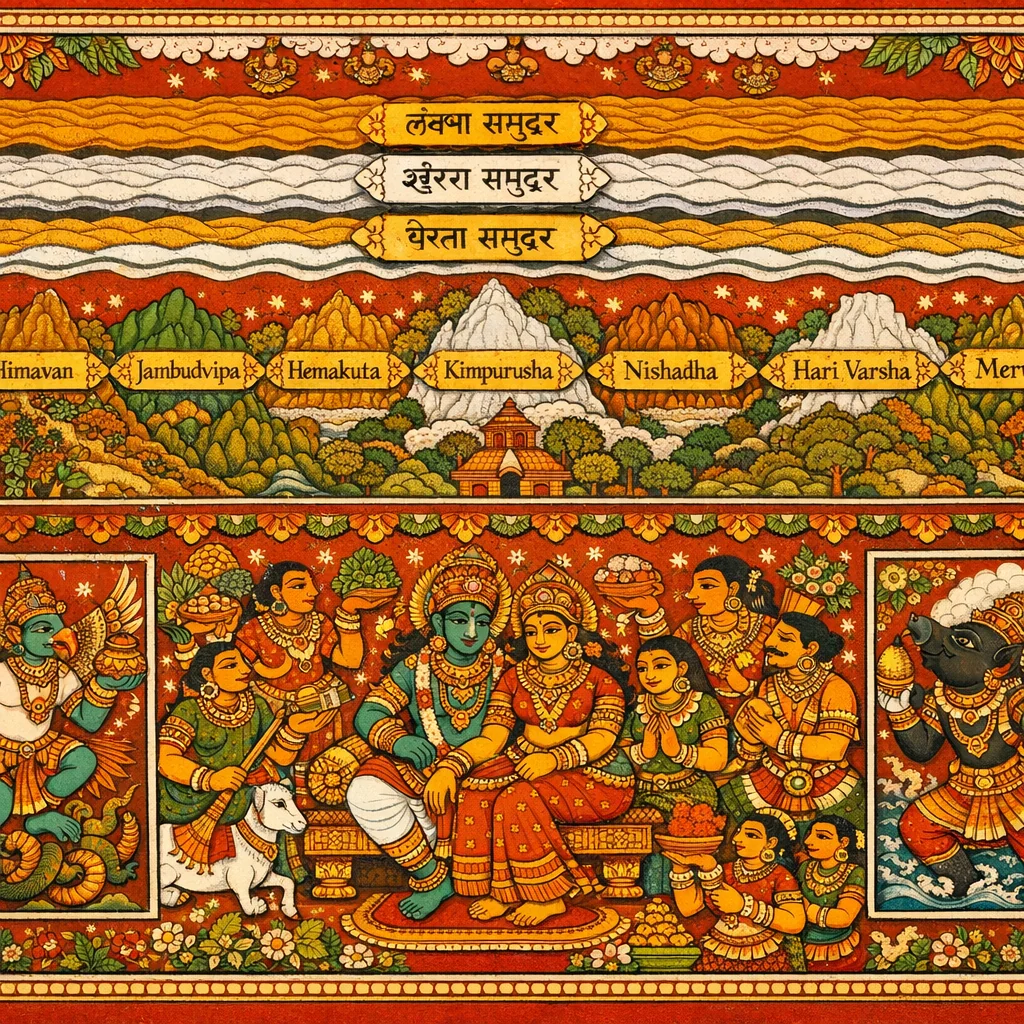
Adhyaya 122: Cosmography of Śākadvīpa and Successive Dvīpas: Mountains, Varṣas, Rivers, and Ideal Time
शाकद्वीप-कुशद्वीप-क्रौञ्चद्वीप-शाल्मलद्वीपवर्णनम्
Speaker: Sūta, Twice-born sages (Dvija-uttamas)
Sūta, addressing the assembled twice-born, continues the bhuvanakośa account: he first fixes Śākadvīpa’s dimensions in relation to Jambūdvīpa, then lists its mountain system, the varṣa names (often given in paired forms), the central Śāka tree with its celestial inhabitants, and the seven river-forms identified with the Gaṅgā. He then proceeds in order to Kuśadvīpa—encircled by the Kṣīroda (milk ocean), with gem-bearing mountains, varṣas, and double-named rivers—then to Krauñcadvīpa, and finally begins Śālmalīdvīpa. The chapter highlights the recurring pattern: measures doubling from dvīpa to dvīpa, sevenfold mountain/varṣa/river schemes, and the dharmic, utopian character of the inhabitants.
Key Concepts
Shlokas in Adhyaya 122
Verse 1
*सूत उवाच शाकद्वीपस्य वक्ष्यामि यथावदिह निश्चयम् कथ्यमानं निबोध त्वं शाकं द्वीपं द्विजोत्तमाः //
Sūta said: “I shall now explain, in proper order and with certainty, the established account of Śākadvīpa. O best of the twice-born, listen attentively as I describe the continent called Śāka.”
Verse 2
जम्बूद्वीपस्य विस्ताराद् द्विगुणस्तस्य विस्तरः विस्तारात्त्रिगुणश्चापि परिणाहः समन्ततः //
Compared to the extent (length) of Jambūdvīpa, its breadth is twice that measure; and its circumference on all sides is said to be three times its extent.
Verse 3
तेनावृतः समुद्रो ऽयं द्वीपेन लवणोदधिः तत्र पुण्या जनपदाश् चिराच्च म्रियते जनः //
Encircled by that island-continent, this salt ocean is enclosed. There, the settled regions are holy, and people die only after a very long span of life.
Verse 4
कुत एव च दुर्भिक्षं क्षमातेजोयुतेष्विह तत्रापि पर्वताः शुभ्राः सप्तैव मणिभूषिताः //
How could there be any famine here, in a realm endowed with the splendor of the earth’s sustaining power? There too are seven radiant white mountains, adorned with gems.
Verse 5
शाकद्वीपादिषु त्वेषु सप्त सप्त नगास् त्रिषु ऋज्वायताः प्रतिदिशं निविष्टा वर्षपर्वताः //
In Śākadvīpa and the other continents, in each of the three divisions there are seven and seven mountain ranges—straight and extended—set in place toward every direction; these are the Varṣa-mountains that mark off the regions.
Verse 6
रत्नाकरादिनामानः सानुमन्तो महाचिताः समोदिताः प्रतिदिशं द्वीपविस्तारमानतः //
They bear names beginning with Ratnākara; they are furnished with ridges and lofty peaks, rich in great and splendid features, and are described in every direction according to the measured extent of the dvīpas (island-continents).
Verse 7
उभयत्रावगाढौ च लवणक्षीरसागरौ शाकद्वीपे तु वक्ष्यामि सप्त दिव्यान्महाचलान् //
On both sides lie the oceans of salt and milk; and now, in regard to Śākadvīpa, I shall describe the seven divine great mountain ranges.
Verse 8
देवर्षिगन्धर्वयुतः प्रथमो मेरुरुच्यते प्रागायतः स सौवर्ण उदयो नाम पर्वतः //
The first mountain is called Meru, attended by divine seers (devarṣis) and Gandharvas. Stretching toward the east, that golden mountain is known as Udaya.
Verse 9
तत्र मेघास्तु वृष्ट्यर्थं प्रभवन्त्यपयान्ति च तस्यापरेण सुमहाञ् जलधारो महागिरिः //
There, clouds arise and pass away for the sake of rainfall; and beyond that lies a very great mountain—the mighty, water-bearing range.
Verse 10
स वै चन्द्रः समाख्यातः सर्वौषधिसमन्वितः तस्मान्नित्यमुपादत्ते वासवः परमं जलम् //
He is indeed known as Candra (the Moon), endowed with all medicinal herbs; therefore Vāsava (Indra) continually draws from him the supreme, life-giving water.
Verse 11
नारदो नाम चैवोक्तो दुर्गशैलो महाचितः तत्राचलौ समुत्पन्नौ पूर्वं नारदपर्वतौ //
O great-minded one, it is said that there was a mountain named Nārada and another called Durgaśaila. In that very place, two peaks first arose, formerly known as the twin Nārada mountains.
Verse 12
तस्यापरेण सुमहाञ् श्यामो नाम महागिरिः यत्र श्यामत्वमापन्नाः प्रजाः पूर्वमिमाः किल //
To the west of that region stands a very great mountain named Śyāma; there, it is said, these peoples of old became dark-complexioned.
Verse 13
स एव दुन्दुभिर्नाम श्यामपर्वतसंनिभः शब्दमृत्युः पुरा तस्मिन् दुन्दुभिस्ताडितः सुरैः //
That very one was named Dundubhi, dark as a blue‑black mountain. In former times he became “death by sound”: the gods struck that Dundubhi like a drum, and his thunderous roar brought terror and destruction.
Verse 14
रत्नमालान्तरमयः शाल्मलश्चान्तरालकृत् तस्यापरेण रजतो महानस्तो गिरिः स्मृतः //
Between the mountain-ranges, as though garlanded with jewels, lies the Śālmala forest forming the intervening tract; and beyond it is remembered the silver mountain called Mahānasta.
Verse 15
स वै सोमक इत्युक्तो देवैर्यत्रामृतं पुरा संभृतं च हृतं चैव मातुरर्थे गरुत्मता //
That place was indeed called “Somaka” by the gods—where, in ancient times, the amṛta, nectar of immortality, was gathered, and then also carried off by Garuḍa for the sake of his mother.
Verse 16
तस्यापरे चाम्बिकेयः सुमनाश्चैव स स्मृतः हिरण्याक्षो वराहेण तस्मिञ्छैले निषूदितः //
Among his other sons/descendants, Ambikeya and Sumanas are also remembered; and Hiraṇyākṣa was slain by Varāha—Viṣṇu in the Boar incarnation—upon that very mountain.
Verse 17
आम्बिकेयात्परो रम्यः सर्वौषधिनिषेवितः विभ्राजस्तु समाख्यातः स्फाटिकस्तु महान्गिरिः //
Beyond Ambikeya lies a delightful region, abundant in every kind of medicinal herb. There stands a great mountain known as Vibhrāja, and another mighty peak called Sphāṭika, the Crystal Mountain.
Verse 18
यस्माद्विभ्राजते वह्निर् विभ्राजस्तेन स स्मृतः सैवेह केशवेत्युक्तो यतो वायुः प्रवाति च //
Because fire shines forth (vibhrājate), he is remembered by the name Vibhrājas. And here he is also called Keśava, because from him the wind blows and moves.
Verse 19
तेषां वर्षाणि वक्ष्यामि पर्वतानां द्विजोत्तमाः शृणुध्वं नामतस्तानि यथावदनुपूर्वशः //
O best of the twice-born, I shall now describe the regions (varṣas) associated with those mountains. Listen to their names, set forth correctly and in proper sequence.
Verse 20
द्विनामान्येव वर्षाणि यथैव गिरयस्तथा उदयस्योदयं वर्षं जलधारेति विश्रुतम् //
The regions (varṣas) indeed bear two names, just as the mountains do as well. Thus the varṣa called “Udayasya Udaya” is also renowned by the name “Jaladhārā” (“the bearer of waters”).
Verse 21
नाम्ना गतभयं नाम वर्षं तत्प्रथमं स्मृतम् द्वितीयं जलधारस्य सुकुमारमिति स्मृतम् //
By name, the first region (varṣa) is remembered as Gatabhaya (“Fearless”); and the second—belonging to Jaladhārā—is remembered as Sukumāra (“Tender/Delicate”).
Verse 22
तदेव शैशिरं नाम वर्षं तत्परिकीर्तितम् नारदस्य च कौमारं तदेव च सुखोदयम् //
That very period is proclaimed as the season called Śaiśira; and for Nārada it is likewise said to be the youthful (Kaumāra) phase—indeed, the same is also termed Sukhodaya (the rise of happiness/prosperity).
Verse 23
श्यामपर्वतवर्षं तद् अनीचकम् इति स्मृतम् आनन्दकमिति प्रोक्तं तदेव मुनिभिः शुभम् //
That region known as Śyāmaparvata-varṣa is remembered by the name Anīcaka; the very same land is also called Ānandaka—so declared by the sages—as an auspicious place.
Verse 24
सोमकस्य शुभं वर्षं विज्ञेयं कुसुमोत्करम् तदेवासितम् इत्युक्तं वर्षं सोमकसंज्ञितम् //
Know the auspicious region (varṣa) of Somaka as “Kusumotkara,” the “Heap of Blossoms.” That very same land is also said to be called “Āsita”; thus it is the varṣa known by the name Somaka.
Verse 25
आम्बिकेयस्य मैनाकं क्षेमकं चैव तत्कृतम् केसरः पर्वतस्यापि महाद्रुममिति स्मृतम् तदेव धवमित्युक्तं वर्षं विभ्राजसंज्ञितम् //
For Ambikeya there is Maināka, and also Kṣemaka, made (assigned) for him. Kesara too is remembered as a mountain, and Mahādruma as well. That very (region) is also called Dhava; the varṣa is known by the name Vibhrāja.
Verse 26
द्वीपस्य परिणाहं च ह्रस्वदीर्घत्वमेव च जम्बूद्वीपेन संख्यातं तस्य मध्ये वनस्पतिः //
The girth of the continent and likewise its shorter and longer dimensions are reckoned with reference to Jambūdvīpa; and in its very center stands a great tree (the central plant).
Verse 27
शाको नाम महावृक्षः प्रजास्तस्य महानुगाः एतेषु देवगन्धर्वाः सिद्धाश्च सह चारणैः //
There is a great tree known as Śāka, and numerous beings live there as its dependents and followers. Among them dwell the divine Gandharvas, the Siddhas, and also the Cāraṇas.
Verse 28
विहरन्ति रमन्ते च दृश्यमानाश्च तैः सह तत्र पुण्या जनपदाश् चातुर्वर्ण्यसमन्विताः //
They sport and rejoice there, appearing together with them; and in that place are meritorious provinces and settlements, complete with the four varṇas (social orders).
Verse 29
तेषु नद्यश्च सप्तैव प्रतिवर्षं समुद्रगाः द्विनाम्ना चैव ताः सर्वा गङ्गाः सप्तविधाः स्मृताः //
Among them there are precisely seven rivers that, in each region, flow to the ocean. All bear two names, and they are remembered as Gaṅgā in seven distinct forms.
Verse 30
प्रथमा सुकुमारीति गङ्गा शिवजला शुभा मुनितप्ता च नाम्नैषा नदी सम्परिकीर्तिता //
This river is first proclaimed as “Sukumārī”; she is also called “Gaṅgā,” “Śiva-jalā” (Śiva’s waters), “Śubhā” (Auspicious), and “Muni-taptā” (hallowed by sages’ austerities)—by these names the river is fully celebrated.
Verse 31
सुकुमारी तपःसिद्धा द्वितीया नामतः सती नन्दा च पावनी चैव तृतीया परिकीर्तिता //
The second (goddess) is named Satī—Sukumārī, accomplished through ascetic power. The third is proclaimed as Nandā, and also as Pāvanī, the Purifier.
Verse 32
शिबिका च चतुर्थी स्याद् द्विविधा च पुनः स्मृता इक्षुश्च पञ्चमी ज्ञेया तथैव च पुनः कुहूः //
The fourth tithi (Caturthī, the fourth lunar day) is called Śibikā, and it is again remembered as being of two kinds. The fifth tithi (Pañcamī) is to be known as Ikṣu; likewise, there is also the designation Kuhū.
Verse 33
वेणुका चामृता चैव षष्ठी सम्परिकीर्तिता सुकृता च गभस्ती च सप्तमी परिकीर्तिता //
The sixth lunar day (Ṣaṣṭhī) is declared to be called Veṇukā and also Amṛtā; and the seventh lunar day (Saptamī) is proclaimed to be called Sukṛtā and also Gabhastī.
Verse 34
एताः सप्त महाभागाः प्रतिवर्षं शिवोदकाः भावयन्ति जनं सर्वं शाकद्वीपनिवासिनम् //
These seven blessed rivers/streams, whose waters are auspicious (śiva-udaka), nourish and sustain—year after year—all the people who dwell in Śākadvīpa.
Verse 35
अभिगच्छन्ति ताश्चान्या नदा नद्यः सरांसि च बहूदकपरिस्रावा यतो वर्षति वासवः //
Other rivers, streams, and lakes also flow toward those waters, becoming rich with abundant currents, from the region where Vāsava (Indra) sends down the rain.
Verse 36
तासां तु नामधेयानि परिमाणं तथैव च न शक्यं परिसंख्यातुं पुण्यास्ताः सरिदुत्तमाः //
But their names—and their extent as well—cannot be fully enumerated; those supreme rivers are holy and merit-bestowing.
Verse 37
ताः पिबन्ति सदा हृष्टा नदीर्जनपदास्तु ते एते शान्तभयाः प्रोक्ताः प्रमोदा ये च वै शिवाः //
Those regions and their people joyfully drink from the rivers at all times. These districts are declared to be free from fear—places of delight, and indeed auspicious (śiva) in nature.
Verse 38
आनन्दाश्च सुखाश्चैव क्षेमकाश्च नवैः सह वर्णाश्रमाचारयुता देशास्ते सप्त विश्रुताः //
Ānanda, Sukha, and Kṣemaka—together with nine others—are regions endowed with the observances of varṇa and āśrama; these are the seven famed lands.
Verse 39
आरोग्या बलिनश्चैव सर्वे मरणवर्जिताः अवसर्पिणी न तेष्वस्ति तथैवोत्सर्पिणी पुनः //
All of them are healthy and strong, and all are free from death. Among them there is neither avasarpiṇī, the downward course of decline, nor again utsarpiṇī, the upward course of improvement.
Verse 40
न तत्रास्ति युगावस्था चतुर्युगकृता क्वचित् त्रेतायुगसमः कालस् तथा तत्र प्रवर्तते //
There, no condition of the ages (yugas) formed as a complete cycle of the four yugas exists at any time. Rather, in that realm, time proceeds in a manner comparable to the Tretā-yuga.
Verse 41
शाकद्वीपादिषु ज्ञेयं पञ्चस्वेतेषु सर्वशः देशस्य तु विचारेण कालः स्वाभाविकः स्मृतः //
In Śākadvīpa and the other regions, throughout all these five divisions, one should understand that time is regarded as “natural”—that is, determined according to a considered assessment of the locality.
Verse 42
न तेषु संकरः कश्चिद् वर्णाश्रमकृतः क्वचित् धर्मस्य चाव्यभीचाराद् एकान्तसुखिनः प्रजाः //
Among them there was never any confusion of social and spiritual duties arising from varṇa and āśrama; and because dharma was never violated, the people lived in undisturbed, single-minded happiness.
Verse 43
न तेषु माया लोभो वा ईर्ष्यासूया भयं कुतः विपर्ययो न तेष्वस्ति तद्वै स्वाभाविकं स्मृतम् //
Among them there is neither māyā (deceit) nor greed; whence could jealousy, malice, or fear arise? In them there is no perversion of understanding—this is remembered as their natural state.
Verse 44
कालो नैव च तेष्वस्ति न दण्डो न च दाण्डिकः स्वधर्मेण च धर्मज्ञास् ते रक्षन्ति परस्परम् //
For them there is no oppressive sense of kāla (Time), no punishment, and not even a punisher; knowing dharma, they protect one another through their own svadharma, their rightful duties.
Verse 45
परिमण्डलस्तु सुमहान् द्वीपो वै कुशसंज्ञकः नदीजलैः परिवृतः पर्वतश्चाभ्रसंनिभैः //
Round in form and exceedingly vast is the continent known as Kuśa; it is encircled by the waters of its rivers and bordered by mountains that resemble masses of cloud.
Verse 46
सर्वधातुविचित्रैश्च मणिविद्रुमभूषितैः अन्यैश्च विविधाकारै रम्यैर्जनपदैस्तथा //
And the land is adorned with delightful provinces and settlements—variegated with all kinds of metals, ornamented with gems and coral, and further marked by many other beautiful forms and features.
Verse 47
वृक्षैः पुष्पफलोपेतैः सर्वतो धनधान्यवान् नित्यं पुष्पफलोपेतः सर्वरत्नसमावृतः //
Surrounded by trees laden with flowers and fruits, he becomes prosperous in wealth and grain on every side—ever endowed with blossoms and fruitfulness, and encompassed by every kind of jewel-like prosperity.
Verse 48
आवृतः पशुभिः सर्वैर् ग्राम्यारण्यैश्च सर्वशः आनुपूर्व्यात्समासेन कुशद्वीपं निबोधत //
It is filled on every side with all kinds of animals, both domesticated and wild. Now understand Kuśadvīpa in due order, briefly and in summary.
Verse 49
अथ तृतीयं वक्ष्यामि कुशद्वीपं च कृत्स्नशः कुशद्वीपेन क्षीरोदः सर्वतः परिवारितः //
Now I shall describe in full the third continent, Kuśadvīpa; and all around Kuśadvīpa lies the ocean called Kṣīroda (the Sea of Milk), encircling it on every side.
Verse 50
शाकद्वीपस्य विस्ताराद् द्विगुणेन समन्वितः तत्रापि पर्वताः सप्त विज्ञेया रत्नयोनयः //
That (next) continent is endowed with an extent twice that of Śākadvīpa; and there too are to be known seven mountains, which are sources (mines) of gems.
Verse 51
रत्नाकरास्तथा नद्यस् तेषां नामानि मे शृणु द्विनामानश्च ते सर्वे शाकद्वीपे यथा तथा //
And likewise the jewel-like seas and the rivers—listen to me as I tell their names. In Śākadvīpa, all of them are known by two names, in the manner I shall describe.
Verse 52
प्रथमः सूर्यसंकाशः कुमुदो नाम पर्वतः विद्रुमोच्चय इत्युक्तः स एव च महीधरः //
The first is the mountain named Kumuda, radiant like the sun; it is also spoken of as Vidrumoccaya (“the Coral-Peak”), and it is indeed a mighty mountain-supporter of the earth.
Verse 53
सर्वधातुमयैः शृङ्गैः शिलाजालसमन्वितैः द्वितीयः पर्वतस्तत्र उन्नतो नाम विश्रुतः //
There, the second mountain—renowned by the name Unnata—rose lofty, its peaks composed of every kind of mineral and interlaced with networks of rock.
Verse 54
हेमपर्वत इत्युक्तः स एव च महीधरः हरितालमयैः शृङ्गैर् द्वीपमावृत्य सर्वशः //
That very earth-bearing range is called Hema-parvata; with peaks made of haritāla (yellow orpiment), it encircles the island-continent on every side.
Verse 55
बलाहकस्तृतीयस्तु जात्यञ्जनमयो गिरिः द्युतिमान्नामतः प्रोक्तः स एव च महीधरः //
The third mountain is Balāhaka, said to be formed of natural añjana (collyrium). By name it is declared Dyutimān, and that very one is a great mahīdhara, a bearer of the earth.
Verse 56
चतुर्थः पर्वतो द्रोणो यत्रौषध्यो महागिरौ विशल्यकरणी चैव मृतसंजीवनी तथा //
The fourth mountain is Droṇa; upon that great peak grow the medicinal herbs—Viśalyakaraṇī, which removes missiles and pain, and Mṛtasaṃjīvanī, the life-restoring herb as well.
Verse 57
पुष्पवान्नाम सैवोक्तः पर्वतः सुमहाचितः कङ्कस्तु पञ्चमस्तेषां पर्वतो नाम सारवान् //
That great and highly renowned mountain is called Puṣpavān, as has been stated. And among them, the fifth mountain is Kaṅka, named Sāravān.
Verse 58
कुशेशय इति प्रोक्तः पुनः स पृथिवीधरः दिव्यपुष्पफलोपेतो दिव्यविरुत्समन्वितः //
Again, that earth-bearing mountain/region was declared to be called “Kuśeśaya,” endowed with divine flowers and fruits, and filled with heavenly vines and creepers.
Verse 59
षष्ठस्तु पर्वतस्तत्र महिषो मेघसंनिभः स एव तु पुनः प्रोक्तो हरिरित्यभिविश्रुतः //
There, the sixth mountain is called Mahiṣa, dark and cloud-like in appearance; and that very one is again declared to be Hari (Viṣṇu) himself, renowned by that name.
Verse 60
तस्मिन्सो ऽग्निर्निवसति महिषो नाम यो ऽप्सुजः सप्तमः पर्वतस्तत्र ककुद्मान्स हि भाषते //
There, Agni is said to dwell—as the one named Mahiṣa, born from the waters. In that same region is the seventh mountain, Kakudmān; thus it is declared.
Verse 61
मन्दरः सैव विज्ञेयः सर्वधातुमयः शुभः मन्द इत्येष यो धातुर् अपामर्थे प्रकाशकः //
That substance is to be understood as “Mandara”—auspicious and composed of all metals and minerals. The verbal root “mand” here is taught as conveying the sense of “Apāmārtha” (dispelling harm and warding off misfortune), thus indicating its protective, beneficent nature.
Verse 62
अपां विदारणाच्चैव मन्दरः स निगद्यते तत्र रत्नान्यनेकानि स्वयं रक्षति वासवः //
Because it also “splits the waters,” it is called Mandara. There, many kinds of precious jewels are found, and Vāsava (Indra) himself protects them.
Verse 63
प्रजापतिमुपादाय प्रजाभ्यो विदधत्स्वयम् तेषामन्तरविष्कम्भो द्विगुणः समुदाहृतः //
Taking Prajāpati as the archetype, and himself laying down the rule for all beings, it is declared that their inner diameter (the clear internal span) is to be twice the base measure.
Verse 64
इत्येते पर्वताः सप्त कुशद्वीपे प्रभाषिताः तेषां वर्षाणि वक्ष्यामि सप्तैव तु विभागशः //
Thus the seven mountains in Kuśadvīpa have been described. Now I shall explain, in their proper divisions, the seven regions (varṣas) of that continent.
Verse 65
कुमुदस्य स्मृतः श्वेत उन्नतश्चेव स स्मृतः उन्नतस्य तु विज्ञेयं वर्षं लोहितसंज्ञकम् //
For the type called Kumuda, the color is remembered as white, and it is also described as “raised” (unnata). But for the type called Unnata, one should understand the corresponding varṣa-category to bear the designation “Lohita” (red).
Verse 66
वेणुमण्डलकं चैव तथैव परिकीर्तितम् बलाहकस्य जीमूतः स्वैरथाकारमित्यपि //
“Veṇumaṇḍalaka” is also mentioned in the same way. Likewise, forms are described as “Balāhaka,” “Jīmūta,” and also “Svairathākāra.”
Verse 67
द्रोणस्य हरिकं नाम लवणं च पुनः स्मृतम् कङ्कस्यापि ककुन् नाम धृतिमच्चैव तत्स्मृतम् //
For Droṇa, the names remembered are Harika and again Lavaṇa. For Kaṅka too, the name Kakun is recalled, and likewise the epithet Dhṛtimat is remembered.
Verse 68
महिषं महिषस्यापि पुनश्चापि प्रभाकरम् ककुद्मिनस्तु तद्वर्षं कपिलं नाम विश्रुतम् //
That region is also called Mahiṣa, again Mahiṣasya, and again Prabhākara; and the varṣa belonging to Kakudmin is renowned by the name Kapila.
Verse 69
एतान्यपि विशिष्टानि सप्त सप्त पृथक्पृथक् वर्षाणि पर्वताश्चैव नदीस्तेषु निबोधत //
Learn also of these distinguished sets—seven and seven, each separately: the regions (varṣas), the mountains, and the rivers that belong to them.
Verse 70
तत्रापि नद्यः सप्तैव प्रतिवर्षं हि ताः स्मृताः द्विनामवत्यस्ताः सर्वाः सर्वाः पुण्यजलाः स्मृताः //
There too, the rivers are remembered as just seven in each varṣa, recurring year after year. All of them bear double names, and all are regarded as waters of sacred merit.
Verse 71
धूतपापा नदी नाम योनिश्चैव पुनः स्मृता सीता द्वितीया विज्ञेया सा चैव हि निशा स्मृता //
A river is known as Dhūtapāpā (“the washer-away of sins”); it is also remembered again by the name Yonī. The second is to be understood as Sītā, and that same one is also remembered as Niśā.
Verse 72
पवित्रा तृतीया विज्ञेया वितृष्णापि च या पुनः चतुर्थी ह्लादिनीत्युक्ता चन्द्रभा इति च स्मृता //
Know the third as Pavitrā (the Purifying one) and also as Vitṛṣṇā (the Thirstless/Desireless). Again, the fourth is said to be Hlādinī (the Gladdening one) and is also remembered as Candrabhā (Moon-lustrous).
Verse 73
विद्युच्च पञ्चमी प्रोक्ता शुक्ला चैव विभाव्यते पुण्ड्रा षष्ठी तु विज्ञेया पुनश्चैव विभावरी //
The fifth lunar day (Pañcamī) is declared to be “Vidyut,” and it is to be regarded as auspicious and bright. The sixth lunar day (Ṣaṣṭhī) should be known as “Puṇḍrā,” and again it is also called “Vibhāvarī.”
Verse 74
महती सप्तमी प्रोक्ता पुनश्चैषा धृतिः स्मृता अन्यास्ताभ्यो ऽपि संजाताः शतशो ऽथ सहस्रशः //
The observance called Mahatī-Saptamī has been taught; and this same observance is also remembered as Dhṛti. From these, moreover, many other variant observances have arisen—by the hundreds and even by the thousands.
Verse 75
अभिगच्छन्ति ता नद्यो यतो वर्षति वासवः इत्येष संनिवेशो वः कुशद्वीपस्य वर्णितः //
Those rivers flow toward the region where Vāsava (Indra) sends down the rain. Thus the arrangement and disposition of Kuśadvīpa has been described to you.
Verse 76
शाकद्वीपेन विस्तारः प्रोक्तस्तस्य सनातनः कुशद्वीपः समुद्रेण घृतमण्डोदकेन च //
Thus has been declared the ancient (traditional) extent of Śākadvīpa. And Kuśadvīpa, too, is encircled by an ocean whose waters are like ghṛta (clarified butter) blended with its rich creamy essence.
Verse 77
सर्वतः सुमहान्द्वीपश् चन्द्रवत्परिवेष्टितः विस्तारान्मण्डलाच्चैव क्षीरोदाद्द्विगुणो मतः //
On every side there is a very great continent, encircled like the moon by a surrounding ring; in both its breadth and its circular extent, it is understood to be twice the measure of the Ocean of Milk (Kṣīroda).
Verse 78
ततः परं प्रवक्ष्यामि क्रौञ्चद्वीपं यथा तथा कुशद्वीपस्य विस्ताराद् द्विगुणस्तस्य विस्तरः //
Next, I shall explain Krauñcadvīpa in proper order; its extent is said to be twice the breadth of Kuśadvīpa.
Verse 79
घृतोदकः समुद्रो वै क्रौञ्चद्वीपेन संवृतः चक्रनेमिप्रमाणेन वृतो वृत्तेन सर्वशः //
Indeed, the ocean of ghee-like waters encloses Krauñcadvīpa; and on all sides it is bounded in a circle, measured in extent like the rim of a wheel.
Verse 80
तस्मिन्द्वीपे नगाः श्रेष्ठा देवनो गिरिरुच्यते देवनात्परतश्चापि गोविन्दो नाम पर्वतः //
In that island-continent, among the foremost mountains, one is spoken of as Devana; and beyond Devana there is also a mountain named Govinda.
Verse 81
गोविन्दात्परतश्चापि क्रौञ्चस्तु प्रथमो गिरिः क्रौञ्चात्परे पावनकः पावनादन्धकारकः //
Beyond Govinda Mountain lies Krauñca, the first of those peaks. Beyond Krauñca is Pāvanaka, and beyond Pāvanaka is Andhakāraka.
Verse 82
अन्धकारात्परे चापि देवावृन् नाम पर्वतः देवावृतः परेणापि पुण्डरीको महान्गिरिः //
Beyond the region called ‘Darkness’ (Andhakāra) there is a mountain named Devāvṛn; and beyond Devāvṛta again stands the great mountain Puṇḍarīka.
Verse 83
एते रत्नमयाः सप्त क्रौञ्चद्वीपस्य पर्वताः परस्परस्य द्विगुणो विष्कम्भो वर्षपर्वतः //
These are the seven jewel-formed mountains of Krauñca-dvīpa; the breadth of each successive Varṣa-mountain is twice that of the one before it.
Verse 84
वर्षाणि तस्य वक्ष्यामि नामतस्तु निबोधत क्रौञ्चस्य कुशलो देशो वामनस्य मनोनुगः //
Now I shall declare the varṣas (territorial regions) of that land, together with their names—listen with attention. There is the prosperous region of Krauñca, and also the region called Vāmana, delightful and agreeable to the mind.
Verse 85
मनोनुगात्परे चोष्णास् तृतीयो ऽपि स उच्यते उष्णात्परे पावनकः पावनादन्धकारकः //
Beyond “Manonuga” (the mind-following region) is “Uṣṇā” (Heat), which is also spoken of as the third. Beyond Heat comes “Pāvanaka” (Wind), and beyond Wind comes “Andhakāraka” (Darkness).
Verse 86
अन्धकारकदेशात्तु मुनिदेशस्तथा परः मुनिदेशात्परे चापि प्रोच्यते दुन्दुभिस्वनः //
Beyond the region called Andhakāraka lies the tract known as Munideśa; and beyond Munideśa again is declared the region called Dundubhisvana—“the reverberation of the drum.”
Verse 87
सिद्धचारणसंकीर्णो गौरप्रायः शुचिर्जनः श्रुतास्तत्रैव नद्यस्तु प्रतिवर्षं गताः शुभाः //
That sacred place is thronged with Siddhas and Cāraṇas; the people there are mostly fair-complexioned and pure. It is also heard that the rivers there become auspicious as they flow on, year after year.
Verse 88
गौरी कुमुद्वती चैव संध्या रात्रिर्मनोजवा ख्याती च पुण्डरीका च गङ्गा सप्तविधा स्मृता //
Gaṅgā is remembered as sevenfold: Gaurī, Kumudvatī, Saṃdhyā, Rātri, Manojavā, Khyātī, and Puṇḍarīkā.
Verse 89
तासां सहस्रशश्चान्या नद्यः पार्श्वसमीपगाः अभिगच्छन्ति ता नद्यो बहुलाश्च बहूदकाः //
And in their thousands, other rivers—running close alongside—flow into those rivers; they are many in number and rich in waters.
Verse 90
तेषां निसर्गो देशानाम् आनुपूर्व्येण सर्वशः न शक्यो विस्तराद्वक्तुम् अपि वर्षशतैरपि //
The full account of the origins and orderly arrangement of those regions—everywhere and in proper sequence—cannot be explained in detail, even in a hundred years.
Verse 91
सर्गो यश्च प्रजानां तु संहारो यश्च तेषु वै अत ऊर्ध्वं प्रवक्ष्यामि शाल्मलस्य निबोधत //
Both the creation of beings and their dissolution as well—now, from this point onward, I shall explain the account of the Śālmalī tree; listen and understand.
Verse 92
शाल्मलो द्विगुणो द्वीपः क्रौञ्चद्वीपस्य विस्तरात् परिवार्य समुद्रं तु दधिमण्डोदकं स्थितः //
Śālmala-dvīpa is twice the extent of Krauñca-dvīpa; and surrounding it lies the ocean whose waters are like dadhimaṇḍa (the whey or thin buttermilk of curd).
Verse 93
तत्र पुण्या जनपदाश् चिराच्च म्रियते जनः कुत एव तु दुर्भिक्षं क्षमातेजोयुता हि ते //
In that land, the provinces are meritorious and auspicious; people die only after a long span. How could famine arise there at all? For those regions are endowed with the splendour and power of fertile, life-sustaining soil.
Verse 94
प्रथमः सूर्यसंकाशः सुमना नाम पर्वतः पीतस्तु मध्यमश्चासीत् ततः कुम्भमयो गिरिः //
The first mountain, radiant like the sun, was named Sumanā. The middle one was yellow in hue; after that came the mountain called Kumbhamaya.
Verse 95
नाम्ना सर्वसुखो नाम दिव्यौषधिसमन्वितः तृतीयश्चैव सौवर्णो भृङ्गपत्त्रनिभो गिरिः //
The mountain known as Sarvasukha is endowed with divine medicinal herbs; and the third is Sauvarṇa, a mountain whose appearance is like the leaf of the bhṛṅga plant.
Verse 96
सुमहान्रोहितो नाम दिव्यो गिरिवरो हि सः सुमनाः कुशलो देशः सुखोदर्कः सुखोदयः //
There is a splendid mountain-king named Sumahānrohita, truly divine in nature. The surrounding land is upright and well ordered—bringing a happy outcome and the rise of prosperity.
Verse 97
रोहितो यस्तृतीयस्तु रोहिणो नाम विश्रुतः तत्र रत्नान्यनेकानि स्वयं रक्षति वासवः //
The third region is Rohita, renowned by the name Rohiṇa. There, many kinds of jewels are found, and Vāsava (Indra) himself guards them.
Verse 98
प्रजापतिमुपादाय प्रसन्नो विदधत्स्वयम् न तत्र मेघा वर्षन्ति शीतोष्णं च न तद्विधम् //
Taking Prajāpati (Prajāpati) into Himself, the Lord—well pleased—personally established the order of all things. In that realm the clouds do not rain, and there is neither cold nor heat of the ordinary kind.
Verse 99
वर्णाश्रमाणां वार्त्ता वा त्रिषु द्वीपेषु विद्यते न ग्रहो न च चन्द्रो ऽस्ति ईर्ष्यासूया भयं तथा //
In those three dvīpas there is no talk at all of varṇa and āśrama (social orders and stages of life). There is neither planet nor moon there; likewise, envy, malice, and fear do not exist.
Verse 100
उद्भिदान्युदकान्यत्र गिरिप्रस्रवणानि च भोजनं षड्रसं तत्र तेषां स्वयमुपस्थितम् //
There, plants and waters abound, and mountain springs flow forth; and for them, food of all six tastes (ṣaḍ-rasa) presents itself spontaneously.
Verse 101
अधमोत्तमं न तेष्वस्ति न लोभो न परिग्रहः आरोग्यबलवन्तश्च एकान्तसुखिनो नराः //
Among them there is no sense of ‘low’ or ‘high’; there is neither greed nor hoarding. Those people are healthy and strong, and they dwell in undisturbed, inward contentment.
Verse 102
त्रिंशद्वर्षसहस्राणि मानसीं सिद्धिमास्थिताः सुखमायुश्च रूपं च धर्मैश्वर्यं तथैव च //
For thirty thousand years they remain established in mental perfection (mānasī siddhi), enjoying happiness, long life, beauty, and likewise the prosperity that comes through dharma.
Verse 103
शाल्मलान्तेषु विज्ञेयं द्वीपेषु त्रिषु सर्वतः व्याख्यातः शाल्मलान्तानां द्वीपानां तु विधिः शुभः //
Thus, in every respect, what is to be understood concerning the three Śālmalānta islands has been explained; indeed, the auspicious ordinance and account of the Śālmalānta dvīpas has been set forth.
Verse 104
परिमण्डलस्तु द्वीपस्य चक्रवत्परिवेष्टितः सुरोदेन समुद्रेण द्विगुणेन समन्वितः //
That island-continent is circular in form, encircled like a wheel, and it is surrounded by the Suroda Ocean, whose expanse is twice that of the island.
Frequently Asked Questions
The chapter’s primary instruction is cosmographical: it lays out a repeatable purāṇic template for mapping dvīpas—each with proportional dimensions, seven principal mountains, seven varṣa divisions (often with double names), and seven sacred rivers identified as forms of Gaṅgā. Alongside geography, it teaches a dharma-ideal: when dharma is unviolated, societies become fear-free, famine-free, long-lived, and orderly, and even time is experienced differently (Śākadvīpa resembling Tretā-yuga).
This adhyāya is primarily sṛṣṭi/cosmography (bhuvanakośa): dvīpas, oceans, mountains, varṣas, and rivers. Dharma appears as social-ethical description—harmonious varṇa-āśrama conduct, absence of greed/deceit, and localized ‘natural’ time. Genealogical lists and Vastu/temple-architecture rules are not the focus here, though mythic episodes (Garuḍa and amṛta; Varāha and Hiraṇyākṣa) function as narrative anchors within the geography.