Adhyaya 55
अर्जुनस्य शीघ्रप्रयाणं भीम-शकुनियुद्धं च (Arjuna’s Rapid Advance and the Bhīma–Śakuni Encounter)
Upa-parva: Arjuna’s Advance to Bhīma; Bhīma–Śakuni Engagement (Context Unit)
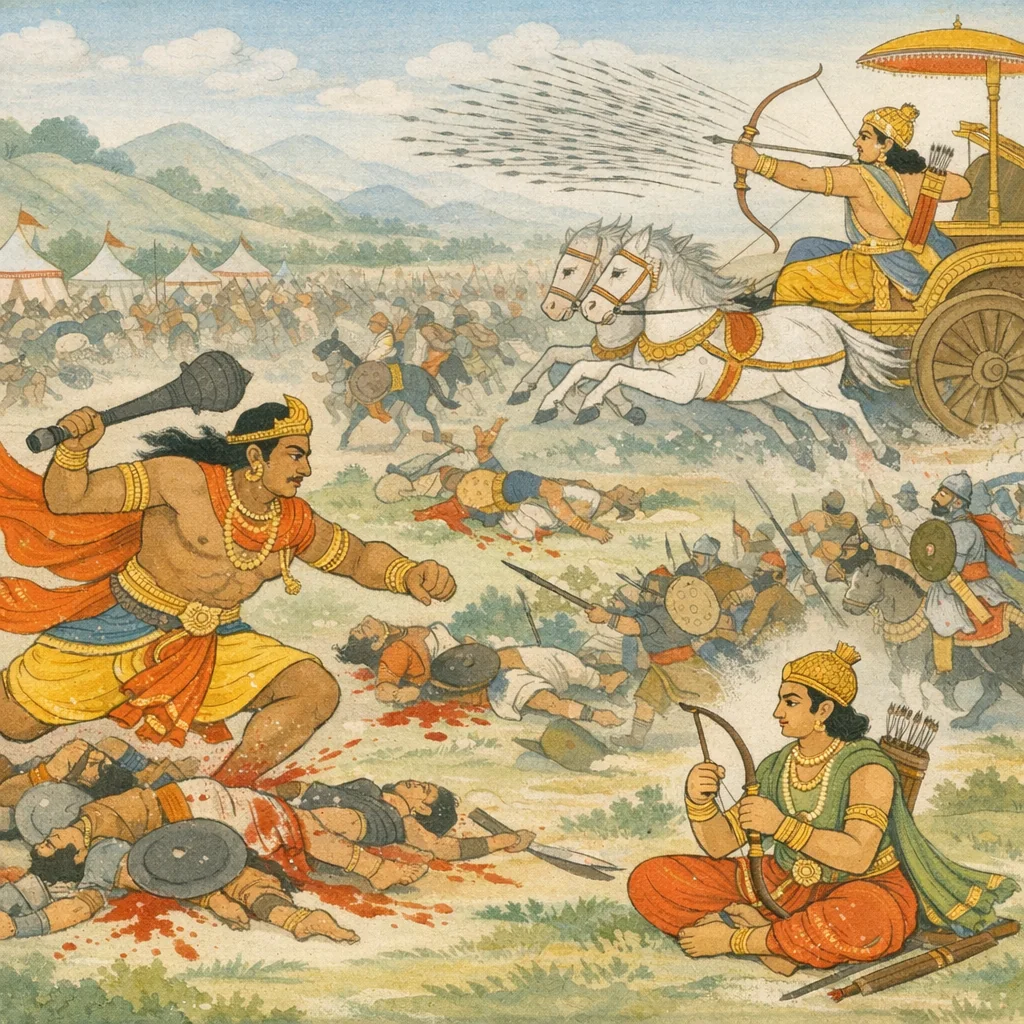
Sañjaya reports that Arjuna, hearing the thunder of chariots and lion-like roars in battle, instructs Govinda (Kṛṣṇa) to drive the horses swiftly toward the sector where Bhīma is stationed (1–2). Arjuna advances with overwhelming martial momentum, cutting down weapons, standards, and formations; Kaurava units surge and then fracture under his arrows (3–22). Hearing Arjuna’s approach, Bhīma is heartened and intensifies his assault, dispersing the opposing host as if a storm scatters clouds; the text uses extended imagery of a ‘river of blood’ and deathward current to represent mass casualty and panic-driven movement (23–43). Observing Bhīma’s effect, Duryodhana orders all forces to prioritize Bhīma’s neutralization, asserting that Bhīma’s fall would imply the collapse of the whole Pandava cause (44–31). Śakuni advances with support, checks Bhīma, and exchanges missile attacks: Śakuni strikes Bhīma, Bhīma counters by damaging Śakuni’s equipment; a thrown śakti is seized and returned, wounding Bhīma’s left arm; Bhīma retaliates by killing Śakuni’s horses, charioteer, and cutting the standard (47–62). Śakuni is rendered incapacitated and is removed by Duryodhana’s forces; Kaurava troops flee in fear, later rallying around Karṇa as a stabilizing refuge and returning to fight with renewed confidence (63–73). The chapter’s thematic center is the interaction of speed, audibility, and reputation in shaping battlefield cohesion and ethical self-conception under kṣātra-dharma.
Chapter Arc: संजय धृतराष्ट्र से कहते हैं—पांचाल, चेदि और केकय वीरों से घिरे भीमसेन को स्वयं वैकर्तन कर्ण अपने बाण-जाल से रोक देता है; रणभूमि में एक क्षण को लगता है मानो भीम की प्रचण्ड गति भी थम जाएगी। → भीम कर्ण को छोड़कर कौरव-सेना में आग की तरह घुस पड़ता है और जहाँ-जहाँ जाता है, पंक्तियाँ टूटती जाती हैं। उधर सूतपुत्र कर्ण भी पीछे नहीं रहता—वह पांचाल, केकय और सृञ्जय धनुर्धरों पर सहस्रों बाण बरसाकर उन्हें काटता चलता है। आकाश बाणों से ढँक जाता है; रथ, घोड़े, हाथी और पैदल—सब ओर संहार का कोलाहल फैलता है। → धृष्टद्युम्न का धनुष कटता है, पर वह कटे धनुष को फेंककर वेग से नया, भार-सह धनुष उठा लेता है और युद्ध-धारा को थामने का प्रयास करता है; उसी बीच कर्ण का प्रचण्ड प्रहार हजारों युद्धविशारदों को धराशायी कर देता है और सेना रक्त-प्रवाह में डूबती-सी दिखती है। → दिन का यह खण्ड निर्णायक द्वंद्व से अधिक ‘समूह-वध’ और ‘पंक्ति-भंग’ का बन जाता है—भीम की धधकती धावा-रेखा और कर्ण की बाण-वृष्टि, दोनों मिलकर रण को महाकदन में बदल देते हैं; कोई एक पक्ष स्थायी बढ़त नहीं बना पाता, पर कौरव-पक्ष की मारक क्षमता कर्ण के कारण भयावह रूप से प्रकट होती है। → इसी उथल-पुथल में अर्जुन के रण-प्रवेश का संकेत मिलता है; उसे सेना में घुसा देख दुर्योधन फिर ‘संशप्तक’ दल को उकसाता है—अगला टकराव अब अर्जुन-केंद्रित होने को है।
Shlokas
Verse 2
संजय कहते हैं--राजन्! पांचालों, चेदियों और केकयोंसे घिरे हुए भीमसेनको स्वयं वैकर्तन कर्णने बाणोंद्वारा अवरुद्ध करके उन्हें आगे बढ़नेसे रोक दिया ।। ततस्तु चेदिकारूषान् सृज्जयांश्न महारथान् । कर्णो जघान समरे भीमसेनस्य पश्यत:,तदनन्तर समरांगणमें कर्णने भीमसेनके देखते-देखते चेदि, कारूष और सूंजय महारथियोंका संहार आरम्भ कर दिया
Sanjaya said: O King, though Bhimasena was surrounded by the Panchalas, the Cedis, the Karushas, and the Kekayas, Karna—son of the charioteer (Vaikartana)—checked him with a dense shower of arrows and stopped his advance. Then, right on the battlefield and in Bhima’s very sight, Karna struck down the great chariot-warriors of the Cedis, the Karushas, and the Sṛñjayas, beginning a ruthless slaughter. The scene underscores the grim ethics of war: valor and tactical mastery can turn into relentless destruction when the aim is victory rather than restraint.
Verse 3
भीमसेनस्तत: कर्ण विहाय रथसत्तमम् | प्रययौ कौरवं सैन्यं कक्षमग्निरिव ज्वलन्,तब भीमसेनने भी रथियोंमें श्रेष्ठ कर्णको छोड़कर जैसे आग घास-फूँसको जलाती है, उसी प्रकार कौरव-सेनाको दग्ध करनेके लिये उसपर आक्रमण किया
Sañjaya said: Then Bhīmasena, leaving aside Karṇa—the foremost of chariot-warriors—advanced against the Kaurava host, blazing like a fire that consumes dry brush. The scene underscores Bhīma’s single-minded martial resolve: even while a principal rival remains, he turns to the wider duty of breaking the enemy formation and burning down its fighting strength.
Verse 4
सूतपुत्रो5पि समरे पञ्चालान् केकयांस्तथा । सृञ्जयांश्व महेष्वासानू निजघान सहस्रश:,सूतपुत्र कर्णने समरांगणमें सहस्रों पांचाल, केकय तथा सूंजय योद्धाओंको, जो महाधनुर्धर थे, मार डाला
Sañjaya said: In the thick of battle, Karṇa—though known as the charioteer’s son—cut down the Pāñcālas, the Kekayas, and the Sṛñjayas, mighty archers all, by the thousand. The verse underscores the grim momentum of war: prowess and fury eclipse lineage, while mass slaughter becomes the tragic measure of victory.
Verse 5
संशप्तकेषु पार्थश्ष॒ कौरवेषु वृकोदर: । पज्चालेषु तथा कर्ण: क्षयं चक्रुर्महारथा:,अर्जुन संशप्तकोंकी, भीमसेन कौरवोंकी तथा कर्ण पांचालोंकी सेनामें घुसकर युद्ध करते थे! इन तीनों महारथियोंने बहुत-से शत्रुओंका संहार कर डाला
Sañjaya said: Arjuna engaged the Saṁśaptakas, Bhīma (Vṛkodara) drove into the Kaurava ranks, and Karṇa likewise plunged into the Pāñcāla host. Those three great chariot-warriors wrought vast destruction among their enemies, deepening the day’s slaughter and the moral weight of duty-bound, relentless violence.
Verse 6
ते क्षत्रिया दहामानास्त्रिभिस्तै: पावकोपमै: । जम्मुर्विनाशं समरे राजन दुर्मन्त्रिते तव,अग्निके समान तेजस्वी इन तीनों वीरोंद्वारा दग्ध होते हुए क्षत्रिय समरांगणमें विनाशको प्राप्त हो रहे थे। राजन! यह सब आपकी कुमन्त्रणाका फल है
Sañjaya said: Those kṣatriya warriors, burned by those three heroes—blazing like fire—were meeting destruction on the battlefield. O King, this calamity is the consequence of your ill counsel and misguided policy.
Verse 7
ततो दुर्योधन: क्रुद्धो नकुलं नवभि: शरै: । विव्याध भरतश्रेष्ठ चतुरश्चास्य वाजिन:,भरतश्रेष्ठ! तब दुर्योधनने कुपित होकर नौ बाणोंसे नकुल तथा उनके चारों घोड़ोंको घायल कर दिया
Sañjaya said: Then Duryodhana, inflamed with anger, pierced Nakula with nine arrows; and, O best of the Bharatas, he also wounded Nakula’s four horses.
Verse 8
ततः पुनरमेयात्मा तव पुत्रो जनाधिप । क्षुरेण सहदेवस्य ध्वजं चिच्छेद काउ्चनम्,जनेश्वरर इसके बाद अमेय आत्मबलसे सम्पन्न आपके पुत्रने एक क्षुरके द्वारा सहदेवकी सुवर्णमयी ध्वजा काट डाली
Sañjaya said: Then again, O lord of men, your son—of immeasurable spirit—severed Sahadeva’s golden banner with a razor-edged weapon.
Verse 9
नकुलस्तु ततः क्रुद्धस्तव पुत्र च सप्तभि: । जघान समरे राजन् सहदेवश्व पठ्चभि:,राजन! तत्पश्चात् समरभूमिमें आपके पुत्रको क्रोधमें भरे हुए नकुलने सात और सहदेवने पाँच बाण मारे
Sañjaya said: Then Nakula, inflamed with anger, struck your son in the battle with seven arrows; and Sahadeva struck him with five, O King.
Verse 10
तावुभौ भरतश्रेष्ठी ज्येष्ठी सर्वधनुष्मताम् । विव्याधोरसि संक्रुद्ध: पज्चभि: पठ्चभि: शरै:,वे दोनों श्रेष्ठ वीर समस्त धनुर्धारियोंमें प्रधान थे। दुर्योधनने कुपित होकर उन दोनोंकी छातीमें पाँच-पाँच बाण मारे
Sañjaya said: Those two were the foremost among the Bharatas, preeminent among all who bore the bow. Enraged, Duryodhana pierced each of them in the chest with five arrows.
Verse 11
ततो<पराभ्यां भल्लाभ्यां धनुषी समकृन्तत । यमयो: सहसा राजन विव्याध च त्रिसप्तभि:,राजन्! फिर सहसा उसने दो भल्लोंसे नकुल और सहदेवके धनुष काट डाले तथा उन दोनोंको भी इकक््कीस बाणोंसे घायल कर दिया
Sañjaya said: Then, O King, with two sharp bhalla arrows he swiftly cut the bows of the twin brothers, and in that same instant pierced both of them with twenty-one shafts.
Verse 12
तावन्ये धनुषी श्रेष्ठे शक्रचापनिभे शुभे । प्रगृह्म रेजतुः शूरौ देवपुत्रसमौ युधि,फिर वे दोनों वीर इन्द्रधनुषके समान सुन्दर दूसरे श्रेष्ठ धनुष लेकर युद्धस्थलमें देवकुमारोंके समान सुशोभित होने लगे
Sañjaya said: Then those two heroes took up other excellent bows—auspicious and beautiful, like Indra’s bow—and on the battlefield they shone like the sons of the gods, resuming the fight with undiminished resolve.
Verse 13
ततस्तौ रभसोौ युद्धे भ्रातरौ भ्रातरं युधि । शरैर्ववृषतुर्घोरैर्महामेघौ यथाचलम्,तत्पश्चात् जैसे दो महामेघ किसी पर्वतपर जलकी वर्षा करते हों, उसी प्रकार दोनों वेगशाली बन्धु नकुल और सहदेव भाई दुर्योधनपर युद्धमें भयंकर बाणोंकी वृष्टि करने लगे
Sañjaya said: Then those two impetuous brothers, in the thick of battle, rained down dreadful arrows upon their brother in combat—just as two great storm-clouds pour torrents upon a mountain.
Verse 14
ततः क्रुद्धो महाराज तव पुत्रो महारथ: । पाण्डुपुत्रौ महेष्वासौ वारयामास पत्रिभि:,महाराज! तब आपके महारथी पुत्रने कुपित होकर उन दोनों महाधनुर्धर पाण्डुपुत्रोंको बाणोंद्वारा आगे बढ़नेसे रोक दिया
Sañjaya said: Then, O King, your son—the great chariot-warrior—angered, checked the advance of the two mighty bowmen, the sons of Pāṇḍu, by means of his arrows.
Verse 15
भनुर्मण्डलमेवास्य दृश्यते युधि भारत । सायकाश्रैव दृश्यन्ते निश्चरन्त: समन्ततः
Sañjaya said: “O Bhārata, in the midst of battle only the circle of his blazing radiance could be seen; and arrows alone were seen streaming forth in every direction.”
Verse 16
बाणभूते ततस्तस्मिन् संछन्ने च नभस्तले
Sañjaya said: Then, as that sky-region became as though made of arrows, and the expanse of the heavens was covered over, the battle’s violence intensified—so dense was the missile-storm that it seemed to veil the very firmament.
Verse 17
यमाभ्यां ददृशे रूपं कालान्तकयमोपमम् । उस समय जब आकाश आच्छादित होकर बाणमय हो रहा था, तब नकुल और सहदेवने आपके पुत्रका स्वरूप काल, अन्तक एवं यमराजके समान भयंकर देखा ।। पराक्रमं तु तं दृष्टवा तव सूनोर्महारथा:
Sañjaya said: When the sky was veiled and seemed to turn into a rain of arrows, Nakula and Sahadeva beheld your son’s form as terrifying—like Time itself, like Death, like Yama. Yet, seeing the prowess of your son, the great chariot-warriors… (the narration continues).
Verse 18
ततः: सेनापती राजन् पाण्डवस्य महारथ:
Sañjaya said: “Then, O King, the commander-in-chief of the Pāṇḍavas—a great chariot-warrior—(advanced/acted accordingly).”
Verse 19
माद्रीपुत्रो ततः शूरौ व्यतिक्रम्य महारथौ
Sañjaya said: Then the son of Mādrī, passing beyond those two heroic great chariot-warriors, pressed forward—signaling a deliberate escalation in the battle’s intensity and a warrior’s resolve to confront greater peril for the sake of his side’s cause.
Verse 20
तमविध्यदमेयात्मा तव पुत्रो हामर्षण:
Sañjaya said: Then your son—of immeasurable spirit and unable to endure an affront—struck him.
Verse 21
ततः पुनरमेयात्मा तव पुत्रो हामर्षण:
Sañjaya said: Then again, your son—of immeasurable spirit—unable to bear the affront, was stirred to renewed action.
Verse 22
तथास्य सशरं चापं हस्तावापं च मारिष
Sañjaya said: “And then, O venerable one, his bow with its arrows, and his hand-guard as well, were struck down.”
Verse 23
तदपास्य धनुश्छिन्नं पाज्चाल्य: शत्रुकर्शन:
Sañjaya said: Casting aside that bow which had been cut, the Pāñcāla warrior—an afflicter of foes—prepared to continue the fight undaunted.
Verse 24
प्रज्वलन्निव वेगेन संरम्भाद् रुधिरेक्षण:
Sañjaya said: Burning as if aflame with speed, and with eyes reddened by furious agitation, he surged forward.
Verse 25
अशोभत महेष्वासो धृष्टद्युम्न: कृतव्रण: । उस समय उनकी आँखें क्रोधसे लाल हो रही थीं। सारे शरीरमें घाव हो रहे थे; अतः वे महाथनुर्धर धृष्टद्युम्न वेगसे जलते हुए अग्निदेवके समान शोभा पा रहे थे ।। स पञठ्चदश नाराचाउ्शवसत: पन्नगानिव
Sañjaya said: Dhṛṣṭadyumna, the great archer, though covered with wounds, shone forth. In that moment his eyes were reddened with anger and his whole body bore the marks of injury; yet, rushing forward, that mighty bowman appeared radiant like a blazing fire. Then he loosed fifteen iron arrows, hissing like serpents—fierce resolve amid the brutal dharma of war, where endurance and mastered wrath become instruments of duty on the battlefield.
Verse 26
ते वर्म हेमविकृतं भित्त्वा राज्ञ: शिलाशिता:
Sañjaya said: Those stone-tipped missiles, piercing the king’s armor—wrought and adorned with gold—broke through its protection. In the brutal ethic of battlefield duty, even splendid royal defenses prove fragile before relentless force, as valor and fate drive the combatants toward their appointed end.
Verse 27
सो5तिविद्धो महाराज पुत्रस्तेडतिव्यराजत
Sañjaya said: O great king, though your son was grievously pierced (by the enemy’s weapons), he still shone with extraordinary splendor—his valor undimmed even in pain.
Verse 28
सच्छिन्नवर्मा नाराचप्रहारैर्जर्जरीकृत:
Sañjaya said: His armor had been cut to pieces, and by repeated blows of nārāca arrows he was battered and shattered—an image of how relentless violence in war strips a warrior of protection and leaves only endurance and resolve amid ruin.
Verse 29
अथीनं छिन्नधन्वानं त्वरमाणो महीपति:
Sañjaya said: The king, hurrying forward, confronted the helpless warrior whose bow had been cut down—pressing the advantage in the heat of battle, where a moment’s weakness can decide life and death.
Verse 30
तस्य ते5शो भयन् वक्त्र॑ कर्मारपरिमार्जिता:
Sañjaya said: “His teeth, in a face tightened by fear, shone with the hard, polished brightness of metal freshly burnished by a smith.”
Verse 31
तदपास्य थनुश्कछिन्नं धृष्टद्युम्नो महामना:
Sañjaya said: “Casting aside that bow, now broken, the high-souled Dhṛṣṭadyumna steadied himself to continue the fight.”
Verse 32
ततो दुर्योधनस्याश्वान् हत्वा सूतं च पठचभि:
Sañjaya said: “Then, having slain Duryodhana’s horses and also his charioteer, he struck down the remaining attendants as well.”
Verse 33
रथं सोपस्करं छत्रं शक्ति खड्गं गदां ध्वजम्
Sañjaya said: “(He took/held) the chariot complete with its fittings, the royal parasol, the spear, the sword, the mace, and the banner.”
Verse 34
तपनीयाड्दं चित्र नागं मणिमयं शुभम्
Sañjaya said: “(He beheld) a splendid, jewel-adorned, wondrous elephant, richly fashioned with gold.”
Verse 35
दुर्योधन तु विरथं छिन्नवर्मायुधं रणे
Sañjaya said: But Duryodhana, in the midst of battle, was left without his chariot—his armor and weapons cut down. The line marks the swift reversal of fortune in war and hints at the moral weight of pride meeting its consequences on the field.
Verse 36
तमारोप्य रथे राजन् दण्डधारो नराधिपम्
Sañjaya said: O King, having lifted that ruler of men onto the chariot, the bearer of the staff (the charioteer/attendant) steadied and secured him—an image of battlefield duty, where even amid violence, care for a fallen leader and the orderly conduct of one’s role are upheld.
Verse 37
कर्णस्तु सात्यकिं जित्वा राजगृद्धी महाबल:
Sañjaya said: Karṇa, of great might and driven by royal ambition, having overcome Sātyaki, pressed on—his victory serving both the immediate demands of battle and his hunger for supremacy.
Verse 38
त॑ पृष्ठतो5भ्ययात् तूर्ण शैनेयो वितुदऊछरै:
Sañjaya said: Then, swiftly closing in from behind, Śaineya pressed him hard, piercing him with a shower of arrows—an act of relentless pursuit amid the ruthless ethics of battlefield necessity.
Verse 39
वारणं जघनोपान्ते विषाणाभ्यामिव द्विप: । उस समय शिनिपौत्र सात्यकि अपने बाणोंसे कर्णको पीड़ा देते हुए तुरंत उसके पीछे- पीछे गये, मानो कोई गजराज अपने दोनों दाँतोंसे दूसरे गजराजकी जाँघोंमें चोट पहुँचाता हुआ उसका पीछा कर रहा हो ।। ३८ $ ।। स भारत महानासीद् योधानां सुमहात्मनाम्
Sañjaya said: Like a mighty elephant striking another at the haunch with its two tusks and pursuing without pause, so the pursuer closed in from behind. Thus, O Bhārata, there arose a great and terrible clash among those high-souled warriors—showing how, in war, prowess and relentless pursuit can eclipse restraint, even as each fighter remains bound to the dharma he has chosen on the battlefield.
Verse 40
न पाण्डवानां नास्माकं योध: कश्चित् पराड्मुख:
Sañjaya said: “Among the Pāṇḍavas and among our own warriors, there is not a single fighter who has turned his face away in retreat.”
Verse 41
प्रत्यदृश्यत् ततः कर्ण: पज्चालांस्त्वरितो ययौ | उस समय पाण्डवों तथा हमलोगोंमेंसे कोई भी योद्धा युद्धसे मुँह फेरकर पीछे हटता नहीं दिखायी दिया। तब कर्णने तुरंत ही पांचालोंपर आक्रमण किया ।। ४० $ ।। तस्मिन् क्षणे नरश्रेष्ठ गजवाजिजनक्षय:
Sañjaya said: Seeing that none among the Pāṇḍavas or our warriors appeared to turn back from the battle, Karṇa at once rushed swiftly against the Pāñcālas—pressing the fight forward in the unrelenting momentum of war.
Verse 42
प्रादुरासीदुभयतो राजन् मध्यगते5हनि । नरश्रेष्ठ नरेश्वर! मध्याह्नकी उस बेलामें दोनों पक्षोंके हाथी, घोड़ों और मनुष्योंका संहार होने लगा ।। पजञ्चालास्तु महाराज त्वरिता विजिगीषव:
Sañjaya said: O King, when the day had reached its middle, a fierce destruction arose on both sides. O best of men, O lord of men, at that midday hour the elephants, horses, and warriors of the two armies began to be cut down in great numbers. And the Pāñcālas, O great king, moved swiftly, intent on victory.
Verse 43
तांस्तथाधिरथि: क्रुद्धो यतमानान् मनस्विन:
Sañjaya said: Then Adhirathi’s son (Karna), angered, confronted those high-spirited warriors who were striving with all their might.
Verse 44
व्याप्रकेतुं सुशर्माणं चित्र चोग्रायुध॑ं जयम्
Sañjaya said: (He sought) to set in motion Suśarmā, along with Citra and Jaya—warriors of fierce weapons—urging them into action amid the battle’s pressing demands.
Verse 45
शुक्लं च रोचमानं च सिंहसेनं च दुर्जयम् । वह व्याप्रकेतु, सुशर्मा-, चित्र, उग्रायुध, जय, शुक्ल, रोचमान और दुर्जय वीर सिंहसेनपर जा चढ़ा || ४४ $ || ते वीरा रथमार्गेण परिवत्रुर्नरोत्तमम्
Sañjaya said: “They surrounded the foremost of men along the chariot-path—Śukla, Rocamāna, Siṃhasena, and the hard-to-conquer Durjaya.”
Verse 46
युध्यमानांस्तु तान् दूरान्मनुजेन्द्र प्रतापवान्
Sañjaya said: “O lord of men, the mighty one, seeing those warriors engaged in battle at a distance…”
Verse 47
अथापरान् महाराज सूतपुत्र: प्रतापवान्
Sañjaya said: “Then, O King, the valiant son of the charioteer turned his attention to the others as well—pressing the battle onward with undiminished prowess, in the relentless momentum of war.”
Verse 48
जिष्णुं च जिष्णुकर्माणं देवापिं भद्रमेव च,निजघान सुसंक्रुद्धश्षेदीनां च महारथान् । राजन! तत्पश्चात् क्रोधमें भरे हुए कर्णने समरांगणमें जिष्णु, जिष्णुकर्मा, देवापि, भद्र, दण्ड, चित्र, चित्रायुध, हरि, सिंहकेतु, रोचमान तथा महारथी शलभ--इन चेदिदेशीय महारथियोंका संहार कर डाला
Sañjaya said: “Then Karṇa, inflamed with fierce wrath, struck down Jiṣṇu, Jiṣṇukarmā, Devāpi, and Bhadrā, along with other great chariot-warriors of the Cedi land.”
Verse 49
दण्डं च राजन् समरे चित्र चित्रायुधं हरिम् । सिंहकेतुं रोचमानं शलभं च महारथम्
Sañjaya said: “O King, in that battle there was also Daṇḍa, and Hari—bearing wondrous, many-colored weapons—shining brightly with a lion-emblem on his banner; and Śalabha too, a great chariot-warrior.”
Verse 50
तेषामाददत: प्राणानासीदाधिरथेरवपु:
Sañjaya said: As he was taking away their lives, the very body of Ādhiratha’s son (Karna) became a fearsome instrument of death—signaling the grim momentum of battle where prowess, not pity, governs the field.
Verse 51
तत्र भारत कर्णेन मातज्ञास्ताडिता: शरै:
There, O Bhārata, the elephants were struck down by Karṇa’s arrows—an image of the battle’s ruthless intensity, where even the mightiest war-beasts fall before focused martial skill.
Verse 52
निपेतुरुरव्या समरे कर्णसायकताडिता:
Sañjaya said: In the thick of battle, the warriors—struck down by Karṇa’s arrows—fell heavily to the earth. The line underscores the grim moral weight of war: prowess and fate, once unleashed through weapons, bring swift and irreversible consequences to embodied life.
Verse 53
गजवाजिमनुष्यैश्न निपतद्धिः समन्तत:
Sañjaya said: “All around, elephants, horses, and men were falling in heaps.”
Verse 54
नैवं भीष्मो न च द्रोणो नान्ये युधि च तावका:
Sañjaya said: “Not even Bhīṣma, nor Droṇa, nor any other of your warriors in battle could act in this manner.”
Verse 55
सूतपुत्रेण नागेषु हयेषु च रथेषु च
Sañjaya said: “By the charioteer’s son (Karna), among the elephants, the horses, and the chariots as well…”
Verse 56
मृगमध्ये यथा सिंहो दृश्यते निर्भयश्वरन्,इति श्रीमहा भारते कर्णपर्वणि संकुलयुद्धे षघट्पठ्चाशत्तमो5ध्याय:
Sañjaya said: “Just as a lion is seen standing out fearlessly in the midst of deer, so did that lord appear—undaunted—amid the press of battle.”
Verse 57
यथा मृगगणांस्त्रस्तान् सिंहो द्रावयते दिश:
Sañjaya said: “Just as a lion drives frightened herds of deer into all directions, so did the mighty warrior scatter the terrified ranks—panic spreading as each sought safety wherever it could be found.”
Verse 58
सिंहास्यं च यथा प्राप्प न जीवन्ति मृगा: क्वचित्
Sañjaya said: “Just as deer, on reaching the lion’s very mouth, do not survive anywhere at all, so too those who fall into the immediate grasp of a mighty foe find no escape—an image underscoring the ruthless finality of war when strength and circumstance overwhelm prudence.”
Verse 59
वैश्वानरं यथा प्राप्य प्रतिदहाुन्ति वै जना:
Sañjaya said: “Just as people, upon encountering the blazing fire of Vaiśvānara, are scorched and burned in return, so too do those who come into contact with that consuming force meet inevitable destruction.”
Verse 60
कण्णाग्निना रणे तद्वद् दग्धा भारत सृञ्जया: । भरतनन्दन! जैसे जलती आगमें पड़ जानेपर सभी मनुष्य दग्ध हो जाते हैं, उसी प्रकार सूंजय-सैनिक रणभूमिमें कर्णरूपी अग्निसे जलकर भस्म हो गये ।। कर्णेन चेदिकैकेयपाञ्चालेषु च भारत
Sañjaya said: O Bhārata, O delight of the Bharatas—just as all people are burned when they fall into a blazing fire, so the Sṛñjaya warriors on the battlefield were scorched by Karṇa, who was like fire itself, and were reduced to ashes. And Karṇa likewise struck down the Cedis, the Kaikeyas, and the Pāñcālas as well, O Bhārata.
Verse 61
विश्राव्य नाम निहता बहव: शूरसम्मता: । भारत! कर्णने चेदि, केकय और पांचाल योद्धाओंमेंसे बहुत-से शूरसम्मत रथियोंको नाम सुनाकर मार डाला ।। मम चासीन्मती राजन् दृष्टवा कर्णस्य विक्रमम्,राजन! कर्णका पराक्रम देखकर मेरे मनमें यही निश्चय हुआ कि युद्धस्थलमें एक भी पांचाल योद्धा सूतपुत्रके हाथसे जीवित नहीं छूट सकता; क्योंकि सूतपुत्र बारंबार युद्धस्थलमें पांचालोंका ही विनाश कर रहा था
Sañjaya said: “O Bhārata, Karṇa, proclaiming their very names, struck down many warriors renowned for valor—many chariot-fighters among the Cedis, Kekayas, and Pāñcālas. Seeing Karṇa’s prowess, O King, I became convinced that on the battlefield not even a single Pāñcāla warrior would escape alive from the Sūta’s son; for again and again he was bringing about the destruction of the Pāñcālas.”
Verse 62
नैको5प्याधिरथेर्जीवन् पाज्चाल्यो मोक्ष्यते युधि । पज्चालान् व्यधमत् संख्ये सूतपुत्र: पुन: पुन:,राजन! कर्णका पराक्रम देखकर मेरे मनमें यही निश्चय हुआ कि युद्धस्थलमें एक भी पांचाल योद्धा सूतपुत्रके हाथसे जीवित नहीं छूट सकता; क्योंकि सूतपुत्र बारंबार युद्धस्थलमें पांचालोंका ही विनाश कर रहा था
Sañjaya said: “O King, seeing Karṇa’s prowess, I became convinced that not even a single Pāñcāla warrior would escape alive from the chariot-fighter (Karṇa) in battle; for the sūta’s son was again and again destroying the Pāñcālas in the thick of the fight.”
Verse 63
पज्चालानथ निष्नन्तं कर्ण दृष्टवा महारणे | अभ्यधावत् सुसंक्रुद्धों धर्मराजो युधिष्ठिर:,उस महासमरमें कर्णको पांचालोंका संहार करते देख धर्मराज युधिष्ठिरने अत्यन्त कुपित होकर उसपर धावा बोल दिया
Sañjaya said: Seeing Karṇa slaughtering the Pāñcālas in that great battle, Dharmarāja Yudhiṣṭhira—overcome with fierce anger—rushed straight at him.
Verse 64
धृष्टय्रुम्नश्व राधेयं द्रौपदेयाश्व मारिष | परिवद्वुरमित्रघ्नं शतशश्नचापरे जना:,आर्य! धृष्टद्युम्न, द्रौपदीके पुत्र तथा दूसरे सैकड़ों मनुष्य शत्रुनाशक राधापुत्र कर्णको चारों ओरसे घेरकर खड़े हो गये
Sañjaya said: “O venerable one, Dhṛṣṭadyumna and the sons of Draupadī, along with hundreds of other warriors, surrounded Rādheya (Karna), the slayer of foes, on every side.”
Verse 65
शिखण्डी सहदेवश्व नकुलो नाकुलिस्तथा । जनमेजय: शिनेर्नप्ता बहवश्न प्रभद्रका:,शिखण्डी, सहदेव, नकुल, शतानीक, जनमेजय, सात्यकि तथा बहुत-से प्रभद्रकगण-- ये सभी अमिततेजस्वी वीर युद्धस्थलमें धृष्टद्युम्मके आगे होकर बाण बरसानेवाले कर्णपर नाना प्रकारके अस्त्र-शस्त्रोंका प्रहार करते हुए विचरने लगे
Sañjaya said: Śikhaṇḍī, Sahadeva, Nakula, and Nākuḷi, along with Janamejaya—the grandson of Śini—and many Prabhadraka warriors, all heroes of immeasurable prowess, ranged over the battlefield before Dhṛṣṭadyumna, showering arrows and striking Karṇa with diverse weapons and missiles.
Verse 66
एते पुरोगमा भूत्वा धृष्टद्युम्नस्य संयुगे । कर्णमस्यन्तमिष्वस्त्रैर्विचेररमितौजस:,शिखण्डी, सहदेव, नकुल, शतानीक, जनमेजय, सात्यकि तथा बहुत-से प्रभद्रकगण-- ये सभी अमिततेजस्वी वीर युद्धस्थलमें धृष्टद्युम्मके आगे होकर बाण बरसानेवाले कर्णपर नाना प्रकारके अस्त्र-शस्त्रोंका प्रहार करते हुए विचरने लगे
Sañjaya said: Taking the lead in the battle under Dhṛṣṭadyumna’s command, those warriors of immeasurable prowess—Śikhaṇḍin, Sahadeva, Nakula, Śatānīka, Janamejaya, Sātyaki, and many companies of the Prabhadrakas—moved about the field, showering arrows and striking Karṇa with diverse weapons and missiles.
Verse 67
तांस्तत्राधिरथि: संख्ये चेदिपाउ्चालपाण्डवान् । एको बहूनभ्यपतद् गरुत्मान् पन्नगानिव,सूतपुत्रने समरांगणमें अकेला होनेपर भी जैसे गरुड़ अनेक सर्पोपर एक साथ आक्रमण करते हैं, उसी प्रकार बहुसंख्यक चेदि, पांचाल और पाण्डवोंपर आक्रमण किया
Sañjaya said: There on the battlefield, Adhirathi (Karna) alone sprang upon the many—Cedis, Pāñcālas, and the Pāṇḍavas—just as Garuḍa swoops down upon a multitude of serpents at once.
Verse 68
तै: कर्णस्याभवद् युद्ध घोररूप॑ विशाम्पते । तादृग् यादृक् पुरा वृत्तं देवानां दानवै: सह,प्रजानाथ! उन सबके साथ कर्णका वैसा ही भयानक युद्ध हुआ, जैसा पूर्वकालमें देवताओंका दानवोंके साथ हुआ था
Sañjaya said: O lord of the people, the battle that then arose around Karṇa became terrifying—like that ancient war of the gods against the Dānavas.
Verse 69
तान् समेतान् महेष्वासान् शरवर्षोचवर्षिण: । एको व्यधमददव्यग्रस्तमांसीव दिवाकर:,जैसे एक ही सूर्य सम्पूर्ण अन्धकार-राशिको नष्ट कर देते हैं, उसी प्रकार एक ही कर्णने ढेर-के-ढेर बाण-वर्षा करनेवाले उन समस्त महाधनुर्धरोंको बिना किसी व्यग्रताके नष्ट कर दिया
Sañjaya said: Those great bowmen, gathered together and pouring forth showers of arrows, were nonetheless struck down by Karṇa alone—without the least agitation—just as the sun, single-handed, dispels masses of darkness.
Verse 70
भीमसेनस्तु संसक्ते राधेये पाण्डवैः सह | सर्वतो5भ्यहनत् क्रुद्धो यमदण्डनिभै: शरैः । वाह्लीकान् केकयान् मत्स्यान् वासात्यान् मद्रसैन्धवान्
Sañjaya said: When the battle had locked Bhīmasena in close engagement with Rādheya (Karna) alongside the Pāṇḍavas, he, enraged, struck down warriors on every side with arrows like Yama’s rod of punishment. He smote the Vāhlīkas, the Kekayas, the Matsyas, the Vāsātyas, and the Madras and Sindhavas—spreading fear and retribution across the field as the fury of war eclipsed restraint.
Verse 71
एक: संख्ये महेष्वासो योधयन् बह्नशोभत । जिस समय राधापुत्र कर्ण पाण्डवोंके साथ उलझा हुआ था, उसी समय महाधनुर्धर भीमसेन क्रोधमें भरकर यमदण्डके समान भयंकर बाणोंद्वारा बाह्नीक, केकय, मत्स्य, वसातीय, मद्र तथा सिंधुदेशीय सैनिकोंका सब ओरसे संहार कर रहे थे। वे युद्धभूमिमें अकेले ही इन सबके साथ युद्ध करते हुए बड़ी शोभा पा रहे थे ।। तत्र मर्मसु भीमेन नाराचैस्ताडिता गजा:
Sañjaya said: In that battle, the great archer Bhīma fought alone and shone brilliantly. At the very time when Rādhā’s son Karṇa was locked in combat with the Pāṇḍavas, Bhīmasena—his wrath fully kindled—was cutting down on every side the Bāhlīka, Kekaya, Matsya, Vāsātīya, Madra, and Sindhu troops with dreadful arrows like the staff of Yama. Even the elephants there, struck in their vital spots by Bhīma’s iron shafts, reeled under the force of his onslaught.
Verse 72
वाजिनश्न हतारोहा: पत्तयश्ष गतासव:
Sañjaya said: The horses too were slain; their riders were struck down, and the foot-soldiers likewise fell lifeless.
Verse 73
सहस्रशश्न॒ रथिन: पातिता: पतितायुधा:
Sañjaya said: In their thousands, the chariot-warriors were struck down—fallen, with their weapons dropped.
Verse 74
रथिशि: सादिभि: सूतै: पादातैरवाजिभिग्गजै:
Sañjaya said: The battlefield was filled with chariot-warriors, with foot-soldiers, with charioteers, and with horses and elephants.
Verse 75
भीमसेन शरैश्कछिन्नैराच्छन्ना वसुधाभवत् | भीमसेनके बाणोंसे छिन्न-भिन्न हुए रथियों, घुड़सवारों, सारथियों, पैदलों, घोड़ों और हाथियोंकी लाशोंसे वहाँकी धरती आच्छादित हो गयी थी || ७४ $ ।। तत् स्तम्भितमिवातिष्ठद् भीमसेनभयार्दितम्,उस महासमरमें दुर्योधनकी सारी सेना भीमसेनके भयसे पीड़ित हो स्तब्ध-सी खड़ी थी। उत्साहशून्य, घायल, निश्रेष्ट, भयंकर और अत्यन्त दीन-सी प्रतीत होती थी
Sañjaya said: The earth was covered with those cut down by Bhīmasena’s arrows—chariot-warriors, horsemen, drivers, foot-soldiers, horses, and elephants—lying slain and mangled. In that great battle, Duryodhana’s entire host, tormented by fear of Bhīmasena, stood as if petrified—bereft of spirit, wounded, disordered, and appearing dreadful yet utterly wretched.
Verse 76
दुर्योधनबलं सर्व निरुत्साहं कृतव्रणम् निश्चैष्ट तुमुलं दीनं बभौ तस्मिन् महारणे,उस महासमरमें दुर्योधनकी सारी सेना भीमसेनके भयसे पीड़ित हो स्तब्ध-सी खड़ी थी। उत्साहशून्य, घायल, निश्रेष्ट, भयंकर और अत्यन्त दीन-सी प्रतीत होती थी
Sañjaya said: In that great battle, all of Duryodhana’s forces appeared drained of spirit and covered with wounds—motionless, thrown into confusion, and utterly dejected—paralyzed by fear of Bhīmasena.
Verse 77
प्रसन्नसलिले काले यथा स्यात् सागरो नृप । तद्धत् तव बल॑ तद् वै निश्चलं समवस्थितम्
Sañjaya said: “O King, just as the ocean becomes calm and steady when its waters are clear and the time is tranquil, so too your army—indeed that very force of yours—stands firm, unmoving and well-set.”
Verse 78
नरेश्वरर जिस समय ज्वार न उठनेसे जल स्वच्छ एवं शान्त हो, उस समय जैसे समुद्र निश्चल दिखायी देता है, उसी प्रकार आपकी सारी सेना निश्चेष्ट खड़ी थी ।। मन्युवीर्यबलोपेतं दर्पात् प्रत्यवरोपितम् । अभवत् तव पुत्रस्य तत् सैन्यं निष्प्रभं तदा,यद्यपि आपके सैनिकोंमें क्रोध, पराक्रम और बलकी कमी नहीं थी तो भी उनका घमंड चूर-चूर हो गया था; इसलिये उस समय आपके पुत्रकी वह सारी सेना तेजोहीन-सी प्रतीत होती थी
Sañjaya said: When no surge rises and the waters are clear and calm, the sea appears motionless; so too your entire army stood inert. Though your son’s host was endowed with wrath, heroism, and strength, its pride had been utterly brought down; therefore, at that time, your son’s army appeared drained of splendor.
Verse 79
तद् बल॑ भरतश्रेष्ठ वध्यमानं परस्परम् | रुधिरौघपरिक्लिन्नं रुधिरार्द्र बभूव ह
Sañjaya said: “O best of the Bharatas, that host, striking and being struck by one another, became drenched in streams of blood—soaked through and through with gore.”
Verse 80
सूतपुत्रो रणे क्रुद्ध: पाण्डवानामनीकिनीम्
Sañjaya said: In the thick of battle, the charioteer’s son Karṇa, inflamed with wrath, advanced against the Pandavas’ army.
Verse 81
वर्तमाने तथा रौद्रे संग्रामे5द्भुतदर्शने,जब इस प्रकार दिखायी देनेवाला वह भयंकर संग्राम चल ही रहा था, उस समय दूसरी ओर विजयी वीसमे | श्रेष्ठ अर्जुन सेनाके मध्यभागमें बहुत-से संशप्तकोंका संहार करके भगवान् श्रीकृष्णसे बोले--
Sañjaya said: While that dreadful battle—terrible in its fury and wondrous to behold—was still raging, the victorious hero Arjuna, foremost among warriors, having slain many of the Saṃsaptakas in the very midst of the army, addressed the Blessed Lord Śrī Kṛṣṇa.
Verse 82
निहत्य पृतनामध्ये संशप्तकगणान् बहून् । अर्जुनो जयतां श्रेष्ठो वासुदेवमथाब्रवीत्,जब इस प्रकार दिखायी देनेवाला वह भयंकर संग्राम चल ही रहा था, उस समय दूसरी ओर विजयी वीसमे | श्रेष्ठ अर्जुन सेनाके मध्यभागमें बहुत-से संशप्तकोंका संहार करके भगवान् श्रीकृष्णसे बोले--
Sañjaya said: In the midst of the army, after slaying many bands of the Saṁśaptakas, Arjuna—foremost among the victorious—then addressed Vāsudeva (Kṛṣṇa).
Verse 83
प्रभग्नं बलमेतद्धि योत्स्यमानं जनार्दन । एते द्रवन्ति सगणा: संशप्तकमहारथा:
Sañjaya said: “O Janārdana, this force has indeed been shattered even while it was still engaged in battle. Look—these great chariot-warriors of the Saṁśaptakas, along with their companies, are fleeing.”
Verse 84
दीर्यते च महत् सैन्यं सृजजयानां महारणे,“उधर वह सूृंजयोंकी विशाल सेना भी महासमरमें विदीर्ण हो रही है। श्रीकृष्ण! वह हाथीकी रस्सीके चिह्नसे युक्त बुद्धिमान् कर्णका ध्वज दिखायी दे रहा है। वह राजाओंकी सेनाके बीच सानन्द विचरण कर रहा है
Sañjaya said: “In that great battle, the vast army of the Sṛñjayas is being torn apart. O Kṛṣṇa, there appears the banner of the wise Karṇa, marked with the sign of an elephant’s tether-rope. Moving with confident delight amid the hosts of kings, it signals his dominance as the slaughter presses the righteous cause into grievous peril.”
Verse 85
हस्तिकक्षो हासौ कृष्ण केतु: कर्णस्य धीमतः । दृश्यते राजसैन्यस्य मध्ये विचरतो मुदा,“उधर वह सूृंजयोंकी विशाल सेना भी महासमरमें विदीर्ण हो रही है। श्रीकृष्ण! वह हाथीकी रस्सीके चिह्नसे युक्त बुद्धिमान् कर्णका ध्वज दिखायी दे रहा है। वह राजाओंकी सेनाके बीच सानन्द विचरण कर रहा है
Sañjaya said: “O Kṛṣṇa, that banner of the wise Karṇa—marked with the emblem of an elephant’s tethering-rope—is clearly seen. It moves about joyfully in the midst of the kings’ host, while the great battle rages and the Sṛñjaya forces are being torn apart.”
Verse 86
न च कर्ण रणे शक्ता जेतुमन्ये महारथा: । जानीते हि भवान् कर्ण वीर्यवन्तं पराक्रमे,“जनार्दन! आप तो जानते ही हैं कि कर्ण कितना बलवान् तथा पराक्रम प्रकट करनेमें समर्थ है। अतः रणभूमिमें दूसरे महारथी उसे जीत नहीं सकते हैं
Sañjaya said: “Nor are the other great chariot-warriors capable of conquering Karṇa in battle. You, O Janārdana, know well how mighty Karṇa is and how able he is to display valor. Therefore, on the battlefield the other maharathas cannot overcome him.”
Verse 87
तत्र याहि यत: कर्णो द्रावयत्येष नो बलम् । वर्जयित्वा रणे याहि सूतपुत्रं महारथम्
Sañjaya said: “Go there—where Karṇa is routing our forces. In the thick of battle, go and confront that great chariot-warrior, the son of a charioteer.”
Verse 88
एतन्मे रोचते कृष्ण यथा वा तव रोचते । “श्रीकृष्ण! जहाँ यह कर्ण हमारी सेनाको खदेड़ रहा है, वहीं चलिये। रणभूमिमें संशप्तकोंको छोड़कर अब महारथी सूतपुत्रके ही पास रथ ले चलिये। “मुझे यही ठीक जान पड़ता है अथवा आपको जैसा जँचे, वैसा कीजिये” ।। 38 कम त्वा वचस्तस्य गोविन्द: प्रहसन्निव
Sañjaya said: “This seems right to me, O Kṛṣṇa—yet do as it seems right to you. Let us go there where Karṇa is driving our army back. Leaving the Saṁsaptakas on the battlefield, now steer the chariot toward the great chariot-warrior, the charioteer’s son.”
Verse 89
ततस्तव महासैन्यं गोविन्दप्रेरिता हया:
Sañjaya said: Then, the horses—impelled by Govinda—drove your vast army onward, as if the very momentum of the battle were being directed by Kṛṣṇa’s will.
Verse 90
केशवप्रेरितैरश्वैः श्वेते: काउ्चनभूषणै:
Sañjaya said: The white horses—adorned with golden ornaments and urged onward at Keśava’s prompting—bore the chariot forward, making plain Kṛṣṇa’s guiding hand amid the war’s grave moral weight.
Verse 91
अर्जुनके द्वारा संशप्तकोंका संहार मेघस्तनितनिर्हाद: स रथो वानरध्वज:
Sañjaya said: Arjuna brought about the destruction of the Saṁsaptakas; his chariot, bearing the monkey-banner, roared like thunder from a cloud—an awe-striking sound that proclaimed relentless resolve and the grim inevitability of war’s consequences.
Verse 92
तौ विदार्य महासेनां प्रविष्टी केशवार्जुनौ
Sañjaya said: Having torn through the vast host, Keśava and Arjuna pressed deep into the enemy ranks. The line marks their resolute advance—courage and skill yoked to duty—while also hinting at war’s moral weight, where even righteous purpose moves through immense destruction.
Verse 93
युद्धशौण्डौ समाहूतावागतौ तौ रणाध्वरम्
Sañjaya said: Those two, famed for prowess in battle, having been summoned, came to the battlefield—like participants arriving at a solemn war-sacrifice—ready to fulfill the grim duty the conflict demanded.
Verse 94
क्रुद्धौं तौ तु नरव्याप्रौ वेगवन्तो बभूवतु:
Sañjaya said: Those two, like tigers among men, grew enraged and surged forward with irresistible speed—showing how wrath, once kindled in war, turns heroes into instruments of relentless momentum.
Verse 95
तलशब्देन रुषितौ यथा नागौ महावने । जैसे विशाल वनमें तालीकी आवाजसे कुपित हुए दो हाथी दौड़े आ रहे हों, उसी प्रकार क्रोधमें भरे हुए वे दोनों पुरुषसिंह बड़े वेगसे बढ़े आ रहे थे ।। ९४ $ ।। विगाहा तु रथानीकमश्चसंघांश्व फाल्गुन:
Sañjaya said: As two elephants in a vast forest, provoked by the sharp slap upon a tāla palm, come charging forward in fury, so those two lion-like heroes—filled with wrath—surged ahead with tremendous speed.
Verse 96
त॑ दृष्टवा युधि विक्रान्तं सेनायां तव भारत
Seeing him—valiant in battle—amid your army, O Bhārata, Sañjaya continued his account, marking the presence of a warrior whose prowess stood out even within the Kaurava host, thereby heightening the war’s moral and strategic tension.
Verse 97
ततो रथसहस्रेण द्विरदानां त्रिभि: शतै:,शरवर्षर्महाराज सर्वतः पाण्डुनन्दनम् । महाराज! तब एक हजार रथ, तीन सौ हाथी, चौदह हजार घोड़े और लक्ष्य वेधनेमें निपुण, सर्वत्र विख्यात एवं शौर्यसम्पन्न दो लाख पैदल सैनिक साथ लेकर संशप्तक महारथी कुन्तीकुमार पाण्डुनन्दन अर्जुनको अपने बाणोंकी वर्षासे आच्छादित करते हुए उनपर चढ़ आये
Sañjaya said: Then, O King, with a thousand chariots and three hundred elephants, they assailed Arjuna, the son of Pāṇḍu, from every side, covering him with a rain of arrows.
Verse 98
चतुर्दशसहसैौस्तु तुरगाणां महाहवे । द्वाभ्यां शतसहस्राभ्यां पदातीनां च धन्विनाम्,शरवर्षर्महाराज सर्वतः पाण्डुनन्दनम् । महाराज! तब एक हजार रथ, तीन सौ हाथी, चौदह हजार घोड़े और लक्ष्य वेधनेमें निपुण, सर्वत्र विख्यात एवं शौर्यसम्पन्न दो लाख पैदल सैनिक साथ लेकर संशप्तक महारथी कुन्तीकुमार पाण्डुनन्दन अर्जुनको अपने बाणोंकी वर्षासे आच्छादित करते हुए उनपर चढ़ आये
Sañjaya said: In that great battle, O King, with fourteen thousand horses and two hundred thousand foot-soldiers—archers—the Saṁsaptaka great chariot-warriors showered Arjuna, the son of Pāṇḍu, from every side with torrents of arrows, advancing to press the fight to its ruthless intensity.
Verse 99
शूराणां लब्धलक्ष्याणां विदितानां समन्तत: | अभ्यवर्तन्त कौन्तेयं छादयन्तो महारथा:,शरवर्षर्महाराज सर्वतः पाण्डुनन्दनम् । महाराज! तब एक हजार रथ, तीन सौ हाथी, चौदह हजार घोड़े और लक्ष्य वेधनेमें निपुण, सर्वत्र विख्यात एवं शौर्यसम्पन्न दो लाख पैदल सैनिक साथ लेकर संशप्तक महारथी कुन्तीकुमार पाण्डुनन्दन अर्जुनको अपने बाणोंकी वर्षासे आच्छादित करते हुए उनपर चढ़ आये
Sañjaya said: O King, those great chariot-warriors—valiant, sure of their aim, and renowned on every side—advanced against Kuntī’s son. From all directions they covered Arjuna, the son of Pāṇḍu, with a dense rain of arrows.
Verse 100
।। स च्छाद्यमान: समरे शरै: परबलार्दन:
Sañjaya said: And he—covered over in battle by a shower of arrows—still pressed the assault on, a destroyer of the enemy’s strength.
Verse 101
दर्शयन् रौद्रमात्मानं पाशहस्त इवान्तक: । निघ्नन् संशप्तकान् पार्थ: प्रेक्षणीयतरो5भवत्
Sañjaya said: Displaying his terrible, wrathful aspect like Death himself holding a noose, Pārtha (Arjuna) struck down the Saṃśaptakas; and in that moment he became all the more a sight to behold—awesome in power, grim in purpose, and unwavering in his vowed duty amid the slaughter of war.
Verse 102
उस समय समरांगणमें उनके बाणोंसे आच्छादित होते हुए शत्रुसैन्यसंहारक कुन्तीकुमार अर्जुन पाशधारी यमराजके समान अपना भयंकर रूप दिखाते और संशप्तकोंका वध करते हुए अत्यन्त दर्शनीय हो रहे थे ।। ततो विद्युत्प्रभैर्बाणै: कार्तस्वरविभूषितै: । निरन्तरमिवाकाशमासीच्छन्न॑ किरीटिना,तदनन्तर किरीटधारी अर्जुनके चलाये हुए विद्युतके समान प्रकाशमान सुवर्णभूषित बाणोंद्वारा आच्छादित हो आकाश ठसाठस भर गया
Sañjaya said: Then Arjuna, Kuntī’s son—the slayer of the enemy host—though covered on the battlefield by their arrows, displayed a fearsome, Yama-like aspect, and as he slew the Saṃśaptakas he became exceedingly wondrous to behold. Thereafter, by lightning-bright arrows adorned with gleaming gold, shot by Arjuna of the diadem, the sky seemed continuously covered, packed as though without a gap.
Verse 103
किरीटिभुजनिर्मुक्ति: सम्पतद्धिर्महाशरै: । समाच्छन्न॑ बभौ सर्व काद्रवेयैरिव प्रभो,प्रभो! किरीटधारी अर्जुनकी भुजाओंसे छूटकर सब ओर गिरनेवाले बड़े-बड़े बाणोंसे आवृत होकर वहाँका सारा प्रदेश सर्पोंसे व्याप्त-सा प्रतीत हो रहा था
Sañjaya said: O lord, O lord! As the great arrows, released from the arms of the diadem-wearing Arjuna, came raining down, the entire region appeared completely covered—like a place overrun by Kādraveya serpents.
Verse 104
रुक्मपुड्खान् प्रसन्नाग्रान् शरान् संनतपर्वण: । अवासृजदमेयात्मा दिक्षु सर्वासु पाण्डव:,अमेय आत्मबलसे सम्पन्न पाण्डुनन्दन अर्जुन सम्पूर्ण दिशाओंमें सुवर्णमय पंख, स्वच्छ धार और झुकी हुई गाँठवाले बाणोंकी वर्षा कर रहे थे
Sañjaya said: The Pāṇḍava—Arjuna, of immeasurable spirit—released in every direction arrows with golden fletching, bright and keen points, and well-bent joints.
Verse 105
मही वियद् दिश: सर्वा: समुद्रा गिरयोडपि वा । स्फुटन्तीति जना जज्ञुः पार्थस्य तलनि:स्वनात्,वहाँ सब लोग यही समझने लगे कि “अर्जुनके तलशब्द (हथेलीकी आवाज)-से पृथ्वी, आकाश, सम्पूर्ण दिशाएँ, समुद्र और पर्वत भी फटे जा रहे हैं!
Sañjaya said: Hearing the sharp report of Pārtha’s (Arjuna’s) clapping palms, the people believed that the earth and sky, all the directions, the oceans, and even the mountains were splitting apart.
Verse 106
हत्वा दशसहस््राणि पार्थिवानां महारथ: । संशप्तकानां कौन्तेय: प्रत्यक्ष॑ं त्वरितो5भ्ययात्,महारथी कुन्तीकुमार अर्जुन सबके देखते-देखते दस हजार संशप्तक नरेशोंका वध करके तुरंत आगे बढ़ गये
Sañjaya said: Arjuna, son of Kuntī, the great chariot-warrior, slew ten thousand kings of the Saṃśaptakas; and, in full view of all, he swiftly pressed forward.
Verse 107
प्रत्यक्ष च समासाद्य पार्थ: काम्बोजरक्षितम् | प्रममाथ बलं॑ बाणैर्दानवानिव वासव:,जैसे इन्द्रने दानवोंका विनाश किया था, उसी प्रकार अर्जुनने हमारी आँखोंके सामने काम्बोजराजके द्वारा सुरक्षित सेनाके पास पहुँचकर अपने बाणोंद्वारा उसका संहार कर डाला
Sañjaya said: Before our very eyes, Pārtha (Arjuna) advanced straight up to the force guarded by the king of Kāmboja and shattered that army with his arrows—just as Vāsava (Indra) once destroyed the Dānavas.
Verse 108
प्रचिच्छेदाशु भल्लेन द्विषतामाततायिनाम् | शस्त्र पाणिं तथा बाहुं तथापि च शिरांस्युत,वे अपने भल्लके द्वारा आततायी शत्रुओंके शस्त्र, हाथ, भुजा तथा मस्तकोंको बड़ी फुर्तीसे काट रहे थे
Sañjaya said: With swift bhalla-arrows he kept cutting down the weapons in the hands of those hostile assailants—severing their hands and arms, and even their heads.
Verse 109
अड्भाड्रावयवैश्क्िन्नैव्यायुधास्तेडपतन् भुवि । विष्वग्वाताभिसम्भग्ना बहुशाखा इव द्रुमा:,जैसे सब ओरसे उठी हुई आँधीके उखाड़े हुए अनेक शाखाओंवाले वृक्ष धराशायी हो जाते हैं, उसी प्रकार अपने शरीरका एक-एक अवयव कट जानेसे वे शस्त्रहीन शत्रु भूतलपर गिर पड़ते थे
Sañjaya said: As many-branched trees, uprooted by a gale rising from every side, fall prostrate upon the earth, so did those weaponless foes—when each limb was cut away—collapse upon the ground.
Verse 110
हस्त्यश्वरथपत्तीनां व्रातान् निध्नन्तमर्जुनम् | सुदक्षिणादवरज: शरवृष्टया भ्यवीवृषत्,तब हाथी, घोड़े, रथ और पैदलोंके समूहोंका संहार करनेवाले अर्जुनपर काम्बोजराज सुदक्षिणका छोटा भाई अपने बाणोंकी वर्षा करने लगा
Sañjaya said: As Arjuna was cutting down the massed divisions of elephants, horses, chariots, and infantry, the younger brother of Sudakṣiṇa, the king of Kāmboja, showered him with a relentless rain of arrows—meeting slaughter with counterassault in the fierce economy of war.
Verse 111
तस्यास्यतोअर्धचन्द्रा भ्यां बाहू परिघसंनिभौ । पूर्णचन्द्रा भवक्त्रं च क्षुरेणाभ्यहरच्छिर:,उस समय अर्जुनने बाण-वर्षा करनेवाले उस वीरकी परिघके समान मोटी और सुदृढ़ भुजाओंको दो अर्धचन्द्राकार बाणोंसे काट डाला और एक छुरेके द्वारा पूर्ण चन्द्रमाके समान मनोहर मुखवाले उसके मस्तकको भी धड़से अलग कर दिया
Sañjaya said: As that warrior showered arrows, Arjuna severed his two arms—thick and powerful like iron clubs—with a pair of crescent-headed shafts; and then, with a razor-edged arrow, he cut off his head as well, whose face was lovely like the full moon.
Verse 112
स पपात ततो वाहात् सुलोहितपरिसत्रव: । मन:शिलागिरे: शृड़ं वज्ेणेवावदारितम्,फिर तो वह रक्तका झरना-सा बहाता हुआ अपने वाहनसे नीचे गिर पड़ा, मानो मैनसिलके पहाड़का शिखर वज्रसे विदीर्ण होकर भूतलपर आ गिरा हो
Sañjaya said: Then he fell down from his chariot, streaming with dark-red blood, like a peak of the Manaḥśilā mountain split by a thunderbolt and crashing to the earth.
Verse 113
सुदक्षिणादवरजं काम्बोजं ददृशुर्हतम् । प्रांशुं कमलपत्राक्षमत्यर्थ प्रियदर्शनम्
Sañjaya said: They saw the Kāmboja prince—the younger brother of Sudakṣiṇa—lying slain: tall in stature, lotus-eyed, and exceedingly pleasing to behold.
Verse 114
ततो<5भवत् पुनर्युद्धं घोरमत्यर्थमद्भुतम्
Sañjaya said: Then, once again, a battle arose—terrifying in its intensity and astonishing beyond measure.
Verse 115
नानावस्थाश्व योधानां बभूवुस्तत्र युद्धयताम् । तदनन्तर पुनः अत्यन्त घोर एवं अद्भुत युद्ध होने लगा। वहाँ युद्ध करते हुए योद्धाओंकी विभिन्न अवस्थाएँ प्रकट होने लगीं ।। ११४ $ ।। एकेषुनिहतैरश्वैः काम्बोजैर्यवनै: शकैः
Sañjaya said: As the warriors fought there, many different conditions and fates became visible among the horsemen and fighters. Immediately afterward, the battle again grew exceedingly dreadful and astonishing; amid the clash, the varied states of the combatants—some thriving, some collapsing, some struck down—stood revealed. (Here the narration turns to those whose horses were felled by arrows—among the Kāmbojas, Yavanas, and Śakas.)
Verse 116
रथैर्तताश्वसूतैश्व हतारोहैश्न वाजिभि:,रथोंके घोड़े और सारथि, घोड़ोंके सवार, हाथियोंके आरोही, महावत और स्वयं हाथी भी मारे गये थे। महाराज! इन सबने परस्पर प्रहार करके घोर जनसंहार मचा दिया था
Sañjaya said: Chariots too lay shattered, along with their horses and charioteers; the mounted riders and the steeds were slain. In that dreadful clash, each side struck the other without restraint, and the field was filled with a grim slaughter—an image of war’s consuming violence and the moral darkness that follows when fury eclipses discernment.
Verse 117
द्विरदेश्व हतारोहैर्महामात्रै्हतद्विपै: | अन्योन्येन महाराज कृपो घोरो जनक्षय:,रथोंके घोड़े और सारथि, घोड़ोंके सवार, हाथियोंके आरोही, महावत और स्वयं हाथी भी मारे गये थे। महाराज! इन सबने परस्पर प्रहार करके घोर जनसंहार मचा दिया था
Sañjaya said: “O King, among the elephants too, the riders were slain; the great officers (mahouts and commanders) were slain; and the elephants themselves were brought down. Striking one another in close combat, they produced a dreadful and pitiless destruction of men—an image of war where mutual aggression multiplies suffering and leaves no role untouched, whether warrior, driver, or beast.”
Verse 118
तस्मिन् प्रपक्षे पक्षे च निहते सव्यसाचिना । अर्जुनं जयतां श्रेष्ठ त्वरितो द्रौणिरभ्ययात्,उस युद्धमें जब सव्यसाची अर्जुनने शत्रुओंके पक्ष और प्रपक्ष दोनोंको मार गिराया, तब द्रोणपुत्र अश्वत्थामा अपने सुवर्णभूषित विशाल धनुषको हिलाता और अपनी किरणोंको धारण करनेवाले सूर्यदेवके समान भयंकर बाण हाथमें लेता हुआ तुरंत विजयी वीरोंमें श्रेष्ठ अर्जुनके सामने आ पहुँचा
Sañjaya said: When, in that encounter, Arjuna—the ambidextrous master-archer—had cut down both the enemy’s main wing and its supporting wing, Aśvatthāmā, the son of Droṇa, swiftly advanced to confront Arjuna, the foremost among victorious warriors.
Verse 119
विधुन्वानो महच्चापं कार्तस्वरविभूषितम् । आददान: शरान् घोरान् स्वरश्मीनिव भास्कर:,उस युद्धमें जब सव्यसाची अर्जुनने शत्रुओंके पक्ष और प्रपक्ष दोनोंको मार गिराया, तब द्रोणपुत्र अश्वत्थामा अपने सुवर्णभूषित विशाल धनुषको हिलाता और अपनी किरणोंको धारण करनेवाले सूर्यदेवके समान भयंकर बाण हाथमें लेता हुआ तुरंत विजयी वीरोंमें श्रेष्ठ अर्जुनके सामने आ पहुँचा
Sañjaya said: Shaking his great bow adorned with gleaming gold, Aśvatthāmā, the son of Droṇa, seized terrible arrows—like the Sun bearing his own rays—and swiftly came to stand before Arjuna, foremost among victorious heroes, after Arjuna had struck down the enemy’s wings and counter-wings in that battle.
Verse 120
क्रोधामर्षविवृत्तास्यो लोहिताक्षो बभौ बली । अन्तकाले यथा क्रुद्धो मृत्यु: किड्करदण्डभूत्,उस समय क्रोध और अमर्षसे उसका मुँह खुला हुआ था, नेत्र रक्तवर्ण हो रहे थे तथा वह बलवान् अभश्व॒त्थामा अन्तकालमें किंकर नामक दण्ड धारण करनेवाले कुपित यमराजके समान जान पड़ता था
Then, his mouth agape with wrath and resentment, his eyes blood-red, the mighty Aśvatthāman appeared like Yama, the Lord of Death, enraged at the final hour, bearing the rod of punishment called “Kiṅkara.”
Verse 121
ततः प्रासृजदुग्राणि शरवर्षाणि संघश: । तैर्विसृष्टर्महाराज व्यद्रवत् पाण्डवी चमू:,महाराज! तत्पश्चात् वह समूह-के-समूह भयंकर बाणोंकी वर्षा करने लगा। उसके छोड़े हुए बाणोंसे व्यथित हो पाण्डव-सेना भागने लगी
Then he unleashed, in dense volleys, fierce showers of arrows. Struck and harried by those missiles, O King, the Pāṇḍava host broke ranks and fled.
Verse 122
स दृष्टवैव तु दाशाहईं स्यन्दनस्थं विशाम्पते । पुनः प्रासृजदुग्राणि शरवर्षाणि मारिष,माननीय प्रजानाथ! वह रथपर बैठे हुए श्रीकृष्णकी ओर देखकर ही पुनः उनके ऊपर भयानक बाणोंकी वृष्टि करने लगा
O lord of the people, seeing Dāśārha (Śrī Kṛṣṇa) seated upon the chariot, he once again unleashed fierce showers of arrows upon him.
Verse 123
तैः पतद्धिर्महाराज द्रौणिमुक्तै: समनन््ततः । संछादितौ रथस्थौ तावुभौ कृष्णधनंजयौ,महाराज! अभश्व॒त्थामाके हाथोंसे छूटकर सब ओर गिरनेवाले उन बाणोंसे रथपर बैठे हुए श्रीकृष्ण और अर्जुन दोनों ही ढक गये
O King, those arrows—released by Drauni (Aśvatthāman) and falling all around—so completely covered the two upon their chariot, Kṛṣṇa and Dhanañjaya (Arjuna).
Verse 124
तत: शरशतैस्ती५णैरश्वत्थामा प्रतापवान् । निश्चैष्टी तावुभौ युद्धे चक्रे माधवपाण्डवी,तत्पश्चात् प्रतापी अश्वत्थामाने सैकड़ों तीखे बाणोंद्वारा श्रीकृष्ण और अर्जुन दोनोंको युद्धस्थलमें निश्चेष्टठ कर दिया
Then the mighty Aśvatthāmā, with hundreds of sharp arrows, rendered both Mādhava (Kṛṣṇa) and the Pāṇḍava (Arjuna) momentarily motionless on the battlefield.
Verse 125
हाहाकृतमभूत् सर्व स्थावरं जड़म॑ तथा | चराचरस्य गोप्तारौ दृष्टवा संछादितौ शरै:,चराचर जगत्की रक्षा करनेवाले उन दोनों वीरोंको बाणोंसे आच्छादित हुआ देख स्थावर-जंगम समस्त प्राणी हाहाकार कर उठे
Sañjaya said: Seeing those two heroes—guardians of the moving and the unmoving world—covered over with arrows, all beings, both stationary and moving, were struck with alarm and raised a great cry of distress. The scene signals how the fall or wounding of righteous protectors in war is felt as a moral shock to the whole order of life.
Verse 126
सिद्धचारणसंघाश्न सम्पेतुस्ते समन््ततः । चिन्तयन्तो भवेदद्य लोकानां स्वस्त्यपीति च,सिद्धों और चारणोंके समुदाय सब ओरसे वहाँ आ पहुँचे और यह चिन्तन करने लगे कि “आज सम्पूर्ण जगत्का कल्याण हो”
Sañjaya said: Companies of Siddhas and Cāraṇas gathered there from every side. Reflecting together, they wished, “May there be well-being for all the worlds today.” In the midst of war’s violence, the verse frames a counter-current of auspicious intention—celestial witnesses turning their thought toward universal welfare rather than partisan victory.
Verse 127
न मया तादृशो राजन दृष्टपूर्व: पराक्रम: । संग्रामे यादृशो द्रौणे: कृष्णौ संछादयिष्यत:,राजन्! समरांगणमें श्रीकृष्ण और अर्जुनको बाणोंद्वारा आच्छादित करनेवाले अश्वत्थामाका जैसा पराक्रम उस दिन देखा गया, वैसा मैंने पहले कभी नहीं देखा था
Sañjaya said: O King, I have never before witnessed such prowess as that displayed in battle by Aśvatthāmā, the son of Droṇa—when he showered his arrows so as to cover both Kṛṣṇa and Arjuna. The report underscores the terrifying intensity of martial skill on the battlefield, where extraordinary power can momentarily eclipse even the most renowned heroes, yet remains bound to the larger moral reckoning of the war.
Verse 128
द्रौणेस्तु धनुष: शब्दमहितत्रासनं रणे । अश्रौषं बहुशो राजन् सिंहस्य निनदो यथा
Sañjaya said: “O King, in that battle I heard again and again the sound of Droṇa’s son’s bow—terrifying to the foes—like the roar of a lion. It proclaimed his fierce resolve and struck fear into the opposing ranks.”
Verse 129
महाराज! मैंने रणभूमिमें अश्वत्थामाके धनुषकी शत्रुओंको भयभीत कर देनेवाली टंकार बारंबार सुनी, मानो किसी सिंहके दहाड़नेकी आवाज हो रही हो ।। ज्या चास्य चरतो युद्धे सव्यदक्षिणमस्यत: । विद्युदम्बुदमध्यस्था भ्राजमानेव साभवत्,जैसे मेघोंकी घटाके बीचमें बिजली चमकती है, उसी प्रकार युद्धमें दायें-बायें बाण- वर्षापूर्वक विचरते हुए अशत्थामाके धनुषकी प्रत्यंचा भी प्रकाशित हो रही थी
Sanjaya said: O King, on the battlefield I heard again and again the terrifying twang of Ashvatthama’s bow, a sound that struck fear into the enemy—like the roar of a lion. And as he moved through the fight, showering arrows to left and right, the bowstring of his bow shone forth, like lightning flashing amid a mass of clouds. The scene presents martial prowess as a force that can overwhelm minds with fear, reminding the listener that in war, psychological dominance and sheer skill often decide the moment, even while the larger moral burden of violence remains implicit.
Verse 130
स तथा क्षिप्रकारी च दृढहस्तश्न॒ पाण्डव: । प्रमोहं परम गत्वा प्रेक्ष्य त॑ द्रोणजं तत:,युद्धमें फुर्ती करने और दृढ़तापूर्वक हाथ चलानेवाले महायशस्वी पाण्डुनन्दन अर्जुन द्रोणकुमारकी ओर देखकर भारी मोहमें पड़ गये और अपने पराक्रमको प्रतिहत हुआ मानने लगे। राजन्! उस समरांगणमें अश्वत्थामाके शरीरकी ओर देखना भी अत्यन्त कठिन हो रहा था
Sañjaya said: Then that Pāṇḍava—swift in action and firm of hand—on looking toward Droṇa’s son, fell into profound bewilderment. He felt as though his own prowess had been checked; and, O King, on that battlefield even to keep one’s gaze fixed upon Aśvatthāmā’s body became exceedingly difficult.
Verse 131
विक्रमं विहतं मेन आत्मन: स महायशा: । तस्यास्य समरे राजन् वपुरासीत् सुदुर्दशम्,युद्धमें फुर्ती करने और दृढ़तापूर्वक हाथ चलानेवाले महायशस्वी पाण्डुनन्दन अर्जुन द्रोणकुमारकी ओर देखकर भारी मोहमें पड़ गये और अपने पराक्रमको प्रतिहत हुआ मानने लगे। राजन्! उस समरांगणमें अश्वत्थामाके शरीरकी ओर देखना भी अत्यन्त कठिन हो रहा था
Sañjaya said: The illustrious warrior deemed his own prowess to have been checked. O King, in that battle the very sight of his body was in a most dreadful state—so terrible that it was hard even to look upon.
Verse 132
द्रोौणिपाण्डवयोरेवं वर्तमाने महारणे । वर्धमाने च राजेन्द्र द्रोणपुत्रे महाबले
Sañjaya said: “O king, as this great battle between Droṇi (Aśvatthāmā) and the Pāṇḍavas continued in this manner, and as the mighty son of Droṇa grew ever more formidable, the conflict intensified.”
Verse 133
सरोषान्नि:श्वसन् राजन् निर्दहन्निव चक्षुषा
Sañjaya said: “O King, he breathed hard in anger, and with his eyes he seemed as though he would burn (his opponent) to ashes.”
Verse 134
द्रौणिं हापश्यत् संग्रामे फाल्गुनं च मुहुर्मुहु: । राजन! वे रोषसे लंबी साँस खींचते और अपने नेत्रोंद्वारा दग्ध-सा करते हुए युद्धस्थलमें अश्वत्थामा और अर्जुनकी ओर बारंबार देखने लगे ।। १३३ $ ।। ततः क्रुद्धो5ब्रवीत् कृष्ण: पार्थ सप्रणयं तदा,तत्पश्चात् क्रोधमें भरे हुए श्रीकृष्ण उस समय अर्जुनसे प्रेमपूर्वक बोले--'पार्थ! युद्धस्थलमें तुम्हारा यह उपेक्षायुक्त अद्भुत बर्ताव देख रहा हूँ। भारत! आज द्रोणपूत्र अश्वृत्थामा तुमसे सर्वथा बढ़ता जा रहा है
Sañjaya said: O King, he kept looking again and again on the battlefield at Droṇa’s son (Aśvatthāmā) and at Phālguna (Arjuna). In anger he drew long breaths, and with his eyes seemed as though he would burn them. Then Kṛṣṇa, wrathful yet speaking with affectionate concern, said to Pārtha: “Pārtha, I am watching this astonishing conduct of yours on the field—this air of neglect. O Bhārata, today Droṇa’s son Aśvatthāmā is, in every way, gaining the upper hand over you.”
Verse 135
अत्यद्भुतमिदं पार्थ तव पश्यामि संयुगे । अतिशेते हि यत्र त्वां द्रोणपुत्रोडद्य भारत,तत्पश्चात् क्रोधमें भरे हुए श्रीकृष्ण उस समय अर्जुनसे प्रेमपूर्वक बोले--'पार्थ! युद्धस्थलमें तुम्हारा यह उपेक्षायुक्त अद्भुत बर्ताव देख रहा हूँ। भारत! आज द्रोणपूत्र अश्वृत्थामा तुमसे सर्वथा बढ़ता जा रहा है
Sañjaya said: “O Partha, on this battlefield I behold something most astonishing in you. For today, O Bharata, the son of Droṇa is plainly gaining the upper hand over you.”
Verse 136
कच्चिद् वीर्य यथापूर्व भुजयोर्वा बल॑ं तव । कच्चित् ते गाण्डिवं हस्ते रथे तिष्ठसि चार्जुन,“अर्जुन! तुम्हारी शारीरिक शक्ति पहलेके समान ही ठीक है न? अथवा तुम्हारी भुजाओंमें पूर्ववत् बल तो है न? तुम्हारे हाथमें गाण्डीव धनुष तो है न? और तुम रथपर ही खड़े हो न?
Sañjaya said: “Arjuna, is your valor as it was before? Do your arms still bear their former strength? Is the Gāṇḍīva in your hand, and are you standing firm upon your chariot?”
Verse 137
कच्चित् कुशलिनौ बाहू मुष्टिवा न व्यशीर्यत । उदीर्यमाणं हि रणे पश्यामि द्रौणिमाहवे,क्या तुम्हारी दोनों भुजाएँ सकुशल हैं? तुम्हारी मुद्दी तो ढीली नहीं हो गयी है? अर्जुन! मैं देखता हूँ कि युद्धस्थलमें अश्वत्थामा तुमसे बढ़ा जा रहा है
Sañjaya said: “Are your two arms still sound and steady? Has your clenched grip not slackened? For on the battlefield I see Droṇa’s son, Aśvatthāman, surging forward in the fight against you.”
Verse 138
गुरुपुत्र इति होनं मानयन् भरतर्षभ । उपेक्षां कुरु मा पार्थ नायं काल उपेक्षितुम्,“भरतश्रेष्ठ! कुन्तीनन्दन! यह मेरे गुरुका पुत्र है, ऐसा मानकर तुम इसके प्रति उपेक्षाभाव न करो। यह समय उपेक्षा करनेका नहीं है”
Sañjaya said: “O bull among the Bharatas, O Partha—do not treat him with indifference merely thinking, ‘He is the son of my teacher.’ This is not a time for overlooking or sparing; the moment demands full resolve.”
Verse 139
एवमुक्तस्तु कृष्णेन गृह भल्लांक्षतुर्दश । त्वरमाणस्त्वराकाले द्रौणेर्धनुरथच्छिनत्,भगवान् श्रीकृष्णके ऐसा कहनेपर अर्जुनने चौदह भल्ल हाथमें लेकर शीघ्रता करनेके अवसरपर फुर्ती दिखायी और अअश्वत्थामाके धनुषको काट डाला। साथ ही उसके ध्वज, छत्र, पताका, खड्ग, शक्ति और गदाके भी टुकड़े-टुकड़े कर दिये। तदनन्तर अश्व॒त्थामाके गलेकी हँसलीपर “वत्सदन्त” नामक बाणोंद्वारा गहरी चोट पहुँचायी
Sañjaya said: Thus addressed by Kṛṣṇa, Arjuna swiftly took fourteen bhalla-arrows in hand; seizing the very moment that demanded speed, he cut down the bow of Drauṇi (Aśvatthāman).
Verse 140
ध्वजं छत्रं पताकाश्न खड्गं शक्ति गदां तथा । जन्रुदेशे च सुभृशं वत्सदन्तैरताडयत्,भगवान् श्रीकृष्णके ऐसा कहनेपर अर्जुनने चौदह भल्ल हाथमें लेकर शीघ्रता करनेके अवसरपर फुर्ती दिखायी और अअश्वत्थामाके धनुषको काट डाला। साथ ही उसके ध्वज, छत्र, पताका, खड्ग, शक्ति और गदाके भी टुकड़े-टुकड़े कर दिये। तदनन्तर अश्व॒त्थामाके गलेकी हँसलीपर “वत्सदन्त” नामक बाणोंद्वारा गहरी चोट पहुँचायी
Sañjaya said: Arjuna shattered Aśvatthāman’s battle-ensign, parasol, and banners, and likewise broke his sword, spear, and mace into pieces. Then, striking fiercely at the region of his neck with the arrows called “Vatsadanta,” he inflicted a deep wound—showing swift mastery in war, intent on disabling the foe rather than indulging in needless cruelty.
Verse 141
स मूर्च्छा परमां गत्वा ध्वजरयष्टिं समाश्रित: । तं विसंज्ञं महाराज शत्रुणा भूशपीडितम्
Sañjaya said: Having fallen into a deep swoon, he clung to the flagstaff. O King, he lay senseless, pressed down upon the earth by the enemy—showing how, in war, even the mighty can be reduced to helplessness when overpowered.
Verse 142
एतस्मिन्नेव काले च विजय: शत्रुतापन:,भारत! इसी समय शत्रुओंको संताप देनेवाले अर्जुनने आपकी सेनाके सैकड़ों और हजारों योद्धाओंको आपके वीर पुत्रके देखते-देखते मार डाला
Sañjaya said: “At that very moment, O Bhārata, Arjuna—called Vijaya, the scorcher of foes—before the eyes of your valiant son, cut down hundreds and thousands of warriors from your army.”
Verse 143
व्यहनत् तावकं सैन्यं शतशो5थ सहसख्रश: । पश्यतस्तस्य वीरस्य तव पुत्रस्य भारत,भारत! इसी समय शत्रुओंको संताप देनेवाले अर्जुनने आपकी सेनाके सैकड़ों और हजारों योद्धाओंको आपके वीर पुत्रके देखते-देखते मार डाला
Sañjaya said: Before the very eyes of your valiant son, O Bhārata, Arjuna—scorching the enemy—cut down your army in hundreds and then in thousands.
Verse 144
एवमेष क्षयो वृत्तस्तावकानां परै: सह | क्रूरो विशसनो घोरो राजन दुर्मन्त्रिते तव,राजन! इस प्रकार आपकी कुमन्त्रणाके फलस्वरूप शत्रुओंके साथ आपके योद्धाओंका यह विनाशकारी, भयंकर एवं क्रूरतापूर्ण संग्राम हुआ
Sañjaya said: “Thus, O King, this destruction of your men came to pass together with the enemy. It was a cruel, slaughtering, and dreadful battle—brought about by your own ill counsel.”
Verse 145
संशप्तकांश्व॒ कौन्तेय: कुरूंश्वापि वृकोदर: | वसुषेणश्न पञज्चालान् क्षणेन व्यधमद् रणे,उस समय रणभूमिमें कुन्तीकुमार अर्जुनने संशप्तकोंका, भीमसेनने कौरवोंका और कर्णने पांचाल-सैनिकोंका क्षणभरमें संहार कर डाला
Sañjaya said: In that moment on the battlefield, Arjuna, son of Kuntī, swiftly crushed the Saṃśaptakas; Bhīma, the wolf-bellied, struck down the Kurus; and Karṇa, son of Vasu, annihilated the Pāñcāla warriors in an instant.
Verse 146
वर्तमाने तथा रौद्रे राजन् वीरवरक्षये । उत्थितान्यगणेयानि कबन्धानि समन्ततः,राजन! जब बड़े-बड़े वीरोंका विनाश करनेवाला वह भीषण संग्राम हो रहा था, उस समय चारों ओर असंख्य कबन्ध खड़े दिखायी देते थे
Sañjaya said: O King, while that dreadful battle—so destructive of the foremost heroes—was raging, countless headless trunks (kabandhas) were seen rising and standing all around.
Verse 147
युधिष्ठिरोडपि संग्रामे प्रहारैगाढ्वेदन: । क्रोशमात्रमपक्रम्य तस्थौ भरतसत्तम,भरतश्रेष्ठ! संग्राममें युधिष्ठिरपर बहुत अधिक प्रहार किये गये थे, जिससे उन्हें गहरी वेदना हो रही थी। वे रणभूमिसे एक कोस दूर हटकर खड़े थे
Sañjaya said: Even Yudhiṣṭhira, in the midst of the battle, was struck by many blows and was in acute pain. Withdrawing about a krośa from the fighting, he stood apart—O best of the Bharatas.
Verse 156
आच्छादयन् दिश: सर्वा: सूर्यस्येवांशवो यथा । भारत! उस समय केवल उसका मण्डलाकार धनुष ही दिखायी देता था और उससे चारों ओर छूटनेवाले बाण सूर्यकी किरणोंके समान सम्पूर्ण दिशाओंको ढके हुए दृष्टिगोचर होते थे
Sañjaya said: O Bhārata, just as the rays of the sun cover all directions, so at that time the warrior’s arrows seemed to veil every quarter. Only his circular bow-disc was visible, and from it the shafts, flashing outward on every side like sunbeams, filled the battlefield.
Verse 173
मृत्योरुपान्तिकं प्राप्तौ माद्रीपुत्रौ सम मेनिरे । आपके पुत्रका वह पराक्रम देखकर सब महारथी ऐसा मानने लगे कि माद्रीके दोनों पुत्र मृत्युके निकट पहुँच गये
Sañjaya said: Seeing the prowess displayed by your son, all the great chariot-warriors concluded that the two sons of Mādrī had been brought to the very brink of death.
Verse 186
पार्षत: प्रययौ तत्र यत्र राजा सुयोधन: । राजन! तब पाण्डव-सेनापति द्रुपदपुत्र महारथी धृष्टद्युम्न जहाँ राजा दुर्योधन था, वहाँ जा पहुँचे
Sañjaya said: O King, then Pārṣata—Dhṛṣṭadyumna, the great chariot-warrior, commander of the Pāṇḍava host, and son of Drupada—advanced to the very spot where King Suyodhana (Duryodhana) stood.
Verse 193
धृष्टद्युम्नस्तव सुतं वारयामास सायकै: । महारथी शूरवीर माद्रीकुमार नकुल-सहदेवको लाँघकर धृष्टद्युम्नने अपने बाणोंकी मारसे आपके पुत्रको रोक दिया
Sañjaya said: Dṛṣṭadyumna, after outstripping the Mādrī-born brothers Nakula and Sahadeva—both great chariot-warriors and valiant heroes—checked your son with an unrelenting shower of arrows.
Verse 206
पाज्चाल्यं पञ्चविंशत्या प्रहसन् पुरुषर्षभ: । तब अमेय आत्मबलसे सम्पन्न आपके अमर्षशील पुत्र पुरुषरत्न दुर्योधनने हँसते हुए पचीस बाण मारकर धृष्टद्युम्नको घायल कर दिया
Sañjaya said: Then your son Duryodhana—high-souled, unyielding in fierce pride, and endowed with immeasurable strength—laughed and struck the Pāñcāla prince Dhṛṣṭadyumna with twenty-five arrows, wounding him.
Verse 216
विद्ध्वा ननाद पाज्चाल्यं षष्टया पडचभिरेव च । तदनन्तर अमेय आत्मबलसे सम्पन्न आपके अमर्षशील पुत्रने पैंसठ बाणोंसे धृष्टद्युम्मको घायल करके बड़े जोरसे गर्जना की
Sañjaya said: Having struck the Pāñcāla warrior with sixty-five arrows, your quick-tempered son—endowed with immeasurable strength of spirit—wounded Dhṛṣṭadyumna with sixty-five shafts and roared aloud with great force.
Verse 226
क्षुरप्रेण सुतीक्ष्णेन राजा चिच्छेद संयुगे । आर्य! फिर राजा दुर्योधनने युद्धस्थलमें एक तीखे श्षुरप्रसे धृष्टद्युम्मके बाणसहित धनुष और दस्तानेको भी काट दिया
Sañjaya said: In the thick of battle, the king (Duryodhana), with a razor-edged, exceedingly sharp kṣurapra arrow, severed Dhṛṣṭadyumna’s bow—together with the arrow already set upon it—and even cut away his hand-guard.
Verse 236
अन्यदादत्त वेगेन धनुर्भारसहं नवम् | शत्रुसूदन धृष्टद्युम्नने उस कटे हुए धनुषको फेंककर वेगपूर्वक दूसरा धनुष हाथमें ले लिया, जो भार सहनेमें समर्थ और नवीन था
Sañjaya said: Casting aside the bow that had been cut, Dhṛṣṭadyumna swiftly took up another—new and able to bear the strain—showing steadfast resolve and readiness to continue the fight without yielding to setback.
Verse 256
जिधघांसुर्भरतश्रेष्ठं धृष्टद्युम्नो व्यपासृजत् । धृष्टद्युम्नने भरतश्रेष्ठ दुर्योधनको मार डालनेकी इच्छासे उसके ऊपर फुफकारते हुए सर्पोंके समान पंद्रह नाराच छोड़े
Sañjaya said: Intent on slaying the foremost of the Bharatas, Dhṛṣṭadyumna launched his attack. With the desire to kill Duryodhana, he hurled fifteen nārāca arrows at him—like hissing serpents—intensifying the ruthless momentum of the battle where resolve and vengeance drive warriors beyond restraint.
Verse 263
विविशुर्वसुधां वेगात् कडुकबर्हिणवासस: । शिलापर तेज किये हुए कंक और मयूरके पंखोंसे युक्त वे बाण राजा दुर्योधनके सुवर्णमय कवचको छेदकर बड़े वेगसे पृथ्वीमें समा गये
Sañjaya said: Those arrows, swift as a rush of fate, plunged into the earth. Fashioned with stone-like hardness and fletched with the feathers of the heron and the peacock, they pierced King Duryodhana’s golden cuirass and, still driven by great force, disappeared into the ground—an image of war’s relentless momentum, where splendor and protection are no guarantee against the consequences of violence.
Verse 273
वसन्तकाले सुमहान् प्रफुल्ल इव किंशुक: । महाराज! उस समय अत्यन्त घायल हुआ आपका पुत्र वसन्त-ऋतुमें खिले हुए महान् पलाश वृक्षके समान अत्यन्त सुशोभित हो रहा था
Sanjaya said: O great king, at that time your son—though grievously wounded—appeared splendid, like a great kiṁśuka (palāśa) tree in full bloom in the spring. Even amid the ruin of battle, his radiance and resolve were being described in the language of beauty, as if valor could momentarily transfigure suffering into a kind of tragic grandeur.
Verse 286
धृष्टद्युम्नस्य भल्लेन क्रुद्धश्चिच्छेद कार्मुकम् । उसका कवच कट गया था और शरीर नाराचोंके प्रहारसे जर्जर कर दिया गया था। उस अवस्थामें उसने कुपित होकर एक भल्लसे धृष्टद्युम्मके धनुषको काट डाला
Sañjaya said: Enraged, he severed Dhṛṣṭadyumna’s bow with a sharp bhalla-arrow. The scene underscores the relentless escalation of battlefield skill and wrath—where disabling an opponent’s weapon becomes a decisive, if ruthless, tactic amid the collapsing restraints of war.
Verse 293
सायकैर्दशभी राजन् भ्रुवोर्मध्ये समार्पयत् । राजन! धनुष कट जानेपर धृष्टद्युम्नकी दोनों भौहोंके मध्यभागमें राजा दुर्योधनने तुरंत ही दस बाणोंका प्रहार किया
Sañjaya said: O King, he swiftly planted ten arrows straight in the middle between the opponent’s brows—an act of precise, ruthless battlefield skill, showing how the war had narrowed into lethal displays of aim and resolve rather than restraint.
Verse 306
प्रफुल्लं पड़कजं यद्वद् भ्रमरा मधुलिप्सव: | कारीगरके द्वारा साफ किये गये वे बाण धृष्टद्युम्नके मुखकी ऐसी शोभा बढ़ाने लगे, मानो मधुलोभी भ्रमर प्रफुल्ल कमल-पुष्पका रसास्वादन कर रहे हों
Sañjaya said: Just as honey-seeking bees crowd around a fully blossomed lotus, so those well-cleaned, expertly fashioned arrows seemed to heighten the splendor of Dhṛṣṭadyumna’s face—as though bees, greedy for nectar, were tasting the juice of an open lotus.
Verse 313
अन्यदादत्त वेगेन धनुर्भल्लांश्व षोडश | महामना धृष्टद्युम्नने उस कटे हुए धनुषको फेंककर बड़े वेगसे दूसरा धनुष और सोलह भल्ल हाथमें ले लिये
Sañjaya said: With swift resolve, the high-souled Dhṛṣṭadyumna cast aside his severed bow and, in a surge of speed, took up another bow along with sixteen bhalla-arrows.
Verse 323
धनुश्वचिच्छेद भल्लेन जातरूपपरिष्कृतम् । उनमेंसे पाँच भल्लोंद्वारा दुर्योधनके सारथि और घोड़ोंको मारकर एक भल्लसे उसके सुवर्णभूषित धनुषको काट डाला
Sanjaya said: With a sharp bhalla-arrow he cut the bow, finely adorned with gold. Then, with five bhalla-arrows he struck down Duryodhana’s charioteer and horses, and with a single bhalla he severed Duryodhana’s bow decorated with gold.
Verse 336
भल्लैश्िच्छेद दशभश्ि: पुत्रस्य तव पार्षत: । तत्पश्चात् दस भल््लोंसे द्रपदकुमारने आपके पुत्रके सब सामग्रियोंसहित रथ, छत्र, शक्ति, खड्ग, गदा और ध्वज काट दिये
Sañjaya said: With ten broad-headed arrows, the son of Drupada’s line (Dhrṣṭadyumna) severed your son’s defenses. Then, with another ten shafts, the Drupada prince cut down, along with all its fittings, your son’s chariot—its parasol, spear, sword, mace, and banner.
Verse 343
ध्वजं कुरुपतेश्छिन्नं ददृशुः सर्वपार्थिवा: । समस्त राजाओंने देखा कि कुरुराज दुर्योधनका सोनेके अंगदोंसे विभूषित नाग- चिह्नयुक्त विचित्र, मणिमय एवं सुन्दर ध्वज कटकर धराशायी हो गया है
Sañjaya said: All the kings beheld that the banner of the lord of the Kurus had been cut down and cast to the ground. In the war’s moral air, the fall of a royal standard is more than a tactical loss: it strikes at prestige and confidence, and it foretells the waning of unrighteous pride upheld by power and display.
Verse 353
भ्रातरं पर्यरक्षन्त सोदरा भरतर्षभ । भरतश्रेष्ठ] रणभूमिमें जिसके कवच और आयुध छिल्न-भिन्न हो गये थे, उस रथहीन दुर्योधनकी उसके सगे भाई सब ओरसे रक्षा करने लगे
Sañjaya said: O bull among the Bharatas, Duryodhana—now without a chariot, and with his armor and weapons shattered on the battlefield—was surrounded and protected on all sides by his own full brothers. The scene shows how, even amid war’s moral collapse, familial loyalty and the duty of comradeship can become a last refuge for a fallen leader.
Verse 373
द्रोणहन्तारमुग्रेषु ससाराभिमुखो रणे । राजा दुर्योधनका हित चाहनेवाला महाबली कर्ण सात्यकिको परास्त करके रणभूमिमें भयंकर बाण धारण करनेवाले द्रोणहन्ता धृष्टद्युम्मके सामने गया
Sañjaya said: In the thick of the fierce fighting, Karṇa—mighty and intent on Duryodhana’s welfare—rushed straight into the battle. Having subdued Sātyaki, he advanced on the battlefield toward Dhṛṣṭadyumna, the slayer of Droṇa, who stood armed with dreadful arrows. The scene shows how loyalty to one’s chosen cause drives warriors toward decisive confrontations, even as the war’s moral weight deepens with each targeted killing.
Verse 393
कर्णपार्षतयोर्मध्ये त्वदीयानां महारण: । भारत! कर्ण और धृष्टद्युम्नके बीचमें खड़े हुए आपके महामनस्वी योद्धाओंका पाण्डव- सैनिकोंके साथ महान संग्राम हुआ
Sañjaya said: O Bharata, in the space between Karṇa and his close supporters, your high-souled warriors—standing between Karṇa and Dhrishtadyumna—were drawn into a vast and terrible clash with the Pāṇḍava forces. Thus the battle swelled, driven by loyalty to leaders and the relentless demands of war, even as righteousness and restraint were tested amid the slaughter.
Verse 426
ते सर्वेडभ्यद्रवन् कर्ण पतत्रिण इव द्रुमम् । महाराज! विजयकी इच्छा रखनेवाले समस्त पांचाल योद्धा कर्णपर उसी प्रकार टूट पड़े, जैसे पक्षी वृक्षकी ओर उड़े जाते हैं
Sañjaya said: “O King, all those Pāñcāla warriors, driven by the desire for victory, rushed straight at Karṇa—just as birds fly in a mass toward a tree.” The verse highlights the battle’s momentum: collective resolve and ambition surge forward even against a formidable foe, showing how the thirst for triumph can concentrate an entire force upon a single, decisive figure.
Verse 433
विचिन्वन्निव बाणौधै: समासादयदग्रगान् । अधिरथपुत्र कर्ण कुपित हो विजयके लिये प्रयत्नशील, मनस्वी एवं अग्रगामी वीरोंको मानो चुन-चुनकर बाणसमूहोंद्वारा मारने लगा
Sañjaya said: As though choosing them one by one, Karṇa—the son of Adhiratha—angered and striving for victory, began to strike down the foremost warriors with volleys of arrows.
Verse 453
सृजन्तं सायकान् क्रुद्धं कर्णमाहवशोभिनम् | उन सभी वीरोंने रथ-मार्गसे आकर युद्धभूमिमें शोभा पाने तथा कुपित होकर बाणोंकी वर्षा करनेवाले नरश्रेष्ठ कर्णको चारों ओरसे घेर लिया
Sañjaya said: The warriors, advancing along the chariot-lanes, surrounded Karṇa on every side—Karṇa, the foremost of men, blazing with wrath and adorning the battlefield as he showered volleys of arrows.
Verse 463
अष्टाभिरष्टौ राधेयो<भ्यर्दयन्निशितै: शरै: । नरेन्द्र! प्रतापी राधापुत्र कर्णने दूरसे युद्ध करनेवाले उन आठों वीरोंको आठ पैने बाणोंसे घायल कर दिया
Sañjaya said: O king, the mighty Radheya—Karna, son of Radha—struck those eight warriors who were fighting from a distance, wounding each of them with eight razor-sharp arrows.
Verse 473
जघान बहुसाहस्रान् योधान् युद्धविशारदान् | महाराज! तदनन्तर प्रतापी सूतपुत्रने कई हजार युद्धकुशल योद्धाओंको मार डाला
Sañjaya said: O King, thereafter the valiant son of the charioteer (Karna), blazing with prowess, struck down many thousands of warriors skilled in battle.
Verse 496
निजघान सुसंक्रुद्धश्षेदीनां च महारथान् । राजन! तत्पश्चात् क्रोधमें भरे हुए कर्णने समरांगणमें जिष्णु, जिष्णुकर्मा, देवापि, भद्र, दण्ड, चित्र, चित्रायुध, हरि, सिंहकेतु, रोचमान तथा महारथी शलभ--इन चेदिदेशीय महारथियोंका संहार कर डाला
Sañjaya said: Fiercely enraged, Karna struck down the great chariot-warriors of Cedi. O King, thereafter, on the battlefield, Karna—his wrath fully kindled—slew these Cedi champions: Jishnu, Jishnukarman, Devapi, Bhadra, Danda, Chitra, Chitrayudha, Hari, Simhaketu, Rochamana, and the great warrior Shalabha.
Verse 503
शोणिताशभ्युक्षिताड्स्य रुद्रस्येवोर्जितं महत् इन वीरोंके प्राण लेते समय रक्तसे भीगे अंगोंवाले सूतपुत्र कर्णका शरीर प्राणियोंका संहार करनेवाले भगवान् रुद्रके विशाल शरीरकी भाँति देदीप्यमान हो रहा था
Sañjaya said: As life was leaving him, Karṇa—the charioteer’s son—his limbs drenched with blood, shone with a fierce, majestic splendor, like the vast and mighty form of Rudra, the destroyer of beings.
Verse 513
सर्वतो<भ्यद्रवन् भीता: कुर्वन्तो महदाकुलम् । भारत! वहाँ कर्णके बाणोंसे घायल हुए हाथी विशाल सेनाको व्याकुल करते हुए भयभीत हो चारों ओर भागने लगे
Sañjaya said: “O Bhārata, stricken by Karṇa’s arrows, the elephants—terrified and throwing the host into great confusion—fled in every direction.”
Verse 523
कुर्वन्तो विविधान् नादान् वज़नुन्ना इवाचला: । कर्णके बाणोंसे आहत होकर समरांगणमें नाना प्रकारके आर्तनाद करते हुए वच्रके मारे हुए पर्वतोंके समान धराशायी हो रहे थे
Sañjaya said: Struck by Karṇa’s arrows, the warriors collapsed upon the battlefield, crying out in many different ways—like mountains shattered by the blow of Indra’s thunderbolt.
Verse 536
रथैक्षाधिरथेर्मार्गे समास्तीर्यत मेदिनी । सूतपुत्र कर्णके रथके मार्गमें सब ओर गिरते हुए हाथियों, घोड़ों, मनुष्यों और रथोंके द्वारा वहाँ सारी पृथ्वी पट गयी थी
Sañjaya said: On the path of the great chariot-warriors, the earth was covered everywhere—strewn with fallen elephants, horses, men, and chariots—so that the roadway became a carpet of the slain.
Verse 546
चक्कुः सम तादृशं कर्म यादृशं वै कृतं रणे । कर्णने उस समय रणभूमिमें जैसा पराक्रम किया था, वैसा न तो भीष्म, न द्रोणाचार्य और न आपके दूसरे कोई योद्धा ही कर सके थे
Sañjaya said: “No deed equal to that—such as was truly accomplished in battle—was performed by anyone else. The valor Karṇa displayed at that time on the battlefield could not be matched: neither Bhīṣma nor Droṇa, nor any other warrior of yours was able to achieve the same.”
Verse 563
पज्चालानां तथा मध्ये कर्णोड्चरदभीतवत् । जैसे सिंह मृगोंके झुंडमें निर्भय विचरता दिखायी देता है, उसी प्रकार कर्ण पांचालोंकी सेनामें निर्भीकके समान विचरण करता था
Sañjaya said: In the very midst of the Pañcālas, Karṇa moved about as though fearless. Just as a lion is seen roaming unafraid within a herd of deer, so Karṇa ranged through the Pañcāla army, displaying a boldness that made him seem beyond fear—an image that underscores the terrifying asymmetry of power on the battlefield and the moral tension of valor exercised in a destructive war.
Verse 573
पज्चालानां रथव्रातान् कर्णो व्यद्रावयत् तथा । जैसे भयभीत हुए मृगसमूहोंको सिंह सब ओर खदेड़ता है, उसी प्रकार कर्ण पांचालोंके रथसमूहोंको भगा रहा था
Sañjaya said: Karṇa drove the massed chariot-formations of the Pāñcālas into flight—just as a lion, striking terror, scatters herds of deer in every direction. The verse underscores the brutal momentum of battle, where prowess and fear reshape the field more than deliberation or restraint.
Verse 583
तथा कर्णमनुप्राप्प न जिजीवुर्महारथा: । जैसे मृग सिंहके मुखके समीप पहुँचकर जीवित नहीं बचते, उसी प्रकार पांचाल महारथी कर्णके निकट पहुँचकर जीवित नहीं रह पाते थे
Sañjaya said: Having come up against Karṇa, those great chariot-warriors did not survive. Just as deer, drawing near the mouth of a lion, do not escape with life, so the Pāñcāla champions, approaching Karṇa at close quarters, could not remain alive. The verse underscores the terrifying asymmetry of power on the battlefield and the grim moral cost of valor when it meets overwhelming force.
Verse 713
प्रपतन्तो हतारोहा: कम्पयन्ति सम मेदिनीम् । वहाँ भीमसेनके नाराचोंद्वारा मर्मस्थानोंमें घायल हुए हाथी सवारोंसहित धराशायी हो इस पृथ्वीको कम्पित कर देते थे
Sañjaya said: As the riders were struck down, they fell headlong and made the earth tremble. There, elephant-warriors—pierced by Bhīmasena’s nārāca arrows in their vital points—collapsed along with their mounts, and their heavy fall shook the ground. The scene underscores the grim ethic of battlefield skill: precise force directed at vulnerable points brings swift, irreversible ruin, revealing war’s terrible cost even when valor is present.
Verse 726
शेरते युधि निर्भिन्ना वमन्तो रुधिरं बहु । जिनके सवार मारे गये थे, वे घोड़े और पैदल सैनिक भी युद्धस्थलमें छिन्न-भिन्न हो मुँहसे बहुत-सा रक्त वमन करते हुए प्राणशून्य होकर पड़े थे
Sañjaya said: On the battlefield they lay shattered and pierced through, vomiting copious blood—lifeless bodies strewn where the violence of war had reached its cruel end. The scene underscores the moral cost of battle: victory and loss alike are purchased with suffering that spares neither rider nor foot-soldier.
Verse 736
ते क्षता: समदृश्यन्त भीतभीता गतासव: । सहस्रों रथी रथसे नीचे गिरा दिये गये थे। उनके अस्त्र-शस्त्र भी गिर चुके थे। वे सब- के-सब क्षत-विक्षत हो भीमसेनके भयसे भीत एवं प्राणहीन दिखायी दे रहे थे
Sañjaya said: They appeared grievously wounded—terrified, as though bereft of life. Thousands of chariot-warriors had been hurled from their cars onto the ground; their weapons too had fallen away. All of them, mangled and bleeding, looked lifeless, overcome by fear of Bhīmasena.
Verse 803
भीमसेन: कुरूंश्वापि द्रावयन्तौ विरेजतु: । सूतपुत्र कर्ण रणभूमिमें कुपित हो पाण्डव-सेनाको और भीमसेन कौरव-सैनिकोंको खदेड़ते हुए बड़ी शोभा पा रहे थे
Sañjaya said: On the battlefield, Karṇa—the charioteer’s son—inflamed with wrath, drove back the Pāṇḍava army; and Bhīmasena, routing the Kaurava soldiers, shone with great splendor.
Verse 836
अपारयन्तो मद्बाणान् सिंहशब्दं मृगा इव । 'जनार्दन! युद्ध करती हुई इस संशप्तक-सेनाके पाँव उखड़ गये हैं। ये संशप्तक महारथी अपने-अपने दलके साथ भागे जा रहे हैं। जैसे मृग सिंहकी गर्जना सुनकर हतोत्साह हो जाते हैं, उसी प्रकार ये लोग मेरे बाणोंकी चोट सहन करनेमें असमर्थ हो गये हैं
Sañjaya said: Unable to endure my arrows, they became like deer at the sound of a lion’s roar. Thus the Saṃśaptaka host, shaken in battle, lost its footing and began to flee with its several divisions—its great chariot-warriors retreating in disarray, their courage broken by the blows they could no longer bear.
Verse 883
तूर्ण कौरवाञ्जहि पाण्डव । अर्जुकी यह बात सुनकर भगवान् श्रीकृष्णने उनसे हँसते हुए-से कहा --'पाण्डुनन्दन! तुम शीघ्र ही कौरव-सैनिकोंका संहार करो”
Sañjaya said: “Strike down the Kauravas swiftly, O son of Pāṇḍu.” Hearing these words, the Blessed Śrī Kṛṣṇa spoke to Arjuna with a faint, knowing smile: “O delight of Pāṇḍu, quickly bring about the destruction of the Kaurava troops.”
Verse 893
हंसवर्णा: प्रविविशुर्वहन्त: कृष्णपाण्डवौ । राजन! तदनन्तर श्रीकृष्णके द्वारा हाँके गये हंसके समान श्वेत रंगवाले घोड़े श्रीकृष्ण और अर्जुनको लेकर आपकी विशाल सेनामें घुस गये
Sañjaya said: O King, thereafter the swan-hued horses—driven by Śrī Kṛṣṇa—carrying Kṛṣṇa and the Pāṇḍava (Arjuna), plunged into your vast army.
Verse 903
प्रविशद्धिस्तव बल॑ चतुर्दिशमभिद्यत । श्रीकृष्णद्वारा संचालित हुए उन सुवर्णभूषित श्वेत अश्वोंके प्रवेश करते ही आपकी सेनामें चारों ओर भगदड़ मच गयी
Sañjaya said: As those forces pressed in from all four directions, the white horses—adorned with gold and driven by Śrī Kṛṣṇa—entered the field. The moment they broke into your ranks, panic and disorder erupted throughout your army on every side.
Verse 913
चलत्पताकस्तां सेनां विमान द्यामिवाविशत् | जैसे कोई विमान स्वर्गलोकमें प्रवेश कर रहा हो, उसी प्रकार चंचल पताकाओंसे युक्त वह कपिध्वज रथ मेघोंकी गर्जनाके समान गम्भीर घोष करता हुआ उस सेनामें जा घुसा
Sañjaya said: With banners fluttering, that chariot bearing the monkey-emblem plunged into the army like a celestial car entering the sky. As though a heavenly vehicle were entering the world of heaven, so that Kapidhvaja chariot—its flags restless, its deep roar like the rumbling of clouds—drove straight into the host.
Verse 926
क्रुद्धौं संरम्भरक्ताक्षौ व्यभ्राजेतां महाद्युती । उस विशाल सेनाको विदीर्ण करके उसके भीतर प्रविष्ट हुए वे दोनों श्रीकृष्ण और अर्जुन अपने महान् तेजसे प्रकाशित हो रहे थे। उनके मनमें शत्रुओंके प्रति क्रोध भरा हुआ था और उनकी आँखें रोषसे लाल हो रही थीं
Sañjaya said: Enraged, their eyes reddened with fierce resolve, those two—radiant with great splendor—shone forth. Having torn through the vast enemy host and entered into its midst, Kṛṣṇa and Arjuna blazed with their own power, their wrath directed against the foes.
Verse 936
यज्वभिर्विधिनाहूतौ मखे देवाविवाश्विनौ । जैसे यज्ञमें ऋत्विजोंद्वारा विधिपूर्वक आवाहन किये जानेपर दोनों अश्विनीकुमार नामक देवता पदार्पण करते हैं, उसी प्रकार युद्धनिपुण वे श्रीकृष्ण और अर्जुन भी मानो आह्वान किये जानेपर उस रणयज्ञमें पधारे थे
Sañjaya said: Just as the twin Aśvin gods arrive at a sacrificial rite when the officiating priests invoke them according to proper rule, so too did Śrī Kṛṣṇa and Arjuna—masters of battle—seem to enter that ‘sacrifice of war’ as though they had been duly summoned.
Verse 956
व्यचरत् पृतनामध्ये पाशहस्त इवान्तकः । अर्जुन रथसेना और घुड़सवारोंके समूहमें घुसकर पाशधारी यमराजके समान कौरव- सेनाके मध्यभागमें विचरने लगे
Sañjaya said: Arjuna moved about in the midst of the battle-host like Antaka (Death) himself bearing a noose—plunging into the enemy’s chariot-forces and cavalry and ranging through the heart of the Kaurava army.
Verse 1133
काजञ्चनस्तम्भसदृशं भिन्न हेमगिरिं यथा । उस समय सब लोगोंने देखा कि सुदक्षिणका छोटा भाई काम्बोजदेशीय वीर जो देखनेमें अत्यन्त प्रिय, कमल-दलके समान नेत्रोंसे सुशोभित तथा सोनेके खम्भेके समान ऊँचा कदका था, मारा जाकर विदीर्ण हुए सुवर्णमय पर्वतके समान धरतीपर पड़ा है
At that moment all the people beheld the Kamboja hero, the younger brother of Sudakshina—most pleasing to look upon, lotus-petaled in his eyes, and tall as a pillar of gold—slain and lying upon the earth like a golden mountain split and shattered.
Verse 1153
शोणिताक्तैस्तदा रक्त सर्वमासीद् विशाम्पते । प्रजानाथ! एक-एक बाणसे मारे गये रक्तरंजित काबुली घोड़ों, यवनों और शकोंके खूनसे वह सारा युद्धस्थल लाल हो गया था
Sanjaya said: “O lord of the people, O ruler of men, everything there turned red, smeared with blood. With single arrows warriors were struck down one by one; the Kabul horses, and the Yavanas and the Shakas, lay blood-stained. By their blood the whole battlefield became crimson.”
Verse 1323
हीयमाने च कौन्तेये कृष्णे रोष: समाविशत् | राजेन्द्र! इस प्रकार अश्वत्थामा और अर्जुनमें महान् युद्ध आरम्भ होनेपर जब महाबली द्रोणपुत्र बढ़ने लगा और कुन्तीकुमार अर्जुनका पराक्रम मन्द पड़ने लगा, तब भगवान् श्रीकृष्णको बड़ा क्रोध हुआ
Sanjaya said: “O best of kings, when the great battle between Ashvatthama and Arjuna began, and the mighty son of Drona pressed forward while Arjuna, the son of Kunti, began to falter, then the Blessed Lord Shri Krishna was seized by fierce wrath.”
Verse 1413
अपोवाह रणात् सूतो रक्षमाणो धनंजयात् | महाराज! उस आघातसे भारी मूर्च्छामें पड़कर अश्वत्थामा ध्वजदण्डके सहारे लुढ़क गया। शत्रुसे अत्यन्त पीड़ित एवं अचेत हुए अश्वत्थामाको उसका सारथि अर्जुनसे उसकी रक्षा करता हुआ रणभूमिसे दूर हटा ले गया
Sanjaya said: “O King, the charioteer, shielding Ashvatthama from Dhananjaya (Arjuna), drove him away from the battlefield. Struck by that blow, Ashvatthama fell into a heavy swoon and collapsed, rolling while clinging to the chariot’s flagstaff. Tormented by the enemy and rendered unconscious, he was protected by his driver, who carried him far from the field.”
Verse 3636
अपाहरदसम्भ्रान्तो धृष्टद्युम्नस्य पश्यत: । राजन्! इसी समय दण्डधार धृष्टद्युम्नके देखते-देखते राजा दुर्योधनको अपने रथपर बिठाकर बिना किसी घबराहटके रणभूमिसे दूर हटा ले गया
Sanjaya said: “O King, at that very moment, before Dhṛṣṭadyumna’s eyes, he remained unperturbed and without panic: he set King Duryodhana upon his chariot and withdrew him far from the battlefield.”
Verse 5536
नरेषु च महाराज कृतं सम कदनं महत् । महाराज! सूतपुत्रने हाथियों, घोड़ों, रथों और पैदल मनुष्योंके दलमें घुसकर बड़ा भारी संहार मचा दिया था
Sañjaya said: “O great king, even among the warriors a vast, even-handed slaughter was wrought.”
Verse 7936
जगाम भरतमश्रेष्ठ वध्यमानं परस्परम् | भरतश्रेष्ठ! परस्पर मार खाती हुई वह सेना रक्तके प्रवाहमें डूबकर खूनसे लथपथ हो गयी थी और एक-दूसरेकी चोट खाकर विनाशको प्राप्त हो रही थी
Sañjaya said: “O best of the Bharatas, that host, striking and being struck by one another, sank into streams of blood. Smeared with gore and shattered by mutual blows, it moved toward destruction.”
Frequently Asked Questions
The chapter implicitly stages the tension between individual heroics and collective responsibility: commanders pursue targeted elimination of a high-impact opponent while troops oscillate between duty-bound engagement and fear-driven flight, complicating idealized kṣātra-dharma.
Strategic outcomes depend not only on weapons but on tempo, coordination, and morale; reputation and rapid reinforcement can stabilize or collapse formations, making disciplined responsiveness a decisive factor in crisis.
No explicit phalaśruti is presented in this chapter; its meta-significance is conveyed through narrative patterning—rout, regrouping, and the ethical weight of command decisions—within the broader war-arc.