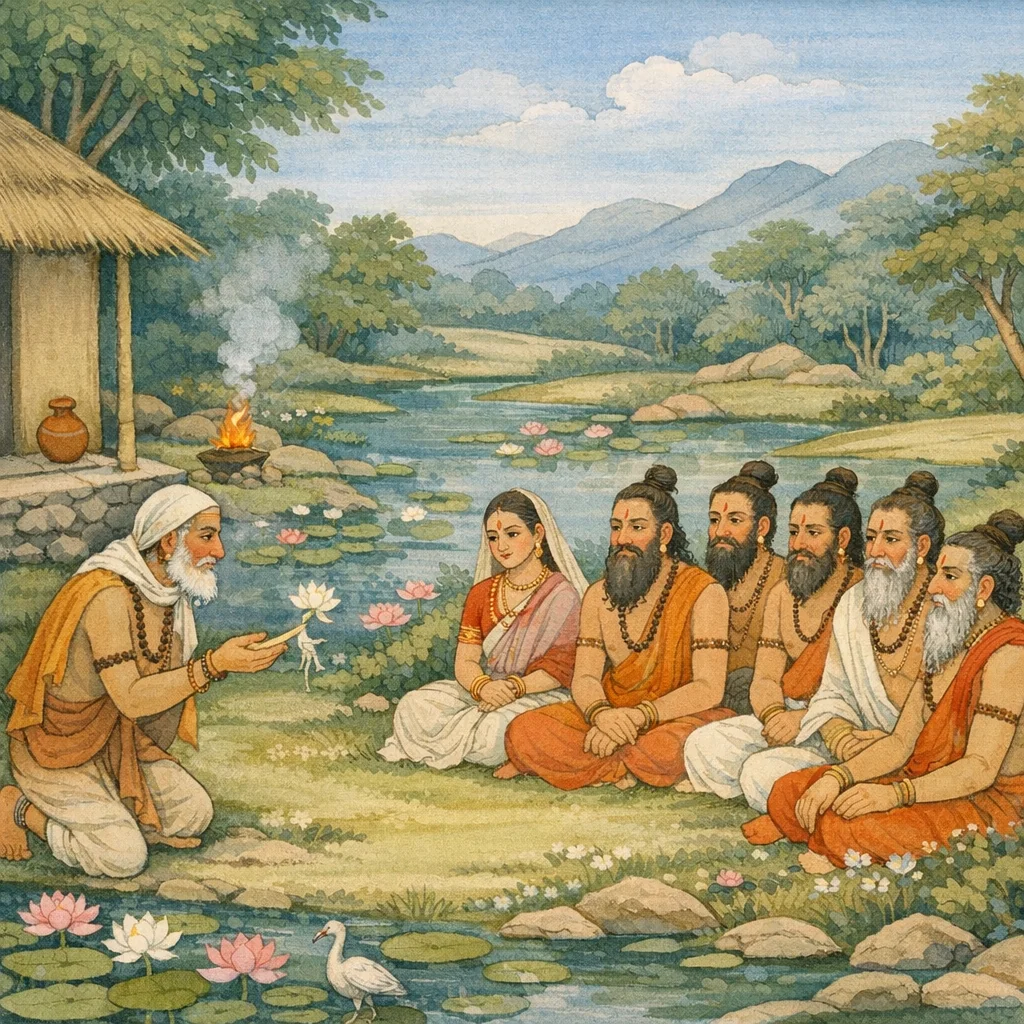
Adhyaya 96
Puṣkara-Śapatha Itihāsa (Agastya–Indra Dispute at the Tīrthas) | पुष्कर-शपथ-आख्यानम्
Upa-parva: Tīrthayātrā-Itihāsa (Puṣkara-Śapatha Episode)
Bhīṣma introduces an old itihāsa connected to pilgrimage and oath-making. A large assembly of sages and renowned figures undertake a tīrtha circuit, visiting sacred waters and bathing at Brahmasaras. During foraging for lotus-related items (bisa/mṛṇāla), they witness Agastya’s puṣkara being taken from a lake; Agastya confronts the group, suspects wrongdoing, and laments a perceived decline of dharma in society. The assembly denies theft and, to establish credibility, multiple ṛṣis and royal exemplars pronounce conditional oaths/curses specifying undesirable social, ritual, and reputational outcomes for “whoever took the puṣkara.” Indra (Śakra) then addresses Agastya, offering a countervailing assurance: the taker should instead gain Vedic learning, religious merit, and access to Brahmā’s abode, asserting that the act was motivated by a desire to hear dharma rather than by greed. Agastya accepts the explanation, receives the lotus back, and the pilgrimage continues. The chapter concludes with a phalaśruti: recitation and contemplation of this account is said to confer well-being, avert misfortune, and support auspicious outcomes, framing the narrative as both ethical instruction and ritual-textual merit.
Chapter Arc: शरशय्या पर लेटे भीष्म युधिष्ठिर को गृहस्थ-धर्म के सूक्ष्म रहस्य की ओर ले जाते हैं—विशेषतः श्राद्ध-भोजन, व्रत-पालन और ‘प्रतिग्रह’ (दान-ग्रहण) के छिपे हुए दोषों पर। → भीष्म बताते हैं कि वेदोक्त व्रतों से च्युत आचरण करने वाले ब्राह्मणों का श्राद्ध-भोजन और दान-ग्रहण धर्म को दूषित कर सकता है; फिर कथा-प्रसंग में वृषादर्भि/राजा और सप्तर्षियों का संवाद उठता है, जहाँ राज-दान ‘मधु-सा’ दिखकर भी ‘विष-सा’ परिणाम देने वाला कहा जाता है। → सप्तर्षि राजा के प्रलोभन को अस्वीकार करते हुए प्रतिग्रह को विषोपम घोषित करते हैं—‘राज्ञां प्रतिग्रहो… विषोपमः’; आगे इन्द्र भिक्षु-वेष में परीक्षा लेकर तपस्वियों के वैराग्य, सत्य और संयम की कसौटी करता है, और छिपाए गए मृणाल/बिस (मृणाल-तंतु) दिखाकर परीक्षा का रहस्य प्रकट करता है। → परीक्षा का उद्देश्य स्पष्ट होता है—भगवत्-स्वभाव वाले महर्षियों की निष्कलुषता और प्रतिग्रह-त्याग की महिमा; भीष्म गृहस्थ को संयम, पवित्र-पाठ, ऋत-वचन, नियत-आहार जैसे नियमों का उपदेश देते हैं और कथा-कीर्तन के फल (यश, अर्थ, देव-ऋषि-पितृ-प्रसन्नता) का प्रतिपादन करते हैं। → युधिष्ठिर के सामने प्रश्न खुला रह जाता है कि गृहस्थ-धर्म में आवश्यक दान-व्यवहार और प्रतिग्रह के विष-तुल्य खतरे के बीच संतुलन कैसे साधा जाए।
Shlokas
Verse 1
०४८ श्यु 8 त्रिनववतितमो<्थ्याय: गृहस्थके धर्मोका रहस्य, प्रतिग्रहके दोष बतानेके लिये वृषादर्भि और सप्तर्षियोंकी कथा, भिक्षुरूपधारी इन्द्रके द्वारा कृत्याका वध करके सप्तर्षियोंकी रक्षा तथा कमलोकी चोरीके विषयमें शपथ खानेके बहानेसे धर्मपालनका संकेत युधिछिर उवाच द्विजातयो व्रतोपेता हविस्ते यदि भुञ्जते । अन्न ब्राह्गकामाय कथमेतत् पितामह,युधिष्ठिरने पूछा--पितामह! यदि व्रतधारी विप्र किसी ब्राह्मणकी इच्छा पूर्ण करनेके लिये उसके घर श्राद्धका अन्न भोजन कर ले तो इसे आप कैसा मानते हैं? (अपने व्रतका लोप करना उचित है या ब्राह्मणकी प्रार्थना अस्वीकार करना)
Yudhiṣṭhira said: “Grandfather, if twice-born men who are observing a vow partake of sacrificial food (havis) to satisfy a Brahmin’s request, how should this be judged? In such a case, what is the proper course—maintaining one’s vow without compromise, or yielding to the Brahmin’s desire out of reverence and duty?”
Verse 2
भीष्म उवाच अवेदोत्तव्रताश्चैव भुज्जाना: कामकारणे । वेदोक्तेषु तु भुज्जाना व्रतलुप्ता युधिष्ठिर
Bhīṣma said: “Some eat driven by mere desire, following vows and restraints not grounded in the Veda. But even those who eat only what is prescribed by the Veda become ‘vow-broken,’ O Yudhiṣṭhira, when they abandon the discipline and intent of the vow.”
Verse 3
भीष्मजीने कहा--युधिष्छिर! जो वेदोक्त व्रतका पालन नहीं करते, वे ब्राह्मणकी इच्छापूर्तिके लिये श्राद्धमें भोजन कर सकते हैं; किंतु जो वैदिक व्रतका पालन कर रहे हों, वे यदि किसीके अनुरोधसे श्राद्धका अन्न ग्रहण करते हैं तो उनका व्रत भंग हो जाता है ।। युधिछ्िर उवाच यदिदं तप इत्याहुरुपवासं पृथग्जना: । तप: स्यादेतदेवेह तपो<न्यद् वापि कि भवेत्,युधिष्ठिरने पूछा--पितामह! साधारण लोग जो उपवासको ही तप कहा करते हैं, उसके सम्बन्धमें आपकी क्या धारणा है? मैं यह जानना चाहता हूँ कि वास्तवमें उपवास ही तप है या उसका और कोई स्वरूप है
Bhīṣma said: “O Yudhiṣṭhira! Those who do not observe a Veda-grounded vow may eat the śrāddha food to fulfill a Brahmin’s wish; but those who are keeping a Vedic vow, if they accept śrāddha food at anyone’s request, their vow is broken.” Yudhiṣṭhira said: “Grandfather, ordinary people call fasting (upavāsa) itself ‘austerity’ (tapas). What is your view of this? I wish to know whether fasting alone is truly tapas here, or whether there is some other form of tapas as well.”
Verse 4
भीष्म उवाच मासार्धमासोपवासाद् यत् तपो मन्यते जन: । आत्मतन्त्रोपघाती यो न तपस्वी न धर्मवित्,भीष्मजीने कहा--राजन्! जो लोग पंद्रह दिन या एक महीनेतक उपवास करके उसे तपस्या मानते हैं, वे व्यर्थ ही अपने शरीरको कष्ट देते हैं। वास्तवमें केवल उपवास करनेवाले न तपस्वी हैं, न धर्मज्ञ
Bhīṣma said: “O King, those people who regard austerity as merely fasting for a fortnight or a month only torment their own bodies in vain. One who is self-willed and self-destructive in this way is neither a true ascetic nor a knower of dharma.”
Verse 5
त्यागस्य चापि सम्पत्ति: शिष्यते तप उत्तमम् | सदोपवासी च भवेद् ब्रह्मचारी तथैव च
Bhīṣma said: “The true ‘wealth’ of renunciation is taught to be the highest austerity. One should live in continual fasting (self-restraint in food) and likewise remain a brahmacārin—disciplined in celibacy and conduct.”
Verse 6
कुट॒म्बिको धर्मकाम: सदास्वप्रश्चन मानव:
Bhīṣma said: “A householder, devoted to dharma and the pursuit of what is right, should live as a disciplined human being—ever self-controlled and vigilant in conduct.”
Verse 7
अमांसाशी सदा च स्यातू् पवित्र च सदा पठेत् । ऋतवादी सदा च स्यान्नियतश्न सदा भवेत्
Bhīṣma said: “One should always abstain from meat, and should regularly recite what is purifying. One should always speak truthfully, and should ever remain disciplined and restrained in one’s eating.”
Verse 8
विघसाशी कथं च स्याद् सदा चैवातिथिप्रिय: । अमृताशी सदा च स्यात् पवित्री च सदा भवेत्
Bhīṣma said: “How may one become a gleaner—eating only what remains after others have been fed—and be ever fond of honoring guests? How may one live as though feeding on nectar, and become continually purifying in conduct?”
Verse 9
धर्मपालनकी इच्छासे ही उसको स्त्री आदि कुटुम्बका संग्रह करना चाहिये (विषयभोगके लिये नहीं)। ब्राह्मणको उचित है कि वह सदा जाग्रत् रहे, मांस कभी न खाय, पवित्रभावसे सदा वेदका पाठ करे, सदा सत्य भाषण करे और इन्द्रियोंको संयममें रखे। उसको सदा अमृताशी, विधघसाशी और अतिथिप्रिय तथा सदा पवित्र रहना चाहिये || ६-- ८ ।। युधिछिर उवाच कथं सदोपवासी स्याद् ब्रह्म॒चारी च पार्थिव । विघसाशी कथं च स्यात् कथं चैवातिथिप्रिय:,युधिष्ठिरने पूछा--पृथ्वीनाथ! ब्राह्मण कैसे सदा उपवासी और ब्रह्मचारी होवे? तथा किस प्रकार वह विघसाशी एवं अतिथिप्रिय हो सकता है?
Yudhiṣṭhira said: “O king, how can a brāhmaṇa be one who is always fasting and also a celibate? How, moreover, can he be a ‘vighasāśin’—one who eats only what remains after others—and how can he truly be devoted to welcoming guests?”
Verse 10
भीष्म उवाच अन्तरा सायमाशं च प्रातराशं च यो नर: । सदोपवासी भवति यो न भुंक्तेडन्तरा पुन:
Bhīṣma said: “A man who does not eat anything in between the evening meal and the morning meal becomes, in effect, a constant observer of fasting—since he refrains from taking food again in the intervening time.”
Verse 11
भीष्मजीने कहा--युधिष्ठिर! जो मनुष्य केवल प्रात:काल और सायंकाल ही भोजन करता है, बीचमें कुछ नहीं खाता, उसे सदा उपवासी समझना चाहिये ।। भार्या गच्छन् ब्रह्मचारी ऋतौ भवति चैव ह । ऋतवादी सदा च स्याद् दानशीलस्तु मानव:,जो केवल ऋतुकालमें धर्मपत्नीके साथ सहवास करता है वह ब्रह्मचारी ही माना जाता है। सदा दान देनेवाला पुरुष सत्यवादी ही समझने योग्य है
Bhishma said: “Yudhishthira, a man who eats only at dawn and at dusk, taking nothing in between, should be regarded as one who is continually fasting. Likewise, a man who approaches his lawful wife only during her fertile season is to be counted as a brahmacārin (one practicing continence). And a person devoted to giving is to be understood as one who is ever committed to truth.”
Verse 12
अभक्षयन् वृथा मांसममांसाशी भवत्युत । दानं ददत् पवित्री स्यादस्वप्नश्न दिवास्वपन्,जो मांस नहीं खाता, वह अमांसाशी होता है और जो सदा दान देनेवाला है, वह पवित्र माना जाता है। जो दिनमें नहीं सोता वह सदा जागनेवाला माना जाता है
Bhishma said: “One who does not consume meat becomes, in truth, a non-meat-eater. One who continually gives gifts becomes purified. And one who does not sleep during the day is regarded as ever-wakeful.”
Verse 13
भृत्यातिथिषु यो भुंक्ते भुक्तवत्सु नर: सदा | अमृतं केवल भुंक्ते इति विद्धि युधिछ्चिर,युधिष्ठिर! जो सदा भृत्यों- और अतिथियोंके भोजन कर लेनेके बाद ही स्वयं भोजन करता है, उसे केवल अमृत भोजन करनेवाला (अमृताशी) समझना चाहिये
Bhīṣma said: “O Yudhiṣṭhira, know this: the man who always eats only after his dependents and his guests have eaten is to be regarded as one who partakes of nectar alone.”
Verse 14
अभुक्तवत्सु नाक्षाति ब्राह्मणेषु तु यो नर: । अभोजनेन तेनास्य जित: स्वर्गों भवत्युत,जबतक ब्राह्मण भोजन नहीं कर लें तबतक जो अन्न ग्रहण नहीं करता, वह मनुष्य अपने उस व्रतके द्वारा स्वर्गलोकपर विजय पाता है
Bhishma said: “The man who does not eat while the Brahmins remain unfed—who restrains himself until they have taken their meal—by that very discipline wins heaven, as it were.”
Verse 15
देवेभ्यश्न पितृभ्यश्न संश्रितेभ्यस्तथैव च | अवशिष्टनि यो भुंक्ते तमाहुर्विघसाशिनम्
Bhīṣma said: “He who first offers food to the gods and to the ancestors, and likewise to those who depend on him for support, and then eats what remains—such a person is called a vighasāśin, one who lives on the residue after rightful sharing.”
Verse 16
तेषां लोका हा[पर्यन्ता: सदने ब्रह्मण: स्मृता: । उपस्थिता हृप्सरसो गन्धर्वैश्व जनाधिप
Bhīṣma said: “Their worlds are remembered as extending up to the very abode of Brahmā. There, O king of men, the Apsarases stood in attendance, and so too the Gandharvas.”
Verse 17
नरेश्वर! जो देवताओं, पितरों और आश्रितोंको भोजन करानेके बाद बचे हुए अन्नको ही स्वयं भोजन करता है उसे विघसाशी कहते हैं। उन मनुष्योंको ब्रह्मधाममें अक्षय लोकोंकी प्राप्ति होती है तथा गन्धर्वोंसहित अप्सराएँ उनकी सेवामें उपस्थित होती हैं ।। देवतातिथिगश्ि: सार्ध पितृभ्यश्लोपभुञ्जते । रमन्ते पुत्रपौत्रेण तेषां गतिरनुत्तमा,जो देवताओं और अतिथियोंसहित पितरोंके लिये अन्नका भाग देकर स्वयं भोजन करते हैं, वे इस जगतमें पुत्र-पौत्रोंके साथ रहकर आनन्द भोगते हैं और मृत्युके पश्चात् उन्हें परम उत्तम गति प्राप्त होती है
Bhishma said: “O king, one who first feeds the gods, the ancestors, and those who depend on him, and then eats only what remains, is called a vighasāśin—an eater of the leavings. Such people attain imperishable worlds in the realm of Brahman, and Apsarases, together with Gandharvas, stand ready in their service. Those who, after setting aside a portion of food for the ancestors along with the gods and guests, then eat themselves—while living in this world they rejoice with sons and grandsons, and after death they reach the highest, unsurpassed state.”
Verse 18
युधिषछ्िर उवाच ब्राह्मणेभ्य: प्रयच्छन्ति दानानि विविधानि च । दातृप्रतिग्रहीत्रोवं को विशेष: पितामह,युधिष्ठिरने पूछा--पितामह! लोग ब्राह्मणोंको नाना प्रकारकी वस्तुएँ दान करते हैं। दान देने और दान लेनेवाले पुरुषोंमें क्या विशेषता होती है?
Yudhiṣṭhira said: “Grandfather, people offer many kinds of gifts to Brahmins. What distinguishes the man who gives from the man who receives—what is the essential difference between donor and recipient?”
Verse 19
भीष्म उवाच साधोर्य: प्रतिगृह्लीयात् तथैवासाधुतो द्विज: । गुणवत्यल्पदोष: स्यान्निर्गुणे तु निमज्जति,भीष्मजीने कहा--राजन! जो ब्राह्मण साधु अर्थात् उत्तम गुण-आचरणवाले पुरुषसे तथा असाधु अर्थात् दुर्गुण और दुराचारवाले पुरुषसे दान ग्रहण करता है, उनमें सदगुणी- सदाचारवाले पुरुषसे दान लेना अल्प दोष है। किंतु दुर्गुण और दुराचारवालेसे दान लेनेवाला पापमें डूब जाता है
Bhishma said: “A brahmin who accepts gifts—whether from a virtuous man or from a wicked one—incurs only a slight fault when receiving from the virtuous. But when he takes from one devoid of good qualities, he sinks into sin.”
Verse 20
अत्राप्युदाहरन्तीममितिहासं पुरातनम् । वृषादर्भेश्व॒ संवादं सप्तर्षीणां च भारत,भारत! इस विषयमें राजा वृषादर्भि और सप्तर्षियोंके संवादरूप एक प्राचीन इतिहासका उदाहरण दिया जाता है
Bhishma said: “Here too, O Bharata, they cite an ancient precedent: a traditional account in the form of a dialogue between King Vṛṣādarbhī and the Seven Sages.”
Verse 22
सर्वेषामथ तेषां तु गण्डा भूत् कर्मकारिका । शूद्र: पशुसखश्वैव भर्ता चास्या बभूव ह
Bhīṣma said: “Then, among all those people, Gaṇḍā became a working woman, living by manual service. A Śūdra—one who tended animals—became her husband as well.”
Verse 23
ते च सर्वे तपस्यन्त: पुरा चेरुर्महीमिमाम् | समाधिनोपशिक्षन्तो ब्रह्मलोक॑ सनातनम्
Bhīṣma said: “And all of them, practicing austerities, once wandered over this very earth. Through deep meditative absorption they trained themselves toward the eternal Brahma-world.”
Verse 24
एक समयकी बात है, कश्यप, अत्रि, वसिष्ठ, भरद्वाज, गौतम, विश्वामित्र, जमदग्नि और पतिव्रता देवी अरुन्धती--ये सब लोग समाधिके द्वारा सनातन ब्रह्मलोकको प्राप्त करनेकी इच्छासे तपस्या करते हुए इस पृथ्वीपर विचर रहे थे। इन सबकी सेवा करनेवाली एक दासी थी, जिसका नाम था “गण्डा'। वह पशुसख नामक एक शूद्रके साथ व्याही गयी थी (पशुसख भी इन्हीं महर्षियोंके साथ रहकर सबकी सेवा किया करता था) || २१-- २३ || अथाभवदनावृष्टिमहती कुरुनन्दन । कृच्छुप्राणो&भवद् यत्र लोको<यं वै क्षुधान्वित:,कुरुनन्दन! एक बार पृथ्वीपर दीर्घकालतक वर्षा नहीं हुई। जिससे अकाल पड़ जानेके कारण यह सारा जगत् भूखसे पीड़ित रहने लगा। लोग बड़ी कठिनाईसे अपने प्राणोंकी रक्षा करते थे
Bhīṣma said: “O joy of the Kurus, once there arose a great failure of rains. In that time this whole world, afflicted by hunger, could scarcely sustain life—people preserved their breath only with extreme difficulty.”
Verse 25
कम्मिंश्रिच्च पुरा यज्ञे शैब्येन शिबिसूनुना । दक्षिणार्थेड्थ ऋत्विग्भ्यो दत्त: पुत्र: पुरा किल,पूर्वकालमें शिबिके पुत्र शैब्यने किसी यज्ञमें दक्षिणाके रूपमें अपना एक पुत्र ही ऋत्विजोंको दे दिया था
Bhīṣma said: “In ancient times, at a sacrifice, Śaibya—the son of Śibi—gave his own son to the officiating priests as the sacrificial fee (dakṣiṇā).”
Verse 26
अस्मिन् काले5थ सोल्पायुर्दिष्टान्तमगमत् प्रभु: । ते त॑ क्षुधाभिसंतप्ता: परिवार्योपतस्थिरे,उस दुर्भिक्षेके समय वह अल्पायु राजकुमार मृत्युको प्राप्त हो गया। वे सप्तर्षि भूखसे पीड़ित थे, इसलिये उस मरे हुए बालकको चारों ओरसे घेरकर खड़े हो गये
Bhīṣma said: “At that time, the young prince—whose life was destined to be short—met his appointed end. The sages, tormented by hunger, gathered around the dead child and stood encircling him.”
Verse 27
वृषादार्थिर्वाच (प्रतिग्रहो ब्राह्मणानां सृष्टा वृत्तिरनिन्दिता ।) प्रतिग्रहस्तारयति पुष्टिवैं प्रतिगृह्मुताम् मयि यद् विद्यते वित्त तद् वृणुध्वं तपोधना:,तब वृषादर्भि बोले--प्रतिग्रह ब्राह्मणोंके लिये उत्तम वृत्ति नियत किया गया है। तपोधन! प्रतिग्रह दुर्भिक्ष और भूखके कष्टसे ब्राह्मणकी रक्षा करता है तथा पुष्टिका उत्तम साधन है। अतः मेरे पास जो धन है उसे आप स्वीकार करें और ले लें
Bhishma said: Vṛṣādarbhi spoke—“For Brahmins, accepting gifts (pratigraha) has been ordained as a blameless means of livelihood. The acceptance of gifts rescues those who receive them from distress such as famine and hunger, and indeed becomes a means to well-being and nourishment. Therefore, O ascetics rich in austerity, take whatever wealth is with me—accept it.”
Verse 28
प्रियो हि मे ब्राह्मणो याचमानो दद्यामहं वो<श्चवतरीसहस्रम् । एकैकश: सवृषा: सम्प्रसूता: सर्वेषां वै शीघ्रगा: श्वेतरोमा:,क्योंकि जो ब्राह्मण मुझसे याचना करता है, वह मुझे बहुत प्रिय लगता है। मैं आपलोगोंमेंसे प्रत्येकको एक हजार खच्चरियाँ देता हूँ तथा सभीको सफेद रोएँवाली शीघ्रगामिनी एवं ब्यायी हुई गौएँ साँडोंसहित देनेको उद्यत हूँ
Bhishma said: “A Brahmin who comes to me asking is truly dear to me. Therefore I am prepared to give each of you a thousand she-mules; and to all of you, I am ready to bestow swift-moving cows with white hair, each already calved, together with bulls.”
Verse 29
कुलंभराननडुह: शतं शतान् धुर्यान् श्वेतान् सर्वशो5हं ददामि । प्रष्ाहीनां पीवराणां च ताव- दग्रया गृष्ट्यो धेनव: सुव्रताश्ष,साथ ही एक कुलका भार वहन करनेवाले दस हजार भारवाहक सफेद बैल भी आप सब लोगोंको दे रहा हूँ। इतना ही नहीं, मैं आप सब लोगोंको जवान, मोटी-ताजी, पहली बारकी ब्यायी हुई, अच्छे स्वभाववाली श्रेष्ठ एवं दुधारू गौएँ भी देता हूँ
Bhishma said: “I give, in every way, hundreds upon hundreds of white, sturdy draught-bulls—beasts fit to bear the burdens of a household. And likewise I give excellent milch-cows: young, well-fleshed, newly calved for the first time, of good conduct and fine observance—cows that yield abundant milk.”
Verse 30
वरान् ग्रामान् व्रीहिरसं यवांश्व रत्नं चान्यद् दुर्लभ कि ददानि | नास्मिन्नभक्ष्ये भावमेवं कुरुध्व॑ पुष्टयर्थ व: कि प्रयच्छाम्यहं वै,इनके सिवा अच्छे-अच्छे गाँव, धान, रस, जौ, रत्न तथा और भी अनेक दुर्लभ वस्तुएँ प्रदान कर सकता हूँ। बतलाइये, मैं आपको क्या दूँ? आप इस अभक्ष्य वस्तुके भक्षणमें मन न लगावें। कहिये, आपके शरीरकी पुष्टिके लिये मैं क्या दूँ
Bhishma said: “I can grant you excellent villages, rice and its nourishing essence, barley, jewels, and other rare valuables. Tell me—what shall I give you? Do not set your mind on eating what is forbidden to eat. Speak: for the strengthening of your bodies, what should I bestow upon you?”
Verse 31
ऋषय ऊचु: राजन प्रतिग्रहो राज्ञां मध्वास्वादो विषोपम: । तज्जानमान: कस्मात् त्वं कुरुषे न: प्रलोभनम्,ऋषि बोले--राजन्! राजाका दिया हुआ दान ऊपरसे मधुके समान मीठा जान पड़ता है, परंतु परिणाममें विषके समान भयंकर हो जाता है। इस बातको जानते हुए भी आप क्यों हमें प्रलोभनमें डाल रहे हैं
The sages said: “O King, accepting gifts from kings tastes sweet like honey at first, yet in its outcome it becomes dreadful like poison. Knowing this, why do you still try to entice us into temptation?”
Verse 32
क्षेत्र हि दैवतमिदं ब्राह्मणान् समुपाश्रितम् । अमलो होष तपसा प्रीत: प्रीणाति देवता:,ब्राह्मणोंका शरीर देवताओंका निवासस्थान है, उसमें सभी देवता विद्यमान रहते हैं। यदि ब्राह्मण तपस्यासे शुद्ध एवं संतुष्ट हो तो वह सम्पूर्ण देवताओंको प्रसन्न करता है
Truly, this body is a sacred realm of the divine, resting upon the brāhmaṇas. The brāhmaṇa’s body is the dwelling of the gods; all the devas abide within it. If a brāhmaṇa is purified by austerity and is content, he gladdens the whole host of gods.
Verse 33
अल्वापहि तपो जातु ब्राह्मणस्योपजायते । तद् दाव इव निर्दह्यात् प्राप्तो राजप्रतिग्रह:,ब्राह्मण दिनभरमें जितना तप संग्रह करता है, उसको राजाका दिया हुआ दान वनको दग्ध करनेवाले दावानलकी भाँति नष्ट कर डालता है
Bhīṣma said: Even the little austerity a brāhmaṇa may gather is burned away like a forest-fire when he accepts gifts from a king.
Verse 34
कुशलं सह दानेन राजन्नस्तु सदा तव | अर्थिभ्यो दीयतां सर्वमित्युक्त्वान्येन ते ययु:,राजन्! इस दानके साथ ही आप सदा सकुशल रहें और यह सारा दान आप उन्हींको दें जो आपसे इन वस्तुओंको लेना चाहते हों। ऐसा कहकर वे दूसरे मार्गसे चल दिये
Bhīṣma said: “O King, may you always remain well, together with this act of giving. Let everything be bestowed upon those who seek it from you.” Having spoken thus, they departed by another route.
Verse 35
तत:ः प्रचोदिता राज्ञा वन॑ गत्वास्य मन्त्रिण: । प्रचीयोदुम्बराणि सम दातु तेषां प्रचक्रिरे,तब राजाकी प्रेरणासे उनके मन्त्री वनमें गये और गूलरके फल तोड़कर उन्हें देनेकी चेष्टा करने लगे
Bhīṣma said: Then, urged on by the king, his ministers went to the forest and set about gathering udumbara (cluster fig) fruits, trying to distribute them equally among those concerned.
Verse 36
उदुम्बराण्यथान्यानि हेमगर्भाण्युपाहरन् । भृत्यास्तेषां ततस्तानि प्रग्राहितुमुपाद्रवन्,मन्त्रियोंने गूलर तथा दूसरे-दूसरे वृक्षोंक फल तोड़कर उनमें सुवर्ण-मुद्राएँ भर दीं। फिर उन फलोंको लेकर राजाके सेवक उन्हें ऋषियोंके हवाले करनेके लिये उनके पीछे दौड़े गये
Bhīṣma said: “Then they brought udumbara fruits and other kinds as well, each filled within with gold. Thereupon the king’s attendants ran after them, intent on placing those fruits into the hands of the sages.”
Verse 37
गुरूणीति विदित्वाथ न ग्राह्माण्यत्रिरब्रवीत् न स्महे मन्दविज्ञाना न स्महे मन्दबुद्धयः,वे सभी फल भारी हो गये थे, इस बातको महर्षि अत्रि ताड़ गये और बोले--ये “गूलर हमारे लेने योग्य नहीं हैं। हमारी बुद्धि मन्द नहीं हुई है। हमारी ज्ञानशक्ति लुप्त नहीं हुई है। हम सो नहीं रहे हैं, जागते हैं। हमें अच्छी तरह ज्ञात है कि इनके भीतर सुवर्ण भरा पड़ा है। यदि आज हम इन्हें स्वीकार कर लेते हैं तो परलोकमें हमें इनका कटु परिणाम भोगना पड़ेगा। जो इहलोक और परलोकमें भी सुख चाहता हो उसके लिये यह फल अग्राह्म है!
Bhishma said: Having understood the proper conduct toward elders and teachers, the sage Atri declared, “These are not to be accepted. We are not of dull discernment, nor are we of dull intellect.” Sensing that the fruits had become unnaturally heavy and knowing the hidden motive behind the gift, he rejected them: even if they appear harmless, accepting what is tainted by greed or deceit brings bitter consequences in the next world. Therefore, one who seeks well-being in both this life and the hereafter should treat such gains as unfit to receive.
Verse 38
हैमानीमानि जानीम: प्रतिबुद्धा: सम जागृूम । इह होतदुपादत्तं प्रेत्य स्पात् कटुकोदयम् । अप्रतिग्राह्ममेवैतत् प्रेत्पेह च सुखेप्सुना,वे सभी फल भारी हो गये थे, इस बातको महर्षि अत्रि ताड़ गये और बोले--ये “गूलर हमारे लेने योग्य नहीं हैं। हमारी बुद्धि मन्द नहीं हुई है। हमारी ज्ञानशक्ति लुप्त नहीं हुई है। हम सो नहीं रहे हैं, जागते हैं। हमें अच्छी तरह ज्ञात है कि इनके भीतर सुवर्ण भरा पड़ा है। यदि आज हम इन्हें स्वीकार कर लेते हैं तो परलोकमें हमें इनका कटु परिणाम भोगना पड़ेगा। जो इहलोक और परलोकमें भी सुख चाहता हो उसके लिये यह फल अग्राह्म है!
Bhishma said: “We recognize these as golden (within). We are fully awake and alert; our understanding has not dimmed. We know well that gold is concealed inside these fruits. If we accept them here and now, their consequence will ripen bitterly after death. Therefore this is not fit to be accepted as a gift by one who seeks well-being and happiness both in this world and the next.”
Verse 39
हर प्ज् (४ ब्र् कर ४ [४4 वसिष्ठ उवाच शतेन निष्कगणितं सहस्रेण च सम्मितम् । तथा बहु प्रतीच्छन् वै पापिष्ठां पतते गतिम्,वसिष्ठ बोले--एक निष्क (स्वर्णमुद्रा) का दान लेनेसे सौ हजार निष्कोंके दान लेनेका दोष लगता है। ऐसी दशामें जो बहुत-से निष्क ग्रहण करता है, उसको तो घोर पापमयी गतिमें गिरना पड़ता है
Vasiṣṭha said: “Accepting a single niṣka (a gold coin) can incur a fault equivalent to that of accepting a hundred; and accepting a thousand can be reckoned as still greater. Therefore, one who accepts many such coins falls into a most sinful course of destiny.”
Verse 40
कश्यप उवाच यत्पृथिव्यां व्रीहियवं हिरण्यं पशव: स्त्रिय: । सर्व तन्नालमेकस्य तस्माद् विद्वान् शमं चरेत्,कश्यपने कहा--इस पृथ्वीपर जितने धान, जौ, सुवर्ण, पशु और स्त्रियाँ हैं, वे सब किसी एक पुरुषको मिल जायाँ तो भी उसे संतोष न होगा; यह सोचकर दविद्वान् पुरुष अपने मनकी तृष्णाको शान्त करे
Kashyapa said: Even if all the rice and barley on this earth, along with gold, cattle, and women, were to come into the possession of a single man, it still would not be enough to satisfy him. Therefore, understanding this truth, a wise person should cultivate inner calm and restrain the mind’s craving.
Verse 41
भरद्वाज उवाच उत्पन्नस्य रुरो: शंंगं वर्धमानस्य वर्धते । प्रार्थना पुरुषस्येव तस्य मात्रा न विद्यते
Bharadvāja said: “As the horn of the serpent Ruru, once it has arisen, keeps increasing as it grows, so too a man’s entreaty (or desire) keeps expanding—there is no fixed measure or limit to it.”
Verse 42
भरद्वाज बोले--जैसे उत्पन्न हुए मृगका सींग उसके बढ़नेके साथ-साथ बढ़ता रहता है, उसी प्रकार मनुष्यकी तृष्णा सदा बढ़ती ही रहती है, उसकी कोई सीमा नहीं है ।। गौतम उवाच न तलल््लोके द्रव्यमस्ति यल्लोकं प्रतिपूरयेत् । समुद्रकल्प: पुरुषो न कदाचन पूर्यते,गौतमने कहा--संसारमें ऐसा कोई द्रव्य नहीं है, जो मनुष्यकी आशाका पेट भर सके। पुरुषकी आशा समुद्रके समान है, वह कभी भरती ही नहीं
Gautama said: In this world there is no possession or substance that can fully satisfy a person’s longing. A human being is like the ocean—never truly filled; desire keeps expanding without limit.
Verse 43
विश्वामित्र उवाच काम कामयमानस्य यदा काम: समृध्यते । अथैनमपर: कामस्तृष्णाविध्यति बाणवत्,विश्वामित्र बोले--किसी वस्तुकी कामना करनेवाले मनुष्यकी एक इच्छा जब पूरी होती है, तब दूसरी नयी उत्पन्न हो जाती है। इस प्रकार तृष्णा तीरकी तरह मनुष्यके मनपर चोट करती ही रहती है
Viśvāmitra said: When a person who longs for pleasures sees one desire fulfilled, then another desire arises in its place. Thus craving keeps striking the mind again and again, like an arrow—showing that indulgence does not end want, but multiplies it.
Verse 44
(भत्रिरुवाच न जातु काम: कामनामुपभोगेन शाम्यति । हविषा कृष्णवर्त्मेव भूय एवाभिवर्धते ।।) अत्रि बोले--भोगोंकी कामना उनके उपभोगसे कभी नहीं शान्त होती है। अपितु घीकी आहुति पड़नेपर प्रज्वलित होनेवाली आगकी भाँति वह और भी बढ़ती ही जाती है।। जगदग्निरुवाच प्रतिग्रहे संयमो वै तपो धारयते ध्रुवम् । तद् धन ब्राह्मणस्येह लुभ्यमानस्य विस्रवेत्,जमदग्निने कहा--प्रतिग्रह न लेनेसे ही ब्राह्मण अपनी तपस्याको सुरक्षित रख सकता है। तपस्या ही ब्राह्मणका धन है। जो लौकिक धनके लिये लोभ करता है, उसका तपरूपी धन नष्ट हो जाता है
Atri said: Desire is never truly quenched by indulging in the objects of desire; like a fire fed with ghee, it only blazes up all the more. Jagadagni said: By refraining from accepting gifts, a brāhmaṇa surely preserves self-restraint and thereby safeguards his austerity. Austerity is the brāhmaṇa’s true wealth here; but for one who becomes greedy for worldly riches, that wealth of tapas drains away and is lost.
Verse 45
अरुन्धत्युवाच धर्मार्थ संचयो यो वै द्रव्याणां पक्षसम्मत: । तप:संचय एवेह विशिष्टो द्रव्यसंचयात्,अरुन्धती बोलीं--संसारमें एक पक्षके लोगोंकी राय है कि धर्मके लिये धनका संग्रह करना चाहिये; किंतु मेरी रायमें धन-संग्रहकी अपेक्षा तपस्याका संचय ही श्रेष्ठ है
Arundhatī said: Some in the world hold that one should accumulate wealth for the sake of dharma; but in my view, the storing up of austerity (tapas) is far superior to the storing up of riches.
Verse 46
गण्डोवाच उग्रादितो भयाद् यस्माद् बिभ्यतीमे ममेश्वरा: । बलीयांसो दुर्बलवद् बिभेम्यहमत: परम्
Gaṇḍa said: “Because I have been harshly threatened, fear has arisen; therefore even those who are my lords and protectors now tremble. Seeing the powerful shaken as though they were weak, I too am terrified—more than ever.”
Verse 47
गण्डाने कहा--मेरे ये मालिक लोग अत्यन्त शक्तिशाली होते हुए भी जब इस भयंकर प्रतिग्रहके भयसे इतना डरते हैं, तब मेरी क्या सामर्थ्य है? मुझे तो दुर्बल प्राणियोंकी भाँति इससे बहुत बड़ा भय लग रहा है ।। पशुसख उवाच यद् वै धर्मे परं नास्ति ब्राह्मणास्तद्धनं विदु: । विनयार्थ सुविद्वांसमुपासेयं यथातथम्,पशुसखने कहा--धर्मका पालन करनेपर जिस धनकी प्राप्ति होती है, उससे बढ़कर कोई धन नहीं है। उस धनको ब्राह्मण ही जानते हैं; अतः मैं भी उसी धर्ममय धनकी प्राप्तिका उपाय सीखनेके लिये विद्वान् ब्राह्मणोंकी सेवामें लगा हूँ
Paśusakha said: “Truly, there is no wealth higher than that which comes from living in accordance with dharma. The brāhmaṇas understand that to be real wealth. Therefore, in order to learn the discipline and method by which such dharma-born wealth is attained, I attach myself—humbly and as best I can—to the service of a truly learned brāhmaṇa.”
Verse 48
ऋषय ऊचु: कुशलं सह दानेन तस्मै यस्य प्रजा इमा: । फलान्युपधियुक्तानि य एवं न: प्रयच्छति,ऋषियोंने कहा--जिसकी प्रजा ये कपटयुक्त फल देनेके लिये ले आयी है तथा जो इस प्रकार फलके व्याजसे हमें सुवर्णदान कर रहा है, वह राजा अपने दानके साथ ही कुशलसे रहे
The sages said: “May well-being attend that king along with his gift—he whose subjects have brought these fruits, tainted with deceit, and who, under the pretext of offering fruit, is thus giving us gold. May he remain safe and prosperous together with his act of giving.”
Verse 49
भीष्म उवाच इत्युक्त्वा हेमगर्भाणि हित्वा तानि फलानि वै | ऋषयो जम्मुरन्यत्र सर्व एव धृतव्रता:,भीष्मजी कहते हैं--युधिष्ठिर! यह कहकर उन सुवर्णयुक्त फलोंका परित्याग करके वे समस्त व्रतधारी महर्षि वहाँसे अन्यत्र चले गये
Bhishma said: “Having spoken thus, all those steadfast sages renounced those fruits filled with gold and departed from that place to elsewhere.”
Verse 50
मन्त्रिण ऊचु. उपधिं शंकमानास्ते हित्वा तानि फलानि वै । ततोडन्येनैव गच्छन्ति विदितं तेडस्तु पार्थिव,तब मन्त्रियोंने शैव्यके पास जाकर कहा--महाराज! आपको विदित हो कि उन फलोंको देखते ही ऋषियोंको यह संदेह हुआ कि हमारे साथ छल किया जा रहा है। इसलिये वे फलोंका परित्याग करके दूसरे मार्गसे चले गये हैं
The ministers said: “O King, be it known to you—those sages, suspecting deceit, abandoned those fruits. Thereafter they proceeded by another route.”
Verse 51
इत्युक्तः स तु भृत्यैस्तैर्वषादर्भिश्ुकोप ह । तेषां वै प्रतिकर्तु च सर्वेषामगमद् गृहम्,सेवकोंके ऐसा कहनेपर राजा वृषादर्भिको बड़ा कोप हुआ और वे उन सप्तर्षियोंसे अपने अपमानका बदला लेनेका विचार करके राजधानीको लौट गये
Bhīṣma said: “Thus addressed by his attendants, King Vṛṣādarbhī was seized with great anger. Intent on retaliating against all those sages for the affront, he returned to his own residence (the capital), brooding over revenge.”
Verse 52
स गत्वा हवनीये>ग्नौ तीव्रं नियममास्थित: । जुहाव संस्कृतैर्मन्त्रेरकेकामाहुतिं नृप:,वहाँ जाकर अत्यन्त कठोर नियमोंका पालन करते हुए वे आहवनीय अम्निमें आभिचारिक मन्त्र पढ़कर एक-एक आहुति डालने लगे
Having gone there, the king, observing an exceedingly severe discipline, began to pour oblations one by one into the Āhavanīya sacred fire, reciting properly prepared, ritually correct mantras—an act suggestive of a forceful, purpose-driven rite rather than a merely routine sacrifice.
Verse 53
तस्मादग्ने: समुत्तस्थौ कृत्या लोकभयंकरी । तस्या नाम वृषादर्भियातुधानीत्यथाकरोत्,आहुति समाप्त होनेपर उस अग्निसे एक लोकभयंकर कृत्या प्रकट हुई। राजा वृषादर्भिने उसका नाम यातुधानी रखा
Therefore, from that fire there arose a kṛtyā—an occult, man-made destructive force—terrifying to the whole world. King Vṛṣādarbhī then gave her the name “Yātudhānī,” marking her as a being aligned with demonic, harmful agencies.
Verse 54
सा कृत्या कालरात्रीव कृताञज्जलिरुपस्थिता । वृषादर्भि नरपतिं कि करोमीति चाब्रवीत्,कालरात्रिके समान विकराल रूप धारण करनेवाली वह कृत्या हाथ जोड़कर राजाके पास उपस्थित हुई और बोली--“महाराज! मैं आपकी किस आज्ञाका पालन करूँ?”
That magical creation, dreadful in form like Kālarātri, came before the king with hands joined in reverence and said, “O king, what is it that I should do by your command?”
Verse 55
वृषादार्थिऱवाच ऋषीणां गच्छ सप्तानामरुन्धत्यास्तथैव च । दासीभर्तुश्न दास्याश्न मनसा नाम धारय,वृषादर्भिने कहा--यातुधानी! तुम यहाँसे वनमें जाओ और वहाँ अरुन्धतीसहित सातों ऋषियोंका, उनकी दासीका और उस दासीके पतिका भी नाम पूछकर उसका तात्पर्य अपने मनमें धारण करो। इस प्रकार उन सबके नामोंका अर्थ समझकर उन्हें मार डालो; उसके बाद जहाँ इच्छा हो चली जाना
Vṛṣādarthi said, “Go to the seven sages, and likewise to Arundhatī. Learn and hold in your mind the names—and their intended meanings—of the sages, of the female attendant, and of that attendant’s husband. Having understood the import of all those names, strike them down; then go wherever you wish.”
Verse 56
मुनिश्च स्थात् सदा विप्रो वेदांश्वैव सदा जपेत् । त्यागका सम्पादन ही सबसे उत्तम तपस्या है। ब्राह्मणको सदा उपवासी (व्रतपरायण), ब्रह्मचारी, मुनि और वेदोंका स्वाध्यायी होना चाहिये,ज्ञात्वा नामानि चैवैषां सर्वानेतान् विनाशय । विनष्टेषु तथा स्वैरं गच्छ यत्रेप्सितं तव वृषादर्भिने कहा--यातुधानी! तुम यहाँसे वनमें जाओ और वहाँ अरुन्धतीसहित सातों ऋषियोंका, उनकी दासीका और उस दासीके पतिका भी नाम पूछकर उसका तात्पर्य अपने मनमें धारण करो। इस प्रकार उन सबके नामोंका अर्थ समझकर उन्हें मार डालो; उसके बाद जहाँ इच्छा हो चली जाना
Bhishma said: “A brahmin should always live as a sage—steadfast, disciplined, and constantly reciting the Vedas. The accomplishment of renunciation is indeed the highest austerity. Therefore a brahmin should be ever devoted to vows and fasting, celibate, contemplative, and committed to Vedic self-study. Having learned the names of all these, destroy them; and when they are destroyed, go freely wherever you wish.”
Verse 57
सा तथेति प्रतिश्रुत्य यातुधानी स्वरूपिणी । जगाम तद् वन यत्र विचेरुस्ते महर्षय:,राजाकी यह आज्ञा पाकर यातुधानीने “तथास्तु” कहकर इसे स्वीकार किया और जहाँ वे महर्षि विचरा करते थे, उस वनमें चली गयी
Bhishma said: “Having pledged, ‘So be it,’ the yātudhānī—able to assume forms at will—went to that forest where those great seers used to wander. Thus is it shown: a given word sets action in motion, and intent carried into the realm of sages invites the scrutiny of dharma and its due consequence.”
Verse 58
भीष्म उवाच अथात्रिप्रमुखा राजन् वने तस्मिन् महर्षय: । व्यचरन् भक्षयन्तो वै मूलानि च फलानि च,भीष्मजी कहते हैं--राजन्! उन दिनों वे अत्रि आदि महर्षि उस वनमें फल-मूलका आहार करते हुए घूमा करते थे
Bhishma said: “O King, at that time the great sages—led by Atri—wandered in that forest, sustaining themselves on roots and fruits.”
Verse 59
अथापश्यन् सुपीनांसपाणिपादमुखोदरम् । परिव्रजन्तं स्थूलांगं परिव्राजं शुना सह,एक दिन उन महर्षियोंने देखा, एक संन्यासी कुत्तेके साथ वहाँ इधर-उधर विचर रहा है। उसका शरीर बहुत मोटा था। उसके मोटे कंधे, हाथ, पैर, मुख और पेट आदि सभी अंग सुन्दर और सुडौल थे
Bhishma said: “Then those sages saw a wandering renunciant, accompanied by a dog, moving about here and there. His body was very stout; his shoulders, hands, feet, face, belly, and other limbs were all handsome and well-proportioned. The scene sets a moral contrast: outward marks of renunciation, and even physical comeliness, do not by themselves prove inner discipline; it invites inquiry into what true dharma in ascetic life really is.”
Verse 60
अरुन्धती तु त॑ दृष्टवा सर्वांगोपचितं शुभम् | भवितारो भवन्तो वै नैवमित्यब्रवीदृूषीन्,अरुन्धतीने सारे अंगोंसे हृष्ट-पुष्ट हुए उस सुन्दर संन्यासीको देखकर ऋषियोंसे कहा --'क्या आपलोग कभी ऐसे नहीं हो सकेंगे?”
Bhishma said: “Seeing that auspicious ascetic, whose whole body appeared well-nourished and radiant, Arundhati addressed the sages and said, ‘Will you not ever become like this?’—urging them to reflect on the true causes of spiritual excellence rather than mere outward austerity.”
Verse 61
वसिष्ठ उवाच नैतस्थेह यथास्माकमग्निहोत्रमनिर्ठठतम् । सायं प्रातश्न होतव्यं तेन पीवाउ्छुना सह,वसिष्ठजीने कहा--हमलोगोंकी तरह इसको इस बातकी चिन्ता नहीं है कि आज हमारा अग्निहोत्र नहीं हुआ और सबेरे तथा शामको अग्निहोत्र करना है; इसीलिये यह कुत्तेके साथ खूब मोटा-ताजा हो गया है
Vasistha said: “This one does not feel the same concern as we do—that our Agnihotra has been left unperformed and must be offered both in the evening and in the morning. Therefore, keeping company with that dog, he has grown quite plump and well-fed.”
Verse 62
अत्रिर्वाच नैतस्येह यथास्माकं क्षुधा वीर्य समाहतम् । कृच्छाधीतं प्रणष्टं च तेन पीवाउछुना सह,अत्रि बोले--हमलोगोंकी तरह भूखके मारे उसकी सारी शक्ति नष्ट नहीं हो गयी है तथा बड़े कष्टसे जो वेदोंका अध्ययन किया गया था, वह भी हमारी तरह इसका नष्ट नहीं हुआ है; इसीलिये यह कुत्तेके साथ मोटा हो गया है
Atri said: “In his case here, as with us, hunger has not crushed and destroyed his strength. Nor has the Vedic learning, acquired with great hardship, been lost as it has been for us. Therefore he has grown fat, even in the company of that dog.”
Verse 63
विश्वामित्र उवाच नैतस्येह यथास्माकं शभश्रच्छास्त्रं जरद्गव: | अलस: क्षुत्परो मूर्खस्तेन पीवाउछुना सह,विश्वामित्रने कहा--हमलोगोंका भूखके मारे सनातन शास्त्र विस्मृत हो गया है और शास्त्रोक्त धर्म भी क्षीण हो चला है। ऐसी दशा इसकी नहीं है तथा यह आलसी, केवल पेटकी भूख बुझानेमें ही लगा हुआ और मूर्ख है। इसीलिये यह कुत्तेके साथ मोटा हो गया है
Viśvāmitra said: “This fellow is not like us here, O Jaradgava—those for whom the ancient sacred teaching has been forgotten under the pressure of hunger, and whose scriptural dharma has grown faint. Rather, he is lazy, driven only by the urge to fill his belly, and foolish; that is why he has grown fat in the company of a dog.”
Verse 64
जगदग्निरुवाच नैतस्थेह यथास्माकं भक्तमिन्धनमेव च । संचिन्त्यं वार्षिक चित्ते तेन पीवाउछुना सह,जमदग्नि बोले--हमारी तरह इसके मनमें वर्षभरके लिये भोजन और ईंधन जुटानेकी चिन्ता नहीं है, इसीलिये कुत्तेके साथ मोटा हो गया है
Jamadagni said: “It is not the case here as it is with us—that one must keep in mind, for the whole year, anxious calculations about food and even firewood. Since he has no such year-long worry in his heart, he has grown plump, along with the dog.”
Verse 65
कश्यप उवाच नैतस्थेह यथास्माकं चत्वारश्न सहोदरा: । देहि देहीति भिक्षन्ति तेन पीवाउछुना सह,कश्यपने कहा--हमलोगोंके चार भाई हमसे प्रतिदिन 'भोजन दो, भोजन दो” कहकर अन्न माँगते हैं, अर्थात् हमलोगोंको एक भारी कुट॒म्बके भोजन-वस्त्रकी चिन्ता करनी पड़ती है। इस संन्यासीको यह सब चिन्ता नहीं है। अतः यह कुत्तेके साथ मोटा है
Kashyapa said: “This one is not ‘fat’ in the way we are. We have four brothers of the same mother, and every day they beg from us, saying, ‘Give, give!’ Therefore we must bear the burden of feeding and clothing a large household. This renunciant has no such anxiety; hence he is well-nourished even with only coarse fare, along with his dog.”
Verse 66
भरद्वाज उवाच नैतस्येह यथास्माकं ब्रह्मुबन्धोरचेतस: । शोको भार्यापवादेन तेन पीवाउछुना सह
Bharadvāja said: “Here, as far as we are concerned, there is no grief for this foolish ‘brahmin-by-birth’ (unworthy of true brahminhood). The sorrow has arisen because of the slander cast upon his wife—along with that pitiable outcry.”
Verse 67
भरद्वाज बोले--इस विवेकशून्य ब्राह्मणबन्धुको हमलोगोंकी तरह अपनी स्त्रीके कलंकित होनेका शोक नहीं है। इसीलिये यह कुत्तेके साथ मोटा हो गया है ।। गौतम उवाच नैतस्येह यथास्माकं त्रिकौशेयं च रांकवम् । एकैकं वै त्रिवर्षीयं तेन पीवाउछुना सह,गौतम बोले--हमलोगोंकी तरह इसे तीन-तीन वर्षोतक कुशकी रस्सीकी बनी हुई तीन लरवाली मेखला और मृगचर्म धारण करके नहीं रहना पड़ता है। इसीलिये यह कुत्तेके साथ मोटा हो गया है
Gautama said: “This man does not have to live here as we do—wearing the three-stranded girdle of kuśa-grass cord and the deer-skin, each kept for three years. Therefore, living together with that dog, he has grown fat and comfortable.”
Verse 68
भीष्म उवाच अथ दृष्टवा परिव्राट् स तान् महर्षीन् शुना सह । अभिगम्य यथान्यायं पाणिस्पर्शमभथाचरत्,भीष्मजी कहते हैं--राजन्! कुत्तेसहित आये हुए संन्यासीने जब उन महर्षियोंको देखा, तब उनके पास आकर संन्यासकी मर्यादाकें अनुसार उनका हाथसे स्पर्श किया
Bhishma said: Then, seeing those great seers, the wandering renunciant—accompanied by a dog—approached them and, in accordance with proper ascetic decorum, performed the respectful greeting by touching their hands.
Verse 69
परिचर्या बने तां तु क्षुत्प्रतिघातकारिकाम् । अन्योन्येन निवेद्याथ प्रातिष्ठन्त सहैव ते,तदनन्तर वे एक दूसरेको अपना कुशल-समाचार बताते हुए बोले--“हमलोग अपनी भूख मिटानेके लिये इस वनमें भ्रमण कर रहे हैं" ऐसा कहकर वे साथ-ही-साथ वहाँसे चल पड़े
Bhishma said: Having informed one another of their well-being, they then set out together, undertaking in that forest the necessary activity meant to ward off hunger—roaming the woods to obtain food.
Verse 70
एकनिश्चषयकार्याश्ष व्यचरन्त वनानि ते । आददाना: समुद्धृत्य मूलानि च फलानि च,उन सबके निश्चय और कार्य एक-से थे। वे फल-मूलका संग्रह करके उन्हें साथ लिये उस वनमें विचर रहे थे
Bhishma said: United in resolve and acting with a single purpose, they wandered through the forests. Uprooting and gathering roots and fruits, they carried their simple provisions with them.
Verse 71
कदाचिद् विचरन्तस्ते वृक्षैरविरलैवृताम् । शुचिवारिप्रसन्नोदां ददृशु: पद्मिनीं शुभाम्,एक दिन घूमते-फिरते हुए उन महर्षियोंको एक सुन्दर सरोवर दिखायी पड़ा; जिसका जल बड़ा ही स्वच्छ और पवित्र था। उसके चारों किनारोंपर सघन वृक्षोंकी पंक्ति शोभा पा रही थी
Bhishma said: Once, as those sages were wandering about, they saw a beautiful lotus-pond, encircled by dense, unbroken stands of trees. Its waters were clear, pure, and serene—an auspicious setting.
Verse 72
बालादित्यवपु:प्रख्यै: पुष्करैरुपशोभिताम् । वैदूर्यवर्णसदृशै: पद्मपत्रैरथावृताम्,प्रातःकालीन सूर्यके समान अरुण रंगके कमलपुष्प उस सरोवरकी शोभा बढ़ा रहे थे तथा वैदूर्यमणिकी-सी कान्तिवाले कमलिनीके पत्ते उसमें चारों ओर छा रहे थे
Bhishma said: The lake was adorned with lotuses whose bodies shone like the hue of the young morning sun; and it was further covered all around with lotus-leaves gleaming like vaidūrya (the cat’s-eye gem). The scene suggests a pure and auspicious setting—serenity and clarity, and the moral atmosphere in which dharma is to be contemplated.
Verse 73
नानाविधैश्व विहगैर्जलप्रकरसेविभि: । एकद्वारामनादेयां सूपतीर्थामकर्दमाम्,नाना प्रकारके विहंगम कलरव करते हुए उसकी जलराशिका सेवन करते थे। उसमें प्रवेश करनेके लिये एक ही द्वार था। उसकी कोई वस्तु ली नहीं जा सकती थी। उसमें उतरनेके लिये बहुत सुन्दर सीढ़ियाँ बनी हुई थीं। वहाँ काई और कीचड़का तो नाम भी नहीं था
Bhishma said: “There, birds of many kinds, living by the waters, drank from its abundant pools while filling the place with varied calls. The water-reservoir had but a single entrance; nothing in it was to be taken away. Its bathing-steps were excellent and well-formed, and it was free from slime and mud.”
Verse 74
वृषादर्भिप्रयुक्ता तु कृत्या विकृतदर्शना । यातुधानीति विख्याता पदूमिनीं तामरक्षत,राजा वृषादर्भिकी भेजी हुई भयानक आकारवाली यातुधानी कृत्या उस तालाबकी रक्षा कर रही थी
Bhīṣma said: “That fearsome-looking kṛtyā—set in motion by Vṛṣādarbhī and renowned as a yātudhānī—was guarding that Padūminī (lotus-pond).”
Verse 75
पशुसखसहायास्तु बिसार्थ ते महर्षय: । पद्मिनीमभिजम्मुस्ते सर्वे कृत्याभिरक्षिताम्,पशुसखके साथ वे सभी महर्षि मृणाल लेनेके लिये उस सरोवरके तटपर गये, जो उस कृत्याके द्वारा सुरक्षित था
Bhishma said: Aided by Paśusakha, those great sages went in search of lotus-stalk fibres (mṛṇāla). All of them approached the lotus-pond, which had been guarded and made inaccessible by that sorcery (kṛtyā).
Verse 76
ततस्ते यातुधानीं तां दृष्टवा विकृतदर्शनाम् । स्थितां कमलिनीतीरे कृत्यामूचुर्महर्षय:,सरोवरके तटपर खड़ी हुई उस यातुधानी कृत्याको जो बड़ी विकराल दिखायी देती थी, देखकर वे सब महर्षि बोले--
Then, seeing that yātudhānī—hideous in appearance—standing on the bank of a lotus-filled lake, the great seers addressed that kṛtyā, saying—
Verse 77
एका तिष्ठसि का च त्वं कस्यार्थे कि प्रयोजनम् । पद्मिनीतीरमाश्रित्य ब्रूहि त्वं किं चिकीर्षसि,“अरी! तू कौन है और किसलिये यहाँ अकेली खड़ी है? यहाँ तेरे आनेका क्या प्रयोजन है? इस सरोवरके तटपर रहकर तू कौन-सा कार्य सिद्ध करना चाहती है?”
Bhīṣma said: “Who are you, standing here all alone, and for whose sake are you here? What purpose has brought you to this place? Having taken refuge on the bank of this lotus-filled lake, tell me—what is it that you intend to accomplish?”
Verse 78
यातुधान्युवाच यास्मि सास्म्यनुयोगो मे न कर्तव्य: कथंचन । आरक्षिणीं मां पद्मिन्या वित्त सर्वे तपोधना:,यातुधानी बोली--तपस्वियो! मैं जो कोई भी होऊँ, तुम्हें मेरे विषयमें पूछ-ताछ करनेका किसी प्रकार कोई अधिकार नहीं है। तुम इतना ही जान लो कि मैं इस सरोवरका संरक्षण करनेवाली हूँ
The Yātudhānī said: “Whoever I am, that indeed I am. You have no right, in any way, to interrogate me about myself. Know only this, O ascetics rich in austerity: I am the guardian appointed for this lotus-filled lake.”
Verse 79
ऋषय ऊचु: सर्व एव क्षुधार्ता: सम न चान्यत् किंचिदस्ति न: । भवत्या: सम्मते सर्वे गृहल्लीयाम बिसान्युत,ऋषि बोले--भटद्रे! इस समय हमलोग भूखसे व्याकुल हैं और हमारे पास खानेके लिये दूसरी कोई वस्तु नहीं है। अत: यदि तुम अनुमति दो तो हम सब लोग इस सरोवरसे कुछ मृणाल ले लें
The sages said: “Revered lady, we are all afflicted by hunger at this time, and we have nothing else to eat. Therefore, if you consent, allow us to take some lotus-stalks (mṛṇāla) from this lake.”
Verse 80
यातुधान्युवाच समयेन बिसानीतो गृह्नीध्वं कामकारत: । एकैको नाम मे प्रोक््त्वा ततो गृह्नीत माचिरम्,यातुधानीने कहा--ऋषियो! एक शर्तपर तुम इस सरोवरसे इच्छानुसार मृणाल ले सकते हो। एक-एक करके आओ और मुझे अपना नाम और तात्पर्य बताकर मृणाल ले लो। इसमें विलम्ब करनेकी आवश्यकता नहीं है
The yātudhānī said, “On this condition, take the lotus-stalks from this lake as you please. But come one by one; first tell me your name and your intent, and then take them—do not delay.”
Verse 81
भीष्म उवाच विज्ञाय यातुधानीं तां कृत्यामृषिवधैषिणीम् । अत्रि: क्षुधापरीतात्मा ततो वचनमत्रवीत्,भीष्मजी कहते हैं--राजन्! उसकी यह बात सुनकर महर्षि अत्रि यह समझ गये कि 'यह राक्षसी कृत्या है और हम सब ऋषियोंका वध करनेकी इच्छासे यहाँ आयी हुई है।' तथापि भूखसे व्याकुल होनेके कारण उन्होंने इस प्रकार उत्तर दिया
Bhishma said: Having recognized her as a yātudhānī—an evil, destructive being—indeed a kṛtyā intent on the slaughter of sages, Atri, though inwardly distressed by hunger, then spoke these words.
Verse 82
अत्रिरवाच अरात्रिरत्रि: सा रात्रियां नाथीते त्रिरद्य वै अरात्रिरत्रिरित्येव नाम मे विद्धि शोभने
Atri said: “I am Arātri Atri. That Night has been rendered powerless—indeed, today it has been overcome threefold. Therefore, O fair one, know my name to be ‘Arātri Atri’ alone.”
Verse 83
अत्रि बोले--कल्याणी! काम आदि शत्रुओंसे त्राण करनेवालेको अरात्रि कहते हैं और अत् (मृत्यु) से बचानेवाला अत्रि कहलाता है। इस प्रकार मैं ही अरात्रि होनेके कारण अत्रि हूँ। जबतक जीवको एकमात्र परमात्माका ज्ञान नहीं होता, तबतककी अवस्था रात्रि कहलाती है। उस अज्ञानावस्थासे रहित होनेके कारण भी मैं अरात्रि एवं अत्रि कहलाता हूँ। सम्पूर्ण प्राणियोंके लिये अज्ञात होनेके कारण जो रात्रिके समान है, उस परमात्मतत्त्वमें मैं सदा जाग्रत् रहता हूँ; अतः वह मेरे लिये अरात्रिके समान है, इस व्युत्पत्तिके अनुसार भी मैं अरात्रि और अत्रि (ज्ञानी) नाम धारण करता हूँ। यही मेरे नामका तात्पर्य समझो ।। यातुधान्युवाच यथोदाह्वतमेतत् ते मयि नाम महाद्युते । दुर्धार्यमेतन्मनसा गच्छावतर पद्मिनीम्,यातुधानीने कहा--तेजस्वी महर्षे! आपने जिस प्रकार अपने नामका तात्पर्य बताया है, उसका मेरी समझमें आना कठिन है। अच्छा, अब आप जाइये और तालाबमें उतरिये
Atri said: “Auspicious lady! One who delivers a being from enemies such as desire is called ‘Arātri’ (one for whom there is no night), and one who saves from ‘at’—death—is called ‘Atri’. Thus, since I am ‘Arātri’, I am ‘Atri’ as well. So long as a living being does not gain knowledge of the one Supreme Self, that condition is called ‘night’. Because I am free from that state of ignorance, I am called ‘Arātri’ and ‘Atri’. And since the Supreme Reality is unknown to all creatures and is like night to them, yet I remain ever-awake in that Reality, it is as though there is no night for me; therefore, by this derivation too I bear the names ‘Arātri’ and ‘Atri’—the knower. Understand this as the meaning of my name.” Yātudhānī said: “O radiant great sage! The meaning of your name as you have explained it is hard for my mind to grasp. Now go—descend into the lotus-filled pond.”
Verse 84
वसिष्ठ उवाच वसिष्ठो5स्मि वरिष्ठो5स्मि वसे वासगृहेष्वपि । वसिष्ठत्वाच्च वासाच्च वसिष्ठ इति विद्धि माम्
Vasiṣṭha said: “I am Vasiṣṭha; I am the most excellent. I dwell even in the houses of those who offer lodging. Know me to be called ‘Vasiṣṭha’ both because of my excellence and because of my abiding (dwelling).”
Verse 85
वसिष्ठ बोले--मेरा नाम वसिष्ठ है, सबसे श्रेष्ठ होनेके कारण लोग मुझे वरिष्ठ भी कहते हैं। मैं गृहस्थ-आश्रममें वास करता हूँ; अतः वसिष्ठता (ऐश्वर्य-सम्पत्ति) और वासके कारण तुम मुझे वसिष्ठ समझो ।। यातुधान्युवाच नामनैरुक्तमेतत् ते दुःखव्याभाषिताक्षरम् | नैतद् धारयितुं शक््यं गच्छावतर पद्मिनीम्,यातुधानी बोली--मुने! आपने जो अपने नामकी व्याख्या की है उसके तो अक्षरोंका भी उच्चारण करना कठिन है। मैं इस नामको नहीं याद रख सकती। आप जाइये तालाबमें प्रवेश कीजिये
Vasiṣṭha said: “My name is Vasiṣṭha. Because I am regarded as the best, people also call me Variṣṭha. I live in the householder’s stage of life; therefore, by reason of ‘vasiṣṭhatā’—prosperity and excellence—and by reason of dwelling (vāsa), understand me to be Vasiṣṭha.” The Yātudhānī said: “Sage, the etymology you have given for your own name is such that even its syllables are hard to pronounce. I cannot retain this name. Go—enter the lotus-pond.”
Verse 86
कश्यप उवाच कुलं कुलं च कुवम: कुवम: कश्यपो द्विज: । काश्य: काशनिकाशत्वादेतन्मे नाम धारय,कश्यपने कहा--यातुधानी! कश्य नाम है शरीरका, जो उसका पालन करता है उसे कश्यप कहते हैं। मैं प्रत्येक कुल (शरीर) में अन्तर्यामीरूपसे प्रवेश करके उसकी रक्षा करता हूँ, इसीलिये कश्यप हूँ। कु अर्थात् पृथ्वीपर वम यानी वर्षा करनेवाला सूर्य भी मेरा ही स्वरूप है, इसलिये मुझे “कुवम” भी कहते हैं। मेरे देहका रंग काशके फूलकी भाँति उज्ज्वल है, अतः मैं काश्य नामसे भी प्रसिद्ध हूँ। यही मेरा नाम है। इसे तुम धारण करो
Kashyapa said: “I am called Kaśyapa, a twice-born sage, and also Ku-vama. I enter each and every ‘kula’—each embodied lineage, each body—as the indwelling guardian and protect it; therefore I am ‘Kaśyapa,’ the one who sustains. And since I am also of the nature of the sun that causes rain to fall upon the earth, I am known as ‘Ku-vama’ as well. Because my bodily radiance is bright like the kāśa flower, I am also famed as ‘Kāśya.’ This is my name—take it up and bear it.”
Verse 87
यातुधान्युवाच यथोदाह्वतमेतत् ते मयि नाम महाद्युते । दुर्धार्यमेतन्मनसा गच्छावतर पद्मिनीम्,यातुधानी बोली--महर्षे! आपके नामका तात्पर्य समझना मेरे लिये बहुत कठिन है। आप भी कमलोंसे भरी हुई बावड़ीमें जाइये
Yātudhānī said: “O illustrious sage, as you have explained it, the meaning of your name in relation to me is exceedingly hard for my mind to grasp. Come—go down into the lotus-filled pond.”
Verse 88
भरद्वाज उवाच भरे5सुतान् भरेडशिष्यान् भरे देवान् भरे द्विजान् । भरे भार्या भरे द्वाजं भरद्वाजोडस्मि शोभने,भरद्वाजने कहा--कल्याणी! जो मेरे पुत्र और शिष्य नहीं हैं, उनका भी मैं पालन करता हूँ, तथा देवता, ब्राह्मण, अपनी धर्मपत्नी तथा द्वाज (वर्णसंकर) मनुष्योंका भी भरण-पोषण करता हूँ, इसलिये भरद्वाज नामसे प्रसिद्ध हूँ
Bharadvāja said: “I support my sons; I support my disciples; I support the gods (through due offerings); and I support the twice-born (through rightful giving). I support my wife, and I also support those called ‘dvāja’ (people of mixed social origin). Therefore, O fair one, I am known as Bharadvāja.”
Verse 89
यातुधान्युवाच नामनैरुक्तमेतत् ते दुःखव्याभाषिताक्षरम् | नैतद् धारयितुं शक््यं गच्छावतर पद्मिनीम्,यातुधानी बोली--मुनिवर! आपके नामाक्षरका उच्चारण करनेमें भी मुझे क्लेश जान पड़ता है, इसलिये मैं इसे धारण नहीं कर सकती। जाइये, आप भी इस सरोवरमें उतरिये
Yātudhānī said: “O best of sages, even uttering the syllables of your name feels burdensome to me; therefore I cannot retain it. Go—descend into the lotus-pond.”
Verse 90
गौतम उवाच गोदमो दमतो<5धूमो5दमस्ते समदर्शनात् । विद्धि मां गौतमं कृत्ये यातुधानि निबोध माम्,गौतमने कहा--कृत्ये! मैंने गो नामक इन्द्रियोंका संयम किया है, इसलिये “गोदम' नाम धारण करता हूँ। मैं धूमरहित अग्निके समान तेजस्वी हूँ, सबमें समान दृष्टि रखनेके कारण तुम्हारे या और किसीके द्वारा मेरा दमन नहीं हो सकता। मेरे शरीरकी कान्ति (गो) अन्धकारको दूर भगानेवाली (अतम) है, अतः तुम मुझे गौतम समझो
Gautama said: “I am called Godama because I have mastered restraint over the ‘go’—the senses. I am like fire without smoke, radiant and unobscured. Because I look upon all with equal vision, you cannot subdue me—nor can anyone else. Know me, O Kṛtyā, as Gautama; and understand me, O yātudhānī.”
Verse 91
यातुधान्युवाच यथोदाह्नतमेतत् ते मयि नाम महामुने । नैतद् धारयितुं शक््यं गच्छावतर पद्मिनीम्,यातुधानी बोली--महामुने! आपके नामकी व्याख्या भी मैं नहीं समझ सकती। जाइये, पोखरेमें प्रवेश कीजिये
The Yātudhānī said: “O great sage, even as you have explained it, I cannot grasp the meaning of your name as it applies to me. This is not something I am able to retain or comprehend. Come—descend into the lotus-pond.”
Verse 92
इस प्रकार श्रीमह्याभारत अनुशासनपर्वके अन्तर्गत दानधर्मपर्वनें श्राद्धकल्पविषयक बानबेवाँ अध्याय पूरा हुआ,विश्वामित्र उवाच विश्वे देवाश्न मे मित्र मित्रमस्मि गवां तथा । विश्वामित्रमिति ख्यातं यातुधानि निबोध माम् विश्वामित्रने कहा--यातुधानी! तू कान खोलकर सुन ले, विश्वेदेव मेरे मित्र हैं, तथा गौओं और सम्पूर्ण विश्वका मैं मित्र हूँ। इसलिये संसारमें विश्वामित्रके नामसे प्रसिद्ध हूँ
Viśvāmitra said: “The Viśvedevas are my friends, and I too am a friend to the cows. Indeed, I am a friend to the whole world. Therefore I am renowned in the world by the name ‘Viśvāmitra.’ O Yātudhānī, listen carefully and understand who I am.”
Verse 93
यातुधान्युवाच नामनैरुक्तमेतत् ते दुःखव्याभाषिताक्षरम् | नैतद् धारयितुं शक््यं गच्छावतर पद्मिनीम्,यातुधानी बोली--महर्ष! आपके नामकी व्याख्याके एक अक्षरका भी उच्चारण करना मेरे लिये कठिन है। इसे याद रखना मेरे लिये असम्भव है। अत: जाइये, सरोवरमें प्रवेश कीजिये इति श्रीमहाभारते अनुशासनपर्वणि दानधर्मपर्वणि बिसस्तैन्योपाख्याने त्रिनवतितमो<ध्याय:
The Yātudhānī said: “This etymological explanation of your name is made up of syllables that are painful for me to utter. I cannot retain it in memory. Therefore, go—enter the lotus-filled lake.”
Verse 94
जगदग्निरुवाच जाजमद्यजजाने5हं जिजाहीह जिजायिषि । जमदग्निरिति ख्यातस्ततो मां विद्धि शोभने,जमदग्निने कहा--कल्याणी! मैं जगत् अर्थात् देवताओंके आहवनीय अग्निसे उत्पन्न हुआ हूँ, इसलिये तुम मुझे जमदग्नि नामसे विख्यात समझो
Jagadagni said: “Today I have been born from the sacrificial fire of the gods—the āhavanīya fire. Therefore know me, O fair one, as famed by the name Jamadagni.”
Verse 95
यातुधान्युवाच यथोदाह्नतमेतत् ते मयि नाम महामुने । नैतद् धारयितुं शक््यं गच्छावतर पद्मिनीम्,यातुधानी बोली--महामुने! आपने जिस प्रकार अपने नामका तात्पर्य बतलाया है, उसको समझना मेरे लिये बहुत कठिन है। अब आप सरोवरमें प्रवेश कीजिये
Yātudhānī said: “O great sage, the meaning you have just explained regarding my very name is difficult for me to grasp and bear. Therefore, please proceed—enter and descend into the lotus-filled lake.”
Verse 96
अरुन्धत्युवाच धरान् धरित्रीं वसुधां भर्तुस्तिष्ठाम्यनन्तरम् । मनो<नुरुन्धती भर्तुरिति मां विद्धयारुन्धतीम्,अरुन्धतीने कहा--यातुधानी! मैं अरु अर्थात् पर्वत, पृथ्वी और द्युलोकको अपनी शक्तिसे धारण करती हूँ। अपने स्वामीसे कभी दूर नहीं रहती और उनके मनके अनुसार चलती हूँ, इसलिये मेरा नाम अरुन्धती है
Arundhatī said: “I uphold the mountains, the earth, and the world as its support. I never remain apart from my husband, and I follow the disposition of his mind. Therefore know me as ‘Arundhatī’.”
Verse 97
यातुधान्युवाच नामनैरुक्तमेतत् ते दुःखव्याभाषिताक्षरम् | नैतद् धारयितुं शक््यं गच्छावतर पद्मिनीम्,यातुधानी बोली--देवि! आपने जो अपने नामकी व्याख्या की है, उसके एक अक्षरका भी उच्चारण मेरे लिये कठिन है, अतः इसे भी मैं नहीं याद रख सकती। आप तालाबमें प्रवेश कीजिये
The Yātudhānī said: “O goddess, this explanation of your name that you have given is made of syllables painful for me to utter. I cannot retain it. Come—enter the lotus-pond.”
Verse 98
गण्डोवाच वक्त्रैकदेशे गण्डेति धातुमेतं प्रचक्षते । तेनोन्नतेन गण्डेति विद्धि मानलसम्भवे,गण्डाने कहा--अग्निसे उत्पन्न होनेवाली कृत्ये! गडि धातुसे गण्ड शब्दकी सिद्धि होती है, यह मुखके एक देश--कपोलका वाचक है। मेरा कपोल (गण्ड) ऊँचा है, इसलिये लोग मुझे गण्डा कहते हैं
Gaṇḍa said: “The root (dhātu) ‘gaṇḍ’ is explained as denoting a particular part of the face—the cheek. Therefore, know, O one born of the Fire, that because my cheek is raised and prominent, people call me ‘Gaṇḍa.’”
Verse 99
यातुधान्युवाच नामनैरुक्तमेतत् ते दुःखव्याभाषिताक्षरम् | नैतद् धारयितुं शक््यं गच्छावतर पद्मिनीम्,यातुधानी बोली--तुम्हारे नामकी व्याख्याका भी उच्चारण करना मेरे लिये कठिन है। अतः इसको याद रखना असम्भव है। जाओ, तुम भी बावड़ीमें उतरो
The yātudhānī said: “This etymological explanation of your name is hard for me even to pronounce; its syllables come out with difficulty and pain. Therefore I cannot retain it in memory. Go—descend into the padminī (the lotus-filled pond/stepwell) as well.”
Verse 100
पशुसख उवाच पशून् रज्जामि दृष्टवाहं पशूनां च सदा सखा | गौणं पशुसखेत्येवं विद्धि मामग्निसम्भवे,पशुसखने कहा--आगसे पैदा हुई कृत्ये! मैं पशुओंको प्रसन्न रखता हूँ और उनका प्रिय सखा हूँ; इस गुणके अनुसार मेरा नाम पशुसख है
Paśusakha said: “I gladden the animals and I am ever their friendly companion. Therefore, know that my name ‘Paśusakha’ is a descriptive one, born of this very quality—O Kṛtyā, sprung from fire.”
Verse 101
यातुधान्युवाच नामनैरुक्तमेतत् ते दुःखव्याभाषिताक्षरम् | नैतद् धारयितुं शक््यं गच्छावतर पद्मिनीम्,यातुधानी बोली--तुमने जो अपने नामकी व्याख्या की है, उसके अक्षरोंका उच्चारण करना भी मेरे लिये कष्टप्रद है। अत: इसको याद नहीं रख सकती; अब तुम भी पोखरेमें जाओ
The yātudhānī said: “The explanation you have given of your name is painful for me even to pronounce, syllable by syllable. Therefore I cannot remember it; now you too, go to the pond.”
Verse 102
शुनःसख उवाच एभिरुक्तं यथा नाम नाहं वक्तुमिहोत्सहे । शुन:ः:सखसखायं मां यातुधान्युपधारय
Śunaḥsakha said: “Just as it has been spoken by these others, I do not feel able to speak of it here. Consider me a companion of Śunaḥsakha—yet take note of me as one associated with the yātudhānī (a demonic, witch-like being).”
Verse 103
शुन:सख (संन्यासी) ने कहा--यातुधानी! इन ऋषियोंने जिस प्रकार अपना नाम बताया है; उस तरह मैं नहीं बता सकता। तू मेरा नाम शुन:सख समझ ।। यातुधान्युवाच नामनैरुक्तमेतत् ते वाक््यं संदिग्धया गिरा | तस्मात् पुनरिदानी त्वं ब्रूहि यन्नाम ते द्विज,यातुधानी बोली--विप्रवर! आपने संदिग्धवाणीमें अपना नाम बताया है। अत: अब फिर स्पष्टरूपसे अपने नामकी व्याख्या कीजिये
Śunaḥsakha, the renunciant, said: “O Yātudhānī! These sages have declared their names in a certain manner; I cannot declare mine in that same way. Take my name to be ‘Śunaḥsakha.’” Yātudhānī replied: “Your statement about your name has been spoken in doubtful words. Therefore, O brāhmaṇa, explain again—clearly—what your name truly is.”
Verse 104
शुन:सख उवाच सकृदुक्त मया नाम न गृहीतं त्वया यदि । तस्मात् त्रिदण्डाभिहता गच्छ भस्मेति मा जिरम्,शुन:ःसखने कहा--मैंने एक बार अपना नाम बता दिया फिर भी यदि तूने उसे ग्रहण नहीं किया तो इस प्रमादके कारण मेरे इस त्रिदण्डकी मार खाकर अभी भस्म हो जा-- इसमें विलम्ब न हो
Śunaḥsakha said: “I have spoken my name once; if you have not accepted it, then for that heedlessness, be struck by my tridaṇḍa (triple staff) and become ashes this very moment—without delay.”
Verse 105
सा ब्रह्मदण्डकल्पेन तेन मूर्थ्नि हता तदा । कृत्या पपात मेदिन्यां भस्म सा च जगाम ह
Then he struck her upon the head with a force like the Brahma-daṇḍa (the sacred staff of chastisement). That malignant kṛtyā fell to the earth and was reduced to ashes—so it is said.
Verse 106
यह कहकर उस संन्यासीने ब्रह्मदण्डके समान अपने त्रिदण्डसे उसके मस्तकपर ऐसा हाथ जमाया कि वह यातुधानी पृथ्वीपर गिर पड़ी और तुरंत भस्म हो गयी ।। शुन:ःसखा च हत्वा तां यातुधानीं महाबलाम् | भूवि त्रिदण्डं विष्ट भ्य शाद्धले समुपाविशत्,इस प्रकार शुन:ः:सखने उस महाबलवती राक्षसीका वध करके त्रिदण्डको पृथ्वीपर रख दिया और स्वयं भी वे वहीं घाससे ढँकी हुई भूमिपर बैठ गये
So saying, the renunciant brought down his tridaṇḍa, like the Brahma-staff, upon her head, and the yātudhānī fell to the earth and at once became ashes. Having slain that mighty yātudhānī, Śunaḥsakha planted his triple staff firmly in the ground and sat there upon the grassy earth.
Verse 107
ततस्ते मुनय: सर्वे पुष्कराणि बिसानि च । यथाकाममुपादाय समुत्तस्थुर्मुदान्विता:,तदनन्तर वे सभी महर्षि इच्छानुसार कमलके फूल और मृणाल लेकर प्रसन्नतापूर्वक सरोवरसे बाहर निकले
Then all those sages, taking lotus-flowers and lotus-stalks as they wished, rose up from the lake, filled with joy.
Verse 108
श्रमेण महता कृत्वा ते बिसानि कलापश: । तीरे निक्षिप्य पद्मिन्यास्तर्पणं चक्रुरम्भसा,फिर बहुत परिश्रम करके उन्होंने अलग-अलग बोझे बाँधे। इसके बाद उन्हें किनारेपर ही रखकर वे सरोवरके जलसे तर्पण करने लगे
After great exertion, they gathered the lotus-stalks into separate bundles. Setting them down on the bank of the lotus-filled lake, they then performed tarpaṇa—ritual offerings of water—using the lake’s water.
Verse 109
अथोत्थाय जलात् तस्मातू् सर्वे ते समुपागमन् । नापश्यंश्वापि ते तानि बिसानि पुरुषर्षभा:,थोड़ी देर बाद जब वे पुरुषप्रवर पानीसे बाहर निकले तो उन्हें रखे हुए अपने वे मृणाल नहीं दिखायी पड़े
Then, rising up from that water, all of them came together. But those bull-like men could not see the lotus-stalks that they had kept there—finding them missing after they emerged.
Verse 110
ऋषय ऊचु: केन क्षुधापरीतानामस्माकं पापकर्मणाम् । नृशंसेनापनीतानि बिसान्याहारकांक्षिणाम्,तब वे ऋषि एक दूसरेसे कहने लगे--अरे! हम सब लोग भूखसे व्याकुल थे और अब भोजन करना चाहते थे। ऐसे समयमें किस निर्दयीने हम पापियोंके मृणाल चुरा लिये
The sages said: “By whom have the lotus-stalks been cruelly taken away from us—who are afflicted by hunger, burdened with sinful deeds, and at this moment longing for food?”
Verse 111
ते शंकमानास्त्वन्योन्यं पप्रच्छुद्धिजसत्तमा: । त ऊचु:ः समयं सर्वे कुर्म इत्यरिकर्शन,शत्रुसूदन! वे श्रेष्ठ ब्राह्मण आपसमें ही एक-दूसरेपर संदेह करते हुए पूछ-ताछ करने लगे और अन्तमें बोले--“हम सब लोग मिलकर शपथ करें"
Those best of the twice-born, doubting one another, began to question each other. At last they all declared, “Let us all together make a solemn compact—let us bind ourselves by an oath,” O subduer of foes.
Verse 112
त उक्त्वा बाढमित्येवं सर्व एव तदा समम् | क्षुधार्ता: सुपरिश्रान्ता: शपथायोपचक्रमु:,शपथकी बात सुनकर सब-के-सब बोल उठे--“बहुत अच्छा'। फिर वे भूखसे पीड़ित और परिश्रमसे थके-माँदे ब्राह्मण एक साथ ही शपथ खानेको तैयार हो गये
Having heard those words, all of them together replied, “Very well.” Then those brāhmaṇas—afflicted by hunger and utterly worn out by exertion—collectively prepared to take the oath.
Verse 113
अत्रिऱवाच सगां स्पृशतु पादेन सूर्य च प्रतिमेहतु । अनध्यायेष्वधीयीत बिसस्तैन्यं करोति यः:
Atri said: “Let him touch the cow with his foot, and let him also urinate facing the Sun. Let him study on days when study is forbidden—whoever does so commits theft of sacred learning.”
Verse 114
अत्रि बोले--जो मृणालकी चोरी करता हो उसे गायको लात मारने, सूर्यकी ओर मुँह करके पेशाब करने और अनध्यायके समय अध्ययन करनेका पाप लगे ।। वसिष्ठ उवाच अनध्याये पठेल्लोके शुन: सः परिकर्षतु । परिव्राट् कामवृत्तस्तु बिसस्तैन्यं करोति यः,वसिष्ठ बोले--जिसने मृणाल चुराये हों उसे निषिद्ध समयमें वेद पढ़ने, कुत्ते लेकर शिकार खेलने, संन्यासी होकर मनमाना बर्ताव करने, शरणागतको मारने, अपनी कन्या बेचकर जीविका चलाने तथा किसानके धन छीन लेनेका पाप लगे
Vasiṣṭha said: “Whoever studies (the Veda) during a time when study is forbidden incurs a fault so grave that it is likened to being dragged about by dogs among people. And the wandering renunciant who lives by whim and desire—he too commits the sin of stealing bisas (lotus-stalk fibres).”
Verse 115
शरणागतं हन्तु स वै स्वसुतां चोपजीवतु । अर्थान् कांक्षतु कीनाशाद् बिसस्तैन्यं करोति यः,वसिष्ठ बोले--जिसने मृणाल चुराये हों उसे निषिद्ध समयमें वेद पढ़ने, कुत्ते लेकर शिकार खेलने, संन्यासी होकर मनमाना बर्ताव करने, शरणागतको मारने, अपनी कन्या बेचकर जीविका चलाने तथा किसानके धन छीन लेनेका पाप लगे
Vasiṣṭha said: ‘He who would slay one who has sought refuge, who would live by selling his own daughter, who covets and seizes the wealth of a farmer, and who commits theft such as stealing lotus-stalks—such a person incurs grave sin.’
Verse 116
कश्यप उवाच सर्वत्र सर्व लपतु न्यासलोपं करोतु च । कूटसाक्षित्वमभ्येतु बिसस्तैन्यं करोति यः:
Kaśyapa said: “Let him speak falsehood everywhere; let him misappropriate what has been entrusted in deposit (nyāsa); and let him resort to false testimony—whoever does so commits the sin of stealing bisas (lotus-stalk fibres).”
Verse 117
कश्यपने कहा--जिसने मृणालोंकी चोरी की हो उसको सब जगह सब तरहकी बातें कहने, दूसरोंकी धरोहर हड़प लेने और झूठी गवाही देनेका पाप लगे ।। वृथामांसाशनश्नास्तु वृथादानं करोतु च । यातु स्त्रियं दिवा चैव बिसस्तैन्यं करोति यः:,जो मृणालोंकी चोरी करता हो उसे मांसाहारका पाप लगे। उसका दान व्यर्थ चला जाय तथा उसे दिनमें स्त्रीके साथ समागम करनेका पाप लगे
Kāśyapa said: “Whoever steals bisas (lotus-stalk fibres) incurs the taint of eating meat without cause; whatever charity he gives becomes fruitless; and he also bears the sin of consorting with a woman in the daytime. Thus even a seemingly minor theft draws multiple ethical and ritual consequences.”
Verse 118
भरद्वाज उवाच नृशंसस्त्यक्तधर्मस्तु स्त्रीषु ज्ञातिषु गोषु च । ब्राह्मणं चापि जयतां बिसस्तैन्यं करोति यः,भरद्वाज बोले--जिसने मृणाल चुराया हो उस निर्दयीको धर्मके परित्यागका दोष लगे। वह स्त्रियों, कुटुम्बीजनों तथा गौओंके साथ पापपूर्ण बर्ताव करनेका दोषी हो और ब्राह्मणको वाद-विवादमें पराजित करनेका पाप लगे
Bharadvāja said: “He who commits the theft of a lotus-stalk is to be regarded as cruel and as one who has abandoned dharma. He incurs the taint of sinful conduct toward women, toward his own kinsmen, and toward cows; and he also bears the sin of defeating a brāhmaṇa in disputation.”
Verse 119
उपाध्यायमध: कृत्वा ऋचो<ध्येतु अजूंषि च । जुहोतु च स कक्षाग्नौ बिसस्तैन्यं करोति यः:,जो मृणालकी चोरी करता हो, उसे उपाध्याय (अध्यापक या गुरु) को नीचे बैठाकर उनसे ऋग्वेद और यजुर्वेदका अध्ययन करने और घास-फ़ूसकी आगमें आहुति डालनेका पाप लगे
Bharadvāja said: “He who commits the theft of bisas (lotus-stalk fibres) incurs the same sin as one who, after making his teacher sit in a lower place, studies the Ṛgveda and the Yajurveda in a disrespectful manner and offers oblations into a mere grass-fire. The teaching is that even seemingly minor theft is a serious breach of dharma, and that sacred learning and ritual, when performed with contempt for the teacher and proper rite, become acts of wrongdoing rather than merit.”
Verse 120
जगदग्निरुवाच पुरीषमुत्सृजत्वप्सु हन्तु गां चैव द्रह्मतु । अनृतौ मैथुन यातु बिसस्तैन्यं करोति यः:,जमदग्नि बोले--जिसने मृणालोंका अपहरण किया हो, उसे पानीमें मलत्याग करनेका पाप लगे, गाय मारनेका अथवा उसके साथ द्रोह करनेका तथा ऋतुकाल आये बिना ही स्त्रीके साथ समागम करनेका पाप लगे
Jagadagni said: “Whoever commits theft of lotus-stalks (bisā) should incur the sin of defecating in water, the sin of killing a cow, the sin of betraying (or harming) a cow, and the sin of having sexual intercourse with a woman outside her proper season. Thus is the grave ethical weight of such theft declared.”
Verse 121
द्वेष्यो भार्योपजीवी स्यादू दूरबन्धुश्न वैरवान् । अन्योन्यस्यातिथिकश्षास्तु बिसस्तैन्यं करोति यः:,जिसने मृणाल चुराये हों उसे सबके साथ द्वेष करनेका, स्त्रीकी कमाईपर जीविका चलानेका, भाई-बन्धुओंसे दूर रहनेका, सबसे वैर करनेका और एक-दूसरेके घर अतिथि होनेका पाप लगे
Bharadvāja said: “He who steals the bisas (the lotus-stalk fibres) becomes one who is hated; he comes to live off his wife’s earnings; he remains estranged from his kinsmen; he turns hostile toward all; and he is reduced to the humiliating condition of going as a dependent guest from one person’s house to another.”
Verse 122
गौतम उवाच अधीत्य वेदांस्त्यजतु त्रीनग्नीनपविध्यतु । विक्रीणातु तथा सोम॑ बिसस्तैन्यं करोति यः,गौतम बोले--जिसने मृणाल चुराये हों उसे वेदोंको पढ़कर त्यागनेका, तीनों अग्नियोंका परित्याग करनेका और सोमरसका विक्रय करनेका पाप लगे
Gautama said: “Let the one who steals lotus-stalks (mṛṇāla/bisa) be deemed to incur the sin of one who studies the Vedas only to abandon them; of one who casts away the three sacred fires; and of one who sells the Soma. Even a theft that seems small is counted as a grave breach of dharma, akin to repudiating sacred learning and ritual duty.”
Verse 123
उदपानप्लवे ग्रामे ब्राह्मणो वृषलीपति: । तस्य सालोक््यतां यातु बिसस्तैन्यं करोति यः,जिसने मृणालोंकी चोरी की हो उसे वही लोक मिले, जो एक ही कूपमें पानी भरनेवाले, गाँवमें निवास करनेवाले और शूद्रकी पत्नीसे संसर्ग रखनेवाले ब्राह्मणको मिलता है
Gautama said: “In a village where people draw water from a common well, there is a Brahmin who cohabits with a Śūdra woman. Let the one who steals lotus-stalks (mṛṇāla/bisa) attain the same world as that Brahmin. Thus even a theft that seems minor is cast as a moral fall, aligning one’s posthumous lot with that of a Brahmin who violates ethical and social restraints through improper sexual conduct.”
Verse 124
विश्वामित्र उवाच जीवतो वै गुरून् भृत्यान् भरन्त्वस्य परे जना: । अगतिर्षहुपुत्र: स्याद् बिसस्तैन्यं करोति यः,विश्वामित्र बोले--जो इन मृणालोंको चुरा ले गया हो, जिस पुरुषके जीवित रहनेपर उसके गुरु और माता तथा पिताका दूसरे पुरुष पोषण करें उसको और जिसकी कुगति हुई हो तथा जिसके बहुत-से पुत्र हों उसको जो पाप लगता है वह पाप उसे लगे
Viśvāmitra said: “May that very sin fall upon the one who steals these lotus-stalks—(the sin of a man) who, while still alive, lets others maintain his elders and dependents (such as his teachers and parents); (the sin of one) who has sunk into a wretched condition; and (the sin of one) who has many children yet fails in his duty.”
Verse 125
अशुचिर्त्रद्यकूटो5स्तु ऋद्धया चैवाप्यहंकृत: । कर्षको मत्सरी चास्तु बिसस्तैन्यं करोति य:,जिसने मृणालोंका अपहरण किया हो, उसे अपवित्र रहनेका, वेदको मिथ्या माननेका, धनका घमंड करनेका, ब्राह्मण होकर खेत जोतनेका और दूसरोंसे डाह रखनेका पाप लगे
Viśvāmitra said: “Let the one who steals lotus-fibres (bisa) become impure; let him be a denier of the Veda; let him be swollen with pride over wealth; let him, though a brāhmaṇa, take to the plough as a cultivator; and let him be envious. Such are the moral stains that cling to the thief of lotus-fibres.”
Verse 126
वर्षाचरो<स्तु भृतको राज्ञश्नास्तु पुरोहित: । अयाज्यस्य भवेदृत्विग् बिसस्तैन्यं करोति यः:,जिसने मृणाल चुराये हों, उसे वर्षाकालमें परदेशकी यात्रा करनेका, ब्राह्मण होकर वेतन लेकर काम करनेका, राजाके पुरोहित तथा यज्ञके अनधिकारीसे भी यज्ञ करानेका पाप लगे
Viśvāmitra said: “Let the one who steals lotus-fibres (bisa) incur the sin of one who journeys abroad in the rainy season; of a brāhmaṇa who works for wages; of one who serves as the king’s purohita; and of one who, as ṛtvij, performs sacrifice for a person unfit to be sacrificed for (ayājya).”
Verse 127
अरुन्धत्युवाच नित्यं परिभवेच्छवश्रूं भर्तुर्भवतु दुर्मना: । एका स्वादु समाश्षातु बिसस्तैन्यं करोति या,अरुन्धती बोलीं--जो स्त्री मृणालोंकी चोरी करती हो उसे प्रतिदिन सासका तिरस्कार करनेका, अपने पतिका दिल दुखानेका और अकेली ही स्वादिष्ट वस्तुएँ खानेका पाप लगे
Arundhatī said: “A woman who steals lotus-stalks (mṛṇāla/bisa) incurs the fault of daily slighting her mother-in-law, of causing grief to her husband, and of eating delicacies all by herself.”
Verse 128
ज्ञातीनां गृहमध्यस्था सक्तूनत्तु दिनक्षये । अभोग्या वीरसूरस्तु बिसस्तैन्यं करोति या,जिसने मृणालोंकी चोरी की हो, उस स्त्रीको कुटुम्बीजनोंका अपमान करके घरमें रहनेका, दिन बीत जानेपर सत्तू खानेका, कलंकिनी होनेके कारण पतिके उपभोगमें न आनेका और ब्राह्मणी होकर भी क्षत्राणियोंके समान उग्र स्वभाववाले वीर पुत्रकी जननी होनेका पाप लगे
Viśvāmitra said: “Let the woman who has stolen lotus-stalk fibres (mṛṇāla/bisa) incur this sin: that she must remain within the household amid her kinsfolk yet live in disgrace, eating only parched flour (sattū) at day’s end; that, being tainted, she becomes unfit for her husband’s conjugal enjoyment; and that, though a brāhmaṇī, she gives birth to a fierce, warrior-like son of harsh kṣatriya temperament.”
Verse 129
गण्डोवाच अनृतं भाषतु सदा बन्धुभिश्च विरुध्यतु । ददातु कन्यां शुल्केन बिसस्तैन्यं करोति या
Gaṇḍa said: “Let her always speak falsehood; let her remain at odds even with her own kinsmen. Let her give her daughter in marriage for a bride-price—such is the lot of her who steals lotus-stalks (bisā).”
Verse 130
गण्डा बोली--जिस स्त्रीने मृणालकी चोरी की हो उसे सदा झूठ बोलनेका, भाई- बन्धुओंसे लड़ने और विरोध करने और शुल्क लेकर कन्यादान करनेका पाप लगे ।। साधयित्वा स्वयं प्राशेद् दास्ये जीर्यतु चैव ह । विकर्मणा प्रमीयेत बिसस्तैन्यं करोति या,जिस स्त्रीने मृणाल चुराया हो उसे रसोई बनाकर अकेली भोजन करनेका, दूसरोंकी गुलामी करती-करती ही बूढ़ी होनेका और पापकर्म करके मौतके मुखमें पड़नेका पाप लगे
Gaṇḍā said: “A woman who steals the lotus-stalk (mṛṇāla) incurs the sin of habitual falsehood, of quarrelling and opposing her own brothers and kinsmen, and of giving a maiden in marriage for a fee. She will be compelled to cook and eat alone, will grow old in servitude to others, and, through wrongful conduct, will meet a ruinous death—such is the consequence for one who commits theft of the lotus-stalk.”
Verse 131
पशुसख उवाच दास एव प्रजायेतामप्रसूतिरकिंचन: । दैवतेष्वनमस्कारो बिसस्तैन्यं करोति यः,पशुसख बोला--जिसने मृणालोंकी चोरी की हो उसे दूसरे जन्ममें भी दासीके ही घरमें पैदा होने, संतानहीन और निर्धन होने तथा देवताओंको नमस्कार न करनेका पाप लगे
Paśusakha said: “One who commits the theft of lotus-fibres (bisā) is reborn only in the house of a female slave, becomes childless and destitute, and also incurs the sin of failing to offer reverence to the deities.”
Verse 132
शुन:सख उवाच अध्वर्यवे दुहितरं वा ददातु च्छन्दोगे वा चरितब्रह्यचर्ये आशरथर्वणं वेदमधीत्य विप्र: स््नायीत वा यो हरते बिसानि,शुन:ःसखने कहा--जिसने मृणालोंको चुराया हो वह ब्रह्मचर्यव्रत पूर्ण करके आये हुए यजुर्वेदी अथवा सामवेदी विद्वानको कन्यादान दे अथवा वह ब्राह्मण अथर्ववेदका अध्ययन पूरा करके शीघ्र ही स्नातक बन जाय
Śunaḥsakha said: “Let the one who has stolen the lotus-stalks make amends by giving his daughter in marriage to a learned priest—either an Adhvaryu versed in the Yajurveda or a Chāndoga of the Sāmaveda who has completed the discipline of brahmacarya. Or else, having fully studied the Atharvaveda, let that Brahmin promptly take the snātaka bath.”
Verse 133
ऋषय ऊचु: इष्टमेतद् द्विजातीनां योड्यं ते शपथ: कृत: । त्वया कृतं बिसस्तैन्यं सर्वेषां न: शुन:सख,ऋषियोंने कहा--शुन:ःसख ! तुमने जो शपथ की है, वह तो ब्राह्मणोंको अभीष्ट ही है। अत: जान पड़ता है, हमारे मृणालोंकी चोरी तुमने ही की है
The sages said: “O Śunaḥsakha, the oath you have taken is exactly what is pleasing to the twice-born. Therefore it appears that the theft of our lotus-stalks was done by you.”
Verse 134
शुन:सख उवाच न्यस्तमद्यं न पश्यदूभिर्यदुक्तं कृतकर्मभि: । सत्यमेतन्न मिथ्यैतद् बिसस्तैन्यं कृतं मया,शुन:ःसखने कहा--मुनिवरो! आपका कहना ठीक है। वास्तवमें आपका भोजन मैंने ही रख लिया है। आपलोग जब तर्पण कर रहे थे, उस समय आपकी दृष्टि इधर नहीं थी; तभी मैंने वह सब लेकर रख लिया था। अतः आपका यह कथन कि तुमने ही मृणाल चुराये हैं, ठीक है। मिथ्या नहीं है। वास्तवमें मैंने ही उन मृणालोंकी चोरी की है
Śunaḥsakha said: “What was said by you, who were engaged in your rites and did not notice, is true. This is not false. I myself committed the theft of the lotus-stalks.”
Verse 135
मया हान्तर्हितानीह बिसानीमानि पश्यत । परीक्षार्थ भगवतां कृतमेवं॑ मयानघा:,मैंने उन मृणालोंको यहाँ छिपा दिया था। देखिये, ये रहे आपके मृणाल। निष्पाप मुनियो! मैंने आपलोगोंकी परीक्षाके लिये ही ऐसा किया था
Śunaḥsakha said: “I had hidden these lotus-stalks here. Look—here are your stalks. O sinless sages, I did this only to test you, the venerable ones.”
Verse 136
रक्षणार्थ च सर्वेषां भवतामहमागत: । यातुधानी ह्ूतिक्रूरा कृत्यैषा वो वधैषिणी,मैं आप सब लोगोंकी रक्षाके लिये यहाँ आया था यह यातुधानी अत्यन्त क्रूर स्वभाववाली कृत्या थी और आपलोगोंका वध करना चाहती थी
“I have come here for the protection of all of you. This yātudhānī—fierce and cruel by nature—this kṛtyā was seeking your destruction.”
Verse 137
वृषादर्भिप्रयुक्तैषा निहता मे तपोधना: । दुष्टा हिंस्थादियं पापा युष्मान् प्रत्यग्निसम्भवा
Śunaḥsakha said: “This wicked woman, born of fire, has slain my ascetic wealth—my hard-won merits—by means of a bull and darbha-grass employed against me. She is cruel and sinful; she has harmed me, and her malice is directed toward you as well.”
Verse 138
तस्मादस्म्यागतो विप्रा वासवं मां निबोधत । अलोभादक्षया लोकाः: प्राप्ता वै सार्वकामिका:
“Therefore I have come (to you), O brāhmaṇas; know me to be Vāsava (Indra). Through freedom from greed, indeed, imperishable worlds—granting the fulfillment of all desires—are attained.”
Verse 139
उत्तिष्ठ ध्वमित: क्षिप्रं तानवाप्लुत वै द्विजा:
Śunaḥśakha said: “Rise up from here at once, O brāhmaṇas, and quickly go and bathe.”
Verse 140
तपोधनो! राजा वृषादर्भिने इसे भेजा था, किंन्तु यह मेरे द्वारा मारी गयी। ब्राह्मणो! मैंने सोचा कि अग्निसे उत्पन्न यह दुष्ट पापिनी कृत्या कहीं आप-लोगोंकी हिंसा न कर डाले; इसलिये मैं यहाँ आ गया। आपलोग मुझे इन्द्र समझें। आपलोगोंने जो लोभका परित्याग किया है, इससे आपको वे अक्षयलोक प्राप्त हुए हैं, जो सम्पूर्ण कामनाओंको देनेवाले हैं। अतः ब्राह्मणो! अब आपलोग यहाँसे उठें और शीघ्र उन लोकोंमें पदार्पण करें || १३७-- १३९ || भीष्म उवाच ततो महर्षय: प्रीतास्तथेत्युक्त्वा पुरंदरम् सहैव त्रिदशेन्द्रेण सर्वे जग्मुस्त्रिविष्टपम्,भीष्मजी कहते हैं--युधिष्ठिर! इन्द्रकी बात सुनकर महर्षियोंको बड़ी प्रसन्नता हुई। उन्होंने देवराजसे “तथास्तु”/ कहकर उनकी आज्ञा स्वीकार कर ली। फिर वे सब-के-सब देवेन्द्रके साथ ही स्वर्गलोक चले गये
Bhishma said: Hearing Indra’s words, the great seers were filled with joy. Saying, “So be it,” they accepted the command of Purandara (Indra). Then, together with the lord of the Thirty gods, they all departed for Triviṣṭapa—heaven.
Verse 141
एवमेते महात्मानो भोगैर्बहुविधैरपि । क्षुधा परमया युक्ताश्छन्द्यमाना महात्मभि:,इस प्रकार उन महात्माओंने अत्यन्त भूखे होनेपर और बड़े-बड़े लोगोंके अनेक प्रकारके भोगोंद्वारा लालच देनेपर भी उस समय लोभ नहीं किया। इसीसे उन्हें स्वर्गलोककी प्राप्ति हुई
Thus those great-souled ones, though pressed by extreme hunger and though tempted with many kinds of enjoyments by eminent men, did not yield to greed at that time. Therefore they attained the world of heaven.
Verse 142
नैव लोभ॑ तदा चक्रुस्तत: स्वर्गमवाप्रुवन्,इस प्रकार उन महात्माओंने अत्यन्त भूखे होनेपर और बड़े-बड़े लोगोंके अनेक प्रकारके भोगोंद्वारा लालच देनेपर भी उस समय लोभ नहीं किया। इसीसे उन्हें स्वर्गलोककी प्राप्ति हुई
Bhishma said: Even then they did not give way to greed; therefore they attained heaven. Though they were extremely hungry and were tempted with many kinds of enjoyments by eminent men, those great-souled ones did not succumb to desire—hence they won the heavenly state.
Verse 143
तस्मात् सर्वास्ववस्थासु नरो लोभ विवर्जयेत् । एष धर्म: परो राजंस्तस्माल्लोभं॑ विवर्जयेत्,राजन! इसलिये मनुष्यको चाहिये कि वह सभी दशाओंमें लोभका त्याग करे, क्योंकि यह सबसे बड़ा धर्म है। अत: लोभको अवश्य त्याग देना चाहिये
Therefore, in every condition of life, a man should renounce greed. This, O king, is the highest dharma; hence you must abandon greed.
Verse 144
इदं नर: सुचरितं समवायेषु कीर्तयन् । अर्थभागी च भवति न च दुर्गाण्यवाप्तुते,जो मनुष्य जनसमुदायमें इस पवित्र चरित्रका कीर्तन करता है, वह धन एवं मनोवांछित वस्तुका भागी होता है और कभी संकटमें नहीं पड़ता है
Bhishma said: A person who publicly recites and proclaims this holy account among gatherings becomes a sharer in prosperity and desired gains, and he does not fall into misfortune or peril.
Verse 145
प्रीयन्ते पितरक्षास्य ऋषयो देवतास्तथा । यशोधर्मार्थभागी च भवति प्रेत्य मानव:,उसके ऊपर देवता, ऋषि और पितर सभी प्रसन्न होते हैं। वह मनुष्य इहलोकमें यश, धर्म एवं धनका भागी होता है। और मृत्युके पश्चात् उसे स्वर्गलोक सुलभ होता है
Bhishma said: “For such a person, the Pitṛs (ancestors), the Ṛṣis, and the gods become pleased. That human being becomes a sharer in fame, righteousness, and prosperity in this world; and after death, heaven becomes readily attainable for him.”
Verse 231
कश्यपोडत्रिर्वसिष्ठ क्ष भरद्वाजो5थ गौतम: । विश्वामित्रो जमदग्नि: साध्वी चैवाप्यरुन्धती
Bhīṣma said: “Kaśyapa, Atri, Vasiṣṭha, Bharadvāja, and Gautama; Viśvāmitra and Jamadagni; and also the virtuous lady Arundhatī.”
Frequently Asked Questions
The dilemma concerns adjudicating an apparent theft within a sacred context: whether the taking of Agastya’s puṣkara should be treated as criminal appropriation or as an act whose ethical status depends on intention and the pursuit of dharma-knowledge.
Ethical judgment should not rest solely on appearances; intent and context matter, and reconciliation through truthful explanation and restitution can prevent escalation—especially when authoritative speech (oaths/curses) carries real social-ritual consequences.
Yes. The closing verses present benefits for reciting/reflecting on the account—protection from misfortune and illness, auspicious progeny and social standing, and posthumous attainment of higher worlds—positioning the chapter as both instruction and merit-bearing text.