Adhyaya 18
मायामोह-प्रवर्तन, वेदमार्ग-बहिष्कार, तथा पाषण्ड-संसर्ग-दोषः (Māyāmoha’s Delusion, Rejection of the Vedic Path, and the Fault of Heretical Association)
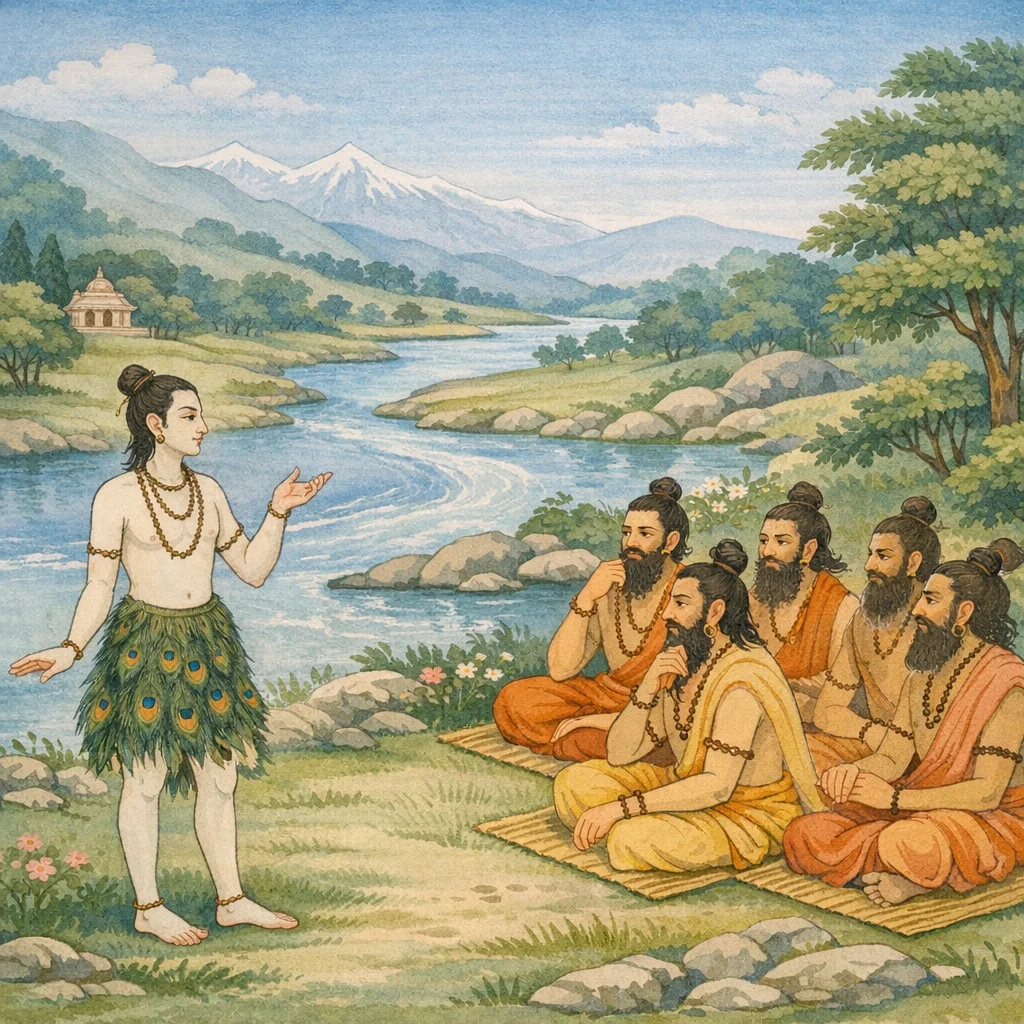
Parāśara relates how Māyāmoha approaches the Daityas on the bank of the Narmadā, first disguised as an ascetic—sky-clad, shaven, and peacock-feathered—and later as a red-robed renunciant. With many-sided, persuasive arguments he draws them away from the Vedic trayi-dharma, spreading deliberate ambiguity by calling the same thing dharma and adharma, real and unreal. The Daityas abandon sadmārga and multiply heterodox creeds that denounce the Veda, the devas, yajña, and the dvijas; once they stray, the Devas renew the war and defeat them. Parāśara then defines ‘nagna’ as those who forsake the varṇāśrama order—such as taking illicit renunciation by skipping the proper stages—and who neglect nitya-karma, stressing the impurity incurred through intimacy, shared meals, and conversation, and warning that even their sight can obstruct śrāddha. To show the peril of pāṣaṇḍa-saṃbhāṣa, he recounts King Śatadhanu’s fall into animal births for speaking with a heretic while fasting, and his later purification through remembrance, dharmic living, and the Aśvamedha’s avabhṛtha bath. The chapter concludes by enjoining strict avoidance of pāṣaṇḍins—especially during rites—to safeguard merit and the efficacy of dharma.
Shlokas
Verse 1
तपस्य् अभिरतान् सो ऽथ मायामोहो महासुरान् मैत्रेय ददृशे गत्वा नर्मदातीरसंश्रयान्
Then Māyāmoha—Delusion itself—went forth and beheld those mighty Asuras, O Maitreya, steadfast in austerities, dwelling along the banks of the Narmadā.
Verse 2
ततो दिगम्बरो मुण्डो बर्हिपत्रधरो द्विज मायामोहो ऽसुरान् श्लक्ष्णम् इदं वचनम् अब्रवीत्
Then Māyāmoha—naked, shaven-headed, and wearing a garment of peacock-feathers—O twice-born, addressed the Asuras with smooth and honeyed words.
Verse 3
भो दैत्यपतयो ब्रूत यदर्थं तप्यते तपः ऐहिकं वाथ पारत्र्यं तपसः फलम् इच्छथ
O lords of the Daityas, speak plainly: for what purpose is this austerity performed? Do you seek the fruit of tapas in this world, or its reward in the world beyond?
Verse 4
पारत्र्यफललाभाय तपश्चर्या महामते अस्माभिर् इयम् आरब्धा किं वा ते ऽत्र विवक्षितम्
O great-minded one, we have undertaken this discipline of austerity to obtain the fruits that belong to the life beyond. What, then, do you wish to ask—or have explained—here?
Verse 5
कुरुध्वं मम वाक्यानि यदि मुक्तिम् अभीप्सथ अर्हध्वं धर्मम् एतं च मुक्तिद्वारम् असंवृतम्
If you truly long for liberation, then carry out my words. Honor this dharma—for it is an open, unobstructed gateway to moksha.
Verse 6
धर्मो विमुक्तेर् अर्हो ऽयं नैतस्माद् अपरः परः अत्रैवावस्थिताः स्वर्गं विमुक्तिं वा गमिष्यथ
This Dharma alone is truly worthy to lead one to liberation; there is no higher path beyond it, nor any superior means. Abiding firmly in it here itself, you shall attain either heaven—or final release.
Verse 7
अर्हध्वं धर्मम् एतं च सर्वे यूयं महाबलाः
Therefore, all of you—mighty in strength—should honor and uphold this dharma.
Verse 8
एवंप्रकारैर् बहुभिर् युक्तिदर्शनवर्धितैः मायामोहेन दैत्यास् ते वेदमार्गाद् अपाकृताः
Thus, by many such modes of argument—ingenious in appearance and strengthened by displays of reasoning—those Daityas, through the delusion of Māyā, were turned aside and driven away from the path of the Vedas.
Verse 9
धर्मायैतद् अधर्माय सद् एतन् न सद् इत्य् अपि विमुक्तये त्व् इदं नैतद् विमुक्तिं संप्रयच्छति
The very same thing is called “for dharma” and “for adharma”; it is declared “real,” and also “not real.” Yet, though it is spoken of as “for liberation,” this—by itself—does not truly bestow liberation.
Verse 10
परमार्थो ऽयम् अत्यर्थं परमार्थो न चाप्य् अयम्
This indeed is the Highest Truth—most truly so; and yet, this too is not (fully) the Highest Truth.
Verse 11
कार्यम् एतद् अकार्यं च नैतद् एवं स्फुटं त्व् इदम् दिग्वाससाम् अयं धर्मो धर्मो ऽयं बहुवाससाम्
“This is to be done, and this is not to be done”—it is not so plainly fixed in every case. For the sky-clad, this is dharma; and for those who wear many garments, that is dharma. Thus, what counts as rightful conduct is often determined by the rule of life one has undertaken.
Verse 12
इत्य् अनेकान्तवादं च मायामोहेन नैकधा तेन दर्शयता दैत्याः स्वधर्मांस् त्याजिता द्विज
Thus, by means of a delusive bewilderment (māyā-moha), he propounded the doctrine of “many-sidedness” in manifold ways; and by having it displayed in this manner, O brāhmaṇa, the Daityas were made to abandon their own ordained dharmas.
Verse 13
अर्हथेमं महाधर्मं मायामोहेन ते यतः प्रोक्तास् तम् आश्रिता धर्मम् अर्हतास् तेन ते ऽभवन्
Deluded by Māyā, you proclaimed this as the “great dharma”; and taking refuge in that very doctrine, you became worthy only of it—your fitness and station were shaped by the path you embraced.
Verse 14
त्रयीधर्मसमुत्सर्गं मायामोहेन ते ऽसुराः कारितास् तन्मया ह्य् आसंस् तथान्ये तत्प्रबोधिताः
Deluded by Māyā, those Asuras were made to abandon the dharmas rooted in the Vedic triad; their minds became wholly steeped in that delusion, and others too were awakened—drawn over—by the same teaching.
Verse 15
तैर् अप्य् अन्ये परे तैश् च तैर् अप्य् अन्ये परे च तैः अल्पैर् अहोभिः संत्यक्ता तैर् दैत्यैः प्रायशस् त्रयी
By those Daityas others too were subdued, and by those others yet others in turn. In only a few days the Daityas had, for the most part, brought the sacred Vedic Triad to ruin—its rites forsaken and its order cast aside.
Verse 16
पुनश् च रक्ताम्बरधृङ् मायामोहो ऽजितेक्षणः अन्यान् आहासुरान् गत्वा मृद्वल्पमधुराक्षरम्
Then again the Deluder by Māyā—He of unconquered vision—clad in red garments, went to the other Asuras and addressed them in words gentle, brief, and sweet-syllabled.
Verse 17
स्वर्गार्थं यदि वो वाञ्छा निर्वाणार्थम् अथासुराः तद् अलं पशुघातादिदुष्टधर्मं निबोधत
If you desire heaven—or, O Asuras, if you seek nirvāṇa—then enough of this wicked “dharma” that begins with the slaughter of animals. Understand the true path of righteousness.
Verse 18
विज्ञानमयम् एवैतद् अशेषम् अवगच्छत बुध्यध्वं मे वचः सम्यग् बुधैर् एवम् उदीरितम्
Know this teaching to be wholly vijñāna—true, realized knowledge. Grasp it in its entirety; understand my words rightly—thus have the wise declared it.
Verse 19
जगद् एतद् अनाधारं भ्रान्तिज्ञानार्थतत्परम् रागादिदुष्टम् अत्यर्थं भ्राम्यते भवसंकटे
This world has no true support of its own; it pursues ends founded on deluded knowledge. Corrupted by passion and the like, it wanders ceaselessly in the perilous straits of becoming (saṃsāra).
Verse 20
एवं बुध्यत बुध्यध्वं बुध्यतैवम् इतीरयन् मायामोहः स दैत्येयान् धर्मम् अत्याजयन् निजम्
Repeating again and again, “Understand thus—reflect, all of you; grasp it in this very way,” Māyāmoha made the sons of Diti (the Daityas) abandon their own rightful dharma.
Verse 21
नानाप्रकारवचनं स तेषां युक्तियोजितम् तथा तथावदद् धर्मं तत्यजुस् ते यथा यथा
He spoke to them in many ways—arguments artfully stitched together with seeming logic; and as he kept speaking like that, they, step by step, abandoned dharma as he led them to.
Verse 22
ते ऽप्य् अन्येषां तथैवोचुर् अन्यैर् अन्ये तथोदिताः मैत्रेय तत्यजुर् धर्मं वेदस्मृत्युदितं परम्
They, in turn, taught the same to others; and those others were instructed likewise by yet others. Thus, O Maitreya, people abandoned the supreme dharma proclaimed in the Vedas and the Smṛtis.
Verse 23
अन्यान् अप्य् अन्यपाषण्डप्रकारैर् बहुभिर् द्विज दैतेयान् मोहयाम् आस मायामोहो ऽतिमोहकृत्
O twice-born, by many other kinds of heterodox creeds as well, Māyāmoha—whose very work is to breed profound delusion—kept the Daityas in bewilderment.
Verse 24
स्वल्पेनैव हि कालेन मायामोहेन ते ऽसुराः मोहितास् तत्यजुः सर्वां त्रयीमार्गाश्रितां कथाम्
In but a short time, those Asuras, deluded by Māyāmoha, utterly abandoned the whole teaching grounded in the threefold Vedic path.
Verse 25
केचिद् विनिन्दां वेदानां देवानाम् अपरे द्विज यज्ञकर्मकलापस्य तथान्ये च द्विजन्मनाम्
Some, O twice-born, reviled the Vedas; others abused the gods. Some mocked the whole order and discipline of sacrificial rites, and others spoke with contempt of the twice-born themselves.
Verse 26
नैतद् युक्तिसहं वाक्यं हिंसा धर्माय नेष्यते हवींष्य् अनलदग्धानि फलायेत्य् अर्भकोदितम्
This saying is not upheld by sound reasoning: violence cannot be made into dharma. That ‘oblations not even touched by fire would still yield the sacrificial fruit’ is mere childish talk.
Verse 27
यज्ञैर् अनेकैर् देवत्वम् अवाप्येन्द्रेण भुज्यते शम्यादि यदि चेत् काष्ठं तद्वरं पत्रभुक् पशुः
By countless sacrifices one may attain godhood, and Indra enjoys that state as its fruit. Yet if the sacred śamī and the rest are nothing but wood, then better than such hollow rites is even an animal that lives on leaves.
Verse 28
निहतस्य पशोर् यज्ञे स्वर्गप्राप्तिर् यदीष्यते स्वपिता यजमानेन किं नु तस्मान् न हन्यते
If it is claimed that a beast slain in sacrifice attains heaven, then by the same reasoning why does the sacrificer not strike down his own father?
Verse 29
तृप्तये जायते पुंसो भुक्तम् अन्येन चेत् ततः दद्याच् छ्राद्धं श्रद्धयान्नं न वहेयुः प्रवासिनः
If a man’s satisfaction is to arise even when the food has been eaten by another, still he should offer the śrāddha with faith; and those away from home should not carry such food on their travels.
Verse 30
जनश्रद्धेयम् इत्य् एतद् अवगम्य ततो ऽत्र वः उपेक्षा श्रेयसी वाक्यं रोचतां यन् मयेरितम्
Knowing this to be a matter worthy of the people’s faith, let it be understood among you here that forbearance is the higher course; may the words I have spoken be pleasing to you.
Verse 31
न ह्य् आप्तवादा नभसो निपतन्ति महासुराः युक्तिमद् वचनं ग्राह्यं मयान्यैश् च भवद्विधैः
O mighty Asuras, trustworthy testimony does not fall from the sky; a statement grounded in reason should be accepted—by me and by others like you who can discern.
Verse 32
मायामोहेन ते दैत्याः प्रकारैर् बहुभिस् तथा व्युत्थापिता यथा नैषां त्रयीं कश्चिद् अरोचयत्
By the delusion wrought through Māyā, those Daityas were turned aside in many ways, so thoroughly that not one among them found any taste for the Triad of the Veda.
Verse 33
इत्थम् उन्मार्गयातेषु तेषु दैत्येषु ते ऽमराः उद्योगं परमं कृत्वा युद्धाय समुपस्थिताः
Thus, when those Daityas strayed from the righteous path and fell into lawlessness, the immortal Devas, mustering their utmost resolve, came forth fully prepared for war.
Verse 34
ततो देवासुरं युद्धं पुनर् एवाभवद् द्विज हताश् च ते ऽसुरा देवैः सन्मार्गपरिपन्थिनः
Then, O twice-born one, the war between the Devas and the Asuras arose once again; and those Asuras—obstructors of the righteous path—were struck down by the Devas.
Verse 35
सद्धर्मकवचस् तेषाम् अभूद् यः प्रथमं द्विज तेन रक्षाभवत् पूर्वं नेशुर् नष्टे च तत्र ते
O twice-born one, the first among them became a coat-of-mail of true dharma itself; by that there was protection at the outset, yet when that safeguard was lost, they too perished there.
Verse 36
ततो मैत्रेय तन्मार्गवर्तिनो ये ऽभवञ् जनाः नग्नास् ते तैर् यतस् त्यक्तं त्रयीसंवरणं वृथा
Then, O Maitreya, those people who took to that path became unclad; for, having abandoned the covering ordained by the Three Vedas, their outward restraint was cast away in vain.
Verse 37
ब्रह्मचारी गृहस्थश् च वानप्रस्थस् तथाश्रमाः परिव्राड् वा चतुर्थो ऽत्र पञ्चमो नोपपद्यते
The āśramas are these: the brahmacārin, the gṛhastha, and the vānaprastha; and here the parivrājaka, the wandering renunciant, is the fourth. A fifth stage has no rightful place in this order.
Verse 38
यस् तु संत्यज्य गार्हस्थ्यं वानप्रस्थो न जायते परिव्राड् वापि मैत्रेय स नग्नः पापकृन् नरः
He who abandons the householder’s station yet does not enter the discipline of the forest-dweller, but instead—O Maitreya—becomes a wandering renunciant, is a man ‘naked’ of dharma and a doer of sin.
Verse 39
नित्यानां कर्मणां विप्र तस्य हानिर् अहर्निशम् अकुर्वन् विहितं कर्म शक्तः पतति तद्दिने
O brāhmaṇa, for one who neglects the daily prescribed rites, loss accrues unceasingly, day and night. If, though able, he does not perform the ordained duty, he falls on that very day.
Verse 40
प्रायश्चित्तेन महता शुद्धिं प्राप्नोत्य् अनापदि पक्षं नित्यक्रियाहानेः कर्ता मैत्रेय मानवः
By a great act of expiation one may regain purity; yet in times free from distress, whoever allows even a fortnight’s lapse of the daily obligatory rites—O Maitreya—is to be regarded as blameworthy.
Verse 41
संवत्सरं क्रियाहानिर् यस्य पुंसो ऽभिजायते तस्यावलोकनात् सूर्यो निरीक्ष्यः साधुभिः सदा
If a man’s lapse in sacred duties endures for a full year, then, upon merely seeing him, the righteous should ever turn their gaze to the Sun (Sūrya), mindful of restoring purity and right order.
Verse 42
स्पृष्टे स्नानं सचैलस्य शुद्धिहेतुर् महामुने पुंसो भवति तस्योक्ता न शुद्धिः पापकर्मणः
O great sage, when one is defiled by contact, bathing even with one’s garments on is declared a means of purification for a man; but for the doer of sinful deeds, such cleansing is not spoken of as true purity.
Verse 43
देवर्षिपितृभूतानि यस्य निःश्वस्य वेश्मनि प्रयान्त्य् अनर्चितान्य् अत्र न तस्मात् पापकृन् नरः
A man in whose very dwelling devas, sages, ancestors, and all beings may come and go even without formal worship is not to be counted a sinner; there, the very breath stands as witness that reverence has not been withheld.
Verse 44
देवादिनिःश्वासहतं शरीरं यस्य वेश्म च न तेन संकरं कुर्याद् गृहासनपरिच्छदैः
He whose body and dwelling have been tainted by the breath of devas and the like—one should not closely intermingle with him through household arrangements: seats, beds, and furnishings; purity is preserved by avoiding such improper mixing.
Verse 45
संभाषणानुप्रश्नादि सहास्यं चैव कुर्वतः जायते तुल्यता पुंसस् तेनैव द्विज वत्सरम्
O twice-born, when a man engages in familiar talk—question and counter-question—and even laughs together in ease, he comes to be regarded as an equal; by that very act, equality is held to arise for a full year.
Verse 46
अथ भुङ्क्ते गृहे तस्य करोत्य् आस्यां तथासने शेते चाप्य् एकशयने स सद्यस् तत्समो भवेत्
If one eats in his house, acts in his presence, sits on the same seat, and even lies on the same bed, then he swiftly becomes equal to him, taking on his very condition through such intimate association.
Verse 47
देवतापितृभूतानि तथानभ्यर्च्य यो ऽतिथीन् भुङ्क्ते स पातकं भुङ्क्ते निष्कृतिस् तस्य कीदृशी
Whoever eats without first offering due reverence to the devas, the ancestors, and living beings—and without honoring the guest—does not truly eat food; he consumes sin. What atonement could ever be adequate for such a fault?
Verse 48
ब्राह्मणाद्याश् च ये वर्णाः स्वधर्माद् अन्यतोमुखम् यान्ति ते नग्नसंज्ञां तु हीनकर्मस्व् अवस्थिताः
Those social orders beginning with the Brāhmaṇas who turn away from their own svadharma and move toward other paths are called “nagna,” for they stand established in degraded deeds.
Verse 49
चतुर्णां यत्र वर्णानां मैत्रेयात्यन्तसंकरः तत्रास्या साधुवृत्तीनाम् उपघाताय जायते
O Maitreya, wherever an extreme intermixture of the four varṇas arises, there the noble ways of conduct are struck down, and dharma is wounded at its root.
Verse 50
अनभ्यर्च्य ऋषीन् देवान् पितृभूतातिथींस् तथा यो भुङ्क्ते तस्य संभाषात् पतन्ति नरके नराः
Whoever eats without first reverently honoring the sages, the gods, the ancestors, living beings, and the guest—by association and converse with such a one, people too fall into hell.
Verse 51
तस्माद् एतान् नरो नग्नांस् त्रयीसंत्यागदूषितान् सर्वदा वर्जयेत् प्राज्ञ आलापस्पर्शनादिषु
Therefore a wise person should always avoid such “nagna,” tainted by abandoning the Threefold Veda—keeping away in speech, in touch, and in all similar dealings.
Verse 52
श्रद्धावद्भिः कृतं यत्नाद् देवान् पितृपितामहान् न प्रीणयति तच् छ्राद्धं यद्य् एभिर् अवलोकितम्
Even a Śrāddha performed with faith and utmost effort does not truly gladden the gods, nor the fathers and grandfathers, if it is carried out under the gaze of these improper onlookers.
Verse 53
श्रूयते च पुरा ख्यातो राजा शतधनुर् भुवि पत्नी च शैब्या तस्याभूद् अतिधर्मपरायणा
Ancient tradition tells that upon the earth there once lived a renowned king named Śatadhanu; and his wife, Śaibyā, was exceedingly devoted to dharma.
Verse 54
पतिव्रता महाभागा सत्यशौचदयान्विता सर्वलक्षणसंपन्ना संपन्ना विनयेन च
She was a steadfast pativratā, greatly blessed and noble of soul—endowed with truth, purity, and compassion; complete in every auspicious mark, and adorned as well with gentle humility.
Verse 55
स तु राजा तया सार्धं देवदेवं जनार्दनम् आराधयाम् आस विभुं परमेण समाधिना
That king, together with her, worshipped Janārdana—the God of gods, the all-sovereign Lord—adoring Him in the highest absorption of samādhi.
Verse 56
होमैर् जपैस् तथा दानैर् उपवासैश् च भक्तितः पूजाभिश् चानुदिवसं तन्मना नान्यमानसः
With devotion—by fire-offerings, recitation, gifts, and fasts—and by daily worship, let one remain wholly absorbed in Him alone, the mind fixed on Him, admitting no other thought.
Verse 57
एकदा तु समं स्नातौ तौ तु भार्यापती जले भागीरथ्याः समुत्तीर्णौ कार्त्तिक्यां समुपोषितौ पाषण्डिनम् अपश्येताम् आयान्तं संमुखं द्विज
Once, after the husband and wife had bathed together in the waters of the Bhāgīrathī and come up to the bank—observing a fast in the month of Kārttika—O brāhmaṇa, they saw a pāṣaṇḍin, a heretical ascetic, approaching them face to face.
Verse 58
चापाचार्यस्य तस्यासौ सखा राज्ञो महात्मनः अतस् तद्गौरवात् तेन सहालापम् अथाकरोत्
He was a friend of that venerable, great-souled king, and a companion of the teacher of the bow. Therefore, honoring his dignity and station, he then entered into conversation with him.
Verse 59
न तु सा वाग्यता देवी तस्य पत्नी यतव्रता उपोषितास्मीति रविं तस्मिन् दृष्टे ददर्श च
But the goddess Vāgyatā—his wife, steadfast in her vow—did not remain unmoved. Thinking, “I am fasting,” when she beheld him, she also beheld Ravi, the Sun, in that very sight.
Verse 60
समागम्य यथान्यायं दम्पती तौ यथाविधि विष्णोः पूजादिकं सर्वं कृतवन्तौ द्विजोत्तम
O best of the twice-born, having come together in due order, that husband and wife, according to prescribed rule, performed every rite—beginning with the worship of Lord Viṣṇu.
Verse 61
कालेन गच्छता राजा ममारासौ सपत्नजित् अन्वारुरोह तं देवी चितास्थं भूपतिं पतिम्
As time moved onward, King Sapatnajit died. And the queen, faithful to her lord, ascended the funeral pyre with her husband, the sovereign, as he lay upon it.
Verse 62
स तु तेनापचारेण श्वा जज्ञे वसुधाधिपः उपोषितेन पाषण्डसंभाषो यः कृतो ऽभवत्
But because of that transgression, the lord of the earth was reborn as a dog; for while fasting he had conversed with a pāṣaṇḍa, one who rejects the Vedic path, and that act became the cause of his fall.
Verse 63
सापि जातिस्मरा जज्ञे काशिराजसुता शुभा सर्वविज्ञानसंपन्ना सर्वलक्षणभूषिता
She too was born with remembrance of former births—the auspicious daughter of the king of Kāśī—complete in understanding and adorned with every mark of excellence.
Verse 64
तां पिता दातुकामो ऽभूद् वराय विनिवारितः तयैव तन्व्या विरतो विवाहारम्भतो नृपः
Her father wished to give her in marriage to the chosen bridegroom, yet he was restrained; and that slender maiden herself made the king desist, even as the wedding was about to begin.
Verse 65
ततः सा दिव्यया दृष्ट्या दृष्ट्वा श्वानं निजं पतिम् वैदिशाख्यं पुरं गत्वा तदवस्थं ददर्श तम्
Then, with divine sight, she beheld her own husband in the form of a dog; and going to the city called Vaidīśa, she saw him there, abiding in that very condition.
Verse 66
तं दृष्ट्वैव महाभागा श्वानभूतं पतिं तथा ददौ तस्मै वराहारं सत्कारप्रवणं शुभम्
The noble lady, seeing her husband reduced to the state of a dog, at once—still devoted to honor and right conduct—offered him wholesome food and tended him with auspicious, respectful care.
Verse 67
भुञ्जन् दत्तं तया सो ऽन्नम् अतिमिष्टम् अभीप्सितम् श्वजातिललितं कुर्वन् बहु चाटु चकार वै
Eating the food she had given—exceedingly sweet and exactly to his liking—he began to behave like a pampered pet dog, and indeed uttered many coaxing, flattering words.
Verse 68
अतीव व्रीडिता बाला कुर्वता चाटु तेन सा प्रणामपूर्वम् आहेदं दयितं तं कुयोनिजम्
The young maiden, overcome with shyness as he spoke to her with coaxing sweetness, first bowed in reverence and then addressed that beloved one—him who was not born of a womb.
Verse 69
स्मर्यतां तन् महाराज दाक्षिण्यललितं त्वया येन श्वयोनिम् आपन्नो मम चाटुकरो भवान्
Let that be recalled, O great king—the gracious, tender kindness once shown by you—by which you came to be born in the womb of a dog, and became a flattering attendant upon me.
Verse 70
पाषण्डिनं समाभाष्य तीर्थस्नानाद् अनन्तरम् प्राप्तो ऽसि कुत्सितां योनिं किं न स्मरसि तत् प्रभो
After bathing at the sacred ford, you conversed with a heretic; and immediately thereafter you fell into a degraded womb. O lord, do you not remember that?
Verse 71
तयैवं स्मारिते तत्र पूर्वजातिकृते तदा दध्यौ चिरम् अथावाप निर्वेदम् अतिदुर्लभम्
Thus, when he was reminded by her of what had been done in a former birth, he sat for a long while in deep reflection; and then he attained that rarest of treasures—profound dispassion toward the world.
Verse 72
निर्विण्णचित्तः स ततो निर्गम्य नगराद् बहिः मरुप्रपतनं कृत्वा शार्गालीं योनिम् आगतः
His mind, worn out with disgust and despair, he left the city and went outside; and after casting himself down at Maruprapatana, he passed into the womb of a she-jackal—thus entering that birth.
Verse 73
सापि द्वितीये संप्राप्ते वर्षे दिव्येन चक्षुषा ज्ञात्वा सृगालं तं द्रष्टुं ययौ कोलाहलं गिरिम्
When the second year arrived, she too, knowing by divine sight, set out to behold that jackal and went to Mount Kolāhala.
Verse 74
तत्रापि दृष्ट्वा तं प्राह शार्गालीं योनिम् आगतम् भर्तारम् अपि चार्वङ्गी तनया पृथिवीक्षितः
There too, on seeing him, Cārvaṅgī, the king’s daughter, spoke to her own husband, who had come to be in the womb-form of a jackal.
Verse 75
अपि स्मरसि राजेन्द्र श्वयोनिस्थस्य यन् मया प्रोक्तं ते पूर्वचरितं पाषण्डालापसंश्रयम्
O best of kings, do you remember what I once told you—when you were in the śva-yoni—about your former life and conduct, and how you became entangled in the talk and influence of the pāṣaṇḍas?
Verse 76
पुनस् तयोक्तं तज् ज्ञात्वा सत्यं सत्यवतां वरः कानने स निराहारस् तत्याज स्वं कलेवरम्
Then, understanding the truth of what those two had spoken, the noblest among the keepers of truth withdrew into the forest; there, renouncing all food, he abandoned his bodily frame.
Verse 77
भूयस् ततो वृकं जातं गत्वा तं निर्जने वने स्मारयाम् आस भर्तारं पूर्ववृत्तम् अनिन्दिता
Then, once again becoming a she-wolf, the blameless lady went to him in a lonely forest and reminded her husband of all that had happened before.
Verse 78
न त्वं वृको महाभाग राजा शतधनुर् भवान् श्वा भूत्वा त्वं शृगालो ऽभूर् वृकत्वं साम्प्रतं गतः
O fortunate one, you are not a wolf—you are King Śatadhanu. Having become a dog, you then became a jackal; and only now have you attained the state of a wolf.
Verse 79
स्मारितेन यथा व्यक्तस् तेनात्मा गृध्रतां गतः अपापा सा पुनश् चैनं बोधयाम् आस भामिनी
Just as he had been reminded, so he became fully aware; and by that very recollection his self took on the state of a vulture. Then that blameless, radiant lady again roused him—awakening him to what had occurred.
Verse 80
नरेन्द्र स्मर्यताम् आत्मा ह्य् अलं ते गृध्रचेष्टया पाषण्डालापजातो ऽयं दोषो यद् गृध्रतां गतः
O king, recollect your higher self. Enough of this vulture-like conduct. This fault has been bred from the chatter of heretics and has dragged you into the state of a carrion-eater—one who grasps and tears at what is not rightfully his.
Verse 81
ततः काकत्वम् आपन्नं समनन्तरजन्मनि उवाच तन्वी भर्तारम् उपलभ्यात्मयोगतः
Thereafter, in her very next birth she took on the state of a crow; yet the slender one, having found her husband again through the power of inner yoga, spoke to him.
Verse 82
अशेषा भूभृतः पूर्वं वश्या यस्मै बलिं ददुः स त्वं काकत्वम् आपन्नो जातो ऽद्य बलिभुक् प्रभो
All kings once stood subdued before you and brought you tribute. Yet you—O lord who once received the offerings of rulers—have now fallen into the state of a crow, born today to live as a mere eater of scraps and oblations.
Verse 83
एवम् एव च काकत्वे स्मारितः स पुरातनम् तत्याज भूपतिः प्राणान् मयूरत्वम् अवाप च
Thus, while in the state of a crow, he was made to remember the ancient truth; the king then cast off his life-breath and attained the condition of a peacock.
Verse 84
मयूरत्वे ततः सा वै चकारानुगतं शुभा दत्तैः प्रतिक्षणं भोज्यैर् बाला तज्जातिभोजनैः
Then, having become a peahen, that auspicious young girl followed her new condition, being sustained at every moment by foods that were given—foods suited to that very species.
Verse 85
ततस् तु जनको राजा वाजिमेधं महाक्रतुम् चकार तस्यावभृथे स्नापयाम् आस तं तदा
Then King Janaka performed the mighty royal sacrifice of the Aśvamedha; and at its concluding rite (avabhṛtha) he had him bathed at that time, in accordance with the sacrificial ordinance.
Verse 86
सस्नौ स्वयं च तन्वङ्गी स्मारयाम् आस चापि तम् यथासौ श्वशृगालाद्या योनीर् जग्राह पार्थिवः
Then the slender-limbed lady bathed herself, and she also caused him to remember. Thus the king, drawn onward by the force of karma, entered wombs such as those of dogs, jackals, and the like.
Verse 87
स्मृतजन्मक्रमः सो ऽथ तत्याज स्वं कलेवरम् जज्ञे च जनकस्यैव पुत्रो ऽसौ सुमहात्मनः
Then that great one—who remembered the sequence of his former births—cast off his own body, and was born again as the very son of the noble-souled King Janaka.
Verse 88
ततः सा पितरं तन्वी विवाहार्थम् अचोदयत् स चापि कारयाम् आस पिता तस्याः स्वयंवरम्
Then the slender maiden urged her father to arrange her marriage; and her father, in response, had a svayaṃvara proclaimed for her.
Verse 89
स्वयंवरे कृते सा तं संप्राप्तं पतिम् आत्मनः वरयाम् आस भूयो ऽपि भर्तृभावेन भामिनी
When the svayaṃvara was held, that spirited lady again chose as her husband the very man who had come to her as the destined lord of her own self—accepting him once more in the fullness of wedded devotion.
Verse 90
बुभुजे च तया सार्धं संभोगान् नृपनन्दनः पितर्य् उपरते राज्यं विदेहेषु चकार सः
And that prince, delight of kings, enjoyed conjugal pleasures together with her; and when his father passed away, he assumed the sovereignty among the Videhas, taking up the rule of the realm in due order.
Verse 91
इयाज यज्ञान् सुबहून् ददौ दानानि चार्थिनाम् पुत्रान् उत्पादयाम् आस युयुधे च सहारिभिः
He performed many sacrificial rites, and he bestowed gifts upon those who sought them. He also begot sons, and he fought alongside the Hari-s, upholding the royal duty that sustains order in the world.
Verse 92
राज्यं कृत्वा यथान्यायं पालयित्वा वसुंधराम् तत्याज स प्रियान् प्राणान् संग्रामे धर्मतो नृपः
Having ruled the kingdom in accordance with justice, and having protected the earth as is proper, that king—faithful to dharma—then relinquished his beloved life-breath in battle.
Verse 93
ततश् चितास्थं तं भूयो भर्तारं सा शुभेक्षणा अन्वारुरोह विधिवद् यथापूर्वं मुदावती
Then, seeing her husband once more seated upon the funeral pyre, that fair‑eyed lady—glad at heart as before—ascended it after him, in due rite and proper manner.
Verse 94
ततो ऽवाप तया सार्धं राजपुत्र्या स पार्थिवः ऐन्द्रान् अतीत्य वै लोकांल् लोकान् कामदुहो ऽक्षयान्
Thereafter, that king—together with the princess—attained realms beyond even the worlds of Indra: inexhaustible planes of existence that grant the heart’s desires.
Verse 95
स्वर्गाक्षयत्वम् अतुलं दाम्पत्यम् अतिदुर्लभम् प्राप्तं पुण्यफलं प्राप्य संशुद्धिं तां द्विजोत्तम
O best of the twice-born, having attained the fruit of merit, you have obtained an incomparable, unfailing heaven—and also that exceedingly rare blessing of true conjugal harmony; thus have you reached that state of purification.
Verse 96
एष पाषण्डसंभाषदोषः प्रोक्तो मया द्विज तथाश्वमेधावभृथस्नानमाहात्म्यम् एव च
Thus, O twice-born one, I have explained the fault incurred by discoursing with the pāṣaṇḍas (those who reject the Vedic way); and I have also set forth the sacred greatness of the avabhṛtha bath that concludes the Aśvamedha sacrifice.
Verse 97
तस्मात् पाषण्डिभिः पापैर् आलापस्पर्शनं त्यजेत् विशेषतः क्रियाकाले यज्ञादौ चापि दीक्षितः
Therefore, one should avoid conversation and physical contact with sinful heretics—most especially at the time of performing rites; and likewise when engaged in sacrifices and other sacred acts, the initiated must keep themselves unsullied.
Verse 98
क्रियाहानिर् गृहे यस्य मासम् एकं प्रजायते तस्यावलोकनात् सूर्यं पश्येत मतिमान् नरः
If, in a man’s house, neglect of sacred observances continues for a full month, then a prudent person, seeing that lapse, should behold the Sun—the witness of dharma—for purification.
Verse 99
किं पुनर् यैस् तु संत्यक्ता त्रयी सर्वात्मना द्विज परान्नभोजिभिः पापैर् वेदवादविरोधिभिः
How much more severe, O twice-born, is the consequence for those sinners who have wholly abandoned the three Vedas, living on others’ food while opposing the teachings and authority of the Veda?
Verse 100
पाषण्डिनो विकर्मस्थान् बैडालव्रतिकाञ् छठान् हैतुकान् बकवृत्तींश् च वाङ्मात्रेणापि नार्चयेत्
One should not offer even verbal honor to heretics—those fixed in forbidden acts, those who keep the ‘cat-like vow’, the deceitful, the sophists, and those whose conduct is like a crane’s.
Verse 101
दूराद् अपास्तः संपर्कस् सहास्यापि च पापिभिः पाषण्डिभिर् दुराचारैस् तस्मात् तान् परिवर्जयेत्
Therefore one should keep far away all contact—even casual familiarity and joking—with sinners, heretics, and those of corrupt conduct; thus they should be avoided.
Verse 102
एते नग्नास् तवाख्याता दृष्ट्या श्राद्धोपघातकाः येषां संभाषणात् पुंसां दिनपुण्यं प्रणश्यति
These are the ‘naked ones’ of whom I have spoken to you: their very sight is said to impair the śrāddha rites, and merely conversing with them destroys a man’s merit earned through the day.
Verse 103
एते पाषण्डिनः पापा न ह्य् एतान् आलपेद् बुधः पुण्यं नश्यति संभाषाद् एतेषां तद्दिनोद्भवम्
These are sinful heretics; therefore a wise person should not even speak with them. For by conversing with such people, one’s merit is destroyed—merit accumulated and ripened from that very day’s righteous conduct.
Verse 104
पुंसां जटाधरणमौण्ड्यवतां वृथैव मोघाशिनाम् अखिलशौचनिराकृतानाम् तोयप्रदानपितृपिण्डबहिष्कृतानां संभाषणाद् अपि नरा नरकं प्रयान्ति
For men who merely wear matted locks or a shaven head in vain—who eat without purpose, cast aside all purity, and abandon the offerings of water and the ancestral piṇḍa—association itself becomes perilous: even by speaking with such people, others are said to fall toward hell.
Frequently Asked Questions
He uses attractive ascetic personas and rhetoric of ambiguity (many-sided ‘reasoning’), reframing dharma as relative to lifestyle and undermining fixed Vedic authority; the Daityas then propagate these views, rapidly abandoning trayi-dharma.
Because saṃsarga (intimate contact—conversation, shared seating/food/bed) is portrayed as transmitting status and impurity, eroding daily merit and obstructing rites like śrāddha; dharma is maintained by guarding boundaries of conduct and company.
Even a single lapse—conversing with a pāṣaṇḍin while in a vow/fast—can distort karmic trajectory; recovery comes through remembrance (jāti-smaraṇa), renewed dharmic alignment, and purificatory rites, culminating in restoration to a higher birth and purified destiny.