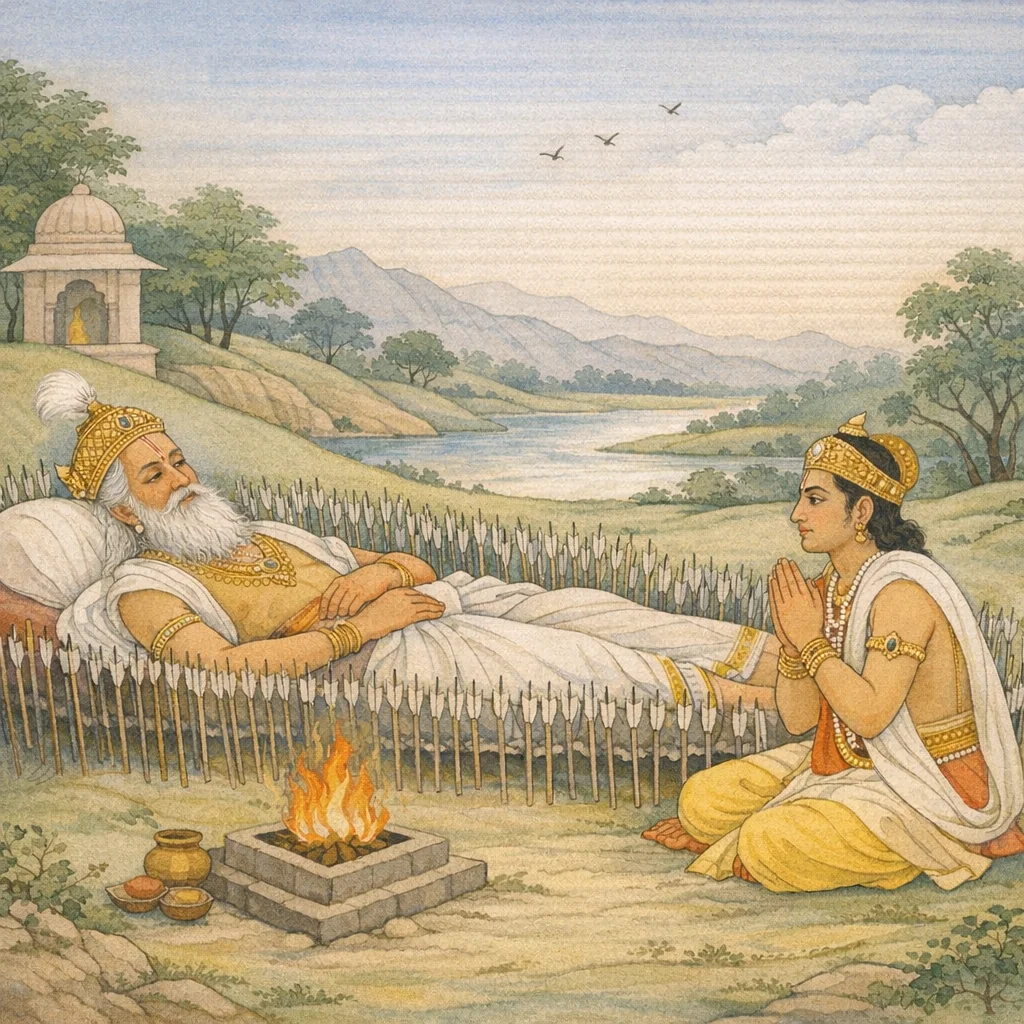
Adhyaya 111
मानसतीर्थ-शौचप्रशंसा | Praise of the ‘Mental Tīrtha’ and the Marks of Purity
Upa-parva: Tīrtha-Śauca-Anuśāsana (Discourse on Pilgrimage and Purity)
Yudhiṣṭhira asks Bhīṣma to identify the श्रेष्ठ (best) among all tīrthas and to explain where ‘parama śauca’ (supreme purity) is found. Bhīṣma responds that all tīrthas have value for the discerning, yet the highest tīrtha is internal: an ‘agādha, vimala, śuddha’ mental ford filled with satya (truth) and sustained by dhṛti (steadfastness). He enumerates purity-markers as ethical and psychological disciplines—gentleness, sincerity, straightforwardness, ahiṃsā, compassion, dama and śama—along with non-possessiveness and absence of ego. He reframes ‘snāna’ (bathing) as ‘dama-snāta’ (bathed in restraint), yielding both external and internal cleanliness. While affirming the sanctity of earthly tīrthas and their rites (prayer, bathing, ancestral offerings) as purifying, he concludes that accomplishment arises from combining bodily/ritual purity with tīrtha-purity understood as inner discipline, paralleling the need to unite ‘strength’ and ‘action’ for success.
Chapter Arc: युधिष्ठिर का प्रश्न—जब यज्ञ बहु-सामग्री, धन और राजवैभव मांगते हैं, तब दरिद्र मनुष्य किस उपाय से वही पुण्य-फल प्राप्त कर सकता है? → भीष्म समझाते हैं कि अनेक यज्ञ ‘बहूपकरण’ हैं; निर्धन के लिए उनका अनुष्ठान कठिन है। तब वे उपवास-विधियों का क्रमबद्ध विधान खोलते हैं—मिताहार, इन्द्रिय-निग्रह, अहिंसा, और अग्निहोत्र-जैसे जप-हवन के साथ दीर्घकालिक व्रत—जिनसे यज्ञ-फल की समता संभव होती है। → भीष्म का निर्णायक प्रतिपादन—उपवास-धर्म का फल यज्ञ-फल के तुल्य है; जो बारह मास तक नियम, मिताहार, जितेन्द्रियता और वैराग्य के साथ आचरण करता है, वह उच्च लोकों का दर्शन/प्राप्ति करता है और दिव्य भोग-सम्पदा से युक्त होकर दीर्घकाल सुख भोगता है। → उपवास के फल का ‘अनुपूर्व्येण’ (क्रमशः) व्याख्यान पूर्ण होता है: दरिद्र मनुष्य भी शुद्ध आचरण, संयम और अहिंसा-प्रधान व्रत से वही आध्यात्मिक उपलब्धि पा सकता है जो सम्पन्न जन यज्ञों से पाते हैं। → भीष्म आगे के अध्यायों के लिए संकेत छोड़ते हैं कि दान-धर्म और व्रत-धर्म के अन्य सूक्ष्म भेदों/फल-विशेषों का विस्तार आगे क्रमशः कहा जाएगा।
Shlokas
Verse 1
इस प्रकार श्रीमह्याभारत अनुशासनपर्वके अन्तर्गत दानधर्मपर्वमें उपवासविधिविषयक एक सौ छठा अध्याय पूरा हुआ ॥/ १०६ ॥/ ऑपन-माज बछ। अफि्-छऋाज सप्ताधिकशततमो< ध्याय: दरिद्रोंके लिये यज्ञतुल्य फल देनेवाले उपवास-व्रत और उसके फलका विस्तारपूर्वक वर्णन युधिछिर उवाच पितामहेन विधिवद् यज्ञा: प्रोक्ता महात्मना । गुणाश्रैषां यथातथ्यं प्रेत्य चेह च सर्वश:,युधिष्ठिरने कहा--महात्मा पितामहने विधिपूर्वक यज्ञोंका वर्णन किया और इहलोक तथा परलोकमें जो उनके सम्पूर्ण गुण हैं, उनका भी यथावत्रूपसे प्रतिपादन किया
Yudhiṣṭhira said: “O Grandsire, the great-souled one has explained the sacrifices in due and proper order, and has also set forth, exactly as they are, all their merits—both in this world and after death.”
Verse 2
न ते शक््या दरिद्रेण यज्ञा: प्राप्तुं पितामह । बहूपकरणा यज्ञा नानासम्भारविस्तरा:,किन्तु पितामह! दरिद्र मनुष्य उन यज्ञोंका लाभ नहीं उठा सकता; क्योंकि उन यज्ञोंके उपकरण बहुत हैं और अनेक प्रकारके आयोजनोंके कारण उनका विस्तार बहुत बढ़ जाता है
Yudhiṣṭhira said: “O Grandfather, a poor man cannot attain (the fruits of) those sacrifices. Sacrifices require many implements and expand through numerous kinds of provisions and arrangements.”
Verse 3
पार्थिवै राजपुत्रैर्वा शक््या: प्राप्तुं पितामह । नार्थन्यूनैरवगुणैरेकात्मभिरसंहतै:,दादाजी! राजा अथवा राजपुत्र ही उन यज्ञोंका लाभ ले सकते हैं। जिनके पास धनकी कमी है, जो गुणहीन, एकाकी और असहाय हैं, वे उस प्रकारके यज्ञ नहीं कर सकते
Yudhiṣṭhira said: “O Grandfather, only kings or princes are able to obtain the fruits of those sacrifices. Those who are deficient in wealth, lacking in virtues, solitary, and without support cannot perform sacrifices of that kind.”
Verse 4
यो दरिद्रैरपि विधि: शकक्य: प्राप्तुं सदा भवेत् | अर्थन्यूनैरवगुणैरेकात्मभिरसंहतै:
Yudhiṣṭhira said: “That prescribed course of conduct which even the poor can always manage to follow—by those who are lacking in wealth, marked by shortcomings, yet of one intent and not divided—(tell me of such a dharma).”
Verse 5
तुल्यो यज्ञफलैरेतैस्तन्मे ब्रूहि पितामह । इसलिये जिस कर्मका अनुष्ठान दरिद्रों, गुणहीनों, एकाकी और असहायोंके लिये भी सुगम तथा बड़े-बड़े यज्ञोंके समान फल देनेवाला हो, उसीका मुझसे वर्णन कीजिये ।। ४ $ || भीष्म उवाच इदमज्िरसा प्रोक्तमुपवासफलात्मकम्
Yudhiṣṭhira said: “Therefore, O Grandfather, tell me of that practice which is easy even for the poor, the unaccomplished, the solitary, and the helpless to undertake, yet yields fruits equal to those of great sacrifices.” Bhīṣma said: “This, it is said, was taught by Aṅgiras and is of the nature of the fruit of fasting.”
Verse 6
यस्तु कल्यं तथा सायं भुञज्जानो नान्तरा पिबेत्,जो सबेरे और शामको ही भोजन करता है, बीचमें जलतक नहीं पीता तथा अहिंसापरायण होकर नित्य अग्निहोत्र करता है, उसे छ: वर्षोमें ही सिद्धि प्राप्त हो जाती है --इसमें संशय नहीं है
Bhishma said: One who eats only at dawn and at dusk, and does not drink even water in between, and who is steadfast in non-violence while performing the daily Agnihotra, attains spiritual accomplishment within six years—of this there is no doubt.
Verse 7
अहिंसानिरतो नित्यं जुह्नमानो जातवेदसम् | षड्भिरेव स वर्षैस्तु सिध्यते नाज संशय:,जो सबेरे और शामको ही भोजन करता है, बीचमें जलतक नहीं पीता तथा अहिंसापरायण होकर नित्य अग्निहोत्र करता है, उसे छ: वर्षोमें ही सिद्धि प्राप्त हो जाती है --इसमें संशय नहीं है
Bhishma said: One who is ever devoted to non-violence, and who daily offers oblations into Jātavedas (the sacred fire), attains spiritual accomplishment in only six years—of this there is no doubt.
Verse 8
तप्तकाञ्चनवर्ण च विमान लभते नर: । देवस्त्रीणामधीवासे नृत्यगीतनिनादिते
Bhīṣma said: A man attains a celestial aerial car, radiant like heated gold, and gains residence among the divine women—an abode resounding with dance and song.
Verse 9
त्रीणि वर्षाणि य: प्राशेत् सततं त्वेकभोजनम्
Bhīṣma said: “Whoever, for three years, continually sustains himself on a single daily meal…”
Verse 10
यज्ञ बहुसुवर्ण वा वासवप्रियमाचरेत्
Bhīṣma said: “One should perform either a sacrifice or an act involving abundant gold—whatever is especially pleasing to Vāsava (Indra).”
Verse 11
सत्यवान् दानशीलबश्र ब्रह्माण्यश्वञानसूयक: । क्षान्तो दान्तो जितक्रोध: स गच्छति परां गतिम्
Bhīṣma said: One who is truthful and generous, devoted to the Brahmins and free from envy; who is forbearing, self-restrained, and has conquered anger—such a person attains the highest state.
Verse 12
जो बहुत-सी सुवर्णकी दक्षिणासे युक्त इन्द्रप्रिय यज्ञका अनुष्ठान करता है तथा सत्यवादी, दानशील, ब्राह्मणभक्त, अदोषदर्शी, क्षमाशील, जितेन्द्रिय और क्रोधविजयी होता है, वह उत्तम गतिको प्राप्त होता है ।। पाण्डुरा भ्रप्रतीकाशे विमाने हंसलक्षणे | द्वे समाप्ते ततः पद्मे सो5प्सरोभिवसेत् सह,वह सफेद बादलोंके समान चमकीले हंसोपलक्षित विमानपर बैठकर दो पद्म वर्षोतक समय समाप्त होनेतक अप्सराओंके साथ वहाँ निवास करता है
Bhishma said: One who performs a sacrifice dear to Indra, endowed with abundant gifts of gold, and who is truthful, generous, devoted to Brahmanas, one who does not look for faults, who is forgiving, self-controlled, and a conqueror of anger—such a person attains the highest course of destiny. Seated in a swan-marked celestial chariot, radiant like white clouds, he dwells there together with apsaras until two ‘Padma’ periods of time are completed.
Verse 13
द्वितीये दिवसे यस्तु प्राश्नीयादेकभोजनम् | सदा द्वादशमासांस्तु जुह्मानो जातवेदसम्
Bhīṣma said: “He who, on the second day, takes food only once, and who continually for twelve months offers oblations into the sacred fire (Agni Jātavedas)—such disciplined restraint and steady worship are praised as a dharmic observance.”
Verse 14
अग्निकार्यपरो नित्यं नित्यं कल्यप्रबोधन: । अग्निष्टोमस्य यज्ञस्य फल प्राप्रोति मानव:
Bhīṣma said: A person who is ever devoted to the sacred duties connected with the fire, and who regularly rises at the proper time, attains the fruit of the Agniṣṭoma sacrifice.
Verse 15
जो मनुष्य नित्य अग्निमें होम करता हुआ एक वर्षतक प्रति दूसरे दिन एक बार भोजन करता है तथा प्रतिदिन अग्निकी उपासनामें तत्पर रहकर नित्य सबेरे जागता है, वह अग्निष्टोम यज्ञका फल पाता है ।। हंससारसयुक्तं च विमानं लभते नर: | इन्द्रलोके च वसते वरस्त्रीभि: समावृत:,वह मानव हंस और सारसोंसे जुते हुए विमानको पाता है और इन्द्रलोकमें सुन्दरी स्त्रियोंसे घिरा हुआ निवास करता है
Bhishma said: A man who, for a full year, performs daily offerings into the sacred fire, eats only once every other day, remains devoted each day to the worship of Agni, and rises regularly at dawn—such a person attains the merit equivalent to the Agniṣṭoma sacrifice. He is said to obtain a celestial chariot yoked with swans and cranes, and to dwell in Indra’s heaven surrounded by excellent women.
Verse 16
तृतीये दिवसे यस्तु प्राश्नीयादेकभोजनम् | सदा द्वादशमासांस्तु जुह्दानो जातवेदसम्,जो बारह महीनोंतक प्रति तीसरे दिन एक समय भोजन करता, नित्य सबेरे उठता और अग्निकी परिचर्यामें तत्पर हो नित्य अग्निमें आहुति देता है, वह अतिरात्र यागका परम उत्तम फल पाता है
Bhīṣma said: “He who, on every third day, takes only a single meal, and who for twelve months continually offers oblations into the sacred fire (Agni), attains the supremely excellent fruit of the Atirātra sacrifice.”
Verse 17
अग्निकार्यपरो नित्यं नित्यं कल्यप्रबोधन: । अतितात्रस्य यज्ञस्य फल प्राप्रोत्यनुत्तमम्,जो बारह महीनोंतक प्रति तीसरे दिन एक समय भोजन करता, नित्य सबेरे उठता और अग्निकी परिचर्यामें तत्पर हो नित्य अग्निमें आहुति देता है, वह अतिरात्र यागका परम उत्तम फल पाता है
“One who is ever devoted to the rites of the sacred fire, who rises early each day and offers oblations daily, obtains the unsurpassed fruit of the Atirātra sacrifice.”
Verse 18
मयूरहंसयुक्तं च विमानं लभते नर: । सप्तर्षीणां सदा लोके सो5प्सरोभिव॑सेत् सह
Bhīṣma said: “That man obtains a celestial aerial car yoked with peacocks and swans, and in the worlds of the Seven Ṛṣis he dwells always, together with the Apsarās.”
Verse 19
निवर्तनं च तत्रास्य त्रीणि पद्मानि चैव ह । उसे मोरोंसे जुता हुआ विमान प्राप्त होता है और वह सदा सप्तर्षियोंके लोकमें अप्सराओंके साथ निवास करता है। वहाँ तीन पद्म वर्षोतक वह निवास करता है ॥| १८३ || दिवसे यश्नतुर्थे तु प्राश्नीयादेकभोजनम्,जो प्रतिदिन अग्निहोत्र करता हुआ बारह महीनोंतक प्रति चौथे दिन एक बार भोजन करता है, वह वाजपेय यज्ञका परम उत्तम फल पाता है
Bhīṣma said: “For him there is also a return (to a higher state), and indeed a residence there for three ‘padmas’ (a vast measure of time). And if, while maintaining the daily Agnihotra, he eats only once on every fourth day for twelve months, he attains the supremely excellent fruit of the Vājapeya sacrifice.”
Verse 20
सदा द्वादशमासान् वै जुह्बमानो जातवेदसम् | वाजपेयस्य यज्ञस्य फल प्राप्रोत्यनुत्तमम्,जो प्रतिदिन अग्निहोत्र करता हुआ बारह महीनोंतक प्रति चौथे दिन एक बार भोजन करता है, वह वाजपेय यज्ञका परम उत्तम फल पाता है
Bhīṣma said: “One who, for a full twelve months, continually offers oblations into Jātavedas (the sacred fire), and who disciplines himself by taking food only once every fourth day while maintaining the daily Agnihotra, attains the unsurpassed merit that is said to arise from the Vājapeya sacrifice.”
Verse 21
इन्द्रकन्याभिरूढं च विमानं लभते नर: । सागरस्य च पर्यन्ते वासवं लोकमावसेत्
Bhīṣma said: “A man attains a celestial aerial car (vimāna) mounted and attended by the daughters of Indra, and at the farthest shore of the ocean he comes to dwell in the world of Vāsava (Indra).”
Verse 22
दिवसे पउ्चमे यस्तु प्राश्नीयादेकभोजनम्,अनसूयुरपापस्थो द्वादशाहफलं लभेत् । जो बारह महीनोंतक प्रतिदिन अग्निहोत्र करता हुआ हर पाँचवें दिन एक समय भोजन करता है और लोभहीन, सत्यवादी, ब्राह्मणभक्त, अहिंसक और अदोषदर्शी होकर सदा पापकमोंसे दूर रहता है, उसे द्वादशाह यज्ञका फल प्राप्त होता है
Bhīṣma said: “Whoever, on every fifth day, takes food only once—free from malice and firmly established in sinlessness—obtains the merit equivalent to the Dvādaśāha sacrifice.”
Verse 23
सदा द्वादशमासांस्तु जुह्दानो जातवेदसम् | अलुब्ध: सत्यवादी च ब्रह्मण्यश्वाविहिंसक:
Bhīṣma said: “One who, throughout the twelve months of the year, continually offers oblations into the sacred fire, Agni (Jātavedas), and who is free from greed, devoted to truthfulness, reverent toward Brahmins and the Vedic order, and non-violent—such a person embodies the marks of righteous conduct.”
Verse 24
जाम्बूनदमयं दिव्यं विमान हंसलक्षणम्
Bhīṣma said: “A celestial aerial car (vimāna), fashioned of pure Jāmbūnada gold and marked with the emblem of a swan (haṃsa).”
Verse 25
सूर्यमालासमाभासमारोहेत् पाण्डुरं गृहम् आवर्तनानि चत्वारि तथा पद्मानि द्वादशश
Bhīṣma said: “One should ascend a white mansion radiant like a garland of suns, furnished with four circular courts and twelve lotus-like features.”
Verse 26
शराग्निपरिमाणं च तत्रासौ वसते सुखम् । वह सूर्यकी किरणमालाओंके समान प्रकाशमान तथा जाम्बूनद नामक सुवर्णके बने हुए श्वेतकान्तिवाले हंसलक्षित दिव्य विमानकर आरूढ़ होता तथा चार, बारह एवं पैंतीस (कुल मिलाकर इक्यावन) पद्म वर्षोतक स्वर्गलोकमें सुखपूर्वक निवास करता है || २४-२५ ई || दिवसे यस्तु षछ्े वै मुनि: प्राशेत भोजनम्,गवां मेधस्य यज्ञस्य फल प्राप्नोत्यनुत्तमम् । जो बारह महीनेतक सदा अन्निहोत्र करता, तीनों संध्याओंके समय स्नान करता, ब्रह्मचर्यका पालन करता, दूसरोंके दोष नहीं देखता तथा मुनिवृत्तिसे रहकर प्रति छठे दिन एक बार भोजन करता है, वह गोमेध यज्ञका सर्वोत्तम फल पाता है
Bhishma said: “The ascetic who eats only once every sixth day attains the unsurpassed merit that is the fruit of the Gomeda (cow-sacrifice). The teaching praises disciplined restraint—regular austerity and regulated living—as a dharmic path whose spiritual reward is held equal to great ritual performances.”
Verse 27
सदा द्वादशमासान् वै जुह्मानो जातवेदसम् | सदा त्रिषवणस्नायी ब्रह्मचार्यनसूयक:
Bhīṣma said: “One who, for a full twelve months, continually offers oblations into the sacred fire (Agni), who regularly bathes at the three daily junctures, who lives in celibate discipline, and who is free from envy—such a person embodies the steady, self-purifying conduct praised in dharma.”
Verse 28
अग्निज्वालासमाभासं हंसबर्हिणसेवितम्
Bhīṣma describes a radiant presence—shining like tongues of fire—revered and attended by swans and peacocks, evoking an image of purity, auspiciousness, and sacred majesty in the context of dharma-teaching.
Verse 29
शातकुम्भसमायुक्त साधयेद् यानमुत्तमम् | तथैवाप्सरसामड्के प्रतिसुप्त: प्रबोध्यते
Bhīṣma said: “One should have an excellent vehicle fashioned and fitted with pure gold. In the same way, a man who has fallen into deep sleep upon the lap of celestial pleasures is roused awake.”
Verse 30
नूपुराणां निनादेन मेखलानां च नि:स्वनै: । उसे अग्निकी ज्वालाके समान प्रकाशमान, हंस और मयूरोंसे सेवित, सुवर्णजटित उत्तम विमान प्राप्त होता है और वह अप्सराओंके अंकमें सोकर उन्हींके कांचीकलाप तथा नूपुरोंकी मधुर ध्वनिसे जगाया जाता है ।। कोटीसहसंरं वर्षाणां त्रीणि कोटिशतानि च,लोम्नां प्रमाणेन सम॑ ब्रह्मलोके महीयते । वह मनुष्य दो पताका (महापद्मा), अठारह पद्मा, एक हजार तीन सौ करोड़ और पचास अयुत वर्षोतक तथा सौ रीछोंके चमड़ोंमें जितने रोएँ होते हैं, उतने वर्षोतक ब्रह्मलोकमें सम्मानित होता है
Bhishma said: By the ringing of anklets and the gentle resonance of girdles, he is awakened. He attains a splendid, radiant aerial car like a flame of fire, adorned with gold and attended by swans and peacocks; he sleeps upon the laps of apsarases and is roused by the sweet sounds of their jeweled girdles and anklets. For a span measured in vast numbers of years—reckoned as many as the hairs (in the stated comparison)—he is honored in the world of Brahmā.
Verse 31
पद्मान्यष्टादश तथा पताके द्वे तथैव च । अयुतानि च पज्चाशदृक्षचर्मशतस्य च
Bhīṣma said: “Eighteen lotus-emblems, and likewise two banners; and fifty ayutas as well—together with a hundred bear-skins.”
Verse 32
दिवसे सप्तमे यस्तु प्राश्नीयादेकभोजनम्,जो बारह महीनोंतक प्रति सातवें दिन एक समय भोजन करता, प्रतिदिन अम्निमें आहुति देता, वाणीको संयममें रखता और ब्रह्मचर्यका पालन करता एवं फूलोंकी माला, चन्दन, मधु और मांसका सदाके लिये त्याग कर देता है, वह पुरुष मरुद्गणों तथा इन्द्रके लोकमें जाता है
Bhīṣma said: Whoever, on every seventh day, takes only a single meal—keeping this discipline for twelve months—while offering daily oblations into the sacred fire, restraining speech, and observing brahmacarya; and who renounces for good garlands of flowers, sandalwood, honey, and meat—such a man attains the world of Indra, dwelling among the Maruts.
Verse 33
सदा द्वादशमासान् वै जुह्मानो जातवेदसम् | सरस्वती गोपयानो ब्रह्मचर्य समाचरन्,जो बारह महीनोंतक प्रति सातवें दिन एक समय भोजन करता, प्रतिदिन अम्निमें आहुति देता, वाणीको संयममें रखता और ब्रह्मचर्यका पालन करता एवं फूलोंकी माला, चन्दन, मधु और मांसका सदाके लिये त्याग कर देता है, वह पुरुष मरुद्गणों तथा इन्द्रके लोकमें जाता है
Bhīṣma said: He who, for a full twelve months, continually offers oblations into the sacred fire (Agni Jātavedas), restrains his speech, and practices brahmacarya—while permanently renouncing garlands of flowers, sandal paste, honey, and meat—attains the worlds of the Maruts and of Indra.
Verse 34
सुमनोवर्णकं चैव मधुमांसं च वर्जयन् । पुरुषो मरुतां लोकमिन्द्रलोक॑ च गच्छति,जो बारह महीनोंतक प्रति सातवें दिन एक समय भोजन करता, प्रतिदिन अम्निमें आहुति देता, वाणीको संयममें रखता और ब्रह्मचर्यका पालन करता एवं फूलोंकी माला, चन्दन, मधु और मांसका सदाके लिये त्याग कर देता है, वह पुरुष मरुद्गणों तथा इन्द्रके लोकमें जाता है
Bhīṣma said: A man who permanently renounces garlands of flowers and sandal-paste, and also gives up honey and meat, attains the world of the Maruts and the world of Indra.
Verse 35
तत्र तत्र हि सिद्धार्थों देवकन्याभिरच्र्यते । फलं॑ बहुसुवर्णस्य यज्ञस्य लभते नर:
Bhīṣma said: “There, in every such realm, the man whose purpose has been fulfilled is honored by celestial maidens. He attains the merit-fruit equal to that of a sacrifice performed with abundant gold.”
Verse 36
यस्तु संवत्सरं क्षान्तो भुड्क्तेडहन्यष्टमे नर:,जो एक वर्षतक प्रति आठवें दिन एक बार भोजन करता, सबके प्रति क्षमाभाव रखता, देवताओंके कार्यमें तत्पर रहता और नित्यप्रति अग्निहोत्र करता है, उसे पौण्डरीक यागका सर्वश्रेष्ठ फल मिलता है
Bhishma said: The man who, for a full year, remains patient and forgiving toward all, eats only once every eighth day, stays devoted to the duties owed to the gods, and performs the daily Agnihotra—he attains the highest fruit of the Pauṇḍarīka sacrifice.
Verse 37
देवकार्यपरो निन््यं॑ जुह्मानो जातवेदसम् | पौण्डरीकस्य यज्ञस्य फल प्राप्रोत्यनुत्तमम्,जो एक वर्षतक प्रति आठवें दिन एक बार भोजन करता, सबके प्रति क्षमाभाव रखता, देवताओंके कार्यमें तत्पर रहता और नित्यप्रति अग्निहोत्र करता है, उसे पौण्डरीक यागका सर्वश्रेष्ठ फल मिलता है
Bhishma said: One who is constantly devoted to the duties owed to the gods, and who daily offers oblations into the fire—Agni, Jātavedas, the knower of all births—attains the unsurpassed fruit of the Pauṇḍarīka sacrifice.
Verse 38
पद्मवर्णनिभं चैव विमानमधिरोहति । कृष्णा: कनकगोर्यश्व नार्य: श्यामास्तथापरा:
Bhīṣma said: “He then ascends a celestial chariot, radiant like the hue of a lotus. Around it are women of varied complexions—some dark, some golden-fair, and others dusky—forming a splendid retinue.”
Verse 39
यस्तु संवत्सरं भुड्क्ते नवमे नवमे5हनि,जो एक वर्षतक नौ-नौ दिनपर एक समय भोजन करता है और बारहों महीने प्रतिदिन अग्निमें आहुति देता है, उसे एक हजार अश्वमेध यज्ञका परम उत्तम फल प्राप्त होता है
Bhishma said: Whoever, for a full year, eats only once on every ninth day, and throughout all twelve months offers oblations into the sacred fire each day—such a disciplined person attains the supremely excellent merit equal to that of a thousand Aśvamedha sacrifices.
Verse 40
सदा द्वादशमासान् वै जुह्मानो जातवेदसम् | अश्वमेधसहस्रस्य फल प्राप्रोत्यनुत्तमम्,जो एक वर्षतक नौ-नौ दिनपर एक समय भोजन करता है और बारहों महीने प्रतिदिन अग्निमें आहुति देता है, उसे एक हजार अश्वमेध यज्ञका परम उत्तम फल प्राप्त होता है
Bhishma said: One who, throughout all twelve months, continually offers oblations into the sacred fire (Agni, the knower of all births) attains the unsurpassed merit equal to that of a thousand Aśvamedha sacrifices.
Verse 41
पुण्डरीकप्रकाशं च विमानं लभते नर: । दीप्तसूर्याग्नितेजोभिर्दिव्यमालाभिरेव च
Bhīṣma said: The man attains a celestial aerial car, radiant like a white lotus, blazing with the splendor of the sun and fire, and adorned with divine garlands.
Verse 42
नीयते रुद्रकन्याभि: सो<न्तरिक्षं सनातनम् | अष्टादश सहस््राणि वर्षाणां कल्पमेव च
Bhīṣma said: He is borne along by the daughters of Rudra into the eternal mid-region of the sky. There he remains for eighteen thousand years—indeed, for a full aeon-like span.
Verse 43
कोटीशतसहस्रं च तेषु लोकेषु मोदते । तथा वह पुण्डरीकके समान श्वेत वर्णोका विमान पाता है। दीप्तिमान् सूर्य और अग्निके समान तेजस्विनी और दिव्यमालाधारिणी रुद्रकन्याएँ उसे सनातन अन्तरिक्ष-लोकमें ले जाती हैं और वहाँ वह एक कल्प लाख करोड़ एवं अठारह हजार वर्षोतक सुख भोगता है ।। यस्तु संवत्सरं भुड्क्ते दशाहे वै गते गते
Bhīṣma said: In those worlds he rejoices amid countless multitudes. He attains a radiant aerial car, white as a lotus. Shining like the sun and fire, the divine daughters of Rudra—wearing heavenly garlands—escort him to the eternal realm of the mid-sky. There he enjoys happiness for a vast span of time: a kalpa, and further for lakhs and crores and eighteen thousand years. (The passage then continues:) “But he who partakes for a year, as each ten-day period passes…”
Verse 44
सदा द्वादशमासान् वै जुह्मानो जातवेदसम् | ब्रह्मकन्यानिवासे च सर्वभूतमनोहरे
Bhīṣma said: One who continually offers oblations to Jātavedas (Agni) throughout the full twelve months, and who dwells in the abode of the Brahma-maidens—an enchanting place that captivates the minds of all beings—attains the merit associated with sustained sacrificial discipline and purity of conduct.
Verse 45
अश्वमेधसहस्रस्य फल प्राप्रोत्यनुत्तमम् रूपवत्यश्नल तं कन्या रमयन्ति सनातनम्
Bhīṣma said: He attains the unsurpassed fruit equal to that of a thousand Aśvamedha sacrifices; and beautiful maidens delight that eternal one.
Verse 46
जो एक वर्षतक दस-दस दिन बीतनेपर एक बार भोजन करता है और बारहों महीने प्रतिदिन अग्निमें आहुति देता है, वह सम्पूर्ण भूतोंके लिये मनोहर ब्रह्मकन्याओंके निवास- स्थानमें जाकर एक हजार अभश्व-मेध यज्ञोंका परम उत्तम फल पाता है और उस सनातन पुरुषका वहाँकी रूपवती कन्याएँ मनोरंजन करती हैं ।। नीलोत्पलनि भैर्वर्ण रक्तोत्पलनिभैस्तथा । विमान मण्डलावर्तमावर्तगहनाकुलम्
Bhishma said: One who, for a full year, eats only once after each interval of ten days has passed, and who for all twelve months offers oblations into the sacred fire every day—such a person goes to a delightful abode of Brahma’s maidens, pleasing to all beings. There he attains the supreme fruit equal to a thousand Aśvamedha sacrifices, and in that realm the beautiful maidens entertain that eternal Person. The scene is filled with swirling circles of celestial chariots, dense with eddies of motion, shimmering with hues like blue and red lotuses.
Verse 47
सागरोर्मिप्रतीकाशं लभेद् यानमनुत्तमम् | विचित्रमणिमालाभिननदितं शंखनि:स्वनै:
Bhīṣma said: “One would obtain an unsurpassed conveyance, gleaming like the waves of the ocean, made resonant by strings of variegated jewels and by the reverberating sounds of conches.”
Verse 48
वह नीले और लाल कमलके समान अनेक रंगोंसे सुशोभित, मण्डलाकार घूमनेवाला, भँवरके समान गहन चक्कर लगानेवाला, सागरकी लहरोंके समान ऊपर-नीचे होनेवाला, विचित्र मणिमालाओंसे अलंकृत और शंखध्वनिसे परिपूर्ण सर्वोत्तम विमान प्राप्त करता है ।। स्फाटिकैर्वज्सारैश्व स्तम्भै: सुकृतवेदिकम् । आरोहति महद् यानं॑ हंससारसनादितम्
Bhishma said: “He obtains the finest celestial car—adorned with many colors like blue and red lotuses, circling in मंडala-like rounds, whirling in deep eddies like a vortex, rising and falling like the ocean’s waves, decked with wondrous garlands of gems and filled with the sound of conches. He ascends a great conveyance whose platform is exquisitely wrought, upheld by crystal pillars and diamond-hard columns, and resonant with the calls of swans and sārasas. Thus, by the merit of righteous conduct, he attains a splendid aerial vehicle—the refined reward that dharma bestows beyond this world.”
Verse 49
उसमें स्फटिक और वज्रसारमणिके खम्भे लगे होते हैं। उसपर सुन्दर ढंगसे बनी हुई वेदी शोभा पाती है तथा वहाँ हंस और सारस पक्षी कलरव करते रहते हैं। ऐसे विशाल विमानपर चढ़ता और स्वच्छन्द घूमता है ।। एकादशे तु दिवसे य: प्राप्ते प्राशते हवि: । सदा द्वादशमासांस्तु जुह्नानो जातवेदसम्
Bhishma said: “In that celestial car are pillars of crystal and columns of vajra-hard substance. Upon it shines a beautifully fashioned altar-platform, and there swans and sārasas continually call. He mounts that vast vimāna and moves about at will. He who, when the eleventh day arrives, partakes of the havi (the sacrificial portion), and who for twelve months continually offers into Agni Jātavedas—such a disciplined observer attains the fruit of sustained ritual conduct.”
Verse 50
परस्त्रियं नाभिलषेद् वाचाथ मनसापि वा । अनृतं च न भाषेत मातापित्रो: कृतेपि वा
Bhīṣma said: One should not desire another man’s wife—whether by speech or even in the mind. And one should not speak falsehood, not even for the sake of one’s mother and father. The teaching underscores inner restraint and truthfulness as foundational disciplines of dharma, extending moral accountability from outward conduct to intention itself.
Verse 51
अभिगच्छेन्महादेवं विमानस्थं महाबलम् । अश्वमेधसहस्रस्य फल प्राप्नोत्यनुत्तमम्
Bhīṣma said: “If one goes to seek audience with Mahādeva—mighty, seated in his celestial chariot—one attains unsurpassed merit, equal to the fruit of a thousand Aśvamedha sacrifices.”
Verse 52
जो बारह महीनोंतक प्रतिदिन अग्निहोत्र करता हुआ प्रति ग्यारहवें दिन एक बार हविष्यान्न ग्रहण करता है, मन-वाणीसे भी कभी परस्त्रीकी अभिलाषा नहीं करता है और माता-पिताके लिये भी कभी झूठ नहीं बोलता है, वह विमानमें विराजमान परम शक्तिमान् महादेवजीके समीप जाता और हजार अभश्वमेध यज्ञोंका सर्वोत्तम फल पाता है | ४९-- ५१ || स्वायम्भुवं च पश्येत विमान समुपस्थितम् । कुमार्य: काउ्चनाभासा रूपवत्यो नयन्ति तम्
Bhīṣma said: “He who, for twelve months, performs the daily Agnihotra and, on every eleventh day, eats only havis—food made of sacrificial oblations; who never, even in thought or speech, desires another man’s wife; and who never speaks falsehood, even for the sake of his mother and father—such a man attains the presence of the supremely powerful Mahādeva, seated in a celestial chariot, and receives the highest fruit said to equal that of a thousand Aśvamedha sacrifices. He beholds the self-manifest heavenly car that has come near, and radiant, golden-hued maidens of great beauty lead him onward.”
Verse 53
विधिं यज्ञफलैस्तुल्यं तन्निबोध युधिष्ठिर । भीष्मजीने कहा--युधिष्ठिर! अंगिरा मुनिकी बतलायी हुई जो उपवासकी विधि है, वह यज्ञोंके समान ही फल देनेवाली है। उसका पुनः वर्णन करता हूँ, सुनो,वर्षाण्यपरिमेयानि युगान्ताग्निसमप्र भ:
Bhīṣma said: “Understand this, O Yudhishthira: the observance of fasting taught by the sage Aṅgirā yields fruits equal to those of sacrificial rites. I shall describe it again—listen. For immeasurable years, its merit endures and shines forth, radiant like the fire at the end of an age.”
Verse 54
कोटीशतसहस््नं च दशकोटिशतानि च । रुद्रं नित्यं प्रणमते देवदानवसम्मतम्
Bhīṣma said: “He ever bows in reverence to Rudra—approved and revered alike by gods and Dānavas—in numbers amounting to hundreds of thousands of koṭis, and again to hundreds of tens of koṭis.”
Verse 55
स तस्मै दर्शन प्राप्तो दिवसे दिवसे भवेत् | वहाँ वह प्रलयकालीन अग्निके समान तेजस्वी शरीर धारण करके असंख्य वर्षोतक एक लाख एक हजार करोड़ वर्षोतक निवास करता हुआ प्रतिदिन देवदानव-सम्मानित भगवान् रुद्रको प्रणाम करता है। वे भगवान् उसे नित्य-प्रति दर्शन देते रहते हैं ।। दिवसे द्वादशे यस्तु प्राप्ते वै प्राशते हवि:
Bhīṣma said: “For him, the vision of that Lord becomes a daily certainty. There, assuming a body radiant like the fire of cosmic dissolution, he dwells for immeasurable ages; and every day he bows to Lord Rudra, revered by gods and asuras/dānavas alike. That Blessed Lord, in turn, grants him His presence day after day. And on the twelfth day, when it arrives, he partakes of the sacrificial offering—havis.”
Verse 56
आदित्यद्वादशं तस्य विमान संविधीयते,उसके लिये बारह सूर्योके समान तेजस्वी विमान प्रस्तुत किया जाता है। बहुमूल्यमणि, मुक्ता और मूँगे उस विमानकी शोभा बढ़ाते हैं। हंसश्रेणीसे परिवेष्टित और नागवीथीसे परिव्याप्त वह विमान कलरव करते हुए मोरों और चक्रवाकोंसे सुशोभित तथा ब्रह्मलोकमें प्रतिष्ठित है। उसके भीतर बड़ी-बड़ी अट्टालिकाएँ बनी हुई हैं। राजन! वह नित्य- निवासस्थान अनेक नर-नारियोंसे भरा हुआ होता है। यह बात महाभाग धर्मज्ञ ऋषि अंगिराने कही थी
Bhīṣma said: “For him there is prepared a celestial chariot, radiant like twelve suns. Its splendor is enhanced by priceless jewels, pearls, and coral. Encircled by rows of swans and pervaded by the ‘serpent-path’—a winding, luminous course—that chariot resounds with calls, adorned with peacocks and cakravāka birds, and is established in Brahmā’s world. Within it are lofty mansions. O King, that eternal dwelling is filled with many men and women. This was declared by the great and dharma-knowing sage Aṅgiras.”
Verse 57
मणिमुक्ताप्रवालैश्न महाहैरुपशोभितम् । हंसमालापरिक्षिप्तं नागवीथीसमाकुलम्
Bhīṣma said: “It was adorned with gems, pearls, and coral, and further beautified by great necklaces. It was encircled by garlands of swans and thronged with the Nāga-vīthī.”
Verse 58
मयूरैश्वक्रवाकैश्व कूजद्भिरुपशोभितम् । अट्टैर्महद्धि: संयुक्त ब्रह्मलोके प्रतिष्ठितम्
Bhishma said: “It is adorned by peacocks and by cakravāka birds calling out sweetly; furnished with lofty mansions and great prosperity, it stands established in the world of Brahmā.”
Verse 59
नित्यमावसथं राजन् नरनारीसमावृतम् | ऋषिरेवं महाभागस्त्वड्िरा प्राह धर्मवित्
Bhīṣma said: “O King, it was a dwelling constantly filled and surrounded by men and women. Thus did the illustrious sage Aṅgirā, knower of dharma, speak.”
Verse 60
त्रयोदशे तु दिवसे प्राप्ते यः प्राशते हवि: । सदा द्वादशमासान् वै देवसत्रफलं लभेत्
Bhīṣma explains that if, on the thirteenth day when the prescribed time has arrived, a person partakes of the sacrificial oblation (havi), then for the entire span of twelve months he continually attains the merit equivalent to a Deva-satra—an extended rite performed for the gods.
Verse 61
जो बारह महीनोंतक सदा तेरहवें दिन हविष्यात्र भोजन करता है, उसे देवसत्रका फल प्राप्त होता है ।। रक्तपद्मोदयं नाम विमान साधयेन्नर: । जातरूपप्रयुक्ते च रत्नसंचयभूषितम्,उस मनुष्यको रक्तपद्मोदय नामक विमान उपलब्ध होता है, जो सुवर्णसे जटित तथा रत्नसमूहसे विभूषित है। उसमें देवकन्याएँ भरी रहती हैं, दिव्य आभूषणोंसे विभूषित उस विमानकी बड़ी शोभा होती है। उससे पवित्र सुगन्ध प्रकट होती रहती है तथा वह दिव्य विमान वायव्यास्त्रसे शोभायमान होता है
Bhīṣma said: Whoever, for twelve months, regularly partakes of the simple oblation-food (haviṣya) on the thirteenth lunar day attains the merit of a Devasatra, a great sacrificial rite for the gods. Such a person gains a celestial chariot named Raktapadmodaya, adorned with gold and embellished with heaps of jewels. It is filled with divine maidens radiant in heavenly ornaments; a pure fragrance continually emanates from it, and that divine vimāna shines with the splendor of the Vāyavya power/weapon associated with the wind.
Verse 62
देवकन्याभिराकीर्ण दिव्याभरणभूषितम् । पुण्यगन्धोदयं दिव्यं वायव्यैरुपशोभितम्,उस मनुष्यको रक्तपद्मोदय नामक विमान उपलब्ध होता है, जो सुवर्णसे जटित तथा रत्नसमूहसे विभूषित है। उसमें देवकन्याएँ भरी रहती हैं, दिव्य आभूषणोंसे विभूषित उस विमानकी बड़ी शोभा होती है। उससे पवित्र सुगन्ध प्रकट होती रहती है तथा वह दिव्य विमान वायव्यास्त्रसे शोभायमान होता है
Bhīṣma said: “That celestial aerial car is thronged with divine maidens and adorned with heavenly ornaments. From it arises a pure, auspicious fragrance; and that radiant vimāna is further beautified by the presence of the Vāyavya (wind-associated) power/weapon—signifying divine protection and splendor granted as the fruit of merit.”
Verse 63
तत्र शंखपताके द्वे युगान्तं कल्पमेव च । अयुतायुतं तथा पद्म समुद्र च तथा वसेत्,वह व्रतधारी पुरुष दो शंख, दो पताका (महापद्मय), एक कल्प एवं एक चतुर्युग तथा दस करोड़ एवं चार पद्म वर्षोतक ब्रह्मलोकमें निवास करता है
Bhīṣma said: “In that higher realm, the observant man who maintains his vow is said to dwell for vast measures of time—two ‘Śaṅkha’ and two ‘Patākā’ periods, a Yugānta, a Kalpa, an Ayutāyuta, a Padma, and even a ‘Samudra’—thus indicating an extraordinarily long residence in Brahmaloka as the fruit of disciplined, vow-based dharma.”
Verse 64
गीतगन्धर्वघोषैश्न भेरीपणवनि:स्वनै: । सदा प्रह्लादितस्ताभिवदेवकन्याभिरिज्यते,वहाँ देवकन्याएँ गीत और वाद्योंके घोष तथा भेरी और पणवकी मधुर ध्वनिसे उस पुरुषको आनन्द प्रदान करती हुई सदा उसका पूजन करती हैं
Bhīṣma said: With resonant songs and Gandharva-like musical acclamations, and with the sweet sounds of kettledrums and paṇava-drums, the celestial maidens continually delight that noble person and ever worship him.
Verse 65
चतुर्दशे तु दिवसे यः पूर्णे प्राशते हवि: । सदा द्वादशमासांस्तु महामेधफलं लभेत्
Bhīṣma said: “He who partakes of the sacrificial oblation (havi) when the fourteenth day has fully arrived attains, for a full twelve months thereafter, the merit that is said to arise from a great sacrifice.”
Verse 66
जो बारह महीनेतक प्रति चौदहवें दिन हविष्यान्न भोजन करता है, वह महामेध यज्ञका फल पाता है ।। अनिर्देश्यवयोरूपा देवकन्या: स्वलंकृता: । मृष्टतप्तांगदधरा विमानैरुपयान्ति तम्,जिनके यौवन तथा रूपका वर्णन नहीं हो सकता, ऐसी देवकन्याएँ तपाये हुए शुद्ध स्वर्णके अंगद (बाजूबन्द) और अन्यान्य अलंकार धारण करके विमानोंद्वारा उस पुरुषकी सेवामें उपस्थित होती हैं
Bhishma said: He who, for twelve months, eats the simple oblation-food (haviṣyānna) on every fourteenth day attains merit equal to that of the Mahāmedha sacrifice. Celestial maidens—whose youth and beauty cannot be adequately described—adorned with ornaments and wearing armlets of purified, fire-refined gold, approach that man in aerial cars to attend upon him.
Verse 67
कलहंसविनिर्धोषैर्नूपुराणां च नि:स्वनै: । काज्चीनां च समुत्कर्षस्तत्र तत्र निबोध्यते,वह सो जानेपर कलहंसोंके कलरवों, नूपुरोंकी मधुर झनकारों तथा काउ्चीकी मनोहर ध्वनियोंद्वारा जगाया जाता है
Bhīṣma said: “There, again and again, one becomes aware of the lively stir—awakened by the calls of the kala-haṃsa swans, by the sweet ringing of anklets, and by the charming resonance of women’s girdles.”
Verse 68
देवकन्यानिवासे च तस्मिन् वसति मानव: । जाह्ववीवालुकाकीर्ण पूर्ण संवत्सरं नर:,वह मानव देवकन्याओंके उस निवासस्थानमें उतने वर्षोतक निवास करता है, जितने कि गंगाजीमें बालूके कण हैं
Bhishma said: In that abode of the celestial maidens, a human being dwells for as many years as there are grains of sand filling the river Jāhnavī (the Gaṅgā).
Verse 69
यत्तु पक्षे गते भुडक्ते एकभक्तं जितेन्द्रिय: । सदा द्वादशमासांस्तु जुह्दानो जातवेदसम्,जो जितेन्द्रिय पुरुष बारह महीनोंतक प्रति पंद्रहवें दिन एक बार खाता और प्रतिदिन अग्निहोत्र करता है, वह एक हजार राजसूय यज्ञका सर्वोत्तम फल पाता है और हंस तथा मोरोंसे सेवित दिव्य विमानपर आरूढ़ होता है
Bhishma said: But the self-controlled man who, after the fortnight has passed, eats only a single meal on the appointed day, and who for twelve months continually offers oblations into the sacred fire (Agni) each day, attains the highest merit—equal to that of a thousand Rājasūya sacrifices—and is borne aloft in a divine aerial car attended by swans and peacocks.
Verse 70
राजसूयसहस्रस्य फल प्राप्नोत्यनुत्तमम् । यानमारोहते दिव्यं हंसबर्हिणसेवितम्,जो जितेन्द्रिय पुरुष बारह महीनोंतक प्रति पंद्रहवें दिन एक बार खाता और प्रतिदिन अग्निहोत्र करता है, वह एक हजार राजसूय यज्ञका सर्वोत्तम फल पाता है और हंस तथा मोरोंसे सेवित दिव्य विमानपर आरूढ़ होता है
Bhīṣma said: A self-controlled man who, for twelve months, eats only once every fifteen days and performs the Agnihotra each day attains the unsurpassed merit equal to a thousand Rājasūya sacrifices. Having gained that highest fruit, he ascends a divine aerial car, attended by swans and peacocks.
Verse 71
मणिमण्डलवकैश्षित्रं जातरूपसमावृतम् | दिव्याभरणशोभाभिरर्वरस्त्रीभिरलंकृतम्,वह विमान सुवर्णपत्रसे जटित तथा मणिमय मण्डलाकार चिह्ढोंसे विचित्र शोभासम्पन्न है। दिव्य वस्त्राभूषणोंसे शोभायमान सुन्दरी रमणियाँ उसे सुशोभित किये रहती है
Bhishma said: “That aerial car was wondrous, patterned with circles of gems and overlaid with gold. It was adorned by celestial women—apsarases—radiant with divine garments and ornaments.”
Verse 72
एकस्तम्भं चतुर्द्धारं सप्तभौमं सुमंगलम् । वैजयन्तीसहसैश्न शोभितं गीतनि:स्वनै:
Bhishma said: “(I beheld) an auspicious, highly fortunate structure—supported by a single pillar, having four gateways, and rising through seven storeys—adorned with thousands of vaijayantī garlands and resonant with the sounds of song.”
Verse 73
उस विमानमें एक ही खम्भा होता है, चार दरवाजे लगे होते हैं। वह सात तल्लोंसे युक्त एवं परममंगलमय विमान सहस्रों वैजयन्ती पताकाओंसे सुशोभित तथा गीतोंकी मधुर- ध्वनिसे व्याप्त होता है ।। दिव्यं दिव्यगुणोपेतं विमानमधिरोहति । मणिमुक्ताप्रवालैश्न भूषितं वैद्युतप्रभम्
Bhishma describes a supremely auspicious celestial aerial car: it has a single pillar, four gateways, and seven storeys. It is adorned with thousands of victory-banners (vaijayantī flags) and is filled with the sweet resonance of songs. Radiant and endowed with divine qualities, it gleams like lightning and is ornamented with gems, pearls, and coral.
Verse 74
वसेद् युगसहस्नं च खड्गकुञ्जरवाहन: । मणि, मोती और मूँगोंसे विभूषित वह दिव्य विमान विद्युत्की-सी प्रभासे प्रकाशित तथा दिव्य गुणोंसे सम्पन्न होता है। वह व्रतधारी पुरुष उसी विमानपर आरूढ़ होता है। उसमें गेंडे और हाथी जुते होते हैं तथा वहाँ एक सहस्र युगोंतक वह निवास करता है ।। ७३ *॥ षोडशे दिवसे प्राप्ते य: कुयादिकभोजनम्
Bhishma said: The observant man comes to dwell for a thousand yugas, mounted upon a divine aerial car—ornamented with gems, pearls, and coral—radiant like lightning and endowed with divine qualities. It is drawn by rhinoceroses and elephants.
Verse 75
सदा द्वादशमासान् वै सोमयज्ञफलं लभेत् । जो बारह महीनोंतक प्रति सोलहवें दिन एक बार भोजन करता है, उसे सोमयागका फल मिलता है ।। सोमकन्यानिवासेषु सो5ध्यावसति नित्यश:
Bhīṣma said: “Indeed, one obtains the merit of a Soma-sacrifice (Soma-yajña) for a full twelve months. Such a person, dwelling continually among the abodes of the Soma-maidens (Soma-kanyā), remains there perpetually.”
Verse 76
सौम्यगन्धानुलिप्तश्न॒ कामकारगतिर्भवेत् । वह सोम-कन्याओंके महलोंमें नित्य निवास करता है, उसके अंगोंमें सौम्य गन्धयुक्त अनुलेप लगाया जाता है। वह अपनी इच्छाके अनुसार जहाँ चाहता है, घूमता है ।। सुदर्शनाभिनरिभिर्मधुराभिस्तथैव च
Bhishma said: He dwells continually in the palaces of the Soma-maidens. His limbs are anointed with gentle, pleasing fragrances. Moving by his own will, he goes wherever he desires. He is also attended by women who are beautiful and sweet of nature.
Verse 77
अर्च्यते वै विमानस्थ: कामभोगैश्न सेव्यते । वह विमानपर विराजमान होता है और देखनेमें परम सुन्दरी तथा मधुरभाषिणी दिव्य नारियाँ उसकी पूजा करती तथा उसे काम-भोगका सेवन कराती हैं ।। फलं पद्मशतप्रख्यं महाकल्पं दशाधिकम्
Bhishma said: Seated in a celestial chariot, he is honored and attended upon; divine maidens—supremely beautiful and sweet-speaking—worship him and provide him with the enjoyments of desire. The reward is said to shine like a hundred lotuses, enduring for a great aeon and ten more besides.
Verse 78
दिवसे सप्तदशमे य: प्राप्ते प्राशते हवि:,जो मनुष्य बारह महीनोंतक प्रतिदिन अग्निहोत्र करता हुआ सोलह दिन उपवास करके सत्रहवें दिन केवल हविष्यात्र भोजन करता है, वह वरुण, इन्द्र, रुद्र, मरुत, शुक्राचार्यजी तथा ब्रह्माजीके लोकमें जाता है और उन लोकोंमें देवताओंकी कन्याएँ आसन देकर उसका पूजन करती हैं
Bhishma said: When the seventeenth day arrives, the person who has maintained the daily Agnihotra for twelve months, then fasted for sixteen days, and on the seventeenth day eats only a simple haviṣya meal, attains the exalted realms of Varuṇa, Indra, Rudra, the Maruts, Śukrācārya, and Brahmā. In those worlds, celestial maidens honor him, offering him a seat and worship.
Verse 79
सदा द्वादशमासान् वै जुह्मानो जातवेदसम् | स्थानं वारुणमैन्द्रं च रौद्रं वाप्पधिगच्छति,जो मनुष्य बारह महीनोंतक प्रतिदिन अग्निहोत्र करता हुआ सोलह दिन उपवास करके सत्रहवें दिन केवल हविष्यात्र भोजन करता है, वह वरुण, इन्द्र, रुद्र, मरुत, शुक्राचार्यजी तथा ब्रह्माजीके लोकमें जाता है और उन लोकोंमें देवताओंकी कन्याएँ आसन देकर उसका पूजन करती हैं
Bhishma said: One who, for a full twelve months, continually offers oblations into Jātavedas (the sacrificial fire) attains the exalted abodes of Varuṇa and Indra, and also the world of Rudra. The teaching emphasizes that sacrificial duty (yajña), sustained with disciplined regularity, yields lofty destinations and honor among the gods.
Verse 80
मारुतौशनसे चैव ब्रह्मलोक॑ स गच्छति । तत्र दैवतकन्याभिरासनेनोपचर्यते,जो मनुष्य बारह महीनोंतक प्रतिदिन अग्निहोत्र करता हुआ सोलह दिन उपवास करके सत्रहवें दिन केवल हविष्यात्र भोजन करता है, वह वरुण, इन्द्र, रुद्र, मरुत, शुक्राचार्यजी तथा ब्रह्माजीके लोकमें जाता है और उन लोकोंमें देवताओंकी कन्याएँ आसन देकर उसका पूजन करती हैं
Bhishma said: He attains the worlds of the Maruts and of Ushanas (Shukra), and also the world of Brahmā. There, celestial maidens honor him by offering a seat and rendering reverent service.
Verse 81
भूर्भुवं चापि देवर्षि विश्वरूपमवेक्षते | तत्र देवाधिदेवस्थ कुमार्यो रमयन्ति तम्
Bhīṣma said: “O divine seer, he beholds the cosmic vision of all forms, encompassing Bhūr and Bhuvar (the earthly and atmospheric realms). There, in the presence of the God of gods, celestial maidens delight in pleasing and entertaining him.”
Verse 82
चन्द्रादित्यावुभी यावद् गगने चरत: प्रभो
Bhīṣma said: “O lord, so long as both the Moon and the Sun move in the sky …”
Verse 83
अष्टादशे यो दिवसे प्राश्नीयादेकभोजनम्
Bhīṣma said: “Whoever, on the eighteenth day, takes food only once (observing a single daily meal),”
Verse 84
रथै: सनन्दिघोषैश्न पृष्तत: सो5नुगम्यते
Bhīṣma said: “Even with chariots resounding in joyful clamour, he is not to be followed from behind.”
Verse 85
देवकन्याधिरूैस्तु भ्राजमानै: स्वलंकृतै: । उसके पीछे आनन्दपूर्वक जयघोष करते हुए बहुत-से तेजस्वी एवं सजे-सजाये रथ चलते हैं। उन रथोंपर देवकन्याएँ बैठी होती हैं ।। ८४ $ || व्याप्रसिंहप्रयुक्ते च मेघस्वननिनादितम्
Bhīṣma said: “Behind them move many radiant, well-adorned chariots, advancing with joyful cries of victory. Upon those chariots are seated celestial maidens.”
Verse 86
प्राजापत्ये वसेत् पद्म वर्षाणामग्निसंनिभे | वह मनुष्य तपाये हुए सुवर्णके समान कान्तिमान् विमान पाता है और अग्नितुल्य तेजस्वी प्रजापतिलोकमें नृत्य तथा गीतोंसे गूँजते हुए देवांगनाओंके महलमें एक पद्म वर्षोतक निवास करता है,तत्र कल्पसहस्रं स कन्याभि: सह मोदते
Bhishma said: “He dwells in the world of Prajapati for a full ‘padma’ measure of years, radiant like fire. There, amid celestial splendor, he rejoices for a thousand kalpas in the company of maidens.”
Verse 87
एकोनविंशतिदिने यो भुड्क्ते एकभोजनम्
Bhishma said: “One who, on the nineteenth day, eats only a single meal…”
Verse 88
उत्तमं लभते स्थानमप्सरोगणसेवितम्
Bhishma declares that such a person attains an excellent, exalted realm—one graced and frequented by hosts of apsarases.
Verse 89
तत्रामरवरस्त्रीभिमोंदते विगतज्वर:
There, freed from all feverish distress, he rejoices in the company of the foremost celestial women—enjoying a state of serene, untroubled happiness.
Verse 90
पूर्णेडथ विंशे दिवसे यो भुड्क्ते होकभोजनम्,स लोकान् विपुलान् रम्यानादित्यानामुपाश्षुते । जो लगातार बारह महीनेतक पूरे बीस दिनपर एक बार भोजन करता, सत्य बोलता, व्रतका पालन करता, मांस नहीं खाता, ब्रह्मचर्यका पालन करता तथा समस्त प्राणियोंके हितमें तत्पर रहता है, वह सूर्यदेवके विशाल एवं रमणीय लोकोंमें जाता है
Bhishma said: “He who, when a full twenty days have passed, takes only a single meal—living in truthfulness and disciplined observance, abstaining from meat, maintaining celibacy, and remaining intent on the welfare of all beings—attains the vast and delightful worlds belonging to the Sun-god (the Ādityas).”
Verse 91
सदा द्वादशमासांस्तु सत्यवादी धृतव्रत: । अमांसाशी ब्रह्मचारी सर्वभूतहिते रत:
Bhīṣma said: “For the full twelve months, he remains ever truthful and steadfast in his vows—abstaining from meat, living in celibacy, and delighting in the welfare of all beings.”
Verse 92
गन्धर्वैरप्सरोभिश्व दिव्यमाल्यानुलेपनै:
Bhīṣma said: “(He/they are attended) by Gandharvas and Apsarases, adorned with celestial garlands and fragrant unguents.”
Verse 93
एकविंशे तु दिवसे यो भुड्क्ते होकभोजनम्,सेव्यमानो वरस्त्रीभि: क्रीडत्यमरवत् प्रभु: । जो लगातार बारह महीनोंतक प्रतिदिन अग्निहोत्र करता हुआ इक्कीसवें दिनपर एक बार भोजन करता है, वह शुक्राचार्य तथा इन्द्रके दिव्यलोकमें जाता है। इतना ही नहीं, उसे अश्विनीकुमारों और मरुद्गणोंके लोकोंकी भी प्राप्ति होती है। उन लोकोंमें वह सदा सुख भोगनेमें ही तत्पर रहता है। दुःखोंका तो वह नाम भी नहीं जानता है और श्रेष्ठ विमानपर विराजमान हो सुन्दरी स्त्रियोंसे सेवित होता हुआ शक्तिशाली देवताके समान क्रीड़ा करता है
Bhīṣma said: “One who, after maintaining the discipline of daily Agnihotra, eats only once on the twenty-first day—taking a simple, regulated meal—attains celestial worlds. There, seated in a splendid aerial car and attended by excellent women, he lives like a lord among the immortals, sporting in divine enjoyment, untouched by sorrow.”
Verse 94
सदा द्वादशमासान् वै जुद्धानो जातवेदसम् | लोकमौशनसं दिव्यं शक्रलोकं॑ च गच्छति
Bhīṣma said: “He who, for a full twelve months, continually offers oblations into the sacred fire (Agni, the knower of all births) attains the radiant Auśanasa world, and also reaches the world of Śakra (Indra).”
Verse 95
अश्रिनोर्मरुतां चैव सुखेष्वभिरत: सदा । अनभि्शज्ञिश्व दुःखानां विमानवरमास्थित:
Bhīṣma said: “He was ever devoted to happiness, and (as if) under the protection of the Maruts. Unacquainted with suffering, he took his seat upon an excellent aerial car.”
Verse 96
धर्मपत्नीरतो नित्यमग्निष्टोमफलं लभेत् । जो अपनी ही धर्मपत्नीमें अनुराग रखते हुए निरन्तर तीन वर्षोतक प्रतिदिन एक समय भोजन करके रहता है, उसे अग्निष्टोम यज्ञका फल प्राप्त होता है,द्वाविंशे दिवसे प्राप्ते यो भुडक्ते होकभोजनम्
Bhishma said: “A man who is ever devoted to his lawful wife attains the merit of the Agniṣṭoma sacrifice. Likewise, one who, when a fixed period is completed (here indicated as the twenty-second day), eats only a single meal with disciplined restraint, gains sacrificial merit as well.”
Verse 97
सदा द्वादशमासान् वै जुह्मानो जातवेदसम् | अहिंसानिरतो धीमान् सत्यवागनसूयक:
Bhīṣma said: “He who, throughout the twelve months, continually offers oblations into Jātavedas, who is devoted to non-violence, wise in conduct, truthful in speech, and free from fault-finding—such a person embodies the disciplined, ethical life praised by dharma.”
Verse 98
लोकान् वसूनामाप्रोति दिवाकरसमप्रभ: । कामचारी सुधाहारो विमानवरमास्थित:
Bhīṣma said: “Radiant like the sun, he attains the worlds of the Vasus. Moving freely at will, sustained on ambrosial fare, he abides in an excellent celestial chariot.”
Verse 99
रमते देवकन्याभिर्दिव्याभरण भूषित: । जो बारह महीनोंतक प्रतिदिन अग्निहोत्र करता हुआ बाईसवाँ दिन प्राप्त होनेपर एक बार भोजन करता है तथा अहिंसामें तत्पर, बुद्धिमान, सत्यवादी और दोषदृष्टिसे रहित होता है, वह सूर्यके समान तेजस्वी रूप धारण करके श्रेष्ठ विमानपर आरूढ़ हो वसुओंके लोकमें जाता है। वहाँ इच्छानुसार विचरता, अमृत पीकर रहता और दिव्य आभूषणोंसे विभूषित हो देवकन्याओंके साथ रमण करता है || ९६--९८ $ ।। त्रयोविंशे तु दिवसे प्राशेद् यस्त्वेकभोजनम्
Bhishma said: “He who, on the twenty-third day, takes food only once—having long practiced disciplined observances such as daily Agnihotra, remaining devoted to non-violence, intelligent, truthful, and free from fault-finding—attains a radiant form like the Sun. Mounted upon an excellent celestial chariot, he goes to the world of the Vasus. There he roams as he wishes, lives by drinking ambrosia, and, adorned with divine ornaments, delights in the company of heavenly maidens.”
Verse 100
सदा द्वादशमासांस्तु मिताहारो जितेन्द्रिय: । वायोरुशनसश्लैव रुद्रलोक॑ च गच्छति
Bhīṣma said: “One who, for a full twelve months, consistently practices moderation in food and keeps the senses under control attains exalted destinations after death—reaching the realm of Vāyu, the sphere associated with Uśanas (Śukra), and also the world of Rudra.”
Verse 101
जो लगातार बारह महीनोंतक मिताहारी और जितेन्द्रिय होकर तेईसवें दिन एक बार भोजन करता है, वह वायु, शुक्राचार्य तथा रुद्रके लोकमें जाता है ।। कामचारी कामगम: पूज्यमानो5प्सरोगणै: । अनेकगुणपर्यन्तं विमानवरमास्थित:
Bhishma said: One who, for twelve continuous months, lives on measured food and with mastered senses, taking a single meal only once on the twenty-third day, attains the worlds of Vayu, Shukracharya, and Rudra. There, moving freely and gaining whatever he desires, honored by hosts of apsarases, he dwells in an excellent celestial chariot for a vast span, his merit multiplied.
Verse 102
चतुर्विंशे तु दिवसे यः प्राप्ते प्राशते हवि:
Bhishma said: “On the twenty-fourth day, when the time has arrived, whoever partakes of the sacrificial oblation (havis)…”
Verse 103
सदा द्वादशमासांश्व जुह्नानो जातवेदसम् | आदित्यानामधीवासे मोदमानो वसेच्चिरम्
Bhishma said: “One who, throughout the twelve months, continually offers oblations into the sacred fire, Agni (Jatavedas), and who dwells joyfully in the abode of the Adityas, may live there for a long time.”
Verse 104
दिव्यमाल्याम्बरधरो दिव्यगन्धानुलेपन: । जो लगातार बारह महीनोंतक अग्निहोत्र करता हुआ चौबीसवें दिन एक बार हविष्यान्न भोजन करता है, वह दिव्यमाला, दिव्यवस्त्र, दिव्यगन्ध तथा दिव्य अनुलेपन धारण करके सुदीर्घकालतक आदित्यलोकमें सानन्द निवास करता है || १०२-१०३ ई || विमाने काउ्चने दिव्ये हंसयुक्ते मनोरमे
Bhishma said: “He is adorned with celestial garlands and garments, anointed with heavenly fragrances. One who maintains the Agnihotra for twelve months and takes a single meal of havishyanna on the twenty-fourth day dwells for a very long time, in joy, in the realm of the Adityas, riding a splendid golden celestial chariot (vimana) yoked with swans.”
Verse 105
रमते देवकन्यानां सहस्रैरयुतैस्तथा । वहाँ हंसयुक्त मनोरम एवं दिव्य सुवर्णमय विमानपर वह सहस्रों तथा अयुतों देवकन्याओंके साथ रमण करता है || १०४ $ ।। पज्चविंशे तु दिवसे य: प्राशेदेकभोजनम्
Bhishma said: He delights there in the company of thousands and tens of thousands of celestial maidens. Above, in a charming golden divine chariot (vimana) drawn by swans, he enjoys their companionship. Further, on the twenty-fifth day, whoever partakes of food only once (observing the prescribed restraint)…
Verse 106
सिंहव्याप्रप्रयुक्तैस्तु मेघनि:स्वननादितैः,उसके पीछे सिंहों और व्याप्रोंसे जुते हुए तथा मेघोंकी गम्भीर गर्जनासे निनादित बहुसंख्यक रथ सानन्द विजयघोष करते हुए चलते हैं। उन सुवर्णमय, निर्मल एवं मंगलकारी रथोंपर देवकन्याएँ आरूढ़ होती हैं
Bhishma said: “Behind them move countless chariots, yoked with lions and tigers and resounding like the deep roar of thunderclouds. Advancing with joyful cries of victory, those chariots—golden, spotless, and auspicious—are mounted by celestial maidens.”
Verse 107
स रथैनन्दिघोषैश्न पृष्ठतो हानुगम्यते । देवकन्यासमारूढै: काउ्चनैर्विमलै: शुभै:,उसके पीछे सिंहों और व्याप्रोंसे जुते हुए तथा मेघोंकी गम्भीर गर्जनासे निनादित बहुसंख्यक रथ सानन्द विजयघोष करते हुए चलते हैं। उन सुवर्णमय, निर्मल एवं मंगलकारी रथोंपर देवकन्याएँ आरूढ़ होती हैं इति श्रीमहा भारते अनुशासनपर्वणि दानधर्मपर्वणि उपवासविधिरनाम सप्ताधिकशततमो<ध्याय:
Bhīṣma said: “He is followed from behind by many chariots that resound with joyful cries of victory, their roar deep like thunderclouds. Upon those golden, spotless, and auspicious chariots ride celestial maidens. The passage evokes the moral fruit of dharma—especially gifts and disciplined observance—pictured as a radiant, orderly procession that honors the righteous and proclaims their merit.”
Verse 108
विमानमुत्तमं दिव्यमास्थाय सुमनोहरम् | तत्र कल्पसहसंरं वै वसते स्त्रीशतावृते
Bhīṣma said: “Having mounted a supreme, divine, and exceedingly enchanting aerial car, he dwells there indeed for a thousand kalpas, surrounded by hundreds of women.”
Verse 109
षड्विंशे दिवसे यस्तु प्रकुयदिकभोजनम्,जो लगातार बारह महीनोंतक मन और इन्द्रियोंको संयममें रखकर मिताहारी हो छब्बीसवें दिन एक बार भोजन करता है तथा वीतराग और जितेन्द्रिय हो प्रतिदिन अग्निमें आहुति देता है, वह महाभाग मनुष्य अप्सराओंसे पूजित हो सात मरुदगणों और आठ वसुओंके लोकोंमें जाता है
Bhīṣma said: “The man who, on the twenty-sixth day, takes a single meal (after a disciplined regimen), and who for twelve continuous months restrains his mind and senses, living on measured food; who is free from attachment, self-controlled, and offers oblations into the sacred fire every day—such a fortunate person, honored by the Apsarases, attains the celestial realms of the seven hosts of the Maruts and of the eight Vasus.”
Verse 110
सदा द्वादशमासांस्तु नियतो नियताशन: । जितेन्द्रियो वीतरागो जुह्मानो जातवेदसम्,जो लगातार बारह महीनोंतक मन और इन्द्रियोंको संयममें रखकर मिताहारी हो छब्बीसवें दिन एक बार भोजन करता है तथा वीतराग और जितेन्द्रिय हो प्रतिदिन अग्निमें आहुति देता है, वह महाभाग मनुष्य अप्सराओंसे पूजित हो सात मरुदगणों और आठ वसुओंके लोकोंमें जाता है
Bhīṣma said: “One who, for a full twelve months, lives under discipline—measured in food, self-controlled, and free from attachment—offering daily oblations into the sacred fire (Agni), attains exalted worlds. Honoured by the Apsarases, that virtuous person goes to the realms of the Marut hosts and the eight Vasus. The teaching praises sustained restraint, regulated living, and faithful sacrificial duty as a path to higher spiritual reward.”
Verse 111
स प्राप्नोति महाभाग: पूज्यमानो5प्सरोगणै: । सप्तानां मरुतां लोकान् वसूनां चापि सो5श्षुते,जो लगातार बारह महीनोंतक मन और इन्द्रियोंको संयममें रखकर मिताहारी हो छब्बीसवें दिन एक बार भोजन करता है तथा वीतराग और जितेन्द्रिय हो प्रतिदिन अग्निमें आहुति देता है, वह महाभाग मनुष्य अप्सराओंसे पूजित हो सात मरुदगणों और आठ वसुओंके लोकोंमें जाता है
Bhishma said: Such a highly fortunate man—honoured by hosts of Apsarases—attains the worlds of the seven Maruts and also those of the Vasus. The passage praises rigorous self-restraint, measured eating, freedom from attachment, and daily fire-offerings as disciplines that elevate one to exalted divine realms.
Verse 112
विमानै: स्फाटिकैर्दिव्यै: सर्वरत्नैरलंकृतै: गन्धर्वैरप्सरोभिश्व पूज्यमान: प्रमोदते
Bhishma said: Honoured by Gandharvas and Apsarases, he rejoices, moving about in divine crystal aerial cars adorned with every kind of jewel—an image of heavenly reward that underscores how meritorious conduct culminates in exalted enjoyment and reverence in the next world.
Verse 113
सप्तविंशेडथ दिवसे य: कुयदिकभोजनम्,जो बारह महीनोंतक प्रतिदिन अग्निहोत्र करता हुआ हर सत्ताईसवें दिन एक बार भोजन करता है, वह प्रचुर फलका भागी होता और देवलोकमें सम्मान पाता है
Bhishma said: “He who undertakes the discipline of eating only once on every twenty-seventh day, and who for twelve months performs the Agnihotra daily while taking food just once on each such twenty-seventh day—he becomes a recipient of abundant merit and is honored in the world of the gods.”
Verse 114
सदा द्वादशमासांस्तु जुह्मानो जातवेदसम् | फल प्राप्रोति विपुलं देवलोके च पूज्यते,जो बारह महीनोंतक प्रतिदिन अग्निहोत्र करता हुआ हर सत्ताईसवें दिन एक बार भोजन करता है, वह प्रचुर फलका भागी होता और देवलोकमें सम्मान पाता है
Bhishma said: One who, for a full twelve months, continually offers oblations into the sacred fire (Agni) and, practicing strict restraint, takes food only once every twenty-seventh day, attains abundant merit and is honored in the world of the gods. The teaching praises disciplined Vedic worship joined with austerity, presenting self-control as a means to spiritual elevation and divine esteem.
Verse 115
अमृताशी वसंस्तत्र स वितृष्ण: प्रमोदते । देवर्षिचरितं राजन् राजर्षिभिरनुछितम्,युगकल्पसहस्राणि त्रीण्यावसति वै सुखम् । वहाँ उसे अमृतका आहार प्राप्त होता है तथा वह तृष्णारहित हो वहाँ रहकर आनन्द भोगता है। राजन! वह दिव्यरूपधारी पुरुष राजर्षियोंद्वारा वर्णित देवर्षियोंके चरित्रका श्रवण-मनन करता है और श्रेष्ठ विमानपर आरूढ़ हो मनोरम सुन्दरियोंके साथ मदोन्मत्तभावसे रमण करता हुआ तीन हजार युगों एवं कल्पोंतक वहाँ सुखपूर्वक निवास करता है
Bhishma said: There, living on ambrosial sustenance, free from craving, he rejoices. O king, he listens to and reflects upon the conduct of the divine seers as taught by royal sages; and, mounted upon an excellent celestial car, sporting in rapturous delight with charming maidens, he dwells there happily for three thousand yugas and kalpas. The passage underscores that higher worlds are enjoyed through desirelessness and the cultivation of noble exemplars, not through grasping.
Verse 116
अध्यावसति दिव्यात्मा विमानवरमास्थित: । स्त्रीभिर्मनोभिरामाभी रममाणो मदोत्कट:
Bhishma said: The radiant-souled one dwells there, seated upon an excellent celestial chariot, sporting in delight with women who are charming to the mind, intoxicated with exuberant pleasure.
Verse 117
योडष्टाविंशे तु दिवसे प्राश्नीयादेकभोजनम्,जो बारह महीनोंतक सदा अपने मन और इन्द्रियोंको काबूमें रखकर अट्ठाईसवें दिन एक बार भोजन करता है, वह देवर्षियोंको प्राप्त होनेवाले महान् फलका उपभोग करता है
Bhishma said: One who eats only once on the twenty-eighth day—maintaining self-control over the mind and senses continuously for twelve months—enjoys the great spiritual reward that is said to be attained by the divine seers.
Verse 118
सदा द्वादशमासांस्तु जितात्मा विजितेन्द्रिय: । फल देवर्षिचरितं विपुलं समुपाश्ुते,जो बारह महीनोंतक सदा अपने मन और इन्द्रियोंको काबूमें रखकर अट्ठाईसवें दिन एक बार भोजन करता है, वह देवर्षियोंको प्राप्त होनेवाले महान् फलका उपभोग करता है
Bhishma said: One who, for a full twelve months, remains self-controlled and master of the senses, taking food only once on the twenty-eighth day, comes to enjoy the abundant reward that is said to be attained by the divine seers.
Verse 119
भोगवांस्तेजसा भाति सहस्रांशुरिवामल: । सुकुमार्यश्न नार्यस्तं रममाणा: सुवर्चस:,सर्वकामगमे दिव्ये कल्पायुतशतं समा: । वह भोगसे सम्पन्न हो अपने तेजसे निर्मल सूर्यकी भाँति प्रकाशित होता है और सुन्दर कान्तिवाली, पीन उरोज, जाँच और जघन प्रदेशवाली, दिव्य वस्त्राभूषणोंसे विभूषित सुकुमारी रमणियाँ सूर्यके समान प्रकाशित और सम्पूर्ण कामनाओंकी प्राप्ति करानेवाले मनोरम दिव्य विमानपर बैठकर उस पुण्यात्मा पुरुषका दस लाख कल्पोंके वर्षोतक मनोरंजन करती हैं
Bhishma said: Endowed with enjoyments, he shines by his own splendor, spotless like the thousand-rayed sun. Delicate, radiant maidens delight in him; and seated with him in a divine aerial car that grants every desired pleasure, they provide him joyous recreation for a hundred myriads of kalpas.
Verse 120
पीनस्तनोरुजघना दिव्याभरणभूषिता: । रमयन्ति मनःकान्ते विमाने सूर्यसंनिभे
Bhīṣma said: “Adorned with divine ornaments, with full breasts and broad hips, they delight the mind of their beloved as they move about in a radiant aerial car, resplendent like the sun.”
Verse 121
एकोनत्रिंशे दिवसे यः प्राशेदेकभोजनम्,जो बारह महीनोंतक सदा सत्यव्रतके पालनमें तत्पर हो उन््तीसवें दिन एक बार भोजन करता है, उसे देवर्षियों तथा राजर्षियोंद्वारा पूजित दिव्य मंगलमय लोक प्राप्त होते हैं
Bhishma said: One who, for twelve months, remains constantly devoted to the vow of truth, and on the twenty-ninth day eats only once, attains a divine and auspicious realm honored by the deva-sages and royal sages. The teaching praises disciplined restraint joined with unwavering truthfulness as a path to elevated spiritual reward.
Verse 122
सदा द्वादशमासान् वै सत्यव्रतपरायण: । तस्य लोका: शुभा दिव्या देवराजर्षिपूजिता:,जो बारह महीनोंतक सदा सत्यव्रतके पालनमें तत्पर हो उन््तीसवें दिन एक बार भोजन करता है, उसे देवर्षियों तथा राजर्षियोंद्वारा पूजित दिव्य मंगलमय लोक प्राप्त होते हैं
Bhishma says: One who, throughout all twelve months, remains steadfastly devoted to the vow of truth attains auspicious and divine worlds—realms honored and revered by the gods, royal sages, and seer-sages. The ethical emphasis is that sustained truthfulness, upheld as a disciplined vow over time, becomes a direct cause of elevated spiritual attainment and honor among the highest orders of beings.
Verse 123
विमान सूर्यचन्द्रा भं दिव्यं समधिगच्छति । जातरूपमयं युक्त सर्वरत्नसमन्वितम्,वह सूर्य और चन्द्रमाके समान प्रकाशित, सम्पूर्ण रत्नोंसे विभूषित तथा आवश्यक सामग्रियोंसे युक्त सुवर्णमय दिव्य विमान प्राप्त करता है
Bhīṣma says that such a person attains a divine aerial car—radiant like the sun and the moon—made of gold, properly equipped, and adorned with every kind of jewel. In ethical terms, the verse presents heavenly attainment as the fruit of meritorious conduct, portraying reward not as mere luxury but as a visible sign of dharma’s auspicious results.
Verse 124
अप्सरोगणसम्पूर्ण गन्धर्वैरभिनादितम् | तत्र चैनं शुभा नार्यों दिव्याभरणभूषिता:
It was filled with hosts of Apsarases and resounded with the music of Gandharvas. There, auspicious celestial women, adorned with divine ornaments, attended upon him.
Verse 125
भोगवांस्तेजसा युक्तो वैश्वानरसमप्रभ:,रुद्राणां च तथा लोकं ब्रह्मलोक॑ च गच्छति । वह पुरुष भोगसम्पन्न, तेजस्वी, अग्निके समान दीप्तिमानू, अपने दिव्य शरीरसे देवताकी भाँति प्रकाशमान तथा दिव्यभावसे युक्त हो वसुओं, मरुद्गणों, साध्यगणों, अश्विनीकुमारों, रुद्रों तथा ब्रह्माजीके लोकमें भी जाता है
Bhishma said: Endowed with enjoyment and prosperity, and united with spiritual radiance—shining like Vaiśvānara (the cosmic fire)—that person attains exalted realms: the world of the Rudras, and even the world of Brahmā. The verse frames luminous self-discipline and divinely oriented conduct as leading not merely to worldly pleasure, but to higher states of being and communion with the divine order.
Verse 126
दिव्यो दिव्येन वपुषा भ्राजमान इवामर: । वसूनां मरुतां चैव साध्यानामश्विनोस्तथा
Bhīṣma said: “He appeared celestial—shining with a divine form, like an immortal. In that radiance he seemed akin to the Vasus and the Maruts, and likewise to the Sādhyas and the Aśvins.”
Verse 127
यस्तु मासे गते भुड्क्ते एकभक्तं शमात्मक:
Bhīṣma said: “But he who, when a month has passed, eats only a single meal—being self-controlled and of a tranquil disposition—practises disciplined restraint as part of a dharmic observance.”
Verse 128
सुधारसकृताहार: श्रीमान् सर्वमनोहर:
Bhīṣma describes him as one whose very sustenance seems like nectar—refined, pure, and life-giving—endowed with auspicious prosperity and a presence that captivates every mind.
Verse 129
दिव्यमाल्याम्बरधरो दिव्यगन्धानुलेपन:
Bhīṣma said: “He is adorned with celestial garlands and garments, and anointed with divine fragrances.”
Verse 130
स्वयंप्रभाभिनरिीभिर्विमानस्थो महीयते,नानामधुरभाषाभिनानारतिभिरेव च | वह विमानपर आरूढ़ हो अपनी ही प्रभासे प्रकाशित होनेवाली दिव्य नारियोंद्वारा सम्मानित होता है। रुद्रों तथा देवर्षियोंकी कन्याएँ सदा उसकी पूजा करती हैं। वे कन्याएँ नाना प्रकारके रमणीय रूप, विभिन्न प्रकारके राग, भाँति-भाँतिकी मधुर भाषणकला तथा अनेक तरहकी रति-क्रीड़ाओंसे सुशोभित होती हैं
Bhīṣma said: “Seated in a celestial chariot, he is honored by radiant divine maidens who shine by their own splendor. They adorn and attend him with many kinds of sweet speech and with varied delights and pleasures—depicting the refined enjoyments that are said to accompany the fruits of meritorious conduct.”
Verse 131
रुद्रदेवर्षिकन्याभि: सततं चाभिपूज्यते । नानारमणरूपाभिनननारागाभिरेव च
Bhīṣma said: “He is continually worshipped with reverence by Rudra, by the gods, and by the daughters of the seers; and also by many enchanting forms—through manifold modes of delight and diverse expressions of devotion.”
Verse 132
विमाने गगनाकारे सूर्यवैदूर्यसंनिभे
Bhīṣma said: “In a celestial aerial car, vast as the sky, shining like the sun and resembling the radiance of vaidūrya (cat’s-eye gem) …”
Verse 133
पृष्ठत: सोमसंकाशे उदर्क चाभ्रसन्निभे | दक्षिणायां तु रक्ताभे अधस्तान्नीलमण्डले
Bhīṣma said: “Behind, it shone with the pale radiance of the moon; above, it resembled a mass of clouds. On the southern side it appeared reddish, while below there was a dark-blue circular expanse.”
Verse 134
ऊर्ध्व विचित्रसंकाशे नैको वसति पूजित: । जिस विमानपर वह विराजमान होता है, वह आकाशके समान विशाल दिखायी देता है। सूर्य और वैदूर्यमणिके समान तेजस्वी जान पड़ता है। उसका पिछला भाग चन्द्रमाके समान, वामभाग मेघके सदृश, दाहिना भाग लाल प्रभासे युक्त, निचला भाग नीलमण्डलके समान तथा ऊपरका भाग अनेक रंगोंके सम्मिश्रणसे विचित्र-सा प्रतीत होता है। उसमें वह अनेक नर-नारियोंके साथ सम्मानित होकर रहता है || १३२-१३३ $ ।। यावद् वर्षसहस्त्रं वै जम्बूद्वीपे प्रवर्षति
Bhīṣma said: “In a lofty celestial mansion whose upper portion appears wondrously variegated, more than one honored being dwells. For as long as a thousand years’ rain falls upon Jambudvīpa, so long does that revered one abide there—resplendent in a radiant aerial car—enjoying esteem and companionship, as the fruit of meritorious conduct.”
Verse 135
विप्रुषश्चैव यावन्त्यो निपतन्ति नभस्तलातू
Bhīṣma said: “Just as countless tiny droplets fall down from the expanse of the sky…,”
Verse 136
मासोपवासी वर्षैस्तु दशभि: स्वर्गमुत्तमम्
Bhīṣma said: “One who undertakes the monthly fast and sustains it for ten years attains the highest heaven.”
Verse 137
मुनिर्दान्तो जितक्रोधो जितशिश्रोदर: सदा
Bhīṣma said: “A sage should be self-restrained, ever disciplined—one who has conquered anger and mastered the impulses of the senses and the belly.”
Verse 138
जुद्वन्नग्नींक्ष नियत: संध्योपासनसेविता । बहुभिननियमैरेवं शुचिरश्षाति यो नर:
Bhīṣma said: “A man who regularly offers oblations into the sacred fires, who is disciplined at the appointed times, who faithfully performs the twilight worship (sandhyā), and who lives by many observances—purified by these restraints, he partakes of his food in purity and righteousness.”
Verse 139
अभ्रावकाशशीलक्ष् तस्य भानोरिव त्विष: । जो मनुष्य सदा मुनि, जितेन्द्रिय, क्रोधको जीतनेवाला, शिश्रव और उदरके वेगको सदा काबूमें रखनेवाला, नियमपूर्वक तीनों अग्नियोंमें आहुति देनेवाला और संध्योपासनामें तत्पर रहनेवाला है तथा जो पवित्र होकर इन पहले बताये हुए अनेक प्रकारके नियमोंके पालनपूर्वक भोजन करता है, वह आकाशके समान निर्मल होता है और उसकी कान्ति सूर्यकी प्रभाके समान प्रकाशित होती है ।। दिवं गत्वा शरीरेण स्वेन राजन् यथामर:
Bhīṣma said: “The radiance of that man becomes like the splendor of the sun, and his nature becomes clear and open like the sky. He who lives as a sage—self-controlled, a conqueror of anger, restraining the impulses of lust and the urges of the belly, offering oblations in the three sacred fires according to rule, and devoted to the daily twilight worship—who, being purified, takes his food only while observing the many disciplines described earlier: such a person becomes spotless like the sky, and his brilliance shines like sunlight. O King, having gone to heaven with his own body, he becomes like a god.”
Verse 140
एष ते भरतश्रेष्ठ यज्ञानां विधिरुत्तम:,भरतमश्रेष्ठ! यह तुम्हें यज्ञोंका उत्तम विधान क्रमशः: विस्तारपूर्वक बताया गया है। इसमें उपवासके फलपर प्रकाश डाला गया है। कुन्तीनन्दन! दरिद्र मनुष्योंने इन उपवासात्मक व्रतोंका अनुष्ठान करके यज्ञोंका फल प्राप्त किया है
Bhīṣma said: “O best of the Bharatas, this is the highest ordinance of the yajñas, which I have explained to you in due order and in detail. Herein the fruit of fasting is also made known. O son of Kuntī, even poor men, by undertaking these vows of fasting, have obtained the merit of sacrifice.”
Verse 141
व्याख्यातो ह्ानुपूर्व्येण उपवासफलात्मक: । दरिद्रेर्मनुजै: पार्थ प्राप्त यज्ञफलं यथा,भरतमश्रेष्ठ! यह तुम्हें यज्ञोंका उत्तम विधान क्रमशः: विस्तारपूर्वक बताया गया है। इसमें उपवासके फलपर प्रकाश डाला गया है। कुन्तीनन्दन! दरिद्र मनुष्योंने इन उपवासात्मक व्रतोंका अनुष्ठान करके यज्ञोंका फल प्राप्त किया है
Bhishma said: “I have explained, in due sequence, the discipline whose essence is the fruit of fasting. O Partha, just as the fruit of sacrifice is obtained, so too have poor men obtained the fruit of sacrifice through these fast-based vows. O best of the Bharatas, I have set forth for you—step by step and in detail—the highest ordinance of sacrifices, and within it I have made clear the merit that arises from fasting. O son of Kunti, even those without wealth, by undertaking these vows of fasting, have attained the same reward as that of sacrifices.”
Verse 142
उपवासानिमान् कृत्वा गच्छेच्च परमां गतिम् । देवद्विजातिपूजायां रतो भरतसत्तम,भरतश्रेष्ठ) देवताओं और ब्राह्मणोंकी पूजामें तत्पर रहकर जो इन उपवासोंका पालन करता है, वह परमगतिको प्राप्त होता है
Bhishma said: “O best of the Bharatas, one who observes these fasts and remains devoted to the worship of the gods and the twice-born (Brahmanas) attains the highest state.”
Verse 143
उपवासविधिवस्त्वेष विस्तरेण प्रकीर्तित: । नियतेष्वप्रमत्तेषु शौचवत्सु महात्मसु,भारत! नियमशील, सावधान, शौचाचारसे सम्पन्न, महामनस्वी, दम्भ और द्रोहसे रहित, विशुद्ध बुद्धि, अचल और स्थिर स्वभाववाले मनुष्योंके लिये मैंने यह उपवासकी विधि विस्तारपूर्वक बतायी है। इस विषयमें तुम्हें संदेह नहीं करना चाहिये
Bhīṣma said: “O Bhārata, I have set forth in detail this rule and procedure of fasting. It is meant for great-souled people who are self-restrained, vigilant, and devoted to purity. Therefore, you should not entertain any doubt regarding this teaching.”
Verse 144
दम्भद्रोहनिवृत्तेषु कृतबुद्धिषु भारत । अचलेष्वप्रकम्पेषु मा ते भूदत्र संशय:,भारत! नियमशील, सावधान, शौचाचारसे सम्पन्न, महामनस्वी, दम्भ और द्रोहसे रहित, विशुद्ध बुद्धि, अचल और स्थिर स्वभाववाले मनुष्योंके लिये मैंने यह उपवासकी विधि विस्तारपूर्वक बतायी है। इस विषयमें तुम्हें संदेह नहीं करना चाहिये
Bhīṣma said: “O Bhārata, regarding those who have turned away from hypocrisy and malice—whose understanding is purified and resolved, whose nature is steady and unshaken—let there be no doubt in you on this matter. For such disciplined, vigilant, and pure-minded great-souled persons, I have set forth in detail this observance of fasting.”
Verse 216
देवराजस्य च क्रीडां नित्यकालमतवेक्षते । उस मनुष्यको देवकन्याओंसे आरूढ़ विमान उपलब्ध होता है और वह पूर्वसागरके तटपर इन्द्रलोकमें निवास करता है तथा वहाँ रहकर वह प्रतिदिन देवराजकी क्रीडाओंको देखा करता है
Bhishma says: He continually beholds the sport and divine pastimes of the Lord of the gods. Such a man attains a celestial aerial car attended by heavenly maidens, dwells in Indra’s world on the shore of the eastern ocean, and there, day after day, witnesses the king of the gods in his joyous play—an image of the reward promised for meritorious conduct and disciplined virtue.
Verse 236
अनसूयुरपापस्थो द्वादशाहफलं लभेत् । जो बारह महीनोंतक प्रतिदिन अग्निहोत्र करता हुआ हर पाँचवें दिन एक समय भोजन करता है और लोभहीन, सत्यवादी, ब्राह्मणभक्त, अहिंसक और अदोषदर्शी होकर सदा पापकमोंसे दूर रहता है, उसे द्वादशाह यज्ञका फल प्राप्त होता है
Bhishma says: One who is free from envy and firmly established in a sinless way of life attains the merit of a Dvādaśāha sacrifice. The teaching emphasizes that sustained daily discipline—such as regular Agnihotra, restrained eating, and a character grounded in truthfulness, non-violence, devotion to Brahmins, freedom from greed, and the habit of not fault-finding—can yield sacrificial fruit through ethical conduct rather than mere ritual display.
Verse 273
गवां मेधस्य यज्ञस्य फल प्राप्नोत्यनुत्तमम् । जो बारह महीनेतक सदा अन्निहोत्र करता, तीनों संध्याओंके समय स्नान करता, ब्रह्मचर्यका पालन करता, दूसरोंके दोष नहीं देखता तथा मुनिवृत्तिसे रहकर प्रति छठे दिन एक बार भोजन करता है, वह गोमेध यज्ञका सर्वोत्तम फल पाता है
He attains the unsurpassed fruit of the Gomedha sacrifice. One who for twelve months continually performs Agnihotra, bathes at the three sandhyā times, observes brahmacarya, does not look for others’ faults, lives with the conduct of a muni, and eats only once every sixth day—such a person gains the highest merit of the Gomedha-yajña.
Verse 313
लोम्नां प्रमाणेन सम॑ ब्रह्मलोके महीयते । वह मनुष्य दो पताका (महापद्मा), अठारह पद्मा, एक हजार तीन सौ करोड़ और पचास अयुत वर्षोतक तथा सौ रीछोंके चमड़ोंमें जितने रोएँ होते हैं, उतने वर्षोतक ब्रह्मलोकमें सम्मानित होता है
Bhishma says: One is honoured in Brahmaloka for a span measured by the number of hairs (lomāni)—i.e., for as many years as there are hairs in the specified collection of hides—indicating an extraordinarily long, merit-born reward in the highest heavenly realm.
Verse 353
संख्यामतिगुणां चापि तेषु लोकेषु मोदते । उन सभी स्थानोंमें सफलमनोरथ होकर वह देवकन्याओंद्वारा पूजित होता है तथा जिस यज्ञमें बहुत-से सुवर्णकी दक्षिणा दी जाती है, उसके फलको वह प्राप्त कर लेता है और असंख्य वर्षोतक वह उन लोकोंमें आनन्द भोगता है
Bhishma says that such a person rejoices in those heavenly worlds in a measure far exceeding ordinary reckoning. Having all desires fulfilled, he is honored and worshipped by celestial maidens, and he attains the same merit as that gained from a sacrifice in which abundant gold is given as priestly fees (dakṣiṇā). For countless years he enjoys happiness in those realms—an ethical affirmation that generous, dharmic giving yields enduring, exalted results.
Verse 383
वयोरूपविलासिन्यो लभते नात्र संशय: । वह कमलके समान वर्णवाले विमानपर चढ़ता है और वहाँ उसे श्यामवर्णा, सुवर्णसदश गौर वर्णवाली, सोलह वर्षकी-सी अवस्थावाली और नूतन यौवन तथा मनोहर रूप- विलाससे सुशोभित देवांगनाएँ प्राप्त होती हैं। इसमें संशय नहीं है
Bhīṣma says that the doer surely attains celestial maidens endowed with the charm of youth, beauty, and graceful allure—there is no doubt about this. He ascends a lotus-hued vimāna, and there he is granted heavenly maidens—some dark-complexioned, some fair as gold—seeming sixteen years of age, radiant with fresh youth and captivating loveliness.
Verse 523
रुद्राणां तमधीवासं दिवि दिव्यं मनोहरम् । वह अपने पास ब्रह्माजीका भेजा हुआ विमान स्वतः उपस्थित देखता है। सुवर्णके समान रंगवाली रूपवती कुमारियाँ उसे उस विमानद्वारा झुलोकमें दिव्य मनोहर रुद्रलोकमें ले जाती हैं
Bhishma said: He beheld, appearing of itself at his side, the celestial aerial car sent by Brahmā. Golden-hued, beautiful maidens then bore him in that vimāna to the radiant world of Rudra in heaven—divine and enchanting—signifying the fruit of merit and the honoring of a worthy soul by the gods.
Verse 556
सदा द्वादशमासान् वै सर्वमेधफलं लभेत् | जो बारह महीनोंतक प्रति बारहवें दिन केवल हविष्यान्न ग्रहण करता है, उसे सर्वमेध यज्ञका फल मिलता है
Bhishma said: One who, for a full twelve months, regularly observes the discipline of taking only havishyānna on every twelfth day attains the merit equivalent to the Sarvamedha sacrifice. The teaching highlights how sustained self-restraint and disciplined observance can yield results praised as equal to grand ritual acts, emphasizing ethical effort over mere external grandeur.
Verse 559
उसके लिये बारह सूर्योके समान तेजस्वी विमान प्रस्तुत किया जाता है। बहुमूल्यमणि, मुक्ता और मूँगे उस विमानकी शोभा बढ़ाते हैं। हंसश्रेणीसे परिवेष्टित और नागवीथीसे परिव्याप्त वह विमान कलरव करते हुए मोरों और चक्रवाकोंसे सुशोभित तथा ब्रह्मलोकमें प्रतिष्ठित है। उसके भीतर बड़ी-बड़ी अट्टालिकाएँ बनी हुई हैं। राजन! वह नित्य- निवासस्थान अनेक नर-नारियोंसे भरा हुआ होता है। यह बात महाभाग धर्मज्ञ ऋषि अंगिराने कही थी
Bhishma said: “For such a person there is made ready a celestial chariot, radiant like twelve suns. Its splendor is enhanced by precious gems, pearls, and coral. Encircled by rows of swans and pervaded by the ‘serpent-path’ (a winding heavenly avenue), that chariot resounds with calls, adorned with peacocks and cakravāka birds, and established in the world of Brahmā. Within it are lofty mansions. O king, that eternal dwelling is filled with many men and women. This, the illustrious, dharma-knowing sage Aṅgiras declared.”
Verse 773
आवर्तनानि चत्वारि साधयेच्चाप्यसौ नर: । वह पुरुष सौ पद्म वर्षोके समान दस महाकल्प तथा चार चतुर्युगीतक अपने पुण्यका फल भोगता है
Bhīṣma said: ‘That man who successfully completes the four prescribed cycles (āvartanas) enjoys the fruit of his merit for an immeasurably long span—likened to a hundred lotus-years, ten mahākalpas, and four caturyugas.’ The verse underscores the Mahābhārata’s ethical emphasis that disciplined, correctly performed religious observances yield enduring spiritual reward.
Verse 813
द्वात्रिंशद् रूपधारिण्यो मधुरा: समलंकृता: । वह पुरुष भूलोक, भुवर्लोक तथा विश्वरूपधारी देवर्षिका वहाँ दर्शन करता है और देवाधिदेवकी कुमारियाँ उसका मनोरंजन करती हैं। उनकी संख्या बत्तीस है। वे मनोहर रूपधारिणी, मधुरभाषिणी तथा दिव्य अलंकारोंसे अलंकृत होती हैं
Bhishma said: That man beheld there Bhūloka and Bhuvarloka, and also the divine seer who bears the universal form (Viśvarūpa). And the daughters of the God of gods delighted him; they were thirty-two in number—of enchanting beauty, sweet of speech, and adorned with celestial ornaments.
Verse 823
तावच्चरत्यसौ धीर: सुधामृतरसाशन: । प्रभो! जबतक आकाशकमें चन्द्रमा और सूर्य विचरते हैं, तबतक वह धीर पुरुष सुधा एवं अमृतरसका भोजन करता हुआ ब्रह्मलोकमें विहार करता है
Bhishma said: So long as the moon and the sun move through the sky, that steadfast man—nourished by the taste of sudhā and amṛta—dwells and roams in the Brahma-world.
Verse 833
सदा द्वादशमासान् वै सप्तलोकान् स पश्यति । जो लगातार बारह महीनोंतक प्रति अठारहवें दिन एक बार भोजन करता है, वह भू आदि सातों लोकोंका दर्शन करता है
Bhīṣma said: One who, for a full twelve months, keeps the discipline of taking food only once on every eighteenth day is said to gain the vision of the seven worlds, beginning with Bhū.
Verse 856
विमानमुत्तमं दिव्यं सुसुखी हाधिरोहति । उसके सामने व्याप्र और सिंहोंसे जुता हुआ तथा मेघके समान गम्भीर गर्जना करनेवाला दिव्य एवं उत्तम विमान प्रस्तुत होता है, जिसपर वह अत्यन्त सुखपूर्वक आरोहण करता है
Bhīṣma said: “A supremely excellent, divine aerial car appears before him—yoked with tigers and lions and resounding with a deep roar like thunderclouds—and he mounts it in perfect ease.”
Verse 863
सुधारयं च भुज्जीत अमृतोपममुत्तमम् । उस दिव्य लोकमें वह एक हजार कल्पोंतक देवकन्याओंके साथ आनन्द भोगता और अमृतके समान उत्तम सुधारसका पान करता है
Bhishma said: “He partakes of the excellent nectar-like sudhā-rasa. In that divine world he enjoys bliss in the company of celestial maidens for a thousand kalpas, drinking that supreme essence comparable to immortality.”
Verse 883
गन्धर्वैरुपगीतं च विमान सूर्यवर्चसम् । उसे अप्सराओंद्वारा सेवित उत्तम स्थान--गन्धर्वोंके गीतोंसे गूँजता हुआ सूर्यके समान तेजस्वी विमान प्राप्त होता है
Bhishma said: One attains a radiant celestial chariot, brilliant like the sun, resounding with songs sung by the Gandharvas and attended by Apsarases—an image of the exalted reward that follows meritorious conduct and righteous living.
Verse 896
दिव्याम्बरधर: श्रीमानयुतानां शतं शतम् । उस विमानमें वह सुन्दरी देवांगगाओंके साथ आनन्द भोगता है। उसे कोई चिन्ता तथा रोग नहीं सताते। दिव्यवस्त्रधारी और श्रीसम्पन्न रूप धारण करके वह दस करोड़ वर्षोतक वहाँ निवास करता है
Bhishma said: Clad in divine garments and endowed with splendor, he dwells there for a vast span of time—hundreds upon hundreds of myriads—enjoying celestial delights in the company of heavenly maidens. No anxiety or disease afflicts him. Thus, by the merit of his conduct, he attains a radiant, carefree existence in the higher worlds for an immense duration.
Verse 913
स लोकान् विपुलान् रम्यानादित्यानामुपाश्षुते । जो लगातार बारह महीनेतक पूरे बीस दिनपर एक बार भोजन करता, सत्य बोलता, व्रतका पालन करता, मांस नहीं खाता, ब्रह्मचर्यका पालन करता तथा समस्त प्राणियोंके हितमें तत्पर रहता है, वह सूर्यदेवके विशाल एवं रमणीय लोकोंमें जाता है
Bhishma said: Such a person attains the vast and delightful worlds of the Adityas (the solar deities). One who, for twelve continuous months, eats only once every twenty days, speaks truth, observes his vow, abstains from meat, maintains celibacy, and remains devoted to the welfare of all beings—he reaches the expansive and beautiful realms of the Sun-god.
Verse 926
विमानै: काज्चनै्ईट्यै: पृष्ठतश्नानुगम्यते । उसके पीछे-पीछे दिव्यमाला और अनुलेपन धारण करनेवाले गन्धर्वों तथा अप्सराओंसे सेवित सोनेके मनोरम विमान चलते हैं
Bhīṣma said: He is followed from behind by delightful golden aerial chariots—splendid and auspicious—attended by Gandharvas and Apsarases who bear divine garlands and fragrant unguents. The scene conveys the honor and celestial welcome that accompany a person of great merit.
Verse 953
सेव्यमानो वरस्त्रीभि: क्रीडत्यमरवत् प्रभु: । जो लगातार बारह महीनोंतक प्रतिदिन अग्निहोत्र करता हुआ इक्कीसवें दिनपर एक बार भोजन करता है, वह शुक्राचार्य तथा इन्द्रके दिव्यलोकमें जाता है। इतना ही नहीं, उसे अश्विनीकुमारों और मरुद्गणोंके लोकोंकी भी प्राप्ति होती है। उन लोकोंमें वह सदा सुख भोगनेमें ही तत्पर रहता है। दुःखोंका तो वह नाम भी नहीं जानता है और श्रेष्ठ विमानपर विराजमान हो सुन्दरी स्त्रियोंसे सेवित होता हुआ शक्तिशाली देवताके समान क्रीड़ा करता है
Bhishma explains the heavenly reward of rigorous Vedic observance: one who performs the Agnihotra daily for a full year and then, on the twenty-first day, eats only once, attains the radiant worlds associated with Śukrācārya and Indra, and also reaches the realms of the Aśvinīkumāras and the Marut hosts. There, free from the very notion of sorrow, he abides in uninterrupted enjoyment—seated in a splendid aerial car, attended by beautiful women, and sporting like a mighty god among the immortals.
Verse 1013
रमते देवकन्याभिर्दिव्याभरणभूषित: । वहाँ अनेक गुणोंसे युक्त श्रेष्ठ विमानपर आरूढ़ हो इच्छानुसार विचरता, जहाँ इच्छा होती वहाँ जाता और अप्सराओंद्वारा पूजित होता है। उन लोकोंमें वह दिव्य आभूषणोंसे विभूषित हो देवकन्याओंके साथ रमण करता है
Bhishma said: Adorned with celestial ornaments, he delights in the company of heavenly maidens. There, endowed with many virtues, mounted upon an excellent aerial car, he roams as he wills—going wherever desire leads—and is honored by the apsarases. In those worlds he shines with divine jewelry and enjoys companionship with the daughters of the gods.
Verse 1053
सदा द्वादशमासांस्तु पुष्कलं यानमारुहेत् । जो लगातार बारह महीनोंतक पचीसवें दिन एक बार भोजन करता है, उसको सवारीके लिये बहुत-से विमान या वाहन प्राप्त होते हैं
Bhishma said: If a person, for a full twelve months, keeps the discipline of eating only once on the twenty-fifth day of each month, then he is rewarded with abundant conveyances—many aerial cars and other vehicles—for his journey. The teaching declares that sustained self-restraint and a regulated life are believed to yield auspicious, even extraordinary, fruits.
Verse 1083
सुधारसं चोपजीवन्नमृतोपममुत्तमम् | वह दिव्य, उत्तम एवं मनोहर विमानपर विराजमान हो सैकड़ों सुन्दरियोंसे भरे हुए महलमें सहस्र कल्पोंतक निवास करता है। वहाँ देवताओंके भोज्य अमृतके समान उत्तम सुधारसको पीकर वह जीवन बिताता है
Bhishma said: Sustained by the finest nectar-like essence, akin to amṛta, he dwells in splendor. Seated upon a divine, excellent, and enchanting celestial chariot, he shines forth, residing for a thousand kalpas in a palace filled with hundreds of beautiful maidens. There he lives by drinking that supreme sudhā-rasa, the gods’ own sustenance, comparable to amṛta—showing how merit ripens into refined and enduring heavenly enjoyment.
Verse 1126
द्वे युगानां सहस्रे तु दिव्ये दिव्येन तेजसा । सम्पूर्ण रत्नोंसे अलंकृत स्फटिक मणिमय दिव्य विमानोंसे सम्पन्न हो गन्धर्वों और अप्सराओंद्वारा पूजित होता हुआ दिव्य तेजसे युक्त हो देवताओंके दो हजार दिव्य युगोंतक वह उन लोकोंमें आनन्द भोगता है
Bhishma said: For two thousand divine yugas, radiant with celestial splendor, he enjoys happiness in those higher worlds—honored by Gandharvas and Apsaras, endowed with divine brilliance, and possessing heavenly aerial chariots of crystal and gems, adorned with complete arrays of jewels. Thus is affirmed the moral law of karma: merit bears refined and long-enduring fruit beyond death.
Verse 1203
सर्वकामगमे दिव्ये कल्पायुतशतं समा: । वह भोगसे सम्पन्न हो अपने तेजसे निर्मल सूर्यकी भाँति प्रकाशित होता है और सुन्दर कान्तिवाली, पीन उरोज, जाँच और जघन प्रदेशवाली, दिव्य वस्त्राभूषणोंसे विभूषित सुकुमारी रमणियाँ सूर्यके समान प्रकाशित और सम्पूर्ण कामनाओंकी प्राप्ति करानेवाले मनोरम दिव्य विमानपर बैठकर उस पुण्यात्मा पुरुषका दस लाख कल्पोंके वर्षोतक मनोरंजन करती हैं
Bhishma said: In that divine aerial car, which grants the fulfillment of every desire, the meritorious man—radiant like the purified sun by the power of his own spiritual splendor—is entertained for vast stretches of time. Delicate celestial maidens, shining like the sun and adorned with divine garments and ornaments, delight him for hundreds of thousands of kalpas, showing heavenly pleasure to be a fruit of accumulated merit, not dharma’s final aim.
Verse 1246
मनो5भिरामा मधुरा रमयन्ति मदोत्कटा: । उस विमानमें अप्सराएँ भरी रहती हैं, गन्धर्वोके गीतोंकी मधुर ध्वनिसे वह विमान गूँजता रहता है। उस विमानमें दिव्य आभूषणोंसे विभूषित, शुभ लक्षणसम्पन्न, मनोभिराम, मदमत्त एवं मधुरभाषिणी रमणियाँ उस पुरुषका मनोरंजन करती हैं
Bhishma describes a celestial aerial car: it is filled with apsarases, and it continually resounds with the sweet music of the gandharvas. Within it, women adorned with divine ornaments—auspicious in every mark, captivating to the mind, exhilarated with joy, and sweet of speech—delight and entertain that man, hinting that such pleasure is a karmic fruit of merit, not dharma’s final end.
Verse 1263
रुद्राणां च तथा लोकं ब्रह्मलोक॑ च गच्छति । वह पुरुष भोगसम्पन्न, तेजस्वी, अग्निके समान दीप्तिमानू, अपने दिव्य शरीरसे देवताकी भाँति प्रकाशमान तथा दिव्यभावसे युक्त हो वसुओं, मरुद्गणों, साध्यगणों, अश्विनीकुमारों, रुद्रों तथा ब्रह्माजीके लोकमें भी जाता है
Bhishma says that such a man attains the worlds of the Rudras and even the world of Brahmā. Endowed with enjoyment and prosperity, radiant and blazing like fire, shining with a divine body like a god and filled with a celestial disposition, he gains access to the realms of the Vasus, the hosts of the Maruts, the Sādhyas, the Aśvin twins, the Rudras, and also Brahmā’s world.
Verse 1276
सदा द्वादशमासान् वै ब्रह्मलोकमवाप्नुयात् । जो बारह महीनोंतक प्रत्येक मास व्यतीत होनेपर तीसवें दिन एक बार भोजन करता और सदा शान्तभावसे रहता है, वह ब्रह्मलोकको प्राप्त होता है
Bhishma said: One who, throughout the twelve months, maintains a disciplined regimen—taking food only once on the thirtieth day of each month and abiding in a constant, tranquil disposition—attains Brahmaloka.
Verse 1283
तेजसा वपुषा लक्ष्म्या भ्राजते रश्मिवानिव । वह वहाँ सुधारसका भोजन करता और सबके मनको हर लेनेवाला कान्तिमान् रूप धारण करता है। वह अपने तेज, सुन्दर शरीर तथा अंगकान्तिसे सूर्यकी भाँति प्रकाशित होता है
Bhishma said: “He shines with spiritual power, with a beautiful form, and with auspicious splendor—radiant like the sun with its rays.” There he partakes of ambrosial food and assumes a captivating, luminous form. By his tejas, his fair body, and the glow of his limbs, he gleams like the sun.
Verse 1313
नानामधुरभाषाभिनानारतिभिरेव च | वह विमानपर आरूढ़ हो अपनी ही प्रभासे प्रकाशित होनेवाली दिव्य नारियोंद्वारा सम्मानित होता है। रुद्रों तथा देवर्षियोंकी कन्याएँ सदा उसकी पूजा करती हैं। वे कन्याएँ नाना प्रकारके रमणीय रूप, विभिन्न प्रकारके राग, भाँति-भाँतिकी मधुर भाषणकला तथा अनेक तरहकी रति-क्रीड़ाओंसे सुशोभित होती हैं
Bhīṣma says: He is honoured by divine maidens who shine by their own radiance as he rides in a celestial aerial car. The daughters of the Rudras and the divine seers continually worship him. Adorned with many delightful forms, varied passions, sweet modes of speech, and diverse arts of amorous play, they attend upon him—depicting the splendour that follows merit and the refined enjoyments granted by righteous conduct.
Verse 1346
तावत् संवत्सरा: प्रोक्ता ब्रह्मलोकेडस्यथ धीमत: । मेघ जम्बूद्वीपमें जितने जलबिन्दुओंकी वर्षा करता है, उतने हजार वर्षोतक उस बुद्धिमान् पुरुषका ब्रह्मलोकमें निवास बताया गया है
Bhīṣma said: “So many years are declared for the wise man’s stay in Brahmaloka: as many drops of water as a rain-cloud pours down upon Jambūdvīpa, for that many thousands of years is his residence in Brahmaloka said to last.”
Verse 1353
वर्षासु वर्षतस्तावन्निवसत्यमरप्रभ: । वर्षा-ऋतुमें आकाशसे धरतीपर जितनी बूँदें गिरती हैं, उतने वर्षोतक वह देवोपम तेजस्वी पुरुष ब्रह्मलोकमें निवास करता है
Bhishma said: As long as the rains keep raining in the rainy season, for that very span—measured as years equal to the number of raindrops that fall from the sky to the earth in the monsoon—this radiant, godlike man dwells in the world of Brahmā (Brahmaloka).
Verse 1366
महर्षित्वमथासाद्य सशरीरगतिर्भवेत् । दस वर्षोतक एक-एक मास उपवास करके एकतीसवें दिन भोजन करनेवाला पुरुष उत्तम स्वर्ग लोकको जाता है। वह महर्षि पदको प्राप्त होकर सशरीर दिव्यलोककी यात्रा करता है
Bhishma said: Having attained the status of a great rishi, one may even proceed onward with the body itself. A man who, for ten years, fasts each month and eats only on the thirty-first day reaches the highest heavenly world. Gaining the rank of a great seer, he journeys to the divine realm in a bodily, transfigured state.
Verse 1393
स्वर्ग पुण्यं यथाकाममुपभुड्धक्ते तथाविध: । राजन! ऐसे गुणोंसे युक्त पुरुष देवताके समान अपने शरीरके साथ ही देवलोकमें जाकर वहाँ इच्छाके अनुसार स्वर्गके पुण्यफलका उपभोग करता है
Bhishma said: “O King, a man endowed with such virtues becomes like a god. Going to the world of the gods with his very body, he enjoys there—according to his own wish—the meritorious fruits of heaven.”
Verse 8736
सदा द्वादशमासान् वै सप्तलोकान् स पश्यति । जो लगातार बारह महीनोंतक उन्नीसवें दिन एक बार भोजन करता है, वह भी भू आदि सातों लोकोंका दर्शन करता है
Bhishma said: “For a full twelve months, he beholds the seven worlds.” In context, this is taught as the spiritual fruit of a vow of regulated eating: one who, for twelve months without break, eats only once on the nineteenth day also gains vision of the seven lokas, beginning with Bhū-loka.
Verse 11636
युगकल्पसहस्राणि त्रीण्यावसति वै सुखम् । वहाँ उसे अमृतका आहार प्राप्त होता है तथा वह तृष्णारहित हो वहाँ रहकर आनन्द भोगता है। राजन! वह दिव्यरूपधारी पुरुष राजर्षियोंद्वारा वर्णित देवर्षियोंके चरित्रका श्रवण-मनन करता है और श्रेष्ठ विमानपर आरूढ़ हो मनोरम सुन्दरियोंके साथ मदोन्मत्तभावसे रमण करता हुआ तीन हजार युगों एवं कल्पोंतक वहाँ सुखपूर्वक निवास करता है
Bhishma said: For three thousand cycles of yugas and kalpas, he dwells there in happiness. In that realm he obtains nectar-like sustenance; free from thirst and craving, he enjoys bliss. O king, that radiant man of divine form listens to and reflects upon the lives of the devarishis as described by royal sages; mounted upon an excellent celestial vimana, he sports in rapturous delight with charming maidens and thus resides there contentedly for three thousand yugas and kalpas.
Verse 12963
सुखेष्वभिरतो भोगी दुःखानामविजानक: । दिव्यमाला, दिव्यवस्त्र, दिव्यगन्ध और दिव्य अनुलेपन धारण करके वह भोगकी शक्ति और साधनसे सम्पन्न हो सुख-भोगमें ही रत रहता है। दुःखोंका उसे कभी अनुभव नहीं होता है
Bhishma said: Absorbed in pleasures, the enjoyer remains unaware of suffering. Wearing a divine garland, divine garments, divine fragrance, and divine unguents, and furnished with the power and means for enjoyment, he stays devoted only to pleasurable experience; pain does not enter his felt experience.
Frequently Asked Questions
The chapter evaluates what counts as ‘best’ in religious practice: whether purity is primarily achieved through external tīrtha-bathing or through internal ethical purification, and how to rank these without dismissing either.
True ‘snāna’ is the cleansing of mind and conduct—truth, compassion, restraint, and non-attachment—so that ritual acts become meaningful extensions of disciplined character rather than substitutes for it.
Yes: it asserts a results-framework in which success/purification arises from conjunction—inner purity with outer practice—illustrated by the analogy that strength without action, or action without strength, fails, while their union succeeds.