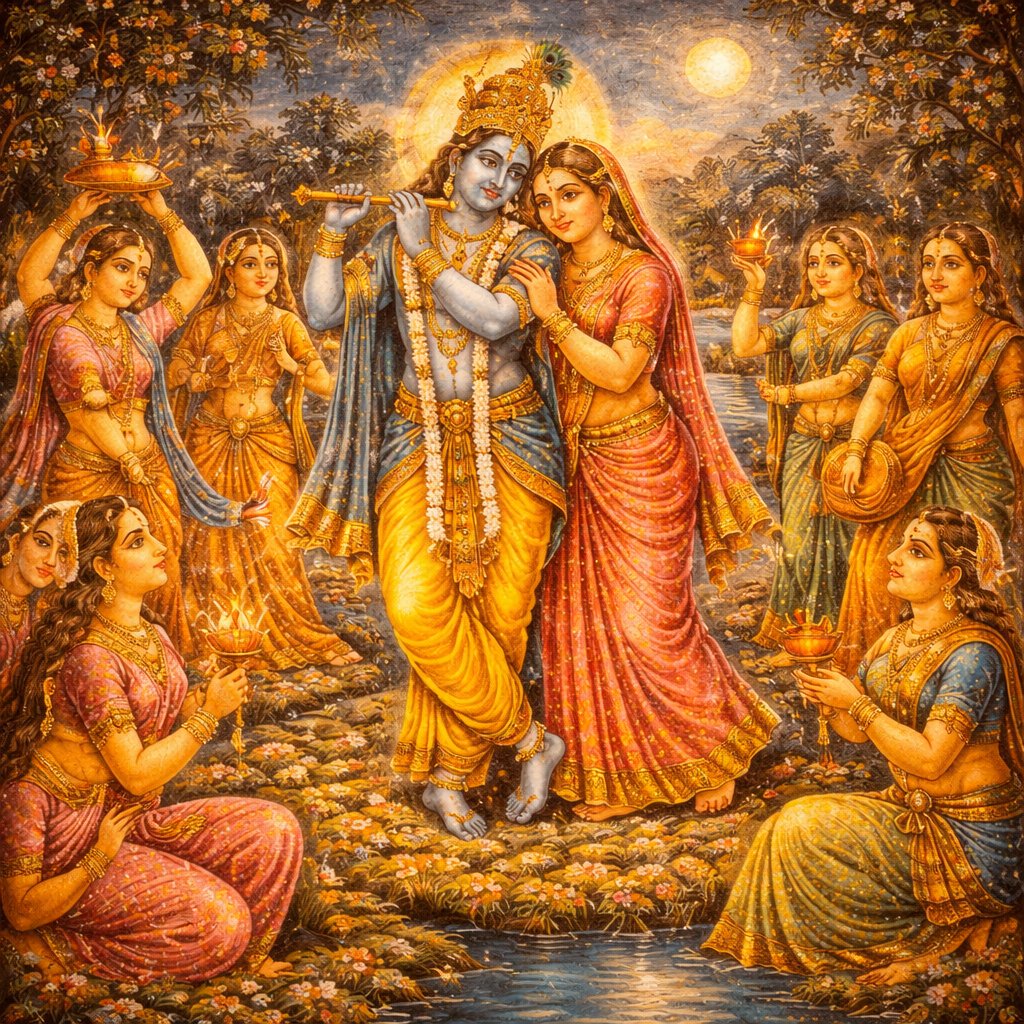
The Tenth Canto: Kṛṣṇa-līlā (The Divine Pastimes of Śrī Kṛṣṇa)
दशमः स्कन्धः (Daśamaḥ Skandhaḥ)
Summum Bonum -- Krishna's Pastimes
The heart of the Bhagavatam -- narrating the birth, childhood, youth, and divine pastimes (lilas) of Lord Krishna in Vrindavan, Mathura, and Dvaraka.
Adhyayas in Dashama Skandha
Adhyaya 1
Parīkṣit’s Questions and the Prelude to Kṛṣṇa’s Advent (Earth’s Burden, Viṣṇu’s Order, and Kaṁsa’s Fear)
Continuing from the prior genealogical narrations of the Sūrya and Candra dynasties and the Yadu line, Mahārāja Parīkṣit pivots the discourse toward Kṛṣṇa-līlā, requesting a full account of Śrī Kṛṣṇa’s character and activities from birth to departure. He frames hari-kathā as paramparā-transmitted medicine for saṁsāra and recalls Kṛṣṇa’s saving grace—guiding the Pāṇḍavas through Kurukṣetra and protecting Parīkṣit in the womb from Aśvatthāmā’s weapon—thus setting a devotional and existential urgency. Parīkṣit also asks technical questions: Balarāma’s transfer from Devakī to Rohiṇī, Kṛṣṇa’s relocation to Vraja, His residence in Vṛndāvana/Mathurā, and the dharma-question of killing Kaṁsa. Śukadeva begins the avatāra context: Bhū-devī, overburdened by demonic rulers, approaches Brahmā; the devas worship Kṣīrodakaśāyī Viṣṇu at the Milk Ocean, receiving the command to take birth in the Yadu dynasty. The narrative then descends into Mathurā’s political crisis—Devakī’s marriage, the prophecy of Kaṁsa’s death by her eighth child, Vasudeva’s reasoning on death and transmigration, Kaṁsa’s duplicity, and the imprisonment and killing of Devakī’s children—ending with Kaṁsa’s tyrannical rule, setting the immediate stage for Kṛṣṇa’s appearance in the next chapter sequence.
Adhyaya 2
The Lord’s Advent: Yoga-māyā’s Mission, Saṅkarṣaṇa’s Transfer, and the Demigods’ Prayers
Continuing the prelude to Kṛṣṇa’s appearance, Śukadeva describes Mathurā’s political-terror landscape: Kaṁsa, backed by Jarāsandha and numerous asuric allies, persecutes the Yadus, forcing many into refuge among other kingdoms. After Kaṁsa kills Devakī’s six sons, the Lord’s arrangement unfolds—Ananta/Saṅkarṣaṇa appears as the seventh conception, and Bhagavān orders Yoga-māyā to transfer this child from Devakī to Rohiṇī in Vraja, producing the public impression of Devakī’s miscarriage. The Lord then enters Vasudeva’s heart in full opulence and is transferred to Devakī, whose radiance alarms Kaṁsa; he debates killing her but restrains himself to preserve reputation and waits for the birth. Meanwhile, Brahmā, Śiva, Nārada, and the devas invisibly offer prayers, presenting a dense theology: the Lord as antaryāmī, cause/maintainer of the cosmic “tree” of embodiment, the insufficiency of speculative liberation, and the decisive power of bhakti. The chapter sets the bridge to the birth narrative: divine concealment, protective logistics, and cosmic confirmation of the avatāra’s purpose.
Adhyaya 3
The Appearance of Lord Viṣṇu (Kṛṣṇa) and the Divine Exchange with Yoga-māyā
Continuing the Kaṁsa-Devakī-Vasudeva prison narrative (from the preceding build-up of Kaṁsa’s fear and oppression), this chapter opens with cosmic auspiciousness at the Lord’s appearance: the heavens, directions, earth, rivers, and ritual fires become serene, while celestial beings celebrate. In the depth of night, Viṣṇu appears from Devakī—likened to the full moon rising—revealing a four-armed form with śaṅkha, cakra, gadā, and padma, Śrīvatsa and Kaustubha. Vasudeva offers learned prayers establishing the Lord’s transcendence to guṇas and senses (avāṅ-mānasa-gocara), and Devakī prays for protection from Kaṁsa, requesting the Lord conceal His divine form. The Lord recalls their prior births (Pṛśni/Sutapā; Aditi/Kaśyapa) and explains His repeated advent, then transforms into a human infant. Yoga-māyā is born in Nanda’s home; by her influence guards sleep, doors open, Ananta shelters Vasudeva, and Yamunā yields passage. Vasudeva exchanges the infants, setting the stage for Kaṁsa’s imminent reaction and the Vraja-līlā to unfold next.
Adhyaya 4
Yoga-māyā Appears as Durgā; Kaṁsa’s Repentance and the Demonic Policy of Persecuting Vaiṣṇavas
Following the prior night’s divine exchange—Kṛṣṇa being transferred to Gokula and Yoga-māyā brought to Mathurā—the prison-house doors re-close and the guards awaken to the newborn’s cry. They inform Kaṁsa, who rushes in terror, interpreting the birth as Kāla incarnate to end him. Devakī pleads for the infant girl, but Kaṁsa violently seizes her and attempts to kill her. The child slips from his hands and manifests in the sky as eight-armed Devī (Yoga-māyā/Durgā), declaring that Kaṁsa’s slayer has already been born elsewhere and warning him against further infanticide. Shocked, Kaṁsa releases Devakī and Vasudeva, expresses remorse, and speaks impersonal-sounding philosophy about body and soul, karma, and providence; the saintly couple pacify him. Yet the narrative turns: Kaṁsa consults his ministers, whose asuric counsel urges systematic violence—killing infants and, more strategically, uprooting Viṣṇu’s “foundation” by persecuting brāhmaṇas, cows, Vedic sacrifice, austerity, and Vaiṣṇavas. The chapter thus bridges from the failed murder in Mathurā to the escalating persecution that sets the stage for Kṛṣṇa’s protective interventions in Vraja and beyond.
Adhyaya 5
Nanda Mahārāja Celebrates Kṛṣṇa’s Birth; Vasudeva Warns of Danger
Continuing from the immediate aftermath of Kṛṣṇa’s appearance and His relocation to Gokula, this chapter depicts the public consolidation of the hidden divine event through social and Vedic rites. Nanda Mahārāja performs the jāta-karma and related maṅgala observances with mantra-vid brāhmaṇas, lavish dāna (cows, grain, ornaments), and communal celebration in Vrajapura. The narrative expands into a Vraja-wide festival: gopas and gopīs arrive with gifts and blessings, music resounds, and the community expresses vātsalya-bhāva toward the newborn who is in truth aja (unborn) and jagad-īśvara (Lord of the cosmos). The chapter then pivots from celebration to impending threat: Nanda travels to Mathurā to pay taxes to Kaṁsa, meets Vasudeva, and they exchange affectionate yet philosophically sobering reflections on destiny and separation. Vasudeva’s warning—anticipating disturbance in Gokula—creates narrative momentum into the next chapter’s protective and conflict-driven developments around Kaṁsa’s hostility and the demons sent toward Vraja.
Adhyaya 6
Pūtanā-mokṣa — The Witch Pūtanā’s Attempt and Kṛṣṇa’s Deliverance
Linking from the prior warnings about danger in Gokula, Nanda Mahārāja returns from Mathurā reflecting on Vasudeva’s foresight and taking refuge in the Supreme Controller. Kaṁsa’s agent Pūtanā—infamous for killing infants—enters Vraja by mystic disguise as a captivating woman, bewildering the gopīs who momentarily mistake her for a Lakṣmī-like figure. She reaches baby Kṛṣṇa, whose divinity is veiled like fire under ashes, and attempts to kill Him by smearing poison on her breast. Kṛṣṇa, as antaryāmī, accepts her offering yet turns it into her destruction: He sucks out both poison and life, and her gigantic demonic form crashes down, terrifying Vraja. The gopīs then perform protective rites—ācāmana, nyāsa, tilaka-like markings, and a Viṣṇu-kavaca mantra—emphasizing nāma as the ultimate shield against grahas and malevolent beings. Nanda and the gopas return, marvel at Vasudeva’s prediction, and burn Pūtanā’s body; astonishingly, fragrant smoke arises, symbolizing her purification. The chapter culminates in siddhānta: even a hostile being attains exalted result by contact with Kṛṣṇa, so what to speak of the gopīs’ natural vātsalya-bhakti. It transitions toward ongoing Vraja protection themes and the deepening intimacy of Kṛṣṇa’s childhood līlās.
Adhyaya 7
Utthāna Ceremony, Śakaṭa-bhañga, Tṛṇāvarta-vadha, and the Vision of the Universe in Kṛṣṇa’s Mouth
Parīkṣit requests further narration of Kṛṣṇa’s bāla-līlā, explaining that hearing avatāra-kathā purifies the mind and dissolves material attachment, especially through Kṛṣṇa’s childhood sweetness. Śukadeva describes Yaśodā’s utthāna ceremony (around three months), with Rohiṇī’s auspicious lunar conjunction and Vedic chanting. During the festivities, baby Kṛṣṇa—crying for milk—kicks beneath a handcart, and the cart collapses (śakaṭa-bhañga), baffling the adults who dismiss the children’s eyewitness account. Fearing graha-doṣa, Yaśodā and Nanda summon brāhmaṇas for protective rites; the narrative emphasizes the potency of truthful, envy-free brāhmaṇas and charity as part of household dharma. About a year later, Tṛṇāvarta, sent by Kaṁsa, arrives as a whirlwind, abducts Kṛṣṇa, but is destroyed when the child becomes unbearably heavy and grasps his throat—illustrating poṣaṇa (divine protection) amid apparent vulnerability. The chapter culminates in Yaśodā seeing the entire universe within Kṛṣṇa’s mouth as He yawns, bridging to the next movement: increasing wonder that will later intensify into the famous binding pastime (dāmodara-līlā).
Adhyaya 8
Garga Muni Names Kṛṣṇa and Balarāma; the Butter-Thief Pastimes; Yaśodā Sees the Universe in Kṛṣṇa’s Mouth
Following the early Vraja protection narratives and the community’s growing awareness that extraordinary events surround Yaśodā’s child, Vasudeva’s priest Garga Muni visits Nanda’s home to perform saṁskāras discreetly. Concerned that Kaṁsa may infer Kṛṣṇa’s true parentage, Garga conducts the name-giving and related rites in secrecy, proclaiming Balarāma’s names (Rāma, Bala, Saṅkarṣaṇa) and indicating Kṛṣṇa’s recurring avatāra identity, varied yuga-colors, and protective role for Vraja. As time passes, the brothers crawl, walk, and play, heightening vātsalya-rasa among Yaśodā, Rohiṇī, and the gopīs. Neighborhood women complain of Kṛṣṇa’s butter-theft and playful mischief, setting the stage for a pivotal revelation: accused of eating earth, Kṛṣṇa opens His mouth and Yaśodā beholds the entire cosmic manifestation within it. Overwhelmed, she momentarily turns to philosophical surrender, but Yoga-māyā restores her maternal absorption. The chapter closes by explaining Yaśodā and Nanda’s extraordinary fortune through their prior identities (Droṇa and Dharā), linking this līlā to Brahmā’s benediction and preparing the narrative for deeper Vraja intimacy and escalating playful transgressions that culminate in later chapters (e.g., the mortar/bandhana-līlā).
Adhyaya 9
Dāmodara-līlā: Mother Yaśodā Binds Kṛṣṇa; the Two-Fingers Mystery; Prelude to the Yamala-Arjuna Deliverance
Continuing the Vraja childhood cycle of intimate household līlās, Yaśodā churns yogurt while singing of Kṛṣṇa’s antics. Kṛṣṇa interrupts, seeking her breast milk; when she briefly leaves Him to save boiling milk, He vents playful anger—breaking the yogurt pot and secretly distributing butter to monkeys. Yaśodā discovers the mischief, approaches quietly, and chases Him; the theological contrast is explicit: yogīs cannot capture Him by meditation, yet He flees before His mother’s stick. When she decides to bind Him to prevent further ‘offenses,’ every rope proves short by two fingers, even after joining many. Neighbors smile in wonder as Yaśodā strains; seeing her fatigue, Kṛṣṇa mercifully consents to be bound—revealing bhakti-vaśyatā (the Lord’s subjugation to devotion). The chapter then pivots toward the next episode: Kṛṣṇa, now near the twin yamala-arjuna trees, recalls their prior identity as Nalakūvara and Maṇigrīva, setting up their liberation that follows.
Adhyaya 10
The Deliverance of Nalakūvara and Maṇigrīva (Yamala-Arjuna Līlā Prelude and Culmination)
Prompted by Parīkṣit’s inquiry, Śukadeva explains why Kuvera’s sons Nalakūvara and Maṇigrīva were cursed by Devarṣi Nārada. Intoxicated by Vāruṇī and celestial opulence in a garden by the Mandākinī near Kailāsa, they remained shamelessly naked even before the sage, unlike the attendant women who covered themselves. Nārada, aiming at mercy rather than vengeance, diagnoses wealth-induced delusion—pride, cruelty, and sense slavery—and prescribes a corrective curse: they will become twin arjuna trees, retaining memory of their fall, and after one hundred divine years will gain the Lord’s direct vision and devotion. Later, to honor Nārada’s words, child Kṛṣṇa—still bound to a mortar from the preceding Dāmodara episode—crawls between the twin trees; the mortar wedges, and with a mighty pull He uproots them. The two demigods emerge, offer profound prayers establishing Kṛṣṇa’s supreme identity, receive His assurance about the liberating power of sādhu-saṅga, and depart, fixed in bhakti—setting the narrative forward into further Vraja pastimes where Kṛṣṇa’s sweetness and supremacy continue to unfold.
Adhyaya 11
Gokula’s Wonder, Kṛṣṇa’s Bhakta-vaśyatā, the Move to Vṛndāvana, and the Slaying of Vatsāsura and Bakāsura
Following the previous episode of the yamala-arjuna’s fall and the liberation of Nalakūvara and Maṇigrīva, the cowherd community rushes to the spot, astonished yet unable to identify the cause. The boys testify that Kṛṣṇa—still bound to the mortar—dragged it between the trees, but Nanda and the elders, overwhelmed by vātsalya, struggle to accept His superhuman agency. Nanda releases Kṛṣṇa, and the narrative turns to daily Vraja intimacy: the gopīs coax Him to dance and fetch items, revealing bhakta-vaśyatā—Bhagavān willingly “controlled” by love. A fruit-seller is blessed when Kṛṣṇa barters grains, transforming her basket into jewels. As disturbances continue, Upananda advises relocation from Gokula to Vṛndāvana for the boys’ safety; the community migrates by carts, singing Kṛṣṇa-kathā. In Vṛndāvana, Kṛṣṇa and Balarāma begin calf-tending and playful sports. Demonic threats resume: Kṛṣṇa kills Vatsāsura (calf demon) and later Bakāsura (crane/duck demon), returning safely and deepening the elders’ conviction that Garga Muni’s prophecies are manifest—setting up the next sequence of escalating Vraja conflicts and revelations.
Adhyaya 12
Aghāsura-vadha: The Killing and Deliverance of Aghāsura
Continuing the Vraja kaumāra līlās, Kṛṣṇa leads the cowherd boys and calves from Vrajabhūmi into the forest for a picnic, where their games—stealing lunch bags, mimicking birds and animals, and racing to touch Kṛṣṇa—display the apex of sakhya-rasa and the paradox of the Absolute as a child companion. The narration then pivots from pastoral play to cosmic peril: Aghāsura, sent by Kaṁsa and kin to Pūtanā and Bakāsura, assumes a colossal python form and lies like a cave on the path. The boys, fearless and confident in Kṛṣṇa’s protection, enter the mouth; Kṛṣṇa follows to save them and simultaneously destroy the demon by expanding within his throat, causing Aghāsura’s life-air to burst through the crown. Kṛṣṇa revives the calves and boys, and Aghāsura attains sārūpya-mukti as divine effulgence merges into Kṛṣṇa’s body amid celestial celebration. The chapter closes with a narrative bridge: the event is disclosed in Vraja only after one year, prompting Parīkṣit’s next inquiry about the apparent time discrepancy—setting up the following adhyāya’s explanation of Brahmā’s intervention and Kṛṣṇa’s yogamāyā.
Adhyaya 13
Brahmā’s Bewilderment and Kṛṣṇa Becoming the Calves and Cowherd Boys (Brahma-vimohana-līlā)
Following the deliverance of Aghāsura, Kṛṣṇa leads the cowherd boys to a beautiful riverbank for their forest lunch, where His intimacy with His friends is described as wondrous even to the devas. When the calves wander off, Kṛṣṇa goes to retrieve them; in His absence, Brahmā—astonished by Kṛṣṇa’s power yet testing Him—steals both calves and boys and hides them under mystic sleep. Kṛṣṇa returns, understands Brahmā’s act, and for the pleasure of Vraja’s parents and to instruct Brahmā, expands Himself into identical calves and boys, continuing daily life for one full year. The residents’ affection intensifies beyond normal bounds, and Balarāma detects the anomaly, realizing all are Kṛṣṇa’s expansions. When Brahmā returns (thinking only a moment has passed), he sees Kṛṣṇa still playing; his confusion culminates as the expansions reveal innumerable four-armed Viṣṇu forms being worshiped by all powers, elements, and cosmic principles. Overwhelmed, Brahmā is humbled; Kṛṣṇa withdraws yoga-māyā, restoring the scene to Kṛṣṇa alone searching with food in hand—setting the stage for Brahmā’s ensuing prayers in the next chapter.
Adhyaya 14
Brahmā’s Prayers to Lord Kṛṣṇa (Brahmā-stuti) and the Restoration of Vraja’s Lunch Pastime
Following the prior episode in which Brahmā tests Kṛṣṇa by stealing the calves and cowherd boys, this chapter records Brahmā’s repentance and theological surrender after witnessing Kṛṣṇa’s inconceivable expansions (boys, calves, Viṣṇu forms, and universes). Brahmā praises Kṛṣṇa’s Vraja form—flute, peacock feather, forest garlands—affirming Him as the only worshipable Lord and the source of Nārāyaṇa and all cosmic functions. He emphasizes that bhakti—humble hearing and chanting—conquers the unconquerable Lord, whereas dry jñāna yields only toil. Brahmā confesses his offense, contrasts his smallness with the Lord’s unlimited universes, and prays for any birth in Vraja, even as grass, to receive the dust of devotees’ feet. After granting Brahmā leave, Kṛṣṇa returns the calves to the riverbank and resumes the boys’ lunch as if no time passed; the year-long separation is concealed by Yogamāyā. The chapter then transitions into Parīkṣit’s inquiry about the gopīs’ extraordinary love, setting up the next philosophical clarification on the self’s dearness and Kṛṣṇa as the Paramātmā and ultimate Self of all.
Adhyaya 15
Paugaṇḍa Cowherding, Tālavana, the Slaying of Dhenukāsura, and Revival from Poisoned Yamunā Water
As Kṛṣṇa and Balarāma enter paugaṇḍa, the elders of Vraja authorize Them to tend cows, marking a new stage of Vraja-līlā. The chapter opens with a sanctified Vṛndāvana ecology: trees bow, bees and birds ‘praise’ the Lord, and Kṛṣṇa’s flute-led herding becomes a liturgy of nature responding to Īśa. Kṛṣṇa playfully imitates birds and animals, while the cowherd boys serve Him and Balarāma in intimate friendship (sakhya-rasa), revealing how Bhagavān conceals aiśvarya under yogamāyā. The narrative then pivots to a heroic protection motif: at the boys’ request for fragrant tāla fruits, the brothers enter Tālavana; Balarāma shakes the palms, Dhenukāsura attacks, and is slain, after which the ass-demons are dispatched and the forest becomes accessible and nourishing again—poṣaṇa expressed as ecological and social restoration. Returning to Vraja, the gopīs’ darśana and Yaśodā–Rohiṇī’s motherly care complete the daily cycle. Finally, without Balarāma, Kṛṣṇa revives cows and boys who collapse from poisoned Yamunā water by His nectarean glance, setting up the next movement toward confronting the source of the poison (the Kāliya episode sequence).
Adhyaya 16
Kāliya-damana: Kṛṣṇa Subdues the Serpent and Purifies the Yamunā
Śukadeva introduces Kṛṣṇa’s resolve to purify the Yamunā after it is poisoned by Kāliya’s lake, answering Parīkṣit’s inquiry about both the chastisement and Kāliya’s long residence. The chapter moves from ecological and sacred-space corruption (boiling, lethal waters and poisoned breezes) to Kṛṣṇa’s deliberate descent into the lake from a kadamba tree, provoking Kāliya’s attack. Vraja’s response forms the emotional core: gopas, gopīs, elders, and animals collapse in grief, reading ominous portents as death, while Balarāma—knowing Kṛṣṇa’s aiśvarya—restrains them. Kṛṣṇa then expands, breaks free, and subdues Kāliya through the iconic dance upon his many hoods, witnessed and celebrated by celestial beings. Kāliya’s wives (Nāgapatnīs) offer profound stuti, interpreting punishment as mercy and the dust of the Lord’s feet as the highest fortune; Kāliya himself confesses his nature and surrenders. Kṛṣṇa banishes him to the ocean, grants protection from Garuḍa via His footprints, and establishes devotional benefits for remembering, narrating, bathing, and worship at the site. The Yamunā is restored, setting the stage for subsequent Vraja līlās in which Kṛṣṇa’s protection and the community’s prema continue to deepen.
Adhyaya 17
Garuḍa, Saubhari’s Curse, Kāliya’s Refuge, and Kṛṣṇa Saves Vraja from Forest Fire
Following Kṛṣṇa’s chastisement of Kāliya in the Yamunā, Parīkṣit asks why Kāliya abandoned Ramaṇaka Island and why Garuḍa opposed him specifically. Śukadeva explains the serpents’ monthly tribute arrangement with Garuḍa: all complied, but Kāliya arrogantly consumed the offerings, provoking Garuḍa’s attack. Overpowered, Kāliya fled to a Yamunā-adjacent lake that Garuḍa could not enter due to Saubhari Muni’s curse—issued after Garuḍa seized a fish there despite prohibition. Thus Kāliya’s “safe haven” is revealed as a karmically protected but spiritually toxic refuge, later dismantled by Kṛṣṇa. The narrative returns to Kṛṣṇa emerging splendidly from the lake; Vraja’s life-force returns as parents, elders, and Balarāma embrace Him, and brāhmaṇas advise charity as a protective rite, which Nanda performs. Exhausted, Vraja rests by the Kālindī; then a sudden forest fire encircles them. The residents cry out to Kṛṣṇa and Balarāma, and Kṛṣṇa effortlessly swallows the fire—bridging this chapter into subsequent demonstrations of His protective poṣaṇa in Vraja.
Adhyaya 18
Kṛṣṇa and Balarāma’s Forest Games and the Slaying of Pralamba
Following the ongoing cowherd life of Vraja, Śukadeva describes Kṛṣṇa’s return amid glorifying companions and then shifts to the onset of summer. Yet, because Bhagavān resides in Vṛndāvana with Balarāma, the season transforms—heat is tempered by waterfalls, lotus-scented breezes, and ever-fresh greenery—establishing dhāma-viśeṣa (the land’s transcendental character). Kṛṣṇa, Balarāma, and the sakhās enter the forest playing the flute, adorning themselves with leaves, feathers, flowers, and minerals, and engaging in games, music, mimicry, and friendly wrestling; even devas join incognito to witness and praise. Into this pastoral play enters the asura Pralamba disguised as a cowherd boy, intent on abducting the Lords. Kṛṣṇa knowingly allows him to join, then orchestrates a carrying game near Bhāṇḍīraka. Pralamba seizes the chance to kidnap Balarāma, reveals his terrifying form, and is slain by Balarāma’s fist. The boys rejoice, embrace Balarāma, and the devas shower flowers—closing the episode with poṣaṇa and the reaffirmation that Vraja’s play defeats disguised evil, setting the stage for further forest-līlās and escalating asuric challenges.
Adhyaya 19
Kṛṣṇa Swallows the Forest Fire (Dāvāgni-līlā) and Restores the Herd
Continuing the Vraja pastoral flow, the cowherd boys become absorbed in play and inadvertently allow the herd to wander deep into the Muñjā forest. The animals, distressed by thirst and threatened by a rapidly spreading forest fire driven by wind, cry out—triggering the boys’ repentance and urgent search by tracking hoofprints and broken grass. When the boys finally gather the cows, the fire suddenly surrounds them, intensifying the existential mood of helplessness. The cowherds then enact śaraṇāgati: they run to Kṛṣṇa and Balarāma as their sole shelter, explicitly appealing to Kṛṣṇa’s duty to protect His own. Kṛṣṇa instructs them to close their eyes and fear nothing; by yogamāyā and supreme mystic power, He opens His mouth and swallows the conflagration. The boys awaken to safety near the Bhāṇḍīra tree, and some interpret Kṛṣṇa as a deva—setting up the ongoing tension between intimate friendship and dawning awareness of divinity. As evening approaches, Kṛṣṇa returns to the village playing His flute, and the gopīs’ longing frames the next emotional movement of Vraja devotion.
Adhyaya 20
Varṣā-Śarad Vṛndāvana-Śobha: The Beauty of the Rainy and Autumn Seasons in Vraja
After the cowherd boys recount to the Vraja elders Kṛṣṇa and Balarāma’s deliverance from the forest fire and the slaying of Pralamba, the community marvels and intuits Their divinity. The narration then shifts into an extended, didactic description of varṣā (rainy season) in Vṛndāvana, where each natural phenomenon becomes an upamā (spiritual analogy) for guṇas, false ego, Kali-yuga distortions, discipline, charity, and bhakti’s beautifying power. As Kṛṣṇa and Balarāma roam the refreshed forest with cows and friends—resting in caves, eating simple meals, and honoring the season as an expansion of internal potency—the text subtly frames nature as a theater of īśānukathā (God-centered narration). The chapter transitions into śarad (autumn): skies clear, waters purify, and lotus blooms mirror the cleansing effects of devotional service and wisdom. This seasonal movement prepares the narrative mood for forthcoming Vraja episodes by intensifying beauty, fertility, and festival life, while also foreshadowing how separation and union will be experienced against Vṛndāvana’s changing rhythms.
Adhyaya 21
The Gopīs Glorify the Song of Kṛṣṇa’s Flute (Veṇu-gīta)
As the rainy season yields to clear autumn in Vṛndāvana, Śukadeva describes the forest’s purified waters and fragrant breezes as Kṛṣṇa enters with Balarāma, the cowherd boys, and the cows. While herding, Kṛṣṇa begins to play His flute, and the sound becomes the narrative pivot: it moves from the forest into the hearts of the Vraja-gopīs, who privately gather and speak in ecstatic, interrupted speech as kāma (Cupid) is transmuted into bhakti-rasa. They praise Kṛṣṇa’s beauty, dress, footprints, and flute, then extend their vision outward—declaring the flute, deer, birds, rivers, clouds, aborigine women, and Govardhana Hill supremely fortunate because each receives some contact with Him. The chapter closes with the gopīs fully absorbed in smaraṇa, setting the emotional and theological bridge toward the intensification of Vraja’s madhurya mood that will unfold in subsequent flute-and-forest centered pastimes leading toward the rāsa-līlā arc.
Adhyaya 22
The Kātyāyanī-vrata, the Stealing of the Gopīs’ Garments, and Kṛṣṇa’s Teaching on Purified Desire
Continuing the Vraja narrative of escalating intimacy between Bhagavān and His devotees, this chapter opens with the unmarried gopīs observing the month-long Kātyāyanī-vrata on the Yamunā’s bank, seeking Kṛṣṇa as their husband—an emblem of single-pointed devotion expressed through culturally recognizable vrata-forms. Kṛṣṇa, as Yogīśvara and the inner witness, arrives with His companions and playfully takes the girls’ garments, placing them in a kadamba tree. His teasing compels them to come forward, transforming social embarrassment into a deliberate spiritual disclosure: their vow’s goal is not mere ritual success but total surrender. Kṛṣṇa then frames their naked bathing as an offense and prescribes atonement—bowing with joined palms—thereby externalizing the inner posture of śaraṇāgati. He returns their clothes, affirms that their desire is approved because it is directed to Him, and promises fulfillment in the coming nights (foreshadowing the Rāsa-līlā sequence). The chapter then pivots to Kṛṣṇa herding cows with Balarāma and the boys; He praises the self-giving trees as moral exemplars, and the scene moves toward the boys’ hunger—setting the narrative bridge into the next episode involving food, dharma, and devotion near the Yamunā.
Adhyaya 23
The Brāhmaṇas’ Wives Blessed (Brāhmaṇa-patnī-prasāda) — Ritualism Humbled by Bhakti
Continuing the Vraja-cycle where Kṛṣṇa reveals the supremacy of devotion over mere social and ritual status, the cowherd boys—hungry while tending cows with Kṛṣṇa and Balarāma—are sent to an Āṅgirasa sacrifice to request food. The officiating brāhmaṇas, absorbed in karma-kāṇḍa and heavenly aspiration, ignore the boys despite hearing Kṛṣṇa’s names, failing to recognize that all yajña-components are Kṛṣṇa’s opulences and that He is the directly manifest Absolute Truth. Kṛṣṇa then redirects the boys to the brāhmaṇas’ wives, whose hearts, nourished by śravaṇa of Kṛṣṇa-kathā, overflow with devotion; they bring abundant fourfold foods and meet Kṛṣṇa by the Yamunā. Though Kṛṣṇa warmly receives them, He instructs them to return, emphasizing that love grows through hearing, chanting, seeing the Deity, and meditation—not mere physical proximity. They obey, the sacrifice completes, one wife attains liberation through internal embrace, and the brāhmaṇas repent, recognizing their offense yet fearing Kaṁsa. The chapter bridges toward further Vraja revelations where bhakti consistently overturns worldly hierarchy and ritual pride.
Adhyaya 24
Govardhana-pūjā: Kṛṣṇa Redirects Indra-yajña to Worship of Govardhana, Cows, and Brāhmaṇas
In Vraja, Kṛṣṇa notices the cowherds preparing an Indra-yajña and, though omniscient, respectfully questions Nanda and the elders to draw out their rationale. Nanda explains the traditional dependence on Indra as rain-giver and the social-religious custom of offering grains and oblations for prosperity and the three goals of life. Kṛṣṇa then advances a deliberate, karma-centered critique: results arise from one’s own work and conditioned nature; even a controller’s dispensing presupposes action, so worship should align with one’s actual sustenance and svadharma. He reframes Vraja’s identity as forest-and-hill dwellers whose livelihood is cow protection, and proposes a sacrifice dedicated to Govardhana Hill, the cows, and the brāhmaṇas using the same paraphernalia. The community follows His plan—feeding all beings, honoring priests with gifts, circumambulating Govardhana with their herds, while the gopīs sing Kṛṣṇa’s glories. Kṛṣṇa manifests a विशाल (unprecedented) form as “Govardhana,” consumes the offerings, and inspires reverence and fear of neglecting the hill. This chapter intentionally sets up the next development: Indra’s pride is provoked, leading to the retaliatory storm and Kṛṣṇa’s protective lifting of Govardhana in the ensuing narrative.
Adhyaya 25
Govardhana-dhāraṇa: Kṛṣṇa Lifts Govardhana and Humbles Indra
Following the redirection of Vraja’s worship from Indra-yajña to Govardhana-pūjā, Indra interprets the shift as an insult and, from ahamkāra-backed authority, unleashes Sāṁvartaka clouds and violent winds to devastate Nanda’s settlement. As rain, hail, thunder, and flooding overwhelm the land, the cows and Vrajavāsīs take exclusive shelter (śaraṇāgati) of Govinda. Kṛṣṇa identifies Indra’s pride as the root cause and resolves to protect His family while correcting deva-arrogance for Indra’s eventual benefit. He lifts Govardhana Hill effortlessly with one hand, inviting the entire community—people, animals, wagons, priests—to reside beneath it for seven days. Indra, astonished, withdraws the storm. When the sky clears, Kṛṣṇa releases the hill back to its place; Vraja responds with embraces, blessings, and honorific rites, while celestial beings praise Him. The chapter transitions toward Indra’s forthcoming repentance and reconciliation, setting up the next phase of recognizing Kṛṣṇa’s supreme lordship beyond administrative demigods.
Adhyaya 26
The Vraja Elders Question Kṛṣṇa’s Identity; Nanda Recounts Garga’s Prophecy
Following the Govardhana-līlā’s astonishing display of protection (poṣaṇa), the cowherd elders of Vraja approach Nanda Mahārāja, overwhelmed by the contrast between Kṛṣṇa’s apparent childhood and His superhuman deeds. They enumerate earlier Vraja miracles—Pūtanā’s death, the overturning of the cart, the slaying of Tṛṇāvarta, the deliverance of the twin arjuna trees, and victories over Bakāsura, Vatsāsura, Dhenukāsura (with Balarāma), Pralambāsura (through Balarāma), the forest fire, and Kāliya—culminating in Govardhana’s lifting. Their affectionate attachment intensifies their theological doubt: who is this child, and why is their love for Him irresistible? Nanda resolves the community’s uncertainty by recalling Garga Muni’s confidential naming and prophecy: Kṛṣṇa appears in every yuga with different colors, is known as Vāsudeva, bears many names and forms, and will act auspiciously to protect Vraja and curb disorder. The chapter closes by re-centering the narrative arc: Indra’s anger at the disrupted sacrifice triggers the storm, and Kṛṣṇa’s compassionate smile and Govardhana shelter prepare the transition into Indra’s humbling and reconciliation in the subsequent chapter.
Adhyaya 27
Indra’s Prayers and the Coronation of Śrī Kṛṣṇa as Govinda (Govindābhiṣeka)
Following the previous Govardhana episode—where Kṛṣṇa protected Vraja by lifting the hill and Indra’s storm failed—Surabhi arrives with Indra to meet the Lord. In seclusion, Indra bows, confesses his aparādha born of aiśvarya-mada (pride of power), and offers a philosophical stotra describing Kṛṣṇa as transcendental to the guṇas, yet the compassionate chastiser who curbs the wicked for their upliftment. Kṛṣṇa replies that He disrupted Indra’s sacrifice out of mercy, since opulence intoxicates and blinds one to the Lord’s corrective “rod of punishment”; He instructs Indra to return to his office sober and humble. Surabhi then petitions that Kṛṣṇa become the true “Indra” for the cows and brāhmaṇas, and, by Brahmā’s order, performs the abhiṣeka: Surabhi bathes Him with milk, and Indra anoints Him with celestial Gaṅgā water from Airāvata. The devas and sages celebrate; nature becomes auspicious; universal enmity subsides. With permission, Indra departs—linking this chapter forward to the continued flourishing of Vraja under Govinda’s protection.
Adhyaya 28
Nanda’s Captivity by Varuṇa and the Revelation of the Spiritual World (Brahma-hrada)
Following the unfolding of Kṛṣṇa’s Vraja līlā that increasingly discloses His divinity, this chapter pivots from communal wonder to direct revelation. Nanda Mahārāja, after Ekādaśī worship and fasting, enters the Yamunā (Kālindī) at an inauspicious hour on Dvādaśī and is seized by a servant of Varuṇa. The cowherds cry out to Kṛṣṇa and Balarāma; Kṛṣṇa immediately goes to Varuṇa’s court, where Varuṇa worships Him as the Supreme Absolute and apologizes for his servant’s ignorance, returning Nanda. Back in Vraja, Nanda recounts Varuṇa’s opulence and humility before Kṛṣṇa, intensifying the cowherds’ question: will the Supreme Lord grant them His own abode? Knowing their hearts, Kṛṣṇa compassionately reveals the realm beyond material darkness by taking them to Brahma-hrada; after immersion and rising, they behold the planet of the Absolute Truth—like Akrūra’s earlier vision—and see Kṛṣṇa there, worshiped by the personified Vedas. The episode bridges to subsequent revelations by establishing that Vraja-bhakti is oriented not to worldly elevation but to the Lord’s eternal domain.
Adhyaya 29
Veṇu-gīta-āhvāna and the Gopīs’ Appeal: The Opening of Rāsa-līlā
As the autumn full moon rises over Vṛndāvana, Kṛṣṇa, though ātmārāma and pūrṇa-aiśvarya, turns toward madhura-rasa and, by His internal potency (yogamāyā), plays the flute to summon the gopīs. They abandon household duties despite social restraints; those unable to leave meditate in separation, which burns pāpa and exhausts puṇya through intense absorption. Parīkṣit questions how gopīs who see Kṛṣṇa as a lover attain perfection; Śukadeva replies that any powerful absorption in Hari—whether lust, fear, anger, or love—leads to Him, and devotees attain the highest. Kṛṣṇa then tests and instructs the gopīs, urging them to return to dharma—family duties and chastity—stating that bhakti arises from śravaṇa, kīrtana, darśana, and smaraṇa, not mere physical proximity. The gopīs answer with siddhānta of exclusive refuge: Kṛṣṇa is the true husband, Self, and relative of all beings; they beg for service at His feet. Pleased, Kṛṣṇa begins loving pastimes on the Yamunā’s bank, but when pride arises, He disappears—setting the next chapter’s search and the deepening of viraha-bhakti.
Adhyaya 30
Gopī-Vipralambha: The Search for Kṛṣṇa and the Revelation of Divine Footprints
Following the intensification of rāsa-līlā, Kṛṣṇa suddenly disappears from the gopīs’ vision, plunging them into vipralambha (love in separation). Overwhelmed, they roam Vṛndāvana like maddened devotees, interrogating trees, creepers, tulasī, the earth, and animals—recognizing Kṛṣṇa as the antaryāmī (Supersoul) pervading all. Their remembrance becomes so total that they spontaneously reenact His childhood and heroic līlās (Pūtanā, Śakaṭāsura, Tṛṇāvarta, Vatsāsura, Bakāsura), revealing how smaraṇa and kīrtana can embody the Lord’s presence. They then discover Kṛṣṇa’s footprints marked with auspicious symbols, but are shaken to see them intermingled with another gopī’s prints, inferring He has led a ‘special’ beloved aside. Reading the ground as scripture, they deduce moments of intimacy—carrying her, gathering flowers, arranging her hair. Pride arises in the chosen gopī; she asks to be carried, and Kṛṣṇa vanishes again, teaching the peril of māna (conceit). The gopīs find her repentant, return toward the Yamunā under moonlight, and sit together singing, awaiting Kṛṣṇa’s reappearance—setting the emotional and theological bridge into the next phase of the rāsa narrative.
Adhyaya 31
Gopī-gīta: The Song of the Gopīs in Separation (Viraha-bhakti)
Following the rāsa-līlā sequence in which Śrī Kṛṣṇa disappears from the circle of dance, the gopīs—overwhelmed by viraha—gather and sing a unified lament-prayer (gopī-gīta). Their verses combine accusation and adoration: they plead for Kṛṣṇa’s darśana, praise His beauty (lotus eyes, smile, voice), and recall His repeated acts of poṣaṇa (saving them from Kāliya, Agha, Indra’s storm, and other dangers). They simultaneously assert profound theology—Kṛṣṇa as the indwelling witness and true protector—while expressing the embodied intensity of madhura-rasa, asking for His lotus hand and lotus feet as medicine for their hearts. The chapter crystallizes the Bhāgavata’s teaching that the highest devotion is self-forgetful dependence on Bhagavān, where even pain becomes a vehicle of remembrance. This lament sets the emotional and narrative bridge toward Kṛṣṇa’s eventual reappearance and the resolution of separation, clarifying that His ‘disappearance’ deepens the devotees’ prema and concentrates their consciousness exclusively upon Him.
Adhyaya 32
Gopī-gīta Aftermath: Kṛṣṇa Returns and Explains Divine Non-Reciprocation (Rāsa-līlā Dialogue)
Following the gopīs’ intense lamentation and song of separation (the emotional crest of the prior episode), Kṛṣṇa reappears with a smile, restoring their life-breath and dissolving the anguish of viraha. The gopīs respond with varied gestures—reverent service, passionate embrace, loving anger, and yogic inward absorption—each revealing a distinct bhāva within the same exclusive devotion. Kṛṣṇa leads them to the Kālindī’s moonlit bank, where the setting amplifies the rasa: fragrant breezes, soft sands, and autumn moonlight. Seated among them like the Paramātmā surrounded by His śaktis, He is worshiped, yet the gopīs—still wounded—question the ethics of love and reciprocity: why some return affection, some love unconditionally, and some love none. Kṛṣṇa answers by distinguishing selfish friendship, natural compassion, and self-satisfied or envious non-reciprocation, then reveals His own “delay” as a deliberate intensification of bhakti. He concludes by declaring His inability to repay the gopīs’ spotless service, setting the theological bridge into the continuing rāsa narrative where intimacy is framed as the highest dharma of prema.
Adhyaya 33
Rāsa-līlā Begins; Divine Multiplication; Moral Doubt and Its Resolution
Following Kṛṣṇa’s reconciliation with the gopīs after the pain of separation, the rāsa dance unfolds on the Yamunā’s moonlit banks. Kṛṣṇa enters the circular dance by expanding Himself so each gopī experiences exclusive proximity, while devas, Gandharvas, and their consorts witness and celebrate from the sky. The chapter lingers on the aesthetic and devotional texture of the rāsa—song, ornaments, perspiration, affectionate gestures—then shifts to a crucial hermeneutic pivot: Parīkṣit questions how the dharma-protecting Lord could appear to transgress morality by associating with others’ wives. Śukadeva answers with a theology of īśvara-transcendence: the Supreme is untouched by karma, cannot be judged by ordinary standards, and must never be imitated by non-controllers; His līlā is enacted to attract hearts toward devotion. The cowherd men are deluded by yogamāyā and feel no jealousy. As dawn approaches, Kṛṣṇa instructs the gopīs to return home. The chapter concludes with a phala-śruti: faithful hearing of these pastimes grants pure bhakti and quickly conquers lust—setting up the next movement of post-rāsa instruction and deepening devotional implications.
Adhyaya 34
Ambikā-vana Śiva-pūjā; Nanda Saved from the Serpent; Śaṅkhacūḍa Slain
Continuing the Vraja cycle of pilgrimage, worship, and divine protection, the cowherd elders journey by cart to Ambikā forest to worship Lord Śiva (Paśupati) and goddess Ambikā, bathing in the Sarasvatī and honoring brāhmaṇas with gifts. That night, while observing vows and fasting, Nanda Mahārāja is seized by a massive serpent; the cowherds’ efforts fail until Kṛṣṇa arrives and liberates Nanda by touching the snake with His foot. The serpent is revealed as the Vidyādhara Sudarśana, cursed for offending Aṅgirasa sages; he praises the superiority of Kṛṣṇa’s darśana and pāda-sparśa over mere name-chanting, receives permission, and returns to his planet. The Vrajavāsīs return home astonished, narrating Kṛṣṇa’s power. The chapter then shifts into nocturnal forest play: Kṛṣṇa and Balarāma sing and delight the gopīs, when Śaṅkhacūḍa (Kuvera’s servant) abducts the girls. The Lords pursue; Balarāma protects the gopīs while Kṛṣṇa kills the demon and gives the crest jewel to Balarāma—setting up continued themes of protection (poṣaṇa) and the safeguarding of Vraja’s rasa against disruption.
Adhyaya 35
Gopī-gīta in Separation: The Flute’s Call and Vraja’s Ecstatic Response
Śukadeva describes a recurring rhythm of Vraja life: when Kṛṣṇa goes to the forest for cowherding, the gopīs’ minds follow Him, and their day becomes sustained by kīrtana of His līlā. Speaking among themselves, they depict Kṛṣṇa’s flute-playing—His posture, tender fingers, dancing brows—and the astonishing power of that sound to overwhelm even celestial women traveling with Siddhas. Their vision expands from human longing to a cosmic ecology of devotion: bulls, deer, and cows freeze in rapture; rivers halt their currents, yearning for the dust of His lotus feet; trees and creepers erupt with fruits, flowers, and dripping sap as if manifesting Viṣṇu within their hearts. Clouds offer gentle thunder, flowers, and shade like an umbrella; great devas (Brahmā, Śiva, Indra) are confounded by the essence of His music. The chapter culminates in evening return imagery—Kṛṣṇa coming back with the cows, praised by gods and friends—linking daytime separation to the next movements of Vraja’s nocturnal longing and līlā, where remembrance intensifies into direct encounter.
Adhyaya 36
The Killing of Ariṣṭāsura and Kaṁsa’s Plot to Summon Kṛṣṇa
Continuing the Vraja-cycle of repeated assaults on the cowherd settlement, Ariṣṭāsura arrives as a terrifying bull whose roars and violence destabilize the land and panic Vraja’s residents. The gopas, gopīs, and animals rush to Govinda for shelter, illustrating poṣaṇa as lived dependence. Kṛṣṇa confronts the demon directly—provoking him, receiving his charge, and subduing him through decisive physical mastery, finally killing him and receiving the devas’ पुष्प-वृष्टि (flower-shower). With Ariṣṭa’s fall, the narrative pivots from local Vraja threats toward Mathurā’s political center: Nārada visits Kaṁsa and reveals Kṛṣṇa’s true parentage and identity connections (Devakī, Rohiṇī), intensifying Kaṁsa’s fear. Kaṁsa attempts violence against Vasudeva, then imprisons Vasudeva and Devakī, and escalates a multi-layered assassination plan—Keśī, Kuvalayāpīḍa, and wrestlers (Cāṇūra, Muṣṭika). He orders the bow-sacrifice festival and commands Akrūra to bring Kṛṣṇa and Balarāma to Mathurā, setting up the next chapters’ transition from pastoral Vraja līlā to the public confrontation that culminates in Kaṁsa’s destruction.
Adhyaya 37
The Killing of Keśī and Vyomāsura; Nārada’s Prophetic Praise of Kṛṣṇa
As Kaṁsa’s campaign against Vraja continues, the horse-demon Keśī storms into Vṛndāvana, terrifying the residents with violent speed and cosmic-scale disruption. Kṛṣṇa confronts him directly: after evading Keśī’s strike and hurling him away, the Lord ends the battle by thrusting His arm into the demon’s mouth; the arm expands, choking Keśī and killing him—an emblem of Bhagavān’s effortless sovereignty and poṣaṇa for Vraja. The devas shower flowers, and Kṛṣṇa accepts worship without pride. Immediately after, Nārada Muni meets Kṛṣṇa privately and offers a concentrated theological stuti: Kṛṣṇa as the indwelling witness (antaryāmī), the controller beyond guṇas, and the cosmic creator who has descended to destroy demonic kings and protect the godly. Nārada then prophetically previews upcoming līlās—Kaṁsa’s death, later demon slayings, Dvārakā exploits, and the Kurukṣetra role—bridging Vraja to Mathurā and beyond. Returning to pastoral play, Kṛṣṇa rescues cowherd boys abducted by the magician-demon Vyomāsura, killing him and freeing the captives, setting a tone of escalating threats before the imminent Mathurā climax.
Adhyaya 38
Akrūra’s Journey to Vraja and His Devotional Vision of Kṛṣṇa and Balarāma
After Kaṁsa dispatches Akrūra as an emissary to bring Kṛṣṇa and Balarāma to Mathurā, Akrūra departs from Mathurā and travels toward Nanda Mahārāja’s Gokula. On the road he becomes absorbed in bhakti-filled contemplation, lamenting his unworthiness yet affirming that even the fallen can reach the Lord’s shore by fortune and the Lord’s grace. He glorifies the Lord’s lotus feet (worshiped by Brahmā, Śiva, Lakṣmī, and sages), the purifying power of hari-kathā, and the Lord’s impartial yet reciprocal nature. Reaching Vraja at sunset, Akrūra beholds the Lord’s footprints and rolls in their dust in ecstatic love. He then sees Kṛṣṇa and Balarāma—resplendent, youthful, and supremely beautiful—approaches, offers daṇḍavat praṇāma, and is embraced by Kṛṣṇa and honored by Balarāma with scriptural hospitality (pāda-prakṣālana, seating, food). Nanda questions Akrūra about the Yadus’ welfare under Kaṁsa, setting the stage for Akrūra’s message and the imminent departure to Mathurā in the next chapter.
Adhyaya 39
Akrūra’s Mission: The Departure from Vraja and the Yamunā Vision of Viṣṇu-Ananta
Continuing from the prior movement toward Mathurā under Kaṁsa’s summons, this chapter begins with Akrūra being warmly honored by Kṛṣṇa and Balarāma and then questioned about Kaṁsa’s intentions and the condition of their relatives. Akrūra reports Kaṁsa’s hostility toward the Yadus and his murderous designs, confirming Nārada’s disclosure that Kṛṣṇa is Devakī’s son. Nanda arranges a caravan of Vraja offerings for the Mathurā festival, but the emotional axis shifts to the gopīs’ intense vipralambha (anticipated separation): they lament fate, criticize Akrūra’s ‘cruelty,’ recall rāsa and Kṛṣṇa’s daily return from the forest, and finally cry out the names Govinda, Dāmodara, Mādhava. As the chariot departs at sunrise, Kṛṣṇa consoles them with glances and a promise conveyed by messenger—“I will return.” En route the party reaches the Yamunā (Kālindī), where Akrūra bathes and receives a revelatory darśana: Ananta Śeṣa and the four-armed Supreme Lord worshiped by devas, sages, and divine potencies. Overwhelmed with bhakti, Akrūra begins his prayers, setting up the next chapter’s stuti and the onward journey to Mathurā’s decisive confrontation.
Adhyaya 40
Akrūra’s Prayers (Akrūra-stuti): The Lord as Cause of Causes, Virāṭ, and the Goal of All Paths
After escorting Kṛṣṇa and Balarāma toward Mathurā and receiving a direct vision of their divinity, Akrūra’s inner certainty matures into formal stuti. In this chapter he bows to Nārāyaṇa as sarva-kāraṇa-kāraṇam, from whose navel-lotus Brahmā arises, and from whose transcendental body the entire chain of cosmological causes unfolds (mahat, ahaṅkāra, elements, senses, devatās). He acknowledges the epistemic limit of prakṛti and even Brahmā to know the Lord beyond the guṇas, then maps diverse worship paths—yogic triad contemplation, Vedic fire-ritualism, jñāna-yajña, Vaiṣṇava āgama, and Śaiva worship—into a single teleology: all ultimately reach Him, like rivers to the sea. Akrūra offers a virāṭ-puruṣa description, salutes major avatāras (Matsya through Kalki), confesses bondage to māyā (“I” and “mine”), and finally takes śaraṇāgati, asking protection. The prayerful climax bridges the journey narrative into Mathurā’s impending confrontation, framing the coming events as the Lord’s līlā and the devotee’s refuge.
Adhyaya 41
Kṛṣṇa Enters Mathurā: City Splendor, Devotees’ Reception, and the Washerman’s Fate
Continuing from Akrūra’s revelation of Kṛṣṇa’s divinity (in the river vision), the Lord withdraws that cosmic form and returns to ordinary travel, teaching that the Absolute can veil and unveil Himself at will. Akrūra resumes the journey and reaches Mathurā with Kṛṣṇa and Balarāma, while Vraja elders wait outside the city. Kṛṣṇa sends Akrūra ahead; Akrūra, torn between duty and devotion, reports to Kaṁsa—setting the political stage for the impending confrontation. Kṛṣṇa then enters Mathurā with friends, and the text lingers on the city’s opulence, framing Mathurā as a public theater where bhakti will appear amid royal power. The women of Mathurā, long hearing of Kṛṣṇa, become overwhelmed by darśana, revealing śravaṇa → darśana → bhāva as a devotional progression. On the road, Kṛṣṇa requests garments: the arrogant royal washerman insults Him and is slain, while a humble weaver and the garland-maker Sudāmā receive grace and boons. The chapter thus contrasts aparādha and sevā, and bridges from arrival in Mathurā to the next episodes culminating in Kaṁsa’s destruction.
Adhyaya 42
Trivakrā’s Transformation and the Breaking of Kaṁsa’s Bow (Mathurā-līlā Prelude)
Continuing Kṛṣṇa and Balarāma’s entry into Mathurā, the chapter shows how the Lord’s presence immediately distributes grace and destabilizes Kaṁsa’s tyranny. On the royal road, Kṛṣṇa meets Trivakrā, Kaṁsa’s ointment-maker, and requests fragrant unguents. Captivated, she serves Them, and Kṛṣṇa reciprocates by straightening her hunchback—an embodied sign of poṣaṇa (divine favor) and the transformative power of darśana and sparśa (contact with Bhagavān). Trivakrā’s awakened desire prompts an invitation, which Kṛṣṇa gently defers, indicating purposeful movement toward confronting adharma. As They proceed, merchants honor Them and city women become love-struck, foreshadowing Mathurā’s collective “benediction” foretold by the gopīs. Kṛṣṇa then goes to the bow-sacrifice arena, lifts and strings the royal bow, and snaps it, defeating the guards who attack. The thunderous crack terrifies Kaṁsa, who is haunted by ominous visions through the night. With dawn, Kaṁsa hastily prepares the wrestling festival, and the wrestlers and dignitaries assemble—setting the immediate stage for the climactic arena confrontation in the next chapter(s).
Adhyaya 43
Kṛṣṇa Slays Kuvalayāpīḍa and Enters Kaṁsa’s Wrestling Arena
After arriving in Mathurā and completing customary purificatory acts, Kṛṣṇa and Balarāma hear the festive kettledrums from Kaṁsa’s wrestling arena and proceed to see the spectacle. At the gate, Kaṁsa’s agent blocks their entry with the royal elephant Kuvalayāpīḍa. Kṛṣṇa warns the keeper to move aside; when provoked, the elephant charges. In a display that is simultaneously playful (līlā) and judicial (dharma-restoration), Kṛṣṇa evades the elephant’s attacks, drags him by the tail, topples him, and finally kills both elephant and keepers, taking a tusk as His weapon. The brothers enter the arena carrying tusks, radiating splendor that different audiences interpret according to their inner disposition—wrestlers, citizens, women, devotees, impious rulers, yogīs, and Kaṁsa each “see” a different Kṛṣṇa. Public discussion recalls Kṛṣṇa’s earlier demon-slayings and divine protections, heightening Kaṁsa’s fear. The chapter culminates as Cāṇūra challenges the brothers, setting the immediate narrative bridge into the formal wrestling bouts and Kaṁsa’s impending downfall in the next sequence.
Adhyaya 44
The Killing of Cāṇūra, Muṣṭika, and Kaṁsa; Liberation and Restoration of Dharma in Mathurā
Continuing from the public arena confrontation arranged by Kaṁsa, Kṛṣṇa accepts the wrestling challenge and pairs with Cāṇūra while Balarāma faces Muṣṭika. The bout intensifies with formal wrestling grips and crushing blows, prompting the assembled women to denounce the royal assembly’s adharma—an ‘unfair fight’ between apparent men and professional giants—while simultaneously revealing Kṛṣṇa’s divine beauty and Vraja’s unique fortune. As the women’s speech blends ethical critique with bhakti-rasa, Kṛṣṇa resolves to end the threat: He kills Cāṇūra, Balarāma kills Muṣṭika, and other wrestlers are dispatched or flee. Kaṁsa, enraged, orders reprisals against Vasudeva, Nanda, and Ugrasena, but Kṛṣṇa leaps to the dais, seizes Kaṁsa, and kills him before the assembly. Kaṁsa’s lifelong absorption in fear of Kṛṣṇa results in a rare liberation-like attainment. Kaṁsa’s brothers attack and are slain; the gods rejoice. Kṛṣṇa consoles the widows, performs funeral rites, frees Vasudeva and Devakī, and offers reverent obeisances—setting the stage for the political and dharmic reordering of Mathurā in the next chapter(s).
Adhyaya 45
Kṛṣṇa Comforts His Parents, Restores Ugrasena, Studies with Sāndīpani, and Returns the Guru’s Son
After Kaṁsa’s fall and the stabilization of Mathurā’s political order, Kṛṣṇa perceives that Devakī and Vasudeva are awakening to His divine opulence; to preserve parental intimacy, He extends Yoga-māyā and speaks as a remorseful son, teaching the irredeemable debt to parents and the gravity of neglecting dependents. His parents, overwhelmed by vātsalya-bhāva, embrace Him. Kṛṣṇa then installs Ugrasena as Yadu king, honoring dynastic constraints (Yayāti’s curse) while positioning Himself as a servant-subject, thereby legitimizing rule and restoring displaced clans to their homes. Turning from royal consolidation to dharma and education, Vasudeva arranges the upanayana; Kṛṣṇa and Balarāma accept brahmacarya and demonstrate ideal guru-sevā under Sāndīpani Muni, mastering Vedas, arts, and statecraft with superhuman ease. For guru-dakṣiṇā, They retrieve the guru’s lost son—killing Pañcajana, confronting Yamarāja, and restoring the boy—then return to Mathurā, greeted with public jubilation. The chapter bridges household/royal duties with the forthcoming mature public mission of the Lords.
Adhyaya 46
Uddhava Sent to Vraja: Consolation to Nanda-Yaśodā and the Gopīs’ Separation
Following Kṛṣṇa’s establishment in Mathurā/Dvārakā affairs, the narrative pivots back to Vraja to reveal the inner cost of His apparent departure. Kṛṣṇa commissions Uddhava—His most intelligent counselor and dear friend—to go to Nanda-gokula, please His parents, and deliver a message meant to sustain the gopīs, whose lives persist only by His promise to return (vv.1–6). Uddhava arrives at sunset, and the text dwells on Gokula’s sensory sacredness—cows, flutes, worship, and the forest-lakes—framing Vraja as a living altar of bhakti (vv.8–13). Welcomed and honored by Nanda, Uddhava hears Nanda’s aching questions: does Kṛṣṇa remember them, Vṛndāvana, Govardhana, and the cows; will He return; how He saved them from calamities; and how His deeds absorb their minds (vv.16–27). Yaśodā’s maternal love overflows physically (v.28). Uddhava replies with siddhānta: Kṛṣṇa-Balarāma as the primeval Supreme, beyond guṇas and birth, yet manifest for līlā and protection; He is impartial yet attentive, the Self of all, and will soon return (vv.30–43). Dawn breaks with Vraja’s women singing while churning butter—devotion embedded in daily life—until villagers see Uddhava’s chariot and suspect Akrūra’s return, setting up the gopīs’ forthcoming confrontation with the messenger (vv.44–49).
Adhyaya 47
Uddhava Meets the Gopīs: Bhramara-gītā and Kṛṣṇa’s Message of Separation
After Kṛṣṇa’s departure from Vraja to Mathurā, the Vrajavāsīs remain immersed in viraha (separation). In this chapter, Uddhava arrives in Vraja as Kṛṣṇa’s confidential messenger, wearing Kṛṣṇa’s ornaments and thus immediately stirring the gopīs’ emotions. The gopīs receive him with honor yet speak piercingly about the fragility of worldly relationships, contrasting self-interest with their single-pointed devotion to Govinda. One gopī, seeing a honeybee, delivers the Bhramara-gītā—an intense, poetic oscillation between accusation and surrender that reveals the psychology of prema under separation. Uddhava then conveys Kṛṣṇa’s message: the Lord is never truly absent, being the indwelling Self, and His physical distance is meant to intensify their meditation and love. Reassured yet still yearning, the gopīs question Uddhava about Kṛṣṇa’s life in Mathurā. Uddhava becomes overwhelmed by their devotion, praises their unparalleled prema, and longs to take birth as vegetation in Vṛndāvana to receive the dust of their feet. He finally departs, and in Mathurā reports to Kṛṣṇa and the Yadus the immeasurable bhakti of Vraja—bridging the Vraja narrative toward Kṛṣṇa’s further royal and social duties while preserving Vraja as the theological apex of love.
Adhyaya 48
Kṛṣṇa Visits Trivakrā; Akrūra’s Praise and the Hastināpura Mission
Following Uddhava’s report and Kṛṣṇa’s ongoing consolidation of Mathurā after Kaṁsa’s fall, the Lord turns to settle personal and political obligations. He visits Trivakrā, the serving girl whose prior offering of sandalwood paste connected her to Him; her home is described as sensually opulent, and Kṛṣṇa, imitating human custom, grants her intimate association. Yet the text underscores a theological pivot: contact with Kṛṣṇa purifies—her lust is pacified by the fragrance of His lotus feet, and her distress dissolves. Kṛṣṇa departs after promising her a future fulfillment, and the narration warns that choosing mere sense enjoyment after worshiping Viṣṇu is a poor benediction. The scene then shifts to Akrūra’s house, where he performs formal pāda-prakṣālana and worship and offers a sustained stuti defining Kṛṣṇa-Balarāma as the nondual cause, controller of guṇas, and restorer of Vedic dharma through avatāras. Pleased, Kṛṣṇa reciprocates by honoring saintly devotees as superior purifiers and commissions Akrūra to assess the Pāṇḍavas’ condition in Hastināpura under Dhṛtarāṣṭra—preparing the next narrative arc of diplomacy and protection (poṣaṇa).
Adhyaya 49
Akrūra in Hastināpura: Kuntī’s Lament and Dhṛtarāṣṭra’s Moral Instruction
Following Kṛṣṇa and Balarāma’s strategic outreach to the Kuru court, Akrūra travels to Hastināpura and meets the principal figures of the Paurava assembly—Dhṛtarāṣṭra, Bhīṣma, Vidura, Kuntī, Droṇa, Kṛpa, Karṇa, Duryodhana, Aśvatthāmā, and the Pāṇḍavas. He stays for months to observe the king’s compromised governance under the sway of partiality and harmful counsel. Privately, Kuntī and Vidura disclose the escalating malice of Dhṛtarāṣṭra’s sons, including attempts to poison the Pāṇḍavas and their intolerance of the brothers’ virtues and popular support. Kuntī then pours out a confidential prayerful lament—remembering her natal family and urgently calling upon Kṛṣṇa as the sole shelter amid enemies. Akrūra and Vidura console her by recalling the extraordinary, divinely ordained births of her sons. Before departing, Akrūra delivers Kṛṣṇa-Balarāma’s friendly yet firm message to Dhṛtarāṣṭra: rule impartially, recognize the impermanence of bodily relations, and avoid hellish consequences of adharma. Dhṛtarāṣṭra admits the truth but confesses his inability to internalize it due to attachment to his sons, acknowledging Kṛṣṇa’s descent to relieve the earth’s burden. Akrūra returns to the Yādava capital and reports the king’s disposition, setting the narrative momentum toward the inevitable Kuru conflict and Kṛṣṇa’s continued protection of His devotees.
Adhyaya 50
Jarāsandha’s Siege of Mathurā, Kṛṣṇa-Balarāma’s Victory, and the Founding of Dvārakā amid Kālayavana’s Threat
After Kaṁsa’s death, his widowed queens Asti and Prāpti incite their father Jarāsandha, who resolves to eradicate the Yādavas and besieges Mathurā with twenty-three akṣauhiṇīs. Kṛṣṇa, acting in humanlike strategy while remaining the jagat-kāraṇa, deliberates on time, place, and purpose: He will destroy the armies to relieve the earth’s burden but spare Jarāsandha for a future role. Divine chariots and weapons appear; Kṛṣṇa and Balarāma ride out with a small force, silence Jarāsandha’s insults, and devastate the Magadhan host with torrents of arrows, producing the famous “rivers of blood” battlefield imagery. Balarāma captures Jarāsandha, but Kṛṣṇa stops his binding, releasing the ashamed king, who is counseled to accept defeat as karma. The chapter then telescopes the recurring pattern—seventeen such defeats—and pivots to the next crisis: Kālayavana arrives with a vast barbarian army. Seeing a two-front danger, Kṛṣṇa plans a new, impregnable sea-fortress (Dvārakā), built by Viśvakarmā and enriched by devas’ gifts, then transports the populace and prepares to face the Yavana, setting up the ensuing chapters’ flight-and-deliverance līlā.
Adhyaya 51
Kṛṣṇa Leads Kālayavana to Mucukunda; The Yavana Is Burned; Mucukunda’s Prayers and Boon of Bhakti
Continuing the Mathurā crisis involving the Yavana threat, Kālayavana beholds Kṛṣṇa’s divine beauty and recognizes Him by the marks Nārada had described (Śrīvatsa, four arms, lotus eyes, forest garland). Presuming Kṛṣṇa to be vulnerable because He is unarmed and on foot, Kālayavana chases Him as the Lord deliberately retreats, remaining always beyond capture—unattainable even to yogīs. Kṛṣṇa leads him into a mountain cave where the ancient king Mucukunda lies asleep under a boon granted by the devas. Mistaking the sleeper for Kṛṣṇa, Kālayavana kicks him and is instantly incinerated by Mucukunda’s fiery glance. Parīkṣit inquires, and Śukadeva narrates Mucukunda’s lineage and long service to the devas, culminating in his cave-sleep. Kṛṣṇa then reveals Himself, and Mucukunda, humbled by time and disillusioned with royal pride, offers profound prayers condemning household entanglement and sense-driven kingship. He asks only for service to the Lord’s feet. Pleased, Kṛṣṇa confirms the purity of such devotion, instructs penance to cleanse kṣatriya sins, and blesses him with future birth as a brāhmaṇa and final attainment of the Lord—setting the stage for Kṛṣṇa’s continued strategy against hostile forces and the broader transition from Mathurā conflicts toward Dvārakā’s establishment.
Adhyaya 52
Mucukunda’s Departure; Jarāsandha’s Pursuit; Prelude to Rukmiṇī’s Abduction (Rukmiṇī’s Message Begins)
This chapter bridges two narrative streams: the aftermath of Kṛṣṇa’s grace to King Mucukunda and the political escalation that sets the stage for Kṛṣṇa’s marriage to Rukmiṇī. Having received the Lord’s benediction, Mucukunda circumambulates Kṛṣṇa, exits the cave, perceives the diminished stature of beings as a sign of Kali-yuga’s onset, and departs north to Gandhamādana and Badarikāśrama to worship Nara-Nārāyaṇa through austerity—showing the Bhāgavata’s theme of renunciation anchored in devotion. Meanwhile, Kṛṣṇa returns to Mathurā, defeats the surrounding Yavanas, and transports their wealth toward Dvārakā, when Jarāsandha arrives with twenty-three armies. Kṛṣṇa and Balarāma, ‘imitating human behavior’ (nara-līlā), flee, abandon the riches, and ascend Pravarṣaṇa Mountain; Jarāsandha burns it, but the Lords leap unseen and return safely to ocean-protected Dvārakā, while Jarāsandha mistakenly withdraws. The chapter then pivots to dynastic and marital developments: Balarāma’s marriage to Raivatī is recalled, and Kṛṣṇa’s forthcoming marriage to Bhīṣmaka’s daughter Rukmiṇī is introduced. Parīkṣit’s curiosity prompts Śukadeva to begin the Vidarbha narrative: Bhīṣmaka’s family, Rukmiṇī’s choice of Kṛṣṇa, Rukmī’s opposition and plan to marry her to Śiśupāla, and Rukmiṇī’s confidential letter sent via a brāhmaṇa messenger—ending as the message is delivered and Kṛṣṇa is asked to act immediately, leading directly into the next chapter’s detailed unfolding of the elopement plan.
Adhyaya 53
Kṛṣṇa Arrives at Kuṇḍina and Abducts Rukmiṇī (Rukmiṇī-haraṇa Prelude)
After receiving Rukmiṇī’s confidential appeal via her brāhmaṇa messenger, Kṛṣṇa discloses His reciprocal absorption in her and resolves to prevent the politically arranged marriage to Śiśupāla, opposed by Rukmī’s envy. Knowing the auspicious timing, He departs immediately with the brāhmaṇa, reaching Vidarbha overnight. In Kuṇḍina, Bhīṣmaka prepares elaborate wedding rites, while Damaghoṣa and allied kings—Jarāsandha, Śālva, Dantavakra and others—assemble with armies, anticipating conflict should Kṛṣṇa ‘steal’ the bride. Balarāma, hearing of the danger, follows with Yadu forces. Meanwhile Rukmiṇī, anxious at the messenger’s delay, fears divine disfavor, then receives auspicious omens and learns Kṛṣṇa has arrived. The city rejoices, and Rukmiṇī proceeds to Ambikā’s temple, praying for Kṛṣṇa as husband. Returning in procession, she is beheld by the kings; at the decisive moment Kṛṣṇa seizes her and places her on His chariot, withdrawing like a lion from jackals—setting up the imminent battle and pursuit in the next chapter.
Adhyaya 54
Chapter 54
Marriage of Krishna and Rukmini
Adhyaya 55
Pradyumna’s Abduction, Mahā-māyā, and the Slaying of Śambara
Continuing the Dvārakā cycle of Kṛṣṇa’s dynastic expansion and divine protection (poṣaṇa), this chapter recounts the restoration of Kāmadeva through Kṛṣṇa’s son Pradyumna. Kāmadeva—previously incinerated by Rudra—re-enters Vāsudeva and is born from Kṛṣṇa in the womb of Rukmiṇī (Vaidarbhī) as Pradyumna, equal to his father in beauty and prowess. The asura Śambara, fearing his destined enemy, abducts the infant and casts him into the sea; a fish swallows the child, and fate brings the fish to Śambara’s own kitchen. The cook’s discovery leads to Māyāvatī, who is revealed (via Nārada) as Rati, Kāmadeva’s consort. As Pradyumna matures, a tension arises between apparent maternal relation and conjugal destiny, resolved when Rati explains his identity and trains him in the sattva-born Mahā-māyā that subdues hostile sorcery. Pradyumna challenges and defeats Śambara despite volleys of daitya magic, then returns with Rati to Dvārakā, where the palace women mistake him for Kṛṣṇa and Rukmiṇī’s maternal intuition culminates in recognition through Nārada’s narration—setting the stage for further Yadu-line developments and Dvārakā court dynamics.
Adhyaya 56
The Syamantaka Jewel: Accusation, Recovery, and Kṛṣṇa’s Marriage to Satyabhāmā
Continuing the Dvārakā-līlā milieu of royal politics and public perception, this chapter centers on the Syamantaka jewel—its divine origin, its social power, and the moral crisis it triggers. Satrājit receives the jewel from Sūrya and, intoxicated by its prosperity, refuses Kṛṣṇa’s request to place it under King Ugrasena’s custodianship, committing offense through greed. When Prasena dies and the jewel disappears, Satrājit’s suspicion and the city’s rumor wrongly stain Kṛṣṇa’s reputation. To establish satya and protect dharma, Kṛṣṇa retraces the path, discovers the chain of events leading to Jāmbavān’s cave, and enters alone. After a prolonged combat, Jāmbavān recognizes Kṛṣṇa as Viṣṇu, recalling Rāma-līlā, and offers both the jewel and his daughter Jāmbavatī. Kṛṣṇa returns, clears the accusation publicly, and returns the jewel to Satrājit, who atones by offering Satyabhāmā and the jewel. Kṛṣṇa marries her yet declines the gem, allowing Satrājit to keep it—closing the conflict while restoring social harmony and setting up subsequent Dvārakā developments around Satyabhāmā and the jewel’s political ramifications.
Adhyaya 57
The Murder of Satrājit and the Recovery of the Syamantaka Jewel
Linking from the prior Syamantaka controversy, this chapter opens with Kṛṣṇa and Balarāma traveling to Hastināpura to honor family obligations after hearing (though already knowing) reports of the Pāṇḍavas’ and Kuntī’s death, displaying nara-līlā by sharing the Kurus’ grief. In Their absence, Akrūra and Kṛtavarmā provoke Śatadhanvā to seize the Syamantaka jewel; driven by greed and resentment, he murders Satrājit and flees with the gem. Satyabhāmā brings her father’s body preserved in oil to Kṛṣṇa, who returns to Dvārakā, pursues Śatadhanvā, and kills him, yet finds the jewel missing. Balarāma remains in Mithilā with Janaka (where Duryodhana learns gadā-yuddha), while Kṛṣṇa returns, performs Satrājit’s rites, and confronts the social unrest caused by Akrūra’s exile. Summoning Akrūra back, Kṛṣṇa gently reveals His omniscience, requests the jewel to pacify relatives, displays it to clear accusations, and returns it to Akrūra—setting up the next chapter’s continued implications of the jewel and Dvārakā’s politics.
Adhyaya 58
Kṛṣṇa Visits Indraprastha; Kuntī’s Remembrance; Kālindī and Further Marriages
Following Kṛṣṇa’s expanding royal responsibilities in Dvārakā, this chapter shifts to His affectionate diplomacy and kinship with the Pāṇḍavas in Indraprastha. The brothers welcome Mukunda with reverence; Draupadī offers shy obeisances, and Kṛṣṇa consoles and inquires after Kuntī, whose tearful remembrance frames Kṛṣṇa as the devotees’ visible refuge who removes distress when remembered. Yudhiṣṭhira marvels that the rarely attainable Lord is personally present, and Kṛṣṇa stays through the rainy season, delighting the city. The narrative then pivots to Arjuna’s forest outing with Kṛṣṇa, leading to the meeting with Kālindī, who performs austerities to attain Viṣṇu as husband; Kṛṣṇa accepts her and later marries her at an auspicious time. A retrospective bridge recalls the Khāṇḍava episode, Agni’s gifts, and Maya’s hall—linking Indraprastha’s splendor to Kṛṣṇa’s earlier interventions. Returning to Dvārakā, the chapter catalogs additional marriages: Mitravindā’s abduction from rival kings, Satyā (Nāgnajitī) won by subduing seven bulls through divine expansion, and subsequent marriages to Bhadrā, Lakṣmaṇā, and many liberated princesses—setting up the next arc of Kṛṣṇa’s household pastimes and the political ramifications of His alliances.
Adhyaya 59
The Slaying of Narakāsura (Bhaumāsura), Rescue of the Princesses, and the Pārijāta Episode Begins
Prompted by Parīkṣit’s inquiry, Śukadeva narrates how Indra reports Bhaumāsura’s theft of Aditi’s earrings, Varuṇa’s umbrella, and the Mandara playground. Kṛṣṇa, accompanied by Satyabhāmā, rides Garuḍa to Prāgyotiṣa-pura, penetrating layered fortifications (rock, weapons, fire-water-wind, and mura-pāśa cables) through precise use of divine weapons. The demon Mura rises from the moat and attacks Garuḍa; Kṛṣṇa neutralizes his missiles and beheads him with the cakra. Bhauma’s commanders and Mura’s sons are destroyed; then Narakāsura himself is isolated, his forces routed by Kṛṣṇa’s arrows and Garuḍa’s assault. Kṛṣṇa decapitates Bhauma with the cakra, after which Bhūmi-devī offers the stolen regalia and praises Kṛṣṇa’s transcendence beyond the guṇas, requesting protection for Bhauma’s son—granted as fearlessness. Entering the palace, Kṛṣṇa finds sixteen thousand abducted princesses, sends them honorably to Dvārakā with wealth, returns Aditi’s earrings, and—at Satyabhāmā’s request—takes the heavenly pārijāta, leading into the subsequent Indra conflict and Dvārakā domestic līlās where Kṛṣṇa marries the rescued princesses by expanding into many forms.
Adhyaya 60
Kṛṣṇa Teases Rukmiṇī; Her Devotional Reply and the Lord’s Assurance
In Dvārakā’s opulent inner quarters, Rukmiṇī personally serves Kṛṣṇa with a cāmara fan as He reclines, establishing the mood of intimate household devotion. Kṛṣṇa then playfully speaks contrary words—questioning her choice of Him over powerful kings (Śiśupāla and others), describing Himself as possessionless and socially “unsuitable,” and implying she should seek a more fitting husband. The teasing functions as a deliberate test and purification: Rukmiṇī, shaken by apparent rejection, faints in grief, revealing her exclusive dependence on Him. Kṛṣṇa compassionately revives and consoles her, admitting He spoke in jest to hear her response. Rukmiṇī answers with penetrating theology: Kṛṣṇa is the Supreme Lord beyond all wealth, the goal of liberation, the refuge sought by renunciants and kings alike; only those ignorant of His glories accept lesser husbands. Pleased, Kṛṣṇa affirms her unalloyed devotion, contrasts pure bhakti with materially motivated worship, praises her past surrender, and continues household pastimes—linking to subsequent portrayals of His conduct with other queens in Dvārakā.
Adhyaya 61
Kṛṣṇa’s Queens, Their Sons, and Balarāma’s Victory over Rukmī at Dice (Aniruddha–Rocanā Marriage Context)
Continuing the Dvārakā-cycle of royal and familial līlās, this chapter first widens the lens from individual marriages to dynastic expansion: each of Kṛṣṇa’s queens bears ten sons, all endowed with opulence befitting their divine father. The queens, enchanted by Kṛṣṇa’s beauty and affectionate dealings, each feels uniquely favored—highlighting His inconceivable potency (acintya-śakti) in reciprocating with many simultaneously. Śukadeva then enumerates the sons of the principal queens (notably Pradyumna and Sāmba) and briefly notes the dynasty’s vast proliferation. Parīkṣit’s inquiry bridges genealogy to political psychology: how could the hostile Rukmī marry his daughter to Pradyumna? Śukadeva explains that Rukmavatī chose Pradyumna at svayaṁvara, and Rukmī—though inimical—consented out of affection for Rukmiṇī. The narrative then advances to Aniruddha’s marriage to Rocanā in Bhojakaṭa, where arrogant kings provoke Rukmī to challenge Balarāma at dice. Rukmī cheats, is condemned by a divine voice, insults Balarāma, and is slain by Balarāma’s club; the Kaliṅga king is punished and the assembly disperses. Kṛṣṇa remains neutral to preserve relational harmony, and the party returns to Dvārakā, setting up subsequent Yādava court developments and the moral consequences of pride and deceit.
Adhyaya 62
Ūṣā-Haraṇa, Bāṇāsura’s Pride, and Aniruddha’s Capture (Prelude to Hari–Śaṅkara Conflict)
Prompted by Parīkṣit’s inquiry, Śukadeva begins the Ūṣā–Aniruddha episode that will culminate in a major confrontation involving Kṛṣṇa (Hari) and Śiva (Śaṅkara). The chapter first situates Bāṇāsura within vaṁśānucarita: he is Bali’s son, empowered and socially eminent, and a fervent Śiva-bhakta whose thousand arms and royal splendor intensify his pride. Having pleased Śiva’s tāṇḍava with musical accompaniment, Bāṇa receives protection of Śoṇitapura and later provokes a prophecy: his flag will be broken when he fights Śiva’s equal—foreshadowing Kṛṣṇa. The narrative shifts to Ūṣā’s dream-encounter with a dark-blue, lotus-eyed youth. Her friend Citralekhā, gifted with yogic siddhi, identifies the beloved by sketching the Vṛṣṇis and recognizes Aniruddha, Kṛṣṇa’s grandson. She transports him from Dvārakā to Ūṣā’s quarters, where a secret romance unfolds. When guards report the breach of maiden decorum, Bāṇa storms in; Aniruddha defeats the guards but is ultimately bound by Bāṇa’s nāga-pāśa. This capture sets the immediate cause for the next chapter’s escalation—Kṛṣṇa’s response and the impending Hari–Śiva battle.
Adhyaya 63
Kṛṣṇa Defeats Bāṇāsura and Receives Śiva’s Prayers (The Śoṇitapura Battle and the Jvara Episode)
As the rainy season passes, Aniruddha’s relatives grieve at his absence. Nārada informs the Vṛṣṇis of Aniruddha’s valor and capture, prompting Kṛṣṇa, Balarāma, and the Sātvata leaders to march with a vast army and besiege Śoṇitapura, Bāṇāsura’s capital. A multi-front battle erupts: Kṛṣṇa confronts Śiva (Śaṅkara), Pradyumna engages Kārtikeya, and Balarāma and other Yādavas rout demonic commanders. Kṛṣṇa repels Śiva’s hosts and neutralizes divine missiles with precise counter-weapons, illustrating sovereign mastery over astras. Bāṇa’s mother Koṭarā distracts Kṛṣṇa, allowing Bāṇa to retreat, after which the personified Śiva-jvara attacks. Kṛṣṇa releases the Viṣṇu-jvara; defeated, the Śiva-jvara surrenders and is granted fearlessness for those who remember this exchange. Bāṇa returns with a thousand arms; Kṛṣṇa severs them with the cakra. Śiva, compassionate to his devotee, offers profound prayers describing Kṛṣṇa as the Absolute and cosmic Puruṣa; Kṛṣṇa spares Bāṇa due to His vow to Prahlāda’s descendants, leaving him four arms and immortality as Śiva’s attendant. Aniruddha and his bride are restored and escorted home in triumph. The chapter transitions from siege warfare to theological reconciliation, setting up the celebratory return to Dvārakā and the devotional fruit of remembrance described at the end.
Adhyaya 64
The Deliverance of King Nṛga and the Warning Against Taking Brāhmaṇa Property
In Dvārakā, after the preceding royal and social episodes that highlight Kṛṣṇa’s governance and protection of dharma, the narrative turns to a didactic wonder-story. Sāmba and other Yadu youths, playing in a forest, discover a massive lizard trapped in a dry well. Unable to rescue it, they bring Kṛṣṇa, who effortlessly lifts the creature out with His left hand. Upon the Lord’s touch, the lizard becomes a radiant celestial person—King Nṛga—who recounts how, despite vast charity, he fell due to an inadvertent offense involving a brāhmaṇa’s cow given to another brāhmaṇa. The two brāhmaṇas refuse compensation; Yamarāja offers Nṛga the choice of enjoying piety first or suffering sin first, and Nṛga chooses to suffer, falling into the lizard body until liberated by Kṛṣṇa. After granting him permission to ascend, Kṛṣṇa instructs His associates and the royal class: brāhmaṇa property is “indigestible,” theft or misuse brings multigenerational ruin and hellish consequence, and even a sinful brāhmaṇa should not be treated harshly. The chapter thus bridges narrative marvel with public ethics, preparing the reader for subsequent Dvārakā teachings on righteous kingship and social order under bhakti.
Adhyaya 65
Balarāma Visits Vraja: Consoling the Gopīs and Dragging the Yamunā
Continuing the Dvārakā-centered flow of the later Tenth Canto, this chapter bridges royal Kṛṣṇa-līlā with Vraja’s unresolved emotions of separation. Balarāma journeys to Nanda Gokula to reassure Kṛṣṇa’s well-wishers. Nanda and Yaśodā receive Him with parental affection and prayers for protection, and the cowherds inquire about their relatives’ safety and Kṛṣṇa’s remembrance. The young gopīs, still wounded by viraha (separation), voice pointed doubts about Kṛṣṇa’s promises and the reliability of His words, then break down remembering His gestures and embraces. Expert in sāma (conciliation), Balarāma comforts them by delivering Kṛṣṇa’s confidential messages. He remains through Madhu and Mādhava months, enjoying Vraja’s spring nights. In a moonlit Yamunā garden, vāruṇī liquor appears by Varuṇa’s arrangement; Balarāma drinks and sports with women. When Yamunā ignores His summons, He drags her with His plow, forcing her into channels; the river-goddess surrenders and is released. The chapter closes by pointing to the river’s altered course as a lasting testimony, and it sets up the onward movement from Vraja’s intimacy back toward the broader arc of Yādava affairs.
Adhyaya 66
Pauṇḍraka’s False Vāsudeva Claim, His Death, and the Burning of Vārāṇasī by Sudarśana
With Lord Balarāma temporarily away in Vraja, King Pauṇḍraka of Karūṣa—deluded by flatterers—declares himself the sole Vāsudeva and sends a messenger to Dvārakā demanding that Śrī Kṛṣṇa abandon the divine name and insignia. Kṛṣṇa and the Yādava assembly respond with laughter, and Kṛṣṇa promises to ‘release’ the very weapons Pauṇḍraka boasts of. Pauṇḍraka and his ally Kāśirāja march out with large forces; Pauṇḍraka theatrically imitates Kṛṣṇa’s emblems (conch, disc, club, Śārṅga bow, Śrīvatsa, Kaustubha, Garuḍa banner). Kṛṣṇa devastates the armies and beheads both kings—Pauṇḍraka with Sudarśana, Kāśirāja with arrows—returning to Dvārakā as Siddhas glorify Him. In Kāśī, Sudakṣiṇa (Kāśirāja’s son) performs funerary rites and seeks revenge by worshiping Śiva and executing an abhicāra rite, producing a terrifying fire-demon aimed at Dvārakā. Kṛṣṇa calmly sends Sudarśana, which repels the demon; the magic backfires, burning Sudakṣiṇa and priests, and Sudarśana then incinerates Vārāṇasī before returning to Kṛṣṇa. The chapter closes with the fruit of hearing: liberation from sin. This episode bridges earlier displays of Kṛṣṇa’s supremacy over rival kings and leads into the consequences of Kāśī’s destruction and the wider political-theological aftermath in subsequent narratives.
Adhyaya 67
Balarāma Slays the Ape Dvivida (Dvivida-vadha)
Responding to Parīkṣit’s desire to hear more of Śrī Balarāma’s astonishing deeds, Śukadeva introduces Dvivida, a powerful ape allied to Narakāsura’s party, who wreaks havoc across kingdoms—burning settlements, churning the ocean to flood coasts, defiling sages’ āśramas and fires, and imprisoning people in caves. Hearing sweet singing on Raivataka Mountain, Dvivida approaches and finds Balarāma sporting with young women, adorned with lotuses and affected by vāruṇī. The ape publicly insults the women and the Lord, seizes and breaks the liquor pot, and escalates his offense by harassing the ladies. Balarāma, recalling Dvivida’s broader disruptions, takes up plow and club to end the menace. A fierce combat follows: Dvivida attacks with uprooted trees, stones, and fists, while Balarāma shatters each assault and finally strikes with His bare hand, killing Dvivida. The mountain trembles, the devas and sages praise the Lord, and Balarāma returns to His capital as people chant His glories—setting the narrative forward toward continued Yadu-līlā in which divine protection restores social and sacred order.
Adhyaya 68
Balarāma Humbles the Kurus and Rescues Sāmba
Following the broader Dvārakā-cycle of Yadu affairs and royal diplomacy in the late Tenth Canto, this chapter turns to a crisis triggered by Sāmba, son of Jāmbavatī, who abducts Lakṣmaṇā, Duryodhana’s daughter, from her svayaṁvara. The Kurus, inflamed by dynastic pride, denounce the Yadus as beneficiaries of Kuru “grace,” arrest Sāmba, and reclaim the princess. When Nārada informs the Yādavas, they prepare to retaliate, but Baladeva restrains them to prevent a ruinous internecine war. He personally goes to Hastināpura with elders and brāhmaṇas, sends Uddhava to assess intentions, and delivers Ugrasena’s demand—tempered by tolerance for the sake of family unity. The Kurus respond with contempt, provoking Baladeva’s righteous fury: He drags Hastināpura toward the Gaṅgā with His plow, forcing the terrified Kurus to surrender with Sāmba and Lakṣmaṇā brought forward. Pacified, Baladeva accepts their submission; Duryodhana gives an immense dowry, and Baladeva returns to Dvārakā, reporting the settlement—setting the stage for continued political-realistic tensions around Yadu–Kuru relations while reaffirming divine sovereignty over royal arrogance.
Adhyaya 69
Nārada Sees Lord Kṛṣṇa’s Yoga-māyā in the Palaces of the Queens (Dvāra-kā-līlā)
After hearing that Śrī Kṛṣṇa killed Narakāsura and married the rescued princesses, Devarṣi Nārada comes to Dvārakā to directly witness the paradox of one Lord living with sixteen thousand queens in separate palaces. Entering the exquisitely crafted royal quarter (a showcase of divine architecture and prosperity), Nārada sees Kṛṣṇa in one palace being served intimately by a queen; the Lord honors Nārada with exemplary brāhmaṇa-sat-kāra—rising, offering His seat, and washing the sage’s feet—thereby modeling dharma despite being the source of all sanctity. Moving from palace to palace, Nārada repeatedly finds Kṛṣṇa simultaneously engaged in diverse household and royal duties: dice with Uddhava, caring for children, bathing, yajña and pañca-mahā-yajñas, feeding brāhmaṇas, Gāyatrī at sandhyā, martial training, statecraft, recreation, charity, śāstra-kathā, family rituals, meditation, elder-service, diplomacy, marriages, public welfare, hunting for sacrificial purpose, and even disguised inspection of citizens. Nārada recognizes this as Yoga-māyā—Bhagavān’s inconceivable potency—then departs to broadcast the Lord’s purifying fame. The chapter bridges earlier Dvārakā episodes (Narakāsura’s defeat and marriages) to the broader theme of Kṛṣṇa’s ideal gṛhastha-dharma and divine omnipresence, preparing the reader for continued Dvārakā-centered teachings on kingship, devotion, and the Lord’s human-like conduct.
Adhyaya 70
Kṛṣṇa’s Daily Life in Dvārakā; the Captive Kings’ Appeal; Nārada Announces the Rājasūya
As dawn breaks in Dvārakā, the queens lament the rooster’s call that signals separation from Kṛṣṇa’s embrace. The chapter then portrays Kṛṣṇa’s brāhma-muhūrta discipline: purification, silent Gāyatrī-japa, worship of the sun, devas, sages, and pitṛs (as His own expansions), honoring elders and brāhmaṇas, and vast daily dāna—especially gifts of cows. Fully adorned, He enters public life, mounts His chariot with Sātyaki and Uddhava, and proceeds to the Sudharmā assembly hall, where music, dance, poets, and Vedic recitation glorify Him. A new messenger arrives, reporting that Jarāsandha has imprisoned 20,000 kings at Girivraja; the kings’ petition frames worldly kingship as dreamlike and seeks release from karmic bondage through surrender to Kṛṣṇa. Nārada then appears, praises the Lord’s inconceivable māyā, and discloses Yudhiṣṭhira’s intent to perform the Rājasūya sacrifice to honor Kṛṣṇa. As Yādavas urge action against Jarāsandha, Kṛṣṇa consults Uddhava, setting up the next chapter’s strategic counsel and the unfolding path toward Jarāsandha’s defeat and the Rājasūya’s completion.
Adhyaya 71
Uddhava’s Counsel: The Jarāsandha Resolution and Kṛṣṇa’s Arrival at Indraprastha
Following Nārada’s counsel and the deliberations among the Yadus, Uddhava proposes a decisive strategy that simultaneously enables Yudhiṣṭhira’s Rājasūya and rescues the imprisoned kings: Jarāsandha must be confronted. Uddhava argues that Jarāsandha’s strength makes conventional warfare costly, but his vow to never refuse brāhmaṇas creates a dharmic ‘entry point’: Bhīma should approach in brāhmaṇa disguise and secure single combat, with Kṛṣṇa’s presence ensuring success. Uddhava frames the outcome as both political necessity and divine providence, noting that even cosmic administrators act as instruments of the Lord’s kāla aspect. Kṛṣṇa receives unanimous approval, prepares a grand departure with queens, retinue, and military divisions, reassures the captive kings’ messenger, and journeys across regions to Indraprastha. There, the Pāṇḍavas and citizens welcome Him with Vedic chants, music, and ecstatic embraces. The chapter closes by situating the visit within the wider arc toward the Rājasūya: Kṛṣṇa’s stay strengthens alliances and foreshadows the next steps—Jarāsandha’s fall and the sacrifice’s unfolding.
Adhyaya 72
Yudhiṣṭhira’s Rājasūya Resolve and the Slaying of Jarāsandha
In the royal sabhā, Yudhiṣṭhira petitions Kṛṣṇa to sanction the Rājasūya-yajña, aiming to demonstrate the supremacy of bhakti and the auspicious destiny of those who worship the Lord. Kṛṣṇa approves, instructing that the Pāṇḍavas first perform digvijaya—subduing kings and gathering wealth. The brothers conquer the directions, but Jarāsandha remains unconquered, blocking the sacrifice’s universal sovereignty. Recalling Uddhava’s strategy, Kṛṣṇa, Arjuna, and Bhīma disguise themselves as brāhmaṇas and approach Jarāsandha as guests, requesting a ‘gift’ of battle. Jarāsandha agrees, refuses to fight Kṛṣṇa, selects Bhīma as his equal, and a prolonged club-and-fist duel ensues without decision. Knowing Jarāsandha’s secret of being rejoined at birth by Jarā, Kṛṣṇa signals Bhīma to split him; Bhīma tears Jarāsandha apart, ending his tyranny. Kṛṣṇa then enthrones Jarāsandha’s son Sahadeva and frees the imprisoned kings, setting the stage for Yudhiṣṭhira’s successful Rājasūya and the next unfolding of imperial dharma under divine guidance.
Adhyaya 73
The Freed Kings Glorify Kṛṣṇa; Instruction on Kingship, Detachment, and Remembrance
Following the decisive fall of Jarāsandha at Bhīma’s hands (arranged by Kṛṣṇa to remove a major threat to dharma), the narrative turns to the immediate human and theological aftermath: the release of 20,800 imprisoned kings from Giridroṇī. Emaciated and degraded by captivity, they are revived by the ecstasy of seeing Kṛṣṇa and offer a collective stuti that reframes their political downfall as divine mercy. They explicitly refuse to blame Jarāsandha, diagnosing instead the intoxication of aiśvarya (royal opulence) as a cause of adharma and delusion under māyā, likened to a desert mirage. They pray for constant remembrance of Kṛṣṇa’s lotus feet. Kṛṣṇa responds with assurance of bhakti, citing fallen exemplars (Haihaya, Nahuṣa, Veṇa, Rāvaṇa, Naraka) and instructing them to rule with restraint, protect subjects by dharma, perform Vedic sacrifice, remain detached from body-identification, and keep the mind fixed on Him amid life’s dualities. He then restores their royal dignity through bathing, adornment, hospitality, gifts, and safe conveyance home. The chapter closes by reconnecting to the rājasūya arc: Kṛṣṇa returns with Bhīma and Arjuna to Indraprastha, where Yudhiṣṭhira receives their report and is overwhelmed with devotional emotion—setting the stage for the ensuing imperial sacrifice and its tensions.
Adhyaya 74
Rājasūya: Agrapūjā for Kṛṣṇa and the Slaying (and Liberation) of Śiśupāla
Following the prior triumph over Jarāsandha and the release of captive kings, Yudhiṣṭhira—rejoicing in Kṛṣṇa’s majesty—prepares the Rājasūya sacrifice with Kṛṣṇa’s consent, appointing eminent Vedic ṛtviks and welcoming rulers and beings from all realms. As the soma day arrives, the assembly debates who merits agrapūjā (first worship). Sahadeva resolves the impasse by establishing Acyuta as the ontological foundation of yajña—its devas, mantras, time, place, and results—thereby defining sacrifice as ultimately God-centered. Yudhiṣṭhira worships Kṛṣṇa with tears and pāda-jala, and the gathering acclaims Him. Śiśupāla, unable to tolerate Kṛṣṇa’s glorification, publicly blasphemes; devotees protest and warriors rise, but Kṛṣṇa restrains them and personally beheads Śiśupāla with the Sudarśana cakra. A radiant effulgence enters Kṛṣṇa, showing that even hatred fixed on the Lord can culminate in liberation by contact with His transcendence. The sacrifice concludes with avabhṛtha; all depart satisfied except Duryodhana, whose envy foreshadows the next phase of conflict.
Adhyaya 75
Duryodhana’s Envy at Yudhiṣṭhira’s Rājasūya and the Avabhṛtha Festival
Responding to Parīkṣit’s query about Duryodhana alone being displeased at the Rājasūya, Śukadeva describes how Yudhiṣṭhira’s relatives and allies joyfully took up humble services—Bhīma in the kitchen, Duryodhana over the treasury, Sahadeva welcoming guests, and even Kṛṣṇa washing feet—revealing the sacrifice as a collective act of devotion to the king whose life is dedicated to Nārāyaṇa. After proper honors and gifts, the avabhṛtha celebration unfolds on the Yamunā with music, procession, mantra-recitation, and festive water-sport, culminating in final rites and purification baths, followed by generous distribution of ornaments and garments. As guests depart praising the yajña, Yudhiṣṭhira cannot bear separation and requests Kṛṣṇa to stay briefly. The narrative then pivots to the seed of Mahābhārata conflict: Duryodhana, disturbed by Yudhiṣṭhira’s opulence and Draupadī’s presence, is further humiliated by Maya Dānava’s illusory architecture, becoming an object of laughter. Burning with shame, he departs in silence—an envy that will mature into hostility, while Kṛṣṇa remains silent, intent on relieving the earth’s burden, linking this chapter’s palace episode to the coming escalation toward the dice match and war.
Adhyaya 76
Śālva Attacks Dvārakā; Pradyumna Leads the Defense (Saubha-vimāna and Māyā-yuddha)
Śukadeva introduces another astonishing exploit of Śrī Kṛṣṇa: the slaying of Śālva, lord of the aerial city Saubha. The chapter backstories Śālva as a confederate of Śiśupāla, humiliated at Rukmiṇī’s wedding when the Yadus defeated him and allied kings. Vowing vengeance, Śālva performs severe worship of Paśupati (Śiva) and receives a boon: an indestructible, fearsome vehicle. By Śiva’s order, Maya Dānava constructs the iron flying city Saubha. Śālva then assaults Dvārakā, devastating its defenses and hurling uncanny weapons amid dust-storm chaos, recalling the demon triple cities’ attack on earth. With Kṛṣṇa absent from the city at this moment, Pradyumna reassures the citizens and leads the Yadu commanders into battle. He counters Saubha’s bewildering māyā—its multiplying, vanishing, and shifting locations—and strikes down key leaders, earning praise from both armies. When Dyumān clubs Pradyumna unconscious, his charioteer withdraws him per kṣatriya protocol of protection; Pradyumna revives and rebukes the retreat as dishonor, setting the moral tension that will propel the battle onward into the next episode where Kṛṣṇa’s direct intervention becomes decisive.
Adhyaya 77
The Slaying of Śālva and the Destruction of Saubha
This chapter continues the Dvārakā crisis caused by Śālva’s assault with the Saubha aerial fortress. As fighting rages, Pradyumna returns to confront Dyumān, while Gada, Sātyaki, Sāmba and other Yadus devastate Śālva’s forces; the battle endures twenty-seven days and nights. In parallel framing, Kṛṣṇa returns from Indraprastha after the Rājasūya and Śiśupāla’s death, perceiving ominous signs and suspecting retaliatory attacks on His capital. Reaching Dvārakā, He organizes defense and directly engages Śālva, warning His charioteer Dāruka against magical bewilderment. Śālva’s weapons fail before Kṛṣṇa’s archery, yet the demon’s māyā produces a staged “abduction and beheading” of Vasudeva to provoke grief. The narration then pivots into siddhānta: some accounts attributing delusion to the Lord are rejected as illogical, affirming Bhagavān’s infinite knowledge. Re-centered, Kṛṣṇa shatters Saubha, disarms Śālva, and beheads him with Sudarśana. The chapter closes by foreshadowing the next conflict: Dantavakra attacks to avenge his allies.
Adhyaya 78
Kṛṣṇa Kills Dantavakra; Balarāma’s Pilgrimage and the Slaying of Romaharṣaṇa
Following the earlier Dvārakā conflict in which Śālva and his Saubha airship are destroyed, the chain of allied hostility continues: Dantavakra, driven by friendship for fallen kings (Śiśupāla, Śālva, Pauṇḍraka), confronts Kṛṣṇa on foot with a club. He accuses Kṛṣṇa of betraying kinship and strikes Him; Kṛṣṇa remains unmoved and kills Dantavakra with Kaumodakī. A subtle light rises from the slain demon and enters Kṛṣṇa, echoing the well-known episode of Śiśupāla’s merger, and Vidūratha is immediately beheaded by Sudarśana. The Lord returns to His capital amid universal praise, while the narration asserts His perpetual victory and refutes any notion of divine defeat. The scene then pivots to Balarāma, who—maintaining neutrality as the Kurus prepare war with the Pāṇḍavas—departs on pilgrimage. At Naimiṣāraṇya he witnesses Romaharṣaṇa’s disrespect toward the assembly and kills him with kuśa grass, prompting the sages’ concern about brāhmaṇa-slaughter. Balarāma accepts exemplary atonement, preserves the sages’ promise by empowering Romaharṣaṇa’s son as Purāṇa-speaker, and is tasked to kill the demon Balvala and then perform a year-long tīrtha-circumambulation—setting up the next movements of the narrative around purification, pilgrimage, and protection of sacrifice.
Adhyaya 79
Balarāma Slays Balvala and Visits Sacred Tīrthas; He Attempts to Stop Bhīma–Duryodhana
On the new-moon day at Naimiṣāraṇya, a terrifying disturbance—foul winds and a shower of impurities—signals the arrival of the demon Balvala, a harasser of brāhmaṇas and yajña. Śrī Balarāma, honoring the sages’ sacrificial arena, summons His weapons (hala and gadā) by will alone and swiftly kills Balvala, restoring ritual order and sanctity. The sages praise and ceremonially bathe Him, paralleling Indra’s consecration after Vṛtra’s death, and bestow auspicious gifts. Thereafter Balarāma undertakes an extended tīrtha-yātrā across Bhārata-varṣa—bathing in renowned rivers, visiting sacred mountains and deities (including Paraśurāma, Skanda, Śiva-kṣetras, and Kanyā-kumārī), and giving massive charity—thereby mapping dharma through sacred geography. Hearing of the Kurukṣetra devastation, He concludes Earth’s burden is relieved and goes to stop the climactic club duel between Bhīma and Duryodhana; when they refuse, He accepts daiva’s arrangement and returns to Dvārakā, and later to Naimiṣāraṇya for sacrifices and spiritual instruction. The chapter closes by praising remembrance of Balarāma’s wondrous deeds as a direct means to become dear to Śrī Viṣṇu, leading into subsequent narrations that continue the Yādava and Kurukṣetra aftermath threads.
Adhyaya 80
Sudāmā Brāhmaṇa: Divine Friendship, Guru-bhakti, and the Lord’s Grace
Prompted by Parīkṣit’s eagerness to hear further unlimited deeds of Mukunda, the narration turns to a paradigmatic bhakti episode: Kṛṣṇa’s meeting with His poor brāhmaṇa friend Sudāmā. Parīkṣit praises true speech, hands, mind, ears, eyes, and limbs as those engaged in describing, serving, remembering, hearing, seeing, and honoring the Lord and His devotees—setting the devotional lens for the story. Sudāmā, learned and detached, lives as a householder in extreme poverty; his chaste wife urges him to seek Kṛṣṇa’s shelter, confident in the Lord’s special compassion for brāhmaṇas. With a humble gift of flat rice, Sudāmā reaches Dvārakā and enters the royal precincts, experiencing liberation-like bliss. Kṛṣṇa rises, embraces him with tears, seats him on the bed, washes his feet, and honors him lavishly, while Lakṣmī herself serves—astonishing the palace residents. In affectionate dialogue, Kṛṣṇa recalls their gurukula life under Sāndīpani and teaches that service to the spiritual master satisfies Him more than ritual, austerity, or formal initiation. The chapter thus bridges prior Dvārakā narratives toward ensuing reflections on Kṛṣṇa’s household kingship as a vehicle for instructing society, and toward the outcome of Sudāmā’s visit (the Lord’s subtle bestowal of grace).
Adhyaya 81
Sudāmā Brāhmaṇa Receives Kṛṣṇa’s Mercy (The Gift of Flat Rice)
Continuing the Sudāmā episode from the preceding chapter—where the impoverished brāhmaṇa friend reaches Dvārakā and is honorably received—this adhyāya centers on Kṛṣṇa’s heart-reading compassion and the theology of devotional offering. Kṛṣṇa playfully asks what gift Sudāmā has brought, teaching that He accepts even a leaf, flower, fruit, or water when offered with love, while loveless grandeur fails to please Him. Sudāmā, embarrassed, hesitates; Kṛṣṇa Himself seizes the tied cloth of flat rice and tastes it, declaring it satisfies the universe. Rukmiṇī restrains Him, indicating one palmful is sufficient to grant immeasurable prosperity. Sudāmā returns home apparently empty-handed yet inwardly fulfilled; he reflects on Kṛṣṇa’s humility and worries wealth could cause forgetfulness. On arrival, he discovers his hut transformed into celestial opulence—an unasked benediction. He interprets this as Kṛṣṇa’s merciful glance, resolves to remain free from greed, and enjoys without attachment, aiming for renunciation. The chapter concludes with the principle that the unconquerable Lord is conquered by His servants, and hearing this narrative awakens love and frees one from karma-bandha. This sets the progression toward further Dvārakā-centered teachings on devotion, prosperity, and detachment.
Adhyaya 82
The Solar Eclipse at Samanta-pañcaka and the Great Reunion of Yādavas, Pāṇḍavas, and Vraja
While Kṛṣṇa and Balarāma reside in Dvārakā, a great solar eclipse draws multitudes to the tīrtha Samanta-pañcaka, famed for Paraśurāma’s sacrificial lakes. The Vṛṣṇis travel in royal splendor, perform purificatory bathing, fasting, and dāna to brāhmaṇas, and explicitly pray for Kṛṣṇa-bhakti—framing pilgrimage as devotion-centered rather than merely merit-centered. At the holy site they encounter a vast assembly of allied and rival kings and, most poignantly, Nanda, Yaśodā, and the Vraja community long distressed by separation. Mutual embraces, tears, and inquiries culminate in Kuntī’s candid reproach and Vasudeva’s reply that all are instruments under the Supreme Lord’s control. The assembled royalty marvel at Kṛṣṇa’s transcendental form and fortune of the Yādus who live with Him intimately. Nanda and the Vṛṣṇis reunite; Devakī and Rohiṇī honor Yaśodā’s unmatched guardianship. Finally Kṛṣṇa meets the gopīs privately, explains separation under divine providence and the fruit of devotion, and instructs them on His immanence and transcendence—preparing the narrative momentum for further intimate dialogues and relational resolutions in the subsequent chapters.
Adhyaya 83
Draupadī Meets Kṛṣṇa’s Queens — Narratives of the Lord’s Marriages and the Queens’ Bhakti
Following Kṛṣṇa’s affectionate dealings with the Vraja-gopīs, the narrative shifts to His interactions with the Kuru-Pāṇḍava world: Kṛṣṇa meets Yudhiṣṭhira and relatives, who glorify Him as the remover of material miseries and the protector of the Vedas through Yoga-māyā. In a parallel domestic-social sphere, the women of the Andhaka and Kaurava clans gather, and Draupadī requests Kṛṣṇa’s principal queens to recount how Acyuta—appearing as a human—married each of them. Rukmiṇī recalls her abduction from Śiśupāla’s party; Satyabhāmā and Jāmbavatī narrate the Syamantaka episode and Jāmbavān’s eventual surrender; Kālindī describes her austerities rewarded by marriage; Mitravindā and Satyā describe svayaṁvara-like contests (including the seven bulls); Bhadrā tells of a family-offered marriage; Lakṣmaṇā gives an extended account of her fish-target svayaṁvara and Kṛṣṇa’s martial protection while departing to Dvārakā. Rohiṇī speaks for the many rescued queens freed from Bhaumāsura’s prison, culminating in their shared aspiration: not sovereignty or siddhi, but the dust of Kṛṣṇa’s lotus feet—an explicit bhakti-rasa conclusion that sets up continued glorification of the Lord’s household pastimes and devotees’ single-pointed desire.
Adhyaya 84
Kurukṣetra Pilgrimage: Sages Praise Kṛṣṇa; Vasudeva Inquires on Karma; Viṣṇu-yajña Performed
At Kurukṣetra, the royal ladies and Kṛṣṇa’s Vraja companions marvel at the Dvārakā queens’ intense prema for Kṛṣṇa. As men and women converse separately, numerous mahāṛṣis arrive (including Vyāsa, Nārada, Paraśurāma and the Kumāras). Kṛṣṇa and Balarāma, with the Pāṇḍavas and assembled kings, rise to honor them, and Kṛṣṇa teaches that tīrthas and Deities purify slowly, whereas realized sādhus purify immediately—warning against bodily identification and “tīrtha-buddhi” devoid of sādhu-sevā. The sages, astonished by His humble conduct, glorify His Yoga-māyā and His role as the protector of varṇāśrama and Vedic truth. As the sages depart, Vasudeva asks how karma can be counteracted by further action; the reply establishes Viṣṇu-oriented yajña as the scriptural method for householders, alongside charity, study, and repayment of the three debts (deva/ṛṣi/pitṛ). Vasudeva then performs elaborate sacrifices at Kurukṣetra, honors all beings with gifts and feasting, and the gathered relatives part in affectionate separation. This chapter bridges the pilgrimage reunion’s emotional climax to the Vṛṣṇis’ return to Dvārakā as the season changes.
Adhyaya 85
Vasudeva and Devakī Glorify Kṛṣṇa and Balarāma; The Recovery of Devakī’s Six Sons from Sutala
In Dvārakā, Vasudeva approaches his two sons—Saṅkarṣaṇa (Balarāma) and Acyuta (Kṛṣṇa)—with reverence shaped by the sages’ testimony and the Lords’ heroic deeds. He offers an extensive Vedāntic-styled stuti identifying Them as the source and substance of creation, the indwelling Supersoul, and the activating power behind the elements, senses, guṇas, and ahaṅkāra. Kṛṣṇa responds by affirming Vasudeva’s analysis yet expands it into a nondual Paramātmā teaching: the one self-luminous Supreme appears as many through the modes He Himself manifests. Freed from duality, Vasudeva becomes silent. Devakī then petitions Kṛṣṇa and Balarāma to restore her six sons killed by Kaṁsa, recalling Their earlier act of retrieving the guru’s son. The Lords enter Sutala, are worshiped by Bali Mahārāja, and reveal the hidden history of Devakī’s sons as Marīci’s cursed sons. They bring the six back to Dvārakā; Devakī’s maternal affection arises through Yoga-māyā, yet the sons awaken to their original identity through contact with the Lord and depart for the demigods’ abode. The chapter closes with the fruit of hearing: purification and steady meditation on the Supreme, preparing the narrative to continue highlighting Kṛṣṇa’s astonishing līlās and their salvific power.
Adhyaya 86
Arjuna Marries Subhadrā; Kṛṣṇa Honors Two Devotees in Mithilā (Śrutadeva and Bahulāśva)
Prompted by Parīkṣit’s inquiry, Śukadeva narrates how Arjuna, while on tīrtha-yātrā, learns at Prabhāsa that Balarāma plans to marry Subhadrā to Duryodhana. Seeking Kṛṣṇa’s sanctioned outcome, Arjuna enters Dvārakā disguised as a tridaṇḍī renunciant, stays through the rainy season, and wins Subhadrā’s mutual affection. During a temple festival he carries out an approved ‘abduction’ (rākṣasa-style within dharma), repels guards, and departs with Subhadrā; Kṛṣṇa and her parents support the match. Balarāma’s initial anger is pacified by Kṛṣṇa’s respectful explanation, and Balarāma then blesses the couple with lavish gifts. The chapter then pivots to Videha/Mithilā, introducing two exemplary devotees—King Bahulāśva and the brāhmaṇa Śrutadeva—both dear to Acyuta. Kṛṣṇa travels with eminent sages, is worshiped en route, and in Mithilā simultaneously accepts both devotees’ invitations, entering both homes by His yogic potency. Their hospitality frames profound teachings: saintly association grants swift purification, and honoring realized brāhmaṇas is direct worship of the Lord. The episode sets a template for Vaiṣṇava social ethics (atithi-sevā, sādhu-maryādā) as Kṛṣṇa returns to Dvārakā after instructing ideal conduct.
Adhyaya 87
The Prayers of the Personified Vedas (Śruti-stuti) and the Indescribable Absolute
Responding to Parīkṣit’s doubt—how the Vedas can speak of the transcendent, nirguṇa Absolute—Śukadeva explains that the Lord manifests the subtle and gross faculties so conditioned beings can exhaust desire, rise through karma, and ultimately attain mukti by His grace. To ground the answer, he narrates a disciplic chain: Parīkṣit’s question echoes Nārada’s inquiry to Nārāyaṇa Ṛṣi at Badarikāśrama, who then recounts an ancient Janaloka assembly where Brahmā’s mind-born sages appointed Sanandana to speak. Sanandana describes cosmic nirodha and re-creation: after dissolution, the Lord ‘rests,’ and the personified Vedas awaken Him by glorification—revealing that śabda (Vedic sound) reaches the Absolute not by material description but by apophatic discernment (neti-neti), devotion, and surrender. The śrutis praise the Lord as the substratum of all, beyond māyā, yet immanent as antaryāmī. They critique materialist and dualist claims, warn against yoga without guru-shelter, and extol bhakti as fearlessness over Death. Nārāyaṇa Ṛṣi instructs Nārada to meditate on this confidential essence; Nārada transmits it to Vyāsa, and Śukadeva concludes: Hari pervades creation as regulator, and constant meditation and surrender alone free one from illusion—setting the stage for deeper bhakti-centered revelations in subsequent teachings of the canto.
Adhyaya 88
Hari’s Special Mercy, Śiva’s Quick Boons, and the Deliverance from Vṛkāsura
Continuing the broader Daśama emphasis on the supremacy of bhakti and the Lord’s unique dealings with devotees, Parīkṣit raises a theological puzzle: worshipers of Śiva often gain swift wealth and enjoyment, while worshipers of Hari may appear materially deprived. Śukadeva explains that Śiva interfaces with material nature and the guṇas, so his worship can yield guṇa-based opulences; Hari, being nirguṇa and the eternal witness, grants freedom from the modes. Śukadeva then recalls an earlier parallel inquiry by Yudhiṣṭhira, to which Kṛṣṇa answers with a defining principle of poṣaṇa: when He especially favors someone, He may gradually remove wealth so the devotee turns from failed material supports to saintly association and realization of the Absolute. The chapter then illustrates why quick boons can be dangerous through the Vṛkāsura episode: advised by Nārada, the asura performs extreme worship at Kedāranātha; Śiva, easily pleased, grants a terrifying boon (death by head-touch). Vṛka turns on Śiva, who flees until reaching Vaikuṇṭha’s shelter. Hari, by Yoga-māyā, appears as a brahmacārī and cleverly induces Vṛka to test the boon on himself; the demon dies instantly, and Śiva is saved. The chapter closes by praising Hari’s protective līlā and the fruit of hearing it—freedom from enemies and from saṁsāra—bridging to subsequent Daśama teachings on the Lord’s supremacy and the correct aim of worship.
Adhyaya 89
Bhṛgu Tests the Trimūrti; Kṛṣṇa and Arjuna Visit Mahā-Viṣṇu and Recover the Brāhmaṇa’s Sons
This chapter bridges theological discernment and cosmic revelation. On the Sarasvatī, sages disputing which deity is supreme send Bhṛgu to test Brahmā, Śiva, and Viṣṇu. Bhṛgu provokes Brahmā by withholding honor and witnesses his anger restrained by intelligence; he then insults Śiva, who erupts in wrath but is pacified by Devī. Finally, Bhṛgu kicks Lord Viṣṇu on the chest, and Viṣṇu responds with humility, hospitality, and a request for the sage’s foot-wash—revealing pure sattva and the Lord’s bhakta-vātsalya. The sages conclude Viṣṇu’s supremacy and attain His abode through devotion. The narrative then shifts in Dvārakā: a brāhmaṇa’s infants repeatedly die at birth, and he blames the king. Arjuna vows to protect the next child but fails when the newborn vanishes. Seeking to keep his promise, Arjuna searches the cosmic domains; Kṛṣṇa intervenes, takes him on a trans-cosmic journey beyond Lokāloka and the brahmajyoti to the realm where Mahā-Viṣṇu rests on Ananta Śeṣa. Mahā-Viṣṇu explains He took the children to witness Kṛṣṇa and Arjuna (as divine expansions) and instructs them to continue exemplifying dharma. They return the infants, establishing Kṛṣṇa’s supremacy and setting the stage for further Dvārakā demonstrations of divine governance.
Adhyaya 90
Chapter 90
Summary of Krishna's Glories
Frequently Asked Questions
Because it directly narrates Śrī Kṛṣṇa’s avatāra and līlā in fullest detail, presenting the Bhagavata’s highest theology of bhakti: the Supreme Lord as both the source of creation and the intimate beloved of His devotees. It synthesizes earlier cosmology and dynastic history into the purpose of divine descent—protecting devotees (rakṣā), reducing the earth’s burden, and granting liberation through hearing and remembrance.
Skandha 10 foregrounds īśānukathā (the Lord’s narrations) and rakṣā (protection), while continuously implying sarga/visarga (creation and secondary creation) as Kṛṣṇa is named the cause of manifestation. Poṣaṇa (divine maintenance), manvantara and vaṁśa/vaṁśānucarita (dynasties and their accounts), and nirodha/mukti (the Lord as time and liberation) are woven into the historical setting of Yadu-Vṛṣṇi lineages and Kṛṣṇa’s acts that deliver both devotees and adversaries.
The text emphasizes a threefold purification: the speaker, the sincere inquirer, and the listeners. Kṛṣṇa-kathā is described as bhava-auṣadhi—medicine for repeated birth and death—because it reorients consciousness from temporary worldly praise to eternal reality (Vāsudeva).