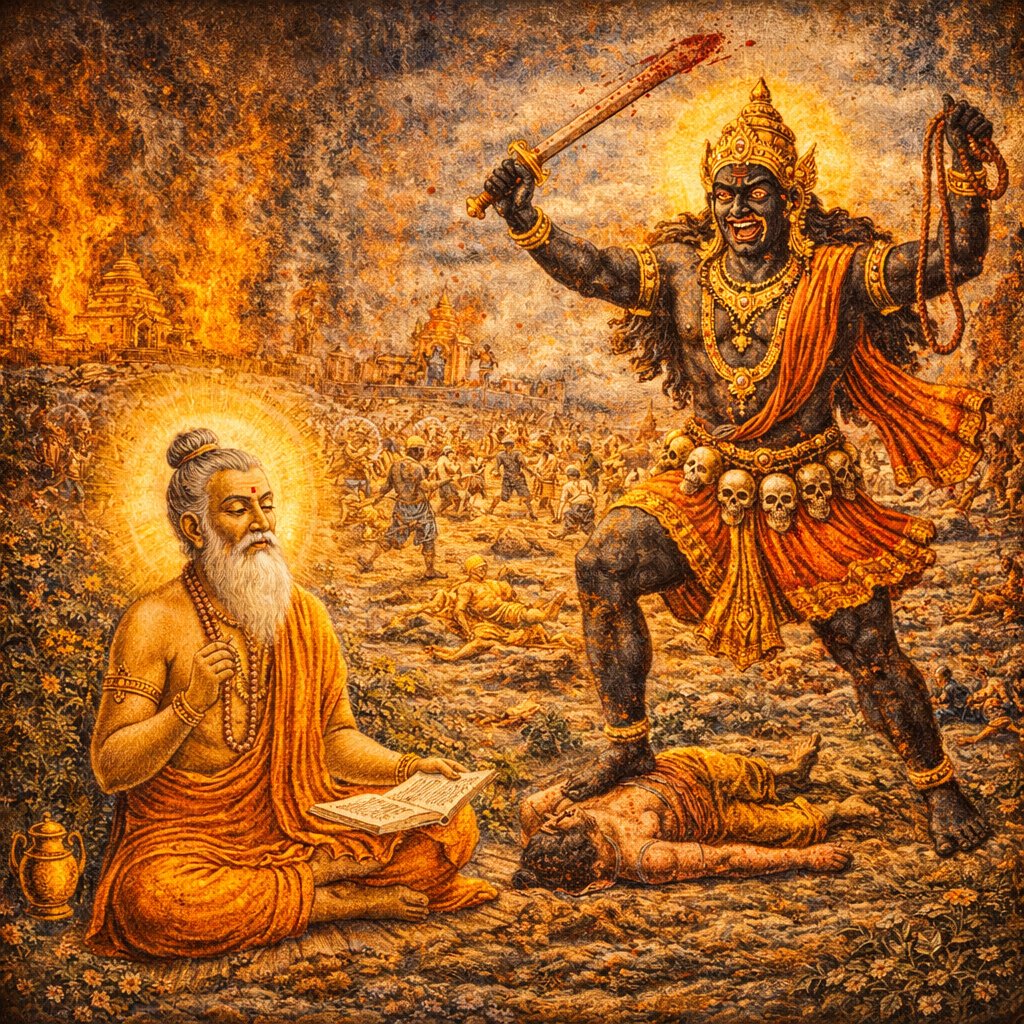
Canto 12 — The Age of Kali and the Concluding Teachings
द्वादश स्कन्ध (द्वादशः स्कन्धः)
The Age of Deterioration
Describes the degradations of Kali Yuga, the future kings, the recension of the Vedas, and the ultimate message of the Bhagavatam as the essence of all Vedanta.
Adhyayas in Dvadasha Skandha
Adhyaya 1
Kali-yuga Dynasties and the Degradation of Kingship
Continuing the prior enumeration of future rulers, Śukadeva Gosvāmī extends the vaṁśānucarita into Kali-yuga by tracing successive dynastic turnovers marked by assassination, ministerial coups, and the rise of non-kṣatriya power. He lists the Pradyotana line, then the Śiśunāga kings, culminating in Mahānandi’s son Nanda—born of a śūdra woman—whose immense military and wealth signal a decisive shift in political dharma and the marginalization of traditional kṣatriya leadership. The narrative proceeds through the Nandas and the intervention of the brāhmaṇa Cāṇakya, who topples them and installs the Mauryas, followed by the Śuṅgas and then the Kāṇvas. After the Kāṇvas fall to an Andhra śūdra servant, a long Andhra sequence is outlined, followed by other groups (Ābhīras, Gardabhīs, Kaṅkas, Yavanas, Turuṣkas, Guruṇḍas, Maulas, and the Kilakilā kings). The chapter then shifts from lists to moral prognosis: barbarous rulers will exploit citizens and dismantle Vedic standards, and the populace will imitate such conduct—setting up the next chapter’s broader Kali-yuga symptoms and spiritual remedies.
Adhyaya 2
Kali-yuga’s Degradation, the Advent of Kalki, and the Reset of the Yuga Cycle
Continuing the Twelfth Canto’s closing survey of history and time, Śukadeva Gosvāmī now gives Parīkṣit Mahārāja a diagnostic portrait of Kali-yuga: day-by-day erosion of dharma’s pillars (truth, cleanliness, mercy, tolerance), social identity reduced to wealth and external markers, and governance degenerating into predation. As corrupt populations swell, the strongest seize power; citizens, crushed by taxes and famine, flee and survive on wild foods, while lifespan contracts dramatically. Śukadeva then pivots from decline to divine intervention: Lord Viṣṇu appears as Kalki in Śambhala, annihilates impostor kings, purifies survivors, and ushers in Satya-yuga’s renewal, marked by auspicious astronomical configurations. The chapter also stitches eschatology to chronology: it references dynastic timelines, the Saptarṣi constellation’s movement through nakṣatras as a time-marker for Kali’s onset and intensification, and the immediate beginning of Kali upon Kṛṣṇa’s departure. It concludes by preparing the next movement of the canto’s finale: a sobering meditation on the futility of royal possessiveness under time’s supremacy.
Adhyaya 3
The Earth Laughs at World-Conquering Kings; Yuga-Dharma and the Remedy for Kali
Continuing the Bhāgavata’s late-stage emphasis on detachment and the urgency of Parīkṣit’s impending death, Śukadeva presents the Earth’s satire: rulers strive to conquer territory while remaining helpless before kāla and mṛtyu. The Earth exposes political ambition as lust-driven misidentification with the perishable body, and she recalls how even the most celebrated kings and powerful demons were reduced to mere names by time. Śukadeva then clarifies his didactic intent—royal histories are vehicles for jñāna and vairāgya, not the final object of knowledge. Turning to positive instruction, he prescribes sustained hearing and chanting of Uttamaḥśloka’s qualities. Parīkṣit asks how people in Kali-yuga can cleanse its contamination and requests an explanation of yugas and time. Śukadeva outlines Satya, Tretā, Dvāpara, and Kali—each with diminishing dharma—then details Kali’s social collapse and inner vices. Finally, he gives the chapter’s soteriological pivot: the Lord within the heart purifies more completely than auxiliary practices, and in Kali-yuga the supreme method is nāma-saṅkīrtana—chanting the Hare Kṛṣṇa mahā-mantra.
Adhyaya 4
Brahmā’s Day, the Four Pralayas, and the Supreme Shelter Beyond Cause–Effect
Continuing from the prior discussion of time’s measurements and cosmic ages, Śukadeva now expands Parīkṣit’s horizon to Brahmā’s day (kalpa) and night and explains naimittika pralaya, when the three planetary systems are withdrawn as Nārāyaṇa rests on Ananta and Brahmā sleeps. He then details prākṛtika pralaya at the end of Brahmā’s full lifespan: drought, famine, the sun’s desiccation, Saṅkarṣaṇa’s fire, destructive winds, and finally inundation. The dissolution proceeds philosophically as the elements and their specific qualities are successively absorbed—earth’s fragrance, water’s taste, fire’s form, air’s touch, ether’s sound—culminating in ahaṅkāra, mahat, the guṇas, and pradhāna. Śuka then argues that all perceived cause–effect dualities are ultimately insubstantial without reference to the Supreme, using classic analogies (lamp-eye-form; sky-in-pot; sun-reflection; cloud and sun). He concludes with ātyantika pralaya—final annihilation of bondage—when false ego is cut by discriminating knowledge and one realizes Acyuta. The chapter bridges into the closing emphasis on the Bhāgavatam’s unique saving power, its lineage, and the inevitability of time’s continuous creation–destruction across all beings.
Adhyaya 5
Ātmā’s Unborn Nature and Fearlessness at Death (Parīkṣit’s Final Instruction)
Continuing the closing movement of Skandha 12, Śukadeva Gosvāmī consolidates the Bhāgavata’s purpose: it has described Hari, the Supreme Soul, from whom Brahmā arises and from whose anger Rudra manifests—thereby situating all cosmic functions under Bhagavān’s supremacy. He then turns directly to Parīkṣit Mahārāja’s imminent death, urging him to abandon the animal-like conviction “I will die.” Through layered analogies—dream observation, fire distinct from fuel, pot-sky remaining sky, and the lamp’s dependence on components—Śukadeva demonstrates that birth and death belong to the body-mind complex shaped by māyā and the guṇas, while the ātmā remains unborn, self-luminous, and the unchanging basis of change. He prescribes constant meditation on Vāsudeva with clear intelligence, assuring Parīkṣit that Takṣaka’s bite cannot touch the realized self. The chapter culminates in an instruction of nondual contemplation and surrender to the Supreme Soul, preparing the narrative to close Parīkṣit’s inquiry and transition into the Bhāgavata’s final wrap-up and concluding reflections.
Adhyaya 6
Parīkṣit’s Final Absorption, Takṣaka’s Bite, Janamejaya’s Snake Sacrifice, and the Vedic Sound-Lineage
Following Śukadeva Gosvāmī’s complete narration, Mahārāja Parīkṣit offers final gratitude, declaring fearlessness of Takṣaka and repeated death due to absorption in Hari and requesting permission to withdraw speech and senses into Lord Adhokṣaja. Śukadeva grants leave and departs, and Parīkṣit enters yogic steadiness on the Gaṅgā’s bank, facing north, fixing the mind in the Absolute Truth until prāṇa becomes still. Takṣaka, diverted from being countered by Kaśyapa through bribery, approaches in disguise and bites; Parīkṣit’s body is burned to ashes as cosmic beings react with lamentation and celestial praise. The narrative then moves to consequence: Janamejaya’s wrathful sarpa-satra (snake sacrifice), Takṣaka’s flight to Indra, and Bṛhaspati’s intervention teaching karma-siddhānta—each being meets life and death through his own actions—leading Janamejaya to stop the rite. The chapter pivots from historical closure to śabda-brahman theology: the subtle transcendental sound, emergence of oṁkāra, its triadic structure (A-U-M), and Brahmā’s generation of the Vedas, culminating in Vyāsa’s fourfold division and the branching disciplic successions (including Yājñavalkya’s acquisition of new Yajur mantras from Sūrya). This bridges the end of Parīkṣit’s epoch to the next chapter’s continued detailing of Vedic branches and preservation in Kali-yuga.
Adhyaya 7
Paramparā of the Atharva Veda and Purāṇas; Definition of a Purāṇa (Daśa-lakṣaṇam)
Continuing the canto’s concluding emphasis on safeguarding revelation in Kali-yuga, Sūta Gosvāmī traces the disciplic succession of the Atharva Veda from Sumantu Ṛṣi through Kabandha and onward to multiple branches of disciples, demonstrating how śruti is preserved by authorized teachers. He then shifts to Purāṇic authority, naming six principal masters of Purāṇas who learned from Romaharṣaṇa (Vyāsa’s disciple), and explains the division of Purāṇas into foundational compilations. The chapter then provides a formal definition of a Purāṇa via the ten characteristic topics (daśa-lakṣaṇam): sarga, visarga, sthāna, poṣaṇa, ūti, manvantara, īśānukathā, nirodha, mukti, and āśraya—clarifying that major Purāṇas treat all ten, while minor works may treat five. These topics are briefly unpacked with philosophical precision, culminating in āśraya—the Absolute Truth as the ultimate shelter present within and beyond all states. The chapter closes by listing the eighteen Mahāpurāṇas and affirming that hearing this lineage narrative strengthens spiritual potency, preparing the reader for the Bhāgavata’s final consolidations that follow.
Adhyaya 8
Mārkaṇḍeya Ṛṣi Tested by Indra and Blessed by Nara-Nārāyaṇa
Continuing the Bhagavata’s late-canto emphasis on kāla, pralaya, and the sure refuge of Nārāyaṇa-kathā, Śaunaka asks Sūta to resolve an apparent paradox about Mārkaṇḍeya Ṛṣi: he is famed as a survivor of Brahmā’s day-end dissolution and as the seer of the divine infant on a banyan leaf, yet he is also said to appear within the current day of Brahmā where such total pralaya has not occurred. Sūta affirms that this inquiry itself dispels Kali’s illusion because it leads to the Lord’s topics. He then outlines Mārkaṇḍeya’s lifelong brahmacarya, rigorous tapas, Vedic study, disciplined daily worship (pañca-ārādhana), and mastery over death through sustained devotion. Alarmed by the sage’s growing potency, Indra sends Kāma, Apsarās, Gandharvas, Spring, and personified temptations to disturb him, but their seduction fails and they are scorched by his spiritual power. Pleased with his steadiness, the Supreme Lord appears directly as Nara and Nārāyaṇa, whom Mārkaṇḍeya reverently worships and praises, establishing the chapter’s bridge to the ensuing revelations about the Lord’s supremacy, māyā, and the true shelter beyond time.
Adhyaya 9
Mārkaṇḍeya’s Request to See Māyā and the Vision of the Cosmic Deluge
Following the sage Mārkaṇḍeya’s successful glorification of Nara-Nārāyaṇa (Bhagavān as the friend of Nara), the Lord appears and offers him a boon, praising his brahmacarya, tapas, Vedic study, niyama, and fixed meditation. Mārkaṇḍeya declines material benedictions, stating that darśana of the Lord is itself the highest gift, yet he requests one further grace: to witness the Lord’s illusory potency (māyā) by which the world appears materially variegated. The Lord consents and departs. Absorbed in contemplation, the sage continues worship—sometimes forgetting formal rites in bhāva. Then, during evening worship on the Puṣpabhadrā’s bank, a sudden apocalypse unfolds: fierce winds, thunderclouds, and a universal flood swallow the cosmos, leaving Mārkaṇḍeya alone, tormented by hunger, fear, and sea monsters across “millions of years.” He finally sees a tiny island with a banyan tree and a luminous infant on a leaf; the child inhales him, revealing the entire pre-dissolution universe within His body, and exhales him back into the deluge. When Mārkaṇḍeya rushes to embrace the Lord, the child vanishes, and instantly the deluge disappears, returning him to his hermitage—preparing the narrative for subsequent closure themes of nirodha, kāla, and āśraya.
Adhyaya 10
Mārkaṇḍeya Ṛṣi Meets Lord Śiva: Devotee as Living Tīrtha and the Lord’s Māyā
After Mārkaṇḍeya Ṛṣi has been shown the Supreme Lord’s bewildering potency (māyā) and takes exclusive shelter, this chapter pivots from the internal vision to its recognition by the cosmic controllers. Lord Śiva, accompanied by Umā and his attendants, finds Mārkaṇḍeya absorbed in deep samādhi, unresponsive to external reality. To awaken him without disturbing his spiritual absorption, Śiva enters the ‘sky of the heart’ through yogic power, appearing within the sage’s meditation. Mārkaṇḍeya then opens his eyes, offers formal hospitality (arghya, pādya, āsana, ārati), and praises Śiva’s transcendental position across the guṇas. Śiva responds by glorifying saintly brāhmaṇas and pure devotees as immediate purifiers—superior to holy waters or mere icons when approached externally. Pressed to ask a boon, Mārkaṇḍeya requests only unfailing bhakti to Lord Adhokṣaja and to His devotees. Śiva grants longevity, freedom from decay, tri-kāla-jñāna (knowledge of past-present-future), and Purāṇic ācārya status, then departs—bridging the prior māyā episode to the canto’s concluding emphasis on liberation through hearing and devotion.
Adhyaya 11
Kriyā-yoga, the Virāṭ-Puruṣa Mapping, and the Sun-God’s Monthly Expansions
Continuing Skandha 12’s closing emphasis on practical realization, the sages at Naimiṣāraṇya ask Sūta Gosvāmī for the tantra-siddhānta: kriyā-yoga as regulated worship of Viṣṇu and the method of conceiving the Lord’s limbs, weapons, ornaments, and associates through material correspondences without reducing Him to matter. Sūta transmits an authoritative vibhūti-map beginning with the virāṭ conception—planetary systems and cosmic functions read as the Lord’s body—then moves to the emblematic theology of Viṣṇu’s adornments (Kaustubha, Śrīvatsa, garland, yellow cloth, sacred thread) and weapons (conch, disc, club, bow, etc.) as principles like elements, prāṇa, guṇas, time, and senses. The chapter then pivots: Śaunaka requests the monthly ‘sets of seven’ surrounding the sun-god; Sūta lists the sun’s twelve monthly manifestations with six associates (sage, gandharva, apsarā, nāga, yakṣa, rākṣasa), culminating in the liturgical promise that dawn-and-dusk remembrance purifies. This bridges contemplative cosmology to daily sādhana and prepares the canto’s final wrap-up by showing Hari’s governance through time and worship.
Adhyaya 12
Bhāgavata-Māhātmya and the Complete Summary of the Śrīmad-Bhāgavatam
Continuing the concluding movement of Skandha 12—where Kali-yuga’s darkness and the urgency of spiritual practice are underscored—Sūta Gosvāmī offers obeisances to bhakti-dharma and to Śrī Kṛṣṇa, then provides a sweeping, canto-by-canto style synopsis of the Bhāgavatam’s contents: creation and dissolution (sarga, visarga, nirodha), manvantaras and avatāras, genealogies (vaṁśa) and saintly histories (vaṁśānucarita), and the central Kṛṣṇa-līlā narrative. The chapter then pivots from catalog to conclusion: it extols transcendental speech that glorifies Hari as the only truly auspicious literature, contrasts it with mundane talk, and proclaims the purifying power of even accidental utterance of ‘Namo Hari’. Finally, it establishes practical devotional results of hearing/reciting—especially on Ekādaśī/Dvādaśī and at tīrthas—culminating in Sūta’s homage to Śukadeva Gosvāmī as the ideal speaker who illuminated the Absolute Truth through Kṛṣṇa’s melodious pastimes. The narrative thereby bridges the Purāṇa’s total scope to its final takeaway: āśraya is Hari, accessed through Bhāgavata-śravaṇa and kīrtana.
Adhyaya 13
Bhāgavatam Mahimā — The Glory, Measure, Transmission, and Gift of Śrīmad-Bhāgavatam
Sūta Gosvāmī offers maṅgalācaraṇa—obeisances to the Supreme Lord praised by the Vedas and realized by perfected yogīs—then invokes the Lord’s Kūrma form as cosmic support and protection. He transitions from the canto’s end-of-age perspective to a formal summation: the verse-counts of the Purāṇas, establishing Śrīmad-Bhāgavatam’s distinct stature within the 400,000 Purāṇic verses. He recounts the Bhāgavatam’s original revelation to Brahmā and defines its core telos: renunciation through divine narration, the essence of Vedānta, and exclusive devotional service to the nondual Absolute Truth realized as Bhagavān Hari. The chapter prescribes a ritualized dāna (gift) of the Bhāgavatam—placing it on a golden throne on Bhādra Pūrṇimā—and proclaims the text’s supremacy among Purāṇas, likening it to Gaṅgā among rivers and Kāśī among tīrthas. It culminates in the paramparā remembrance (Brahmā–Nārada–Vyāsa–Śuka–Parīkṣit) and closing prayers for pure bhakti, linking the previous canto’s concluding mood to the Purāṇa’s final benediction: liberation through devoted hearing and chanting.
Frequently Asked Questions
The dynastic catalog (vaṁśānucarita) is used as a dharma-indicator: as rulers degrade in character, society mirrors that decline. The Bhāgavata frames political history as a spiritual lesson on impermanence (anityatā), the consequences of irreligion (adharma), and the need to take shelter of bhakti when Kali-yuga’s institutions fail.
Skandha 12 strongly foregrounds vaṁśa and vaṁśānucarita (genealogies and dynastic narratives) and connects them to nirodha (the winding down of cosmic and moral order). The collapse of righteous kingship is presented as a symptom of Kali’s progression within the larger cosmological framework described throughout the Purāṇa.
Śukadeva Gosvāmī narrates to Mahārāja Parīkṣit. This setting matters because Parīkṣit represents the ideal listener facing death: the canto’s Kali-yuga descriptions are not meant to induce despair but to sharpen renunciation and intensify exclusive hearing and remembrance of Bhagavān.