Adhyaya 30
Gopī-Vipralambha: The Search for Kṛṣṇa and the Revelation of Divine Footprints
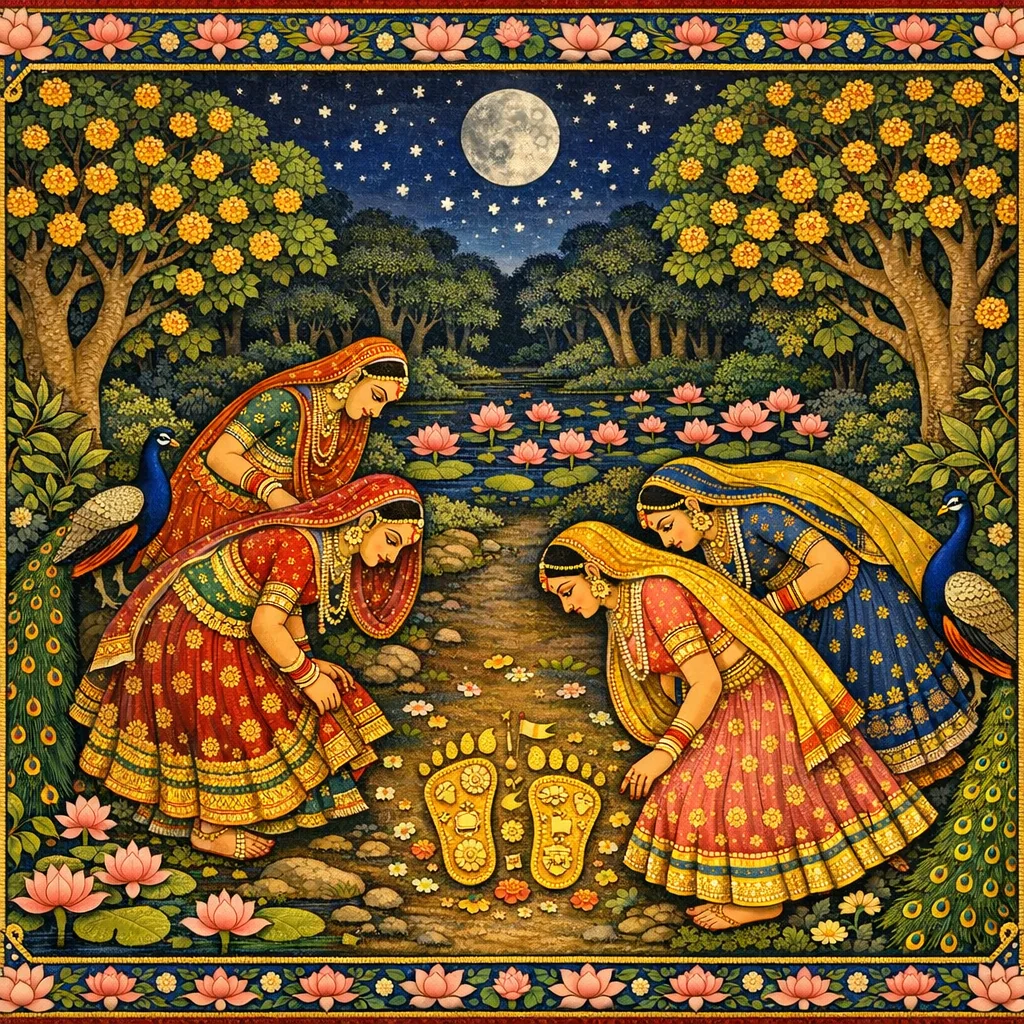
Following the intensification of rāsa-līlā, Kṛṣṇa suddenly disappears from the gopīs’ vision, plunging them into vipralambha (love in separation). Overwhelmed, they roam Vṛndāvana like maddened devotees, interrogating trees, creepers, tulasī, the earth, and animals—recognizing Kṛṣṇa as the antaryāmī (Supersoul) pervading all. Their remembrance becomes so total that they spontaneously reenact His childhood and heroic līlās (Pūtanā, Śakaṭāsura, Tṛṇāvarta, Vatsāsura, Bakāsura), revealing how smaraṇa and kīrtana can embody the Lord’s presence. They then discover Kṛṣṇa’s footprints marked with auspicious symbols, but are shaken to see them intermingled with another gopī’s prints, inferring He has led a ‘special’ beloved aside. Reading the ground as scripture, they deduce moments of intimacy—carrying her, gathering flowers, arranging her hair. Pride arises in the chosen gopī; she asks to be carried, and Kṛṣṇa vanishes again, teaching the peril of māna (conceit). The gopīs find her repentant, return toward the Yamunā under moonlight, and sit together singing, awaiting Kṛṣṇa’s reappearance—setting the emotional and theological bridge into the next phase of the rāsa narrative.
Shlokas
Verse 1
श्रीशुक उवाच अन्तर्हिते भगवति सहसैव व्रजाङ्गना: । अतप्यंस्तमचक्षाणा: करिण्य इव यूथपम् ॥ १ ॥
Śukadeva Gosvāmī said: When Lord Kṛṣṇa disappeared so suddenly, the gopīs felt great sorrow at losing sight of Him, like a group of female elephants who have lost their mate.
Verse 2
गत्यानुरागस्मितविभ्रमेक्षितै- र्मनोरमालापविहारविभ्रमै: । आक्षिप्तचित्ता: प्रमदा रमापते- स्तास्ता विचेष्टा जगृहुस्तदात्मिका: ॥ २ ॥
As the cowherd women remembered Lord Kṛṣṇa, their hearts were overwhelmed by His movements and loving smiles, His playful glances and enchanting talks, and by the many other pastimes He would enjoy with them. Thus absorbed in thoughts of Kṛṣṇa, the Lord of Ramā, the gopīs began acting out His various transcendental pastimes.
Verse 3
गतिस्मितप्रेक्षणभाषणादिषु प्रिया: प्रियस्य प्रतिरूढमूर्तय: । असावहं त्वित्यबलास्तदात्मिका न्यवेदिषु: कृष्णविहारविभ्रमा: ॥ ३ ॥
Because the beloved gopīs were absorbed in thoughts of their beloved Kṛṣṇa, their bodies imitated His way of moving and smiling, His way of beholding them, His speech and His other distinctive features. Deeply immersed in thinking of Him and maddened by remembering His pastimes, they declared to one another, “I am Kṛṣṇa!”
Verse 4
गायन्त्य उच्चैरमुमेव संहता विचिक्युरुन्मत्तकवद् वनाद् वनम् । पप्रच्छुराकाशवदन्तरं बहि- र्भूतेषु सन्तं पुरुषं वनस्पतीन् ॥ ४ ॥
Singing loudly of Kṛṣṇa, they searched for Him throughout the Vṛndāvana forest like a band of madwomen. They even asked the trees about Him, who as the Supersoul is present inside and outside of all created things, just like the sky.
Verse 5
दृष्टो व: कच्चिदश्वत्थ प्लक्ष न्यग्रोध नो मन: । नन्दसूनुर्गतो हृत्वा प्रेमहासावलोकनै: ॥ ५ ॥
[The gopīs said:] O aśvattha tree, O plakṣa, O nyagrodha, have you seen Kṛṣṇa? That son of Nanda Mahārāja has gone away after stealing our minds with His loving smiles and glances.
Verse 6
कच्चित् कुरबकाशोकनागपुन्नागचम्पका: । रामानुजो मानिनीनामितो दर्पहरस्मित: ॥ ६ ॥
O kurabaka tree, O aśoka, O nāga, punnāga and campaka, has Balarāma’s younger brother, whose smile removes the audacity of all proud women, passed this way?
Verse 7
कच्चित्तुलसि कल्याणि गोविन्दचरणप्रिये । सह त्वालिकुलैर्बिभ्रद् दृष्टस्तेऽतिप्रियोऽच्युत: ॥ ७ ॥
O most kind tulasī, to whom the feet of Govinda are so dear, have you seen that infallible one walk by, wearing you and encircled by swarms of bees?
Verse 8
मालत्यदर्शि व: कच्चिन्मल्लिके जाति यूथिके । प्रीतिं वो जनयन् यात: करस्पर्शेन माधव: ॥ ८ ॥
O mālati, O mallikā, O jāti and yūthikā, has Mādhava gone by here, giving you pleasure with the touch of His hand?
Verse 9
चूतप्रियालपनसासनकोविदार- जम्ब्वर्कबिल्वबकुलाम्रकदम्बनीपा: । येऽन्ये परार्थभवका यमुनोपकूला: शंसन्तु कृष्णपदवीं रहितात्मनां न: ॥ ९ ॥
O cūta, O priyāla, O panasa, āsana and kovidāra, O jambu, O arka, O bilva, bakula and āmra, O kadamba and nīpa and all you other plants and trees living by the banks of the Yamunā who have dedicated your very existence to the welfare of others, we gopīs have lost our minds, so please tell us where Kṛṣṇa has gone.
Verse 10
किं ते कृतं क्षिति तपो बत केशवाङ्घ्रि- स्पर्शोत्सवोत्पुलकिताङ्गरुहैर्विभासि । अप्यङ्घ्रिसम्भव उरुक्रमविक्रमाद् वा आहो वराहवपुष: परिरम्भणेन ॥ १० ॥
O mother earth, what austerity did you perform to attain the touch of Lord Keśava’s lotus feet, which has brought you such great joy that your bodily hairs are standing on end? You appear very beautiful in this condition. Was it during the Lord’s current appearance that you acquired this ecstatic symptom, or was it perhaps much earlier, when He stepped upon you in His form of the dwarf Vāmanadeva, or even earlier, when He embraced you in His form of the boar Varāhadeva?
Verse 11
अप्येणपत्न्युपगत: प्रिययेह गात्रै- स्तन्वन् दृशां सखि सुनिर्वृतिमच्युतो व: । कान्ताङ्गसङ्गकुचकुङ्कुमरञ्जिताया: कुन्दस्रज: कुलपतेरिह वाति गन्ध: ॥ ११ ॥
O friend, wife of the deer, has Lord Acyuta been here with His beloved, bringing great joy to your eyes? Indeed, blowing this way is the fragrance of His garland of kunda flowers, which was smeared with the kuṅkuma from the breasts of His girlfriend when He embraced Her.
Verse 12
बाहुं प्रियांस उपधाय गृहीतपद्मो रामानुजस्तुलसिकालिकुलैर्मदान्धै: । अन्वीयमान इह वस्तरव: प्रणामं किं वाभिनन्दति चरन् प्रणयावलोकै: ॥ १२ ॥
O trees, we see that you are bowing down. When the younger brother of Rāma walked by here, followed by intoxicated bees swarming around the tulasī mañjarīs decorating His garland, did He acknowledge your obeisances with His affectionate glances? He must have been resting His arm on the shoulder of His beloved and carrying a lotus flower in His free hand.
Verse 13
पृच्छतेमा लता बाहूनप्याश्लिष्टा वनस्पते: । नूनं तत्करजस्पृष्टा बिभ्रत्युत्पुलकान्यहो ॥ १३ ॥
Let us ask these creepers about Kṛṣṇa. Even though they are embracing the arms of their husband, this tree, they certainly must have been touched by Kṛṣṇa’s fingernails, since out of joy they are manifesting eruptions on their skin.
Verse 14
इत्युन्मत्तवचोगोप्य: कृष्णान्वेषणकातरा: । लीला भगवतस्तास्ता ह्यनुचक्रुस्तदात्मिका: ॥ १४ ॥
Having spoken these words, the gopīs, distraught from searching for Kṛṣṇa, began to act out His various pastimes, fully absorbed in thoughts of Him.
Verse 15
कस्याचित् पूतनायन्त्या: कृष्णायन्त्यपिबत् स्तनम् । तोकयित्वा रुदत्यन्या पदाहन् शकटायतीम् ॥ १५ ॥
One gopī imitated Pūtanā, while another acted like infant Kṛṣṇa and pretended to suck her breast. Another gopī, crying in imitation of infant Kṛṣṇa, kicked a gopī who was taking the role of the cart demon, Śakaṭāsura.
Verse 16
दैत्यायित्वा जहारान्यामेको कृष्णार्भभावनाम् । रिङ्गयामास काप्यङ्घ्री कर्षन्ती घोषनि:स्वनै: ॥ १६ ॥
One gopī took the role of Tṛṇāvarta and carried away another, who was acting like infant Kṛṣṇa, while yet another gopī crawled about, her ankle bells tinkling as she pulled her feet.
Verse 17
कृष्णरामायिते द्वे तु गोपायन्त्यश्च काश्चन । वत्सायतीं हन्ति चान्या तत्रैका तु बकायतीम् ॥ १७ ॥
Two gopīs acted like Rāma and Kṛṣṇa in the midst of several others, who took the role of cowherd boys. One gopī enacted Kṛṣṇa’s killing of the demon Vatsāsura, represented by another gopī, and a pair of gopīs acted out the killing of Bakāsura.
Verse 18
आहूय दूरगा यद्वत् कृष्णस्तमनुवर्ततीम् । वेणुं क्वणन्तीं क्रीडन्तीमन्या: शंसन्ति साध्विति ॥ १८ ॥
When one gopī perfectly imitated how Kṛṣṇa would call the cows who had wandered far away, how He would play His flute and how He would engage in various sports, the others congratulated her with exclamations of “Well done! Well done!”
Verse 19
कस्याञ्चित् स्वभुजं न्यस्य चलन्त्याहापरा ननु । कृष्णोऽहं पश्यत गतिं ललितामिति तन्मना: ॥ १९ ॥
Another gopī, her mind fixed on Kṛṣṇa, walked about with her arm resting on the shoulder of a friend and declared, “I am Kṛṣṇa! Just see how gracefully I move!”
Verse 20
मा भैष्ट वातवर्षाभ्यां तत्त्राणं विहितं मया । इत्युक्त्वैकेन हस्तेन यतन्त्युन्निदधेऽम्बरम् ॥ २० ॥
“Don’t be afraid of the wind and rain,” said one gopī. “I will save you.” And with that she lifted her shawl above her head.
Verse 21
आरुह्यैका पदाक्रम्य शिरस्याहापरां नृप । दुष्टाहे गच्छ जातोऽहं खलानां ननु दण्डकृत् ॥ २१ ॥
[Śukadeva Gosvāmī continued:] O King, one gopī climbed on another’s shoulders and, putting her foot on the other’s head, said, “Go away from here, O wicked snake! You should know that I have taken birth in this world just to punish the envious.”
Verse 22
तत्रैकोवाच हे गोपा दावाग्निं पश्यतोल्बणम् । चक्षूंष्याश्वपिदध्वं वो विधास्ये क्षेममञ्जसा ॥ २२ ॥
Then another gopī spoke up: My dear cowherd boys, look at this raging forest fire! Quickly close your eyes and I will easily protect you.
Verse 23
बद्धान्यया स्रजा काचित्तन्वी तत्र उलूखले । बध्नामि भाण्डभेत्तारं हैयङ्गवमुषं त्विति । भीता सुदृक् पिधायास्यं भेजे भीतिविडम्बनम् ॥ २३ ॥
One gopī tied up her slender companion with a flower garland and said, “Now I will bind this boy who has broken the butter pots and stolen the butter.” The second gopī then covered her face and beautiful eyes, pretending to be afraid.
Verse 24
एवं कृष्णं पृच्छमाना गण्दावनलतास्तरून् । व्यचक्षत वनोद्देशे पदानि परमात्मन: ॥ २४ ॥
While the gopīs were thus imitating Kṛṣṇa’s pastimes and asking Vṛndāvana’s creepers and trees where Kṛṣṇa, the Supreme Soul, might be, they happened to see His footprints in a corner of the forest.
Verse 25
पदानि व्यक्तमेतानि नन्दसूनोर्महात्मन: । लक्ष्यन्ते हि ध्वजाम्भोजवज्राङ्कुशयवादिभि: ॥ २५ ॥
[The gopīs said:] The marks of a flag, lotus, thunderbolt, elephant goad, barleycorn and so forth on these footprints clearly distinguish them as belonging to that great soul, the son of Nanda Mahārāja.
Verse 26
तैस्तै: पदैस्तत्पदवीमन्विच्छन्त्योऽग्रतोऽबला: । वध्वा: पदै: सुपृक्तानि विलोक्यार्ता: समब्रुवन् ॥ २६ ॥
The gopīs began following Kṛṣṇa’s path, as shown by His many footprints, but when they saw that these prints were thoroughly intermixed with those of His dearmost consort, they became perturbed and spoke as follows.
Verse 27
कस्या: पदानि चैतानि याताया नन्दसूनुना । अंसन्यस्तप्रकोष्ठाया: करेणो: करिणा यथा ॥ २७ ॥
[The gopīs said:] Here we see the footprints of some gopī who must have been walking along with the son of Nanda Mahārāja. He must have put His arm on Her shoulder, just as an elephant rests His trunk on the shoulder of an accompanying she-elephant.
Verse 28
अनयाराधितो नूनं भगवान् हरिरीश्वर: । यन्नो विहाय गोविन्द: प्रीतो यामनयद् रह: ॥ २८ ॥
Certainly this particular gopī has perfectly worshiped the all-powerful Personality of Godhead, Govinda, since He was so pleased with Her that He abandoned the rest of us and brought Her to a secluded place.
Verse 29
धन्या अहो अमी आल्यो गोविन्दाङ्घ्य्रब्जरेणव: । यान् ब्रह्मेशौ रमा देवी दधुर्मूध्र्न्यघनुत्तये ॥ २९ ॥
O girls! The dust of Govinda’s lotus feet is so sacred that even Brahmā, Śiva and the goddess Ramā take that dust upon their heads to dispel sinful reactions.
Verse 30
तस्या अमूनि न: क्षोभं कुर्वन्त्युच्चै: पदानि यत् यैकापहृत्य गोपीनां रहो भुङ्क्तेऽच्युताधरम् । न लक्ष्यन्ते पदान्यत्र तस्या नूनं तृणाङ्कुरै: खिद्यत्सुजाताङ्घ्रितलामुन्निन्ये प्रेयसीं प्रिय: ॥ ३० ॥
These footprints of that special gopī greatly disturb us. Of all the gopīs, She alone was taken away to a secluded place, where She is enjoying the lips of Kṛṣṇa. Look, we can’t see Her footprints over here! It’s obvious that the grass and sprouts were hurting the tender soles of Her feet, and so the lover lifted up His beloved.
Verse 31
इमान्यधिकमग्नानि पदानि वहतो वधूम् । गोप्य: पश्यत कृष्णस्य भाराक्रान्तस्य कामिन: । अत्रावरोपिता कान्ता पुष्पहेतोर्महात्मना ॥ ३१ ॥
Please observe, my dear gopīs, how in this place lusty Kṛṣṇa’s footprints are pressed more deeply into the ground. Carrying the weight of His beloved must have been difficult for Him. And over here that intelligent boy must have put Her down to gather some flowers.
Verse 32
अत्र प्रसूनावचय: प्रियार्थे प्रेयसा कृत: । प्रपदाक्रमण एते पश्यतासकले पदे ॥ ३२ ॥
Just see how in this place dear Kṛṣṇa collected flowers for His beloved. Here He has left the impression of only the front part of His feet because He was standing on His toes to reach the flowers.
Verse 33
केशप्रसाधनं त्वत्र कामिन्या: कामिना कृतम् । तानि चूडयता कान्तामुपविष्टमिह ध्रुवम् ॥ ३३ ॥
Certainly Kṛṣṇa sat down here with His girlfriend to arrange Her hair. The lusty boy must have made a crown for that lusty girl out of the flowers He had collected.
Verse 34
रेमे तया चात्मरत आत्मारामोऽप्यखण्डित: । कामिनां दर्शयन् दैन्यं स्त्रीणां चैव दुरात्मताम् ॥ ३४ ॥
[Śukadeva Gosvāmī continued:] Lord Kṛṣṇa enjoyed with that gopī, although He enjoys only within, being self-satisfied and complete in Himself. Thus by contrast He showed the wretchedness of ordinary lusty men and hardhearted women.
Verse 35
इत्येवं दर्शयन्त्यस्ताश्चेरुर्गोप्यो विचेतस: । यां गोपीमनयत्कृष्णो विहायान्या: स्त्रियो वने ॥ ३५ ॥ सा च मेने तदात्मानं वरिष्ठं सर्वयोषिताम् । हित्वा गोपी: कामयाना मामसौ भजते प्रिय: ॥ ३६ ॥
As the gopīs wandered about, their minds completely bewildered, they pointed out various signs of Kṛṣṇa’s pastimes. The particular gopī whom Kṛṣṇa had led into a secluded forest when He had abandoned all the other young girls began to think Herself the best of women. “My beloved has rejected all the other gopīs,” She thought, “even though they are driven by Cupid himself. He has chosen to reciprocate with Me alone.”
Verse 36
इत्येवं दर्शयन्त्यस्ताश्चेरुर्गोप्यो विचेतस: । यां गोपीमनयत्कृष्णो विहायान्या: स्त्रियो वने ॥ ३५ ॥ सा च मेने तदात्मानं वरिष्ठं सर्वयोषिताम् । हित्वा गोपी: कामयाना मामसौ भजते प्रिय: ॥ ३६ ॥
As the gopīs wandered about, their minds completely bewildered, they pointed out various signs of Kṛṣṇa’s pastimes. The particular gopī whom Kṛṣṇa had led into a secluded forest when He had abandoned all the other young girls began to think Herself the best of women. “My beloved has rejected all the other gopīs,” She thought, “even though they are driven by Cupid himself. He has chosen to reciprocate with Me alone.”
Verse 37
ततो गत्वा वनोद्देशं दृप्ता केशवमब्रवीत् । न पारयेऽहं चलितुं नय मां यत्र ते मन: ॥ ३७ ॥
As the two lovers passed through one part of the Vṛndāvana forest, the special gopī began feeling proud of Herself. She told Lord Keśava, “I cannot walk any further. Please carry Me wherever You want to go.”
Verse 38
एवमुक्त: प्रियामाह स्कन्ध आरुह्यतामिति । ततश्चान्तर्दधे कृष्ण: सा वधूरन्वतप्यत ॥ ३८ ॥
Thus addressed, Lord Kṛṣṇa replied, “Just climb on My shoulder.” But as soon as He said this, He disappeared. His beloved consort then immediately felt great remorse.
Verse 39
हा नाथ रमण प्रेष्ठ क्वासि क्वासि महाभुज । दास्यास्ते कृपणाया मे सखे दर्शय सन्निधिम् ॥ ३९ ॥
She cried out: O master! My lover! O dearmost, where are You? Where are You? Please, O mighty-armed one, O friend, show Yourself to Me, Your poor servant!
Verse 40
श्रीशुक उवाच अन्विच्छन्त्यो भगवतो मार्गं गोप्योऽविदूरित: । ददृशु: प्रियविश्लेषान्मोहितां दु:खितां सखीम् ॥ ४० ॥
Śukadeva Gosvāmī said: While continuing to search out Kṛṣṇa’s path, the gopīs discovered their unhappy friend close by. She was bewildered by separation from Her lover.
Verse 41
तया कथितमाकर्ण्य मानप्राप्तिं च माधवात् । अवमानं च दौरात्म्याद् विस्मयं परमं ययु: ॥ ४१ ॥
She told them how Mādhava had given Her much respect, but how She then suffered dishonor because of Her misbehavior. The gopīs were extremely amazed to hear this.
Verse 42
ततोऽविशन्वनं चन्द्रज्योत्स्ना यावद् विभाव्यते । तम: प्रविष्टमालक्ष्य ततो निववृतु: स्त्रिय: ॥ ४२ ॥
In search of Kṛṣṇa, the gopīs then entered the depths of the forest as far as the light of the moon shone. But when they found themselves engulfed in darkness, they decided to turn back.
Verse 43
तन्मनस्कास्तदालापास्तद्विचेष्टास्तदात्मिका: । तद्गुणानेव गायन्त्यो नात्मगाराणि सस्मरु: ॥ ४३ ॥
Their minds absorbed in thoughts of Him, they conversed about Him, acted out His pastimes and felt themselves filled with His presence. They completely forgot about their homes as they loudly sang the glories of Kṛṣṇa’s transcendental qualities.
Verse 44
पुन: पुलिनमागत्य कालिन्द्या: कृष्णभावना: । समवेता जगु: कृष्णं तदागमनकाङ्क्षिता: ॥ ४४ ॥
The gopīs again came to the bank of the Kālindī. Meditating on Kṛṣṇa and eagerly hoping He would come, they sat down together to sing of Him.
Frequently Asked Questions
In the rasa context, Kṛṣṇa’s disappearance intensifies prema through vipralambha, where separation deepens remembrance, humility, and single-pointed longing. It also exposes subtle ego (māna) and reorients devotion from possessiveness to surrender. Traditional Vaiṣṇava readings emphasize that the Lord’s ‘absence’ is a pedagogical līlā: He becomes more present in the devotees’ consciousness, transforming longing into heightened bhakti.
Their līlā-anukaraṇa is not theatrical imitation for entertainment but an overflow of absorption (tad-ātmya) in Kṛṣṇa. It demonstrates bhakti as embodied remembrance: guṇa-kīrtana and smaraṇa become so vivid that the devotees experience the Lord’s qualities and actions as immediate reality. Commentarial traditions treat this as evidence of the gopīs’ unsurpassed bhāva, where the mind, speech, and body naturally align with Kṛṣṇa-centered consciousness.
The text presents her as Kṛṣṇa’s dearmost consort in that moment (commonly understood in Gauḍīya tradition as Śrī Rādhā), and the narrative uses this to reveal two teachings: (1) Kṛṣṇa reciprocates uniquely with each devotee’s love, and (2) even intimate favor can become spiritually dangerous if it produces pride. The episode culminates in her remorse when Kṛṣṇa disappears, underscoring humility as intrinsic to mature prema.
The symbols (dhvaja/flag, padma/lotus, vajra/thunderbolt, aṅkuśa/elephant goad, yava/barleycorn, etc.) mark Kṛṣṇa as mahā-puruṣa and Bhagavān, turning the forest floor into a readable theology. Devotion here becomes interpretive practice: the gopīs ‘read’ līlā through signs, deducing intimacy, compassion (carrying the beloved), and play. In bhakti hermeneutics, pāda-cihna also signifies refuge—contact with the Lord’s feet as the purifier revered by Brahmā, Śiva, and Lakṣmī.