Adhyaya 57
The Murder of Satrājit and the Recovery of the Syamantaka Jewel
Linking from the prior Syamantaka controversy, this chapter opens with Kṛṣṇa and Balarāma traveling to Hastināpura to honor family obligations after hearing (though already knowing) reports of the Pāṇḍavas’ and Kuntī’s death, displaying nara-līlā by sharing the Kurus’ grief. In Their absence, Akrūra and Kṛtavarmā provoke Śatadhanvā to seize the Syamantaka jewel; driven by greed and resentment, he murders Satrājit and flees with the gem. Satyabhāmā brings her father’s body preserved in oil to Kṛṣṇa, who returns to Dvārakā, pursues Śatadhanvā, and kills him, yet finds the jewel missing. Balarāma remains in Mithilā with Janaka (where Duryodhana learns gadā-yuddha), while Kṛṣṇa returns, performs Satrājit’s rites, and confronts the social unrest caused by Akrūra’s exile. Summoning Akrūra back, Kṛṣṇa gently reveals His omniscience, requests the jewel to pacify relatives, displays it to clear accusations, and returns it to Akrūra—setting up the next chapter’s continued implications of the jewel and Dvārakā’s politics.
Shlokas
Verse 1
श्रीबादरायणिरुवाच विज्ञातार्थोऽपि गोविन्दो दग्धानाकर्ण्य पाण्डवान् । कुन्तीं च कुल्यकरणे सहरामो ययौ कुरून् ॥ १ ॥
Śrī Bādarāyaṇi said: Although Lord Govinda was fully aware of what had actually occurred, when He heard reports that the Pāṇḍavas and Queen Kuntī had burned to death, He went with Lord Balarāma to the kingdom of the Kurus to fulfill the family obligations expected of Him.
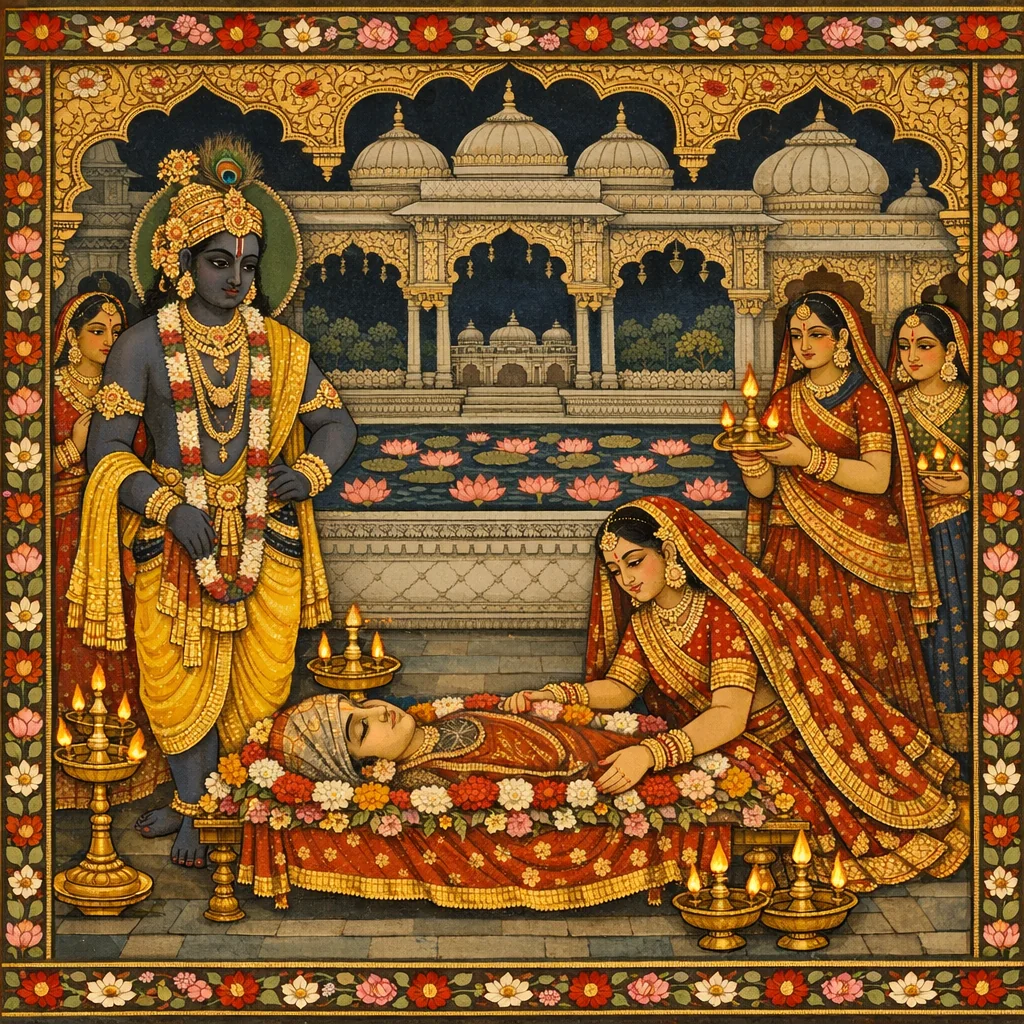
Verse 2
भीष्मं कृपं सविदुरं गान्धारीं द्रोणमेव च । तुल्यदु:खौ च सङ्गम्य हा कष्टमिति होचतु: ॥ २ ॥
The two Lords met with Bhīṣma, Kṛpa, Vidura, Gāndhārī and Droṇa. Showing sorrow equal to theirs, They cried out, “Alas, how painful this is!”
Verse 3
लब्ध्वैतदन्तरं राजन् शतधन्वानमूचतु: । अक्रूरकृतवर्माणौ मनि: कस्मान्न गृह्यते ॥ ३ ॥
Taking advantage of this opportunity, O King, Akrūra and Kṛtavarmā went to Śatadhanvā and said, “Why not take the Syamantaka jewel?
Verse 4
योऽस्मभ्यं सम्प्रतिश्रुत्य कन्यारत्नं विगर्ह्य न: । कृष्णायादान्न सत्राजित् कस्माद् भ्रातरमन्वियात् ॥ ४ ॥
“Satrājit promised his jewellike daughter to us but then gave her to Kṛṣṇa instead, contemptuously neglecting us. So why should Satrājit not follow his brother’s path?”
Verse 5
एवं भिन्नमतिस्ताभ्यां सत्राजितमसत्तम: । शयानमवधील्लोभात् स पाप: क्षीणजीवित: ॥ ५ ॥
His mind thus influenced by their advice, wicked Śatadhanvā murdered Satrājit in his sleep simply out of greed. In this way the sinful Śatadhanvā shortened his own life span.
Verse 6
स्त्रीणां विक्रोशमानानां क्रन्दन्तीनामनाथवत् । हत्वा पशून् सौनिकवन्मणिमादाय जग्मिवान् ॥ ६ ॥
As the women of Satrājit’s palace screamed and helplessly wept, Śatadhanvā took the jewel and left, like a butcher after he has killed some animals.
Verse 7
सत्यभामा च पितरं हतं वीक्ष्य शुचार्पिता । व्यलपत्तात तातेति हा हतास्मीति मुह्यती ॥ ७ ॥
When Satyabhāmā saw her dead father, she was plunged into grief. Lamenting “My father, my father! Oh, I am killed!” she fell unconscious.
Verse 8
तैलद्रोण्यां मृतं प्रास्य जगाम गजसाह्वयम् । कृष्णाय विदितार्थाय तप्ताचख्यौ पितुर्वधम् ॥ ८ ॥
Queen Satyabhāmā put her father’s corpse in a large vat of oil and went to Hastināpura, where she sorrowfully told Lord Kṛṣṇa, who was already aware of the situation, about her father’s murder.
Verse 9
तदाकर्ण्येश्वरौ राजन्ननुसृत्य नृलोकताम् । अहो न: परमं कष्टमित्यस्राक्षौ विलेपतु: ॥ ९ ॥
When Lord Kṛṣṇa and Lord Balarāma heard this news, O King, They exclaimed, “Alas! This is the greatest tragedy for Us!” Thus imitating the ways of human society, They lamented, Their eyes brimming with tears.
Verse 10
आगत्य भगवांस्तस्मात् सभार्य: साग्रज: पुरम् । शतधन्वानमारेभे हन्तुं हर्तुं मणिं तत: ॥ १० ॥
The Supreme Lord returned to His capital with His wife and elder brother. After arriving in Dvārakā, He readied Himself to kill Śatadhanvā and retrieve the jewel from him.
Verse 11
सोऽपि कृतोद्यमं ज्ञात्वा भीत: प्राणपरीप्सया । साहाय्ये कृतवर्माणमयाचत स चाब्रवीत् ॥ ११ ॥
Upon learning that Lord Kṛṣṇa was preparing to kill him, Śatadhanvā was struck with fear. To save his life he approached Kṛtavarmā and begged him for help, but Kṛtavarmā replied as follows.
Verse 12
नाहमीस्वरयो: कुर्यां हेलनं रामकृष्णयो: । को नु क्षेमाय कल्पेत तयोर्वृजिनमाचरन् ॥ १२ ॥ कंस: सहानुगोऽपीतो यद्द्वेषात्त्याजित: श्रिया । जरासन्ध: सप्तदश संयुगाद् विरथो गत: ॥ १३ ॥
[Kṛtavarmā said:] I dare not offend the Supreme Lords, Kṛṣṇa and Balarāma. Indeed, how can one who troubles Them expect any good fortune? Kaṁsa and all his followers lost both their wealth and their lives because of enmity toward Them, and after battling Them seventeen times Jarāsandha was left without even a chariot.
Verse 13
नाहमीस्वरयो: कुर्यां हेलनं रामकृष्णयो: । को नु क्षेमाय कल्पेत तयोर्वृजिनमाचरन् ॥ १२ ॥ कंस: सहानुगोऽपीतो यद्द्वेषात्त्याजित: श्रिया । जरासन्ध: सप्तदश संयुगाद् विरथो गत: ॥ १३ ॥
[Kṛtavarmā said:] I dare not offend the Supreme Lords, Kṛṣṇa and Balarāma. Indeed, how can one who troubles Them expect any good fortune? Kaṁsa and all his followers lost both their wealth and their lives because of enmity toward Them, and after battling Them seventeen times Jarāsandha was left without even a chariot.
Verse 14
प्रत्याख्यात: स चाक्रूरं पार्ष्णिग्राहमयाचत । सोऽप्याह को विरुध्येत विद्वानीश्वरयोर्बलम् ॥ १४ ॥
His appeal refused, Śatadhanvā went to Akrūra and begged him for protection. But Akrūra similarly told him, “Who would oppose the two Personalities of Godhead if he knew Their strength?
Verse 15
य इदं लीलया विश्वं सृजत्यवति हन्ति च । चेष्टां विश्वसृजो यस्य न विदुर्मोहिताजया ॥ १५ ॥
“It is the Supreme Lord who creates, maintains and destroys this universe simply as His pastime. The cosmic creators cannot even understand His purpose, bewildered as they are by His illusory Māyā.
Verse 16
य: सप्तहायन: शैलमुत्पाट्यैकेन पाणिना । दधार लीलया बाल उच्छिलीन्ध्रमिवार्भक: ॥ १६ ॥
“As a child of seven, Kṛṣṇa uprooted an entire mountain and held it aloft as easily as a young boy picks up a mushroom.
Verse 17
नमस्तस्मै भगवते कृष्णायाद्भुतकर्मणे । अनन्तायादिभूताय कूटस्थायात्मने नम: ॥ १७ ॥
“I offer my obeisances to that Supreme Personality of Godhead, Kṛṣṇa, whose every deed is amazing. He is the Supreme Soul, the unlimited source and fixed center of all existence.”
Verse 18
प्रत्याख्यात: स तेनापि शतधन्वा महामणिम् । तस्मिन् न्यस्याश्वमारुह्य शतयोजनगं ययौ ॥ १८ ॥
His appeal thus rejected by Akrūra also, Śatadhanvā placed the precious jewel in Akrūra’s care and fled on a horse that could travel one hundred yojanas [eight hundred miles].
Verse 19
गरुडध्वजमारुह्य रथं रामजनार्दनौ । अन्वयातां महावेगैरश्वै राजन् गुरुद्रुहम् ॥ १९ ॥
My dear King, Kṛṣṇa and Balarāma mounted Kṛṣṇa’s chariot, which flew the flag of Garuḍa and was yoked with tremendously swift horses, and pursued Their elder’s murderer.
Verse 20
मिथिलायामुपवने विसृज्य पतितं हयम् । पद्भ्यामधावत् सन्त्रस्त: कृष्णोऽप्यन्वद्रवद् रुषा ॥ २० ॥
In a garden on the outskirts of Mithilā, the horse Śatadhanvā was riding collapsed. Terrified, he abandoned the horse and began to flee on foot, with Kṛṣṇa in angry pursuit.
Verse 21
पदातेर्भगवांस्तस्य पदातिस्तिग्मनेमिना । चक्रेण शिर उत्कृत्य वाससोर्व्यचिनोन्मणिम् ॥ २१ ॥
As Śatadhanvā fled on foot, the Supreme Lord, also going on foot, cut off his head with His sharp-edged disc. The Lord then searched Śatadhanvā’s upper and lower garments for the Syamantaka jewel.
Verse 22
अलब्धमणिरागत्य कृष्ण आहाग्रजान्तिकम् । वृथा हत: शतधनुर्मणिस्तत्र न विद्यते ॥ २२ ॥
Not finding the jewel, Lord Kṛṣṇa went to His elder brother and said, “We have killed Śatadhanvā uselessly. The jewel isn’t here.”
Verse 23
तत आह बलो नूनं स मणि: शतधन्वना । कस्मिंश्चित् पुरुषे न्यस्तस्तमन्वेष पुरं व्रज ॥ २३ ॥
To this Lord Balarāma replied, “Indeed, Śatadhanvā must have placed the jewel in the care of someone. You should return to Our city and find that person.
Verse 24
अहं वैदेहमिच्छामि द्रष्टुं प्रियतमं मम । इत्युक्त्वा मिथिलां राजन् विवेश यदुनन्दन: ॥ २४ ॥
“I wish to visit King Videha, who is most dear to Me.” O King, having said this, Lord Balarāma, the beloved descendant of Yadu, entered the city of Mithilā.
Verse 25
तं दृष्ट्वा सहसोत्थाय मैथिल: प्रीतमानस: । अर्हयामास विधिवदर्हणीयं समर्हणै: ॥ २५ ॥
The King of Mithilā immediately rose from his seat when he saw Lord Balarāma approaching. With great love the King honored the supremely worshipable Lord by offering Him elaborate worship, as stipulated by scriptural injunctions.
Verse 26
उवास तस्यां कतिचिन्मिथिलायां समा विभु: । मानित: प्रीतियुक्तेन जनकेन महात्मना । ततोऽशिक्षद् गदां काले धार्तराष्ट्र: सुयोधन: ॥ २६ ॥
The almighty Lord Balarāma stayed in Mithilā for several years, honored by His affectionate devotee Janaka Mahārāja. During that time Dhṛtarāṣṭra’s son Duryodhana learned from Balarāma the art of fighting with a club.
Verse 27
केशवो द्वारकामेत्य निधनं शतधन्वन: । अप्राप्तिं च मणे: प्राह प्रियाया: प्रियकृद् विभु: ॥ २७ ॥
Lord Keśava arrived in Dvārakā and described the demise of Śatadhanvā and His own failure to find the Syamantaka jewel. He spoke in a way that would please His beloved, Satyabhāmā.
Verse 28
तत: स कारयामास क्रिया बन्धोर्हतस्य वै । साकं सुहृद्भिर्भगवान् या या: स्यु: साम्परायिकी: ॥ २८ ॥
Lord Kṛṣṇa then had the various funeral rites performed for His deceased relative, Satrājit. The Lord attended the funeral along with well-wishers of the family.
Verse 29
अक्रूर: कृतवर्मा च श्रुत्वा शतधनोर्वधम् । व्यूषतुर्भयवित्रस्तौ द्वारकाया: प्रयोजकौ ॥ २९ ॥
When Akrūra and Kṛtavarmā, who had originally incited Śatadhanvā to commit his crime, heard that he had been killed, they fled Dvārakā in terror and took up residence elsewhere.
Verse 30
अक्रूरे प्रोषितेऽरिष्टान्यासन् वै द्वारकौकसाम् । शारीरा मानसास्तापा मुहुर्दैविकभौतिका: ॥ ३० ॥
In Akrūra’s absence ill omens arose in Dvārakā, and the citizens began to suffer continually from physical and mental distresses, as well as from disturbances caused by higher powers and by creatures of the earth.
Verse 31
इत्यङ्गोपदिशन्त्येके विस्मृत्य प्रागुदाहृतम् । मुनिवासनिवासे किं घटेतारिष्टदर्शनम् ॥ ३१ ॥
Some men proposed [that the troubles were due to Akrūra’s absence], but they had forgotten the glories of the Supreme Lord, which they themselves had so often described. Indeed, how can calamities occur in a place where the Personality of Godhead, the residence of all the sages, resides?
Verse 32
देवेऽवर्षति काशीश: श्वफल्कायागताय वै । स्वसुतां गान्दिनीं प्रादात् ततोऽवर्षत् स्म काशिषु ॥ ३२ ॥
[The elders said:] Previously, when Lord Indra had withheld rain from Kāsī [Benares], the king of that city gave his daughter Gāndinī to Śvaphalka, who was then visiting him. It soon rained in the kingdom of Kāśī.
Verse 33
तत्सुतस्तत्प्रभावोऽसावक्रूरो यत्र यत्र ह । देवोऽभिवर्षते तत्र नोपतापा न मारीका: ॥ ३३ ॥
Wherever his equally powerful son Akrūra stays, Lord Indra will provide sufficient rain. Indeed, that place will be free of miseries and untimely deaths.
Verse 34
इति वृद्धवच: श्रुत्वा नैतावदिह कारणम् । इति मत्वा समानाय्य प्राहाक्रूरं जनार्दन: ॥ ३४ ॥
Hearing these words from the elders, Lord Janārdana, though aware that the absence of Akrūra was not the only cause of the evil omens, had him summoned back to Dvārakā and spoke to him.
Verse 35
पूजयित्वाभिभाष्यैनं कथयित्वा प्रिया: कथा: । विज्ञाताखिलचित्तज्ञ: स्मयमान उवाच ह ॥ ३५ ॥ ननु दानपते न्यस्तस्त्वय्यास्ते शतधन्वना । स्यमन्तको मनि: श्रीमान् विदित: पूर्वमेव न: ॥ ३६ ॥
Lord Kṛṣṇa honored Akrūra, greeted him confidentially and spoke pleasant words with him. Then the Lord, who was fully aware of Akrūra’s heart by virtue of His being the knower of everything, smiled and addressed him: “O master of charity, surely the opulent Syamantaka jewel was left in your care by Śatadhanvā and is still with you. Indeed, We have known this all along.
Verse 36
पूजयित्वाभिभाष्यैनं कथयित्वा प्रिया: कथा: । विज्ञाताखिलचित्तज्ञ: स्मयमान उवाच ह ॥ ३५ ॥ ननु दानपते न्यस्तस्त्वय्यास्ते शतधन्वना । स्यमन्तको मनि: श्रीमान् विदित: पूर्वमेव न: ॥ ३६ ॥
Lord Kṛṣṇa honored Akrūra, greeted him confidentially and spoke pleasant words with him. Then the Lord, who was fully aware of Akrūra’s heart by virtue of His being the knower of everything, smiled and addressed him: “O master of charity, surely the opulent Syamantaka jewel was left in your care by Śatadhanvā and is still with you. Indeed, We have known this all along.
Verse 37
सत्राजितोऽनपत्यत्वाद् गृह्णीयुर्दुहितु: सुता: । दायं निनीयाप: पिण्डान् विमुच्यर्णं च शेषितम् ॥ ३७ ॥
“Since Satrājit had no sons, his daughter’s sons should receive his inheritance. They should pay for memorial offerings of water and piṇḍa, clear their grandfather’s outstanding debts and keep the remainder of the inheritance for themselves.
Verse 38
तथापि दुर्धरस्त्वन्यैस्त्वय्यास्तां सुव्रते मणि: । किन्तु मामग्रज: सम्यङ्न प्रत्येति मणिं प्रति ॥ ३८ ॥ दर्शयस्व महाभाग बन्धूनां शान्तिमावह । अव्युच्छिन्ना मखास्तेऽद्य वर्तन्ते रुक्मवेदय: ॥ ३९ ॥
“Nevertheless, the jewel should remain in your care, O trustworthy Akrūra, because no one else can keep it safely. But please show the jewel just once, since My elder brother does not fully believe what I have told Him about it. In this way, O most fortunate one, you will pacify My relatives. [Everyone knows you have the jewel, for] you are now continually performing sacrifices on altars of gold.”
Verse 39
तथापि दुर्धरस्त्वन्यैस्त्वय्यास्तां सुव्रते मणि: । किन्तु मामग्रज: सम्यङ्न प्रत्येति मणिं प्रति ॥ ३८ ॥ दर्शयस्व महाभाग बन्धूनां शान्तिमावह । अव्युच्छिन्ना मखास्तेऽद्य वर्तन्ते रुक्मवेदय: ॥ ३९ ॥
“Nevertheless, the jewel should remain in your care, O trustworthy Akrūra, because no one else can keep it safely. But please show the jewel just once, since My elder brother does not fully believe what I have told Him about it. In this way, O most fortunate one, you will pacify My relatives. [Everyone knows you have the jewel, for] you are now continually performing sacrifices on altars of gold.”
Verse 40
एवं सामभिरालब्ध: श्वफल्कतनयो मणिम् । आदाय वाससाच्छन्न: ददौ सूर्यसमप्रभम् ॥ ४० ॥
Thus shamed by Lord Kṛṣṇa’s conciliatory words, the son of Śvaphalka brought out the jewel from where he had concealed it in his clothing and gave it to the Lord. The brilliant gem shone like the sun.
Verse 41
स्यमन्तकं दर्शयित्वा ज्ञातिभ्यो रज आत्मन: । विमृज्य मणिना भूयस्तस्मै प्रत्यर्पयत् प्रभु: ॥ ४१ ॥
After the almighty Lord had shown the Syamantaka jewel to His relatives, thus dispelling the false accusations against Him, He returned it to Akrūra.
Verse 42
यस्त्वेतद् भगवत ईश्वरस्य विष्णो- र्वीर्याढ्यं वृजिनहरं सुमङ्गलं च । आख्यानं पठति शृणोत्यनुस्मरेद् वा दुष्कीर्तिं दुरितमपोह्य याति शान्तिम् ॥ ४२ ॥
This narration, rich with descriptions of the prowess of Lord Śrī Viṣṇu, the Supreme Personality of Godhead, removes sinful reactions and bestows all auspiciousness. Anyone who recites, hears or remembers it will drive away his own infamy and sins and attain peace.
Frequently Asked Questions
Śatadhanvā is incited by Akrūra and Kṛtavarmā, who exploit resentment over Satrājit giving Satyabhāmā to Kṛṣṇa instead of them. The immediate driver is lobha (greed) for the Syamantaka jewel, and the Bhāgavatam frames the act as adharma that shortens his lifespan—showing how corrupted ūti (motivation) produces swift karmic collapse.
The text explicitly notes Kṛṣṇa was fully aware, yet He acts in a humanlike way—mourning with relatives and following social duties. This nara-līlā preserves dharma, teaches proper conduct, and allows His devotees to relate to Him intimately, without compromising His status as sarva-jña (all-knowing).
Śatadhanvā entrusted the jewel to Akrūra before fleeing. Kṛṣṇa later summons Akrūra back to Dvārakā and, through gentle but incisive speech, has him reveal the jewel publicly—clearing Kṛṣṇa of accusations—after which Kṛṣṇa returns the gem to Akrūra for safekeeping.
Balarāma chooses to visit King Videha (Janaka), who honors Him with scriptural worship, and He remains there for years. The narrative notes Duryodhana learns gadā-yuddha from Balarāma, foreshadowing Mahābhārata-era outcomes: the transmission of martial skill becomes part of providential history, linking Kṛṣṇa-līlā to broader dynastic dharma and future conflict.
Elders attribute the city’s miseries to Akrūra’s absence due to his family’s rain-bestowing merit (connected to Śvaphalka and Gāndinī). Kṛṣṇa, though knowing multiple causes, summons Akrūra back to restore social confidence and stability—demonstrating divine governance through both metaphysical truth and practical statecraft.