Adhyaya 50
Jarāsandha’s Siege of Mathurā, Kṛṣṇa-Balarāma’s Victory, and the Founding of Dvārakā amid Kālayavana’s Threat
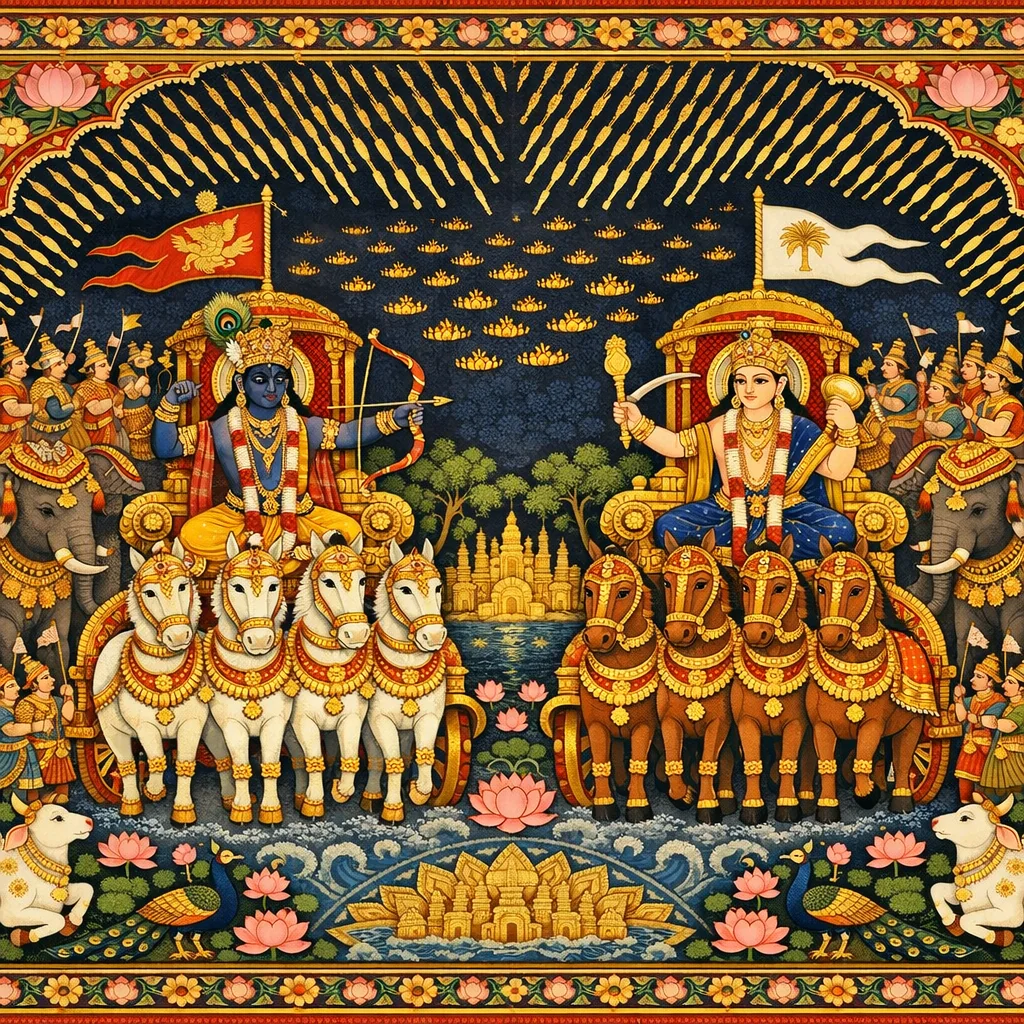
After Kaṁsa’s death, his widowed queens Asti and Prāpti incite their father Jarāsandha, who resolves to eradicate the Yādavas and besieges Mathurā with twenty-three akṣauhiṇīs. Kṛṣṇa, acting in humanlike strategy while remaining the jagat-kāraṇa, deliberates on time, place, and purpose: He will destroy the armies to relieve the earth’s burden but spare Jarāsandha for a future role. Divine chariots and weapons appear; Kṛṣṇa and Balarāma ride out with a small force, silence Jarāsandha’s insults, and devastate the Magadhan host with torrents of arrows, producing the famous “rivers of blood” battlefield imagery. Balarāma captures Jarāsandha, but Kṛṣṇa stops his binding, releasing the ashamed king, who is counseled to accept defeat as karma. The chapter then telescopes the recurring pattern—seventeen such defeats—and pivots to the next crisis: Kālayavana arrives with a vast barbarian army. Seeing a two-front danger, Kṛṣṇa plans a new, impregnable sea-fortress (Dvārakā), built by Viśvakarmā and enriched by devas’ gifts, then transports the populace and prepares to face the Yavana, setting up the ensuing chapters’ flight-and-deliverance līlā.
Shlokas
Verse 1
श्रीशुक उवाच अस्ति: प्राप्तिश्च कंसस्य महिष्यौ भरतर्षभ । मृते भर्तरि दु:खार्ते ईयतु: स्म पितुर्गृहान् ॥ १ ॥
Śukadeva Gosvāmī said: When Kaṁsa was killed, O heroic descendant of Bharata, his two queens, Asti and Prāpti, went to their father’s house in great distress.
Verse 2
पित्रे मगधराजाय जरासन्धाय दु:खिते । वेदयां चक्रतु: सर्वमात्मवैधव्यकारणम् ॥ २ ॥
The sorrowful queens told their father, King Jarāsandha of Magadha, all about how they had become widows.
Verse 3
स तदप्रियमाकर्ण्य शोकामर्षयुतो नृप । अयादवीं महीं कर्तुं चक्रे परममुद्यमम् ॥ ३ ॥
Hearing this odious news, O King, Jarāsandha was filled with sorrow and anger, and he began the greatest possible endeavor to rid the earth of the Yādavas.
Verse 4
अक्षौहिणीभिर्विंशत्या तिसृभिश्चापि संवृत: । यदुराजधानीं मथुरां न्यरुधत् सर्वतोदिशम् ॥ ४ ॥
With a force of twenty-three akṣauhiṇī divisions, he laid siege to the Yadu capital, Mathurā, on all sides.
Verse 5
निरीक्ष्य तद्बलं कृष्ण उद्वेलमिव सागरम् । स्वपुरं तेन संरुद्धं स्वजनं च भयाकुलम् ॥ ५ ॥ चिन्तयामास भगवान् हरि: कारणमानुष: । तद्देशकालानुगुणं स्वावतारप्रयोजनम् ॥ ६ ॥
Although Lord Kṛṣṇa, the Supreme Personality of Godhead, is the original cause of this world, when He descended to the earth He played the role of a human being. Thus when He saw Jarāsandha’s assembled army surrounding His city like a great ocean overflowing its shores, and when He saw how this army was striking fear into His subjects, the Lord considered what His suitable response should be according to the time, place and specific purpose of His current incarnation.
Verse 6
निरीक्ष्य तद्बलं कृष्ण उद्वेलमिव सागरम् । स्वपुरं तेन संरुद्धं स्वजनं च भयाकुलम् ॥ ५ ॥ चिन्तयामास भगवान् हरि: कारणमानुष: । तद्देशकालानुगुणं स्वावतारप्रयोजनम् ॥ ६ ॥
Although Lord Kṛṣṇa, the Supreme Personality of Godhead, is the original cause of this world, when He descended to the earth He played the role of a human being. Thus when He saw Jarāsandha’s assembled army surrounding His city like a great ocean overflowing its shores, and when He saw how this army was striking fear into His subjects, the Lord considered what His suitable response should be according to the time, place and specific purpose of His current incarnation.
Verse 7
हनिष्यामि बलं ह्येतद्भुवि भारं समाहितम् । मागधेन समानीतं वश्यानां सर्वभूभुजाम् ॥ ७ ॥ अक्षौहिणीभि: सङ्ख्यातं भटाश्वरथकुञ्जरै: । मागधस्तु न हन्तव्यो भूय: कर्ता बलोद्यमम् ॥ ८ ॥
[The Supreme Lord thought:] Since it is such a burden on the earth, I will destroy Jarāsandha’s army, consisting of akṣauhiṇīs of foot soldiers, horses, chariots and elephants, which the King of Magadha has assembled from all subservient kings and brought together here. But Jarāsandha himself should not be killed, since in the future he will certainly assemble another army.
Verse 8
हनिष्यामि बलं ह्येतद्भुवि भारं समाहितम् । मागधेन समानीतं वश्यानां सर्वभूभुजाम् ॥ ७ ॥ अक्षौहिणीभि: सङ्ख्यातं भटाश्वरथकुञ्जरै: । मागधस्तु न हन्तव्यो भूय: कर्ता बलोद्यमम् ॥ ८ ॥
[The Supreme Lord thought:] Since it is such a burden on the earth, I will destroy Jarāsandha’s army, consisting of akṣauhiṇīs of foot soldiers, horses, chariots and elephants, which the King of Magadha has assembled from all subservient kings and brought together here. But Jarāsandha himself should not be killed, since in the future he will certainly assemble another army.
Verse 9
एतदर्थोऽवतारोऽयं भूभारहरणाय मे । संरक्षणाय साधूनां कृतोऽन्येषां वधाय च ॥ ९ ॥
This is the purpose of My present incarnation — to relieve the earth of its burden, protect the pious and kill the impious.
Verse 10
अन्योऽपि धर्मरक्षायै देह: संभ्रियते मया । विरामायाप्यधर्मस्य काले प्रभवत: क्वचित् ॥ १० ॥
I also assume other bodies to protect religion and to end irreligion whenever it flourishes in the course of time.
Verse 11
एवं ध्यायति गोविन्द आकाशात् सूर्यवर्चसौ । रथावुपस्थितौ सद्य: ससूतौ सपरिच्छदौ ॥ ११ ॥
[Śukadeva Gosvāmī continued:] As Lord Govinda was thinking in this way, two chariots as effulgent as the sun suddenly descended from the sky. They were complete with drivers and equipment.
Verse 12
आयुधानि च दिव्यानि पुराणानि यदृच्छया । दृष्ट्वा तानि हृषीकेश: सङ्कर्षणमथाब्रवीत् ॥ १२ ॥
The Lord’s eternal divine weapons also appeared before Him spontaneously. Seeing these, Śrī Kṛṣṇa, Lord of the senses, addressed Lord Saṅkarṣaṇa.
Verse 13
पश्यार्य व्यसनं प्राप्तं यदूनां त्वावतां प्रभो । एष ते रथ आयातो दयितान्यायुधानि च ॥ १३ ॥ एतदर्थं हि नौ जन्म साधूनामीश शर्मकृत् । त्रयोविंशत्यनीकाख्यं भूमेर्भारमपाकुरु ॥ १४ ॥
[The Supreme Lord said:] My respected elder brother, see this danger which has beset Your dependents, the Yadus! And see, dear master, how Your personal chariot and favorite weapons have come before You. The purpose for which We have taken birth, My Lord, is to secure the welfare of Our devotees. Please now remove from the earth the burden of these twenty-three armies.
Verse 14
पश्यार्य व्यसनं प्राप्तं यदूनां त्वावतां प्रभो । एष ते रथ आयातो दयितान्यायुधानि च ॥ १३ ॥ एतदर्थं हि नौ जन्म साधूनामीश शर्मकृत् । त्रयोविंशत्यनीकाख्यं भूमेर्भारमपाकुरु ॥ १४ ॥
[The Supreme Lord said:] My respected elder brother, see this danger which has beset Your dependents, the Yadus! And see, dear master, how Your personal chariot and favorite weapons have come before You. The purpose for which We have taken birth, My Lord, is to secure the welfare of Our devotees. Please now remove from the earth the burden of these twenty-three armies.
Verse 15
एवं सम्मन्त्र्य दाशार्हौ दंशितौ रथिनौ पुरात् । निर्जग्मतु: स्वायुधाढ्यौ बलेनाल्पीयसा वृतौ ॥ १५ ॥
After Lord Kṛṣṇa had thus invited His brother, the two Dāśārhas, Kṛṣṇa and Balarāma, wearing armor and displaying Their resplendent weapons, drove out of the city in Their chariots. Only a very small contingent of soldiers accompanied Them.
Verse 16
शङ्खं दध्मौ विनिर्गत्य हरिर्दारुकसारथि: । ततोऽभूत् परसैन्यानां हृदि वित्रासवेपथु: ॥ १६ ॥
As Lord Kṛṣṇa came out of the city with Dāruka at the reins of His chariot, He blew His conchshell, and the enemy soldiers’ hearts began to tremble with fear.
Verse 17
तावाह मागधो वीक्ष्य हे कृष्ण पुरुषाधम । न त्वया योद्धुमिच्छामि बालेनैकेन लज्जया । गुप्तेन हि त्वया मन्द न योत्स्ये याहि बन्धुहन् ॥ १७ ॥
Jarāsandha looked at the two of Them and said: O Kṛṣṇa, lowest of men! I do not wish to fight alone with You, since it would be a shame to fight with a mere boy. You fool who keep Yourself hidden, O murderer of Your relatives, go away! I will not fight with You.
Verse 18
तव राम यदि श्रद्धा युध्यस्व धैर्यमुद्वह । हित्वा वा मच्छरैश्छिन्नं देहं स्वर्याहि मां जहि ॥ १८ ॥
You, Rāma, should gather Your courage and fight with me, if You think You can do it. You may either give up Your body when it is cut to pieces by my arrows, and thus attain to heaven, or else kill me.
Verse 19
श्रीभगवानुवाच न वै शूरा विकत्थन्ते दर्शयन्त्येव पौरुषम् । न गृह्णीमो वचो राजन्नातुरस्य मुमूर्षत: ॥ १९ ॥
The Supreme Lord said: Real heroes do not simply boast but rather show their prowess in action. We cannot take seriously the words of one who is full of anxiety and who wants to die.
Verse 20
श्रीशुक उवाच जरासुतस्तावभिसृत्य माधवौ महाबलौघेन बलीयसावृणोत् । ससैन्ययानध्वजवाजिसारथी सूर्यानलौ वायुरिवाभ्ररेणुभि: ॥ २० ॥
Śukadeva Gosvāmī said: Just as the wind covers the sun with clouds or a fire with dust, the son of Jarā marched toward the two descendants of Madhu and with his huge assemblage of armies surrounded Them and Their soldiers, chariots, flags, horses and charioteers.
Verse 21
सुपर्णतालध्वजचिह्नितौ रथा- वलक्षयन्त्यो हरिरामयोर्मृधे । स्त्रिय: पुराट्टालकहर्म्यगोपुरं समाश्रिता: सम्मुमुहु: शुचार्दिता: ॥ २१ ॥
The women stood in the watchtowers, palaces and high gates of the city. When they could no longer see Kṛṣṇa’s and Balarāma’s chariots, identified by banners marked with the emblems of Garuḍa and a palm tree, they were struck with grief and fainted.
Verse 22
हरि: परानीकपयोमुचां मुहु: शिलीमुखात्युल्बणवर्षपीडितम् । स्वसैन्यमालोक्य सुरासुरार्चितं व्यस्फूर्जयच्छार्ङ्गशरासनोत्तमम् ॥ २२ ॥
Seeing His army tormented by the relentless and savage rain of arrows from the massive opposing forces gathered like clouds about Him, Lord Hari twanged His excellent bow, Śārṅga, which both gods and demons worship.
Verse 23
गृह्णन् निशङ्गादथ सन्दधच्छरान् विकृष्य मुञ्चन् शितबाणपूगान् । निघ्नन् रथान् कुञ्जरवाजिपत्तीन् निरन्तरं यद्वदलातचक्रम् ॥ २३ ॥
Lord Kṛṣṇa took arrows from His quiver, fixed them on the bowstring, pulled back, and released endless torrents of sharp shafts, which struck the enemy’s chariots, elephants, horses and infantrymen. The Lord shooting His arrows resembled a blazing circle of fire.
Verse 24
निर्भिन्नकुम्भा: करिणो निपेतु- रनेकशोऽश्वा: शरवृक्णकन्धरा: । रथा हताश्वध्वजसूतनायका: पदायतश्छिन्नभुजोरुकन्धरा: ॥ २४ ॥
Elephants fell to the ground, their foreheads split open, cavalry horses fell with severed necks, chariots fell with their horses, flags, drivers and masters all shattered, and foot soldiers collapsed with severed arms, thighs and shoulders.
Verse 25
सञ्छिद्यमानद्विपदेभवाजिना- मङ्गप्रसूता: शतशोऽसृगापगा: । भुजाहय: पूरुषशीर्षकच्छपा हतद्विपद्वीपहयग्रहाकुला: ॥ २५ ॥ करोरुमीना नरकेशशैवला धनुस्तरङ्गायुधगुल्मसङ्कुला: । अच्छूरिकावर्तभयानका महा- मणिप्रवेकाभरणाश्मशर्करा: ॥ २६ ॥ प्रवर्तिता भीरुभयावहा मृधे मनस्विनां हर्षकरी: परस्परम् । विनिघ्नतारीन् मुषलेन दुर्मदान् सङ्कर्षणेनापरिमेयतेजसा ॥ २७ ॥ बलं तदङ्गार्णवदुर्गभैरवं दुरन्तपारं मगधेन्द्रपालितम् । क्षयं प्रणीतं वसुदेवपुत्रयो- र्विक्रीडितं तज्जगदीशयो: परम् ॥ २८ ॥
On the battlefield, hundreds of rivers of blood flowed from the limbs of the humans, elephants and horses who had been cut to pieces. In these rivers arms resembled snakes; human heads, turtles; dead elephants, islands; and dead horses, crocodiles. Hands and thighs appeared like fish, human hair like waterweeds, bows like waves, and various weapons like clumps of bushes. The rivers of blood teemed with all of these.
Verse 26
सञ्छिद्यमानद्विपदेभवाजिना- मङ्गप्रसूता: शतशोऽसृगापगा: । भुजाहय: पूरुषशीर्षकच्छपा हतद्विपद्वीपहयग्रहाकुला: ॥ २५ ॥ करोरुमीना नरकेशशैवला धनुस्तरङ्गायुधगुल्मसङ्कुला: । अच्छूरिकावर्तभयानका महा- मणिप्रवेकाभरणाश्मशर्करा: ॥ २६ ॥ प्रवर्तिता भीरुभयावहा मृधे मनस्विनां हर्षकरी: परस्परम् । विनिघ्नतारीन् मुषलेन दुर्मदान् सङ्कर्षणेनापरिमेयतेजसा ॥ २७ ॥ बलं तदङ्गार्णवदुर्गभैरवं दुरन्तपारं मगधेन्द्रपालितम् । क्षयं प्रणीतं वसुदेवपुत्रयो- र्विक्रीडितं तज्जगदीशयो: परम् ॥ २८ ॥
On the battlefield, hundreds of rivers of blood flowed from the limbs of the humans, elephants and horses who had been cut to pieces. In these rivers arms resembled snakes; human heads, turtles; dead elephants, islands; and dead horses, crocodiles. Hands and thighs appeared like fish, human hair like waterweeds, bows like waves, and various weapons like clumps of bushes. The rivers of blood teemed with all of these.
Verse 27
सञ्छिद्यमानद्विपदेभवाजिना- मङ्गप्रसूता: शतशोऽसृगापगा: । भुजाहय: पूरुषशीर्षकच्छपा हतद्विपद्वीपहयग्रहाकुला: ॥ २५ ॥ करोरुमीना नरकेशशैवला धनुस्तरङ्गायुधगुल्मसङ्कुला: । अच्छूरिकावर्तभयानका महा- मणिप्रवेकाभरणाश्मशर्करा: ॥ २६ ॥ प्रवर्तिता भीरुभयावहा मृधे मनस्विनां हर्षकरी: परस्परम् । विनिघ्नतारीन् मुषलेन दुर्मदान् सङ्कर्षणेनापरिमेयतेजसा ॥ २७ ॥ बलं तदङ्गार्णवदुर्गभैरवं दुरन्तपारं मगधेन्द्रपालितम् । क्षयं प्रणीतं वसुदेवपुत्रयो- र्विक्रीडितं तज्जगदीशयो: परम् ॥ २८ ॥
On the battlefield, hundreds of rivers of blood flowed from the limbs of the humans, elephants and horses who had been cut to pieces. In these rivers arms resembled snakes; human heads, turtles; dead elephants, islands; and dead horses, crocodiles. Hands and thighs appeared like fish, human hair like waterweeds, bows like waves, and various weapons like clumps of bushes. The rivers of blood teemed with all of these.
Verse 28
सञ्छिद्यमानद्विपदेभवाजिना- मङ्गप्रसूता: शतशोऽसृगापगा: । भुजाहय: पूरुषशीर्षकच्छपा हतद्विपद्वीपहयग्रहाकुला: ॥ २५ ॥ करोरुमीना नरकेशशैवला धनुस्तरङ्गायुधगुल्मसङ्कुला: । अच्छूरिकावर्तभयानका महा- मणिप्रवेकाभरणाश्मशर्करा: ॥ २६ ॥ प्रवर्तिता भीरुभयावहा मृधे मनस्विनां हर्षकरी: परस्परम् । विनिघ्नतारीन् मुषलेन दुर्मदान् सङ्कर्षणेनापरिमेयतेजसा ॥ २७ ॥ बलं तदङ्गार्णवदुर्गभैरवं दुरन्तपारं मगधेन्द्रपालितम् । क्षयं प्रणीतं वसुदेवपुत्रयो- र्विक्रीडितं तज्जगदीशयो: परम् ॥ २८ ॥
On the battlefield, hundreds of rivers of blood flowed from the limbs of the humans, elephants and horses who had been cut to pieces. In these rivers arms resembled snakes; human heads, turtles; dead elephants, islands; and dead horses, crocodiles. Hands and thighs appeared like fish, human hair like waterweeds, bows like waves, and various weapons like clumps of bushes. The rivers of blood teemed with all of these.
Verse 29
स्थित्युद्भवान्तं भुवनत्रयस्य य: समीहितेऽनन्तगुण: स्वलीलया । न तस्य चित्रं परपक्षनिग्रह- स्तथापि मर्त्यानुविधस्य वर्ण्यते ॥ २९ ॥
For Him who orchestrates the creation, maintenance and destruction of the three worlds and who possesses unlimited spiritual qualities, it is hardly amazing that He subdues an opposing party. Still, when the Lord does so, imitating human behavior, sages glorify His acts.
Verse 30
जग्राह विरथं रामो जरासन्धं महाबलम् । हतानीकावशिष्टासुं सिंह: सिंहमिवौजसा ॥ ३० ॥
Jarāsandha, with his chariot lost and all his soldiers dead, was left with only his breath. At that point Lord Balarāma forcibly seized the powerful warrior, just as one lion takes hold of another.
Verse 31
बध्यमानं हतारातिं पाशैर्वारुणमानुषै: । वारयामास गोविन्दस्तेन कार्यचिकीर्षया ॥ ३१ ॥
With the divine noose of Varuṇa and other, mortal ropes, Balarāma began tying up Jarāsandha, who had killed so many foes. But Lord Govinda still had a purpose to fulfill through Jarāsandha, and thus He asked Balarāma to stop.
Verse 32
स मुक्तो लोकनाथाभ्यां व्रीडितो वीरसम्मत: । तपसे कृतसङ्कल्पो वारित: पथि राजभि: ॥ ३२ ॥ वाक्यै: पवित्रार्थपदैर्नयनै: प्राकृतैरपि । स्वकर्मबन्धप्राप्तोऽयं यदुभिस्ते पराभव: ॥ ३३ ॥
Jarāsandha, whom fighters had highly honored, was ashamed after being released by the two Lords of the universe, and thus he decided to undergo penances. On the road, however, several kings convinced him with both spiritual wisdom and mundane arguments that he should give up his idea of self-abnegation. They told him, “Your defeat by the Yadus was simply the unavoidable reaction of your past karma.”
Verse 33
स मुक्तो लोकनाथाभ्यां व्रीडितो वीरसम्मत: । तपसे कृतसङ्कल्पो वारित: पथि राजभि: ॥ ३२ ॥ वाक्यै: पवित्रार्थपदैर्नयनै: प्राकृतैरपि । स्वकर्मबन्धप्राप्तोऽयं यदुभिस्ते पराभव: ॥ ३३ ॥
Jarāsandha, whom fighters had highly honored, was ashamed after being released by the two Lords of the universe, and thus he decided to undergo penances. On the road, however, several kings convinced him with both spiritual wisdom and mundane arguments that he should give up his idea of self-abnegation. They told him, “Your defeat by the Yadus was simply the unavoidable reaction of your past karma.”
Verse 34
हतेषु सर्वानीकेषु नृपो बार्हद्रथस्तदा । उपेक्षितो भगवता मगधान् दुर्मना ययौ ॥ ३४ ॥
All of his armies having been killed, and himself neglected by the Personality of Godhead, King Jarāsandha, son of Bṛhadratha, then sadly returned to the kingdom of the Magadhas.
Verse 35
मुकुन्दोऽप्यक्षतबलो निस्तीर्णारिबलार्णव: । विकीर्यमाण: कुसुमैस्त्रीदशैरनुमोदित: ॥ ३५ ॥ माथुरैरुपसङ्गम्य विज्वरैर्मुदितात्मभि: । उपगीयमानविजय: सूतमागधवन्दिभि: ॥ ३६ ॥
Lord Mukunda had crossed the ocean of His enemy’s armies with His own military force completely intact. He received congratulations from the denizens of heaven, who showered Him with flowers. The people of Mathurā, relieved of their feverish anxiety and filled with joy, came out to meet Him as professional bards, heralds and panegyrists sang in praise of His victory.
Verse 36
मुकुन्दोऽप्यक्षतबलो निस्तीर्णारिबलार्णव: । विकीर्यमाण: कुसुमैस्त्रीदशैरनुमोदित: ॥ ३५ ॥ माथुरैरुपसङ्गम्य विज्वरैर्मुदितात्मभि: । उपगीयमानविजय: सूतमागधवन्दिभि: ॥ ३६ ॥
Lord Mukunda had crossed the ocean of His enemy’s armies with His own military force completely intact. He received congratulations from the denizens of heaven, who showered Him with flowers. The people of Mathurā, relieved of their feverish anxiety and filled with joy, came out to meet Him as professional bards, heralds and panegyrists sang in praise of His victory.
Verse 37
शङ्खदुन्दुभयो नेदुर्भेरीतूर्याण्यनेकश: । वीणावेणुमृदङ्गानि पुरं प्रविशति प्रभौ ॥ ३७ ॥ सिक्तमार्गां हृष्टजनां पताकाभिरभ्यलङ्कृताम् । निर्घुष्टां ब्रह्मघोषेण कौतुकाबद्धतोरणाम् ॥ ३८ ॥
As the Lord entered His city, conchshells and kettledrums sounded, and many drums, horns, vīṇās, flutes and mṛdaṅgas played in concert. The boulevards were sprinkled with water, there were banners everywhere, and the gateways were decorated for the celebration. The citizens were elated, and the city resounded with the chanting of Vedic hymns.
Verse 38
शङ्खदुन्दुभयो नेदुर्भेरीतूर्याण्यनेकश: । वीणावेणुमृदङ्गानि पुरं प्रविशति प्रभौ ॥ ३७ ॥ सिक्तमार्गां हृष्टजनां पताकाभिरभ्यलङ्कृताम् । निर्घुष्टां ब्रह्मघोषेण कौतुकाबद्धतोरणाम् ॥ ३८ ॥
As the Lord entered His city, conchshells and kettledrums sounded, and many drums, horns, vīṇās, flutes and mṛdaṅgas played in concert. The boulevards were sprinkled with water, there were banners everywhere, and the gateways were decorated for the celebration. The citizens were elated, and the city resounded with the chanting of Vedic hymns.
Verse 39
निचीयमानो नारीभिर्माल्यदध्यक्षताङ्कुरै: । निरीक्ष्यमाण: सस्नेहं प्रीत्युत्कलितलोचनै: ॥ ३९ ॥
As the women of the city affectionately looked at the Lord, their eyes wide open with love, they scattered flower garlands, yogurt, parched rice and newly grown sprouts upon Him.
Verse 40
आयोधनगतं वित्तमनन्तं वीरभूषणम् । यदुराजाय तत् सर्वमाहृतं प्रादिशत्प्रभु: ॥ ४० ॥
Lord Kṛṣṇa then presented to the Yadu king all the wealth that had fallen on the battlefield — namely, the countless ornaments of the dead warriors.
Verse 41
एवं सप्तदशकृत्वस्तावत्यक्षौहिणीबल: । युयुधे मागधो राजा यदुभि: कृष्णपालितै: ॥ ४१ ॥
Seventeen times the King of Magadha met defeat in this very way. And yet throughout these defeats he fought on with his akṣauhiṇī divisions against the forces of the Yadu dynasty who were protected by Śrī Kṛṣṇa.
Verse 42
अक्षिण्वंस्तद्बलं सर्वं वृष्णय: कृष्णतेजसा । हतेषु स्वेष्वनीकेषु त्यक्तोऽगादरिभिर्नृप: ॥ ४२ ॥
By the power of Lord Kṛṣṇa, the Vṛṣṇis would invariably annihilate all of Jarāsandha’s forces, and when all his soldiers had been killed, the King, released by his enemies, would again go away.
Verse 43
अष्टादशमसङ्ग्राम आगामिनि तदन्तरा । नारदप्रेषितो वीरो यवन: प्रत्यदृश्यत ॥ ४३ ॥
Just as the eighteenth battle was about to take place, a barbarian warrior named Kālayavana, sent by Nārada, appeared on the battlefield.
Verse 44
रुरोध मथुरामेत्य तिसृभिर्म्लेच्छकोटिभि: । नृलोके चाप्रतिद्वन्द्वो वृष्णीन्श्रुत्वात्मसम्मितान् ॥ ४४ ॥
Arriving at Mathurā, this Yavana laid siege to the city with thirty million barbarian soldiers. He had never found a human rival worth fighting, but he had heard that the Vṛṣṇis were his equals.
Verse 45
तं दृष्ट्वाचिन्तयत् कृष्ण: सङ्कर्षणसहायवान् । अहो यदूनां वृजिनं प्राप्तं ह्युभयतो महत् ॥ ४५ ॥
When Lord Kṛṣṇa and Lord Saṅkarṣaṇa saw Kālayavana, Kṛṣṇa thought about the situation and said, “Ah, a great danger now threatens the Yadus from two sides.
Verse 46
यवनोऽयं निरुन्धेऽस्मानद्य तावन्महाबल: । मागधोऽप्यद्य वा श्वो वा परश्वो वागमिष्यति ॥ ४६ ॥
“This Yavana is besieging us already, and the mighty King of Magadha will soon arrive here, if not today then tomorrow or the next day.
Verse 47
आवयो: युध्यतोरस्य यद्यागन्ता जरासुत: । बन्धून् हनिष्यत्यथवा नेष्यते स्वपुरं बली ॥ ४७ ॥
“If powerful Jarāsandha comes while We two are busy fighting Kālayavana, Jarāsandha may kill Our relatives or else take them away to his capital.
Verse 48
तस्मादद्य विधास्यामो दुर्गं द्विपददुर्गमम् । तत्र ज्ञातीन् समाधाय यवनं घातयामहे ॥ ४८ ॥
“Therefore We will immediately construct a fortress that no human force can penetrate. Let Us settle our family members there and then kill the barbarian king.”
Verse 49
इति सम्मन्त्र्य भगवान् दुर्गं द्वादशयोजनम् । अन्त:समुद्रे नगरं कृत्स्नाद्भुतमचीकरत् ॥ ४९ ॥
After thus discussing the matter with Balarāma, the Supreme Personality of Godhead had a fortress twelve yojanas in circumference built within the sea. Inside that fort He had a city built containing all kinds of wonderful things.
Verse 50
दृश्यते यत्र हि त्वाष्ट्रं विज्ञानं शिल्पनैपुणम् । रथ्याचत्वरवीथीभिर्यथावास्तु विनिर्मितम् ॥ ५० ॥ सुरद्रुमलतोद्यानविचित्रोपवनान्वितम् । हेमशृङ्गैर्दिविस्पृग्भि: स्फटिकाट्टालगोपुरै: ॥ ५१ ॥ राजतारकुटै: कोष्ठैर्हेमकुम्भैरलङ्कृतै: । रत्नकूतैर्गृहैर्हेमैर्महामारकत स्थलै: ॥ ५२ ॥ वास्तोष्पतीनां च गृहैर्वल्लभीभिश्च निर्मितम् । चातुर्वर्ण्यजनाकीर्णं यदुदेवगृहोल्लसत् ॥ ५३ ॥
In the construction of that city could be seen the full scientific knowledge and architectural skill of Viśvakarmā. There were wide avenues, commercial roads and courtyards laid out on ample plots of land; there were splendid parks, and also gardens stocked with trees and creepers from the heavenly planets. The gateway towers were topped with golden turrets touching the sky, and their upper levels were fashioned of crystal quartz. The gold-covered houses were adorned in front with golden pots and on top with jeweled roofs, and their floors were inlaid with precious emeralds. Beside the houses stood treasury buildings, warehouses, and stables for fine horses, all built of silver and brass. Each residence had a watchtower, and also a temple for its household deity. Filled with citizens of all four social orders, the city was especially beautified by the palaces of Śrī Kṛṣṇa, the Lord of the Yadus.
Verse 51
दृश्यते यत्र हि त्वाष्ट्रं विज्ञानं शिल्पनैपुणम् । रथ्याचत्वरवीथीभिर्यथावास्तु विनिर्मितम् ॥ ५० ॥ सुरद्रुमलतोद्यानविचित्रोपवनान्वितम् । हेमशृङ्गैर्दिविस्पृग्भि: स्फटिकाट्टालगोपुरै: ॥ ५१ ॥ राजतारकुटै: कोष्ठैर्हेमकुम्भैरलङ्कृतै: । रत्नकूतैर्गृहैर्हेमैर्महामारकत स्थलै: ॥ ५२ ॥ वास्तोष्पतीनां च गृहैर्वल्लभीभिश्च निर्मितम् । चातुर्वर्ण्यजनाकीर्णं यदुदेवगृहोल्लसत् ॥ ५३ ॥
In the construction of that city could be seen the full scientific knowledge and architectural skill of Viśvakarmā. There were wide avenues, commercial roads and courtyards laid out on ample plots of land; there were splendid parks, and also gardens stocked with trees and creepers from the heavenly planets. The gateway towers were topped with golden turrets touching the sky, and their upper levels were fashioned of crystal quartz. The gold-covered houses were adorned in front with golden pots and on top with jeweled roofs, and their floors were inlaid with precious emeralds. Beside the houses stood treasury buildings, warehouses, and stables for fine horses, all built of silver and brass. Each residence had a watchtower, and also a temple for its household deity. Filled with citizens of all four social orders, the city was especially beautified by the palaces of Śrī Kṛṣṇa, the Lord of the Yadus.
Verse 52
दृश्यते यत्र हि त्वाष्ट्रं विज्ञानं शिल्पनैपुणम् । रथ्याचत्वरवीथीभिर्यथावास्तु विनिर्मितम् ॥ ५० ॥ सुरद्रुमलतोद्यानविचित्रोपवनान्वितम् । हेमशृङ्गैर्दिविस्पृग्भि: स्फटिकाट्टालगोपुरै: ॥ ५१ ॥ राजतारकुटै: कोष्ठैर्हेमकुम्भैरलङ्कृतै: । रत्नकूतैर्गृहैर्हेमैर्महामारकत स्थलै: ॥ ५२ ॥ वास्तोष्पतीनां च गृहैर्वल्लभीभिश्च निर्मितम् । चातुर्वर्ण्यजनाकीर्णं यदुदेवगृहोल्लसत् ॥ ५३ ॥
In the construction of that city could be seen the full scientific knowledge and architectural skill of Viśvakarmā. There were wide avenues, commercial roads and courtyards laid out on ample plots of land; there were splendid parks, and also gardens stocked with trees and creepers from the heavenly planets. The gateway towers were topped with golden turrets touching the sky, and their upper levels were fashioned of crystal quartz. The gold-covered houses were adorned in front with golden pots and on top with jeweled roofs, and their floors were inlaid with precious emeralds. Beside the houses stood treasury buildings, warehouses, and stables for fine horses, all built of silver and brass. Each residence had a watchtower, and also a temple for its household deity. Filled with citizens of all four social orders, the city was especially beautified by the palaces of Śrī Kṛṣṇa, the Lord of the Yadus.
Verse 53
दृश्यते यत्र हि त्वाष्ट्रं विज्ञानं शिल्पनैपुणम् । रथ्याचत्वरवीथीभिर्यथावास्तु विनिर्मितम् ॥ ५० ॥ सुरद्रुमलतोद्यानविचित्रोपवनान्वितम् । हेमशृङ्गैर्दिविस्पृग्भि: स्फटिकाट्टालगोपुरै: ॥ ५१ ॥ राजतारकुटै: कोष्ठैर्हेमकुम्भैरलङ्कृतै: । रत्नकूतैर्गृहैर्हेमैर्महामारकत स्थलै: ॥ ५२ ॥ वास्तोष्पतीनां च गृहैर्वल्लभीभिश्च निर्मितम् । चातुर्वर्ण्यजनाकीर्णं यदुदेवगृहोल्लसत् ॥ ५३ ॥
In the construction of that city could be seen the full scientific knowledge and architectural skill of Viśvakarmā. There were wide avenues, commercial roads and courtyards laid out on ample plots of land; there were splendid parks, and also gardens stocked with trees and creepers from the heavenly planets. The gateway towers were topped with golden turrets touching the sky, and their upper levels were fashioned of crystal quartz. The gold-covered houses were adorned in front with golden pots and on top with jeweled roofs, and their floors were inlaid with precious emeralds. Beside the houses stood treasury buildings, warehouses, and stables for fine horses, all built of silver and brass. Each residence had a watchtower, and also a temple for its household deity. Filled with citizens of all four social orders, the city was especially beautified by the palaces of Śrī Kṛṣṇa, the Lord of the Yadus.
Verse 54
सुधर्मां पारिजातं च महेन्द्र: प्राहिणोद्धरे: । यत्र चावस्थितो मर्त्यो मर्त्यधर्मैर्न युज्यते ॥ ५४ ॥
Lord Indra brought Śrī Kṛṣṇa the Sudharmā assembly hall, standing within which a mortal man is not subject to the laws of mortality. Indra also gave the pārijāta tree.
Verse 55
श्यामैकवर्णान् वरुणो हयान् शुक्लान्मनोजवान् । अष्टौ निधिपति: कोशान् लोकपालो निजोदयान् ॥ ५५ ॥
Lord Varuṇa offered horses as swift as the mind, some of which were pure dark-blue, others white. The treasurer of the demigods, Kuvera, gave his eight mystic treasures, and the rulers of various planets each presented their own opulences.
Verse 56
यद् यद् भगवता दत्तमाधिपत्यं स्वसिद्धये । सर्वं प्रत्यर्पयामासुर्हरौ भूमिगते नृप ॥ ५६ ॥
The Supreme Lord having come to the earth, O King, these demigods now offered Him whatever powers of control He had previously delegated to them for the exercise of their particular authority.
Verse 57
तत्र योगप्रभावेन नीत्वा सर्वजनं हरि: । प्रजापालेन रामेण कृष्ण: समनुमन्त्रित: । निर्जगाम पुरद्वारात् पद्ममाली निरायुध: ॥ ५७ ॥
After transporting all His subjects to the new city by the power of His mystic Yoga-māyā, Lord Kṛṣṇa consulted with Lord Balarāma, who had remained in Mathurā to protect it. Then, wearing a garland of lotuses but bearing no weapons, Lord Kṛṣṇa went out of Mathurā by its main gate.
Frequently Asked Questions
Kṛṣṇa’s stated intention is strategic and teleological: the immediate goal is to remove the earth’s burden by annihilating massive armies, while Jarāsandha is preserved for a later necessity in the Lord’s unfolding plan. The text also shows that Bhagavān’s līlā can operate through future causal links, not merely immediate victory.
This chapter notes a repeated cycle of seventeen defeats: Jarāsandha arrives with akṣauhiṇī divisions, the Vṛṣṇis—protected by Kṛṣṇa—destroy his forces, and Jarāsandha is released to depart, only to return again, intensifying the bhū-bhāra theme.
Kālayavana is a powerful Yavana (barbarian) warrior, appearing here as a new external threat that creates a two-front crisis alongside Jarāsandha. His siege forces Kṛṣṇa to shift from defending Mathurā to founding Dvārakā, advancing the narrative into the next major arc.
Kṛṣṇa proposes an immediate, impregnable refuge to protect the Yadu clan from simultaneous assaults. The sea-fortress ensures the devotees’ safety while enabling Kṛṣṇa and Balarāma to engage threats without exposing their dependents—an application of rakṣaṇa (protection of devotees) within dharmic statecraft.
The chapter explicitly frames Kṛṣṇa as the world’s original cause who nonetheless adopts nara-vat conduct—deliberation, strategy, and staged outcomes—so that His līlā remains relatable and instructive. This preserves both His transcendence (aiśvarya) and His intimate accessibility (mādhurya), which sages glorify.