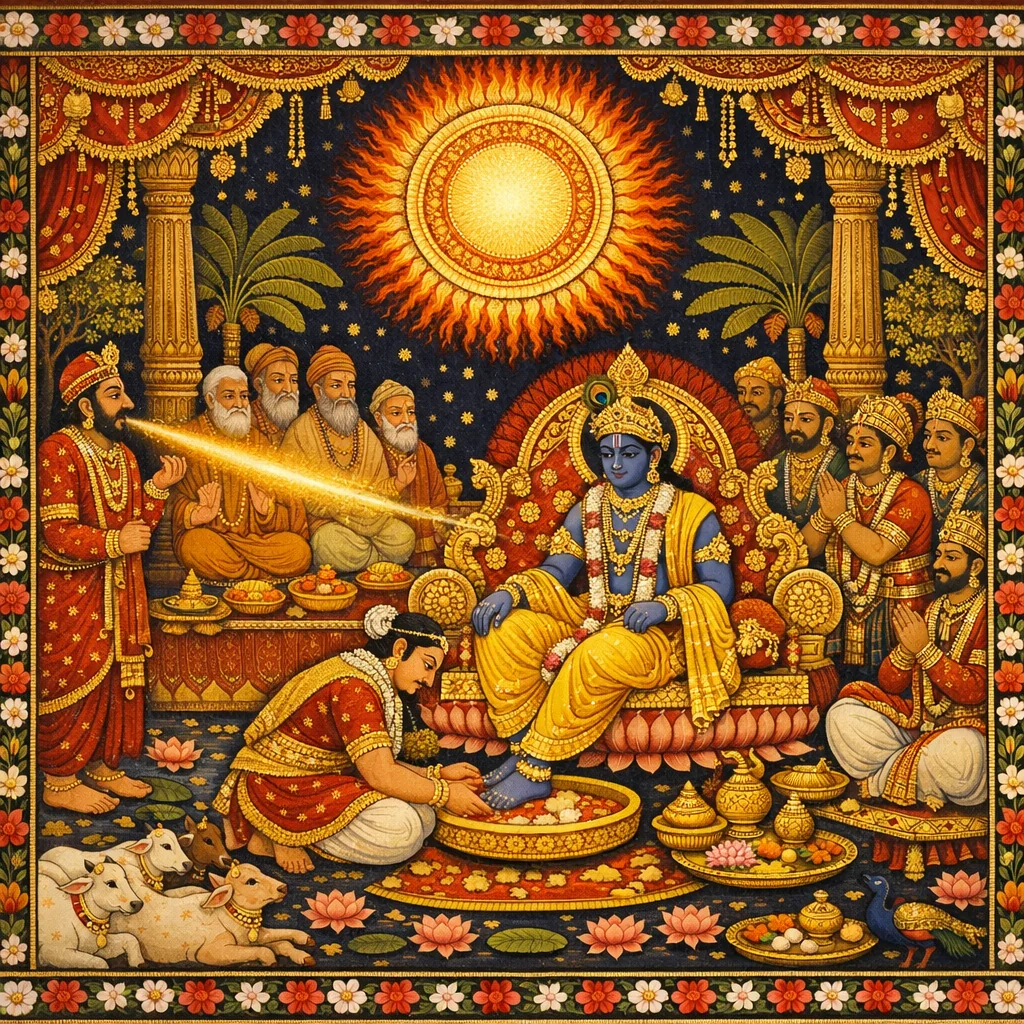
Adhyaya 74
Rājasūya: Agrapūjā for Kṛṣṇa and the Slaying (and Liberation) of Śiśupāla
Following the prior triumph over Jarāsandha and the release of captive kings, Yudhiṣṭhira—rejoicing in Kṛṣṇa’s majesty—prepares the Rājasūya sacrifice with Kṛṣṇa’s consent, appointing eminent Vedic ṛtviks and welcoming rulers and beings from all realms. As the soma day arrives, the assembly debates who merits agrapūjā (first worship). Sahadeva resolves the impasse by establishing Acyuta as the ontological foundation of yajña—its devas, mantras, time, place, and results—thereby defining sacrifice as ultimately God-centered. Yudhiṣṭhira worships Kṛṣṇa with tears and pāda-jala, and the gathering acclaims Him. Śiśupāla, unable to tolerate Kṛṣṇa’s glorification, publicly blasphemes; devotees protest and warriors rise, but Kṛṣṇa restrains them and personally beheads Śiśupāla with the Sudarśana cakra. A radiant effulgence enters Kṛṣṇa, showing that even hatred fixed on the Lord can culminate in liberation by contact with His transcendence. The sacrifice concludes with avabhṛtha; all depart satisfied except Duryodhana, whose envy foreshadows the next phase of conflict.
Shlokas
Verse 1
श्रीशुक उवाच एवं युधिष्ठिरो राजा जरासन्धवधं विभो: । कृष्णस्य चानुभावं तं श्रुत्वा प्रीतस्तमब्रवीत् ॥ १ ॥
Śukadeva Gosvāmī said: Having thus heard of the killing of Jarāsandha, and also of almighty Kṛṣṇa’s wonderful power, King Yudhiṣṭhira addressed the Lord as follows with great pleasure.
Verse 2
श्रीयुधिष्ठिर उवाच ये स्युस्त्रैलोक्यगुरव: सर्वे लोकामहेश्वरा: । वहन्ति दुर्लभं लब्ध्वा शिरसैवानुशासनम् ॥ २ ॥
Śrī Yudhiṣṭhira said: All the exalted spiritual masters of the three worlds, together with the inhabitants and rulers of the various planets, carry on their heads Your command, which is rarely obtained.
Verse 3
स भवानरविन्दाक्षो दीनानामीशमानिनाम् । धत्तेऽनुशासनं भूमंस्तदत्यन्तविडम्बनम् ॥ ३ ॥
That You, the lotus-eyed Supreme Lord, accept the orders of wretched fools who presume themselves rulers is a great pretense on Your part, O all-pervading one.
Verse 4
न ह्येकस्याद्वितीयस्य ब्रह्मण: परमात्मन: । कर्मभिर्वर्धते तेजो ह्रसते च यथा रवे: ॥ ४ ॥
But of course the power of the Absolute Truth, the Supreme Soul, the primeval one without a second, is neither increased nor diminished by His activities, any more than the sun’s power is by its movements.
Verse 5
न वै तेऽजित भक्तानां ममाहमिति माधव । त्वं तवेति च नानाधी: पशूनामिव वैकृती ॥ ५ ॥
O unconquerable Mādhava, even Your devotees make no distinctions of “I” and “mine,” “you” and “yours,” for this is the perverted mentality of animals.
Verse 6
श्रीशुक उवाच इत्युक्त्वा यज्ञिये काले वव्रे युक्तान् स ऋत्विज: । कृष्णानुमोदित: पार्थो ब्राह्मणान् ब्रह्मवादिन: ॥ ६ ॥
Śukadeva Gosvāmī said: Having said this, King Yudhiṣṭhira waited until the proper time for the sacrifice was at hand. Then with Lord Kṛṣṇa’s permission he selected suitable priests, all expert authorities on the Vedas, to execute the sacrifice.
Verse 7
द्वैपायनो भरद्वाज: सुमन्तुर्गोतमोऽसित: । वसिष्ठश्च्यवन: कण्वो मैत्रेय: कवषस्त्रित: ॥ ७ ॥ विश्वामित्रो वामदेव: सुमतिर्जैमिनि: क्रतु: । पैल: पराशरो गर्गो वैशम्पायन एव च ॥ ८ ॥ अथर्वा कश्यपो धौम्यो रामो भार्गव आसुरि: । वीतिहोत्रो मधुच्छन्दा वीरसेनोऽकृतव्रण: ॥ ९ ॥
He selected Kṛṣṇa-dvaipāyana, Bharadvāja, Sumantu, Gotama and Asita, along with Vasiṣṭha, Cyavana, Kaṇva, Maitreya, Kavaṣa and Trita. He also selected Viśvāmitra, Vāmadeva, Sumati, Jaimini, Kratu, Paila and Parāśara, as well as Garga, Vaiśampāyana, Atharvā, Kaśyapa, Dhaumya, Rāma of the Bhārgavas, Āsuri, Vītihotra, Madhucchandā, Vīrasena and Akṛtavraṇa.
Verse 8
द्वैपायनो भरद्वाज: सुमन्तुर्गोतमोऽसित: । वसिष्ठश्च्यवन: कण्वो मैत्रेय: कवषस्त्रित: ॥ ७ ॥ विश्वामित्रो वामदेव: सुमतिर्जैमिनि: क्रतु: । पैल: पराशरो गर्गो वैशम्पायन एव च ॥ ८ ॥ अथर्वा कश्यपो धौम्यो रामो भार्गव आसुरि: । वीतिहोत्रो मधुच्छन्दा वीरसेनोऽकृतव्रण: ॥ ९ ॥
He selected Kṛṣṇa-dvaipāyana, Bharadvāja, Sumantu, Gotama and Asita, along with Vasiṣṭha, Cyavana, Kaṇva, Maitreya, Kavaṣa and Trita. He also selected Viśvāmitra, Vāmadeva, Sumati, Jaimini, Kratu, Paila and Parāśara, as well as Garga, Vaiśampāyana, Atharvā, Kaśyapa, Dhaumya, Rāma of the Bhārgavas, Āsuri, Vītihotra, Madhucchandā, Vīrasena and Akṛtavraṇa.
Verse 9
द्वैपायनो भरद्वाज: सुमन्तुर्गोतमोऽसित: । वसिष्ठश्च्यवन: कण्वो मैत्रेय: कवषस्त्रित: ॥ ७ ॥ विश्वामित्रो वामदेव: सुमतिर्जैमिनि: क्रतु: । पैल: पराशरो गर्गो वैशम्पायन एव च ॥ ८ ॥ अथर्वा कश्यपो धौम्यो रामो भार्गव आसुरि: । वीतिहोत्रो मधुच्छन्दा वीरसेनोऽकृतव्रण: ॥ ९ ॥
He selected Kṛṣṇa-dvaipāyana, Bharadvāja, Sumantu, Gotama and Asita, along with Vasiṣṭha, Cyavana, Kaṇva, Maitreya, Kavaṣa and Trita. He also selected Viśvāmitra, Vāmadeva, Sumati, Jaimini, Kratu, Paila and Parāśara, as well as Garga, Vaiśampāyana, Atharvā, Kaśyapa, Dhaumya, Rāma of the Bhārgavas, Āsuri, Vītihotra, Madhucchandā, Vīrasena and Akṛtavraṇa.
Verse 10
उपहूतास्तथा चान्ये द्रोणभीष्मकृपादय: । धृतराष्ट्र: सहसुतो विदुरश्च महामति: ॥ १० ॥ ब्राह्मणा: क्षत्रिया वैश्या: शूद्रा यज्ञदिदृक्षव: । तत्रेयु: सर्वराजानो राज्ञां प्रकृतयो नृप ॥ ११ ॥
O King, others who were invited included Droṇa, Bhīṣma, Kṛpa, Dhṛtarāṣṭra with his sons, the wise Vidura, and many other brāhmaṇas, kṣatriyas, vaiśyas and śūdras, all eager to witness the sacrifice. Indeed, all the kings came there with their entourages.
Verse 11
उपहूतास्तथा चान्ये द्रोणभीष्मकृपादय: । धृतराष्ट्र: सहसुतो विदुरश्च महामति: ॥ १० ॥ ब्राह्मणा: क्षत्रिया वैश्या: शूद्रा यज्ञदिदृक्षव: । तत्रेयु: सर्वराजानो राज्ञां प्रकृतयो नृप ॥ ११ ॥
O King, others who were invited included Droṇa, Bhīṣma, Kṛpa, Dhṛtarāṣṭra with his sons, the wise Vidura, and many other brāhmaṇas, kṣatriyas, vaiśyas and śūdras, all eager to witness the sacrifice. Indeed, all the kings came there with their entourages.
Verse 12
ततस्ते देवयजनं ब्राह्मणा: स्वर्णलाङ्गलै: । कृष्ट्वा तत्र यथाम्नायं दीक्षयां चक्रिरे नृपम् ॥ १२ ॥
The brāhmaṇa priests then plowed the sacrificial ground with golden plowshares and initiated King Yudhiṣṭhira for the sacrifice in accordance with the traditions set down by standard authorities.
Verse 13
हैमा: किलोपकरणा वरुणस्य यथा पुरा । इन्द्रादयो लोकपाला विरिञ्चिभवसंयुता: ॥ १३ ॥ सगणा: सिद्धगन्धर्वा विद्याधरमहोरगा: । मुनयो यक्षरक्षांसि खगकिन्नरचारणा: ॥ १४ ॥ राजानश्च समाहूता राजपत्न्यश्च सर्वश: । राजसूयं समीयु: स्म राज्ञ: पाण्डुसुतस्य वै । मेनिरे कृष्णभक्तस्य सूपपन्नमविस्मिता: ॥ १५ ॥
The utensils used in the sacrifice were made of gold, just as in the ancient Rājasūya performed by Lord Varuṇa. Indra, Brahmā, Śiva and many other planetary rulers; the Siddhas and Gandharvas with their entourage; the Vidyādharas; great serpents; sages; Yakṣas; Rākṣasas; celestial birds; Kinnaras; Cāraṇas; and earthly kings — all were invited, and indeed they all came from every direction to the Rājasūya sacrifice of King Yudhiṣṭhira, the son of Pāṇḍu. They were not in the least astonished to see the opulence of the sacrifice, since it was quite appropriate for a devotee of Lord Kṛṣṇa.
Verse 14
हैमा: किलोपकरणा वरुणस्य यथा पुरा । इन्द्रादयो लोकपाला विरिञ्चिभवसंयुता: ॥ १३ ॥ सगणा: सिद्धगन्धर्वा विद्याधरमहोरगा: । मुनयो यक्षरक्षांसि खगकिन्नरचारणा: ॥ १४ ॥ राजानश्च समाहूता राजपत्न्यश्च सर्वश: । राजसूयं समीयु: स्म राज्ञ: पाण्डुसुतस्य वै । मेनिरे कृष्णभक्तस्य सूपपन्नमविस्मिता: ॥ १५ ॥
The utensils used in the sacrifice were made of gold, just as in the ancient Rājasūya performed by Lord Varuṇa. Indra, Brahmā, Śiva and many other planetary rulers; the Siddhas and Gandharvas with their entourage; the Vidyādharas; great serpents; sages; Yakṣas; Rākṣasas; celestial birds; Kinnaras; Cāraṇas; and earthly kings — all were invited, and indeed they all came from every direction to the Rājasūya sacrifice of King Yudhiṣṭhira, the son of Pāṇḍu. They were not in the least astonished to see the opulence of the sacrifice, since it was quite appropriate for a devotee of Lord Kṛṣṇa.
Verse 15
हैमा: किलोपकरणा वरुणस्य यथा पुरा । इन्द्रादयो लोकपाला विरिञ्चिभवसंयुता: ॥ १३ ॥ सगणा: सिद्धगन्धर्वा विद्याधरमहोरगा: । मुनयो यक्षरक्षांसि खगकिन्नरचारणा: ॥ १४ ॥ राजानश्च समाहूता राजपत्न्यश्च सर्वश: । राजसूयं समीयु: स्म राज्ञ: पाण्डुसुतस्य वै । मेनिरे कृष्णभक्तस्य सूपपन्नमविस्मिता: ॥ १५ ॥
The utensils used in the sacrifice were made of gold, just as in the ancient Rājasūya performed by Lord Varuṇa. Indra, Brahmā, Śiva and many other planetary rulers; the Siddhas and Gandharvas with their entourage; the Vidyādharas; great serpents; sages; Yakṣas; Rākṣasas; celestial birds; Kinnaras; Cāraṇas; and earthly kings — all were invited, and indeed they all came from every direction to the Rājasūya sacrifice of King Yudhiṣṭhira, the son of Pāṇḍu. They were not in the least astonished to see the opulence of the sacrifice, since it was quite appropriate for a devotee of Lord Kṛṣṇa.
Verse 16
अयाजयन् महाराजं याजका देववर्चस: । राजसूयेन विधिवत् प्रचेतसमिवामरा: ॥ १६ ॥
The priests, as powerful as gods, performed the Rājasūya sacrifice for King Yudhiṣṭhira in accordance with the Vedic injunctions, just as the demigods had previously performed it for Varuṇa.
Verse 17
सूत्येऽहन्यवनीपालो याजकान् सदसस्पतीन् । अपूजयन् महाभागान् यथावत् सुसमाहित: ॥ १७ ॥
On the day of extracting the soma juice, King Yudhiṣṭhira properly and very attentively worshiped the priests and the most exalted personalities of the assembly.
Verse 18
सदस्याग्र्यार्हणार्हं वै विमृशन्त: सभासद: । नाध्यगच्छन्ननैकान्त्यात् सहदेवस्तदाब्रवीत् ॥ १८ ॥
The members of the assembly then pondered over who among them should be worshiped first, but since there were many personalities qualified for this honor, they were unable to decide. Finally Sahadeva spoke up.
Verse 19
अर्हति ह्यच्युत: श्रैष्ठ्यं भगवान् सात्वतां पति: । एष वै देवता: सर्वा देशकालधनादय: ॥ १९ ॥
[Sahadeva said:] Certainly it is Acyuta, the Supreme Personality of Godhead and chief of the Yādavas, who deserves the highest position. In truth, He Himself comprises all the demigods worshiped in sacrifice, along with such aspects of the worship as the sacred place, the time and the paraphernalia.
Verse 20
यदात्मकमिदं विश्वं क्रतवश्च यदात्मका: । अग्निराहुतयो मन्त्रा साङ्ख्यं योगश्च यत्पर: ॥ २० ॥ एक एवाद्वितीयोऽसावैतदात्म्यमिदं जगत् । आत्मनात्माश्रय: सभ्या: सृजत्यवति हन्त्यज: ॥ २१ ॥
This entire universe is founded upon Him, as are the great sacrificial performances, with their sacred fires, oblations and mantras. Sāṅkhya and yoga both aim toward Him, the one without a second. O assembly members, that unborn Lord, relying solely on Himself, creates, maintains and destroys this cosmos by His personal energies, and thus the existence of this universe depends on Him alone.
Verse 21
यदात्मकमिदं विश्वं क्रतवश्च यदात्मका: । अग्निराहुतयो मन्त्रा साङ्ख्यं योगश्च यत्पर: ॥ २० ॥ एक एवाद्वितीयोऽसावैतदात्म्यमिदं जगत् । आत्मनात्माश्रय: सभ्या: सृजत्यवति हन्त्यज: ॥ २१ ॥
This entire universe is founded upon Him, as are the great sacrificial performances, with their sacred fires, oblations and mantras. Sāṅkhya and yoga both aim toward Him, the one without a second. O assembly members, that unborn Lord, relying solely on Himself, creates, maintains and destroys this cosmos by His personal energies, and thus the existence of this universe depends on Him alone.
Verse 22
विविधानीह कर्माणि जनयन् यदवेक्षया । ईहते यदयं सर्व: श्रेयो धर्मादिलक्षणम् ॥ २२ ॥
He creates the many activities of this world, and thus by His grace the whole world endeavors for the ideals of religiosity, economic development, sense gratification and liberation.
Verse 23
तस्मात् कृष्णाय महते दीयतां परमार्हणम् । एवं चेत् सर्वभूतानामात्मनश्चार्हणं भवेत् ॥ २३ ॥
Therefore we should give the highest honor to Kṛṣṇa, the Supreme Lord. If we do so, we will be honoring all living beings and also our own selves.
Verse 24
सर्वभूतात्मभूताय कृष्णायानन्यदर्शिने । देयं शान्ताय पूर्णाय दत्तस्यानन्त्यमिच्छता ॥ २४ ॥
Anyone who wishes the honor he gives to be reciprocated infinitely should honor Kṛṣṇa, the perfectly peaceful and perfectly complete Soul of all beings, the Supreme Lord, who views nothing as separate from Himself.
Verse 25
इत्युक्त्वा सहदेवोऽभूत् तूष्णीं कृष्णानुभाववित् । तच्छ्रुत्वा तुष्टुवु: सर्वे साधु साध्विति सत्तमा: ॥ २५ ॥
[Śukadeva Gosvāmī continued:] Having said this, Sahadeva, who understood Lord Kṛṣṇa’s powers, fell silent. And having heard his words, all the saintly persons present congratulated him, exclaiming “Excellent! Excellent!”
Verse 26
श्रुत्वा द्विजेरितं राजा ज्ञात्वा हार्दं सभासदाम् । समर्हयद्धृषीकेशं प्रीत: प्रणयविह्वल: ॥ २६ ॥
The King was delighted to hear this pronouncement of the brāhmaṇas, from which he understood the mood of the entire assembly. Overwhelmed with love, he fully worshiped Lord Kṛṣṇa, the master of the senses.
Verse 27
तत्पादाववनिज्याप: शिरसा लोकपावनी: । सभार्य: सानुजामात्य: सकुटुम्बो वहन्मुदा ॥ २७ ॥ वासोभि: पीतकौषेयैर्भूषणैश्च महाधनै: । अर्हयित्वाश्रुपूर्णाक्षो नाशकत् समवेक्षितुम् ॥ २८ ॥
After bathing Lord Kṛṣṇa’s feet, Mahārāja Yudhiṣṭhira joyfully sprinkled the water upon his own head, and then upon the heads of his wife, brothers, other family members and ministers. That water purifies the whole world. As he honored the Lord with presentations of yellow silken garments and precious jeweled ornaments, the King’s tear-filled eyes prevented him from looking directly at the Lord.
Verse 28
तत्पादाववनिज्याप: शिरसा लोकपावनी: । सभार्य: सानुजामात्य: सकुटुम्बो वहन्मुदा ॥ २७ ॥ वासोभि: पीतकौषेयैर्भूषणैश्च महाधनै: । अर्हयित्वाश्रुपूर्णाक्षो नाशकत् समवेक्षितुम् ॥ २८ ॥
After bathing Lord Kṛṣṇa’s feet, Mahārāja Yudhiṣṭhira joyfully sprinkled the water upon his own head, and then upon the heads of his wife, brothers, other family members and ministers. That water purifies the whole world. As he honored the Lord with presentations of yellow silken garments and precious jeweled ornaments, the King’s tear-filled eyes prevented him from looking directly at the Lord.
Verse 29
इत्थं सभाजितं वीक्ष्य सर्वे प्राञ्जलयो जना: । नमो जयेति नेमुस्तं निपेतु: पुष्पवृष्टय: ॥ २९ ॥
When they saw Lord Kṛṣṇa thus honored, nearly all who were present joined their palms reverentially, exclaiming “Obeisances to You! All victory to You!” and then bowed down to Him. Flowers rained down from above.
Verse 30
इत्थं निशम्य दमघोषसुत: स्वपीठा- दुत्थाय कृष्णगुणवर्णनजातमन्यु: । उत्क्षिप्य बाहुमिदमाह सदस्यमर्षी संश्रावयन् भगवते परुषाण्यभीत: ॥ ३० ॥
The intolerant son of Damaghoṣa became infuriated upon hearing the glorification of Lord Kṛṣṇa’s transcendental qualities. He stood up from his seat and, angrily waving his arms, fearlessly spoke to the entire assembly the following harsh words against the Supreme Lord.
Verse 31
ईशो दुरत्यय: काल इति सत्यवती श्रुति: । वृद्धानामपि यद् बुद्धिर्बालवाक्यैर्विभिद्यते ॥ ३१ ॥
[Śiśupāla said:] The statement of the Vedas that time is the unavoidable controller of all has indeed been proven true, since the intelligence of wise elders has now become diverted by the words of a mere boy.
Verse 32
यूयं पात्रविदां श्रेष्ठा मा मन्ध्वं बालभाषितम् । सदसस्पतय: सर्वे कृष्णो यत् सम्मतोऽर्हणे ॥ ३२ ॥
O leaders of the assembly, you know best who is a fit candidate for being honored. Therefore you should not heed the words of a child when he claims that Kṛṣṇa deserves to be worshiped.
Verse 33
तपोविद्याव्रतधरान् ज्ञानविध्वस्तकल्मषान् । परमऋषीन्ब्रह्मनिष्ठाल्ँ लोकपालैश्च पूजितान् ॥ ३३ ॥ सदस्पतीनतिक्रम्य गोपाल: कुलपांसन: । यथा काक: पुरोडाशं सपर्यां कथमर्हति ॥ ३४ ॥
How can you pass over the most exalted members of this assembly — topmost sages dedicated to the Absolute Truth endowed with powers of austerity, divine insight and strict adherence to severe vows, sanctified by knowledge and worshiped even by the rulers of the universe? How does this cowherd boy, the disgrace of His family, deserve your worship, any more than a crow deserves to eat the sacred puroḍāśa rice cake?
Verse 34
तपोविद्याव्रतधरान् ज्ञानविध्वस्तकल्मषान् । परमऋषीन्ब्रह्मनिष्ठाल्ँ लोकपालैश्च पूजितान् ॥ ३३ ॥ सदस्पतीनतिक्रम्य गोपाल: कुलपांसन: । यथा काक: पुरोडाशं सपर्यां कथमर्हति ॥ ३४ ॥
How can you pass over the most exalted members of this assembly — topmost sages dedicated to the Absolute Truth endowed with powers of austerity, divine insight and strict adherence to severe vows, sanctified by knowledge and worshiped even by the rulers of the universe? How does this cowherd boy, the disgrace of His family, deserve your worship, any more than a crow deserves to eat the sacred puroḍāśa rice cake?
Verse 35
वर्णाश्रमकुलापेत: सर्वधर्मबहिष्कृत: । स्वैरवर्ती गुणैर्हीन: सपर्यां कथमर्हति ॥ ३५ ॥
How does one who follows no principles of the social and spiritual orders or of family ethics, who has been excluded from all religious duties, who behaves whimsically, and who has no good qualities — how does such a person deserve to be worshiped?
Verse 36
ययातिनैषां हि कुलं शप्तं सद्भिर्बहिष्कृतम् । वृथापानरतं शश्वत् सपर्यां कथमर्हति ॥ ३६ ॥
Yayāti cursed the dynasty of these Yādavas, and ever since then they have been ostracized by honest men and addicted to liquor. How, then, does Kṛṣṇa deserve to be worshiped?
Verse 37
ब्रह्मर्षिसेवितान् देशान् हित्वैतेऽब्रह्मवर्चसम् । समुद्रं दुर्गमाश्रित्य बाधन्ते दस्यव: प्रजा: ॥ ३७ ॥
These Yādavas have abandoned the holy lands inhabited by saintly sages and have instead taken shelter of a fortress in the sea, a place where no brahminical principles are observed. There, just like thieves, they harass their subjects.
Verse 38
एवमादीन्यभद्राणि बभाषे नष्टमङ्गल: । नोवाच किञ्चिद्भगवान्यथा सिंह: शिवारुतम् ॥ ३८ ॥
[Śukadeva Gosvāmī continued:] Bereft of all good fortune, Śiśupāla spoke these and other insults. But the Supreme Lord said nothing, just as a lion ignores a jackal’s cry.
Verse 39
भगवन्निन्दनं श्रुत्वा दु:सहं तत् सभासद: । कर्णौ पिधाय निर्जग्मु: शपन्तश्चेदिपं रुषा ॥ ३९ ॥
Upon hearing such intolerable blasphemy of the Lord, several members of the assembly covered their ears and walked out, angrily cursing the King of Cedi.
Verse 40
निन्दां भगवत: शृण्वंस्तत्परस्य जनस्य वा । ततो नापैति य: सोऽपि यात्यध: सुकृताच्च्युत: ॥ ४० ॥
Anyone who fails to immediately leave the place where he hears criticism of the Supreme Lord or His faithful devotee will certainly fall down, bereft of his pious credit.
Verse 41
तत: पाण्डुसुता: क्रुद्धा मत्स्यकैकयसृञ्जया: । उदायुधा: समुत्तस्थु: शिशुपालजिघांसव: ॥ ४१ ॥
Then the sons of Pāṇḍu became furious, and together with the warriors of the Matsya, Kaikaya and Sṛñjaya clans, they rose up from their seats with weapons poised, ready to kill Śiśupāla.
Verse 42
ततश्चैद्यस्त्वसम्भ्रान्तो जगृहे खड्गचर्मणी । भर्त्सयन् कृष्णपक्षीयान् राज्ञ: सदसि भारत ॥ ४२ ॥
Undaunted, Śiśupāla then took up his sword and shield in the midst of all the assembled kings, O Bhārata, and hurled insults at those who sided with Lord Kṛṣṇa.
Verse 43
तावदुत्थाय भगवान् स्वान् निवार्य स्वयं रुषा । शिर: क्षुरान्तचक्रेण जहारपततो रिपो: ॥ ४३ ॥
At that point the Supreme Lord stood up and checked His devotees. He then angrily sent forth His razor-sharp disc and severed the head of His enemy as he was attacking.
Verse 44
शब्द: कोलाहलोऽथासीच्छिशुपाले हते महान् । तस्यानुयायिनो भूपा दुद्रुवुर्जीवितैषिण: ॥ ४४ ॥
When Śiśupāla was thus killed, a great roar and howl went up from the crowd. Taking advantage of that disturbance, the few kings who were supporters of Śiśupāla quickly left the assembly out of fear for their lives.
Verse 45
चैद्यदेहोत्थितं ज्योतिर्वासुदेवमुपाविशत् । पश्यतां सर्वभूतानामुल्केव भुवि खाच्च्युता ॥ ४५ ॥
An effulgent light rose from Śiśupāla’s body and, as everyone watched, entered Lord Kṛṣṇa just like a meteor falling from the sky to the earth.
Verse 46
जन्मत्रयानुगुणितवैरसंरब्धया धिया । ध्यायंस्तन्मयतां यातो भावो हि भवकारणम् ॥ ४६ ॥
Obsessed with hatred of Lord Kṛṣṇa throughout three lifetimes, Śiśupāla attained the Lord’s transcendental nature. Indeed, one’s consciousness determines one’s future birth.
Verse 47
ऋत्विग्भ्य: ससदस्येभ्यो दक्षिणां विपुलामदात् । सर्वान् सम्पूज्य विधिवच्चक्रेऽवभृथमेकराट् ॥ ४७ ॥
Emperor Yudhiṣṭhira gave generous gifts to the sacrificial priests and the members of the assembly, properly honoring them all in the manner prescribed by the Vedas. He then took the avabhṛtha bath.
Verse 48
साधयित्वा क्रतु: राज्ञ: कृष्णो योगेश्वरेश्वर: । उवास कतिचिन्मासान् सुहृद्भिरभियाचित: ॥ ४८ ॥
Thus Śrī Kṛṣṇa, the Lord of all masters of mystic yoga, saw to the successful execution of this great sacrifice on behalf of King Yudhiṣṭhira. Afterwards, the Lord stayed with His intimate friends for a few months at their earnest request.
Verse 49
ततोऽनुज्ञाप्य राजानमनिच्छन्तमपीश्वर: । ययौ सभार्य: सामात्य: स्वपुरं देवकीसुत: ॥ ४९ ॥
Then the Lord, the son of Devakī, took the reluctant permission of the King and returned to His capital with His wives and ministers.
Verse 50
वर्णितं तदुपाख्यानं मया ते बहुविस्तरम् । वैकुण्ठवासिनोर्जन्म विप्रशापात् पुन: पुन: ॥ ५० ॥
I have already described to you in detail the history of the two residents of Vaikuṇṭha who had to undergo repeated births in the material world because of being cursed by brāhmaṇas.
Verse 51
राजसूयावभृथ्येन स्नातो राजा युधिष्ठिर: । ब्रह्मक्षत्रसभामध्ये शुशुभे सुरराडिव ॥ ५१ ॥
Purified in the final, avabhṛthya ritual, which marked the successful completion of the Rājasūya sacrifice, King Yudhiṣṭhira shone among the assembled brāhmaṇas and kṣatriyas like the King of the demigods himself.
Verse 52
राज्ञा सभाजिता: सर्वे सुरमानवखेचरा: । कृष्णं क्रतुं च शंसन्त: स्वधामानि ययुर्मुदा ॥ ५२ ॥
The demigods, humans and residents of intermediate heavens, all properly honored by the King, happily set off for their respective domains while singing the praises of Lord Kṛṣṇa and the great sacrifice.
Verse 53
दुर्योधनमृते पापं कलिं कुरुकुलामयम् । यो न सेहे श्रियं स्फीतां दृष्ट्वा पाण्डुसुतस्य ताम् ॥ ५३ ॥
[All were satisfied] except sinful Duryodhana, the personification of the age of quarrel and the disease of the Kuru dynasty. He could not bear to see the flourishing opulence of the son of Pāṇḍu.
Verse 54
य इदं कीर्तयेद् विष्णो: कर्म चैद्यवधादिकम् । राजमोक्षं वितानं च सर्वपापै: प्रमुच्यते ॥ ५४ ॥
One who recites these activities of Lord Viṣṇu, including the killing of Śiśupāla, the deliverance of the kings and the performance of the Rājasūya sacrifice, is freed from all sins.
Frequently Asked Questions
Sahadeva’s reasoning is that Kṛṣṇa is not merely one qualified guest among many but the very ground of yajña: the devas invoked, the mantras and fires, the sacred time and place, and the capacity for results all rest upon Him as the advaya-tattva (nondual Absolute). Thus honoring Kṛṣṇa is simultaneously honoring all beings and all sacrificial principles, making agrapūjā a theological conclusion rather than a political preference.
The chapter states that consciousness determines one’s destination: sustained absorption in the Lord—whether through devotion or antagonism—creates direct contact with His transcendence. Śiśupāla’s three-lifetime fixation culminates in the dissolution of enmity at death, symbolized by the effulgence entering Kṛṣṇa. Traditional Vaiṣṇava readings distinguish this from pure bhakti (which yields loving service), yet affirm that intense God-absorption can still grant a form of mukti.
The text gives a clear dharmic protocol: one should immediately leave the place where criticism of the Supreme Lord or His faithful devotee is heard; otherwise one risks spiritual decline and loss of pious merit. This frames śravaṇa (hearing) as a sacred channel that must be protected from aparādha (offense).
Yudhiṣṭhira appoints renowned Vedic authorities as priests (ṛtviks), while the sacrifice draws a vast interplanetary assembly: major devas (e.g., Indra, Brahmā, Śiva), Siddhas, Gandharvas, Vidyādharas, Nāgas, sages, Yakṣas, Rākṣasas, and earthly kings—showing the rite’s cosmic recognition, yet culminating in Kṛṣṇa’s supremacy over all participants.