Adhyaya 86
Arjuna Marries Subhadrā; Kṛṣṇa Honors Two Devotees in Mithilā (Śrutadeva and Bahulāśva)
Prompted by Parīkṣit’s inquiry, Śukadeva narrates how Arjuna, while on tīrtha-yātrā, learns at Prabhāsa that Balarāma plans to marry Subhadrā to Duryodhana. Seeking Kṛṣṇa’s sanctioned outcome, Arjuna enters Dvārakā disguised as a tridaṇḍī renunciant, stays through the rainy season, and wins Subhadrā’s mutual affection. During a temple festival he carries out an approved ‘abduction’ (rākṣasa-style within dharma), repels guards, and departs with Subhadrā; Kṛṣṇa and her parents support the match. Balarāma’s initial anger is pacified by Kṛṣṇa’s respectful explanation, and Balarāma then blesses the couple with lavish gifts. The chapter then pivots to Videha/Mithilā, introducing two exemplary devotees—King Bahulāśva and the brāhmaṇa Śrutadeva—both dear to Acyuta. Kṛṣṇa travels with eminent sages, is worshiped en route, and in Mithilā simultaneously accepts both devotees’ invitations, entering both homes by His yogic potency. Their hospitality frames profound teachings: saintly association grants swift purification, and honoring realized brāhmaṇas is direct worship of the Lord. The episode sets a template for Vaiṣṇava social ethics (atithi-sevā, sādhu-maryādā) as Kṛṣṇa returns to Dvārakā after instructing ideal conduct.
Shlokas
Verse 1
श्रीराजोवाच ब्रह्मन् वेदितुमिच्छाम: स्वसारां रामकृष्णयो: । यथोपयेमे विजयो या ममासीत् पितामही ॥ १ ॥
King Parīkṣit said: O brāhmaṇa, we would like to learn how Arjuna married Lord Balarāma’s and Lord Kṛṣṇa’s sister, who was my grandmother.
Verse 2
श्रीशुक उवाच अर्जुनस्तीर्थयात्रायां पर्यटन्नवनीं प्रभु: । गत: प्रभासमशृणोन्मातुलेयीं स आत्मन: ॥ २ ॥ दुर्योधनाय रामस्तां दास्यतीति न चापरे । तल्लिप्सु: स यतिर्भूत्वा त्रिदण्डी द्वारकामगात् ॥ ३ ॥
Śukadeva Gosvāmī said: While traveling far and wide visiting various holy places of pilgrimage, Arjuna came to Prabhāsa. There he heard that Lord Balarāma intended to give his maternal cousin Subhadrā to Duryodhana in marriage, and that no one else approved of this plan. Arjuna wanted to marry her himself, so he disguised himself as a renunciant, complete with triple staff, and went to Dvārakā.
Verse 3
श्रीशुक उवाच अर्जुनस्तीर्थयात्रायां पर्यटन्नवनीं प्रभु: । गत: प्रभासमशृणोन्मातुलेयीं स आत्मन: ॥ २ ॥ दुर्योधनाय रामस्तां दास्यतीति न चापरे । तल्लिप्सु: स यतिर्भूत्वा त्रिदण्डी द्वारकामगात् ॥ ३ ॥
Śukadeva Gosvāmī said: While traveling far and wide visiting various holy places of pilgrimage, Arjuna came to Prabhāsa. There he heard that Lord Balarāma intended to give his maternal cousin Subhadrā to Duryodhana in marriage, and that no one else approved of this plan. Arjuna wanted to marry her himself, so he disguised himself as a renunciant, complete with triple staff, and went to Dvārakā.
Verse 4
तत्र वै वार्षितान् मासानवात्सीत् स्वार्थसाधक: । पौरै: सभाजितोऽभीक्ष्णं रामेणाजानता च स: ॥ ४ ॥
He stayed there during the monsoon months to fulfill his purpose. Lord Balarāma and the other residents of the city, not recognizing him, offered him all honor and hospitality.
Verse 5
एकदा गृहमानीय आतिथ्येन निमन्त्र्य तम् । श्रद्धयोपहृतं भैक्ष्यं बलेन बुभुजे किल ॥ ५ ॥
One day Lord Balarāma brought him to His home as His invited dinner guest, and Arjuna ate the food the Lord respectfully offered him.
Verse 6
सोऽपश्यत्तत्र महतीं कन्यां वीरमनोहराम् । प्रीत्युत्फुल्लेक्षणस्तस्यां भावक्षुब्धं मनो दधे ॥ ६ ॥
There he saw the wonderful maiden Subhadrā, who was enchanting to heroes. His eyes opened wide with delight, and his mind became agitated and absorbed in thoughts of her.
Verse 7
सापि तं चकमे वीक्ष्य नारीणां हृदयंगमम् । हसन्ती व्रीडितापाङ्गी तन्न्यस्तहृदयेक्षणा ॥ ७ ॥
Arjuna was very attractive to women, and as soon as Subhadrā saw him, she wanted to have him as her husband. Smiling bashfully with sidelong glances, she fixed her heart and eyes upon him.
Verse 8
तां परं समनुध्यायन्नन्तरं प्रेप्सुरर्जुन: । न लेभे शं भ्रमच्चित्त: कामेनातिबलीयसा ॥ ८ ॥
Meditating only on her and waiting for the opportunity to take her away, Arjuna had no peace. His heart trembled with passionate desire.
Verse 9
महत्यां देवयात्रायां रथस्थां दुर्गनिर्गताम् । जहारानुमत: पित्रो: कृष्णस्य च महारथ: ॥ ९ ॥
Once, on the occasion of a great temple festival in honor of the Supreme Lord, Subhadrā rode out of the fortresslike palace on a chariot, and at that time the mighty chariot warrior Arjuna took the opportunity to kidnap her. Subhadrā’s parents and Kṛṣṇa had sanctioned this.
Verse 10
रथस्थो धनुरादाय शूरांश्चारुन्धतो भटान् । विद्राव्य क्रोशतां स्वानां स्वभागं मृगराडिव ॥ १० ॥
Standing on his chariot, Arjuna took up his bow and drove off the valiant fighters and palace guards who tried to block his way. As her relatives shouted in anger, he took Subhadrā away just as a lion takes his prey from the midst of lesser animals.
Verse 11
तच्छ्रुत्वा क्षुभितो राम: पर्वणीव महार्णव: । गृहीतपाद: कृष्णेन सुहृद्भिश्चानुसान्त्वित: ॥ ११ ॥
When He heard of Subhadrā’s kidnapping, Lord Balarāma became as disturbed as the ocean during the full moon, but Lord Kṛṣṇa respectfully took hold of His feet and, together with other family members, pacified Him by explaining the matter.
Verse 12
प्राहिणोत् पारिबर्हाणि वरवध्वोर्मुदा बल: । महाधनोपस्करेभरथाश्वनरयोषित: ॥ १२ ॥
Lord Balarāma then happily sent the bride and groom very valuable wedding gifts consisting of elephants, chariots, horses and male and female servants.
Verse 13
श्रीशुक उवाच कृष्णस्यासीद् द्विजश्रेष्ठ: श्रुतदेव इति श्रुत: । कृष्णैकभक्त्या पूर्णार्थ: शान्त: कविरलम्पट: ॥ १३ ॥
Śukadeva Gosvāmī continued: There was a devotee of Kṛṣṇa’s known as Śrutadeva, who was a first-class brāhmaṇa. Perfectly satisfied by rendering unalloyed devotional service to Lord Kṛṣṇa, he was peaceful, learned and free from sense gratification.
Verse 14
स उवास विदेहेषु मिथिलायां गृहाश्रमी । अनीहयागताहार्यनिर्वर्तितनिजक्रिय: ॥ १४ ॥
Living as a religious householder in the city of Mithilā, within the kingdom of Videha, he managed to fulfill his obligations while maintaining himself with whatever sustenance easily came his way.
Verse 15
यात्रामात्रं त्वहरहर्दैवादुपनमत्युत । नाधिकं तावता तुष्ट: क्रिया चक्रे यथोचिता: ॥ १५ ॥
By the will of Providence he obtained each day just what he needed for his maintenance, and no more. Satisfied with this much, he properly executed his religious duties.
Verse 16
तथा तद्राष्ट्रपालोऽङ्ग बहुलाश्व इति श्रुत: । मैथिलो निरहम्मान उभावप्यच्युतप्रियौ ॥ १६ ॥
Similarly free from false ego was the ruler of that kingdom, my dear Parīkṣit, a descendant of the Mithila dynasty named Bahulāśva. Both these devotees were very dear to Lord Acyuta.
Verse 17
तयो: प्रसन्नो भगवान् दारुकेणाहृतं रथम् । आरुह्य साकं मुनिभिर्विदेहान् प्रययौ प्रभु: ॥ १७ ॥
Pleased with both of them, the Supreme Personality of Godhead mounted His chariot, which Dāruka had brought, and traveled to Videha with a group of sages.
Verse 18
नारदो वामदेवोऽत्रि: कृष्णो रामोऽसितोऽरुणि: । अहं बृहस्पति: कण्वो मैत्रेयश्च्यवनादय: ॥ १८ ॥
Among these sages were Nārada, Vāmadeva, Atri, Kṛṣṇa-dvaipāyana Vyāsa, Paraśurāma, Asita, Aruṇi, myself, Bṛhaspati, Kaṇva, Maitreya and Cyavana.
Verse 19
तत्र तत्र तमायान्तं पौरा जानपदा नृप । उपतस्थु: सार्घ्यहस्ता ग्रहै: सूर्यमिवोदितम् ॥ १९ ॥
In every city and town the Lord passed along the way, O King, the people came forward to worship Him with offerings of arghya water in their hands, as if to worship the risen sun surrounded by planets.
Verse 20
आनर्तधन्वकुरुजाङ्गलकङ्कमत्स्य- पाञ्चालकुन्तिमधुकेकयकोशलार्णा: । अन्ये च तन्मुखसरोजमुदारहास- स्निग्धेक्षणं नृप पपुर्दृशिभिर्नृनार्य: ॥ २० ॥
The men and women of Ānarta, Dhanva, Kuru-jāṅgala, Kaṅka, Matsya, Pañcāla, Kunti, Madhu, Kekaya, Kośala, Arṇa and many other kingdoms drank with their eyes the nectarean beauty of Lord Kṛṣṇa’s lotuslike face, which was graced with generous smiles and affectionate glances.
Verse 21
तेभ्य: स्ववीक्षणविनष्टतमिस्रदृग्भ्य: क्षेमं त्रिलोकगुरुरर्थदृशं च यच्छन् । शृण्वन् दिगन्तधवलं स्वयशोऽशुभघ्नं गीतं सुरैर्नृभिरगाच्छनकैर्विदेहान् ॥ २१ ॥
Simply by glancing at those who came to see Him, Lord Kṛṣṇa, the spiritual master of the three worlds, delivered them from the blindness of materialism. As He thus endowed them with fearlessness and divine vision, He heard demigods and men singing His glories, which purify the entire universe and destroy all misfortune. Gradually, He reached Videha.
Verse 22
तेऽच्युतं प्राप्तमाकर्ण्य पौरा जानपदा नृप । अभीयुर्मुदितास्तस्मै गृहीतार्हणपाणय: ॥ २२ ॥
Hearing that Lord Acyuta had arrived, O King, the residents of the cities and villages of Videha joyfully came forth to receive Him with offerings in their hands.
Verse 23
दृष्ट्वा त उत्तम:श्लोकं प्रीत्युत्फुलाननाशया: । कैर्धृताञ्जलिभिर्नेमु: श्रुतपूर्वांस्तथा मुनीन् ॥ २३ ॥
As soon as the people saw Lord Uttamaḥśloka, their faces and hearts blossomed with affection. Joining their palms above their heads, they bowed down to the Lord and to the sages accompanying Him, whom they had previously only heard about.
Verse 24
स्वानुग्रहाय सम्प्राप्तं मन्वानौ तं जगद्गुरुम् । मैथिल: श्रुतदेवश्च पादयो: पेततु: प्रभो: ॥ २४ ॥
Both the King of Mithilā and Śrutadeva fell at the Lord’s feet, each thinking that the spiritual master of the universe had come there just to show him mercy.
Verse 25
न्यमन्त्रयेतां दाशार्हमातिथ्येन सह द्विजै: । मैथिल: श्रुतदेवश्च युगपत् संहताञ्जली ॥ २५ ॥
At exactly the same time, King Maithila and Śrutadeva each went forward with joined palms and invited the Lord of the Daśārhas to be his guest, along with the brāhmaṇa sages.
Verse 26
भगवांस्तदभिप्रेत्य द्वयो: प्रियचिकीर्षया । उभयोराविशद् गेहमुभाभ्यां तदलक्षित: ॥ २६ ॥
Wanting to please them both, the Lord accepted both their invitations. Thus He simultaneously went to both homes, and neither could see Him entering the other’s house.
Verse 27
श्रान्तानप्यथ तान् दूराज्जनक: स्वगृहागतान् । आनीतेष्वासनाग्र्येषु सुखासीनान् महामना: ॥ २७ ॥ प्रवृद्धभक्त्या उद्धर्षहृदयास्राविलेक्षण: । नत्वा तदङ्घ्रीन् प्रक्षाल्य तदपो लोकपावनी: ॥ २८ ॥ सकुटुम्बो वहन् मूर्ध्ना पूजयां चक्र ईश्वरान् । गन्धमाल्याम्बराकल्पधूपदीपार्घ्यगोवृषै: ॥ २९ ॥
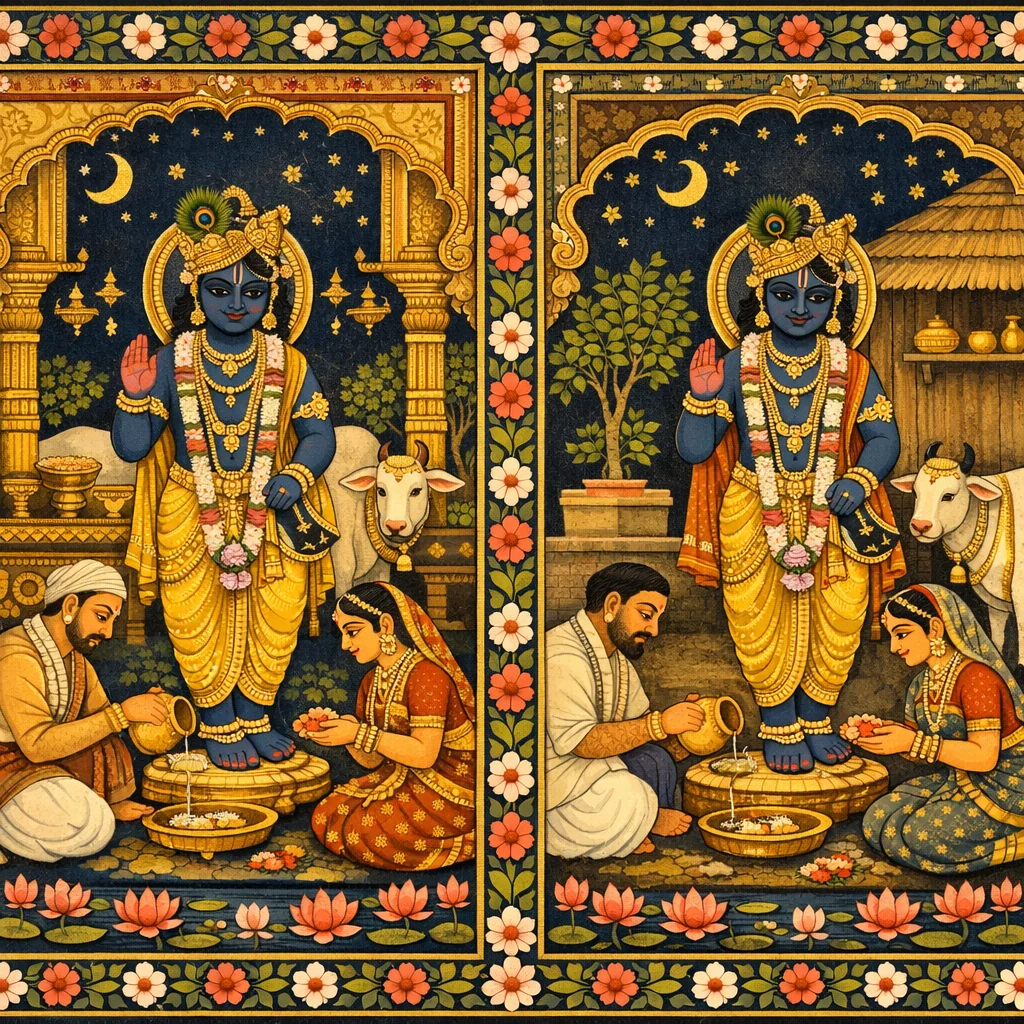
When King Bahulāśva, a descendant of Janaka, saw Lord Kṛṣṇa approaching his house from a distance with the sages, who were somewhat fatigued from the journey, he immediately arranged to have seats of honor brought out for them. After they were all comfortably seated, the wise King, his heart overflowing with joy and his eyes clouded by tears, bowed down to them and washed their feet with intense devotion. Taking the wash water, which could purify the entire world, he sprinkled it on his head and the heads of his family members. Then he worshiped all those great lords by offering them fragrant sandalwood paste, flower garlands, fine clothing and ornaments, incense, lamps, arghya and cows and bulls.
Verse 28
श्रान्तानप्यथ तान् दूराज्जनक: स्वगृहागतान् । आनीतेष्वासनाग्र्येषु सुखासीनान् महामना: ॥ २७ ॥ प्रवृद्धभक्त्या उद्धर्षहृदयास्राविलेक्षण: । नत्वा तदङ्घ्रीन् प्रक्षाल्य तदपो लोकपावनी: ॥ २८ ॥ सकुटुम्बो वहन् मूर्ध्ना पूजयां चक्र ईश्वरान् । गन्धमाल्याम्बराकल्पधूपदीपार्घ्यगोवृषै: ॥ २९ ॥
When King Bahulāśva, a descendant of Janaka, saw Lord Kṛṣṇa approaching his house from a distance with the sages, who were somewhat fatigued from the journey, he immediately arranged to have seats of honor brought out for them. After they were all comfortably seated, the wise King, his heart overflowing with joy and his eyes clouded by tears, bowed down to them and washed their feet with intense devotion. Taking the wash water, which could purify the entire world, he sprinkled it on his head and the heads of his family members. Then he worshiped all those great lords by offering them fragrant sandalwood paste, flower garlands, fine clothing and ornaments, incense, lamps, arghya and cows and bulls.
Verse 29
श्रान्तानप्यथ तान् दूराज्जनक: स्वगृहागतान् । आनीतेष्वासनाग्र्येषु सुखासीनान् महामना: ॥ २७ ॥ प्रवृद्धभक्त्या उद्धर्षहृदयास्राविलेक्षण: । नत्वा तदङ्घ्रीन् प्रक्षाल्य तदपो लोकपावनी: ॥ २८ ॥ सकुटुम्बो वहन् मूर्ध्ना पूजयां चक्र ईश्वरान् । गन्धमाल्याम्बराकल्पधूपदीपार्घ्यगोवृषै: ॥ २९ ॥
When King Bahulāśva, a descendant of Janaka, saw Lord Kṛṣṇa approaching his house from a distance with the sages, who were somewhat fatigued from the journey, he immediately arranged to have seats of honor brought out for them. After they were all comfortably seated, the wise King, his heart overflowing with joy and his eyes clouded by tears, bowed down to them and washed their feet with intense devotion. Taking the wash water, which could purify the entire world, he sprinkled it on his head and the heads of his family members. Then he worshiped all those great lords by offering them fragrant sandalwood paste, flower garlands, fine clothing and ornaments, incense, lamps, arghya and cows and bulls.
Verse 30
वाचा मधुरया प्रीणन्निदमाहान्नतर्पितान् । पादावङ्कगतौ विष्णो: संस्पृशञ्छनकैर्मुदा ॥ ३० ॥
When they had eaten to their full satisfaction, for their further pleasure the King began to speak slowly and in a gentle voice as he held Lord Viṣṇu’s feet in his lap and happily massaged them.
Verse 31
श्रीबहुलाश्व उवाच भवान् हि सर्वभूतानामात्मा साक्षी स्वदृग् विभो । अथ नस्त्वत्पदाम्भोजं स्मरतां दर्शनं गत: ॥ ३१ ॥
Śrī Bahulāśva said: O almighty Lord, You are the Soul of all created beings, their self-illumined witness, and now You are giving Your audience to us, who constantly meditate on Your lotus feet.
Verse 32
स्ववचस्तदृतं कर्तुमस्मद्दृग्गोचरो भवान् । यदात्थैकान्तभक्तान् मे नानन्त: श्रीरज: प्रिय: ॥ ३२ ॥
You have said, “Neither Ananta, Goddess Śrī nor unborn Brahmā is dearer to Me than My unalloyed devotee.” To prove Your own words true, You have now revealed Yourself to our eyes.
Verse 33
को नु त्वच्चरणाम्भोजमेवंविद् विसृजेत् पुमान् । निष्किञ्चनानां शान्तानां मुनीनां यस्त्वमात्मद: ॥ ३३ ॥
What person who knows this truth would ever abandon Your lotus feet, when You are ready to give Your very self to peaceful sages who call nothing their own?
Verse 34
योऽवतीर्य यदोर्वंशे नृणां संसरतामिह । यशो वितेने तच्छान्त्यै त्रैलोक्यवृजिनापहम् ॥ ३४ ॥
Appearing in the Yadu dynasty, You have spread Your glories, which can remove all the sins of the three worlds, just to deliver those entrapped in the cycle of birth and death.
Verse 35
नमस्तुभ्यं भगवते कृष्णायाकुण्ठमेधसे । नारायणाय ऋषये सुशान्तं तप ईयुषे ॥ ३५ ॥
Obeisances to You, the Supreme Personality of Godhead, Lord Kṛṣṇa, whose intelligence is ever unrestricted. Obeisances to the sage Nara-Nārāyaṇa, who always undergoes austerities in perfect peace.
Verse 36
दिनानि कतिचिद् भूमन् गृहान् नो निवस द्विजै: । समेत: पादरजसा पुनीहीदं निमे: कुलम् ॥ ३६ ॥
Please stay a few days in our house, along with these brāhmaṇas, O all-pervading one, and with the dust of Your feet sanctify this dynasty of Nimi.
Verse 37
इत्युपामन्त्रितो राज्ञा भगवाल्ँ लोकभावन: । उवास कुर्वन् कल्याणं मिथिलानरयोषिताम् ॥ ३७ ॥
[Śukadeva Gosvāmī continued:] Thus invited by the King, the Supreme Lord, sustainer of the world, consented to stay for some time to bestow good fortune on the men and women of Mithilā.
Verse 38
श्रुतदेवोऽच्युतं प्राप्तं स्वगृहाञ्जनको यथा । नत्वा मुनीन् सुसंहृष्टो धुन्वन् वासो ननर्त ह ॥ ३८ ॥
Śrutadeva received Lord Acyuta into his home with as much enthusiasm as that shown by King Bahulāśva. After bowing down to the Lord and the sages, Śrutadeva began to dance with great joy, waving his shawl.
Verse 39
तृणपीठबृषीष्वेतानानीतेषूपवेश्य स: । स्वागतेनाभिनन्द्याङ्घ्रीन् सभार्योऽवनिजे मुदा ॥ ३९ ॥
After bringing mats of grass and darbha straw and seating his guests upon them, he greeted them with words of welcome. Then he and his wife washed their feet with great pleasure.
Verse 40
तदम्भसा महाभाग आत्मानं सगृहान्वयम् । स्नापयां चक्र उद्धर्षो लब्धसर्वमनोरथ: ॥ ४० ॥
With the wash water, the virtuous Śrutadeva copiously sprinkled himself, his house and his family. Overjoyed, he felt that all his desires had now been fulfilled.
Verse 41
फलार्हणोशीरशिवामृताम्बुभि- र्मृदा सुरभ्या तुलसीकुशाम्बुजै: । आराधयामास यथोपपन्नया सपर्यया सत्त्वविवर्धनान्धसा ॥ ४१ ॥
He worshiped them with offerings of auspicious items easily available to him, such as fruits, uśīra root, pure, nectarean water, fragrant clay, tulasī leaves, kuśa grass and lotus flowers. Then he offered them food that increases the mode of goodness.
Verse 42
स तर्कयामास कुतो ममान्वभूत् गृहान्धकूपे पतितस्य सङ्गम: । य: सर्वतीर्थास्पदपादरेणुभि: कृष्णेन चास्यात्मनिकेतभूसुरै: ॥ ४२ ॥
He wondered: How is it that I, fallen into the blind well of family life, have been able to meet Lord Kṛṣṇa? And how have I also been allowed to meet these great brāhmaṇas, who always carry the Lord within their hearts? Indeed, the dust of their feet is the shelter of all holy places.
Verse 43
सूपविष्टान् कृतातिथ्यान् श्रुतदेव उपस्थित: । सभार्यस्वजनापत्य उवाचाङ्घ्र्यभिमर्शन: ॥ ४३ ॥
When his guests were seated comfortably, having each received a proper welcome, Śrutadeva approached them and sat down nearby with his wife, children and other dependents. Then, while massaging the Lord’s feet, he addressed Kṛṣṇa and the sages.
Verse 44
श्रुतदेव उवाच नाद्य नो दर्शनं प्राप्त: परं परमपूरुष: । यर्हीदं शक्तिभि: सृष्ट्वा प्रविष्टो ह्यात्मसत्तया ॥ ४४ ॥
Śrutadeva said: It is not that we have attained the audience of the Supreme Person only today, for we have in fact been associating with Him ever since He created this universe with His energies and then entered it in His transcendental form.
Verse 45
यथा शयान: पुरुषो मनसैवात्ममायया । सृष्ट्वा लोकं परं स्वाप्नमनुविश्यावभासते ॥ ४५ ॥
The Lord is like a sleeping person who creates a separate world in his imagination and then enters his own dream and sees himself within it.
Verse 46
शृण्वतां गदतां शश्वदर्चतां त्वाभिवन्दताम् । नृणां संवदतामन्तर्हृदि भास्यमलात्मनाम् ॥ ४६ ॥
You reveal Yourself within the hearts of those persons of pure consciousness who constantly hear about You, chant about You, worship You, glorify You and converse with one another about You.
Verse 47
हृदिस्थोऽप्यतिदूरस्थ: कर्मविक्षिप्तचेतसाम् । आत्मशक्तिभिरग्राह्योऽप्यन्त्युपेतगुणात्मनाम् ॥ ४७ ॥
But although You reside within the heart, You are very far away from those whose minds are disturbed by their entanglement in material work. Indeed, no one can grasp You by his material powers, for You reveal Yourself only in the hearts of those who have learned to appreciate Your transcendental qualities.
Verse 48
नमोऽस्तु तेऽध्यात्मविदां परात्मने अनात्मने स्वात्मविभक्तमृत्यवे । सकारणाकारणलिङ्गमीयुषे स्वमाययासंवृतरुद्धदृष्टये ॥ ४८ ॥
Let me offer my obeisances unto You. You are realized as the Supreme Soul by those who know the Absolute Truth, whereas in Your form of time You impose death upon the forgetful souls. You appear both in Your causeless spiritual form and in the created form of this universe, thus simultaneously uncovering the eyes of Your devotees and obstructing the vision of the nondevotees.
Verse 49
स त्वं शाधि स्वभृत्यान् न: किं देव करवाम हे । एतदन्तो नृणां क्लेशो यद् भवानक्षिगोचर: ॥ ४९ ॥
O Lord, You are that Supreme Soul, and we are Your servants. How shall we serve You? My Lord, simply seeing You puts an end to all the troubles of human life.
Verse 50
श्रीशुक उवाच तदुक्तमित्युपाकर्ण्य भगवान् प्रणतार्तिहा । गृहीत्वा पाणिना पाणिं प्रहसंस्तमुवाच ह ॥ ५० ॥
Śrī Śukadeva Gosvāmī said: After hearing Śrutadeva speak these words, the Supreme Personality of Godhead, who relieves His surrendered devotees’ distress, took Śrutadeva’s hand in His own and, smiling, spoke to him as follows.
Verse 51
श्रीभगवानुवाच ब्रह्मंस्तेऽनुग्रहार्थाय सम्प्राप्तान् विद्ध्यमून् मुनीन् । सञ्चरन्ति मया लोकान् पुनन्त: पादरेणुभि: ॥ ५१ ॥
The Supreme Lord said: My dear brāhmaṇa, you should know that these great sages have come here just to bless you. They travel throughout the worlds with Me, purifying them with the dust of their feet.
Verse 52
देवा: क्षेत्राणि तीर्थानि दर्शनस्पर्शनार्चनै: । शनै: पुनन्ति कालेन तदप्यर्हत्तमेक्षया ॥ ५२ ॥
One can gradually become purified by seeing, touching and worshiping temple deities, places of pilgrimage and holy rivers. But one can attain the same result immediately simply by receiving the glance of exalted sages.
Verse 53
ब्राह्मणो जन्मना श्रेयान् सर्वेषां प्राणिनामिह । तपसा विद्यया तुष्ट्या किमु मत्कलया युत: ॥ ५३ ॥
By his very birth, a brāhmaṇa is the best of all living beings in this world, and he becomes even more exalted when he is endowed with austerity, learning and self-satisfaction, what to speak of devotion to Me.
Verse 54
न ब्राह्मणान्मे दयितं रूपमेतच्चतुर्भुजम् । सर्ववेदमयो विप्र: सर्वदेवमयो ह्यहम् ॥ ५४ ॥
Even My own four-armed form is no dearer to Me than a brāhmaṇa. Within himself a learned brāhmaṇa comprises all the Vedas, just as within Myself I comprise all the demigods.
Verse 55
दुष्प्रज्ञा अविदित्वैवमवजानन्त्यसूयव: । गुरुं मां विप्रमात्मानमर्चादाविज्यदृष्टय: ॥ ५५ ॥
Ignorant of this truth, foolish people neglect and enviously offend a learned brāhmaṇa, who, being nondifferent from Me, is their spiritual master and very self. They consider worshipable only such obvious manifestations of divinity as My Deity form.
Verse 56
चराचरमिदं विश्वं भावा ये चास्य हेतव: । मद्रूपाणीति चेतस्याधत्ते विप्रो मदीक्षया ॥ ५६ ॥
Because he has realized Me, a brāhmaṇa is firmly fixed in the knowledge that everything moving and nonmoving in the universe, and also the primary elements of its creation, are all manifest forms expanded from Me.
Verse 57
तस्माद् ब्रह्मऋषीनेतान् ब्रह्मन् मच्छ्रद्धयार्चय । एवं चेदर्चितोऽस्म्यद्धा नान्यथा भूरिभूतिभि: ॥ ५७ ॥
Therefore you should worship these brāhmaṇa sages, O brāhmaṇa, with the same faith you have in Me. If you do so, you will worship Me directly, which you cannot do otherwise, even with offerings of vast riches.
Verse 58
श्रीशुक उवाच स इत्थं प्रभुनादिष्ट: सहकृष्णान् द्विजोत्तमान् । आराध्यैकात्मभावेन मैथिलश्चाप सद्गतिम् ॥ ५८ ॥
Śrī Śuka said: So instructed by his Lord, with single-minded devotion Śrutadeva worshiped Śrī Kṛṣṇa and the topmost brāhmaṇas accompanying Him, and King Bahulāśva did the same. Thus both Śrutadeva and the King attained the ultimate transcendental destination.
Verse 59
एवं स्वभक्तयो राजन् भगवान् भक्तभक्तिमान् । उषित्वादिश्य सन्मार्गं पुनर्द्वारवतीमगात् ॥ ५९ ॥
O King, thus the Personality of Godhead, who is devoted to His own devotees, stayed for some time with His two great devotees Śrutadeva and Bahulāśva, teaching them the behavior of perfect saints. Then the Lord returned to Dvārakā.
Frequently Asked Questions
The narrative presents Arjuna acting strategically within royal and familial politics: Balarāma’s intent to give Subhadrā to Duryodhana required discretion until the proper moment. By adopting a tridaṇḍī disguise, Arjuna could enter Dvārakā without provoking conflict, gain proximity during the monsoon stay, and then execute the dharmically sanctioned rākṣasa-style taking at a public festival—an approach ultimately approved by Kṛṣṇa and Subhadrā’s parents.
Śukadeva explicitly notes that Subhadrā’s parents and Kṛṣṇa had sanctioned the act, and Subhadrā herself reciprocates affection. In classical kṣatriya contexts, rākṣasa-vivāha can occur as a socially recognized form when aligned with consent and dharmic approval. The Bhāgavata frames the event as a legitimate marital outcome protected by Kṛṣṇa’s will, not as coercion or exploitation.
Śrutadeva is portrayed as a content, learned brāhmaṇa householder devoted to unalloyed service, while Bahulāśva is a humble Videha king free from false ego—both equally dear to Acyuta. Their pairing demonstrates the Bhāgavata principle that bhakti, not social position (royal opulence vs. simple livelihood), attracts the Lord’s personal presence.
The chapter describes an act of divine aiśvarya: to please both devotees, Kṛṣṇa simultaneously went to both homes so that each host perceived the Lord exclusively in his own house. This illustrates Bhagavān’s yogic sovereignty and His bhakta-vātsalya—His eagerness to reciprocate fully with each devotee.
Kṛṣṇa teaches that exalted sages purify the worlds by their presence and that honoring realized brāhmaṇas is direct worship of Him. He contrasts gradual purification through tīrthas and Deity worship with the immediacy of receiving the glance and blessings of saintly persons, emphasizing sādhu-sevā and brāhmaṇa-respect as core Vaiṣṇava conduct.