Adhyaya 60
Kṛṣṇa Teases Rukmiṇī; Her Devotional Reply and the Lord’s Assurance
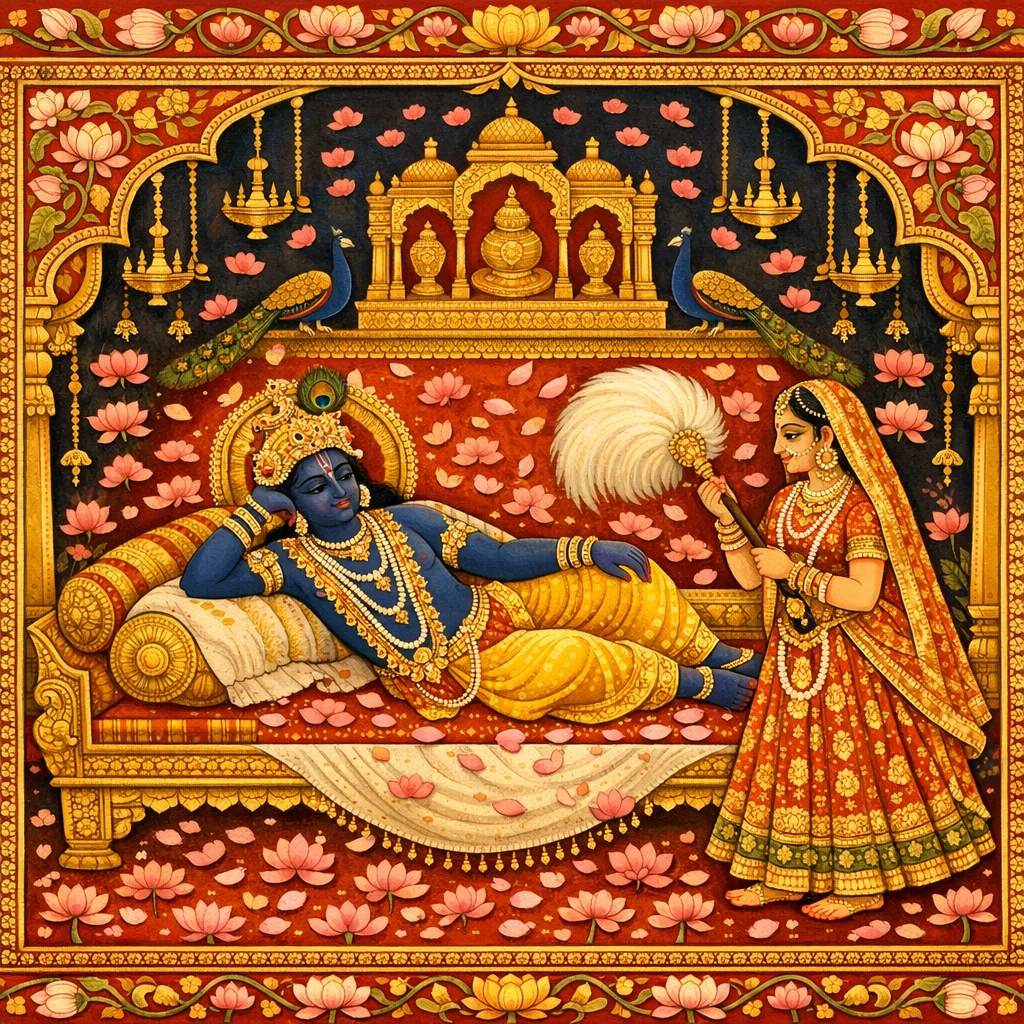
In Dvārakā’s opulent inner quarters, Rukmiṇī personally serves Kṛṣṇa with a cāmara fan as He reclines, establishing the mood of intimate household devotion. Kṛṣṇa then playfully speaks contrary words—questioning her choice of Him over powerful kings (Śiśupāla and others), describing Himself as possessionless and socially “unsuitable,” and implying she should seek a more fitting husband. The teasing functions as a deliberate test and purification: Rukmiṇī, shaken by apparent rejection, faints in grief, revealing her exclusive dependence on Him. Kṛṣṇa compassionately revives and consoles her, admitting He spoke in jest to hear her response. Rukmiṇī answers with penetrating theology: Kṛṣṇa is the Supreme Lord beyond all wealth, the goal of liberation, the refuge sought by renunciants and kings alike; only those ignorant of His glories accept lesser husbands. Pleased, Kṛṣṇa affirms her unalloyed devotion, contrasts pure bhakti with materially motivated worship, praises her past surrender, and continues household pastimes—linking to subsequent portrayals of His conduct with other queens in Dvārakā.
Shlokas
Verse 1
श्रीबादरायणिरुवाच कर्हिचित् सुखमासीनं स्वतल्पस्थं जगद्गुरुम् । पतिं पर्यचरद् भैष्मी व्यजनेन सखीजनै: ॥ १ ॥
Śrī Bādarāyaṇi said: Once, in the company of her maidservants, Queen Rukmiṇī was personally serving her husband, the spiritual master of the universe, by fanning Him as He relaxed on her bed.
Verse 2
यस्त्वेतल्लीलया विश्वं सृजत्यत्त्यवतीश्वर: । स हि जात: स्वसेतूनां गोपीथाय यदुष्वज: ॥ २ ॥
The unborn Personality of Godhead, the supreme controller, who creates, maintains and then devours this universe simply as His play, took birth among the Yadus to preserve His own laws.
Verse 3
तस्मिनन्तर्गृहे भ्राजन्मुक्तादामविलम्बिना । विराजिते वितानेन दीपैर्मणिमयैरपि ॥ ३ ॥ मल्लिकादामभि: पुष्पैर्द्विरेफकुलनादिते । जालरन्ध्रप्रविष्टैश्च गोभिश्चन्द्रमसोऽमलै: ॥ ४ ॥ पारिजातवनामोदवायुनोद्यानशालिना । धूपैरगुरुजै राजन् जालरन्ध्रविनिर्गतै: ॥ ५ ॥ पय:फेननिभे शुभ्रे पर्यङ्के कशिपूत्तमे । उपतस्थे सुखासीनं जगतामीश्वरं पतिम् ॥ ६ ॥
Queen Rukmiṇī’s quarters were extremely beautiful, boasting a canopy hung with brilliant strings of pearls, as well as effulgent jewels serving as lamps. Garlands of jasmine and other flowers hung here and there, attracting swarms of humming bees, and the spotless rays of the moon shone through the holes of the lattice windows. As aguru incense drifted out of the window holes, my dear King, the breeze wafting the scent of the pārijāta grove carried the mood of a garden into the room. There the Queen served her husband, the Supreme Lord of all the worlds, as He reclined upon an opulent pillow on her bed, which was as soft and white as the foam of milk.
Verse 4
तस्मिनन्तर्गृहे भ्राजन्मुक्तादामविलम्बिना । विराजिते वितानेन दीपैर्मणिमयैरपि ॥ ३ ॥ मल्लिकादामभि: पुष्पैर्द्विरेफकुलनादिते । जालरन्ध्रप्रविष्टैश्च गोभिश्चन्द्रमसोऽमलै: ॥ ४ ॥ पारिजातवनामोदवायुनोद्यानशालिना । धूपैरगुरुजै राजन् जालरन्ध्रविनिर्गतै: ॥ ५ ॥ पय:फेननिभे शुभ्रे पर्यङ्के कशिपूत्तमे । उपतस्थे सुखासीनं जगतामीश्वरं पतिम् ॥ ६ ॥
Queen Rukmiṇī’s quarters were extremely beautiful, boasting a canopy hung with brilliant strings of pearls, as well as effulgent jewels serving as lamps. Garlands of jasmine and other flowers hung here and there, attracting swarms of humming bees, and the spotless rays of the moon shone through the holes of the lattice windows. As aguru incense drifted out of the window holes, my dear King, the breeze wafting the scent of the pārijāta grove carried the mood of a garden into the room. There the Queen served her husband, the Supreme Lord of all the worlds, as He reclined upon an opulent pillow on her bed, which was as soft and white as the foam of milk.
Verse 5
तस्मिनन्तर्गृहे भ्राजन्मुक्तादामविलम्बिना । विराजिते वितानेन दीपैर्मणिमयैरपि ॥ ३ ॥ मल्लिकादामभि: पुष्पैर्द्विरेफकुलनादिते । जालरन्ध्रप्रविष्टैश्च गोभिश्चन्द्रमसोऽमलै: ॥ ४ ॥ पारिजातवनामोदवायुनोद्यानशालिना । धूपैरगुरुजै राजन् जालरन्ध्रविनिर्गतै: ॥ ५ ॥ पय:फेननिभे शुभ्रे पर्यङ्के कशिपूत्तमे । उपतस्थे सुखासीनं जगतामीश्वरं पतिम् ॥ ६ ॥
Queen Rukmiṇī’s quarters were extremely beautiful, boasting a canopy hung with brilliant strings of pearls, as well as effulgent jewels serving as lamps. Garlands of jasmine and other flowers hung here and there, attracting swarms of humming bees, and the spotless rays of the moon shone through the holes of the lattice windows. As aguru incense drifted out of the window holes, my dear King, the breeze wafting the scent of the pārijāta grove carried the mood of a garden into the room. There the Queen served her husband, the Supreme Lord of all the worlds, as He reclined upon an opulent pillow on her bed, which was as soft and white as the foam of milk.
Verse 6
तस्मिनन्तर्गृहे भ्राजन्मुक्तादामविलम्बिना । विराजिते वितानेन दीपैर्मणिमयैरपि ॥ ३ ॥ मल्लिकादामभि: पुष्पैर्द्विरेफकुलनादिते । जालरन्ध्रप्रविष्टैश्च गोभिश्चन्द्रमसोऽमलै: ॥ ४ ॥ पारिजातवनामोदवायुनोद्यानशालिना । धूपैरगुरुजै राजन् जालरन्ध्रविनिर्गतै: ॥ ५ ॥ पय:फेननिभे शुभ्रे पर्यङ्के कशिपूत्तमे । उपतस्थे सुखासीनं जगतामीश्वरं पतिम् ॥ ६ ॥
Queen Rukmiṇī’s quarters were extremely beautiful, boasting a canopy hung with brilliant strings of pearls, as well as effulgent jewels serving as lamps. Garlands of jasmine and other flowers hung here and there, attracting swarms of humming bees, and the spotless rays of the moon shone through the holes of the lattice windows. As aguru incense drifted out of the window holes, my dear King, the breeze wafting the scent of the pārijāta grove carried the mood of a garden into the room. There the Queen served her husband, the Supreme Lord of all the worlds, as He reclined upon an opulent pillow on her bed, which was as soft and white as the foam of milk.
Verse 7
वालव्यजनमादाय रत्नदण्डं सखीकरात् । तेन वीजयती देवी उपासां चक्र ईश्वरम् ॥ ७ ॥
From her maidservant’s hand Goddess Rukmiṇī took a yak-hair fan with a jeweled handle, and then she began to worship her master by fanning Him.
Verse 8
सोपाच्युतं क्वणयती मणिनूपुराभ्यां रेजेऽङ्गुलीयवलयव्यजनाग्रहस्ता । वस्त्रान्तगूढकुचकुङ्कुमशोणहार- भासा नितम्बधृतया च परार्ध्यकाञ्च्या ॥ ८ ॥
Her hand adorned with rings, bangles and the cāmara fan, Queen Rukmiṇī looked resplendent standing near Lord Kṛṣṇa. Her jeweled ankle-bells tinkled, and her necklace glittered, reddened by the kuṅkuma from her breasts, which were covered by the end of her sari. On her hips she wore a priceless belt.
Verse 9
तां रूपिणीं श्रियमनन्यगतिं निरीक्ष्य या लीलया धृततनोरनुरूपरूपा । प्रीत: स्मयन्नलककुण्डलनिष्ककण्ठ- वक्त्रोल्लसत्स्मितसुधां हरिराबभाषे ॥ ९ ॥
As He contemplated her, the goddess of fortune herself, who desires only Him, Lord Kṛṣṇa smiled. The Lord assumes various forms to enact His pastimes, and He was pleased that the form the goddess of fortune had assumed was just suitable for her to serve as His consort. Her charming face was adorned with curling hair, earrings, a locket on her neck, and the nectar of her bright, happy smile. The Lord then spoke to her as follows.
Verse 10
श्रीभगवानुवाच राजपुत्रीप्सिता भूपैर्लोकपालविभूतिभि: । महानुभावै: श्रीमद्भी रूपौदार्यबलोर्जितै: ॥ १० ॥
The Supreme Lord said: My dear princess, you were sought after by many kings as powerful as the rulers of planets. They were all abundantly endowed with political influence, wealth, beauty, generosity and physical strength.
Verse 11
तान्प्राप्तानर्थिनो हित्वा चैद्यादीन् स्मरदुर्मदान् । दत्ता भ्रात्रा स्वपित्रा च कस्मान्नो ववृषेऽसमान् ॥ ११ ॥
Since your brother and father offered you to them, why did you reject the King of Cedi and all those other suitors, who stood before you, maddened by Cupid? Why, instead, did you choose Us, who are not at all your equal?
Verse 12
राजभ्यो बिभ्यत: सुभ्रु समुद्रं शरणं गतान् । बलवद्भि: कृतद्वेषान् प्रायस्त्यक्तनृपासनान् ॥ १२ ॥
Terrified of these kings, O lovely-browed one, We took shelter in the ocean. We have become enemies of powerful men, and We practically abandoned Our royal throne.
Verse 13
अस्पष्टवर्त्मनां पुंसामलोकपथमीयुषाम् । आस्थिता: पदवीं सुभ्रु प्राय: सीदन्ति योषित: ॥ १३ ॥
O fine-browed lady, women are usually destined to suffer when they stay with men whose behavior is uncertain and who pursue a path not approved by society.
Verse 14
निष्किञ्चना वयं शश्वन्निष्किञ्चनजनप्रिया: । तस्मात् प्रायेण न ह्याढ्या मां भजन्ति सुमध्यमे ॥ १४ ॥
We have no material possessions, and We are dear to those who similarly have nothing. Therefore, O slender one, the wealthy hardly ever worship Me.
Verse 15
ययोरात्मसमं वित्तं जन्मैश्वर्याकृतिर्भव: । तयोर्विवाहो मैत्री च नोत्तमाधमयो: क्वचित् ॥ १५ ॥
Marriage and friendship are proper between two people who are equal in terms of their wealth, birth, influence, physical appearance and capacity for good progeny, but never between a superior and an inferior.
Verse 16
वैदर्भ्येतदविज्ञाय त्वयादीर्घसमीक्षया । वृता वयं गुणैर्हीना भिक्षुभि: श्लाघिता मुधा ॥ १६ ॥
O Vaidarbhī, not being farsighted, you didn’t realize this, and therefore you chose Us as your husband, even though We have no good qualities and are glorified only by deluded beggars.
Verse 17
अथात्मनोऽनुरूपं वै भजस्व क्षत्रियर्षभम् । येन त्वमाशिष: सत्या इहामुत्र च लप्स्यसे ॥ १७ ॥
Now you should definitely accept a more suitable husband, a first-class man of the royal order who can help you achieve everything you want, both in this life and the next.
Verse 18
चैद्यशाल्वजरासन्धदन्तवक्रादयो नृपा: । मम द्विषन्ति वामोरु रुक्मी चापि तवाग्रज: ॥ १८ ॥
Kings like Śiśupāla, Śālva, Jarāsandha and Dantavakra all hate Me, O beautiful-thighed one, and so does your elder brother Rukmī.
Verse 19
तेषां वीर्यमदान्धानां दृप्तानां स्मयनुत्तये । आनितासि मया भद्रे तेजोपहरतासताम् ॥ १९ ॥
It was to dispel the arrogance of these kings that I carried you away, My good woman, for they were blinded by the intoxication of power. My purpose was to curb the strength of the wicked.
Verse 20
उदासीना वयं नूनं न स्त्र्यपत्यार्थकामुका: । आत्मलब्ध्यास्महे पूर्णा गेहयोर्ज्योतिरक्रिया: ॥ २० ॥
We care nothing for wives, children and wealth. Always satisfied within Ourselves, We do not work for body and home, but like a light, We merely witness.
Verse 21
श्रीशुक उवाच एतावदुक्त्वा भगवानात्मानं वल्लभामिव । मन्यमानामविश्लेषात् तद्दर्पघ्न उपारमत् ॥ २१ ॥
Śukadeva Gosvāmī said: Rukmiṇī had thought herself especially beloved by the Lord because He never left her company. By saying these things to her He vanquished her pride, and then He stopped speaking.
Verse 22
इति त्रिलोकेशपतेस्तदात्मन: प्रियस्य देव्यश्रुतपूर्वमप्रियम् । आश्रुत्य भीता हृदि जातवेपथु- श्चिन्तां दुरन्तां रुदती जगाम ह ॥ २२ ॥
Goddess Rukmiṇī had never before heard such unpleasantries from her beloved, the Lord of universal rulers, and she became frightened. A tremor arose in her heart, and in terrible anxiety she began to cry.
Verse 23
पदा सुजातेन नखारुणश्रिया भुवं लिखन्त्यश्रुभिरञ्जनासितै: । आसिञ्चती कुङ्कुमरूषितौ स्तनौ तस्थावधोमुख्यतिदु:खरुद्धवाक् ॥ २३ ॥
With her tender foot, effulgent with the reddish glow of her nails, she scratched the ground, and tears darkened by her eye makeup sprinkled her kuṅkuma-reddened breasts. There she stood, face downward, her voice choked up by extreme sorrow.
Verse 24
तस्या: सुदु:खभयशोकविनष्टबुद्धे- र्हस्ताच्छ्लथद्वलयतो व्यजनं पपात । देहश्च विक्लवधिय: सहसैव मुह्यन् रम्भेव वायुविहतो प्रविकीर्य केशान् ॥ २४ ॥
Rukmiṇī’s mind was overwhelmed with unhappiness, fear and grief. Her bangles slipped from her hand, and her fan fell to the ground. In her bewilderment she suddenly fainted, her hair scattering all about as her body fell to the ground like a plantain tree blown over by the wind.
Verse 25
तद् दृष्ट्वा भगवान् कृष्ण: प्रियाया: प्रेमबन्धनम् । हास्यप्रौढिमजानन्त्या: करुण: सोऽन्वकम्पत ॥ २५ ॥
Seeing that His beloved was so bound to Him in love that she could not understand the full meaning of His teasing, merciful Lord Kṛṣṇa felt compassion for her.
Verse 26
पर्यङ्कादवरुह्याशु तामुत्थाप्य चतुर्भुज: । केशान् समुह्य तद्वक्त्रं प्रामृजत् पद्मपाणिना ॥ २६ ॥
The Lord quickly got down from the bed. Manifesting four arms, He picked her up, gathered her hair and caressed her face with His lotus hand.
Verse 27
प्रमृज्याश्रुकले नेत्रे स्तनौ चोपहतौ शुचा । आश्लिष्य बाहुना राजननन्यविषयां सतीम् ॥ २७ ॥ सान्त्वयामास सान्त्वज्ञ: कृपया कृपणां प्रभु: । हास्यप्रौढिभ्रमच्चित्तामतदर्हां सतां गति: ॥ २८ ॥
Wiping her tear-filled eyes and her breasts, which were stained by tears of grief, the Supreme Lord, the goal of His devotees, embraced His chaste wife, who desired nothing but Him, O King. Expert in the art of pacification, Śrī Kṛṣṇa tenderly consoled pitiable Rukmiṇī, whose mind was bewildered by His clever joking and who did not deserve to suffer so.
Verse 28
प्रमृज्याश्रुकले नेत्रे स्तनौ चोपहतौ शुचा । आश्लिष्य बाहुना राजननन्यविषयां सतीम् ॥ २७ ॥ सान्त्वयामास सान्त्वज्ञ: कृपया कृपणां प्रभु: । हास्यप्रौढिभ्रमच्चित्तामतदर्हां सतां गति: ॥ २८ ॥
Wiping her tear-filled eyes and her breasts, which were stained by tears of grief, the Supreme Lord, the goal of His devotees, embraced His chaste wife, who desired nothing but Him, O King. Expert in the art of pacification, Śrī Kṛṣṇa tenderly consoled pitiable Rukmiṇī, whose mind was bewildered by His clever joking and who did not deserve to suffer so.
Verse 29
श्रीभगवानुवाच मा मा वैदर्भ्यसूयेथा जाने त्वां मत्परायणाम् । त्वद्वच: श्रोतुकामेन क्ष्वेल्याचरितमङ्गने ॥ २९ ॥
The Supreme Lord said: O Vaidarbhī, do not be displeased with Me. I know that you are fully devoted to Me. I only spoke in jest, dear lady, because I wanted to hear what you would say.
Verse 30
मुखं च प्रेमसंरम्भस्फुरिताधरमीक्षितुम् । कटाक्षेपारुणापाङ्गं सुन्दरभ्रुकुटीतटम् ॥ ३० ॥
I also wanted to see your face with lips trembling in loving anger, the reddish corners of your eyes throwing sidelong glances and the line of your beautiful eyebrows knit in a frown.
Verse 31
अयं हि परमो लाभो गृहेषु गृहमेधिनाम् । यन्नर्मैरीयते याम: प्रियया भीरु भामिनि ॥ ३१ ॥
The greatest pleasure worldly householders can enjoy at home is to spend time joking with their beloved wives, My dear timid and temperamental one.
Verse 32
श्रीशुक उवाच सैवं भगवता राजन् वैदर्भी परिसान्त्विता । ज्ञात्वा तत्परिहासोक्तिं प्रियत्यागभयं जहौ ॥ ३२ ॥
Śukadeva Gosvāmī said: O King, Queen Vaidarbhī was fully pacified by the Supreme Personality of Godhead and understood that His words had been spoken in jest. Thus she gave up her fear that her beloved would reject her.
Verse 33
बभाष ऋषभं पुंसां वीक्षन्ती भगवन्मुखम् । सव्रीडहासरुचिरस्निग्धापाङ्गेन भारत ॥ ३३ ॥
Smiling bashfully as she cast charming, affectionate glances upon the face of the Lord, the best of males, Rukmiṇī spoke the following, O descendant of Bharata.
Verse 34
श्रीरुक्मिण्युवाच नन्वेवमेतदरविन्दविलोचनाह यद्वै भवान् भगवतोऽसदृशी विभूम्न: । क्व स्वे महिम्न्यभिरतो भगवांस्त्र्यधीश: क्वाहं गुणप्रकृतिरज्ञगृहीतपादा ॥ ३४ ॥
Śrī Rukmiṇī said: Actually, what You have said is true, O lotus-eyed one. I am indeed unsuitable for the almighty Personality of Godhead. What comparison is there between that Supreme Lord, who is master of the three primal deities and who delights in His own glory, and myself, a woman of mundane qualities whose feet are grasped by fools?
Verse 35
सत्यं भयादिव गुणेभ्य उरुक्रमान्त: शेते समुद्र उपलम्भनमात्र आत्मा । नित्यं कदिन्द्रियगणै: कृतविग्रहस्त्वं त्वत्सेवकैर्नृपपदं विधुतं तमोऽन्धम् ॥ ३५ ॥
Yes, my Lord Urukrama, You lay down within the ocean as if afraid of the material modes, and thus in pure consciousness You appear within the heart as the Supersoul. You are always battling against the foolish material senses, and indeed even Your servants reject the privilege of royal dominion, which leads to the blindness of ignorance.
Verse 36
त्वत्पादपद्ममकरन्दजुषां मुनीनां वर्त्मास्फुटं नृपशुभिर्ननु दुर्विभाव्यम् । यस्मादलौकिकमिवेहितमीश्वरस्य भूमंस्तवेहितमथो अनु ये भवन्तम् ॥ ३६ ॥
Your movements, inscrutable even for sages who relish the honey of Your lotus feet, are certainly incomprehensible for human beings who behave like animals. And just as Your activities are transcendental, O all-powerful Lord, so too are those of Your followers.
Verse 37
निष्किञ्चनो ननु भवान् न यतोऽस्ति किञ्चिद् यस्मै बलिं बलिभुजोऽपि हरन्त्यजाद्या: । न त्वा विदन्त्यसुतृपोऽन्तकमाढ्यतान्धा: प्रेष्ठो भवान् बलिभुजामपि तेऽपि तुभ्यम् ॥ ३७ ॥
You possess nothing because there is nothing beyond You. Even the great enjoyers of tribute — Brahmā and other demigods — pay tribute to You. Those who are blinded by their wealth and absorbed in gratifying their senses do not recognize You in the form of death. But to the gods, the enjoyers of tribute, You are the most dear, as they are to You.
Verse 38
त्वं वै समस्तपुरुषार्थमय: फलात्मा यद्वाञ्छया सुमतयो विसृजन्ति कृत्स्नम् । तेषां विभो समुचितो भवत: समाज: पुंस: स्त्रियाश्च रतयो: सुखदु:खिनोर्न ॥ ३८ ॥
You are the embodiment of all human goals and are Yourself the final aim of life. Desiring to attain You, O all-powerful Lord, intelligent persons abandon everything else. It is they who are worthy of Your association, not men and women absorbed in the pleasure and grief resulting from their mutual lust.
Verse 39
त्वं न्यस्तदण्डमुनिभिर्गदितानुभाव आत्मात्मदश्च जगतामिति मे वृतोऽसि । हित्वा भवद्भ्रुव उदीरितकालवेग ध्वस्ताशिषोऽब्जभवनाकपतीन् कुतोऽन्ये ॥ ३९ ॥
Knowing that great sages who have renounced the sannyāsī’s daṇḍa proclaim Your glories, that You are the Supreme Soul of all the worlds, and that You are so gracious that You give away even Your own self, I chose You as my husband, rejecting Lord Brahmā, Lord Śiva and the rulers of heaven, whose aspirations are all frustrated by the force of time, which is born from Your eyebrows. What interest, then, could I have in any other suitors?
Verse 40
जाड्यं वचस्तव गदाग्रज यस्तु भूपान् विद्राव्य शार्ङ्गनिनदेन जहर्थ मां त्वम् । सिंहो यथा स्वबलिमीश पशून् स्वभागं तेभ्यो भयाद् यदुदधिं शरणं प्रपन्न: ॥ ४० ॥
My Lord, as a lion drives away lesser animals to claim his proper tribute, You drove off the assembled kings with the resounding twang of Your Śārṅga bow and then claimed me, Your fair share. Thus it is sheer foolishness, my dear Gadāgraja, for You to say You took shelter in the ocean out of fear of those kings.
Verse 41
यद्वाञ्छया नृपशिखामणयोऽङ्गवैन्य- जायन्तनाहुषगयादय ऐक्यपत्यम् । राज्यं विसृज्य विविशुर्वनमम्बुजाक्ष सीदन्ति तेऽनुपदवीं त इहास्थिता: किम् ॥ ४१ ॥
Wanting Your association, the best of kings — Aṅga, Vainya, Jāyanta, Nāhuṣa, Gaya and others — abandoned their absolute sovereignty and entered the forest to seek You out. How could those kings suffer frustration in this world, O lotus-eyed one?
Verse 42
कान्यं श्रयेत तव पादसरोजगन्ध- माघ्राय सन्मुखरितं जनतापवर्गम् । लक्ष्म्यालयं त्वविगणय्य गुणालयस्य मर्त्या सदोरुभयमर्थविविक्तदृष्टि: ॥ ४२ ॥
The aroma of Your lotus feet, which is glorified by great saints, awards people liberation and is the abode of Goddess Lakṣmī. What woman would take shelter of any other man after savoring that aroma? Since You are the abode of transcendental qualities, what mortal woman with the insight to distinguish her own true interest would disregard that fragrance and depend instead on someone who is always subject to terrible fear?
Verse 43
तं त्वानुरूपमभजं जगतामधीश- मात्मानमत्र च परत्र च कामपूरम् । स्यान्मे तवाङ्घ्रिररणं सृतिभिर्भ्रमन्त्या यो वै भजन्तमुपयात्यनृतापवर्ग: ॥ ४३ ॥
Because You are suitable for me, I have chosen You, the master and Supreme Soul of all the worlds, who fulfill our desires in this life and the next. May Your feet, which give freedom from illusion by approaching their worshiper, give shelter to me, who have been wandering from one material situation to another.
Verse 44
तस्या: स्युरच्युत नृपा भवतोपदिष्टा: स्त्रीणां गृहेषु खरगोश्वविडालभृत्या: । यत्कर्णमूलमरिकर्षण नोपयायाद् युष्मत्कथा मृडविरिञ्चसभासु गीता ॥ ४४ ॥
O infallible Kṛṣṇa, let each of the kings You named become the husband of a woman whose ears have never heard Your glories, which are sung in the assemblies of Śiva and Brahmā. After all, in the households of such women these kings live like asses, oxen, dogs, cats and slaves.
Verse 45
त्वक्श्मश्रुरोमनखकेशपिनद्धमन्त- र्मांसास्थिरक्तकृमिविट्कफपित्तवातम् । जीवच्छवं भजति कान्तमतिर्विमूढा या ते पदाब्जमकरन्दमजिघ्रती स्त्री ॥ ४५ ॥
A woman who fails to relish the fragrance of the honey of Your lotus feet becomes totally befooled, and thus she accepts as her husband or lover a living corpse covered with skin, whiskers, nails, head-hair and body-hair and filled with flesh, bones, blood, parasites, feces, mucus, bile and air.
Verse 46
अस्त्वम्बुजाक्ष मम ते चरणानुराग आत्मन् रतस्य मयि चानतिरिक्तदृष्टे: । यर्ह्यस्य वृद्धय उपात्तरजोऽतिमात्रो मामीक्षसे तदु ह न: परमानुकम्पा ॥ ४६ ॥
O lotus-eyed one, though You are satisfied within Yourself and thus rarely turn Your attention toward me, please bless me with steady love for Your feet. It is when You assume a predominance of passion in order to manifest the universe that You glance upon me, showing me what is indeed Your greatest mercy.
Verse 47
नैवालीकमहं मन्ये वचस्ते मधुसूदन । अम्बाया एव हि प्राय: कन्याया: स्याद् रति: क्वचित् ॥ ४७ ॥
Actually, I don’t consider Your words false, Madhūsudana. Quite often an unmarried girl is attracted to a man, as in the case of Ambā.
Verse 48
व्यूढायाश्चापि पुंश्चल्या मनोऽभ्येति नवं नवम् । बुधोऽसतीं न बिभृयात् तां बिभ्रदुभयच्युत: ॥ ४८ ॥
The mind of a promiscuous woman always hankers for new lovers, even if she is married. An intelligent man should not keep such an unchaste wife, for if he does he will lose his good fortune both in this life and the next.
Verse 49
श्रीभगवानुवाच साध्व्येतच्छ्रोतुकामैस्त्वं राजपुत्री प्रलम्भिता । मयोदितं यदन्वात्थ सर्वं तत् सत्यमेव हि ॥ ४९ ॥
The Supreme Lord said: O saintly lady, O princess, We deceived you only because We wanted to hear you speak like this. Indeed, everything you said in reply to My words is most certainly true.
Verse 50
यान् यान् कामयसे कामान् मय्यकामाय भामिनि । सन्ति ह्येकान्तभक्तायास्तव कल्याणि नित्यद ॥ ५० ॥
Whatever benedictions you hope for in order to become free of material desires are ever yours, O fair and noble lady, for you are My unalloyed devotee.
Verse 51
उपलब्धं पतिप्रेम पातिव्रत्यं च तेऽनघे । यद्वाक्यैश्चाल्यमानाया न धीर्मय्यपकर्षिता ॥ ५१ ॥
O sinless one, I have now seen firsthand the pure love and chaste attachment you have for your husband. Even though shaken by My words, your mind could not be pulled away from Me.
Verse 52
ये मां भजन्ति दाम्पत्ये तपसा व्रतचर्यया । कामात्मानोऽपवर्गेशं मोहिता मम मायया ॥ ५२ ॥
Although I have the power to award spiritual liberation, lusty persons worship Me with penance and vows in order to get My blessings for their mundane family life. Such persons are bewildered by My illusory energy.
Verse 53
मां प्राप्य मानिन्यपवर्गसम्पदं वाञ्छन्ति ये सम्पद एव तत्पतिम् । ते मन्दभागा निरयेऽपि ये नृणां मात्रात्मकत्वात्निरय: सुसङ्गम: ॥ ५३ ॥
O supreme reservoir of love, unfortunate are they who even after obtaining Me, the Lord of both liberation and material riches, hanker only for material treasures. These worldly gains can be found even in hell. Since such persons are obsessed with sense gratification, hell is a fitting place for them.
Verse 54
दिष्ट्या गृहेश्वर्यसकृन्मयि त्वया कृतानुवृत्तिर्भवमोचनी खलै: । सुदुष्करासौ सुतरां दुराशिषो ह्यसुंभराया निकृतिं जुष: स्त्रिया: ॥ ५४ ॥
Fortunately, O mistress of the house, you have always rendered Me faithful devotional service, which liberates one from material existence. This service is very difficult for the envious to perform, especially for a woman whose intentions are wicked, who lives only to gratify her bodily demands, and who indulges in duplicity.
Verse 55
न त्वादृशीं प्रणयिनीं गृहिणीं गृहेषु पश्यामि मानिनि यया स्वविवाहकाले । प्राप्तान् नृपान्न विगणय्य रहोहरो मे प्रस्थापितो द्विज उपश्रुतसत्कथस्य ॥ ५५ ॥
In all My palaces I can find no other wife as loving as you, O most respectful one. When you were to be married, you disregarded all the kings who had assembled to seek your hand, and simply because you had heard authentic accounts concerning Me, you sent a brāhmaṇa to Me with your confidential message.
Verse 56
भ्रातुर्विरूपकरणं युधि निर्जितस्य प्रोद्वाहपर्वणि च तद्वधमक्षगोष्ठ्याम् । दु:खं समुत्थमसहोऽस्मदयोगभीत्या नैवाब्रवी: किमपि तेन वयं जितास्ते ॥ ५६ ॥
When your brother, who had been defeated in battle and then disfigured, was later killed during a gambling match on Aniruddha’s wedding day, you felt unbearable grief, yet out of fear of losing Me you spoke not a word. By this silence you have conquered Me.
Verse 57
दूतस्त्वयात्मलभने सुविविक्तमन्त्र: प्रस्थापितो मयि चिरायति शून्यमेतत् । मत्वा जिहास इदमङ्गमनन्ययोग्यं तिष्ठेत तत्त्वयि वयं प्रतिनन्दयाम: ॥ ५७ ॥
When you sent the messenger with your most confidential plan and yet I delayed going to you, you began to see the whole world as void and wanted to quit your body, which could never have been given to anyone but Me. May this greatness of yours remain with you always; I can do nothing to reciprocate except joyfully thank you for your devotion.
Verse 58
श्रीशुक उवाच एवं सौरतसंलापैर्भगवान् जगदीश्वर: । स्वरतो रमया रेमे नरलोकं विडम्बयन् ॥ ५८ ॥
Śukadeva Gosvāmī said: And so the self-satisfied Supreme Lord of the universe enjoyed with the goddess of fortune, engaging her in lovers’ talks and thus imitating the ways of human society.
Verse 59
तथान्यासामपि विभुर्गृहेषु गृहवानिव । आस्थितो गृहमेधीयान् धर्मान् लोकगुरुर्हरि: ॥ ५९ ॥
The almighty Lord Hari, preceptor of all the worlds, similarly behaved like a conventional householder in the palaces of His other queens, performing the religious duties of a family man.
Frequently Asked Questions
He speaks in jest as līlā to remove subtle pride and to relish the devotee’s exclusive dependence. The episode shows that Kṛṣṇa’s “contrary speech” is not cruelty but mercy (anugraha): it draws out Rukmiṇī’s siddhānta-filled devotion, proving her mind cannot be pulled from Him even when emotionally shaken.
Rukmiṇī argues that worldly kings are subject to time, fear, and sense desire, whereas Kṛṣṇa is the Supreme Soul, the final aim of life, and the very source of all wealth and authority (including Brahmā and Śiva’s power). Therefore choosing Kṛṣṇa is not romantic preference but spiritual discernment: the jīva’s true interest is shelter at His lotus feet.
Śiśupāla, Śālva, Jarāsandha, Dantavakra, and Rukmī are cited as embodiments of royal pride and hostility to Bhagavān. Their presence in the dialogue underscores the canto’s recurring contrast: political power without devotion becomes antagonism to dharma, while Kṛṣṇa’s protection (poṣaṇa) curbs the strength of the wicked and safeguards His devotees.
It deepens the portrayal of Kṛṣṇa’s domestic life as a teaching arena: the Lord remains self-satisfied yet reciprocates with each queen uniquely. The conclusion explicitly transitions to His similar household conduct in other palaces, preparing readers for further accounts of His queens, progeny, and the dharmic-social dimensions of His Dvārakā līlā.