Adhyaya 37
The Killing of Keśī and Vyomāsura; Nārada’s Prophetic Praise of Kṛṣṇa
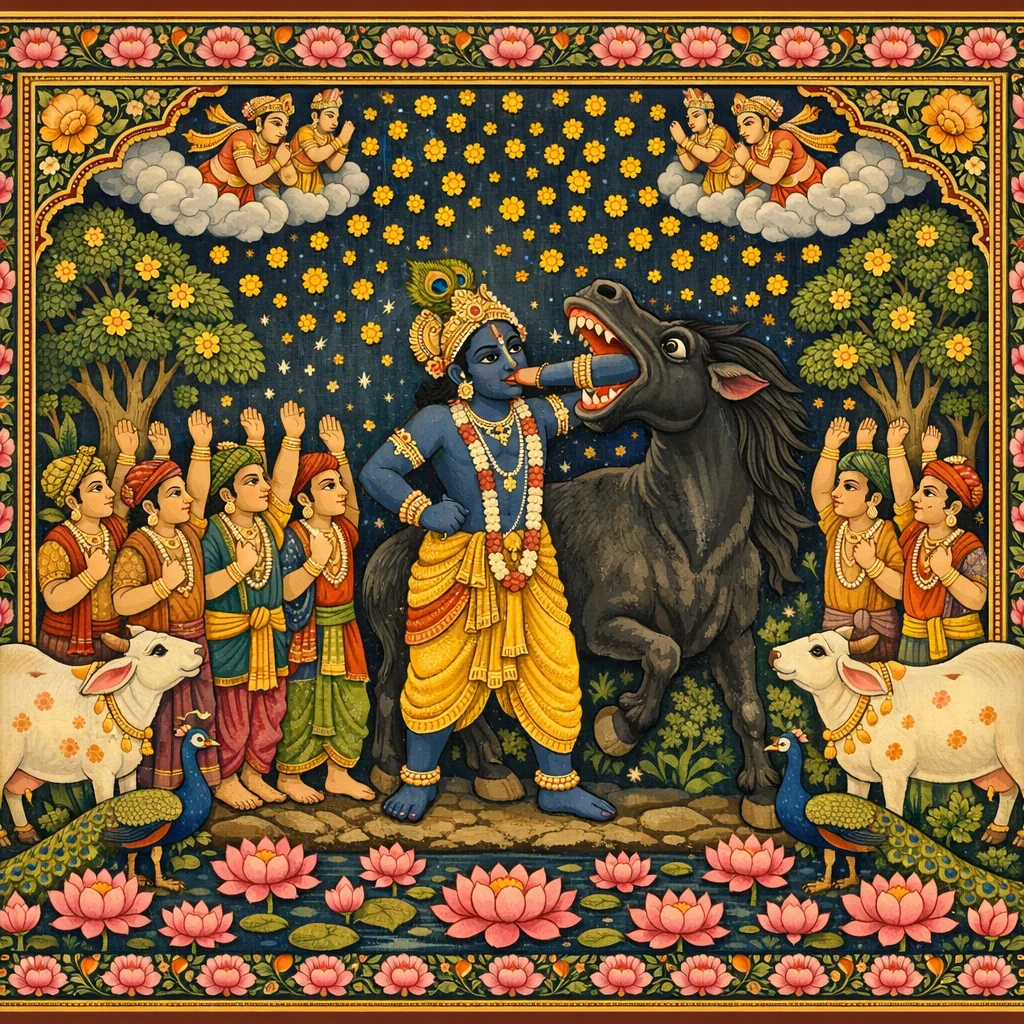
As Kaṁsa’s campaign against Vraja continues, the horse-demon Keśī storms into Vṛndāvana, terrifying the residents with violent speed and cosmic-scale disruption. Kṛṣṇa confronts him directly: after evading Keśī’s strike and hurling him away, the Lord ends the battle by thrusting His arm into the demon’s mouth; the arm expands, choking Keśī and killing him—an emblem of Bhagavān’s effortless sovereignty and poṣaṇa for Vraja. The devas shower flowers, and Kṛṣṇa accepts worship without pride. Immediately after, Nārada Muni meets Kṛṣṇa privately and offers a concentrated theological stuti: Kṛṣṇa as the indwelling witness (antaryāmī), the controller beyond guṇas, and the cosmic creator who has descended to destroy demonic kings and protect the godly. Nārada then prophetically previews upcoming līlās—Kaṁsa’s death, later demon slayings, Dvārakā exploits, and the Kurukṣetra role—bridging Vraja to Mathurā and beyond. Returning to pastoral play, Kṛṣṇa rescues cowherd boys abducted by the magician-demon Vyomāsura, killing him and freeing the captives, setting a tone of escalating threats before the imminent Mathurā climax.
Shlokas
Verse 1
श्रीशुक उवाच केशी तु कंसप्रहित: खुरैर्महीं महाहयो निर्जरयन् मनोजव: । सटावधूताभ्रविमानसङ्कुलं कुर्वन् नभो हेषितभीषिताखिल: ॥ १ ॥ तं त्रासयन्तं भगवान् स्वगोकुलं तद्धेषितैर्वालविघूर्णिताम्बुदम् । आत्मानमाजौ मृगयन्तमग्रणी- रुपाह्वयत् स व्यनदन्मृगेन्द्रवत् ॥ २ ॥
Śukadeva Gosvāmī said: The demon Keśī, sent by Kaṁsa, appeared in Vraja as a great horse. Running with the speed of the mind, he tore up the earth with his hooves. The hairs of his mane scattered the clouds and the demigods’ airplanes throughout the sky, and he terrified everyone present with his loud neighing.
Verse 2
श्रीशुक उवाच केशी तु कंसप्रहित: खुरैर्महीं महाहयो निर्जरयन् मनोजव: । सटावधूताभ्रविमानसङ्कुलं कुर्वन् नभो हेषितभीषिताखिल: ॥ १ ॥ तं त्रासयन्तं भगवान् स्वगोकुलं तद्धेषितैर्वालविघूर्णिताम्बुदम् । आत्मानमाजौ मृगयन्तमग्रणी- रुपाह्वयत् स व्यनदन्मृगेन्द्रवत् ॥ २ ॥
Śukadeva Gosvāmī said: The demon Keśī, sent by Kaṁsa, appeared in Vraja as a great horse. Running with the speed of the mind, he tore up the earth with his hooves. The hairs of his mane scattered the clouds and the demigods’ airplanes throughout the sky, and he terrified everyone present with his loud neighing.
Verse 3
स तं निशाम्याभिमुखो मुखेन खं पिबन्निवाभ्यद्रवदत्यमर्षण: । जघान पद्भ्यामरविन्दलोचनं दुरासदश्चण्डजवो दुरत्यय: ॥ ३ ॥
Seeing the Lord standing before him, Keśī ran toward Him in extreme rage, his mouth gaping as if to swallow up the sky. Rushing with furious speed, the unconquerable and unapproachable horse demon tried to strike the lotus-eyed Lord with his two front legs.
Verse 4
तद् वञ्चयित्वा तमधोक्षजो रुषा प्रगृह्य दोर्भ्यां परिविध्य पादयो: । सावज्ञमुत्सृज्य धनु:शतान्तरे यथोरगं तार्क्ष्यसुतो व्यवस्थित: ॥ ४ ॥
But the transcendental Lord dodged Keśī’s blow and then with His arms angrily seized the demon by the legs, whirled him around in the air and contemptuously threw him the distance of one hundred bow-lengths, just as Garuḍa might throw a snake. Lord Kṛṣṇa then stood there.
Verse 5
स: लब्धसंज्ञ: पुनरुत्थितो रुषा व्यादाय केशी तरसापतद्धरिम् । सोऽप्यस्य वक्त्रे भुजमुत्तरं स्मयन् प्रवेशयामास यथोरगं बिले ॥ ५ ॥
Upon regaining consciousness Keśī angrily got up, opened his mouth wide and again rushed to attack Lord Kṛṣṇa. But the Lord just smiled and thrust His left arm into the horse’s mouth as easily as one would make a snake enter a hole in the ground.
Verse 6
दन्ता निपेतुर्भगवद्भुजस्पृश- स्ते केशिनस्तप्तमयस्पृशो यथा । बाहुश्च तद्देहगतो महात्मनो यथामय: संववृधे उपेक्षित: ॥ ६ ॥
Keśī’s teeth immediately fell out when they touched the Supreme Lord’s arm, which to the demon felt as hot as molten iron. Within Keśī’s body the Supreme Personality’s arm then expanded greatly, like a diseased stomach swelling because of neglect.
Verse 7
समेधमानेन स कृष्णबाहुना निरुद्धवायुश्चरणांश्च विक्षिपन् । प्रस्विन्नगात्र: परिवृत्तलोचन: पपात लण्डं विसृजन् क्षितौ व्यसु: ॥ ७ ॥
As Lord Kṛṣṇa’s expanding arm completely blocked Keśī’s breathing, his legs kicked convulsively, his body became covered with sweat, and his eyes rolled around. The demon then passed stool and fell on the ground, dead.
Verse 8
तद्देहत: कर्कटिकाफलोपमाद् व्यसोरपाकृष्य भुजं महाभुज: । अविस्मितोऽयत्नहतारिक: सुरै: प्रसूनवर्षैर्वर्षद्भिरीडित: ॥ ८ ॥
The mighty-armed Kṛṣṇa withdrew His arm from Keśī’s body, which now appeared like a long karkaṭikā fruit. Without the least display of pride at having so effortlessly killed His enemy, the Lord accepted the demigods’ worship in the form of flowers rained down from above.
Verse 9
देवर्षिरुपसङ्गम्य भागवतप्रवरो नृप । कृष्णमक्लिष्टकर्माणं रहस्येतदभाषत ॥ ९ ॥
My dear King, thereafter Lord Kṛṣṇa was approached in a solitary place by the great sage among the demigods, Nārada Muni. That most exalted devotee spoke as follows to the Lord, who effortlessly performs His pastimes.
Verse 10
कृष्ण कृष्णाप्रमेयात्मन् योगेश जगदीश्वर । वासुदेवाखिलावास सात्वतां प्रवर प्रभो ॥ १० ॥ त्वमात्मा सर्वभूतानामेको ज्योतिरिवैधसाम् । गूढो गुहाशय: साक्षी महापुरुष ईश्वर: ॥ ११ ॥
[Nārada Muni said:] O Kṛṣṇa, Kṛṣṇa, unlimited Lord, source of all mystic power, Lord of the universe! O Vāsudeva, shelter of all beings and best of the Yadus! O master, You are the Supreme Soul of all created beings, sitting unseen within the cave of the heart like the fire dormant within kindling wood. You are the witness within everyone, the Supreme Personality and the ultimate controlling Deity.
Verse 11
कृष्ण कृष्णाप्रमेयात्मन् योगेश जगदीश्वर । वासुदेवाखिलावास सात्वतां प्रवर प्रभो ॥ १० ॥ त्वमात्मा सर्वभूतानामेको ज्योतिरिवैधसाम् । गूढो गुहाशय: साक्षी महापुरुष ईश्वर: ॥ ११ ॥
[Nārada Muni said:] O Kṛṣṇa, Kṛṣṇa, unlimited Lord, source of all mystic power, Lord of the universe! O Vāsudeva, shelter of all beings and best of the Yadus! O master, You are the Supreme Soul of all created beings, sitting unseen within the cave of the heart like the fire dormant within kindling wood. You are the witness within everyone, the Supreme Personality and the ultimate controlling Deity.
Verse 12
आत्मनात्माश्रय: पूर्वं मायया ससृजे गुणान् । तैरिदं सत्यसङ्कल्प: सृजस्यत्स्यवसीश्वर: ॥ १२ ॥
You are the shelter of all souls, and being the supreme controller, You fulfill Your desires simply by Your will. By Your personal creative potency You manifested in the beginning the primal modes of material nature, and through their agency You create, maintain and then destroy this universe.
Verse 13
स त्वं भूधरभूतानां दैत्यप्रमथरक्षसाम् । अवतीर्णो विनाशाय साधुनां रक्षणाय च ॥ १३ ॥
You, that very same creator, have now descended to the earth to annihilate the Daitya, Pramatha and Rākṣasa demons who are posing as kings, and also to protect the godly.
Verse 14
दिष्ट्या ते निहतो दैत्यो लीलयायं हयाकृति: । यस्य हेषितसन्त्रस्तास्त्यजन्त्यनिमिषा दिवम् ॥ १४ ॥
The horse demon was so terrifying that his neighing frightened the demigods into leaving their heavenly kingdom. But by our good fortune You have enjoyed the sport of killing him.
Verse 15
चाणूरं मुष्टिकं चैव मल्लानन्यांश्च हस्तिनम् । कंसं च निहतं द्रक्ष्ये परश्वोऽहनि ते विभो ॥ १५ ॥ तस्यानु शङ्खयवनमुराणां नरकस्य च । पारिजातापहरणमिन्द्रस्य च पराजयम् ॥ १६ ॥ उद्वाहं वीरकन्यानां वीर्यशुल्कादिलक्षणम् । नृगस्य मोक्षणं शापाद्द्वारकायां जगत्पते ॥ १७ ॥ स्यमन्तकस्य च मणेरादानं सह भार्यया । मृतपुत्रप्रदानं च ब्राह्मणस्य स्वधामत: ॥ १८ ॥ पौण्ड्रकस्य वधं पश्चात् काशिपुर्याश्च दीपनम् । दन्तवक्रस्य निधनं चैद्यस्य च महाक्रतौ ॥ १९ ॥ यानि चान्यानि वीर्याणि द्वारकामावसन्भवान् । कर्ता द्रक्ष्याम्यहं तानि गेयानि कविभिर्भुवि ॥ २० ॥
In just two days, O almighty Lord, I will see the deaths of Cāṇūra, Muṣṭika and other wrestlers, along with those of the elephant Kuvalayāpīḍa and King Kaṁsa — all by Your hand. Then I will see You kill Kālayavana, Mura, Naraka and the conch demon, and I will also see You steal the pārijāta flower and defeat Indra. I will then see You marry many daughters of heroic kings after paying for them with Your valor. Then, O Lord of the universe, in Dvārakā You will deliver King Nṛga from a curse and take for Yourself the Syamantaka jewel, together with another wife. You will bring back a brāhmaṇa’s dead son from the abode of Your servant Yamarāja, and thereafter You will kill Pauṇḍraka, burn down the city of Kāśī and slay Dantavakra, and You will also put an end to the King of Cedi during the great Rājasūya sacrifice. I shall see all these heroic pastimes, along with many others You will perform during Your residence in Dvārakā. These pastimes are glorified on this earth in the songs of transcendental poets.
Verse 16
चाणूरं मुष्टिकं चैव मल्लानन्यांश्च हस्तिनम् । कंसं च निहतं द्रक्ष्ये परश्वोऽहनि ते विभो ॥ १५ ॥ तस्यानु शङ्खयवनमुराणां नरकस्य च । पारिजातापहरणमिन्द्रस्य च पराजयम् ॥ १६ ॥ उद्वाहं वीरकन्यानां वीर्यशुल्कादिलक्षणम् । नृगस्य मोक्षणं शापाद्द्वारकायां जगत्पते ॥ १७ ॥ स्यमन्तकस्य च मणेरादानं सह भार्यया । मृतपुत्रप्रदानं च ब्राह्मणस्य स्वधामत: ॥ १८ ॥ पौण्ड्रकस्य वधं पश्चात् काशिपुर्याश्च दीपनम् । दन्तवक्रस्य निधनं चैद्यस्य च महाक्रतौ ॥ १९ ॥ यानि चान्यानि वीर्याणि द्वारकामावसन्भवान् । कर्ता द्रक्ष्याम्यहं तानि गेयानि कविभिर्भुवि ॥ २० ॥
In just two days, O almighty Lord, I will see the deaths of Cāṇūra, Muṣṭika and other wrestlers, along with those of the elephant Kuvalayāpīḍa and King Kaṁsa — all by Your hand. Then I will see You kill Kālayavana, Mura, Naraka and the conch demon, and I will also see You steal the pārijāta flower and defeat Indra. I will then see You marry many daughters of heroic kings after paying for them with Your valor. Then, O Lord of the universe, in Dvārakā You will deliver King Nṛga from a curse and take for Yourself the Syamantaka jewel, together with another wife. You will bring back a brāhmaṇa’s dead son from the abode of Your servant Yamarāja, and thereafter You will kill Pauṇḍraka, burn down the city of Kāśī and slay Dantavakra, and You will also put an end to the King of Cedi during the great Rājasūya sacrifice. I shall see all these heroic pastimes, along with many others You will perform during Your residence in Dvārakā. These pastimes are glorified on this earth in the songs of transcendental poets.
Verse 17
चाणूरं मुष्टिकं चैव मल्लानन्यांश्च हस्तिनम् । कंसं च निहतं द्रक्ष्ये परश्वोऽहनि ते विभो ॥ १५ ॥ तस्यानु शङ्खयवनमुराणां नरकस्य च । पारिजातापहरणमिन्द्रस्य च पराजयम् ॥ १६ ॥ उद्वाहं वीरकन्यानां वीर्यशुल्कादिलक्षणम् । नृगस्य मोक्षणं शापाद्द्वारकायां जगत्पते ॥ १७ ॥ स्यमन्तकस्य च मणेरादानं सह भार्यया । मृतपुत्रप्रदानं च ब्राह्मणस्य स्वधामत: ॥ १८ ॥ पौण्ड्रकस्य वधं पश्चात् काशिपुर्याश्च दीपनम् । दन्तवक्रस्य निधनं चैद्यस्य च महाक्रतौ ॥ १९ ॥ यानि चान्यानि वीर्याणि द्वारकामावसन्भवान् । कर्ता द्रक्ष्याम्यहं तानि गेयानि कविभिर्भुवि ॥ २० ॥
In just two days, O almighty Lord, I will see the deaths of Cāṇūra, Muṣṭika and other wrestlers, along with those of the elephant Kuvalayāpīḍa and King Kaṁsa — all by Your hand. Then I will see You kill Kālayavana, Mura, Naraka and the conch demon, and I will also see You steal the pārijāta flower and defeat Indra. I will then see You marry many daughters of heroic kings after paying for them with Your valor. Then, O Lord of the universe, in Dvārakā You will deliver King Nṛga from a curse and take for Yourself the Syamantaka jewel, together with another wife. You will bring back a brāhmaṇa’s dead son from the abode of Your servant Yamarāja, and thereafter You will kill Pauṇḍraka, burn down the city of Kāśī and slay Dantavakra, and You will also put an end to the King of Cedi during the great Rājasūya sacrifice. I shall see all these heroic pastimes, along with many others You will perform during Your residence in Dvārakā. These pastimes are glorified on this earth in the songs of transcendental poets.
Verse 18
चाणूरं मुष्टिकं चैव मल्लानन्यांश्च हस्तिनम् । कंसं च निहतं द्रक्ष्ये परश्वोऽहनि ते विभो ॥ १५ ॥ तस्यानु शङ्खयवनमुराणां नरकस्य च । पारिजातापहरणमिन्द्रस्य च पराजयम् ॥ १६ ॥ उद्वाहं वीरकन्यानां वीर्यशुल्कादिलक्षणम् । नृगस्य मोक्षणं शापाद्द्वारकायां जगत्पते ॥ १७ ॥ स्यमन्तकस्य च मणेरादानं सह भार्यया । मृतपुत्रप्रदानं च ब्राह्मणस्य स्वधामत: ॥ १८ ॥ पौण्ड्रकस्य वधं पश्चात् काशिपुर्याश्च दीपनम् । दन्तवक्रस्य निधनं चैद्यस्य च महाक्रतौ ॥ १९ ॥ यानि चान्यानि वीर्याणि द्वारकामावसन्भवान् । कर्ता द्रक्ष्याम्यहं तानि गेयानि कविभिर्भुवि ॥ २० ॥
In just two days, O almighty Lord, I will see the deaths of Cāṇūra, Muṣṭika and other wrestlers, along with those of the elephant Kuvalayāpīḍa and King Kaṁsa — all by Your hand. Then I will see You kill Kālayavana, Mura, Naraka and the conch demon, and I will also see You steal the pārijāta flower and defeat Indra. I will then see You marry many daughters of heroic kings after paying for them with Your valor. Then, O Lord of the universe, in Dvārakā You will deliver King Nṛga from a curse and take for Yourself the Syamantaka jewel, together with another wife. You will bring back a brāhmaṇa’s dead son from the abode of Your servant Yamarāja, and thereafter You will kill Pauṇḍraka, burn down the city of Kāśī and slay Dantavakra, and You will also put an end to the King of Cedi during the great Rājasūya sacrifice. I shall see all these heroic pastimes, along with many others You will perform during Your residence in Dvārakā. These pastimes are glorified on this earth in the songs of transcendental poets.
Verse 19
चाणूरं मुष्टिकं चैव मल्लानन्यांश्च हस्तिनम् । कंसं च निहतं द्रक्ष्ये परश्वोऽहनि ते विभो ॥ १५ ॥ तस्यानु शङ्खयवनमुराणां नरकस्य च । पारिजातापहरणमिन्द्रस्य च पराजयम् ॥ १६ ॥ उद्वाहं वीरकन्यानां वीर्यशुल्कादिलक्षणम् । नृगस्य मोक्षणं शापाद्द्वारकायां जगत्पते ॥ १७ ॥ स्यमन्तकस्य च मणेरादानं सह भार्यया । मृतपुत्रप्रदानं च ब्राह्मणस्य स्वधामत: ॥ १८ ॥ पौण्ड्रकस्य वधं पश्चात् काशिपुर्याश्च दीपनम् । दन्तवक्रस्य निधनं चैद्यस्य च महाक्रतौ ॥ १९ ॥ यानि चान्यानि वीर्याणि द्वारकामावसन्भवान् । कर्ता द्रक्ष्याम्यहं तानि गेयानि कविभिर्भुवि ॥ २० ॥
In just two days, O almighty Lord, I will see the deaths of Cāṇūra, Muṣṭika and other wrestlers, along with those of the elephant Kuvalayāpīḍa and King Kaṁsa — all by Your hand. Then I will see You kill Kālayavana, Mura, Naraka and the conch demon, and I will also see You steal the pārijāta flower and defeat Indra. I will then see You marry many daughters of heroic kings after paying for them with Your valor. Then, O Lord of the universe, in Dvārakā You will deliver King Nṛga from a curse and take for Yourself the Syamantaka jewel, together with another wife. You will bring back a brāhmaṇa’s dead son from the abode of Your servant Yamarāja, and thereafter You will kill Pauṇḍraka, burn down the city of Kāśī and slay Dantavakra, and You will also put an end to the King of Cedi during the great Rājasūya sacrifice. I shall see all these heroic pastimes, along with many others You will perform during Your residence in Dvārakā. These pastimes are glorified on this earth in the songs of transcendental poets.
Verse 20
चाणूरं मुष्टिकं चैव मल्लानन्यांश्च हस्तिनम् । कंसं च निहतं द्रक्ष्ये परश्वोऽहनि ते विभो ॥ १५ ॥ तस्यानु शङ्खयवनमुराणां नरकस्य च । पारिजातापहरणमिन्द्रस्य च पराजयम् ॥ १६ ॥ उद्वाहं वीरकन्यानां वीर्यशुल्कादिलक्षणम् । नृगस्य मोक्षणं शापाद्द्वारकायां जगत्पते ॥ १७ ॥ स्यमन्तकस्य च मणेरादानं सह भार्यया । मृतपुत्रप्रदानं च ब्राह्मणस्य स्वधामत: ॥ १८ ॥ पौण्ड्रकस्य वधं पश्चात् काशिपुर्याश्च दीपनम् । दन्तवक्रस्य निधनं चैद्यस्य च महाक्रतौ ॥ १९ ॥ यानि चान्यानि वीर्याणि द्वारकामावसन्भवान् । कर्ता द्रक्ष्याम्यहं तानि गेयानि कविभिर्भुवि ॥ २० ॥
In just two days, O almighty Lord, I will see the deaths of Cāṇūra, Muṣṭika and other wrestlers, along with those of the elephant Kuvalayāpīḍa and King Kaṁsa — all by Your hand. Then I will see You kill Kālayavana, Mura, Naraka and the conch demon, and I will also see You steal the pārijāta flower and defeat Indra. I will then see You marry many daughters of heroic kings after paying for them with Your valor. Then, O Lord of the universe, in Dvārakā You will deliver King Nṛga from a curse and take for Yourself the Syamantaka jewel, together with another wife. You will bring back a brāhmaṇa’s dead son from the abode of Your servant Yamarāja, and thereafter You will kill Pauṇḍraka, burn down the city of Kāśī and slay Dantavakra, and You will also put an end to the King of Cedi during the great Rājasūya sacrifice. I shall see all these heroic pastimes, along with many others You will perform during Your residence in Dvārakā. These pastimes are glorified on this earth in the songs of transcendental poets.
Verse 21
अथ ते कालरूपस्य क्षपयिष्णोरमुष्य वै । अक्षौहिणीनां निधनं द्रक्ष्याम्यर्जुनसारथे: ॥ २१ ॥
Subsequently I will see You appear as time personified, serving as Arjuna’s chariot driver and destroying entire armies of soldiers to rid the earth of her burden.
Verse 22
विशुद्धविज्ञानघनं स्वसंस्थया समाप्तसर्वार्थममोघवाञ्छितम् । स्वतेजसा नित्यनिवृत्तमाया- गुणप्रवाहं भगवन्तमीमहि ॥ २२ ॥
Let us approach You, the Supreme Personality of Godhead, for shelter. You are full of perfectly pure spiritual awareness and are always situated in Your original identity. Since Your will is never thwarted, You have already achieved all possible desirable things, and by the power of Your spiritual energy You remain eternally aloof from the flow of the qualities of illusion.
Verse 23
त्वामीश्वरं स्वाश्रयमात्ममायया विनिर्मिताशेषविशेषकल्पनम् । क्रीडार्थमद्यात्तमनुष्यविग्रहं नतोऽस्मि धुर्यं यदुवृष्णिसात्वताम् ॥ २३ ॥
I bow down to You, the supreme controller, who are dependent only on Yourself. By Your potency You have constructed the unlimited particular arrangements of this universe. Now you have appeared as the greatest hero among the Yadus, Vṛṣṇis and Sātvatas and have chosen to participate in human warfare.
Verse 24
श्रीशुक उवाच एवं यदुपतिं कृष्णं भागवतप्रवरो मुनि: । प्रणिपत्याभ्यनुज्ञातो ययौ तद्दर्शनोत्सव: ॥ २४ ॥
Śukadeva Gosvāmī said: Having thus addressed Lord Kṛṣṇa, the chief of the Yadu dynasty, Nārada bowed down and offered Him obeisances. Then that great sage and most eminent devotee took his leave from the Lord and went away, feeling great joy at having directly seen Him.
Verse 25
भगवानपि गोविन्दो हत्वा केशिनमाहवे । पशूनपालयत् पालै: प्रीतैर्व्रजसुखावह: ॥ २५ ॥
After killing the demon Keśī in battle, the Supreme Personality of Godhead continued to tend the cows and other animals in the company of His joyful cowherd boyfriends. Thus He brought happiness to all the residents of Vṛndāvana.
Verse 26
एकदा ते पशून्पालाश्चारयन्तोऽद्रिसानुषु । चक्रुर्निलायनक्रीडाश्चोरपालापदेशत: ॥ २६ ॥
One day the cowherd boys, while grazing their animals on the mountain slopes, played the game of stealing and hiding, acting out the roles of rival thieves and herders.
Verse 27
तत्रासन् कतिचिच्चोरा: पालाश्च कतिचिन्नृप । मेषायिताश्च तत्रैके विजह्रुरकुतोभया: ॥ २७ ॥
In that game, O King, some acted as thieves, others as shepherds and others as sheep. They played their game happily, without fear of danger.
Verse 28
मयपुत्रो महामायो व्योमो गोपालवेषधृक् । मेषायितानपोवाह प्रायश्चोरायितो बहून् ॥ २८ ॥
A powerful magician named Vyoma, son of the demon Maya, then appeared on the scene in the guise of a cowherd boy. Pretending to join the game as a thief, he proceeded to steal most of the cowherd boys who were acting as sheep.
Verse 29
गिरिदर्यां विनिक्षिप्य नीतं नीतं महासुर: । शिलया पिदधे द्वारं चतु:पञ्चावशेषिता: ॥ २९ ॥
Gradually the great demon abducted more and more of the cowherd boys and cast them into a mountain cave, which he sealed shut with a boulder. Finally only four or five boys acting as sheep remained in the game.
Verse 30
तस्य तत् कर्म विज्ञाय कृष्ण: शरणद: सताम् । गोपान् नयन्तं जग्राह वृकं हरिरिवौजसा ॥ ३० ॥
Lord Kṛṣṇa, who shelters all saintly devotees, understood perfectly well what Vyomāsura was doing. Just as a lion grabs a wolf, Kṛṣṇa forcefully seized the demon as he was taking away more cowherd boys.
Verse 31
स निजं रूपमास्थाय गिरीन्द्रसदृशं बली । इच्छन्विमोक्तुमात्मानं नाशक्नोद्ग्रहणातुर: ॥ ३१ ॥
The demon changed into his original form, as big and powerful as a great mountain. But try as he might to free himself, he could not do so, having lost his strength from being held in the Lord’s tight grip.
Verse 32
तं निगृह्याच्युतो दोर्भ्यां पातयित्वा महीतले । पश्यतां दिवि देवानां पशुमारममारयत् ॥ ३२ ॥
Lord Acyuta clutched Vyomāsura between His arms and threw him to the ground. Then, while the demigods in heaven looked on, Kṛṣṇa killed him in the same way that one kills a sacrificial animal.
Verse 33
गुहापिधानं निर्भिद्य गोपान्नि:सार्य कृच्छ्रत: । स्तूयमान: सुरैर्गोपै: प्रविवेश स्वगोकुलम् ॥ ३३ ॥
Kṛṣṇa then smashed the boulder blocking the cave’s entrance and led the trapped cowherd boys to safety. Thereafter, as the demigods and cowherd boys sang His glories, He returned to His cowherd village, Gokula.
Frequently Asked Questions
Kaṁsa’s strategy is to eliminate Kṛṣṇa by escalating demonic assaults on Vraja. Keśī, appearing as a monstrous horse, represents violent, uncontrolled force and terror aimed at disrupting the Lord’s pastoral domain. In bhakti exegesis, such demons often embody obstructive tendencies (fear, aggression, arrogance) that threaten devotional life; Kṛṣṇa’s victory signals the Lord’s poṣaṇa—His decisive protection of His devotees and His līlā’s capacity to dissolve fear.
Kṛṣṇa thrust His arm into Keśī’s mouth; to the demon it felt like molten iron, and the arm expanded within, blocking breath until Keśī died. Theologically, the episode emphasizes Bhagavān’s acintya-śakti (inconceivable power): the Lord’s body is spiritual, not subject to material limits, and He defeats adharma effortlessly. The expansion motif also signals that the finite cannot ‘contain’ the Infinite—hostility toward the Supreme collapses under the Supreme’s own presence.
Vyomāsura is a powerful magician, son of the demon Maya, who infiltrates the boys’ play disguised as a cowherd. He abducts the boys and seals them in a cave, exploiting innocence and social trust. The lesson is twofold: (1) līlā shows that threats can arise even amid ordinary joy, and (2) Kṛṣṇa, as the shelter of devotees, perceives hidden danger and rescues the vulnerable, reaffirming poṣaṇa and the Lord’s vigilance over His community.
Nārada’s visit functions as a theological hinge: after an outward display of divine heroism, the sage articulates the inward metaphysics—Kṛṣṇa as antaryāmī, supreme controller, and creator beyond māyā’s guṇas. It also serves narrative architecture: Nārada’s prophecy links the Vraja cycle to imminent Mathurā events (wrestlers, Kuvalayāpīḍa, Kaṁsa) and future Dvārakā and Kurukṣetra līlās, mapping Kṛṣṇa’s avatāra-kārya across the Purāṇa.