Adhyaya 81
Sudāmā Brāhmaṇa Receives Kṛṣṇa’s Mercy (The Gift of Flat Rice)
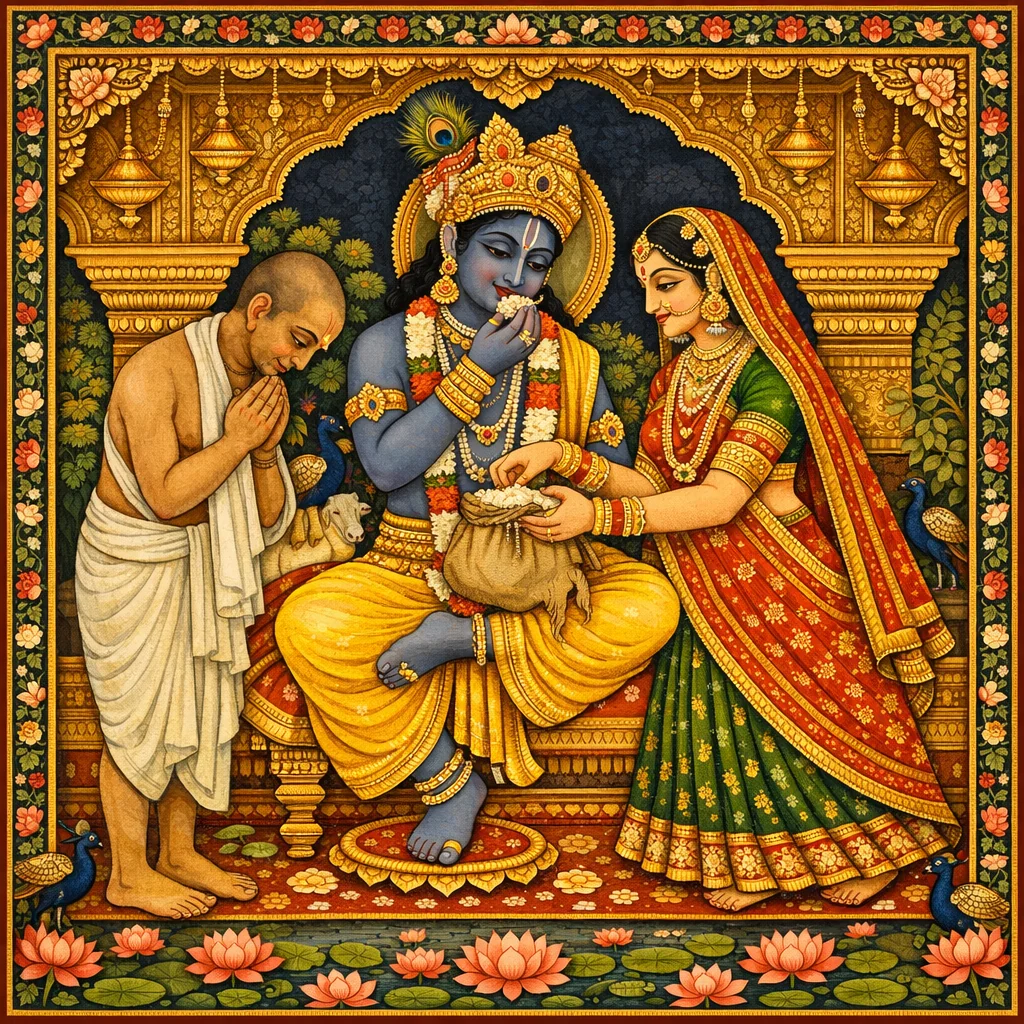
Continuing the Sudāmā episode from the preceding chapter—where the impoverished brāhmaṇa friend reaches Dvārakā and is honorably received—this adhyāya centers on Kṛṣṇa’s heart-reading compassion and the theology of devotional offering. Kṛṣṇa playfully asks what gift Sudāmā has brought, teaching that He accepts even a leaf, flower, fruit, or water when offered with love, while loveless grandeur fails to please Him. Sudāmā, embarrassed, hesitates; Kṛṣṇa Himself seizes the tied cloth of flat rice and tastes it, declaring it satisfies the universe. Rukmiṇī restrains Him, indicating one palmful is sufficient to grant immeasurable prosperity. Sudāmā returns home apparently empty-handed yet inwardly fulfilled; he reflects on Kṛṣṇa’s humility and worries wealth could cause forgetfulness. On arrival, he discovers his hut transformed into celestial opulence—an unasked benediction. He interprets this as Kṛṣṇa’s merciful glance, resolves to remain free from greed, and enjoys without attachment, aiming for renunciation. The chapter concludes with the principle that the unconquerable Lord is conquered by His servants, and hearing this narrative awakens love and frees one from karma-bandha. This sets the progression toward further Dvārakā-centered teachings on devotion, prosperity, and detachment.
Shlokas
Verse 1
श्रीशुक उवाच स इत्थं द्विजमुख्येन सह सङ्कथयन् हरि: । सर्वभूतमनोऽभिज्ञ: स्मयमान उवाच तम् ॥ १ ॥ ब्रह्मण्यो ब्राह्मणं कृष्णो भगवान् प्रहसन् प्रियम् । प्रेम्णा निरीक्षणेनैव प्रेक्षन् खलु सतां गति: ॥ २ ॥
[Śukadeva Gosvāmī said:] Lord Hari, Kṛṣṇa, perfectly knows the hearts of all living beings, and He is especially devoted to the brāhmaṇas. While the Supreme Lord, the goal of all saintly persons, conversed in this way with the best of the twice-born, He laughed and spoke the following words to that dear friend of His, the brāhmaṇa Sudāmā, all the while smiling and looking upon him with affection.
Verse 2
श्रीशुक उवाच स इत्थं द्विजमुख्येन सह सङ्कथयन् हरि: । सर्वभूतमनोऽभिज्ञ: स्मयमान उवाच तम् ॥ १ ॥ ब्रह्मण्यो ब्राह्मणं कृष्णो भगवान् प्रहसन् प्रियम् । प्रेम्णा निरीक्षणेनैव प्रेक्षन् खलु सतां गति: ॥ २ ॥
[Śukadeva Gosvāmī said:] Lord Hari, Kṛṣṇa, perfectly knows the hearts of all living beings, and He is especially devoted to the brāhmaṇas. While the Supreme Lord, the goal of all saintly persons, conversed in this way with the best of the twice-born, He laughed and spoke the following words to that dear friend of His, the brāhmaṇa Sudāmā, all the while smiling and looking upon him with affection.
Verse 3
श्रीभगवानुवाच किमुपायनमानीतं ब्रह्मन् मे भवता गृहात् । अण्वप्युपाहृतं भक्तै: प्रेम्णा भूर्येव मे भवेत् । भूर्यप्यभक्तोपहृतं न मे तोषाय कल्पते ॥ ३ ॥
The Supreme Lord said: O brāhmaṇa, what gift have you brought Me from home? I regard as great even the smallest gift offered by My devotees in pure love, but even great offerings presented by nondevotees do not please Me.
Verse 4
पत्रं पुष्पं फलं तोयं यो मे भक्त्या प्रयच्छति । तदहं भक्त्युपहृतमश्नामि प्रयतात्मन: ॥ ४ ॥
If one offers Me with love and devotion a leaf, a flower, a fruit or water, I will accept it.
Verse 5
इत्युक्तोऽपि द्वियस्तस्मै व्रीडित: पतये श्रिय: । पृथुकप्रसृतिं राजन् न प्रायच्छदवाङ्मुख: ॥ ५ ॥
[Śukadeva Gosvāmī continued:] Even after being addressed in this way, O King, the brāhmaṇa felt too embarrassed to offer his palmfuls of flat rice to the husband of the goddess of fortune. He simply kept his head bowed in shame.
Verse 6
सर्वभूतात्मदृक् साक्षात् तस्यागमनकारणम् । विज्ञायाचिन्तयन्नायं श्रीकामो माभजत्पुरा ॥ ६ ॥ पत्न्या: पतिव्रतायास्तु सखा प्रियचिकीर्षया । प्राप्तो मामस्य दास्यामि सम्पदोऽमर्त्यदुर्लभा: ॥ ७ ॥
Being the direct witness in the hearts of all living beings, Lord Kṛṣṇa fully understood why Sudāmā had come to see Him. Thus He thought, “In the past My friend has never worshiped Me out of a desire for material opulence, but now he comes to Me to satisfy his chaste and devoted wife. I will give him riches that even the immortal demigods cannot obtain.”
Verse 7
सर्वभूतात्मदृक् साक्षात् तस्यागमनकारणम् । विज्ञायाचिन्तयन्नायं श्रीकामो माभजत्पुरा ॥ ६ ॥ पत्न्या: पतिव्रतायास्तु सखा प्रियचिकीर्षया । प्राप्तो मामस्य दास्यामि सम्पदोऽमर्त्यदुर्लभा: ॥ ७ ॥
Being the direct witness in the hearts of all living beings, Lord Kṛṣṇa fully understood why Sudāmā had come to see Him. Thus He thought, “In the past My friend has never worshiped Me out of a desire for material opulence, but now he comes to Me to satisfy his chaste and devoted wife. I will give him riches that even the immortal demigods cannot obtain.”
Verse 8
इत्थं विचिन्त्य वसनाच्चीरबद्धान्द्विजन्मन: । स्वयं जहार किमिदमिति पृथुकतण्डुलान् ॥ ८ ॥
Thinking like this, the Lord snatched from the brāhmaṇa’s garment the grains of flat rice tied up in an old piece of cloth and exclaimed, “What is this?
Verse 9
नन्वेतदुपनीतं मे परमप्रीणनं सखे । तर्पयन्त्यङ्ग मां विश्वमेते पृथुकतण्डुला: ॥ ९ ॥
“My friend, have You brought this for Me? It gives Me extreme pleasure. Indeed, these few grains of flat rice will satisfy not only Me but also the entire universe.”
Verse 10
इति मुष्टिं सकृज्जग्ध्वा द्वितीयां जग्धुमाददे । तावच्छ्रीर्जगृहे हस्तं तत्परा परमेष्ठिन: ॥ १० ॥
After saying this, the Supreme Lord ate one palmful and was about to eat a second when the devoted goddess Rukmiṇī took hold of His hand.
Verse 11
एतावतालं विश्वात्मन् सर्वसम्पत्समृद्धये । अस्मिन्लोकेऽथवामुष्मिन् पुंसस्त्वत्तोषकारणम् ॥ ११ ॥
[Queen Rukmiṇī said:] This is more than enough, O Soul of the universe, to secure him an abundance of all kinds of wealth in this world and the next. After all, one’s prosperity depends simply on Your satisfaction.
Verse 12
ब्राह्मणस्तां तु रजनीमुषित्वाच्युतमन्दिरे । भुक्त्वा पीत्वा सुखं मेने आत्मानं स्वर्गतं यथा ॥ १२ ॥
[Śukadeva Gosvāmī continued:] The brāhmaṇa spent that night in Lord Acyuta’s palace after eating and drinking to his full satisfaction. He felt as if he had gone to the spiritual world.
Verse 13
श्वोभूते विश्वभावेन स्वसुखेनाभिवन्दित: । जगाम स्वालयं तात पथ्यनुव्रज्य नन्दित: ॥ १३ ॥
The next day, Sudāmā set off for home while being honored by Lord Kṛṣṇa, the self-satisfied maintainer of the universe. The brāhmaṇa felt greatly delighted, my dear King, as he walked along the road.
Verse 14
स चालब्ध्वा धनं कृष्णान्न तु याचितवान्स्वयम् । स्वगृहान् व्रीडितोऽगच्छन्महद्दर्शननिर्वृत: ॥ १४ ॥
Although he had apparently received no wealth from Lord Kṛṣṇa, Sudāmā was too shy to beg for it on his own. He simply returned home, feeling perfectly satisfied to have had the Supreme Lord’s audience.
Verse 15
अहो ब्रह्मण्यदेवस्य दृष्टा ब्रह्मण्यता मया । यद् दरिद्रतमो लक्ष्मीमाश्लिष्टो बिभ्रतोरसि ॥ १५ ॥
[Sudāmā thought:] Lord Kṛṣṇa is known to be devoted to the brāhmaṇas, and now I have personally seen this devotion. Indeed, He who carries the goddess of fortune on His chest has embraced the poorest beggar.
Verse 16
क्वाहं दरिद्र: पापीयान् क्व कृष्ण: श्रीनिकेतन: । ब्रह्मबन्धुरिति स्माहं बाहुभ्यां परिरम्भित: ॥ १६ ॥
Who am I? A sinful, poor friend of a brāhmaṇa. And who is Kṛṣṇa? The Supreme Personality of Godhead, full in six opulences. Nonetheless, He has embraced me with His two arms.
Verse 17
निवासित: प्रियाजुष्टे पर्यङ्के भ्रातरो यथा । महिष्या वीजित: श्रान्तो बालव्यजनहस्तया ॥ १७ ॥
He treated me just like one of His brothers, making me sit on the bed of His beloved consort. And because I was fatigued, His queen personally fanned me with a yak-tail cāmara.
Verse 18
शुश्रूषया परमया पादसंवाहनादिभि: । पूजितो देवदेवेन विप्रदेवेन देववत् ॥ १८ ॥
Although He is the Lord of all demigods and the object of worship for all brāhmaṇas, He worshiped me as if I were a demigod myself, massaging my feet and rendering other humble services.
Verse 19
स्वर्गापवर्गयो: पुंसां रसायां भुवि सम्पदाम् । सर्वासामपि सिद्धीनां मूलं तच्चरणार्चनम् ॥ १९ ॥
Devotional service to His lotus feet is the root cause of all the perfections a person can find in heaven, in liberation, in the subterranean regions and on earth.
Verse 20
अधनोऽयं धनं प्राप्य माद्यन्नुच्चैर्न मां स्मरेत् । इति कारुणिको नूनं धनं मेऽभूरि नाददात् ॥ २० ॥
Thinking “If this poor wretch suddenly becomes rich, he will forget Me in his intoxicating happiness,” the compassionate Lord did not grant me even a little wealth.
Verse 21
इति तच्चिन्तयन्नन्त: प्राप्तो निजगृहान्तिकम् । सूर्यानलेन्दुसङ्काशैर्विमानै: सर्वतो वृतम् ॥ २१ ॥ विचित्रोपवनोद्यानै: कूजद्द्विजकुलाकुलै: । प्रोत्फुल्लकमुदाम्भोजकह्लारोत्पलवारिभि: ॥ २२ ॥ जुष्टं स्वलङ्कृतै: पुम्भि: स्त्रीभिश्च हरिणाक्षिभि: । किमिदं कस्य वा स्थानं कथं तदिदमित्यभूत् ॥ २३ ॥
[Śukadeva Gosvāmī continued:] Thinking thus to himself, Sudāmā finally came to the place where his home stood. But that place was now crowded on all sides with towering, celestial palaces rivaling the combined brilliance of the sun, fire and the moon. There were splendorous courtyards and gardens, each filled with flocks of cooing birds and beautified by ponds in which kumuda, ambhoja, kahlāra and utpala lotuses grew. Finely attired men and doe-eyed women stood in attendance. Sudāmā wondered, “What is all this? Whose property is it? How has this all come about?”
Verse 22
इति तच्चिन्तयन्नन्त: प्राप्तो निजगृहान्तिकम् । सूर्यानलेन्दुसङ्काशैर्विमानै: सर्वतो वृतम् ॥ २१ ॥ विचित्रोपवनोद्यानै: कूजद्द्विजकुलाकुलै: । प्रोत्फुल्लकमुदाम्भोजकह्लारोत्पलवारिभि: ॥ २२ ॥ जुष्टं स्वलङ्कृतै: पुम्भि: स्त्रीभिश्च हरिणाक्षिभि: । किमिदं कस्य वा स्थानं कथं तदिदमित्यभूत् ॥ २३ ॥
[Śukadeva Gosvāmī continued:] Thinking thus to himself, Sudāmā finally came to the place where his home stood. But that place was now crowded on all sides with towering, celestial palaces rivaling the combined brilliance of the sun, fire and the moon. There were splendorous courtyards and gardens, each filled with flocks of cooing birds and beautified by ponds in which kumuda, ambhoja, kahlāra and utpala lotuses grew. Finely attired men and doe-eyed women stood in attendance. Sudāmā wondered, “What is all this? Whose property is it? How has this all come about?”
Verse 23
इति तच्चिन्तयन्नन्त: प्राप्तो निजगृहान्तिकम् । सूर्यानलेन्दुसङ्काशैर्विमानै: सर्वतो वृतम् ॥ २१ ॥ विचित्रोपवनोद्यानै: कूजद्द्विजकुलाकुलै: । प्रोत्फुल्लकमुदाम्भोजकह्लारोत्पलवारिभि: ॥ २२ ॥ जुष्टं स्वलङ्कृतै: पुम्भि: स्त्रीभिश्च हरिणाक्षिभि: । किमिदं कस्य वा स्थानं कथं तदिदमित्यभूत् ॥ २३ ॥
[Śukadeva Gosvāmī continued:] Thinking thus to himself, Sudāmā finally came to the place where his home stood. But that place was now crowded on all sides with towering, celestial palaces rivaling the combined brilliance of the sun, fire and the moon. There were splendorous courtyards and gardens, each filled with flocks of cooing birds and beautified by ponds in which kumuda, ambhoja, kahlāra and utpala lotuses grew. Finely attired men and doe-eyed women stood in attendance. Sudāmā wondered, “What is all this? Whose property is it? How has this all come about?”
Verse 24
एवं मीमांसमानं तं नरा नार्योऽमरप्रभा: । प्रत्यगृह्णन् महाभागं गीतवाद्येन भूयसा ॥ २४ ॥
As he continued to ponder in this way, the beautiful men — and maidservants, as effulgent as demigods, came forward to greet their greatly fortunate master with loud song and instrumental music.
Verse 25
पतिमागतमाकर्ण्य पत्न्युद्धर्षातिसम्भ्रमा । निश्चक्राम गृहात्तूर्णं रूपिणी श्रीरिवालयात् ॥ २५ ॥
When she heard that her husband had arrived, the brāhmaṇa’s wife quickly came out of the house in a jubilant flurry. She resembled the goddess of fortune herself emerging from her divine abode.
Verse 26
पतिव्रता पतिं दृष्ट्वा प्रेमोत्कण्ठाश्रुलोचना । मीलिताक्ष्यनमद्बुद्ध्या मनसा परिषस्वजे ॥ २६ ॥
When the chaste lady saw her husband, her eyes filled with tears of love and eagerness. As she held her eyes closed, she solemnly bowed down to him, and in her heart she embraced him.
Verse 27
पत्नीं वीक्ष्य विस्फुरन्तीं देवीं वैमानिकीमिव । दासीनां निष्ककण्ठीनां मध्ये भान्तीं स विस्मित: ॥ २७ ॥
Sudāmā was amazed to see his wife. Shining forth in the midst of maidservants adorned with jeweled lockets, she looked as effulgent as a demigoddess in her celestial airplane.
Verse 28
प्रीत: स्वयं तया युक्त: प्रविष्टो निजमन्दिरम् । मणिस्तम्भशतोपेतं महेन्द्रभवनं यथा ॥ २८ ॥
With pleasure he took his wife with him and entered his house, where there were hundreds of gem-studded pillars, just as in the palace of Lord Mahendra.
Verse 29
पय:फेननिभा: शय्या दान्ता रुक्मपरिच्छदा: । पर्यङ्का हेमदण्डानि चामरव्यजनानि च ॥ २९ ॥ आसनानि च हैमानि मृदूपस्तरणानि च । मुक्तादामविलम्बीनि वितानानि द्युमन्ति च ॥ ३० ॥ स्वच्छस्फटिककुड्येषु महामारकतेषु च । रत्नदीपान् भ्राजमानान् ललनारत्नसंयुता: ॥ ३१ ॥ विलोक्य ब्राह्मणस्तत्र समृद्धी: सर्वसम्पदाम् । तर्कयामास निर्व्यग्र: स्वसमृद्धिमहैतुकीम् ॥ ३२ ॥
In Sudāmā’s home were beds as soft and white as the foam of milk, with bedsteads made of ivory and ornamented with gold. There were also couches with golden legs, as well as royal cāmara fans, golden thrones, soft cushions and gleaming canopies hung with strings of pearls. Upon the walls of sparkling crystal glass, inlaid with precious emeralds, shone jeweled lamps, and the women in the palace were all adorned with precious gems. As he viewed this luxurious opulence of all varieties, the brāhmaṇa calmly reasoned to himself about his unexpected prosperity.
Verse 30
पय:फेननिभा: शय्या दान्ता रुक्मपरिच्छदा: । पर्यङ्का हेमदण्डानि चामरव्यजनानि च ॥ २९ ॥ आसनानि च हैमानि मृदूपस्तरणानि च । मुक्तादामविलम्बीनि वितानानि द्युमन्ति च ॥ ३० ॥ स्वच्छस्फटिककुड्येषु महामारकतेषु च । रत्नदीपान् भ्राजमानान् ललनारत्नसंयुता: ॥ ३१ ॥ विलोक्य ब्राह्मणस्तत्र समृद्धी: सर्वसम्पदाम् । तर्कयामास निर्व्यग्र: स्वसमृद्धिमहैतुकीम् ॥ ३२ ॥
In Sudāmā’s home were beds as soft and white as the foam of milk, with bedsteads made of ivory and ornamented with gold. There were also couches with golden legs, as well as royal cāmara fans, golden thrones, soft cushions and gleaming canopies hung with strings of pearls. Upon the walls of sparkling crystal glass, inlaid with precious emeralds, shone jeweled lamps, and the women in the palace were all adorned with precious gems. As he viewed this luxurious opulence of all varieties, the brāhmaṇa calmly reasoned to himself about his unexpected prosperity.
Verse 31
पय:फेननिभा: शय्या दान्ता रुक्मपरिच्छदा: । पर्यङ्का हेमदण्डानि चामरव्यजनानि च ॥ २९ ॥ आसनानि च हैमानि मृदूपस्तरणानि च । मुक्तादामविलम्बीनि वितानानि द्युमन्ति च ॥ ३० ॥ स्वच्छस्फटिककुड्येषु महामारकतेषु च । रत्नदीपान् भ्राजमानान् ललनारत्नसंयुता: ॥ ३१ ॥ विलोक्य ब्राह्मणस्तत्र समृद्धी: सर्वसम्पदाम् । तर्कयामास निर्व्यग्र: स्वसमृद्धिमहैतुकीम् ॥ ३२ ॥
In Sudāmā’s home were beds as soft and white as the foam of milk, with bedsteads made of ivory and ornamented with gold. There were also couches with golden legs, as well as royal cāmara fans, golden thrones, soft cushions and gleaming canopies hung with strings of pearls. Upon the walls of sparkling crystal glass, inlaid with precious emeralds, shone jeweled lamps, and the women in the palace were all adorned with precious gems. As he viewed this luxurious opulence of all varieties, the brāhmaṇa calmly reasoned to himself about his unexpected prosperity.
Verse 32
पय:फेननिभा: शय्या दान्ता रुक्मपरिच्छदा: । पर्यङ्का हेमदण्डानि चामरव्यजनानि च ॥ २९ ॥ आसनानि च हैमानि मृदूपस्तरणानि च । मुक्तादामविलम्बीनि वितानानि द्युमन्ति च ॥ ३० ॥ स्वच्छस्फटिककुड्येषु महामारकतेषु च । रत्नदीपान् भ्राजमानान् ललनारत्नसंयुता: ॥ ३१ ॥ विलोक्य ब्राह्मणस्तत्र समृद्धी: सर्वसम्पदाम् । तर्कयामास निर्व्यग्र: स्वसमृद्धिमहैतुकीम् ॥ ३२ ॥
In Sudāmā’s home were beds as soft and white as the foam of milk, with bedsteads made of ivory and ornamented with gold. There were also couches with golden legs, as well as royal cāmara fans, golden thrones, soft cushions and gleaming canopies hung with strings of pearls. Upon the walls of sparkling crystal glass, inlaid with precious emeralds, shone jeweled lamps, and the women in the palace were all adorned with precious gems. As he viewed this luxurious opulence of all varieties, the brāhmaṇa calmly reasoned to himself about his unexpected prosperity.
Verse 33
नूनं बतैतन्मम दुर्भगस्य शश्वद्दरिद्रस्य समृद्धिहेतु: । महाविभूतेरवलोकतोऽन्यो नैवोपपद्येत यदूत्तमस्य ॥ ३३ ॥
[Sudāmā thought:] I have always been poor. Certainly the only possible way that such an unfortunate person as myself could become suddenly rich is that Lord Kṛṣṇa, the supremely opulent chief of the Yadu dynasty, has glanced upon Me.
Verse 34
नन्वब्रुवाणो दिशते समक्षं याचिष्णवे भूर्यपि भूरिभोज: । पर्जन्यवत्तत् स्वयमीक्षमाणो दाशार्हकाणामृषभ: सखा मे ॥ ३४ ॥
After all, my friend Kṛṣṇa, the most exalted of the Dāśārhas and the enjoyer of unlimited wealth, noticed that I secretly intended to beg from Him. Thus even though He said nothing about it when I stood before Him, He actually bestowed upon me the most abundant riches. In this way He acted just like a merciful rain cloud.
Verse 35
किञ्चित्करोत्युर्वपि यत् स्वदत्तं सुहृत्कृतं फल्ग्वपि भूरिकारी । मयोपनीतं पृथुकैकमुष्टिं प्रत्यग्रहीत् प्रीतियुतो महात्मा ॥ ३५ ॥
The Lord considers even His greatest benedictions to be insignificant, while He magnifies even a small service rendered to Him by His well-wishing devotee. Thus with pleasure the Supreme Soul accepted a single palmful of the flat rice I brought Him.
Verse 36
तस्यैव मे सौहृदसख्यमैत्री दास्यं पुनर्जन्मनि जन्मनि स्यात् । महानुभावेन गुणालयेन विषज्जतस्तत्पुरुषप्रसङ्ग: ॥ ३६ ॥
The Lord is the supremely compassionate reservoir of all transcendental qualities. Life after life may I serve Him with love, friendship and sympathy, and may I cultivate such firm attachment for Him by the precious association of His devotees.
Verse 37
भक्ताय चित्रा भगवान् हि सम्पदो राज्यं विभूतीर्न समर्थयत्यज: । अदीर्घबोधाय विचक्षण: स्वयं पश्यन् निपातं धनिनां मदोद्भवम् ॥ ३७ ॥
To a devotee who lacks spiritual insight, the Supreme Lord will not grant the wonderful opulences of this world — kingly power and material assets. Indeed, in His infinite wisdom the unborn Lord well knows how the intoxication of pride can cause the downfall of the wealthy.
Verse 38
इत्थं व्यवसितो बुद्ध्या भक्तोऽतीव जनार्दने । विषयान् जायया त्यक्ष्यन्बुभुजे नातिलम्पट: ॥ ३८ ॥
[Śukadeva Gosvāmī continued:] Thus firmly fixing his determination by means of his spiritual intelligence, Sudāmā remained absolutely devoted to Lord Kṛṣṇa, the shelter of all living beings. Free from avarice, he enjoyed, together with his wife, the sense pleasures that had been bestowed upon him, always with the idea of eventually renouncing all sense gratification.
Verse 39
तस्य वै देवदेवस्य हरेर्यज्ञपते: प्रभो: । ब्राह्मणा: प्रभवो दैवं न तेभ्यो विद्यते परम् ॥ ३९ ॥
Lord Hari is the God of all gods, the master of all sacrifices, and the supreme ruler. But He accepts the saintly brāhmaṇas as His masters, and so there exists no deity higher than them.
Verse 40
एवं स विप्रो भगवत्सुहृत्तदा दृष्ट्वा स्वभृत्यैरजितं पराजितम् । तद्ध्यानवेगोद्ग्रथितात्मबन्धन- स्तद्धाम लेभेऽचिरत: सतां गतिम् ॥ ४० ॥
Thus seeing how the unconquerable Supreme Lord is nonetheless conquered by His own servants, the Lord’s dear brāhmaṇa friend felt the remaining knots of material attachment within his heart being cut by the force of his constant meditation on the Lord. In a short time he attained Lord Kṛṣṇa’s supreme abode, the destination of great saints.
Verse 41
एतद् ब्रह्मण्यदेवस्य श्रुत्वा ब्रह्मण्यतां नर: । लब्धभावो भगवति कर्मबन्धाद् विमुच्यते ॥ ४१ ॥
The Lord always shows brāhmaṇas special favor. Anyone who hears this account of the Supreme Lord’s kindness to brāhmaṇas will come to develop love for the Lord and thus become freed from the bondage of material work.
Frequently Asked Questions
Because the Bhāgavata’s siddhānta is that bhakti (prema-bhāva) is the essential substance of worship, not the material magnitude of the offering. Kṛṣṇa, as antaryāmī (the indwelling witness), receives the devotee’s intention and love; therefore even a meager gift offered with śraddhā and affection becomes spiritually “great,” while lavish gifts offered without devotion do not touch the Lord’s heart.
Rukmiṇī’s gesture illustrates that the Lord’s satisfaction (tṛpti) is the root of all prosperity and that a single act of pure devotion can generate unlimited auspicious results. It also protects the narrative’s emphasis: Sudāmā’s bhakti is not a commercial exchange but a love-offering; the benediction is granted by the Lord’s independent mercy, not by transactional merit.
Sudāmā reasons that Kṛṣṇa may withhold wealth to prevent forgetfulness born of intoxication (mada) and pride—an idea consistent with the Lord’s protective poṣaṇa. Yet Kṛṣṇa still grants opulence in a way that does not break Sudāmā’s devotion: Sudāmā remains free from greed, interprets prosperity as mercy (not entitlement), and keeps renunciation as his horizon. Thus the gift becomes spiritually safe—supporting dharma and bhakti rather than ego.
The unconquerable Supreme Lord (Ajita) is ‘conquered’ by His devotee’s love and humility—meaning He voluntarily submits to the devotee’s claim upon His affection. Kṛṣṇa massages Sudāmā’s feet, honors him, and delights in his offering, showing that Bhagavān’s supreme independence includes the freedom to be bound by prema. This is bhakta-vaśyatā: the Lord’s willing subordination to devotion.
It teaches that prosperity is neither the goal nor the measure of divine favor; the true treasure is darśana, intimacy, and steady bhakti. When wealth comes, it should be held without avarice and used without loss of spiritual intelligence (buddhi), remembering its dangers and keeping the intention of eventual renunciation. When wealth does not come, the devotee remains satisfied in service—showing devotion is independent of outcomes.