Adhyaya 35
Gopī-gīta in Separation: The Flute’s Call and Vraja’s Ecstatic Response
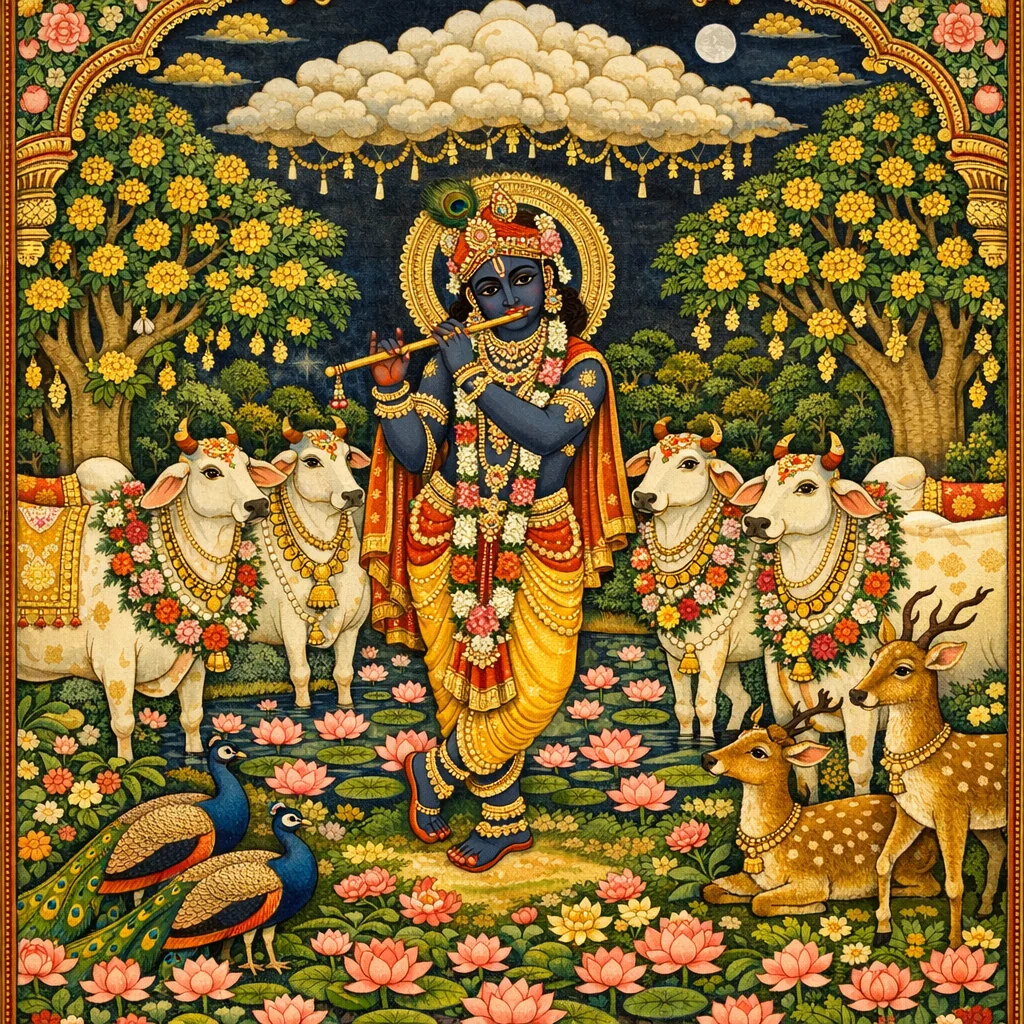
Śukadeva describes a recurring rhythm of Vraja life: when Kṛṣṇa goes to the forest for cowherding, the gopīs’ minds follow Him, and their day becomes sustained by kīrtana of His līlā. Speaking among themselves, they depict Kṛṣṇa’s flute-playing—His posture, tender fingers, dancing brows—and the astonishing power of that sound to overwhelm even celestial women traveling with Siddhas. Their vision expands from human longing to a cosmic ecology of devotion: bulls, deer, and cows freeze in rapture; rivers halt their currents, yearning for the dust of His lotus feet; trees and creepers erupt with fruits, flowers, and dripping sap as if manifesting Viṣṇu within their hearts. Clouds offer gentle thunder, flowers, and shade like an umbrella; great devas (Brahmā, Śiva, Indra) are confounded by the essence of His music. The chapter culminates in evening return imagery—Kṛṣṇa coming back with the cows, praised by gods and friends—linking daytime separation to the next movements of Vraja’s nocturnal longing and līlā, where remembrance intensifies into direct encounter.
Shlokas
Verse 1
श्रीशुक उवाच गोप्य: कृष्णे वनं याते तमनुद्रुतचेतस: । कृष्णलीला: प्रगायन्त्यो निन्युर्दु:खेन वासरान् ॥ १ ॥
Śukadeva Gosvāmī said: Whenever Kṛṣṇa went to the forest, the minds of the gopīs would run after Him, and thus the young girls sadly spent their days singing of His pastimes.
Verse 2
श्रीगोप्य ऊचु: वामबाहुकृतवामकपोलो वल्गितभ्रुरधरार्पितवेणुम् । कोमलाङ्गुलिभिराश्रितमार्गं गोप्य ईरयति यत्र मुकुन्द: ॥ २ ॥ व्योमयानवनिता: सह सिद्धै- र्विस्मितास्तदुपधार्य सलज्जा: । काममार्गणसमर्पितचित्ता: कश्मलं ययुरपस्मृतनीव्य: ॥ ३ ॥
The gopīs said: When Mukunda vibrates the flute He has placed to His lips, stopping its holes with His tender fingers, He rests His left cheek on His left arm and makes His eyebrows dance. At that time the demigoddesses traveling in the sky with their husbands, the Siddhas, become amazed. As those ladies listen, they are embarrassed to find their minds yielding to the pursuit of lusty desires, and in their distress they are unaware that the belts of their garments are loosening.
Verse 3
श्रीगोप्य ऊचु: वामबाहुकृतवामकपोलो वल्गितभ्रुरधरार्पितवेणुम् । कोमलाङ्गुलिभिराश्रितमार्गं गोप्य ईरयति यत्र मुकुन्द: ॥ २ ॥ व्योमयानवनिता: सह सिद्धै- र्विस्मितास्तदुपधार्य सलज्जा: । काममार्गणसमर्पितचित्ता: कश्मलं ययुरपस्मृतनीव्य: ॥ ३ ॥
The gopīs said: When Mukunda vibrates the flute He has placed to His lips, stopping its holes with His tender fingers, He rests His left cheek on His left arm and makes His eyebrows dance. At that time the demigoddesses traveling in the sky with their husbands, the Siddhas, become amazed. As those ladies listen, they are embarrassed to find their minds yielding to the pursuit of lusty desires, and in their distress they are unaware that the belts of their garments are loosening.
Verse 4
हन्त चित्रमबला: शृणुतेदं हारहास उरसि स्थिरविद्युत् । नन्दसूनुरयमार्तजनानां नर्मदो यर्हि कूजितवेणु: ॥ ४ ॥ वृन्दशो व्रजवृषा मृगगावो वेणुवाद्यहृतचेतस आरात् । दन्तदष्टकवला धृतकर्णा निद्रिता लिखितचित्रमिवासन् ॥ ५ ॥
O girls! This son of Nanda, who gives joy to the distressed, bears steady lightning on His chest and has a smile like a jeweled necklace. Now please hear something wonderful. When He vibrates His flute, Vraja’s bulls, deer and cows, standing in groups at a great distance, are all captivated by the sound, and they stop chewing the food in their mouths and cock their ears. Stunned, they appear as if asleep, or like figures in a painting.
Verse 5
हन्त चित्रमबला: शृणुतेदं हारहास उरसि स्थिरविद्युत् । नन्दसूनुरयमार्तजनानां नर्मदो यर्हि कूजितवेणु: ॥ ४ ॥ वृन्दशो व्रजवृषा मृगगावो वेणुवाद्यहृतचेतस आरात् । दन्तदष्टकवला धृतकर्णा निद्रिता लिखितचित्रमिवासन् ॥ ५ ॥
O girls! This son of Nanda, who gives joy to the distressed, bears steady lightning on His chest and has a smile like a jeweled necklace. Now please hear something wonderful. When He vibrates His flute, Vraja’s bulls, deer and cows, standing in groups at a great distance, are all captivated by the sound, and they stop chewing the food in their mouths and cock their ears. Stunned, they appear as if asleep, or like figures in a painting.
Verse 6
बर्हिणस्तबकधातुपलाशै- र्बद्धमल्लपरिबर्हविडम्ब: । कर्हिचित् सबल आलि स गोपै- र्गा: समाह्वयति यत्र मुकुन्द: ॥ ६ ॥ तर्हि भग्नगतय: सरितो वै तत्पदाम्बुजरजोऽनिलनीतम् । स्पृहयतीर्वयमिवाबहुपुण्या: प्रेमवेपितभुजा: स्तिमिताप: ॥ ७ ॥
My dear gopī, sometimes Mukunda imitates the appearance of a wrestler by decorating Himself with leaves, peacock feathers and colored minerals. Then, in the company of Balarāma and the cowherd boys, He plays His flute to call the cows. At that time the rivers stop flowing, their water stunned by the ecstasy they feel as they eagerly wait for the wind to bring them the dust of His lotus feet. But like us, the rivers are not very pious, and thus they merely wait with their arms trembling out of love.
Verse 7
बर्हिणस्तबकधातुपलाशै- र्बद्धमल्लपरिबर्हविडम्ब: । कर्हिचित् सबल आलि स गोपै- र्गा: समाह्वयति यत्र मुकुन्द: ॥ ६ ॥ तर्हि भग्नगतय: सरितो वै तत्पदाम्बुजरजोऽनिलनीतम् । स्पृहयतीर्वयमिवाबहुपुण्या: प्रेमवेपितभुजा: स्तिमिताप: ॥ ७ ॥
My dear gopī, sometimes Mukunda imitates the appearance of a wrestler by decorating Himself with leaves, peacock feathers and colored minerals. Then, in the company of Balarāma and the cowherd boys, He plays His flute to call the cows. At that time the rivers stop flowing, their water stunned by the ecstasy they feel as they eagerly wait for the wind to bring them the dust of His lotus feet. But like us, the rivers are not very pious, and thus they merely wait with their arms trembling out of love.
Verse 8
अनुचरै: समनुवर्णितवीर्य आदिपूरुष इवाचलभूति: । वनचरो गिरितटेषु चरन्ती- र्वेणुनाह्वयति गा: स यदा हि ॥ ८ ॥ वनलतास्तरव आत्मनि विष्णुं व्यञ्जयन्त्य इव पुष्पफलाढ्या: । प्रणतभारविटपा मधुधारा: प्रेमहृष्टतनवो ववृषु: स्म ॥ ९ ॥ दर्शनीयतिलको वनमाला- दिव्यगन्धतुलसीमधुमत्तै: । अलिकुलैरलघुगीतामभीष्ट- माद्रियन् यर्हि सन्धितवेणु: ॥ १० ॥ सरसि सारसहंसविहङ्गा- श्चारुगीताहृतचेतस एत्य । हरिमुपासत ते यतचित्ता हन्त मीलितदृशो धृतमौना: ॥ ११ ॥
Kṛṣṇa moves about the forest in the company of His friends, who vividly chant the glories of His magnificent deeds. He thus appears just like the Supreme Personality of Godhead exhibiting His inexhaustible opulences. When the cows wander onto the mountainsides and Kṛṣṇa calls out to them with the sound of His flute, the trees and creepers in the forest respond by becoming so luxuriant with fruits and flowers that they seem to be manifesting Lord Viṣṇu within their hearts. As their branches bend low with the weight, the filaments on their trunks and vines stand erect out of the ecstasy of love of God, and both the trees and the creepers pour down a rain of sweet sap.
Verse 9
अनुचरै: समनुवर्णितवीर्य आदिपूरुष इवाचलभूति: । वनचरो गिरितटेषु चरन्ती- र्वेणुनाह्वयति गा: स यदा हि ॥ ८ ॥ वनलतास्तरव आत्मनि विष्णुं व्यञ्जयन्त्य इव पुष्पफलाढ्या: । प्रणतभारविटपा मधुधारा: प्रेमहृष्टतनवो ववृषु: स्म ॥ ९ ॥ दर्शनीयतिलको वनमाला- दिव्यगन्धतुलसीमधुमत्तै: । अलिकुलैरलघुगीतामभीष्ट- माद्रियन् यर्हि सन्धितवेणु: ॥ १० ॥ सरसि सारसहंसविहङ्गा- श्चारुगीताहृतचेतस एत्य । हरिमुपासत ते यतचित्ता हन्त मीलितदृशो धृतमौना: ॥ ११ ॥
Kṛṣṇa moves about the forest in the company of His friends, who vividly chant the glories of His magnificent deeds. He thus appears just like the Supreme Personality of Godhead exhibiting His inexhaustible opulences. When the cows wander onto the mountainsides and Kṛṣṇa calls out to them with the sound of His flute, the trees and creepers in the forest respond by becoming so luxuriant with fruits and flowers that they seem to be manifesting Lord Viṣṇu within their hearts. As their branches bend low with the weight, the filaments on their trunks and vines stand erect out of the ecstasy of love of God, and both the trees and the creepers pour down a rain of sweet sap.
Verse 10
अनुचरै: समनुवर्णितवीर्य आदिपूरुष इवाचलभूति: । वनचरो गिरितटेषु चरन्ती- र्वेणुनाह्वयति गा: स यदा हि ॥ ८ ॥ वनलतास्तरव आत्मनि विष्णुं व्यञ्जयन्त्य इव पुष्पफलाढ्या: । प्रणतभारविटपा मधुधारा: प्रेमहृष्टतनवो ववृषु: स्म ॥ ९ ॥ दर्शनीयतिलको वनमाला- दिव्यगन्धतुलसीमधुमत्तै: । अलिकुलैरलघुगीतामभीष्ट- माद्रियन् यर्हि सन्धितवेणु: ॥ १० ॥ सरसि सारसहंसविहङ्गा- श्चारुगीताहृतचेतस एत्य । हरिमुपासत ते यतचित्ता हन्त मीलितदृशो धृतमौना: ॥ ११ ॥
Kṛṣṇa moves about the forest in the company of His friends, who vividly chant the glories of His magnificent deeds. He thus appears just like the Supreme Personality of Godhead exhibiting His inexhaustible opulences. When the cows wander onto the mountainsides and Kṛṣṇa calls out to them with the sound of His flute, the trees and creepers in the forest respond by becoming so luxuriant with fruits and flowers that they seem to be manifesting Lord Viṣṇu within their hearts. As their branches bend low with the weight, the filaments on their trunks and vines stand erect out of the ecstasy of love of God, and both the trees and the creepers pour down a rain of sweet sap.
Verse 11
अनुचरै: समनुवर्णितवीर्य आदिपूरुष इवाचलभूति: । वनचरो गिरितटेषु चरन्ती- र्वेणुनाह्वयति गा: स यदा हि ॥ ८ ॥ वनलतास्तरव आत्मनि विष्णुं व्यञ्जयन्त्य इव पुष्पफलाढ्या: । प्रणतभारविटपा मधुधारा: प्रेमहृष्टतनवो ववृषु: स्म ॥ ९ ॥ दर्शनीयतिलको वनमाला- दिव्यगन्धतुलसीमधुमत्तै: । अलिकुलैरलघुगीतामभीष्ट- माद्रियन् यर्हि सन्धितवेणु: ॥ १० ॥ सरसि सारसहंसविहङ्गा- श्चारुगीताहृतचेतस एत्य । हरिमुपासत ते यतचित्ता हन्त मीलितदृशो धृतमौना: ॥ ११ ॥
Kṛṣṇa moves about the forest in the company of His friends, who vividly chant the glories of His magnificent deeds. He thus appears just like the Supreme Personality of Godhead exhibiting His inexhaustible opulences. When the cows wander onto the mountainsides and Kṛṣṇa calls out to them with the sound of His flute, the trees and creepers in the forest respond by becoming so luxuriant with fruits and flowers that they seem to be manifesting Lord Viṣṇu within their hearts. As their branches bend low with the weight, the filaments on their trunks and vines stand erect out of the ecstasy of love of God, and both the trees and the creepers pour down a rain of sweet sap.
Verse 12
सहबल: स्रगवतंसविलास: सानुषु क्षितिभृतो व्रजदेव्य: । हर्षयन् यर्हि वेणुरवेण जातहर्ष उपरम्भति विश्वम् ॥ १२ ॥ महदतिक्रमणशङ्कितचेता मन्दमन्दमनुगर्जति मेघ: । सुहृदमभ्यवर्षत् सुमनोभि- श्छायया च विदधत् प्रतपत्रम् ॥ १३ ॥
O goddesses of Vraja, when Kṛṣṇa is enjoying Himself with Balarāma on the mountain slopes, playfully wearing a flower garland on the top of His head, He engladdens all with the resonant vibrations of His flute. Thus He delights the entire world. At that time the nearby cloud, afraid of offending a great personality, thunders very gently in accompaniment. The cloud showers flowers onto his dear friend Kṛṣṇa and shades Him from the sun like an umbrella.
Verse 13
सहबल: स्रगवतंसविलास: सानुषु क्षितिभृतो व्रजदेव्य: । हर्षयन् यर्हि वेणुरवेण जातहर्ष उपरम्भति विश्वम् ॥ १२ ॥ महदतिक्रमणशङ्कितचेता मन्दमन्दमनुगर्जति मेघ: । सुहृदमभ्यवर्षत् सुमनोभि- श्छायया च विदधत् प्रतपत्रम् ॥ १३ ॥
O goddesses of Vraja, when Kṛṣṇa is enjoying Himself with Balarāma on the mountain slopes, playfully wearing a flower garland on the top of His head, He engladdens all with the resonant vibrations of His flute. Thus He delights the entire world. At that time the nearby cloud, afraid of offending a great personality, thunders very gently in accompaniment. The cloud showers flowers onto his dear friend Kṛṣṇa and shades Him from the sun like an umbrella.
Verse 14
विविधगोपचरणेषु विदग्धो वेणुवाद्य उरुधा निजशिक्षा: । तव सुत: सति यदाधरबिम्बे दत्तवेणुरनयत् स्वरजाती: ॥ १४ ॥ सवनशस्तदुपधार्य सुरेशा: शक्रशर्वपरमेष्ठिपुरोगा: । कवय आनतकन्धरचित्ता: कश्मलं ययुरनिश्चिततत्त्वा: ॥ १५ ॥
O pious mother Yaśodā, your son, who is expert in all the arts of herding cows, has invented many new styles of flute-playing. When He takes His flute to His bimba-red lips and sends forth the tones of the harmonic scale in variegated melodies, Brahmā, Śiva, Indra and other chief demigods become confused upon hearing the sound. Although they are the most learned authorities, they cannot ascertain the essence of that music, and thus they bow down their heads and hearts.
Verse 15
विविधगोपचरणेषु विदग्धो वेणुवाद्य उरुधा निजशिक्षा: । तव सुत: सति यदाधरबिम्बे दत्तवेणुरनयत् स्वरजाती: ॥ १४ ॥ सवनशस्तदुपधार्य सुरेशा: शक्रशर्वपरमेष्ठिपुरोगा: । कवय आनतकन्धरचित्ता: कश्मलं ययुरनिश्चिततत्त्वा: ॥ १५ ॥
O pious mother Yaśodā, your son, who is expert in all the arts of herding cows, has invented many new styles of flute-playing. When He takes His flute to His bimba-red lips and sends forth the tones of the harmonic scale in variegated melodies, Brahmā, Śiva, Indra and other chief demigods become confused upon hearing the sound. Although they are the most learned authorities, they cannot ascertain the essence of that music, and thus they bow down their heads and hearts.
Verse 16
निजपदाब्जदलैर्ध्वजवज्र- नीरजाङ्कुशविचित्रललामै: । व्रजभुव: शमयन् खुरतोदं वर्ष्मधुर्यगतिरीडितवेणु: ॥ १६ ॥ व्रजति तेन वयं सविलास- वीक्षणार्पितमनोभववेगा: । कुजगतिं गमिता न विदाम: कश्मलेन कवरं वसनं वा ॥ १७ ॥
As Kṛṣṇa strolls through Vraja with His lotus-petal-like feet, marking the ground with the distinctive emblems of flag, thunderbolt, lotus and elephant goad, He relieves the distress the ground feels from the cows’ hooves. As He plays His renowned flute, His body moves with the grace of an elephant. Thus we gopīs, who become agitated by Cupid when Kṛṣṇa playfully glances at us, stand as still as trees, unaware that our hair and garments are slackening.
Verse 17
निजपदाब्जदलैर्ध्वजवज्र- नीरजाङ्कुशविचित्रललामै: । व्रजभुव: शमयन् खुरतोदं वर्ष्मधुर्यगतिरीडितवेणु: ॥ १६ ॥ व्रजति तेन वयं सविलास- वीक्षणार्पितमनोभववेगा: । कुजगतिं गमिता न विदाम: कश्मलेन कवरं वसनं वा ॥ १७ ॥
As Kṛṣṇa strolls through Vraja with His lotus-petal-like feet, marking the ground with the distinctive emblems of flag, thunderbolt, lotus and elephant goad, He relieves the distress the ground feels from the cows’ hooves. As He plays His renowned flute, His body moves with the grace of an elephant. Thus we gopīs, who become agitated by Cupid when Kṛṣṇa playfully glances at us, stand as still as trees, unaware that our hair and garments are slackening.
Verse 18
मणिधर: क्वचिदागणयन् गा मालया दयितगन्धतुलस्या: । प्रणयिनोऽनुचरस्य कदांसे प्रक्षिपन् भुजमगायत यत्र ॥ १८ ॥ क्वणितवेणुरववञ्चितचित्ता: कृष्णमन्वसत कृष्णगृहिण्य: । गुणगणार्णमनुगत्य हरिण्यो गोपिका इव विमुक्तगृहाशा: ॥ १९ ॥
Now Kṛṣṇa is standing somewhere counting His cows on a string of gems. He wears a garland of tulasī flowers that bear the fragrance of His beloved, and He has thrown His arm over the shoulder of an affectionate cowherd boyfriend. As Kṛṣṇa plays His flute and sings, the music attracts the black deer’s wives, who approach that ocean of transcendental qualities and sit down beside Him. Just like us cowherd girls, they have given up all hope for happiness in family life.
Verse 19
मणिधर: क्वचिदागणयन् गा मालया दयितगन्धतुलस्या: । प्रणयिनोऽनुचरस्य कदांसे प्रक्षिपन् भुजमगायत यत्र ॥ १८ ॥ क्वणितवेणुरववञ्चितचित्ता: कृष्णमन्वसत कृष्णगृहिण्य: । गुणगणार्णमनुगत्य हरिण्यो गोपिका इव विमुक्तगृहाशा: ॥ १९ ॥
Now Kṛṣṇa is standing somewhere counting His cows on a string of gems. He wears a garland of tulasī flowers that bear the fragrance of His beloved, and He has thrown His arm over the shoulder of an affectionate cowherd boyfriend. As Kṛṣṇa plays His flute and sings, the music attracts the black deer’s wives, who approach that ocean of transcendental qualities and sit down beside Him. Just like us cowherd girls, they have given up all hope for happiness in family life.
Verse 20
कुन्ददामकृतकौतुकवेषो गोपगोधनवृतो यमुनायाम् । नन्दसूनुरनघे तव वत्सो नर्मद: प्रणयिणां विजहार ॥ २० ॥ मन्दवायुरुपवात्यनुकूलं मानयन् मलयजस्पर्शेन । वन्दिनस्तमुपदेवगणा ये वाद्यगीतबलिभि: परिवव्रु: ॥ २१ ॥
O sinless Yaśodā, your darling child, the son of Mahārāja Nanda, has festively enhanced His attire with a jasmine garland, and He is now playing along the Yamunā in the company of the cows and cowherd boys, amusing His dear companions. The gentle breeze honors Him with its soothing fragrance of sandalwood, while the various Upadevas, standing on all sides like panegyrists, offer their music, singing and gifts of tribute.
Verse 21
कुन्ददामकृतकौतुकवेषो गोपगोधनवृतो यमुनायाम् । नन्दसूनुरनघे तव वत्सो नर्मद: प्रणयिणां विजहार ॥ २० ॥ मन्दवायुरुपवात्यनुकूलं मानयन् मलयजस्पर्शेन । वन्दिनस्तमुपदेवगणा ये वाद्यगीतबलिभि: परिवव्रु: ॥ २१ ॥
O sinless Yaśodā, your darling child, the son of Mahārāja Nanda, has festively enhanced His attire with a jasmine garland, and He is now playing along the Yamunā in the company of the cows and cowherd boys, amusing His dear companions. The gentle breeze honors Him with its soothing fragrance of sandalwood, while the various Upadevas, standing on all sides like panegyrists, offer their music, singing and gifts of tribute.
Verse 22
वत्सलो व्रजगवां यदगध्रो वन्द्यमानचरण: पथि वृद्धै: । कृत्स्नगोधनमुपोह्य दिनान्ते गीतवेणुरनुगेडितकीर्ति: ॥ २२ ॥ उत्सवं श्रमरुचापि दृशीना- मुन्नयन् खुररजश्छुरितस्रक् । दित्सयैति सुहृदासिष एष देवकीजठरभूरुडुराज: ॥ २३ ॥
Out of great affection for the cows of Vraja, Kṛṣṇa became the lifter of Govardhana Hill. At the end of the day, having rounded up all His own cows, He plays a song on His flute, while exalted demigods standing along the path worship His lotus feet and the cowherd boys accompanying Him chant His glories. His garland is powdered by the dust raised by the cows’ hooves, and His beauty, enhanced by His fatigue, creates an ecstatic festival for everyone’s eyes. Eager to fulfill His friends’ desires, Kṛṣṇa is the moon arisen from the womb of mother Yaśodā.
Verse 23
वत्सलो व्रजगवां यदगध्रो वन्द्यमानचरण: पथि वृद्धै: । कृत्स्नगोधनमुपोह्य दिनान्ते गीतवेणुरनुगेडितकीर्ति: ॥ २२ ॥ उत्सवं श्रमरुचापि दृशीना- मुन्नयन् खुररजश्छुरितस्रक् । दित्सयैति सुहृदासिष एष देवकीजठरभूरुडुराज: ॥ २३ ॥
Out of great affection for the cows of Vraja, Kṛṣṇa became the lifter of Govardhana Hill. At the end of the day, having rounded up all His own cows, He plays a song on His flute, while exalted demigods standing along the path worship His lotus feet and the cowherd boys accompanying Him chant His glories. His garland is powdered by the dust raised by the cows’ hooves, and His beauty, enhanced by His fatigue, creates an ecstatic festival for everyone’s eyes. Eager to fulfill His friends’ desires, Kṛṣṇa is the moon arisen from the womb of mother Yaśodā.
Verse 24
मदविघूर्णितलोचन ईषत्- मानद: स्वसुहृदां वनमाली । बदरपाण्डुवदनो मृदुगण्डं मण्डयन् कनककुण्डललक्ष्म्या ॥ २४ ॥ यदुपतिर्द्विरदराजविहारो यामिनीपतिरिवैष दिनान्ते । मुदितवक्त्र उपयाति दुरन्तं मोचयन् व्रजगवां दिनतापम् ॥ २५ ॥
As Kṛṣṇa respectfully greets His well-wishing friends, His eyes roll slightly as if from intoxication. He wears a flower garland, and the beauty of His soft cheeks is accentuated by the brilliance of His golden earrings and the whiteness of His face, which has the color of a badara berry. With His cheerful face resembling the moon, lord of the night, the Lord of the Yadus moves with the grace of a regal elephant. Thus He returns in the evening, delivering the cows of Vraja from the heat of the day.
Verse 25
मदविघूर्णितलोचन ईषत्- मानद: स्वसुहृदां वनमाली । बदरपाण्डुवदनो मृदुगण्डं मण्डयन् कनककुण्डललक्ष्म्या ॥ २४ ॥ यदुपतिर्द्विरदराजविहारो यामिनीपतिरिवैष दिनान्ते । मुदितवक्त्र उपयाति दुरन्तं मोचयन् व्रजगवां दिनतापम् ॥ २५ ॥
As Kṛṣṇa respectfully greets His well-wishing friends, His eyes roll slightly as if from intoxication. He wears a flower garland, and the beauty of His soft cheeks is accentuated by the brilliance of His golden earrings and the whiteness of His face, which has the color of a badara berry. With His cheerful face resembling the moon, lord of the night, the Lord of the Yadus moves with the grace of a regal elephant. Thus He returns in the evening, delivering the cows of Vraja from the heat of the day.
Verse 26
श्रीशुक उवाच एवं व्रजस्त्रियो राजन् कृष्णलीलानुगायती: । रेमिरेऽह:सु तच्चित्तास्तन्मनस्का महोदया: ॥ २६ ॥
Śrī Śukadeva Gosvāmī said: O King, thus during the daytime the women of Vṛndāvana took pleasure in continuously singing about the pastimes of Kṛṣṇa, and those ladies’ minds and hearts, absorbed in Him, were filled with great festivity.
Frequently Asked Questions
The passage magnifies Kṛṣṇa’s veṇu-nāda as transcendental attraction (ākarṣaṇa) that surpasses social and cosmic boundaries. The ‘disturbance’ is not endorsement of mundane lust but a poetic revelation of how Bhagavān’s beauty and sound subdue conditioned propriety and awaken involuntary absorption. Bhāgavata rhetoric uses this to assert Kṛṣṇa’s supremacy: if even celestial beings lose composure, the gopīs’ exclusive fixation is shown as spiritually inevitable and theologically meaningful.
These are Bhāgavata signs (lakṣaṇa) of bhakti’s contagion in Vraja: the environment mirrors the devotees’ inner state. Rivers halting suggests nature’s suspension before the Absolute, yearning for contact with His pāda-raja (foot-dust). Trees and creepers becoming luxuriant and ‘manifesting Viṣṇu’ indicates sattvika transformation—external fertility symbolizing internal revelation—teaching that devotion is not only psychological but cosmically participatory in Kṛṣṇa’s līlā.
Śukadeva Gosvāmī narrates to King Parīkṣit, framing the gopīs’ speech as daytime kīrtana born from separation during Kṛṣṇa’s forest pastimes. This frame is crucial: it presents the gopīs’ words as sādhana (continuous remembrance) and as pramāṇa (authoritative testimony) for the Bhāgavata’s theology of āśraya—Kṛṣṇa as the supreme object of love.
The evening return (go-cāraṇa completion) resolves the day’s vipralambha with a glimpse of reunion: Kṛṣṇa, dusted by cows’ hooves, worshiped along the path, and welcomed by friends. Literarily it provides narrative progression from daytime separation to the intensification of Vraja’s nocturnal affect; theologically it shows poṣaṇa—Kṛṣṇa as the one who protects, gathers, and ‘delivers’ Vraja (including the cows) from hardship while simultaneously nourishing devotees’ longing into deeper bhakti.