Adhyaya 51
Kṛṣṇa Leads Kālayavana to Mucukunda; The Yavana Is Burned; Mucukunda’s Prayers and Boon of Bhakti
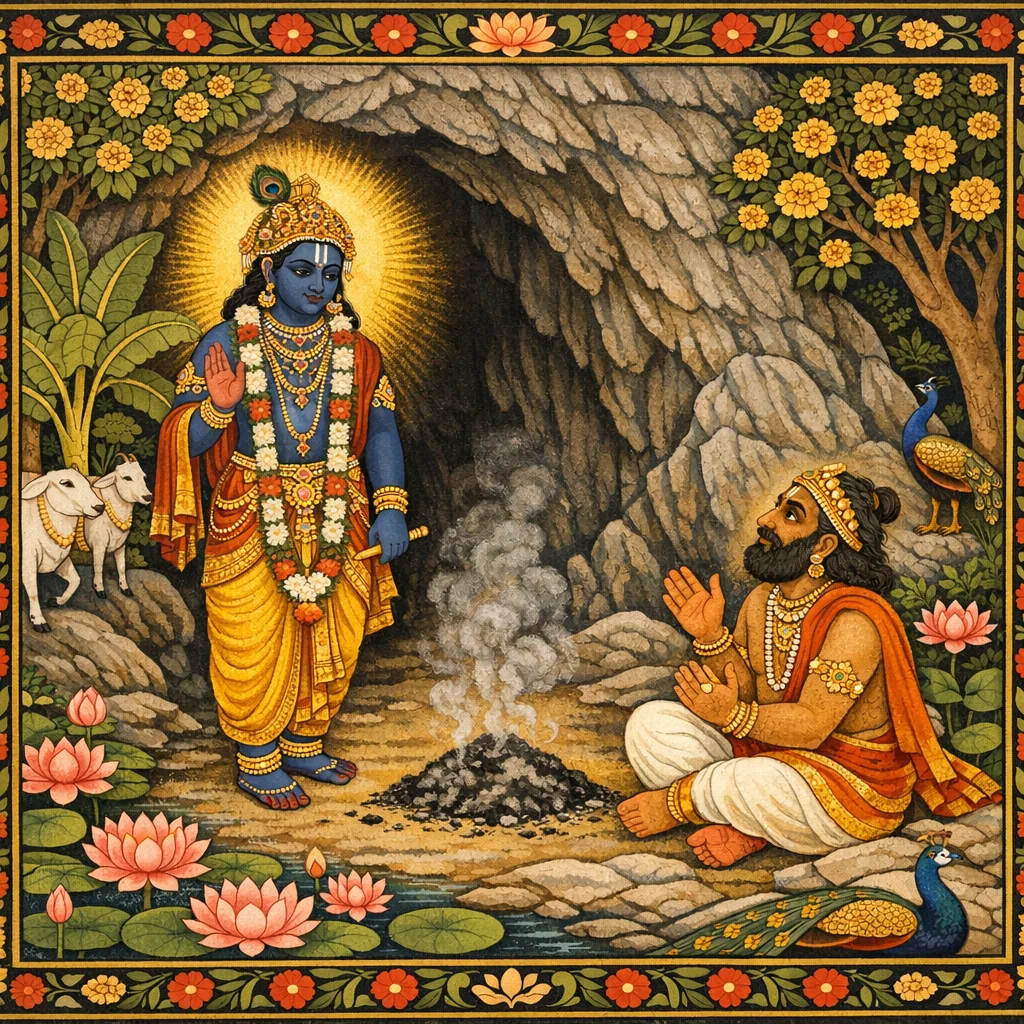
Continuing the Mathurā crisis involving the Yavana threat, Kālayavana beholds Kṛṣṇa’s divine beauty and recognizes Him by the marks Nārada had described (Śrīvatsa, four arms, lotus eyes, forest garland). Presuming Kṛṣṇa to be vulnerable because He is unarmed and on foot, Kālayavana chases Him as the Lord deliberately retreats, remaining always beyond capture—unattainable even to yogīs. Kṛṣṇa leads him into a mountain cave where the ancient king Mucukunda lies asleep under a boon granted by the devas. Mistaking the sleeper for Kṛṣṇa, Kālayavana kicks him and is instantly incinerated by Mucukunda’s fiery glance. Parīkṣit inquires, and Śukadeva narrates Mucukunda’s lineage and long service to the devas, culminating in his cave-sleep. Kṛṣṇa then reveals Himself, and Mucukunda, humbled by time and disillusioned with royal pride, offers profound prayers condemning household entanglement and sense-driven kingship. He asks only for service to the Lord’s feet. Pleased, Kṛṣṇa confirms the purity of such devotion, instructs penance to cleanse kṣatriya sins, and blesses him with future birth as a brāhmaṇa and final attainment of the Lord—setting the stage for Kṛṣṇa’s continued strategy against hostile forces and the broader transition from Mathurā conflicts toward Dvārakā’s establishment.
Shlokas
Verse 1
श्रीशुक उवाच तं विलोक्य विनिष्क्रान्तमुज्जिहानमिवोडुपम् । दर्शनीयतमं श्यामं पीतकौशेयवाससम् ॥ १ ॥ श्रीवत्सवक्षसं भ्राजत्कौस्तुभामुक्तकन्धरम् । पृथुदीर्घचतुर्बाहुं नवकञ्जारुणेक्षणम् ॥ २ ॥ नित्यप्रमुदितं श्रीमत्सुकपोलं शुचिस्मितम् । मुखारविन्दं बिभ्राणं स्फुरन्मकरकुण्डलम् ॥ ३ ॥ वासुदेवो ह्ययमिति पुमान् श्रीवत्सलाञ्छन: । चतुर्भुजोऽरविन्दाक्षो वनमाल्यतिसुन्दर: ॥ ४ ॥ लक्षणैर्नारदप्रोक्तैर्नान्यो भवितुमर्हति । निरायुधश्चलन् पद्भ्यां योत्स्येऽनेन निरायुध: ॥ ५ ॥ इति निश्चित्य यवन: प्राद्रवद् तं पराङ्मुखम् । अन्वधावज्जिघृक्षुस्तं दुरापमपि योगिनाम् ॥ ६ ॥
Śukadeva Gosvāmī said: Kālayavana saw the Lord come out from Mathurā like the rising moon. The Lord was most beautiful to behold, with His dark-blue complexion and yellow silk garment. Upon His chest He bore the mark of Śrīvatsa, and the Kaustubha gem adorned His neck. His four arms were sturdy and long. He displayed His ever-joyful lotuslike face, with eyes pink like lotuses, beautifully effulgent cheeks, a pristine smile and glittering shark-shaped earrings. The barbarian thought, “This person must indeed be Vāsudeva, since He possesses the characteristics Nārada mentioned: He is marked with Śrīvatsa, He has four arms, His eyes are like lotuses, He wears a garland of forest flowers, and He is extremely handsome. He cannot be anyone else. Since He goes on foot and unarmed, I will fight Him without weapons.” Resolving thus, he ran after the Lord, who turned His back and ran away. Kālayavana hoped to catch Lord Kṛṣṇa, though great mystic yogīs cannot attain Him.
Verse 2
श्रीशुक उवाच तं विलोक्य विनिष्क्रान्तमुज्जिहानमिवोडुपम् । दर्शनीयतमं श्यामं पीतकौशेयवाससम् ॥ १ ॥ श्रीवत्सवक्षसं भ्राजत्कौस्तुभामुक्तकन्धरम् । पृथुदीर्घचतुर्बाहुं नवकञ्जारुणेक्षणम् ॥ २ ॥ नित्यप्रमुदितं श्रीमत्सुकपोलं शुचिस्मितम् । मुखारविन्दं बिभ्राणं स्फुरन्मकरकुण्डलम् ॥ ३ ॥ वासुदेवो ह्ययमिति पुमान् श्रीवत्सलाञ्छन: । चतुर्भुजोऽरविन्दाक्षो वनमाल्यतिसुन्दर: ॥ ४ ॥ लक्षणैर्नारदप्रोक्तैर्नान्यो भवितुमर्हति । निरायुधश्चलन् पद्भ्यां योत्स्येऽनेन निरायुध: ॥ ५ ॥ इति निश्चित्य यवन: प्राद्रवद् तं पराङ्मुखम् । अन्वधावज्जिघृक्षुस्तं दुरापमपि योगिनाम् ॥ ६ ॥
Śukadeva Gosvāmī said: Kālayavana saw the Lord come out from Mathurā like the rising moon. The Lord was most beautiful to behold, with His dark-blue complexion and yellow silk garment. Upon His chest He bore the mark of Śrīvatsa, and the Kaustubha gem adorned His neck. His four arms were sturdy and long. He displayed His ever-joyful lotuslike face, with eyes pink like lotuses, beautifully effulgent cheeks, a pristine smile and glittering shark-shaped earrings. The barbarian thought, “This person must indeed be Vāsudeva, since He possesses the characteristics Nārada mentioned: He is marked with Śrīvatsa, He has four arms, His eyes are like lotuses, He wears a garland of forest flowers, and He is extremely handsome. He cannot be anyone else. Since He goes on foot and unarmed, I will fight Him without weapons.” Resolving thus, he ran after the Lord, who turned His back and ran away. Kālayavana hoped to catch Lord Kṛṣṇa, though great mystic yogīs cannot attain Him.
Verse 3
श्रीशुक उवाच तं विलोक्य विनिष्क्रान्तमुज्जिहानमिवोडुपम् । दर्शनीयतमं श्यामं पीतकौशेयवाससम् ॥ १ ॥ श्रीवत्सवक्षसं भ्राजत्कौस्तुभामुक्तकन्धरम् । पृथुदीर्घचतुर्बाहुं नवकञ्जारुणेक्षणम् ॥ २ ॥ नित्यप्रमुदितं श्रीमत्सुकपोलं शुचिस्मितम् । मुखारविन्दं बिभ्राणं स्फुरन्मकरकुण्डलम् ॥ ३ ॥ वासुदेवो ह्ययमिति पुमान् श्रीवत्सलाञ्छन: । चतुर्भुजोऽरविन्दाक्षो वनमाल्यतिसुन्दर: ॥ ४ ॥ लक्षणैर्नारदप्रोक्तैर्नान्यो भवितुमर्हति । निरायुधश्चलन् पद्भ्यां योत्स्येऽनेन निरायुध: ॥ ५ ॥ इति निश्चित्य यवन: प्राद्रवद् तं पराङ्मुखम् । अन्वधावज्जिघृक्षुस्तं दुरापमपि योगिनाम् ॥ ६ ॥
Śukadeva Gosvāmī said: Kālayavana saw the Lord come out from Mathurā like the rising moon. The Lord was most beautiful to behold, with His dark-blue complexion and yellow silk garment. Upon His chest He bore the mark of Śrīvatsa, and the Kaustubha gem adorned His neck. His four arms were sturdy and long. He displayed His ever-joyful lotuslike face, with eyes pink like lotuses, beautifully effulgent cheeks, a pristine smile and glittering shark-shaped earrings. The barbarian thought, “This person must indeed be Vāsudeva, since He possesses the characteristics Nārada mentioned: He is marked with Śrīvatsa, He has four arms, His eyes are like lotuses, He wears a garland of forest flowers, and He is extremely handsome. He cannot be anyone else. Since He goes on foot and unarmed, I will fight Him without weapons.” Resolving thus, he ran after the Lord, who turned His back and ran away. Kālayavana hoped to catch Lord Kṛṣṇa, though great mystic yogīs cannot attain Him.
Verse 4
श्रीशुक उवाच तं विलोक्य विनिष्क्रान्तमुज्जिहानमिवोडुपम् । दर्शनीयतमं श्यामं पीतकौशेयवाससम् ॥ १ ॥ श्रीवत्सवक्षसं भ्राजत्कौस्तुभामुक्तकन्धरम् । पृथुदीर्घचतुर्बाहुं नवकञ्जारुणेक्षणम् ॥ २ ॥ नित्यप्रमुदितं श्रीमत्सुकपोलं शुचिस्मितम् । मुखारविन्दं बिभ्राणं स्फुरन्मकरकुण्डलम् ॥ ३ ॥ वासुदेवो ह्ययमिति पुमान् श्रीवत्सलाञ्छन: । चतुर्भुजोऽरविन्दाक्षो वनमाल्यतिसुन्दर: ॥ ४ ॥ लक्षणैर्नारदप्रोक्तैर्नान्यो भवितुमर्हति । निरायुधश्चलन् पद्भ्यां योत्स्येऽनेन निरायुध: ॥ ५ ॥ इति निश्चित्य यवन: प्राद्रवद् तं पराङ्मुखम् । अन्वधावज्जिघृक्षुस्तं दुरापमपि योगिनाम् ॥ ६ ॥
Śukadeva Gosvāmī said: Kālayavana saw the Lord come out from Mathurā like the rising moon. The Lord was most beautiful to behold, with His dark-blue complexion and yellow silk garment. Upon His chest He bore the mark of Śrīvatsa, and the Kaustubha gem adorned His neck. His four arms were sturdy and long. He displayed His ever-joyful lotuslike face, with eyes pink like lotuses, beautifully effulgent cheeks, a pristine smile and glittering shark-shaped earrings. The barbarian thought, “This person must indeed be Vāsudeva, since He possesses the characteristics Nārada mentioned: He is marked with Śrīvatsa, He has four arms, His eyes are like lotuses, He wears a garland of forest flowers, and He is extremely handsome. He cannot be anyone else. Since He goes on foot and unarmed, I will fight Him without weapons.” Resolving thus, he ran after the Lord, who turned His back and ran away. Kālayavana hoped to catch Lord Kṛṣṇa, though great mystic yogīs cannot attain Him.
Verse 5
श्रीशुक उवाच तं विलोक्य विनिष्क्रान्तमुज्जिहानमिवोडुपम् । दर्शनीयतमं श्यामं पीतकौशेयवाससम् ॥ १ ॥ श्रीवत्सवक्षसं भ्राजत्कौस्तुभामुक्तकन्धरम् । पृथुदीर्घचतुर्बाहुं नवकञ्जारुणेक्षणम् ॥ २ ॥ नित्यप्रमुदितं श्रीमत्सुकपोलं शुचिस्मितम् । मुखारविन्दं बिभ्राणं स्फुरन्मकरकुण्डलम् ॥ ३ ॥ वासुदेवो ह्ययमिति पुमान् श्रीवत्सलाञ्छन: । चतुर्भुजोऽरविन्दाक्षो वनमाल्यतिसुन्दर: ॥ ४ ॥ लक्षणैर्नारदप्रोक्तैर्नान्यो भवितुमर्हति । निरायुधश्चलन् पद्भ्यां योत्स्येऽनेन निरायुध: ॥ ५ ॥ इति निश्चित्य यवन: प्राद्रवद् तं पराङ्मुखम् । अन्वधावज्जिघृक्षुस्तं दुरापमपि योगिनाम् ॥ ६ ॥
Śukadeva Gosvāmī said: Kālayavana saw the Lord come out from Mathurā like the rising moon. The Lord was most beautiful to behold, with His dark-blue complexion and yellow silk garment. Upon His chest He bore the mark of Śrīvatsa, and the Kaustubha gem adorned His neck. His four arms were sturdy and long. He displayed His ever-joyful lotuslike face, with eyes pink like lotuses, beautifully effulgent cheeks, a pristine smile and glittering shark-shaped earrings. The barbarian thought, “This person must indeed be Vāsudeva, since He possesses the characteristics Nārada mentioned: He is marked with Śrīvatsa, He has four arms, His eyes are like lotuses, He wears a garland of forest flowers, and He is extremely handsome. He cannot be anyone else. Since He goes on foot and unarmed, I will fight Him without weapons.” Resolving thus, he ran after the Lord, who turned His back and ran away. Kālayavana hoped to catch Lord Kṛṣṇa, though great mystic yogīs cannot attain Him.
Verse 6
श्रीशुक उवाच तं विलोक्य विनिष्क्रान्तमुज्जिहानमिवोडुपम् । दर्शनीयतमं श्यामं पीतकौशेयवाससम् ॥ १ ॥ श्रीवत्सवक्षसं भ्राजत्कौस्तुभामुक्तकन्धरम् । पृथुदीर्घचतुर्बाहुं नवकञ्जारुणेक्षणम् ॥ २ ॥ नित्यप्रमुदितं श्रीमत्सुकपोलं शुचिस्मितम् । मुखारविन्दं बिभ्राणं स्फुरन्मकरकुण्डलम् ॥ ३ ॥ वासुदेवो ह्ययमिति पुमान् श्रीवत्सलाञ्छन: । चतुर्भुजोऽरविन्दाक्षो वनमाल्यतिसुन्दर: ॥ ४ ॥ लक्षणैर्नारदप्रोक्तैर्नान्यो भवितुमर्हति । निरायुधश्चलन् पद्भ्यां योत्स्येऽनेन निरायुध: ॥ ५ ॥ इति निश्चित्य यवन: प्राद्रवद् तं पराङ्मुखम् । अन्वधावज्जिघृक्षुस्तं दुरापमपि योगिनाम् ॥ ६ ॥
Śukadeva Gosvāmī said: Kālayavana saw the Lord come out from Mathurā like the rising moon. The Lord was most beautiful to behold, with His dark-blue complexion and yellow silk garment. Upon His chest He bore the mark of Śrīvatsa, and the Kaustubha gem adorned His neck. His four arms were sturdy and long. He displayed His ever-joyful lotuslike face, with eyes pink like lotuses, beautifully effulgent cheeks, a pristine smile and glittering shark-shaped earrings. The barbarian thought, “This person must indeed be Vāsudeva, since He possesses the characteristics Nārada mentioned: He is marked with Śrīvatsa, He has four arms, His eyes are like lotuses, He wears a garland of forest flowers, and He is extremely handsome. He cannot be anyone else. Since He goes on foot and unarmed, I will fight Him without weapons.” Resolving thus, he ran after the Lord, who turned His back and ran away. Kālayavana hoped to catch Lord Kṛṣṇa, though great mystic yogīs cannot attain Him.
Verse 7
हस्तप्राप्तमिवात्मानं हरीणा स पदे पदे । नीतो दर्शयता दूरं यवनेशोऽद्रिकन्दरम् ॥ ७ ॥
Appearing virtually within reach of Kālayavana’s hands at every moment, Lord Hari led the King of the Yavanas far away to a mountain cave.
Verse 8
पलायनं यदुकुले जातस्य तव नोचितम् । इति क्षिपन्ननुगतो नैनं प्रापाहताशुभ: ॥ ८ ॥
While chasing the Lord, the Yavana cast insults at Him, saying “You took birth in the Yadu dynasty. It’s not proper for You to run away!” But still Kālayavana could not reach Lord Kṛṣṇa, because his sinful reactions had not been cleansed away.
Verse 9
एवं क्षिप्तोऽपि भगवान्प्राविशद् गिरिकन्दरम् । सोऽपि प्रविष्टस्तत्रान्यं शयानं ददृशे नरम् ॥ ९ ॥
Although insulted in this way, the Supreme Lord entered the mountain cave. Kālayavana also entered, and there he saw another man lying asleep.
Verse 10
नन्वसौ दूरमानीय शेते मामिह साधुवत् । इति मत्वाच्युतं मूढस्तं पदा समताडयत् ॥ १० ॥
“So, after leading me such a long distance, now He is lying here like some saint!” Thus thinking the sleeping man to be Lord Kṛṣṇa, the deluded fool kicked him with all his strength.
Verse 11
स उत्थाय चिरं सुप्त: शनैरुन्मील्य लोचने । दिशो विलोकयन् पार्श्वे तमद्राक्षीदवस्थितम् ॥ ११ ॥
The man awoke after a long sleep and slowly opened his eyes. Looking all about, he saw Kālayavana standing beside him.
Verse 12
स तावत्तस्य रुष्टस्य दृष्टिपातेन भारत । देहजेनाग्निना दग्धो भस्मसादभवत् क्षणात् ॥ १२ ॥
The awakened man was angry and cast his glance at Kālayavana, whose body burst into flames. In a single moment, O King Parīkṣit, Kālayavana was burnt to ashes.
Verse 13
श्रीराजोवाच को नाम स पुमान् ब्रह्मन् कस्य किंवीर्य एव च । कस्माद् गुहां गत: शिष्ये किंतेजो यवनार्दन: ॥ १३ ॥
King Parīkṣit said: Who was that person, O brāhmaṇa? To which family did he belong, and what were his powers? Why did that destroyer of the barbarian lie down to sleep in the cave, and whose son was he?
Verse 14
श्रीशुक उवाच स इक्ष्वाकुकुले जातो मान्धातृतनयो महान् । मुचुकुन्द इति ख्यातो ब्रह्मण्य: सत्यसङ्गर: ॥ १४ ॥
Śukadeva Gosvāmī said: Mucukunda was the name of this great personality, who was born in the Ikṣvāku dynasty as the son of Māndhātā. He was devoted to brahminical culture and always true to his vow in battle.
Verse 15
स याचित: सुरगणैरिन्द्राद्यैरात्मरक्षणे । असुरेभ्य: परित्रस्तैस्तद्रक्षां सोऽकरोच्चिरम् ॥ १५ ॥
Begged by Indra and the other demigods to help protect them when they were terrorized by the demons, Mucukunda defended them for a long time.
Verse 16
लब्ध्वा गुहं ते स्व:पालं मुचुकुन्दमथाब्रुवन् । राजन् विरमतां कृच्छ्राद् भवान् न: परिपालनात् ॥ १६ ॥
When the demigods obtained Kārttikeya as their general, they told Mucukunda, “O King, you may now give up your troublesome duty of guarding us.
Verse 17
नरलोकं परित्यज्य राज्यं निहतकण्टकम् । अस्मान् पालयतो वीर कामास्ते सर्व उज्झिता: ॥ १७ ॥
“Abandoning an unopposed kingdom in the world of men, O valiant one, you neglected all your personal desires while engaged in protecting us.
Verse 18
सुता महिष्यो भवतो ज्ञातयोऽमात्यमन्त्रिण: । प्रजाश्च तुल्यकालीना नाधुना सन्ति कालिता: ॥ १८ ॥
“The children, queens, relatives, ministers, advisers and subjects who were your contemporaries are no longer alive. They have all been swept away by time.
Verse 19
कालो बलीयान् बलिनां भगवानीश्वरोऽव्यय: । प्रजा: कालयते क्रीडन् पशुपालो यथा पशून् ॥ १९ ॥
“Inexhaustible time, stronger than the strong, is the Supreme Personality of Godhead Himself. Like a herdsman moving his animals along, He moves mortal creatures as His pastime.
Verse 20
वरं वृणीष्व भद्रं ते ऋते कैवल्यमद्य न: । एक एवेश्वरस्तस्य भगवान् विष्णुरव्यय: ॥ २० ॥
“All good fortune to you! Now please choose a benediction from us — anything but liberation, since only the infallible Supreme Lord, Viṣṇu, can bestow that.”
Verse 21
एवमुक्त: स वै देवानभिवन्द्य महायशा: । अशयिष्ट गुहाविष्टो निद्रया देवदत्तया ॥ २१ ॥
Addressed thus, King Mucukunda took his respectful leave of the demigods and went to a cave, where he lay down to enjoy the sleep they had granted him.
Verse 22
यवने भस्मसान्नीते भगवान् सात्वतर्षभ: । आत्मानं दर्शयामास मुचुकुन्दाय धीमते ॥ २२ ॥
After the Yavana was burnt to ashes, the Supreme Lord, chief of the Sātvatas, revealed Himself to the wise Mucukunda.
Verse 23
तमालोक्य घनश्यामं पीतकौशेयवाससम् । श्रीवत्सवक्षसं भ्राजत्कौस्तुभेन विराजितम् ॥ २३ ॥ चतुर्भुजं रोचमानं वैजयन्त्या च मालया । चारुप्रसन्नवदनं स्फुरन्मकरकुण्डलम् ॥ २४ ॥ प्रेक्षणीयं नृलोकस्य सानुरागस्मितेक्षणम् । अपीव्यवयसं मत्तमृगेन्द्रोदारविक्रमम् ॥ २५ ॥ पर्यपृच्छन्महाबुद्धिस्तेजसा तस्य धर्षित: । शङ्कित: शनकै राजा दुर्धर्षमिव तेजसा ॥ २६ ॥
As he gazed at the Lord, King Mucukunda saw that He was dark blue like a cloud, had four arms, and wore a yellow silk garment. On His chest He bore the Śrīvatsa mark and on His neck the brilliantly glowing Kaustubha gem. Adorned with a Vaijayantī garland, the Lord displayed His handsome, peaceful face, which attracts the eyes of all mankind with its shark-shaped earrings and affectionately smiling glance. The beauty of His youthful form was unexcelled, and He moved with the nobility of an angry lion. The highly intelligent King was overwhelmed by the Lord’s effulgence, which showed Him to be invincible. Expressing his uncertainty, Mucukunda hesitantly questioned Lord Kṛṣṇa as follows.
Verse 24
तमालोक्य घनश्यामं पीतकौशेयवाससम् । श्रीवत्सवक्षसं भ्राजत्कौस्तुभेन विराजितम् ॥ २३ ॥ चतुर्भुजं रोचमानं वैजयन्त्या च मालया । चारुप्रसन्नवदनं स्फुरन्मकरकुण्डलम् ॥ २४ ॥ प्रेक्षणीयं नृलोकस्य सानुरागस्मितेक्षणम् । अपीव्यवयसं मत्तमृगेन्द्रोदारविक्रमम् ॥ २५ ॥ पर्यपृच्छन्महाबुद्धिस्तेजसा तस्य धर्षित: । शङ्कित: शनकै राजा दुर्धर्षमिव तेजसा ॥ २६ ॥
As he gazed at the Lord, King Mucukunda saw that He was dark blue like a cloud, had four arms, and wore a yellow silk garment. On His chest He bore the Śrīvatsa mark and on His neck the brilliantly glowing Kaustubha gem. Adorned with a Vaijayantī garland, the Lord displayed His handsome, peaceful face, which attracts the eyes of all mankind with its shark-shaped earrings and affectionately smiling glance. The beauty of His youthful form was unexcelled, and He moved with the nobility of an angry lion. The highly intelligent King was overwhelmed by the Lord’s effulgence, which showed Him to be invincible. Expressing his uncertainty, Mucukunda hesitantly questioned Lord Kṛṣṇa as follows.
Verse 25
तमालोक्य घनश्यामं पीतकौशेयवाससम् । श्रीवत्सवक्षसं भ्राजत्कौस्तुभेन विराजितम् ॥ २३ ॥ चतुर्भुजं रोचमानं वैजयन्त्या च मालया । चारुप्रसन्नवदनं स्फुरन्मकरकुण्डलम् ॥ २४ ॥ प्रेक्षणीयं नृलोकस्य सानुरागस्मितेक्षणम् । अपीव्यवयसं मत्तमृगेन्द्रोदारविक्रमम् ॥ २५ ॥ पर्यपृच्छन्महाबुद्धिस्तेजसा तस्य धर्षित: । शङ्कित: शनकै राजा दुर्धर्षमिव तेजसा ॥ २६ ॥
As he gazed at the Lord, King Mucukunda saw that He was dark blue like a cloud, had four arms, and wore a yellow silk garment. On His chest He bore the Śrīvatsa mark and on His neck the brilliantly glowing Kaustubha gem. Adorned with a Vaijayantī garland, the Lord displayed His handsome, peaceful face, which attracts the eyes of all mankind with its shark-shaped earrings and affectionately smiling glance. The beauty of His youthful form was unexcelled, and He moved with the nobility of an angry lion. The highly intelligent King was overwhelmed by the Lord’s effulgence, which showed Him to be invincible. Expressing his uncertainty, Mucukunda hesitantly questioned Lord Kṛṣṇa as follows.
Verse 26
तमालोक्य घनश्यामं पीतकौशेयवाससम् । श्रीवत्सवक्षसं भ्राजत्कौस्तुभेन विराजितम् ॥ २३ ॥ चतुर्भुजं रोचमानं वैजयन्त्या च मालया । चारुप्रसन्नवदनं स्फुरन्मकरकुण्डलम् ॥ २४ ॥ प्रेक्षणीयं नृलोकस्य सानुरागस्मितेक्षणम् । अपीव्यवयसं मत्तमृगेन्द्रोदारविक्रमम् ॥ २५ ॥ पर्यपृच्छन्महाबुद्धिस्तेजसा तस्य धर्षित: । शङ्कित: शनकै राजा दुर्धर्षमिव तेजसा ॥ २६ ॥
As he gazed at the Lord, King Mucukunda saw that He was dark blue like a cloud, had four arms, and wore a yellow silk garment. On His chest He bore the Śrīvatsa mark and on His neck the brilliantly glowing Kaustubha gem. Adorned with a Vaijayantī garland, the Lord displayed His handsome, peaceful face, which attracts the eyes of all mankind with its shark-shaped earrings and affectionately smiling glance. The beauty of His youthful form was unexcelled, and He moved with the nobility of an angry lion. The highly intelligent King was overwhelmed by the Lord’s effulgence, which showed Him to be invincible. Expressing his uncertainty, Mucukunda hesitantly questioned Lord Kṛṣṇa as follows.
Verse 27
श्रीमुचुकुन्द उवाच को भवानिह सम्प्राप्तो विपिने गिरिगह्वरे । पद्भ्यां पद्मपलाशाभ्यां विचरस्युरुकण्टके ॥ २७ ॥
Śrī Mucukunda said: Who are You who have come to this mountain cave in the forest, having walked on the thorny ground with feet as soft as lotus petals?
Verse 28
किंस्वित्तेजस्विनां तेजो भगवान् वा विभावसु: । सूर्य: सोमो महेन्द्रो वा लोकपालोऽपरोऽपि वा ॥ २८ ॥
Perhaps You are the potency of all potent beings. Or maybe You are the powerful god of fire, or the sun-god, the moon-god, the King of heaven or the ruling demigod of some other planet.
Verse 29
मन्ये त्वां देवदेवानां त्रयाणां पुरुषर्षभम् । यद् बाधसे गुहाध्वान्तं प्रदीप: प्रभया यथा ॥ २९ ॥
I think You are the Supreme Personality among the three chief gods, since You drive away the darkness of this cave as a lamp dispels darkness with its light.
Verse 30
शुश्रूषतामव्यलीकमस्माकं नरपुङ्गव । स्वजन्म कर्म गोत्रं वा कथ्यतां यदि रोचते ॥ ३० ॥
O best among men, if You like, please truly describe Your birth, activities and lineage to us, who are eager to hear.
Verse 31
वयं तु पुरुषव्याघ्र ऐक्ष्वाका: क्षत्रबन्धव: । मुचुकुन्द इति प्रोक्तो यौवनाश्वात्मज: प्रभो ॥ ३१ ॥
As for ourselves, O tiger among men, we belong to a family of fallen kṣatriyas, descendants of King Ikṣvāku. My name is Mucukunda, my Lord, and I am the son of Yauvanāśva.
Verse 32
चिरप्रजागरश्रान्तो निद्रयापहतेन्द्रिय: । शयेऽस्मिन् विजने कामं केनाप्युत्थापितोऽधुना ॥ ३२ ॥
I was fatigued after remaining awake for a long time, and my senses were overwhelmed by sleep. Thus I slept comfortably here in this solitary place until, just now, someone woke me.
Verse 33
सोऽपि भस्मीकृतो नूनमात्मीयेनैव पाप्मना । अनन्तरं भवान् श्रीमाल्ँ लक्षितोऽमित्रशासन: ॥ ३३ ॥
The man who woke me was burned to ashes by the reaction of his sins. Just then I saw You, possessing a glorious appearance and the power to chastise Your enemies.
Verse 34
तेजसा तेऽविषह्येण भूरि द्रष्टुं न शक्नुम: । हतौजसा महाभाग माननीयोऽसि देहिनाम् ॥ ३४ ॥
Your unbearably brilliant effulgence overwhelms our strength, and thus we cannot fix our gaze upon You. O exalted one, You are to be honored by all embodied beings.
Verse 35
एवं सम्भाषितो राज्ञा भगवान् भूतभावन: । प्रत्याह प्रहसन् वाण्या मेघनादगभीरया ॥ ३५ ॥
[Śukadeva Gosvāmī continued:] Thus addressed by the King, the Supreme Personality of Godhead, origin of all creation, smiled and then replied to him in a voice as deep as the rumbling of clouds.
Verse 36
श्रीभगवानुवाच जन्मकर्माभिधानानि सन्ति मेऽङ्ग सहस्रश: । न शक्यन्तेऽनुसङ्ख्यातुमनन्तत्वान्मयापि हि ॥ ३६ ॥
The Supreme Lord said: My dear friend, I have taken thousands of births, lived thousands of lives and accepted thousands of names. In fact My births, activities and names are limitless, and thus even I cannot count them.
Verse 37
क्वचिद् रजांसि विममे पार्थिवान्युरुजन्मभि: । गुणकर्माभिधानानि न मे जन्मानि कर्हिचित् ॥ ३७ ॥
After many lifetimes someone might count the dust particles on the earth, but no one can ever finish counting My qualities, activities, names and births.
Verse 38
कालत्रयोपपन्नानि जन्मकर्माणि मे नृप । अनुक्रमन्तो नैवान्तं गच्छन्ति परमर्षय: ॥ ३८ ॥
O King, the greatest sages enumerate My births and activities, which take place throughout the three phases of time, but never do they reach the end of them.
Verse 39
तथाप्यद्यतनान्यङ्ग शृणुष्व गदतो मम । विज्ञापितो विरिञ्चेन पुराहं धर्मगुप्तये । भूमेर्भारायमाणानामसुराणां क्षयाय च ॥ ३९ ॥ अवतीर्णो यदुकुले गृह आनकदुन्दुभे: । वदन्ति वासुदेवेति वसुदेवसुतं हि माम् ॥ ४० ॥
Nonetheless, O friend, I will tell you about My current birth, name and activities. Kindly hear. Some time ago, Lord Brahmā requested Me to protect religious principles and destroy the demons who were burdening the earth. Thus I descended in the Yadu dynasty, in the home of Ānakadundubhi. Indeed, because I am the son of Vasudeva, people call Me Vāsudeva.
Verse 40
तथाप्यद्यतनान्यङ्ग शृणुष्व गदतो मम । विज्ञापितो विरिञ्चेन पुराहं धर्मगुप्तये । भूमेर्भारायमाणानामसुराणां क्षयाय च ॥ ३९ ॥ अवतीर्णो यदुकुले गृह आनकदुन्दुभे: । वदन्ति वासुदेवेति वसुदेवसुतं हि माम् ॥ ४० ॥
Nonetheless, O friend, I will tell you about My current birth, name and activities. Kindly hear. Some time ago, Lord Brahmā requested Me to protect religious principles and destroy the demons who were burdening the earth. Thus I descended in the Yadu dynasty, in the home of Ānakadundubhi. Indeed, because I am the son of Vasudeva, people call Me Vāsudeva.
Verse 41
कालनेमिर्हत: कंस: प्रलम्बाद्याश्च सद्द्विष: । अयं च यवनो दग्धो राजंस्ते तिग्मचक्षुषा ॥ ४१ ॥
I have killed Kālanemi, reborn as Kaṁsa, as well as Pralamba and other enemies of the pious. And now, O King, this barbarian has been burnt to ashes by your piercing glance.
Verse 42
सोऽहं तवानुग्रहार्थं गुहामेतामुपागत: । प्रार्थित: प्रचुरं पूर्वं त्वयाहं भक्तवत्सल: ॥ ४२ ॥
Since in the past you repeatedly prayed to Me, I have personally come to this cave to show you mercy, for I am affectionately inclined to My devotees.
Verse 43
वरान्वृणीष्व राजर्षे सर्वान् कामान् ददामि ते । मां प्रसन्नो जन: कश्चिन्न भूयोऽर्हति शोचितुम् ॥ ४३ ॥
Now choose some benedictions from Me, O saintly King. I will fulfill all your desires. One who has satisfied Me need never again lament.
Verse 44
श्रीशुक उवाच इत्युक्तस्तं प्रणम्याह मुचुकुन्दो मुदान्वित: । ज्ञात्वा नारायणं देवं गर्गवाक्यमनुस्मरन् ॥ ४४ ॥
Śukadeva Gosvāmī said: Mucukunda bowed down to the Lord when he heard this. Remembering the words of the sage Garga, he joyfully recognized Kṛṣṇa to be the Supreme Lord, Nārāyaṇa. The King then addressed Him as follows.
Verse 45
श्रीमुचुकुन्द उवाच विमोहितोऽयं जन ईश मायया त्वदीयया त्वां न भजत्यनर्थदृक् । सुखाय दु:खप्रभवेषु सज्जते गृहेषु योषित् पुरुषश्च वञ्चित: ॥ ४५ ॥
Śrī Mucukunda said: O Lord, the people of this world, both men and women, are bewildered by Your illusory energy. Unaware of their real benefit, they do not worship You but instead seek happiness by entangling themselves in family affairs, which are actually sources of misery.
Verse 46
लब्ध्वा जनो दुर्लभमत्र मानुषं कथञ्चिदव्यङ्गमयत्नतोऽनघ । पादारविन्दं न भजत्यसन्मति- र्गृहान्धकूपे पतितो यथा पशु: ॥ ४६ ॥
That person has an impure mind who, despite having somehow or other automatically obtained the rare and highly evolved human form of life, does not worship Your lotus feet. Like an animal that has fallen into a blind well, such a person has fallen into the darkness of a material home.
Verse 47
ममैष कालोऽजित निष्फलो गतो राज्यश्रियोन्नद्धमदस्य भूपते: । मर्त्यात्मबुद्धे: सुतदारकोशभू- ष्वासज्जमानस्य दुरन्तचिन्तया ॥ ४७ ॥
I have wasted all this time, O unconquerable one, becoming more and more intoxicated by my domain and opulence as an earthly king. Misidentifying the mortal body as the self, becoming attached to children, wives, treasury and land, I suffered endless anxiety.
Verse 48
कलेवरेऽस्मिन् घटकुड्यसन्निभे निरूढमानो नरदेव इत्यहम् । वृतो रथेभाश्वपदात्यनीकपै- र्गां पर्यटंस्त्वागणयन् सुदुर्मद: ॥ ४८ ॥
With deep arrogance I took myself to be the body, which is a material object like a pot or a wall. Thinking myself a god among men, I traveled the earth surrounded by my charioteers, elephants, cavalry, foot soldiers and generals, disregarding You in my deluding pride.
Verse 49
प्रमत्तमुच्चैरितिकृत्यचिन्तया प्रवृद्धलोभं विषयेषु लालसम् । त्वमप्रमत्त: सहसाभिपद्यसे क्षुल्लेलिहानोऽहिरिवाखुमन्तक: ॥ ४९ ॥
A man obsessed with thoughts of what he thinks needs to be done, intensely greedy, and delighting in sense enjoyment is suddenly confronted by You, who are ever alert. Like a hungry snake licking its fangs before a mouse, You appear before him as death.
Verse 50
पुरा रथैर्हेमपरिष्कृतैश्चरन् मतंगजैर्वा नरदेवसंज्ञित: । स एव कालेन दुरत्ययेन ते कलेवरो विट्कृमिभस्मसंज्ञित: ॥ ५० ॥
The body that at first rides high on fierce elephants or chariots adorned with gold and is known by the name “king” is later, by Your invincible power of time, called “feces,” “worms,” or “ashes.”
Verse 51
निर्जित्य दिक्चक्रमभूतविग्रहो वरासनस्थ: समराजवन्दित: । गृहेषु मैथुन्यसुखेषु योषितां क्रीडामृग: पूरुष ईश नीयते ॥ ५१ ॥
Having conquered the entire circle of directions and being thus free of conflict, a man sits on a splendid throne, receiving praise from leaders who were once his equals. But when he enters the women’s chambers, where sex pleasure is found, he is led about like a pet animal, O Lord.
Verse 52
करोति कर्माणि तप:सुनिष्ठितो निवृत्तभोगस्तदपेक्षयाददत् । पुनश्च भूयासमहं स्वराडिति प्रवृद्धतर्षो न सुखाय कल्पते ॥ ५२ ॥
A king who desires even greater power than he already has strictly performs his duties, carefully practicing austerity and forgoing sense enjoyment. But he whose urges are so rampant, thinking “I am independent and supreme,” cannot attain happiness.
Verse 53
भवापवर्गो भ्रमतो यदा भवे- ज्जनस्य तर्ह्यच्युत सत्समागम: । सत्सङ्गमो यर्हि तदैव सद्गतौ परावरेशे त्वयि जायते मति: ॥ ५३ ॥
When the material life of a wandering soul has ceased, O Acyuta, he may attain the association of Your devotees. And when he associates with them, there awakens in him devotion unto You, who are the goal of the devotees and the Lord of all causes and their effects.
Verse 54
मन्ये ममानुग्रह ईश ते कृतो राज्यानुबन्धापगमो यदृच्छया । य: प्रार्थ्यते साधुभिरेकचर्यया वनं विविक्षद्भिरखण्डभूमिपै: ॥ ५४ ॥
My Lord, I think You have shown me mercy, since my attachment to my kingdom has spontaneously ceased. Such freedom is prayed for by saintly rulers of vast empires who desire to enter the forest for a life of solitude.
Verse 55
न कामयेऽन्यं तव पादसेवना- दकिञ्चनप्रार्थ्यतमाद्वरं विभो । आराध्य कस्त्वां ह्यपवर्गदं हरे वृणीत आर्यो वरमात्मबन्धनम् ॥ ५५ ॥
O all-powerful one, I desire no boon other than service to Your lotus feet, the boon most eagerly sought by those free of material desire. O Hari, what enlightened person who worships You, the giver of liberation, would choose a boon that causes his own bondage?
Verse 56
तस्माद्विसृज्याशिष ईश सर्वतो रजस्तम:सत्त्वगुणानुबन्धना: । निरञ्जनं निर्गुणमद्वयं परं त्वां ज्ञाप्तिमात्रं पुरुषं व्रजाम्यहम् ॥ ५६ ॥
Therefore, O Lord, having put aside all objects of material desire, which are bound to the modes of passion, ignorance and goodness, I am approaching You, the Supreme Personality of Godhead, for shelter. You are not covered by mundane designations; rather, You are the Supreme Absolute Truth, full in pure knowledge and transcendental to the material modes.
Verse 57
चिरमिह वृजिनार्तस्तप्यमानोऽनुतापै- रवितृषषडमित्रोऽलब्धशान्ति: कथञ्चित् । शरणद समुपेतस्त्वत्पदाब्जं परात्म- नभयमृतमशोकं पाहि मापन्नमीश ॥ ५७ ॥
For so long I have been pained by troubles in this world and have been burning with lamentation. My six enemies are never satiated, and I can find no peace. Therefore, O giver of shelter, O Supreme Soul, please protect me. O Lord, in the midst of danger I have by good fortune approached Your lotus feet, which are the truth and which thus make one fearless and free of sorrow.
Verse 58
श्रीभगवानुवाच सार्वभौम महाराज मतिस्ते विमलोर्जिता । वरै: प्रलोभितस्यापि न कामैर्विहता यत: ॥ ५८ ॥
The Supreme Lord said: O emperor, great ruler, your mind is pure and potent. Though I enticed You with benedictions, your mind was not overcome by material desires.
Verse 59
प्रलोभितो वरैर्यत्त्वमप्रमादाय विद्धि तत् । न धीरेकान्तभक्तानामाशीर्भिर्भिद्यते क्वचित् ॥ ५९ ॥
Understand that I enticed you with benedictions just to prove that you would not be deceived. The intelligence of My unalloyed devotees is never diverted by material blessings.
Verse 60
युञ्जानानामभक्तानां प्राणायामादिभिर्मन: । अक्षीणवासनं राजन् दृश्यते पुनरुत्थितम् ॥ ६० ॥
The minds of nondevotees who engage in such practices as prāṇāyama are not fully cleansed of material desires. Thus, O King, material desires are again seen to arise in their minds.
Verse 61
विचरस्व महीं कामं मय्यावेशितमानस: । अस्त्वेवं नित्यदा तुभ्यं भक्तिर्मय्यनपायिनी ॥ ६१ ॥
Wander this earth at will, with your mind fixed on Me. May you always possess such unfailing devotion for Me.
Verse 62
क्षात्रधर्मस्थितो जन्तून् न्यवधीर्मृगयादिभि: । समाहितस्तत्तपसा जह्यघं मदुपाश्रित: ॥ ६२ ॥
Because you followed the principles of a kṣatriya, you killed living beings while hunting and performing other duties. You must vanquish the sins thus incurred by carefully executing penances while remaining surrendered to Me.
Verse 63
जन्मन्यनन्तरे राजन् सर्वभूतसुहृत्तम: । भूत्वा द्विजवरस्त्वं वै मामुपैष्यसि केवलम् ॥ ६३ ॥
O King, in your very next life you will become an excellent brāhmaṇa, the greatest well-wisher of all creatures, and certainly come to Me alone.
Frequently Asked Questions
Kṛṣṇa’s retreat is līlā and strategy: He remains the unconquerable Āśraya, beyond the grasp of even perfected yogīs, yet He arranges the downfall of the aggressor through a higher purpose. By leading Kālayavana to Mucukunda, Kṛṣṇa fulfills multiple dharmic aims at once—destroying the Yavana threat without conventional combat, honoring the boon surrounding Mucukunda’s sleep, and granting His devotee direct darśana and upliftment. The episode teaches that the Lord is not bound by kṣatriya expectations of immediate retaliation; He orchestrates outcomes through kāla and divine intelligence.
Mucukunda was a valorous king of the Ikṣvāku line (son of Māndhātā in Śukadeva’s narration), renowned for protecting the devas against demons for a prolonged era. As recompense, the devas granted him extraordinary sleep and a protective condition: whoever disturbed him would be destroyed. Thus, when Kālayavana violently awakened him, the sinful aggressor was consumed by the fiery power inherent in that boon and in the king’s awakened potency. The Bhāgavatam frames the destruction as the reaction of Kālayavana’s sins meeting a divinely sanctioned consequence.
Mucukunda interprets kingship as a theater of māyā: pride in armies, wealth, and conquest collapses under kāla, and even a celebrated “king” becomes ‘ashes’ or ‘worms.’ He exposes sense pleasure—especially the loss of autonomy within indulgence—as bondage, not happiness. From this diagnosis he concludes the cure: association with devotees awakens devotion, and the highest boon is service to Kṛṣṇa’s lotus feet, not material prosperity or even worldly security. His prayers model śaraṇāgati: renouncing desires tied to the guṇas and taking shelter of the Lord as the only fearlessness.
Kṛṣṇa states that He offered benedictions to demonstrate Mucukunda’s steadfastness: pure devotees are not diverted by material rewards. He contrasts this with nondevotees whose minds, though disciplined by practices like prāṇāyāma, may still generate latent desires because the heart is not fully purified. The teaching is that bhakti is not merely a technique but a relationship of surrender; when devotion is unalloyed, intelligence remains fixed on the Lord despite temptations.
Mucukunda asked for no material boon—only service to the Lord’s lotus feet. Kṛṣṇa blessed him to wander with unwavering devotion, instructed him to perform penance to counteract kṣatriya हिंसा (violence) incurred in duty, and promised that in his next life he would be born as an exemplary brāhmaṇa and attain the Lord alone. The boon thus culminates in purified life, bhakti, and final God-realization rather than temporary power.