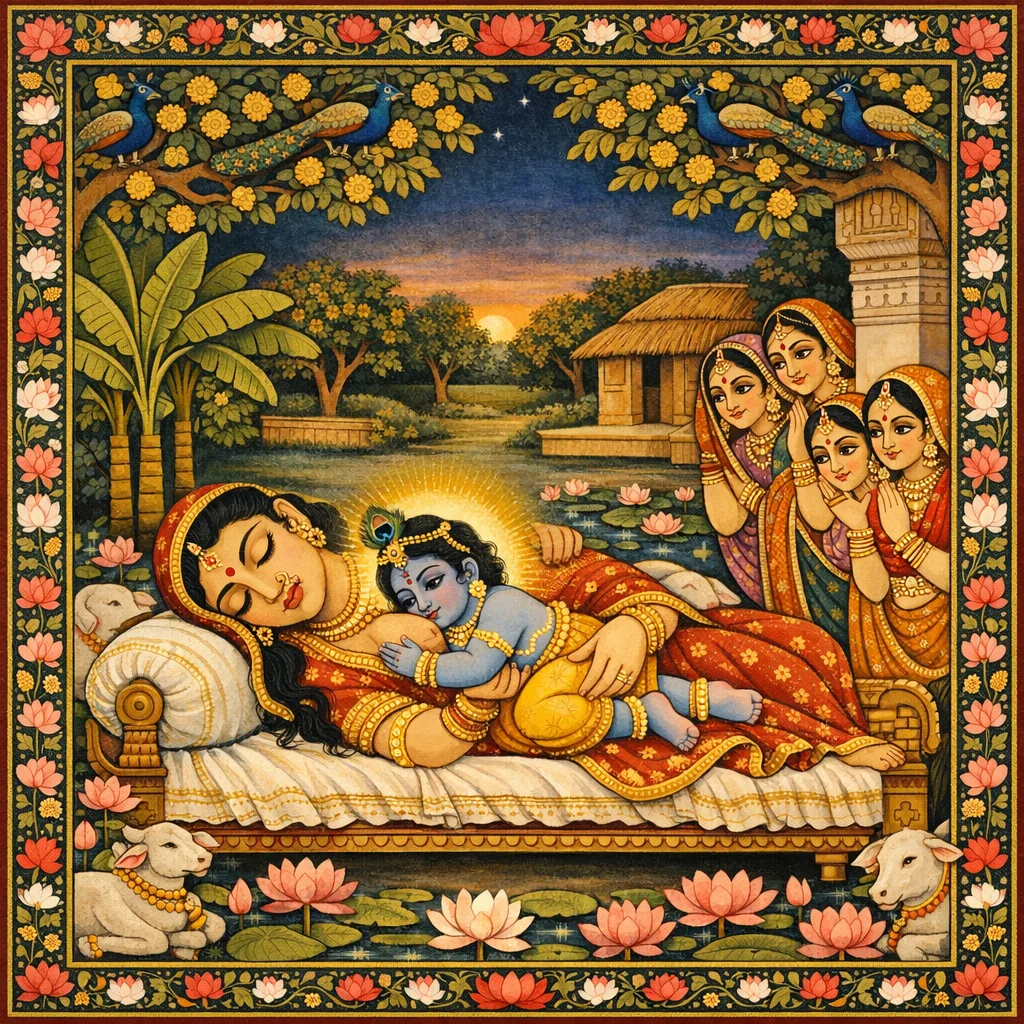
Adhyaya 6
Pūtanā-mokṣa — The Witch Pūtanā’s Attempt and Kṛṣṇa’s Deliverance
Linking from the prior warnings about danger in Gokula, Nanda Mahārāja returns from Mathurā reflecting on Vasudeva’s foresight and taking refuge in the Supreme Controller. Kaṁsa’s agent Pūtanā—infamous for killing infants—enters Vraja by mystic disguise as a captivating woman, bewildering the gopīs who momentarily mistake her for a Lakṣmī-like figure. She reaches baby Kṛṣṇa, whose divinity is veiled like fire under ashes, and attempts to kill Him by smearing poison on her breast. Kṛṣṇa, as antaryāmī, accepts her offering yet turns it into her destruction: He sucks out both poison and life, and her gigantic demonic form crashes down, terrifying Vraja. The gopīs then perform protective rites—ācāmana, nyāsa, tilaka-like markings, and a Viṣṇu-kavaca mantra—emphasizing nāma as the ultimate shield against grahas and malevolent beings. Nanda and the gopas return, marvel at Vasudeva’s prediction, and burn Pūtanā’s body; astonishingly, fragrant smoke arises, symbolizing her purification. The chapter culminates in siddhānta: even a hostile being attains exalted result by contact with Kṛṣṇa, so what to speak of the gopīs’ natural vātsalya-bhakti. It transitions toward ongoing Vraja protection themes and the deepening intimacy of Kṛṣṇa’s childhood līlās.
Shlokas
Verse 1
श्रीशुक उवाच नन्द: पथि वच: शौरेर्न मृषेति विचिन्तयन् । हरिं जगाम शरणमुत्पातागमशङ्कित: ॥ १ ॥
Śukadeva Gosvāmī continued: My dear King, while Nanda Mahārāja was on the way home, he considered that what Vasudeva had said could not be false or useless. There must have been some danger of disturbances in Gokula. As Nanda Mahārāja thought about the danger for his beautiful son, Kṛṣṇa, he was afraid, and he took shelter at the lotus feet of the supreme controller.
Verse 2
कंसेन प्रहिता घोरा पूतना बालघातिनी । शिशूंश्चचार निघ्नन्ती पुरग्रामव्रजादिषु ॥ २ ॥
While Nanda Mahārāja was returning to Gokula, the same fierce Pūtanā whom Kaṁsa had previously engaged to kill babies was wandering about in the towns, cities and villages, doing her nefarious duty.
Verse 3
न यत्र श्रवणादीनि रक्षोघ्नानि स्वकर्मसु । कुर्वन्ति सात्वतां भर्तुर्यातुधान्यश्च तत्र हि ॥ ३ ॥
My dear King, wherever people in any position perform their occupational duties of devotional service by chanting and hearing [śravaṇaṁ kīrtanaṁ viṣṇoḥ], there cannot be any danger from bad elements. Therefore there was no need for anxiety about Gokula while the Supreme Personality of Godhead was personally present.
Verse 4
सा खेचर्येकदोत्पत्य पूतना नन्दगोकुलम् । योषित्वा माययात्मानं प्राविशत् कामचारिणी ॥ ४ ॥
Once upon a time, Pūtanā Rākṣasī, who could move according to her desire and was wandering in outer space, converted herself by mystic power into a very beautiful woman and thus entered Gokula, the abode of Nanda Mahārāja.
Verse 5
तां केशबन्धव्यतिषक्तमल्लिकां बृहन्नितम्बस्तनकृच्छ्रमध्यमाम् । सुवाससं कल्पितकर्णभूषण- त्विषोल्लसत्कुन्तलमण्डिताननाम् ॥ ५ ॥ वल्गुस्मितापाङ्गविसर्गवीक्षितै- र्मनो हरन्तीं वनितां व्रजौकसाम् । अमंसताम्भोजकरेण रूपिणीं गोप्य: श्रियं द्रष्टुमिवागतां पतिम् ॥ ६ ॥
Her hips were full, her breasts were large and firm, seeming to overburden her slim waist, and she was dressed very nicely. Her hair, adorned with a garland of mallikā flowers, was scattered about her beautiful face. Her earrings were brilliant, and as she smiled very attractively, glancing upon everyone, her beauty drew the attention of all the inhabitants of Vraja, especially the men. When the gopīs saw her, they thought that the beautiful goddess of fortune, holding a lotus flower in her hand, had come to see her husband, Kṛṣṇa.
Verse 6
तां केशबन्धव्यतिषक्तमल्लिकां बृहन्नितम्बस्तनकृच्छ्रमध्यमाम् । सुवाससं कल्पितकर्णभूषण- त्विषोल्लसत्कुन्तलमण्डिताननाम् ॥ ५ ॥ वल्गुस्मितापाङ्गविसर्गवीक्षितै- र्मनो हरन्तीं वनितां व्रजौकसाम् । अमंसताम्भोजकरेण रूपिणीं गोप्य: श्रियं द्रष्टुमिवागतां पतिम् ॥ ६ ॥
Her hips were full, her breasts were large and firm, seeming to overburden her slim waist, and she was dressed very nicely. Her hair, adorned with a garland of mallikā flowers, was scattered about her beautiful face. Her earrings were brilliant, and as she smiled very attractively, glancing upon everyone, her beauty drew the attention of all the inhabitants of Vraja, especially the men. When the gopīs saw her, they thought that the beautiful goddess of fortune, holding a lotus flower in her hand, had come to see her husband, Kṛṣṇa.
Verse 7
बालग्रहस्तत्र विचिन्वती शिशून् यदृच्छया नन्दगृहेऽसदन्तकम् । बालं प्रतिच्छन्ननिजोरुतेजसं ददर्श तल्पेऽग्निमिवाहितं भसि ॥ ७ ॥
While searching for small children, Pūtanā, whose business was to kill them, entered the house of Nanda Mahārāja unobstructed, having been sent by the superior potency of the Lord. Without asking anyone’s permission, she entered Nanda Mahārāja’s room, where she saw the child sleeping in bed, His unlimited power covered like a powerful fire covered by ashes. She could understand that this child was not ordinary, but was meant to kill all demons.
Verse 8
विबुध्य तां बालकमारिकाग्रहं चराचरात्मा स निमीलितेक्षण: । अनन्तमारोपयदङ्कमन्तकं यथोरगं सुप्तमबुद्धिरज्जुधी: ॥ ८ ॥
Lord Śrī Kṛṣṇa, the all-pervading Supersoul, lying on the bed, understood that Pūtanā, a witch who was expert in killing small children, had come to kill Him. Therefore, as if afraid of her, Kṛṣṇa closed His eyes. Thus Pūtanā took upon her lap Him who was to be her own annihilation, just as an unintelligent person places a sleeping snake on his lap, thinking the snake to be a rope.
Verse 9
तां तीक्ष्णचित्तामतिवामचेष्टितां वीक्ष्यान्तरा कोषपरिच्छदासिवत् । वरस्त्रियं तत्प्रभया च धर्षिते निरीक्ष्यमाणे जननी ह्यतिष्ठताम् ॥ ९ ॥
Pūtanā Rākṣasī’s heart was fierce and cruel, but she looked like a very affectionate mother. Thus she resembled a sharp sword in a soft sheath. Although seeing her within the room, Yaśodā and Rohiṇī, overwhelmed by her beauty, did not stop her, but remained silent because she treated the child like a mother.
Verse 10
तस्मिन् स्तनं दुर्जरवीर्यमुल्बणं घोराङ्कमादाय शिशोर्ददावथ । गाढं कराभ्यां भगवान् प्रपीड्य तत्- प्राणै: समं रोषसमन्वितोऽपिबत् ॥ १० ॥
On that very spot, the fiercely dangerous Rākṣasī took Kṛṣṇa on her lap and pushed her breast into His mouth. The nipple of her breast was smeared with a dangerous, immediately effective poison, but the Supreme Personality of Godhead, Kṛṣṇa, becoming very angry at her, took hold of her breast, squeezed it very hard with both hands, and sucked out both the poison and her life.
Verse 11
सा मुञ्च मुञ्चालमिति प्रभाषिणी निष्पीड्यमानाखिलजीवमर्मणि । विवृत्य नेत्रे चरणौ भुजौ मुहु: प्रस्विन्नगात्रा क्षिपती रुरोद ह ॥ ११ ॥
Unbearably pressed in every vital point, the demon Pūtanā began to cry, “Please leave me, leave me! Suck my breast no longer!” Perspiring, her eyes wide open and her arms and legs flailing, she cried very loudly again and again.
Verse 12
तस्या: स्वनेनातिगभीररंहसा साद्रिर्मही द्यौश्च चचाल सग्रहा । रसा दिशश्च प्रतिनेदिरे जना: पेतु: क्षितौ वज्रनिपातशङ्कया ॥ १२ ॥
As Pūtanā screamed loudly and forcefully, the earth with its mountains, and outer space with its planets, trembled. The lower planets and all directions vibrated, and people fell down, fearing that thunderbolts were falling upon them.
Verse 13
निशाचरीत्थं व्यथितस्तना व्यसु- र्व्यादाय केशांश्चरणौ भुजावपि । प्रसार्य गोष्ठे निजरूपमास्थिता वज्राहतो वृत्र इवापतन्नृप ॥ १३ ॥
In this way the demon Pūtanā, very much aggrieved because her breast was being attacked by Kṛṣṇa, lost her life. O King Parīkṣit, opening her mouth wide and spreading her arms, legs and hair, she fell down in the pasturing ground in her original form as a Rākṣasī, as Vṛtrāsura had fallen when killed by the thunderbolt of Indra.
Verse 14
पतमानोऽपि तद्देहस्त्रिगव्यूत्यन्तरद्रुमान् । चूर्णयामास राजेन्द्र महदासीत्तदद्भुतम् ॥ १४ ॥
O King Parīkṣit, when the gigantic body of Pūtanā fell to the ground, it smashed all the trees within a limit of twelve miles. Appearing in a gigantic body, she was certainly extraordinary.
Verse 15
ईषामात्रोग्रदंष्ट्रास्यं गिरिकन्दरनासिकम् । गण्डशैलस्तनं रौद्रं प्रकीर्णारुणमूर्धजम् ॥ १५ ॥ अन्धकूपगभीराक्षं पुलिनारोहभीषणम् । बद्धसेतुभुजोर्वङ्घ्रि शून्यतोयह्रदोदरम् ॥ १६ ॥ सन्तत्रसु: स्म तद्वीक्ष्य गोपा गोप्य: कलेवरम् । पूर्वं तु तन्नि:स्वनितभिन्नहृत्कर्णमस्तका: ॥ १७ ॥
The Rākṣasī’s mouth was full of teeth, each resembling the front of a plow, her nostrils were deep like mountain caves, and her breasts resembled big slabs of stone fallen from a hill. Her scattered hair was the color of copper. The sockets of her eyes appeared like deep blind wells, her fearful thighs resembled the banks of a river, her arms, legs and feet seemed like big bridges, and her abdomen appeared like a dried-up lake. The hearts, ears and heads of the cowherd men and women were already shocked by the Rākṣasī’s screaming, and when they saw the fierce wonder of her body, they were even more frightened.
Verse 16
ईषामात्रोग्रदंष्ट्रास्यं गिरिकन्दरनासिकम् । गण्डशैलस्तनं रौद्रं प्रकीर्णारुणमूर्धजम् ॥ १५ ॥ अन्धकूपगभीराक्षं पुलिनारोहभीषणम् । बद्धसेतुभुजोर्वङ्घ्रि शून्यतोयह्रदोदरम् ॥ १६ ॥ सन्तत्रसु: स्म तद्वीक्ष्य गोपा गोप्य: कलेवरम् । पूर्वं तु तन्नि:स्वनितभिन्नहृत्कर्णमस्तका: ॥ १७ ॥
The Rākṣasī’s mouth was full of teeth, each resembling the front of a plow, her nostrils were deep like mountain caves, and her breasts resembled big slabs of stone fallen from a hill. Her scattered hair was the color of copper. The sockets of her eyes appeared like deep blind wells, her fearful thighs resembled the banks of a river, her arms, legs and feet seemed like big bridges, and her abdomen appeared like a dried-up lake. The hearts, ears and heads of the cowherd men and women were already shocked by the Rākṣasī’s screaming, and when they saw the fierce wonder of her body, they were even more frightened.
Verse 17
ईषामात्रोग्रदंष्ट्रास्यं गिरिकन्दरनासिकम् । गण्डशैलस्तनं रौद्रं प्रकीर्णारुणमूर्धजम् ॥ १५ ॥ अन्धकूपगभीराक्षं पुलिनारोहभीषणम् । बद्धसेतुभुजोर्वङ्घ्रि शून्यतोयह्रदोदरम् ॥ १६ ॥ सन्तत्रसु: स्म तद्वीक्ष्य गोपा गोप्य: कलेवरम् । पूर्वं तु तन्नि:स्वनितभिन्नहृत्कर्णमस्तका: ॥ १७ ॥
The Rākṣasī’s mouth was full of teeth, each resembling the front of a plow, her nostrils were deep like mountain caves, and her breasts resembled big slabs of stone fallen from a hill. Her scattered hair was the color of copper. The sockets of her eyes appeared like deep blind wells, her fearful thighs resembled the banks of a river, her arms, legs and feet seemed like big bridges, and her abdomen appeared like a dried-up lake. The hearts, ears and heads of the cowherd men and women were already shocked by the Rākṣasī’s screaming, and when they saw the fierce wonder of her body, they were even more frightened.
Verse 18
बालं च तस्या उरसि क्रीडन्तमकुतोभयम् । गोप्यस्तूर्णं समभ्येत्य जगृहुर्जातसम्भ्रमा: ॥ १८ ॥
Without fear, the child Kṛṣṇa was playing on the upper portion of Pūtanā Rākṣasī’s breast, and when the gopīs saw the child’s wonderful activities, they immediately came forward with great jubilation and picked Him up.
Verse 19
यशोदारोहिणीभ्यां ता: समं बालस्य सर्वत: । रक्षां विदधिरे सम्यग्गोपुच्छभ्रमणादिभि: ॥ १९ ॥
Thereafter, mother Yaśodā and Rohiṇī, along with the other elderly gopīs, waved about the switch of a cow to give full protection to the child Śrī Kṛṣṇa.
Verse 20
गोमूत्रेण स्नापयित्वा पुनर्गोरजसार्भकम् । रक्षां चक्रुश्च शकृता द्वादशाङ्गेषु नामभि: ॥ २० ॥
The child was thoroughly washed with cow urine and then smeared with the dust raised by the movements of the cows. Then different names of the Lord were applied with cow dung on twelve different parts of His body, beginning with the forehead, as done in applying tilaka. In this way, the child was given protection.
Verse 21
गोप्य: संस्पृष्टसलिला अङ्गेषु करयो: पृथक् । न्यस्यात्मन्यथ बालस्य बीजन्यासमकुर्वत ॥ २१ ॥
The gopīs first executed the process of ācamana, drinking a sip of water from the right hand. They purified their bodies and hands with the nyāsa-mantra and then applied the same mantra upon the body of the child.
Verse 22
अव्यादजोऽङ्घ्रि मणिमांस्तव जान्वथोरू यज्ञोऽच्युत: कटितटं जठरं हयास्य: । हृत्केशवस्त्वदुर ईश इनस्तु कण्ठं विष्णुर्भुजं मुखमुरुक्रम ईश्वर: कम् ॥ २२ ॥ चक्रयग्रत: सहगदो हरिरस्तु पश्चात् त्वत्पार्श्वयोर्धनुरसी मधुहाजनश्च । कोणेषु शङ्ख उरुगाय उपर्युपेन्द्र- स्तार्क्ष्य: क्षितौ हलधर: पुरुष: समन्तात् ॥ २३ ॥
[Śukadeva Gosvāmī informed Mahārāja Parīkṣit that the gopīs, following the proper system, protected Kṛṣṇa, their child, with this mantra.] May Aja protect Your legs, may Maṇimān protect Your knees, Yajña Your thighs, Acyuta the upper part of Your waist, and Hayagrīva Your abdomen. May Keśava protect Your heart, Īśa Your chest, the sun-god Your neck, Viṣṇu Your arms, Urukrama Your face, and Īśvara Your head. May Cakrī protect You from the front; may Śrī Hari, Gadādharī, the carrier of the club, protect You from the back; and may the carrier of the bow, who is known as the enemy of Madhu, and Lord Ajana, the carrier of the sword, protect Your two sides. May Lord Urugāya, the carrier of the conchshell, protect You from all corners; may Upendra protect You from above; may Garuḍa protect You on the ground; and may Lord Haladhara, the Supreme Person, protect You on all sides.
Verse 23
अव्यादजोऽङ्घ्रि मणिमांस्तव जान्वथोरू यज्ञोऽच्युत: कटितटं जठरं हयास्य: । हृत्केशवस्त्वदुर ईश इनस्तु कण्ठं विष्णुर्भुजं मुखमुरुक्रम ईश्वर: कम् ॥ २२ ॥ चक्रयग्रत: सहगदो हरिरस्तु पश्चात् त्वत्पार्श्वयोर्धनुरसी मधुहाजनश्च । कोणेषु शङ्ख उरुगाय उपर्युपेन्द्र- स्तार्क्ष्य: क्षितौ हलधर: पुरुष: समन्तात् ॥ २३ ॥
[Śukadeva Gosvāmī informed Mahārāja Parīkṣit that the gopīs, following the proper system, protected Kṛṣṇa, their child, with this mantra.] May Aja protect Your legs, may Maṇimān protect Your knees, Yajña Your thighs, Acyuta the upper part of Your waist, and Hayagrīva Your abdomen. May Keśava protect Your heart, Īśa Your chest, the sun-god Your neck, Viṣṇu Your arms, Urukrama Your face, and Īśvara Your head. May Cakrī protect You from the front; may Śrī Hari, Gadādharī, the carrier of the club, protect You from the back; and may the carrier of the bow, who is known as the enemy of Madhu, and Lord Ajana, the carrier of the sword, protect Your two sides. May Lord Urugāya, the carrier of the conchshell, protect You from all corners; may Upendra protect You from above; may Garuḍa protect You on the ground; and may Lord Haladhara, the Supreme Person, protect You on all sides.
Verse 24
इन्द्रियाणि हृषीकेश: प्राणान् नारायणोऽवतु । श्वेतद्वीपपतिश्चित्तं मनो योगेश्वरोऽवतु ॥ २४ ॥
May Hṛṣīkeśa protect Your senses, and Nārāyaṇa Your life air. May the master of Śvetadvīpa protect the core of Your heart, and may Lord Yogeśvara protect Your mind.
Verse 25
पृश्निगर्भस्तु ते बुद्धिमात्मानं भगवान् पर: । क्रीडन्तं पातु गोविन्द: शयानं पातु माधव: ॥ २५ ॥ व्रजन्तमव्याद्वैकुण्ठ आसीनं त्वां श्रिय: पति: । भुञ्जानं यज्ञभुक् पातु सर्वग्रहभयङ्कर: ॥ २६ ॥
May Lord Pṛśnigarbha protect Your intelligence, and the Supreme Personality of Godhead Your soul. While You are playing, may Govinda protect You, and while You are sleeping may Mādhava protect You. May Lord Vaikuṇṭha protect You while You are walking, and may Lord Nārāyaṇa, the husband of the goddess of fortune, protect You while You are sitting. Similarly, may Lord Yajñabhuk, the fearful enemy of all evil planets, always protect You while You enjoy life.
Verse 26
पृश्निगर्भस्तु ते बुद्धिमात्मानं भगवान् पर: । क्रीडन्तं पातु गोविन्द: शयानं पातु माधव: ॥ २५ ॥ व्रजन्तमव्याद्वैकुण्ठ आसीनं त्वां श्रिय: पति: । भुञ्जानं यज्ञभुक् पातु सर्वग्रहभयङ्कर: ॥ २६ ॥
May Lord Pṛśnigarbha protect Your intelligence, and the Supreme Personality of Godhead Your soul. While You are playing, may Govinda protect You, and while You are sleeping may Mādhava protect You. May Lord Vaikuṇṭha protect You while You are walking, and may Lord Nārāyaṇa, the husband of the goddess of fortune, protect You while You are sitting. Similarly, may Lord Yajñabhuk, the fearful enemy of all evil planets, always protect You while You enjoy life.
Verse 27
डाकिन्यो यातुधान्यश्च कुष्माण्डा येऽर्भकग्रहा: । भूतप्रेतपिशाचाश्च यक्षरक्षोविनायका: ॥ २७ ॥ कोटरा रेवती ज्येष्ठा पूतना मातृकादय: । उन्मादा ये ह्यपस्मारा देहप्राणेन्द्रियद्रुह: ॥ २८ ॥ स्वप्नदृष्टा महोत्पाता वृद्धा बालग्रहाश्च ये । सर्वे नश्यन्तु ते विष्णोर्नामग्रहणभीरव: ॥ २९ ॥
The evil witches known as Ḍākinīs, Yātudhānīs and Kuṣmāṇḍas are the greatest enemies of children, and the evil spirits like Bhūtas, Pretas, Piśācas, Yakṣas, Rākṣasas and Vināyakas, as well as witches like Koṭarā, Revatī, Jyeṣṭhā, Pūtanā and Mātṛkā, are always ready to give trouble to the body, the life air and the senses, causing loss of memory, madness and bad dreams. Like the most experienced evil stars, they all create great disturbances, especially for children, but one can vanquish them simply by uttering Lord Viṣṇu’s name, for when Lord Viṣṇu’s name resounds, all of them become afraid and go away.
Verse 28
डाकिन्यो यातुधान्यश्च कुष्माण्डा येऽर्भकग्रहा: । भूतप्रेतपिशाचाश्च यक्षरक्षोविनायका: ॥ २७ ॥ कोटरा रेवती ज्येष्ठा पूतना मातृकादय: । उन्मादा ये ह्यपस्मारा देहप्राणेन्द्रियद्रुह: ॥ २८ ॥ स्वप्नदृष्टा महोत्पाता वृद्धा बालग्रहाश्च ये । सर्वे नश्यन्तु ते विष्णोर्नामग्रहणभीरव: ॥ २९ ॥
The evil witches known as Ḍākinīs, Yātudhānīs and Kuṣmāṇḍas are the greatest enemies of children, and the evil spirits like Bhūtas, Pretas, Piśācas, Yakṣas, Rākṣasas and Vināyakas, as well as witches like Koṭarā, Revatī, Jyeṣṭhā, Pūtanā and Mātṛkā, are always ready to give trouble to the body, the life air and the senses, causing loss of memory, madness and bad dreams. Like the most experienced evil stars, they all create great disturbances, especially for children, but one can vanquish them simply by uttering Lord Viṣṇu’s name, for when Lord Viṣṇu’s name resounds, all of them become afraid and go away.
Verse 29
डाकिन्यो यातुधान्यश्च कुष्माण्डा येऽर्भकग्रहा: । भूतप्रेतपिशाचाश्च यक्षरक्षोविनायका: ॥ २७ ॥ कोटरा रेवती ज्येष्ठा पूतना मातृकादय: । उन्मादा ये ह्यपस्मारा देहप्राणेन्द्रियद्रुह: ॥ २८ ॥ स्वप्नदृष्टा महोत्पाता वृद्धा बालग्रहाश्च ये । सर्वे नश्यन्तु ते विष्णोर्नामग्रहणभीरव: ॥ २९ ॥
The evil witches known as Ḍākinīs, Yātudhānīs and Kuṣmāṇḍas are the greatest enemies of children, and the evil spirits like Bhūtas, Pretas, Piśācas, Yakṣas, Rākṣasas and Vināyakas, as well as witches like Koṭarā, Revatī, Jyeṣṭhā, Pūtanā and Mātṛkā, are always ready to give trouble to the body, the life air and the senses, causing loss of memory, madness and bad dreams. Like the most experienced evil stars, they all create great disturbances, especially for children, but one can vanquish them simply by uttering Lord Viṣṇu’s name, for when Lord Viṣṇu’s name resounds, all of them become afraid and go away.
Verse 30
श्रीशुक उवाच इति प्रणयबद्धाभिर्गोपीभि: कृतरक्षणम् । पाययित्वा स्तनं माता सन्न्यवेशयदात्मजम् ॥ ३० ॥
Śrīla Śukadeva Gosvāmī continued: All the gopīs, headed by mother Yaśodā, were bound by maternal affection. After they thus chanted mantras to protect the child, mother Yaśodā gave the child the nipple of her breast to suck and then got Him to lie down on His bed.
Verse 31
तावन्नन्दादयो गोपा मथुराया व्रजं गता: । विलोक्य पूतनादेहं बभूवुरतिविस्मिता: ॥ ३१ ॥
Meanwhile, all the cowherd men, headed by Nanda Mahārāja, returned from Mathurā, and when they saw on the way the gigantic body of Pūtanā lying dead, they were struck with great wonder.
Verse 32
नूनं बतर्षि: सञ्जातो योगेशो वा समास स: । स एव दृष्टो ह्युत्पातो यदाहानकदुन्दुभि: ॥ ३२ ॥
Nanda Mahārāja and the other gopas exclaimed: My dear friends, you must know that Ānakadundubhi, Vasudeva, has become a great saint or a master of mystic power. Otherwise how could he have foreseen this calamity and predicted it to us?
Verse 33
कलेवरं परशुभिश्छित्त्वा तत्ते व्रजौकस: । दूरे क्षिप्त्वावयवशो न्यदहन् काष्ठवेष्टितम् ॥ ३३ ॥
The inhabitants of Vraja cut the gigantic body of Pūtanā into pieces with the help of axes. Then they threw the pieces far away, covered them with wood and burned them to ashes.
Verse 34
दह्यमानस्य देहस्य धूमश्चागुरुसौरभ: । उत्थित: कृष्णनिर्भुक्तसपद्याहतपाप्मन: ॥ ३४ ॥
Because of Kṛṣṇa’s having sucked the breast of the Rākṣasī Pūtanā, when Kṛṣṇa killed her she was immediately freed of all material contamination. Her sinful reactions automatically vanished, and therefore when her gigantic body was being burnt, the smoke emanating from her body was fragrant like aguru incense.
Verse 35
पूतना लोकबालघ्नी राक्षसी रुधिराशना । जिघांसयापि हरये स्तनं दत्त्वाप सद्गतिम् ॥ ३५ ॥ किं पुन: श्रद्धया भक्त्या कृष्णाय परमात्मने । यच्छन् प्रियतमं किं नु रक्तास्तन्मातरो यथा ॥ ३६ ॥
Pūtanā was always hankering for the blood of human children, and with that desire she came to kill Kṛṣṇa; but because she offered her breast to the Lord, she attained the greatest achievement. What then is to be said of those who had natural devotion and affection for Kṛṣṇa as mothers and who offered Him their breasts to suck or offered something very dear, as a mother offers something to a child?
Verse 36
पूतना लोकबालघ्नी राक्षसी रुधिराशना । जिघांसयापि हरये स्तनं दत्त्वाप सद्गतिम् ॥ ३५ ॥ किं पुन: श्रद्धया भक्त्या कृष्णाय परमात्मने । यच्छन् प्रियतमं किं नु रक्तास्तन्मातरो यथा ॥ ३६ ॥
Pūtanā was always hankering for the blood of human children, and with that desire she came to kill Kṛṣṇa; but because she offered her breast to the Lord, she attained the greatest achievement. What then is to be said of those who had natural devotion and affection for Kṛṣṇa as mothers and who offered Him their breasts to suck or offered something very dear, as a mother offers something to a child?
Verse 37
पद्भ्यां भक्तहृदिस्थाभ्यां वन्द्याभ्यां लोकवन्दितै: । अङ्गं यस्या: समाक्रम्य भगवानपितत् स्तनम् ॥ ३७ ॥ यातुधान्यपि सा स्वर्गमवाप जननीगतिम् । कृष्णभुक्तस्तनक्षीरा: किमु गावोऽनुमातर: ॥ ३८ ॥
The Supreme Personality of Godhead, Kṛṣṇa, is always situated within the core of the heart of the pure devotee, and He is always offered prayers by such worshipable personalities as Lord Brahmā and Lord Śiva. Because Kṛṣṇa embraced Pūtanā’s body with great pleasure and sucked her breast, although she was a great witch, she attained the position of a mother in the transcendental world and thus achieved the highest perfection. What then is to be said of the cows whose nipples Kṛṣṇa sucked with great pleasure and who offered their milk very jubilantly with affection exactly like that of a mother?
Verse 38
पद्भ्यां भक्तहृदिस्थाभ्यां वन्द्याभ्यां लोकवन्दितै: । अङ्गं यस्या: समाक्रम्य भगवानपितत् स्तनम् ॥ ३७ ॥ यातुधान्यपि सा स्वर्गमवाप जननीगतिम् । कृष्णभुक्तस्तनक्षीरा: किमु गावोऽनुमातर: ॥ ३८ ॥
The Supreme Personality of Godhead, Kṛṣṇa, is always situated within the core of the heart of the pure devotee, and He is always offered prayers by such worshipable personalities as Lord Brahmā and Lord Śiva. Because Kṛṣṇa embraced Pūtanā’s body with great pleasure and sucked her breast, although she was a great witch, she attained the position of a mother in the transcendental world and thus achieved the highest perfection. What then is to be said of the cows whose nipples Kṛṣṇa sucked with great pleasure and who offered their milk very jubilantly with affection exactly like that of a mother?
Verse 39
पयांसि यासामपिबत् पुत्रस्नेहस्नुतान्यलम् । भगवान् देवकीपुत्र: कैवल्याद्यखिलप्रद: ॥ ३९ ॥ तासामविरतं कृष्णे कुर्वतीनां सुतेक्षणम् । न पुन: कल्पते राजन् संसारोऽज्ञानसम्भव: ॥ ४० ॥
The Supreme Personality of Godhead, Kṛṣṇa, is the bestower of many benedictions, including liberation [kaivalya], or oneness with the Brahman effulgence. For that Personality of Godhead, the gopīs always felt maternal love, and Kṛṣṇa sucked their breasts with full satisfaction. Therefore, because of their relationship as mother and son, although the gopīs were engaged in various family activities, one should never think that they returned to this material world after leaving their bodies.
Verse 40
पयांसि यासामपिबत् पुत्रस्नेहस्नुतान्यलम् । भगवान् देवकीपुत्र: कैवल्याद्यखिलप्रद: ॥ ३९ ॥ तासामविरतं कृष्णे कुर्वतीनां सुतेक्षणम् । न पुन: कल्पते राजन् संसारोऽज्ञानसम्भव: ॥ ४० ॥
The Supreme Personality of Godhead, Kṛṣṇa, is the bestower of many benedictions, including liberation [kaivalya], or oneness with the Brahman effulgence. For that Personality of Godhead, the gopīs always felt maternal love, and Kṛṣṇa sucked their breasts with full satisfaction. Therefore, because of their relationship as mother and son, although the gopīs were engaged in various family activities, one should never think that they returned to this material world after leaving their bodies.
Verse 41
कटधूमस्य सौरभ्यमवघ्राय व्रजौकस: । किमिदं कुत एवेति वदन्तो व्रजमाययु: ॥ ४१ ॥
Upon smelling the fragrance of the smoke emanating from Pūtanā’s burning body, many inhabitants of Vrajabhūmi in distant places were astonished. “Where is this fragrance coming from?” they asked. Thus they went to the spot where Pūtanā’s body was being burnt.
Verse 42
ते तत्र वर्णितं गोपै: पूतनागमनादिकम् । श्रुत्वा तन्निधनं स्वस्ति शिशोश्चासन् सुविस्मिता: ॥ ४२ ॥
When the inhabitants of Vraja who had come from distant places heard the whole story of how Pūtanā had come and then been killed by Kṛṣṇa, they were certainly astonished, and they offered their blessings to the child for His wonderful deed of killing Pūtanā. Nanda Mahārāja, of course, was very much obliged to Vasudeva, who had foreseen the incident, and simply thanked him, thinking how wonderful Vasudeva was.
Verse 43
नन्द: स्वपुत्रमादाय प्रेत्यागतमुदारधी: । मूर्ध्न्युपाघ्राय परमां मुदं लेभे कुरूद्वह ॥ ४३ ॥
O Mahārāja Parīkṣit, best of the Kurus, Nanda Mahārāja was very liberal and simple. He immediately took his son Kṛṣṇa on his lap as if Kṛṣṇa had returned from death, and by formally smelling his son’s head, Nanda Mahārāja undoubtedly enjoyed transcendental bliss.
Verse 44
य एतत् पूतनामोक्षं कृष्णस्यार्भकमद्भुतम् । शृणुयाच्छ्रद्धया मर्त्यो गोविन्दे लभते रतिम् ॥ ४४ ॥
Any person who hears with faith and devotion about how Kṛṣṇa, the Supreme Personality of Godhead, killed Pūtanā, and who thus invests his hearing in such childhood pastimes of Kṛṣṇa, certainly attains attachment for Govinda, the supreme, original person.
Frequently Asked Questions
Bhāgavata logic emphasizes the Lord’s absolute purity and transformative touch: Pūtanā’s breast-offering, though motivated by violence, still became a form of contact-service to Bhagavān. Kṛṣṇa accepted the external act (dāna of milk/breast) and removed the internal poison (sin), granting an elevated result—demonstrating His bhakta-vātsalya and the supremacy of His grace over karma.
The metaphor indicates concealed aiśvarya: the infant appears ordinary to human eyes, yet His unlimited potency remains fully present. Yogamāyā covers His majesty to facilitate intimate Vraja relationships, while the līlā simultaneously reveals that the same child effortlessly destroys a rākṣasī.
The passage integrates Vraja’s maternal care with Vaiṣṇava siddhānta: mantras, nyāsa, and protective naming are subordinate supports, but the text explicitly concludes that uttering Viṣṇu’s name alone terrifies and disperses harmful beings. It teaches that the highest protection is nāma-āśraya (taking shelter of the Lord’s name), with rituals functioning as expressions of loving concern.
On the surface, Kaṁsa deputes Pūtanā to kill infants; at the deeper theological level, the chapter states she entered ‘having been sent by the superior potency of the Lord,’ meaning Bhagavān’s arrangement turns demonic aggression into līlā that protects Vraja, reveals Kṛṣṇa’s divinity, and delivers the demon—without compromising human moral agency.
The fragrance symbolizes purification (pāpa-kṣaya) resulting from Kṛṣṇa’s direct contact. The Bhāgavata uses sensory imagery—aguru-like aroma—to externalize an inner metaphysical change: contamination is burned away, leaving a sign of sanctity recognizable even to distant villagers.