Adhyaya 7
Utthāna Ceremony, Śakaṭa-bhañga, Tṛṇāvarta-vadha, and the Vision of the Universe in Kṛṣṇa’s Mouth
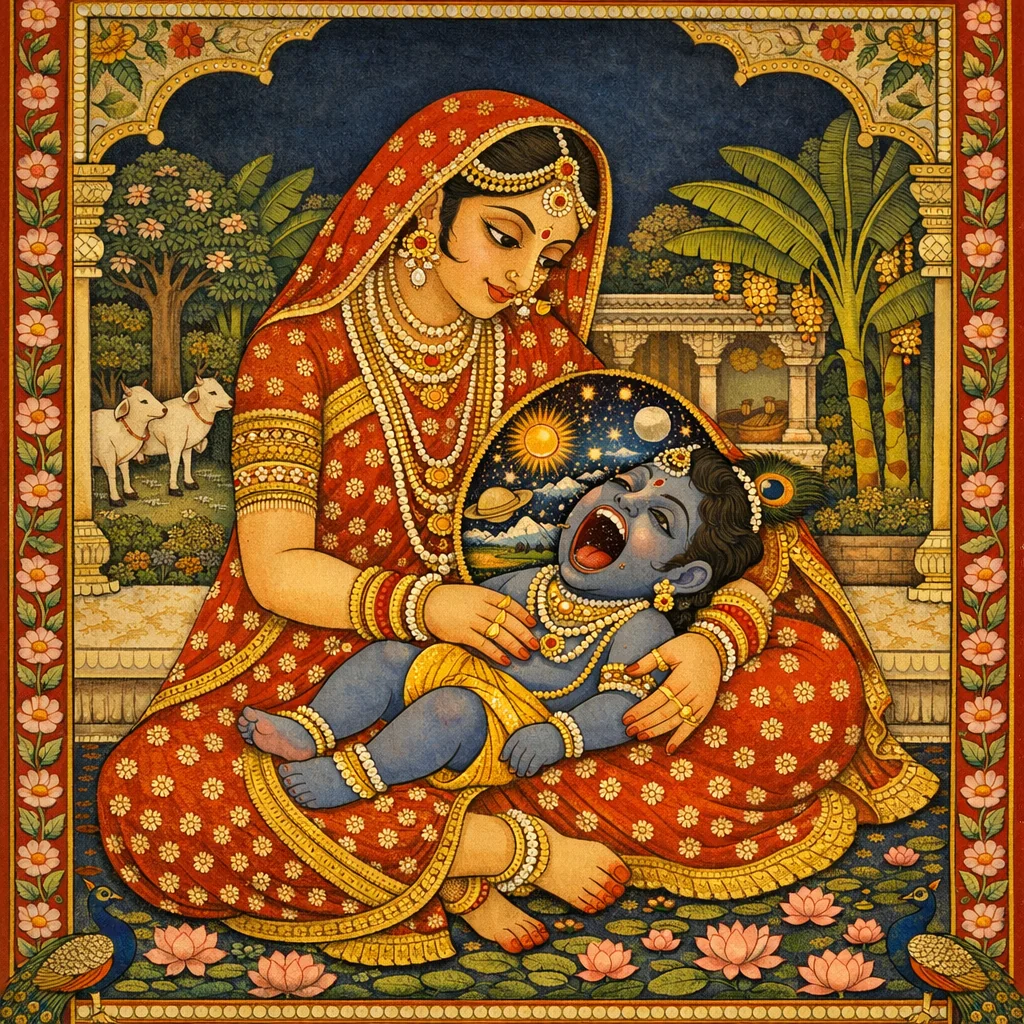
Parīkṣit requests further narration of Kṛṣṇa’s bāla-līlā, explaining that hearing avatāra-kathā purifies the mind and dissolves material attachment, especially through Kṛṣṇa’s childhood sweetness. Śukadeva describes Yaśodā’s utthāna ceremony (around three months), with Rohiṇī’s auspicious lunar conjunction and Vedic chanting. During the festivities, baby Kṛṣṇa—crying for milk—kicks beneath a handcart, and the cart collapses (śakaṭa-bhañga), baffling the adults who dismiss the children’s eyewitness account. Fearing graha-doṣa, Yaśodā and Nanda summon brāhmaṇas for protective rites; the narrative emphasizes the potency of truthful, envy-free brāhmaṇas and charity as part of household dharma. About a year later, Tṛṇāvarta, sent by Kaṁsa, arrives as a whirlwind, abducts Kṛṣṇa, but is destroyed when the child becomes unbearably heavy and grasps his throat—illustrating poṣaṇa (divine protection) amid apparent vulnerability. The chapter culminates in Yaśodā seeing the entire universe within Kṛṣṇa’s mouth as He yawns, bridging to the next movement: increasing wonder that will later intensify into the famous binding pastime (dāmodara-līlā).
Shlokas
Verse 1
श्रीराजोवाच येन येनावतारेण भगवान् हरिरीश्वर: । करोति कर्णरम्याणि मनोज्ञानि च न: प्रभो ॥ १ ॥ यच्छृण्वतोऽपैत्यरतिर्वितृष्णा सत्त्वं च शुद्ध्यत्यचिरेण पुंस: । भक्तिर्हरौ तत्पुरुषे च सख्यं तदेव हारं वद मन्यसे चेत् ॥ २ ॥
King Parīkṣit said: My lord, Śukadeva Gosvāmī, all the various activities exhibited by the incarnations of the Supreme Personality of Godhead are certainly pleasing to the ear and to the mind. Simply by one’s hearing of these activities, the dirty things in one’s mind immediately vanish. Generally we are reluctant to hear about the activities of the Lord, but Kṛṣṇa’s childhood activities are so attractive that they are automatically pleasing to the mind and ear. Thus one’s attachment for hearing about material things, which is the root cause of material existence, vanishes, and one gradually develops devotional service to the Supreme Lord, attachment for Him, and friendship with devotees who give us the contribution of Kṛṣṇa consciousness. If you think it fit, kindly speak about those activities of the Lord.
Verse 2
श्रीराजोवाच येन येनावतारेण भगवान् हरिरीश्वर: । करोति कर्णरम्याणि मनोज्ञानि च न: प्रभो ॥ १ ॥ यच्छृण्वतोऽपैत्यरतिर्वितृष्णा सत्त्वं च शुद्ध्यत्यचिरेण पुंस: । भक्तिर्हरौ तत्पुरुषे च सख्यं तदेव हारं वद मन्यसे चेत् ॥ २ ॥
King Parīkṣit said: My lord, Śukadeva Gosvāmī, all the various activities exhibited by the incarnations of the Supreme Personality of Godhead are certainly pleasing to the ear and to the mind. Simply by one’s hearing of these activities, the dirty things in one’s mind immediately vanish. Generally we are reluctant to hear about the activities of the Lord, but Kṛṣṇa’s childhood activities are so attractive that they are automatically pleasing to the mind and ear. Thus one’s attachment for hearing about material things, which is the root cause of material existence, vanishes, and one gradually develops devotional service to the Supreme Lord, attachment for Him, and friendship with devotees who give us the contribution of Kṛṣṇa consciousness. If you think it fit, kindly speak about those activities of the Lord.
Verse 3
अथान्यदपि कृष्णस्य तोकाचरितमद्भुतम् । मानुषं लोकमासाद्य तज्जातिमनुरुन्धत: ॥ ३ ॥
Please describe other pastimes of Kṛṣṇa, the Supreme Personality, who appeared on this planet earth, imitating a human child and performing wonderful activities like killing Pūtanā.
Verse 4
श्रीशुक उवाच कदाचिदौत्थानिककौतुकाप्लवे जन्मर्क्षयोगे समवेतयोषिताम् । वादित्रगीतद्विजमन्त्रवाचकै- श्चकार सूनोरभिषेचनं सती ॥ ४ ॥
Śukadeva Gosvāmī said: When mother Yaśodā’s baby was slanting His body to attempt to rise and turn around, this attempt was observed by a Vedic ceremony. In such a ceremony, called utthāna, which is performed when a child is due to leave the house for the first time, the child is properly bathed. Just after Kṛṣṇa turned three months old, mother Yaśodā celebrated this ceremony with other women of the neighborhood. On that day, there was a conjunction of the moon with the constellation Rohiṇī. As the brāhmaṇas joined by chanting Vedic hymns and professional musicians also took part, this great ceremony was observed by mother Yaśodā.
Verse 5
नन्दस्य पत्नी कृतमज्जनादिकं विप्रै: कृतस्वस्त्ययनं सुपूजितै: । अन्नाद्यवास:स्रगभीष्टधेनुभि: सञ्जातनिद्राक्षमशीशयच्छनै: ॥ ५ ॥
After completing the bathing ceremony for the child, mother Yaśodā received the brāhmaṇas by worshiping them with proper respect and giving them ample food grains and other eatables, clothing, desirable cows, and garlands. The brāhmaṇas properly chanted Vedic hymns to observe the auspicious ceremony, and when they finished and mother Yaśodā saw that the child felt sleepy, she lay down on the bed with the child until He was peacefully asleep.
Verse 6
औत्थानिकौत्सुक्यमना मनस्विनी समागतान् पूजयती व्रजौकस: । नैवाशृणोद् वै रुदितं सुतस्य सा रुदन् स्तनार्थी चरणावुदक्षिपत् ॥ ६ ॥
The liberal mother Yaśodā, absorbed in celebrating the utthāna ceremony, was busy receiving guests, worshiping them with all respect and offering them clothing, cows, garlands and grains. Thus she could not hear the child crying for His mother. At that time, the child Kṛṣṇa, demanding to drink the milk of His mother’s breast, angrily threw His legs upward.
Verse 7
अध:शयानस्य शिशोरनोऽल्पक- प्रवालमृद्वङ्घ्रिहतं व्यवर्तत । विध्वस्तनानारसकुप्यभाजनं व्यत्यस्तचक्राक्षविभिन्नकूबरम् ॥ ७ ॥
Lord Śrī Kṛṣṇa was lying down underneath the handcart in one corner of the courtyard, and although His little legs were as soft as leaves, when He struck the cart with His legs, it turned over violently and collapsed. The wheels separated from the axle, the hubs and spokes fell apart, and the pole of the handcart broke. On the cart there were many little utensils made of various metals, and all of them scattered hither and thither.
Verse 8
दृष्ट्वा यशोदाप्रमुखा व्रजस्त्रिय औत्थानिके कर्मणि या: समागता: । नन्दादयश्चाद्भुतदर्शनाकुला: कथं स्वयं वै शकटं विपर्यगात् ॥ ८ ॥
When mother Yaśodā and the other ladies who had assembled for the utthāna festival, and all the men, headed by Nanda Mahārāja, saw the wonderful situation, they began to wonder how the handcart had collapsed by itself. They began to wander here and there, trying to find the cause, but were unable to do so.
Verse 9
ऊचुरव्यवसितमतीन् गोपान्गोपीश्च बालका: । रुदतानेन पादेन क्षिप्तमेतन्न संशय: ॥ ९ ॥
The assembled cowherd men and ladies began to contemplate how this thing had happened. “Is it the work of some demon or evil planet?” they asked. At that time, the small children present asserted that the cart had been kicked apart by the baby Kṛṣṇa. As soon as the crying baby had kicked the cart’s wheel, the cart had collapsed. There was no doubt about it.
Verse 10
न ते श्रद्दधिरे गोपा बालभाषितमित्युत । अप्रमेयं बलं तस्य बालकस्य न ते विदु: ॥ १० ॥
The assembled gopīs and gopas, unaware that Kṛṣṇa is always unlimited, could not believe that baby Kṛṣṇa had such inconceivable power. They could not believe the statements of the children, and therefore they neglected these statements as being childish talk.
Verse 11
रुदन्तं सुतमादाय यशोदा ग्रहशङ्किता । कृतस्वस्त्ययनं विप्रै: सूक्तै: स्तनमपाययत् ॥ ११ ॥
Thinking that some bad planet had attacked Kṛṣṇa, mother Yaśodā picked up the crying child and allowed Him to suck her breast. Then she called for experienced brāhmaṇas to chant Vedic hymns and perform an auspicious ritualistic ceremony.
Verse 12
पूर्ववत् स्थापितं गोपैर्बलिभि: सपरिच्छदम् । विप्रा हुत्वार्चयांचक्रुर्दध्यक्षतकुशाम्बुभि: ॥ १२ ॥
After the strong, stout cowherd men assembled the pots and paraphernalia on the handcart and set it up as before, the brāhmaṇas performed a ritualistic ceremony with a fire sacrifice to appease the bad planet, and then, with rice grains, kuśa, water and curd, they worshiped the Supreme Lord.
Verse 13
येऽसूयानृतदम्भेर्षाहिंसामानविवर्जिता: । न तेषां सत्यशीलानामाशिषो विफला: कृता: ॥ १३ ॥ इति बालकमादाय सामर्ग्यजुरुपाकृतै: । जलै: पवित्रौषधिभिरभिषिच्य द्विजोत्तमै: ॥ १४ ॥ वाचयित्वा स्वस्त्ययनं नन्दगोप: समाहित: । हुत्वा चाग्निं द्विजातिभ्य: प्रादादन्नं महागुणम् ॥ १५ ॥
When brāhmaṇas are free from envy, untruthfulness, unnecessary pride, grudges, disturbance by the opulence of others, and false prestige, their blessings never go in vain. Considering this, Nanda Mahārāja soberly took Kṛṣṇa on his lap and invited such truthful brāhmaṇas to perform a ritualistic ceremony according to the holy hymns of the Sāma Veda, Ṛg Veda and Yajur Veda. Then, while the hymns were being chanted, he bathed the child with water mixed with pure herbs, and after performing a fire ceremony, he sumptuously fed all the brāhmaṇas with first-class grains and other food.
Verse 14
येऽसूयानृतदम्भेर्षाहिंसामानविवर्जिता: । न तेषां सत्यशीलानामाशिषो विफला: कृता: ॥ १३ ॥ इति बालकमादाय सामर्ग्यजुरुपाकृतै: । जलै: पवित्रौषधिभिरभिषिच्य द्विजोत्तमै: ॥ १४ ॥ वाचयित्वा स्वस्त्ययनं नन्दगोप: समाहित: । हुत्वा चाग्निं द्विजातिभ्य: प्रादादन्नं महागुणम् ॥ १५ ॥
When brāhmaṇas are free from envy, untruthfulness, unnecessary pride, grudges, disturbance by the opulence of others, and false prestige, their blessings never go in vain. Considering this, Nanda Mahārāja soberly took Kṛṣṇa on his lap and invited such truthful brāhmaṇas to perform a ritualistic ceremony according to the holy hymns of the Sāma Veda, Ṛg Veda and Yajur Veda. Then, while the hymns were being chanted, he bathed the child with water mixed with pure herbs, and after performing a fire ceremony, he sumptuously fed all the brāhmaṇas with first-class grains and other food.
Verse 15
येऽसूयानृतदम्भेर्षाहिंसामानविवर्जिता: । न तेषां सत्यशीलानामाशिषो विफला: कृता: ॥ १३ ॥ इति बालकमादाय सामर्ग्यजुरुपाकृतै: । जलै: पवित्रौषधिभिरभिषिच्य द्विजोत्तमै: ॥ १४ ॥ वाचयित्वा स्वस्त्ययनं नन्दगोप: समाहित: । हुत्वा चाग्निं द्विजातिभ्य: प्रादादन्नं महागुणम् ॥ १५ ॥
When brāhmaṇas are free from envy, untruthfulness, unnecessary pride, grudges, disturbance by the opulence of others, and false prestige, their blessings never go in vain. Considering this, Nanda Mahārāja soberly took Kṛṣṇa on his lap and invited such truthful brāhmaṇas to perform a ritualistic ceremony according to the holy hymns of the Sāma Veda, Ṛg Veda and Yajur Veda. Then, while the hymns were being chanted, he bathed the child with water mixed with pure herbs, and after performing a fire ceremony, he sumptuously fed all the brāhmaṇas with first-class grains and other food.
Verse 16
गाव: सर्वगुणोपेता वास:स्रग्रुक्ममालिनी: । आत्मजाभ्युदयार्थाय प्रादात्ते चान्वयुञ्जत ॥ १६ ॥
Nanda Mahārāja, for the sake of the affluence of his own son Kṛṣṇa, gave the brāhmaṇas cows fully decorated with garments, flower garlands and gold necklaces. These cows, fully qualified to give ample milk, were given to the brāhmaṇas in charity, and the brāhmaṇas accepted them and bestowed blessings upon the whole family, and especially upon Kṛṣṇa.
Verse 17
विप्रा मन्त्रविदो युक्तास्तैर्या: प्रोक्तास्तथाशिष: । ता निष्फला भविष्यन्ति न कदाचिदपि स्फुटम् ॥ १७ ॥
The brāhmaṇas, who were completely expert in chanting the Vedic hymns, were all yogīs fully equipped with mystic powers. Whatever blessings they spoke were certainly never fruitless.
Verse 18
एकदारोहमारूढं लालयन्ती सुतं सती । गरिमाणं शिशोर्वोढुं न सेहे गिरिकूटवत् ॥ १८ ॥
One day, a year after Kṛṣṇa’s appearance, mother Yaśodā was patting her son on her lap. But suddenly she felt the child to be heavier than a mountain peak, and she could no longer bear His weight.
Verse 19
भूमौ निधाय तं गोपी विस्मिता भारपीडिता । महापुरुषमादध्यौ जगतामास कर्मसु ॥ १९ ॥
Feeling the child to be as heavy as the entire universe and therefore being anxious, thinking that perhaps the child was being attacked by some other ghost or demon, the astonished mother Yaśodā put the child down on the ground and began to think of Nārāyaṇa. Foreseeing disturbances, she called for the brāhmaṇas to counteract this heaviness, and then she engaged in her other household affairs. She had no alternative than to remember the lotus feet of Nārāyaṇa, for she could not understand that Kṛṣṇa was the original source of everything.
Verse 20
दैत्यो नाम्ना तृणावर्त: कंसभृत्य: प्रणोदित: । चक्रवातस्वरूपेण जहारासीनमर्भकम् ॥ २० ॥
While the child was sitting on the ground, a demon named Tṛṇāvarta, who was a servant of Kaṁsa’s, came there as a whirlwind, at Kaṁsa’s instigation, and very easily carried the child away into the air.
Verse 21
गोकुलं सर्वमावृण्वन् मुष्णंश्चक्षूंषि रेणुभि: । ईरयन् सुमहाघोरशब्देन प्रदिशो दिश: ॥ २१ ॥
Covering the whole land of Gokula with particles of dust, that demon, acting as a strong whirlwind, covered everyone’s vision and began vibrating everywhere with a greatly fearful sound.
Verse 22
मुहूर्तमभवद् गोष्ठं रजसा तमसावृतम् । सुतं यशोदा नापश्यत्तस्मिन् न्यस्तवती यत: ॥ २२ ॥
For a moment, the whole pasturing ground was overcast with dense darkness from the dust storm, and mother Yaśodā was unable to find her son where she had placed Him.
Verse 23
नापश्यत्कश्चनात्मानं परं चापि विमोहित: । तृणावर्तनिसृष्टाभि: शर्कराभिरुपद्रुत: ॥ २३ ॥
Because of the bits of sand thrown about by Tṛṇāvarta, people could not see themselves or anyone else, and thus they were illusioned and disturbed.
Verse 24
इति खरपवनचक्रपांशुवर्षे सुतपदवीमबलाविलक्ष्य माता । अतिकरुणमनुस्मरन्त्यशोचद् भुवि पतिता मृतवत्सका यथा गौ: ॥ २४ ॥
Because of the dust storm stirred up by the strong whirlwind, mother Yaśodā could find no trace of her son, nor could she understand why. Thus she fell down on the ground like a cow who has lost her calf and began to lament very pitifully.
Verse 25
रुदितमनुनिशम्य तत्र गोप्यो भृशमनुतप्तधियोऽश्रुपूर्णमुख्य: । रुरुदुरनुपलभ्य नन्दसूनुं पवन उपारतपांशुवर्षवेगे ॥ २५ ॥
When the force of the dust storm and the winds subsided, Yaśodā’s friends, the other gopīs, approached mother Yaśodā, hearing her pitiful crying. Not seeing Kṛṣṇa present, they too felt very much aggrieved and joined mother Yaśodā in crying, their eyes full of tears.
Verse 26
तृणावर्त: शान्तरयो वात्यारूपधरो हरन् । कृष्णं नभोगतो गन्तुं नाशक्नोद् भूरिभारभृत् ॥ २६ ॥
Having assumed the form of a forceful whirlwind, the demon Tṛṇāvarta took Kṛṣṇa very high in the sky, but when Kṛṣṇa became heavier than the demon, the demon had to stop his force and could go no further.
Verse 27
तमश्मानं मन्यमान आत्मनो गुरुमत्तया । गले गृहीत उत्स्रष्टुं नाशक्नोदद्भुतार्भकम् ॥ २७ ॥
Because of Kṛṣṇa’s weight, Tṛṇāvarta considered Him to be like a great mountain or a hunk of iron. But because Kṛṣṇa had caught the demon’s neck, the demon was unable to throw Him off. He therefore thought of the child as wonderful, since he could neither bear the child nor cast aside the burden.
Verse 28
गलग्रहणनिश्चेष्टो दैत्यो निर्गतलोचन: । अव्यक्तरावो न्यपतत्सहबालो व्यसुर्व्रजे ॥ २८ ॥
With Kṛṣṇa grasping him by the throat, Tṛṇāvarta choked, unable to make even a sound or even to move his hands and legs. His eyes popping out, the demon lost his life and fell, along with the little boy, down to the ground of Vraja.
Verse 29
तमन्तरिक्षात् पतितं शिलायां विशीर्णसर्वावयवं करालम् । पुरं यथा रुद्रशरेण विद्धं स्त्रियो रुदत्यो ददृशु: समेता: ॥ २९ ॥
While the gopīs who had gathered were crying for Kṛṣṇa, the demon fell from the sky onto a big slab of stone, his limbs dislocated, as if he had been pierced by the arrow of Lord Śiva like Tripurāsura.
Verse 30
प्रादाय मात्रे प्रतिहृत्य विस्मिता: कृष्णं च तस्योरसि लम्बमानम् । तं स्वस्तिमन्तं पुरुषादनीतं विहायसा मृत्युमुखात् प्रमुक्तम् । गोप्यश्च गोपा: किल नन्दमुख्या लब्ध्वा पुन: प्रापुरतीव मोदम् ॥ ३० ॥
The gopīs immediately picked Kṛṣṇa up from the chest of the demon and delivered Him, free from all inauspiciousness, to mother Yaśodā. Because the child, although taken into the sky by the demon, was unhurt and now free from all danger and misfortune, the gopīs and cowherd men, headed by Nanda Mahārāja, were extremely happy.
Verse 31
अहो बतात्यद्भुतमेष रक्षसा बालो निवृत्तिं गमितोऽभ्यगात् पुन: । हिंस्र: स्वपापेन विहिंसित: खल: साधु: समत्वेन भयाद् विमुच्यते ॥ ३१ ॥
It is most astonishing that although this innocent child was taken away by the Rākṣasa to be eaten, He has returned without having been killed or even injured. Because this demon was envious, cruel and sinful, he has been killed for his own sinful activities. This is the law of nature. An innocent devotee is always protected by the Supreme Personality of Godhead, and a sinful person is always vanquished for his sinful life.
Verse 32
किं नस्तपश्चीर्णमधोक्षजार्चनं पूर्तेष्टदत्तमुत भूतसौहृदम् । यत्सम्परेत: पुनरेव बालको दिष्टया स्वबन्धून् प्रणयन्नुपस्थित: ॥ ३२ ॥
Nanda Mahārāja and the others said: We must previously have performed austerities for a very long time, worshiped the Supreme Personality of Godhead, performed pious activities for public life, constructing public roads and wells, and also given charity, as a result of which this boy, although faced with death, has returned to give happiness to His relatives.
Verse 33
दृष्ट्वाद्भुतानि बहुशो नन्दगोपो बृहद्वने । वसुदेववचो भूयो मानयामास विस्मित: ॥ ३३ ॥
Having seen all these incidents in Bṛhadvana, Nanda Mahārāja became more and more astonished, and he remembered the words spoken to him by Vasudeva in Mathurā.
Verse 34
एकदार्भकमादाय स्वाङ्कमारोप्य भामिनी । प्रस्नुतं पाययामास स्तनं स्नेहपरिप्लुता ॥ ३४ ॥
One day mother Yaśodā, having taken Kṛṣṇa up and placed Him on her lap, was feeding Him milk from her breast with maternal affection. The milk was flowing from her breast, and the child was drinking it.
Verse 35
पीतप्रायस्य जननी सुतस्य रुचिरस्मितम् । मुखं लालयती राजञ्जृम्भतो ददृशे इदम् ॥ ३५ ॥ खं रोदसी ज्योतिरनीकमाशा: सूर्येन्दुवह्निश्वसनाम्बुधींश्च । द्वीपान् नगांस्तद्दुहितृर्वनानि भूतानि यानि स्थिरजङ्गमानि? ॥ ३६ ॥
O King Parīkṣit, when the child Kṛṣṇa was almost finished drinking His mother’s milk and mother Yaśodā was touching Him and looking at His beautiful, brilliantly smiling face, the baby yawned, and mother Yaśodā saw in His mouth the whole sky, the higher planetary system and the earth, the luminaries in all directions, the sun, the moon, fire, air, the seas, islands, mountains, rivers, forests, and all kinds of living entities, moving and nonmoving.
Verse 36
पीतप्रायस्य जननी सुतस्य रुचिरस्मितम् । मुखं लालयती राजञ्जृम्भतो ददृशे इदम् ॥ ३५ ॥ खं रोदसी ज्योतिरनीकमाशा: सूर्येन्दुवह्निश्वसनाम्बुधींश्च । द्वीपान् नगांस्तद्दुहितृर्वनानि भूतानि यानि स्थिरजङ्गमानि? ॥ ३६ ॥
O King Parīkṣit, when the child Kṛṣṇa was almost finished drinking His mother’s milk and mother Yaśodā was touching Him and looking at His beautiful, brilliantly smiling face, the baby yawned, and mother Yaśodā saw in His mouth the whole sky, the higher planetary system and the earth, the luminaries in all directions, the sun, the moon, fire, air, the seas, islands, mountains, rivers, forests, and all kinds of living entities, moving and nonmoving.
Verse 37
सा वीक्ष्य विश्वं सहसा राजन् सञ्जातवेपथु: । सम्मील्य मृगशावाक्षी नेत्रे आसीत्सुविस्मिता ॥ ३७ ॥
When mother Yaśodā saw the whole universe within the mouth of her child, her heart began to throb, and in astonishment she wanted to close her restless eyes.
Frequently Asked Questions
Śāstric tradition reads śakaṭa-bhañga as both līlā and protection: Kṛṣṇa effortlessly neutralizes hidden inauspiciousness while remaining a seemingly helpless infant, intensifying Vraja’s parental affection (vātsalya-rasa). The adults’ inability to trace a cause, and their dismissal of the children’s report, underscores yogamāyā—Kṛṣṇa’s sweetness veils His supremacy so love can remain primary.
Tṛṇāvarta abducts Kṛṣṇa as a whirlwind, but Kṛṣṇa becomes unbearably heavy and grips the demon’s throat, choking him; the demon falls dead, and Kṛṣṇa is recovered unharmed. Theologically, this dramatizes poṣaṇa: the Lord safeguards His devotee-community while appearing dependent on them, teaching that envy-driven violence rebounds upon the aggressor, while innocent devotion is protected by Bhagavān’s unseen governance.
This vision reveals Kṛṣṇa’s aiśvarya (cosmic sovereignty): the child contains within Himself the totality of creation—planets, elements, luminaries, beings—signaling that He is the source and container of the cosmos. Yet, in Vraja, such revelations do not permanently replace intimacy; yogamāyā soon re-establishes vātsalya so Yaśodā can continue loving Him as her child rather than worshiping Him from distance.