Adhyaya 34
Ambikā-vana Śiva-pūjā; Nanda Saved from the Serpent; Śaṅkhacūḍa Slain
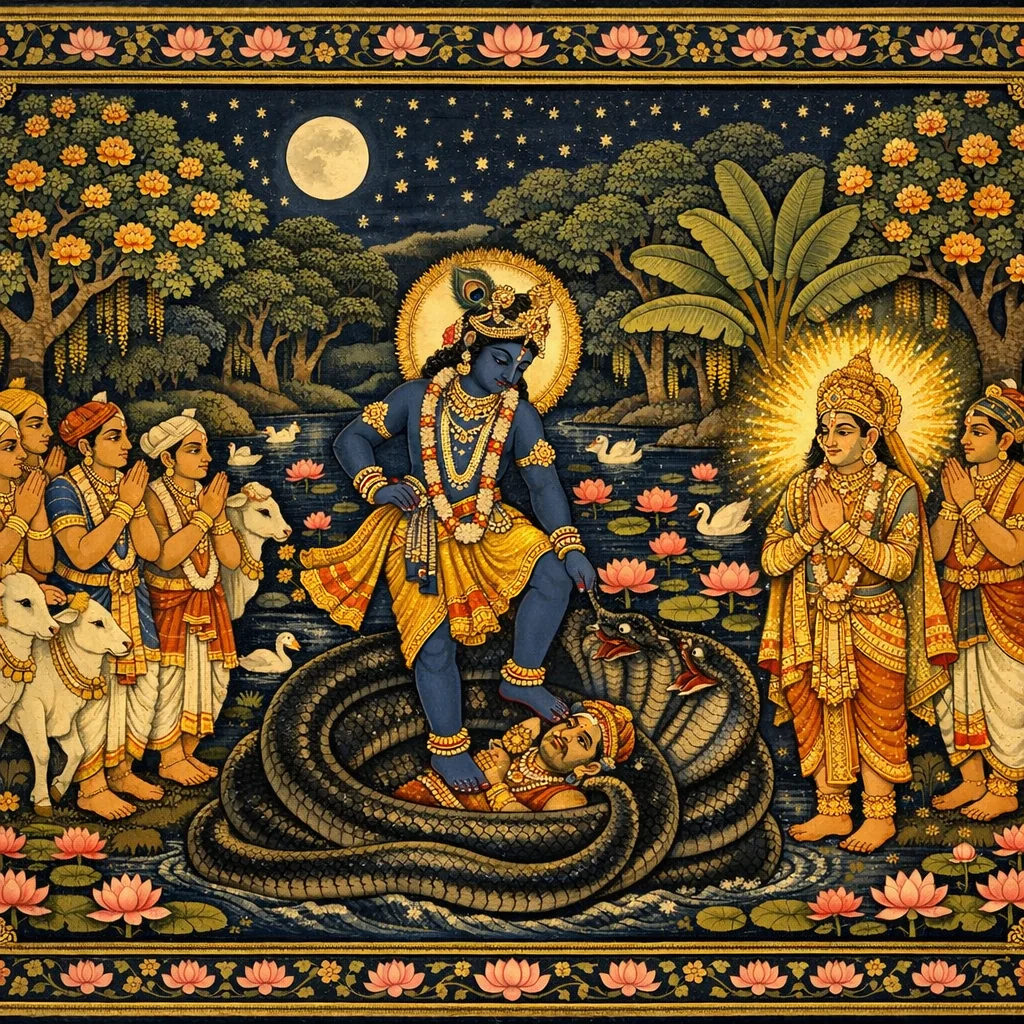
Continuing the Vraja cycle of pilgrimage, worship, and divine protection, the cowherd elders journey by cart to Ambikā forest to worship Lord Śiva (Paśupati) and goddess Ambikā, bathing in the Sarasvatī and honoring brāhmaṇas with gifts. That night, while observing vows and fasting, Nanda Mahārāja is seized by a massive serpent; the cowherds’ efforts fail until Kṛṣṇa arrives and liberates Nanda by touching the snake with His foot. The serpent is revealed as the Vidyādhara Sudarśana, cursed for offending Aṅgirasa sages; he praises the superiority of Kṛṣṇa’s darśana and pāda-sparśa over mere name-chanting, receives permission, and returns to his planet. The Vrajavāsīs return home astonished, narrating Kṛṣṇa’s power. The chapter then shifts into nocturnal forest play: Kṛṣṇa and Balarāma sing and delight the gopīs, when Śaṅkhacūḍa (Kuvera’s servant) abducts the girls. The Lords pursue; Balarāma protects the gopīs while Kṛṣṇa kills the demon and gives the crest jewel to Balarāma—setting up continued themes of protection (poṣaṇa) and the safeguarding of Vraja’s rasa against disruption.
Shlokas
Verse 1
श्रीशुक उवाच एकदा देवयात्रायां गोपाला जातकौतुका: । अनोभिरनडुद्युक्तै: प्रययुस्तेऽम्बिकावनम् ॥ १ ॥
Śukadeva Gosvāmī said: One day the cowherd men, eager to take a trip to worship Lord Śiva, traveled by bullock carts to the Ambikā forest.
Verse 2
तत्र स्नात्वा सरस्वत्यां देवं पशुपतिं विभुम् । आनर्चुरर्हणैर्भक्त्या देवीं च नृपतेऽम्बिकाम् ॥ २ ॥
O King, after arriving there, they bathed in the Sarasvatī and then devotedly worshiped with various paraphernalia the powerful Lord Paśupati and his consort, goddess Ambikā.
Verse 3
गावो हिरण्यं वासांसि मधु मध्वन्नमादृता: । ब्राह्मणेभ्यो ददु: सर्वे देवो न: प्रीयतामिति ॥ ३ ॥
The cowherd men gave the brāhmaṇas gifts of cows, gold, clothing and cooked grains mixed with honey. Then the cowherds prayed, “May the lord be pleased with us.”
Verse 4
ऊषु: सरस्वतीतीरे जलं प्राश्य यतव्रता: । रजनीं तां महाभागा नन्दसुनन्दकादय: ॥ ४ ॥
Nanda, Sunanda and the other greatly fortunate cowherds spent that night on the bank of the Sarasvatī, strictly observing their vows. They fasted, taking only water.
Verse 5
कश्चिन्महानहिस्तस्मिन् विपिनेऽतिबुभुक्षित: । यदृच्छयागतो नन्दं शयानमुरगोऽग्रसीत् ॥ ५ ॥
During the night a huge and extremely hungry snake appeared in that thicket. Slithering on his belly up to the sleeping Nanda Mahārāja, the snake began swallowing him.
Verse 6
स चुक्रोशाहिना ग्रस्त: कृष्ण कृष्ण महानयम् । सर्पो मां ग्रसते तात प्रपन्नं परिमोचय ॥ ६ ॥
In the clutches of the snake, Nanda Mahārāja cried out, “Kṛṣṇa, Kṛṣṇa, my dear boy! This huge serpent is swallowing me! Please save me, who am surrendered to You!”
Verse 7
तस्य चाक्रन्दितं श्रुत्वा गोपाला: सहसोत्थिता: । ग्रस्तं च दृष्ट्वा विभ्रान्ता: सर्पं विव्यधुरुल्मुकै: ॥ ७ ॥
When the cowherd men heard the cries of Nanda, they immediately rose up and saw that he was being swallowed. Distraught, they beat the serpent with blazing torches.
Verse 8
अलातैर्दह्यमानोऽपि नामुञ्चत्तमुरङ्गम: । तमस्पृशत्पदाभ्येत्य भगवान्सात्वतां पति: ॥ ८ ॥
But even though the firebrands were burning him, the serpent would not release Nanda Mahārāja. Then the Supreme Lord Kṛṣṇa, master of His devotees, came to the spot and touched the snake with His foot.
Verse 9
स वै भगवत: श्रीमत्पादस्पर्शहताशुभ: । भेजे सर्पवपुर्हित्वा रूपं विद्याधरार्चितम् ॥ ९ ॥
The snake had all his sinful reactions destroyed by the touch of the Supreme Lord’s divine foot, and thus he gave up his serpent body and appeared in the form of a worshipable Vidyādhara.
Verse 10
तमपृच्छद् धृषीकेश: प्रणतं समवस्थितम् । दीप्यमानेन वपुषा पुरुषं हेममालिनम् ॥ १० ॥
The Supreme Lord Hṛṣīkeśa then questioned this personality, who was standing before Him with his head bowed, his brilliantly effulgent body bedecked with golden necklaces.
Verse 11
को भवान् परया लक्ष्म्या रोचतेऽद्भुतदर्शन: । कथं जुगुप्सितामेतां गतिं वा प्रापितोऽवश: ॥ ११ ॥
[Lord Kṛṣṇa said:] My dear sir, you appear so wonderful, glowing with such great beauty. Who are you? And who forced you to assume this terrible body of a snake?
Verse 12
सर्प उवाच अहं विद्याधर: कश्चित्सुदर्शन इति श्रुत: । श्रिया स्वरूपसम्पत्त्या विमानेनाचरन् दिश: ॥ १२ ॥ ऋषीन् विरूपाङ्गिरस: प्राहसं रूपदर्पित: । तैरिमां प्रापितो योनिं प्रलब्धै: स्वेन पाप्मना ॥ १३ ॥
The serpent replied: I am the well-known Vidyādhara named Sudarśana. I was very opulent and beautiful, and I used to wander freely in all directions in my airplane. Once I saw some homely sages of the lineage of Aṅgirā Muni. Proud of my beauty, I ridiculed them, and because of my sin they made me assume this lowly form.
Verse 13
सर्प उवाच अहं विद्याधर: कश्चित्सुदर्शन इति श्रुत: । श्रिया स्वरूपसम्पत्त्या विमानेनाचरन् दिश: ॥ १२ ॥ ऋषीन् विरूपाङ्गिरस: प्राहसं रूपदर्पित: । तैरिमां प्रापितो योनिं प्रलब्धै: स्वेन पाप्मना ॥ १३ ॥
The serpent replied: I am the well-known Vidyādhara named Sudarśana. I was very opulent and beautiful, and I used to wander freely in all directions in my airplane. Once I saw some homely sages of the lineage of Aṅgirā Muni. Proud of my beauty, I ridiculed them, and because of my sin they made me assume this lowly form.
Verse 14
शापो मेऽनुग्रहायैव कृतस्तै: करुणात्मभि: । यदहं लोकगुरुणा पदा स्पृष्टो हताशुभ: ॥ १४ ॥
It was actually for my benefit that those merciful sages cursed me, since now I have been touched by the foot of the supreme spiritual master of all the worlds and have thus been relieved of all inauspiciousness.
Verse 15
तं त्वाहं भवभीतानां प्रपन्नानां भयापहम् । आपृच्छे शापनिर्मुक्त: पादस्पर्शादमीवहन् ॥ १५ ॥
My Lord, You destroy all fear for those who, fearing this material world, take shelter of You. By the touch of Your feet I am now freed from the curse of the sages. O destroyer of distress, please let me return to my planet.
Verse 16
प्रपन्नोऽस्मि महायोगिन् महापुरुष सत्पते । अनुजानीहि मां देव सर्वलोकेश्वरेश्वर ॥ १६ ॥
O master of mystic power, O great personality, O Lord of the devotees, I surrender to You. Please command me as You will, O supreme God, Lord of all lords of the universe.
Verse 17
ब्रह्मदण्डाद्विमुक्तोऽहं सद्यस्तेऽच्युत दर्शनात् । यन्नाम गृह्णन्नखिलान् श्रोतृनात्मानमेव च । सद्य: पुनाति किं भूयस्तस्य स्पृष्ट: पदा हि ते ॥ १७ ॥
O infallible one, I was immediately freed from the brāhmaṇas’ punishment simply by seeing You. Anyone who chants Your name purifies all who hear his chanting, as well as himself. How much more beneficial, then, is the touch of Your lotus feet?
Verse 18
इत्यनुज्ञाप्य दाशार्हं परिक्रम्याभिवन्द्य च । सुदर्शनो दिवं यात: कृच्छ्रान्नन्दश्च मोचित: ॥ १८ ॥
Thus receiving the permission of Lord Kṛṣṇa, the demigod Sudarśana circumambulated Him, bowed down to offer Him homage and then returned to his heavenly planet. Nanda Mahārāja was thus delivered from peril.
Verse 19
निशाम्य कृष्णस्य तदात्मवैभवं व्रजौकसो विस्मितचेतसस्तत: । समाप्य तस्मिन् नियमं पुनर्व्रजं नृपाययुस्तत् कथयन्त आदृता: ॥ १९ ॥
The inhabitants of Vraja were astonished to see the mighty power of Śrī Kṛṣṇa. Dear King, they then completed their worship of Lord Śiva and returned to Vraja, along the way respectfully describing Kṛṣṇa’s powerful acts.
Verse 20
कदाचिदथ गोविन्दो रामश्चाद्भुतविक्रम: । विजह्रतुर्वने रात्र्यां मध्यगौ व्रजयोषिताम् ॥ २० ॥
Once Lord Govinda and Lord Rāma, the performers of wonderful feats, were playing in the forest at night with the young girls of Vraja.
Verse 21
उपगीयमानौ ललितं स्त्रीजनैर्बद्धसौहृदै: । स्वलङ्कृतानुलिप्ताङ्गौ स्रग्विनौ विरजोऽम्बरौ ॥ २१ ॥
Kṛṣṇa and Balarāma wore flower garlands and spotless garments, and Their limbs were beautifully decorated and anointed. The women sang Their glories in a charming way, bound to Them by affection.
Verse 22
निशामुखं मानयन्तावुदितोडुपतारकम् । मल्लिकागन्धमत्तालि जुष्टं कुमुदवायुना ॥ २२ ॥
The two Lords praised the nightfall, signaled by the rising of the moon and the appearance of stars, a lotus-scented breeze and bees intoxicated by the fragrance of jasmine flowers.
Verse 23
जगतु: सर्वभूतानां मन:श्रवणमङ्गलम् । तौ कल्पयन्तौ युगत्स्वरमण्डलमूर्च्छितम् ॥ २३ ॥
Kṛṣṇa and Balarāma sang, producing the entire range of musical sounds simultaneously. Their singing brought happiness to the ears and minds of all living beings.
Verse 24
गोप्यस्तद्गीतमाकर्ण्य मूर्च्छिता नाविदन्नृप । स्रंसद्दुकूलमात्मानं स्रस्तकेशस्रजं तत: ॥ २४ ॥
The gopīs became stunned when they heard that song. Forgetting themselves, O King, they did not notice that their fine garments were becoming loose and their hair and garlands disheveled.
Verse 25
एवं विक्रीडतो: स्वैरं गायतो: सम्प्रमत्तवत् । शङ्खचूड इति ख्यातो धनदानुचरोऽभ्यगात् ॥ २५ ॥
While Lord Kṛṣṇa and Lord Balarāma thus played according to Their own sweet will and sang to the point of apparent intoxication, a servant of Kuvera named Śaṅkhacūḍa came upon the scene.
Verse 26
तयोर्निरीक्षतो राजंस्तन्नाथं प्रमदाजनम् । क्रोशन्तं कालयामास दिश्युदीच्यामशङ्कित: ॥ २६ ॥
O King, even as the two Lords looked on, Śaṅkhacūḍa brazenly began driving the women off toward the north. The women, who had accepted Kṛṣṇa and Balarāma as their Lords, began to cry out to Them.
Verse 27
क्रोशन्तं कृष्ण रामेति विलोक्य स्वपरिग्रहम् । यथा गा दस्युना ग्रस्ता भ्रातरावन्वधावताम् ॥ २७ ॥
Hearing Their devotees crying out “Kṛṣṇa! Rāma!” and seeing that they were just like cows being stolen by a thief, Kṛṣṇa and Balarāma began to run after the demon.
Verse 28
मा भैष्टेत्यभयारावौ शालहस्तौ तरस्विनौ । आसेदतुस्तं तरसा त्वरितं गुह्यकाधमम् ॥ २८ ॥
The Lords called out in reply, “Do not fear!” Then They picked up logs of the śala tree and quickly pursued that lowest of Guhyakas, who swiftly ran away.
Verse 29
स वीक्ष्य तावनुप्राप्तौ कालमृत्यू इवोद्विजन् । विषृज्य स्त्रीजनं मूढ: प्राद्रवज्जीवितेच्छया ॥ २९ ॥
When Śaṅkhacūḍa saw the two of Them coming toward him like the personified forces of Time and Death, he was filled with anxiety. Confused, he abandoned the women and fled for his life.
Verse 30
तमन्वधावद् गोविन्दो यत्र यत्र स धावति । जिहीर्षुस्तच्छिरोरत्नं तस्थौ रक्षन् स्त्रियो बल: ॥ ३० ॥
Lord Govinda chased the demon wherever he ran, eager to take his crest jewel. Meanwhile Lord Balarāma stayed with the women to protect them.
Verse 31
अविदूर इवाभ्येत्य शिरस्तस्य दुरात्मन: । जहार मुष्टिनैवाङ्ग सहचूडमणिं विभु: ॥ ३१ ॥
The mighty Lord overtook Śaṅkhacūḍa from a great distance as if from nearby, my dear King, and then with His fist the Lord removed the wicked demon’s head, together with his crest jewel.
Verse 32
शङ्खचूडं निहत्यैवं मणिमादाय भास्वरम् । अग्रजायाददात्प्रीत्या पश्यन्तीनां च योषिताम् ॥ ३२ ॥
Having thus killed the demon Śaṅkhacūḍa and taken away his shining jewel, Lord Kṛṣṇa gave it to His elder brother with great satisfaction as the gopīs watched.
Frequently Asked Questions
In the Bhāgavata’s Vaiṣṇava frame, devas like Śiva are honored as exalted devotees and empowered administrators within Bhagavān’s order (īśānukathā), not as independent supreme shelters. The cowherds’ Śiva-pūjā models dharmic culture—pilgrimage, vows, charity to brāhmaṇas—while the narrative simultaneously demonstrates that ultimate poṣaṇa comes from Kṛṣṇa alone: when Nanda is in mortal peril, ritual efforts and human strength fail, and deliverance occurs by Kṛṣṇa’s direct intervention. Thus the chapter harmonizes respect for Śiva with the Bhāgavata’s conclusion that Kṛṣṇa is the final refuge (āśraya).
The serpent was the Vidyādhara named Sudarśana, cursed to take a snake body for ridiculing sages of the Aṅgirā lineage out of pride in his beauty and opulence. His release occurs instantly by Kṛṣṇa’s foot-touch, illustrating (1) the purifying supremacy of contact with Bhagavān, (2) the pedagogical mercy within a curse when it leads one to the Lord, and (3) the Bhāgavata’s ethic that spiritual status is maintained by humility and reverence for brāhmaṇas and sages. Sudarśana’s prayers explicitly frame Kṛṣṇa as the remover of fear for those who surrender.
The night play and singing of Kṛṣṇa and Balarāma with the gopīs establishes a rasa setting—beauty, music, and absorbed devotion. Śaṅkhacūḍa’s abduction functions as an intrusion of adharma and fear into that intimacy. The Lords’ swift response—Balarāma guarding the gopīs while Kṛṣṇa pursues and kills the offender—dramatizes poṣaṇa: Bhagavān actively preserves the devotees’ safety and the sanctity of their loving exchange. The taking of the crest jewel underscores the removal of the aggressor’s power and the re-establishment of order under divine guardianship.