Adhyaya 16
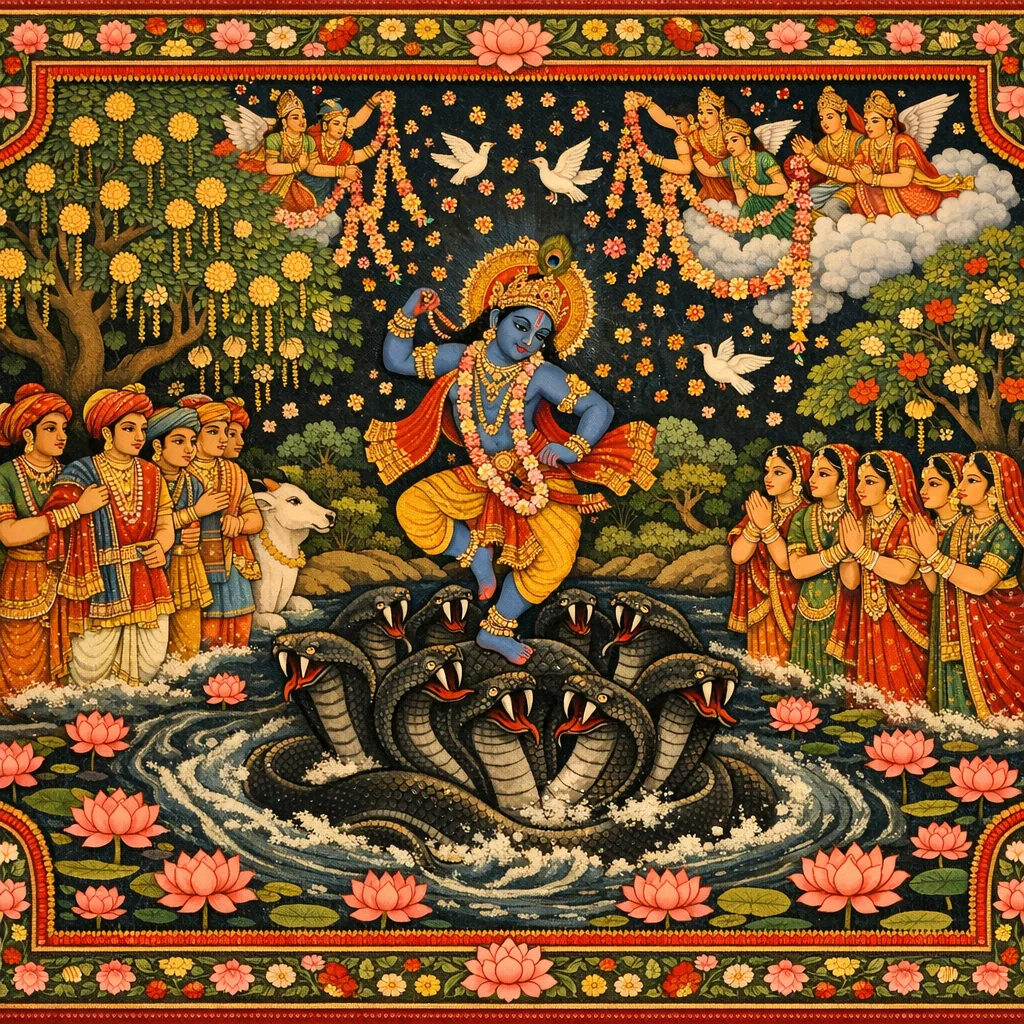
Kāliya-damana: Kṛṣṇa Subdues the Serpent and Purifies the Yamunā
Śukadeva introduces Kṛṣṇa’s resolve to purify the Yamunā after it is poisoned by Kāliya’s lake, answering Parīkṣit’s inquiry about both the chastisement and Kāliya’s long residence. The chapter moves from ecological and sacred-space corruption (boiling, lethal waters and poisoned breezes) to Kṛṣṇa’s deliberate descent into the lake from a kadamba tree, provoking Kāliya’s attack. Vraja’s response forms the emotional core: gopas, gopīs, elders, and animals collapse in grief, reading ominous portents as death, while Balarāma—knowing Kṛṣṇa’s aiśvarya—restrains them. Kṛṣṇa then expands, breaks free, and subdues Kāliya through the iconic dance upon his many hoods, witnessed and celebrated by celestial beings. Kāliya’s wives (Nāgapatnīs) offer profound stuti, interpreting punishment as mercy and the dust of the Lord’s feet as the highest fortune; Kāliya himself confesses his nature and surrenders. Kṛṣṇa banishes him to the ocean, grants protection from Garuḍa via His footprints, and establishes devotional benefits for remembering, narrating, bathing, and worship at the site. The Yamunā is restored, setting the stage for subsequent Vraja līlās in which Kṛṣṇa’s protection and the community’s prema continue to deepen.
Shlokas
Verse 1
श्रीशुक उवाच विलोक्य दूषितां कृष्णां कृष्ण: कृष्णाहिना विभु: । तस्या विशुद्धिमन्विच्छन् सर्पं तमुदवासयत् ॥ १ ॥
Śukadeva Gosvāmī said: Lord Śrī Kṛṣṇa, the Supreme Personality of Godhead, seeing that the Yamunā River had been contaminated by the black snake Kāliya, desired to purify the river, and thus the Lord banished him from it.
Verse 2
श्रीराजोवाच कथमन्तर्जलेऽगाधे न्यगृह्णाद् भगवानहिम् । स वै बहुयुगावासं यथासीद् विप्र कथ्यताम् ॥ २ ॥
King Parīkṣit inquired: O learned sage, please explain how the Supreme Personality of Godhead chastised the serpent Kāliya within the unfathomable waters of the Yamunā, and how it was that Kāliya had been living there for so many ages.
Verse 3
ब्रह्मन् भगवतस्तस्य भूम्न: स्वच्छन्दवर्तिन: । गोपालोदारचरितं कस्तृप्येतामृतं जुषन् ॥ ३ ॥
O brāhmaṇa, the unlimited Supreme Personality of Godhead freely acts according to His own desires. Who could be satiated when hearing the nectar of the magnanimous pastimes He performed as a cowherd boy in Vṛndāvana?
Verse 4
श्रीशुक उवाच कालिन्द्यां कालियस्यासीद् ह्रद: कश्चिद् विषाग्निना । श्रप्यमाणपया यस्मिन् पतन्त्युपरिगा: खगा: ॥ ४ ॥
Śrī Śukadeva Gosvāmī said: Within the river Kālindī [Yamunā] was a lake inhabited by the serpent Kāliya, whose fiery poison constantly heated and boiled its waters. Indeed, the vapors thus created were so poisonous that birds flying over the contaminated lake would fall down into it.
Verse 5
विप्रुष्मता विषदोर्मिमारुतेनाभिमर्शिता: । म्रियन्ते तीरगा यस्य प्राणिन: स्थिरजङ्गमा: ॥ ५ ॥
The wind blowing over that deadly lake carried droplets of water to the shore. Simply by coming in contact with that poisonous breeze, all vegetation and creatures on the shore died.
Verse 6
तं चण्डवेगविषवीर्यमवेक्ष्य तेन दुष्टां नदीं च खलसंयमनावतार: । कृष्ण: कदम्बमधिरुह्य ततोऽतितुङ्ग- मास्फोट्य गाढरशनो न्यपतद् विषोदे ॥ ६ ॥
Lord Kṛṣṇa saw how the Kāliya serpent had polluted the Yamunā River with his terribly powerful poison. Since Kṛṣṇa had descended from the spiritual world specifically to subdue envious demons, the Lord immediately climbed to the top of a very high kadamba tree and prepared Himself for battle. He tightened His belt, slapped His arms and then jumped into the poisonous water.
Verse 7
सर्पह्रद: पुरुषसारनिपातवेग- सङ्क्षोभितोरगविषोच्छ्वसिताम्बुराशि: । पर्यक्प्लुतो विषकषायबिभीषणोर्मि- र्धावन् धनु:शतमनन्तबलस्य किं तत् ॥ ७ ॥
When the Supreme Personality of Godhead landed in the serpent’s lake, the snakes there became extremely agitated and began breathing heavily, further polluting it with volumes of poison. The force of the Lord’s entrance into the lake caused it to overflow on all sides, and poisonous, fearsome waves flooded the surrounding lands up to a distance of one hundred bow-lengths. This is not at all amazing, however, for the Supreme Lord possesses infinite strength.
Verse 8
तस्य ह्रदे विहरतो भुजदण्डघूर्ण- वार्घोषमङ्ग वरवारणविक्रमस्य । आश्रुत्य तत् स्वसदनाभिभवं निरीक्ष्य चक्षु:श्रवा: समसरत्तदमृष्यमाण: ॥ ८ ॥
Kṛṣṇa began sporting in Kāliya’s lake like a lordly elephant — swirling His mighty arms and making the water resound in various ways. When Kāliya heard these sounds, he understood that someone was trespassing in his lake. The serpent could not tolerate this and immediately came forward.
Verse 9
तं प्रेक्षणीयसुकुमारघनावदातं श्रीवत्सपीतवसनं स्मितसुन्दरास्यम् । क्रीडन्तमप्रतिभयं कमलोदराङ्घ्रि सन्दश्य मर्मसु रुषा भुजया चछाद ॥ ९ ॥
Kāliya saw that Śrī Kṛṣṇa, who wore yellow silken garments, was very delicate, His attractive body shining like a glowing white cloud, His chest bearing the mark of Śrīvatsa, His face smiling beautifully and His feet resembling the whorl of a lotus flower. The Lord was playing fearlessly in the water. Despite His wonderful appearance, the envious Kāliya furiously bit Him on the chest and then completely enwrapped Him in his coils.
Verse 10
तं नागभोगपरिवीतमदृष्टचेष्ट- मालोक्य तत्प्रियसखा: पशुपा भृशार्ता: । कृष्णेऽर्पितात्मसुहृदर्थकलत्रकामा दु:खानुशोकभयमूढधियो निपेतु: ॥ १० ॥
When the members of the cowherd community, who had accepted Kṛṣṇa as their dearmost friend, saw Him enveloped in the snake’s coils, motionless, they were greatly disturbed. They had offered Kṛṣṇa everything — their very selves, their families, their wealth, wives and all pleasures. At the sight of the Lord in the clutches of the Kāliya snake, their intelligence became deranged by grief, lamentation and fear, and thus they fell to the ground.
Verse 11
गावो वृषा वत्सतर्य: क्रन्दमाना: सुदु:खिता: । कृष्णे न्यस्तेक्षणा भीता रुदन्त्य इव तस्थिरे ॥ ११ ॥
The cows, bulls and female calves, in great distress, called out piteously to Kṛṣṇa. Fixing their eyes on Him, they stood still in fear, as if ready to cry but too shocked to shed tears.
Verse 12
अथ व्रजे महोत्पातास्त्रिविधा ह्यतिदारुणा: । उत्पेतुर्भुवि दिव्यात्मन्यासन्नभयशंसिन: ॥ १२ ॥
In the Vṛndāvana area there then arose all three types of fearful omens — those on the earth, those in the sky and those in the bodies of living creatures — which announced imminent danger.
Verse 13
तानालक्ष्य भयोद्विग्ना गोपा नन्दपुरोगमा: । विना रामेण गा: कृष्णं ज्ञात्वा चारयितुं गतम् ॥ १३ ॥ तैर्दुर्निमित्तैर्निधनं मत्वा प्राप्तमतद्विद: । तत्प्राणास्तन्मनस्कास्ते दु:खशोकभयातुरा: ॥ १४ ॥ आबालवृद्धवनिता: सर्वेऽङ्ग पशुवृत्तय: । निर्जग्मुर्गोकुलाद् दीना: कृष्णदर्शनलालसा: ॥ १५ ॥
Seeing the inauspicious omens, Nanda Mahārāja and the other cowherd men were fearful, for they knew that Kṛṣṇa had gone to herd the cows that day without His elder brother, Balarāma. Because they had dedicated their minds to Kṛṣṇa, accepting Him as their very life, they were unaware of His great power and opulence. Thus they concluded that the inauspicious omens indicated He had met with death, and they were overwhelmed with grief, lamentation and fear. All the inhabitants of Vṛndāvana, including the children, women and elderly persons, thought of Kṛṣṇa just as a cow thinks of her helpless young calf, and thus these poor, suffering people rushed out of the village, intent upon finding Him.
Verse 14
तानालक्ष्य भयोद्विग्ना गोपा नन्दपुरोगमा: । विना रामेण गा: कृष्णं ज्ञात्वा चारयितुं गतम् ॥ १३ ॥ तैर्दुर्निमित्तैर्निधनं मत्वा प्राप्तमतद्विद: । तत्प्राणास्तन्मनस्कास्ते दु:खशोकभयातुरा: ॥ १४ ॥ आबालवृद्धवनिता: सर्वेऽङ्ग पशुवृत्तय: । निर्जग्मुर्गोकुलाद् दीना: कृष्णदर्शनलालसा: ॥ १५ ॥
Seeing the inauspicious omens, Nanda Mahārāja and the other cowherd men were fearful, for they knew that Kṛṣṇa had gone to herd the cows that day without His elder brother, Balarāma. Because they had dedicated their minds to Kṛṣṇa, accepting Him as their very life, they were unaware of His great power and opulence. Thus they concluded that the inauspicious omens indicated He had met with death, and they were overwhelmed with grief, lamentation and fear. All the inhabitants of Vṛndāvana, including the children, women and elderly persons, thought of Kṛṣṇa just as a cow thinks of her helpless young calf, and thus these poor, suffering people rushed out of the village, intent upon finding Him.
Verse 15
तानालक्ष्य भयोद्विग्ना गोपा नन्दपुरोगमा: । विना रामेण गा: कृष्णं ज्ञात्वा चारयितुं गतम् ॥ १३ ॥ तैर्दुर्निमित्तैर्निधनं मत्वा प्राप्तमतद्विद: । तत्प्राणास्तन्मनस्कास्ते दु:खशोकभयातुरा: ॥ १४ ॥ आबालवृद्धवनिता: सर्वेऽङ्ग पशुवृत्तय: । निर्जग्मुर्गोकुलाद् दीना: कृष्णदर्शनलालसा: ॥ १५ ॥
Seeing the inauspicious omens, Nanda Mahārāja and the other cowherd men were fearful, for they knew that Kṛṣṇa had gone to herd the cows that day without His elder brother, Balarāma. Because they had dedicated their minds to Kṛṣṇa, accepting Him as their very life, they were unaware of His great power and opulence. Thus they concluded that the inauspicious omens indicated He had met with death, and they were overwhelmed with grief, lamentation and fear. All the inhabitants of Vṛndāvana, including the children, women and elderly persons, thought of Kṛṣṇa just as a cow thinks of her helpless young calf, and thus these poor, suffering people rushed out of the village, intent upon finding Him.
Verse 16
तांस्तथा कातरान् वीक्ष्य भगवान् माधवो बल: । प्रहस्य किञ्चिन्नोवाच प्रभावज्ञोऽनुजस्य स: ॥ १६ ॥
The Supreme Lord Balarāma, the master of all transcendental knowledge, smiled and said nothing when He saw the residents of Vṛndāvana in such distress, since He understood the extraordinary power of His younger brother.
Verse 17
तेऽन्वेषमाणा दयितं कृष्णं सूचितया पदै: । भगवल्लक्षणैर्जग्मु: पदव्या यमुनातटम् ॥ १७ ॥
The residents hurried toward the banks of the Yamunā in search of their dearmost Kṛṣṇa, following the path marked by His footprints, which bore the unique signs of the Personality of Godhead.
Verse 18
ते तत्र तत्राब्जयवाङ्कुशाशनि- ध्वजोपपन्नानि पदानि विश्पते: । मार्गे गवामन्यपदान्तरान्तरे निरीक्षमाणा ययुरङ्ग सत्वरा: ॥ १८ ॥
The footprints of Lord Kṛṣṇa, the master of the entire cowherd community, were marked with the lotus flower, barleycorn, elephant goad, thunderbolt and flag. My dear King Parīkṣit, seeing His footprints on the path among the cows’ hoofprints, the residents of Vṛndāvana rushed along in great haste.
Verse 19
अन्तर्ह्रदे भुजगभोगपरीतमारात् कृष्णं निरीहमुपलभ्य जलाशयान्ते । गोपांश्च मूढधिषणान् परित: पशूंश्च सङ्क्रन्दत: परमकश्मलमापुरार्ता: ॥ १९ ॥
As they hurried along the path to the bank of the Yamunā River, they saw from a distance that Kṛṣṇa was in the lake, motionless within the coils of the black serpent. They further saw that the cowherd boys had fallen unconscious and that the animals were standing on all sides, crying out for Kṛṣṇa. Seeing all this, the residents of Vṛndāvana were overwhelmed with anguish and confusion.
Verse 20
गोप्योऽनुरक्तमनसो भगवत्यनन्ते तत्सौहृदस्मितविलोकगिर: स्मरन्त्य: । ग्रस्तेऽहिना प्रियतमे भृशदु:खतप्ता: शून्यं प्रियव्यतिहृतं ददृशुस्त्रिलोकम् ॥ २० ॥
When the young gopīs, whose minds were constantly attached to Kṛṣṇa, the unlimited Supreme Lord, saw that He was now within the grips of the serpent, they remembered His loving friendship, His smiling glances and His talks with them. Burning with great sorrow, they saw the entire universe as void.
Verse 21
ता: कृष्णमातरमपत्यमनुप्रविष्टां तुल्यव्यथा: समनुगृह्य शुच: स्रवन्त्य: । तास्ता व्रजप्रियकथा: कथयन्त्य आसन् कृष्णाननेऽर्पितदृशो मृतकप्रतीका: ॥ २१ ॥
Although the elder gopīs were feeling just as much distress as she and were pouring forth a flood of sorrowful tears, they had to forcibly hold back Kṛṣṇa’s mother, whose consciousness was totally absorbed in her son. Standing like corpses, with their eyes fixed upon His face, these gopīs each took turns recounting the pastimes of the darling of Vraja.
Verse 22
कृष्णप्राणान्निर्विशतो नन्दादीन् वीक्ष्य तं ह्रदम् । प्रत्यषेधत् स भगवान् राम: कृष्णानुभाववित् ॥ २२ ॥
Lord Balarāma then saw that Nanda Mahārāja and the other cowherd men, who had dedicated their very lives to Kṛṣṇa, were beginning to enter the serpent’s lake. As the Supreme Personality of Godhead, Lord Balarāma fully knew Lord Kṛṣṇa’s actual power, and therefore He restrained them.
Verse 23
इत्थं स्वगोकुलमनन्यगतिं निरीक्ष्य सस्त्रीकुमारमतिदु:खितमात्महेतो: । आज्ञाय मर्त्यपदवीमनुवर्तमान: स्थित्वा मुहूर्तमुदतिष्ठदुरङ्गबन्धात् ॥ २३ ॥
The Lord remained for some time within the coils of the serpent, imitating the behavior of an ordinary mortal. But when He understood that the women, children and other residents of His village of Gokula were in acute distress because of their love for Him, their only shelter and goal in life, He immediately rose up from the bonds of the Kāliya serpent.
Verse 24
तत्प्रथ्यमानवपुषा व्यथितात्मभोग- स्त्यक्त्वोन्नमय्य कुपित: स्वफणान् भुजङ्ग: । तस्थौ श्वसञ्छ्वसनरन्ध्रविषाम्बरीष- स्तब्धेक्षणोल्मुकमुखो हरिमीक्षमाण: ॥ २४ ॥
His coils tormented by the expanding body of the Lord, Kāliya released Him. In great anger the serpent then raised his hoods high and stood still, breathing heavily. His nostrils appeared like vessels for cooking poison, and the staring eyes in his face like firebrands. Thus the serpent looked at the Lord.
Verse 25
तं जिह्वया द्विशिखया परिलेलिहानं द्वे सृक्वणी ह्यतिकरालविषाग्निदृष्टिम् । क्रीडन्नमुं परिससार यथा खगेन्द्रो बभ्राम सोऽप्यवसरं प्रसमीक्षमाण: ॥ २५ ॥
Again and again Kāliya licked his lips with his bifurcated tongues as He stared at Kṛṣṇa with a glance full of terrible, poisonous fire. But Kṛṣṇa playfully circled around him, just as Garuḍa would play with a snake. In response, Kāliya also moved about, looking for an opportunity to bite the Lord.
Verse 26
एवं परिभ्रमहतौजसमुन्नतांस- मानम्य तत्पृथुशिर:स्वधिरूढ आद्य: । तन्मूर्धरत्ननिकरस्पर्शातिताम्र- पादाम्बुजोऽखिलकलादिगुरुर्ननर्त ॥ २६ ॥
Having severely depleted the serpent’s strength with His relentless circling, Śrī Kṛṣṇa, the origin of everything, pushed down Kāliya’s raised shoulders and mounted his broad serpentine heads. Thus Lord Śrī Kṛṣṇa, the original master of all fine arts, began to dance, His lotus feet deeply reddened by the touch of the numerous jewels upon the serpent’s heads.
Verse 27
तं नर्तुमुद्यतमवेक्ष्य तदा तदीय- गन्धर्वसिद्धमुनिचारणदेववध्व: । प्रीत्या मृदङ्गपणवानकवाद्यगीत- पुष्पोपहारनुतिभि: सहसोपसेदु: ॥ २७ ॥
Seeing the Lord dancing, His servants in the heavenly planets — the Gandharvas, Siddhas, sages, Cāraṇas and wives of the demigods — immediately arrived there. With great pleasure they began accompanying the Lord’s dancing by playing drums such as mṛdaṅgas, paṇavas and ānakas. They also made offerings of songs, flowers and prayers.
Verse 28
यद् यच्छिरो न नमतेऽङ्ग शतैकशीर्ष्ण- स्तत्तन् ममर्द खरदण्डधरोऽङ्घ्रिपातै: । क्षीणायुषो भ्रमत उल्बणमास्यतोऽसृङ् नस्तो वमन् परमकश्मलमाप नाग: ॥ २८ ॥
My dear King, Kāliya had 101 prominent heads, and when one of them would not bow down, Lord Śrī Kṛṣṇa, who inflicts punishment on cruel wrong-doers, would smash that stubborn head by striking it with His feet. Then, as Kāliya entered his death throes, he began wheeling his heads around and vomiting ghastly blood from his mouths and nostrils. The serpent thus experienced extreme pain and misery.
Verse 29
तस्याक्षिभिर्गरलमुद्वमत: शिर:सु यद् यत् समुन्नमति नि:श्वसतो रुषोच्चै: । नृत्यन् पदानुनमयन् दमयां बभूव पुष्पै: प्रपूजित इवेह पुमान् पुराण: ॥ २९ ॥
Exuding poisonous waste from his eyes, Kāliya, would occasionally dare to raise up one of his heads, which would breathe heavily with anger. Then the Lord would dance on it and subdue it, forcing it to bow down with His foot. The demigods took each of these exhibitions as an opportunity to worship Him, the primeval Personality of Godhead, with showers of flowers.
Verse 30
तच्चित्रताण्डवविरुग्नफणासहस्रो रक्तं मुखैरुरु वमन्नृप भग्नगात्र: । स्मृत्वा चराचरगुरुं पुरुषं पुराणं नारायणं तमरणं मनसा जगाम ॥ ३० ॥
My dear King Parīkṣit, Lord Kṛṣṇa’s wonderful, powerful dancing trampled and broke all of Kāliya’s one thousand hoods. Then the serpent, profusely vomiting blood from his mouths, finally recognized Śrī Kṛṣṇa to be the eternal Personality of Godhead, the supreme master of all moving and nonmoving beings, Śrī Nārāyaṇa. Thus within his mind Kāliya took shelter of the Lord.
Verse 31
कृष्णस्य गर्भजगतोऽतिभरावसन्नं पार्ष्णिप्रहारपरिरुग्नफणातपत्रम् । दृष्ट्वाहिमाद्यमुपसेदुरमुष्य पत्न्य आर्ता: श्लथद्वसनभूषणकेशबन्धा: ॥ ३१ ॥
When Kāliya’s wives saw how the serpent had become so fatigued from the excessive weight of Lord Kṛṣṇa, who carries the entire universe in His abdomen, and how Kāliya’s umbrellalike hoods had been shattered by the striking of Kṛṣṇa’s heels, they felt great distress. With their clothing, ornaments and hair scattered in disarray, they then approached the eternal Personality of Godhead.
Verse 32
तास्तं सुविग्नमनसोऽथ पुरस्कृतार्भा: कायं निधाय भुवि भूतपतिं प्रणेमु: । साध्व्य: कृताञ्जलिपुटा: शमलस्य भर्तु- र्मोक्षेप्सव: शरणदं शरणं प्रपन्ना: ॥ ३२ ॥
Their minds very much disturbed, those saintly ladies placed their children before them and then bowed down to the Lord of all creatures, laying their bodies flat upon the ground. They desired the liberation of their sinful husband and the shelter of the Supreme Lord, the giver of ultimate shelter, and thus they folded their hands in supplication and approached Him.
Verse 33
नागपत्न्य ऊचु: न्याय्यो हि दण्ड: कृतकिल्बिषेऽस्मिं- स्तवावतार: खलनिग्रहाय । रिपो: सुतानामपि तुल्यदृष्टि- र्धत्से दमं फलमेवानुशंसन् ॥ ३३ ॥
The wives of the Kāliya serpent said: The punishment this offender has been subjected to is certainly just. After all, You have incarnated within this world to curb down envious and cruel persons. You are so impartial that You look equally upon Your enemies and Your own sons, for when You impose a punishment on a living being You know it to be for his ultimate benefit.
Verse 34
अनुग्रहोऽयं भवत: कृतो हि नो दण्डोऽसतां ते खलु कल्मषापह: । यद् दन्दशूकत्वममुष्य देहिन: क्रोधोऽपि तेऽनुग्रह एव सम्मत: ॥ ३४ ॥
What You have done here is actually mercy for us, since the punishment You give to the wicked certainly drives away all their contamination. Indeed, because this conditioned soul, our husband, is so sinful that he has assumed the body of a serpent, Your anger toward him is obviously to be understood as Your mercy.
Verse 35
तप: सुतप्तं किमनेन पूर्वं निरस्तमानेन च मानदेन । धर्मोऽथ वा सर्वजनानुकम्पया यतो भवांस्तुष्यति सर्वजीव: ॥ ३५ ॥
Did our husband carefully perform austerities in a previous life, with his mind free of pride and full of respect for others? Is that why You are pleased with him? Or did he in some previous existence carefully execute religious duties with compassion for all living beings, and is that why You, the life of all living beings, are now satisfied with him?
Verse 36
कस्यानुभावोऽस्य न देव विद्महे तवाङ्घ्रिरेणुस्परशाधिकार: । यद्वाञ्छया श्रीर्ललनाचरत्तपो विहाय कामान् सुचिरं धृतव्रता ॥ ३६ ॥
O Lord, we do not know how the serpent Kāliya has attained this great opportunity of being touched by the dust of Your lotus feet. For this end, the goddess of fortune performed austerities for centuries, giving up all other desires and observing austere vows.
Verse 37
न नाकपृष्ठं न च सार्वभौमं न पारमेष्ठ्यं न रसाधिपत्यम् । न योगसिद्धीरपुनर्भवं वा वाञ्छन्ति यत्पादरज:प्रपन्ना: ॥ ३७ ॥
Those who have attained the dust of Your lotus feet never hanker for the kingship of heaven, limitless sovereignty, the position of Brahmā or rulership over the earth. They are not interested even in the perfections of yoga or in liberation itself.
Verse 38
तदेष नाथाप दुरापमन्यै- स्तमोजनि: क्रोधवशोऽप्यहीश: । संसारचक्रे भ्रमत: शरीरिणो यदिच्छत: स्याद् विभव: समक्ष: ॥ ३८ ॥
O Lord, although this Kāliya, the king of the serpents, has taken birth in the mode of ignorance and is controlled by anger, he has achieved that which is difficult for others to achieve. Embodied souls, who are full of desires and are thus wandering in the cycle of birth and death, can have all benedictions manifested before their eyes simply by receiving the dust of Your lotus feet.
Verse 39
नमस्तुभ्यं भगवते पुरुषाय महात्मने । भूतावासाय भूताय पराय परमात्मने ॥ ३९ ॥
We offer our obeisances unto You, the Supreme Personality of Godhead. Although present in the hearts of all living beings as the Supersoul, You are all-pervasive. Although the original shelter of all created material elements, You exist prior to their creation. And although the cause of everything, You are transcendental to all material cause and effect, being the Supreme Soul.
Verse 40
ज्ञानविज्ञाननीधये ब्रह्मणेऽनन्तशक्तये । अगुणायाविकाराय नमस्ते प्राकृताय च ॥ ४० ॥
Obeisances unto You, the Absolute Truth, who are the reservoir of all transcendental consciousness and potency and the possessor of unlimited energies. Although completely free of material qualities and transformations, You are the prime mover of material nature.
Verse 41
कालाय कालनाभाय कालावयवसाक्षिणे । विश्वाय तदुपद्रष्ट्रे तत्कर्त्रे विश्वहेतवे ॥ ४१ ॥
Obeisances unto You, who are time itself, the shelter of time and the witness of time in all its phases. You are the universe, and also its separate observer. You are its creator, and also the totality of all its causes.
Verse 42
भूतमात्रेन्द्रियप्राणमनोबुद्ध्याशयात्मने । त्रिगुणेनाभिमानेन गूढस्वात्मानुभूतये ॥ ४२ ॥ नमोऽनन्ताय सूक्ष्माय कूटस्थाय विपश्चिते । नानावादानुरोधाय वाच्यवाचकशक्तये ॥ ४३ ॥
Obeisances unto You, who are the ultimate soul of the physical elements, of the subtle basis of perception, of the senses, of the vital air of life, and of the mind, intelligence and consciousness. By Your arrangement the infinitesimal spirit souls falsely identify with the three modes of material nature, and their perception of their own true self thus becomes clouded. We offer our obeisances unto You, the unlimited Supreme Lord, the supremely subtle one, the omniscient Personality of Godhead, who are always fixed in unchanging transcendence, who sanction the opposing views of different philosophies, and who are the power upholding expressed ideas and the words that express them.
Verse 43
भूतमात्रेन्द्रियप्राणमनोबुद्ध्याशयात्मने । त्रिगुणेनाभिमानेन गूढस्वात्मानुभूतये ॥ ४२ ॥ नमोऽनन्ताय सूक्ष्माय कूटस्थाय विपश्चिते । नानावादानुरोधाय वाच्यवाचकशक्तये ॥ ४३ ॥
Obeisances unto You, who are the ultimate soul of the physical elements, of the subtle basis of perception, of the senses, of the vital air of life, and of the mind, intelligence and consciousness. By Your arrangement the infinitesimal spirit souls falsely identify with the three modes of material nature, and their perception of their own true self thus becomes clouded. We offer our obeisances unto You, the unlimited Supreme Lord, the supremely subtle one, the omniscient Personality of Godhead, who are always fixed in unchanging transcendence, who sanction the opposing views of different philosophies, and who are the power upholding expressed ideas and the words that express them.
Verse 44
नम: प्रमाणमूलाय कवये शास्त्रयोनये । प्रवृत्ताय निवृत्ताय निगमाय नमो नम: ॥ ४४ ॥
We offer our obeisances again and again to You, who are the basis of all authoritative evidence, who are the author and ultimate source of the revealed scriptures, and who have manifested Yourself in those Vedic literatures encouraging sense gratification as well as in those encouraging renunciation of the material world.
Verse 45
नम: कृष्णाय रामाय वसुदेवसुताय च । प्रद्युम्नायानिरुद्धाय सात्वतां पतये नम: ॥ ४५ ॥
We offer our obeisances to Lord Kṛṣṇa and Lord Rāma, the sons of Vasudeva, and to Lord Pradyumna and Lord Aniruddha. We offer our respectful obeisances unto the master of all the saintly devotees of Viṣṇu.
Verse 46
नमो गुणप्रदीपाय गुणात्मच्छादनाय च । गुणवृत्त्युपलक्ष्याय गुणद्रष्ट्रे स्वसंविदे ॥ ४६ ॥
Obeisances to You, O Lord, who manifest varieties of material and spiritual qualities. You disguise Yourself with the material qualities, and yet the functioning of those same material qualities ultimately reveals Your existence. You stand apart from the material qualities as a witness and can be fully known only by Your devotees.
Verse 47
अव्याकृतविहाराय सर्वव्याकृतसिद्धये । हृषीकेश नमस्तेऽस्तु मुनये मौनशीलिने ॥ ४७ ॥
O Lord Hṛṣīkeśa, master of the senses, please let us offer our obeisances unto You, whose pastimes are inconceivably glorious. Your existence can be inferred from the necessity for a creator and revealer of all cosmic manifestations. But although Your devotees can understand You in this way, to the nondevotees You remain silent, absorbed in self-satisfaction.
Verse 48
परावरगतिज्ञाय सर्वाध्यक्षाय ते नम: । अविश्वाय च विश्वाय तद्द्रष्ट्रेऽस्य च हेतवे ॥ ४८ ॥
Obeisances unto You, who know the destination of all things, superior and inferior, and who are the presiding regulator of all that be. You are distinct from the universal creation, and yet You are the basis upon which the illusion of material creation evolves, and also the witness of this illusion. Indeed, You are the root cause of the entire world.
Verse 49
त्वं ह्यस्य जन्मस्थितिसंयमान् विभो गुणैरनीहोऽकृतकालशक्तिधृक् । तत्तत्स्वभावान् प्रतिबोधयन् सत: समीक्षयामोघविहार ईहसे ॥ ४९ ॥
O almighty Lord, although You have no reason to become involved in material activity, still You act through Your eternal potency of time to arrange for the creation, maintenance and destruction of this universe. You do this by awakening the distinct functions of each of the modes of nature, which before the creation lie dormant. Simply by Your glance You perfectly execute all these activities of cosmic control in a sporting mood.
Verse 50
तस्यैव तेऽमूस्तनवस्त्रिलोक्यां शान्ता अशान्ता उत मूढयोनय: । शान्ता: प्रियास्ते ह्यधुनावितुं सतां स्थातुश्च ते धर्मपरीप्सयेहत: ॥ ५० ॥
Therefore all material bodies throughout the three worlds — those that are peaceful, in the mode of goodness; those that are agitated, in the mode of passion; and those that are foolish, in the mode of ignorance — all are Your creations. Still, those living entities whose bodies are in the mode of goodness are especially dear to You, and it is to maintain them and protect their religious principles that You are now present on the earth.
Verse 51
अपराध: सकृद् भर्त्रा सोढव्य: स्वप्रजाकृत: । क्षन्तुमर्हसि शान्तात्मन् मूढस्य त्वामजानत: ॥ ५१ ॥
At least once, a master should tolerate an offense committed by his child or subject. O supreme peaceful Soul, You should therefore forgive our foolish husband, who did not understand who You are.
Verse 52
अनुगृह्णीष्व भगवन् प्राणांस्त्यजति पन्नग: । स्त्रीणां न: साधुशोच्यानां पति: प्राण: प्रदीयताम् ॥ ५२ ॥
O Supreme Lord, please be merciful. It is proper for the saintly to feel compassion for women like us. This serpent is about to give up his life. Please give us back our husband, who is our life and soul.
Verse 53
विधेहि ते किङ्करीणामनुष्ठेयं तवाज्ञया । यच्छ्रद्धयानुतिष्ठन् वै मुच्यते सर्वतोभयात् ॥ ५३ ॥
Now please tell us, Your maidservants, what we should do. Certainly anyone who faithfully executes Your order is automatically freed from all fear.
Verse 54
श्रीशुक उवाच इत्थं स नागपत्नीभिर्भगवान् समभिष्टुत: । मूर्च्छितं भग्नशिरसं विससर्जाङ्घ्रिकुट्टनै: ॥ ५४ ॥
Śukadeva Gosvāmī said: Thus praised by the Nāgapatnīs, the Supreme Personality of Godhead released the serpent Kāliya, who had fallen unconscious, his heads battered by the striking of the Lord’s lotus feet.
Verse 55
प्रतिलब्धेन्द्रियप्राण: कालिय: शनकैर्हरिम् । कृच्छ्रात् समुच्छ्वसन् दीन: कृष्णं प्राह कृताञ्जलि: ॥ ५५ ॥
Kāliya slowly regained his vital force and sensory functions. Then, breathing loudly and painfully, the poor serpent addressed Lord Kṛṣṇa, the Supreme Personality of Godhead, in humble submission.
Verse 56
कालिय उवाच वयं खला: सहोत्पत्त्या तामसा दीर्घमन्यव: । स्वभावो दुस्त्यजो नाथ लोकानां यदसद्ग्रह: ॥ ५६ ॥
The serpent Kāliya said: Our very birth as a snake has made us envious, ignorant and constantly angry. O my Lord, it is so difficult for people to give up their conditioned nature, by which they identify with that which is unreal.
Verse 57
त्वया सृष्टमिदं विश्वं धातर्गुणविसर्जनम् । नानास्वभाववीर्यौजोयोनिबीजाशयाकृति ॥ ५७ ॥
O supreme creator, it is You who generate this universe, composed of the variegated arrangement of the material modes, and in the process You manifest various kinds of personalities and species, varieties of sensory and physical strength, and varieties of mothers and fathers with variegated mentalities and forms.
Verse 58
वयं च तत्र भगवन् सर्पा जात्युरुमन्यव: । कथं त्यजामस्त्वन्मायां दुस्त्यजां मोहिता: स्वयम् ॥ ५८ ॥
O Supreme Personality of Godhead, among all the species within Your material creation, we serpents are by nature always enraged. Being thus deluded by Your illusory energy, which is very difficult to give up, how can we possibly give it up on our own?
Verse 59
भवान् हि कारणं तत्र सर्वज्ञो जगदीश्वर: । अनुग्रहं निग्रहं वा मन्यसे तद् विधेहि न: ॥ ५९ ॥
O Lord, since You are the omniscient Lord of the universe, You are the actual cause of freedom from illusion. Please arrange for us whatever You consider proper, whether it be mercy or punishment.
Verse 60
श्रीशुक उवाच इत्याकर्ण्य वच: प्राह भगवान् कार्यमानुष: । नात्र स्थेयं त्वया सर्प समुद्रं याहि मा चिरम् । स्वज्ञात्यपत्यदाराढ्यो गोनृभिर्भुज्यते नदी ॥ ६० ॥
Śukadeva Gosvāmī said: After hearing Kāliya’s words, the Supreme Personality of Godhead, who was acting the role of a human being, replied: O serpent, you may not remain here any longer. Go back to the ocean immediately, accompanied by your retinue of children, wives, other relatives and friends. Let this river be enjoyed by the cows and humans.
Verse 61
य एतत् संस्मरेन्मर्त्यस्तुभ्यं मदनुशासनम् । कीर्तयन्नुभयो: सन्ध्योर्न युष्मद् भयमाप्नुयात् ॥ ६१ ॥
If a mortal being attentively remembers My command to you — to leave Vṛndāvana and go to the ocean — and narrates this account at sunrise and sunset, he will never be afraid of you.
Verse 62
योऽस्मिन् स्नात्वा मदाक्रीडे देवादींस्तर्पयेज्जलै: । उपोष्य मां स्मरन्नर्चेत् सर्वपापै: प्रमुच्यते ॥ ६२ ॥
If one bathes in this place of My pastimes and offers the water of this lake to the demigods and other worshipable personalities, or if one observes a fast and duly worships and remembers Me, he is sure to become free from all sinful reactions.
Verse 63
द्वीपं रमणकं हित्वा ह्रदमेतमुपाश्रित: । यद्भयत्स सुपर्णस्त्वां नाद्यान्मत्पादलाञ्छितम् ॥ ६३ ॥
Out of fear of Garuḍa, you left Ramaṇaka Island and came to take shelter of this lake. But because you are now marked with My footprints, Garuḍa will no longer try to eat you.
Verse 64
श्रीऋषिरुवाच मुक्तो भगवता राजन् कृष्णेनाद्भुतकर्मणा । तं पूजयामास मुदा नागपत्न्यश्च सादरम् ॥ ६४ ॥
Śukadeva Gosvāmī continued: My dear King, having been released by Lord Kṛṣṇa, the Supreme Personality of Godhead, whose activities are wonderful, Kāliya joined his wives in worshiping Him with great joy and reverence.
Verse 65
दिव्याम्बरस्रङ्मणिभि: परार्ध्यैरपि भूषणै: । दिव्यगन्धानुलेपैश्च महत्योत्पलमालया ॥ ६५ ॥ पूजयित्वा जगन्नाथं प्रसाद्य गरुडध्वजम् । तत: प्रीतोऽभ्यनुज्ञात: परिक्रम्याभिवन्द्य तम् ॥ ६६ ॥ सकलत्रसुहृत्पुत्रो द्वीपमब्धेर्जगाम ह । तदैव सामृतजला यमुना निर्विषाभवत् । अनुग्रहाद् भगवत: क्रीडामानुषरूपिण: ॥ ६७ ॥
Kāliya worshiped the Lord of the universe by offering Him fine garments, along with necklaces, jewels and other valuable ornaments, wonderful scents and ointments, and a large garland of lotus flowers. Having thus pleased the Lord, whose flag is marked with the emblem of Garuḍa, Kāliya felt satisfied. Receiving the Lord’s permission to leave, Kāliya circumambulated Him and offered Him obeisances. Then, taking his wives, friends and children, he went to his island in the sea. The very moment Kāliya left, the Yamunā was immediately restored to her original condition, free from poison and full of nectarean water. This happened by the mercy of the Supreme Personality of Godhead, who was manifesting a humanlike form to enjoy His pastimes.
Verse 66
दिव्याम्बरस्रङ्मणिभि: परार्ध्यैरपि भूषणै: । दिव्यगन्धानुलेपैश्च महत्योत्पलमालया ॥ ६५ ॥ पूजयित्वा जगन्नाथं प्रसाद्य गरुडध्वजम् । तत: प्रीतोऽभ्यनुज्ञात: परिक्रम्याभिवन्द्य तम् ॥ ६६ ॥ सकलत्रसुहृत्पुत्रो द्वीपमब्धेर्जगाम ह । तदैव सामृतजला यमुना निर्विषाभवत् । अनुग्रहाद् भगवत: क्रीडामानुषरूपिण: ॥ ६७ ॥
Kāliya worshiped the Lord of the universe by offering Him fine garments, along with necklaces, jewels and other valuable ornaments, wonderful scents and ointments, and a large garland of lotus flowers. Having thus pleased the Lord, whose flag is marked with the emblem of Garuḍa, Kāliya felt satisfied. Receiving the Lord’s permission to leave, Kāliya circumambulated Him and offered Him obeisances. Then, taking his wives, friends and children, he went to his island in the sea. The very moment Kāliya left, the Yamunā was immediately restored to her original condition, free from poison and full of nectarean water. This happened by the mercy of the Supreme Personality of Godhead, who was manifesting a humanlike form to enjoy His pastimes.
Verse 67
दिव्याम्बरस्रङ्मणिभि: परार्ध्यैरपि भूषणै: । दिव्यगन्धानुलेपैश्च महत्योत्पलमालया ॥ ६५ ॥ पूजयित्वा जगन्नाथं प्रसाद्य गरुडध्वजम् । तत: प्रीतोऽभ्यनुज्ञात: परिक्रम्याभिवन्द्य तम् ॥ ६६ ॥ सकलत्रसुहृत्पुत्रो द्वीपमब्धेर्जगाम ह । तदैव सामृतजला यमुना निर्विषाभवत् । अनुग्रहाद् भगवत: क्रीडामानुषरूपिण: ॥ ६७ ॥
Kāliya worshiped the Lord of the universe by offering Him fine garments, along with necklaces, jewels and other valuable ornaments, wonderful scents and ointments, and a large garland of lotus flowers. Having thus pleased the Lord, whose flag is marked with the emblem of Garuḍa, Kāliya felt satisfied. Receiving the Lord’s permission to leave, Kāliya circumambulated Him and offered Him obeisances. Then, taking his wives, friends and children, he went to his island in the sea. The very moment Kāliya left, the Yamunā was immediately restored to her original condition, free from poison and full of nectarean water. This happened by the mercy of the Supreme Personality of Godhead, who was manifesting a humanlike form to enjoy His pastimes.
Frequently Asked Questions
Kṛṣṇa acts as the āśraya (ultimate shelter) who restores dharma and protects His devotees. Kāliya’s poison made the Yamunā lethal to birds, vegetation, and Vraja’s animals, so Kṛṣṇa entered the lake to purify the sacred river and subdue the envious force behind the contamination, demonstrating rakṣā (protection) and śuddhi (purification) through līlā.
The Nāgapatnīs argue that Bhagavān’s chastisement removes contamination and ultimately benefits the offender. Since the Lord is impartial and aims at the soul’s welfare, His “anger” functions as dayā (compassion): it breaks pride, burns sin, and creates the conditions for surrender. Thus daṇḍa becomes a purifying grace rather than mere retribution.
The Nāgapatnīs are Kāliya’s wives who approach Kṛṣṇa with their children and offer a sustained hymn describing Him as Supersoul, time, witness, and the source of Vedic revelation. Their stuti is significant because it frames the episode philosophically: Kṛṣṇa is simultaneously immanent and transcendent, and the highest fortune is contact with the dust of His lotus feet—surpassing svarga, siddhis, and even impersonal liberation.
Balarāma fully knows Kṛṣṇa’s true power (aiśvarya) and therefore understands the outcome is under divine control. Vraja’s residents, absorbed in mādhurya-bhāva (intimate love), relate to Kṛṣṇa as their dependent child and friend, so they read omens through affection rather than theology—an intentional contrast that highlights the supremacy of prema.
Kṛṣṇa declares that one who attentively remembers His command to Kāliya (to leave Vṛndāvana for the ocean) and narrates the account at sunrise and sunset will not be afraid of Kāliya. He also states that bathing at the pastime site, offering its water, fasting, and worshiping Him there frees one from sinful reactions—linking līlā-kathā and tīrtha-sevā to spiritual and moral purification.