Adhyaya 13
Brahmā’s Bewilderment and Kṛṣṇa Becoming the Calves and Cowherd Boys (Brahma-vimohana-līlā)
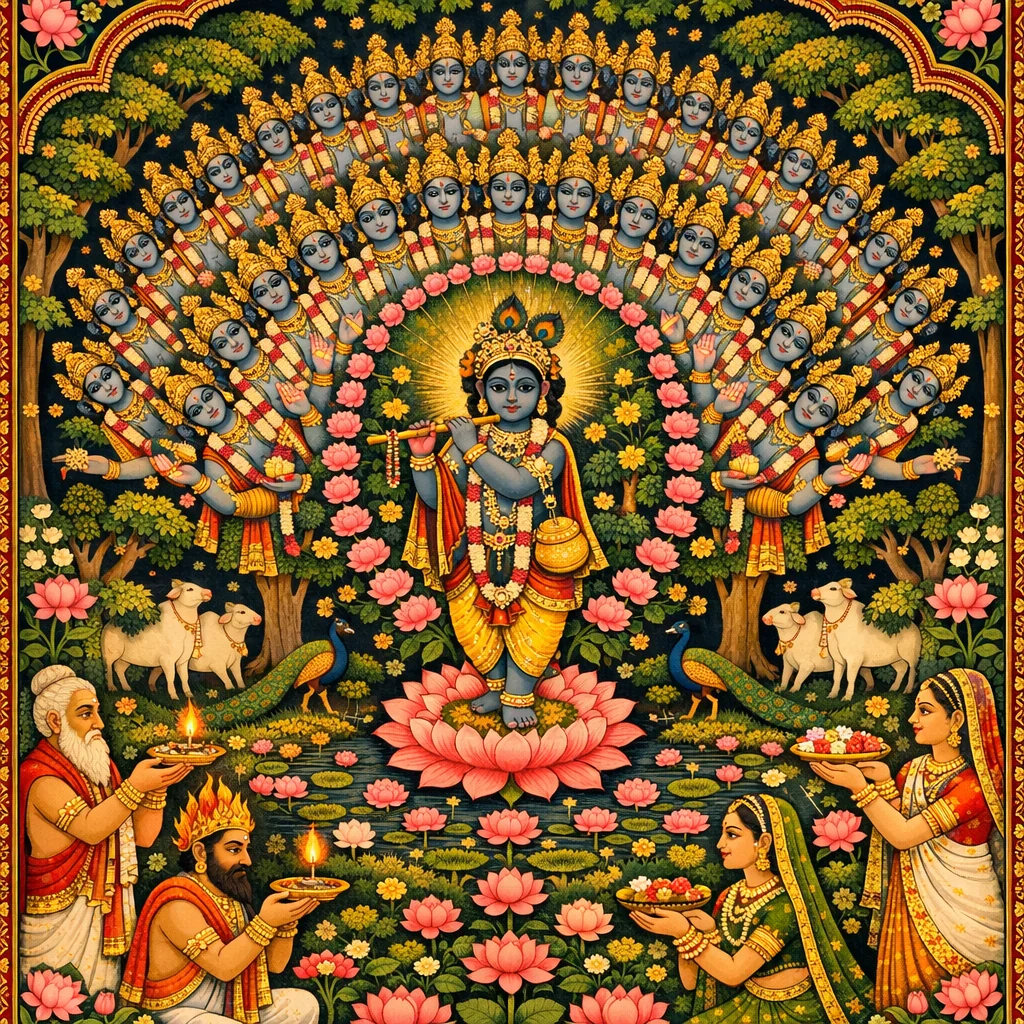
Following the deliverance of Aghāsura, Kṛṣṇa leads the cowherd boys to a beautiful riverbank for their forest lunch, where His intimacy with His friends is described as wondrous even to the devas. When the calves wander off, Kṛṣṇa goes to retrieve them; in His absence, Brahmā—astonished by Kṛṣṇa’s power yet testing Him—steals both calves and boys and hides them under mystic sleep. Kṛṣṇa returns, understands Brahmā’s act, and for the pleasure of Vraja’s parents and to instruct Brahmā, expands Himself into identical calves and boys, continuing daily life for one full year. The residents’ affection intensifies beyond normal bounds, and Balarāma detects the anomaly, realizing all are Kṛṣṇa’s expansions. When Brahmā returns (thinking only a moment has passed), he sees Kṛṣṇa still playing; his confusion culminates as the expansions reveal innumerable four-armed Viṣṇu forms being worshiped by all powers, elements, and cosmic principles. Overwhelmed, Brahmā is humbled; Kṛṣṇa withdraws yoga-māyā, restoring the scene to Kṛṣṇa alone searching with food in hand—setting the stage for Brahmā’s ensuing prayers in the next chapter.
Shlokas
Verse 1
श्रीशुक उवाच साधु पृष्टं महाभाग त्वया भागवतोत्तम । यन्नूतनयसीशस्य शृण्वन्नपि कथां मुहु: ॥ १ ॥
Śrīla Śukadeva Gosvāmī said: O best of devotees, most fortunate Parīkṣit, you have inquired very nicely, for although constantly hearing the pastimes of the Lord, you are perceiving His activities to be newer and newer.
Verse 2
सतामयं सारभृतां निसर्गो यदर्थवाणीश्रुतिचेतसामपि । प्रतिक्षणं नव्यवदच्युतस्य यत् स्त्रिया विटानामिव साधुवार्ता ॥ २ ॥
Paramahaṁsas, devotees who have accepted the essence of life, are attached to Kṛṣṇa in the core of their hearts, and He is the aim of their lives. It is their nature to talk only of Kṛṣṇa at every moment, as if such topics were newer and newer. They are attached to such topics, just as materialists are attached to topics of women and sex.
Verse 3
शृणुष्वावहितो राजन्नपि गुह्यं वदामि ते । ब्रूयु: स्निग्धस्य शिष्यस्य गुरवो गुह्यमप्युत ॥ ३ ॥
O King, kindly hear me with great attention. Although the activities of the Supreme Lord are very confidential, no ordinary man being able to understand them, I shall speak about them to you, for spiritual masters explain to a submissive disciple even subject matters that are very confidential and difficult to understand.
Verse 4
तथाघवदनान्मृत्यो रक्षित्वा वत्सपालकान् । सरित्पुलिनमानीय भगवानिदमब्रवीत् ॥ ४ ॥
Then, after saving the boys and calves from the mouth of Aghāsura, who was death personified, Lord Kṛṣṇa, the Supreme Personality of Godhead, brought them all to the bank of the river and spoke the following words.
Verse 5
अहोऽतिरम्यं पुलिनं वयस्या: स्वकेलिसम्पन्मृदुलाच्छबालुकम् । स्फुटत्सरोगन्धहृतालिपत्रिक- ध्वनिप्रतिध्वानलसद्द्रुमाकुलम् ॥ ५ ॥
My dear friends, just see how this riverbank is extremely beautiful because of its pleasing atmosphere. And just see how the blooming lotuses are attracting bees and birds by their aroma. The humming and chirping of the bees and birds is echoing throughout the beautiful trees in the forest. Also, here the sands are clean and soft. Therefore, this must be considered the best place for our sporting and pastimes.
Verse 6
अत्र भोक्तव्यमस्माभिर्दिवारूढं क्षुधार्दिता: । वत्सा: समीपेऽप: पीत्वा चरन्तु शनकैस्तृणम् ॥ ६ ॥
I think we should take our lunch here, since we are already hungry because the time is very late. Here the calves may drink water and go slowly here and there and eat the grass.
Verse 7
तथेति पाययित्वार्भा वत्सानारुध्य शाद्वले । मुक्त्वा शिक्यानि बुभुजु: समं भगवता मुदा ॥ ७ ॥
Accepting Lord Kṛṣṇa’s proposal, the cowherd boys allowed the calves to drink water from the river and then tied them to trees where there was green, tender grass. Then the boys opened their baskets of food and began eating with Kṛṣṇa in great transcendental pleasure.
Verse 8
कृष्णस्य विष्वक् पुरुराजिमण्डलै- रभ्यानना: फुल्लदृशो व्रजार्भका: । सहोपविष्टा विपिने विरेजु- श्छदा यथाम्भोरुहकर्णिकाया: ॥ ८ ॥
Like the whorl of a lotus flower surrounded by its petals and leaves, Kṛṣṇa sat in the center, encircled by lines of His friends, who all looked very beautiful. Every one of them was trying to look forward toward Kṛṣṇa, thinking that Kṛṣṇa might look toward him. In this way they all enjoyed their lunch in the forest.
Verse 9
केचित् पुष्पैर्दलै: केचित्पल्लवैरङ्कुरै: फलै: । शिग्भिस्त्वग्भिर्दृषद्भिश्च बुभुजु: कृतभाजना: ॥ ९ ॥
Among the cowherd boys, some placed their lunch on flowers, some on leaves, fruits, or bunches of leaves, some actually in their baskets, some on the bark of trees and some on rocks. This is what the children imagined to be their plates as they ate their lunch.
Verse 10
सर्वे मिथो दर्शयन्त: स्वस्वभोज्यरुचिं पृथक् । हसन्तो हासयन्तश्चाभ्यवजह्रु: सहेश्वरा: ॥ १० ॥
All the cowherd boys enjoyed their lunch with Kṛṣṇa, showing one another the different tastes of the different varieties of preparations they had brought from home. Tasting one another’s preparations, they began to laugh and make one another laugh.
Verse 11
बिभ्रद् वेणुं जठरपटयो: शृङ्गवेत्रे च कक्षे वामे पाणौ मसृणकवलं तत्फलान्यङ्गुलीषु । तिष्ठन् मध्ये स्वपरिसुहृदो हासयन् नर्मभि: स्वै: स्वर्गे लोके मिषति बुभुजे यज्ञभुग् बालकेलि: ॥ ११ ॥
Kṛṣṇa is yajña-bhuk — that is, He eats only offerings of yajña — but to exhibit His childhood pastimes, He now sat with His flute tucked between His waist and His tight cloth on His right side and with His horn bugle and cow-driving stick on His left. Holding in His hand a very nice preparation of yogurt and rice, with pieces of suitable fruit between His fingers, He sat like the whorl of a lotus flower, looking forward toward all His friends, personally joking with them and creating jubilant laughter among them as He ate. At that time, the denizens of heaven were watching, struck with wonder at how the Personality of Godhead, who eats only in yajña, was now eating with His friends in the forest.
Verse 12
भारतैवं वत्सपेषु भुञ्जानेष्वच्युतात्मसु । वत्सास्त्वन्तर्वने दूरं विविशुस्तृणलोभिता: ॥ १२ ॥
O Mahārāja Parīkṣit, while the cowherd boys, who knew nothing within the core of their hearts but Kṛṣṇa, were thus engaged in eating their lunch in the forest, the calves went far away, deep into the forest, being allured by green grass.
Verse 13
तान् दृष्ट्वा भयसन्त्रस्तानूचे कृष्णोऽस्य भीभयम् । मित्राण्याशान्मा विरमतेहानेष्ये वत्सकानहम् ॥ १३ ॥
When Kṛṣṇa saw that His friends the cowherd boys were frightened, He, the fierce controller even of fear itself, said, just to mitigate their fear, “My dear friends, do not stop eating. I shall bring your calves back to this spot by personally going after them Myself.”
Verse 14
इत्युक्त्वाद्रिदरीकुञ्जगह्वरेष्वात्मवत्सकान् । विचिन्वन्भगवान्कृष्ण: सपाणिकवलो ययौ ॥ १४ ॥
“Let Me go and search for the calves,” Kṛṣṇa said. “Don’t disturb your enjoyment.” Then, carrying His yogurt and rice in His hand, the Supreme Personality of Godhead, Kṛṣṇa, immediately went out to search for the calves of His friends. To please His friends, He began searching in all the mountains, mountain caves, bushes and narrow passages.
Verse 15
अम्भोजन्मजनिस्तदन्तरगतो मायार्भकस्येशितु- र्द्रष्टुं मञ्जु महित्वमन्यदपि तद्वत्सानितो वत्सपान् । नीत्वान्यत्र कुरूद्वहान्तरदधात् खेऽवस्थितो य: पुरा दृष्ट्वाघासुरमोक्षणं प्रभवत: प्राप्त: परं विस्मयम् ॥ १५ ॥
O Mahārāja Parīkṣit, Brahmā, who resides in the higher planetary system in the sky, had observed the activities of the most powerful Kṛṣṇa in killing and delivering Aghāsura, and he was astonished. Now that same Brahmā wanted to show some of his own power and see the power of Kṛṣṇa, who was engaged in His childhood pastimes, playing as if with ordinary cowherd boys. Therefore, in Kṛṣṇa’s absence, Brahmā took all the boys and calves to another place. Thus he became entangled, for in the very near future he would see how powerful Kṛṣṇa was.
Verse 16
ततो वत्सानदृष्ट्वैत्य पुलिनेऽपि च वत्सपान् । उभावपि वने कृष्णो विचिकाय समन्तत: ॥ १६ ॥
Thereafter, when Kṛṣṇa was unable to find the calves, He returned to the bank of the river, but there He was also unable to see the cowherd boys. Thus He began to search for both the calves and the boys, as if He could not understand what had happened.
Verse 17
क्वाप्यदृष्ट्वान्तर्विपिने वत्सान्पालांश्च विश्ववित् । सर्वं विधिकृतं कृष्ण: सहसावजगाम ह ॥ १७ ॥
When Kṛṣṇa was unable to find the calves and their caretakers, the cowherd boys, anywhere in the forest, He could suddenly understand that this was the work of Lord Brahmā.
Verse 18
तत: कृष्णो मुदं कर्तुं तन्मातृणां च कस्य च । उभयायितमात्मानं चक्रे विश्वकृदीश्वर: ॥ १८ ॥
Thereafter, just to create pleasure both for Brahmā and for the mothers of the calves and cowherd boys, Kṛṣṇa, the creator of the entire cosmic manifestation, expanded Himself as calves and boys.
Verse 19
यावद् वत्सपवत्सकाल्पकवपुर्यावत् कराङ्घ्र्यादिकं यावद् यष्टिविषाणवेणुदलशिग् यावद् विभूषाम्बरम् । यावच्छीलगुणाभिधाकृतिवयो यावद् विहारादिकं सर्वं विष्णुमयं गिरोऽङ्गवदज: सर्वस्वरूपो बभौ ॥ १९ ॥
By His Vāsudeva feature, Kṛṣṇa simultaneously expanded Himself into the exact number of missing cowherd boys and calves, with their exact bodily features, their particular types of hands, legs and other limbs, their sticks, bugles and flutes, their lunch bags, their particular types of dress and ornaments placed in various ways, their names, ages and forms, and their special activities and characteristics. By expanding Himself in this way, beautiful Kṛṣṇa proved the statement samagra-jagad viṣṇumayam: “Lord Viṣṇu is all-pervading.”
Verse 20
स्वयमात्मात्मगोवत्सान् प्रतिवार्यात्मवत्सपै: । क्रीडन्नात्मविहारैश्च सर्वात्मा प्राविशद् व्रजम् ॥ २० ॥
Now expanding Himself so as to appear as all the calves and cowherd boys, all of them as they were, and at the same time appear as their leader, Kṛṣṇa entered Vrajabhūmi, the land of His father, Nanda Mahārāja, just as He usually did while enjoying their company.
Verse 21
तत्तद्वत्सान्पृथङ्नीत्वा तत्तद्गोष्ठे निवेश्य स: । तत्तदात्माभवद् राजंस्तत्तत्सद्म प्रविष्टवान् ॥ २१ ॥
O Mahārāja Parīkṣit, Kṛṣṇa, who had divided Himself as different calves and also as different cowherd boys, entered different cow sheds as the calves and then different homes as different boys.
Verse 22
तन्मातरो वेणुरवत्वरोत्थिता उत्थाप्य दोर्भि: परिरभ्य निर्भरम् । स्नेहस्नुतस्तन्यपय:सुधासवं मत्वा परं ब्रह्म सुतानपाययन् ॥ २२ ॥
The mothers of the boys, upon hearing the sounds of the flutes and bugles being played by their sons, immediately rose from their household tasks, lifted their boys onto their laps, embraced them with both arms and began to feed them with their breast milk, which flowed forth because of extreme love specifically for Kṛṣṇa. Actually Kṛṣṇa is everything, but at that time, expressing extreme love and affection, they took special pleasure in feeding Kṛṣṇa, the Parabrahman, and Kṛṣṇa drank the milk from His respective mothers as if it were a nectarean beverage.
Verse 23
ततो नृपोन्मर्दनमज्जलेपना- लङ्काररक्षातिलकाशनादिभि: । संलालित: स्वाचरितै: प्रहर्षयन् सायं गतो यामयमेन माधव: ॥ २३ ॥
Thereafter, O Mahārāja Parīkṣit, as required according to the scheduled round of His pastimes, Kṛṣṇa returned in the evening, entered the house of each of the cowherd boys, and engaged exactly like the former boys, thus enlivening their mothers with transcendental pleasure. The mothers took care of the boys by massaging them with oil, bathing them, smearing their bodies with sandalwood pulp, decorating them with ornaments, chanting protective mantras, decorating their bodies with tilaka and giving them food. In this way, the mothers served Kṛṣṇa personally.
Verse 24
गावस्ततो गोष्ठमुपेत्य सत्वरं हुङ्कारघोषै: परिहूतसङ्गतान् । स्वकान् स्वकान् वत्सतरानपाययन् मुहुर्लिहन्त्य: स्रवदौधसं पय: ॥ २४ ॥
Thereafter, all the cows entered their different sheds and began mooing loudly, calling for their respective calves. When the calves arrived, the mothers began licking the calves’ bodies again and again and profusely feeding them with the milk flowing from their milk bags.
Verse 25
गोगोपीनां मातृतास्मिन्नासीत्स्नेहर्धिकां विना । पुरोवदास्वपि हरेस्तोकता मायया विना ॥ २५ ॥
Previously, from the very beginning, the gopīs had motherly affection for Kṛṣṇa. Indeed, their affection for Kṛṣṇa exceeded even their affection for their own sons. In displaying their affection, they had thus distinguished between Kṛṣṇa and their sons, but now that distinction disappeared.
Verse 26
व्रजौकसां स्वतोकेषु स्नेहवल्ल्याब्दमन्वहम् । शनैर्नि:सीम ववृधे यथा कृष्णे त्वपूर्ववत् ॥ २६ ॥
Although the inhabitants of Vrajabhūmi, the cowherd men and cowherd women, previously had more affection for Kṛṣṇa than for their own children, now, for one year, their affection for their own sons continuously increased, for Kṛṣṇa had now become their sons. There was no limit to the increment of their affection for their sons, who were now Kṛṣṇa. Every day they found new inspiration for loving their children as much as they loved Kṛṣṇa.
Verse 27
इत्थमात्मात्मनात्मानं वत्सपालमिषेण स: । पालयन् वत्सपो वर्षं चिक्रीडे वनगोष्ठयो: ॥ २७ ॥
In this way, Lord Śrī Kṛṣṇa, having Himself become the cowherd boys and groups of calves, maintained Himself by Himself. Thus He continued His pastimes, both in Vṛndāvana and in the forest, for one year.
Verse 28
एकदा चारयन् वत्सान्सरामो वनमाविशत् । पञ्चषासु त्रियामासु हायनापूरणीष्वज: ॥ २८ ॥
One day, five or six nights before the completion of the year, Kṛṣṇa, tending the calves, entered the forest along with Balarāma.
Verse 29
ततो विदूराच्चरतो गावो वत्सानुपव्रजम् । गोवर्धनाद्रिशिरसि चरन्त्यो ददृशुस्तृणम् ॥ २९ ॥
Thereafter, while pasturing atop Govardhana Hill, the cows looked down to find some green grass and saw their calves pasturing near Vṛndāvana, not very far away.
Verse 30
दृष्ट्वाथ तत्स्नेहवशोऽस्मृतात्मा स गोव्रजोऽत्यात्मपदुर्गमार्ग: । द्विपात्ककुद्ग्रीव उदास्यपुच्छो- ऽगाद्धुङ्कृतैरास्रुपया जवेन ॥ ३० ॥
When the cows saw their own calves from the top of Govardhana Hill, they forgot themselves and their caretakers because of increased affection, and although the path was very rough, they ran toward their calves with great anxiety, each running as if with one pair of legs. Their milk bags full and flowing with milk, their heads and tails raised, and their humps moving with their necks, they ran forcefully until they reached their calves to feed them.
Verse 31
समेत्य गावोऽधो वत्सान् वत्सवत्योऽप्यपाययन् । गिलन्त्य इव चाङ्गानि लिहन्त्य: स्वौधसं पय: ॥ ३१ ॥
The cows had given birth to new calves, but while coming down from Govardhana Hill, the cows, because of increased affection for the older calves, allowed the older calves to drink milk from their milk bags and then began licking the calves’ bodies in anxiety, as if wanting to swallow them.
Verse 32
गोपास्तद्रोधनायासमौघ्यलज्जोरुमन्युना । दुर्गाध्वकृच्छ्रतोऽभ्येत्य गोवत्सैर्ददृशु: सुतान् ॥ ३२ ॥
The cowherd men, having been unable to check the cows from going to their calves, felt simultaneously ashamed and angry. They crossed the rough road with great difficulty, but when they came down and saw their own sons, they were overwhelmed by great affection.
Verse 33
तदीक्षणोत्प्रेमरसाप्लुताशया जातानुरागा गतमन्यवोऽर्भकान् । उदुह्य दोर्भि: परिरभ्य मूर्धनि घ्राणैरवापु: परमां मुदं ते ॥ ३३ ॥
At that time, all the thoughts of the cowherd men merged in the mellow of paternal love, which was aroused by the sight of their sons. Experiencing a great attraction, their anger completely disappearing, they lifted their sons, embraced them in their arms and enjoyed the highest pleasure by smelling their sons’ heads.
Verse 34
तत: प्रवयसो गोपास्तोकाश्लेषसुनिर्वृता: । कृच्छ्राच्छनैरपगतास्तदनुस्मृत्युदश्रव: ॥ ३४ ॥
Thereafter the elderly cowherd men, having obtained great feeling from embracing their sons, gradually and with great difficulty and reluctance ceased embracing them and returned to the forest. But as the men remembered their sons, tears began to roll down from their eyes.
Verse 35
व्रजस्य राम: प्रेमर्धेर्वीक्ष्यौत्कण्ठ्यमनुक्षणम् । मुक्तस्तनेष्वपत्येष्वप्यहेतुविदचिन्तयत् ॥ ३५ ॥
Because of an increase of affection, the cows had constant attachment even to those calves that were grown up and had stopped sucking milk from their mothers. When Baladeva saw this attachment, He was unable to understand the reason for it, and thus He began to consider as follows.
Verse 36
किमेतदद्भुतमिव वासुदेवेऽखिलात्मनि । व्रजस्य सात्मनस्तोकेष्वपूर्वं प्रेम वर्धते ॥ ३६ ॥
What is this wonderful phenomenon? The affection of all the inhabitants of Vraja, including Me, toward these boys and calves is increasing as never before, just like our affection for Lord Kṛṣṇa, the Supersoul of all living entities.
Verse 37
केयं वा कुत आयाता दैवी वा नार्युतासुरी । प्रायो मायास्तु मे भर्तुर्नान्या मेऽपि विमोहिनी ॥ ३७ ॥
Who is this mystic power, and where has she come from? Is she a demigod or a demoness? She must be the illusory energy of My master, Lord Kṛṣṇa, for who else can bewilder Me?
Verse 38
इति सञ्चिन्त्य दाशार्हो वत्सान्सवयसानपि । सर्वानाचष्ट वैकुण्ठं चक्षुषा वयुनेन स: ॥ ३८ ॥
Thinking in this way, Lord Balarāma was able to see, with the eye of transcendental knowledge, that all these calves and Kṛṣṇa’s friends were expansions of the form of Śrī Kṛṣṇa.
Verse 39
नैते सुरेशा ऋषयो न चैते त्वमेव भासीश भिदाश्रयेऽपि । सर्वं पृथक्त्वं निगमात् कथं वदे- त्युक्तेन वृत्तं प्रभुणा बलोऽवैत् ॥ ३९ ॥
Lord Baladeva said, “O supreme controller! These boys are not great demigods, as I previously thought. Nor are these calves great sages like Nārada. Now I can see that You alone are manifesting Yourself in all varieties of difference. Although one, You are existing in the different forms of the calves and boys. Please briefly explain this to Me.” Having thus been requested by Lord Baladeva, Kṛṣṇa explained the whole situation, and Baladeva understood it.
Verse 40
तावदेत्यात्मभूरात्ममानेन त्रुट्यनेहसा । पुरोवदाब्दं क्रीडन्तं ददृशे सकलं हरिम् ॥ ४० ॥
When Lord Brahmā returned after a moment of time had passed (according to his own measurement), he saw that although by human measurement a complete year had passed, Lord Kṛṣṇa, after all that time, was engaged just as before in playing with the boys and calves, who were His expansions.
Verse 41
यावन्तो गोकुले बाला: सवत्सा: सर्व एव हि । मायाशये शयाना मे नाद्यापि पुनरुत्थिता: ॥ ४१ ॥
Lord Brahmā thought: Whatever boys and calves there were in Gokula, I have kept them sleeping on the bed of my mystic potency, and to this very day they have not yet risen again.
Verse 42
इत एतेऽत्र कुत्रत्या मन्मायामोहितेतरे । तावन्त एव तत्राब्दं क्रीडन्तो विष्णुना समम् ॥ ४२ ॥
A similar number of boys and calves have been playing with Kṛṣṇa for one whole year, yet they are different from the ones illusioned by my mystic potency. Who are they? Where did they come from?
Verse 43
एवमेतेषु भेदेषु चिरं ध्यात्वा स आत्मभू: । सत्या: के कतरे नेति ज्ञातुं नेष्टे कथञ्चन ॥ ४३ ॥
Thus Lord Brahmā, thinking and thinking for a long time, tried to distinguish between those two sets of boys, who were each separately existing. He tried to understand who was real and who was not real, but he couldn’t understand at all.
Verse 44
एवं सम्मोहयन् विष्णुं विमोहं विश्वमोहनम् । स्वयैव माययाजोऽपि स्वयमेव विमोहित: ॥ ४४ ॥
Thus because Lord Brahmā wanted to mystify the all-pervading Lord Kṛṣṇa, who can never be mystified, but who, on the contrary, mystifies the entire universe, he himself was put into bewilderment by his own mystic power.
Verse 45
तम्यां तमोवन्नैहारं खद्योतार्चिरिवाहनि । महतीतरमायैश्यं निहन्त्यात्मनि युञ्जत: ॥ ४५ ॥
As the darkness of snow on a dark night and the light of a glowworm in the light of day have no value, the mystic power of an inferior person who tries to use it against a person of great power is unable to accomplish anything; instead, the power of that inferior person is diminished.
Verse 46
तावत् सर्वे वत्सपाला: पश्यतोऽजस्य तत्क्षणात् । व्यदृश्यन्त घनश्यामा: पीतकौशेयवासस: ॥ ४६ ॥
Then, while Lord Brahmā looked on, all the calves and the boys tending them immediately appeared to have complexions the color of bluish rainclouds and to be dressed in yellow silken garments.
Verse 47
चतुर्भुजा: शङ्खचक्रगदाराजीवपाणय: । किरीटिन: कुण्डलिनो हारिणो वनमालिन: ॥ ४७ ॥ श्रीवत्साङ्गददोरत्नकम्बुकङ्कणपाणय: । नूपुरै: कटकैर्भाता: कटिसूत्राङ्गुलीयकै: ॥ ४८ ॥
All those personalities had four arms, holding conchshell, disc, mace and lotus flower in Their hands. They wore helmets on Their heads, earrings on Their ears and garlands of forest flowers around Their necks. On the upper portion of the right side of Their chests was the emblem of the goddess of fortune. Furthermore, They wore armlets on Their arms, the Kaustubha gem around Their necks, which were marked with three lines like a conchshell, and bracelets on Their wrists. With bangles on Their ankles, ornaments on Their feet, and sacred belts around Their waists, They all appeared very beautiful.
Verse 48
चतुर्भुजा: शङ्खचक्रगदाराजीवपाणय: । किरीटिन: कुण्डलिनो हारिणो वनमालिन: ॥ ४७ ॥ श्रीवत्साङ्गददोरत्नकम्बुकङ्कणपाणय: । नूपुरै: कटकैर्भाता: कटिसूत्राङ्गुलीयकै: ॥ ४८ ॥
All those personalities had four arms, holding conchshell, disc, mace and lotus flower in Their hands. They wore helmets on Their heads, earrings on Their ears and garlands of forest flowers around Their necks. On the upper portion of the right side of Their chests was the emblem of the goddess of fortune. Furthermore, They wore armlets on Their arms, the Kaustubha gem around Their necks, which were marked with three lines like a conchshell, and bracelets on Their wrists. With bangles on Their ankles, ornaments on Their feet, and sacred belts around Their waists, They all appeared very beautiful.
Verse 49
आङ्घ्रिमस्तकमापूर्णास्तुलसीनवदामभि: । कोमलै: सर्वगात्रेषु भूरिपुण्यवदर्पितै: ॥ ४९ ॥
Every part of Their bodies, from Their feet to the top of Their heads, was fully decorated with fresh, tender garlands of tulasī leaves offered by devotees engaged in worshiping the Lord by the greatest pious activities, namely hearing and chanting.
Verse 50
चन्द्रिकाविशदस्मेरै: सारुणापाङ्गवीक्षितै: । स्वकार्थानामिव रज:सत्त्वाभ्यां स्रष्टृपालका: ॥ ५० ॥
Those Viṣṇu forms, by Their pure smiling, which resembled the increasing light of the moon, and by the sidelong glances of Their reddish eyes, created and protected the desires of Their own devotees, as if by the modes of passion and goodness.
Verse 51
आत्मादिस्तम्बपर्यन्तैर्मूर्तिमद्भिश्चराचरै: । नृत्यगीताद्यनेकार्है: पृथक्पृथगुपासिता: ॥ ५१ ॥
All beings, both moving and nonmoving, from the four-headed Lord Brahmā down to the most insignificant living entity, had taken forms and were differently worshiping those viṣṇu-mūrtis, according to their respective capacities, with various means of worship, such as dancing and singing.
Verse 52
अणिमाद्यैर्महिमभिरजाद्याभिर्विभूतिभि: । चतुर्विंशतिभिस्तत्त्वै: परीता महदादिभि: ॥ ५२ ॥
All the viṣṇu-mūrtis were surrounded by the opulences, headed by aṇimā-siddhi; by the mystic potencies, headed by Ajā; and by the twenty-four elements for the creation of the material world, headed by the mahat-tattva.
Verse 53
कालस्वभावसंस्कारकामकर्मगुणादिभि: । स्वमहिध्वस्तमहिभिर्मूर्तिमद्भिरुपासिता: ॥ ५३ ॥
Then Lord Brahmā saw that kāla (the time factor), svabhāva (one’s own nature by association), saṁskāra (reformation), kāma (desire), karma (fruitive activity) and the guṇas (the three modes of material nature), their own independence being completely subordinate to the potency of the Lord, had all taken forms and were also worshiping those viṣṇu-mūrtis.
Verse 54
सत्यज्ञानानन्तानन्दमात्रैकरसमूर्तय: । अस्पृष्टभूरिमाहात्म्या अपि ह्युपनिषद्दृशाम् ॥ ५४ ॥
The viṣṇu-mūrtis all had eternal, unlimited forms, full of knowledge and bliss and existing beyond the influence of time. Their great glory was not even to be touched by the jñānīs engaged in studying the Upaniṣads.
Verse 55
एवं सकृद् ददर्शाज: परब्रह्मात्मनोऽखिलान् । यस्य भासा सर्वमिदं विभाति सचराचरम् ॥ ५५ ॥
Thus Lord Brahmā saw the Supreme Brahman, by whose energy this entire universe, with its moving and nonmoving living beings, is manifested. He also saw at the same time all the calves and boys as the Lord’s expansions.
Verse 56
ततोऽतिकुतुकोद्वृत्यस्तिमितैकादशेन्द्रिय: । तद्धाम्नाभूदजस्तूष्णीं पूर्देव्यन्तीव पुत्रिका ॥ ५६ ॥
Then, by the power of the effulgence of those viṣṇu-mūrtis, Lord Brahmā, his eleven senses jolted by astonishment and stunned by transcendental bliss, became silent, just like a child’s clay doll in the presence of the village deity.
Verse 57
इतीरेशेऽतर्क्ये निजमहिमनि स्वप्रमितिके परत्राजातोऽतन्निरसनमुखब्रह्मकमितौ । अनीशेऽपि द्रष्टुं किमिदमिति वा मुह्यति सति चच्छादाजो ज्ञात्वा सपदि परमोऽजाजवनिकाम् ॥ ५७ ॥
The Supreme Brahman is beyond mental speculation, He is self-manifest, existing in His own bliss, and He is beyond the material energy. He is known by the crest jewels of the Vedas by refutation of irrelevant knowledge. Thus in relation to that Supreme Brahman, the Personality of Godhead, whose glory had been shown by the manifestation of all the four-armed forms of Viṣṇu, Lord Brahmā, the lord of Sarasvatī, was mystified. “What is this?” he thought, and then he was not even able to see. Lord Kṛṣṇa, understanding Brahmā’s position, then at once removed the curtain of His yoga-māyā.
Verse 58
ततोऽर्वाक्प्रतिलब्धाक्ष: क: परेतवदुत्थित: । कृच्छ्रादुन्मील्य वै दृष्टीराचष्टेदं सहात्मना ॥ ५८ ॥
Lord Brahmā’s external consciousness then revived, and he stood up, just like a dead man coming back to life. Opening his eyes with great difficulty, he saw the universe, along with himself.
Verse 59
सपद्येवाभित: पश्यन् दिशोऽपश्यत्पुर:स्थितम् । वृन्दावनं जनाजीव्यद्रुमाकीर्णं समाप्रियम् ॥ ५९ ॥
Then, looking in all directions, Lord Brahmā immediately saw Vṛndāvana before him, filled with trees, which were the means of livelihood for the inhabitants and which were equally pleasing in all seasons.
Verse 60
यत्र नैसर्गदुर्वैरा: सहासन् नृमृगादय: । मित्राणीवाजितावासद्रुतरुट्तर्षकादिकम् ॥ ६० ॥
Vṛndāvana is the transcendental abode of the Lord, where there is no hunger, anger or thirst. Though naturally inimical, both human beings and fierce animals live there together in transcendental friendship.
Verse 61
तत्रोद्वहत् पशुपवंशशिशुत्वनाट्यं ब्रह्माद्वयं परमनन्तमगाधबोधम् । वत्सान् सखीनिव पुरा परितो विचिन्व- देकं सपाणिकवलं परमेष्ठ्यचष्ट ॥ ६१ ॥
Then Lord Brahmā saw the Absolute Truth — who is one without a second, who possesses full knowledge and who is unlimited — assuming the role of a child in a family of cowherd men and standing all alone, just as before, with a morsel of food in His hand, searching everywhere for the calves and His cowherd friends.
Verse 62
दृष्ट्वा त्वरेण निजधोरणतोऽवतीर्य पृथ्व्यां वपु: कनकदण्डमिवाभिपात्य । स्पृष्ट्वा चतुर्मुकुटकोटिभिरङ्घ्रियुग्मं नत्वा मुदश्रुसुजलैरकृताभिषेकम् ॥ ६२ ॥
After seeing this, Lord Brahmā hastily got down from his swan carrier, fell down like a golden rod and touched the lotus feet of Lord Kṛṣṇa with the tips of the four crowns on his heads. Offering his obeisances, he bathed the feet of Kṛṣṇa with the water of his tears of joy.
Verse 63
उत्थायोत्थाय कृष्णस्य चिरस्य पादयो: पतन् । आस्ते महित्वं प्राग्दृष्टं स्मृत्वा स्मृत्वा पुन: पुन: ॥ ६३ ॥
Rising and falling again and again at the lotus feet of Lord Kṛṣṇa for a long time, Lord Brahmā remembered over and over the Lord’s greatness he had just seen.
Verse 64
शनैरथोत्थाय विमृज्य लोचने मुकुन्दमुद्वीक्ष्य विनम्रकन्धर: । कृताञ्जलि: प्रश्रयवान् समाहित: सवेपथुर्गद्गदयैलतेलया ॥ ६४ ॥ ज्ञाने प्रयासमुदपास्य नमन्त एव जीवन्ति सन्मुखरितां भवदीयवार्ताम् । स्थाने स्थिता: श्रुतिगतां तनुवाङ्मनोभि- र्ये प्रायशोऽजित जितोऽप्यसि तैस्त्रिलोक्याम् ॥
Then, rising very gradually and wiping his two eyes, Lord Brahmā looked up at Mukunda. Lord Brahmā, his head bent low, his mind concentrated and his body trembling, very humbly began, with faltering words, to offer praises to Lord Kṛṣṇa.
Frequently Asked Questions
Brahmā, though a great cosmic administrator, became astonished after Aghāsura’s deliverance and wished to test the childlike cowherd Kṛṣṇa—measuring His power against Brahmā’s own mystic capacity. The Bhāgavata frames this as ūti: Brahmā’s intention to “see” Kṛṣṇa’s greatness becomes the cause of his bewilderment, demonstrating that even the highest created intellect cannot comprehend Bhagavān by experiment, only by surrender.
Kṛṣṇa expands by His own internal potency (yoga-māyā) into exact replicas—names, forms, behaviors, ornaments, and personal traits—while remaining the same Supreme Person. This illustrates samagra-jagad viṣṇumayam (the Lord’s all-pervasiveness) and the principle that His expansions are not products of matter or illusion but direct manifestations of His svarūpa-śakti.
Because the “sons” and “calves” they embraced were actually Kṛṣṇa Himself. Since Kṛṣṇa is the ātmā and āśraya of all beings, contact with Him naturally intensifies love (prema) and vatsalya-rasa. The narrative also shows poṣaṇa: Kṛṣṇa nourishes devotion by arranging deeper attachment within everyday life.
Balarāma detects it within Vraja by observing an unprecedented surge of affection even for older calves and boys, then perceives with transcendental knowledge that all are Kṛṣṇa’s expansions. Brahmā, returning later, becomes confused by two sets (his hidden originals and Kṛṣṇa’s manifested replicas) and is ultimately instructed by the revelation of innumerable viṣṇu-mūrtis.
The revelation discloses Kṛṣṇa’s aiśvarya: the same child in Vraja is the source of Viṣṇu, worshiped by all cosmic principles—time (kāla), nature (svabhāva), desire (kāma), karma, and the guṇas—showing their subordination to Him. It functions as a theological climax: Brahman realization and Upaniṣadic inquiry are surpassed by direct vision of Bhagavān’s personal supremacy.