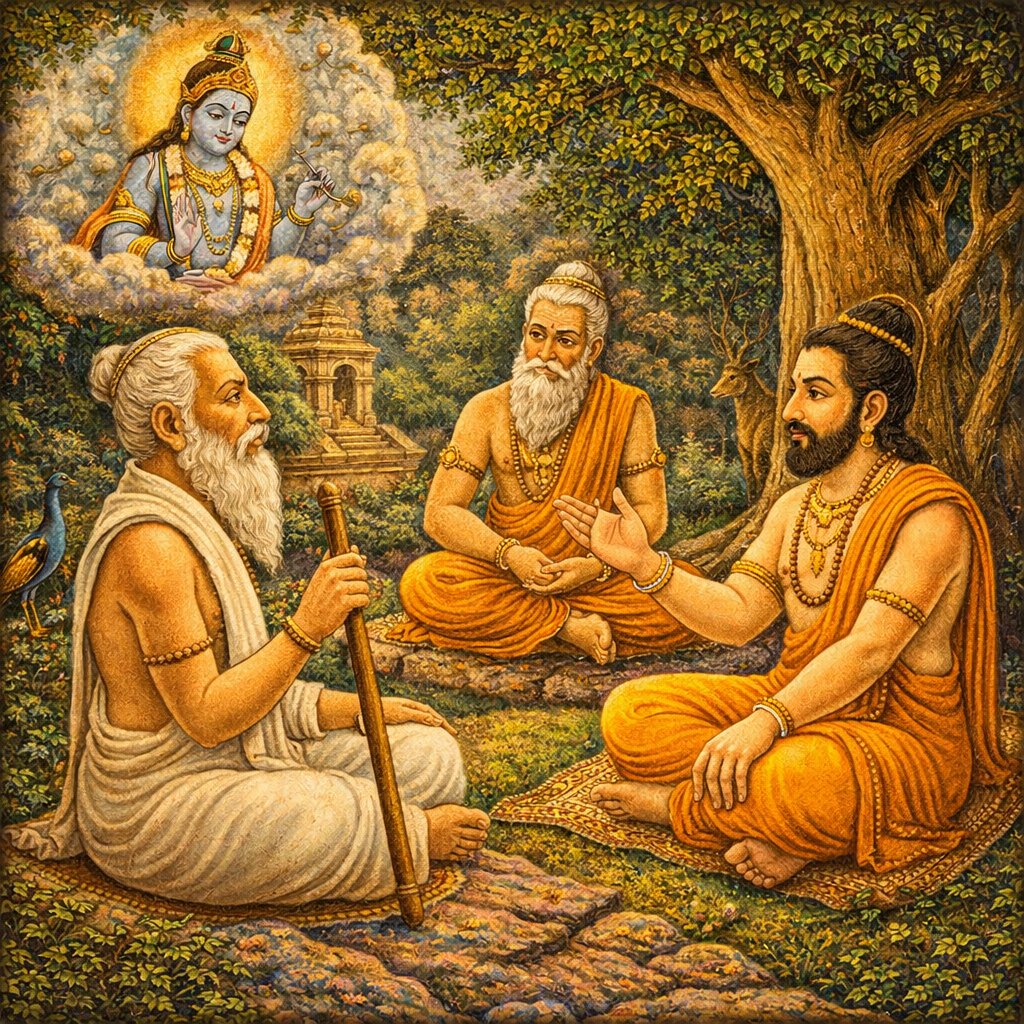
Canto 3: Vidura’s Pilgrimage, Uddhava’s Counsel, and the Groundwork for Kapila’s Sāṅkhya
तृतीयः स्कन्धः (विदुरोद्धवसंवादः / कपिलदेवोपदेशः-प्रारम्भभूमिः)
The Status Quo
Describes the creation by Brahma, the appearance of the Varaha avatara, the Kumaras, Kapila's Sankhya philosophy, and the account of cosmic maintenance.
Adhyayas in Tritiya Skandha
Adhyaya 1
Vidura Leaves Hastināpura and Meets Uddhava (Vidura’s Tīrtha-yātrā Begins)
Prompted by the King’s inquiry into Vidura and Maitreya’s meeting, Śukadeva frames Vidura’s departure as the moral consequence of Kuru adharma: Dhṛtarāṣṭra’s complicity in the lacquer-house plot, Draupadī’s humiliation, and the refusal to restore the Pāṇḍavas’ rightful share despite Kṛṣṇa’s counsel. Vidura offers pointed statecraft and dharma-advice—return the kingdom, fear the karmic and political backlash—yet Duryodhana insults him as an outsider, forcing Vidura to renounce the palace without resentment, seeing māyā’s workings. He then undertakes solitary pilgrimage across sacred sites, maintaining purity through bathing and Hari-sevā, remaining largely unseen by family. At Prabhāsa he learns of the Yadu destruction, then proceeds along Sarasvatī’s tīrthas and onward through western regions to the Yamunā, where the narrative pivots: Vidura meets Uddhava, embraces him, and begins a long sequence of inquiries about Kṛṣṇa’s family and the Pāṇḍavas. This chapter thus connects the Kuru collapse to the next adhyāyas in which Uddhava becomes the living witness who can direct Vidura toward higher instruction (eventually through Maitreya) after Kṛṣṇa’s departure.
Adhyaya 2
Uddhava’s Remembrance of Kṛṣṇa and the Theology of the Lord’s Disappearance
Following Vidura’s request to hear about Kṛṣṇa, Uddhava is overwhelmed: remembrance triggers devotional ecstasy, bodily transformations, and tears of separation. Regaining composure, he laments that the ‘sun’ of the world has set—Kṛṣṇa’s disappearance—and that time has swallowed the Yadu household. Uddhava reflects on the paradox that even the Yadus, constantly with Kṛṣṇa, could not fully recognize His supreme divinity, emphasizing that true knowledge arises from surrendered vision rather than mere proximity or learning. He explains that the Lord appears by yoga-māyā in an eternal form suited to līlā, and He ‘disappears’ from those whose vision is unpurified. Uddhava then recounts key Vraja and Mathurā-Dvārakā līlās—birth in prison, childhood in Vṛndāvana, demon-slaying, Kāliya chastisement, Govardhana lifting, and rāsa—showing how the Lord’s compassion and sovereignty coexist with humanlike conduct. This chapter bridges the previous inquiry (Vidura’s desire to hear) to the next movement of the canto: a more systematic narration of Kṛṣṇa’s life and the metaphysical implications of His descent and withdrawal.
Adhyaya 3
Uddhava Recalls Kṛṣṇa’s Mission: Earth’s Burden, Royal Dharma, and the Prelude to Dvārakā’s Withdrawal
Continuing Vidura’s inquiry, Uddhava compresses Kṛṣṇa’s public mission into a theological timeline: the Lord removes oppressive powers (Kaṁsa and other asuras), displays omniscience and compassion (mastering the Vedas; reviving Sāndīpani’s son), and establishes dharmic order through marriages and protection of the distressed (Rukmiṇī, Nāgnijitī, the rescued princesses). He demonstrates divine sovereignty even within household life—expanding into many forms to honor each queen—while remaining detached, illustrating that transcendence can coexist with social duty. Uddhava then links the Kurukṣetra war to the Lord’s purpose of reducing the earth’s burden and highlights Kṛṣṇa’s concern that even the Yadu strength could become a future burden. The chapter moves toward the Lord’s planned withdrawal: a sage’s curse, the pilgrimage to Prabhāsa, and the Yadus’ acts of charity and ritual propriety, setting the narrative momentum for the dissolution of Dvārakā’s visible era in the chapters ahead.
Adhyaya 4
Uddhava’s Departure to Badarikāśrama and Vidura’s Turn Toward Maitreya
This chapter opens in the aftermath of the brāhmaṇas’ curse, as the Vṛṣṇis and Bhojas, intoxicated, quarrel violently and destroy one another—an outward pretext for the Lord’s own intent to withdraw His dynasty from the earth. Śrī Kṛṣṇa, foreseeing the end by His internal potency, sits in solitude on the Sarasvatī’s bank. Uddhava, unable to bear separation, follows and beholds the Lord’s four-armed, serene form. The sage Maitreya arrives providentially, and the Lord honors Uddhava, recalling Uddhava’s ancient desire for divine association and granting him permission to go to Vaikuṇṭha. Uddhava, however, requests the confidential knowledge earlier spoken to Brahmā; the Lord instructs him on His transcendental position (foreshadowing the Uddhava-gītā framework). Returning to Vidura, Uddhava proceeds to Badarikāśrama as ordered, while Vidura—grieving yet steadied by knowledge—asks for teachings. Uddhava directs him to Maitreya, thereby linking this chapter to the next phase: Maitreya’s extended exposition on creation, dharma, and devotion.
Adhyaya 5
Vidura’s Questions on Devotion and Sarga; Maitreya Begins the Account of Creation
Continuing Vidura’s pilgrimage-driven search for transcendental meaning, he reaches the source region of the Gaṅgā and approaches Maitreya. Vidura rejects the promise of happiness through fruitive work, arguing that karma intensifies distress, and requests instruction in devotional service that pleases the Lord in the heart and reveals Vedic truth. He asks for a coherent account of the Lord’s incarnations and the orderly creation and governance of the cosmos, including the diversification of species, names, forms, and social gradations. Maitreya honors Vidura, identifies his extraordinary identity and divine association, and begins the cosmological sequence: the Lord alone exists prior to creation; māyā is the seen energy; the puruṣa impregnates prakṛti under kāla; mahat-tattva manifests, evolves into ahaṅkāra in three guṇic phases, producing mind, senses, and the elements from sound to earth. Empowered deities, unable to execute their functions, offer prayers taking shelter of the Lord’s lotus feet and seek directives for service. The chapter thus bridges Vidura’s existential inquiry to the forthcoming detailed exposition of creation and divine administration in subsequent chapters.
Adhyaya 6
The Universal Form (Virāṭ-Puruṣa): The Lord’s Entry into the Elements, the Devas, and the Origin of Varṇāśrama
Continuing the cosmological account delivered by Maitreya to Vidura, this chapter addresses a suspension in progressive creation caused by the non-combination of the Lord’s potencies. The Supreme Lord then enters the twenty-three elements along with His external energy (here named Kālī), and the jīvas awaken into activity as if rising from sleep. From this activation emerges the virāṭ-puruṣa (Hiraṇmaya), the first manifest universal form, within whom planetary systems and all beings rest. Maitreya then maps how specific devas preside over the manifested organs and functions of the virāṭ—speech, taste, smell, sight, touch, hearing, procreation, evacuation, grasping, locomotion, intelligence, mind, ego, and consciousness—showing a coherent theology of embodiment and cosmic administration. The chapter further situates beings across loka-regions according to guṇas and derives the four varṇas from the virāṭ’s limbs, culminating in the instruction that self-realization requires worship of the Supreme under a guru’s direction. It closes by stressing the Lord’s inconceivable potency beyond mind and speech, preparing the reader for deeper inquiries into creation’s mechanics and the jīva’s deliverance in subsequent chapters.
Adhyaya 7
Vidura’s Questions: How the Unchangeable Lord Relates to Māyā; Bhakti as the Remedy; Blueprint for the Coming Cosmology
As Maitreya continues speaking to Vidura (carrying forward the prior chapter’s momentum of inquiry into the Lord and creation), Vidura respectfully intensifies the philosophical problem: if Bhagavān is pūrṇa and avikāra, how can He be “connected” with the guṇas and their karmic outcomes, and why do jīvas suffer when Paramātmā resides within the heart? Maitreya rejects the illogical claim that Brahman is simultaneously overcome by māyā and yet unconditioned, explaining bondage as a mistaken self-identity—like dream perception or the moon’s reflection trembling due to water. He then gives the practical resolution: by Vāsudeva’s mercy received through devotional service in detachment—especially hearing and chanting—the misconception fades and miseries cease. Vidura, satisfied, glorifies guru-sevā and pure devotees as rare and decisive. The chapter then pivots into a “table of contents” for the next narrative arc: Vidura requests detailed exposition of the virāṭ/puruṣa entry into the mahat-tattva, planetary systems, Manus and lineages, species classifications, guṇa-avatāras, varṇāśrama, yajña, yoga/jñāna/bhakti paths, karma-based transmigration, Pitṛloka, time calculations, and dissolution—thereby setting up the succeeding chapters’ systematic cosmology and dharma exposition.
Adhyaya 8
Transmission of Bhāgavata Wisdom and Brahmā’s Vision of the Supreme Lord on Ananta
Maitreya honors Vidura’s lineage and devotion, then establishes the Bhāgavata’s authority through a chain of hearing: Saṅkarṣaṇa instructs the Kumāras; Sanat-kumāra teaches Sāṅkhyāyana; Parāśara and Bṛhaspati hear; Parāśara transmits to Maitreya, who now speaks to Vidura. The narrative then shifts to the dissolution waters where Garbhodakaśāyī Viṣṇu rests on Ananta under internal potency, while kāla-śakti stirs the subtle ingredients of creation. From the Lord’s navel arises the universal lotus; Brahmā appears, gains four heads by surveying the directions, and—unable to find the lotus root—abandons external search for internal meditation. After prolonged tapas, Brahmā realizes the Lord within the heart and beholds the majestic form of Hari reclining on Śeṣa, adorned with jewels, śrīvatsa, garlands, and the Sudarśana protection. Surcharged with rajo-guṇa and seeing the causal factors for creation, Brahmā prepares to begin visarga through prayers—leading directly into the next chapter’s stuti (Brahmā’s prayers).
Adhyaya 9
Brahmā’s Prayers to Lord Nārāyaṇa and the Lord’s Empowering Instructions for Creation
Continuing the creation-cycle narrative, Brahmā—born from the lotus arising from the Lord’s navel—offers extended stuti (prayers) after realizing the Supreme Person as the only ultimate knowable reality. He contrasts the Lord’s eternal personal form and Brahman effulgence, laments the conditioned souls’ anxiety and sense-driven suffering, and praises śravaṇa-kīrtana as the doorway to the Lord’s presence in the heart. Brahmā acknowledges the Lord as kāla (time), as the root of the cosmic tree, and as the controller of creation, maintenance, and dissolution, while praying to perform visarga without false prestige or material contamination and to remain steady in Vedic vibration. Maitreya then describes Brahmā’s silence and anxiety over forming planetary systems amid devastation waters. The Lord responds, assuring Brahmā that the benediction is already granted, instructing him in tapas, meditation, and bhakti-yoga, promising internal vision of the Lord everywhere, freedom from bodily identification, and protection from passion while generating progeny. Pleased, the Lord grants that those who pray similarly are fulfilled, then authorizes Brahmā to create and finally disappears—setting the stage for the next phase of detailed secondary creation and its ordering principles.
Adhyaya 10
Brahmā’s Secondary Creation, Kāla (Eternal Time), and the Taxonomy of Species
Vidura presses Maitreya to explain how Brahmā generated embodied forms after the Lord’s disappearance from direct view, requesting a complete resolution of his doubts. Maitreya begins by describing Brahmā’s long tapas and devotion, by which his knowledge becomes mature and effective. When a violent wind agitates the cosmic waters and lotus, Brahmā—empowered by realized knowledge—stabilizes the situation and proceeds to organize the cosmic lotus into the three worlds and then fourteen planetary divisions, establishing habitats for varied beings. Vidura then shifts the inquiry toward kāla, the Lord’s impersonal, unmanifest feature that activates the interactions of the guṇas and regulates creation, maintenance, and dissolution. Maitreya outlines the nine creations (including mahat-tattva, ahaṅkāra, senses, elements, capacities, and presiding deities) and then details Brahmā’s vaikṛta creations: immovable life, lower species, humans, and the eightfold classes of demigods and related beings. The chapter closes by pointing forward to genealogies—especially the descendants of the Manus—linking cosmology to historical unfolding in subsequent chapters.
Adhyaya 11
Kāla-vibhāga: The Divisions of Time from Atom to Brahmā, and the Lord Beyond Time
Continuing Vidura’s inquiry into how the cosmos is administered under the Supreme, Maitreya shifts from descriptive cosmology to its regulating principle—kāla (time). He begins at the most subtle level, defining the atom (paramāṇu) as the indivisible basis of material manifestation, and explains that time is inferred by motion within atomic combinations. The chapter then builds a graduated scale of time units (truṭi through muhūrta, day/night, fortnight, month, season), extending to the distinct calendrics of Pitṛ-loka and deva-loka. Vidura’s questions lead further into yuga measurements (Satya to Kali), yuga-sandhyās, and the structure of Brahmā’s day and night, including manvantaras and the recurring appearance of the Lord’s avatāras to maintain dharma. The narrative culminates in the night of Brahmā (pralaya imagery: Saṅkarṣaṇa’s fire, inundation, the Lord resting on Ananta) and concludes with a theological apex: time controls only the body-conscious, while kāla itself is controlled by Śrī Kṛṣṇa, the cause of all causes—preparing the reader for deeper ontological and devotional instruction in subsequent chapters.
Adhyaya 12
Brahmā’s Creation: The Kumāras, Rudra, the Prajāpatis, and the Manifestation of Vedic Sound
Continuing the account of cosmic unfolding under kāla, Maitreya shifts from the Lord’s time-feature to Brahmā’s visarga—how secondary creation proceeds and is regulated. Brahmā first produces misleading conditions (moha-like nescience and its derivatives), feels revulsion, and re-centers himself through meditation. He then creates the four Kumāras, who refuse progeny due to Vāsudeva-bhakti and liberation-oriented renunciation, provoking Brahmā’s restrained anger that manifests as Rudra. Brahmā assigns Rudra names, abodes, and Rudrāṇīs; Rudra’s furious progeny threaten cosmic stability, so Brahmā redirects him to tapas, establishing restraint as a cosmic necessity. Brahmā then generates the ten mind-born sons (including Nārada) and describes how dharma/adharma and various impulses arise from his body—illustrating how psychophysical tendencies enter the cosmos. A moral crisis follows with Vāk’s episode, where Brahmā is corrected by his sons and abandons that body, which becomes darkness/fog—teaching governance through shame and correction. The chapter culminates in the manifestation of the four Vedas from Brahmā’s mouths, the subsidiary sciences, sacrifices, varṇāśrama duties, meters, phonetics, and oṁkāra—presenting śabda as the organizing principle of reality. Finally, to increase population, Brahmā differentiates into Svāyambhuva Manu and Śatarūpā, whose lineage (Priyavrata, Uttānapāda, and daughters) sets the narrative bridge into subsequent genealogies and the Devahūti–Kardama–Kapila arc.
Adhyaya 13
Varāha-avatāra: The Boar Incarnation Lifts the Earth and Slays Hiraṇyākṣa
Following earlier teachings from Maitreya, Vidura’s eagerness intensifies as he requests the exemplary conduct of Svāyambhuva Manu after receiving his wife—linking cosmic history to ideal devotional kingship. Maitreya narrates Manu’s surrender to Brahmā and Brahmā’s instruction: populate the world, protect beings, and worship Hari through yajña, because all effort is futile if Janārdana is not pleased. A crisis emerges: the earth has sunk into the cosmic waters. As Brahmā deliberates, a minute boar manifests from his nostril, rapidly expanding into a wondrous form—revealed as Viṣṇu. The Lord’s roar awakens the sages across higher lokas, who respond with Vedic hymns. Varāha plunges into the ocean, finds the earth, lifts it effortlessly upon His tusks, and kills Hiraṇyākṣa. The sages then offer a profound stuti identifying Varāha as the personified Vedas and the very structure of sacrifice. The chapter closes with the phala-śruti: hearing and speaking this narration in bhakti pleases the Lord within the heart and elevates the devotee. The narrative naturally leads into further avatāra-centered protections and the unfolding manvantara history.
Adhyaya 14
Diti’s Untimely Desire and the Birth-Cause of the Asura Line (Prelude to Hiranyākṣa–Varāha)
After Vidura hears Maitreya’s account of the Varāha incarnation, he requests the specific cause of the Lord’s battle with Hiraṇyākṣa, indicating that mere description of appearance is insufficient without the causal history. Maitreya affirms that such inquiry is devotional and liberating, then traces the conflict’s seed to a prior episode: Diti, overwhelmed by kāma at twilight (a sandhyā time meant for worship), urges Kaśyapa to unite immediately. Kaśyapa warns that the time is inauspicious—associated with Bhūta-gaṇas and Śiva’s roaming—and explains Śiva’s transcendental position, often misunderstood by the superficial. Pressed by Diti, Kaśyapa reluctantly complies, then performs purification. Diti repents, fearing offense to Śiva and harm to her embryo. Kaśyapa prophesies two destructive sons (Hiraṇyākṣa and Hiraṇyakaśipu) who will torment the worlds until the Supreme Lord descends to kill them; yet by Diti’s penitence and faith, her lineage will also produce Prahlāda, the exemplary devotee. The chapter thus bridges the Varāha battle (previous topic) to the asura genealogy that necessitates the next līlā developments.
Adhyaya 15
The Kingdom of God (Vaikuṇṭha) and the Curse of Jaya and Vijaya
Maitreya narrates to Vidura how Diti’s prolonged pregnancy with Kaśyapa’s potent seed disturbs cosmic balance, dimming the sun and moon and alarming the devas. The demigods approach Brahmā, praising him as Veda-pravartaka and cosmic administrator, and Brahmā responds by recounting the Vaikuṇṭha-journey of his mind-born sons—the four Kumāras. Brahmā describes Vaikuṇṭha’s spiritual ecology: desire trees, fragrance-laden blossoms, tulasī’s supremacy, jewel-like vimānas, and residents absorbed in kīrtana without lust or envy. The narrative then turns sharply to a theological tension: at the seventh gate of Vaikuṇṭha, the doorkeepers Jaya and Vijaya block the Kumāras, provoking the sages’ anger and a curse to descend to the material world. The repentant gatekeepers seek protection from forgetfulness, and the Lord (Padmanābha/Nārāyaṇa), with Lakṣmī, personally arrives. His darśana transforms the Kumāras from impersonal realization toward personal devotion, as tulasī-scent and the Lord’s beauty awaken bhakti. This chapter sets up the ensuing descent of Jaya-Vijaya as a catalyst for the Lord’s līlā in the material realm (next narrative arc), while also contrasting Vaikuṇṭha’s harmony with the seed of fear that precipitates divine arrangement.
Adhyaya 16
The Lord’s Apology to the Kumāras and the Fall of Jaya and Vijaya
At Vaikuṇṭha’s gate, after the Four Kumāras curse the doorkeepers Jaya and Vijaya, Brahmā and the Lord appear to resolve the crisis. The Supreme Lord accepts responsibility for His servants’ offense and seeks forgiveness, proclaiming the exalted position of brāhmaṇas, cows, and the defenseless as integral to His own body. He reveals His bhakta-vātsalya: He relishes offerings to saintly brāhmaṇas more than ritual oblations and honors the dust of Vaiṣṇava feet. The sages, though initially angered, are softened by the Lord’s Vedic-like speech yet cannot fathom His deeper intention. They praise Him as the source and protector of dharma and submit to whatever consequence He ordains. The Lord explains the curse was sanctioned by Him: Jaya and Vijaya will take demoniac births but return quickly through intense, anger-driven absorption in Him. As they depart Vaikuṇṭha, the demigods lament; Lakṣmī’s earlier foretelling is recalled. The narrative transitions toward their incarnation in Diti’s womb as cosmic antagonists whose rise will set the stage for forthcoming divine interventions and the restoration of balance.
Adhyaya 17
Portents at the Birth of Diti’s Sons and Hiraṇyākṣa Challenges Varuṇa
Maitreya narrates to Vidura that after Brahmā explains the cause of prior darkness, the devas regain composure and return to their abodes. The focus then shifts to Diti, who—despite foreboding and Kaśyapa’s warning—gives birth to twin Daitya sons after an extraordinary hundred-year gestation. Their birth triggers terrifying cosmic omens across heaven, earth, and the intermediate regions: earthquakes, unnatural winds, eclipses, inauspicious planetary dominance, animal cries, and even ritual icons weeping—signaling adharma’s rise. Only Brahmā’s four Kumāras, aware of Jaya and Vijaya’s descent, understand these portents and do not fear pralaya. The twins rapidly grow to mountain-like proportions; Kaśyapa names them Hiraṇyākṣa and Hiraṇyakaśipu. Empowered by boons, Hiraṇyakaśipu subjugates the three worlds, while Hiraṇyākṣa roams aggressively seeking combat. Finding the devas hidden, he roars and dives into the ocean, reaches Varuṇa’s capital, and mockingly demands battle. Varuṇa restrains anger and redirects him to Viṣṇu, predicting that the Lord will end his pride—thus setting the narrative momentum toward the Varāha avatāra confrontation in the next progression of chapters.
Adhyaya 18
Varāha Confronts Hiraṇyākṣa: The Challenge, the Rescue of Earth, and the Opening of the Mace-Duel
Continuing from the prior tension of Hiraṇyākṣa’s defiance and the Lord’s descent to restore the displaced Earth, this chapter begins as the Daitya—having learned from Nārada where the Supreme Lord is—rushes into the oceanic depths and beholds Varāha lifting Bhū-devī upon His tusks. Mocking the Lord as a mere beast, the demon issues threats against the devas and sacrificial order, claiming dominion over the Earth. Varāha, though pained by abusive speech, prioritizes Bhū-devī’s safety: He rises from the waters, places Earth upon the surface, and empowers her to float, while Brahmā and the devas praise and shower flowers. The Lord then answers the demon’s taunts with fearless, dharma-restoring challenge, exposing Hiraṇyākṣa as bound by death. The combat formally begins: the demon strikes; the Lord deftly evades; both exchange heavy mace blows with escalating fury. The chapter concludes with Brahmā arriving to witness the duel and urging the Lord to end the fight swiftly before inauspicious time passes—setting up the decisive continuation in the next chapter.
Adhyaya 19
The Slaying of Hiraṇyākṣa and the Triumph of Varāha
Continuing from the prior chapter’s climactic duel between Lord Varāha and Hiraṇyākṣa, this adhyāya intensifies the single-combat contest as the Lord accepts Brahmā’s pure-hearted prayers and engages the demon at close quarters. The demon briefly gains advantage when Varāha’s mace slips, yet he upholds warrior etiquette, prompting the Lord to invoke Sudarśana. Hiraṇyākṣa’s rage escalates into a barrage of weapons and finally yogic conjurations that simulate cosmic dissolution—dark winds, foul rains, spectral armies—terrifying the observers in the heavens. Varāha disperses the māyā with His discus, reasserting divine sovereignty over yoga-māyā. The demon attempts physical overpowering, but the Lord remains untouched and ends the battle with a decisive blow, granting Hiraṇyākṣa a “blessed death” witnessed and praised by Brahmā. The chapter closes with Sūta emphasizing the purifying power of hearing this līlā: it destroys sin, grants worldly and spiritual benefits, and at life’s end carries the hearer to the Lord’s abode—preparing the narrative to move from avatāra-vijaya (divine victory) toward the next phases of instruction and devotion-centered reflection.
Adhyaya 20
Secondary Creation Begins: Brahmā’s Productions, the Guṇas, and the Emergence of Orders of Beings
The chapter opens with Śaunaka urging Sūta to continue the Vidura–Maitreya narration, praising hearing as purifying like Gaṅgā-snān. Vidura, having heard the Varāha-līlā, presses forward: after Brahmā evolves the Prajāpatis, how does creation proceed—individually, with wives, or collectively? Maitreya answers by outlining the cosmological sequence: agitation of the guṇas by kāla, Mahā-Viṣṇu, and jīva-karma produces the elements; from mahat evolves tri-fold ahaṅkāra; the elements combine by the Lord’s energy into the cosmic egg; the Lord enters as Garbhodakaśāyī Viṣṇu; from His navel arises the lotus and Brahmā, who receives inner guidance to recreate. Brahmā’s subsequent creations unfold through casting off bodies that become night, twilight, and other conditions, while various classes (Yakṣas/Rākṣasas, Devas, Asuras, Gandharvas/Apsarās, ghosts, Pitṛs, Siddhas, etc.) arise in alignment with guṇic tendencies. The chapter sets up the next phase: stabilized human order (Manus) and the emergence of ṛṣis to accelerate creation and dharma.
Adhyaya 21
Kardama Muni’s Penance, Viṣṇu’s Darśana, and the Arrangement of Devahūti’s Marriage
Vidura presses Maitreya for specifics of Svāyambhuva Manu’s dynasty—especially Devahūti’s marriage to Kardama and the progeny of Manu’s daughters, linking earlier genealogical mentions to concrete historical unfolding. Maitreya then narrates Kardama’s ten-thousand-year tapas on the Sarasvatī at Bindu-sarovara, culminating in Viṣṇu’s personal appearance on Garuḍa. Kardama’s prayers blend devotional awe with candid admission of material desire for a suitable wife, and he praises the Lord’s role as time, creator, and liberator whose wheel governs the cosmos yet cannot diminish devotees. Viṣṇu responds by validating Kardama’s disciplined worship, foretelling Manu and Śatarūpā’s arrival with Devahūti, promising nine daughters, and announcing His own partial descent as Kapila to teach tattva (Sāṅkhya). After the Lord departs toward Vaikuṇṭha, Manu arrives at the foretold time; the chapter lingers on the sanctity and beauty of Bindu-sarovara and then turns to Kardama’s reception of Manu, setting up the forthcoming marriage negotiations and household-stage developments that lead to Kapila’s teachings.
Adhyaya 22
Manu Offers Devahūti to Kardama; The Sage Accepts with a Devotional Vow
Following the prior glorification of Svāyambhuva Manu’s saintly rule and the king’s reception of Kardama Muni, the dialogue turns intimate and dynastic. Manu, humbled after hearing the sage’s assessment of royal duty, praises the brāhmaṇa–kṣatriya interdependence as divinely ordained protection (rakṣaṇa) and confesses a personal concern: affection for his daughter Devahūti. He petitions Kardama to accept her, citing her voluntary attraction upon hearing Nārada’s praise. Kardama agrees under Vedic propriety, extols Devahūti’s beauty, and sets a condition: after begetting offspring he will embrace the higher life of devotional service as taught by Viṣṇu, acknowledging the Supreme Lord as the ultimate authority and source of creation. The marriage is arranged with dowry and poignant parental separation. Manu returns to Barhiṣmatī, whose sanctity is tied to Varāha and kuśa grass, worships Viṣṇu, and rules in a Kṛṣṇa-conscious atmosphere—spending his vast manvantara lifespan in hearing and chanting. The chapter closes by transitioning back to Devahūti’s future flourishing, preparing for Kapila’s advent and teachings.
Adhyaya 23
Kardama Muni’s Mystic Opulence, Devahūti’s Rejuvenation, and the Turning Toward Fearlessness
Continuing from the prior household establishment and devotional service mood, Devahūti serves Kardama with chaste dedication (pati-vratā-dharma), becoming physically emaciated through austerity and self-neglect. Kardama, pleased and compassionate, reveals that all achievements are fragile without Viṣṇu’s grace, yet grants Devahūti rare boons and divine vision. Devahūti requests fulfillment of Kardama’s earlier promise of progeny; Kardama manifests a jewel-like aerial palace (vimāna), then directs her to bathe in Bindu-sarovara—Viṣṇu’s sacred lake—where celestial maidens cleanse, adorn, and restore her beauty. The couple travels through celestial pleasure-grounds (Meru, Nandana and others), illustrating yogic mastery and the intoxicating power of refined enjoyment. Kardama then divides into nine forms to satisfy Devahūti; a hundred years pass like a moment, and nine daughters are born in one day. As Kardama prepares for renunciation, Devahūti’s heart turns from enjoyment to existential fear and spiritual urgency: she laments wasted time, recognizes sense-association as bondage, and begs for fearlessness—setting the narrative bridge to the next phase where true liberation will be taught and secured through higher knowledge and bhakti (ultimately via Kapila).
Adhyaya 24
Kapila’s Advent: Brahmā’s Confirmation, the Marriage of the Nine Daughters, and Kardama’s Renunciation
After Devahūti’s renunciant appeal in the preceding flow of the Kardama–Devahūti narrative, Kardama consoles her with Viṣṇu’s promise: the Lord will enter her womb and sever the heart’s knot by teaching Brahma-jñāna. Devahūti performs sustained worship, and the Lord manifests as Kapila; the devas celebrate with music, flowers, and auspiciousness. Brahmā arrives with sages, recognizes the avatāra’s purpose—reviving Sāṅkhya-yoga—and praises Kardama’s obedience to guru and fatherly command. He then directs Kardama to marry his nine daughters to nine ṛṣis to expand prajā (population/lineages), linking household duty to cosmic visarga. After Brahmā departs, Kardama completes the marriages and privately approaches the newborn Lord with surrender, glorifying His transcendental forms and supremacy over time and guṇas. Kardama requests sannyāsa; Kapila authorizes him and declares His own mission to teach lost Sāṅkhya for liberation from material desire. Kardama departs as a silent wandering mendicant, realizes the Supersoul in all, and attains the path back to Godhead—setting the stage for Kapila’s forthcoming instruction to Devahūti in the next chapter sequence.
Adhyaya 25
Kapila’s Devotional Sāṅkhya: Sādhu-saṅga, Bhakti-yoga, and Fearlessness in the Supreme Shelter
Continuing the Vidura–Maitreya narration stream, Maitreya introduces the setting after Kardama Muni’s departure: Kapila remains by Bindu-sarovara to fulfill Devahūti’s spiritual need. Devahūti, recalling Brahmā’s assurance, confesses her distress under sense agitation and false ego and seeks the Lord as the sole deliverer from ignorance. Kapila responds by defining the highest yoga as that which connects jīva and Bhagavān, producing detachment from material dualities. He contrasts conditioned consciousness (guṇa-ākarṣaṇa) with liberated consciousness (Bhagavad-āśraya), emphasizing purification from lust and greed. The chapter then pivots to sādhu-lakṣaṇa and the transformative power of sādhu-saṅga: hearing and chanting about the Lord matures into fixed attraction and then genuine bhakti. Devahūti asks for the practical form of this yoga, and Kapila explains bhakti’s supremacy—dissolving the subtle body, granting liberation without separate endeavor, and making devotees desire only service. The discourse concludes with the Lord as the only fearless refuge: cosmic controllers act ‘out of fear’ of Him, and yogīs devoted to His feet attain perfection and His association even in this life—setting up deeper Sāṅkhya elaborations in subsequent chapters.
Adhyaya 26
Sāṅkhya: Categories of the Absolute Truth and the Unfolding of Creation (Tattva-vicāra)
Continuing Kapila’s instruction to Devahūti, this chapter shifts from the diagnosis of bondage to a structured map of tattvas whose right understanding severs material attachment. Kapila defines pradhāna/prakṛti as the equilibrium and manifestation of the three guṇas, enumerates the aggregate of elements and senses, and identifies kāla (time) as the integrating principle and a potency through which the Lord governs transformation and fear of death. From the Lord’s impregnation of material nature arises mahat-tattva (cosmic intelligence), within which pure vāsudeva-like clarity appears; then ahaṅkāra manifests in three guṇic divisions, generating mind (from sattva), intelligence and senses (from rajas), and the tanmātras and mahābhūtas (from tamas) in a stepwise sequence: sound→ether→touch→air→form→fire→taste→water→odor→earth. The narrative then turns cosmological: the Lord enters the universal egg, the virāṭ-puruṣa’s organs and presiding deities appear, yet the cosmic body remains inert until the inner controller (Supersoul/consciousness) enters—teaching that mere mechanics cannot animate existence without Paramātmā. The chapter prepares the next movement of Kapila’s yoga by grounding devotion, detachment, and knowledge in a precise ontology of creation and embodiment.
Adhyaya 27
Kapila on Liberation: Detachment, Devotional Discipline, and the Soul’s Aloofness from the Guṇas
Continuing Kapila’s Sāṅkhya-bhakti instruction to Devahūti from the preceding chapter, this adhyāya clarifies the jīva’s transcendence to prakṛti while diagnosing how false ego (ahaṅkāra) and proprietorship bind the soul to guṇa-driven action and transmigration. Kapila uses recurring sun-reflection analogies and sleep/dream imagery to show how consciousness appears entangled though the self remains the seer. He then outlines the sādhaka’s regimen—equanimity toward all beings, regulated living, celibacy, simplicity, seclusion, and offering results to Bhagavān—culminating in hearing and chanting as the elevating force from yoga discipline to unalloyed bhakti. Devahūti’s philosophical doubt about whether prakṛti ever releases the soul is answered: liberation arises by sustained devotional service that burns its own causes of bondage, removing contamination like fire consuming its fuel. The chapter points forward to deeper consolidation of bhakti as the final shelter beyond mystic by-products, culminating in the devotee’s assured return to the Lord’s protected spiritual abode.
Adhyaya 28
Kapila Describes Bhakti-Saturated Aṣṭāṅga-Yoga and Meditation on the Lord’s Form
Continuing Kapila’s liberating instructions to Devahūti, this chapter shifts from foundational sāṅkhya discernment to a practical sādhana-map for inner absorption (samādhi). Kapila begins with preparatory dharma: performing one’s allotted duty, contentment by the Lord’s grace, and surrender to the spiritual master. He then outlines yama-niyama-like virtues—nonviolence, truthfulness, austerity, cleanliness, Vedic study—followed by posture, breath regulation, sense-withdrawal, and concentration within the heart. The yogī is guided to meditate on Viṣṇu’s personal form in a deliberate limb-by-limb progression (from lotus feet upward), transforming attention into devotion and culminating in prema-bhakti symptoms. The result is a mind freed from guṇic reactions, realizing the difference between self, body, and false ego, and perceiving the same soul in all beings as energies of the Supreme. This chapter thus bridges earlier analytical teaching to the next stages of realized detachment and God-centered vision, showing yoga’s perfection as bhakti-driven samādhi beyond māyā.
Adhyaya 29
Bhakti Yoga: The Three Modes of Devotion, Non-Envy, and Time as the Lord
Continuing from Kapila’s Sāṅkhya exposition of matter and spirit, Devahūti requests the definitive path—devotional service—as well as teachings on saṁsāra (birth and death) and kāla (eternal time). Maitreya narrates Kapila’s compassionate reply: bhakti appears in gradations shaped by the guṇas—tāmasika devotion marked by envy and violence, rājasika devotion driven by enjoyment and prestige, and sāttvika devotion offered to cleanse fruitive intoxication. Kapila then defines śuddha-bhakti as spontaneous, uninterrupted attraction to hearing the Lord’s names and qualities, flowing naturally like Gaṅgā toward the ocean, and he notes that a pure devotee rejects even the five kinds of liberation. The chapter advances from temple worship to universal God-vision: Deity worship divorced from recognizing Paramātmā in all beings is condemned as imitation; true worship expresses non-envious respect and equal vision. Kapila ranks beings and human excellence to culminate in the pure devotee as सर्वोत्तम. The discourse then widens to cosmology: time is the Lord’s feature, feared by the ignorant, and all cosmic order operates ‘out of fear’ of Him, leading into deeper reflections on kāla and dissolution in subsequent teachings.
Adhyaya 30
Kapila’s Analysis of Materialistic Life, Death, and the Path to Hell (Kāla, Karma, and Yamadūtas)
Continuing Kapila’s instruction to Devahūti, this chapter intensifies the ethical-psychological critique of material consciousness. Kapila begins by establishing kāla (time) as the Lord’s irresistible agency that carries away the materially absorbed person, who—like clouds unaware of wind—cannot perceive time’s force. He then traces the householder’s delusion: attachment to body-based relations (home, land, wealth), satisfaction even in degrading conditions, and the futile attempt to engineer happiness amid anxiety. The narrative moves through a realistic decline—economic struggle, humiliation within family, senility, disease, and helpless dependence—culminating in death under lamentation. The post-mortem sequence follows: fearful vision of Yamadūtas, arrest of the subtle body, a punishing journey to Yamarāja, and graphic hellish torments corresponding to sinful sense gratification, violence, greed, and illicit sex. Kapila notes that hellish experience can also manifest on earth, then concludes with karmic rebalancing: after hell and lower births, the jīva is purified and returns to human life. The next movement naturally presses the listener toward renunciation, moral restraint, and bhakti as the only secure shelter from kāla and karma.
Adhyaya 31
The Lord’s Supervision of Embodiment: Fetal Development, Womb-Suffering, and the Jīva’s Prayer (Garbha-stuti) — and the Trap of Māyā
Continuing Lord Kapila’s sādhana-oriented Sāṅkhya to Devahūti, this chapter turns philosophical analysis into visceral existential instruction by tracing the jīva’s entry into the womb under the Supreme Lord’s supervision and karmic allotment. It outlines staged embryological development, the fetus’s intense suffering amid impurity and constraint, and the awakening of consciousness that enables remembrance of many prior births. In that helpless condition, the embodied soul offers a womb-prayer (garbha-stuti), taking shelter of Viṣṇu’s lotus feet, acknowledging māyā’s binding force, and fearing the post-birth amnesia that renews false identification. The narrative then depicts birth as a traumatic expulsion that erases memory; infancy and childhood follow with helpless distress, leading into ego, desire, anger, and renewed karmic entanglement. The chapter closes with sober warnings about sensual association—especially attachment that intensifies bondage—and reframes birth and death as shifts in identification and perception rather than ultimate realities. This prepares the next movement of Kapila’s teaching: cultivating right vision, detachment, and bhakti to transcend repeated embodiment.
Adhyaya 32
Kapila’s Conclusion: Limits of Karma and Yoga; Supremacy of Bhakti and Qualification to Receive the Teaching
Continuing Kapila’s instruction to Devahūti, this chapter contrasts the repetitive cycle of household-centered dharma and fruitive ritual (karma-kāṇḍa) with the liberating path of purified duty and devotion. Kapila explains that ritualists devoted to devas and pitṛs may rise to higher lokas (e.g., Soma on the moon or Pitṛloka) yet inevitably return when merit is exhausted and at cosmic dissolution. Even elevated attainments up to Brahmaloka remain within time; yogīs may merge into Brahmā’s body and be carried upward when Brahmā is liberated, yet the chapter urges Devahūti to take direct shelter of the Lord in the heart. Kapila then synthesizes paths—jñāna, yoga, varṇāśrama duty, austerity, charity—showing their culmination in realizing Bhagavān as the one Absolute perceived diversely as Brahman, Paramātmā, or Bhagavān. He concludes with a strong teaching-ethic: this knowledge is not for the envious or hypocritical but for faithful, clean, non-envious devotees. The chapter ends with the promise that hearing, chanting, and meditating on Kapila with faith leads back to Godhead, setting the transition into the aftermath of instruction and its intended recipients.
Adhyaya 33
Devahūti’s Prayers, Kapila’s Departure, and Devahūti’s Liberation (Siddhapada)
Continuing from Kapila’s prior instruction on Sāṅkhya-bhakti and the path of self-realization, this chapter depicts its fruition. Maitreya narrates how Devahūti, now freed from ignorance, offers profound prayers that glorify the Lord as the source of Brahmā and innumerable universes, the director of the guṇas, and the compassionate avatāra who descends to uplift the fallen. She emphasizes the transformative power of nāma-saṅkīrtana—hearing, chanting, remembering—by which even those born in marginalized conditions become qualified for Vedic sanctity. Pleased, Kapila reassures her that the path he gave is easy and quickly liberating, then takes leave, his mission complete, and travels north-east, receiving celestial honors; he remains in trance for the deliverance of the conditioned souls and is worshiped by Sāṅkhya ācāryas. Devahūti remains in Kardama’s opulent āśrama yet renounces comfort, intensifies meditation on Viṣṇu, attains guṇa-transcendence, and achieves liberation. The site of her perfection becomes Siddhapada; her bodily elements become a sacred river granting perfection to bathers—bridging the narrative into ongoing sacred geography and Kapila’s continuing presence.
Frequently Asked Questions
Skandha 3 shifts the reader from court-centered history to the sādhana-centered method of the Bhāgavata: realized devotees (Vidura, Uddhava, Maitreya) interpret history as līlā and as moral instruction. This canto foregrounds Poṣaṇa (the Lord’s protection), the limits of political power without dharma, and the inward turn toward śravaṇa and smaraṇa that culminates later in Kapila’s liberating Sāṅkhya. It therefore links itihāsa to tattva (metaphysics) and shows how knowledge is transmitted through saintly saṅga.