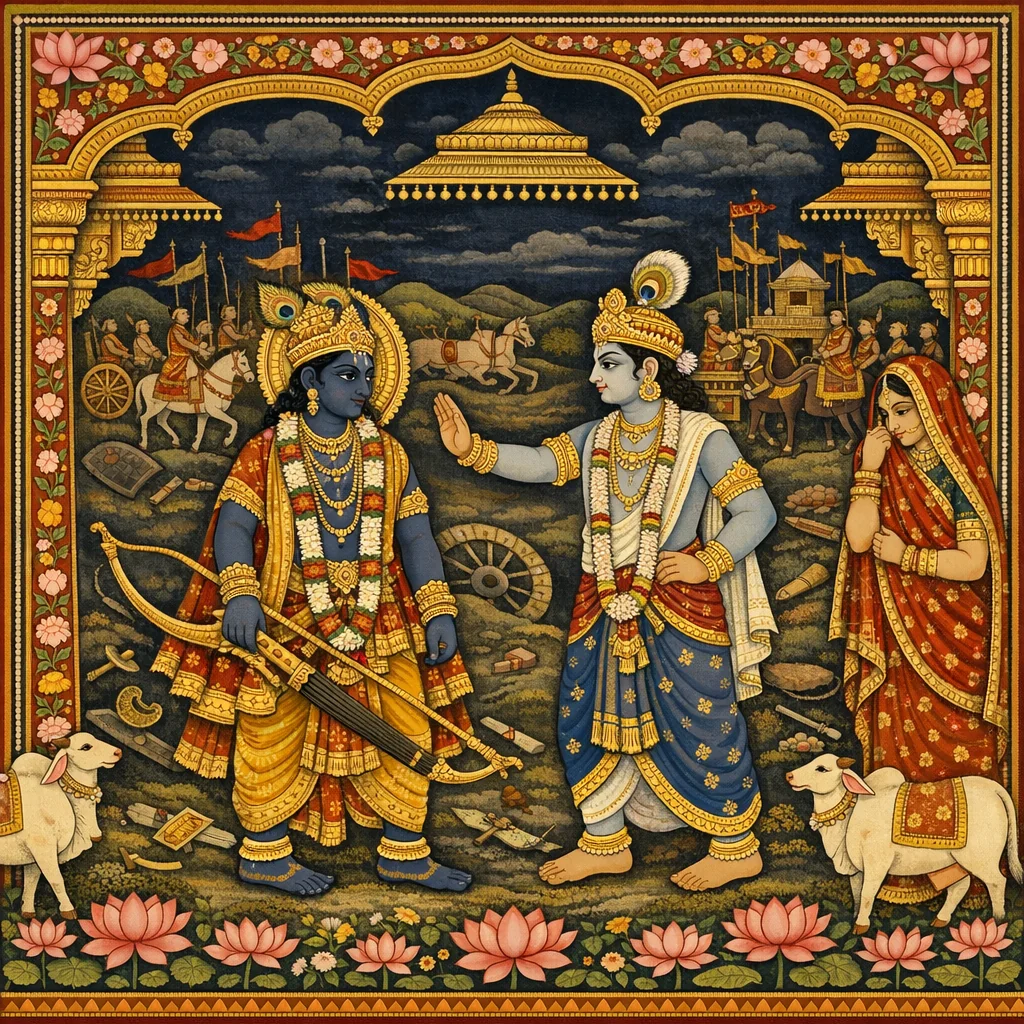
Adhyaya 54
Chapter 54
Marriage of Krishna and Rukmini
Shlokas
Verse 1
श्री-शुक उवाच इति सर्वे सु-संरब्धा वाहान् आरुह्य दंशिताः । स्वैः स्वैर् बलैः परिक्रान्ता अन्वीयुर् धृत-कार्मुकाः ॥
Śrī Śuka said: Hearing this, they all became intensely agitated. Mounting their vehicles and fully armored, they set out—surrounding the way with their respective forces—pursuing with bows held ready.
Verse 2
तान् आपतत आलोक्य यादवान् ईक-यूथपाः । तस्थुस् तत्-सम्मुखा राजन् विस्फूर्ज्य स्व-धनूंषि ते ॥
Seeing them rushing forward, O King, the commanders of the Yadu army stood facing them, twanging their own bows.
Verse 3
अश्वपृष्ठे गजस्कन्धे रथोपस्थेऽस्त्रकोविदाः । मुमुचुः शरवर्षाणि मेघा अद्रिष्वपो यथा ॥
Expert warriors mounted on horses, seated upon elephants, and standing on chariots released torrents of arrows—like clouds pouring down sheets of rain upon the mountains.
Verse 4
पत्युर्बलं शरासारैश्छन्नं वीक्ष्य सुमध्यमाः । सव्रीड्मैक्षत तद्वक्त्रं भयविह्वललोचना ॥
Seeing her husband’s army covered by volleys of arrows, the slender-waisted Rukmiṇī—her eyes trembling with fear—looked toward His face, with shyness mixed into her glance.
Verse 5
प्रहस्य भगवान् आह मा स्म भैर् वाम-लोचने । विनङ्क्ष्यत्य् अधुनैवैतत् तावकैः शात्रवं बलम् ॥
Smiling, the Supreme Lord said, “Do not be afraid, O doe-eyed one. This hostile force will be destroyed at once by your own men.”
Verse 6
तेषां तद्-विक्रमं वीरा गद-सङ्कर्षणादयः । अमृष्यमाणा नाराचैर् जघ्नुर् हय-गजान् रथान् ॥
Unable to tolerate the prowess of those opponents, the heroic warriors—Gada, Saṅkarṣaṇa (Balarāma) and others—struck down with their iron arrows the enemy’s horses, elephants, and chariots.
Verse 7
पेतुः शिरांसि रथिनाम् अश्विनां गजिनां भुवि । स-कुण्डल-किरीटानि सोष्णीषाणि च कोटिशः ॥
Upon the ground fell the heads of chariot-warriors, horsemen, and elephant-riders—by the millions—still adorned with earrings and crowns, and even with their turbans intact.
Verse 8
हस्ताः सासि-गदेṣ्व-आसाः करभा ऊरवो ’ङ्घ्रयः । अश्वाश्वतर-नागोष्ट्र-खर-मर्त्य-शिरांसि च ॥
Arms fell—still gripping swords, clubs, and bows—along with forearms, thighs, and feet. And there also fell the heads of horses, mules, elephants, camels, donkeys, and men.
Verse 9
हन्यमान-बलानीका वृष्णिभिर् जय-काङ्क्षिभिः । राजानो विमुखा जग्मुर् जरासन्ध-पुरःसराः ॥
Their military divisions being cut down by the victory-seeking Vṛṣṇis, the kings turned their backs and fled—led in retreat by Jarāsandha.
Verse 10
शिशुपालं समभ्येत्य हृत-दारम् इवातुरम् । नष्ट-त्विषं गतोत्साहं शुष्यद्-वदनम् अब्रुवन् ॥
Approaching Śiśupāla, who was distressed like a man whose wife has been stolen away, they spoke to him as he stood drained of splendor, bereft of enthusiasm, his face drying in despair.
Verse 11
भो भोः पुरुष-शार्दूल दौर्मनस्यम् इदं त्यज । न प्रियाप्रिययो राजन् निष्ठा देहिषु दृश्यते ॥
O tiger among men, give up this dejection. O King, in embodied beings no lasting steadiness is seen toward what is pleasing or displeasing.
Verse 12
यथा दारु-मयी योषित् नृत्यते कुहकेच्छया । एवम् ईश्वर-तन्त्रोऽयम् ईहते सुख-दुःखयोः ॥
Just as a wooden female doll dances according to the desire of the puppeteer, so this person—controlled by the Supreme Lord—strives amid happiness and distress.
Verse 13
शौरेः सप्तदशाहं वै संयुगानि पराजितः । त्रयोविंशतिभिः सैन्यैर् जिग्ये एकम् अहं परम् ॥
For seventeen days I was repeatedly defeated in battle by Śauri (Śrī Kṛṣṇa). Yet with twenty-three military divisions I conquered him once—only that single time.
Verse 14
तथाप्य् अहं न शोचामि न प्रहृष्यामि कर्हिचित् । कालेन दैवयुक्तेन जानन् विद्रावितं जगत् ॥
Even so, I neither lament nor rejoice at any time, knowing that this world is driven about by Time, joined with destiny (daiva).
Verse 15
अधुनापि वयं सर्वे वीर-यूथप-यूथपाः । पराजिताः फल्गु-तन्त्रैर् यदुभिः कृष्ण-पालितैः ॥
Even now, all of us—leaders of heroic battalions—have been defeated by the Yadus, though their tactics were insignificant, because they are protected by Kṛṣṇa.
Verse 16
रिपवो जिग्युर् अधुना काल आत्मानुसारिणि । तदा वयं विजेष्यामो यदा कालः प्रदक्षिणः ॥
Our enemies have won for now, because time follows its own course. But we shall be victorious when time turns favorable to us.
Verse 17
श्री-शुक उवाच एवं प्रबोधितो मित्रैश् चैद्यो 'गात् सानुगः पुरम् । हत-शेषाः पुनस् ते 'पि ययुः स्वं स्वं पुरं नृपाः ॥
Śrī Śuka said: Thus counseled by his friends, Caidya (Śiśupāla) returned to his city along with his followers. And those kings who had survived the slaughter also went back—each to his own capital.
Verse 18
रुक्मी तु राक्षसोद्वाहं कृष्ण-द्विड् असहन् स्वसुः । पृष्ठतो 'न्वगमत् कृष्णम् अक्षौहिण्या वृतो बली ॥
But Rukmī, unable to tolerate that his sister’s marriage had become a rākṣasa-style abduction, and being hostile to Kṛṣṇa, pursued Kṛṣṇa from behind—powerful and surrounded by an akṣauhiṇī military division.
Verse 19
रुक्म्य् अमर्षी सु-संरब्धः शृण्वतां सर्व-भूभुजाम् । प्रतिजज्ञे महा-बाहुर् दंशितः स-शरासनः ॥
Rukmī, burning with intolerance and fiercely enraged, in the hearing of all the assembled kings, made a vow. That mighty-armed warrior, having girded himself for battle and taking up his bow with arrows, proclaimed his resolve.
Verse 20
अहत्वा समरे कृष्णम् अप्रत्यूह्य च रुक्मिणीम् । कुण्डिनं न प्रवेक्ष्यामि सत्यम् एतद् ब्रवीमि वः ॥
“Unless I kill Kṛṣṇa in battle and also recover Rukmiṇī, I will not enter Kuṇḍina again. This I speak to you as the truth.”
Verse 21
इत्युक्त्वा रथम आरुह्य सारथिं प्राह सत्वरः । चोदयाश्वान् यतः कृष्णः तस्य मे संयुगं भवेत् ॥
Having spoken thus, he mounted his chariot and, in great haste, addressed his charioteer: “Drive the horses to where Kṛṣṇa is, so that I may meet Him in battle.”
Verse 22
अद्याहं निशितैर् बाणैर् गोपालस्य सु-दुर्मतेः । नेष्ये वीर्य-मदं येन स्वसा मे प्रसभं हृता ॥
“Today, with my razor-sharp arrows, I shall bring down the intoxication of valor of that wicked-minded cowherd—he who has forcibly taken away my sister.”
Verse 23
विकत्थमानः कुमतिर् ईश्वरस्याप्रमाण-वित् । रथेनैकेन गोविन्दं तिष्ठ तिष्ठेत्य अथाह्वयत् ॥
Boasting arrogantly, that misguided man—ignorant of the immeasurable power of the Supreme Lord—challenged Govinda from his lone chariot, calling out, “Stand! Stand!”
Verse 24
धनुर् विकृष्य सु-दृढं जघ्ने कृष्णं त्रिभिः शरैः । आह चात्र क्षणं तिष्ठ यादूनां कुल-पांसन ॥
Drawing his bow back powerfully, he struck Kṛṣṇa with three arrows. Then he said, “Stay here for a moment, you disgrace to the Yadu dynasty!”
Verse 25
यत्र यासि स्वसारं मे मुषित्वा ध्वाङ्क्ष-वद् धविः । हरिष्ये 'द्य मदं मन्द मायिनः कूट-योधिनः ॥
Where do you think you are going after stealing my sister, like a crow snatching the sacrificial offering? Today, O dull one, I will surely strip away your pride—you deceitful magician, you fighter who wages a crooked war!
Verse 26
यावन् न मे हतो बाणैः शयीथा मुञ्च दारीकाम् । स्मयन् कृष्णो धनुश् छित्त्वा षड्भिर् विव्याध रुक्मिणम् ॥
“Before you fall by my arrows, lie down—release the maiden!” Thus he shouted. But smiling, Kṛṣṇa cut his bow and then pierced Rukmī with six arrows.
Verse 27
अष्टभिश्चतुरो वाहान् द्वाभ्यां सूतं ध्वजं त्रिभिः । स चान्यद्धनुराधाय कृष्णं विव्याध पञ्चभिः ॥
With eight arrows he struck down four of Kṛṣṇa’s horses; with two he wounded the charioteer; with three he cut the flag. Then, taking up another bow, he pierced Kṛṣṇa with five arrows.
Verse 28
तैस्ताडितः शरौघैस्तु चिच्छेद धनुरच्युतः । पुनरन्यदुपादत्त तदप्यच्छिनदव्ययः ॥
Struck by that shower of arrows, Acyuta cut his opponent’s bow. The other at once seized another bow, but the infallible Lord severed that one as well.
Verse 29
परिघं पट्टिशं शूलं चर्मासी शक्तितोमरौ । यद् यद् आयुधम् आदत्त तत् सर्वं सोऽच्छिनद्धरिः ॥
He seized a club, a battle-axe, a trident, a shield and sword, and also a spear and javelin. Yet whatever weapon he took up, Hari cut it down—every one of them.
Verse 30
ततो रथादवप्लुत्य खड्गपाणिर्जिघांसया । कृष्णमभ्यद्रवत्क्रुद्धः पतङ्ग इव पावकम् ॥
Then, leaping down from his chariot, sword in hand and intent on killing, he rushed at Krishna in fury—like a moth flying into a blazing fire.
Verse 31
तस्य चापततः खड्गं तिलशश् चर्म चेषुभिः । छित्त्वासिम् आददे तिग्मं रुक्मिणं हन्तुम् उद्यतः ॥
As Rukmī rushed forward, Kṛṣṇa shattered his sword into pieces and pierced his shield with arrows. Then Kṛṣṇa seized His own razor-sharp sword, ready to strike Rukmī down.
Verse 32
दृष्ट्वा भ्रातृ-वधोद्योगं रुक्मिणी भय-विह्वला । पतित्वा पादयोर्भर्तुर् उवाच करुणं सती ॥
Seeing that her husband was about to kill her brother, saintly Rukmiṇī became overwhelmed with fear. Falling at her husband’s feet, she spoke to Him with heartfelt compassion.
Verse 33
श्री-रुक्मिण्य् उवाच योगेश्वराप्रमेयात्मन् देव-देव जगत्-पते । हन्तुं नार्हसि कल्याण भ्रातरं मे महा-भुज ॥
Śrī Rukmiṇī said: O Lord of all mystic power, O immeasurable Self, O God of gods, O Master of the universe—O auspicious one with mighty arms, please do not kill my brother.
Verse 34
श्री-शुक उवाच तया परित्रास-विकम्पिताङ्गया शुचावशुष्यन्-मुख-रुद्ध-कण्ठया । कातर्य-विस्रंसित-हेम-मालयाः गृहीत-पादः करुणो न्यवर्तत ॥
Śrī Śuka said: As she spoke—her limbs trembling with fear, her face drying from grief and her throat choked—her golden garland slipping in distress—she seized His feet, and the compassionate Lord desisted.
Verse 35
चैलेन बद्ध्वा तमसाधु-कारीणं स-श्मश्रु-केशं प्रवपन व्यरूपयत् । तावन्ममर्दुः पर-सैन्यमद्भुतं यदु-प्रवीरा नलिनीं यथा गजाः ॥
Binding that evildoer with a cloth, He shaved off his moustache and hair and thus disfigured him. Meanwhile the foremost heroes of the Yadus astonishingly crushed the enemy army, just as elephants trample a lotus-filled lake.
Verse 36
कृष्णान्तिकमुपव्रज्य ददृशुस्तत्र रुक्मिणम् । तथा-भूतं हत-प्रायं दृष्ट्वा सङ्कर्षणो विभुः । विमुच्य बद्धं करुणो भगवान्कृष्णमब्रवीत् ॥
Approaching Kṛṣṇa, they saw Rukmī there in that condition—nearly dead. Seeing him so, the powerful Saṅkarṣaṇa, the compassionate Lord, released the bound man and then spoke to Kṛṣṇa.
Verse 37
असाध्विदं त्वया कृष्ण कृतमस्मज्जुगुप्सितम् । वपनं श्मश्रुकेशानां वैरूप्यं सुहृदो वधः ॥
O Kṛṣṇa, what You have done is not proper and is disgraceful for us. To shave off a man’s beard and hair, to disfigure him—this is like killing a friend.
Verse 38
मैवास्मान् साध्व्यसूयेथा भ्रातुर्वैरूप्यचिन्तया । सुखदुःखदो न चान्योऽस्ति यतः स्वकृतभुक् पुमान् ॥
O virtuous lady, do not be angry with Us because you are thinking of your brother’s disfigurement. No one else is the giver of happiness and distress, for a person simply reaps the results of his own actions.
Verse 39
बन्धुर् वधार्ह-दोषो ’पि न बन्धोर् वधम् अर्हति । त्याज्यः स्वेनैव दोषेण हतः किं हन्यते पुनः ॥
Even if a relative has committed an offense worthy of death, a kinsman should not be executed by his own family. Let him be rejected—his own wrongdoing has already struck him down; why should he be killed again?
Verse 40
क्षत्रियाणाम् अयं धर्मः प्रजापति-विनिर्मितः । भ्रातापि भ्रातरं हन्याद् येन घोरतमस् ततः ॥
This is the dharma of kṣatriyas, established by the Prajāpatis: even a brother may kill a brother—therefore, from that arises the most dreadful consequence.
Verse 41
राज्यस्य भूमेर् वित्तस्य स्त्रियो मानस्यम् तेजसः । मानिनो 'न्यस्य वा हेतोः श्री-मदान्धाः क्षिपन्ति हि ॥
Blinded by the intoxication of opulence, proud men will indeed hurl insults—whether over a kingdom, land, wealth, women, the mind’s prestige, personal prowess, or for some other cause.
Verse 42
तवेयं विषमा बुद्धिः सर्व-भूतेषु दुर्हृदाम् । यन् मन्यसे सदाभद्रं सुहृदां भद्रम् अज्ञ-वत् ॥
Your intelligence is perverse: you see enemies in all beings. Like an ignorant man, you consider the well-wishing friends to be always inauspicious, and you take what is truly harmful to be good.
Verse 43
आत्ममोहो नृणामेव कल्पते देवमायया । सुहृद्दुहृदुदासीन इति देहात्ममानिनाम् ॥
By the Lord’s divine illusory potency, self-delusion arises in human beings—especially in those who identify the self with the body—by which they see others as ‘friend,’ ‘enemy,’ or ‘indifferent.’
Verse 44
एक एव परो ह्यात्मा सर्वेषामपि देहिनाम् । नानेव गृह्यते मूढैर्यथा ज्योतिर्यथा नभः ॥
The Supreme Self is one alone, present within all embodied beings; yet the foolish perceive Him as many—just as light or the sky is (in truth) one though it appears divided.
Verse 45
देह आद्य-अन्तवान् एष द्रव्य-प्राण-गुणात्मकः । आत्मन्य् अविद्यया कॢप्तः संसारयति देहिनम् ॥
This body has a beginning and an end. It is constituted of material elements, the life-air, and the modes of nature. Fabricated upon the self by ignorance, it drives the embodied being to wander in repeated birth and death.
Verse 46
नात्मनो ऽन्येन संयोगो वियोगश् चासतस् सति । तद्-हेतुत्वात् तत्-प्रसिद्धेर् दृग्-रूपाभ्यां यथा रवेः ॥
In truth, the self has no real union with anything else, nor any separation, for such relations pertain only to what is unreal. Because that (false identification) is the cause and is well-known, it is like the relation between the seer and the seen—like the eye and a form, or like the sun and what it illuminates.
Verse 47
जन्मादयस् तु देहस्य विक्रिया नात्मनः क्वचित् । कलानाम् इव नैवेन्दोर् मृतिर् ह्य् अस्य कुहूर् इव ॥
Birth and the other transformations belong only to the body; they never truly occur for the Self. The moon does not actually perish when its phases wane—so too the soul’s ‘death’ is only an appearance, like the moon’s dark night.
Verse 48
यथा शयान आत्मानं विषयान् फलम् एव च । अनुभुङ्क्ते ऽप्य् असत्य् अर्थे तथाप्नोत्य् अबुधो भवम् ॥
Just as a person lying asleep experiences himself, sense objects, and their results—even though the ‘things’ are unreal—so an ignorant person attains repeated worldly existence by taking the unreal to be real.
Verse 49
तस्माद् अज्ञानजं शोकम् आत्मशोषविमोहनम् । तत्त्वज्ञानेन निर्हृत्य स्वस्था भव शुचिस्मिते ॥
Therefore, cast off this grief born of ignorance—this delusion that dries up the self. Remove it by true knowledge of reality, and become steady within yourself, O you whose smile is so pure and gentle.
Verse 50
श्रीशुक उवाच एवं भगवता तन्वी रामेण प्रतिबोधिताः । वैमनस्यं परित्यज्य मनो बुद्ध्या समादधे ॥
Śrī Śuka said: Thus instructed by the Lord, the slender princess—roused to clarity by Rāma—gave up her dejection and, with her intelligence, brought her mind back to composure.
Verse 51
प्राणावशेष उत्सृष्टो द्विड्भिर् हत-बल-प्रभः । स्मरन् विरूप-करणं वितथात्म-मनोरथः । चक्रे भोजकटं नाम निवासाय महत् पुरम् ॥
Left with only his life-breath, cast off by his enemies and stripped of his strength and splendor, he remembered how he had been disfigured. His hopes now shattered, he built for his residence a great city called Bhojakaṭa.
Verse 52
अहत्वा दुर्मतिं कृष्णम् अप्रत्यूह्य यवीयसीम् । कुण्डिनं न प्रवेक्ष्यामीत्य् उक्त्वा तत्रावसद् रुषा ॥
“Unless I kill that wicked-minded Kṛṣṇa and bring back my younger sister, I will not enter Kuṇḍina!” Saying this, he remained there, burning with anger.
Verse 53
भगवान् भीष्मक-सुताम् एवं निर्जित्य भूमि-पान् । पुरम् आनीय विधि-वद् उपयेमे कुरूद्वह ॥
O best of the Kurus, having thus vanquished the kings of the earth, the Supreme Lord brought Bhīṣmaka’s daughter to His city and, in full accordance with sacred rites, accepted her as His wife.
Verse 54
तदा महोत्सवो नॄणां यदु-पुर्यां गृहे गृहे । अभूद् अनन्य-भावानां कृष्णे यदु-पतौ नृप ॥
O King, at that time there was a great festival throughout the Yadu city, in each and every home, for those whose hearts were exclusively devoted to Kṛṣṇa, the Lord of the Yadus.
Verse 55
नराः नार्यश् च मुदिताः प्रमृष्ट-मणि-कुण्डलाः । पारिबर्हम् उपाजह्रुर् वरयोश् चित्र-वाससोः ॥
Joyful men and women—having cleansed and polished their jeweled earrings—brought forth wedding gifts and auspicious presentations for the beautifully dressed bride and bridegroom.
Verse 56
सा वृष्णि-पुरी उत्तम्भितेन्द्र-केतुभिः विचित्र-माल्याम्बर-रत्न-तोरणैः । बभौ प्रति-द्वार्य् उपकॢप्त-मङ्गलैर् आपूर्ण-कुम्भागरु-धूप-दीपकैः ॥
That city of the Vṛṣṇis shone brilliantly—its victory banners raised high like Indra’s standards, adorned with variegated garlands, fine cloth, and jeweled archways; and at every doorway were arranged auspicious articles: full water pots, fragrant aguru incense, and lamps.
Verse 57
सिक्तमार्गा मदच्युद्भिर् आहूतप्रेष्ठभूभुजाम् । गजैर् द्वाःसु परामृष्ट-रम्भापूगोपशोभिता ॥
The roads were sprinkled with the flowing ichor of elephants belonging to the beloved kings who had been invited. At the gateways stood elephants, and the city was beautified with plantain trees and areca-nut palms arranged as festive decorations.
Verse 58
कुरुसृञ्जयकैकेय-विदर्भयदुकुन्तयः । मिथो मुमुदिरे तस्मिन् सम्भ्रमात् परिधावताम् ॥
The Kurus, Sṛñjayas, Kaikeyas, Vidarbhas, Yadus, and Kuntis—rushing about in excited commotion—rejoiced together as they met one another there.
Verse 59
रुक्मिण्याः हरणं श्रुत्वा गीयमानं ततस् ततः । राजानो राजकन्याश् च बभूवुर् भृशविस्मिताः ॥
Hearing again and again the songs being sung everywhere about Rukmiṇī’s abduction, both the kings and the princesses became utterly astonished.
Verse 60
द्वारकायाम् अभूद् राजन् महामोदः पुरौकसाम् । रुक्मिण्या रमयोपेतं दृष्ट्वा कृष्णं श्रियः पतिम् ॥
O King, in Dvārakā the residents were filled with great jubilation when they saw Kṛṣṇa—the Lord of fortune—arrive accompanied by Rukmiṇī, who is like the goddess Ramā herself.