Adhyaya 63
Kṛṣṇa Defeats Bāṇāsura and Receives Śiva’s Prayers (The Śoṇitapura Battle and the Jvara Episode)
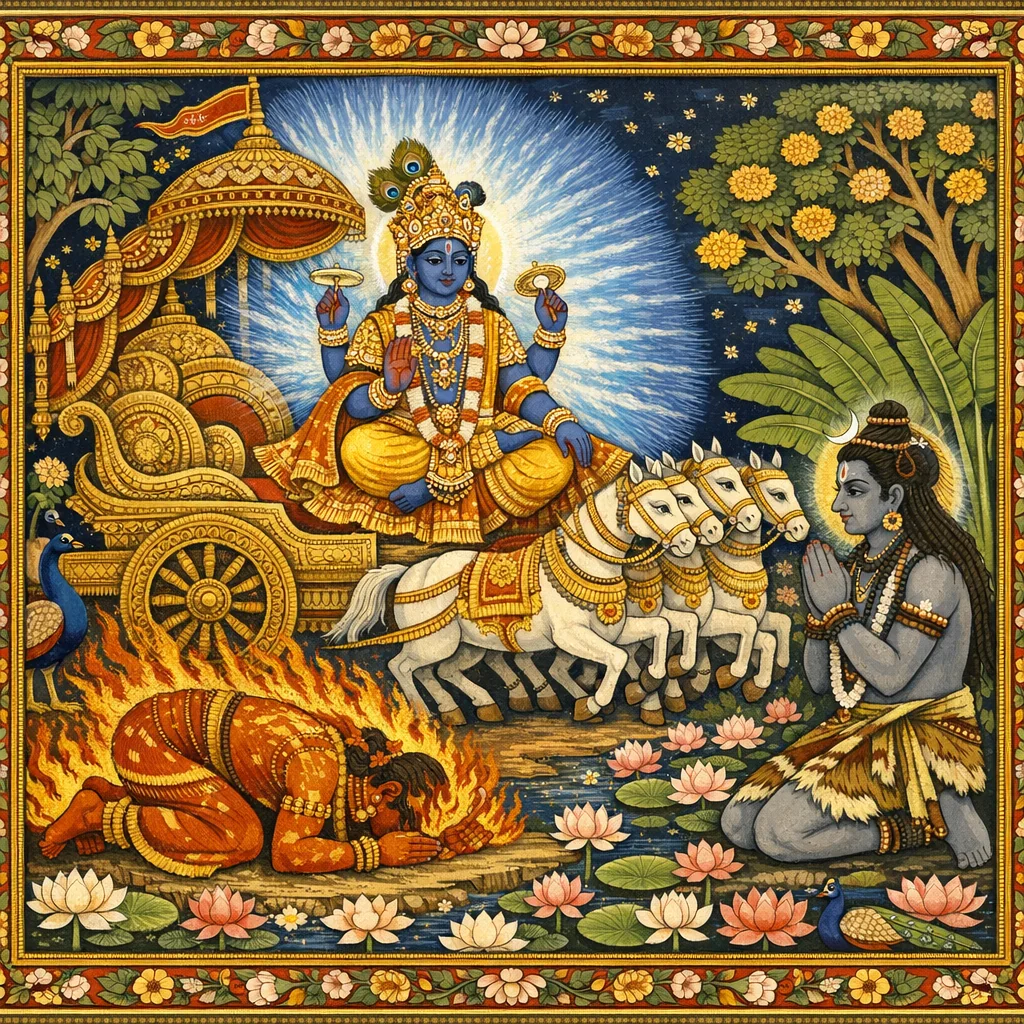
As the rainy season passes, Aniruddha’s relatives grieve at his absence. Nārada informs the Vṛṣṇis of Aniruddha’s valor and capture, prompting Kṛṣṇa, Balarāma, and the Sātvata leaders to march with a vast army and besiege Śoṇitapura, Bāṇāsura’s capital. A multi-front battle erupts: Kṛṣṇa confronts Śiva (Śaṅkara), Pradyumna engages Kārtikeya, and Balarāma and other Yādavas rout demonic commanders. Kṛṣṇa repels Śiva’s hosts and neutralizes divine missiles with precise counter-weapons, illustrating sovereign mastery over astras. Bāṇa’s mother Koṭarā distracts Kṛṣṇa, allowing Bāṇa to retreat, after which the personified Śiva-jvara attacks. Kṛṣṇa releases the Viṣṇu-jvara; defeated, the Śiva-jvara surrenders and is granted fearlessness for those who remember this exchange. Bāṇa returns with a thousand arms; Kṛṣṇa severs them with the cakra. Śiva, compassionate to his devotee, offers profound prayers describing Kṛṣṇa as the Absolute and cosmic Puruṣa; Kṛṣṇa spares Bāṇa due to His vow to Prahlāda’s descendants, leaving him four arms and immortality as Śiva’s attendant. Aniruddha and his bride are restored and escorted home in triumph. The chapter transitions from siege warfare to theological reconciliation, setting up the celebratory return to Dvārakā and the devotional fruit of remembrance described at the end.
Shlokas
Verse 1
श्रीशुक उवाच अपश्यतां चानिरुद्धं तद्बन्धूनां च भारत । चत्वारो वार्षिका मासा व्यतीयुरनुशोचताम् ॥ १ ॥
Śukadeva Gosvāmī said: O descendant of Bharata, the relatives of Aniruddha, not seeing Him return, continued to lament as the four rainy months passed.
Verse 2
नारदात्तदुपाकर्ण्य वार्तां बद्धस्य कर्म च । प्रययु: शोणितपुरं वृष्णय: कृष्णदैवता: ॥ २ ॥
After hearing from Nārada the news of Aniruddha’s deeds and His capture, the Vṛṣṇis, who worshiped Lord Kṛṣṇa as their personal Deity, went to Śoṇitapura.
Verse 3
प्रद्युम्नो युयुधानश्च गद: साम्बोऽथ सारण: । नन्दोपनन्दभद्राद्या रामकृष्णानुवर्तिन: ॥ ३ ॥ अक्षौहिणीभिर्द्वादशभि: समेता: सर्वतोदिशम् । रुरुधुर्बाणनगरं समन्तात् सात्वतर्षभा: ॥ ४ ॥
With Lord Balarāma and Lord Kṛṣṇa in the lead, the chiefs of the Sātvata clan — Pradyumna, Sātyaki, Gada, Sāmba, Sāraṇa, Nanda, Upananda, Bhadra and others — converged with an army of twelve divisions and laid siege to Bāṇasura’s capital, completely surrounding the city on all sides.
Verse 4
प्रद्युम्नो युयुधानश्च गद: साम्बोऽथ सारण: । नन्दोपनन्दभद्राद्या रामकृष्णानुवर्तिन: ॥ ३ ॥ अक्षौहिणीभिर्द्वादशभि: समेता: सर्वतोदिशम् । रुरुधुर्बाणनगरं समन्तात् सात्वतर्षभा: ॥ ४ ॥
With Lord Balarāma and Lord Kṛṣṇa in the lead, the chiefs of the Sātvata clan — Pradyumna, Sātyaki, Gada, Sāmba, Sāraṇa, Nanda, Upananda, Bhadra and others — converged with an army of twelve divisions and laid siege to Bāṇasura’s capital, completely surrounding the city on all sides.
Verse 5
भज्यमानपुरोद्यानप्राकाराट्टालगोपुरम् । प्रेक्षमाणो रुषाविष्टस्तुल्यसैन्योऽभिनिर्ययौ ॥ ५ ॥
Bāṇāsura became filled with anger upon seeing them destroy his city’s suburban gardens, ramparts, watchtowers and gateways, and thus he went out to confront them with an army of equal size.
Verse 6
बाणार्थे भगवान् रुद्र: ससुत: प्रमथैर्वृत: । आरुह्य नन्दिवृषभं युयुधे रामकृष्णयो: ॥ ६ ॥
Lord Rudra, accompanied by his son Kārtikeya and the Pramathas, came riding on Nandi, his bull carrier, to fight Balarāma and Kṛṣṇa on Bāṇa’s behalf.
Verse 7
आसीत्सुतुमुलं युद्धमद्भुतं रोमहर्षणम् । कृष्णशङ्करयो राजन् प्रद्युम्नगुहयोरपि ॥ ७ ॥
A most astonishing, tumultuous and hair-raising battle then commenced, with Lord Kṛṣṇa matched against Lord Śaṅkara, and Pradyumna against Kārtikeya.
Verse 8
कुम्भाण्डकूपकर्णाभ्यां बलेन सह संयुग: । साम्बस्य बाणपुत्रेण बाणेन सह सात्यके: ॥ ८ ॥
Lord Balarāma fought with Kumbhāṇḍa and Kūpakarṇa, Sāmba with Bāṇa’s son, and Sātyaki with Bāṇa.
Verse 9
ब्रह्मादय: सुराधीशा मुनय: सिद्धचारणा: । गन्धर्वाप्सरसो यक्षा विमानैर्द्रष्टुमागमन् ॥ ९ ॥
Brahmā and the other ruling demigods, along with Siddhas, Cāraṇas and great sages, as well as Gandharvas, Apsarās and Yakṣas, all came in their celestial airplanes to watch.
Verse 10
शङ्करानुचरान् शौरिर्भूतप्रमथगुह्यकान् । डाकिनीर्यातुधानांश्च वेतालान् सविनायकान् ॥ १० ॥ प्रेतमातृपिशाचांश्च कुष्माण्डान् ब्रह्मराक्षसान् । द्रावयामास तीक्ष्णाग्रै: शरै: शार्ङ्गधनुश्च्युतै: ॥ ११ ॥
With sharp-pointed arrows discharged from His bow Śārṅga, Lord Kṛṣṇa drove away the various followers of Lord Śiva — Bhūtas, Pramathas, Guhyakas, Ḍākinīs, Yātudhānas, Vetālas, Vināyakas, Pretas, Mātās, Piśācas, Kuṣmāṇḍas and Brahma-rākṣasas.
Verse 11
शङ्करानुचरान् शौरिर्भूतप्रमथगुह्यकान् । डाकिनीर्यातुधानांश्च वेतालान् सविनायकान् ॥ १० ॥ प्रेतमातृपिशाचांश्च कुष्माण्डान् ब्रह्मराक्षसान् । द्रावयामास तीक्ष्णाग्रै: शरै: शार्ङ्गधनुश्च्युतै: ॥ ११ ॥
With sharp-pointed arrows discharged from His bow Śārṅga, Lord Kṛṣṇa drove away the various followers of Lord Śiva — Bhūtas, Pramathas, Guhyakas, Ḍākinīs, Yātudhānas, Vetālas, Vināyakas, Pretas, Mātās, Piśācas, Kuṣmāṇḍas and Brahma-rākṣasas.
Verse 12
पृथग्विधानि प्रायुङ्क्त पिणाक्यस्त्राणि शार्ङ्गिणे । प्रत्यस्त्रै: शमयामास शार्ङ्गपाणिरविस्मित: ॥ १२ ॥
Lord Śiva, wielder of the trident, shot various weapons at Lord Kṛṣṇa, wielder of Śārṅga. But Lord Kṛṣṇa was not in the least perplexed: He neutralized all these weapons with appropriate counterweapons.
Verse 13
ब्रह्मास्त्रस्य च ब्रह्मास्त्रं वायव्यस्य च पार्वतम् । आग्नेयस्य च पार्जन्यं नैजं पाशुपतस्य च ॥ १३ ॥
Lord Kṛṣṇa counteracted a brahmāstra with another brahmāstra, a wind weapon with a mountain weapon, a fire weapon with a rain weapon, and Lord Śiva’s personal pāśupatāstra weapon with His own personal weapon, the nārāyaṇāstra.
Verse 14
मोहयित्वा तु गिरिशं जृम्भणास्त्रेण जृम्भितम् । बाणस्य पृतनां शौरिर्जघानासिगदेषुभि: ॥ १४ ॥
After bewildering Lord Śiva by making him yawn with a yawning weapon, Lord Kṛṣṇa proceeded to strike down Bāṇāsura’s army with His sword, club and arrows.
Verse 15
स्कन्द: प्रद्युम्नबाणौघैरर्द्यमान: समन्तत: । असृग् विमुञ्चन् गात्रेभ्य: शिखिनापक्रमद् रणात् ॥ १५ ॥
Lord Kārtikeya was distressed by the flood of Pradyumna’s arrows raining down from all sides, and thus he fled the battlefield on his peacock as blood poured from his limbs.
Verse 16
कुम्भाण्डकूपकर्णश्च पेततुर्मुषलार्दितौ । दुद्रुवुस्तदनीकानि हतनाथानि सर्वत: ॥ १६ ॥
Kumbhāṇḍa and Kūpakarṇa, tormented by Lord Balarāma’s club, fell down dead. When the soldiers of these two demons saw that their leaders had been killed, they scattered in all directions.
Verse 17
विशीर्यमाणं स्वबलं दृष्ट्वा बाणोऽत्यमर्षित: । कृष्णमभ्यद्रवत् सङ्ख्ये रथी हित्वैव सात्यकिम् ॥ १७ ॥
Bāṇāsura was furious to see his entire military force being torn apart. Leaving his fight with Sātyaki, he charged across the battlefield on his chariot and attacked Lord Kṛṣṇa.
Verse 18
धनूंष्याकृष्य युगपद् बाण: पञ्चशतानि वै । एकैकस्मिन् शरौ द्वौ द्वौ सन्दधे रणदुर्मद: ॥ १८ ॥
Excited to a frenzy by the fighting, Bāṇa simultaneously pulled taut all the strings of his five hundred bows and fixed two arrows on each string.
Verse 19
तानि चिच्छेद भगवान् धनूंषि युगपद्धरि: । सारथिं रथमश्वांश्च हत्वा शङ्खमपूरयत् ॥ १९ ॥
Lord Śrī Hari split every one of Bāṇāsura’s bows simultaneously, and also struck down his chariot driver, chariot and horses. The Lord then sounded His conchshell.
Verse 20
तन्माता कोटरा नाम नग्ना मक्तशिरोरुहा । पुरोऽवतस्थे कृष्णस्य पुत्रप्राणरिरक्षया ॥ २० ॥
Just then Bāṇāsura’s mother, Koṭarā, desiring to save her son’s life, appeared before Lord Kṛṣṇa naked and with her hair undone.
Verse 21
ततस्तिर्यङ्मुखो नग्नामनिरीक्षन् गदाग्रज: । बाणश्च तावद् विरथश्छिन्नधन्वाविशत् पुरम् ॥ २१ ॥
Lord Gadāgraja turned His face away to avoid seeing the naked woman, and Bāṇāsura — deprived of his chariot, his bow shattered — took the opportunity to flee into his city.
Verse 22
विद्राविते भूतगणे ज्वरस्तु त्रिशिरास्त्रीपात् । अभ्यधावत दाशार्हं दहन्निव दिशो दश ॥ २२ ॥
After Lord Śiva’s followers had been driven away, the Śiva-jvara, who had three heads and three feet, pressed forward to attack Lord Kṛṣṇa. As the Śiva-jvara approached, he seemed to burn everything in the ten directions.
Verse 23
अथ नारायण: देव: तं दृष्ट्वा व्यसृजज्ज्वरम् । माहेश्वरो वैष्णवश्च युयुधाते ज्वरावुभौ ॥ २३ ॥
Seeing this personified weapon approach, Lord Nārāyaṇa then released His own personified fever weapon, the Viṣṇu-jvara. The Śiva-jvara and Viṣṇu-jvara thus battled each other.
Verse 24
माहेश्वर: समाक्रन्दन् वैष्णवेन बलार्दित: । अलब्ध्वाभयमन्यत्र भीतो माहेश्वरो ज्वर: । शरणार्थी हृषीकेशं तुष्टाव प्रयताञ्जलि: ॥ २४ ॥
The Śiva-jvara, overwhelmed by the strength of the Viṣṇu-jvara, cried out in pain. But finding no refuge, the frightened Śiva-jvara approached Lord Kṛṣṇa, the master of the senses, hoping to attain His shelter. Thus with joined palms he began to praise the Lord.
Verse 25
ज्वर उवाच नमामि त्वानन्तशक्तिं परेशं सर्वात्मानं केवलं ज्ञप्तिमात्रम् । विश्वोत्पत्तिस्थानसंरोधहेतुं यत्तद् ब्रह्म ब्रह्मलिङ्गं प्रशान्तम् ॥ २५ ॥
The Śiva-jvara said: I bow down to You of unlimited potencies, the Supreme Lord, the Supersoul of all beings. You possess pure and complete consciousness and are the cause of cosmic creation, maintenance and dissolution. Perfectly peaceful, You are the Absolute Truth to whom the Vedas indirectly refer.
Verse 26
कालो दैवं कर्म जीव: स्वभावो द्रव्यं क्षेत्रं प्राण आत्मा विकार: । तत्सङ्घातो बीजरोहप्रवाह- स्त्वन्मायैषा तन्निषेधं प्रपद्ये ॥ २६ ॥
Time; fate; karma; the jīva and his propensities; the subtle material elements; the material body; the life air; false ego; the various senses; and the totality of these as reflected in the living being’s subtle body — all this constitutes your material illusory energy, māyā, an endless cycle like that of seed and plant. I take shelter of You, the negation of this māyā.
Verse 27
नानाभावैर्लीलयैवोपपन्नै- र्देवान् साधून् लोकसेतून् बिभर्षि । हंस्युन्मार्गान् हिंसया वर्तमानान् जन्मैतत्ते भारहाराय भूमे: ॥ २७ ॥
With various intentions, You perform pastimes to maintain the demigods, the saintly persons and the codes of religion for this world. By these pastimes You also kill those who stray from the right path and live by violence. Indeed, your present incarnation is meant to relieve the earth’s burden.
Verse 28
तप्तोऽहं ते तेजसा दु:सहेन शान्तोग्रेणात्युल्बणेन ज्वरेण । तावत्तापो देहिनां तेऽङ्घ्रिमूलं नो सेवेरन् यावदाशानुबद्धा: ॥ २८ ॥
I am tortured by the fierce power of Your terrible fever weapon, which is cold yet burning. All embodied souls must suffer as long as they remain bound to material ambitions and thus averse to serving Your feet.
Verse 29
श्रीभगवानुवाच त्रिशिरस्ते प्रसन्नोऽस्मि व्येतु ते मज्ज्वराद् भयम् । यो नौ स्मरति संवादं तस्य त्वन्न भवेद् भयम् ॥ २९ ॥
The Supreme Lord said: O three-headed one, I am pleased with you. May your fear of My fever weapon be dispelled, and may whoever remembers our conversation here have no reason to fear you.
Verse 30
इत्युक्तोऽच्युतमानम्य गतो माहेश्वरो ज्वर: । बाणस्तु रथमारूढ: प्रागाद्योत्स्यन् जनार्दनम् ॥ ३० ॥
Thus addressed, the Māheśvara-jvara bowed down to the infallible Lord and went away. But Bāṇāsura then appeared, riding forth on his chariot to fight Lord Kṛṣṇa.
Verse 31
ततो बाहुसहस्रेण नानायुधधरोऽसुर: । मुमोच परमक्रुद्धो बाणांश्चक्रायुधे नृप ॥ ३१ ॥
Carrying numerous weapons in his thousand hands, O King, the terribly infuriated demon shot many arrows at Lord Kṛṣṇa, the carrier of the disc weapon.
Verse 32
तस्यास्यतोऽस्त्राण्यसकृच्चक्रेण क्षुरनेमिना । चिच्छेद भगवान् बाहून् शाखा इव वनस्पते: ॥ ३२ ॥
As Bāṇa continued hurling weapons at Him, the Supreme Lord began using His razor-sharp cakra to cut off Bāṇāsura’s arms as if they were tree branches.
Verse 33
बाहुषु छिद्यमानेषु बाणस्य भगवान् भव: । भक्तानुकम्प्युपव्रज्य चक्रायुधमभाषत ॥ ३३ ॥
Lord Śiva felt compassion for his devotee Bāṇāsura, whose arms were being cut off, and thus he approached Lord Cakrāyudha [Kṛṣṇa] and spoke to Him as follows.
Verse 34
श्रीरुद्र उवाच त्वं हि ब्रह्म परं ज्योतिर्गूढं ब्रह्मणि वाङ्मये । यं पश्यन्त्यमलात्मान आकाशमिव केवलम् ॥ ३४ ॥
Śrī Rudra said: You alone are the Absolute Truth, the supreme light, the mystery hidden within the verbal manifestation of the Absolute. Those whose hearts are spotless can see You, for You are uncontaminated, like the sky.
Verse 35
नाभिर्नभोऽग्निर्मुखमम्बु रेतो द्यौ: शीर्षमाशा: श्रुतिरङ्घ्रिरुर्वी । चन्द्रो मनो यस्य दृगर्क आत्मा अहं समुद्रो जठरं भुजेन्द्र: ॥ ३५ ॥ रोमाणि यस्यौषधयोऽम्बुवाहा: केशा विरिञ्चो धिषणा विसर्ग: । प्रजापतिर्हृदयं यस्य धर्म: स वै भवान् पुरुषो लोककल्प: ॥ ३६ ॥
The sky is Your navel, fire Your face, water Your semen, and heaven Your head. The cardinal directions are Your sense of hearing, herbal plants the hairs on Your body, and water-bearing clouds the hair on Your head. The earth is Your foot, the moon Your mind, and the sun Your vision, while I am Your ego. The ocean is Your abdomen, Indra Your arm, Lord Brahmā Your intelligence, the progenitor of mankind Your genitals, and religion Your heart. You are indeed the original puruṣa, creator of the worlds.
Verse 36
नाभिर्नभोऽग्निर्मुखमम्बु रेतो द्यौ: शीर्षमाशा: श्रुतिरङ्घ्रिरुर्वी । चन्द्रो मनो यस्य दृगर्क आत्मा अहं समुद्रो जठरं भुजेन्द्र: ॥ ३५ ॥ रोमाणि यस्यौषधयोऽम्बुवाहा: केशा विरिञ्चो धिषणा विसर्ग: । प्रजापतिर्हृदयं यस्य धर्म: स वै भवान् पुरुषो लोककल्प: ॥ ३६ ॥
The sky is Your navel, fire Your face, water Your semen, and heaven Your head. The cardinal directions are Your sense of hearing, herbal plants the hairs on Your body, and water-bearing clouds the hair on Your head. The earth is Your foot, the moon Your mind, and the sun Your vision, while I am Your ego. The ocean is Your abdomen, Indra Your arm, Lord Brahmā Your intelligence, the progenitor of mankind Your genitals, and religion Your heart. You are indeed the original puruṣa, creator of the worlds.
Verse 37
तवावतारोऽयमकुण्ठधामन् धर्मस्य गुप्त्यै जगतो हिताय । वयं च सर्वे भवतानुभाविता विभावयामो भुवनानि सप्त ॥ ३७ ॥
Your current descent into the material realm, O Lord of unrestricted power, is meant for upholding the principles of justice and benefiting the entire universe. We demigods, each depending on Your grace and authority, develop the seven planetary systems.
Verse 38
त्वमेक आद्य: पुरुषोऽद्वितीय- स्तुर्य: स्वदृग् धेतुरहेतुरीश: । प्रतीयसेऽथापि यथाविकारं स्वमायया सर्वगुणप्रसिद्ध्यै ॥ ३८ ॥
You are the original person, one without a second, transcendental and self-manifesting. Uncaused, you are the cause of all, and You are the ultimate controller. You are nonetheless perceived in terms of the transformations of matter effected by Your illusory energy — transformations You sanction so that the various material qualities can fully manifest.
Verse 39
यथैव सूर्य: पिहितश्छायया स्वया छायां च रूपाणि च सञ्चकास्ति । एवं गुणेनापिहितो गुणांस्त्व- मात्मप्रदीपो गुणिनश्च भूमन् ॥ ३९ ॥
O almighty one, just as the sun, though hidden by a cloud, illuminates the cloud and all other visible forms as well, so You, although hidden by the material qualities, remain self-luminous and thus reveal all those qualities, along with the living entities who possess them.
Verse 40
यन्मायामोहितधिय: पुत्रदारगृहादिषु । उन्मज्जन्ति निमज्जन्ति प्रसक्ता वृजिनार्णवे ॥ ४० ॥
Their intelligence bewildered by Your māyā, fully attached to children, wife, home and so on, persons immersed in the ocean of material misery sometimes rise to the surface and sometimes sink down.
Verse 41
देवदत्तमिमं लब्ध्वा नृलोकमजितेन्द्रिय: । यो नाद्रियेत त्वत्पादौ स शोच्यो ह्यात्मवञ्चक: ॥ ४१ ॥
One who has attained this human form of life as a gift from God, yet who fails to control his senses and honor Your feet, is surely to be pitied, for he is only cheating himself.
Verse 42
यस्त्वां विसृजते मर्त्य आत्मानं प्रियमीश्वरम् । विपर्ययेन्द्रियार्थार्थं विषमत्त्यमृतं त्यजन् ॥ ४२ ॥
That mortal who rejects You — his true Self, dearmost friend, and Lord — for the sake of sense objects, whose nature is just the opposite, refuses nectar and instead consumes poison.
Verse 43
अहं ब्रह्माथ विबुधा मुनयश्चामलाशया: । सर्वात्मना प्रपन्नास्त्वामात्मानं प्रेष्ठमीश्वरम् ॥ ४३ ॥
I, Lord Brahmā, the other demigods and the pure-minded sages have all surrendered wholeheartedly unto You, our dearmost Self and Lord.
Verse 44
तं त्वा जगत्स्थित्युदयान्तहेतुं समं प्रशान्तं सुहृदात्मदैवम् । अनन्यमेकं जगदात्मकेतं भवापवर्गाय भजाम देवम् ॥ ४४ ॥
Let us worship You, the Supreme Lord, to be freed from material life. You are the maintainer of the universe and the cause of its creation and demise. Equipoised and perfectly at peace, You are the true friend, Self and worshipable Lord. You are one without a second, the shelter of all the worlds and all souls.
Verse 45
अयं ममेष्टो दयितोऽनुवर्ती मयाभयं दत्तममुष्य देव । सम्पाद्यतां तद् भवत: प्रसादो यथा हि ते दैत्यपतौ प्रसाद: ॥ ४५ ॥
This Bāṇāsura is my dear and faithful follower, and I have awarded him freedom from fear. Therefore, my Lord, please grant him Your mercy, just as You showed mercy to Prahlāda, the lord of the demons.
Verse 46
श्रीभगवानुवाच यदात्थ भगवंस्त्वं न: करवाम प्रियं तव । भवतो यद् व्यवसितं तन्मे साध्वनुमोदितम् ॥ ४६ ॥
The Supreme Lord said: My dear lord, for your pleasure We must certainly do what you have requested of Us. I fully agree with your conclusion.
Verse 47
अवध्योऽयं ममाप्येष वैरोचनिसुतोऽसुर: । प्रह्रादाय वरो दत्तो न वध्यो मे तवान्वय: ॥ ४७ ॥
I will not kill this demonic son of Vairocani, for I gave Prahlāda Mahārāja the benediction that I would not kill any of his descendants.
Verse 48
दर्पोपशमनायास्य प्रवृक्णा बाहवो मया । सूदितं च बलं भूरि यच्च भारायितं भुव: ॥ ४८ ॥
It was to subdue Bāṇāsura’s false pride that I severed his arms. And I slew his mighty army because it had become a burden upon the earth.
Verse 49
चत्वारोऽस्य भुजा: शिष्टा भविष्यत्यजरामर: । पार्षदमुख्यो भवतो न कुतश्चिद्भयोऽसुर: ॥ ४९ ॥
This demon, who still has four arms, will be immune to old age and death, and he will serve as one of your principal attendants. Thus he will have nothing to fear on any account.
Verse 50
इति लब्ध्वाभयं कृष्णं प्रणम्य शिरसासुर: । प्राद्युम्निं रथमारोप्य सवध्वो समुपानयत् ॥ ५० ॥
Thus attaining freedom from fear, Bāṇāsura offered obeisances to Lord Kṛṣṇa by touching his head to the ground. Bāṇa then seated Aniruddha and His bride on their chariot and brought them before the Lord.
Verse 51
अक्षौहिण्या परिवृतं सुवास:समलङ्कृतम् । सपत्नीकं पुरस्कृत्य ययौ रुद्रानुमोदित: ॥ ५१ ॥
At the front of the party Lord Kṛṣṇa then placed Aniruddha and His bride, both beautifully adorned with fine clothes and ornaments, and surrounded them with a full military division. Thus Lord Kṛṣṇa took His leave of Lord Śiva and departed.
Verse 52
स्वराजधानीं समलङ्कृतां ध्वजै: सतोरणैरुक्षितमार्गचत्वराम् । विवेश शङ्खानकदुन्दुभिस्वनै- रभ्युद्यत: पौरसुहृद्द्विजातिभि: ॥ ५२ ॥
The Lord then entered His capital. The city was lavishly decorated with flags and victory arches, and its avenues and crossways were all sprinkled with water. As conchshells, ānakas and dundubhi drums resounded, the Lord’s relatives, the brāhmaṇas and the general populace all came forward to greet Him respectfully.
Verse 53
य एवं कृष्णविजयं शङ्करेण च संयुगम् । संस्मरेत् प्रातरुत्थाय न तस्य स्यात् पराजय: ॥ ५३ ॥
Whoever rises early in the morning and remembers Lord Kṛṣṇa’s victory in His battle with Lord Śiva will never experience defeat.
Frequently Asked Questions
They are not metaphysically opposed; the conflict is contextual (līlā) and dharmic. Śiva fights on behalf of his devotee Bāṇāsura, while Kṛṣṇa acts to rescue Aniruddha, subdue demonic pride, and relieve the earth’s burden. The episode culminates in Śiva’s explicit glorification of Kṛṣṇa as the Absolute Truth and cosmic Puruṣa, showing harmony: Śiva is the foremost Vaiṣṇava, and Kṛṣṇa is the supreme shelter.
Kṛṣṇa counters each astra with an appropriate counter-astra (e.g., brahmāstra with brahmāstra; pāśupatāstra with nārāyaṇāstra), demonstrating mastery over all divine energies and the principle that all śakti operates under Bhagavān’s sanction. The narrative teaches that even the most formidable cosmic forces are subordinate to the Supreme Lord’s will.
They are personified fever-weapons (jvara-astra) representing the destructive potency released by Śiva and the counter-potency released by Nārāyaṇa (Kṛṣṇa). Their battle dramatizes theological hierarchy: the Māheśvara-jvara, overwhelmed, takes refuge in Kṛṣṇa and is granted relief and a benediction that remembrance of their dialogue removes fear. It highlights śaraṇāgati as the resolution of existential suffering caused by māyā and material ambition.
Kṛṣṇa spares him for two intertwined reasons given in the text: (1) He had blessed Prahlāda that He would not kill Prahlāda’s descendants, and Bāṇa is of that line; (2) Śiva petitions for mercy upon his faithful devotee. Kṛṣṇa’s action shows that divine justice includes restraint, fidelity to vows, and compassion mediated through devotees.
Narratively, it functions as a battlefield interruption allowing Bāṇa to escape into the city. Theologically, it underscores Kṛṣṇa’s maryādā (propriety): He turns away rather than exploit the moment for violence. The scene contrasts demonic desperation with the Lord’s ethical self-governance, reinforcing that His victory is not merely power but dharmic sovereignty.