Adhyaya 4
Yoga-māyā Appears as Durgā; Kaṁsa’s Repentance and the Demonic Policy of Persecuting Vaiṣṇavas
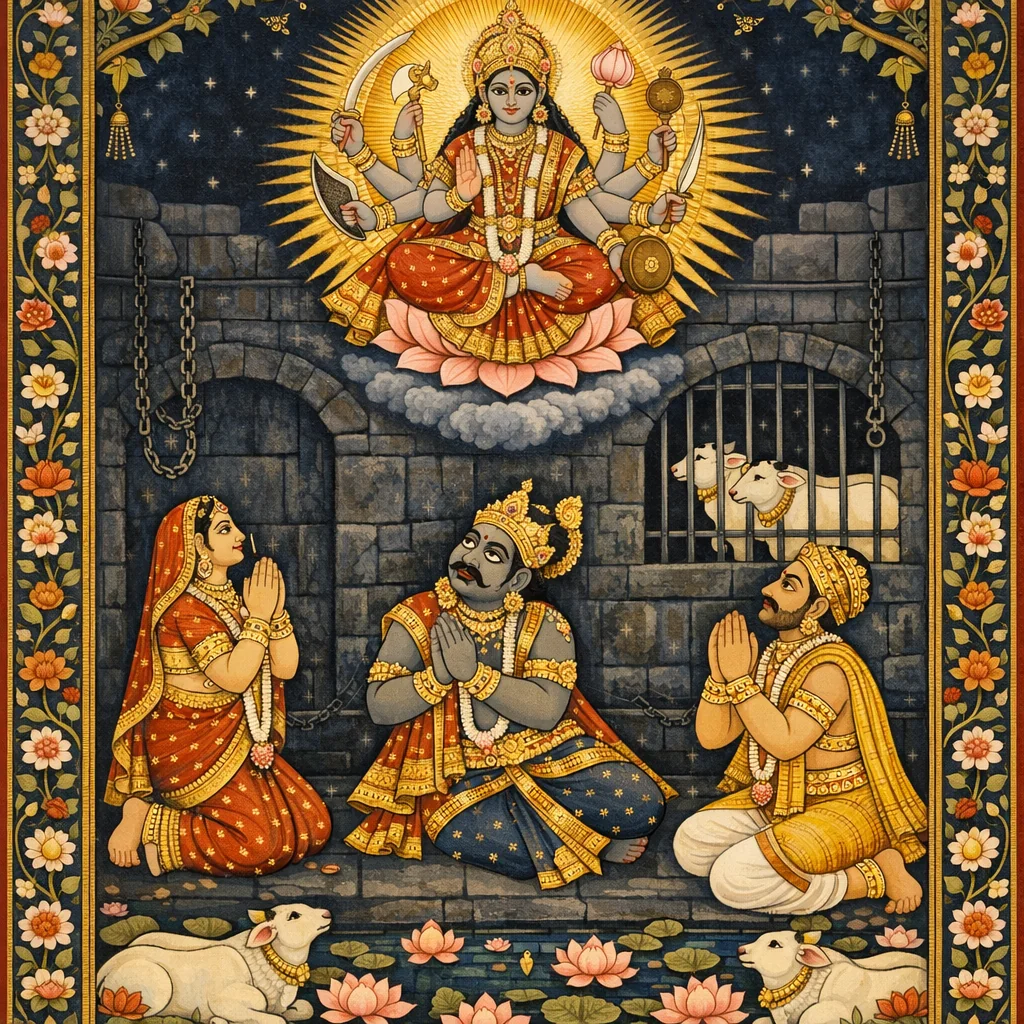
Following the prior night’s divine exchange—Kṛṣṇa being transferred to Gokula and Yoga-māyā brought to Mathurā—the prison-house doors re-close and the guards awaken to the newborn’s cry. They inform Kaṁsa, who rushes in terror, interpreting the birth as Kāla incarnate to end him. Devakī pleads for the infant girl, but Kaṁsa violently seizes her and attempts to kill her. The child slips from his hands and manifests in the sky as eight-armed Devī (Yoga-māyā/Durgā), declaring that Kaṁsa’s slayer has already been born elsewhere and warning him against further infanticide. Shocked, Kaṁsa releases Devakī and Vasudeva, expresses remorse, and speaks impersonal-sounding philosophy about body and soul, karma, and providence; the saintly couple pacify him. Yet the narrative turns: Kaṁsa consults his ministers, whose asuric counsel urges systematic violence—killing infants and, more strategically, uprooting Viṣṇu’s “foundation” by persecuting brāhmaṇas, cows, Vedic sacrifice, austerity, and Vaiṣṇavas. The chapter thus bridges from the failed murder in Mathurā to the escalating persecution that sets the stage for Kṛṣṇa’s protective interventions in Vraja and beyond.
Shlokas
Verse 1
श्रीशुक उवाच बहिरन्त:पुरद्वार: सर्वा: पूर्ववदावृता: । ततो बालध्वनिं श्रुत्वा गृहपाला: समुत्थिता: ॥ १ ॥
Śukadeva Gosvāmī continued: My dear King Parīkṣit, the doors inside and outside the house closed as before. Thereafter, the inhabitants of the house, especially the watchmen, heard the crying of the newborn child and thus awakened from their beds.
Verse 2
ते तु तूर्णमुपव्रज्य देवक्या गर्भजन्म तत् । आचख्युर्भोजराजाय यदुद्विग्न: प्रतीक्षते ॥ २ ॥
Thereafter, all the watchmen very quickly approached King Kaṁsa, the ruler of the Bhoja dynasty, and submitted the news of the birth of Devakī’s child. Kaṁsa, who had awaited this news very anxiously, immediately took action.
Verse 3
स तल्पात् तूर्णमुत्थाय कालोऽयमिति विह्वल: । सूतीगृहमगात् तूर्णं प्रस्खलन् मुक्तमूर्धज: ॥ ३ ॥
Kaṁsa immediately got up from bed, thinking, “Here is Kāla, the supreme time factor, which has taken birth to kill me!” Thus overwhelmed, Kaṁsa, his hair scattered on his head, at once approached the place where the child had been born.
Verse 4
तमाह भ्रातरं देवी कृपणा करुणं सती । स्नुषेयं तव कल्याण स्त्रियं मा हन्तुमर्हसि ॥ ४ ॥
Devakī helplessly, piteously appealed to Kaṁsa: My dear brother, all good fortune unto you. Don’t kill this girl. She will be your daughter-in-law. Indeed, it is unworthy of you to kill a woman.
Verse 5
बहवो हिंसिता भ्रात: शिशव: पावकोपमा: । त्वया दैवनिसृष्टेन पुत्रिकैका प्रदीयताम् ॥ ५ ॥
My dear brother, by the influence of destiny you have already killed many babies, each of them as bright and beautiful as fire. But kindly spare this daughter. Give her to me as your gift.
Verse 6
नन्वहं ते ह्यवरजा दीना हतसुता प्रभो । दातुमर्हसि मन्दाया अङ्गेमां चरमां प्रजाम् ॥ ६ ॥
My lord, my brother, I am very poor, being bereft of all my children, but still I am your younger sister, and therefore it would be worthy of you to give me this last child as a gift.
Verse 7
श्रीशुक उवाच उपगुह्यात्मजामेवं रुदत्या दीनदीनवत् । याचितस्तां विनिर्भर्त्स्य हस्तादाचिच्छिदे खल: ॥ ७ ॥
Śukadeva Gosvāmī continued: Piteously embracing her daughter and crying, Devakī begged Kaṁsa for the child, but he was so cruel that he chastised her and forcibly snatched the child from her hands.
Verse 8
तां गृहीत्वा चरणयोर्जातमात्रां स्वसु: सुताम् । अपोथयच्छिलापृष्ठे स्वार्थोन्मूलितसौहृद: ॥ ८ ॥
Having uprooted all relationships with his sister because of intense selfishness, Kaṁsa, who was sitting on his knees, grasped the newborn child by the legs and tried to dash her against the surface of a stone.
Verse 9
सा तद्धस्तात् समुत्पत्य सद्यो देव्यम्बरं गता । अदृश्यतानुजा विष्णो: सायुधाष्टमहाभुजा ॥ ९ ॥
The child, Yoga-māyā-devī, the younger sister of Lord Viṣṇu, slipped upward from Kaṁsa’s hands and appeared in the sky as Devī, the goddess Durgā, with eight arms, completely equipped with weapons.
Verse 10
दिव्यस्रगम्बरालेपरत्नाभरणभूषिता । धनु:शूलेषुचर्मासिशङ्खचक्रगदाधरा ॥ १० ॥ सिद्धचारणगन्धर्वैरप्सर:किन्नरोरगै: । उपाहृतोरुबलिभि: स्तूयमानेदमब्रवीत् ॥ ११ ॥
The goddess Durgā was decorated with flower garlands, smeared with sandalwood pulp and dressed with excellent garments and ornaments made of valuable jewels. Holding in her hands a bow, a trident, arrows, a shield, a sword, a conchshell, a disc and a club, and being praised by celestial beings like Apsarās, Kinnaras, Uragas, Siddhas, Cāraṇas and Gandharvas, who worshiped her with all kinds of presentations, she spoke as follows.
Verse 11
दिव्यस्रगम्बरालेपरत्नाभरणभूषिता । धनु:शूलेषुचर्मासिशङ्खचक्रगदाधरा ॥ १० ॥ सिद्धचारणगन्धर्वैरप्सर:किन्नरोरगै: । उपाहृतोरुबलिभि: स्तूयमानेदमब्रवीत् ॥ ११ ॥
The goddess Durgā was decorated with flower garlands, smeared with sandalwood pulp and dressed with excellent garments and ornaments made of valuable jewels. Holding in her hands a bow, a trident, arrows, a shield, a sword, a conchshell, a disc and a club, and being praised by celestial beings like Apsarās, Kinnaras, Uragas, Siddhas, Cāraṇas and Gandharvas, who worshiped her with all kinds of presentations, she spoke as follows.
Verse 12
किं मया हतया मन्द जात: खलु तवान्तकृत् । यत्र क्व वा पूर्वशत्रुर्मा हिंसी: कृपणान् वृथा ॥ १२ ॥
O Kaṁsa, you fool, what will be the use of killing me? The Supreme Personality of Godhead, who has been your enemy from the very beginning and who will certainly kill you, has already taken His birth somewhere else. Therefore, do not unnecessarily kill other children.
Verse 13
इति प्रभाष्य तं देवी माया भगवती भुवि । बहुनामनिकेतेषु बहुनामा बभूव ह ॥ १३ ॥
After speaking to Kaṁsa in this way, the goddess Durgā, Yoga-māyā, appeared in different places, such as Vārāṇasī, and became celebrated by different names, such as Annapūrṇā, Durgā, Kālī and Bhadrā.
Verse 14
तयाभिहितमाकर्ण्य कंस: परमविस्मित: । देवकीं वसुदेवं च विमुच्य प्रश्रितोऽब्रवीत् ॥ १४ ॥
After hearing the words of the goddess Durgā, Kaṁsa was struck with wonder. Thus he approached his sister Devakī and brother-in-law Vasudeva, released them immediately from their shackles, and very humbly spoke as follows.
Verse 15
अहो भगिन्यहो भाम मया वां बत पाप्मना । पुरुषाद इवापत्यं बहवो हिंसिता: सुता: ॥ १५ ॥
Alas, my sister! Alas, my brother-in-law! I am indeed so sinful that exactly like a man-eater [Rākṣasa] who eats his own child, I have killed so many sons born of you.
Verse 16
स त्वहं त्यक्तकारुण्यस्त्यक्तज्ञातिसुहृत् खल: । कान्लोकान् वै गमिष्यामि ब्रह्महेव मृत: श्वसन् ॥ १६ ॥
Being merciless and cruel, I have forsaken all my relatives and friends. Therefore, like a person who has killed a brāhmaṇa, I do not know to which planet I shall go, either after death or while breathing.
Verse 17
दैवमप्यनृतं वक्ति न मर्त्या एव केवलम् । यद्विश्रम्भादहं पाप: स्वसुर्निहतवाञ्छिशून् ॥ १७ ॥
Alas, not only human beings but sometimes even providence lies. And I am so sinful that I believed the omen of providence and killed so many of my sister’s children.
Verse 18
मा शोचतं महाभागावात्मजान् स्वकृतंभुज: । जान्तवो न सदैकत्र दैवाधीनास्तदासते ॥ १८ ॥
O great souls, your children have suffered their own misfortune. Therefore, please do not lament for them. All living entities are under the control of the Supreme, and they cannot always live together.
Verse 19
भुवि भौमानि भूतानि यथा यान्त्यपयान्ति च । नायमात्मा तथैतेषु विपर्येति यथैव भू: ॥ १९ ॥
In this world, we can see that pots, dolls and other products of the earth appear, break and then disappear, mixing with the earth. Similarly, the bodies of all conditioned living entities are annihilated, but the living entities, like the earth itself, are unchanging and never annihilated [na hanyate hanyamāne śarīre].
Verse 20
यथानेवंविदो भेदो यत आत्मविपर्यय: । देहयोगवियोगौ च संसृतिर्न निवर्तते ॥ २० ॥
One who does not understand the constitutional position of the body and the soul [ātmā] becomes too attached to the bodily concept of life. Consequently, because of attachment to the body and its by-products, he feels affected by union with and separation from his family, society and nation. As long as this continues, one continues his material life. [Otherwise, one is liberated.]
Verse 21
तस्माद् भद्रे स्वतनयान् मया व्यापादितानपि । मानुशोच यत: सर्व: स्वकृतं विन्दतेऽवश: ॥ २१ ॥
My dear sister Devakī, all good fortune unto you. Everyone suffers and enjoys the results of his own work under the control of providence. Therefore, although your sons have unfortunately been killed by me, please do not lament for them.
Verse 22
यावद्धतोऽस्मि हन्तास्मीत्यात्मानं मन्यतेऽस्वदृक् । तावत्तदभिमान्यज्ञो बाध्यबाधकतामियात् ॥ २२ ॥
In the bodily conception of life, one remains in darkness, without self-realization, thinking, “I am being killed” or “I have killed my enemies.” As long as a foolish person thus considers the self to be the killer or the killed, he continues to be responsible for material obligations, and consequently he suffers the reactions of happiness and distress.
Verse 23
क्षमध्वं मम दौरात्म्यं साधवो दीनवत्सला: । इत्युक्त्वाश्रुमुख: पादौ श्याल: स्वस्रोरथाग्रहीत् ॥ २३ ॥
Kaṁsa begged, “My dear sister and brother-in-law, please be merciful to such a poor-hearted person as me, since both of you are saintly persons. Please excuse my atrocities.” Having said this, Kaṁsa fell at the feet of Vasudeva and Devakī, his eyes full of tears of regret.
Verse 24
मोचयामास निगडाद् विश्रब्ध: कन्यकागिरा । देवकीं वसुदेवं च दर्शयन्नात्मसौहृदम् ॥ २४ ॥
Fully believing in the words of the goddess Durgā, Kaṁsa exhibited his familial affection for Devakī and Vasudeva by immediately releasing them from their iron shackles.
Verse 25
भ्रातु: समनुतप्तस्य क्षान्तरोषा च देवकी । व्यसृजद् वसुदेवश्च प्रहस्य तमुवाच ह ॥ २५ ॥
When Devakī saw her brother actually repentant while explaining ordained events, she was relieved of all anger. Similarly, Vasudeva was also free from anger. Smiling, he spoke to Kaṁsa as follows.
Verse 26
एवमेतन्महाभाग यथा वदसि देहिनाम् । अज्ञानप्रभवाहंधी: स्वपरेति भिदा यत: ॥ २६ ॥
O great personality Kaṁsa, only by the influence of ignorance does one accept the material body and bodily ego. What you have said about this philosophy is correct. Persons in the bodily concept of life, lacking self-realization, differentiate in terms of “This is mine” and “This belongs to another.”
Verse 27
शोकहर्षभयद्वेषलोभमोहमदान्विता: । मिथो घ्नन्तं न पश्यन्ति भावैर्भावं पृथग्दृश: ॥ २७ ॥
Persons with the vision of differentiation are imbued with the material qualities lamentation, jubilation, fear, envy, greed, illusion and madness. They are influenced by the immediate cause, which they are busy counteracting, because they have no knowledge of the remote, supreme cause, the Personality of Godhead.
Verse 28
श्रीशुक उवाच कंस एवं प्रसन्नाभ्यां विशुद्धं प्रतिभाषित: । देवकीवसुदेवाभ्यामनुज्ञातोऽविशद् गृहम् ॥ २८ ॥
Śukadeva Gosvāmī continued: Thus having been addressed in purity by Devakī and Vasudeva, who were very much appeased, Kaṁsa felt pleased, and with their permission he entered his home.
Verse 29
तस्यां रात्र्यां व्यतीतायां कंस आहूय मन्त्रिण: । तेभ्य आचष्ट तत् सर्वं यदुक्तं योगनिद्रया ॥ २९ ॥
After that night passed, Kaṁsa summoned his ministers and informed them of all that had been spoken by Yoga-māyā [who had revealed that He who was to slay Kaṁsa had already been born somewhere else].
Verse 30
आकर्ण्य भर्तुर्गदितं तमूचुर्देवशत्रव: । देवान् प्रति कृतामर्षा दैतेया नातिकोविदा: ॥ ३० ॥
After hearing their master’s statement, the envious asuras, who were enemies of the demigods and were not very expert in their dealings, advised Kaṁsa as follows.
Verse 31
एवं चेत्तर्हि भोजेन्द्र पुरग्रामव्रजादिषु । अनिर्दशान् निर्दशांश्च हनिष्यामोऽद्य वै शिशून् ॥ ३१ ॥
If this is so, O King of the Bhoja dynasty, beginning today we shall kill all the children born in all the villages, towns and pasturing grounds within the past ten days or slightly more.
Verse 32
किमुद्यमै: करिष्यन्ति देवा: समरभीरव: । नित्यमुद्विग्नमनसो ज्याघोषैर्धनुषस्तव ॥ ३२ ॥
The demigods always fear the sound of your bowstring. They are constantly in anxiety, afraid of fighting. Therefore, what can they do by their endeavors to harm you?
Verse 33
अस्यतस्ते शरव्रातैर्हन्यमाना: समन्तत: । जिजीविषव उत्सृज्य पलायनपरा ययु: ॥ ३३ ॥
While being pierced by your arrows, which you discharged on all sides, some of them, who were injured by the multitude of arrows but who desired to live, fled the battlefield, intent on escaping.
Verse 34
केचित् प्राञ्जलयो दीना न्यस्तशस्त्रा दिवौकस: । मुक्तकच्छशिखा: केचिद् भीता: स्म इति वादिन: ॥ ३४ ॥
Defeated and bereft of all weapons, some of the demigods gave up fighting and praised you with folded hands, and some of them, appearing before you with loosened garments and hair, said, “O lord, we are very much afraid of you.”
Verse 35
न त्वं विस्मृतशस्त्रास्त्रान् विरथान् भयसंवृतान् । हंस्यन्यासक्तविमुखान् भग्नचापानयुध्यत: ॥ ३५ ॥
When the demigods are bereft of their chariots, when they forget how to use weapons, when they are fearful or attached to something other than fighting, or when their bows are broken and they have thus lost the ability to fight, Your Majesty does not kill them.
Verse 36
किं क्षेमशूरैर्विबुधैरसंयुगविकत्थनै: । रहोजुषा किं हरिणा शम्भुना वा वनौकसा । किमिन्द्रेणाल्पवीर्येण ब्रह्मणा वा तपस्यता ॥ ३६ ॥
The demigods boast uselessly while away from the battlefield. Only where there is no fighting can they show their prowess. Therefore, from such demigods we have nothing to fear. As for Lord Viṣṇu, He is in seclusion in the core of the hearts of the yogīs. As for Lord Śiva, he has gone to the forest. And as for Lord Brahmā, he is always engaged in austerities and meditation. The other demigods, headed by Indra, are devoid of prowess. Therefore you have nothing to fear.
Verse 37
तथापि देवा: सापत्न्यान्नोपेक्ष्या इति मन्महे । ततस्तन्मूलखनने नियुङ्क्ष्वास्माननुव्रतान् ॥ ३७ ॥
Nonetheless, because of their enmity, our opinion is that the demigods should not be neglected. Therefore, to uproot them completely, engage us in fighting with them, for we are ready to follow you.
Verse 38
यथामयोऽङ्गे समुपेक्षितो नृभि- र्न शक्यते रूढपदश्चिकित्सितुम् । यथेन्द्रियग्राम उपेक्षितस्तथा रिपुर्महान् बद्धबलो न चाल्यते ॥ ३८ ॥
As a disease, if initially neglected, becomes acute and impossible to cure, or as the senses, if not controlled at first, are impossible to control later, an enemy, if neglected in the beginning, later becomes insurmountable.
Verse 39
मूलं हि विष्णुर्देवानां यत्र धर्म: सनातन: । तस्य च ब्रह्म गोविप्रास्तपो यज्ञा: सदक्षिणा: ॥ ३९ ॥
The foundation of all the demigods is Lord Viṣṇu, who lives and is worshiped wherever there are religious principles, traditional culture, the Vedas, cows, brāhmaṇas, austerities, and sacrifices with proper remuneration.
Verse 40
तस्मात् सर्वात्मना राजन् ब्राह्मणान् ब्रह्मवादिन: । तपस्विनो यज्ञशीलान् गाश्च हन्मो हविर्दुघा: ॥ ४० ॥
O King, we, who are your adherents in all respects, shall therefore kill the Vedic brāhmaṇas, the persons engaged in offering sacrifices and austerities, and the cows that supply milk, from which clarified butter is obtained for the ingredients of sacrifice.
Verse 41
विप्रा गावश्च वेदाश्च तप: सत्यं दम: शम: । श्रद्धा दया तितिक्षा च क्रतवश्च हरेस्तनू: ॥ ४१ ॥
The brāhmaṇas, the cows, Vedic knowledge, austerity, truthfulness, control of the mind and senses, faith, mercy, tolerance and sacrifice are the different parts of the body of Lord Viṣṇu, and they are the paraphernalia for a godly civilization.
Verse 42
स हि सर्वसुराध्यक्षो ह्यसुरद्विड् गुहाशय: । तन्मूला देवता: सर्वा: सेश्वरा: सचतुर्मुखा: । अयं वै तद्वधोपायो यदृषीणां विहिंसनम् ॥ ४२ ॥
Lord Viṣṇu, the Supersoul within the core of everyone’s heart, is the ultimate enemy of the asuras and is therefore known as asura-dviṭ. He is the leader of all the demigods because all the demigods, including Lord Śiva and Lord Brahmā, exist under His protection. The great saintly persons, sages and Vaiṣṇavas also depend upon Him. To persecute the Vaiṣṇavas, therefore, is the only way to kill Viṣṇu.
Verse 43
श्रीशुक उवाच एवं दुर्मन्त्रिभि: कंस: सह सम्मन्त्र्य दुर्मति: । ब्रह्महिंसां हितं मेने कालपाशावृतोऽसुर: ॥ ४३ ॥
Śukadeva Gosvāmī continued: Thus, having considered the instructions of his bad ministers, Kaṁsa, who was bound by the laws of Yamarāja and devoid of good intelligence because he was a demon, decided to persecute the saintly persons, the brāhmaṇas, as the only way to achieve his own good fortune.
Verse 44
सन्दिश्य साधुलोकस्य कदने कदनप्रियान् । कामरूपधरान् दिक्षु दानवान् गृहमाविशत् ॥ ४४ ॥
These demons, the followers of Kaṁsa, were expert at persecuting others, especially the Vaiṣṇavas, and could assume any form they desired. After giving these demons permission to go everywhere and persecute the saintly persons, Kaṁsa entered his palace.
Verse 45
ते वै रज:प्रकृतयस्तमसा मूढचेतस: । सतां विद्वेषमाचेरुरारादागतमृत्यव: ॥ ४५ ॥
Surcharged with passion and ignorance and not knowing what was good or bad for them, the asuras, for whom impending death was waiting, began the persecution of the saintly persons.
Verse 46
आयु: श्रियं यशो धर्मं लोकानाशिष एव च । हन्ति श्रेयांसि सर्वाणि पुंसो महदतिक्रम: ॥ ४६ ॥
My dear King, when a man persecutes great souls, all his benedictions of longevity, beauty, fame, religion, blessings and promotion to higher planets will be destroyed.
Frequently Asked Questions
Yoga-māyā is the Lord’s divine potency that arranges and protects His līlā (poṣaṇa). By manifesting as Devī Durgā, she both escapes Kaṁsa’s violence and delivers a decisive revelation: Kṛṣṇa—the destined slayer—has already been born elsewhere. The appearance establishes śakti-tattva: the Goddess acts under the Supreme Lord’s will, shielding devotees and ensuring the avatāra narrative proceeds according to divine plan rather than demonic control.
The chapter illustrates that philosophical speech without transformed character can be superficial. Kaṁsa’s remorse is triggered by fear and astonishment, not stable sattva or bhakti. When he returns to his political environment, his ministers amplify envy and violence, and his prior “knowledge” does not mature into repentance as a lived ethic. The Bhāgavata thus distinguishes between verbal jñāna and realized wisdom grounded in devotion and purified intent.
They identify Viṣṇu’s presence where dharma is maintained: brāhmaṇas, Vedic learning, yajña, austerity, truthfulness, sense control, cows, and Vaiṣṇavas. Their logic is that these uphold divine order and invite Viṣṇu’s protection; therefore, persecuting them is a strategic attempt to weaken dharma itself. The Bhāgavata frames this as asuric policy: attacking the Lord by attacking His devotees and the institutions of sacred culture.
Devakī appeals to social and dharmic norms to restrain Kaṁsa: killing a female child is adharma, and in dynastic terms the girl could become connected to Kaṁsa’s lineage through marriage. The text highlights Devakī’s helplessness and moral reasoning, contrasting saintly compassion with Kaṁsa’s severing of familial bonds due to selfish fear.