Adhyaya 19
Kṛṣṇa Swallows the Forest Fire (Dāvāgni-līlā) and Restores the Herd
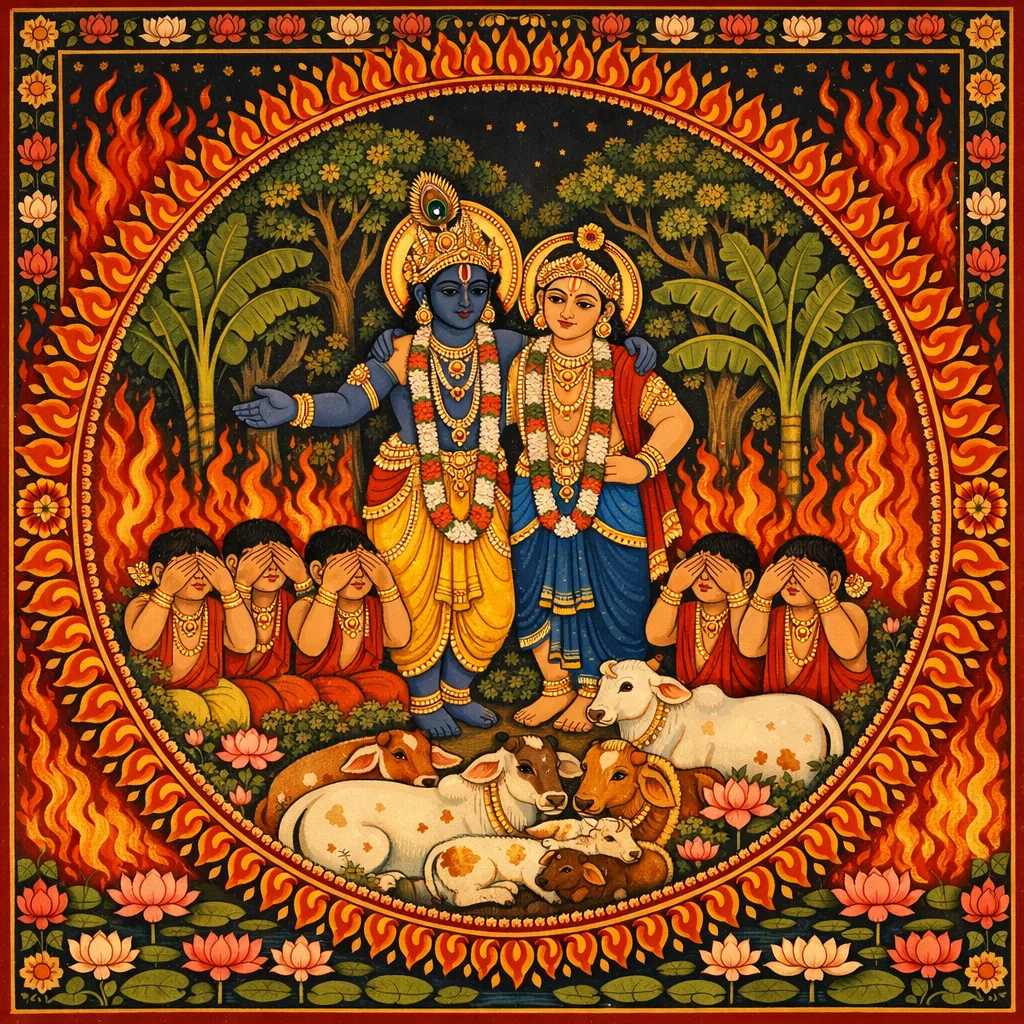
Continuing the Vraja pastoral flow, the cowherd boys become absorbed in play and inadvertently allow the herd to wander deep into the Muñjā forest. The animals, distressed by thirst and threatened by a rapidly spreading forest fire driven by wind, cry out—triggering the boys’ repentance and urgent search by tracking hoofprints and broken grass. When the boys finally gather the cows, the fire suddenly surrounds them, intensifying the existential mood of helplessness. The cowherds then enact śaraṇāgati: they run to Kṛṣṇa and Balarāma as their sole shelter, explicitly appealing to Kṛṣṇa’s duty to protect His own. Kṛṣṇa instructs them to close their eyes and fear nothing; by yogamāyā and supreme mystic power, He opens His mouth and swallows the conflagration. The boys awaken to safety near the Bhāṇḍīra tree, and some interpret Kṛṣṇa as a deva—setting up the ongoing tension between intimate friendship and dawning awareness of divinity. As evening approaches, Kṛṣṇa returns to the village playing His flute, and the gopīs’ longing frames the next emotional movement of Vraja devotion.
Shlokas
Verse 1
श्रीशुक उवाच क्रीडासक्तेषु गोपेषु तद्गावो दूरचारिणी: । स्वैरं चरन्त्यो विविशुस्तृणलोभेन गह्वरम् ॥ १ ॥
Śukadeva Gosvāmī said: While the cowherd boys were completely absorbed in playing, their cows wandered far away. They hungered for more grass, and with no one to watch them they entered a dense forest.
Verse 2
अजा गावो महिष्यश्च निर्विशन्त्यो वनाद् वनम् । ईषीकाटवीं निर्विविशु: क्रन्दन्त्यो दावतर्षिता: ॥ २ ॥
Passing from one part of the great forest to another, the goats, cows and buffalo eventually entered an area overgrown with sharp canes. The heat of a nearby forest fire made them thirsty, and they cried out in distress.
Verse 3
तेऽपश्यन्त: पशून् गोपा: कृष्णरामादयस्तदा । जातानुतापा न विदुर्विचिन्वन्तो गवां गतिम् ॥ ३ ॥
Not seeing the cows before them, Kṛṣṇa, Rāma and Their cowherd friends suddenly felt repentant for having neglected them. The boys searched all around, but could not discover where they had gone.
Verse 4
तृणैस्तत्खुरदच्छिन्नैर्गोष्पदैरङ्कितैर्गवाम् । मार्गमन्वगमन् सर्वे नष्टाजीव्या विचेतस: ॥ ४ ॥
Then the boys began tracing out the cows’ path by noting their hoofprints and the blades of grass the cows had broken with their hooves and teeth. All the cowherd boys were in great anxiety because they had lost their source of livelihood.
Verse 5
मुञ्जाटव्यां भ्रष्टमार्गं क्रन्दमानं स्वगोधनम् । सम्प्राप्य तृषिता: श्रान्तास्ततस्ते सन्न्यवर्तयन् ॥ ५ ॥
Within the Muñjā forest the cowherd boys finally found their valuable cows, who had lost their way and were crying. Then the boys, thirsty and tired, herded the cows onto the path back home.
Verse 6
ता आहूता भगवता मेघगम्भीरया गिरा । स्वनाम्नां निनदं श्रुत्वा प्रतिनेदु: प्रहर्षिता: ॥ ६ ॥
The Supreme Personality of Godhead called out to the animals in a voice that resounded like a rumbling cloud. Hearing the sound of their own names, the cows were overjoyed and called out to the Lord in reply.
Verse 7
तत: समन्ताद्देवधूमकेतु- र्यदृच्छयाभूत् क्षयकृद् वनौकसाम् । समीरित: सारथिनोल्बणोल्मुकै- र्विलेलिहान: स्थिरजङ्गमान् महान् ॥ ७ ॥
Suddenly a great forest fire appeared on all sides, threatening to destroy all the forest creatures. Like a chariot driver, the wind swept the fire onward, and terrible sparks shot in all directions. Indeed, the great fire extended its tongues of flame toward all moving and nonmoving creatures.
Verse 8
तमापतन्तं परितो दवाग्निं गोपाश्च गाव: प्रसमीक्ष्य भीता: । ऊचुश्च कृष्णं सबलं प्रपन्ना यथा हरिं मृत्युभयार्दिता जना: ॥ ८ ॥
As the cows and cowherd boys stared at the forest fire attacking them on all sides, they became fearful. The boys then approached Kṛṣṇa and Balarāma for shelter, just as those who are disturbed by fear of death approach the Supreme Personality of Godhead. The boys addressed Them as follows.
Verse 9
कृष्ण कृष्ण महावीर हे रामामोघविक्रम । दावाग्निना दह्यमानान् प्रपन्नांस्त्रातुमर्हथ: ॥ ९ ॥
[The cowherd boys said:] O Kṛṣṇa! Kṛṣṇa! Most powerful one! O Rāma! You whose prowess never fails! Please save Your devotees, who are about to be burned by this forest fire and have come to take shelter of You!
Verse 10
नूनं त्वद्बान्धवा: कृष्ण न चार्हन्त्यवसादितुम् । वयं हि सर्वधर्मज्ञ त्वन्नाथास्त्वत्परायणा: ॥ १० ॥
Kṛṣṇa! Certainly Your own friends shouldn’t be destroyed. O knower of the nature of all things, we have accepted You as our Lord, and we are souls surrendered unto You!
Verse 11
श्रीशुक उवाच वचो निशम्य कृपणं बन्धूनां भगवान् हरि: । निमीलयत मा भैष्ट लोचनानीत्यभाषत ॥ ११ ॥
Śukadeva Gosvāmī said: Hearing these pitiful words from His friends, the Supreme Lord Kṛṣṇa told them, “Just close your eyes and do not be afraid.”
Verse 12
तथेति मीलिताक्षेषु भगवानग्निमुल्बणम् । पीत्वा मुखेन तान्कृच्छ्राद् योगाधीशो व्यमोचयत् ॥ १२ ॥
“All right,” the boys replied, and immediately closed their eyes. Then the Supreme Lord, the master of all mystic power, opened His mouth and swallowed the terrible fire, saving His friends from danger.
Verse 13
ततश्च तेऽक्षीण्युन्मील्य पुनर्भाण्डीरमापिता: । निशम्य विस्मिता आसन्नात्मानं गाश्च मोचिता: ॥ १३ ॥
The cowherd boys opened their eyes and were amazed to find not only that they and the cows had been saved from the terrible fire but that they had all been brought back to the Bhāṇḍīra tree.
Verse 14
कृष्णस्य योगवीर्यं तद् योगमायानुभावितम् । दावाग्नेरात्मन: क्षेमं वीक्ष्य ते मेनिरेऽमरम् ॥ १४ ॥
When the cowherd boys saw that they had been saved from the forest fire by the Lord’s mystic power, which is manifested by His internal potency, they began to think that Kṛṣṇa must be a demigod.
Verse 15
गा: सन्निवर्त्य सायाह्ने सहरामो जनार्दन: । वेणुं विरणयन् गोष्ठमगाद् गोपैरभिष्टुत: ॥ १५ ॥
It was now late in the afternoon, and Lord Kṛṣṇa, accompanied by Balarāma, turned the cows back toward home. Playing His flute in a special way, Kṛṣṇa returned to the cowherd village in the company of His cowherd friends, who chanted His glories.
Verse 16
गोपीनां परमानन्द आसीद् गोविन्ददर्शने । क्षणं युगशतमिव यासां येन विनाभवत् ॥ १६ ॥
The young gopīs took the greatest pleasure in seeing Govinda come home, since for them even a moment without His association seemed like a hundred ages.
Frequently Asked Questions
In shāstric reading, the instruction protects the intimacy of Vraja-bhāva: the boys are spared an overwhelming vision of aiśvarya that could disrupt their friendly mood (sakhya-rasa). It also functions pedagogically—surrender precedes deliverance. By obeying without argument, they embody śaraṇāgati (trust in the protector), after which the Lord removes the danger by His internal potency.
The dāvāgni is both literal līlā and symbolic condition: uncontrolled material danger arising “on all sides,” intensified by wind (impelling forces of guṇa and karma). The episode teaches poṣaṇa—Bhagavān personally preserves those who take refuge. The boys’ prayer frames the normative Bhāgavata stance: existential fear is resolved not by self-reliance but by turning to the āśraya, Kṛṣṇa.
Bhāṇḍīra is associated with a sacred landmark in Vraja known as the Bhāṇḍīra-vṛkṣa, a central pastoral setting for Kṛṣṇa’s cowherding līlās. In this chapter, the return to the Bhāṇḍīra tree underscores Kṛṣṇa’s sovereign control over space and circumstance: after the crisis, He restores the devotees to a familiar refuge, reinforcing the theme that the Lord governs nature while preserving the normalcy of loving village life.
Their sakhya intimacy is periodically punctuated by glimpses of aiśvarya. Seeing an act beyond ordinary human capacity, they infer ‘devahood’ as the closest category available within their social imagination. Yet the Bhāgavata’s intent is deeper: Kṛṣṇa is not a deva among many but Svayaṁ Bhagavān, whose yogamāyā allows devotees to relate to Him in friendship even while He displays cosmic mastery when protection is required.