Adhyaya 70
Kṛṣṇa’s Daily Life in Dvārakā; the Captive Kings’ Appeal; Nārada Announces the Rājasūya
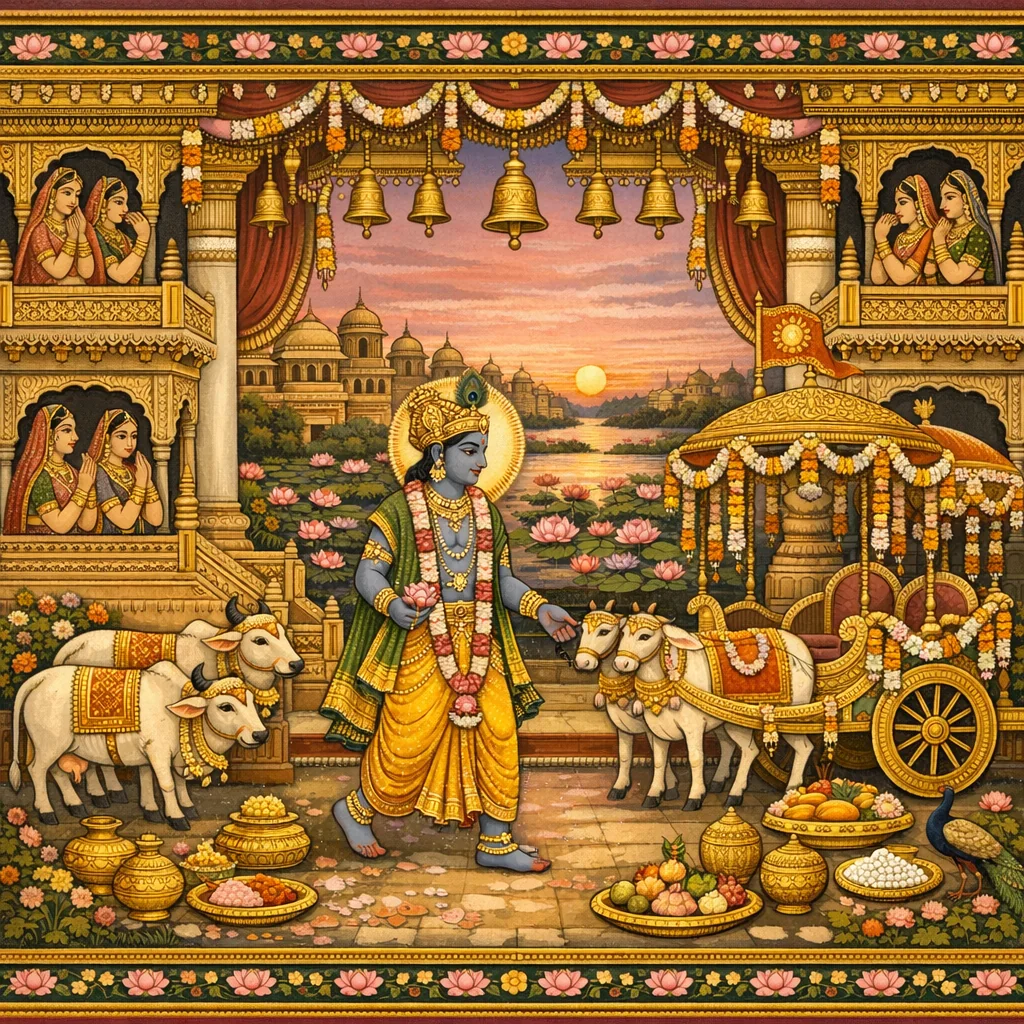
As dawn breaks in Dvārakā, the queens lament the rooster’s call that signals separation from Kṛṣṇa’s embrace. The chapter then portrays Kṛṣṇa’s brāhma-muhūrta discipline: purification, silent Gāyatrī-japa, worship of the sun, devas, sages, and pitṛs (as His own expansions), honoring elders and brāhmaṇas, and vast daily dāna—especially gifts of cows. Fully adorned, He enters public life, mounts His chariot with Sātyaki and Uddhava, and proceeds to the Sudharmā assembly hall, where music, dance, poets, and Vedic recitation glorify Him. A new messenger arrives, reporting that Jarāsandha has imprisoned 20,000 kings at Girivraja; the kings’ petition frames worldly kingship as dreamlike and seeks release from karmic bondage through surrender to Kṛṣṇa. Nārada then appears, praises the Lord’s inconceivable māyā, and discloses Yudhiṣṭhira’s intent to perform the Rājasūya sacrifice to honor Kṛṣṇa. As Yādavas urge action against Jarāsandha, Kṛṣṇa consults Uddhava, setting up the next chapter’s strategic counsel and the unfolding path toward Jarāsandha’s defeat and the Rājasūya’s completion.
Shlokas
Verse 1
श्रीशुक उवाच अथोषस्युपवृत्तायां कुक्कुटान् कूजतोऽशपन् । गृहीतकण्ठ्य: पतिभिर्माधव्यो विरहातुरा: ॥ १ ॥
Śukadeva Gosvāmī said: As dawn approached, the wives of Lord Mādhava, each embraced around the neck by her husband, cursed the crowing roosters. The ladies were disturbed that now they would be separated from Him.
Verse 2
वयांस्यरोरुवन्कृष्णं बोधयन्तीव वन्दिन: । गायत्स्वलिष्वनिद्राणि मन्दारवनवायुभि: ॥ २ ॥
The bees’ buzzing, caused by the fragrant breeze from the pārijāta garden, roused the birds from sleep. And when the birds began to sing loudly, they woke Lord Kṛṣṇa like court poets reciting His glories.
Verse 3
मुहूर्तं तं तु वैदर्भी नामृष्यदतिशोभनम् । परिरम्भणविश्लेषात् प्रियबाह्वन्तरं गता ॥ ३ ॥
Lying in her beloved’s arms, Queen Vaidarbhī did not like this most auspicious hour, for it meant she would lose His embrace.
Verse 4
ब्राह्मे मुहूर्त उत्थाय वार्युपस्पृश्य माधव: । दध्यौ प्रसन्नकरण आत्मानं तमस: परम् ॥ ४ ॥ एकं स्वयंज्योतिरनन्यमव्ययंस्वसंस्थया नित्यनिरस्तकल्मषम् । ब्रह्माख्यमस्योद्भवनाशहेतुभि:स्वशक्तिभिर्लक्षितभावनिर्वृतिम् ॥ ५ ॥
Lord Mādhava would rise during the brāhma-muhūrta period and touch water. With a clear mind He would then meditate upon Himself, the single, self-luminous, unequaled and infallible Supreme Truth, known as Brahman, who by His very nature ever dispels all contamination, and who through His personal energies, which cause the creation and destruction of this universe, manifests His own pure and blissful existence.
Verse 5
ब्राह्मे मुहूर्त उत्थाय वार्युपस्पृश्य माधव: । दध्यौ प्रसन्नकरण आत्मानं तमस: परम् ॥ ४ ॥ एकं स्वयंज्योतिरनन्यमव्ययंस्वसंस्थया नित्यनिरस्तकल्मषम् । ब्रह्माख्यमस्योद्भवनाशहेतुभि:स्वशक्तिभिर्लक्षितभावनिर्वृतिम् ॥ ५ ॥
Lord Mādhava would rise during the brāhma-muhūrta period and touch water. With a clear mind He would then meditate upon Himself, the single, self-luminous, unequaled and infallible Supreme Truth, known as Brahman, who by His very nature ever dispels all contamination, and who through His personal energies, which cause the creation and destruction of this universe, manifests His own pure and blissful existence.
Verse 6
अथाप्लुतोऽम्भस्यमले यथाविधि क्रियाकलापं परिधाय वाससी । चकार सन्ध्योपगमादि सत्तमो हुतानलो ब्रह्म जजाप वाग्यत: ॥ ६ ॥
That most saintly of personalities would then bathe in sanctified water, dress Himself in lower and upper garments and perform the entire sequence of prescribed rituals, beginning with worship at dawn. After offering oblations into the sacred fire, Lord Kṛṣṇa would silently chant the Gāyatrī mantra.
Verse 7
उपस्थायार्कमुद्यन्तं तर्पयित्वात्मन: कला: । देवानृषीन् पितॄन्वृद्धान्विप्रानभ्यर्च्य चात्मवान् ॥ ७ ॥ धेनूनां रुक्मशृङ्गीनां साध्वीनां मौक्तिकस्रजाम् । पयस्विनीनां गृष्टीनां सवत्सानां सुवाससाम् ॥ ८ ॥ ददौ रूप्यखुराग्राणां क्षौमाजिनतिलै: सह । अलङ्कृतेभ्यो विप्रेभ्यो बद्वं बद्वं दिने दिने ॥ ९ ॥
Each day the Lord worshiped the rising sun and propitiated the demigods, sages and forefathers, who are all His expansions. The self-possessed Lord would then carefully worship His elders and the brāhmaṇas. To those well-attired brāhmaṇas He would offer herds of tame and peaceful cows with gold-plated horns and pearl necklaces. These cows were also dressed in fine cloth, and the fronts of their hooves were plated with silver. Providers of abundant milk, they had each given birth only once and were accompanied by their calves. Daily the Lord gave many groups of 13,084 cows to the learned brāhmaṇas, together with linen, deerskins and sesame seeds.
Verse 8
उपस्थायार्कमुद्यन्तं तर्पयित्वात्मन: कला: । देवानृषीन् पितॄन्वृद्धान्विप्रानभ्यर्च्य चात्मवान् ॥ ७ ॥ धेनूनां रुक्मशृङ्गीनां साध्वीनां मौक्तिकस्रजाम् । पयस्विनीनां गृष्टीनां सवत्सानां सुवाससाम् ॥ ८ ॥ ददौ रूप्यखुराग्राणां क्षौमाजिनतिलै: सह । अलङ्कृतेभ्यो विप्रेभ्यो बद्वं बद्वं दिने दिने ॥ ९ ॥
Each day the Lord worshiped the rising sun and propitiated the demigods, sages and forefathers, who are all His expansions. The self-possessed Lord would then carefully worship His elders and the brāhmaṇas. To those well-attired brāhmaṇas He would offer herds of tame and peaceful cows with gold-plated horns and pearl necklaces. These cows were also dressed in fine cloth, and the fronts of their hooves were plated with silver. Providers of abundant milk, they had each given birth only once and were accompanied by their calves. Daily the Lord gave many groups of 13,084 cows to the learned brāhmaṇas, together with linen, deerskins and sesame seeds.
Verse 9
उपस्थायार्कमुद्यन्तं तर्पयित्वात्मन: कला: । देवानृषीन् पितॄन्वृद्धान्विप्रानभ्यर्च्य चात्मवान् ॥ ७ ॥ धेनूनां रुक्मशृङ्गीनां साध्वीनां मौक्तिकस्रजाम् । पयस्विनीनां गृष्टीनां सवत्सानां सुवाससाम् ॥ ८ ॥ ददौ रूप्यखुराग्राणां क्षौमाजिनतिलै: सह । अलङ्कृतेभ्यो विप्रेभ्यो बद्वं बद्वं दिने दिने ॥ ९ ॥
Each day the Lord worshiped the rising sun and propitiated the demigods, sages and forefathers, who are all His expansions. The self-possessed Lord would then carefully worship His elders and the brāhmaṇas. To those well-attired brāhmaṇas He would offer herds of tame and peaceful cows with gold-plated horns and pearl necklaces. These cows were also dressed in fine cloth, and the fronts of their hooves were plated with silver. Providers of abundant milk, they had each given birth only once and were accompanied by their calves. Daily the Lord gave many groups of 13,084 cows to the learned brāhmaṇas, together with linen, deerskins and sesame seeds.
Verse 10
गोविप्रदेवतावृद्धगुरून् भूतानि सर्वश: । नमस्कृत्यात्मसम्भूतीर्मङ्गलानि समस्पृशत् ॥ १० ॥
Lord Kṛṣṇa would offer obeisances to the cows, brāhmaṇas and demigods, His elders and spiritual masters, and all living beings — all of whom are expansions of His supreme personality. Then He would touch auspicious things.
Verse 11
आत्मानं भूषयामास नरलोकविभूषणम् । वासोभिर्भूषणै: स्वीयैर्दिव्यस्रगनुलेपनै: ॥ ११ ॥
He would decorate His body, the very ornament of human society, with His own special clothes and jewelry and with divine flower garlands and ointments.
Verse 12
अवेक्ष्याज्यं तथादर्शं गोवृषद्विजदेवता: । कामांश्च सर्ववर्णानां पौरान्त:पुरचारिणाम् । प्रदाप्य प्रकृती: कामै: प्रतोष्य प्रत्यनन्दत ॥ १२ ॥
He would then look at ghee, a mirror, the cows and bulls, the brāhmaṇas and the demigods and see to it that the members of all the social classes living in the palace and throughout the city were satisfied with gifts. After this He would greet His ministers, gratifying them by fulfilling all their desires.
Verse 13
संविभज्याग्रतो विप्रान् स्रक्ताम्बूलानुलेपनै: । सुहृद: प्रकृतीर्दारानुपायुङ्क्त तत: स्वयम् ॥ १३ ॥
After first distributing flower garlands, pān and sandalwood paste to the brāhmaṇas, He would give these gifts to His friends, ministers and wives, and finally He would partake of them Himself.
Verse 14
तावत् सूत उपानीय स्यन्दनं परमाद्भुतम् । सुग्रीवाद्यैर्हयैर्युक्तं प्रणम्यावस्थितोऽग्रत: ॥ १४ ॥
By then the Lord’s driver would have brought His supremely wonderful chariot, yoked with Sugrīva and His other horses. His charioteer would bow down to the Lord and then stand before Him.
Verse 15
गृहीत्वा पाणिना पाणी सारथेस्तमथारुहत् । सात्यक्युद्धवसंयुक्त: पूर्वाद्रिमिव भास्कर: ॥ १५ ॥
Holding on to His charioteer’s hands, Lord Kṛṣṇa would mount the chariot, together with Sātyaki and Uddhava, just like the sun rising over the easternmost mountain.
Verse 16
ईक्षितोऽन्त:पुरस्त्रीणां सव्रीडप्रेमवीक्षितै: । कृच्छ्राद् विसृष्टो निरगाज्जातहासो हरन् मन: ॥ १६ ॥
The palace women would look upon Lord Kṛṣṇa with shy, loving glances, and thus He would get free from them only with difficulty. He would then set off, His smiling face captivating their minds.
Verse 17
सुधर्माख्यां सभां सर्वैर्वृष्णिभि: परिवारित: । प्राविशद् यन्निविष्टानां न सन्त्यङ्ग षडूर्मय: ॥ १७ ॥
The Lord, attended by all the Vṛṣṇis, would enter the Sudharmā assembly hall, which protects those who enter it from the six waves of material life, dear King.
Verse 18
तत्रोपविष्ट: परमासने विभु- र्बभौ स्वभासा ककुभोऽवभासयन् । वृतो नृसिंहैर्यदुभिर्यदूत्तमो यथोडुराजो दिवि तारकागणै: ॥ १८ ॥
As the almighty Supreme Lord would seat Himself upon His exalted throne there in the assembly hall, He shone with His unique effulgence, illuminating all the quarters of space. Surrounded by the Yadus, lions among men, that best of the Yadus appeared like the moon amidst many stars.
Verse 19
तत्रोपमन्त्रिणो राजन् नानाहास्यरसैर्विभुम् । उपतस्थुर्नटाचार्या नर्तक्यस्ताण्डवै: पृथक् ॥ १९ ॥
And there, O King, jesters would entertain the Lord by displaying various comic moods, expert entertainers would perform for Him, and female dancers would dance energetically.
Verse 20
मृदङ्गवीणामुरजवेणुतालदरस्वनै: । ननृतुर्जगुस्तुष्टुवुश्च सूतमागधवन्दिन: ॥ २० ॥
These performers would dance and sing to the sounds of mṛdaṅgas, vīṇās, murajas, flutes, cymbals and conchshells, while professional poets, chroniclers and panegyrists would recite the Lord’s glories.
Verse 21
तत्राहुर्ब्राह्मणा: केचिदासीना ब्रह्मवादिन: । पूर्वेषां पुण्ययशसां राज्ञां चाकथयन् कथा: ॥ २१ ॥
Some brāhmaṇas sitting in that assembly hall would fluently chant Vedic mantras, while others recounted stories of past kings of pious renown.
Verse 22
तत्रैक: पुरुषो राजन्नागतोऽपूर्वदर्शन: । विज्ञापितो भगवते प्रतीहारै: प्रवेशित: ॥ २२ ॥
Once a certain person arrived in the assembly, O King, who had never been seen there before. The doorkeepers announced him to the Lord and then escorted him inside.
Verse 23
स नमस्कृत्य कृष्णाय परेशाय कृताञ्जलि: । राज्ञामावेदयद् दु:खं जरासन्धनिरोधजम् ॥ २३ ॥
That person bowed down to Kṛṣṇa, the Supreme Personality of Godhead, and with joined palms he described to the Lord how a number of kings were suffering because Jarāsandha had imprisoned them.
Verse 24
ये च दिग्विजये तस्य सन्नतिं न ययुर्नृपा: । प्रसह्य रुद्धास्तेनासन्नयुते द्वे गिरिव्रजे ॥ २४ ॥
Twenty thousand kings who had refused to submit absolutely to Jarāsandha during his world conquest had been forcibly imprisoned by him in the fortress named Girivraja.
Verse 25
राजान ऊचु: कृष्ण कृष्णाप्रमेयात्मन् प्रपन्नभयभञ्जन । वयं त्वां शरणं यामो भवभीता: पृथग्धिय: ॥ २५ ॥
The kings said [as related through their messenger]: O Kṛṣṇa, Kṛṣṇa, O immeasurable Soul, destroyer of fear for those surrendered to You! Despite our separatist attitude, we have come to You for shelter out of fear of material existence.
Verse 26
लोको विकर्मनिरत: कुशले प्रमत्त: कर्मण्ययं त्वदुदिते भवदर्चने स्वे । यस्तावदस्य बलवानिह जीविताशां सद्यश्छिनत्त्यनिमिषाय नमोऽस्तु तस्मै ॥ २६ ॥
People in this world are always engaged in sinful activities and are thus bewildered about their real duty, which is to worship You according to Your commandments. This activity would truly bring them good fortune. Let us offer our obeisances unto the all-powerful Lord, who appears as time and suddenly cuts down one’s stubborn hope for a long life in this world.
Verse 27
लोके भवाञ्जगदिन: कलयावतीर्ण: सद्रक्षणाय खलनिग्रहणाय चान्य: । कश्चित् त्वदीयमतियाति निदेशमीश किं वा जन: स्वकृतमृच्छति तन्न विद्म: ॥ २७ ॥
You are the predominating Lord of the universe and have descended into this world with Your personal power to protect the saintly and suppress the wicked. We cannot understand, O Lord, how anyone can transgress Your law and still continue to enjoy the fruits of his work.
Verse 28
स्वप्नायितं नृपसुखं परतन्त्रमीश शश्वद्भयेन मृतकेन धुरं वहाम: । हित्वा तदात्मनि सुखं त्वदनीहलभ्यं क्लिश्यामहेऽतिकृपणास्तव माययेह ॥ २८ ॥
O Lord, with this corpselike body, always full of fear, we bear the burden of the relative happiness of kings, which is just like a dream. Thus we have rejected the real happiness of the soul, which comes by rendering selfless service to You. Being so very wretched, we simply suffer in this life under the spell of Your illusory energy.
Verse 29
तन्नो भवान् प्रणतशोकहराङ्घ्रियुग्मो बद्धान् वियुङ्क्ष्व मगधाह्वयकर्मपाशात् । यो भूभुजोऽयुतमतङ्गजवीर्यमेको बिभ्रद् रुरोध भवने मृगराडिवावी: ॥ २९ ॥
Therefore, since Your feet relieve the sorrow of those who surrender to them, please release us prisoners from the shackles of karma, manifest as the King of Magadha. Wielding alone the prowess of ten thousand maddened elephants, he has locked us up in his house just as a lion captures sheep.
Verse 30
यो वै त्वया द्विनवकृत्व उदात्तचक्र भग्नो मृधे खलु भवन्तमनन्तवीर्यम् । जित्वा नृलोकनिरतं सकृदूढदर्पो युष्मत्प्रजा रुजति नोऽजित तद् विधेहि ॥ ३० ॥
O wielder of the disc! Your strength is unlimited, and thus seventeen times You crushed Jarāsandha in battle. But then, absorbed in human affairs, You allowed him to defeat You once. Now he is so filled with pride that he dares to torment us, Your subjects. O unconquerable one, please rectify this situation.
Verse 31
दूत उवाच इति मागधसंरुद्धा भवद्दर्शनकाङ्क्षिण: । प्रपन्ना: पादमूलं ते दीनानां शं विधीयताम् ॥ ३१ ॥
The messenger continued: This is the message of the kings imprisoned by Jarāsandha, who all hanker for Your audience, having surrendered to Your feet. Please bestow good fortune on these poor souls.
Verse 32
श्रीशुक उवाच राजदूते ब्रुवत्येवं देवर्षि: परमद्युति: । बिभ्रत्पिङ्गजटाभारं प्रादुरासीद् यथा रवि: ॥ ३२ ॥
Śukadeva Gosvāmī said: When the kings’ messenger had thus spoken, the sage of the demigods, Nārada, suddenly appeared. Bearing a mass of golden matted locks on his head, the supremely effulgent sage entered like the brilliant sun.
Verse 33
तं दृष्ट्वा भगवान् कृष्ण: सर्वलोकेश्वरेश्वर: । ववन्द उत्थित: शीर्ष्णा ससभ्य: सानुगो मुदा ॥ ३३ ॥
Lord Kṛṣṇa is the worshipable master of even planetary rulers like Lord Brahmā and Lord Śiva, yet as soon as He saw that Nārada Muni had arrived, He joyfully stood up along with His ministers and secretaries to receive the great sage and offer His respectful obeisances by bowing His head.
Verse 34
सभाजयित्वा विधिवत् कृतासनपरिग्रहम् । बभाषे सुनृतैर्वाक्यै: श्रद्धया तर्पयन् मुनिम् ॥ ३४ ॥
After Nārada had accepted the seat offered to him, Lord Kṛṣṇa honored the sage according to scriptural injunctions and, gratifying him with His reverence, spoke the following truthful and pleasing words.
Verse 35
अपि स्विदद्य लोकानां त्रयाणामकुतोभयम् । ननु भूयान् भगवतो लोकान् पर्यटतो गुण: ॥ ३५ ॥
[Lord Kṛṣṇa said:] It is certain that today the three worlds have attained freedom from all fear, for that is the influence of such a great personality as you, who travel at will throughout all the worlds.
Verse 36
न हि तेऽविदितं किञ्चिल्लोकेष्वीश्वरकर्तृषु । अथ पृच्छामहे युष्मान्पाण्डवानां चिकीर्षितम् ॥ ३६ ॥
There is nothing unknown to you within God’s creation. Therefore please tell Us what the Pāṇḍavas intend to do.
Verse 37
श्रीनारद उवाच दृष्टा मया ते बहुशो दुरत्यया माया विभो विश्वसृजश्च मायिन: । भूतेषु भूमंश्चरत: स्वशक्तिभि- र्वह्नेरिवच्छन्नरुचो न मेऽद्भुतम् ॥ ३७ ॥
Śrī Nārada said: I have seen many times the insurmountable power of Your Māyā, O almighty one, by which You bewilder even the creator of the universe, Brahmā. O all-encompassing Lord, it does not surprise me that You disguise Yourself by Your own energies while moving among the created beings, as a fire covers its own light with smoke.
Verse 38
तवेहितं कोऽर्हति साधु वेदितुं स्वमाययेदं सृजतो नियच्छत: । यद् विद्यमानात्मतयावभासते तस्मै नमस्ते स्वविलक्षणात्मने ॥ ३८ ॥
Who can properly understand Your purpose? With Your material energy You expand and also withdraw this creation, which thus appears to have substantial existence. Obeisances to You, whose transcendental position is inconceivable.
Verse 39
जीवस्य य: संसरतो विमोक्षणं न जानतोऽनर्थवहाच्छरीरत: । लीलावतारै: स्वयश:प्रदीपकं प्राज्वालयत्त्वा तमहं प्रपद्ये ॥ ३९ ॥
The living being caught in the cycle of birth and death does not know how he can be delivered from the material body, which brings him so much trouble. But You, the Supreme Lord, descend to this world in various personal forms, and by performing Your pastimes You illumine the soul’s path with the blazing torch of Your fame. Therefore I surrender unto You.
Verse 40
अथाप्याश्रावये ब्रह्म नरलोकविडम्बनम् । राज्ञ: पैतृष्वस्रेयस्य भक्तस्य च चिकीर्षितम् ॥ ४० ॥
Nonetheless, O Supreme Truth playing the part of a human being, I shall tell You what Your devotee Yudhiṣṭhira Mahārāja, the son of Your father’s sister, intends to do.
Verse 41
यक्ष्यति त्वां मखेन्द्रेण राजसूयेन पाण्डव: । पारमेष्ठ्यकामो नृपतिस्तद् भवाननुमोदताम् ॥ ४१ ॥
Desiring unrivaled sovereignty, King Yudhiṣṭhira intends to worship You with the greatest fire sacrifice, the Rājasūya. Please bless his endeavor.
Verse 42
तस्मिन् देव क्रतुवरे भवन्तं वै सुरादय: । दिदृक्षव: समेष्यन्ति राजानश्च यशस्विन: ॥ ४२ ॥
O Lord, exalted demigods and glorious kings, eager to see You, will all come to that best of sacrifices.
Verse 43
श्रवणत्कीर्तनाद् ध्यानात्पूयन्तेऽन्तेवसायिन: । तव ब्रह्ममयस्येश किमुतेक्षाभिमर्शिन: ॥ ४३ ॥
O Lord, even outcastes are purified by hearing and chanting Your glories and meditating upon You, the Absolute Truth. What then to speak of those who see and touch You?
Verse 44
यस्यामलं दिवि यश: प्रथितं रसायां भूमौ च ते भुवनमङ्गल दिग्वितानम् । मन्दाकिनीति दिवि भोगवतीति चाधो गङ्गेति चेह चरणाम्बु पुनाति विश्वम् ॥ ४४ ॥
My dear Lord, You are the symbol of everything auspicious. Your transcendental name and fame is spread like a canopy all over the universe, including the higher, middle and lower planetary systems. The transcendental water that washes Your lotus feet is known in the higher planetary systems as the Mandākinī River, in the lower planetary systems as the Bhogavatī and in this earthly planetary system as the Ganges. This sacred, transcendental water flows throughout the entire universe, purifying wherever it goes.
Verse 45
श्रीशुक उवाच तत्र तेष्वात्मपक्षेष्वगृणत्सु विजिगीषया । वाच: पेशै: स्मयन् भृत्यमुद्धवं प्राह केशव: ॥ ४५ ॥
Śukadeva Gosvāmī said: When His supporters, the Yādavas, objected to this proposal out of eagerness to defeat Jarāsandha, Lord Keśava turned to His servant Uddhava and, smiling, addressed him with fine words.
Verse 46
श्रीभगवानुवाच त्वं हि न: परमं चक्षु: सुहृन्मन्त्रार्थतत्त्ववित् । अथात्र ब्रूह्यनुष्ठेयं श्रद्दध्म: करवाम तत् ॥ ४६ ॥
The Personality of Godhead said: You are indeed Our best eye and closest friend, for you know perfectly the relative value of various kinds of counsel. Therefore please tell Us what should be done in this situation. We trust your judgment and shall do as you say.
Verse 47
इत्युपामन्त्रितो भर्त्रा सर्वज्ञेनापि मुग्धवत् । निदेशं शिरसाधाय उद्धव: प्रत्यभाषत ॥ ४७ ॥
[Śukadeva Gosvāmī continued:] Thus requested by his master, who, though omniscient, acted as if perplexed, Uddhava took this order upon his head and replied as follows.
Frequently Asked Questions
The rooster’s crow marks the end of nocturnal intimacy and the start of royal and Vedic duties, so the queens’ lament highlights vipralambha (love in separation). Devotion here is not abstract: it is embodied in relational bhakti where time itself becomes an antagonist. The text thereby contrasts Kṛṣṇa’s private sweetness (mādhurya) with His public responsibility, intensifying the devotee’s longing and underscoring the Lord’s accessibility within household life.
Bhāgavata theology holds Kṛṣṇa as the āśraya (ultimate ground) of Brahman and Paramātmā. His ‘self-meditation’ is not a conditioned practice to attain realization; it is a līlā that teaches ideal sādhana and affirms His self-luminous, nondependent nature. The passage also instructs that true purification and freedom from contamination arise from centering consciousness on the Supreme Truth, not merely from external rite.
They are rulers captured by Jarāsandha for refusing total submission during his conquests and are confined at Girivraja. Their plea is framed as śaraṇāgati: they acknowledge the futility of royal ‘happiness’ and interpret their captivity as a manifestation of karmic bondage. By appealing to Kṛṣṇa as the destroyer of fear, they model how suffering can become a turning point from ahaṅkāra (separatist pride) to bhakti and liberation.
Kṛṣṇa’s inquiry is a deliberate humanlike posture (nara-līlā) that honors His devotee’s role and demonstrates proper consultative governance. It also sets the narrative mechanism for revealing the Rājasūya plan and for eliciting Uddhava’s counsel. In Bhāgavata pedagogy, omniscience does not prevent dialog; rather, dialog becomes the medium through which dharma, strategy, and devotion are taught.
The Rājasūya is an imperial consecration that establishes unrivaled sovereignty, but in the Bhāgavata it is reoriented: Yudhiṣṭhira’s aim is to worship Kṛṣṇa as the true enjoyer and center of all yajña. Thus political unification becomes a theological act—publicly recognizing Bhagavān as the supreme ruler—while also requiring the removal of adharmic obstacles like Jarāsandha.