Adhyaya 90
Chapter 90
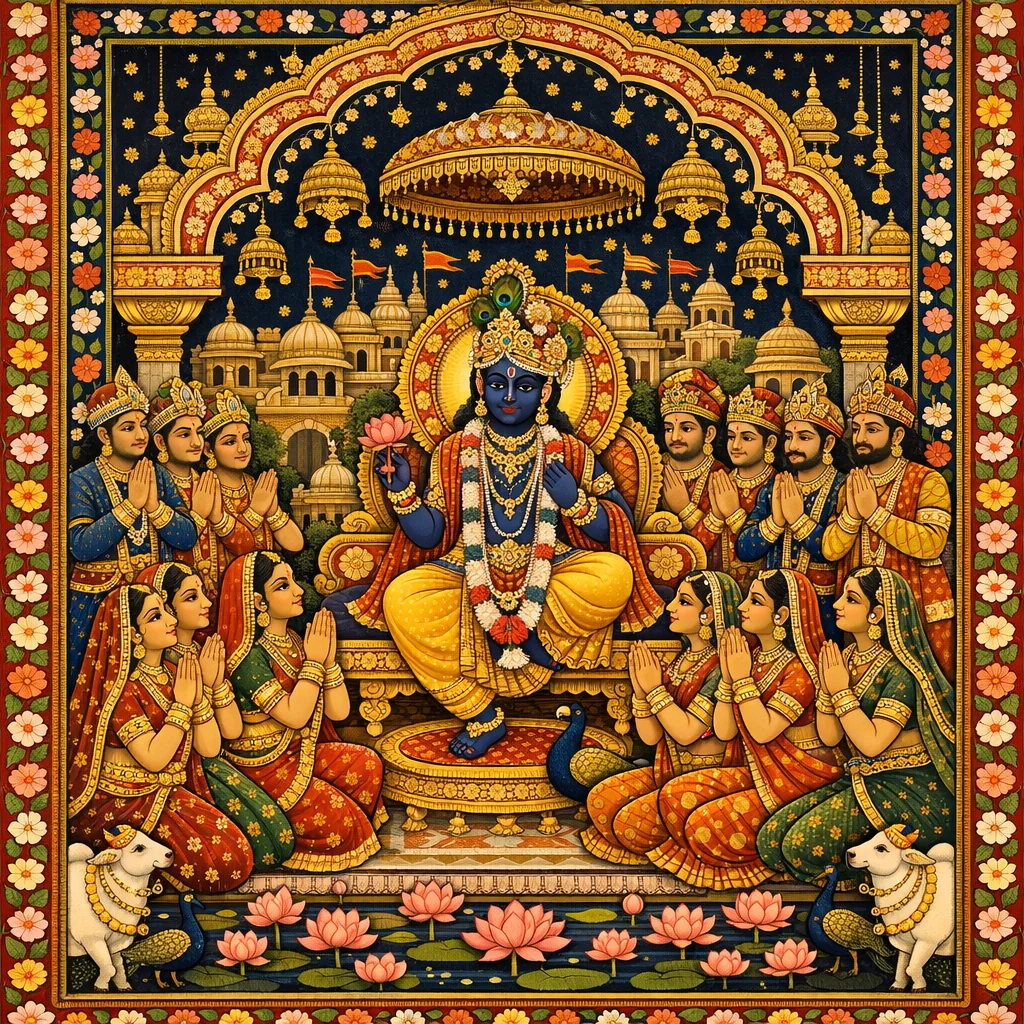
Summary of Krishna's Glories
Shlokas
Verse 1
श्री-शुक उवाच सुखं स्व-पुर्यां निवसन् द्वारकायां श्रियः पतिः । सर्व-सम्पत्-समृद्धायां जुष्टायां वृष्णि-पुङ्गवैः ॥
Śrī Śuka said: The Lord of fortune, residing happily in His own city of Dvārakā—abounding in every opulence and graced by the foremost heroes of the Vṛṣṇi dynasty—lived there in perfect ease.
Verse 2
स्त्रीभिश्चोत्तम-वेषाभिर्नव-यौवन-कान्तिभिः । कन्दुकादिभिर्हर्म्येषु क्रीडन्तीभिस्तडिद्-द्युभिः ॥
There (in Dvārakā) were noble ladies in exquisite attire, radiant with the charm of fresh youth, playing in the palace chambers with balls and other games, their splendor flashing like lightning.
Verse 3
नित्यं सङ्कुलमार्गायां मदच्युद्भिर्मतङ्गजैः । स्वलङ्कृतैर्भटैरश्वैरथैश्च कनकोज्ज्वलैः ॥
Every day the roads of Dvārakā were crowded—filled with rut-fluid-dripping elephants, and with finely adorned soldiers, horses, and chariots shining with gold.
Verse 4
उद्यानोपवनाढ्यायां पुष्पितद्रुमराजिषु । निर्विशद्भृङ्गविहगैर्नादितायां समन्ततः ॥
The city abounded in gardens and pleasure groves, lined with rows of flowering trees, and everywhere it resounded with the humming of bees and the calls of birds moving about.
Verse 5
रेमे षोडश-साहस्र-पत्नीनां एक-वल्लभः । तावद् विचित्र-रूपो 'सौ तद्-गेहेषु महर्द्धिषु ॥
The Lord, the sole beloved of His sixteen thousand queens, enjoyed with each of them. By His wondrous expansions, He was simultaneously present within their opulent palaces.
Verse 6
प्रोत्फुल्लोत्पल-कह्लार-कुमुदाम्भोज-रेणुभिः । वासितामल-तोयेषु कूजद्-द्विज-कुलेषु च ॥
There were lakes whose clear waters were perfumed by the pollen of fully blossomed lotuses, kahlāras, kumudas, and ambhojas, and where flocks of birds resounded with their calls.
Verse 7
विजहार विगाह्याम्भो ह्रदिनीषु महोदयः । कुच-कुङ्कुम-लिप्ताङ्गः परिरब्धश्च योषिताम् ॥
The supremely fortunate Lord sported by plunging into the waters of the lakes and rivers. Embraced by the women, His limbs became smeared with the vermilion from their breasts.
Verse 8
उपगीयमानो गन्धर्वैर्मृदङ्ग-पणवानकान् । वादयद्भिर्मुदा वीणां सूत-मागध-वन्दिभिः ॥
As the Gandharvas sang His glories, and as the Sūtas, Māgadhas, and other bards joyfully played vīṇās, mṛdaṅgas, paṇavas, and other instruments, the Lord was thus celebrated.
Verse 9
सिच्यमानोऽच्युतस्ताभिर्हसन्तीभिः स्म रेचकैः । प्रतिषिञ्चन् विचिक्रीडे यक्षीभिर्यक्षराड् इव ॥
As the queens laughingly sprinkled Him with streams of water from their syringes, Acyuta (Lord Kṛṣṇa) sprinkled them back and sported with them, just like the king of the Yakṣas playing with Yakṣiṇīs.
Verse 10
ताः क्लिन्न-वस्त्र-विवृतोरु-कुच-प्रदेशाः सिञ्चन्त्य उद्धृत-बृहत्-कवर-प्रसूनाः । कान्तं स्म रेचक-जिहीर्षययोपगुह्य जात-स्मरोत्स्मय-लसद्-वदना विरेजुः ॥
Their garments soaked, revealing their broad hips and the region of their breasts, the queens—flowers slipping from their loosened, heavy braids—sprinkled their beloved. Then, trying to snatch away His water-syringe, they embraced Him, and with awakened amorous joy their smiling faces shone brilliantly.
Verse 11
कृष्णस् तु तत्-स्तन-विशज्जित-कुङ्कुम-स्रक् । क्रीडाभिषङ्ग-धुत-कुन्तल-वृन्द-बन्धः ॥ सिञ्चन् मुहुर् युवतिभिः प्रतिषिच्यमानो रेमे करेणुभिर् इवेभ-पतिः परीतः ॥
Śrī Kṛṣṇa—garlanded with the kuṅkuma that had clung to the breasts of the young women, and with the braid and cluster of His hair loosened by the intensity of play—kept sprinkling them again and again, while they also splashed Him in return. Thus, surrounded by those youthful ladies, He sported joyfully, like the lord of elephants encircled by his she-elephants.
Verse 12
नटानां नर्तकीनां च गीत-वाद्योपजीविनाम् । क्रीडालङ्कार-वासांसि कृष्णो 'दात् तस्य च स्त्रियः ॥
Śrī Kṛṣṇa gave garments, ornaments, and other enjoyable gifts to the actors and dancing girls and to those who earned their livelihood by singing and playing musical instruments; and He also gave gifts to their womenfolk.
Verse 13
कृष्णस्यैवं विहरतो गत्यालापेक्षितस्मितैः । नर्मक्ष्वेलिपरिष्वङ्गैः स्त्रीणां किल हृता धियः ॥
As Lord Kṛṣṇa thus sported (among them), by His graceful movements, His sweet conversation, His sidelong glances, and His smiling, and by His joking, playful pastimes, and affectionate embraces, the minds of the women were indeed completely stolen away.
Verse 14
ऊचुर्मुकुन्दैकधियो गिर उन्मत्तवज्जडम् । चिन्तयन्त्योऽरविन्दाक्षं तानि मे गदतः शृणु ॥
Their minds fixed solely on Mukunda, they spoke words as if mad or bewildered, constantly thinking of the lotus-eyed Lord. Now hear those words from me as I recount them.
Verse 15
महिष्य ऊचुः कुररि विलपसि त्वं वीत-निद्रा न शेषे स्वपिति जगति रात्र्याम् ईश्वरो गुप्त-बोधः । कुररि विलपसि त्वं वीत-निद्रा न शेषे स्वपिति जगति रात्र्याम् ईश्वरो गुप्त-बोधः । वयमिव सखि कच्चिद् गाढ-निर्विद्ध-चेता नलिन-नयन-हासोदार-लीलेक्षितेन ॥
The queens said: O kurarī bird, why do you lament, sleepless and unable to rest, while the world sleeps at night and the Supreme Lord lies with His awareness concealed? O friend, are you—like us—pierced deep within the heart by His playful, generous glances, joined with lotus-eyed smiles?
Verse 16
नेत्रे निमीलयसि नक्तम् अदृष्ट-बन्धुस् त्वं रोरवीषि करुणं बत चक्रवाकि । नेत्रे निमीलयसि नक्तम् अदृष्ट-बन्धुस् त्वं रोरवीषि करुणं बत चक्रवाकि । दास्यं गत वयमिवाच्युत-पाद-जुष्टां किं वा स्रजं स्पृहयसि कवरेण वोढुम् ॥
O cakravākī bird, at night you close your eyes, bereft of the sight of your beloved, and you cry out so piteously. Have you, like us—who have come under the service of Acyuta’s feet—become eager to carry upon your braid a garland that has adorned the infallible Lord?
Verse 17
भो भोः सदा निष्टनसे उदन्वन्न् अलब्ध-निद्रो ’धिगत-प्रजागरः । किं वा मुकुन्दापहृतात्म-लाञ्छनः प्राप्तां दशां त्वं च गतो दुरत्ययाम् ॥
O Ocean, O Ocean! Why do you always roar, sleepless and ever wakeful? Or is it that Mukunda has stolen away your very insignia of self—so that you have fallen into an unbearable condition?
Verse 18
त्वं यक्ष्मणा बलवतासि गृहीत इन्दो क्षीणस् तमो न निज-दीधितिभिः क्षिणोषि । कच्चिन् मुकुन्द-गदितानि यथा वयं त्वं विस्मृत्य भोः स्थगित-गीर् उपलक्ष्यसे नः ॥
O Moon! Have you been seized by some powerful wasting disease, so that you are diminished and no longer dispel the darkness by your own rays? Or is it that, having forgotten Mukunda’s words—just as we have—you now stand before us with choked speech?
Verse 19
किं न्वाचरितमस्माभिर्मलयानिल तेऽप्रियम् । गोविन्दापाङ्गनिर्भिन्ने हृदीरयसि नः स्मरम् ॥
O Malaya breeze, what have we done that displeases you? Pierced by Govinda’s sidelong glance, you now stir up within our hearts the pangs of love.
Verse 20
मेघ श्रीमंस्त्वमसि दयितो यादवेन्द्रस्य नूनं श्रीवत्साङ्कं वयमिव भवान् ध्यायति प्रेमबद्धः । अत्युत्कण्ठः शवलहृदयोऽस्मद्विधो बाष्पधाराः स्मृत्वा स्मृत्वा विसृजसि मुहुर्दुःखदस्तत्प्रसङ्गः ॥
O glorious cloud, surely you are dear to the king of the Yadus. Like us, bound by love, you meditate upon Him—upon the Śrīvatsa-marked Lord. Overcome with intense longing, your heart dark and heavy like ours, you repeatedly pour down streams of tears, for such remembrance brings painful separation.
Verse 21
प्रिय-राव-पदानि भाषसे मृत-सञ्जीविकयानयाऽनया गिरा । करवाणि किमद्य ते प्रियं वद मे वल्गित-कण्ठ कोकिल ॥
You speak words that sound so dear—indeed, with this voice you revive the dead. Tell me, O kokila with the playfully warbling throat: what may I do today that will please you?
Verse 22
न चलसि न वदस्युदार-बुद्धे क्षिति-धर चिन्तयसि महान्तम् अर्थम् । अपि बत वसुदेव-नन्दनाङ्घ्रिं वयमिव कामयसि स्तनैर्विधर्तुम् ॥
You do not move, and You do not speak, O noble-minded one—O lifter of the earth—surely You are pondering some great purpose. Or perhaps, alas, You desire to hold the feet of Vasudeva’s son upon Your breasts, as we do.
Verse 23
शुष्यद्-ध्रदाः करशिता बत सिन्धु-पत्न्यः सम्प्रत्य अपास्त-कमल-श्रिय इष्ट-भर्तुः । यद्वद् वयं मधु-पतेः प्रणयावलोकम् अप्राप्य मुष्ट-हृदयाः पुरु-कर्शिताः स्म ॥
Alas, the wives of the ocean—its lakes and rivers—are drying up, their waters reduced to mere handfuls, now that the lotus-like splendor of their beloved lord has been withdrawn. In the same way, we too have become hard-hearted and severely afflicted, for we have not obtained the loving glance of Madhu’s Lord (Śrī Kṛṣṇa).
Verse 24
हंस स्वागतम् आस्यतां पिब पयो ब्रूहि अङ्ग शौरेः कथां दूतं त्वां नु विदाम कच्चिद् अजितः स्वस्त्य् आस्त उक्तं पुरा । हंस स्वागतम् आस्यतां पिब पयो ब्रूहि अङ्ग शौरेः कथां दूतं त्वां नु विदाम कच्चिद् अजितः स्वस्त्य् आस्त उक्तं पुरा । किं वा नश् चल-सौहृदः स्मरति तं कस्माद् भजामो वयं क्षौद्रालापय काम-दं श्रियम् ऋते सैवैक-निष्ठा स्त्रियाम् ॥
O swan, welcome! Please sit here, drink some milk, and tell us, dear one, some news of Śauri (Kṛṣṇa). We recognize you as His messenger—has the unconquerable Lord remained well, as was foretold? But why would He, whose friendship is ever-shifting, even remember us? And why should we continue to worship Him? O sweet-tongued one, speak! Apart from Him—who alone grants all desires and all fortune—there is for a woman no other single-pointed shelter.
Verse 25
श्री-शुक उवाच इतीदृशेन भावेन कृष्णे योगेश्वरेश्वरे । क्रियमाणेन माधव्यो लेभिरे परमां गतिम् ॥
Śrī Śuka said: With such a mood of devotion, directed toward Kṛṣṇa—the supreme master of all mystic power—the queens of Mādhava attained the highest destination.
Verse 26
श्रुत-मात्रोऽपि यः स्त्रीणां प्रसह्याकर्षते मनः । उरु-गायोरु-गीतो वा पश्यन्तीनां च किं पुनः ॥
Even merely heard, He forcibly draws the minds of women—He who is greatly glorified and sung of by exalted singers. What then to speak of those who actually see Him?
Verse 27
याः सम्पर्यचरन् प्रेम्णा पाद-संवाहनादिभिः । जगद्गुरुं भर्तृ-बुद्ध्या तासां किं वर्ण्यते तपः ॥
With loving devotion they served Him in every way—massaging His feet and performing other intimate services. Though He is the spiritual master of the entire universe, they regarded Him as their husband. What austerity and spiritual merit of theirs could possibly be described?
Verse 28
एवं वेदोदितं धर्मम् अनुतिष्ठन् सतां गतिः । गृहं धर्मार्थ-कामानां मुहुः चादर्शयत् पदम् ॥
Thus, faithfully practicing the dharma taught in the Vedas, the Lord—who is the ultimate destination of the saintly—repeatedly demonstrated that household life can be a proper foundation for dharma, prosperity, and regulated enjoyment.
Verse 29
आस्थितस्य परं धर्मं कृष्णस्य गृह-मेधिनाम् । आसन् षोडश-साहस्रं महिष्यश् च शताधिकम् ॥
Śrī Kṛṣṇa, while fully upholding the highest dharma for householders, had sixteen thousand queens, and additionally more than a hundred (principal) wives.
Verse 30
तासां स्त्री-रत्न-भूतानाम् अष्टौ याः प्राग् उदाहृताः । रुक्मिणी-प्रमुखा राजंस् तत्-पुत्राश् चानुपूर्वशः ॥
O King, among those queens—who were like jewels among women—the eight previously mentioned, headed by Rukmiṇī, and their sons are now being described in due order.
Verse 31
एकैकस्यां दश दश कृष्णो 'जीजनद् आत्मजान् । यावत्या आत्मनो भार्या अमोघ-गतिर् ईश्वरः ॥
With each one of His queens, Lord Kṛṣṇa—whose will never fails—begot ten sons, as many queens as the Supreme Lord had taken as His wives.
Verse 32
तेषाम् उद्दाम-वीर्याणाम् अष्टा-दश महा-रथाः । आसन्न् उदार-यशसस् तेषां नामानि मे शृणु ॥
Of those sons—possessed of unbounded valor—eighteen became mahā-rathas, mighty chariot-warriors of exalted fame. Now hear their names from me.
Verse 33
प्रद्युम्नश् चानिरुद्धश् च दीप्तिमान् भानुर् एव च । साम्बो मधुर् बृहद्भानुश् चित्रभानुर् वृकोऽरुणः ॥
Pradyumna and Aniruddha; Dīptimān and Bhānu; Sāmba and Madhū; Bṛhadbhānu and Citrabhānu; and also Vṛka and Aruṇa—these were among the sons (being named).
Verse 34
पुष्करो वेदबाहुश् च श्रुतदेवः सुनन्दनः । चित्रबाहुर् विरूपश् च कविर् न्यग्रोध एव च ॥
Puṣkara and Vedabāhu; Śrutadeva and Sunandana; Citrabāhu and Virūpa; and also Kavi and Nyagrodha—these too were among the sons (being named).
Verse 35
एतेषाम् अपि राजेन्द्र तनु-जानां मधु-द्विषः । प्रद्युम्न आसीत् प्रथमः पितृ-वद् रुक्मिणी-सुतः ॥
O King, among all these sons of Madhudviṣa (Lord Kṛṣṇa), the first was Pradyumna—Rukmiṇī’s son—who was just like his father in qualities.
Verse 36
स रुक्मिणो दुहितरम् उपयेमे महा-रथः । तस्यां ततो 'निरुद्धो 'भूत् नागायत-बलान्वितः ॥
That great warrior (Pradyumna) married the daughter of Rukmī, and from her Aniruddha was born—endowed with strength like that of an elephant.
Verse 37
स चापि रुक्मिणः पौत्रीं दौहित्रो जगृहे ततः । वज्रस् तस्याभवद् यस् तु मौषलाद् अवशेषितः ॥
Thereafter, the grandson (of Lord Kṛṣṇa) also married the granddaughter of Rukmī. From her was born Vajra—he who alone remained after the devastation caused by the club-weapon (the Mauṣala catastrophe).
Verse 38
प्रतिबाहुर् अभूत् तस्मात् सुबाहुस् तस्य चात्मजः । सुबाहोः शान्तसेनो 'भूच् छतसेनस् तु तत्सुतः ॥
From him was born Pratibāhu, and Pratibāhu’s son was Subāhu. From Subāhu came Śāntasena, and Śāntasena’s son was Śatasena.
Verse 39
न ह्येतस्मिन्कुले जाता अधना अबहुप्रजाः । अल्पायुषोऽल्पवीर्याश्च अब्रह्मण्याश्च जज्ञिरे ॥
Indeed, in this dynasty no one was ever born who was poor, who lacked many descendants, who lived only a short life, who possessed little strength, or who was irreverent toward brāhmaṇas and sacred tradition.
Verse 40
यदुवंशप्रसूतानां पुंसां विख्यातकर्मणाम् । सङ्ख्या न शक्यते कर्तुमपि वर्षायुतैर्नृप ॥
O King, the number of celebrated men born in the Yadu dynasty cannot be counted—even over tens of thousands of years.
Verse 41
तिस्रः कोट्यः सहस्राणाम् अष्टाशीति-शतानि च । आसन् यदु-कुलाचार्याः कुमाराणाम् इति श्रुतम् ॥
It is heard that there were three crores, eighty-eight hundred, and thousands of princes—who served as teachers and exemplars of conduct for the Yadu dynasty.
Verse 42
सङ्ख्यानं यादवानां कः करिष्यति महात्मनाम् । यत्रायुतानाम् अयुत-लक्षेणास्ते स आहुकः ॥
Who could possibly count those great-souled Yādavas—among whom even Āhuka alone was present with a multitude numbering in tens of thousands upon tens of thousands?
Verse 43
देवासुराहव-हता दैतेया ये सु-दारुणाः । ते चोत्पन्ना मनुष्येषु प्रजा दृप्ता बबाधिरे ॥
Those extremely fierce Daityas who had been slain in the battle between the gods and demons took birth again among human beings, and, becoming arrogant, they began to torment the people.
Verse 44
तन्-निग्रहाय हरिणा प्रोक्ता देवा यदोः कुले । अवतीर्णाः कुल-शतं तेषामेकाधिकं नृप ॥
To subdue them, the gods—summoned by Lord Hari—descended into the dynasty of Yadu. O King, they appeared there in one hundred clans, and one more besides.
Verse 45
तेषां प्रमाणं भगवान् प्रभुत्वेनाभवद्धरिः । ये चानुवर्तिनस्तस्य ववृधुः सर्वयादवाः ॥
For them, the Supreme Lord Hari Himself became the ultimate authority by the power of His lordship; and all the Yādavas who followed His lead flourished greatly.
Verse 46
शय्यासनाटनालाप- क्रीडास्नानादि-कर्मसु । न विदुः सन्तमात्मानं वृष्णयः कृष्ण-चेतसः ॥
In activities such as lying down, sitting, walking about, conversing, playing, bathing, and the like, the Vṛṣṇis—whose minds were absorbed in Kṛṣṇa—did not perceive their own selves as separate from Him.
Verse 47
तीर्थं चक्रे नृपोनं यदजनि यदुषु स्वः-सरित् पाद-शौचं । विद्विट्-स्निग्धाः स्वरूपं ययुरजित-पर श्रीर् यदर्थे ’न्य-यत्नः ॥ यन्-नामामङ्गल-घ्नं श्रुतमथ गदितं यत्कृतो गोत्र-धर्मः । कृष्णस्यैतन्न चित्रं क्षिति-भर-हरणं काल-चक्रायुधस्य ॥
The Lord made even a place that was lacking in royal sanctity into a holy pilgrimage site, for there, among the Yadus, the celestial river took the role of washing His feet. Enemies and affectionate friends alike attained their true spiritual identity; and even Lakṣmī, devoted to the unconquerable Lord, strives for Him with efforts unlike any other. His very name destroys inauspiciousness when heard or spoken, and by His presence the codes of family and social duty become established. None of this is astonishing for Śrī Kṛṣṇa—the wielder of the wheel of time—who removes the burden of the earth.
Verse 48
जयति जन-निवासो देवकी-जन्म-वादो । यदु-वर-परिषत् स्वैर् दोर्भिरस्यन्नधर्मम् ॥ जयति जन-निवासो देवकी-जन्म-वादो । यदु-वर-परिषत् स्वैर् दोर्भिरस्यन्नधर्मम् ॥ स्थिर-चर-वृजिन-घ्नः सु-स्मित-श्री-मुखेन । व्रज-पुर-वनितानां वर्धयन् काम-देवम् ॥
All victory to the shelter of all beings—He whose birth was celebrated as the son of Devakī—who, in the assembly of the best of the Yadus, freely cast down irreligion with His mighty arms. All victory to that shelter of all beings, famed as Devakī’s son. With His radiant face adorned by a gentle smile, He destroys the suffering of the moving and the unmoving, and He increases the love-god’s ecstasy within the women of Vraja-town.
Verse 49
इत्त्थं परस्य निज-वर्त्म-रिरक्षयात्त-लीला-तनोस् तदनुरूप-विडम्बनानि । कर्माणि कर्म-कषणानि यदूत्तमस्य श्रूयाद् अमुष्य पदयोर् अनुवृत्तिम् इच्छन् ॥
Thus, the Supreme Lord—having assumed a pastime-form to protect His own divine path—enacted deeds that, though resembling ordinary human behavior, destroy the reactions of karma. One who desires to follow in the footsteps of that best of the Yadus should hear about His activities at His lotus feet.
Verse 50
मर्त्यस् तयानुसवम् एधितया मुकुन्द- श्रीमद्-कथा-श्रवण-कीर्तन-चिन्तयैति । तद् धाम दुस्तर-कृतान्त-जवापवर्गं ग्रामाद् वनं क्षिति-भुजोऽपि ययुर् यदर्थाः ॥
A mortal who, day after day, increasingly engages in hearing, chanting, and remembering the glorious narrations of Mukunda comes to His abode—where the swift force of inexorable death is overcome. For that very purpose, even kings (rulers of the earth) have left their towns and gone to the forest.